
Diagrammatic Reasoning and AI

John F Sowa
From a Science Egg to a Science of Diagrams
John F. Sowa
Draft of 26 August 2023
1. Developments from 1903 to 1913
2. The Role of Diagrams in Phaneroscopy
3. Relating Images to Diagrams
4. Significs
5. Language Games
6. Diagrams As the Language of Thought
Peirce’s existential graphs are remarkable. They establish the feasibility of a diagrammatic system of reasoning equivalent to the first-order predicate calculus. They anticipate the theory of mental models in many respects, including their iconic and symbolic components, their eschewal of variables, and their fundamental operations of insertion and deletion. Much is known about the psychology of reasoning... But we still lack a comprehensive account of how individuals represent multiply-quantified assertions, and so the graphs may provide a guide to the future development of psychological theories.
The distinctive feature of brains such as the one we own is their uncanny ability to create maps... But when brains make maps, they are also creating images, the main currency of our minds. Ultimately consciousness allows us to experience maps as images, to manipulate those images, and to apply reasoning to them.
7. Diagrammatic Reasoning
All necessary reasoning without exception is diagrammatic. That is, we construct an icon of our hypothetical state of things and proceed to observe it. This observation leads us to suspect that something is true, which we may or may not be able to formulate with precision, and we proceed to inquire whether it is true or not. For this purpose it is necessary to form a plan of investigation, and this is the most difficult part of the whole operation. We not only have to select the features of the diagram which it will be pertinent to pay attention to, but it is also of great importance to return again and again to certain features. (EP 2:212)

doug foxvog
> Doug F, et al.,
> I'm writing an article about Peirce's phaneroscopy and diagrammatic
> reasoning, which has strong implications for ontology, reasoning methods,
> and their implications for the latest issues in generative artificial
> intelligence. See below for excerpts from that article and some links for
> further information.
the statement. It doesn't address if blind people think in diagrams. It
merely gives examples of people who CONVERT some of their thoughts into
diagrams. That's very different.
Even if most everybody often thinks in diagrams, that doesn't mean it is
the sole method of thinking. If i am listening to a bird or insect making
noises outside my window, my attempt to recognize the type of animal is
not diagramatic. If i am smelling a flower blindfolded, my attempt to
recognize the type of bloom is not diagramatic. If i am petting my cat
while reading and detect a bur in her fur, that is not diagramatic. If i
taste something i am cooking to determine whether to add more (and which)
herb or spice, i am not engaged in diagramatic thinking.
Of course, many things (including thought processes) can be diagrammed,
but that doesn't mean all thoughts are diagramatic. Merely stating so
doesn't make it true.
-- doug foxvog
>
> PS: I just did a cut & paste below, but the diagrams did not get copied.
> I'll include a PDF later. But the text explains the issues, and the
> citations have more explanations and diagrams.
> ___________________________________
> Draft of 26 August 2023Abstract. In the last decade of his life, Peirce
> pragmaticism. To publish the proof, he wrote a series of articles for the
> Monist. The first two began with phaneroscopy. But in 1906, he added a
> version of tinctured existential graphs to the third article, An Apology
> for Pragmaticism. In 1908, he began a fourth article, which he never
> finished. One reason he stopped may be his remark in 1909:
> “Phaneroscopy, still in the condition of a science-egg, hardly any
> details of it being as yet distinguishable.” Other reasons involve
> issues about the graphs, which he resolved in 1911. Although Peirce did
> not complete the proof, his writings inspired aspects of Lady Welby’s
> significs, Wittgenstein’s language games, and patterns of diagrams in
> every branch of science and engineering. Today, Peirce’s theories of
> phaneroscopy and diagrammatic reasoning clarify critical issues in
> cognitive science. Among them are the methods of reasoning in
> linguistics, neuroscience and artificial intelligence.
> Minute Logic was rejected. But three events in 1903 led him to rethink
> every aspect of his life’s work: his Harvard lectures in the spring,
> his Lowell lectures in the fall, and his correspondence with Victoria
> Welby. As a guide to the new developments, the tree in Figure 1 shows his
> classification of the sciences and dependencies among them. Branches show
> the classification, and dotted lines show the dependencies. Sciences to
> the right of each dotted line depend on sciences to the left. Pure
> mathematics stands alone, and all other sciences and engineering depend on
> mathematics (CP 1.180ff, 1903).
> . . . [deleted]
> In summary, phaneroscopy depends on mathematics, which includes
> existential graphs as a formal logic. But as a diagrammatic logic, EGs
> can be used in two ways. For phaneroscopy, the option of changing shape
> is important. Nodes of a graph may be moved to match the shape of the
> image they represent. For logic, however, changing the shape does not
> change the meaning. Since the same notation can serve both purposes, EGs
> support Peirce’s prediction that phaneroscopy “surely will in the
> future become a strong and beneficient science” (R645, 1909).
> ordinary existential graphs cannot represent them. In the letter L231, in
> which Peirce specified his most general notation for EGs, he mentioned his
> hopes of representingn“stereoscopic moving images.” To accommodate
> them, Sowa (2016, 2018) proposed generalized existential graphs (GEGs).
> Figure 5 shows Euclid’s Proposition 1 stated in three kinds of GEGs:
> “On a given finite straight line, to draw an equilateral triangle.”
> . . . [deleted].
> For details, see Sowa (2018) Reasoning with diagrams and images, Journal
> of Applied Logics 5:5, 987-1059.
> http://www.collegepublications.co.uk/downloads/ifcolog00025.pdf
> critic said that Wittgenstein began as a logician and ended as a
> lexicographer. Ironically, that remark, which was intended in a
> derogatory sense, is true in a higher sense: they both discovered the
> flexibility and expressive power of natural languages. For Peirce, the
> transition was marked by the 16,000 definitions he wrote or edited for the
> Century Dictionary. For Wittgenstein, it was his second published book,
> Wörterbuch für Kindern, which he wrote when he was teaching elementary
> school in Austrian mountain villages. He learned that children do not
> think or speak along the lines of his first book, the Tractatus
> Logico-Philosophicus (TLP).
> . . . [deleted]
> of the 20th century, are now at the forefront of research in the 21st. The
> psychologist Johnson-Laird (2002), who had written extensively about
> mental models, said that Peirce’s existential graphs and rules of
> inference are a good candidate for a neural theory of reasoning:
> Peirce’s existential graphs are remarkable. They establish the
> feasibility of a diagrammatic system of reasoning equivalent to the
> first-order predicate calculus. They anticipate the theory of mental
> models in many respects, including their iconic and symbolic components,
> their eschewal of variables, and their fundamental operations of insertion
> and deletion. Much is known about the psychology of reasoning... But we
> still lack a comprehensive account of how individuals represent
> multiply-quantified assertions, and so the graphs may provide a guide to
> interacting processes. Frege’s rejection of psychologism and “mental
> pictures” reinforced the behaviorism of the early 20th century. But the
> latest work in neuroscience uses “folk psychology” and introspection
> to interpret data from brain scans (Dehaene 2014). The neuroscientist
> Antonio Damasio (2010) summarized the issues:
> The distinctive feature of brains such as the one we own is their uncanny
> ability to create maps... But when brains make maps, they are also
> creating images, the main currency of our minds. Ultimately consciousness
> allows us to experience maps as images, to manipulate those images, and to
> They provide a “model theoretic” semantics for language that uses
> perception and action for testing models against reality. Like Tarski’s
> models, they define the criteria for truth, but they are flexible,
> dynamic, and situated in the daily drama of life.
> 7. Diagrammatic Reasoning
> engineers who draw what they think. Ancient peoples saw diagrams in the
> sky, and ancient monuments are based on those celestial diagrams. They
> correspond to the mathematical “patterns of plausible inference”
> identified by Pólya (1954). The role of diagrammatic reasoning is one of
> Peirce’s most brilliant insights, and the generalized EGs in his late
> writings include much more than an alternative to predicate calculus.
> All necessary reasoning without exception is diagrammatic. That is, we
> construct an icon of our hypothetical state of things and proceed to
> observe it. This observation leads us to suspect that something is true,
> which we may or may not be able to formulate with precision, and we
> proceed to inquire whether it is true or not. For this purpose it is
> necessary to form a plan of investigation, and this is the most difficult
> part of the whole operation. We not only have to select the features of
> the diagram which it will be pertinent to pay attention to, but it is also
> of great importance to return again and again to certain features. (EP

Ravi Sharma
- I have referenced my conversations with Norwood Hanson, Yale Prof of Philosophy in the 1960's on the topic of "Picture Theory of Theory Meaning". I reached there in 1966 after he passed away as a pilot in a crash.
- I also predict and see a trend that the next generations will progressively move to ward knowledge acquired by use of media (AV). There is going to be much less scope of learning through formal text languages in this AI influenced world!
- From first hand thinking about understanding Particle and Nuclear theory and often Quantum FIeld Theory, yes based on Math related comments, using all knowledge of math to support, we end up making "mind" models of Physical Universe, frequently supplemented by others knowledge and astrophysics and LHC type visuals.
- As we are able to understand fMRI, PET and other mental learning processes and relate them to learning, we will see that inherent in development of human life from infancy is a synergy of sound (usually) and Visuals in life experiences, this will become more clear as we have better tools.
- I look forward to learning the scholarly track of how western philosophers have developed new subjects such as phaneroscopy etc, but I like " All necessary reasoning without exception is diagrammatic"
--
All contributions to this forum are covered by an open-source license.
For information about the wiki, the license, and how to subscribe or
unsubscribe to the forum, see http://ontologforum.org/info/
---
You received this message because you are subscribed to the Google Groups "ontolog-forum" group.
To unsubscribe from this group and stop receiving emails from it, send an email to ontolog-foru...@googlegroups.com.
To view this discussion on the web visit https://groups.google.com/d/msgid/ontolog-forum/c10785e0de6a44f549164c2090bb92e6.squirrel%40emailmg.ipage.com.

Alex Shkotin
Thinking the process is complete we get the structure for the natural numbers.
It can probably be drawn if it helps in its study.
To view this discussion on the web visit https://groups.google.com/d/msgid/ontolog-forum/CAAN3-5eJcDm5UWmK%2BobzpXTMz%2BszQwkpVjDQH-Q2jMdUhSt6iw%40mail.gmail.com.
John F Sowa
the sole method of thinking. If i am listening to a bird or insect making
noises outside my window, my attempt to recognize the type of animal is
not diagramatic. If i am smelling a flower blindfolded, my attempt to
recognize the type of bloom is not diagramatic. If i am petting my cat
while reading and detect a bur in her fur, that is not diagramatic.
herb or spice, i am not engaged in diagrammatic thinking.
Alex Shkotin
John,
Diagrams are used wherever they can be used to explain and sometimes even imagine what the structure is, up to the structure of the process. This is because a human being really has a very developed thinking in visual images.
For example, diagrams, especially commutative ones, are widely used in category theory, but it absolutely does not follow from this that the category itself is a diagram. A diagram and a structure are not the same thing. We can always draw a diagram. The structure, especially if it is infinite, or very large, is impossible to draw. A crystal has a structure, and various diagrams can be drawn to explain its structure. Let's take any fractal, is it also a diagram?
The diagram is a powerful tool. And there are many different types and varieties. Suffice it to recall UML, ER etc.
For me, the science of diagrams would begin with a careful enumeration of their types (there are hundreds if not thousands) and an indication of what is not. For example, an engineering drawing of some detail or mechanism. Is this a diagram?
Such a science (some prefer the term "theory") would be quite extensive.
In your main text, the word "structures" occurs once: "...diagrams, such as EGs, are mathematical structures…" p.1. Here I absolutely agree with you.
Alex
--
All contributions to this forum are covered by an open-source license.
For information about the wiki, the license, and how to subscribe or
unsubscribe to the forum, see http://ontologforum.org/info/
---
You received this message because you are subscribed to the Google Groups "ontolog-forum" group.
To unsubscribe from this group and stop receiving emails from it, send an email to ontolog-foru...@googlegroups.com.
To view this discussion on the web visit https://groups.google.com/d/msgid/ontolog-forum/6a4efb8d80bc4412aad05b957d9c772c%40bestweb.net.
Alex Shkotin
To show the omnipresence of diagrams and to compare the approach of diagrams and formulas, we can consider the presentation of an English sentence with which R. Montague worked. It is considered in [1] among others.
eng: John tries to find a unicorn and wishes to eat it.
mth: (John ((try-s ((to find) (a unicorn))) and ((wishe-s ((to eat) it)))))
And here are several types of diagrams representing the same thing:
expression tree
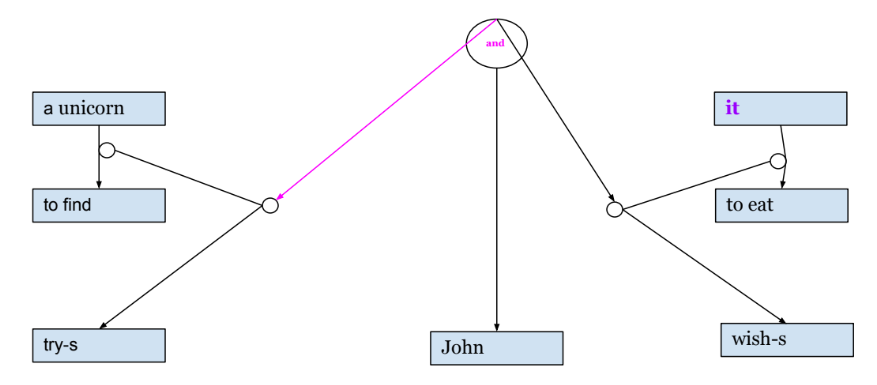
arrow-arrow tree

nested rectangles

variation. unary operand(!) is a label

Alex
[1] https://www.researchgate.net/publication/366216531_English_is_a_HOL_language_message_1X
John F Sowa

Nadin, Mihai
Hadamard was NOT an active member of the Bourbaki group. Jean Dieudonné, one of the founders, specifically excluded Hadamard from the group. Of course, not important for the argument John Sowa makes.
MN
--
All contributions to this forum are covered by an open-source license.
For information about the wiki, the license, and how to subscribe or
unsubscribe to the forum, see http://ontologforum.org/info/
---
You received this message because you are subscribed to the Google Groups "ontolog-forum" group.
To unsubscribe from this group and stop receiving emails from it, send an email to
ontolog-foru...@googlegroups.com.
To view this discussion on the web visit https://groups.google.com/d/msgid/ontolog-forum/b8b4f15989c049f7a79db4de77fdfae9%40bestweb.net.
John F Sowa
John F Sowa
Alex Shkotin
I look forward to reading your article, as the presentation is more or less sketchy. Diagrams are a wonderful tool, but thinking in concepts is what science and technology, and thinking in general, relies on.
--
All contributions to this forum are covered by an open-source license.
For information about the wiki, the license, and how to subscribe or
unsubscribe to the forum, see http://ontologforum.org/info/
---
You received this message because you are subscribed to the Google Groups "ontolog-forum" group.
To unsubscribe from this group and stop receiving emails from it, send an email to ontolog-foru...@googlegroups.com.
To view this discussion on the web visit https://groups.google.com/d/msgid/ontolog-forum/09fcca0c31cf493ab3bdf7ac2121bf82%40bestweb.net.
John F Sowa
I look forward to reading your article, as the presentation is more or less sketchy. Diagrams are a wonderful tool, but thinking in concepts is what science and technology, and thinking in general, relies on.
Subject: [ontolog-forum] Re: On the concept of consciousness
Alex Shkotin
John,
It is nice to hear from you that "Every node in a diagram represents a concept." And precisely: a node (and let me add a labeled node) represents a concept, but the concept is not a diagram.
The question raises: is diagram a finite structure?
And about your "every structure can be represented by a diagram".
This raises the point that structuring (determination of structures) is the deal number one. As reasoning and theories are about structures.
What kind of structures do we have and what kind of determinations is good for entities to exist?
Do we have infinite structures?
For example, as I mentioned before.
Let's build a digraph like this: create a node, keep it as the current one. ad infinitum: from the current node create the arrow and create a node at the end of it, keep this new node as the current one.
The Nat1 structure will be obtained if the process is considered terminated.
We have a ground structure for natural numbers. Does this structure exist?
What is a diagram for this structure?
What kind of math structures do we have to model objects and processes of reality? This is the question.
As Gelfand told in his lecture in Japan: we do not have math for biology yet.
Or let me say this way: they try to use a whole power of math, beginning at least from Newton's Principia, to model reality.
Alex
--
All contributions to this forum are covered by an open-source license.
For information about the wiki, the license, and how to subscribe or
unsubscribe to the forum, see http://ontologforum.org/info/
---
You received this message because you are subscribed to the Google Groups "ontolog-forum" group.
To unsubscribe from this group and stop receiving emails from it, send an email to ontolog-foru...@googlegroups.com.
To view this discussion on the web visit https://groups.google.com/d/msgid/ontolog-forum/71fa3b9b430f4df2b9af7f968abfae20%40bestweb.net.
John F Sowa
John,
Alex Shkotin
John,
You have moved into the realm of philosophy and other worlds. I won't go there.
For me, diagrams are a wonderful tool, which if somebody can use it, then the researcher is very lucky.
My immediate task is to identify theoretical knowledge about reality and see how it can be formalized. It is expected that formalization leads to more precise definitions of terms and the general structure of the theory. If some theoretical knowledge contains diagrams of one kind or another, they will also have to be formalized. Fortunately, you have already formalized your diagrams yourself.
The main advantage of formalization is that then a lot of work with domain knowledge can be entrusted to algorithms.
I'm going to explore how the T-box and A-box of some ontology on OWL2 from OBO Foundry is divided into theoretical and factual knowledge. And what structure is hidden behind the factual knowledge.
Alex
--
All contributions to this forum are covered by an open-source license.
For information about the wiki, the license, and how to subscribe or
unsubscribe to the forum, see http://ontologforum.org/info/
---
You received this message because you are subscribed to the Google Groups "ontolog-forum" group.
To unsubscribe from this group and stop receiving emails from it, send an email to ontolog-foru...@googlegroups.com.
To view this discussion on the web visit https://groups.google.com/d/msgid/ontolog-forum/d25df3dae3004644944b0729cbada386%40bestweb.net.
John F Sowa
John,
You have moved into the realm of philosophy and other worlds. I won't go there....
Alex
Alex Shkotin
John,
A few more thoughts.
It is very interesting to compare your approach with this [1] project of Jon Awbrey as you have the same root: Pierce's EG.
By the way, even such a formalist as N. Bourbaki, in order to avoid variables bound by a quantifiers, turned a formative construction into a graph. In this graph, occurrences of quantifier variables are replaced by the sign □, and are directly connected to their quantifier by an edge. This saved N. Bourbaki from writing an algorithm for binding a quantifier variable to its own quantifier.
Alex
[1] https://inquiryintoinquiry.com/2023/08/24/logical-graphs-first-impressions/
To view this discussion on the web visit https://groups.google.com/d/msgid/ontolog-forum/408bf68782344035b948c96bbc86d607%40bestweb.net.
John F Sowa
John,
Alex Shkotin
--
All contributions to this forum are covered by an open-source license.
For information about the wiki, the license, and how to subscribe or
unsubscribe to the forum, see http://ontologforum.org/info/
---
You received this message because you are subscribed to the Google Groups "ontolog-forum" group.
To unsubscribe from this group and stop receiving emails from it, send an email to ontolog-foru...@googlegroups.com.
To view this discussion on the web visit https://groups.google.com/d/msgid/ontolog-forum/71f18d2953b542398ac0865350879bd0%40bestweb.net.