
Get data from MQTT broker usining inject node

Greg EVA
I am working on getting to know Node-RED and trying to build a little energy management application and am having trouble wrapping my head around how this whole event driven flow approach works.
What I want to do is set some periodic cron type triggers (hourly, daily, monthly) which will start a flow, allow me to grab some data from an MQTT broker, and then store that somewhere.
Currently I am using the MQTT input node to subscribe to topic updates, but I can't figure out how to do a point in time read.
Help please!
Cheers,
Greg

ryan...@gmail.com
Greg EVA
Hi Ryan,
Thanks for your advice. The rate limiting delay is not something I was aware of.
The frequency is however not the issue.
I am trying to have the flows input trigger be periodic using the inject node with a from scheduled expression, say every hour. Then I want to be able to grab the data from an MQTT topic at that moment.... Not when it eventually updates.
The use case would be the same for an HTTP get.... However I gather the implementations are different due to the pub/sub approach of MQTT.
Cheers,
Greg
--
http://nodered.org
---
You received this message because you are subscribed to a topic in the Google Groups "Node-RED" group.
To unsubscribe from this topic, visit https://groups.google.com/d/topic/node-red/SZd1M3nU3gM/unsubscribe.
To unsubscribe from this group and all its topics, send an email to node-red+u...@googlegroups.com.
For more options, visit https://groups.google.com/d/optout.

Mark Setrem
This would then be updated everytime a new value was broadcast over MQTT.
Then in a separate flow you can use a timed trigger linked to a function node to pick up the value from context.global.whatever
Take a look at http://nodered.org/docs/writing-functions.html to find out details of the context.global

Julian Knight
This is an area I'd like to see some improvements on since this would seem to be a common requirement - setting/getting a global var. Seems a shame we have to resort to a function node just to do that.
Developing with Node-Red (and Node.JS in general) often requires some lateral thinking! One of the reasons it is fun.

Nicholas O'Leary
Julian, you know we have the item to make context more widely used by nodes. It has come up a number of times, you've commented on the issue itself. We will get there.
Greg, the only way a 'point in time' read would work with MQTT is if you are publishing every message with the retained flag set. The broker stores the most recent message with the retained flag set for each topic. Our MQTT nodes do not enable this sort of dynamic connect & subscribe pattern. Mark's suggested approach is the way to do it with the nodes we have.
Nick
--
http://nodered.org
---
You received this message because you are subscribed to the Google Groups "Node-RED" group.
To unsubscribe from this group and stop receiving emails from it, send an email to node-red+u...@googlegroups.com.
Greg EVA
@Nick: I am using the retained flag with persistent storage at the broker. My thinking is that upon Node-RED startup, it would fire a flow which could say load the electric meter ID into a global context variable; which I could then use everywhere else, knowing that the flow would be retriggered and the topic updated should someone say, replace my electric meter. OK... perhaps not the best example... ;-P Energy consumption tarification period indexes are a better example as they may or may not change, but I would like to know what they are at particular times.
Thanks for the help!
Cheers,
Greg
Julian Knight
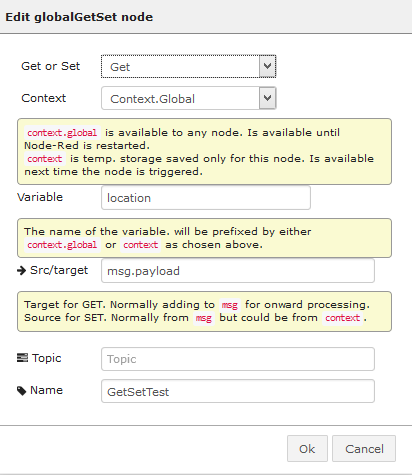
RED.settings.functionGlobalContextThe node UI looks like this (dratted Google Groups web sticks it in the wrong place - might appear at the top of this post!):
Greg EVA
Nicholas O'Leary
Julian, by all means play, but please consider listening to what we already have planned and collaborate with us rather than go your own way.
This node will be completely redundant very soon and in fact will be unhelpful as it will not factor in the changes to context we have planned.
Nick
Nice!!! I think this will be a good addition to the node library as this seems to help cross-flow data sharing.
--
Julian Knight
Happy to contribute this or other nodes or just some code to core if anyone thinks any of it worth while. Corporate IT is my thing so programming is "play" for me :) I'm just keen for NR to get some simpler ways of working for people without JavaScript skills.

Dave C-J
Greg EVA
As Nick has said we are looking at how best to expose some of this context more widely - but we also want to be a bit careful... the whole point of a wiring type tool is to show what is connected to what - and what can affect what - and just allowing things to talk globally (ie not through wires drawn on the canvas) may make things more confusing rather than less. Hence why currently only functions support it - so the user is explicitly acting to use it.
Nicholas O'Leary
Hi,
If I understand your suggestion correctly, you would have some nodes pulling values across wires rather than the normal push? We don't want to confuse the model by doing that.
The use of a shared context solves this problem in a very straight forward way. Once the Change and Switch nodes are able to access Context, which is the plan, it all becomes much easier to achieve without writing code in function blocks.
Nick
As Nick has said we are looking at how best to expose some of this context more widely - but we also want to be a bit careful... the whole point of a wiring type tool is to show what is connected to what - and what can affect what - and just allowing things to talk globally (ie not through wires drawn on the canvas) may make things more confusing rather than less. Hence why currently only functions support it - so the user is explicitly acting to use it.This is just an idea for you guys to ponder... but what if there was a node.... in my brain I called it a micro-node as it may appear smaller in the workspace.... which would get an input and set a global context type value. Then you'd take the output; once or many times, and wire it to a connection on the top (left) of another node (like function node), and then you'd use a node local context to reference that value.... and the flow execution would "pull" the current value from the "global micro-node". You could then wire certain values up to many nodes, see their connections, wire/unwire, etc. It would essentially be like passing variables to a function.
--
Greg EVA
--
http://nodered.org
---
You received this message because you are subscribed to a topic in the Google Groups "Node-RED" group.
To unsubscribe from this topic, visit https://groups.google.com/d/topic/node-red/SZd1M3nU3gM/unsubscribe.
To unsubscribe from this group and all its topics, send an email to node-red+u...@googlegroups.com.
Greg EVA
What if the change node had "flying leads" that came up from the top and down from the bottom of the node. They could be short, and say end in an arrow... indicating that the wire goes somewhere. Hovering over it could show the value it is refering to. You would then quickly be able to look at a change node and see that it grabs a global context variable, and sets three of them. The leads would obviously be obviously be drawn based on how the change node was configured inside.