
Some Thoughts on Joe Austin's Chroma Tonnetz Notation/System
264 views
Skip to first unread message

O.E. Soriano
Nov 4, 2014, 11:10:44 PM11/4/14
to musicn...@googlegroups.com
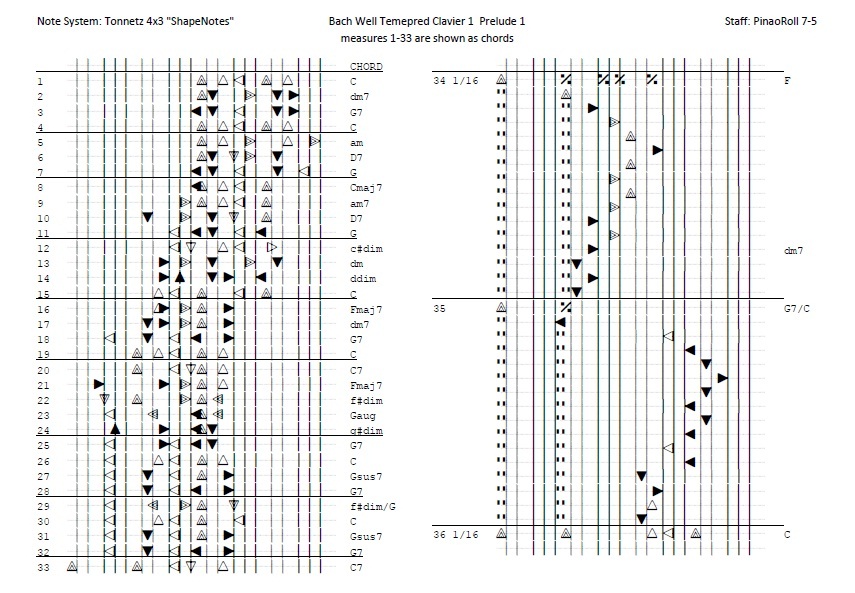
First off, I'll be calling it a notation-slash-system, because I feel that it is not just a way of notating music, but also possesses, or at least begs to posses, a distinct philosophy of music.
Second caveat is that I'll be exploring it with certain comparisons to Roy Pertchick's Tri-Chromatic system of coloring keys/vibes etc. I understand that there was some dialogue between Mr.'s Pertchick and Austin as Austin developed his system.
Okay here are some pros and cons.
Pros:
1) Because of the inclusion of 2 + 3 lines representing notes chromatic tot he C-scale, it pretty easy on the eyes to spot each note as a sort of WYSIWYG, especially for pianists on the diatonic piano, or even for those who play a Janko with traditional 7+5 black and white coloring like Paul Vandervoort does
2) Its easy to see how symmetrical a scale/melody/etc is. Its a little hard to explain the value of this without going deep in to the Jazz teachings of Barry Harris, or even explaining the Tri-Chromatic scheme in full. But let me try.
Consider the screenshot posted above that Austin created , of a few bars of Bach's prelude #1. You can see it larger here
Now look at bar 35. The right hand side tells us that this is a G7 chord -- apparently the V7 for the key of C. Now look at all the melody notes in that bar, What color notehead sticks out the most? Clearly the black noteheads refer to notes F, Ab , B and D. Those of us who studied tension know that this collection of notes, this tri-tone pair, pull us to one of four tonal centers: either C, Eb, Gb or A. I other words, those black noteheads will be pulling to C, the tonic of the song, or one of its Bartok substitutions (Eb, G, A). Naturally , you would expect this to happen during a V7 chord.
BTW, the black noteheads are comparible to the black keys on Petchick's vibraphone (someone correct me if I'm wrong), or, on my iteration of the Tri-Chromatic system, the dark blue (night) keys. In this case, we are seeing "night notes" (F, Ab, B, D) pulling us to "morning" tonic (C).
I love how seeing one color of notehead already tells me in what tonal direction the piece is going.
Getting back to the concept of symmetry.
For example, Barry Harris' 6th diminished (minor) scale would, on this system, show up as:
Grey, black, grey, black, white, black, grey, black, grey
C, D, D#, F, G, G#, A, B, C in the key of C
Now just looking at the colors of the noteheads, we can tell that it adheres very closely some diminished scale. In the tri-chromatic system, it becomes manfiest that a diminished scale will simple include all the notes of two colors while containing no notes of the third remaining color. In this case, white gets almost completely left out (only G appears)
The C diminished scale, which goes
C,D,Eb,F,Gb,Ab,A,B
would be colored
Grey Black Grey Black Grey Black Grey Black
So, just by looking at noteheads, we see how symmetrical the 6th diminished minor is, in fact it is only one note away from C diminished, a perfectly symmetrical scale (it contains a G instead of Gb)
So those are some strong pros of the system
Cons:
1) Especially because it is vertically arranged, the system caters more to keyboardists and less to other musicians.
2) The different noteheads sacrifice some of the isomorphism of the notation. A Cmaj7 will not look the same Dbmaj7; the triangles will point in different directions in both of these chords. But the notes will still be in same relative position to the staff. All in all, a fair trade-off to me.
3) I'm less crazy about the triangles' direction being an indicator of what "phase" of the whole tone scale the note is a part of. I may change my tune a year from now, like if I suddenly discover that the wholetone scale is indeed some sort of key to extremely powerful harmonic movement. In the meantime, I am far more concerned with the diminished scale.
4) That "triangle within a triangle" notehead looks like a burden if one is drawing this system freehand.
So that's it out for now. I hope someone found this interesting or helpful.

Joseph Austin
Nov 5, 2014, 5:41:30 PM11/5/14
to musicn...@googlegroups.com
O E,
Thank you for your attention to ChromaTonnetz.
As you concluded, the tri-color scheme was copied directly from Roy Pertchik.
The 7+5 staff was copied from KlavarSkribo.
Note, however, that the choice of staff is completely independent of the notehead scheme.
With 12 distinct note symbols, the staff is largely redundant.
For example, the noteheads can be interpreted as scale-degrees (shape-note style),
while the staff conveys absolute pitch information.
The vertical orientation was also copied from KlavarSkribo, and perhaps for the same reason:
it is easier to “print” the score as text if time runs vertically and pitches run horizontally.
As for the four orientations,
my original intent was to have 12 distinct symbols for 12 ET notes.
Given 3 colors, that required another dimension of 4.
It occurred to me that a single symbol in 4 orientations would provide the most “isomorphic” choice, and I chose the nearly-equilateral triangle as the simplest symbol to create.
I did choose a shape that had similar size in both horizontal and vertical directions.
(Later I experimented with a “house-shaped” symbol for using the noteheads without a staff,
since the triangles sometimes led to an optical illusion making the orientation difficult to recognize.)
It also happens that the 3x4 system parallels Euler’s Tonnetz,
and also parallels a 3x4 naming scheme described by Roy.
The triangle-in-triangle for “gray” ( Roy’s “red”), was the result of some experimentation to achieve a recognizably distinct monochrome “shading” between black and white.
I was not influenced by the diminished scale, so any resemblance is purely coincidental.
Joe Austin
--
You received this message because you are subscribed to the forum of the Music Notation Project (hosted by Google Groups).
To post to this group, send email to musicn...@googlegroups.com
To unsubscribe from this group, send email to musicnotatio...@googlegroups.com
For more options, visit this group at http://groups.google.com/group/musicnotation?hl=en
---
You received this message because you are subscribed to the Google Groups "The Music Notation Project | Forum" group.
To unsubscribe from this group and stop receiving emails from it, send an email to musicnotatio...@googlegroups.com.
For more options, visit https://groups.google.com/d/optout.
O.E. Soriano
Nov 5, 2014, 7:41:36 PM11/5/14
to musicn...@googlegroups.com
I was not influenced by the diminished scale, so any resemblance is purely coincidental.
This is *exactly* the point. Sooner or later, most systems that intelligently describe western music converge on the diminished scale -- either intentionally or not.
Allow me to draw a metaphor from Christian Theology, since I see you have an interest in Theology, at the risk of perhaps putting off the non-religious folks.
Much of Christian Theology has been done on John 1:1, roughly translated as "In the beginning was the Word, and the Word was with God." Now, a studied man such as yourself knows that the Greek word rendered "word" there is logos, and that "word" is a pretty crude translation of the concept. Instead, it is a concept borrowed from Greek philosophy which might be more properly rendered as "rationale," "account," "explanation." or, my personal favorite "organizing principle."
So what St. John is asserting is that there is this God, and, right from the very start, part and parcel with that is there is this organizing principle: the logos. This logos, Christ, is the theological and metaphysical center of the universe: its what makes it makes sense and what makes it tick. Now this Christ serves as an organizing principle for the universe whether people realize it or not. A Chinese farmer who has never heard the name Jesus still has, according to St. John, an organizing principle in the universe he lives in: the logos, the Christ. Now in the next verse, John goes on to explain how this logos took on human form at one point in history, but that's beyond the scope of the metaphor I am making.
To wrap the metaphor up, you might say Barry Harris is like St. John, lol. He is basically saying there is an organizing principle, a logos, to all western music, and that is the diminished scale.
It is the notes of the diminished scale that provide the tri-tones that push movements forwards from tense dominant to stable major. It is the diminished scale that explains not only why G7 resolves naturally to C (the F-B tri-tone pulls to C) , but also to Gb (the F-B tri-tone, by mathematical necessity, pull equally to Gb), and since there is a second tri-tone pair implied with a V7 chord (Ab - D) which pull either to Eb or to A. Line up all those pulling tones together (F - Ab - B - D) and you have there 1/2 of the G diminished chord -- which is the underlying structure of the G7, or perhaps more properly the Galt7 or the G7b9 chord.
Anyway, all I'm saying is that any notation system that makes seeing that diminished theme a bit more clearly is going to get a +1 from me.
With 12 distinct note symbols, the staff is largely redundant.
Perhaps. But I like it: instant recognition.
I also think they're necessary for spotting isomorphic patterns of things like chords. Without the staff lines, I think its a tiny bit harder to see how a Am7b5 chord and a Ebm7b5 chord would have the same shape. Just a little bit.
O.E. Soriano
Nov 5, 2014, 7:48:52 PM11/5/14
to musicn...@googlegroups.com
another thing is, I'd love to see how transcriptions of Jazz solos from some of my favorite players would look in this notation. Looking at the color of the noteheads would add an extra dimension of understanding to what scale tones they are hitting.

roy pertchik
Nov 5, 2014, 9:25:30 PM11/5/14
to musicn...@googlegroups.com
Hi Omar,
Just a few nit picks, and a suggestion for further research. In your paragraph 6 you refer several times to "diminished scale" when it would be more correct to say "diminished chord" or "diminished arpeggio." You fix it by the end of the paragraph. Also, when you say G7 pulls to C and Gb, you are saying G7 is the V of C and G7 is the tritone substitute of V of Gb, (Db7). The other 2 dominants in that family, E7 and Bb7 are (notably!) the V of the relative minor, A, and again the tritone substitue of that V (Bb7 in lieu of E7.)
FWIW, Bary really dislikes the idea of the diminished scale; whole, half, whole, half, etc. But there are other masters who do use the dim scale concept.
In terms of the universal utility of the 3 diminished chord framework, I learned one system from Barry, (I created my keyboard to access his harmony more easily, Barry calls it "a scale for chording" and he has a particular approach to voicings), but you may also want to look into other masters who utilize diminished arpeggios as the universal highway through harmony space.. Pat Matheny comes to mind.
What originally led you to the significance of the three diminished arpeggios, and what led you to overlay them on a keyboard in your original 7+5 work?
Cheers,
Roy
Roy Pertchik
Design and Construction Consultant
NYS Arch., NCARB
Design and Construction Consultant
NYS Arch., NCARB
1299 Lost Acre Drive
Felton, CA 95018
--
O.E. Soriano
Nov 5, 2014, 9:48:25 PM11/5/14
to musicn...@googlegroups.com
Thanks for responding, Roy
Just a few nit picks, and a suggestion for further research. In your paragraph 6 you refer several times to "diminished scale" when it would be more correct to say "diminished chord" or "diminished arpeggio." You fix it by the end of the paragraph.
I actually do mean "diminished scale," in that I am thinking of, for example, of D, F, Ab, B as a subset of the G diminished scale ( or or Bb diminished or Db diminished or E diminished, since they are all the same). Now, I realize that D, F, Ab, B together, make up a Dim7 chord, which is interesting, but I am not drawing attention to that fact at the moment.
What originally led you to the significance of the three diminished arpeggios?
I'd have to say exploration of tri-tones, and their remarkable power to pull to new key centers. I might choose to think of the dim7 chord as a pitch collection containing two tri-tone pairs, and I might choose to look at the diminished scale as a pitch collection of four tri-tone pairs.
the three diminished arpeggios, and what led you to overlay them on a keyboard in your original 7+5 work?
I think the answer is in the question..the fact that there are only three of them. Why not color code the keys that way? If you had three kinds of paperwork on your desk: complaints, queries, and invoices, would you be tempted to put them in corresponding red, blue, and green folders?
O.E. Soriano
Nov 5, 2014, 10:30:29 PM11/5/14
to musicn...@googlegroups.com
Correction. I said
I actually do mean "diminished scale," in that I am thinking of, for example, of D, F, Ab, B as a subset of the G diminished scale
when I meant to say G half-diminished. (like Roy, these days I don't think in names and stuff, but sometimes just in colors, as in "that scale that goes morning-night-morning-night")
but you may also want to look into other masters who utilize diminished arpeggios as the universal highway through harmony space.. Pat Matheny comes to mind.
Thanks for the heads up about Methany. I haven't gotten into him but many have recommended him.
Any other theorists thinking about the diminished scale that you can name specifically?
I've been listening to Eddie Palmieri alot this year. Alot of soloing takes place in those corridors in between keys .
http://youtu.be/26sTYS2sUxA?t=1m1s
roy pertchik
Nov 5, 2014, 11:01:40 PM11/5/14
to musicn...@googlegroups.com
Hmm, well the paragraph makes more sense to me reading "dim chord."
So you used the three dim chords for "formal" reasons, ie. the form was symmetrical, and simple, and further exploration revealed they where musically useful. Interesting process. I came to it from musical utility origins, and yes, as you say, used three colors for three things.
I'm hoping you will do some looking for other masters using the harmonic sounds I learned from Barry. He credits Bud Powel, in who's music I hear much of the same, but Bud left no teaching material as far as I know. Lenny Tristano comes to mind for the sound. Horn players like Lester Young and Coleman Hawkens play lines with a lot of diminished chord connectors. And of course there is a lot of Barry stuff on Howard Reese's web site, which I already sent you to... I wonder what Berklee music school has to say. I heard Gary Burton (Vibes master and dean of Berklee) give a lecture. He said it's all about 10 scales; the 7 modes, the diminished (whole, half, whole, half...), the "altered" scale, and I think he had an augmented scale. I think this system is to complicated for me, and I find most of the same sounds in Barry's 2 most important scales (Maj6/dim & min6/dim) plus some tinker toy transformation.
Anyway, if you find additional written work on the utility of dim chords, let me know.
Roy Pertchik
Design and Construction Consultant
NYS Arch., NCARB
Design and Construction Consultant
NYS Arch., NCARB
1299 Lost Acre Drive
Felton, CA 95018
Joseph Austin
Nov 6, 2014, 5:00:19 PM11/6/14
to musicn...@googlegroups.com
O E
Theoretically, I’m more partial to Markov chains or finite state automata.
Translated to music, this would be a diagram showing the probability of “progression” from one interval or chord to another.
As for scales, I understand the Pythagorean scale is based on the “spiral of 2:3” aka. “circle of fifths”,
and the diatonic scale is based on alternating major/minor thirds (4:5:6) aka Euler’s Tonnetz.
I’ve watched Roy Pertchik’s talk on his system and the diminished scale,
but I don’t know quite how to apply that to the music I usually deal with, which is mostly pops and show tunes from the 20th century.
It seems to me Harris’s scale is more like a scale from two chords rather than a scale from an interval series. From that perspective, it’s more like the concept that the diatonic scale derives from three hexachords (do re me fa so la on IV, I and V), like Sacred Harp singing theory.
I had once seen a presentation of Jazz Theory as derived from three major6 / (or relative minor 7 chords) on IV I V.
So, theologically, are you saying the Diminished Scale is the “Messiah” come to save music from bondage to the classics? Aren’t you then going to have Paul’s problem of convincing people they don’t need to first learn the Classical Rules in order to apply the Moderns? That controversy is already brewing in the reluctance to abandon “enharmonic accidentals” for 12TET.
Re staff: when I say staff is “irrelevant”, I mean the specific choice of staff, e.g. 7+5 or any of the other 12-tone staves proposed on MNP. Once I posted an example of the ChromaTonnetz noteheads used on a variety of different staves, and even with no staff.
I do believe that music needs a “theory update” and that that effort should logically precede any “standardization” of new notations or instrument designs.
I’m also concerned that “teaching music” should include composition (simple rhythms, tunes, harmonies and forms at first) and that notation should be introduced as a way of representing musical structures the student already understands kinesthetically and aurally, instead of starting with "manual gymnastics" as a way of interpreting notation.
Joseph Austin
Nov 6, 2014, 5:11:48 PM11/6/14
to musicn...@googlegroups.com
O E,
I tried adding “color” to the notation via html tags,
but i could not find a browser that would apply the tags properly to kernered text without introducing superfluous spacing. Since my layout depends on linear proportion to represent pitch intervals, the extra spaces destroyed the alignment of the score.
I’m not sure whether my problems were actual limitations of browsers or my incomplete understanding of HTML5 and XML.
In any event, if you know a practical way to add color to computer-printable text without modifying the spacing, let me know.
At the moment, I have software to produce my notation in Lilypond,
or from a spreadsheet form of piano roll.
I realize it would be useful to produce the notation directly from MIDI,
but I haven’t tackled that challenge yet.
If I had a Midi-file-decoder function or package usable from Java,
I might be persuaded to build the rest.
Joe
On Nov 5, 2014, at 7:48 PM, O.E. Soriano <oeso...@gmail.com> wrote:
another thing is, I'd love to see how transcriptions of Jazz solos from some of my favorite players would look in this notation. Looking at the color of the noteheads would add an extra dimension of understanding to what scale tones they are hitting.
O.E. Soriano
Nov 6, 2014, 7:51:55 PM11/6/14
to musicn...@googlegroups.com
So, theologically, are you saying the Diminished Scale is the “Messiah” come to save music from bondage to the classics?
No, I'm saying the diminished scale has always been there.
Joseph Austin
Nov 8, 2014, 9:38:23 PM11/8/14
to musicn...@googlegroups.com
Having seen some of the later messages between you and Roy,
I’m now unclear on what is the “diminished scale” you speak of.
The “classical” scales I’m familiar with are generated by interval sequences:
Pythagorean, by 2:3, which are called “fifths” but of course that is circular reasoning because you don’t have a “fifth” until you have a scale!
The Diatonic scale can be generated by three successive chords 4:5:6, e.g what are called IV I V, each consisting of a “major” and “minor” third, but again the terminology can’t be considered “defining” because the intervals preceded the scale whose “steps” name the intervals and chords.
(The diatonic relative minor is likewise generated by 10:12:15 chords or ii vi iii )
The “whole-half” step terminology is even worse. In the just case, there isn’t even consistency among the two “whole” steps in the “major third”, for example.
So what IS the “defining” pattern for the “diminished scale” (or arpeggio)?
Is this purely an artifact of equal-temerpament, or does it have “just” (i.e. Pythagorean) roots?
And what accounts for the primacy of the “diminished” arpeggio?
The “augmented” chords / arpeggio likewise evenly divide the 12TET dozen—
is there a similar “theory” based on augmenteds?
Or perhaps there is a richer structure of intersecting “rings” somewhat akin to the Tonnetz,
in which melodies can proceed within a “tonality” or around “harmonic circles” of tonality changes, jumping back an forth. Perhaps the power of the “diminished” offers more jumping-off points within the tonality than the “circle of fifths”.
You also speak of whole-half-whole-half. I don’t understand the relation of that sequence to a “dim scale”.
The “dim scale” I understood from Roy was
WWhWhhW(h) [W=whole, h=half) or in colors: BWRWRWBW (Black White Red)
being equivalent to a diatonic scale with an extra note,
the otherwise missing “7th” note of the vii-dim7.
Joe Austin
On Nov 6, 2014, at 7:51 PM, O.E. Soriano <oeso...@gmail.com> wrote:
So, theologically, are you saying the Diminished Scale is the “Messiah” come to save music from bondage to the classics?
No, I'm saying the diminished scale has always been there.
O.E. Soriano
Nov 8, 2014, 11:17:35 PM11/8/14
to musicn...@googlegroups.com
Let's keep it simple.
1) The diminished arpeggio that Roy and I refer to is the pitch collection of 4 notes spaced a minor third apart. (They show up on your Tonnetz Torus)
C-Eb-Gb-A
Db-E-G-Bb
D-F-Ab-B
2) The diminished scale is the whole-half scale that you list here:
1) The diminished arpeggio that Roy and I refer to is the pitch collection of 4 notes spaced a minor third apart. (They show up on your Tonnetz Torus)
C-Eb-Gb-A
Db-E-G-Bb
D-F-Ab-B
2) The diminished scale is the whole-half scale that you list here:
The “dim scale” I understood from Roy wasWWhWhhW(h) [W=whole, h=half) or in colors: BWRWRWBW (Black White Red)
However,
being equivalent to a diatonic scale with an extra note,
No, no at all. The diminished scale is not similar to the diatonic scale. I think you are thinking of the 6th diminished scale, which is Barry Harris' designer scale.
The diminished scales are only three, and follow the whole-half formula you listed above:
C-D-Eb-F-Gb-Ab-A-B
Db-Eb-E-Gb-G-A-Bb-C
D-E-F-G-Ab-Bb-B-Db
3)
And what accounts for the primacy of the “diminished” arpeggio?
This is the million dollar question. In my estimation, the answer is one word: Tri-tones.
A recap of what I wrote earlier
It is the notes of the diminished scale that provide the tri-tones that push movements forwards from tense dominant to stable major. It is the diminished scale that explains not only why G7 resolves naturally to C (the F-B tri-tone pulls to C) , but also to Gb (the F-B tri-tone, by mathematical necessity, pull equally to Gb), and since there is a second tri-tone pair implied with a V7 chord (Ab - D) which pull either to Eb or to A. Line up all those pulling tones together (F - Ab - B - D) and you have there 1/2 of the G diminished chord -- which is the underlying structure of the G7, or perhaps more properly the Galt7 or the G7b9 chord.
I wrote a pretty extensive post on tri-tones almost exactly eight years ago, which you can read here if you feel like immersing yourself more deeply in the importance of tri-tone (Caveat, having written that a long time ago, I'm not sure I still "stand" by all the views I expressed in that piece) : Ways to use Tri-tones
4)
The “augmented” chords / arpeggio likewise evenly divide the 12TET dozen—is there a similar “theory” based on augmenteds?
There may very well be, but I do not know it. My first impulse is to say "no" because there is no tri-tone present in the augmented chord. However, as I sit at the keyboard and play Caug (C-E-Ab), there is a definite tension there, and tension means movement and a desire to resolve, but I am ignorant of any working theory that predicts in which ways augmented chord resolve. Perhaps Roy or someone else knows.
if this topic is still confusing at this point, don't read the next paragraph; it'll only confuse you more.
5) One last thing. You may have noticed me mention the Half-Diminished Scale. Its really just the opposite formula from the Diminished scale: its half-whole-half-whole, etc, instead of whole-half etc. Doing a bit of math, you'll see that In reality the three half-diminished scales have the same notes as the three diminished scale, except they start on a different note. I didn't bring them up to be confusing, but because they are the way I choose play these scales in the context of real playing. So, for example, i generally will play G half-diminished over a G7 (or Galt or G7b9) chord, because it is easier to remember G half-diminished rather than F diminished, because G half-diminished has the same root as the chord I am soloing over.
O.E. Soriano
Nov 8, 2014, 11:21:04 PM11/8/14
to musicn...@googlegroups.com
sorry, I made a mistake
this...
this...
2) The diminished scale is the whole-half scale that you list here:The “dim scale” I understood from Roy wasWWhWhhW(h) [W=whole, h=half) or in colors: BWRWRWBW (Black White Red)
I see now that you are listing here the formula for Harris' 6th diminished scale. That's not the diminished scale.
IMHO, a person shouldn't even be messing with barry's scales until they're very comfortable with regular diminished scales

John Keller
Nov 8, 2014, 11:42:37 PM11/8/14
to musicn...@googlegroups.com
I suggest using the term "dominant diminished
scale" to mean the scale starting with the semitone.
"Half diminished" means something else to me,
namely locrian, the scale that goes with the half diminished chord.
Thus a C dim chord will take a C dim scale
(wholetone first : C D Eb etc)
C7th chord will take a C dom dim scale (semitone
first, C C# D# E etc)
John K
roy pertchik
Nov 9, 2014, 8:08:37 AM11/9/14
to musicn...@googlegroups.com
Hi Joe,
I'll pass on the chicken/egg problems of giving bootstrapping definitions, and instead simply define my terms, assuming an existing backdrop of the traditional tempered keyboard. BTW, I'm not attempting to describe all music, I'm describing the method I use to play music I happen to like. What I mean by these terms..
Diminished chord is four notes in a stack of three minor thirds.
Diminished arpeggio is the same. I sometimes also mean the extension of the chord multiple octaves up and down.
Why/how is the diminished chord such a powerful organizer of harmony? There are 3 diminished chords, each contains 4 notes. By "dropping" any note in a diminished chord, you create a Dominant7 chord. The resulting 4 Dom7 chords are a family. Just as the "normal" Dom7 on the V sounds like it wants to resolve to I, the other 3 Dom7's in the family imply additional resolutions (to relative minor, and to tritone substitute keys.) There are 3 families of Dom7's, with 4 Dom7's in each and 3x4=12. The 3 diminished chords are each related to the 3 Major triads in a traditional scale, I, IV, V, so you can choose any note for the root of I, and find a path from any Dom7 back to I, using modificationa of I, IV, V progressions. You can get from anywhere to anywhere through this organization.
Finally, when I say scale, I am usually referring to 8 notes selected from within an octave. I use Barry Harris' method of constructing a scale: take a diminished chord, add to it another chord so that the notes are interlaced. There are only 5 unique ways to do thi, making 5 scales. The most important are the Maj6/Dim scale and the min6/dim scale. Another of the 5 possible is the Dim/Dim scale. This can be thought of as W,h,W,h,W,h,W,h,W,h,W,h or h,W,h,W,h,W,h,W,h,W,h,W, and people will advocate one or the other for various reasons. To me, it's a useful scale, but not central to the organization of harmony as I understand it. Omar seems to view it as more centrally important, but I'll let him speak for himself.
Roy Pertchik
Design and Construction Consultant
NYS Arch., NCARB
Design and Construction Consultant
NYS Arch., NCARB
1299 Lost Acre Drive
Felton, CA 95018
roy pertchik
Nov 9, 2014, 8:28:15 AM11/9/14
to musicn...@googlegroups.com
> IMHO, a person shouldn't even be messing with barry's scales until they're very comfortable with regular diminished scales
I see things differently. I don't see why people like the diminished scales so much, except that they are sort of easy and there are only 3. But it's not centrally important. I think the idea behind Barry's methods is that it is a gestalt way of seeing many, many harmonic movements. His concept of a scale being made of two interlaced chords is a much more powerful way of conceptualizing whats going on, than is a lists of whole and half steps. (The list of steps is a useful way to be very specific, but it's not the "idea".) I think it is much better to learn the Maj6/Dim scale and it's movements, on C, F, and G (I, IV, and V in C)
There are only 5 ways to interlace two 4 note chords if one of them is a diminished chord. The two most important are the Maj6/Dim and the min6/Dim. Another way is the Dim/Dim which results in the "diminished scale", either starting with a W or h. This is sort of a "special effect" scale in the larger system. Think interlaced chords, much more powerful.
Roy Pertchik
Design and Construction Consultant
NYS Arch., NCARB
Design and Construction Consultant
NYS Arch., NCARB
1299 Lost Acre Drive
Felton, CA 95018

Ole Kirkeby
Nov 9, 2014, 10:26:37 AM11/9/14
to musicn...@googlegroups.com
Augmented scales: the great jazz guitarist Pat Martino bases his thinking on major thirds rather than minor thirds.
https://www.youtube.com/watch?v=xngN9Mf9ass
It is also described in his books Creative Force part 1 and 2 which I haven't looked at for a while (they were way beyond me when I bought them 20 years ago). However, since I play guitar tuned in major thirds, I am going to persue this. That also goes for the color-coding of the Chromatone keyboard. It might not work out as well as the tri-tone system but I have invested so much time in getting familiar with the patterns on the fretboard that I have to try.
ole
https://www.youtube.com/watch?v=xngN9Mf9ass
It is also described in his books Creative Force part 1 and 2 which I haven't looked at for a while (they were way beyond me when I bought them 20 years ago). However, since I play guitar tuned in major thirds, I am going to persue this. That also goes for the color-coding of the Chromatone keyboard. It might not work out as well as the tri-tone system but I have invested so much time in getting familiar with the patterns on the fretboard that I have to try.
ole
O.E. Soriano
Nov 9, 2014, 2:49:58 PM11/9/14
to musicn...@googlegroups.com
Why/how is the diminished chord such a powerful organizer of harmony? There are 3 diminished chords, each contains 4 notes. By "dropping" any note in a diminished chord, you create a Dominant7 chord. The resulting 4 Dom7 chords are a family. Just as the "normal" Dom7 on the V sounds like it wants to resolve to I, the other 3 Dom7's in the family imply additional resolutions (to relative minor, and to tritone substitute keys.) There are 3 families of Dom7's, with 4 Dom7's in each and 3x4=12. The 3 diminished chords are each related to the 3 Major triads in a traditional scale, I, IV, V, so you can choose any note for the root of I, and find a path from any Dom7 back to I, using modificationa of I, IV, V progressions. You can get from anywhere to anywhere through this organization.
This is a very well written paragraph. Kudos.
I see things differently. I don't see why people like the diminished scales so much, except that they are sort of easy and there are only 3. But it's not centrally important. I think the idea behind Barry's methods is that it is a gestalt way of seeing many, many harmonic movements. His concept of a scale being made of two interlaced chords is a much more powerful way of conceptualizing whats going on, than is a lists of whole and half steps. (The list of steps is a useful way to be very specific, but it's not the "idea".) I think it is much better to learn the Maj6/Dim scale and it's movements, on C, F, and G (I, IV, and V in C)
There are only 5 ways to interlace two 4 note chords if one of them is a diminished chord. The two most important are the Maj6/Dim and the min6/Dim. Another way is the Dim/Dim which results in the "diminished scale", either starting with a W or h. This is sort of a "special effect" scale in the larger system. Think interlaced chords, much more powerful.
I agree that Barry's 6th Diminished scales (the major and the minor) are probably much more practical for actual playing than the regular diminished scale.
I just think the diminished scale is a great organizer for a system of twelve tones. Its "neat" if you will. To describe my feelings more clearly about this,I'd have to get into the theory of "earth and sky" that I am working on. But that may be lengthy, and I think I'll save that for the new Janko/Chromatone group.

Keislar, Doug
Nov 9, 2014, 3:06:39 PM11/9/14
to musicn...@googlegroups.com
Hi Joe,
You asked whether there is a theory based on augmented triads. I don't have time to go into it, but Dmitri Tymoczko's book A Geometry of Music is an extremely far-reaching approach to music theory. The geometric model he constructs for twelve-tone equal temperament (which his system isn't limited to) has augmented triads at the core. I haven't finished reading the book, but it seems to be a milestone in music theory (which is not to say that all its ideas are original).
Doug
________________________________________
From: musicn...@googlegroups.com [musicn...@googlegroups.com] on behalf of Joseph Austin [drtec...@gmail.com]
Sent: Saturday, November 08, 2014 6:38 PM
To: musicn...@googlegroups.com
Subject: Re: [MNP] Some Thoughts on Joe Austin's Chroma Tonnetz Notation/System
To post to this group, send email to musicn...@googlegroups.com<mailto:musicn...@googlegroups.com>
To unsubscribe from this group, send email to musicnotatio...@googlegroups.com<mailto:musicnotatio...@googlegroups.com>
You asked whether there is a theory based on augmented triads. I don't have time to go into it, but Dmitri Tymoczko's book A Geometry of Music is an extremely far-reaching approach to music theory. The geometric model he constructs for twelve-tone equal temperament (which his system isn't limited to) has augmented triads at the core. I haven't finished reading the book, but it seems to be a milestone in music theory (which is not to say that all its ideas are original).
Doug
________________________________________
From: musicn...@googlegroups.com [musicn...@googlegroups.com] on behalf of Joseph Austin [drtec...@gmail.com]
Sent: Saturday, November 08, 2014 6:38 PM
To: musicn...@googlegroups.com
Subject: Re: [MNP] Some Thoughts on Joe Austin's Chroma Tonnetz Notation/System
To unsubscribe from this group, send email to musicnotatio...@googlegroups.com<mailto:musicnotatio...@googlegroups.com>
For more options, visit this group at http://groups.google.com/group/musicnotation?hl=en
---
You received this message because you are subscribed to the Google Groups "The Music Notation Project | Forum" group.
To unsubscribe from this group and stop receiving emails from it, send an email to musicnotatio...@googlegroups.com<mailto:musicnotatio...@googlegroups.com>.
---
You received this message because you are subscribed to the Google Groups "The Music Notation Project | Forum" group.
--
You received this message because you are subscribed to the forum of the Music Notation Project (hosted by Google Groups).
To post to this group, send email to musicn...@googlegroups.com
To unsubscribe from this group, send email to musicnotatio...@googlegroups.com
For more options, visit this group at http://groups.google.com/group/musicnotation?hl=en
---
You received this message because you are subscribed to the Google Groups "The Music Notation Project | Forum" group.
To unsubscribe from this group and stop receiving emails from it, send an email to musicnotatio...@googlegroups.com<mailto:musicnotatio...@googlegroups.com>.
You received this message because you are subscribed to the forum of the Music Notation Project (hosted by Google Groups).
To post to this group, send email to musicn...@googlegroups.com
To unsubscribe from this group, send email to musicnotatio...@googlegroups.com
For more options, visit this group at http://groups.google.com/group/musicnotation?hl=en
---
You received this message because you are subscribed to the Google Groups "The Music Notation Project | Forum" group.

dominique.waller
Nov 9, 2014, 4:13:24 PM11/9/14
to musicn...@googlegroups.com
Speaking about that, Joe, you might interested to know that Dmitri Tymoczko
wrote an long article called "The Generalized Tonnetz" in issue 56:1 of the
Journal of Music Theory, spring 2012, see
https://www.dukeupress.edu/Journal-of-Music-Theory-56-1/index.html Dominique
-----Message d'origine-----
From: Keislar, Doug
Sent: Sunday, November 09, 2014 9:06 PM
To: musicn...@googlegroups.com
Subject: RE: [MNP] Some Thoughts on Joe Austin's Chroma Tonnetz
email to musicnotatio...@googlegroups.com.
---
Ce courrier électronique ne contient aucun virus ou logiciel malveillant parce que la protection avast! Antivirus est active.
http://www.avast.com
wrote an long article called "The Generalized Tonnetz" in issue 56:1 of the
Journal of Music Theory, spring 2012, see
https://www.dukeupress.edu/Journal-of-Music-Theory-56-1/index.html Dominique
-----Message d'origine-----
From: Keislar, Doug
Sent: Sunday, November 09, 2014 9:06 PM
To: musicn...@googlegroups.com
Subject: RE: [MNP] Some Thoughts on Joe Austin's Chroma Tonnetz
---
Ce courrier électronique ne contient aucun virus ou logiciel malveillant parce que la protection avast! Antivirus est active.
http://www.avast.com
Joseph Austin
Nov 10, 2014, 4:21:09 PM11/10/14
to musicn...@googlegroups.com
Doug,
Thanks, I’ll have a look at it.
> To unsubscribe from this group and stop receiving emails from it, send an email to musicnotatio...@googlegroups.com.
Thanks, I’ll have a look at it.
Joseph Austin
Nov 10, 2014, 4:24:45 PM11/10/14
to musicn...@googlegroups.com
Dominique,
Thanks.
Is/was Tymoczko at Duke? I live near there—perhaps I can find it in the library.
Joe Austin
Doug Keislar
Nov 10, 2014, 4:56:51 PM11/10/14
to musicn...@googlegroups.com
Joe,
I believe he's at Princeton, but a major university like Duke should have this material in their library.
Doug
I believe he's at Princeton, but a major university like Duke should have this material in their library.
Doug
Joseph Austin
Nov 10, 2014, 5:10:42 PM11/10/14
to musicn...@googlegroups.com
Roy, John, Omar, et.al.
Thanks for all the illuminating insights into the diminished scales.
Of course, I’m not a composer, just a amateur musician of sorts.
but as a computerist and almost-physicist I am intrigued by the mathematical underpinnings of music.
It occurs to me that “tritone” itself may have multiple definitions.
I once heard a just-intonation lecture that suggested a “just” Dom7 would be 4:5:6:7,
giving a “tritone” of 5:7 = 1.4
The conventional just diatonic scale gives a Dom7 of M3-m3-m3,
which works out to 25:30:36 or a tritone of 5*5 : 7*7 =1.44
In ET, the tritone of the Dom7 would be 2ˆ(11/12) : 2ˆ(17/12),
or equivalently, 2ˆ(0/12) : 2ˆ(6/12)
which works out to 1: sqrt(2) = 1.41..., the geometric mean of the “octave" 1:2,
which is also quite close to the 4:5:6:7 interpretation.
As to the “chicken and egg” problem, I’ve always found it easier to remember simple formulas and derive the complex than vice versa, so for now I favor defining scales from interval ratios or multiple chords rather than from step patterns.
Joe Austin
Joseph Austin
Nov 10, 2014, 7:07:51 PM11/10/14
to musicn...@googlegroups.com
Thanks. I was keying off Duke University Press, which publishes the journal.
I ordered his book from Amazon.
Joe
O.E. Soriano
Nov 10, 2014, 9:54:36 PM11/10/14
to musicn...@googlegroups.com
So getting back to the original point of this post...
This is what I like about the Chroma Tonnetz notation/system. Its conducive to symmetrical scale analysis (look at all the discussion we've had in that direction), and for playing an instrument with that sort of thing in Mind. I don't think I see that in other systems in the MNP project yet.
This is what I like about the Chroma Tonnetz notation/system. Its conducive to symmetrical scale analysis (look at all the discussion we've had in that direction), and for playing an instrument with that sort of thing in Mind. I don't think I see that in other systems in the MNP project yet.

Music Integrated Solution
Nov 12, 2014, 9:18:49 PM11/12/14
to musicnotation
On Mon, Nov 10, 2014 at 9:54 PM, O.E. Soriano <oeso...@gmail.com> wrote:
So getting back to the original point of this post...
This is what I like about the Chroma Tonnetz notation/system. Its conducive to symmetrical scale analysis (look at all the discussion we've had in that direction), and for playing an instrument with that sort of thing in Mind. I don't think I see that in other systems in the MNP project yet.
I guess you can see now why it is unlikely on this group a consensus on a best particular system or as you put it, the possibility of backing just one system; I think the group is about expressing opinions and ideas; it would be good to be able to measure the ability of communicating those ideas and knowing how much we are wrong or right.
A lot has been argued about the ‘look’ or ‘visual appearance’ of intervals and think there has been a consensus that some systems graphically highlight some intervals more than others. We might say those intervals have a ‘special visual distinction’ because of the notation method used.
Joe’s CT concept should have some special visual distinctions for the intervals which notes (symbols) share same orientation or color.
Staff notation or the positional symbols notation can be arranged in several ways but probably there is not an arrangement in any notation method with all the advantages for both melodic and harmonic uses, e.g. I find CT extremely cumbersome for melodic uses while a 6/6 staff is so natural.
I have settled between the pure symbolic (e.g. CT) and pure positional (e.g. 6/6 staff) which is a mid point for melodic and harmonic uses and become a believer of the hybrid notation theory (combination of symbols and positions), which has been a natural selection for both our numerical and musical notation systems.
As a matter of fact a quick way of evaluating a music notation system is asking:
() Is it useful for people that already know TN?
() Does it use a hybrid method for notating pitch?
Enrique.
O.E. Soriano
Nov 13, 2014, 1:48:02 AM11/13/14
to musicn...@googlegroups.com
Joe’s CT concept should have some special visual distinctions for the intervals which notes (symbols) share same orientation or color.
Um, it does. The direction of the noteheads, for example.
I find CT extremely cumbersome for melodic uses while a 6/6 staff is so natural.
I disagree. Especially in vertical orientation, its pretty easy to follow the notes moving left and right -- at least as easy to follow as klavar skribo, upon which it is partially modeled.
I have settled between the pure symbolic (e.g. CT) and pure positional (e.g. 6/6 staff) which is a mid point for melodic and harmonic uses and become a believer of the hybrid notation theory (combination of symbols and positions), which has been a natural selection for both our numerical and musical notation systems.
Is there any post on this board that doesn't evolve into a commercial for the poster's system?
As a matter of fact a quick way of evaluating a music notation system is asking:() Is it useful for people that already know TN?() Does it use a hybrid method for notating pitch?
As for the first bullet, I disagree. I think a stronger litmus test is "does it make sense to people who don't currently read music"? " I possible could care less what people who already play TN think. They've already been conditioned to a poor system, and are unlikely to abandon it.
As for the second bullet, meh..who cares? As long as " it make sense to people who don't currently read music."
Music Integrated Solution
Nov 13, 2014, 6:48:10 AM11/13/14
to musicnotation
On Thu, Nov 13, 2014 at 1:48 AM, O.E. Soriano <oeso...@gmail.com> wrote:
I disagree. Especially in vertical orientation, its pretty easy to follow the notes moving left and right -- at least as easy to follow as klavar skribo, upon which it is partially modeled.
The difference of opinion is based on that you seem to evaluate a notation based on a score that somebody else wrote and you just read it; I evaluate notation based on a blank paper (or screen) where I have to put all the information; can you write a simple scale using CT on a blank paper? I cannot, but I can do it naturally on a 6/6 staff e.g. starting on any line, line, line then space, space, space and space; believe me I have given a fair try to CT and there is no way that I can remember that cumbersome process of interlacing rotation and color changes.
Is there any post on this board that doesn't evolve into a commercial for the poster's system?
Well, this is not exactly just about the system I use, it applies to probably most staff notation proposals in one way or another both chromatic and diatonic, e.g. you might notice the use of hollow and solid heads to discriminate pitch, which are two different symbols combined with positions of a staff.
As for the first bullet, I disagree. I think a stronger litmus test is "does it make sense to people who don't currently read music"? " I possible could care less what people who already play TN think. They've already been conditioned to a poor system, and are unlikely to abandon it.
Remember the natural and logical process is to teach beginners what professionals already use, if I had no arguments for professionals probably I would not present the system at all, or at least warn about it.
As for the second bullet, meh..who cares?
Mankind does, the rational species does, it has demonstrated it in its natural choices, TN notates about 35 pitches with seven positions and three symbols, not to mention our ingenious numeral system.
Would you try 24 microtonal with 24 different symbols then?
Music Integrated Solution
Nov 13, 2014, 11:22:39 AM11/13/14
to musicnotation
I have given the name ‘hybrid notation method’ as a way of differentiating between pure methods or methods that only use symbols or positions; it is an observation and 'the theory’ might be just an opinion after all, trying to explain a simple instinct of taking advantage of both resources and not discarding any of them as there is value in both, but the greatest value or efficiency seems to be in its combination, I dare calling it a magic that clicks and works, and those looking for 'what makes sense' might find a clue on the wisdom of a huge crowd.
Doug Keislar
Nov 13, 2014, 1:22:00 PM11/13/14
to musicn...@googlegroups.com
I think Enrique raises some interesting points.
His discomfort with ChromaTonnetz seems to be based on the difficulty of writing music in the system, rather than reading. I do get the sense that many people are focused on reading and take it almost as a given that writing will be accomplished through computer technology.
As Enrique indicates, his notion of a "hybrid" method of notating pitch refers not just to this Integrated Music Notation system but to any system that uses both the position on a pitch axis (usually a staff) and one or more symbols to help identify the pitch.
Systems that include only positional information are those that don't use notehead coloring (including black versus white) or notehead shape to help indicate pitch. (In principle, other types of symbols could also be used, but I can't think of any examples offhand.)
A large set of such systems can be found by doing the following:
1. Visit http://musicnotation.org/systems/gallery/
2. Click the button called "Re-Sort and Filter the Notation Systems"
3. Under "Solid or Hollow Noteheads," deselect "Indicate pitch: 6-6 pattern" and "Indicate pitch: 7-5 pattern."
Then, after viewing the resulting systems, do steps and 1 and 2 again, but for step 3 do:
3. Under "Notehead Shapes," deselect "Has 2 or 3 shapes" and "More than 3 shapes."
Similarly, a set of systems that use symbolic information in addition to positional information to indicate pitch -- what Enrique refers to as the hybrid method -- can be found by doing steps 1 and 2 and then:
3. Under "Solid or Hollow Noteheads," deselect " Indicate note duration " and " Neither pitch nor duration."
Then, after viewing the resulting systems, do steps and 1 and 2 again, but for step 3 do:
3. Under "Notehead Shapes," deselect " Has 1 notehead shape."
I agree with Enrique about the advantage of using both position and symbology to help indicate pitch. As can be seen above, many systems follow TN by using only position for pitch, reserving symbology for duration, for the most part. That seems unfortunate, for reasons given here: http://musicnotation.org/tutorials/noteheads-and-pitch/ . On the other hand, some numerical notation systems (http://musicnotation.org/tutorials/numerical-notation-systems/) use only symbology for the most part, supplemented by position to distinguish octaves.
Doug
His discomfort with ChromaTonnetz seems to be based on the difficulty of writing music in the system, rather than reading. I do get the sense that many people are focused on reading and take it almost as a given that writing will be accomplished through computer technology.
As Enrique indicates, his notion of a "hybrid" method of notating pitch refers not just to this Integrated Music Notation system but to any system that uses both the position on a pitch axis (usually a staff) and one or more symbols to help identify the pitch.
Systems that include only positional information are those that don't use notehead coloring (including black versus white) or notehead shape to help indicate pitch. (In principle, other types of symbols could also be used, but I can't think of any examples offhand.)
A large set of such systems can be found by doing the following:
1. Visit http://musicnotation.org/systems/gallery/
2. Click the button called "Re-Sort and Filter the Notation Systems"
3. Under "Solid or Hollow Noteheads," deselect "Indicate pitch: 6-6 pattern" and "Indicate pitch: 7-5 pattern."
Then, after viewing the resulting systems, do steps and 1 and 2 again, but for step 3 do:
3. Under "Notehead Shapes," deselect "Has 2 or 3 shapes" and "More than 3 shapes."
Similarly, a set of systems that use symbolic information in addition to positional information to indicate pitch -- what Enrique refers to as the hybrid method -- can be found by doing steps 1 and 2 and then:
3. Under "Solid or Hollow Noteheads," deselect " Indicate note duration " and " Neither pitch nor duration."
Then, after viewing the resulting systems, do steps and 1 and 2 again, but for step 3 do:
3. Under "Notehead Shapes," deselect " Has 1 notehead shape."
I agree with Enrique about the advantage of using both position and symbology to help indicate pitch. As can be seen above, many systems follow TN by using only position for pitch, reserving symbology for duration, for the most part. That seems unfortunate, for reasons given here: http://musicnotation.org/tutorials/noteheads-and-pitch/ . On the other hand, some numerical notation systems (http://musicnotation.org/tutorials/numerical-notation-systems/) use only symbology for the most part, supplemented by position to distinguish octaves.
Doug
O.E. Soriano
Nov 13, 2014, 2:06:07 PM11/13/14
to musicn...@googlegroups.com
I concede that that the Chroma Tonnetz system, in its current state, would be more difficult to write by hand than other systems. I suppose this is a deficiency that could be addressed.
On the rest of the points, I'll simply agree to disagree.
On the rest of the points, I'll simply agree to disagree.
O.E. Soriano
Nov 13, 2014, 5:22:23 PM11/13/14
to musicn...@googlegroups.com
If someone were to ask me (which they haven't) to suggest simplifications of the Chroma Tonnetz system, whereby it would be easier to notate freehand, among other things, I would suggest the following:
1) Eliminate the need to indicate in which "cycle" of the augmented chord the note is. As I've written about earlier, knowing a scale/chord/melody's relation to the augmented or wholetone scale is not nearly as useful, for western music, of knowing its relation to the diminished scale and the dim 7 arpeggios.
2) Eliminate the empty, "shaded" and "darkened" noteheads, which currently denote the phase of the dim 7 arp. Phase of the dim 7 arp will be notated by...
3) Replace the triangles, which can easily can easily be confused when drawn freehand, with three simple wedges (Λ, > , <), whose direction (up, down, or left) are now used to denote phase of dim7 arp, rather than phase of the augmented arp. (I also tinkered with the idea of using -, /, and \ , but I'll save my thoughts on that for a post I am writing for the Janko/Chromatone google group)
So, I took a few minutes to draw up, freehand, what a few scales would like like with these suggested simplifications. It didn't take long, and didn't feel cumbersome. In fact, by the time I got to the end of the page, I was already memorizing in which direction each wedge went. PDF attached.
(No disrespect intended to Mr. Austin with this. Just some speculation and brainstorming for possible improvements of what is, to me. already a a good system.)
1) Eliminate the need to indicate in which "cycle" of the augmented chord the note is. As I've written about earlier, knowing a scale/chord/melody's relation to the augmented or wholetone scale is not nearly as useful, for western music, of knowing its relation to the diminished scale and the dim 7 arpeggios.
2) Eliminate the empty, "shaded" and "darkened" noteheads, which currently denote the phase of the dim 7 arp. Phase of the dim 7 arp will be notated by...
3) Replace the triangles, which can easily can easily be confused when drawn freehand, with three simple wedges (Λ, > , <), whose direction (up, down, or left) are now used to denote phase of dim7 arp, rather than phase of the augmented arp. (I also tinkered with the idea of using -, /, and \ , but I'll save my thoughts on that for a post I am writing for the Janko/Chromatone google group)
So, I took a few minutes to draw up, freehand, what a few scales would like like with these suggested simplifications. It didn't take long, and didn't feel cumbersome. In fact, by the time I got to the end of the page, I was already memorizing in which direction each wedge went. PDF attached.
(No disrespect intended to Mr. Austin with this. Just some speculation and brainstorming for possible improvements of what is, to me. already a a good system.)
Joseph Austin
Nov 13, 2014, 6:43:57 PM11/13/14
to musicn...@googlegroups.com
On Nov 13, 2014, at 6:48 AM, Music Integrated Solution <mtall...@gmail.com> wrote:
I have given a fair try to CT and there is no way that I can remember that cumbersome process of interlacing rotation and color changes.
Enrique,
What works for me is to just memorize the symbols.
I prefer to associate them with scale degrees: do ra re ma mi fa fi so si la ta ti (do),
but one could also associate them with pitch names, e.g. John Keller’s A B C D E F G H I J K L.
Or pick you favorite naming scheme.
Of course, this approach applies to any symbol notation, not just CT.
Memorizing twelve symbols should not be unreasonable;
school children easily master a couple dozen symbols in the alphabet of their language.
Joe Austin
Joseph Austin
Nov 13, 2014, 7:35:56 PM11/13/14
to musicn...@googlegroups.com
On Nov 13, 2014, at 6:48 AM, Music Integrated Solution <mtall...@gmail.com> wrote:
As a matter of fact a quick way of evaluating a music notation system is asking:
() Is it useful for people that already know TN?
As for the first bullet, I disagree. I think a stronger litmus test is "does it make sense to people who don't currently read music"? " I possible could care less what people who already play TN think. They've already been conditioned to a poor system, and are unlikely to abandon it. [O E Soriano]
Remember the natural and logical process is to teach beginners what professionals already use, if I had no arguments for professionals probably I would not present the system at all, or at least warn about it.
Well, that depends. I taught computing. I knew that by the time my students became professionals, most of the specifics (e.g., languages, applications) of what I taught them would be obsolete. Furthermore, many of the major “theoretical” concepts I taught had not been discovered/invented when I was in grad school, and likewise new theories would replace those in vogue when I taught. So I attempted to teach “timeless truths,” but necessarily had to use the languages and applications available at the time.
Of course, music is not moving as fast as computing. Or is it?
I believe our goal is not just to improve what is, but to open doors to what can be.
So I would encourage people to develop notations that express and expose relationships in music that lie “hidden” under the arcane code of TN.
I contend that no new notation will be widely adopted until it can express things that TN cannot—
things that contemporary music actually contains or does that cannot now be expressed.
Meanwhile, the closer we get to representing “timeless truths” instead of “historical accidents”, the more likely our work will have enduring value.
So the ultimate answer to Omar’s question:
It’s not so much about “settling” on a “best” system as it is about comprehending what features of music each of the new systems reveals. In the era of computers, it is potentially possible to re-score any piece in any notation whatsoever, in order to expose whatever aspect is pertinent to the task at hand.
But in my opinion, one of the most important tasks is to develop “new musicians,”
and secondarily to develop some basic musical ability in nearly everyone.
Consider this: our uncanny ability to memorize vast numbers of tunes and to create melodies and harmonies and rhythms is one of the most under-utilized capabilities of homo sapiens!
And the more “advanced” we get, the less we exploit it.
Are we using “music” like the ancients used rockets for fireworks—just to put on a pretty show--when we might be going to the moon?
Is anyone doing serious research on the emotion-inducing aspects of music,
especially considering the epidemic of emotional and mental illness?
Joe Austin
Joseph Austin
Nov 13, 2014, 7:45:27 PM11/13/14
to musicn...@googlegroups.com
Doug,
The CT system as I use it with the Klavar staff is “totally redundant” in that there are twelve distinct symbols as well as twelve distinct positions.
This allows me to use the staff for pitch (C D E…) and the symbol for scale degree (do re mi…).
So it is not really a “hybrid” system, in the sense that it does not rely on a “oombination” of shape and position.
Joe
Doug Keislar
Nov 13, 2014, 7:54:08 PM11/13/14
to musicn...@googlegroups.com
That's a good distinction to make: whether the use of both shape and
symbol is necessary for discriminating the pitches, or just helpful
(meaning one can be used alone). Thanks for pointing that out.
There are some other systems like yours in which both are used for
pitch discrimination, but not out of necessity.
Joseph Austin
Nov 13, 2014, 7:59:39 PM11/13/14
to musicn...@googlegroups.com
Omar,
No disrespect taken—we are all exploring.
I would point out that my main motivation was to develop a set of “shape-note” symbols,
that is, a unique symbol for each of the 12 ET scale degrees.
I’d fully support any effort to streamline the symbols for easier hand-writing,
but for my purposes (singing), I would want 12 distinct symbols.
Four differently-oriented wedges with two or three other distinguishing marks would suffice.
The style of the present symbol set was “minimalist” in terms of the effort needed to create them with the font system I was using. I have no doubt someone with artistic or human-factors talent could improve upon them.
As to their utility, I can assure you that I have no trouble distinguishing them in music I print.
Joe Austin
Joseph Austin
Nov 13, 2014, 8:13:29 PM11/13/14
to musicn...@googlegroups.com
Doug,
Another thought:
I’ve recently been “drafted” to sing tenor rather than my preferred bass.
It occurs to me that the inner voice parts are defined more by harmony than by melody.
I’m just beginning to learn to sing harmony (as distinct from melody), but I’m speculating that the interval-identification potential of CT will prove much more useful in that regard than say for playing keyboard, where the positional staff is a better match for the instrument.
Joe
Doug Keislar
Nov 13, 2014, 8:13:31 PM11/13/14
to musicn...@googlegroups.com
Joe,
Regarding your last three paragraphs below: I've been reading Musicophilia by Oliver Sacks (which -- unlike the last book I recommended to you, a Geometry of Music -- is easily read by nonmusicians). In it, he discusses many things, including the notion that humans evolved music because of its mnemonic capabilites (which you mention) -- people could memorize thousands of lines of words if the words had rhyming and pitch and rhythm. An opposing idea is that music predated speech. Regarding the emotion-inducing aspects of music, the book discusses many neurological and medical conditions (as all his books do). Some conditions involve the ability to appreciate music intellectually but not emotionally, others vice versa. In some conditions, people can sing or play music perfectly well although they are otherwise severely impaired in their movements, speech, memory, etc. The book also discusses the remarkable range in people's abilities to remember music and so on.
Doug
Regarding your last three paragraphs below: I've been reading Musicophilia by Oliver Sacks (which -- unlike the last book I recommended to you, a Geometry of Music -- is easily read by nonmusicians). In it, he discusses many things, including the notion that humans evolved music because of its mnemonic capabilites (which you mention) -- people could memorize thousands of lines of words if the words had rhyming and pitch and rhythm. An opposing idea is that music predated speech. Regarding the emotion-inducing aspects of music, the book discusses many neurological and medical conditions (as all his books do). Some conditions involve the ability to appreciate music intellectually but not emotionally, others vice versa. In some conditions, people can sing or play music perfectly well although they are otherwise severely impaired in their movements, speech, memory, etc. The book also discusses the remarkable range in people's abilities to remember music and so on.
Doug

Paul Morris
Nov 13, 2014, 8:31:36 PM11/13/14
to musicn...@googlegroups.com
Hi Joe,
"Deep Listeners: Music Emotion, Trancing" is a book that's on my reading list. I had the opportunity to hear the author speak awhile back, and it's definitely interesting stuff.
Cheers,
-Paul
Joseph Austin
Nov 13, 2014, 8:34:11 PM11/13/14
to musicn...@googlegroups.com
Doug,
Ah, to be young again!
As some sage once said, how precious a gift to be wasted on the young!
But thanks for posting the reference.
Joe
On Nov 13, 2014, at 8:13 PM, Doug Keislar <do...@musclefish.com> wrote:
Joseph Austin
Nov 13, 2014, 8:43:37 PM11/13/14
to musicn...@googlegroups.com
Wow—so this is an active area of research.
My list of books I’ll probably never get around to reading continues to grow!
Joe
On Nov 13, 2014, at 8:31 PM, Paul Morris <pa...@paulwmorris.com> wrote:
Hi Joe,"Deep Listeners: Music Emotion, Trancing" is a book that's on my reading list. I had the opportunity to hear the author speak awhile back, and it's definitely interesting stuff.
O.E. Soriano
Nov 13, 2014, 9:14:31 PM11/13/14
to musicn...@googlegroups.com
On Thursday, November 13, 2014 7:59:39 PM UTC-5, DrTechDaddy wrote:
I would point out that my main motivation was to develop a set of “shape-note” symbols,that is, a unique symbol for each of the 12 ET scale degrees.
I admit that the simplification I came up with did away with one of your favorite features of your system, different note symbols for each note of the chromatic scale.
However, there's kind of catch 22. If you want each of the symbols to be different, and yet united around some theme (in the case of your system, triangles), you have to do all kinds of doodling to your triangles to enable them to communicate meaning (for example, your triangle within a triangle to denote C). However, symbols like this, as Enrique points out, are cumbersome to draw freehand.
Now, we could make 12 different symbols that are not cumbersome to draw. For example, numerals 0 through N, like Stuckey's system. Or even
! @ # $ % ^ & * ( ) - +
the symbols above numbers on a typical keyboard.
But then, you loose the "theme" of conveying information from Euler's Tonnetz, which I realize is important to you, and, to me, is the charm of the system.
Quite a pickle.
One idea might be to interlace three easy to draw, yet easy to orient symbols
for example, 1) wedges
Λ > V < (up, right, down, left)
2) arrows
↑ → ↓ ← (up, right, down, left)
3) dashes
| / - \ (up, right, down, left)
...putting them all together as a cycle, you would get:
Λ → - < ↑ / V ← | > ↓ \
for
C, Db, D, Eb, E, F, Gb, G, Ab, A, Bb, B,
...each of which is easy to draw, and you maintain the Euler Tonnetz info. For example, if it is wedge shaped, you know it know it belongs to the C,Eb,Gb, A dim 7 family , or Pertchick's Red family. If it is arrow shaped, its silver Dim 7, and if its a dash, then the black dim7 family.
And you maintain the Augmented info, by the orientation Up is the first augmented, right is the second augmented, down is the third augmented, and left is the fourth augmented)
In other words, this is the same Chroma Tonnetz system, with perhaps quicker to handdraw symbols. Its not perfect, there are few issues, For example, when draw over the bold vertical staff line, it might be easy to confuse Gb (V) with a down facing arrow. And how would you distinguish Ab (|) over the bold back line? Perhaps with serifs? Not perfect, but perhaps a start.
O.E. Soriano
Nov 13, 2014, 9:41:22 PM11/13/14
to musicn...@googlegroups.com
I have not read "This is Your Brain on Music" by Daniel Levitin, but its another book that gets quoted alot in this fertile topic of the psychology of music.
John Keller
Nov 14, 2014, 5:03:08 AM11/14/14
to musicn...@googlegroups.com
Omar et al,
I would like to point out that Express Stave
contains a lot of codings. Apart from the obvious naturals / accidentals
(notehead color), there is key circle position (note position relative to stave
lines), 6/6 (big and small alternating noteheads); and also a dim 7th coding in
that B D F L are the "line" notes, (real or "invisible" lines),
A C J K are the "lower" space notes, and H
I E G are the "higher" space notes.
See page 4 of my Express Stave Guide on the
Wiki.
The Dim 7th coding is marked by letters M B T
(middle, bottom, top).
I am interested to know whether this notation
would satisfy the people interested primarily in the triple (dim 7th)
coding.
Thanks!
John K
----- Original Message -----
From: O.E. SorianoSent: Friday, November 14, 2014 1:41 PMSubject: Re: [MNP] Some Thoughts on Joe Austin's Chroma Tonnetz Notation/System
Paul Morris
Nov 14, 2014, 11:40:44 AM11/14/14
to musicn...@googlegroups.com
Hi everyone,
Another distinction worth making is whether notes use different shapes (as in shape note systems), or the same shape in different orientations (as in Joe's ChromaTonnetz or my TwinNote).
One reason I designed Clairnote and now prefer it over TwinNote was the aesthetics of how the triangles in TwinNote changed orientations. Theoretically it was a nice approach (IMHO), achieving a compact staff and strong 6-6 pattern. However, there was something disruptive about how the triangles reversed directions as you read a melody. At the very least, it complicated the perception of the positional relationships, as compared with the consistent oval notes in Clairnote.
Joe's ChromaTonnetz is a bit different in that the triangles are basically always changing direction so there's less consistency to feel is being disrupted.
Also, I have not noticed this sense of "disruptiveness" when reading/singing shape note music where the note shapes vary but not their orientation (and where there is also less consistency to feel is being disrupted).
Of course YMMV.
Cheers,
-Paul
TwinNote:
http://clairnote.org/twinnote/
Clairnote:
http://clairnote.org/
Another distinction worth making is whether notes use different shapes (as in shape note systems), or the same shape in different orientations (as in Joe's ChromaTonnetz or my TwinNote).
One reason I designed Clairnote and now prefer it over TwinNote was the aesthetics of how the triangles in TwinNote changed orientations. Theoretically it was a nice approach (IMHO), achieving a compact staff and strong 6-6 pattern. However, there was something disruptive about how the triangles reversed directions as you read a melody. At the very least, it complicated the perception of the positional relationships, as compared with the consistent oval notes in Clairnote.
Joe's ChromaTonnetz is a bit different in that the triangles are basically always changing direction so there's less consistency to feel is being disrupted.
Also, I have not noticed this sense of "disruptiveness" when reading/singing shape note music where the note shapes vary but not their orientation (and where there is also less consistency to feel is being disrupted).
Of course YMMV.
Cheers,
-Paul
TwinNote:
http://clairnote.org/twinnote/
Clairnote:
http://clairnote.org/
Joseph Austin
Nov 14, 2014, 6:55:32 PM11/14/14
to musicn...@googlegroups.com
Omar,
Go for it!
I’m also receptive to the “numerical” approach.
For example, consider domino faces, or clock faces.
Joe
Joseph Austin
Nov 14, 2014, 7:01:37 PM11/14/14
to musicn...@googlegroups.com
Thanks--I think I’ve seen that one at the library but don’t recall reading it yet.
Joe
O.E. Soriano
Nov 14, 2014, 8:12:36 PM11/14/14
to musicn...@googlegroups.com
well, you got a little taste above. tell me what you think about that
O.E. Soriano
Nov 14, 2014, 9:35:13 PM11/14/14
to musicn...@googlegroups.com
I'd like to be "meta" for a second, and suggest that this thread I think is a template for a way the MNP community could be doing well.
I haven't been hanging around for long, but I think alot of the talk on this forum is alot of "this person's system vs that person's system" and "why my system is the best."
Instead, why not take one system, perhaps a system that has already met the basic desirable requirements, and spend a few weeks asking hard questions about the system. What's strong about the system? What's weak about it? Suggested improvements? What best practices can we learn about notation that we may want to borrow for other systems?
The result could be that you end up with something really great. Or not.
I haven't been hanging around for long, but I think alot of the talk on this forum is alot of "this person's system vs that person's system" and "why my system is the best."
Instead, why not take one system, perhaps a system that has already met the basic desirable requirements, and spend a few weeks asking hard questions about the system. What's strong about the system? What's weak about it? Suggested improvements? What best practices can we learn about notation that we may want to borrow for other systems?
The result could be that you end up with something really great. Or not.
John Keller
Nov 15, 2014, 2:49:55 AM11/15/14
to musicn...@googlegroups.com
Ok how about Express Stave?
I have just updated the Wiki to describe my
preferred reverse colour version. Look at the newer guide here:
With respect to Joe's system, and the tricolour
Pertchick / Harris systems in general, I think this analysis is not necessary in
order to read and play from the notation. So for example, reading ChromaTonetz,
you only need to see the Klavar background stave, not the noteheads. The
noteheads may give you some additional insight into structures and theories, but
only if you know how to analyse them.
Same with Express Stave; there are ways to see more
of what is going on when you understand more of the theory and coding, but for
just playing from the notation, it is a kind of abridged Klavar stave, the stave
lines representing groups of black keys (3, 2, 3) rather than having an
individual line for each black key.
If anyone wants to address ES, with positive or
negative comments, perhaps then the subject line should be changed to
"Express Stave critique"
"Express Stave critique"
Cheers,
john k
----- Original Message -----From: O.E. SorianoSent: Saturday, November 15, 2014 1:35 PMSubject: Re: [MNP] Some Thoughts on Joe Austin's Chroma Tonnetz Notation/System
--
O.E. Soriano
Nov 15, 2014, 7:11:28 AM11/15/14
to musicn...@googlegroups.com
Lol.
Music Integrated Solution
Nov 15, 2014, 9:31:13 AM11/15/14
to musicnotation
I think before going into specific proposals we could attempt again a serious more generalized analysis, e.g. diatonic vs. chromatic notation, the complete system vs. a notation just to play, staff notation vs. other techniques.
The greatest problem I have found is not that with a few exceptions people mostly speak about the advantages of their preference or that newcomers quickly show their own instead of accepting an existing such as it is.
A problem is that the MNP and others are so biased to ‘chromatic staff notation’ that do not speak about the consequences of doing away with accidentals and the diatonic numbering layer, I mean doing away with diatonic notation, it is all about the advantages of CN.
Let’s be serious, a system with twelve note names is another game in another ballpark that we need to learn to play, it has not been demonstrated yet if that game is easier or harder, so let’s not put the cart before the horse.
Enrique.

Michael Johnston
Nov 15, 2014, 10:38:23 AM11/15/14
to musicn...@googlegroups.com
> A problem is that the MNP and others are so biased to ‘chromatic staff
> notation’
As someone who has been around MNMA and now MNP for a while, I will
> notation’
offer my observation that there is not an MNP Position. I am an
evaluator only, not an inventor, and have as open mind as I can. I enjoy
the history of notation because I think the best ideas often come from a
study of the past. I publish organ music in TN but I have given other
systems to organists and symphony players to evaluate. Many of the
systems that have been discussed here are not practical to offer to a
string player in an orchestra or a brass player in a band. Some of
course are; John's Express Stave works for strings and John plays the
viola. Keyboards are not the most important part of the acceptance of an
alternate notation for me.
A solid notation that could be used by those who play Western music of
all kinds is what I'm looking for. I'm not looking for a faster or
easier way to learn to play the piano, the guitar, or whatever; I'm
looking for an alternative to the "spaghetti code" notation we all use
today. Naturally, I do not expect the inventors who post here to
maintain less than enthusiasm for their own system or indeed systems.
If you think that the prejudice for showing consistent spacing, or
linearity, of the pitch is a problem, I'll add that it was one way to
rule out some of the hundreds of systems that were considered in the
last evaluation. If you remove this filter, any alternate system thus
considered would not be much different in this regard from TN, would it?
How would that help us?
Cheers!
Michael
--
MICHAEL'S MUSIC SERVICE 4146 Sheridan Dr, Charlotte, NC 28205
704-567-1066 ** Please call or email us for your organ needs **
http://michaelsmusicservice.com "Organ Music Is Our Specialty"
roy pertchik
Nov 15, 2014, 12:25:16 PM11/15/14
to musicn...@googlegroups.com
>Let’s be serious, a system with twelve note names is another game
in another ballpark that we need to learn to play, it has not been
demonstrated yet if that game is easier or harder,...
(emphasis added)
Bravo, Enrique, yes, thank you
(emphasis added)
Roy Pertchik
Design and Construction Consultant
NYS Arch., NCARB
Design and Construction Consultant
NYS Arch., NCARB
1299 Lost Acre Drive
Felton, CA 95018
roy pertchik
Nov 15, 2014, 1:12:17 PM11/15/14
to musicn...@googlegroups.com
Michael, I would like to take the opportunity presented in this train of thought to note that I believe that the diatonic quality of TN is a huge advantage and I do not assume that a 12 tone proportional notation would be better. I believe, in most cases, the impetus to improve TN comes not from difficulty of use once mastered, but rather from the steepness of the learning curve in the first place. And the steepness of the learning curve is a result of one of TN's main advantages: it leaves out a lot of information. TN assumes the reader knows the intervals of the scale, and that the key signature will establish in the musician's mind the root location. For this to be true, the musician needs to acquire a strong understanding of scale, theory, and mode. TN then notates only scalar degree, and exceptions to the key signature, and by relying on the musician to supply everything else, TN is thus very, very compact; no redundant markings are present for information that can be assumed from the key. In distinction from many on this board, I am interested in alternative notation that retains this characteristic.
This, mind you, is my feeling based on playing a 6+6 vibraphone as my main instrument for the last 13 years,and on which I have attained great fluency. I have this conclusion about TN precisely because of how I play the 6+6. I have internalized scales, intervals, and theory and this is what I look for when I play the 6+6 layout. I suppose someone could simply memorize pieces as sequences of notes on the 6+6, but my intention was to create an instrument that let me improvise, so the theoretical underpinning is completely necessary for me. Having a good theoretical understanding allows me to fill in all the information that is not present on 6+6. (7+5 presents a ton of scalar information, particularly in CM or Am) It is my expectation, then, that an optimal system of musician/instrument/notation, would assume theory is located properly: in the mind of the musician. Then, the instrument can be proportionally spaced for ergonomic consistency, while the musician supplies the theory, and the notation can leave out all extraneous information, because again, the musician supplies the theory.
This, mind you, is my feeling based on playing a 6+6 vibraphone as my main instrument for the last 13 years,and on which I have attained great fluency. I have this conclusion about TN precisely because of how I play the 6+6. I have internalized scales, intervals, and theory and this is what I look for when I play the 6+6 layout. I suppose someone could simply memorize pieces as sequences of notes on the 6+6, but my intention was to create an instrument that let me improvise, so the theoretical underpinning is completely necessary for me. Having a good theoretical understanding allows me to fill in all the information that is not present on 6+6. (7+5 presents a ton of scalar information, particularly in CM or Am) It is my expectation, then, that an optimal system of musician/instrument/notation, would assume theory is located properly: in the mind of the musician. Then, the instrument can be proportionally spaced for ergonomic consistency, while the musician supplies the theory, and the notation can leave out all extraneous information, because again, the musician supplies the theory.
I have not tackled notation yet, but I am imagining: a staff that represents a scale, some kind of key signature for global information, and I think the root should always be in the same location on the staff, with the root note indicated in the global information. So, for example, if there are five lines, perhaps the root is always on the second line from the bottom, and that line is G in key of G, or that line is C in key of C. As I said, I have not worked on this at all, it's just an idea forming.. I'm not sure, for example, what root to mark for a minor mode, and so forth.
Roy Pertchik
Design and Construction Consultant
NYS Arch., NCARB
Design and Construction Consultant
NYS Arch., NCARB
1299 Lost Acre Drive
Felton, CA 95018
--
You received this message because you are subscribed to the forum of the Music Notation Project (hosted by Google Groups).
To post to this group, send email to musicn...@googlegroups.com
To unsubscribe from this group, send email to musicnotation-unsubscribe@googlegroups.com
For more options, visit this group at http://groups.google.com/group/musicnotation?hl=en
--- You received this message because you are subscribed to the Google Groups "The Music Notation Project | Forum" group.
To unsubscribe from this group and stop receiving emails from it, send an email to musicnotation+unsubscribe@googlegroups.com.

Ivaylo Naydenov
Nov 15, 2014, 5:20:00 PM11/15/14
to The Music Notation Project | Forum
Hi to all,
well I am a big advocate of the 12-note names systems with some important considerations or constraints I should say.Music Integrated Solution
Nov 15, 2014, 5:38:59 PM11/15/14
to musicnotation
On Sat, Nov 15, 2014 at 10:38 AM, Michael Johnston <mic...@michaelsmusicservice.com> wrote:
As someone who has been around MNMA and now MNP for a while, I will offer my observation that there is not an MNP Position.
I value your observations but I speak of my perception from visiting the official MNP website and inconclusive previous conversations, not about anyone particularly, I am aware that there are no two people agreeing on everything here, but also perceive that chromatic notation is not properly presented, I mean it is presented comparing a so called ‘bad’ side of TN and an alleged ‘good’ side of the chromatic staff, when both systems have two sides.
Chromatic staff notation is referred as an improvement and better, while the only successful chromatic notation is ignored.
Chromatic notation might not have more use than what it already has unless we find a better way of presenting it but most of all ‘a better way of using it’.
I am an evaluator only, not an inventor, and have as open mind as I can. I enjoy the history of notation because I think the best ideas often come from a study of the past. I publish organ music in TN but I have given other systems to organists and symphony players to evaluate. Many of the systems that have been discussed here are not practical to offer to a string player in an orchestra or a brass player in a band. Some of course are; John's Express Stave works for strings and John plays the viola. Keyboards are not the most important part of the acceptance of an alternate notation for me.
A solid notation that could be used by those who play Western music of all kinds is what I'm looking for. I'm not looking for a faster or easier way to learn to play the piano, the guitar, or whatever; I'm looking for an alternative to the "spaghetti code" notation we all use today. Naturally, I do not expect the inventors who post here to maintain less than enthusiasm for their own system or indeed systems.
If you think that the prejudice for showing consistent spacing, or linearity, of the pitch is a problem, I'll add that it was one way to rule out some of the hundreds of systems that were considered in the last evaluation. If you remove this filter, any alternate system thus considered would not be much different in this regard from TN, would it? How would that help us?
Cheers!
Michael
--
MICHAEL'S MUSIC SERVICE 4146 Sheridan Dr, Charlotte, NC 28205
704-567-1066 ** Please call or email us for your organ needs **
http://michaelsmusicservice.com "Organ Music Is Our Specialty"
--
You received this message because you are subscribed to the forum of the Music Notation Project (hosted by Google Groups).
To post to this group, send email to musicn...@googlegroups.com
To unsubscribe from this group, send email to musicnotation-unsubscribe@googlegroups.com
For more options, visit this group at http://groups.google.com/group/musicnotation?hl=en
--- You received this message because you are subscribed to the Google Groups "The Music Notation Project | Forum" group.
To unsubscribe from this group and stop receiving emails from it, send an email to musicnotation+unsubscribe@googlegroups.com.
Music Integrated Solution
Nov 15, 2014, 7:06:56 PM11/15/14
to musicnotation
We could fantasize it would be good if major companies like Apple or Microsoft consider bundling with their operating systems a music application using an alternative music notation, but guess what: Apple has already done it and that groundbreaking event has been ignored here, the expectative is different, it is expected more and at the same time, that step is not given importance, we want it to happen in big and all of a sudden but that is the way it is.
John Keller
Nov 15, 2014, 7:25:27 PM11/15/14
to musicn...@googlegroups.com
I guess you are speaking about Piano Roll Notation,
Enrique?
I would make the point that this is not a notation
that is used in the same way as TN. As in a musician puts a sheet of music in
front of him and plays his instrument by sight reading from the sheet.
Whatever other ways PRN might be used, (as in
scrolling Synthesia videos, or as a way of entering notes into a midi computer
program) it does not count as a proper music "notation"!
Just my humble opinion!
John K
----- Original Message -----To: musicnotationSent: Sunday, November 16, 2014 11:06 AMSubject: Re: [MNP] Some Thoughts on Joe Austin's Chroma Tonnetz Notation/System
To unsubscribe from this group, send email to musicnotatio...@googlegroups.com
For more options, visit this group at http://groups.google.com/group/musicnotation?hl=en
---
You received this message because you are subscribed to the Google Groups "The Music Notation Project | Forum" group.
To unsubscribe from this group and stop receiving emails from it, send an email to musicnotatio...@googlegroups.com.
O.E. Soriano
Nov 15, 2014, 8:32:15 PM11/15/14
to musicn...@googlegroups.com
@RoyP
TN then notates only scalar degree, and exceptions to the key signature, and by relying on the musician to supply everything else, TN is thus very, very compact; no redundant markings are present for information that can be assumed from the key. In distinction from many on this board, I am interested in alternative notation that retains this characteristic.
I can see why we might want to maintain, in a new system, the concept of presenting diatonic information front-row-center. Most music is, after all, diatonic.
Now, from hanging around this and the MNP site the last month or two, what I take away is that a very high value is placed on a notation system that preserves isomorphism of chords, scales, etc. In fact, I would say that implementing isomorphism gracefully into a notation system is the holy grail of this community.
So the question becomes, do you think it is possible to develop a system that puts diatonic info front row center, but also presents scales/chords etc in an isomorphic way?
My first impulse is to say "no", but then, nothing is impossible. But we have to consider that the neatness of TN comes from treating something that is not symmetrical as though it is. The reason why Cmaj has the same chord shape as Amin in TN is because TN treats C major scale as if it were symmetrical. But if we change the notation to reflect the truth, which is that Am consists of a different set of intervals than Cmaj, then it seems like we blow the diatonism out of the water.
The problem seems to be that we are forced to choose between diatonism and isomorphism in a notation system. (I say "seems" because maybe there is an elegant solution).
I think the root should always be in the same location on the staff, with the root note indicated in the global information. So, for example, if there are five lines, perhaps the root is always on the second line from the bottom, and that line is G in key of G, or that line is C in key of C. As I said, I have not worked on this at all, it's just an idea forming.. I'm not sure, for example, what root to mark for a minor mode, and so forth.
This seems to be a viable idea, though I personally would prefer to use a system where the note is always at the same place on the staff.
But let's suppose. Take a system like Stuckey's
But, instead of 0 representing C, and 5 representing F, etc...
Your suggesting that 0 (or any other number you prefer) represent the root of whatever Key signature the song is in? Thus, chords in a key would always have the same number combination
For example (if 0 were chosen as the universal root)
IIm would always be 2-5-8
V would always be 7-N-2
I would always be 0-4-7
I think there would be several desirable traits of such a system. I could also think of a few cons. But this post is long enough already.
roy pertchik
Nov 15, 2014, 9:36:44 PM11/15/14
to musicn...@googlegroups.com
Omar: >I can see why we might want to maintain, in a new system, the concept of
presenting diatonic information front-row-center. Most music is, after
all, diatonic.
That's true, but my emphasis is on achieving compactness, density, for rapid real time reading. I think the efficiency of reading/writing is that by using symbols, we transmit maximum information with most economy. For example, the advantage of written English is that 26 letter symbols spell other symbolic units like the word "horse." If isomorphism was the holy grail, we'd simply draw a picture of a horse. And for better isomorphism, we could draw the anatomy of the horse, or make a threee dimensional model. But these representations are very time consuming to make, and can be cumbersome to interpret (why am I looking at this information on the horse's bones?) But compactness is the holy grail, so we assemble symbols that roughly correspond to the sound of the word horse, and the reader uses his phonetic knowledge and equestrian knowledge to complete the picture. The same is achieved in TN by assuming the musician knows the intervals and need only read scalar degrees.
> I would say that implementing isomorphism gracefully into a notation system is the holy grail of this community.
As I said in my original post, contrary to popular opinion here, I believe this is not the holy grail. Compactness is.
>This seems to be a viable idea, though I personally would prefer to use a system where the note is always at the same place on the staff.
As you give no reason for your personal preference, I am tempted to reply that personally I would like to be 2" taller, and I miss coffee ice cream ;^) But let me compare the two notions; In TN, position indicates the pitch, roughly, and the root is implied in the key signature. Some designers are attempting to add symbology to indicate scalar degree, such as a do-re-mi type naming systems, or note head differentiation, etc. But in the interest of compactness, the holy grail IMHO, I'm suggesting that if the root was always in the same spot, all scale degrees would be instantly recognizable with no additional symbol at all. The down side at the moment is, I'm not sure how to handle changes of key within a passage. There might be a system of accidentals, or the insertion of a new key signature in the middle of the line. This last, however, would cause a transposition of the meaning of the lines, ie. a line was G before the point and the same line is suddenly D after the point. This would introduce dramatic nonisomorphism... so I'm not sure about this whole idea yet. As I said, it's only a work in progress at the moment.
But I can say for a fact, in my experience with a 6+6 keyboard, isomorphism helps in muscle memory, and helps in "seeing" music theory, but isopmorphism adds overhead to some aspects of visual recognition. There is more computation going on; "I just played a note, and now I'm looking for a note that is a 10th above" vs. "I just played G now I'm going to play B an octave up." There is an analogy in programing; the difference between calculating a result via an algorithm, vs. using a look-up table of precalculated results. Isomorphism is more like an algorithm for finding notes visually by using a sense of proportion, it's good for intuition and muscle memory, but there is more mental computational overhead than there would be using the traditional keyboard which, with it's built in C scaleness, is more like a look-up table.
I think the correct placement of attributes is, isomorphism in the instrument you are physically manipulating, compact symbolism in the transcript, and theory in your head to bridge between.
Roy Pertchik
Design and Construction Consultant
NYS Arch., NCARB
Design and Construction Consultant
NYS Arch., NCARB
1299 Lost Acre Drive
Felton, CA 95018
O.E. Soriano
Nov 16, 2014, 2:48:40 AM11/16/14
to musicn...@googlegroups.com
@Roy
That's true, but my emphasis is on achieving compactness, density, for rapid real time reading. I think the efficiency of reading/writing is that by using symbols, we transmit maximum information with most economy. For example, the advantage of written English is that 26 letter symbols spell other symbolic units like the word "horse." If isomorphism was the holy grail, we'd simply draw a picture of a horse. And for better isomorphism, we could draw the anatomy of the horse, or make a threee dimensional model. But these representations are very time consuming to make, and can be cumbersome to interpret (why am I looking at this information on the horse's bones?) But compactness is the holy grail, so we assemble symbols that roughly correspond to the sound of the word horse, and the reader uses his phonetic knowledge and equestrian knowledge to complete the picture. The same is achieved in TN by assuming the musician knows the intervals and need only read scalar degrees.
You make some salient points in this paragraph. This is a well-thought out view, and I can't disagree. If I had to take issue with anything, it would be if you truly feel that your "emphasis is on achieving compactness, density, for rapid real time reading" then I think one needs to take issue with accidental markings, 'cause I think they're a big obstacle on most learners' path to rapid real time reading.
>This seems to be a viable idea, though I personally would prefer to use a system where the note is always at the same place on the staff.
As you give no reason for your personal preference, I am tempted to reply that personally I would like to be 2" taller, and I miss coffee ice cream ;^)
Well, since it seems I am being challenged to verbalize my preference, I would say my preference is rooted in
a) the basic notion, or perhaps sense, that notes on a staff should correspond to actual frequencies. If we decide that A goes on the third line, then that note on the third line should correspond to 440 hz (or octaves up or down from that, as it were). Again, just a preference. Part of me likes your idea of notes representing scale degrees rather than pitches. I think it'd be interesting to see commonalities between songs that way.
b) you already mentioned that key signature changes would create the awkward phenomenon of suddenly the same staff positions representing a different set of pitches. Awkward, but not insurmountable. Not that much worse than a key change in TN from F to C, where the middle line on the staff suddenly goes from meaning Bb to B.
But I can say for a fact, in my experience with a 6+6 keyboard, isomorphism helps in muscle memory, and helps in "seeing" music theory, but isopmorphism adds overhead to some aspects of visual recognition. There is more computation going on; "I just played a note, and now I'm looking for a note that is a 10th above" vs. "I just played G now I'm going to play B an octave up." There is an analogy in programing; the difference between calculating a result via an algorithm, vs. using a look-up table of precalculated results. Isomorphism is more like an algorithm for finding notes visually by using a sense of proportion, it's good for intuition and muscle memory, but there is more mental computational overhead than there would be using the traditional keyboard which, with it's built in C scaleness, is more like a look-up table.
I empathize with your sentiment here, about isomorphism requiring one to calculate on the spot. For me, it is a trade off I gladly make, because a) doing that calculation on an isomorphic instrument (assuming one is playing one) is soooo much easier than on something like a diatonic piano. That tenth always seems to fall in the same place (relatively speaking), in every key. (Of course, not everyone would be playing the new notation on an isomorphic instrument.)
But I get that you are talking about the notation, not the instrument really, and get that you are saying that TN sorta does the work for you of telling what the 10th is without you having to calculate it
********
So, putting together all your comments Roy, and trying to read between the lines: it seems like you'd prefer a system that is not that different from TN. Perhaps a system that
a) handles accidentals more neatly.
b) notes don't change from octave to octave
In fact, perhaps you'd like a system that is identical to TN, in which every song is in C, except that the notes on the staff don't represent C, D, E, etc but rather scale degrees 1, 2, 3 etc. The beginning of the piece would state the signature, and then it would be the musicians job to play the scale degrees in the appropriate key.
Is this sorta what you're getting at?
*****
As for me, I am pretty sure I fall into the "isomorphic camp." After what we experienced musically in the 20th century, for example, just in Jazz, I think isomorphic notation is the way forward.
When I think about a simple Jazz turnaround, for example the ubiquitous | Cmaj7 A7 | Dm7 G7 |
I can't help but think "I want a notation that shows me that A7 and G7 are of the same chord quality, despite the fact A7 is chromatic to the key of C and G7 is diatonic. And show me that truth by displaying them as having equal (iso) shape (morph). "
roy pertchik
Nov 16, 2014, 4:07:54 AM11/16/14
to musicn...@googlegroups.com
Thanks for the detailed reply, Omar.
Omar: >the basic notion, or perhaps sense, that notes on a staff should correspond to actual frequencies.
Omar: >the basic notion, or perhaps sense, that notes on a staff should correspond to actual frequencies.
If you examine carefully, I think you'll recognize that that is not a reason either, it's actually just a circular appeal to an a priori bias. Now, I am not challenging you to justify your preference. Rather, I hope that you will consider that in two attempts, you have stated your preference but have not been able to say why, so I ask you to seriously question this assumption: maybe lines don't have to represent specific notes, just scale degrees.
> one needs to take issue with accidental markings, 'cause I think they're a big obstacle
yes, the system of accidental markings is very challenging to beginners, as are key signatures. I suspect it's because the cycle of 5ths is difficult to understand on 7+5 and TN. My point is, the mystery will largely evaporate, if you play an isomorphic keyboard and use notation that references scale degrees, not specific notes.
> ...isomorphism requiring one to calculate on the spot. For me, it is a trade off I gladly make,
> ...isomorphism requiring one to calculate on the spot. For me, it is a trade off I gladly make,
Duh, I have played 6+6 for 13 years, and will never go back.
> But I get that you are talking about the notation, not the instrument really,
Glad you understand and agree after all.
>perhaps you'd like a system that is identical to TN, in which every song is in C, except that the notes on the staff don't represent C, D, E, etc but rather scale degrees 1, 2, 3 etc. The beginning of the piece would state the signature, and then it would be the musicians job to play the scale degrees in the appropriate key.
If you take off what's between "system" and the coma, you've correctly restated my germ of an idea.
Looking at your summary last three paragraphs, you are again stating your assumptions as conclusions. I teach design. The two greatest stumbling blocks for young designers are related; not recognizing unquestioned assumptions, and holding on to early solutions. I believe the idea I have suggested is worthy of thought (an assumption on my part.) I wonder what you might come up with along these lines a week from now. I hope to have my next try at it sometime in 2015.
Roy Pertchik
Design and Construction Consultant
NYS Arch., NCARB
Design and Construction Consultant
NYS Arch., NCARB
1299 Lost Acre Drive
Felton, CA 95018
O.E. Soriano
Nov 16, 2014, 4:31:59 AM11/16/14
to musicn...@googlegroups.com
Looking at your summary last three paragraphs, you are again stating your assumptions as conclusions. I teach design. The two greatest stumbling blocks for young designers are related; not recognizing unquestioned assumptions, and holding on to early solutions. I believe the idea I have suggested is worthy of thought (an assumption on my part.) I wonder what you might come up with along these lines a week from now. I hope to have my next try at it sometime in 2015.
I am stating neither assumptions not conclusions, just what I want. A system that shows me chords of the same quality having the same shape.
Ivaylo Naydenov
Nov 16, 2014, 4:32:11 AM11/16/14
to The Music Notation Project | Forum
I indulge myself again in this very good discussion.
With the TN designation of chords I am very confused of what exactly is A7 or G7. Then I learn that it is, believe it or not, a 5 (five) tones chord.Ivaylo Naydenov
Nov 16, 2014, 4:34:47 AM11/16/14
to The Music Notation Project | Forum
I indulge myself again in this very good discussion.
With
the TN designation of chords I am very confused of what exactly is A7
or G7. Then I learn that it is, believe it or not, a 4 (four) tones
chord.
Well, I see a root note and a number: A7 or G7 or generaly a
X7. Where are those 5 notes in such a script? Am I supposed to know some
preliminary structures of inversions of X7 chords so i can play it as
intended? Ok, I am advised to look at the staf and see the notes there.
X7 is just for reference inforamtion.That is odd. Same
with Cmaj7 or whatever chord script in TN there is. With those symbols
they mean less. Oh, there is some intention invloved in scripts like: C7no5/A#
8 symbols for a 4 tones chord in what knows what inversion? No way! Sych script is totaly useless at least to me.
And here we even do not talk about the staf or the key signatures, etc.!
2014-11-16 11:31 GMT+02:00 O.E. Soriano <oeso...@gmail.com>:
Looking at your summary last three paragraphs, you are again stating your assumptions as conclusions. I teach design. The two greatest stumbling blocks for young designers are related; not recognizing unquestioned assumptions, and holding on to early solutions. I believe the idea I have suggested is worthy of thought (an assumption on my part.) I wonder what you might come up with along these lines a week from now. I hope to have my next try at it sometime in 2015.
I am stating neither assumptions not conclusions, just what I want. A system that shows me chords of the same quality having the same shape.
--
You received this message because you are subscribed to the forum of the Music Notation Project (hosted by Google Groups).
To post to this group, send email to musicn...@googlegroups.com
To unsubscribe from this group, send email to musicnotatio...@googlegroups.com
For more options, visit this group at http://groups.google.com/group/musicnotation?hl=en
---
You received this message because you are subscribed to the Google Groups "The Music Notation Project | Forum" group.
To unsubscribe from this group and stop receiving emails from it, send an email to musicnotatio...@googlegroups.com.
For more options, visit https://groups.google.com/d/optout.
--
— van Loyden
Treatise On Pentatonics
Treatise On Pentatonics
Ivaylo Naydenov
Nov 16, 2014, 4:38:15 AM11/16/14
to The Music Notation Project | Forum
I indulge myself again in this very good discussion.
With
the TN designation of chords I am very confused of what exactly is A7
or G7. Then I learn that it is, believe it or not, a 4 (four) tones
chord.Well, I see a rot and a number: A7 or G7 or generaly a
X7. Where are those 4 notes in such a script? What about "octave" repeats eventually? Am I supposed to know some
preliminary structures of inversions of X7 chords so I can play it as
intended? Ok, I am advised to look at the staf and see the notes there.
X7 is just for reference inforamtion.
That is odd. Same
with Cmaj7 or whatever chord script in TN there is. With those symbols
they mean less. Oh, there is some intention invloved in scripts like: C7no5/A#
8 symbols for a 4 tones chord in what knows what inversion? No way! Sych script is totaly useless at least to me.
And here we even do not talk about the staf or the key signatures, etc.!
— Ivaylo
roy pertchik
Nov 16, 2014, 4:45:22 AM11/16/14
to musicn...@googlegroups.com
Yes Omar, I get that. I ask why?
Roy Pertchik
Design and Construction Consultant
NYS Arch., NCARB
Design and Construction Consultant
NYS Arch., NCARB
1299 Lost Acre Drive
Felton, CA 95018
On Sun, Nov 16, 2014 at 1:31 AM, O.E. Soriano <oeso...@gmail.com> wrote:
Looking at your summary last three paragraphs, you are again stating your assumptions as conclusions. I teach design. The two greatest stumbling blocks for young designers are related; not recognizing unquestioned assumptions, and holding on to early solutions. I believe the idea I have suggested is worthy of thought (an assumption on my part.) I wonder what you might come up with along these lines a week from now. I hope to have my next try at it sometime in 2015.
I am stating neither assumptions not conclusions, just what I want. A system that shows me chords of the same quality having the same shape.
--
O.E. Soriano
Nov 16, 2014, 9:49:15 AM11/16/14
to musicn...@googlegroups.com
I have a belief. It is not an unexamined belief. It is one I have thought through quite a bit. I choose to keep this belief because I feel it is useful for organizing the world's information.
The belief is this: two things that are fundamentally the same should be given the same designation. The flip side of this belief is: two things that are fundamentally different should be given different designations. I find this to be a sound philosophy of names and symbols.
So, suppose I look in the upper left hand pantry. In it, I find a bag of rice, alongside a second bag of rice. Given that what is in the first bag is fundamentally the same as what's in the second bag (though not identical -- we understand that the second bag, for instance, occupies a different place in space, or perhaps has a different expiration date) does it make sense to call the first bag "rice," and the second bag "gertrude"? I believe not. I believe that one designation, "rice," does a fine job of describing similar things: which is the essential function of names.
Now, suppose I look in my upper right hand pantry. There, I find a bad of rice, and a bag of bobby pins. The two bags have different stuff in them. Does it make sense to call both bags "rice." I think not. I think it is wiser to name one "rice," and the other "bobby pins." This reminds us that we are dealing with two different things, with two different essenses, and has the added benefit of helping prevent us from accidentally preparing bobby pins as a side dish this evening.
This is my problem with TN. When asked to notate A7 and D7, in the key of C, it will show me two different shapes (one contains an accidental and one does not) though fundamentally an A dominant 7th chord is the same as a D dominant 7th chord. Why is it telling me we are dealing with "rice" and "getrude," when, to me, we are dealing with one thing: rice. Now one might reply, "because the Db contained in the A7 chord is not diatonic to the scale of C." to which, I would reply, that I'm less concerned with that and more concerned that a system show me similar things (in this case, chords) being designated by similar symbols (in this case, chord shapes).
Similarly, in TN, in the key of C, I am shown Dm having the same shape as Cmaj. A Dm chord is about as different from Cmaj chord as rice is to bobby pins (well, perhaps that's an exaggeration). Yet one symbol (the same chord shape) is given to unlike things. Yet they are different. We need a "rice " symbol for Dm and a "bobby pin" symbol for Cmaj.
This is my belief. I have questioned it, thought through it, and choose to hold it. At another time, I may question it again, but as of now, here I stand.
The belief is this: two things that are fundamentally the same should be given the same designation. The flip side of this belief is: two things that are fundamentally different should be given different designations. I find this to be a sound philosophy of names and symbols.
So, suppose I look in the upper left hand pantry. In it, I find a bag of rice, alongside a second bag of rice. Given that what is in the first bag is fundamentally the same as what's in the second bag (though not identical -- we understand that the second bag, for instance, occupies a different place in space, or perhaps has a different expiration date) does it make sense to call the first bag "rice," and the second bag "gertrude"? I believe not. I believe that one designation, "rice," does a fine job of describing similar things: which is the essential function of names.
Now, suppose I look in my upper right hand pantry. There, I find a bad of rice, and a bag of bobby pins. The two bags have different stuff in them. Does it make sense to call both bags "rice." I think not. I think it is wiser to name one "rice," and the other "bobby pins." This reminds us that we are dealing with two different things, with two different essenses, and has the added benefit of helping prevent us from accidentally preparing bobby pins as a side dish this evening.
This is my problem with TN. When asked to notate A7 and D7, in the key of C, it will show me two different shapes (one contains an accidental and one does not) though fundamentally an A dominant 7th chord is the same as a D dominant 7th chord. Why is it telling me we are dealing with "rice" and "getrude," when, to me, we are dealing with one thing: rice. Now one might reply, "because the Db contained in the A7 chord is not diatonic to the scale of C." to which, I would reply, that I'm less concerned with that and more concerned that a system show me similar things (in this case, chords) being designated by similar symbols (in this case, chord shapes).
Similarly, in TN, in the key of C, I am shown Dm having the same shape as Cmaj. A Dm chord is about as different from Cmaj chord as rice is to bobby pins (well, perhaps that's an exaggeration). Yet one symbol (the same chord shape) is given to unlike things. Yet they are different. We need a "rice " symbol for Dm and a "bobby pin" symbol for Cmaj.
This is my belief. I have questioned it, thought through it, and choose to hold it. At another time, I may question it again, but as of now, here I stand.
John Keller
Nov 16, 2014, 10:42:00 AM11/16/14
to musicn...@googlegroups.com
Omar,
Lets make the correction. Where you wrote D7, you
meant to write G7, correct? (Otherwise they DO have the same shape, both
with a sharpened 3rd.)
So comparing A7 and G7 chords, they have the same
"interval shape", yes.
Are they the same "chord", no!
A7 is further away from C on the key circle than
G7. So having an accidental C# in A7 is the TN way of showing this.
It is a chord PROGRESSION to hear A7 Dm G7 C. We
need to have some symbolic way to show that there is movement of the
roots.
In ES this key circle movement is indicated in the
notation, as I indicate in my guide on the Wiki.
In purely 6/6 systems, there is only a
graphical indication of pitch difference between A7 and G7 but nothing to show
that these chords progress clockwise around the key clock.
Not rice and bobby pins, but more like raw and
cooked, a progression!
This is my belief :)
John K
----- Original Message -----
--
Music Integrated Solution
Nov 16, 2014, 11:26:51 AM11/16/14
to musicnotation
John,
Agree it is used in a different way but we are talking about centuries of use vs. decades of actual use.
To be that young (in use as a notation) it has achieved a lot and has established itself as an indispensable complementary notation for the digital era.
It became relevant as a music notation system with computers; a diatonic mode was used as well, but after MIDI the notation has prevailed chromatic; finally chromatic notation is used though not yet in the way we would like it to be.
The point is: that type of notation is the only one that has already made a crossover from diatonic to chromatic, it is the frontrunner in that respect; my experience is that a simple refinement makes it a lot more useful; in my experience more useful than chromatic staff notation because it fits better on the digital era.
roy pertchik
Nov 16, 2014, 11:37:26 AM11/16/14
to musicn...@googlegroups.com
John, you make some very good points here. I want to say something about the difference between A7 and G7 with regards to the key of C as well. Before Before I do, Omar, I feel I have managed to get you to take an entrenched position, and I regret doing so. I really meant to encourage you to stay open to reexamining all assumptions. The history of the progress of science relies on this technique.
I agree with the principle you describe, that like things should look alike, but that is of course to be weighed against other possible factors. I think in this case, the ultimate criteria is ease of use in the long run. You know, everyone loves drop down menus on a computer. They are easy to understand, easy to learn, the menus offer neat categories in a hierarchy, so in a new program you can find the commands you're looking for with out too much instruction. However you may also be aware that real world testing has proven that, it you are willing to invest in learning them, using keyboard shortcuts is in the long run is much faster, and much less fatiguing. I think TN is pretty clumsy and there is room for improvement. While I agree isomorphism is helpful, my real world testing of playing my instrument leads me to believe that for notation, the holy grail is compactness, not isomorphism, chiefly because of the advantage of recognizing simple abstractions vs. interpreting analog representations. I may be wrong, time and testing will tell.
Now, I would like to say something about G7 and A7 in the key of C. G7 is the V of C. All of the notes in between the chord tones of G7 are diatonic to C. I'm not too sure how deeply you have learned Barry Harris' harmonic system, but lets look at the A7. With regards to C, where does the A7 come from? The A7, in the cadence you gave (I think it was I, VI7, II, V,..) comes from the Dom7 built on the 3rd degree of F! Wow, you might wonder, how did I get that? Please remember that I'm using the Maj6th/Dim scale, so in C, there is an Ab, and in F, there is a C#. Now F is the IV of C, and a lovely, very natural sounding voicing for the A7 you referred to in the A7 found on the third of FMaj6th/Dim. The Dom7 than you find on the 3rd degree of a Maj6th/Dim is different from the Dom7 you find on the 5th degree. It differs in that the notes between the chord tones are different. The sound of the A7 from the 3rd of F is very much like what is refereed to as an "altered scale", with b9, #9, b6, and b7. So in this regard, though the intervals of the A7 and G7 chord tones are the same, the two chords are are very different animals.
I am trying to build a very in depth system of instrument, theory, and notation. There are many factors I weigh before committing to a decision. As I said before, I am not willing to say that isomorphism trumps all other factors. It may be much more useful to note, per the foregoing example, the origin of the A7 on the 3rd of FMaj6/Dim vs. the origin of the G7 on the V of C.
Omar, I understand you position. It's rather a fundamentalist stance, very clear and certain. It may work for you. However, if you want to understand what I am doing, and learn more about Barry's methods, I hope you will think for a while about some of the material I'm presenting here. I've been working on embodying this combination of theory, instrument, and notation for 2 1/2 decades, and I have learned that there is a lot of a lot subtlety to be considered.
Roy Pertchik
Design and Construction Consultant
NYS Arch., NCARB
Design and Construction Consultant
NYS Arch., NCARB
1299 Lost Acre Drive
Felton, CA 95018
Music Integrated Solution
Nov 16, 2014, 11:43:45 AM11/16/14
to musicnotation
So I think I have raised another generalized point here:
What could be more useful on the digital era, chromatic staff notation or a refinement to the PRN e.g. the positional symbols notation?
What et al think?
Music Integrated Solution
Nov 16, 2014, 12:06:57 PM11/16/14
to musicnotation
Another point is that to justify that chromatic type of notation it is not necessary to attack TN or the diatonic system or make comparisons; whatever the reasons its use is already widespread and what is intended in the first place is to make it more useful though eventually it could lead also to alternative music theory, but that is another step that should be studied and tested; personally I have gone a long way on that respect.
Paul Morris
Nov 16, 2014, 12:30:50 PM11/16/14
to musicn...@googlegroups.com
Hi Roy and everyone,
Thanks for sharing your thoughts on compactness vs isomorphism. I wish I had time at the moment to really discuss this, but unfortunately I have some deadlines coming up that require all my attention.
I'll just say briefly that I am not convinced that you lose that much in the way of compactness with a chromatic staff, or that compactness benefits you that much on a diatonic staff compared to the costs of having it.
I’ll just put some things on the table for everyone’s consideration in relation to this — a chromatic staff system that:
A. has "vertical compression" so physical compactness is only say 1.2 times larger than that of TMN (although I realize Roy also (primarily?) means symbolic compactness), for example:
B. indicates accidental notes through alternative accidental signs, so that just like on a diatonic staff you can assume the notes are in the key unless the accidental signs indicate otherwise, for example:
To me a staff that represents diatonic scale degrees is appealing until you get to key changes or passages that are ambiguous in terms of what key they are in. At that point I prefer a staff that doesn’t change underneath me, and that makes fewer assumptions about the music it represents. Also it’s nice to have a staff that always maps to an instrument in the same way.
But it’s certainly an interesting approach. See also:
I think a notation system that supports *both* "lookup table" (individual notes) and “algorithmic" (interval) ways of reading and playing is the way to go. This doesn't have to be an either/or, it can be a both/and.
Again thanks for your thoughts, these are interesting questions. I just wish I had more time at the moment, this email turned out longer than I intended...
All the best,
-Paul
To unsubscribe from this group, send email to musicnotatio...@googlegroups.com
For more options, visit this group at http://groups.google.com/group/musicnotation?hl=en
---
You received this message because you are subscribed to the Google Groups "The Music Notation Project | Forum" group.
To unsubscribe from this group and stop receiving emails from it, send an email to musicnotatio...@googlegroups.com.
O.E. Soriano
Nov 16, 2014, 1:22:03 PM11/16/14
to musicn...@googlegroups.com
Before Before I do, Omar, I feel I have managed to get you to take an entrenched position, and I regret doing so. I really meant to encourage you to stay open to reexamining all assumptions. The history of the progress of science relies on this technique.
No, no. I am not entrenched. Kindly stop trying to paint me as the mentally inflexible guy, here.
I have taken a stance. You asked me a series of why questions. I confronted each of those why questions with candor, I too am a teacher, and I enjoy the sometimes challenging task of getting students to question their assumptions. Sometimes, after a student thinks through his or her assumptions, the student says, "y'know, I've thought about it deeply in all the ways you've challenged me too, and you know what, I'm right back where I started. I think the belief I had in the first place is the right one." And you know what I usually say about that? I usually say something like "Bravo! I wasn't really trying to change your mind, anyway. That's not what Adult Education is about. But I wanted you to think through what you believe. I didn't want you to be a [insert ideology here: Communist, Existentialist, Democrat, Pentecostal] just because it is the thought system that was passed down to you, but rather because you have thought though what that means. Now you will be an even better [Communist, Existentialist, Democrat, Pentecostal]. I have worked with the student to form a well thought out stance.
That is what is happening here: I have taken a stance on isomorphism. Not entrenched. Entrenched to me implies that you are dug in, just because, and you plan on never changing your mind. On the contrary, I am choosing isomorphism because, given the information and insight I have at this time, and given my own state of development, it seems the best way. That may change as I learn more and grow as a person.
Music Integrated Solution
Nov 17, 2014, 3:02:22 PM11/17/14
to musicnotation
On Sun, Nov 16, 2014 at 11:37 AM, roy pertchik <roype...@gmail.com> wrote:
I've been working on embodying this combination of theory, instrument, and notation for 2 1/2 decades, and I have learned that there is a lot of a lot subtlety to be considered.
Roy,
If we were to put some type of general guidelines it makes sense to me designing a notation for our times, which has varied a lot compared with the times when the idea of staff notation prevailed, their guidelines were naturally dictated by their times, possibilities and requirements, why should be different now? I insist, the same is already happening again though it does not seem to be perceived.
I agree it should be compact and uncluttered in the first place; proportional, consistency and some kind of regularity (some people prefer to call it isomorphic) should be appreciated.
But if there is a holy grail, for me it would be that it has to be more suitable and useful for our times than what staff notation is.
Enrique.
roy pertchik
Nov 17, 2014, 3:34:50 PM11/17/14
to musicn...@googlegroups.com
Enrique, I agree completely and will do all I can to help ;^)
Roy Pertchik
Design and Construction Consultant
NYS Arch., NCARB
Design and Construction Consultant
NYS Arch., NCARB
1299 Lost Acre Drive
Felton, CA 95018
Ivaylo Naydenov
Nov 17, 2014, 5:51:05 PM11/17/14
to The Music Notation Project | Forum
Another 2 cents by me:
We live in a electronic, digital era with computers, visual and audio technoglogies run by electricity (whatever that thing may be?! I do not know exactly what it is).roy pertchik
Nov 17, 2014, 6:43:09 PM11/17/14
to musicn...@googlegroups.com
I like where you are going with this, Ivaylo. In general computers and humans are very good at very different things. Computers are fantastic at detail. Humans are good at abstraction. Computers can do arithmetic fantastically well. Humans make mistakes. Humans can come up with equations, computers are not so good at this. Computers can replicate tons of information from a piano roll or midi list. Humans can't read that stuff in real time, but humans can play phrases and remember rhymes. Humans can think about a whole song, it's place in a show, the significance of the show culturally, who might be moved or offended by the show. Computers do as they are told. Computers can print photo realistic images at 1200 dpi, and can transcribe scores on the head of a pin, and can optically sense almost as well. Humans misspell and can't always read their own writing. Computers take their instructions literally, humans excel at thinking in context.
This is why I favor abstraction for notation for humans.
This is why I favor abstraction for notation for humans.
Roy Pertchik
Design and Construction Consultant
NYS Arch., NCARB
Design and Construction Consultant
NYS Arch., NCARB
1299 Lost Acre Drive
Felton, CA 95018
--
Music Integrated Solution
Nov 18, 2014, 7:12:30 AM11/18/14
to musicnotation
On Mon, Nov 17, 2014 at 6:43 PM, roy pertchik <roype...@gmail.com> wrote:
This is why I favor abstraction for notation for humans.
Ok, add it to the list of guidelines but below the grail, there could even be abstract guidelines but remember it was communication with technology a reason that made possible the popularization of an alternative form of music notation that a ton of other reasons and generations of avant-garde composers could not.
Just ask Chinese if it matters.
Music Integrated Solution
Nov 18, 2014, 8:11:27 AM11/18/14
to musicnotation
I think abstraction in music notation seems to be what I think of as encapsulation; nowadays notation does not have to be cluttered exposing or detailing all information, but simple musical objects encapsulate that information; to a large extent a value of notation nowadays is like a memory-aid and we put the rest.
Music Integrated Solution
Nov 18, 2014, 8:47:15 AM11/18/14
to musicnotation
What I call the core of the MIS is a highly abstract, compact, encapsulated, neutral, uncluttered and efficient music notation; the idea of the music notation framework is the idea of optionally adding information to that core and giving it multiple uses.
Well, that is it for today.
Ivaylo Naydenov
Nov 18, 2014, 10:24:25 AM11/18/14
to The Music Notation Project | Forum
MIS is trying to be more like a MIDI-roll (in fact it is a MIDI-roll) notation with some confusing symbols and placement of the duration symbols (time events).
It is unreadable by humans. It is suitable for computers and we already have MIDI-rolls in computer DAWs software. Tha way of writting music is far from compact yet it gives us the relative movement in pitch and duration (start edn position) of notes. It is suitable for screens rather than paper.Keislar, Doug
Nov 18, 2014, 11:18:24 AM11/18/14
to musicn...@googlegroups.com
Hi Ivaylo,
Saying that MIS is unreadable by humans is a strong opinion. I would prefer to see experimental results on the readability (and writability) of this and other notations, both by novices and by trained musicians. The fact that MIS is based on the idea of a MIDI roll is not in itself a disqualification, anymore than the fact that Klavar was based on piano rolls -- and many people have offered the opinion that Klavar is much more readable than TN.
Doug
Saying that MIS is unreadable by humans is a strong opinion. I would prefer to see experimental results on the readability (and writability) of this and other notations, both by novices and by trained musicians. The fact that MIS is based on the idea of a MIDI roll is not in itself a disqualification, anymore than the fact that Klavar was based on piano rolls -- and many people have offered the opinion that Klavar is much more readable than TN.
Doug
From: musicn...@googlegroups.com [musicn...@googlegroups.com] on behalf of Ivaylo Naydenov [adxo...@gmail.com]
Sent: Tuesday, November 18, 2014 7:24 AM
To: The Music Notation Project | Forum
Sent: Tuesday, November 18, 2014 7:24 AM
To: The Music Notation Project | Forum
Subject: Re: [MNP] Re: Some Thoughts on Joe Austin's Chroma Tonnetz Notation/System
Ivaylo Naydenov
Nov 18, 2014, 2:53:48 PM11/18/14
to The Music Notation Project | Forum
Maybe I have got to this conclusion by comparing it with the MIDI-roll and some alternative notations like www.hummingbirdnotation.com
It has very specific design with duration lines marking start-end position that requires vertical grid. It also requeres lanes (at least alternating in color) and "octave" dividers (lines marking clusturs of lanes).
That is for proper orientation for the player (human reader). Then vertical grid should have difference in barlines weight or hight so the grid divisions (measure) by beats to be recognizable and cauntable.
All that leads to crazy many lines, bars, lanes + the lines for the duration of the notes. At least to me it would look like a rectangular spider web.
MIDI-rolls have a 7·5 backround shaded lanes where the midi event notes are placed. It also has vertical grid divisions and the note events themself have different shading than the backround.
And the pauses... empty space. Dotted notes, triplets and their correspondign pauses: that's why I am saying it woill be difficult for propper reading especially at 'prima vista'.
So in that realm of computer displays those work well. In MIS we have duration lines attached to the top/middle/bottom right edge of the note symbols and... two colors for the two note symbols.
And what about pauses? Empty spaces is fine. Well maybe it is more like the MIDI-roll in that aspect as well. And of course the duration lines should be the only lines in the MIS staf and the "octave" register should be marked as... well, I do not know how. Maybe with a number somwehere, not sure.
And what about pauses? Empty spaces is fine. Well maybe it is more like the MIDI-roll in that aspect as well. And of course the duration lines should be the only lines in the MIS staf and the "octave" register should be marked as... well, I do not know how. Maybe with a number somwehere, not sure.
An idea: maybe with three note shape symbols (circle, square and triangle), two colors (filled and stroked) and just top and bottom duration lines it would be better for the reader to determine the pitch of the note faster and with less confusion than with three duration line positions per note. At least to me a triangle is many times more distinguishable than a circle compared to a line placed at the top or at thi midle point of the triangle.
Joseph Austin
Nov 18, 2014, 4:17:33 PM11/18/14
to musicn...@googlegroups.com
Speaking of abstraction,
I sometimes use the tag-line,
“Music is poetry;
why print it as prose?”.
Part of my motivation for creating my own music-printing system is that I want to exhibit the *form* of the music, not just the pitch sequence.
I’ve tried to express this on other occasions as a desire to represent the “patterns” of music.
Given that music takes place in the sound x time domain and notation typically is realized in the 2D space domain, it seems to me that a notation that is space proportional to (log) frequency x time would be the most mentally effective way to represent the pitch x time *patterns* of music.
At this point, that is a conjecture on my part, as I have undertaken no formal studies of that assumption.
There are of course other representations we might investigate.
For example, consider a “drum track” as a representation of rhythm.
Or consider replacing the hodgepodge of stems, flags, dots, etc. for duration
with a vertical-bar “timing staff” to notation “note-on count” instead of duration—
something akin to a piano-roll approach.
Consider using “poetic feet” as a means of understanding rhythm,
vs. what I call the “tyranny of the bar”.
Consider how we might represent the “phase-shift” between lyric phrases and musical lines.
(In singing, I tend to “think” the lyric structure,
and am continually annoyed by scores that insist in ending lines at measure boundaries
instead of lyric boundaries,
and putting pickup-notes on page 7 for a repeat back to page 2!)
Consider the variety of hexagonal keyboard layouts, such as the Tonnetz,
or Wicki-Hayden.
What if one were to consider a staff with intervals other than a semitone,
say a fifth? Wouldn’t that make “circle of fifths” progressions stand out?
Such a notation might actually work well for an hexagonal layout instrument.
In physics, we try to reduce all relationships to a “constant”—some measurable value that remains constant among all the possible variations of the system.
The formula that expresses the relationship of the variable aspects to the conserved quantity then becomes a physical “law”.
Are there similar “constants” in music?
Is it possible that the permutations of sounds tend to orbit around some “nuclear” concept?
Perhaps not deterministically so, but somewhat probabilistically?
It’s encouraging to see that my tonnetz-based notation has sparked so much discussion.
But I think the search for patterns would benefit from broader exploration rather than an attempt at standardization.
With modern technology, we can design new instruments and produce new notations;
we need not be bound by tradition.
Joe Austin
Joseph Austin
Nov 18, 2014, 6:35:17 PM11/18/14
to musicn...@googlegroups.com
Ivaylo,
Do you consider “pencil” and “paper” to be “machines”?
What about a “piano”?
I wouldn’t say the goal is to create notations that can be created without any “technology”
so much as to require only “technology” that is readily available.
I specifically addressed this point in exploring notations that could be created with “Office” software instead of proprietary special-purpose software.
All of my notations can be printed as TEXT—lines of characters.
Let me offer a counter-objective:
create notations that CAN be easily created and edited with typical “office” or “web” software and printed or displayed as “web content” with standard personal or office computers or tablets or smartphones. This would mean avoiding complex graphics,
or alternatively, investing in web markups and browser add-ons to render music within the context of standard text, spreadsheet, slide, and web-page formats.
Joe Austin
Joseph Austin
Nov 18, 2014, 6:56:29 PM11/18/14
to musicn...@googlegroups.com
Before rendering a judgment on “midi-roll” or “piano-roll”,
spend some time with Synthesia.
If it doesn’t work for you, consider how it could be made better.
Joe Austin
Joseph Austin
Nov 18, 2014, 7:41:24 PM11/18/14
to musicn...@googlegroups.com
(A) When considering “compactness”, we must consider *two* dimensions.
TN achieves vertical compactness by requiring additional horizontal space for some notes:
extra space for accidentals, and typically two columns of noteheads for chords that contain any “second” intervals. This typically results in a non-space-proportional time axis, or in a lot of “unused” horizontal space.
For example, “piano roll” notation requires 12 note-sizes per octave (12 tones) but only one row per note-time, a total “area” of 12.
TN requires 4 note-sizes per octave (7 tones) but up to 4 columns per note time
(for a semitone chord interval with accidentals on each note)
a total area of 28, or more than twice the total space of piano roll, for the most general case.
I think there is also a subtle assumption that music will never contain two notes with the same letter name (e.g. F and F#) in the same chord, although in general music does contain semitone intervals.
(B) I had suggested elsewhere that the “true” enharmonic indication for twelve ET notes could be included in an expanded signature, covering the main tonality plus the most common “neighbor” keys or chords, for those who think exact enharmonics is important.
As for indicating tonality change, I think the occurrence of an out-of-scale “accidental” note is a rather haphazard way to do it. Instead, consider a compact (one-column or modified bar line) signature to indicate the new keynote.
Music Integrated Solution
Nov 18, 2014, 8:21:06 PM11/18/14
to musicnotation
On Tue, Nov 18, 2014 at 2:53 PM, Ivaylo Naydenov <adxo...@gmail.com> wrote:
An idea: maybe with three note shape symbols (circle, square and triangle), two colors (filled and stroked) and just top and bottom duration...
That is one of several variants of the idea of the positional symbols to discriminate notes that are represented with traces; some time ago I gave it a try along with several other variants but prefer around what have shown most.
There are a lot of reasons for that preference but overall four positional symbols is better than six or three.
Six symbols on the same space than four have to be smaller, in other words less symbols mean bigger symbols. Can you imagine how big I can make four symbols in the space that you write twelve? The math is simple they always will be three times bigger. Just stack any twelve readable symbols then stack four covering that same area and you will see that the top middle and bottom positions occupy the same place than three of the twelve symbols; if you can not differentiate three positions you can not differentiate any of the three symbols, which is not true the other way around.
One more time: one positional symbol is three times more readable than any symbol on a twelve symbol system.
ON THE OTHER HAND THOSE SYMBOLS ARE NOT PART OF THE NOTES; the notes are just the traces, the symbols is just a discrimination method (a reference) and can be used only the necessary ones not a symbol for each note.
Ivaylo Naydenov
Nov 19, 2014, 4:20:05 AM11/19/14
to The Music Notation Project | Forum
Hi, Joe
I think of "paper and pencil" as tools rather than as machines although they require machines to be produced. A piano is certainly both a tool (instrument) and a machine.I spent quite a bit of time with Synthesia and I can say it is a very good standart piano roll tuitor. You can learn how to play piano music pieces with patience and with ease than by reading the same notes form a TN staf.
It is vertical time MIDI-roll. In most DAWs MIDI-rolls have their time in horizontal direction.
Doug Keislar
Nov 20, 2014, 12:34:27 PM11/20/14
to musicn...@googlegroups.com
On 11/18/14, 4:41 PM, Joseph Austin
wrote:
[...]
I think there is also a subtle assumption that music will never contain two notes with the same letter name (e.g. F and F#) in the same chord, although in general music does contain semitone intervals.
Actually, this does occur in music -- fairly often after 1900 but
also before. This page shows an example from Chopin:
http://music.stackexchange.com/questions/24030/what-does-this-split-stem-notation-mean
Doug
http://music.stackexchange.com/questions/24030/what-does-this-split-stem-notation-mean
Doug
Ivaylo Naydenov
Nov 20, 2014, 1:37:00 PM11/20/14
to The Music Notation Project | Forum
Hi, Doug
This a remarkable example of the "semitone" interval in harmonic use that clearly shows the limitations of TN staf.Joseph Austin
Nov 20, 2014, 10:05:21 PM11/20/14
to musicn...@googlegroups.com
I’m not sure I get your point.
My point is that whether you use a pencil and paper or a computer and screen to “write” your music, you are still using tools which may or may not be readily available depending on your culture and it’s era in history.
Whether you can play from a piano roll type notation depends on how the notation is presented. I don’t agree with every aspect of Synthesia, but it does demonstrate that people can “play from” a version of piano roll. If it’s not perfect, we can improve it. But we can’t deny that, in principle, the approach works.
As for numbers for notes, to me the biggest disadvantage is that we do not have standard digits for ten and eleven, to make a duodecimal system. Personally, I would like to see distinct digits for the hexadecimal system digits ten trough fifteen, distinct from alphabet letters.
But I don’t expect that to happen until our society is ready to abandon decimal in favor of binary/hex.
Yes, MNP could agree on something, but my position is, unless it exists on everybody’s keyboard, "everybody" is not going to use it!
Joe
--
Joseph Austin
Nov 20, 2014, 10:09:52 PM11/20/14
to musicn...@googlegroups.com
Thanks. I had never seen that before.
Ivaylo Naydenov
Nov 21, 2014, 6:34:46 AM11/21/14
to The Music Notation Project | Forum
Hi, Joeseph
Well, there could be no difference if you open just a MS Paint or other draw program and start to write staf. It would be the same if paper and pencil were used instead.5. Readability and compactness: tiniest note size, compact overall staf dimensions per song, position, operability with screen or page turns?
It is loading more messages.
0 new messages