
Bengaluru -:- The Golden City of Music, Dance & the Arts !!!

Bangalore R Ramanath
Monday, 20th April 7 pm to 9.30 pm .. We are singing at Fort High School grounds Ramaseva Mandali,Near Makkala koota,Chamarajpet... Accompanied by Vid Mathur Srinidhi, Vid T R Sundaresan and Vid B Rajashekar. Pls do come and grace the occasion. Rgds Hari & Ashok Bangalore Brothers


Music
Today at 1830hrs
Pandith,Prakash Sontakke-Hawaiian sliding Guitar
Mr. Anil Srinivasan-Piano
Pandith,Ravindra Yavagal-Tabala


Music
Nadasurabhi Cultural Association will host the Carnatic concert of Palghat Dr. R. Ramprasad, the grandson of Palghat Mani Iyer, on April 19 at 4.15 p.m. at The Indian Heritage Academy Hall, Near Police Station, 6{+t}{+h}Block, Koramangala, Bangalore. He will be accompanied by T.S.Krishnamurthy on the violin, V. Krishna on the mridangam and M.Gururaj on the morsing.
‘Concert singing was a revered thing those days’
VENKATESAN SRIKANTH
Chennai-based Carnatic vocalist Suguna Varadachari, in New Delhi recently for a recital, looks back at her learning days under the renowned Guru Musiri Subramanya Iyer

Senior Carnatic vocalist Suguna Varadachari has been performing for the past five decades both in the country and outside it. Suguna, who served as a faculty member at the Department of Indian Music, University of Madras, for two decades, is a disciple of the renowned vocalist Musiri Subramanya Iyer. Many of her students are already on the concert circuit.
Suguna answers a few questions on her musical career. Excerpts: How did you get the opportunity to learn from the renowned Musiri Subramanya Iyer?
In the year 1967, I got a scholarship under the Government of India Cultural Scholarship Scheme, which enabled me to learn music from him. Till then, I had learnt music only in institutions like the Central College of Carnatic Music, Chennai, etc.
How did Guru Musiri Iyer conduct his classes?
He would take classes every day except on Sundays. Our classes would start at 2 p.m. and would go on till dusk. In a day, he would take up a song and teach it completely, along with the neraval and kalpana swaras. Having taught the song that particular day, it was not that he would not teach the same song again. He would teach us the same song again and again for about a month so that we heard it again and again, sing the song again and again, till we attained perfection.
When did you get into the concert circuit?
In those days, we did not get a chance to sing in concerts till we were 25 years old or so. The concert exposure was less than how it is today. The thrust was on learning and attaining perfection. Concert singing was not an aim at all. We were also worried that someone would pass sarcastic comments on our getting into the concert circuits quite early. Concert singing was a revered thing those days.
Was it difficult to to balance your busy concert schedule, teaching assignments at the university and family commitments?
Yes, it was a difficult task in the initial days. It was a little bit of a struggle to balance family and music. With the support of my family, particularly my husband, I managed it.
But, during the December music season, I would reduce my classes.
What is your advice to young students of music?
Practice and hard work should be their key words. Without these, perfect singing will not be achieved, no matter how creative one is. I recollect what late Pandit Ravi Shankar once said about practice. “If I don’t practice for a day, I come to know when I perform on the stage. If I don’t practice for two days, my accompanists come to know. If I don’t practice for more than three days, my audience comes to know”.
Do you think technology has been a boon to students of music?
Technology has both advantages and disadvantages.
Yes, you can download and get to hear lots of music and even record your entire music classes.
When you sing along with the voice recorder, it might appear to you that you are singing correctly.
But it may not be the case always.
The recorder will not tell you that.
It is your guru who tells you that, the nuances and the finer aspects of music and singing methods.
The insider’s view
DEEPA GANESH
R.K. Shriram Kumar’s lecdem on the role of manodharma in Carnatic music was insightful and elaborate

R.K. Shriram Kumar for most of us is a renowned violinist, sought after by most of the top-notch vocalists in the Carnatic music circuit. But when Shriram Kumar doubles as a vocalist it’s more than a surprise – he not only is competent, but sings with meaning. This was a recent discovery at the lecdem on Manodharma Sangeeta organized by Sri Rama Lalita Kala Mandira.
Carnatic music — Shriram Kumar said — is a perfect balance of kalpita and manodharma sangita, each feeding of the other. “We have a wealth of compositions that enrich our manodharma. Why were so many compositions created by the great vaggeyakaras? It was done with the prime purpose of giving life to illustrate and showcase the movement of the raga. Raga and laya are the lifelines of our music. Laya is an inherent part of everything,” he said, setting the stage for his lecture.
Illustrating with the example of raga Shankarabharana, Shriram Kumar listed its physical features – it is the 29th Melakarta raga, arohana, avarohana, vadi, samvadi, chaturashrita rishabha, so on and so forth. But are physical features the embodiment of a raga? Then what is manodharma sangita’s concern? The composition not only presents the raga’s constituents but also showcases the essence or where the ‘life’ of each raga lies. Manodharma begins here.
Both Shankarabharana and Kalyani share the same gandhara , but does that mean they are sung in the same way? “No book on music can tell you this…,” he emphatically said, implying the importance of a guru as well as listening. While the former uses gandhara straight, the latter comes with an oscillation or a gamaka. “If there are hundreds of compositions, each of them paints a different picture of the raga.” Scale of the raga is only a reference; a musician should be guided by the abstract of the raga.
Shriram Kumar took up the cases of Begade, Devagandhari, and Kanada ragas which, though allied in nature, conjure up dramatically different facets. “It is unfair to suffocate ragas into structures of notes. Tyagaraja himself gives you such a different picture of Begade in each of the many compositions he has composed. A serious musician must recognize the uniqueness in each of them. For instance, in “Nadopasana”, the phrases Tyagaraja deploys are so unique that you can build a beautiful raga inspired by it.” So is the case with Devagandhari. Look at the kritis “Ksheerasagara shayana”, “Kshitija Ramanam”, “Na Morala”, and “Koluvaiyunnade”… each of them are composed in different speeds, and Devagandhari can sound beautiful in all of them. However, a raga like Aarabhi comes to life only in madhyamakala. The examples for which are “Chalakalla”, “Saadhinchane”, “Narasimha Mamava” and “Sri Saraswati Namostute”.
The two great traditions of Tyagaraja and Dikshitar come with their own similarities and differences. There are several ragas that are only used by Dikshitar’s school and not Tyagaraja’s. Shriram Kumar made very pointed observations about how over a period of time, perhaps in a bid to make things popular, we have lost several authentic usages of raga. Hindola, he said, cannot use the ‘ma da ni sa’ phrase; the chitteswara in the great kriti “Neerajakshi Kamakshi” is a perfect illustration of how Hindola should be sung. “Manodharma has to be developed within the framework of tradition itself, and that allows a huge playing field,” he explained.
Shriram Kumar sang throughout his presentation to illustrate the points he was making and was sensitively accompanied by B.R. Shrinivas on mridanga and Charulata Ramanujam on the violin. Presenting the neraval, he said lyric and music should never be separate components. “It is imperative that the violinist and percussionist must understand the vocalist’s sentiments, else it will end in a disaster.”
The presentation ended in the traditional way with the rendition of the ‘mangalam’, but as Shriram Kumar himself said, there was a lot more left to say.
It is unfair to suffocate ragas into structures of notes.
In the company of fingersmiths
PRAVEEN SHIVASHANKAR


The incessant rainfall outside does not dim the rhythm of the mridangam beats inside the house of K.U. Jayachandra Rao. The young voices rendering a krithi reverberates through the halls alongside the pitter-patter of young feet. “Things get quite busy around here during summer,” explains Jayachandra. There is a lot of excitement on his face. Summer has indeed set in and along with it, the Jackfruit project by Bhoomija is once again set to regale the audience of Bengaluru. This time it is a feast of percussion ensemble that is waiting to capture the hearts of population. Through this performance by 11 young artists less than 16 years of age, Jackfruit project aims to continue its tradition of providing outstanding performances through these youngsters from all over India. These children are being trained by Jayachandra Rao and Ghatam Giridhar Udupa – two of the most renowned and admired percussionists from the current generation.
“The percussion ensemble is actually a coming together of four genres of music,” explains Jayachandra. “It’ll be a confluence of Carnatic, Hindustani, Western and Folk music. There are a variety of percussion instruments like mridangam, ghatam, morsing, tabla, pakhawaj, narikela (coconut shells), drums, tavil, and even chande-maddale.”
It is no small task to be training these talented young minds and Jayachandra agrees, “There are some folk artists who have had no exposure to traditional music tutelage. They were initially hesitant towards being a part of this but we were able to convince them of their abilities and make them join the group. The whole programme is structured to make everyone comfortable and to make this an enjoyable experience as well as an enriching one for the children.”
Adding on, Giridhar explains “We began the preparation quite early on – touring across different parts of the country and meeting artistes. Each of them were very well trained and excelled in their respective forms. We had to bring them all together and enable them to imbibe something of another genre and work together.” Thus team work would be a good takeaway for the children. The idea they both have in mind is for these youngsters to get exposed to other forms of music and their intricacies. To that extent, the ensemble provides them a platform to not only showcase individual talents but also compare and contrast with other forms of music. There are jugalbandi compositions where the artists tango through their instruments. And then come together without one over-riding the other. When kids are involved, fun can never be left behind! Bring that up and Jayachandra and Giridhar perk up with smiles on their face. “We have planned so much for the kids. They’ll be training with us for nearly five to six hours each day and we want to make it as much fun as possible,” quips Jayachandra. Giridhar Udupa has already made arrangements at his house for training these kids. “I really become a kid with them. It is so much fun! You forget your age when you are with such young, bright and energetic minds around you!” Giridhar is barely able to mask the excitement!
Jayachandra and Giridhar are unequivocal in their admiration for each other and to Bhoomija. “Working with Giridhar is a homely experience – whether on stage or off stage, we are so much in sync, it has seized to amaze me that whatever I have in my mind, he’d have a similar thought when composing! It’s like working with your own brother!” says Jayachandra. “Bhoomija is probably the only organization that is so committed to regularly conduct such exquisite programs for the benefit of children that bring many young artists to limelight and give them an opportunity to work with some of the best artists of our country,” Giridhar added.
“The eventual outcome of this whole exercise would be for these children to realize the importance of practice and patience. The younger generation today is so brilliant and creative – it is astounding to watch their minds work. But they need to give particular attention to practising every day and develop patience for the art form. The parents seem to want the kids on stage in no time once they begin learning music. This will only lead to mediocre performances for the sake of popularity. Indian music is one of the richest forms of art in the world, and these kids have a lot to contribute to its growth,” envisions Jayachandra.
Giridhar concurs while adding, “Each of the 11 kids is so musically gifted! I want them to scale the peaks of artistic excellence and we hope their experience with us will provide them with just that stepping stone.”
Jackfruit Festival for and by children is at MLR Convention Centre, JP Nagar, Bangalore on April 24 and 25.
It’s in the memory

For old times’ sake – for the brilliant Shiv-Hari days and memories of the Maestro’s Choice series – one felt compelled to be present at Pt. Shivkumar Sharma’s santoor concert in Bangalore last weekend. A two-day festival Swar Zankar organised by the Violin Academy Pune and Sapthak, Bangalore, had drawn a huge crowd and it seemed like the entire auditorium was waiting with bated breath for the santoor’s strings to break the silence.
It took a long time for the santoor to be tuned at the end of which the maestro announced, “I have lost a lot of time. Rageshri will perhaps be the first and also the last raga I will play this evening.” Nothing much has changed about the 77-year-old musician, he looks almost the same, his hair, except that it has greyed, is the same as well. But Rageshri was disappointing. The raga just didn’t arrive that evening, and the audience were quietly slipping away, one by one.
D.G.
Mali’s favourite
V.BALASUBRAMANIAN


His gift drew the guru to him. Flute vidwan T.S. Sankaran, who passed away recently, proved to be a worthy disciple.
Flute maestro Mali (T.R. Mahalingam) had once written, in the form of a letter to his disciple, about the 16 good qualities that a person should possess. After listing these qualities, he ended the letter abruptly stating, “you are that true human being, for all these qualities are encompassed in you”. Coming from Mali, this praise was lavish. The disciple, who received such encomiums, wasflute vidwan T.S. Sankaran (TSS).
TSS, 85, passed away on April 9. He had been partially affected by a stroke about a year ago and had lost his speech but was reasonably active at home. This writer witnessed some brilliant moments when he used sign language to correct the mistakes of his students during class. A beaming smile meant they were doing a good job. The way he maintained talam with his left hand, despite his ailment, was surprising. His legacy is being carried forward by his grandson J.A. Jayanth, who is already a name to reckon with in the field of Carnatic music.TSS was born in Sathanur, a hamlet near Kumbakonam. His great grandfather Sathanur Panchanatha Iyer (Panju Iyer) was an authority in Dikshitar kritis, who was also one of the guru’s of Veenai Dhanammal.
T.N. Sambasiva Iyer, TSS’ father, was also a renowned flute player, who was the asthana vidwan (court musician) of the Mysore palace for several years.
Sambasiva Iyer wanted his son to take up music full time and while Vedaranyam Ramachandra Iyer trained him in vocals, he taught his son the flute-playing techniques.
When TSS was nine, he started playing for concerts at the temples in and around his village. He enjoyed listening to TNR’s nagaswaram and would never miss any of his concerts. As a young boy he would keep awake the whole night listening to his recital.
TNR inspired him to introduce a new viraladi technique in flute playing. However, his father insisted that TSS should listen to other nagaswaram stalwarts as well, such as Tiruveezhimizhalai brothers, to have an all round development.A moment that he cherished, when as a young boy the Kanchi Mahaswami asked him to play Sankarabharanam ragam, befitting his name, during his Chandramouliswara Puja at the Mutt.
When Tiruvavaduthurai Adheena flute vidwan Tiruppamburam Swaminathan Pillai was approached to give advanced training to Sankaran, he suggested Mali’s name.
At that time, nobody imagined the bond that would develop over the years between Mali and TSS. After their first meeting in Chennai during his concert, Mali became attached to TSS. Every concert of Mali was a classroom for TSS, who absorbed all the nuances of flute playing.
Joining All India Radio Trichy in 1948, was an enriching experience as he had the opportunity to rub shoulders with many stalwarts, including MK Tyagaraja Bhagavatar, whenever they came to perform at AIR. Weekends were dedicated to visiting Mali in Chennai and their bond grew stronger. Later, TSS quit the AIR job and shifted to Chennai to be with Mali. He started associating with the thematic performances of Kalakshetra, Adyar, during the period of Rukmini Devi Arundale and thus became their permanent flute player. He was known as ‘Delhi’ Sankaran in music circles. He became a much sought after player in that circuit, so much so, he accompanied Mrinalini Sarabhai on her tour to Japan in 1955.
After a teaching stint for about two years at the Baroda University, TSS joined AIR, New Delhi, as their staff artist and also got his grading. He was a regular at the Tansen music festival and Sankat Mochan festival during this period. He toured many countries with Sonal Mansingh and also performed abroad as a solo artist. When Mali moved to Bangalore, TSS continued his visits. In fact the time he spent with Mali was more than the time he spent with his family. They were so close that Sabha secretaries approached TSS to convince Mali to play for them and seldom did he fail in his efforts. Mali even went to the extent of bequeathing his assets, through a will, to TSS. TSS destroyed this will and returned the inheritance to Mali’s brother promptly after Mali passed away.
Kalaimamani and Sangeet Natak Akademi were the only recognitions that he received.TSS had not only performed with Hariprasad Chaurasia, but also with the Chicago Symphony for radio programmes abroad.
J.A. Jayanth showed the compilation of over 450 kritis all notated in English by TSS, which he worked on during his leisure time while on tours abroad.
This compilation is about to be published as a book shortly. “If only he had lived to see its release, he would have felt fulfilled,” said Jayanth, who had performed in more than 100 concerts alongside his grandfather.

Miscellaneous


Audio-book on violin maestro Lalgudi Jayaraman
RANJANI GOVIND
The city pays tribute to a music legend by doing what it does best: through software.
The works of violinist Lalgudi G. Jayaraman, whose second death anniversary will be observed on April 22, will be accessible with the click of a button as an audio-book is being released on Twaang, a mobile app developed by a Bengaluru-based company.
“The violinist had an intrinsic bond with the city from the time he first played at Sree Ramaseva Mandali concert as a 17-year-old. We wanted to talk to senior musicians and his students to bring out a multiple-track audio-file as a curated package for the app,” says Madhuri Vaidyeswar, co-founder of Twang.
The file features an endearing “melodic recall” from the violinist’s children, Lalgudi Vijayalaksmi and G.J.R. Krishnan, who talk about Jayaraman’s photographic memory, his insatiable thirst behind his own musical compositions and creativity, the revolutionary changes he brought about in his bowing techniques, and his schooling and improvisations that supported every other style of play.
“Violinist T. Chowdiah, Jayaraman’s close associate, has spun a lyrical descriptive to sum-up the personality of the musician,” says Mr. Krishnan.
But the idea of including special audio files started when Carnatic vocalist Aruna Sairam spoke of the interesting history of the devotional poetry form Abhang, popular in Maharashtra, during the release of her album ‘Rang-Abhang’ on the app platform, Ms. Vaidyeswar says. “We were excited to include her talk explaining that apart from musicians, Abhangs were frequently hummed by porters at railway stations or sung at get-togethers in villages,” she says.
Twaang, started in 2012, has expanded its content base from Indian classical music to include folk, fusion and contemporary music. It now has nearly 1.25 lakh subscribers. Along with performances of classical musicians such as R.K. Srikantan, M.S., M.L.V., and Malladi Brothers, ‘world music’ from Raghu Dixit, Jyotsna Srikanth, and Agam Band is part of Twaang’s offering of 80,000 tracks.
“Our dream is to pull in youngsters to be associated with music as our offer is on digital platform,” says Ms. Vaidyeswar.
Pranava Fine Arts/Radha and Thiagarajan
are pleased to invite you all for the 17th Chamber (free) concert (carnatic vocal) at our home as follows :
- She is currently undergoing advanced training under Ganakalabhushana Vidwan R. K. Padmanabha (Bangalore), an eminent and well known vocalist of the country.
- An Engineer from the prestigious VJTI College, Mumbai, Veena Mohan gave up a promising career in the IT field to pursue her Masters in Classical Music(vocal) from the Bangalore University. She has the distinction of being the university topper and also the honor of receiving the Gold Medal from our ex-President Dr. A P J Kalam
- Has performed in numerous Sabhas across the country including the Bangalore Gayana Samaja, Mumbai Sri Shanmughananda Fine Arts, Pallakad Nurani Gramam, Cannanore Sangeetha Sabha etc
-is a graded artist with AIR Bangalore.
- In this concert, Vidushi Veena Mohan would render a Raga Tana Pallavi in a rare Tala


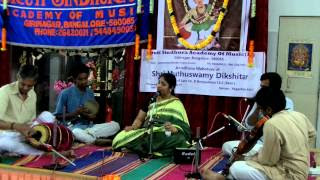


Musical Resume
-
Name: Smt. Kanchana S. Shriranjanai & Smt. Kanchana S. Shruthiranjani
-
Date of Births: 08-02-1978 & 15-7-1981
-
Fathers Name: Kanchana V. Subbarathnam
-
Mothers Name: K. Rohini Subbarathnam
Shriranjani’s Musical Achievements:
-
Recipient of the Kalavathamsa Award
-
Scholarship holders HRD Ministry, New Delhi
-
Received Grants from Ministry of Tourism& Culture, New Delhi
-
Won the award ‘Ananya Yuva Prathibha Puraskara’
-
1st Prize in State Level Competition conducted by Sangeetha Nrithya Academy
-
Innumerable awards, felicitations by renowned Educational Institutions, Religious Mutts, temples and Famous personalities.
-
Padmabhushana Dr. D.Veerendra Heggade felicitated for her musical achievements.
-
She has visited and performed in different parts of England.
-
Has brought forward several promising musicians through her extensive teaching and training
Shruthiranjani’s Musical Achievements:
-
Recipient of Award and appreciations from Padmabhushana Dr. Veerendra Heggade of Dharmasthala, Swamijis of Subramanya, Udupi, and Edneer Mutt.
-
Won the award ‘Ananya Yuva Prathibha Puraskara’
-
Well-versed in rendering Bhajans, gazals and Avadhana Pallavis.
-
Recipient of Merit Scholarship from the renowned Sri. D.Subbaramayya Trust, Bangalore.
-
Recipient of Scholarship from Human Resource of Development, Department of culture, New Delhi.
-
Has brought forward several promising musicians through her extensive teaching and training
Kanchana Ranjani Sisters musical life is one of astonishing achievements. At a tender age of 3 years, their father, Karnataka Kalashri Kanchana V. Subbarathnam the renowned violinist of our country, initiated them into music.
Having successfully served as one of the faculty in the famous Kanchana Shree
Lakshminarayana Music Academy Trust® in Dakshina Kannada District in Karnataka, Kanchana Ranjani Sisters have performed in many prestigious festivals and organizations all over the country. They have also performed in South Zone Cultural Centre organized programs. The intricate and scholarly “Avadhana Tala Pallavis” rendered by them, are recorded to be preserved in archives of famous music institutions and universities. To their credit, they have released many audiocassettes and CDs. Besides the rendition of their music concerts, Ranjani Sisters have also brilliantly organized many significant music events of various artists throughout Karnataka.
Family Background:
Kanchana Ranjani Sisters hail from a highly respectable family, which is renowned for patronage of music, for charity and benevolence. Sri. Kanchana Venkataramanayya, thier great grandfather was a great patron of Yakshagana, Harikatha and music. His spouse, Smt. Anandalakshmi was a renowned Veena and Leg Harmonium maestro. Their son Kanchana Venkatasubramaniam rendered Yeoman’s service in the field of patronage and propagation of music even under dire financial adversities. No wonder Kanchana is rightly called the ‘Tiruvayyar’ of Karnataka. His son, Kanchana V.Subbarathnam is a violinist of great repute. Their Maternal Grandfather, Mahamahopadhyaya Dr. R.Sathyanarayana is a very renowned musicologist of International fame. The art of Avadhana Pallavi has descended to these sisters from their maternal uncle R.S. Nandakumar. Smt. Kanchana Shriranjani is married to the renowned young Mridangam Vidwan Sri K.U.Jayachandra rao.
What Press Says:
THE HINDU
“Making Name all over the state and country she carved her own niche in the world of Carnatic Music.”
STAR OF MYSORE:
“The 120 minute concert left one craving for more. Senior musicians in the audience were appreciative. Warm welcome to Kanchana Sisters, who promise to be the contribution of Karnataka in the field of Carnatic Music, especially in the 21st Century.”
UDAYAVANI
“A Silver line in the field of Carnatic Music”
Academic Qualifications of Sriranjani:
-
M.A, LL.B
-
Proficiency - Vidwath in Carnatic Classical Vocal and Violin with 1st Rank in both; conducted by KSEE, Govt. of Karnataka
-
‘B’ High Graded Artists in AIR
Academic Qualifications of Shruthiranjani:
-
LL.B
-
Proficiency - Vidwath in Carnatic Classical Vocal and Violin with Rank; conducted by KSEE, Govt. of Karnataka
-
‘B’ High Graded Artists in AIR


