
Itaxsoftware.net

itaxsoftware.net
Itaxsoftware.net |
|
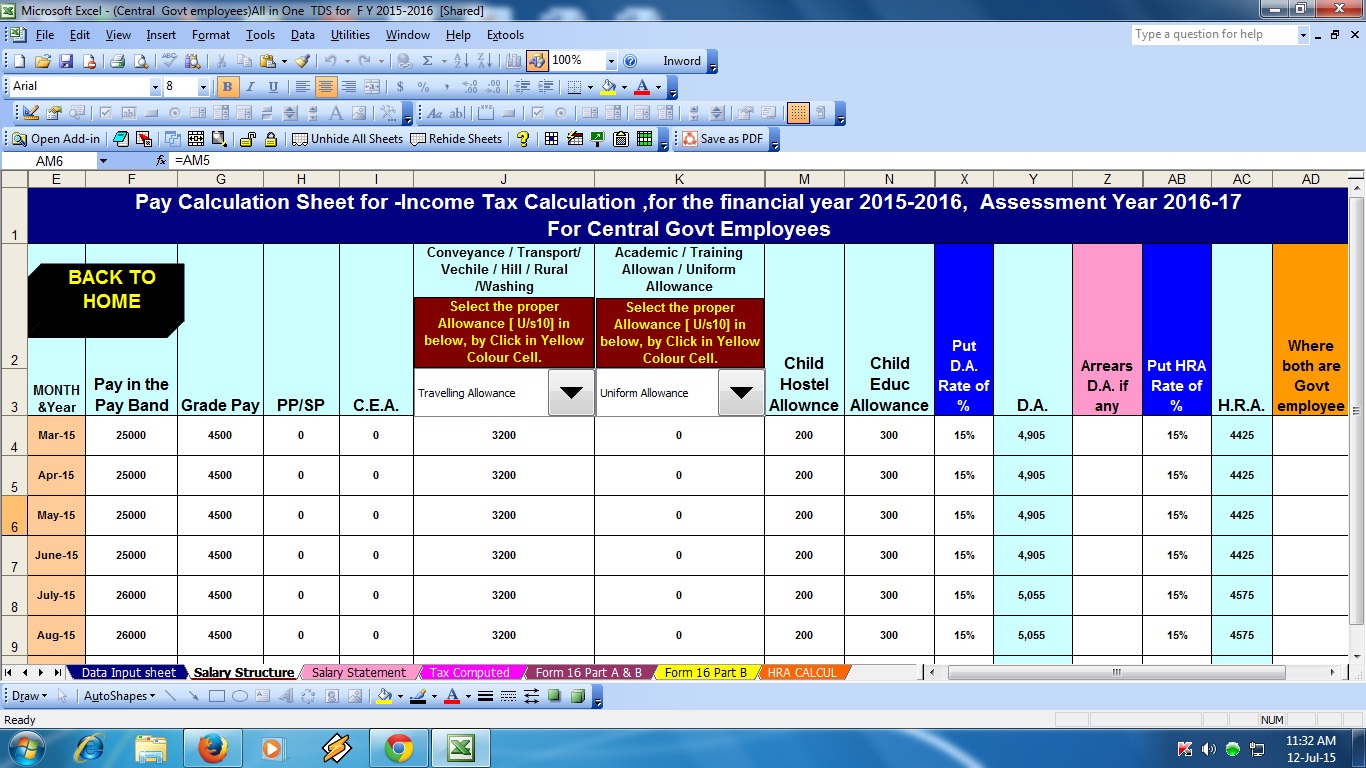
Posted: 14 Jul 2015 06:40 AM PDT Click here to Download the latest Income Tax Preparation Excel Based software which can prepare CENTRAL Govt employee’s For F.Y.2015-16 ( This Excel utility can prepare at a time Tax Computed Sheet + Individual Salary Sheet + Salary Structure for Central Govt Salary Pattern for calculating the Gross Salary Income + Automatic House Rent Exemption Calculation + Automatic Form 16 Part B and Form 16 Part A&B for the Financial Year 2015-16 and Assessment Year 2016-17.)
As per the Central Govt Salary Pattern and Central Govt employees Salary and Allowances made this Excel Utility and follow the Central Finance Budget 2015. All the Amended in Income Tax as per the Finance Budget have in this Software for the financial Year 2015-16 and Assessment year 2016-17. It seems that the various Central Govt Office calculate the Income Tax as manually which take time to calculate the Tax Liability.In this Excel Based Software can use Central Govt Employee. The Salary Structure of Central Govt Pattern have built in this utility and which can fit for Central Govt Employees Salary Structure. This Excel Based Software most easy to generate and easy to handle. You can prepare more than 100 employees TDS on Salary by this One software ( One by One). Feature this utility1. In build the Salary Structure for Calculating the Gross Salary with the all Benefits of Central Govt Salary Pattern. 2. All the Income Tax Section have in this Utility and you can view the section at a glance 3. Automatic Calculate your Income Tax Liability 4. Automatic Calculate the House Rent Exemption Calculation U/s 10(13A) 5. Automatic Prepare the Form 16 Part B and Form 16 Part A&B as you like to print 6. Print Facility of all the sheets 7. Automatic Convert the Amount in to the In Words
Click here to Download the latest Income Tax Preparation Excel Based software which can prepare Central Govt employee’s ( This Excel Utility can prepare at a time the Tax Computed Sheet + Individual Salary Sheet + Salary Structure for any State Govt concerned Salary Pattern for calculating the Gross Salary Income + Automatic House Rent Exemption Calculation + Automatic Form 16 Part B and Form 16 Part A&B for the Financial Year 2015-16 and Assessment Year 2016-17.)    
 This posting includes an audio/video/photo media file: Download Now |

| You are subscribed to email updates from itaxsoftware.net
To stop receiving these emails, you may unsubscribe now. |
Email delivery powered by Google |
| Google Inc., 1600 Amphitheatre Parkway, Mountain View, CA 94043, United States | |
itaxsoftware.net
Itaxsoftware.net |
|
Posted: 15 Jul 2015 07:36 AM PDT Substitution of new section for section 80EQ. Who is eligible for deduction u/s 80E? A. Loan should be taken by individual for pursuing higher education of self, spouse or his /her Children’s. Hence parents are also eligible to claim deduction of interest paid by them on loan taken for their children’s education. This deduction is not available to HUF. Click to download the Automatic All in One for Govt and Non-Govt employees for FY 2015-16 [This Excel Utility can prepare at a time Tax Computed Sheet+Individual Salary Structure+Automatic Arrears Relief Calculation+Automatic House Rent Exemption Calculation + Form 16 Part A&B and Part B with the all Income Tax Section including New Income Tax Section and Automatic Tax Rebate U/s 87A ]Q. What is eligible amount? A. Only interest paid on an educational loan is allowed as deduction u/s. 80E of The Income Tax Act, 1961, out of his/her income chargeable to tax i.e. Deduction will be allowed only when actual interest is paid. Q. How much amount is deductible? A. There is no limit for amount of repayment of interest. Unlimited amount of interest can be deducted under this section. However there is no benefit available on the repayment of principal amount of the loan. The assesse can claim the amount of interest in the initial assessment year & carry forward up to 7 assessment years. Deduction is allowed for a continuous period of eight years, starting with initial assessment year in which the assessee starts paying the interest on the loan or until the interest is paid in full whichever is earlier. Q. Can loan be taken for any education? A. The loan should be taken for the purpose of higher education. Q. Can higher studies be pursued outside India? A. There is no condition that the course should be in India. Q. Can loan be taken from relatives? A. The loan should be taken from any financial institution or any approved charitable institution. Interest on Loan taken from relatives or friends will not be eligible for deduction under section 80E. Download All in One TDS on Salary for Only Non-Govt employees for F.Y.2015-16 [ This Excel Based Software can prepare your Tax Compute Sheet + Individual Salary Structure as per Non-Govt Concerned Salary pattern + Automatic HRA Calculator U/s 10(13A) + Form 16 Part A&B and Part B for A.Y.2016-17]Below given the actually says by the Income Tax Department about the U/S 80E25. For section 80E of the Income-tax Act, the following section shall be substituted with effect from the 1st day of April, 2006, namely:— ‘80E. Deduction in respect of interest on loan taken for higher education.— (1) In computing the total income of an assessee, being an individual, there shall be deducted, in accordance with and subject to the provisions of this section, any amount paid by him in the previous year, out of his income chargeable to tax, by way of interest on loan taken by him from any financial institution or any approved charitable institution for the purpose of pursuing his higher education. (2) The deduction specified in sub-section (1) shall be allowed in computing the total income in respect of the initial assessment year and seven assessment years immediately succeeding the initial assessment year or until the interest referred to in sub-section (1) is paid by the assessee in full, whichever is earlier. (3) For the purposes of this section,— (a) “approved charitable institution” means an institution specified in, or, as the case may be, an institution established for charitable purposes and notified by the Central Government under clause (23C) of section 10 or an institution referred to in clause (a) of sub-section (2) of section 80G; (b) “financial institution” means a banking company to which the Banking Regulation Act, 1949 (10 of 1949) applies (including any bank or banking institution referred to in section 51 of that Act); or any other financial institution which the Central Government may, by notification in the Official Gazette, specify in this behalf; (c) “higher education” means full-time studies for any graduate or post-graduate course in engineering, medicine, management or for post-graduate course in applied sciences or pure sciences including mathe-matics and statistics; (d) “initial assessment year” means the assessment year relevant to the previous year, in which the assessee starts paying the interest on the loan.’. |


itaxsoftware.net
Itaxsoftware.net |
|
Posted: 16 Jul 2015 09:14 AM PDT 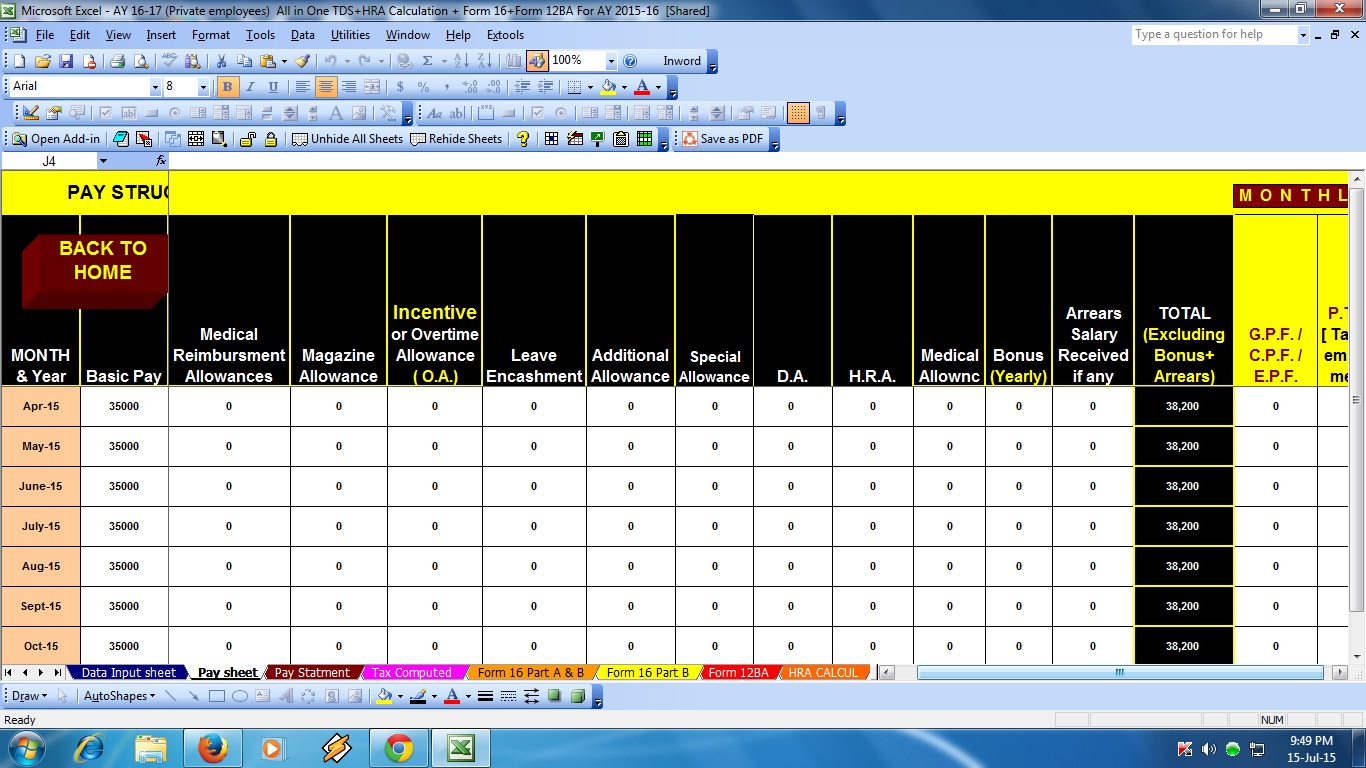 As per the Finance Budget 2015 have some changes in the Tax Section and hike the limit of some Section other than the Tax Slab is the same as previous Financial Year 2014-15. Main Changes in this Budget and main effect to the Salaried Person for Financial Year 2015-16 as given below 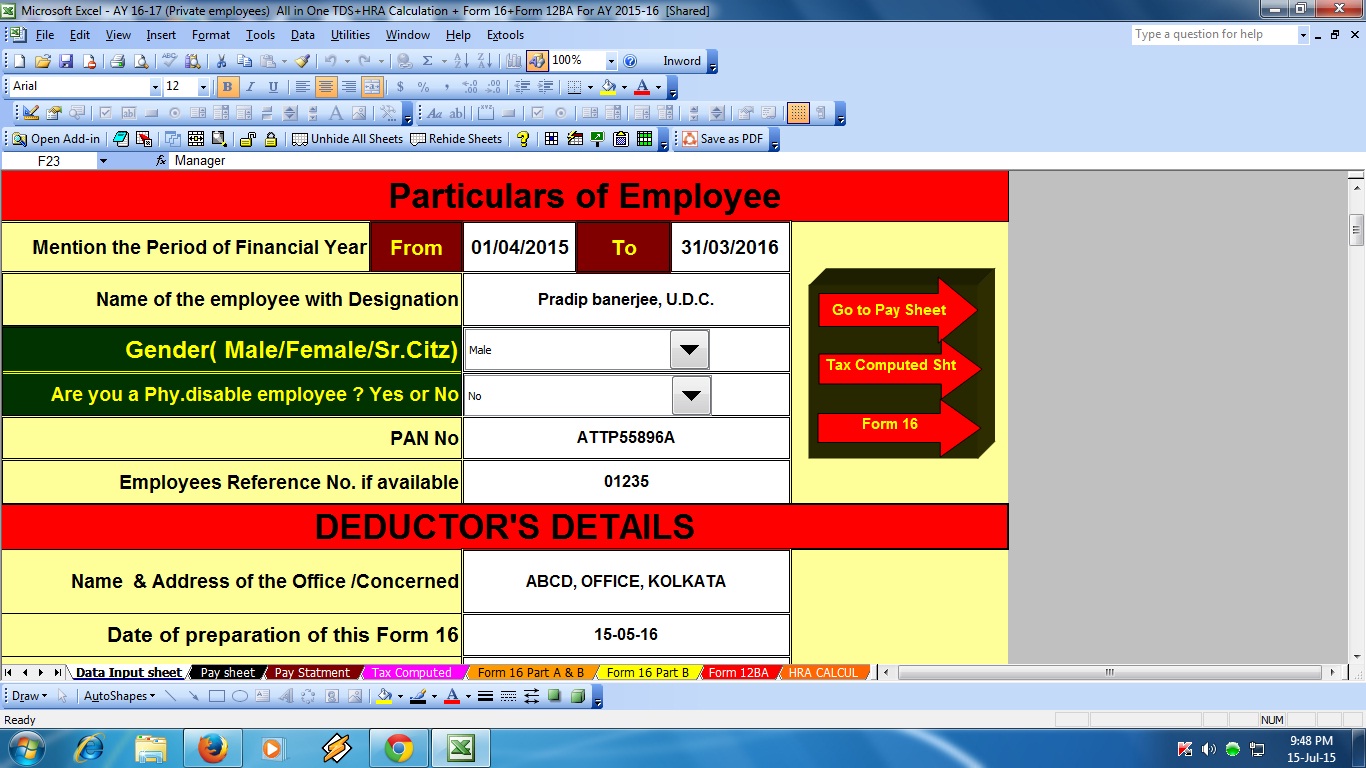
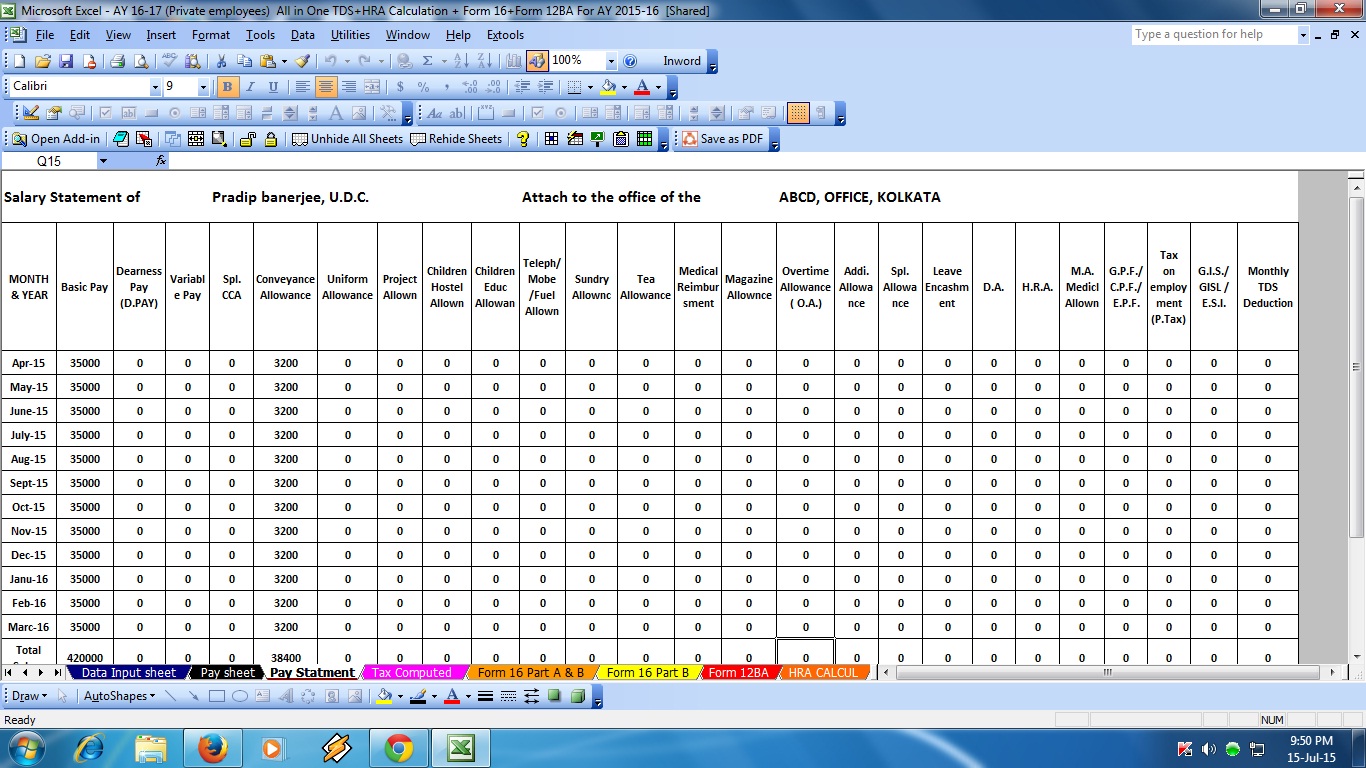 As per the Finance Budget 2015-16 have prepared the Excel Based All in One Income Tax Preparation Software for Only Private ( Non-Govt ) employees for Financial Year 2015-16. 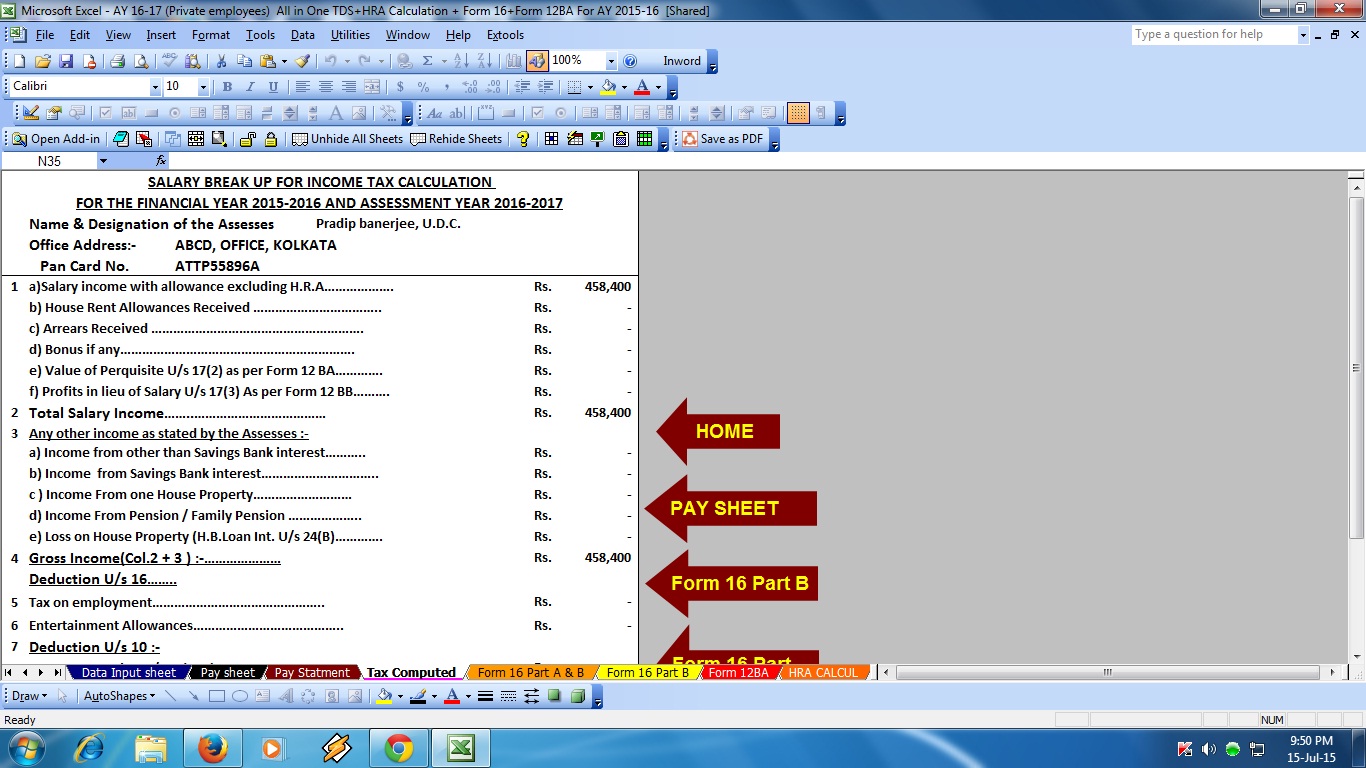 All in One Income Tax Preparation Excel Based Software for only the Non Govt employees for the Financial Year 2015-16 and Assessment Year 2016-17. This Excel Based Software can prepare at a time your Income Tax Compute Sheet + Automatic House Rent Exemption Calculation + Automated Form 16 Part B and Automated Form 16 Part A&B + Form 12 BA for the Financial Year 2015-16. 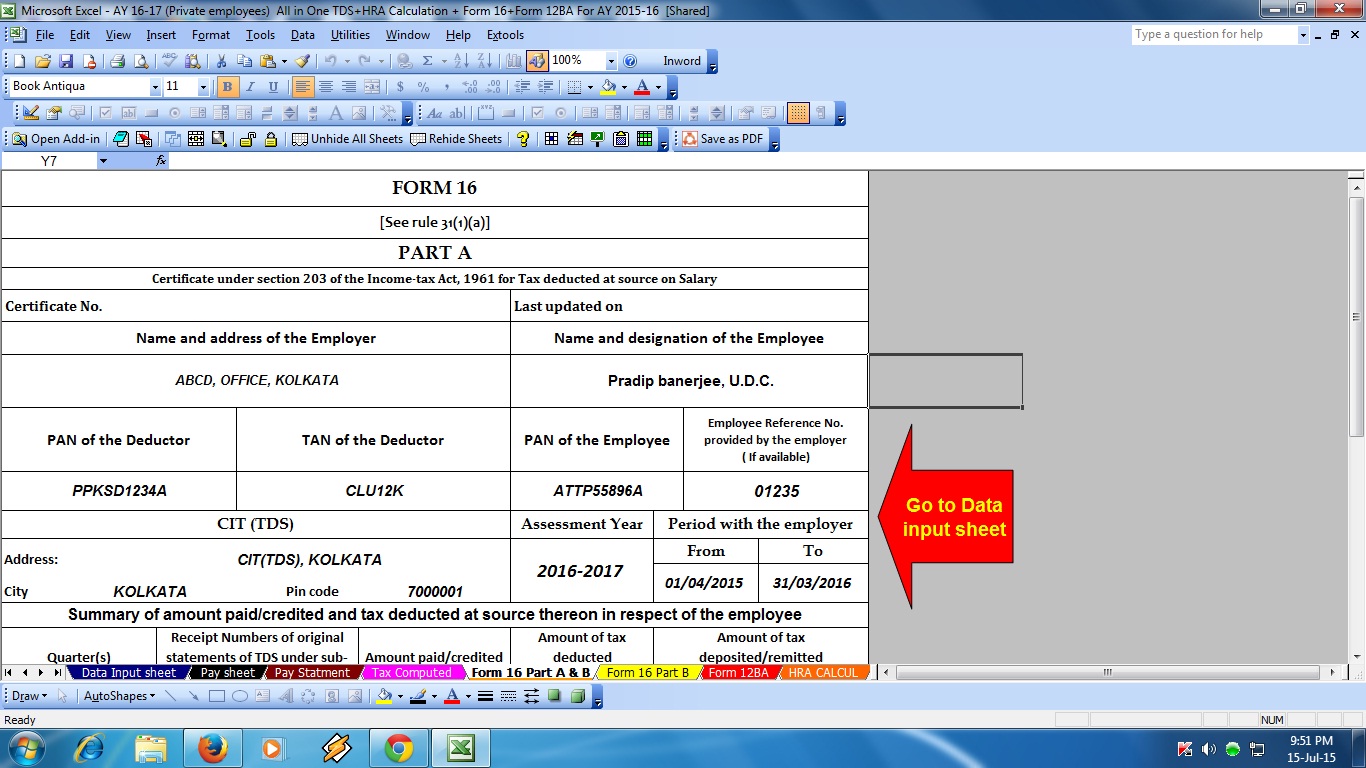 This Excel Based Software can use only for the (Private Employees) Non Govt employees. The Salary Structure has prepared as per the Salary Pattern of any Non Govt Concerned which can fit for any Private Concerned Salary PatternFeature of this Excel Based Software :-
|
|


itaxsoftware.net
Itaxsoftware.net |
|
Posted: 17 Jul 2015 07:41 AM PDT Click here to Download the Master of Form 16 Part B with 24Q & 26Q for the Financial Year 2015-16 & Assessment Year 2016-17 ( This Excel Based Software can prepare at a time 50 employees Form 16 Part B with 24Q & 26Q[All Quarters] )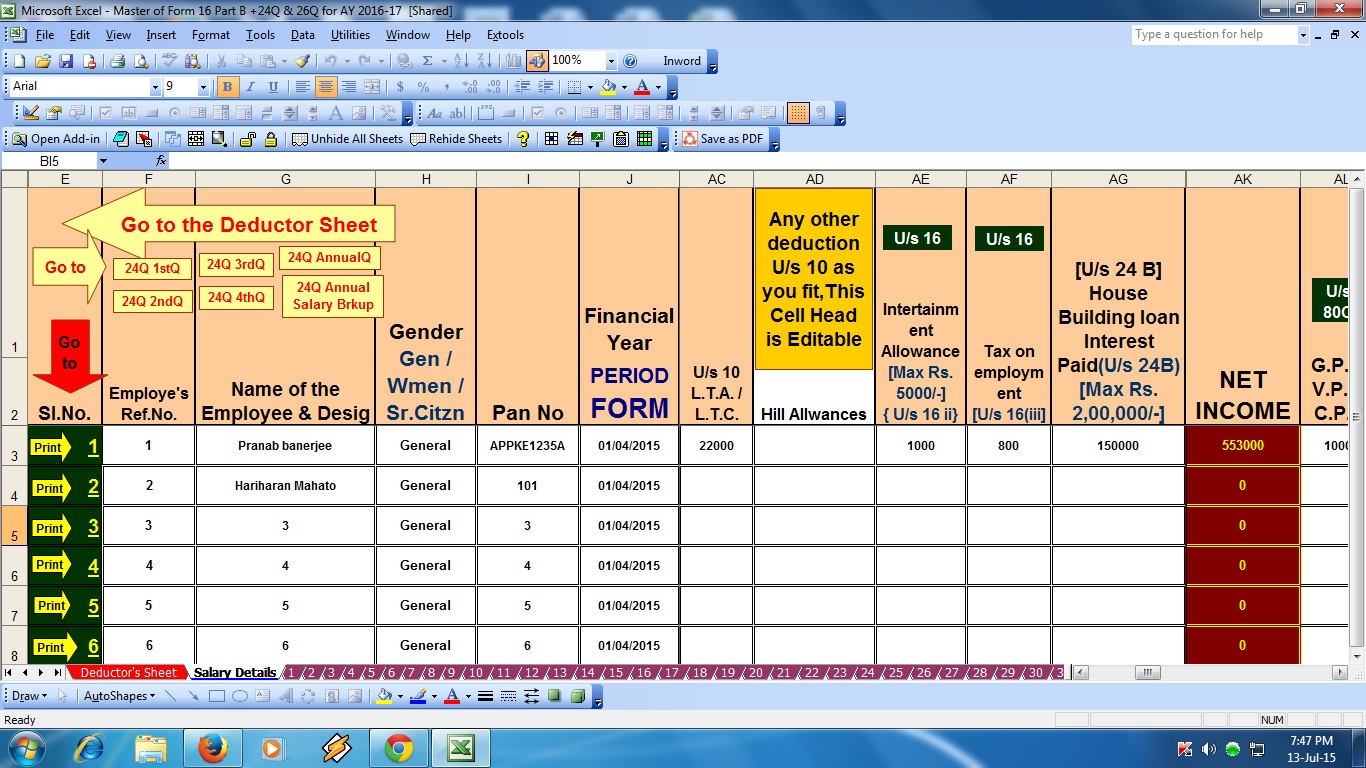 As per the Income Tax Rules it is mandatory to submit the each quarter ended Income Tax Return to the Central Govt by the Govt and Non-Govt Concerned of their employees with the Challan 24 Q for Govt and 26Q for Non-Govt Concerned. In the One Financial Year have 4 (four) quarter 1st,2nd,3rd and 4th and final quarter.The CBDT has modified the Challan of 24Q and 26Q and published the new Amended Format of 24Q and 26Q. 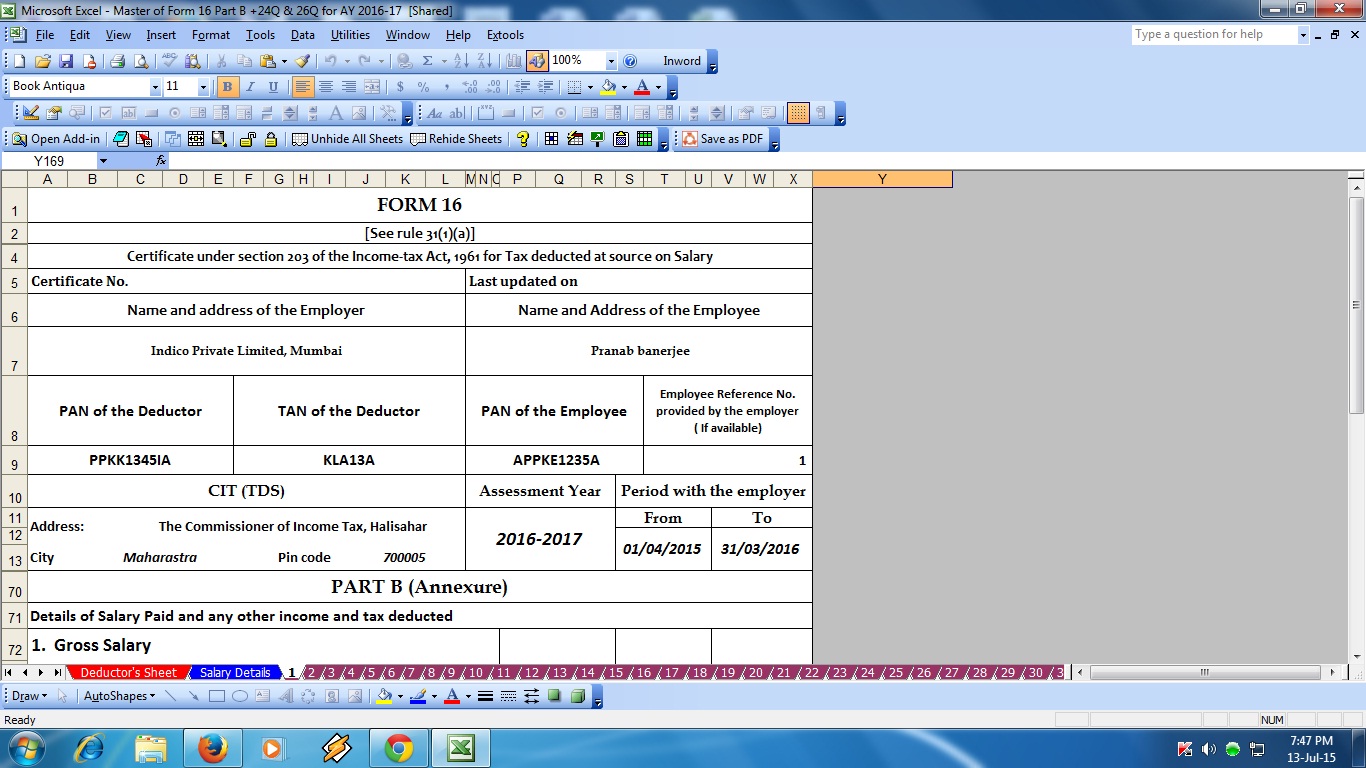 Most of the concerned have not prepare and submit the Challan in each quarter and it appears that they have submit only the 27A Challan where not found of each employees salary details as well as TDS deduction of each employees. Now it is Mandatory to submit the 24Q or 26Q by the CBDT in each quarter. The Final and 4th Quarter will be Total Income of the hole financial year of an employees with the details of TDS deduction with Annex A.  It may help if you have already prepare the both of Form 16 Part B and 24Q or 26Q of each quarter for the Financial Year 2015-16 & Assessment Year 2016-17. If it is possible, then your time will be reduce and it will be advance to prepare the Form 16 Part B which can distribute to the employees after 31st Marc 2016. The itaxsoftware.net have prepared an Excel Based Software which can prepare at a time 50 employees Form 16 Part B with 24Q & 26Q ( for all quarters) for the financial year 2015-16 and Assessment Year 2016-17. 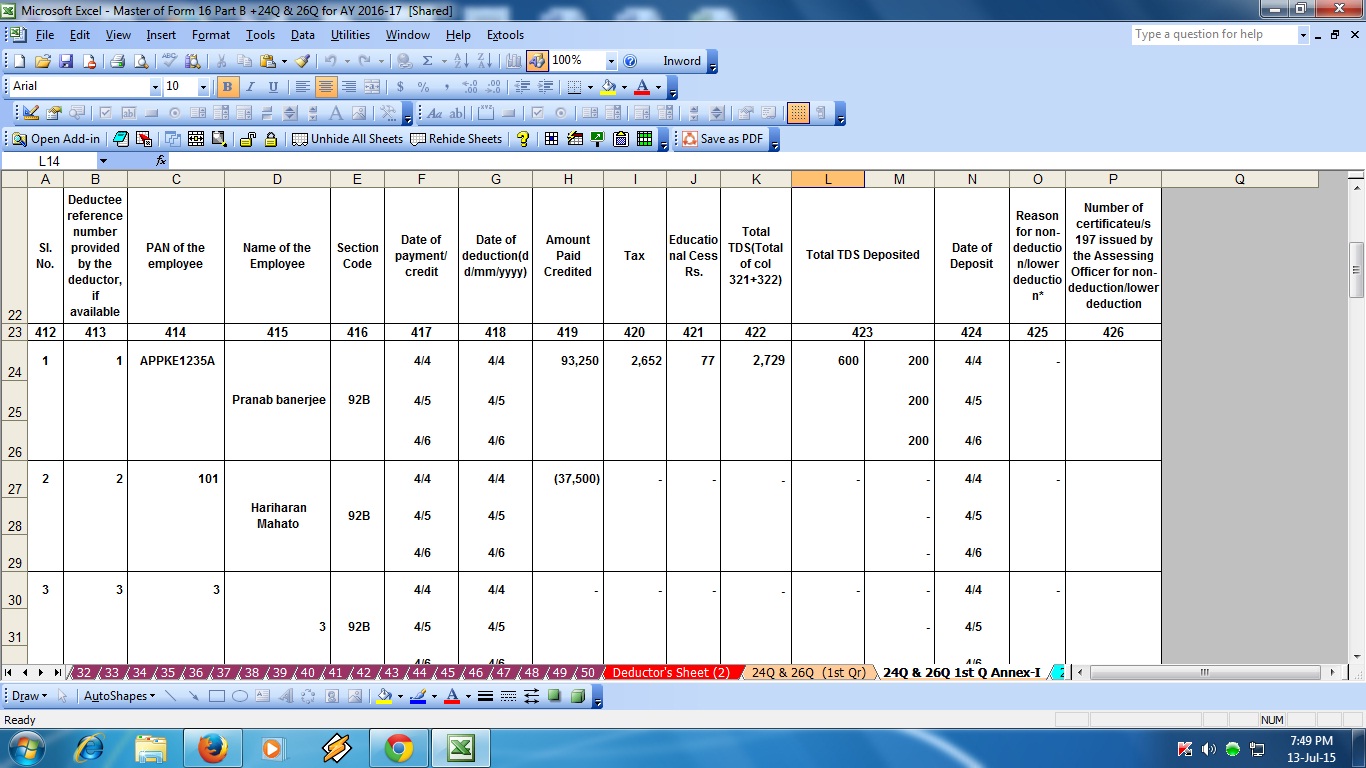 Feature of this Utility :- 1) This Excel Based Utility can prepare at a time 50 employees Form 16 Part B 2) Prepare at a time 50 employees All Quarters 24Q & 26Q ( Amended Version) 3) Prevent the double entry of the Name of Employee and Pan Number 4) Automatic Calculate the Income Tax 5) Automatic Prepare the Form 16 Part B ( Amended Version) 6) Automatic Convert the Amount in to the In Words ( Without any Excel Formula) 7) Easy to install in any Computer 8) Easy to Generate as this file is simple Excel File 9) Both of Govt and Non-Govt Concerned can be used this utility 10) The Salary Structure have in built, so it will be easy to calculate Tax Liability Click here to Download the Master of Form 16 Part B with 24Q & 26Q for the Financial Year 2015-16 & Assessment Year 2016-17 ( This Excel Based Software can prepare at a time 50 employees Form 16 Part B with 24Q & 26Q[All Quarters] ) |


itaxsoftware.net
Itaxsoftware.net |
|
Posted: 18 Jul 2015 09:54 AM PDT Government is trying hard to go green but the necessity of sending signed ITR-V form to Bangalore was becoming an obstacle to make e-filing process completely paperless. Digital Signature has already been mandated for the companies to file and verify their returns but individuals were given an option to sign the physical copy of ITR-V and send it to CPC, Bangalore. Government has come out with the Electronic Verification Code for verifying the income tax return to get rid of this last piece of paper and make the e-filing process completely paperless. Now, you just have to put an EVC after filing your return and you are done with e-filing, no need to send signed ITR-V to CPC, Bangalorewithin 120 days’ time frame. What is Electronic Verification Code (EVC)?Electronic Verification Code (EVC) is a 10 digits alpha numeric code to verify your income tax return and can be generated via various methods. Let’s see the features and usage of Electronic Verification code to e-verify your income tax return. § EVC is a 10 digit alpha numeric code which would verify the identity of the person filing the income tax return. § The EVC could be used to verify ITR 1 (Sahaj) / ITR 2 / ITR 2A / ITR 3 / ITR 4 /ITR 4S (Sugam). § EVC would be unique and can be used only with the PAN of the person furnishing the income tax return. This means one EVC for one PAN. § One EVC can be used to validate only one ITR whether it is original or revised return. § The EVC remains valid for 72 hours but can be generated various times through various modes. § In case the tax returns are already filed or uploaded, the verification needs to be done within 120 days of filing of return. How to Generate Electronic Verification Code (EVC)?CBDT has notified four methods to generate Electronic Verification Code (EVC). Before proceeding to generate EVC please ensure that the mobile number and email address registered with the CBDT is accessible by you. 1. Generate EVC through e-filing websiteI consider this as the simplest method because you just need to click few buttons and you will get EVC on your mobile and registered email. But this method is only available if your salary income is up to Rs.5 lacs and you are not claiming any tax refunds. § Simply login to your account with PAN number as user id and your password. § Click on the e-file tab and select Generate EVC as shown in the image below: § You would then receive EVC on your registered mobile number as well on your registered email address. 
2. Generate EVC through Linking Aadhaar Card with PANBefore generating EVC through Aadhaar Card, make sure that your mobile number should be registered with your aadhaar. (I faced this problem generating EVC). How to link your aadhaar with PAN?After login, you would see “Profile Settings” Tab besides downloads. Click on it and a drop-down menu would appear, select Link Aadhaar with PAN. You would then be presented with the image as shown below:  Fill in the required details and click on Link Now to complete the process. Next Step would be to generate EVC and for that you have to select “I would like to generate Aadhaar OTP to e-Verify my return” at the time of e-verifying your tax return. 3. Generate EVC through Bank ATM (Automatic Teller Machine)For this option you have to use the ATM card of the bank which is registered with the IT department. You can generate EVC by selecting “generate EVC for ITR filing” appears on the ATM Screen. The EVC would be sent to your registered mobile number with Bank. 4. Generate EVC through Net Banking FacilityGenerating EVC using Net Banking requires you to route your process of e-filing through the bank which is registered with IT Department. You would have to login into your net banking account and seek the redirection to income tax e-filing website where you can generate EVC. The EVC would be sent to your registered mobile number with Bank. This option requires a valid PAN to be linked with your Bank account as per KYC norms and ITR should be for same PAN number. How to use Electronic Verification Code (EVC) to verify Income Tax Return?Electronic Verification Code (EVC) for e-verification process of Income Tax Return can be used while:
1. In case you are Uploading Tax Return without using Net Banking than as soon as you are finished with uploading of return, a screen having following options would popup:
You can use any one of the above options (1 to 3) to e-verify your Income Tax Return and download the Acknowledgement (No Further action required). Option 1 requires you to put the EVC you have already generated and then download the Acknowledgement (No Further action required). Option 2 requires you to generate EVC either through AMT or E-filing website. Option 3 would use generating EVC through Aadhaar Card (As described above). Option 4 would means you don’t want to use the new method of EVC and would like to go with the old method of ITR-V signing and sending it to CPC Bangalore. 2. In case you have routed to e-filing website through net banking account then after you finish uploading tax return three options would be shown on your screen:
You can use any one of the above options (1 and 2) to e-verify your Income Tax Return and download the Acknowledgement (No Further action required). Option 1 would simply need you to confirm the verification of ITR by clicking on “Continue” button. Download the Acknowledgement (No further action is required). Option 2 remains same as in above case and ECV would be sent to your registered mobile number. Option 3 would be old method of ITR-V signing. 3. Verification of Already Uploaded Returns requires you to verify them within 120 days of submission or uploading by following below mentioned steps:


 Remember: E-Verification of Income Tax Return through Electronic Verification Code (EVC) is available from the current assessment year i.e. 2015-16 (F.Y. 2014-15). If you are filing belated return of the last previous year u/s 139(4) or filing revised returns for past years u/s 139(5) than you would have to follow the old method of ITR-V signing and sending it to CPC, Bangalore within 120 days of filing of return. |


itaxsoftware.net
Itaxsoftware.net |
|
Posted: 19 Jul 2015 08:56 AM PDT Click & Download Automated Master of Form 16 Part B for FY 2014-15 ( This Excel Utility can prepare at a time 100 employees Form 16 Part B for Financial Year 2014-15As per the CBDT Notification the Format of Form 16 have already changed and this Form 16 have divided in two part, One is Part A and Part B. The Part A is now mandatory to download from the TRACES Portal and the Part B is mandatory to prepare by the employer.Now the time of each and every Govt or Non Govt Concerned busy to prepare and supply the Income Tax Salary Certificate Form 16 for the Financial Year 2014-15 and Assessment Year 2015-16. The Excel Based Software for preparing the Form 16 is available in various Web Site. But this Excel based Software unique to other Software. New Tax Slab and Some Changes in Income Tax in Financial Year 2014-15 As per the new Finance Budget the Income Tax Slab has raised from 2 Lakh to 2.5 Lakh and the Tax Section 80C has also raised from 1 Lakh to 1.5 Lakh, it is the great news to the all salaried persons for the Financial Year 2014-15. The Income Tax Section 87A Tax Rebate Rs. 2,000/- will be continue in this Financial Year 2014-15.
|
|
Here is given below Two Type of Form 16 Preparation Excel Based Software, 1) One by One Preparation Form 16 Part A&B and Part B (2) Master of Form 16 Part B ( This utility can prepare at a time 50 employees Form 16 Part B) Download the utility from below link:-1) Click to download One by One Preparation Form 16 Part A&B and Part B for FY 2014-152) Click to download Master of Form 16 Part B for FY 2014-15 ( This utility can prepare at a time 50 employees Form 16) |


|
Joint Home Loan can entitled : Eligibility rules & Income Tax Benefits U/s 80C and U/s 24B Posted: 19 Jul 2015 04:53 AM PDT A joint home loan not only allows you to share your debt burden but also allows you to extract maximum benefits offered by the IT Act. As per the existing Income Tax Laws, both the individuals (loan applicants) can claim income tax deductions on the principal repayment under section 80c and on the interest amount under Section 24. The maximum amount that can be claimed as tax deduction depends on the use of the property ie whether it is a ‘Self occupied property’ or a ‘Let-out property’. What is a Joint Home Loan? – A joint home loan is a loan which is taken by more than one person. Who is a co-borrower? – A Co-borrower is a person with whom you take the home loan jointly. Who is a co-owner? – A Co-Owner is an individual that shares ownership in an asset with another individual / group. Joint Home Loan & Eligibility rules / ConditionsIf the loan applicants are married couples then it is a perfect arrangement for home loan providers. The couple is at liberty to decide if they want to be co-owners or if only one of them wants to be a co-borrower. If the loan applicants are Father & son or Father & unmarried daughter then Lenders generally insists on the son / daughter being the Primary Owner of the property. (This can be applicable when Mother & unmarried daughter are the borrowers)
|


itaxsoftware.net
Itaxsoftware.net |
|
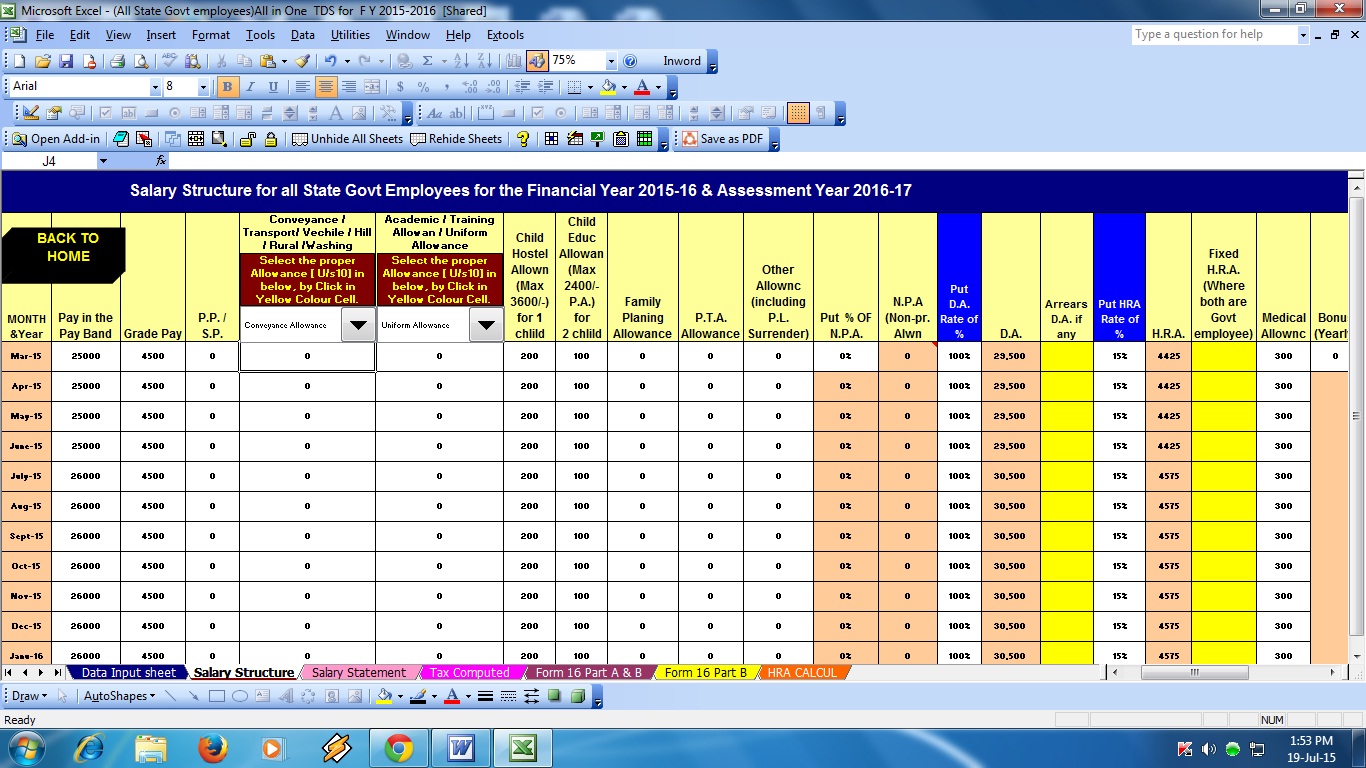
Posted: 20 Jul 2015 06:10 PM PDT Download the Excel Based Income Tax Software All in One for All State Govt employees for the Financial Year 2015-16 and Assessment Year 2016-17 with all new feature of Finance Budget 2015-16 [ This Excel Utility can prepare at a time the Tax Compute Sheet + As per Salary Structure of State Govt Employees the Salary Structure + Automatic House Rent Exemption Calculation + Form 16 Part A&B and Form 16 Part B for FY 2015-16]
Apart from increase in Income Tax exemption limit under Section 80 D for Health Insurance Premium and enhanced exemption limit for Transport Allowance, Salaried Employees coming under NPS will get additional Income Tax Exemption in the Financial Year 2015-16, if they contribute in excess of Rs. 1,00,000 in NPS. Section 80 CCD (1) : Provision meant for deduction of own contribution in NPS from total income. Limit provided under this Section has been increased from Rs.1,00,000/- to Rs. 1,50,000/- Finance Bill 2015-16 provides that a tax payer can avail Income Tax Exemption under Section 80 CCD(1) by way of deduction of contribution made by him/her in National Pension System (NPS) up to Rs. 1,50,000. This new change in Section 80CCD (1) by introducing an additional sub section in the form of sub section 1B to Section 80CCD and by deleting existing sub section 1A, provides for additional exemption / deduction from total income to extent of Rs. 50,000 over and above limit of Rs. 1.50 lakh imposed by Section 80CCE (for the purpose of allowing deduction under Section 80C, 80CCD(1) and Section 80CCC) But Who will really be benefited by this additional Deduction / Exemption under Section 80CCD (1B)?Individuals who are self employed and allowed to contribute 10% of their gross total income in NPS and tax payers who contribute up to Rs.1,50,000 in Tier 1 account in a year towards NPS by virtue of their higher salary will be benefited by this additional limit. In other words, those who earn less than Rs.15 lakh in a year and contribute in 10% of their salary in NPS Tier 1 account will be benefited under Section 80 CCD (1) only up to the value of the yearly contribution made by them in NPS and it would be less than Rs. 1.5 lakh Note on amendment / Omission relating to Section 80CCD in Finance Bill 2015Clause 17 of the Bill seeks to amend section 80CCD of the Income-tax Act relating to deduction in respect of contribution to pension scheme of Central Government. The existing provisions contained in sub-section (1) of section 80CCD, inter alia, provides that in the case of an individual, employed by the Central Government on or after 1st January, 2004, or being an individual employed by any other employer or any other assessee being an individual who has in the previous year paid or deposited any amount in his account under a pension scheme notified or as may be notified by the Central Government, a deduction of such amount not exceeding ten per cent. of his salary is allowed. It is proposed to omit sub-section (1A) and insert a new sub-section (1B) so as to provide that an assessee referred to in sub¬section (1), shall, be allowed an additional deduction in computation of his total income, of the whole of the amount paid or deposited in the previous year in his account under a pension scheme notified or as may be notified by the Central Government, which shall not exceed fifty thousand rupees. It is also propose to provide that no deduction under this sub-section shall be allowed in respect of the amount on whcih deduction has been claimed and allowed under sub-section (1). Consequential amendments have been proposed in sub-section (3) and sub-section (4) of section 80CCD. These amendments will take effect from 1st April, 2016 and will, accordingly, apply in relation to the assessment year 2016-17 and subsequent assessment years. Provisions of Finance Bill 2015 that seeks amendment / Omission relating to Section 80CCD17. Amendment of section 80CCD. In section 80CCD of the Income-tax Act, with effect from the 1st day of April, 2016,-— (a) sub-section (1A) shall be omitted; (b) after sub-section (1A), as so omitted the following sub-section shall be inserted, namely:— “(1B) An assesse referred to in sub-section (1), shall be allowed a deduction in computation of histotal income, [in addition to the deduction allowed under sub-section (1)], of the whole of the amount paid or deposited in the previous year in his account under a pension scheme notified or as may be notified by the Central Government, which shall not exceed fifty thousand rupees: Provided that no deduction under this sub-section shall be allowed in respect of the amount on which a deduction has been claimed and allowed under sub-section (1); (c) in sub-section (3),— (I) for the words, brackets and figure, “sub-section (1)”, wherever they occur, the words, brackets, figures and letter “sub-section (1) or sub-section (1B)” shall be substituted; (II) for the words “under that sub-section”, the words “under those sub-sections” shall be substituted; (d) in sub-section (4), for the words, brackets and figure, “sub-section (1)”, the words, brackets, figures and letter “sub-section (1) or sub-section (1B)” shall be substituted. Section 80 CCD (2) : Though there is no change as far as Section 80 CCD(2) this section finds mention here as this is an Income Tax Exemption that a NPS Employee gets for the contribution made by Govt / employer. It provides for Income Tax Exemption with no limit for 10% of Salary consisting of basic pay and Dearness Allowance if any contributed by an employer in NPS Tier 1 Account. The more attractive feature of this deduction provision is that it is not limited by overall exemption limit of Rs. 1.5 lakh under Section 80 CCE of Income Tax Act. In other words, deduction for contribution made by an employer towards NPS Tier 1 account will be allowed in addition to Rs. 1.5 lakh exemption limit under Section 80 CCE. |


itaxsoftware.net
Itaxsoftware.net |
|
Posted: 21 Jul 2015 07:39 AM PDT Download All in One TDS on Salary for Govt and Non-Govt employees for F.Y.2015-16 and A.Y.2016-17[ This Excel Utility can use both of Govt and Non-Govt Concerned + Tax Compute Sheet + Individual Salary Sheet + Individual Salary Structure + Automatic Arrears Relief Calculator with Form 10E + Automatic HRA Exemption Calculation + Form 16 Part A&B and Part B]
While Finance Minister termed Budget 2015-16 as a growth oriented one with due attention to common and poor in India, there were not much changes as far as Income Tax 2015-16 in respect of salaried employees concerned. Personal Income Tax Rates were untouched and as a result Salaried Class will have to pay same Income Tax that they paid last year. However, following changes have been effected with regard to deductions / exemption allowed from total income of Salaried Employees under various Sections Income Tax Act by which quantum of Income Taxpayable this year may get reduced if an employee is eligible for such deduction / exemption. Sukanaya Samriddhi Scheme made eligible for deduction under Section 80C Max Rs. 1.5 LakhIndividuals who are subjected to Personal Income Tax Provisions can now save Sukanaya Samriddhi Scheme, a newly started savings scheme with a view to encourage savings in the name of girl child’s education and marriage, for the purpose of claiming deduction under Section 80C Additional Income Tax Exemption in respect of Health Insurance Premium under Section 80 D:Medical expenditure is getting increased day by day and however awareness towards Health Insurance is very minimal in India. In order to make Health Insurance Schemes more attractive and to cover entire health insurance premium paid by an employee for the purpose of deduction under Section 80 D, limits of Health Insurance Premium for covering individual and a senior citizen for the Income Tax Exemption have been increased to Rs. 25,000 and Rs. 30,000 respectively. Moreover, as far as very senior citizens (aged 80 years or more) are concerned any payment made on account of medical expenditure up to Rs. 30,000 would be eligible for deduction under Section 80D. More Deduction under Section 80DD for very senior citizens (increased from Rs. 50,000 to Rs. 80,000)While an individual is eligible to deduct up Rs. 50,000 which was spent towards medical expenditure under Section 80DD, budget 2015 has brought out an additional provision under this section to allow deduction of Rs. 80,000 for very senior citizens. The condition of producing certificate from a medical doctor under Section 80DDB has been relaxed and it is enough the tax payer produces a prescription from a specialist doctor. Additional Income Tax Exemption for Persons with disability under Section 80U:In view of the rising cost of medical care and special needs of a disabled person, it is proposed to amend section 80DD and section 80U so as to raise the limit of deduction in respect of a person with a disability from Rs. 50,000 to Rs. 75,000. It is also to raise the limit of deduction in respect of a person with severe disability from Rs. 1 lakh to Rs. 1.25 lakhs. Limit under Section 80CCD and Section 80CCC for contribution in NPS and other pension funds raisedAn additional deduction under section 80CCD to the extent of Rs. 50,000 has been introduced for contributions under the National Pension Scheme. Deduction towards Transport Allowance increased Rs. 1600 per monthThe long due increment in the monthly travel allowance has now finally materialized. In order to commensurate with the increased costs of transportation, it is now proposed to be double the original transport allowance and it shall stand at Rs. 1,600 per month. And more than 80% Rs. 3200/- P.M. |


itaxsoftware.net
Itaxsoftware.net |
|
Posted: 22 Jul 2015 10:00 AM PDT Downloadthe All in One Tax Preparation Excel Based Software for Central Govt employeesfor F.Y.2015-16 and A.Y.2016-17 [ This Excel Utility can prepare at a time your Tax Compute Sheet + Individual Salary Structure + Individual Salary Sheet + Automatic HRA Exemption Calculation + Automatic Form 16 Part A&B and Form 16 Part B including the latest amended by the Finance Budget 2015-16]Insurance Policies Tax BenefitsThe very first step of a successful tax or financial planning start with getting yourself adequately Insured. Let’s see how you can save tax through Insurance Policy in India. Life Insurance Tax BenefitTax benefit on Life Insurance Policy Premium Paid
Insurance Sum Received:In case the policy is surrendered before the maturity than the whole sum received from the Insurer will be taxable, if 5 premiums have not been paid. If you have surrendered the policy after paying 5 premiums than the amount received from the insurer would be tax-free. 2. On Maturity: Insurance Sum received on maturity is completely tax-free u/s 10 of the I-T Act. 3. On the Death of the Policy Holder: Insurance Sum received on the death of the assesse by his family or legal heirs is completely tax-free u/s 10 of the I-T Act. But a death certificate of the policy holder is required to be given to the insurer along with the other documents to claim the insurance amount. Health Insurance Tax Benefit or Mediclaim PolicyTax benefit on Health Medical InsurancePremium Paid:But to claim the deduction, few conditions have to be met:
Insurance Sum Received:Many of the Insurance Companies have started Cashless Health Insurance Schemes, under which you don’t need to pay any amount to the medical institutes. The medical bills are directly paid to the medical institute by TPA/Insurance Company. |


itaxsoftware.net
Itaxsoftware.net |
|
Posted: 23 Jul 2015 08:53 AM PDT Click here to Download the All in One Master of Form 16 Part B with Individual Salary Structure for FY 2015-16 ( Prepare at a time 50 employees Individual Salary Sheet + Individual Salary Structure + Form 16 Part B for the Financial Year 2015-16)It is most laborious to calculate the individual Income Tax calculate without Salary Structure of an employee, but this Excel Utility in build the Individual Salary Structure for each employee, where you can easily calculate the Gross Salary Income and also automatic feed the calculation in the Form 16 Part B.The Salary Structure has build in the concept of every Govt and Non-Govt Salary Pattern and this Salary Structure may fit for each and every Concerned Salary and Benefits. You can also Print the Individual Salary Sheet for each employee and preserve the same for your office use. 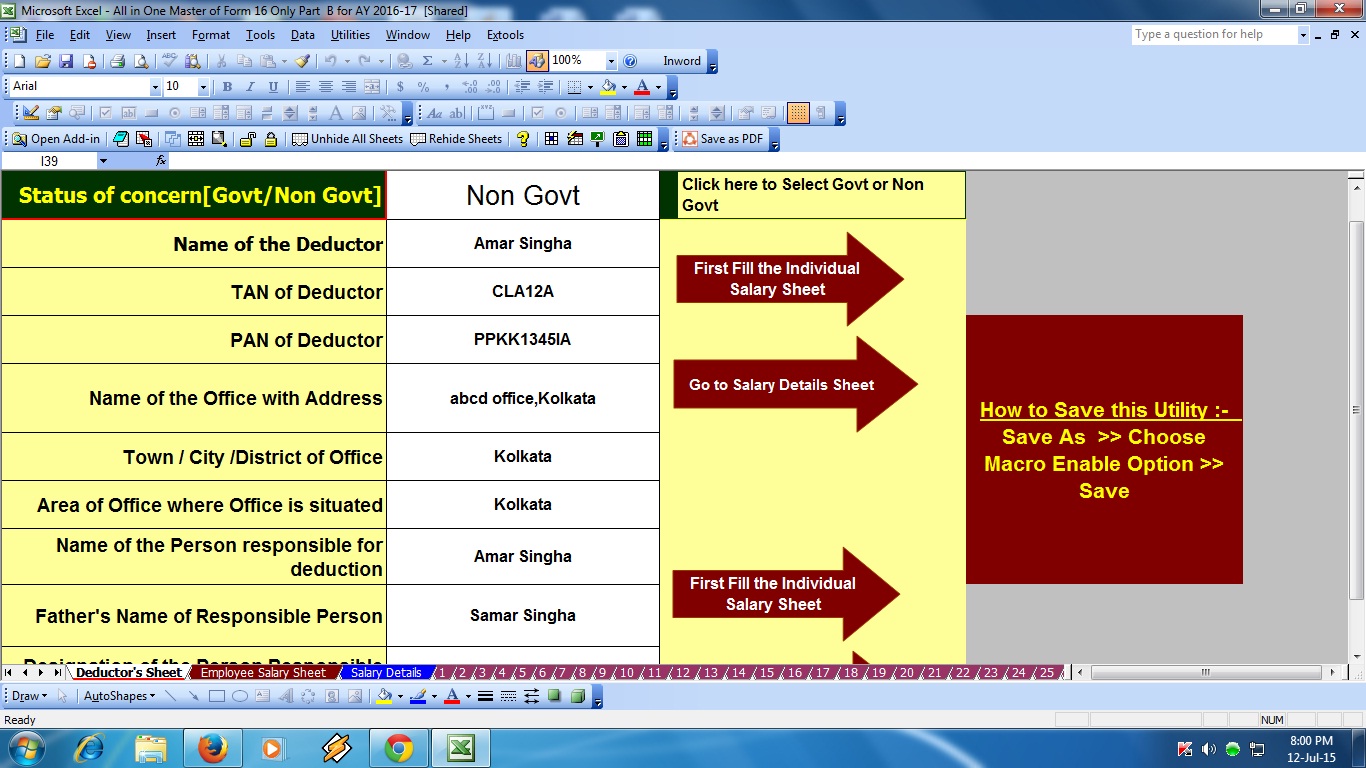 The all of new Income Tax Section have in this Excel Utility, no need to search for new Income Tax Section. This Section include as per the new Finance Budget 2014. The Tax Slab and Section 80 C has also include in this Utility as per the new Income Tax Slab. 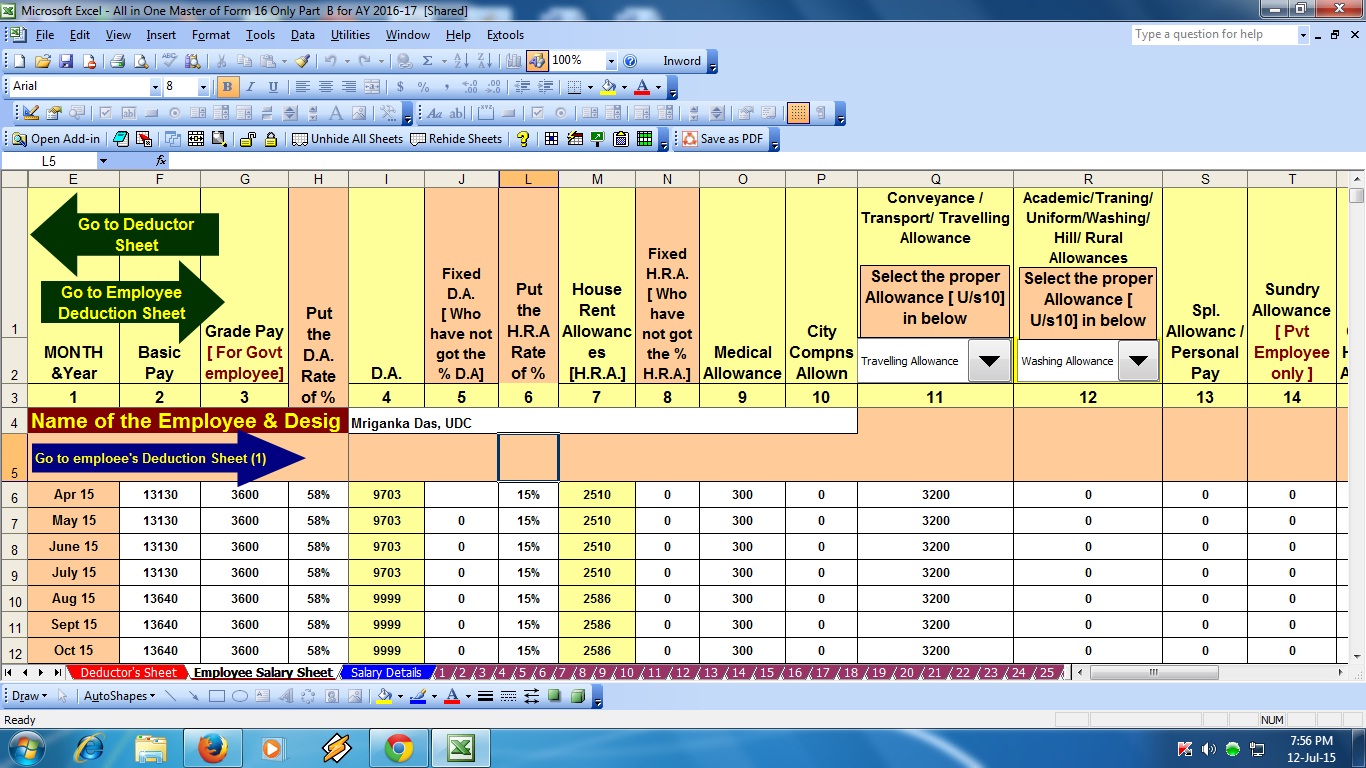 All the calculation have made automatically and all Income Tax Section as per the Income Tax Rules have calculate by this utility.  First you should fill the employees Individual Salary Structure, then Fill the employees deduction Under Chapter VIA, after filling this two sheet the Individual Salary Sheet and the Form 16 Part B will be prepare automatically.This Excel Utility can use for both of Govt and Non-Govt Concerned employee. 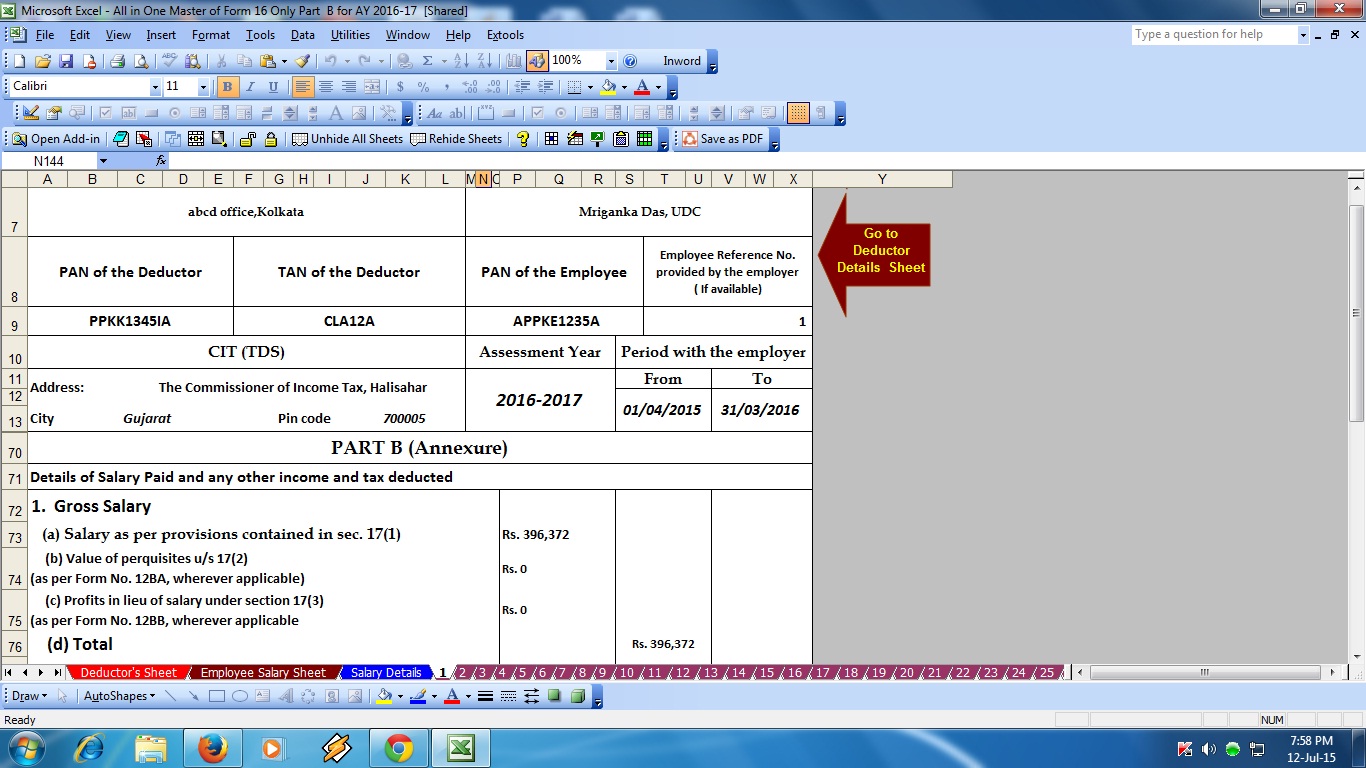 Click here to Download the All in One Master of Form 16 Part B for F.Y.2015-16 ( Prepare at a time your Individual Salary Sheet + Individual Salary Structure + Form 16 Part B for the Financial Year 2015-16) |


itaxsoftware.net
Itaxsoftware.net |
|
Check Your Form 26AS before filing Income tax return for Assessment Year 2015-16 Posted: 24 Jul 2015 09:04 AM PDT  Form 26AS is the important document issued by the IT department to the taxpayers. I have noticed that the majority of taxpayers are not aware of Form 26AS and its importance. In order to spread awareness about Form 26AS I am here with detail information about Form 26AS and its importance. What is Form 26AS?Form 26S is consolidated annual tax statement issued to the income tax payer by the IT department every year. You can download Form 26AS from Income tax filing website. Form 26AS shows how much tax is credited on your account from various sources like salary, pension, interest income etc. Apart from this Form 26AS contains following information. Part A: Details of Tax Deducted at Source (TDS)Part A1: Details of TDS for 15G/15H Part A2: Details of TDS on sale of immovable property Part B: Details of Tax Collected at Source (TCS) Part C: Details of Advance tax, self-assessment tax or regular assessment Part D: Details of paid Refunds Part E: Details of AIR transactions Why it is Important to check form 26AS before filing Income Tax return?You should cross check detail mentioned in form 26AS against TDS certificate. i.e Form 16 or Form 16AS before filing income tax return. This is to ensure that the TDS deducted on behalf of the taxpayer by deductor is actually deposited with the income tax department. E.g If you are a salaried person and your employer has deducted Rs 50,000 and you have also paid the advance tax of Rs 10,000, form 26AS should reflect these details. If your 26AS is not showing this detail and you are filing a income tax return without checking 26AS it will be misleading information in Income tax return and you may receive demand notice. How 26AS form is useful to you?
What is the reason of mismatch in Form 26AS? Sometimes Form 26AS contain information that is not matching with TDS certificate. The reason of mismatch in form 26AS is given below. Non Filing of TDS Return – Dedcutor has not filed TDS return which will result in non mapping of TDS deducted with form 26AS. Wrong Information in TDS Return– Deductor have punched wrong information in TDS written like PAN number, Amount of TDS deducted, Amount of TDS deposited or Assessment Year. Omission of Information in TDS Return – Mismatch Due to clerical mistake done by theWhat is to be done in case of mismatch in TDS and Form 26AS? In case you find a mismatch in TDS and form 26AS, you don’t have any option but to chase deductor of TDS (employer or bank) to correct the mistake. If the return is not filed you need to ask them to file TDS return. If the return is already filed you need to ask them to locate and correct the mistake. How to view/download Tax Credit Statement Form 26AS? You can view/download this form in 2 different ways. On Income tax site -

 On Bank site using Net banking – You can use Net banking facility of the bank to view your Form 26 AS. This facility is available if PAN number is mapped with the respective account. This facility is available for free. Only authorized banks like SBI, ICICI, Axis Bank, Bank of Baroda, UCO Bank etc. are providing this facility. Conclusion – Check your form 26 AS before filing your income tax return. I have seen that many taxpayers are receiving demand notice asking them to pay tax although they have already paid taxes. So please verify your form 26AS against your TDS statement. |


itaxsoftware.net
Itaxsoftware.net |
|
Posted: 26 Jul 2015 09:31 AM PDT WHAT IS THE ACTUAL CALCULATION OF ARREARS RELIEF U/S 89(1) AND WHAT'S THE PROCEDURE TO CALCULATE THE ARREARS RELIEF WHICH IS GET THE AMOUNT OF AN EMPLOYEE BEHIND HIS PREVIOUS YEARS.HERE IS GIVEN BELOW THE AUTOMATIC ARREARS RELIEF CALCULATOR SINCE THE FINANCIAL YEAR 2000-01 TO FY 2015-16 WITH FORM 10E.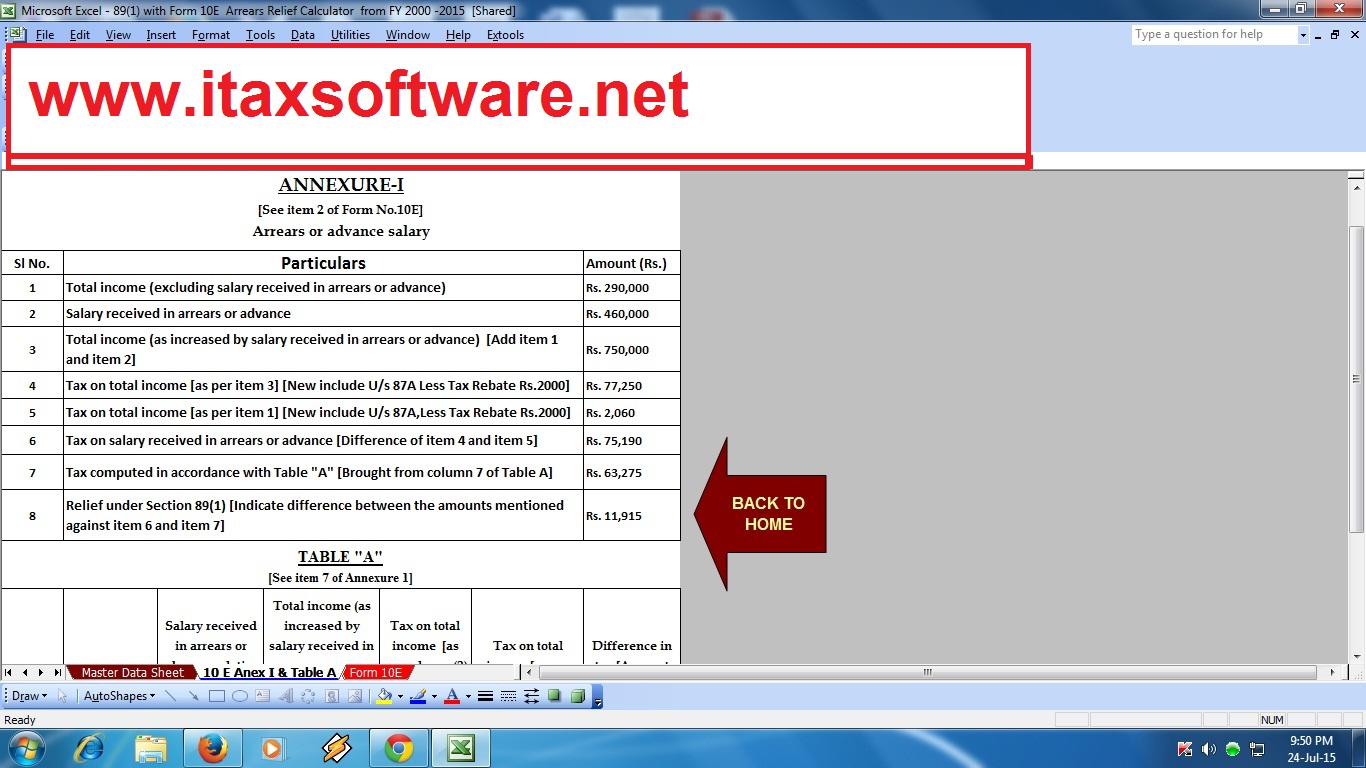 BELOW GIVEN THE METHOD OF CALCULATION U/S 89(1)AS PER THE INCOME TAX RULES. SECTION 89 l RELIEF WHEN SALARY ETC., IS PAID IN ARREARS OR IN ADVANCE Scope of relief under the section in five situations explained1. Section 89(1) authorises grant of relief in a case where an employee receives salary in arrears or in advance or has received in any financial year salary for more than twelve months, a payment which under the provisions of section 17(3)(ii) is a profit in lieu of salary. The effect of such increase is that the income will be assessed at a higher rate than it otherwise would have been assessed and it is for this reason that section 89(1) authorises relief to be allowed. The relief is to be allowed in terms of rule 21A of the Income-tax Rules, 1962. 2. Rule 21A(1) enumerates the following five different situations wherein the assessees will be entitled to relief (four of these are specific situations while the fifth is a residuary one) : a. salary being received in arrears or advance; b. where the payment is in the nature of gratuity in respect of past services extending over a period of not less than five years is received; c. where the payment is in the nature of compensation received by the employee from his employer or former employer at or in connection with termination of his employment after continuous service of not less than three years and where the unexpired portion of the term of employment is also not less than three years; d. where the payment is in the nature of commutation of pension; e. where the payment is not covered by the description given in (a) to (d) above. The relief is to be worked out in the first four situations in accordance with the specific modes described in rule 21A (2)(a) to (d). 3. The authority to grant relief in the four specific cases is the Income-tax Officer assessing the employee. In the residua case, it is Central Board of Direct Taxes. 4. The relief under section 89(1) is to be given in the assessment in which the extra payment by way of arrears, advance, etc., is taxed. The mode of granting relief spelt out in rule 21A(2) to 21A(5) would show that in all the four different cases the exercise of giving relief is initiated by bringing to tax the whole of the extra amount in the assessment for the assessment year relevant to the year of receipt. Basically, the relief under section 89(1) is arithmetical. It involves finding out of two rates of tax. The first is the rate of tax applicable to the total income including the extra amount in the year of receipt. The second is finding out the rate by adding the arrears to the total income of the years to which they relate. For this purpose the assessee should be asked for a true and authentic statement of the total income of the earlier years to which the arrears pertain There is no warrant for issuing a notice under section 148 or calling for returns of income of the earlier years. 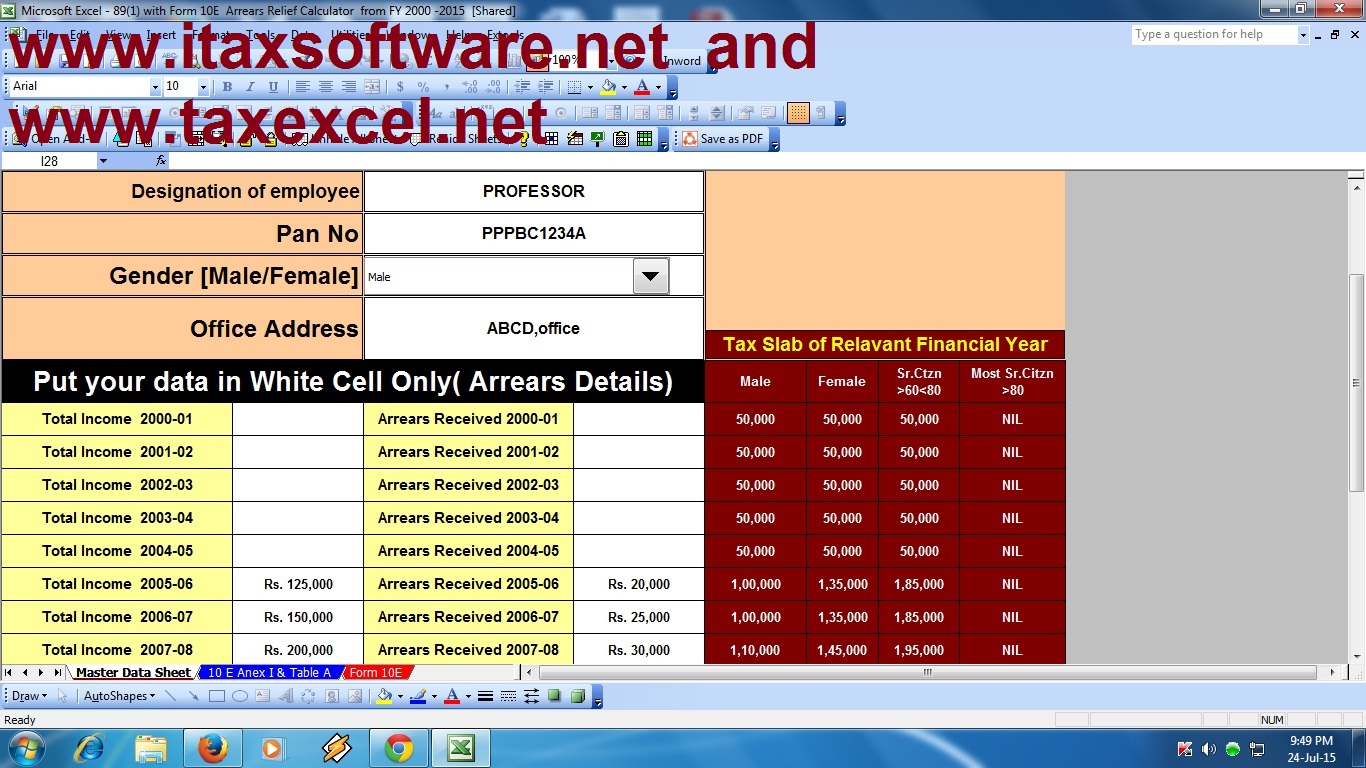  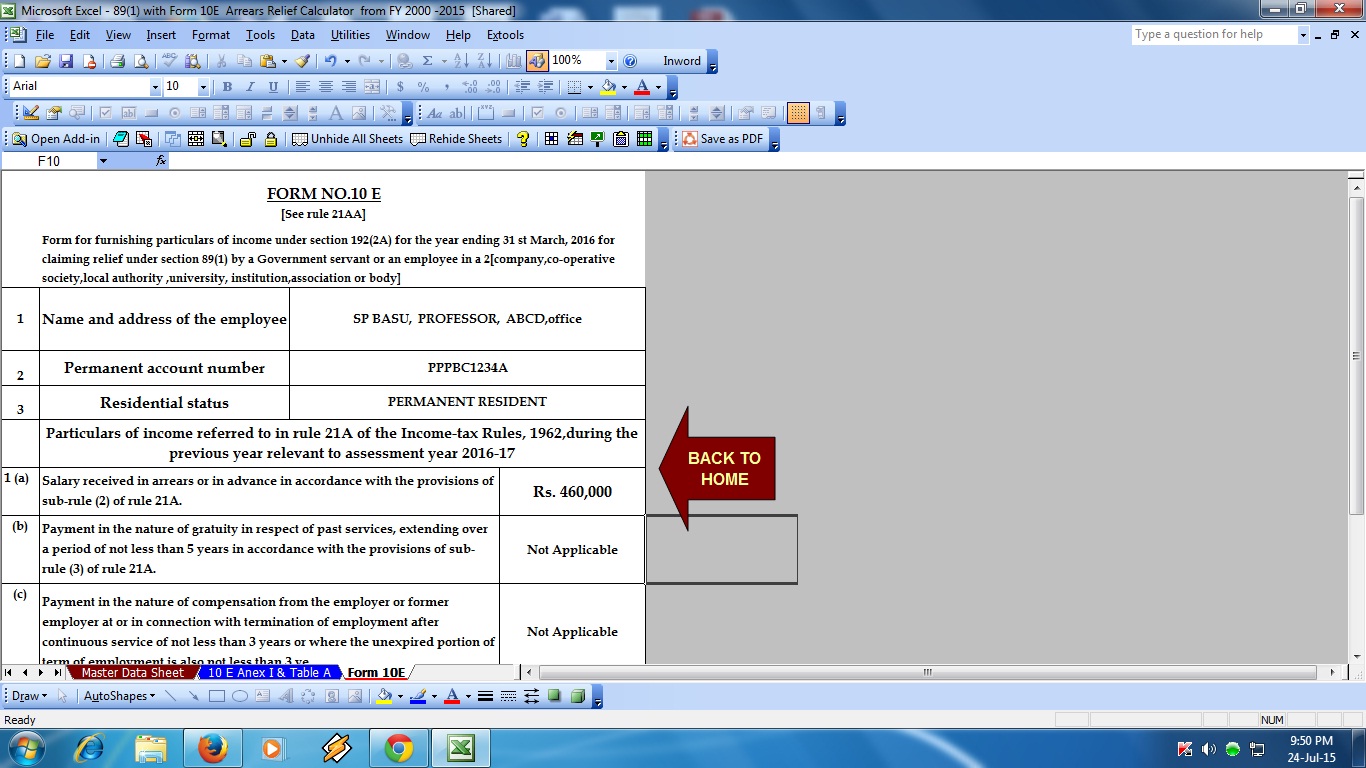 Click here to Download Automated Arrears Relief Calculator with Form 10E from the Financial Year 2000-01 to Financial Year 2015-16 |


itaxsoftware.net
Itaxsoftware.net |
|
Posted: 27 Jul 2015 09:25 AM PDT In this fast moving world, young individuals switch job more often with an aim to get better opportunity and better increment. Form 16, is very vital for the salaried employee while filing tax returns. However, a situation may arise when they have to file returns and are left with multiple Form 16. Here are 10 things you must know on Form 16. Download the Automated Master of Form 16 Part B for FY 2014-15 [ This Excel Based Utility Can Prepare at a time 50 employees Form 16 Part B]Download the Automated Master of Form 16 Part A&B for FY 2014-15 [ This Excel Based Utility can prepare at a time 50 employees Form 16 Part A&B]1) Form 16 is issued by the employer to employee. This certificate provides all details of salary earned and tax deducted at source by the employer. 2) If a person has changed job, he needs to collect the Form 16 from both the employer at the year end, with the help of both forms only he would able to file his returns. 3) An individual can have multiple Form 16 in cases such as change in job or working with multiple employers simultaneously. 4) If your salary drawn is below the basic exemption limit, you may not be issued with this certificate by your employer as no TDS is deducted. 5) If your employer has not provided with Form 16, you can check the salary slip as it will mention the same. 6) Form 16 includes key information required such as gross salary, perquisites, various allowances and deductibles. 7) If you have changed the job in the same financial year, authorities require you to sum up the total income from both the employers and file income tax return. 8) If the previous employer has not issued form 16 on account of some reason such as no tax deduction at its end, employee can file the return taking into consideration the pay-slips plus the form 16 issued by the new employer. 9) If you do not wish to furnish form 16 issued by your previous employer to the new employer, you can file tax return taking cues from the two form 16 issued by the previous and new employer. 10) Form 16 will must mention the PAN Number of the employer. |


itaxsoftware.net
Itaxsoftware.net |
|
Posted: 28 Jul 2015 07:46 AM PDT The Financial Year 2014-15 have already gone and start the new Financial Year 2015-16 has start since 1st April 2015 and end will be March 2016. All the concerned have already calculate the Income Tax for their employees and also deducted Tax from their Salary and deposited the same to the Central Govt Account. Now it is necessary to prepare and distribute the Form 16 to the concern employee so they can fill the Income Tax Return in due time. As per the Income Tax time schedule it is mandatory to prepare and supply the Form 16 to the employees with April 2015. So you should ready to prepare the Form 16 for the Financial Year 2014-15 and Assessment Year 2015-16. As per the CBDT new Notification 11/2013 the format of Form 16 have already changed. In this New Format of Form 16 have two parts. One is Part A and another is Part B. In Form 16 Part A have the all details of Tax deducted and deposited to the Central Govt respective account, and Form 16 Part B have the all details of Salary of employee. It is also Notifies by the CBDT that the Form 16 Part A mandatory from the Income Tax New Web Site TRACES Portal (www.tdscpc.gov.in), and the Part B of Form 16 must be prepare by the Employer. If you have not known that how to Download the Form 16 Part A from the Tracess Portal, CLICK HERE to view "How to Download Form 16 Part A". But most of Concerned have not well known about this new Notification or they can not be able to download the Form 16 Part A from the Tracess Portal. In this regard they have need to prepare both of Form 16 Part A&B both. Here is given below the Automated Form 16 Part B and Automated Form 16 Part A&B for the Financial Year 2014-15 and Assessment Year 2015-16 which can prepare at a time 50,100 and One by One Form 16 Part A&B and Part B for the Financial Year 2015-16Feature of this Excel Based Form 16 Preparation Software :-
Download the Form 16 preparation Excel Based Software from the below given link :- 1) Master of Form 16 Part B for FY 2014-15 [ This Excel Utility can prepare at a time 50 employees Form 16 Part B for FY 2014-15]2) Master of Form 16 Part A&B for FY 2014-15 [This Excel Utility can prepare at a time 50 employees Form 16 Part A&B]3) Master of Form 16 Part B for FY 2014-15 [ This Excel Utility can prepare at a time 100 employees Form 16 Part B]4) Master of Form 16 Part A&B for FY 2014-15 [ This Excel Utility can prepare at a time 100 employees Form 16 Part B]5) One by One Prepare Automatic Form 16 Part A&B and Part B [This Excel Utility can prepare both Form 16 part A&B and Part B ] |


itaxsoftware.net
Itaxsoftware.net |
|
Posted: 29 Jul 2015 07:11 AM PDT Click to Download Income Tax Master of Form 16 Part B with 24Q and 26Q All Quarters for the Financial Year 2015-16 and Assessment Year 2016-17( This Utility can prepare at a time 50 employees Form 16 Part B with 24Q & 26Q for the Financial Year 2015-16 as per the New Income Tax Slab)The Financial Year 2014-15 and Assessment Year 2015-16 have already gone and the New Financial Year 2015-16 and Assessment Year 2016-17 have already started since 1st April 2014 to 31st March 2016. The CBDT have already changes the Format of Income Tax Form 16 and this Form 16 have in the two parts one is Form 16 Part A which is mandatory to download from the TRACES PORTAL(www.tdscpc.gov.in) and another Part of Form 16 Part B is must be prepared by the employer. In this Part B have the all details of employee's Salary and benefits. The Income Tax Challan 24Q (For Govt Concerned) and 26 Q(For Non Govt Concerned) also prepare for submitting the each Quarter end by this Challan this 24Q and 26Q by the employer. Now it comes the 1st Quarter Cahallan submit date in the June 2014 and you have to prepare and submit your employees Quarter wise return to the Income Tax Department for the Financial Year 2015-16. Below given Excel Based Automated Form 16 Part B with the Challan 24Q and 26Q for the all quarters for the Financial Year 2015-16 and Assessment Year 2016-17. This Utility can help and reduce your time for preparation of 24Q or 26Q with Form 16 Part B. Click here to Download Income Tax Master of Form 16 Part B with 24Q and 26Q All Quarters for the Financial Year 2015-16 and Assessment Year 2016-17( This Utility can prepare at a time 50 employees Form 16 Part B with 24Q & 26Q for the Financial Year 2015-16 as per the New Income Tax Slab) |


itaxsoftware.net
Itaxsoftware.net |
|
Posted: 30 Jul 2015 06:58 AM PDT Click here to Download Automated Form 16 Part A&B for the Financial Year 2014-15 & Assessment Year 2015-16 ( This Excel Utility can prepare at a time 100 employees form 16 Part A&B)  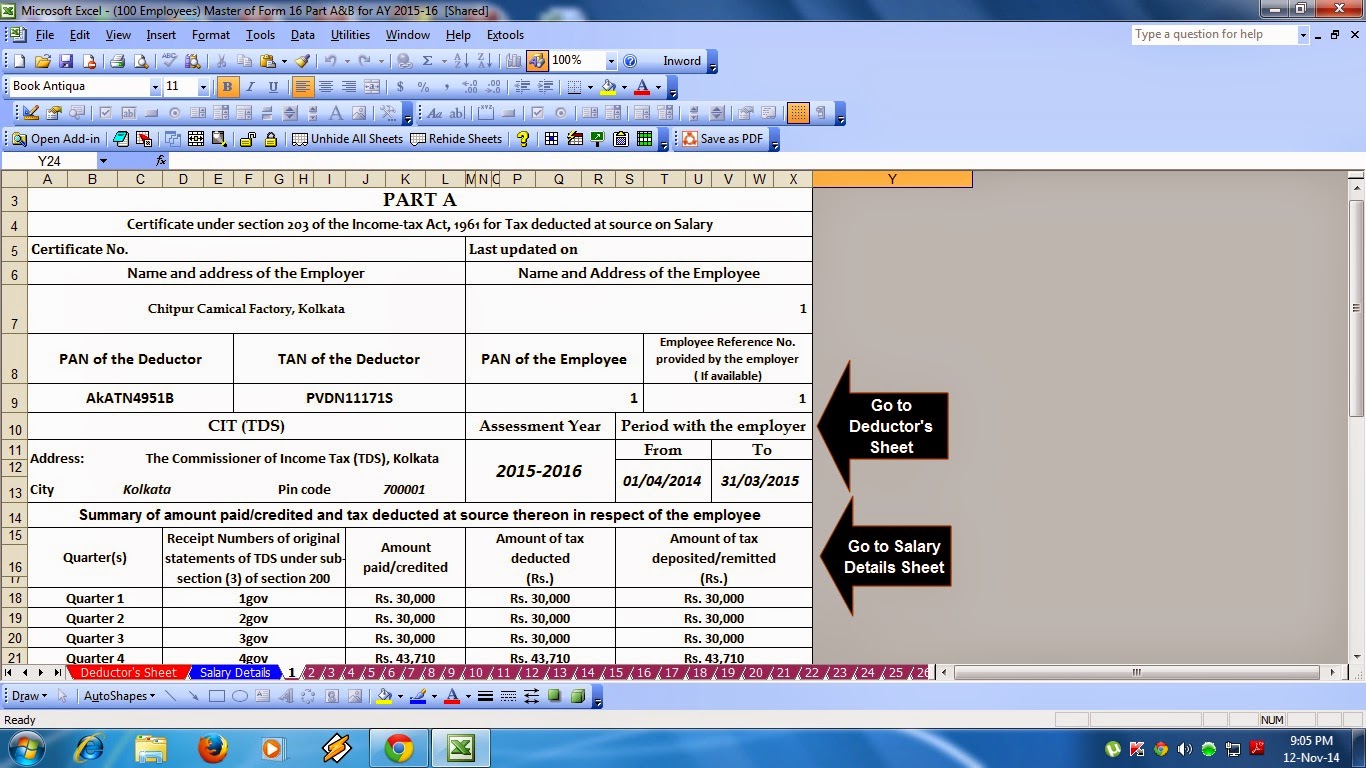 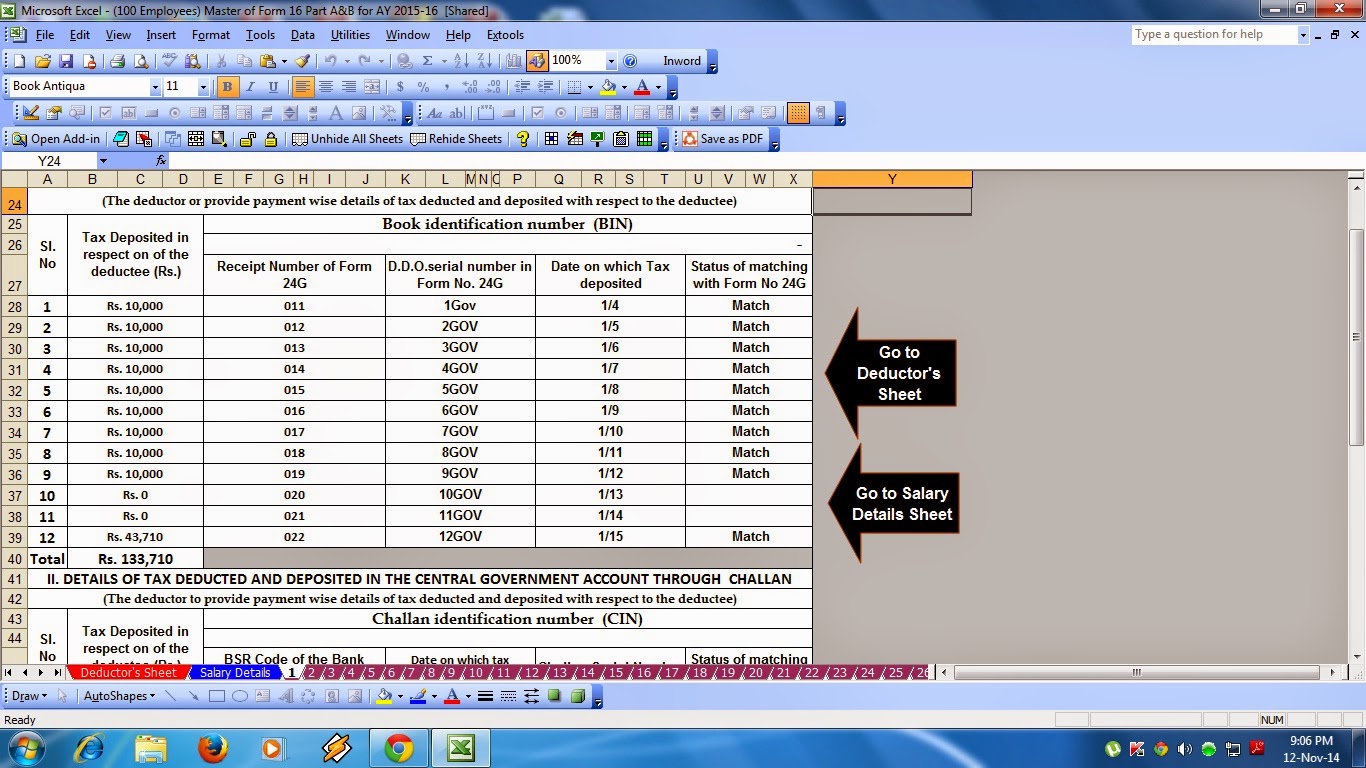 The CBDT has already changed the Format of Form 16 dated on 19/2/2013. In this Format have two part. Part A which found the Tax Deducted At Source and deposited in to the Central Govt Account and another Part B which is found the details of employee's Salary. This Part B is mandatory to prepare by the employer. This Part A is mandatory to download form the Income Tax TRACES Portal. Most of the Employer or deductor yet not well known about this new Format of form 16. Also you most of employer could not able to download the Form 16 Part A from the TRACES portal. Who have not able to download the Form 16 Part A from the TRACES Portal, they can use this below given both in one file Form 16 Part A&B in New Format of Form 16. This Excel Based Software can prepare at a time 100 employees Form 16 Part A&B for the Financial Year 2014-15 and Assessment Year 2015-16. This Utility can use both of Govt and Non Govt Concerned. |
Feature of this Utility:- |
Click here to Download Automated Form 16 Part A&B for the Financial Year 2014-15 & Assessment Year 2015-16( This Excel Utility can prepare at a time 100 employees form 16 Part A&B) |


itaxsoftware.net
Itaxsoftware.net |
|
Posted: 31 Jul 2015 08:34 AM PDT Income Tax Department has come up with a New user friendly online Income Tax Return filing tool. Unlike the tools provided earlier in which we have to fill up an offline Excel sheet, the new Income Tax tool has a neat online interface for filling up and saving data at once. Undoubtedly, the new online Income Tax Return filing facility is user friendly and professional. We could see that presently this online tool is applicable only for ITR-1 and ITR-4S. We hope to Income Tax Department would extend this online tool to ITR-2 also in the near future.
Here is an intro to this useful tool 1. Go to this Income Tax Department’s Official online ITR filing Website. Register using your PAN and get user name and password, if you have not already registered.  2. Login in to New Income Tax E-filing tool  3. Once you have successfully logged in you will land in to following page  4. After you select the ITR type and relevant year for which ITR has to be filed, entry page of ITR will be shown. The first tab will be containing the instructions for filling the data  5. As you are in logged in session, it is adviceable to save the data entered after each tab is completed. However Submit Button has to be used only after entry of all the data. The following Screenshot is Personal Information entry tab. Once entry is completed save the data as draft and proceed to next tab.  6. Following Screenshots are relating to entry tabs for Income Tax details, Details of Income Tax Deducted by employer, and Bank Account details. After entry of data in all these tabs are completed, click Submit button to generate ITR-V Button. ITR-V is a document which contains the summary of your income, deductions and income tax paid. This document has to be signed and sent to the Income Tax Central Processing Centre at Bangalore. Address of this centre will be available in the mail sent to you attaching filled up ITR-V form. Please note that Online E-filing will get completed only after receipt of this ITR-V at Central Processing Centre at Bangalore.  As per the CBDT has mandatory to mention the Aadhar Card for the Assessment Year 2015-16 |


|
Posted: 31 Jul 2015 08:29 AM PDT Click here to download the Automatic Master of Form 16 Part B ( This Excel Utility can prepare at a time 100 employees Form 16 Part B for the Financial Year 2014-15)Updated list of deductions available Chapter VI-A while calculating Income Tax for Individual & also helpful for tax planning. Section 80C: Under this section deduction from total income in respect of various investments/ expenditures/payments in respect of which tax rebate u/s 88 was earlier available. The total deduction under this section (alongwith section 80CCC and 80CCD) is limited to Rs. 1.5 lakh only.( As per the Finance Budget 2014-15 the Max Limit of U/s 80 C HAS RAISED UP TO RS. 1.5 LAKH) 1. Life Insurance Premium For individual, policy must be in self or spouse's or any child's name. For HUF, it may be on life of any member of HUF. 2. Sum paid under contract for deferred annuity For individual, on life of self, spouse or any child . 3. Sum deducted from salary payable to Govt. Servant for securing deferred annuity for self-spouse or child Payment limited to 20% of salary. 4. Contribution made under Employee's Provident Fund Scheme. 5. Contribution to PPF For individual, can be in the name of self/spouse, any child & for HUF, it can be in the name of any member of the family. 6. Contribution by employee to a Recognised Provident Fund. 7. Sum deposited in 10 year/15 year account of Post Office Saving Bank 8. Subscription to any notified securities/notified deposits scheme. e.g. NSS 9. Subscription to any notified savings certificate, e.g. NSC VIII issue. 10. Unit Linked Savings certificates. 11. Contribution to notified deposit scheme/Pension fund set up by the National Housing Scheme. 12. Certain payment made by way of installment or part payment of loan taken for purchase/construction of residential house property. Condition has been laid that in case the property is transferred before the expiry of 5 years from the end of the financial year in which possession of such property is obtained by him, the aggregate amount of deduction of income so allowed for various years shall be liable to tax in that year. 13. Contribution to notified annuity Plan of LIC(e.g. Jeevan Dhara) or Units of UTI/notified Mutual Fund. If in respect of such contribution, deduction u/s 80CCC has been availed of rebate u/s 88 would not be allowable. 14. Subscription to units of a Mutual Fund notified u/s 10 (23D). 15. Subscription to deposit scheme of a public sector, company engaged in providing housing finance. 16. Subscription to equity shares/ debentures forming part of any approved eligible issue of capital made by a public company or public financial institutions. 17. Tuition fees paid at the time of admission or otherwise to any school, college, university or other educational institution situated within India for the purpose of full time education of any two children. Available in respect of any two children Section 80CCC: Deduction in respect of Premium Paid for Annuity Plan of LIC or Other Insurer Payment of premium for annuity plan of LIC or any other insurer Deduction is available upto a maximum of Rs. 150,000/-. The premium must be deposited to keep in force a contract for an annuity plan of the LIC or any other insurer for receiving pension from the fund. Section 80CCD: Deduction in respect of Contribution to Pension Account Deposit made by a Central government servant in his pension account to the extent of 10% of his salary. Where the Central Government makes any contribution to the pension account, deduction of such contribution to the extent of 10% of salary shall be allowed. Further, in any year where any amount is received from the pension account such amount shall be charged to tax as income of that previous year. 18. Section 80CCG: Rajiv Gandhi Equity Saving Scheme As per the Budget 2012 anouncements, a new scheme Rajiv Gandhi Equity Saving Scheme (RGESS) will be launched. Those investors whose annual income is less than Rs. 10 lakh can invest in this scheme up to Rs. 50,000 and get a deduction of 50% of the investment. So if you invest Rs. 50,000 (maximum amount eligible for income tax rebate is Rs. 50,000), you can claim a tax deduction of Rs. 25,000 (50% of Rs. 50,000). 19. Section 80D: Deduction in respect of Medical Insurance Deduction is available upto Rs. 20,000/- for senior citizens and upto Rs. 15,000/ in other cases for insurance of self, spouse and dependent children. Additionally, a deduction for insurance of parents (father or mother or both) is available to the extent of Rs. 20,000/- if parents are senior Citizen and Rs. 15,000/- in other cases. Therefore, the maximum deduction available under this section is to the extent of Rs. 40,000/-. From AY 2013-14, within the existing limit a deduction of upto Rs. 5,000 for preventive health check-up is available. Note:- By the Finance Budget 2015 has Raised the Limit up to Rs. 25,000/- for General below 60 years and Rs. 30,000/- for Sr.Citizen, apply since 1/4/2015 for the Financial Year 2015-16 20. Section 80DD: Deduction in respect of Rehabilitation of Handicapped Dependent Relative Deduction of Rs. 50,000/- w.e.f. 01.04.2004 in respect of ü Expenditure incurred on medical treatment, (including nursing), training and rehabilitation of handicapped dependent relative. ü Payment or deposit to specified scheme for maintenance of dependent handicapped relative. Further, if the defendant is a person with severe disability a deduction of Rs. 100,000/- shall be available under this section. The handicapped dependent should be a dependent relative suffering from a permanent disability (including blindness) or mentally retarded, as certified by a specified physician or psychiatrist. Note: A person with 'severe disability' means a person with 80% or more of one or more disabilities as outlined in section 56(4) of the 'Persons with disabilities (Equal opportunities, protection of rights and full participation)' Act. 21. Section 80DDB: Deduction in respect of Medical Expenditure on Self or Dependent Relative A deduction to the extent of Rs. 40,000/- or the amount actually paid, whichever is less is available for expenditure actually incurred by resident assessee on himself or dependent relative for medical treatment of specified disease or ailment. The diseases have been specified in Rule 11DD. A certificate in form 10 I is to be furnished by the assessee from any Registered Doctor. Section 80E: Deduction in respect of Interest on Loan for Higher Studies Deduction in respect of interest on loan taken for pursuing higher education. The deduction is also available for the purpose of higher education of a relative w.e.f. A.Y. 2008-09. Section 80G: Deduction in respect of Various Donations The various donations specified in Sec. 80G are eligible for deduction upto either 100% or 50% with or without restriction as provided in Sec. 80G, Section 80GG: Deduction in respect of House Rent Paid Deduction available is the least of 1. Rent paid less 10% of total income 2. Rs. 2000/- per month 3. 25% of total income, provided of Assessee or his spouse or minor child should not own residential accommodation at the place of employment. of He should not be in receipt of house rent allowance. of He should not have self occupied residential premises in any other place. 22. Section 80U: Deduction in respect of Person suffering from Physical Disability Deduction of Rs. 50,000/- to an individual who suffers from a physical disability(including blindness) or mental retardation. Further, if the individual is a person with severe disability, deduction of Rs. 100,000/- shall be available u/s 80U. Certificate should be obtained from a Govt. Doctor. The relevant rule is Rule 11D. Section 80RRB: Deduction in respect of any Income by way of Royalty of a Patent Deduction in respect of any income by way of royalty is respect of a patent registered on or after 01.04.2003 under the Patents Act 1970 shall be available upto Rs. 3 lacs or the income received, whichever is less. The assessee must be an individual resident of India who is a patentee. The assessee must furnish a certificate in the prescribed form duly signed by the prescribed authority. NOTE THAT BY THE FINANCE BUDGET 2015 THIS LIMIT HAS RAISED UP TO Rs.75,000/- FROM 50,000/- SINCE 1/4/2015 FINANCIAL YEAR. 23. 80 TTA: Deduction from gross total income in respect of any Income by way of Interest on Savings account Deduction from gross total income of an individual or HUF, upto a maximum of Rs. 10,000/-, in respect of interest on deposits in savings account ( not time deposits ) with a bank, co-operative society or post office, is allowable w.e.f. 01.04.2012 (Assessment Year 2013-14). 24. 80 EE. Additional House Building Loan Interest up to Rs. 1,00,000/- will be admissible who have paid the HBL Interest w.e.f. 1/4/2013 (Excluding the Section 24 B) |


itaxsoftware.net
Itaxsoftware.net |
- IRCTC Updates: No ID Needed For Tatkal Bookings, IRCTC Requests to Banks For Providing OTPs
- All about Income Tax Salary Certificate Form 16 for Salaried persons for F.Y.2014-15 with Automatic Form 16 for F.Y.2014-15
- IRCTC Updates: No ID Needed For Tatkal Bookings, IRCTC Requests to Banks For Providing OTPs
|
IRCTC Updates: No ID Needed For Tatkal Bookings, IRCTC Requests to Banks For Providing OTPs Posted: 01 Aug 2015 06:49 PM PDT |


|
Posted: 01 Aug 2015 06:49 PM PDT |


|
IRCTC Updates: No ID Needed For Tatkal Bookings, IRCTC Requests to Banks For Providing OTPs Posted: 01 Aug 2015 04:49 PM PDT |


itaxsoftware.net
|
What is the benefits of Income Tax Return File, Who and Why need to File Income Tax Return Posted: 02 Aug 2015 05:53 AM PDT Who needs to mandatory to file ITR? As per Income tax laws; You need to file your income tax return if your gross taxable income (without any tax saving deduction) is more than the basic tax limit applicable for you. Gross Taxable Income is defined as Total Income for the financial year (Minus) Conveyance Allowance, LTA, HRA, Profession Tax, Home loan interest, etc. But before exemptions under Section 80C to 80U etc which includes investments such as ELSS, PPF, NPS, Insurance etc Below is the Basic Tax limit: § For citizens below 60 years of age – Rs 2.5 Lakhs § Between 60 and 80 years (Senior Citizens) – Rs 3 Lakhs § Above 80 years (Very Senior Citizens) – Rs 5 Lakhs Some Examples: 1. If you are 58 years of age and your income is Rs 3 lakhs, you need not necessarily pay tax as you can invest Rs 50,000 in Sec 80C (such as PPF, ELSS etc) and pay 0 taxes. But still you will need to file your tax returns.2. If you are 81 years of age and your income is Rs 4.5 Lakhs you need not necessarily file income tax return as the basic tax limit is Rs 5 lakhs for very senior citizens. Other than the above you still need to file your ITR if you satisfy any of the following conditions: 1. You have to claim any excess tax deposited 2. You have losses that you want to take forward to next financial years 3. If you have any foreign asset or income from sources outside India 4. If you have income from property held by a trust Why filing ITR is good idea? Other than the categories of people described above who needs to mandatory to file ITR, we encourage everyone with income to file their ITR because of following reasons: 1. ITR is required when you want to take any loan. This serves as valid income proof especially for the self employed. 2. Also it’s useful document when you apply for Visa for some countries 3. The filing of ITR is easy, free and can be done by self in 15 – 20 minutes especially if you income sources only from salary/pension, fixed deposit interests etc. Is e-filing ITR mandatory?You would need to e-file your income tax return in case 1. You have to claim refund of excess tax paid 2. Your gross income is more than Rs 5 lakhs 3. ITR forms 3, 4, 5, 6 & 7 have to e-file However for citizens above 80 years of age, they can still file their returns in paper format if they are using ITR forms 1, 2A or 2. Last date for Filing ITR?The last date for filing income tax return for AY 2015-16 (FY 2014-15) is August 31, 2015. However in case you are carrying on a business and your accounts are required to be audited, the due date gets extended till September 30, 2015. What if you miss the ITR deadline?In case you miss the deadline for filing your ITR for AY 2015-16, you can still do it by March 31, 2016 without any penalty and up to March 31, 2017 with penalty. But in either case you loose on following benefits: 1. You cannot revise your returns in case you find any error on a later date 2. You cannot carry forward your losses 3. In case you had tax due, you will need to pay penalty on that – 1% for every month of delay What’s the Penalty for non-filing ITR?In case you do not file your income tax return for AY 2015-16 by March 31, 2016 (but should have filed as per IT laws),the assessing officer can put a fine of up to Rs 5,000 under section 271F after hearing the credits of your case. Ideally everyone with income should file their IT return as it serves as valid proof of income. Paying taxes and filing returns are two different things and you should not default on either. So even if you paid all your taxes or have zero tax liability you must file your returns as per law. |


This posting includes an audio/video/photo media file: Download Now |
|
IRCTC Updates: No ID Needed For Tatkal Bookings, IRCTC Requests to Banks For Providing OTPs Posted: 01 Aug 2015 07:10 PM PDT Indian Railways has announced several new updates and programs this week. Here is a quick brief:  No IDs Required For Tatkal TicketsIndian Railways has decided to stop the practice of asking identity proofs during booking –both online and offline. As per an official release, the ID proof would only be required to show during the journey. As of now, passengers are mandated to provide booking clerk an attested copy of their identity proof while booking from counter, and mention the ID number in online bookings. Stopping of this step will certainly benefit the passenger during tatkal bookings, as much time is lost in arranging such photocopies and providing them to the booking clerk. IRCTC Requests Banks For Providing OTPSAs of now, IRCTC has formally partnered with 50 banks for providing payment options during an online booking. However, only 24 banks have One Time Password (OTP) arrangement, which creates fraud possibilities and obstruct smooth flow for the Railways. IRCTC has formally requested all the remaining banks to initiate OTP procedure so that customers don’t face any hassle while booking tickets. In fact, these 26 banks without OTP system has been given a deadline of August 15th to implement the same. IRCTC GM (software) M Srinivas said, “We need to implement OTP system by all the banks with a view to checking fraudulent transactions on the IRCTC website. Railway crime branch has also put the IRCTC on alert about fraudulent transactions,” Out of these 50 banks, 28 banks provide net banking, six offer payment gateways, 10 provide debit card option, 4 offer cash cards while 1 each is EMI-based and IRCTC prepaid card system. |


This posting includes an audio/video/photo media file: Download Now |
|
Posted: 01 Aug 2015 07:09 PM PDT What is Form 16: If you are salaried employee in an organization, then you will get the salary after deducting tax by the employer. Therefore Form 16 is a certificate issued to you by your employer stating the Personal details of the Employee including Name, Permanent Account Number (PAN) etc , details of the salary you have earned, Perquisites that has been offered, allowances given , details of Chapter VIA deductions and the tax deducted on your salary by your Employer and paid to the government. It also has Employer details like Name, permanent account number PAN, TAN etc. This is the basic document which is required by the employee to file income tax returns because Form-16 contains income chargeable under the head “Salaries” which is the taxable salary. The same needs to be indicated in Income Tax Returns. Form 16 has 2 parts – Part A and Part B. Part A has TAN (tax deduction & collection account number) of the employer & PAN (permanent account number) details of both the employer and employee. The name and address of employer and employee is also mentioned. It also mentions the assessment year and provide summary of tax deducted from your income and deposited to the government as per the quarterly TDS return filed by the employer. A monthly detail of TDS deducted and deposited is also certified. Part B is an important part of your Form 16 since it has a consolidated detail of salary paid to you during the year. The breakup of your salary as well as detail of deduction claimed by you under section 80 of the income tax act is mentioned. Deductions under Chapter VIA include details of amounts claimed under Section 80C for EPF, PPF, NSC, life insurance premium or Section 80D for health insurance, Section 80G for donations made are all mentioned here. It also shows your total taxable income and tax deducted on such income. Necessity of Form 16 In Filing Income Tax Return: Form 16 is necessary to file an income tax return in Indiabecause Firstly, Form 16 acts as a checker for you to verify whether your employer has deposited the whole amount of TDS that he may have deducted from your salary. Secondly, it will enable you to file Income tax return disclosing the correct taxable salary income and various deductions from your salary like EPF, Profession tax and TDS. Download Amended Format of Form 16 Part B for the Financial Year 2014-15 ( This Excel based Software can prepare at a time 50 employees Form 16 Part B for F.Y.2014-15)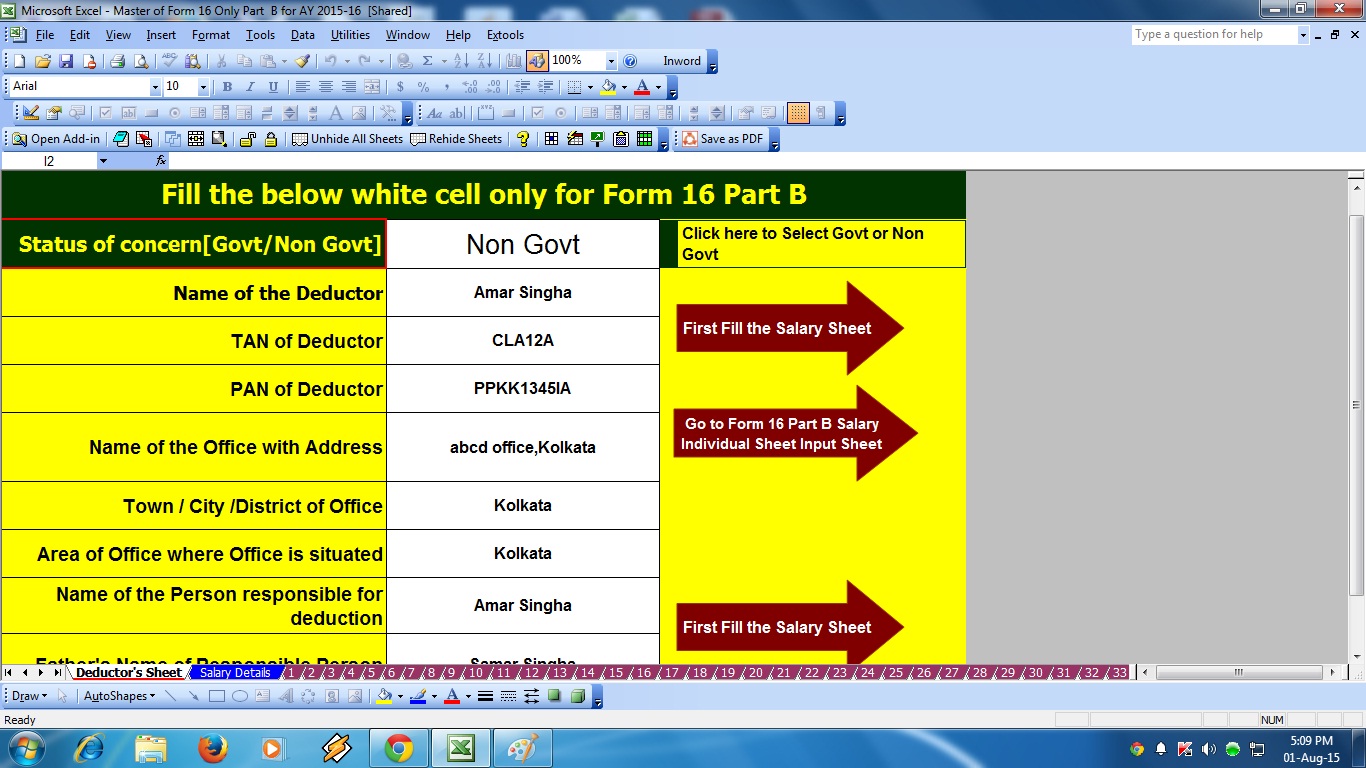 Download Amended Format of Form 16 Part A&B for the Financial Year 2014-15 ( This Excel based Software can prepare at a time 50 employees Form 16 Part A & B for F.Y.2014-15)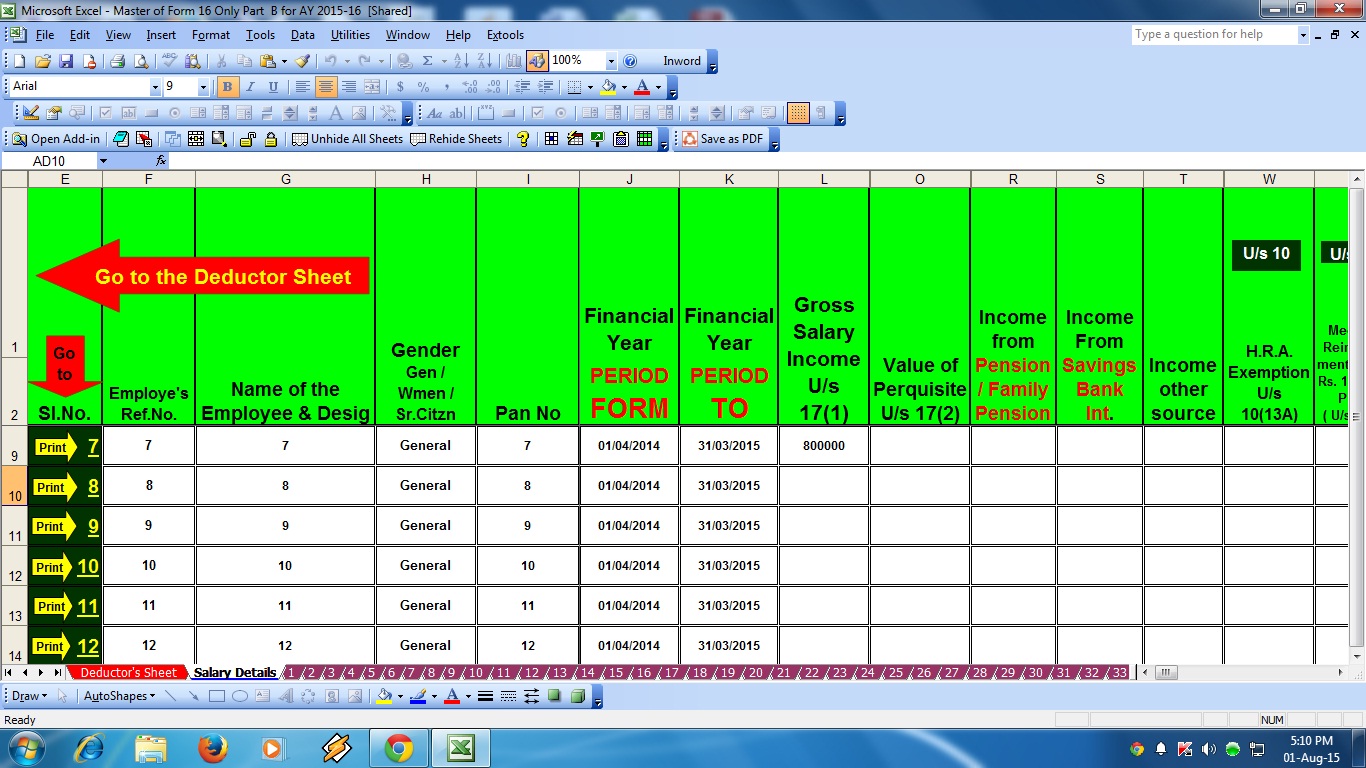 Employer Obligation to provide Form 16 :- Further, it is the obligation of the employer to provide a Form 16 to all employees by 31 May of the assessment year (AY), if TDS has been deducted , In case no TDS has been deducted by the employer they may not issue you a Form 16.The employer can be liable to pay a penalty of Rs. 100 for each day by which he delays issuance of this certificate, also if you have been employed under more than one employer during the year, each of your employers will provide you a Form 16. Filing of Income Tax Return without Form16:- Even if Form 16 has not been issued you cannot escape from the liability to file Income Tax Return , therefore to file income tax return without Form 16 you need to collect your monthly salary slip and compute total salary for the year. Note: The amount credited in your bank statement is after deducting the tax at source but for reporting in ITR you need to calculate Gross Salary. An employee receives many types of allowances in the form of salary while some allowances such as conveyance allowance, medical allowance, HRA, etc. are exempt from income tax while dearness allowance is completely taxable. Hence, the IT Department allows you to deduct the exempt allowances from salary to arrive at the figure of taxable salary. Since you have not received form 16 from your employer, you must verify Form 26AS to know about the TAN and TDS deducted by your Employer If you have other income as well apart from salary then sum up all the income like Income from renting of House property , capital gains from sale of assets , income from other sources like interest on bank deposits, RDs, FDs etc. Deduct tax benefit from the above computed income like investments made under NSC, LIC, tuition fees, PPF, and repayment of principal of housing loan under section 80C. Similarly, donations made to charitable institutions can be claimed under section 80G, and payment made towards premium of medical insurance policy can be claimed in section 80D. After summing up all income and deducting the tax benefits , the resultant computation will be taxable income. Now, calculate income tax on this taxable income using the IT slab rates for financial year 2014-15. Now you are all set for filing tax return. You can now visit the online tax filing site http://www.tdscpc.gov.into file your INCOME TAX RETURN. |


This posting includes an audio/video/photo media file: Download Now |
| You are subscribed to email updates from itaxsoftware.net
|
| To stop receiving these emails, you may unsubscribe now. |
| Email delivery powered by Google |
itaxsoftware.net
Itaxsoftware.net |
|
Posted: 03 Aug 2015 06:17 AM PDT Download Income Tax Calculator for Govt & Non Govt employees for Assessment Year 2016-17 with all amended Tax Limit as per New Finance Budget 2015-16* No change in tax slabs or minimum taxable limit for the Financial Year 2015-16 and Assessment Year 2016-17* The transport allowance exemption hiked to Rs 1,600 per month from Rs 800 per month U/s 10 * Limit of deduction of health insurance premium increased from Rs. 15000 to Rs. 25000. For senior citizens limit increased from Rs 20000 to Rs 30000. U/s 80D * Senior citizens above the age of 80 years, who are not covered by health insurance, to be allowed deduction of Rs 30000 towards medical expenditures. * Deduction limit of Rs 60000 with respect to specified decease of serious nature enhanced to Rs 80000 in case of senior citizen. U/s 80DDB *Additional deduction of Rs 25000 allowed for differently abled persons.U/s 80U *Limit on deduction on account of contribution to a pension fund and the new pension scheme increased from Rs 1 lakh to Rs 1.5 lakh.U/s 80CCC *Payments to the beneficiaries including interest payment on deposit in Sukanya Samriddhi scheme to be fully exempt. Max Rs.1.5 Lakh U/s 80C |


itaxsoftware.net
Itaxsoftware.net |
|
Posted: 04 Aug 2015 06:11 AM PDT The Financial Year 2015-16 has already started and as per the Finance Budget 2015, the Tax Slab have not changed, same as previous financial year 2014-15. But Limit of some Tax Section has Increased by this Finance Budget. The Section 80U have increased 75000/- P.A. and Rs. 125000/- P.A. for Blind persons. Traveling Allowances also raised up to 1600/- P.M. and Blind Person can avail Rs. 3200/- P.M. Section 80D Raised Rs. 25000/- and Sr.Citizen Rs. 30,000/-It is necessary to calculate your Tax Liability for the Financial Year 2015-16 as the D.A. has also increased to the Govt employees time to time.It is most hazard to calculate individually HRA Calculation separately another sheet and also it is hazard to calculate the Arrears Relief Calculation from the financial Year 2000-01 to 2015-16. This Excel Utility can prepare all the calculation just a moment. Thus your time may reduce for calculating the actual Income Tax of each employee. This Excel Based Software Can prepare more than 500 employees Tax Computed One by One for the Financial Year 2015-16 and Assessment Year 2016-17 |
Feature of this Utility:- |
· Automatic Calculate Income Tax with Tax Computed sheet individually· Individual Salary Structure for calculating the Gross Salary Income· Salary Structure have prepare on the Basis of Govt and Non Govt Salary Pattern· Automatic Calculate the House Rent Exemption Calculation U/s 10(13A)· Automatic Calculate the Arrears Relief Calculation with Form 10E since 2000-01 to 2014-15· Automated Form 16 Part A&B· Automated Form 16 Part B· Automatic Convert the Amount in to In WordsClick here to Download theExcel Based Software All in One Tax preparation Software for Govt and Non-Govt employees for F.Y.2015-16 and A.Y.2016-17[This Excel Utility can prepare at a time Income Tax Computed Sheet + Automatic Arrears Relief Calculator + Automatic House Rent Exemption calculation + In built Salary Structure for both Govt & Non Govt employees which prepared on the basis of Salary Pattern of each Govt and Non Govt concerned + Automated Form 16 Part A&B + Automated Form 16 Part B for the Financial Year 2015-16 and Assessment Year 2016-17.] |


itaxsoftware.net
Itaxsoftware.net |
|
Automated up to date Arrears Relief Calculator with Form 10E since FY 2000 to 2015-16 Posted: 05 Aug 2015 07:50 AM PDT Download the Arrears Relief Calculator U/s 89(1) Up to Date from FY 2000-01 to FY 2015-16]As the New Finance Budget 2015 has already declare the Income Tax Slab have not changed and same as past Financial Year, but some changes have been made and raised some maximum limit of some Tax Section in this Financial Year 2015-16.1) The Income Tax Section 80 D Raised up to Rs. 25,000/- for general and up to Rs. 30,000/- for Sr.Citizen. Read more in details 2) A new deduction U/s 80C have introduce in this Finance Budget 2015 in the name of Sukanya Samriddhi Scheme Account which is Max Limit Rs. 1,50,000/-.Read this deduction in details 3) The Section 80CC have also raised up to Rs. 1,50,000/- in this Finance Budget 2015 for Pension Account. 4) Transport/Conveyance Allowance is double up to Max Rs. 1600 P.M. 5) Tax Rebate Rs.2,000/- U/s 87A and Savings Bank Interest up to Rs. 10,000/- U/s 80TTA will be continue in the Financial Year 2015-16. In Future it will be indispensable the Arrears Relief Calculator, as the Central Govt and other some State Govt have already arrange to set the 7th Pay Commission to the Govt employees. In this Regard it may helpful to calculate the Arrears Relief of Salary which can calculate by the Income Tax Section 89(1) for Relief of Arrears. The itaxsoftware.net have already prepared the Up to Date Arrears Relief Calculator U/s 89(1) Since the financial year 2000-01 to Financial Year 2015-16 with Form 10E. Download the Arrears Relief Calculator U/s 89(1) Up to Date |


|
Posted: 05 Aug 2015 06:44 AM PDT Tax Treatment of Gratuity as per Income Tax Act,1961 is covered U/S 10(10) of the Act. In case of retirement, resignation or termination, you have to consider Income Tax liability on propose receipt of Gratuity. If Gratuity is received by employee himself, it will be taxable under head salary while if it is received by legal heir on death of employee, It will be taxable under “Income from other sources’ to the extent it is not chargeable to tax as per below mentioned provisionTax Treatment of Gratuity depends on type of employee viz;
Download Tax Calculator with Form 16 Part A&B and Part B for F.Y.2014-15
Employee can claim relief under section 89 of Income Tax in case of taxable gratuity. Meaning of Salary: For computation of salary as per point 2(1) as mentioned above means salary last drawn by the employee and includes dearness allowance but doesn’t include any bonus, commission, house rent allowance, overtime wages or any other allowance. 15 days salary can be calculated as under; 3. Any another Employee: Any gratuity received by employee which is not covered in above two points on termination, retirement, death, resignation or on his becoming incapacitated prior to retirement, is exempt from tax to the extent of minimum of either of below three items on due or receipt basis;
Salary mean last drawn salary by the employee and includes dearness allowance ( if terms of employment so provide) but doesn’t include any bonus, commission, house rent allowance, overtime wages or any other allowance. If terms of employments provide commission for a fixed percentage of turnover achievement, same will be included in salary. If gratuity received by employee from more than one employer in same financial year or different years, agreement maximum amount of gratuity cannot exceed Rs. 10 Lacs as mentioned in point 3(2) above. Please note that gratuity received during the employment do not qualify for exemption from tax. Assessee can claim relief under section 89 of Income Tax Act. |


itaxsoftware.net
Itaxsoftware.net |
|
Posted: 06 Aug 2015 06:46 AM PDT As per the New Finance Budget 2015 the Tax Slab have not change and the Tax Slab is the same as previous Financial Year 2014-15. Some Changes in this Budget and hike the limit of some Section which is given below :- 1) Travelling Allowances hike up to Rs. 19200/- P.A. 2) U/s 80CC hike the limit Rs. 1.5 Lakh 3) U/s 80U hike the Max Limit Rs. 75,000/- up to 80% and 1,25,000/- above 80% for Phy.disable person. 4) New insert a deduction U/s 80C " Sukanya Samriddhi Account" Max.Limit Rs. 1.5 Lakh. for minor Girl Child. 5) U/s 80D hike the limit up to Rs. 25,000/- for below 60 years age and Rs. 30,000/- for Sr.Citizen Below given a Excel Based Automated Form 16 Part A&B and Part B with the all changes has incorporate in this Excel Utility as per the New Finance Budget as stated above. Download the Automated Form 16 Part A&B and Part B for FY 2015-16 and Ass Yr 2016-17 [ This Excel Utility can prepare One by One Form 16 Part A&B and Part B for FY 2015-16]Feature of this Excel Utility:-
Some of the Concerned have need to prepare the Form 16 in the middle of the Financial Year 2015-16. If any employee change his present Concerned and join to another Concerned, the Form 16 must be given to the employee as he is entitled to get the Form 16 for his previous Concerned.So the Form 16 may prepare by the deductor of the previous Concerned. In this Excel Utility have this facility to change the Period of Financial Year. |
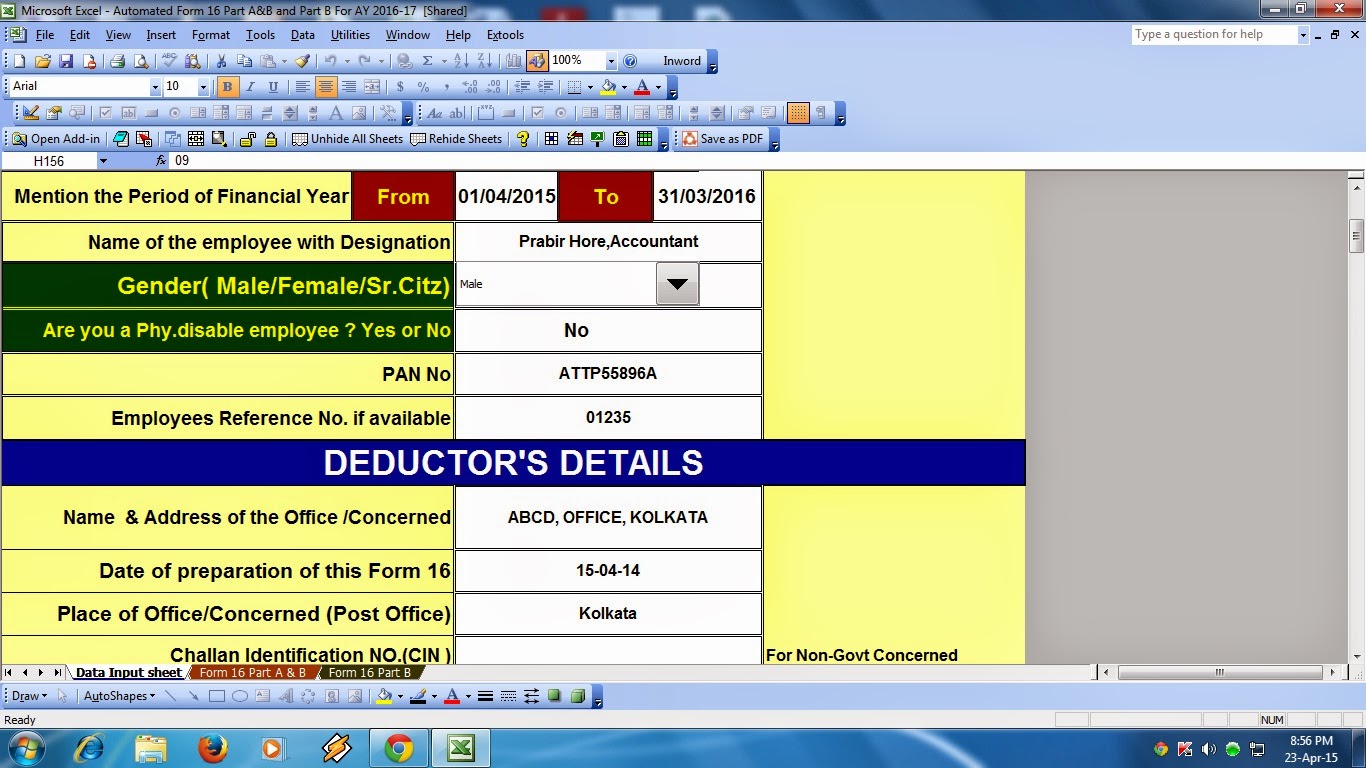
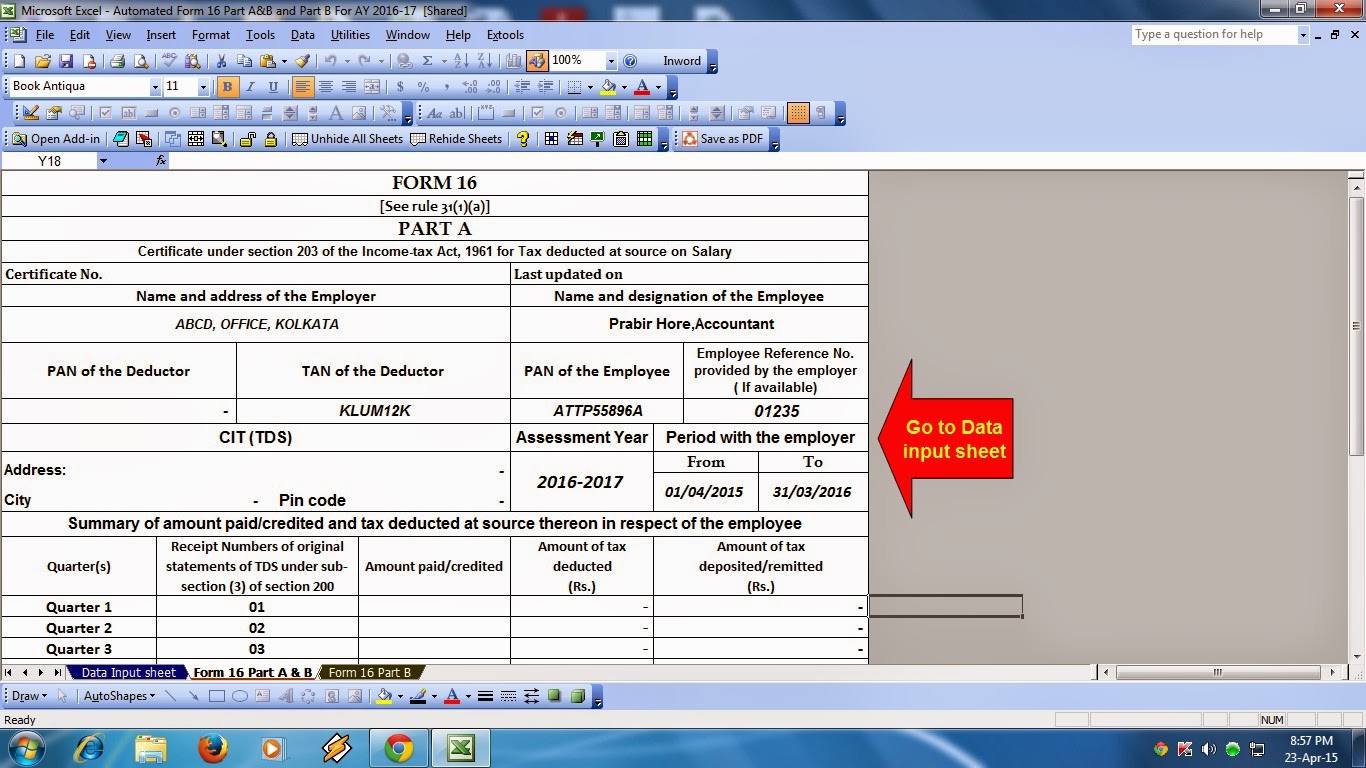
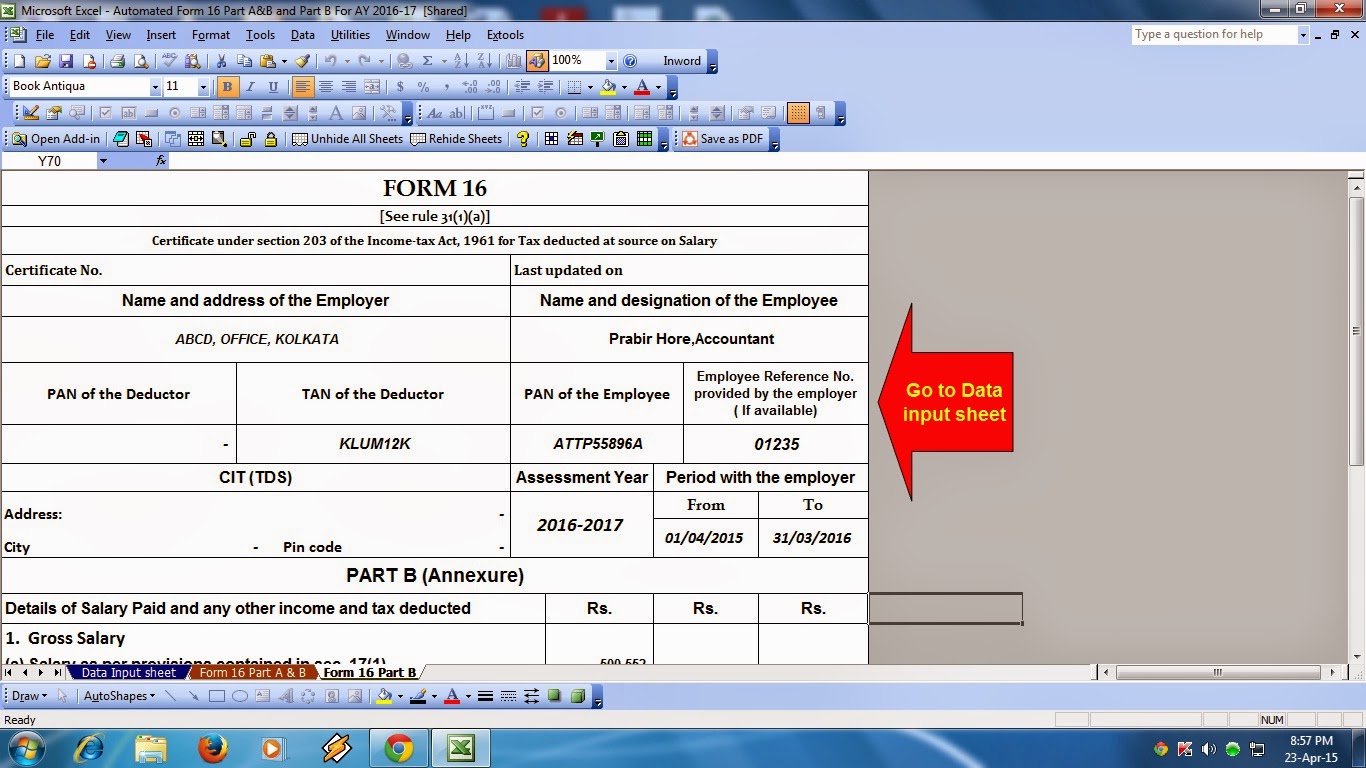


itaxsoftware.net
Itaxsoftware.net |
|
Posted: 07 Aug 2015 06:10 AM PDT Download Income Tax Calculator All in One TDS on Salary for Non-Govt Employees for the Financial Year 2015-16 and Ass Yr 2016-17. [ This Excel Utility can prepare at a time Tax Compute Sheet + Individual Salary Structure + Individual Salary Sheet + Automatic HRA Calculation + Automatic Form 16 Part A&B and Form 16 Part B + 12 BA for FY 2015-16]
Budget 2015 has been introduced in Parliament. The Finance Minister has kept the Personal Income Tax rates unchanged for the Financial Year 2015 /2016 (Assessment Year 2016-2017).He has to introduce or extend the Tax Deduction limits Under few Sections of the Income Tax Act. Let us understand all the important sections and new introduce with respect to ‘Income Tax Deductions 2015′. This list will help you in planning your taxes. Income Tax Deductions 2015Section 80C The maximum tax exemption limit under Section 80C has been retained as Rs 1.5 Lakh only. The various investment avenues under this section are;
Section 80CCC Contribution to annuity plan of LIC (Life Insurance Corporation of India) or any other Life Insurance Company for receiving pension from the fund is considered for tax benefit. The maximum allowable Tax deduction under this section is Rs 1.5 Lakh. Section 80CCD Employee can contribute to Government notified Pension Schemes (like National Pension Scheme – NPS). The contributions can be upto 10% of the salary (or) Gross Income and Rs 50,000 additional tax benefit u/s 80CCD (1b) is proposed in Budget 2015. In FY 2014-2015, the maximum tax exemption allowed under Section 80CCD is Rs 1 Lakh only. In Financial Year 2015-2016 or Assessment Year (2016-2017), this will be Rs 1.5 Lakh (u/s 80 CCD 1 ) and additional exemption of Rs 50,000 u/s 80CCD (1b) will be allowed. ( To claim this deduction, the employee has to contribute to Govt recognized Pension schemes like NPS) (10% of salary is applicable for salaried individuals and Gross income is applicable for non-salaried. The definition of Salary is only ‘Dearness Allowance.’ If your employer also contributes to Pension Scheme, the whole contribution amount (10% of salary) can be claimed as tax deduction under Section 80CCD (2). The ceiling limit of 1.5 Lakh u/s 80CCD is not applicable on employer’s contribution.) Section 80D Deduction u/s 80D on health insurance premium will be Rs 25,000, increased from Rs 15000. For Senior Citizens it has been increased to Rs 30,000 from the existing Rs 20,000. For very senior citizen above the age of 80 years who are not eligible to take health insurance, deduction is allowed for Rs 30,000 toward medical expenditure. Section 80DDB An individual (less than 60 years of age) can claim upto Rs 40,000 for the treatment of specified critical ailments. This can also be claimed on behalf of the dependents. The tax deduction limit under this section for Senior Citizens is proposed as Rs 60,000 and for very Senior Citizens (above 80 years) the limit is Rs 80,000 Section 24 (B) You can claim upto Rs 2 Lakh as tax deduction on the home loan interest payment. If your property is a let-out one then the entire interest amount can be claimed as tax deduction.Also if you are get joint home loan, you can get the benefits from the both side. Section 80U You can claim up to Rs 75,000 (increased from the existing Rs 50,000) for spending who have up to 80% disability. It is also been Introduce to increase the limit of deduction from Rs 1 lakh to Rs 1.25 lakh in case of above 80% severe disability. The other sections are – Section 80E (tax deduction benefit on the interest payment of an education loan), Section 80 G (Donations), Section 80GG (when HRA is not paid by the company but you incur rental expenses) and 100% TAX DEDUCTION on contributions made to SWACHH BHARAT & CLEAN GANGA initiatives have also been proposed. The above ‘Income Tax Deductions 2015′ are applicable for Financial year 2015-2016 (or Assessment Year 2016-2017). |
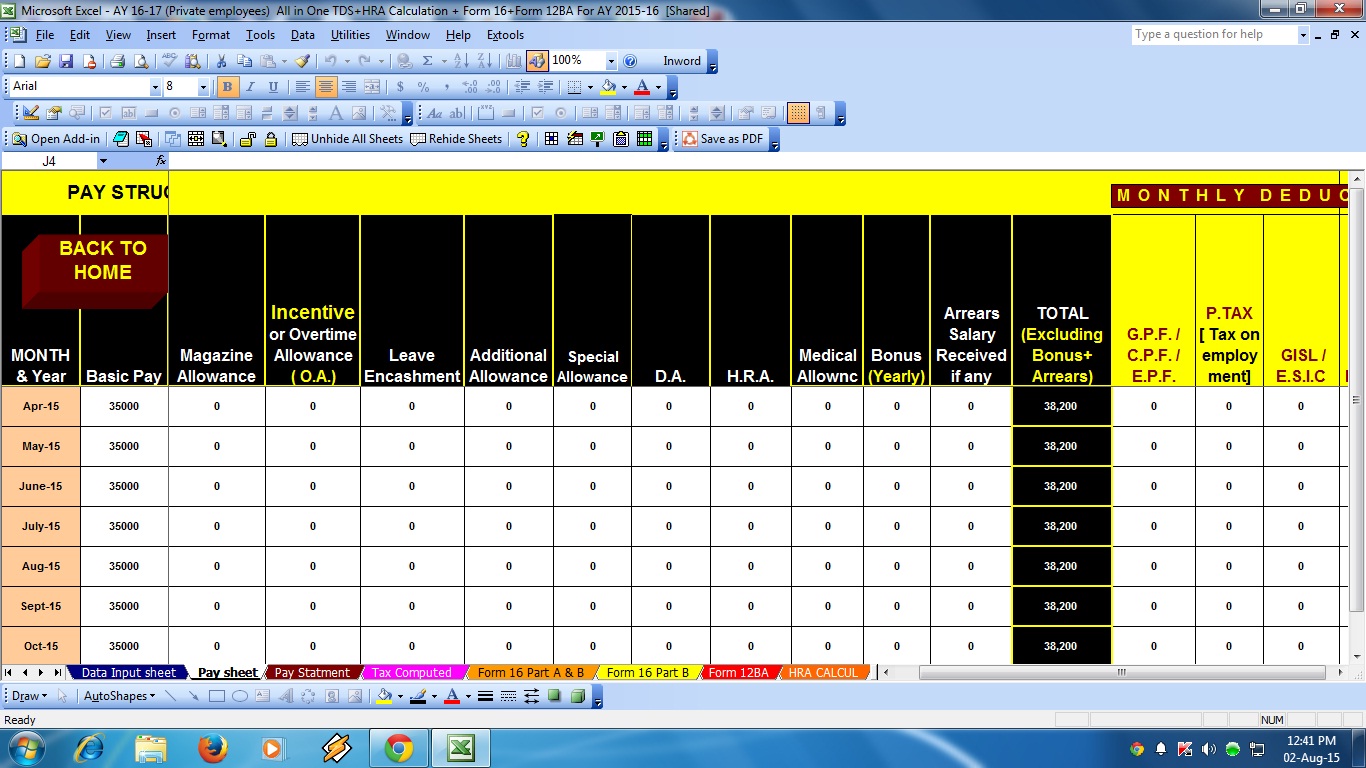
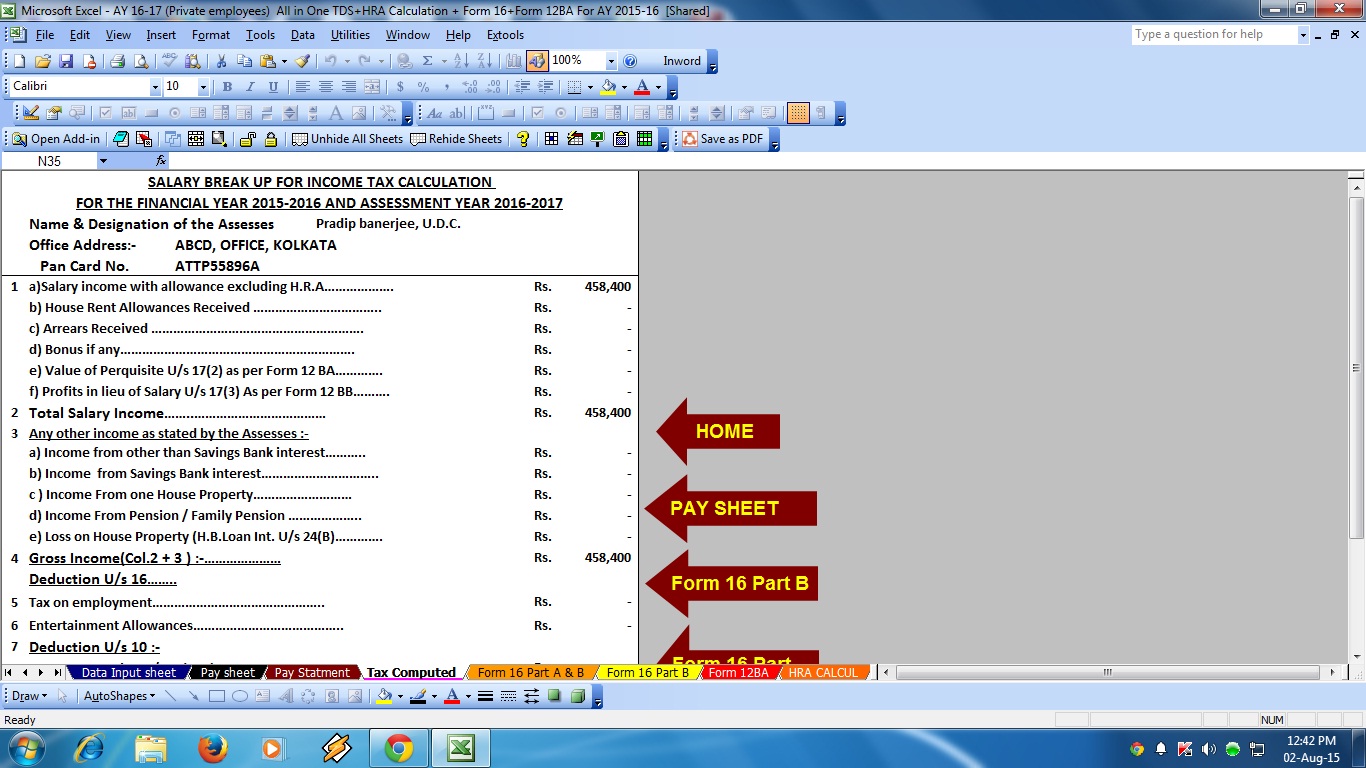
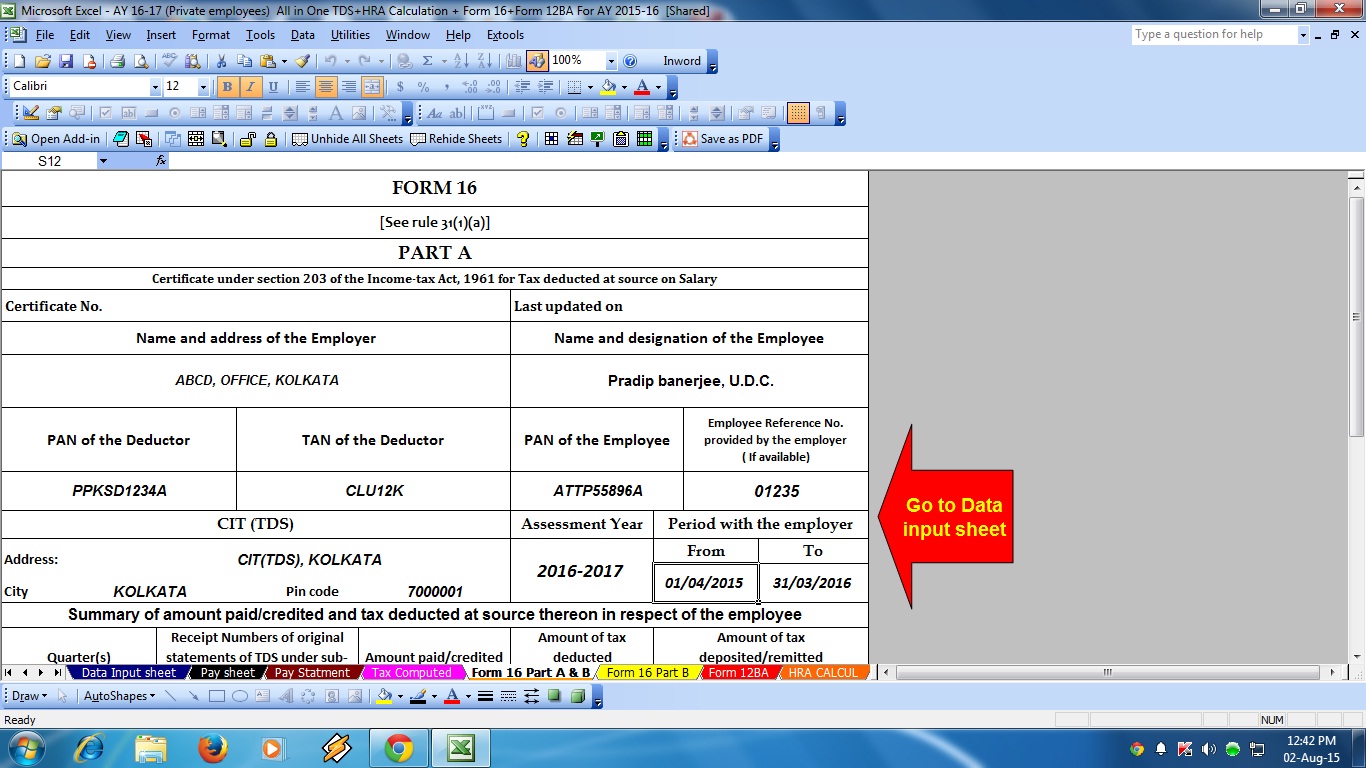


itaxsoftware.net
Itaxsoftware.net |
|
Posted: 08 Aug 2015 06:00 PM PDT The deadline for filing of tax return for AY 2015-16 is August 31, 2015. But what if you do not file your income tax return (ITR) by due date? Can I-T department penalize you?The good news is there is no penalty if you miss the August 31 deadline but file your ITR by March 31, 2016. But you loose on some benefits (discussed later). In case you miss that deadline too, you still can file your return till March 31, 2017 but in this case the I-T department can ask for penalty of Rs 5,000 after giving you chance to explain your reason for not filing. Though the late filing penalty is rare in case you have no tax dues but still it depends on your accessing officer. What if you don’t file AY 2015-16 return even by March 31, 2017?In case you miss the March 31, 2017 deadline then you would not be able to file your returns without I-T Department intervention. Also, the tax officer has to do your tax assessment based on best information he has resulting in increased tax liability.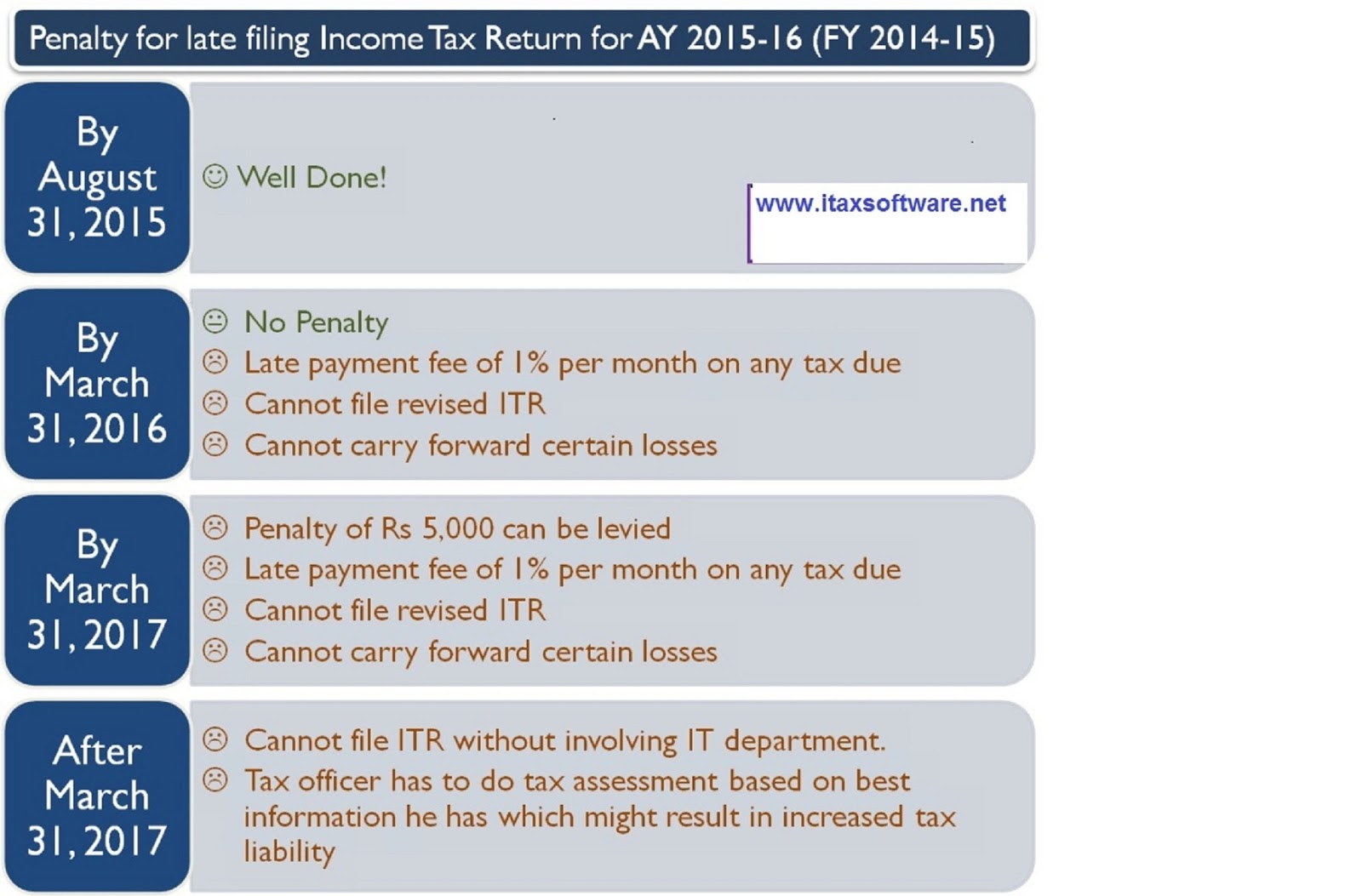 Impact of late filing of tax return: Here is a list of benefits you miss on in case you skip the August 31 deadline: 1. 1% Monthly Late payment fee on tax due: In case after adding up all the TDS and advance taxes, if there is any tax payable from your side, you will need to pay monthly 1% late fee on the amount due for each month of delay. 2. Late refund: if you file your ITR late, you will also get your excess tax paid refunded late. This is a loss as you could have put to the money to better use and you obviously loose on the interest part. 3. Cannot revise your ITR: You cannot file a revised return in case you filed your original ITR late. This can be a major drawback if you find some error on a later date or just forgot to take advantage of some tax exemption. 4. Cannot carry forward your losses: you cannot carry forward following losses in case of delayed filing: 1. Speculation loss, 2. business loss excluding loss due to un-absorbed depreciation and capital exp on scientific research, 3. short term capital loss, 4. long term capital loss, 5. loss due to owning and maintenance of horse races However you can still carry forward loss from House property. The above list is not comprehensive and may impact you the wrong way in case of late filing of tax returns. So if you have not filed your return yet do it before August 31, 2015 deadline. |


itaxsoftware.net
Itaxsoftware.net |
|
Posted: 09 Aug 2015 07:10 AM PDT This section has been introduced by the Finance Act 2005. Broadly speaking, this section provides deduction from total income in respect of various investments/ expenditures/ payments in respect of which tax rebate u/s 88 was earlier available. The total deduction under this section (along with section 80CCC and 80CCD) is limited to Rs. 1.50 lakh only. · Life Insurance Premium For individual, policy must be in self or spouse's or any child's name. For HUF, it may be on life of any member of HUF. · Sum paid under contract for deferred annuity for individual, on life of self, spouse or any child . · Sum deducted from salary payable to Govt. Servant for securing deferred annuity for self-spouse or child Payment limited to 20% of salary. · Investment in Senior Citizens Savings Scheme 2004 for 5 year by resident individuals. · Contribution made under Employee's Provident Fund Scheme. · Contribution to PPF For resident individual, can be in the name of self/spouse, any child & for HUF, it can be in the name of any member of the family. · Deposit in Sukanya Samriddhi Account as natural / legal guardian of girl child. · Contribution by employee to a Recognised Provident Fund. · Sum deposited in 10 year/15 year account of Post Office Saving Bank · Subscription to any notified securities/notified deposits scheme. e.g. NSS · Subscription to any notified savings certificate, Unit Linked Savings certificates. e.g. NSC VIII issue. · Contribution to Unit Linked Insurance Plan of LIC Mutual Fund e.g. Dhanrakhsa 1989 · Contribution to notified deposit scheme/Pension fund set up by the National Housing Scheme. · Certain payment made by way of instalment or part payment of loan taken for purchase/construction of residential house property. · Investments in Sukanya Samriddhi Scheme (w.e.f. 01.04.2015} |
Condition has been laid that in case the property is transferred before the expiry of 5 years from the end of the financial year in which possession of such property is obtained by him, the aggregate amount of deduction of income so allowed for various years shall be liable to tax in that year. |
· Contribution to notified annuity Plan of LIC(e.g. Jeevan Dhara) or Units of UTI/notified Mutual Fund. If in respect of such contribution, deduction u/s 80CCC has been availed of rebate u/s 88 would not be allowable. · Subscription to units of a Mutual Fund notified u/s 10(23D). · Subscription to deposit scheme of a public sector, company engaged in providing housing finance. · Subscription to equity shares/ debentures forming part of any approved eligible issue of capital made by a public company or public financial institutions. · Tuition fees paid at the time of admission or otherwise to any school, college, university or other educational institution situated within India for the purpose of full time education of any two children. Available in respect of any two children Download Automated TDS on Salary All in One for only BIHAR STATE EMPLOYEES for F.Y.2015-16 [ This Excel Utility can prepare at a time Tax Compute Sheet + Individual Salary Sheet + Individual Salary Structure for Bihar State Salary Pattern + Automatic HRA Exemption Calculation + Automatic Form 16 Part A&B and Part B for F.Y.2015-16] |
Section 80CCC: Deduction in respect of Premium Paid for Annuity Plan of LIC or Other InsurerPayment of premium for annuity plan of LIC or any other insurer Deduction is available upto a maximum of Rs. 150,000/-. |
The premium must be deposited to keep in force a contract for an annuity plan of the LIC or any other insurer for receiving pension from the fund. Note: The limit for maximum deduction available under Sections 80C, 80CCC and 80CCD(1) (combined together) is Rs. 1,50,000/-. Section 80CCD (1): Deduction in respect of Contribution to Pension Account (by Assessee}Deduction available for the amount paid or deposited in a pension scheme notified or as may be notified by the Central Government subject to a maximum of : (a) 10% of salary in the previous year in the case of an employee (b) 10% of gross total income in any other case. The maximum deduction allowable under the secion is Rs. 1.00 lac. Rs. 1.50 lacs w.e.f. 01.04.2015 in case of contribution to New Pension Scheme (NPS). Section 80CCD (2): Deduction in respect of Contribution to Pension Account (by Employer}Deduction available for the amount paid or deposited by the employer of the assessee in a pension scheme notified or as may be notified by the Central Government subject to a maximum of 10% of salary in the financial year. Section 80CCD: Additional Contribution to New Pension Scheme (NPS)A deduction of upto Rs. 50,000 is available over and above the limit of Rs. 1.50 lakh in respect of contributions made to NPS under Section 80CCD(1). Section 80CCG:Amount invested by resident individuals, whose gross total income does not exceed Rs. 12 lakhs, in listed shares or listed units in accordance with notified scheme for a lock-in period of 3 years (Subject to certain conditions). Deduction of 50 % of total investment subject to maximum of Rs. 25,000 in 3 consecutive assessment years, beginning with the assessment year relevant to the previous year in which the listed shares or list units of equity oriented funds are first acquired. |
Section 80D: Deduction in respect of Medical Insurance |
Deduction is available upto Rs. 30,000/- (enhanced from Rs. 20,000 w.e.f. 01.04.2015) for senior citizens and upto Rs. 25,000/- (enhanced from Rs. 15,000 w.e.f. 01.04.2015) in other cases for insurance of self, spouse and dependent children. Additionally, a deduction for insurance of parents (father or mother or both) is available to the extent of Rs. 30,000/- (enhanced from Rs. 20,000 w.e.f. 01.04.2015) if parents are senior Citizen and Rs. 25,000/- (enhanced from Rs. 15,000 w.e.f. 01.04.2015) in other cases. Therefore, the maximum deduction available under this section is to the extent of Rs. 60,000/-. From AY 2013-14, within the existing limit a deduction of upto Rs. 5,000 for preventive health check-up is available. Section 80DD: Deduction available to resident Individual and HUF in respect of Rehabilitation of Handicapped Dependent RelativeDeduction of Rs. 75,000/- (enhanced from Rs. 50,000 w.e.f. 01.04.2015) in respect of 1. Expenditure incurred on medical treatment, (including nursing), training and rehabilitation of handicapped dependent relative. 2. Payment or deposit to specified scheme for maintenance of dependent handicapped relative. Further, if the defendant is a person with severe disability a deduction of Rs. 125,000/- (enhanced from Rs. 1,00,000 w.e.f. 01.04.2015) shall be available under this section. The handicapped dependent should be a dependent relative suffering from a permanent disability (including blindness) or mentally retarded, as certified by a specified physician or psychiatrist. Note: A person with 'severe disability' means a person with 80% or more of one or more disabilities as outlined in section 56(4) of the 'Persons with disabilities (Equal opportunities, protection of rights and full participation)' Act. Section 80DDB: Deduction allowed to resident Individual and HUF in respect of Medical Expenditure on Self or Dependent RelativeA deduction to the extent of Rs. 60,000/- (Rs. 80,000 in case of senior citizen) or the amount actually paid, whichever is less is available for expenditure actually incurred by resident assessee on himself or dependent relative for medical treatment of specified disease or ailment. The diseases have been specified in Rule 11DD. A certificate in form 10 I is to be furnished by the assessee from any Registered Doctor. |
Section 80E: Deduction in respect of Interest on Loan for Higher StudiesDeduction in respect of interest on loan taken for pursuing higher education. The deduction is also available for the purpose of higher education of a relative w.e.f. A.Y. 2008-09. |
Section 80EE: Deduction in respect of Interest on Residential House PropertyThe deduction under this sub-section is available w.e.f. AY 2014-15. The maximum deduction available is Rs. 1 lac. In a case where the interest payable for the financial year 2013-14 is less than Rs. 1 lac, the balance deduction amount shall be available in AY 2015-16. The deduction under sub-section (1) shall be subject to the following conditions : i. the loan has been sanctioned by the financial institution during the period beginning on the 1st day of April, 2013 and ending on the 31st day of March, 2014; ii. the amount of loan sanctioned for acquisition of the residential house property does not exceed twenty-five lakh rupees; iii. the value of the residential house property does not exceed forty lakh rupees; iv. the assessee does not own any residential house property on the date of sanction of the loan. If deduction for Housing Loan Interest is availed under this section, no deduction can be availed for such interest under any other provisions of the Act for the same or any other assessment year. |
Section 80G: Deduction in respect of Various Donations |
The various donations specified in Sec. 80G are eligible for deduction up to either 100% or 50% with or without restriction as provided in Sec. 80G |
Section 80GG: Deduction in respect of House Rent PaidDeduction available is the least of 1. Rent paid less 10% of total income |
2. Rs. 2000/- per month i.e. Maximum Deduction available is 24,000/- |
3. 25% of total income, provided |
Assessee or his spouse or minor child should not own residential accommodation at the place of employment. |
He should not be in receipt of house rent allowance. |
He should not have self occupied residential premises in any other place. |
Section 80GGA: Deduction in respect of certain donations for scientific research or rural developmentSection 80GGC: Deduction in respect of contributions given by any person to political partiesSection 80QQB: Royalty Income of resident individuals on patents.Maximum deduction Rs. 3,00,000/- Section 80RRB: Royalty Income of resident individual authors of certain books other than text books.Maximum deduction Rs. 3,00,000/- Section 80 TTA: Deduction from gross total income in respect of any Income by way of Interest on Savings account |
Deduction from gross total income of an individual or HUF, upto a maximum of Rs. 10,000/-, in respect of interest on deposits in savings account ( not time deposits ) with a bank, co-operative society or post office, is allowable w.e.f. 01.04.2012 (Assessment Year 2013-14). |
Section 80U: Deduction in respect of Person suffering from Physical Disability |
Deduction of Rs. 75,000/- (enhanced from Rs. 50,000 w.e.f. 01.04.2015) to a resident individual who suffers from a physical disability(including blindness) or mental retardation. Further, if the individual is a person with severe disability, deduction of Rs. 125,000/- (enhanced from Rs. 1,00,000 w.e.f. 01.04.2015) shall be available u/s 80U. Certificate should be obtained from a Govt. Doctor. The relevant rule is Rule 11D. Deductions Allowable under Section 24 of Income Tax Act :Where a housing property has been acquired / constructed / repaired / renewed with borrowed capital, the amount of interest payable yearly on such capital is allowed as deduction under Section 24 of Income Tax Act, subject to the limits stated below. Penal interest on housing loan is not eligible for deduction. If a fresh loan has been raised to repay the original loan and the new loan has been used only for the purpose of repaying the original loan then, the interest accrued on such fresh loan is allowed for deduction. 1. If the property is acquired or constructed with the capital borrowed on or after 01-04-1999 and such acquisition or construction is completed within 3 years of the end of the financial year in which capital was borrowed then the actual interest payable is allowed as deduction subject to a maximum Rs. 2,00,000/- (Rs. 1,50,000/- upto 31.03.2015). 2. In other case interest up to maximum Rs. 30,000/- is deductible. 3. The ceiling of Rs.2,00,000/- (Rs. 1,50,000 upto 31.03.2015) or Rs. 30,000/- is only in case the property is self occupied. There is no limit on deduction of interest if the property is let out. The visitors may visit the web site of Income Tax Department for resolving their doubts or for clarifications. |


itaxsoftware.net
Itaxsoftware.net |
|
Posted: 10 Aug 2015 08:39 AM PDT Download the All in One TDS on Salary for all State Employees for F.Y.2015-16 [ This Excel Utility can prepare at a time Tax Compute Sheet + Individual Salary Structure + Automatic HRA Exemption Calculation + Form 16 Part A&B and Form 16 Part B for F.Y.2015-16 ]
|
|
A homemaker, salary earner, self-employed, the rich or the poor – all eyes are on the Finance Minister during the budget each year expecting tax relief. Although Budget 2015 did not offer any changes in the income tax threshold limit – Rs 2.5 lakh for individuals, Rs 3 lakh for senior citizens and Rs 5 lakh for very senior citizens, there were many other additional deductions added to the tax deductions kitty. To retain the smile on the taxpayers’ face finance minister Arun Jaitley remarked “…today an individual tax payer will get tax benefit of Rs 4,44,200.” He was here referring to the total savings, aggregating reliefs granted earlier and during the current Budget 2015. The total tax benefit of upto Rs 4,44,200 includes the savings under enhancement of health insurance exemption limit, doubling the transport allowance exemption limit to Rs 1600 per month and Rs.3200 per month for disable persons. Here are the areas that will impact your personal tax outgo Retirement savings To lure investments into pension funds the limit on deduction for contribution to a pension fund and the New Pension Scheme (NPS) was increased to Rs 1.5 lakh from the existing Rs 1 lakh, in an effort to streamline the deductions as per the Section 80 C investment avenues. An additional deduction under Section 80CCD sub section 1B of Rs 50,000 has been announced for contribution to the NPS. Hence the total deduction under section 80C and 80CCD will now be Rs 200,000. Employees now also have an option of choosing between Employees Provident Fund or the NPS for their retirement benefits. A reason to cheer for the small wage earners is that they wouldn’t be required to mandatorily invest in EPF, until their salary crosses a limit (to be announced later). An impetus has been given to social security net by offering the Atal Pension Yojana, a defined benefit pension scheme where the government would contribute 50% of the amount invested (maximum Rs 1000) by beneficiaries for five years, in accounts opened before 31st December 2015. Insurance An individual can claim a tax benefit of upto Rs 55,000 under the Section 80 D if he pays the premium for self and family including senior-citizen dependant parents. The enhanced limit for health insurance tax exemption is Rs 25,000 for individuals and upto Rs 30,000 for senior citizens. In a move to offer a tax breather to very senior citizens (above 80 years), they have been allowed to claim a deduction of upto Rs 30,000 for amount spent on medical treatment, as no health covers are available for them. Similar to the option for retirement savings, employees can also opt between Employee State Insurance (ESI) or health insurance scheme offered by insurers regulated by Insurance Regulatory Development Authority. Senior citizens can also rejoice the abolition of service-tax on premium payments for Varishtha Bima Yojana. Disabled and disease victims The Budget 2015 has shown sympathy toward those who have been suffering from severe diseases or are taking care of the differently-abled. The tax exemption limit for amount spent on treatment of diseases such as Cancer, full blown AIDS, Thalassaemia, Haemophilia etc by senior citizen has been increased to Rs 80,000 from Rs 60,000 earlier. Similarly additional deduction of Rs 25,000 has been allowed for differently-abled persons. New tax-saving instrument The Sukanya Samriddhi Account scheme has found its space among the tax-saving instruments under the Section 80 C basket, where one can invest and claim deduction of upto a maximum of Rs 1.5 lakh. Just like the Public Provident Fund the interest accruing on deposits in The Sukanya Samriddhi Account will be exempt from income tax. “Any withdrawal from an account opened in accordance with the Sukanya Samriddhi Account Rules, 2014 shall not be included in the total income of the assessee,” the finance minister announced. Saving for cleanliness Three more funds have been added to the list of funds where one can claim for philanthropic purposes. Contributions to Swachh Bharat Kosh, Clean Ganga Fund and National Fund for Control of Drug Abuse would be deductible upto 100% under the Section 80 G. Taxation at source So far the interest earned on fixed deposits was taxed at source (TDS). Starting the financial year 2015-16 interest above Rs 10,000 earned on recurring deposits too would be taxed before the payments are made to you. The elaborate Budget document specifies that all the deposits opened at various branches of a bank would be taken into account while calculating the threshold interest limit. Your co-operative bank deposits which weren’t subjected to TDS so far would now come under the realm of TDS for interest payments exceeding Rs 10,000. Those who aren’t liable to pay any tax yet have been subjected to TDS deduction on payments made under life insurance can submit Form 15H/ 15G for exemption from deduction at source, similar to that offered under bank deposits. |


itaxsoftware.net
Itaxsoftware.net |
|
Posted: 11 Aug 2015 06:14 AM PDT Download All in One TDS on Salary for Govt and Non Govt Employees for F.Y.2015-16 [This Excel Utility can prepare at a time Tax Calculation Sheet + Salary Structure + Automatic HRA Exemption Calculation + Form 16 Part A&B and Part B for A.Y.2016-17 ]1. No Hike in basic exemption Tax limitThe first disappointment comes in the form of no increase in the basic exemption limit. This means the tax slab will remain same for the financial year 2015-16 i.e. assessment year 2106-17 but the surcharge rate of 10% is increased to 12% for the tax payers having income above Rs.1 crore. This increment in the surcharge rate is made to compensate the income from the abolished wealth tax. 2. Section 80C ceiling limit remains Rs.1.50 lakhs per annumWith the inclusion of Sukanya Samriddhi Account Max limit Rs.1.5 Lakh and equity oriented pension funds Max Rs.1.5 Lakh, there was an inevitable need of expanding the threshold limit of section 80C but that did not happen. Section 80C remains intact in budget 2015. 3. Rise in the Health Insurance Premium paid u/s 80DTo spread the health care awareness among individual tax payers, section 80D has been amended by increasing the deduction limit for the premium paid for health insurance to Rs.25,000 for non-senior individuals (earlier Rs.15,000) and Rs.30,000 for senior citizens (earlier Rs.20,000). For super senior citizens (80 years or more) who are not eligible for health insurance get some relief in terms of deduction towards their medical expenses up to Rs.30,000 per year. 4. Additional Tax-Savings under Section 80DD, Section 80DDB and Section 80UIn view of the steep rise in the cost of the medical care, Government has increased deduction limit under section 80U and section 80DD by Rs.25,000 i.e. medical expense of disabled individual and dependent on Individual, from existing Rs.50,000 to Rs.75,000 and in case of severe disability the addition amounts to Rs.50,000 i.e. from existing Rs.1,00,000 to Rs.1,50,000. Further, Government has also given additional tax sop of Rs.20,000 (from Rs.60,000 to Rs.80,000) on the medical treatment of some specific diseases such as cancer, AIDS etc. for very senior citizens (aged 80 years or more) under section 80DDB. 5. Transport Allowance DoubledThe transport allowance cost has witnessed some sharp increase and to cope up with that Government has doubled the transport allowance from existing Rs.800 per month to Rs.1,600 per month which totaled to Rs.19,200 per year. 6. Home Loan Interest Deductions remains IntactThe limit of home loan interest deduction u/s 24 was hiked in the interim budget last year to Rs.2 lakhs. But with the rising cost of property, there was a need of increasing this deduction limit to Rs.3 lakhs which was not met. So the ceiling limit of home loan interest for the self-occupied property remains intact at Rs.2 lakhs per year under section 24(b). 7. National Pension Scheme u/s 80CCD increased by Rs.50,000Investments towards National Pension Scheme has got some additional tax sops of Rs.50,000 over and above the Section 80C ceiling limit of Rs.1.50 lakhs. Deduction limit of investment towards pension plans, annuity plans and new pension scheme is hiked to Rs.1.50 lakhs from earlier threshold limit of Rs.1 lakhs. In the previous budget, the limit of section 80C was hiked but the deduction limit for pension plans capped to Rs.1 lakh only; now, budget 2015 has removed that anomaly. Summary of all Deductions 8. Service tax rate increased to 14%A major hit to the common men comes in the guise of service tax. Budget 2015-16 has hiked the service tax rate from existing 12.36 to 14%. This means now every service such as eating food outside, paying your mobile or gymnasium bills etc. would attract extra tax. |


itaxsoftware.net
Itaxsoftware.net |
|
How to find Income Tax ward and circle? for filing the Income Tax Return for A.Y.2015-16 Posted: 12 Aug 2015 08:49 AM PDT With the advent of online tax filing it is much easier task to file your returns. But sometime there may be situations where you need to interact with income tax department to clarify their doubts or to raise the issues related to your tax filing. At that time you must first know about your tax ward and circle or about your assessing officer. Income tax department made your life easy in finding the tax ward or circle of your PAN Card. But before proceeding further let us understand what do you mean by tax ward and circle and who is assessing officer. Assessing Officer-He is the authorized person who make assessment of your return filed and if some clarification need then he will issue notice to you requesting for more data. Hence to assess each individual’s tax return, Income Tax Department set up different offices across India. These officers sit in these designated offices and will verify depending on the location they allotted and category of tax payers. Designation of such officers may vary based on volume of income, nature of trade assigned by board. It may be like Income Tax Officer, Assistant Commissioner, Deputy Commissioner, Joint Commissioner or Additional Commissioner. Such individual offices of Assessing Officer is allotted a unique number to identify. This number is called Income Tax Ward/Range No./AO Code. They have the powers to scrutinize your returns and if possible request for additional information. Your income tax refund will also be approved by these AOs only. By going by above information, you noticed that how much important for you to know about your AO or tax ward and circle. Below is the procedure to find the same. 1) Visit the link https://incometaxindiaefiling.gov.in/. Screen will be as below.  You need to enter your PAN number and enter the Catpcha Code then press on tab “Submit”. 2) Next you will view the below image which mentions PAN holder name, Area Code, AO Type, Range Code, AO Number, Jurisdiction and building.  |


itaxsoftware.net
Itaxsoftware.net |
|
Posted: 13 Aug 2015 06:15 AM PDT Download Automated Master of Form 16 Part B for F.Y.2015-16 [This Excel based utility can prepare at a time 100 employees Form 16 Part B for F.Y.2015-16] |
The CBDT has already changed the Format of Form 16 dated on 19/2/2013. In this Format have two part. Part A which found the Tax Deducted At Source and deposited in to the Central Govt Account and another Part B which is found the details of employee's Salary. This Part B is mandatory to prepare by the employer. This Part A is mandatory to download form the Income Tax TRACES Portal. |
Most of Employer or deductor yet not well known about this new Format of form 16. Also you most of employer could not able to download the Form 16 Part A from the TRACES portal. |
Who have not able to download the Form 16 Part A from the TRACES Portal, they can use this below given both in one file Form 16 Part A&B in New Format of Form 16. |
This Excel Based Software can prepare at a time 100 employees Form 16 Part B for the Financial Year 2015-16 and Assessment Year 2016-17. This Utility can use both of Govt and Non Govt Concerned. |
Feature of this Utility:- |
|
|
|
|
Download the Automatic Master of Form 16 Part A&B for F.Y.2015-16 [This Excel Based Software can prepare at a time 100 employees Form 16 Part A&B for the Financial Year 2015-16] |


itaxsoftware.net
Itaxsoftware.net |
|
Posted: 14 Aug 2015 06:57 AM PDT Income tax return filing is mandatory if your income is exceeding tax exempted limit. This year government has introduced the facility of EVC to e-verify electronically filed returns. Last date of filing the income tax return is 31st Aug 2015. You must be ready to filing your income tax return. If you are filing income tax return for the first time you must take extra precautions while filing income tax return. In order to help you, I am here with 20 common mistakes you should avoid while filing income tax return. 20 Common Mistakes Income Tax Return filingMistake -1 – Mentioning wrong PAN number Quoting wrong PAN number means your income tax rerun will be filed on someone else name. You should recheck your PAN number twice before filing your income tax return. Mistake -2 – Selection of wrong ITR form for filing You should select correct ITR form for filing income tax return. Specific ITR form is defined for the specific purpose. Filing return with incorrect ITR form may lead to rejection of ITR. Mistake -3 – Entering incorrect Account number, IFSC Code You should enter correct bank account number while filing income tax return. Entering an improper Account number or IFSC code means delay/problem in getting a refund. Mistake -4 – Not reporting detail of exempted income One must report the detail of all exempted income like dividend income, income from long-term capital gain etc. There is popular misunderstanding that these incomes need not to be disclosed in ITR. However, these details are easily tracked by income tax department via your PAN card number. If you are salaried you should report these incomes to your employer before generation of form 16 to incorporate these details in form 16. Mistake – 5 – Not reporting extra income You should report extra income earned by you during the financial year without fail. Extra income source could be consultancy, selling products, affiliate income etc. Your form 16 might not contain these incomes. Mistake -6 –Not checking form 26AS (Tax credit statement) before filing income tax return You should check form 26AS (Your tax credit statement) before filing income tax return. This is to ensure that the TDS deducted on behalf of the taxpayer by deductor is actually deposited with the income tax department and you are filing a return with legitimate information. Mistake -7 – Not paying tax before filing income tax return It is important to pay remaining taxes before filing income tax return. Filing income tax return without paying taxes will lead to rejection of return. Mistake -8 – Not reporting interest income under section 80TTA Remember that maximum deduction allowed on interest income of saving bank account is 10,000 Rs.(Section 80TTA). Interest income exceeding 10,000 Rs/- will be taxable and you should report this income. Mistake -9 – Tax is not applicable on second house/property Another common mistake which people make is not reporting income from the second house/property. The second property which is not self-occupied is by default assumed as let out property. You need to add rental income from this property in your income. Mistake -10 – Reporting wrong salary figures in tax return If you are filing income tax return for the first time you are likely to make this mistake. Under form 16 you will find salary in “Income chargeable under head salaries” while in ITR you will find simple title “Income from salary”. Mistake -11 – Not verifying return after submission Another common mistake which people make after submission of ITR is not verifying return. This year onwards you can e-verify your income tax return by EVC. Another alternative is to send the physical copy of acknowledgement at CPC, Banglore within 120 days of filing income tax return. If you are not verifying return after submission your ITR will be considered as defective. Mistake -12 – I cannot revise return if mistake is made in original return Another common misconception is one cannot revise return if mistake is made in original return, but it is not true. You can submit a revised return before the expiry of one year from the end of the relevant assessment year or before the completion of assessment by the income tax department, whichever is earlier. Mistake-13 – I cannot file return after due date You can file income tax return after due date also. Income tax department allows you to submit income tax return any time before the expiry of two years from the end of the financial year in which the income was earned. Mistake 14 – Filing return is not mandatory if I have paid all my taxes and no refund is due Common confusion for the new taxpayer is – “Filing return is not mandatory if I have paid all my taxes and no refund is due”. However it is not correct Income tax return filing is mandatory if your income is exceeding tax exempted limit. Mistake -15 – Not reporting income of Minor If you have invested money on the name of child you need to club this income with your income. Mistake -16 – Assessment year and financial year is same Remember that Assessment year and the financial year is not same. Financial year always starts from 1st April and ends on 31st March. Assessment year is the year immediately after the financial year. For FY 2014-15, Assessment year will be 2015-16. Mistake -17 – Filing multiple forms for multiple form 16 If you are changing job frequently you might have got multiple forms 16 in one financial year. Although you have got multiple forms 16 in one year you need to file only single Income tax return. Mistake -18 – Not providing incorrect e-mail or postal address You need to provide a correct e-mail address and postal address while filing income tax return. Any information or notification sent by income tax department will be sent to address mentioned in income tax return. If you provide a wrong address you might not receive important communication from Income Tax department. Mistake -19 – Not reporting interest income from fixed deposit Income from the fixed deposit is taxable and you need to mention the same in income tax return. Bank will be sending information about TDS on FD to income tax office on your PAN number. Not mentioning detail may lead to the discrepancy and may lead to rejection of income tax return. Mistake -20 – You can submit only schedule in case of revise return If you encounter any mistake in return you need to submit complete income tax return and not just the schedules/filed that require change/correction. Making mistakes mentioned above while filing income tax return means inviting income tax department for notice, scrutiny or penalties. Avoid them to have a spotless tax record. |


itaxsoftware.net
Posted: 15 Aug 2015 07:28 AM PDT |
Income Tax Department has come up with a New user friendly online Income Tax Return filing tool. Unlike the tools provided earlier in which we have to fill up an offline Excel sheet, the new Income Tax tool has a neat online interface for filling up and saving data at once. Undoubtedly, the new online Income Tax Return filing facility is user friendly and professional. We could see that presently this online tool is applicable only for ITR-1 and ITR-4S. We hope to Income Tax Department would extend this online tool to ITR-2 also in the near future.
Here is an intro to this useful tool 1. Go to this Income Tax Department’s Official online ITR filing Website. Register using your PAN and get user name and password, if you have not already registered. 2. Login in to New Income Tax E-filing tool 3. Once you have successfully logged in you will land in to following page 4. After you select the ITR type and relevant year for which ITR has to be filed, entry page of ITR will be shown. The first tab will be containing the instructions for filling the data 5. As you are in logged in session, it is adviceable to save the data entered after each tab is completed. However Submit Button has to be used only after entry of all the data. The following Screenshot is Personal Information entry tab. Once entry is completed save the data as draft and proceed to next tab. 6. Following Screenshots are relating to entry tabs for Income Tax details, Details of Income Tax Deducted by employer, and Bank Account details. After entry of data in all these tabs are completed, click Submit button to generate ITR-V Button. ITR-V is a document which contains the summary of your income, deductions and income tax paid. This document has to be signed and sent to the Income Tax Central Processing Centre at Bangalore. Address of this centre will be available in the mail sent to you attaching filled up ITR-V form. Please note that Online E-filing will get completed only after receipt of this ITR-V at Central Processing Centre at Bangalore. As per the CBDT has mandatory to mention the Aadhar Card for the Assessment Year 2015-16 |


|
How to rectify your income tax return through online for the A.Y. 2015-16 Posted: 15 Aug 2015 08:13 AM PDT A taxpayer can rectify his incometax return online if there is an apparent mistake in the return already filed. The change can be effected only after the taxpayer has received an order under Section 143(1) from CPC Bangalorefor the e-return. Rectification enables correcting the error and refilling the return for assessment. To do so, one needs to log in to the income tax e-filing website with the login name and password that have been used for filing the return.Log in: After logging in to the site, go to the 'My Account' page and click on the 'Rectification' tab. You will be guided to a form for rectification. Details: The taxpayer must fill in the assessment year for which the rectification is sought. The latest communication reference number and CPC order date, as it appears on the intimation under Section 143(1), also need to be filled. If the return is audited under Section 44AB, sign the rectification return digitally. Processing: Once the rectification return is successfully uploaded, a rectification request number and acknowledgement will be displayed. The request will be processed at CPC Bangalore. A rectification order under Section 154 can be issued, or the request can be rejected. Withdrawal: The taxpayer has the option to withdraw the rectification return online within seven days of filing the same. Points to note 1) Only one rectification request can be filed for an assessment year as per the CPC order, unless the rectification return is withdrawn. 2) A rectification should not be filed for any change in income. Instead, a revised return should be filed for this. 3) Rectification request can be filed only for the last five assessment years. |


itaxsoftware.net
Itaxsoftware.net |
|
Posted: 16 Aug 2015 07:46 AM PDT Download the All in One TDS on Salary for Central Govt Employees for F.Y.2015-16 [ This Excel Based Utility can prepare at a time Tax Compute Sheet + Individual Salary Structure + Individual Salary Sheet + Automatic HRA Exemption Calculation + Form 16 Part A&B and Form 16 Part B ]Income Tax Exemptions and deductions, give you plenty of opportunities to save tax. By using wisely these exemptions and deductions, you can reduce your tax out-go. In this post, I am listing the available exemptions, and deduction under income tax act.Allowances Exempted Under Section 10 of Income Tax Act1. House Rent Allowance (HRA)You get a job and shift to another city. Because of your job, you live in a different place. You are forced to live in a rented accommodation. The rented flat is not by choice but because of the duty. Hence, the expense on rent is because of your job. You can’t avoid this, even if you wish. Therefore, government exempt the rent from income tax. However, your employer must pay the house rent allowance. Click here to Download and Calculate your House Rent Exemption U/s 10(13A) Leave Travel AllowanceLTC or LTA is exempted if the same is actually spent Transport AllowanceYou daily go to your office or workplace from you house. You also spend on the local transport. This expenditure is also forced upon you. Therefore, the government has exempted transport allowance from the income tax, provided your employer gives you the transport allowance. You don’t need to give any receipt of this local travel. However, the tax exemption is Rs 1600/month and for Phy. Disable Persons can get Rs.3200 Per Month.Children Education AllowanceChildren Education allowance in also exempted from income tax. Your employer must give this allowance for availing the tax exemptions. It is Rs. 100 per month per child up to a maximum of 2 children. Hostel SubsidyThis is another tax exemption related to your child’s education. It is Rs. 300 per month per child up to a maximum of two children. Other Allowance Eligible For Income Tax exemptionsUniform Allowance, Special Compensatory Allowance, High Altitude Allowance, allowances applicable to North East, Compensatory Field Area Allowance, Counter Insurgency Allowance, High Active Field Area Allowance, island duty allowance, tribal allowance etc. These allowances are tax-free, but you need to produce the proof of the actual expense in some cases. Income Tax Exemption on Interest Paid on Housing Loan U/s 24BThis Exemption is also related to your accommodation because of the job. After shifting to a different place, you may opt for your own house instead of rented accommodation. If you take home loan for the house, the interest payment is tax exempted. You can get maximum exemption of Rs 2 lakh on housing loan interest. There are some conditions for this exemption. The house should be self-occupied. You may get this exemption if your home is under construction. however the construction should complete within 3 years. Tax Deduction Under Section 80C, Max limit Rs.1.5 LakhThe Government wants to encourage some certain types of investments and expenses. To achieve this goal it gives the benefit of tax deductions. There are many investments and expenses under section 80C, 80CCC and 80CCD. However, the total deductions under this section are limited to Rs 1.5 lakh. · Employee Provident Fund · Pension/ Annuity Schemes · Life insurance premium · Tax Saving mutual fund (ELSS) · Home loan principal payment · Sukanya Samriddhi Account · Tuition fees of children · PPF Account Contribution · National Saving Certificate · Tax-saving fixed Deposit · Post office time deposits Section 80CCC: Deduction For Annuity PlanYou can also get a deduction for the annuity plan of insurance companies. There are some limitations on this deduction. · You can’t contribute more than 10% of your salary or gross income. · You can’t enjoy the deduction of more than Rs 1.5 lakh in a year. Section 80CCD(1) : Contribution For Pension PlanSimilar to annuities, contribution in pension plans is also eligible for tax deduction. For example contribution to National Pension Scheme (NPS) will get deduction benefit under this rule. It is also limited to 10% of salary or 10% gross income (if not salaried). Section 80CCD(2): Contribution To Pension Plan By employerThis section gives you extra tax saving opportunity. If your employer contributes into your pension plan, it would be also tax-free. This contribution does not come under the overall limit of 1.5 lakh. You can ask your employer to contribute 10% of your salary into your pension plan. It will not affect your employer financially, but you would be able to save some more tax. Deductions Under Chapter VIA of Income Tax ActSection 80CCG: Rajiv Gandhi Equity Saving Scheme (RGESS)This scheme also gives you the extra tax saving. To avail this benefit, you must be the first-time investor in the share market. Your annual income should not be more than Rs 10 lakh. You can invest up to Rs 50,000 under this scheme. However, the tax deduction would be available for the 50% of your investment. So, if you invest Rs 50,000, you will get the tax deduction of only Rs 25,000. There is some mutual fund scheme which is designed for RGESS. However, due to the complex rules, it could not become popular. Section 80D: Medical Insurance DeductionThis scheme also gives you a chance to save tax over and above the 1.5 lakh. One must use this tax saving opportunity. In the budget 2015 the government does not change income tax slab, but it has increased the limit for section 80D. Section 80D can give you a tax deduction of up to Rs 65,000. Medical insurance of self, family and parents are eligible for tax deduction under section 80D. Section 80D: Tax Deduction For Medical Insurance In FY 2015-16 Section 80DD: Deduction For Maintenance of Disable DependentUnder this section, one can get extra tax deduction of Rs 50,000. To avail this deduction, you must fulfill some conditions. 1. A person with a disability must be dependent upon you. The disability may be physical or mental. 2. You must produce a certificate from the doctor. 3. You must incur the expense of treatment, rehabilitation, nursing and training. If you deposit any amount in any scheme for the disabled, it would be also eligible for tax deduction. If dependent person is with severe disability, you can claim deduction up to Rs 1,00,000. Section 80DDB: Serious Illness Deduction This deduction is for the treatment of serious illness. An assessee can get an income tax deduction of Rs 80,000 under this section. Amended by the Finance Budget 2015 1. The deduction is for the expense of illness of self or dependent. 2. The illness should be within the prescribed list. 3. There should be real expense. Any reimbursements of insurance claims should be subtracted. 4. You must give a certificate from the government doctor. 5. For senior citizens this deduction limit is Rs 80,000. Section 80E: Deduction on Loan for Higher StudiesLike the home loan interest, one can also claim income tax deduction for education loan interest. 1. You must take education loan from a financial institution. 2. You can avail this tax deduction maximum of 7 years. 3. You can take the benefit of this deduction only for the higher education. 4. You can take this benefit only for the education of self, spouse or children. If you are the legal guardian of a student, you can also take this benefit. Section 80G: Deduction for DonationsThe donations specified in Section 80G are eligible for deduction. The deduction may of 100% of donation or 50%, It depends upon the type of receiver. Section 80GG: Deduction on House Rent PaidThis deduction is for those, who don’t get the house rent allowance from their employer. Such person can avail this deduction according the specified rules. Deduction is the least of |
1. Rent paid less 10% of total income |
2. Rs. 2000/ month, i.e. Maximum Deduction available is 24,000. 3. 25% of total income There are some conditions for this benefit. · Assessee or his spouse or minor child should not own residential accommodation at the place of employment. · He should not get a house rent allowance (HRA). · He should not have self occupied residential premises in any other place. Section 80TTA: Saving Account Interest DeductionInterest earned on a saving account is not added in taxable income, if it is less than Rs 10,000 in a financial year. Section 80U: Deduction For DisabledUnder section 80U a person with disability gets extra deduction from his/her taxable income. Such person can deduct Rs 75,000 from the taxable income. In case the disability is severe, the deduction is up to Rs 1,25,000. To avail this deduction one should obtain a certificate from the government doctor. |


itaxsoftware.net
Itaxsoftware.net |
|
Posted: 17 Aug 2015 06:27 AM PDT Download Automatic Arrears Relief Calculator with Form 10E from F.Y.2000-01 to F.Y.2015-16Your expense of medical insurance can also give you the opportunity to save some more tax. Under section 80D of the income tax act, you can get the tax benefit for the insurance premium. Well, there are other tax saving options under section 80C, But section 80D gives you additional tax benefit. You can get a tax deduction of up to Rs 65,000 under the section 80D. Like any other tax saving option, there are some limitations with section 80D. Section 80D: Income Tax Saving LimitYou can claim a tax deduction of health insurance premium. You can claim a tax deduction for the premium payment of your family and parents separately. But it is subject to an upper limit. Tax Saving On The Health Insurance Premium of Your FamilyYou can get a tax deduction of maximum Rs 25,000 on the health insurance premium for self and family. If you are a senior citizen, you can claim tax deduction on the premium of up to Rs 30,000. Tax Saving On The Health Insurance Premium of Your ParentsIn Addition to above you can further claim a tax deduction for the insurance premium of your parents. The maximum limit for this deduction is Rs 25,000. If the parents are a senior citizen, the maximum limit is 30,000. Section 80D: Preventive Health Check Up Tax DeductionThere is another tax benefit under section 80D. You can also claim a tax deduction for the expense of health check up. The maximum deduction allowed under this provision is 5,000. Health check up can be Section 80D: Who Is Eligible For Tax BenefitAny taxpayer can avail the tax deduction under section 80D. The medical insurance premium can be of any or all of these family members. · Self · Wife/Husband · Dependent Children · Parents The cumulative insurance premium payment of all the family members should not exceed the prescribed limit. If An HUF is claiming a tax deduction under section 80D. It can add the insurance premium of any family member, subject to the maximum limit. Maximum Tax Saving Because Of the Section 80DTax saving because of the section 80D is different to different situation. Have a look at the table.
|


itaxsoftware.net
Itaxsoftware.net |
|
How to save more this financial year 2015-16,Plus Automatic HRA Exemption Calculator Posted: 18 Aug 2015 08:16 AM PDT As the new Financial Year begins, now is the best time to save. From ways to claim maximum tax benefits to various avenues of personal savings that earn attractive income tax rebates, this guide will help you make informed choices.During his Budget speech, Finance Minister Arun Jaitley said an individual tax payer can claim tax benefits for up to Rs. 4,44,200 in addition to the tax exemption. No change in tax slabs for individual payersIncreased exemption limits on health insurance premium and transport allowance were announced in the Union Budget for 2015. Public provident fundThis dependable small saving scheme offers 8.7 per cent interest per annum and comes with a lock-in period of 15 years. Part withdrawal and loan is also possible. Maturity is also exempted from IT. Sukanya-SamriddhiA small savings scheme through India Post for the welfare of girl child, it presently yeilds 9.2 per cent per annum. Being a long-term corpus fund, the amount matures when the daughter turns 21. Till then, you can enjoy IT exemption under Sec. 80(C). Employee Provident FundThe Employee Provident Fund Act is likely to be amended this year. The big change on this front is that the pension option has been withdrawn for new employees. The entire EPF corpus will be given at the time of retirement without tax deducations. National Pension SchemeBudget has granted an additional tax deduction of Rs.50,000 for investment in the New Pension Scheme. So start to save early, for a financially-independent post-retirement life. Home loansRepayment of the Principal amount in entitled for income tax rebate under Section 80 (C). Tax deducation upto a maximum of Rs. 2 lakh can be availed if the property is self-occupied. Whole interest is tax deductible incase the property is not self-occupied. InsurancePremiums paid on ULIP, pension plans, endowment and pure terms are exempted from tax upto Rs. 1.5 lakh under Section 80(C). HealthUnder Section 80(D) premiums paid on health insurance for self, spouse, children are tax deductible upto Rs. 35,000. Additional rebate of Rs. 20,000 for senior-citizen dependent parents. Small Saving SchemesThe once-popular Kisan Vikas Patra is back through India Post. Small contributions in denominations of Rs. 1000, 5000, 10,000 and 50,000, with no upper ceiling on investment, will double in 100 months. |


itaxsoftware.net
Itaxsoftware.net |
|
Posted: 19 Aug 2015 06:26 AM PDT The Income Tax Section Under Section 80GG where allow the House Rent Exemption Maximum Rs. 24,000/- P.A. and 2000/- P.M. who have not get the House Rent allowances from the employer. The Section 80GG says in brief is given below:- Download West Bengal Govt employees Income Tax Preparation Excel based Software For FY 2015-16 [This Utility can prepare at a time your Income Tax Calculated Sheet + Individual Salary Structure + Automatic House Rent Exemption Calculation + Automated Form 16 Part B and Part A&B for the Financial Year 2015-16 and this Excel Utility only for W.B.Govt Employees.] Feature of above utility:-
Details of Income Tax Section 80GG :-Section 80GG allows the employee to a deduction in respect of house rent paid by him for his own residence. Such deduction is permissible subject to the following conditions :- (a) the employee has not been in receipt of any House Rent Allowance specifically granted to him which qualifies for exemption under section 10(13A) of the Act; (b) the employee files the declaration in Form No.10BA. (Annexure X) (c) The employee does not own: (i) any residential accommodation himself or by his spouse or minor child or where such employee is a member of a Hindu Undivided Family, by such family, at the place where he ordinarily resides or performs duties of his office or carries on his business or profession; or (ii) at any other place, any residential accommodation which is in the occupation of the employee, the value of which is to be determined under section 23(2)(a) or section 23(4)(a), as the case may be. (d) He will be entitled to a deduction in respect of house rent paid by him in excess of 10% of his total income. The deduction shall be equal to 25% of total income or Rs. 2,000/- per month, whichever is less. The total income for working out these percentages will be computed before making any deduction under section 80GG. The Drawing and Disbursing Authorities should satisfy themselves that all the conditions mentioned above are satisfied before such deduction is allowed by them to the employee. They should also satisfy themselves in this regard by insisting on production of evidence of actual payment of rent. |


itaxsoftware.net
Itaxsoftware.net |
|
Posted: 20 Aug 2015 06:47 AM PDT Download All in One TDS on Salary for All State Employees for Financial Year 2015-16 and Assessment Year 2016-17[ This Excel based Software can prepare at a time Tax Compute Sheet + Individual Salary Structure + Individual Salary Sheet + Automated HRA Calculation + Automated Form 16 Part A&B and Part B for F.Y.2014-15]Budget 2015 Effect to the Salaried Persons :- With no hike in the basic exemption limit of Rs.2.50 lakhs and no rise in threshold/ceiling limit of section 80C, budget did not give many reasons to grin to the salaried class tax payers aka common man. The expectations of common man from budget 2015 were high but most of them remained unattained. Although there are couple of social scheme which includes low-cost pension scheme and low-premium insurance scheme such as PM Suraksha Bima Yojana, Atal Pension Yojana and PM Jeevan Jyothi Bima Yojana. All these schemes reflect that Government has tried to support the lower class by making easy access to insurance and pension plans. Let’s see What’s in Budget 2015 for Salaried Class1. No Hike in basic exemption limit |
The first disappointment comes in the form of no increase in the basic exemption limit. This means the tax slab will remain same for the financial year 2015-16 i.e. assessment year 2106-17 but the surcharge rate of 10% is increased to 12% for the tax payers having income above Rs.1 crore. This increment in the surcharge rate is made to compensate the income from the abolished wealth tax. |
Tax-Slabs for financial year 2015-16 i.e. assessment year 2106-17 |
2. Section 80C ceiling limit remains Rs.1.50 lakhs per annum |
With the inclusion of sukanya samriddhi yojana and equity oriented pension funds, there was an inevitable need of expanding the threshold limit of section 80C but that did not happen. Section 80C remains intact in budget 2015. Recommended Read: How to Maximize Tax Savings on Salary Income? |
3. Rise in the Health Insurance Premium paid u/s 80DTo spread the health care awareness among individual tax payers, section 80D has been amended by increasing the deduction limit for the premium paid for health insurance to Rs.25,000 for non-senior individuals (earlier Rs.15,000) and Rs.30,000 for senior citizens (earlier Rs.20,000). |
4. Additional Tax-Savings under Section 80DD, Section 80DDB and Section 80UIn view of the steep rise in the cost of the medical care, Government has increased deduction limit under section 80U and section 80DD by Rs.25,000 i.e. medical expense of disabled individual and dependent on Individual, from existing Rs.50,000 to Rs.75,000 and in case of severe disability the addition amounts to Rs.50,000 i.e. from existing Rs.1,00,000 to Rs.1,50,000. Further, Government has also given additional tax sop of Rs.20,000 (from Rs.60,000 to Rs.80,000) on the medical treatment of some specific diseases such as cancer, AIDS etc. for very senior citizens (aged 80 years or more) under section 80DDB. 5. Transport Allowance DoubledThe transport allowance cost has witnessed some sharp increase and to cope up with that Government has doubled the transport allowance from existing Rs.800 per month to Rs.1,600 per month which totaled to Rs.19,200 per year. 6. Home Loan Interest Deductions remains IntactThe limit of home loan interest deduction u/s 24 was hiked in the interim budget last year to Rs.2 lakhs. But with the rising cost of property, there was a need of increasing this deduction limit to Rs.3 lakhs which was not met. So the ceiling limit of home loan interest for the self-occupied property remains intact at Rs.2 lakhs per year under section 24(b). 7. National Pension Scheme u/s 80CCD increased by Rs.50,000Investments towards National Pension Scheme has got some additional tax sops of Rs.50,000 over and above the Section 80C ceiling limit of Rs.1.50 lakhs. |
8. Continue Section 87A ( Rebate Rs.2,000/-)9.Continue Section 80TTA ( Relief From Savings Bank Account Max Rs.10,000/-) |


itaxsoftware.net
Itaxsoftware.net |
|
Posted: 21 Aug 2015 09:37 AM PDT Download All in One TDS on Salary for Govt and Non-Govt employees for the Financial Year 2015-16 and Assessment Year 2016-17 [ This Excel Utility can prepare at a time your Income Tax Compute Sheet + Individual Salary Structure + Individual Salary Sheet + Automatic HRA Exemption Calculation + Automatic Arrears Relief Calculator with Form 10E + Automated Form 16 Part A&B and Form 16 Part B as per the new Finance Budget 2015-16 ]Brief in Section 80EE ( New deduction Under Chapter VIA as House Building Loan Interest Max Rs. 1 Lakh.First time individual home buyers can get tax deduction on interest of home loan, under newly inserted section 80EE of the Income Tax Act, applicable form assessment year 2014-15 on words Financial Year. This is in addition to tax rebate on interest payment of home loan, under section 24B. Eligibility for 80EE rebateThis rebate on home loan interest is applicable only for home loans satisfying the following conditions: i. Loan is sanctioned by a financial institution or housing finance company between 1st April 2013 and 31st March 2014. ii. Loan amount is Rs. 25 lakhs or less and cost of residential house is Rs. 40 lakhs or less This should be the only house owned by the taxpayer at the time of sanction. Maximum deduction limit under 80EEUp to Rs. 1 lakh can be claimed towards interest payable on home loan from the financial year 2013-14. If interest payable in this year is less than Rs. 1 lakh then the balance can be claimed in the following year. For instance if interest payable in FY 2013-14 is Rs. 75,000 then tax rebate on remaining Rs. 25,000 can be claimed in FY 2014-15. The amount claimed under 80EE cannot be claimed for tax rebate under any other sections in any year. The deduction under sub-section shall be subject to the following conditions, namely:— (i) the loan has been sanctioned by the financial institution during the period beginning on the 1st day of April, 2013 and ending on the 31st day of March, 2014 and on words financial years. (ii) the amount of loan sanctioned for acquisition of the residential house property does not exceed twenty-five lakh rupees; (iii) the value of the residential house property does not exceed forty lakh rupees; (iv) the assessee does not own any residential house property on the date of sanction of the loan. (4) Where a deduction under this section is allowed for any interest referred to in sub-section (1), deduction shall not be allowed in respect of such interest under any other provisions of the Act for the same or any other assessment year. (5) For the purposes of this section,—(a) "financial institution" means a banking company to which the Banking Regulation Act, 1949 (10 of 1949) applies including any bank or banking institution referred to in section 51 of that Act or a housing finance company; (b) "housing finance company" means a public company formed or registered in India with the main object of carrying on the business of providing long-term finance for construction or purchase of houses in India for residential purposes. |


itaxsoftware.net
Itaxsoftware.net |
|
How to Check Income Tax Refund Status through Online Posted: 22 Aug 2015 08:37 AM PDT How to check income tax refund status online ?Click to this link Tax Information Network of the Income Tax Department of India. You will find a rectangular submission form at the end of the page.  To check your tax refund status online, fill in your Permanent Account Number (PAN) and the assessment year for which you want to track the income tax refund status for. Once you have entered the details and clicked on the submit button, you will get to know about the status of your income tax refund. In most of the cases you might see this message.  This message indicates that your income tax refund has not been processed yet. Keep checking back, as I mentioned earlier, the Income Tax Department will take its own sweet time to process your tax refund. If you have provided a bank account number for the refund to be deposited in at the time of filing your return, you will see the below status if you tax refund has been processed.  If the income tax refund status shows as processed, do check you bank statement to verify if the refund amount has been credited to your account |


|
Bank Holidays on 2nd and 4th Saturdays From 1st September 2015 – Govt Notification issued Posted: 22 Aug 2015 05:22 AM PDT Banks will be closed on 2nd and 4th Saturdays from 1st September 2015 of each month as per the Wage Negotiation AgreementMinistry of Finance has announced that as per the Wage Negotiation between IBA Workmen Unions and Officers’ Association – 10th BPS – 2nd and 4th Saturday are declared as Holidays for Banks with effect from 01.09.2015. F.No.4/1l7/2015-IR Government of India Ministry of Finance Department of Financial Services Jeevan Deep, IIIrd Floor, Parliament Street. New Delhi Dated the August 20. 2015 To 1. Dy. Governor, Reserve Bank of India. Central Office, Mumbai. 2. Chief Executive, Indian Banks’ Association, Mumbai. Subject: Wage Negotiation between IBA Workmen Unions and Officers’ Association – 10th BPS – 2nd and 4th Saturday as Holidays Sir, I am directed to refer to IBA’s letter No. HR&IR/XBPS/3/975 dated 25th June, 2015 and RBI’s letterNo.DBR(Leg.)No.953/09.04.022/2015-16 dated 15.7.2015 on the subject cited above and to enclose herewith a copy of the Notification(in English and in Hindi) regarding declaring every second and fourth Saturday of every month as public holiday for banks in India with effect from 1st September, 2015. 2. RBI and IBA are requested to take necessary action accordingly. 3. This issues with the approval of Competent Authority. Yours faithfully. (Manish Kumar) Under Secretary to the Government of India Encl. As above To be published in the Gazette of India, Extra ordinary, Part II, Section 3, Sub-section (II) MINISTRY OF FINANCE (DEPARTMENT OF FINANCIAL SERVICES) NOTIFICATION NEW DELHI, THE 20 AUGUST, 2015 S.O. – (E) In exercise of the powers conferred by section 25 of the Negotiable Instruments Act, 1881 (26 of 1881), the Central Government hereby declares the second and the fourth Saturday of every month as public holiday for banks In India, whether or not such banks are Included In the Second Schedule to the Reserve Bank of India Act, 1934 (2 of 1934), with effect from the 1st day September, 2015. [F. No. 4/1/712015-IR] (Mohammad Mustafa) Joint Secretary to the Government of India To The Manager, Government of India Press, Ring Road, Mayapuri, New Delhi -1 10064. |


itaxsoftware.net
Itaxsoftware.net |
|
New Amended Salary Certificate Form 16 Part-B for FY 2014-15 and Ass Yr 2015-16 Posted: 23 Aug 2015 08:29 AM PDT Download New Salary Certificate Form 16 Part B for Fy 2014-15 and AY 2015-16 [Prepare at a time 50 employees Form 16 Part B]The CBDT has already Circulate vide Circular No.4/2013 dated 17/4/2013 and it is clear that the Part A(Annexure) of Salary Certificate Form 16 is mandatory to download from the Income Tax New Web Site TRACE and the Part B (Annexure) must be prepare by the Employer/Deductor. As per the New Amended Salary Certificate Form 16 has already Changed of Format of Form 16 vide Notification No. 11/2013, where the Form 16 made in two part. One Part -A and Part - B. The Part A has now mandatory to download from the Web Site TRACES Portal. Snapshot of Form 16 Part A  Snapshot of Form 16 Part B which can prepare by the deductor of employer 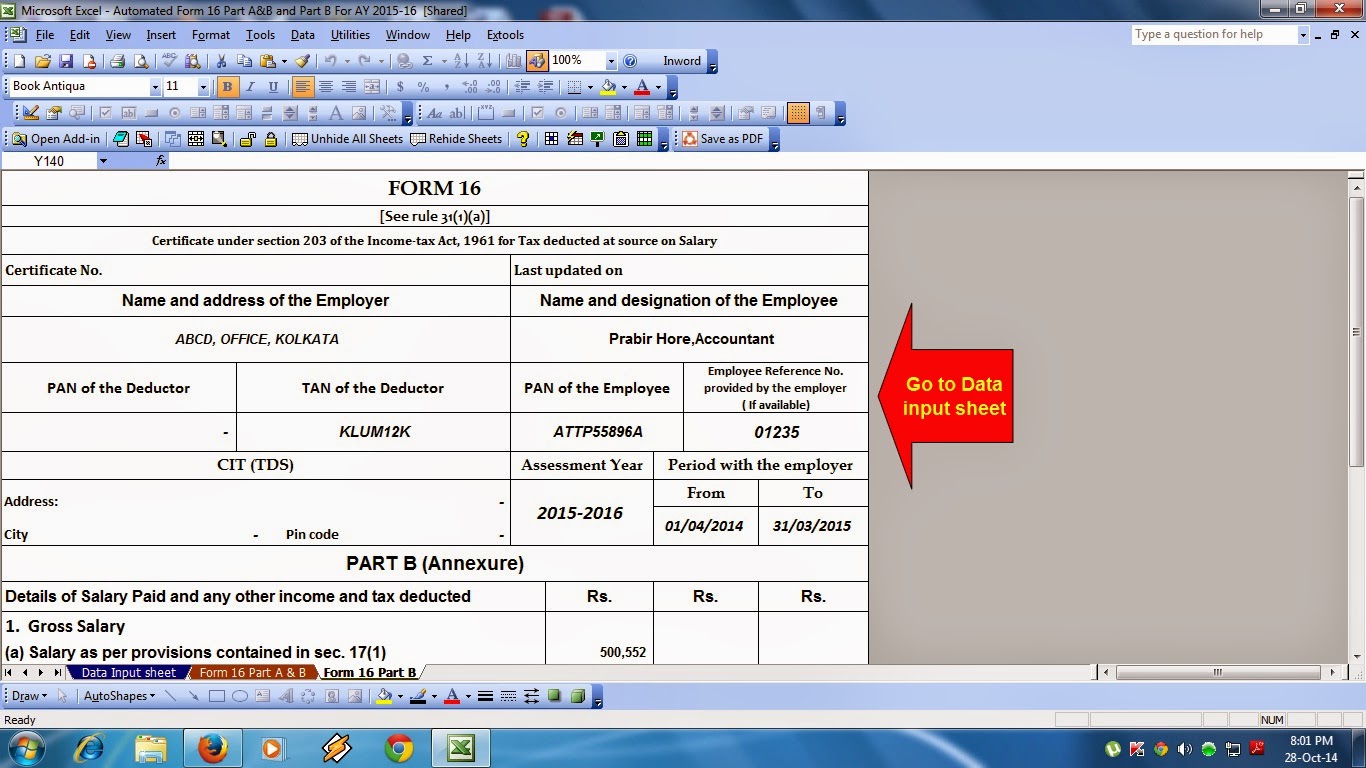 It may also have in trouble who are un- known about this New Circular, and also facing a problem to download the Part A of Form 16 from the New TRACES Portal. Most of small concerned where have no Internet Facility and they can not able to download the Part A from the TRACES Portal. The New Amended Form 16 where have two part A and B ( Annexure), it observe that the Part B which can must be prepared by the Employer/Deductor, that there have no extra column for indicate the who's Salary Certificate Form 16 Part B is prepared. Below given the Format of New Amended Form 16 Part A and Part B ( Annexure) in Excel format.Click here to download Automated Master of Form 16 Part A&B for FY 2014-15This Excel Utility can prepare limit less Salary Certificate Form 16 Part B for the FY 2014-15 and Assessment Year 2015-16. This Excel Utility have in a Zip file, where also available the New CBDT Circular and also have an Instruction about " How to prepare the limit less Form 16 Part-B Download the Utility (One by one Preparation Form 16 Part B) [ This Excel Utility Can prepare Form 16 Part A&B and Part B One by One ] |


|
Posted: 23 Aug 2015 04:51 AM PDT Download All State Govt employees All in One TDS on Salary for FY 2015-16 (Prepare at a time Tax Compute Sheet + Individual Salary Structure + Individual Salary sheet + Automated HRA Calculation + Form 16 Part A&B and Part B for the Financial Year 2015-16)As per the Income Tax Rules the all deduction Under Chapter VI A with the all current amended Section of Income Tax which was passed by the Central Finance Budget 2015-16 have also in this Chapter and showing the same is given below, so you can guess the which Section you can get the Income Tax benefits. Deduction Under chapter VI A is given bwlow:- |
Section 80D: Deduction in respect of Medical Insurance |
Deduction is available up to Rs. 30,000/- for senior citizens and upto Rs. 25,000/ in other cases for insurance of self, spouse and dependent children. Additionally, a deduction for insurance of parents (father or mother or both) is available to the extent of Rs. 30,000/- if parents are senior Citizen and Rs. 25,000/- in other cases. Therefore, the maximum deduction available under this section is to the extent of Rs. 55,000/-. From AY 2016-17, within the existing limit a deduction of up to Rs. 5,000 for preventive health check-up is available. Download the Automatic Master of Form 16 Part A&B for FY 2015-16 (Prepare at a time 50 employees Form 16 Part A&B for the Financial Year 2015-16)Section 80DD: Deduction in respect of Rehabilitation of Handicapped Dependent RelativeDeduction of Rs. 50,000/- is available on: 1. expenditure incurred on medical treatment, (including nursing), training and rehabilitation of handicapped dependent relative. |
2. Payment or deposit to specified scheme for maintenance of dependent handicapped relative. |
Further, if the dependent is a person with severe disability, a deduction of Rs. 100,000/- is also available under this section. The handicapped dependent should be a dependent relative suffering from a permanent disability (including blindness) or mentally retarded, as certified by a specified physician or psychiatrist. |
Note: A person with 'severe disability' means a person with 80% or more of one or more disabilities as outlined in section 56(4) of the 'Persons with disabilities (Equal opportunities, protection of rights and full participation)' Act. |
Download Govt & Non Govt employeesAll in One TDS on Salary for FY 2015-16 (Prepare at a time Tax Compute Sheet + Arrears Relief Calculation + Form 10E + HRA Calculation+Form 16 Part A&B and Form 16 Part B)Section 80DDB: Deduction in respect of Medical Expenditure on Self or Dependent RelativeA deduction to the extent of Rs. 80,000/- or the amount actually paid, whichever is less is available for expenditure actually incurred by resident assessee on himself or dependent relative for medical treatment of specified disease or ailment. The diseases have been specified in Rule 11DD. A certificate in form 10 I is to be furnished by the assessee from any Registered Doctor. Section 80G: Deduction for donations towards Social CausesThe various donations specified in Sec. 80G are eligible for deduction upto either 100% or 50% with or without restriction as provided in Sec. 80G. 80G deduction not applicable in case donation is done in form of cash for amount over Rs 10,000. Donations with 100% deduction without any qualifying limit:
Donations with 50% deduction without any qualifying limit.
Donations to the following are eligible for 100% deduction subject to 10% of adjusted gross total incomeDonations to the Government or a local authority for the purpose of promoting family planning. Donations to the following are eligible for 50% deduction subject to 10% of adjusted gross total incomeDonation to the Government or any local authority to be utilized by them for any charitable purposes other than the purpose of promoting family planning. |
Section 80U: Deduction in respect of Person suffering from Physical Disability |
Deduction of Rs. 75,000/- to an individual who suffers from a physical disability (including blindness) or mental retardation. Further, if the individual is a person with severe disability, deduction of Rs. 125,000/- shall be available u/s 80U. Certificate should be obtained from a Govt. Doctor. The relevant rule is Rule 11D. Section 80TTA:- Deduction can be available from the Savings Bank Interest up to Rs. 10,000/- who's Taxable Income below 5 Lakh Section 87A:- Tax Rebate can be available up to Rs. 2,000/- who's Taxable Income below 5 Lakhs. |


itaxsoftware.net
Itaxsoftware.net |
|
Posted: 24 Aug 2015 09:14 AM PDT Download the All in One TDS on Salary for Non-Govt Employees for Financial Year 2015-16 and Ass Yr 2016-17 [ This Excel Based utility can prepare at a time Tax Compute sheet + Individual Salary Sheet + Individual Salary Structure + Automatic HRA Exemption Calculation + Automatic Form 16 Part A&B and Part B for F.Y.2015-16 only for Non-Govt Employees]Claim Income Tax Exemptions And Deductions After Passed the Finance Budget 2015 to the Salaried PersonsThe deadline to file income tax return is closing. You might have got the form 16 from your employer. You may be in the hurry to complete this annual ritual. This year, you may be e-filing income tax yourself. The process has become easier. Even you don’t need to send ITR-V.Are you sure about the tax deduction amount? Have you saved tax as much as possible? Is there not any chance to save more tax?4 out of 10 people have the opportunity to save tax before e-filing income tax return. You may be also one of them. No, I am not talking about the tax saving investment of the new financial year. You can still save tax on the investments of previous financial year. As, there is a probability of under reporting the tax deductions and exemptions. The employers deduct tax according to your income, exemptions and tax saving investments. For uniform tax deductions throughout the year, the employers ask a tax declaration. You state your insurance premium, ELSS, PPF and other tax saving investments. In the month of January and February Employers again ask the investment proof and rent receipts to calculate the final TDS on the basis of hard facts. This is the time when you may be struggling for the proofs. Many tax saving investments are done in the hurry. You have to meet the deadline given by the employer. The total tax deduction is done on the basis of the given proof. you might miss the deadline. You might not produce proofs on time. You may not get the receipt of term insurance on time. You may have invested in the PPF account just before the end of the financial year. The tuition fees receipt may come late. Or, you may find a good time to invest in ELSS after the deadline. There may be many reasons of under reporting. Did you also miss the bus of tax saving? Not really. If you deserve to pay less tax, the proof submission deadline can’t deprive you. What if, your employer has deducted excess tax, you can claim income tax refund. The income tax filing is the method to claim refund of excess tax. Hence, once again, you should review the tax liability. Write down all of your tax saving investments and expenses. Ponder over the tax exemptions. Were you eligible for more tax exemptions? Here is the checklist to help you. · Did your landlord increase the rent of the last few months, will this increase was part of the HRA exemption? · Did you take an insurance plan after the proof submission deadline? · Did you contribute into the PPF account just before the end of the financial year? · Did you get the receipt of tuition fees after the proof submission deadline? · Did you also invest lumpsum amount in the ELSS in addition to thes ystematic investment plan (SIP)? · Have you gone for the health check up after the deadline? · Is your home loan approved after the deadline and EMI started before 31st march? The reasons can be many. You have to just think over it. A review of tax deductions and exemption can save tax. It is to your benefit. Fortunately, if you find any missed tax deduction or exemption, you can ask for tax refund. Path To Save More TaxThink Beyond Form 16You can cut excess tax while filing income tax return. The income tax return is the mechanism to present the tax liability with all the details. In this form, you have to tell about the income, the applicable exemptions and tax saving deductions. The ITR utility calculates tax according to the data given by you. It relies upon you. To simplify the things your employer gives form 16. The form 16 has all the details of your income, TDS and tax saving exemptions and deductions. The form 16 only helps in filing income tax return. It is not the final word of your tax calculation. The income tax return filed by you is final tax information from you. No Need To Attach Any ProofDo you want to add any extra tax deduction investment in the income tax return? Are you thinking of sending the proof of extra investment to the income tax department? Just chill. The income tax department does not accept any proof of investment. Neither, it accepts any proof with income tax return, nor It accepts the proof from your employer. Rather, It is the responsibility of your employer to maintain the record. If required, income tax department can ask the record and proof. As far as the investment proof after the deadline is concerned, you need not to attach it with the income tax return. Indeed, It is not possible with efiling. Keep All The Records To Prove The Claimed Tax Exemption And DeductionsThe tax department relies on your income tax declaration and accepts your income tax return. But, if it finds any anomaly or tax avoidance, the assessing officer can ask for the proofs. Nowadays, the hi-tech system of income tax department can track all of your earning and investment. Hence, if there is any suspicion, it can ask for proof. Therefore, you should always keep the investment proof for 6 years. The tax department can reopen the case of the last 6 years. Don’t Misuse System To Avoid TaxIt seems enticing to file a false income tax return. It can give heavy tax refunds. But, please beware! Tax avoidance has become very tough, therefore you should always give correct information in the ITR form. Be truthful to avoid heavy penalty. Take Note of the Financial YearYou can claim tax deduction on the investment done after the proof submission deadline. But it does not mean you can also count the investment done after the 31st March. Please take care of the financial year before adding any investment in ITR forms. You can Also Revise ITRIf for any reason, you misses to report an investment in ITR form, you can report it further. You can file revised income tax return. The extra investment can be incorporated in the revised income tax return. Claiming Tax Refund Can’t Be A Norm, It Is a Suspicious BehaviourThe income tax return gives you the opportunity to get back the excess taxes. But, It can’t be a regular practice. You should not ask for tax refund every year. Although, technically there is nothing wrong with repeated tax refund claims. But this type of behavior can generate suspicion. You should not attract the tax official. The Exemptions and Deductions You Can File In Income Tax Return FormThere are some exemption and deductions which are not dependent upon the employer or form 16. You can give the information about the exemption, you deemed correct. House Rent Allowance exemption on your income tax return House Rent allowance (HRA) exemption is a major tax saver for salaried. Without the HRA, your tax liability increases substantially. Therefore, you must take the tax benefit of HRA. This exemption is available when the employee is living in a rented accommodation and pays rent to the landlord. But could you not submit the rent receipt before deadline? Did your employer deduct tax on the HRA as well? You can claim this exemption through the income tax return. 1. To avail this benefit through ITR, you need to calculate the HRA exemption available to you. 2. You should deduct the applicable HRA exemption from the taxable income. 3. If you have already availed some HRA exemption, you should only deduct the remaining exemption. The HRA exemption will reduce your total tax liability, which in turn will give you a tax refund. EPF ContributionThe EPF can be also claimed at the time of income tax return filing. Since, the employer deducts this amount it self, there would be a less chance to change in this amount. The PF contribution by you is eligible for tax deduction under section 80C. Life Insurance premiumThe premium paid by you for life insurance for yourself, your spouse or any child can be claimed as a deduction. The deduction can be claimed for the full amount paid (premium including service tax & other charges). Children’s Tuition Fee PaymentTuition fees paid by you for the education of your children (maximum 2) are eligible for tax deduction under section 80C. If you could not produce the receipt of fees paid, you can claim this expense with income tax return. Principal Repayments on Home Loan The principal payment of a home loan is eligible for tax deduction. You can mention it in the income tax return. The home loan principal payment deduction is covered under section 80C. Health Check-upThe health check-up is often missed. Under section 80D, you can claim tax deduction on the maximum expense of 5000 in a financial year. The health check-up can be of your, spouse or children. Exemption Can’t be Claimed In the Income Tax ReturnYou can’t claim each and every tax exemption through the income tax return. There is some exemption, which needs the validation of your employer. LTAExpenses on a trip against the LTA can only be claimed via your employer. Because, it needs the authorization of the employer. The unclaimed LTA can be carried forward to the next year. Medical ReimbursementMedical reimbursement requires original receipt. Only your employer can claim tax exemption under this head. You can’t claim it with the income tax return. You have a flexibility to claim the tax deductions and exemption with the income tax return. But never try to misuse it. The advanced technology of the income tax department is keeping an eye on every taxpayer. Also, you must keep the record of all the claimed exemptions or deductions. So that you can produce it whenever the tax assessing officer asks. |


itaxsoftware.net
Itaxsoftware.net |
|
Prepare Automatic Form 16 Part B for AY 2015-16 and Download Form 16 Part A from TRACES PORTAL Posted: 25 Aug 2015 09:39 AM PDT Download the Form 16 Part A from the TRACES portal with direct link and mandatory to Prepare Part B of Form 16 by the employer for the Assessment Year 2015-16 [ Download Automated Master of Form 16 Part B ] for Financial Year 2014-15As per the New Notification by the CBDT vide Notification Number 11/2013 it is mandatory to download the Salary Certificate Form 16 Part A from the New Web Site TRACES Portal for each and every Govt and Non- Govt Concerned.The Part B is also mandatory to prepare by the Employer himself. Hence this Part A of form 16 which can easily download from the TRACE portal after Register the TAN of Deductor/Employer through this Portal. Most of Concerned Govt and Non-Govt has not intimated this Notification and they have not yet download the Part A of Form 16 which continue from the Financial Year 2012-13 and Assessment Year 2013-14 on wards. The New Financial Year has already started since 1st April 2014 and the Taxable Income of each Employee for the FY 2014-15 and Assessment Year 2015-16 may calculate and deduction can be made month wise. In this connection it is necessary to guess the Tax liability of an employee. Below given the Excel Based Software which can prepare at a time 50 employees Form 16 Part B and you can also download the Form 16 Part A with the direct link of TRACES portal through this Excel Based Software. You can prepare end less Form 16 Part B by this one Utility. It can help to preserve the all employees Salary Certificate with the automatic Preparation of form 16 part B.Click here to Download the Master of Form 16 Part B for FY 2014-15 |


|
Posted: 25 Aug 2015 06:15 AM PDT Download the All in One TDS on Salary for Non-Govt employees ( Private Employees) for Financial Year 2015-16 with all changes in Budget 2015 [ This Excel Utility can prepare at a time your Income Tax Compute Sheet + Individual Salary Structure + Automatic HRA Exemption Calculator + 12 BA + Automated Form 16 Part A&B and Part B for F.Y.2015-16 ] 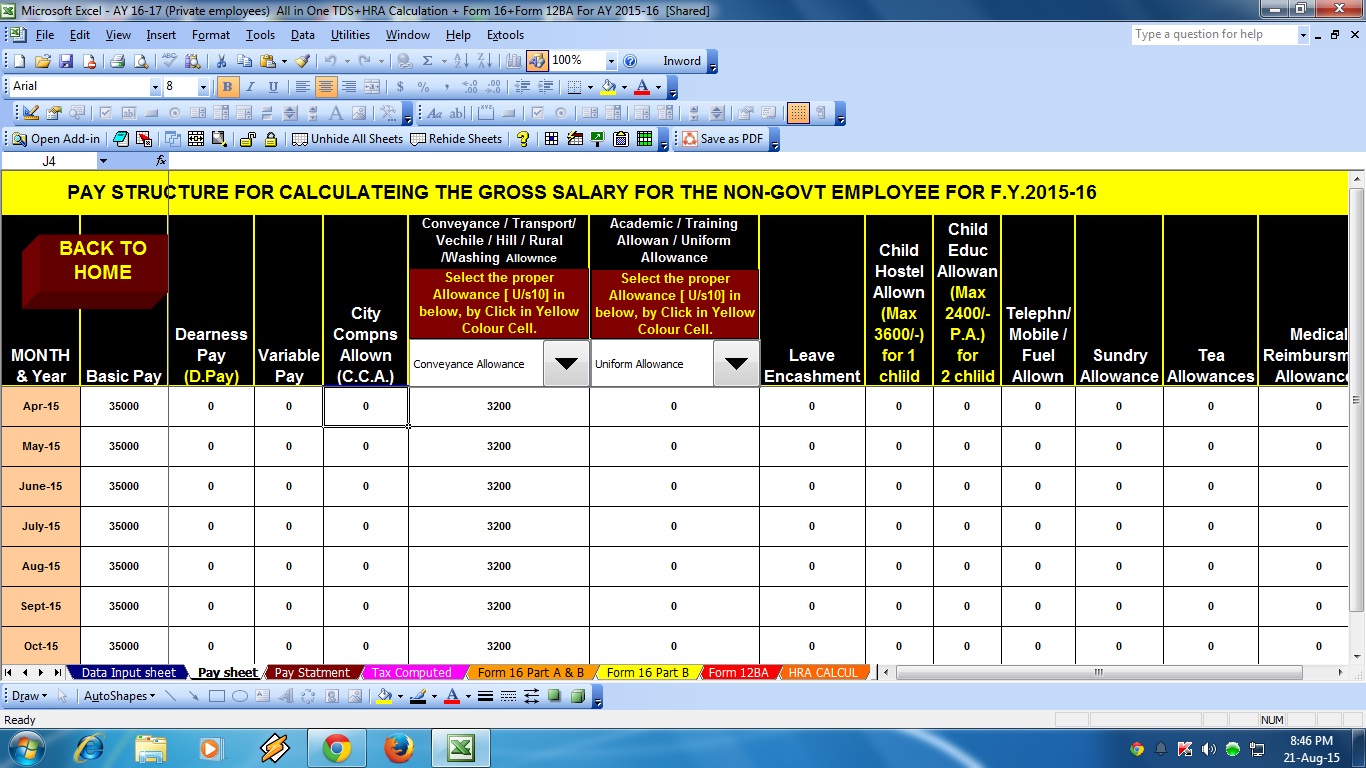 As all are aware that the Union Budget for FY 2015-16 was tabled in the Parliament by the Finance Minister of India on 28-Feb-2015. Here are the some changes and Raised the some Income Tax Section related to computation of tax on salaried persons have need to consider for FY 2015-16. 1. The tax slabs remain the same.The tax rates for salaried employees (below 60 years of age) for FY 2015-16 shall be the same as those for FY 2014-15.
The tax rates for salaried employees (aged 60 years and above but below 80 years) for FY 2015-16 are as follows.
Note: 1. The Education cess including Higher Education cess stays at 3%. 2. Tax relief under Section 87A – the tax credit of Rs 2,000 is available for FY 2015-16 as long as the total income does not exceed Rs 5 lakh for the year. 2. Increase in surcharge.In case the total taxable income goes beyond Rs 1 crore in the year, a surcharge of 12% (subject to marginal relief) is to be deducted – the surcharge was 10% in FY 2014-15. 3. Deduction under Section 80C.The maximum deduction under 80C (Life insurance premium, PPF, investment in National Savings Certificate, interest from notified bank deposits, principal repayment on housing loan, etc.) stays at Rs 1.5 lakh for 2015-16. Deposit made in the Sukanya Samriddhi Yojana Account by a parent or a legal guardian of a girl child has been included in the list of Section 80C deductions. 4. Deduction under Section 80CCC.The maximum deduction under 80CCC (Deposits in pension fund) has been increased to Rs 1.5 lakh for 2015-16. 5. Deduction under Section 80CCD.80CCD(1) – The maximum deduction available for an employee on account of his or her contribution to National Pension System (NPS) is Rs 1,50,000 or 10% of employee salary (Basic plus Dearness Allowance), whichever is lesser. 80CCD(1B) – Additional deduction (over and above deduction under 80CCD(1)) up to Rs 50,000. 80CCD(2) – Employer contribution to NPS – The maximum deduction available is 10% of employee salary. Salary means Basic plus Dearness Allowance. Note: 1. As per Section 80CCE, the aggregate deduction under sections 80C, 80CCC and 80CCD(1) cannot exceed Rs 1.5 lakh per annum. 2. The total deduction under Section 80C, 80CCC, 80CCD(1) and 80 CCD(1B) cannot exceed Rs 2 lakh per annum. 3. Any deduction under Section 80CCD(2) is outside of the above limit. 6. Deduction under Section 80D – Medical insurance premium.1. Employee, spouse, and dependent children (no senior citizens): The maximum available deduction is Rs 25,000 per annum. 2. Employee, spouse, and dependent children (even if there is one senior citizen): The maximum available deduction is Rs 30,000 per annum. 3. Parents of the employee (no senior citizens): The maximum available deduction is Rs 25,000 per annum. 4. Parents of the employee (even if there is one senior citizen): The maximum available deduction is Rs 30,000 per annum. Note: 1. Senior citizen means an individual resident in India who is of the age of sixty years or more at any time during the year. 2. The limit for the employee, spouse and dependent children and that for the parents of the employee are separate. For example, if an employee incurs Rs 25,000 towards medical insurance premium for himself and Rs 25,000 towards medical insurance premium for his parents, the total deduction available under Section 80D is Rs 50,000. What about deduction available for expense incurred for preventive health checkup? The benefit available for expenses incurred for preventive health checkup continues (maximum of Rs 5,000). This falls within the overall limit of Rs 25,000 or Rs 30,000 (as the case may be). 7. Deduction under Section 80DD – Maintenance/medical treatment of disabled dependent.1. Ordinary disability: Rs 75,000. 2. Severe disability: Rs 125,000. 8. Deduction under Section 80DDB – Medical treatment for specified diseases.1. Junior citizen: Rs 40,000 (Maximum deduction). 2. Senior citizen (60 years or more but less than 80 years): Rs 60,000 (Maximum deduction). 3. Very senior citizen (80 years or more): Rs 80,000 (Maximum deduction) The government has relaxed the norm with respect to production of proof of medical treatment. From 2015-16, an employee who seeks this benefit can submit a medical certificate from a specialist who may or may not be working in a government hospital. 9. Deduction under Section 80U – Deduction in case of an employee with disability.1. Ordinary disability: Rs 75,000. 2. Severe disability: Rs 125,000. 10. Exemption under Section 10 (14) (Rule 2BB) – Transport Allowance.The exemption limit has been enhanced to Rs 1,600 per month. You could consider revising the salary structure of your employees to make the amount paid under transport allowance at least Rs 1,600 per month. and the Phy.Disable person can get the exemption Rs. 32,00/- P.M. Click http://www.incometaxindia.gov.in/communications/notification/notification39_2015.pdf to download the Income Tax Circular relating this Raised the Limit of Transport Allowance. |


itaxsoftware.net
Itaxsoftware.net |
|
Posted: 26 Aug 2015 08:12 AM PDT Click to Download the Master of Form 16 Part B with 24Q & 26Q for the Financial Year 2015-16 & Assessment Year 2016-17 ( This Excel Based Software can prepare at a time 50 employees Form 16 Part B with 24Q & 26Q[All Quarters] )As per the Income Tax Rules it is mandatory to submit the each quarter ended Income Tax Return to the Central Govt by the Govt and Non-Govt Concerned of their employees with the Challan 24 Q for Govt and 26Q for Non-Govt Concerned. In the One Financial Year have 4 (four) quarter 1st,2nd,3rd and 4th and final quarter.The CBDT has modified the Challan of 24Q and 26Q and published the new Amended Format of 24Q and 26Q. Most of the concerned have not prepare and submit the Challan in each quarter and it appears that they have submit only the 27A Challan where not found of each employees salary details as well as TDS deduction of each employees. Now it is Mandatory to submit the 24Q or 26Q by the CBDT in each quarter. The Final and 4th Quarter will be Total Income of the hole financial year of an employees with the details of TDS deduction with Annex A. It may help if you have already prepare the both of Form 16 Part B and 24Q or 26Q of each quarter for the Financial Year 2015-16 & Assessment Year 2016-17. If it is possible, then your time will be reduce and it will be advance to prepare the Form 16 Part B which can distribute to the employees after 31st Marc 2016. This Excel Based Software which can prepare at a time 50 employees Form 16 Part B with 24Q & 26Q ( for all quarters) for the financial year 2015-16 and Assessment Year 2016-17. |
Feature of this Utility :- |
1) This Excel Based Utility can prepare at a time 50 employees Form 16 Part B 2) Prepare at a time 50 employees All Quarters 24Q & 26Q ( Amended Version) 3) Prevent the double entry of the Name of Employee and Pan Number 4) Automatic Calculate the Income Tax 5) Automatic Prepare the Form 16 Part B ( Amended Version) 6) Automatic Convert the Amount in to the In Words ( Without any Excel Formula) 7) Easy to install in any Computer 8) Easy to Generate as this file is simple Excel File 9) Both of Govt and Non-Govt Concerned can be used this utility Click to Download the Master of Form 16 Part B with 24Q & 26Q for the Financial Year 2015-16 & Assessment Year 2016-17 ( This Excel Based Software can prepare at a time 50 employees Form 16 Part B with 24Q & 26Q[All Quarters] ) |


|
Posted: 26 Aug 2015 08:08 AM PDT No changes in the basic Tax Slab limit of Rs.2.50 lakhs and no rise in threshold/ceiling limit of section 80C, budget did not give many reasons to grin to the salaried class tax payers or common man. Although there are couple of social scheme which includes low-cost pension scheme and low-premium insurance scheme such as PM Suraksha Bima Yojana, Atal Pension Yojana and PM Jeevan Jyothi Bima Yojana. All these schemes reflect that Government has tried to support the lower class by making easy access to insurance and pension plans. All are deduction other than U/s 80C. Download Automated Master of Form 16 Part A&B for Financial Year 2015-16 and Assessment Year 2016-17 [ This Excel Based Software can prepare at a time 100 employees Form 16 Part A&B as per New Finance Budget 2015-16]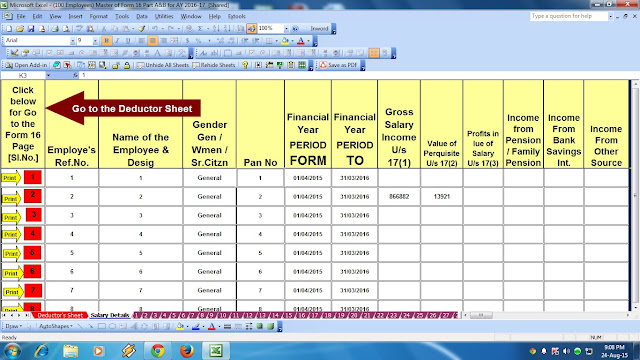 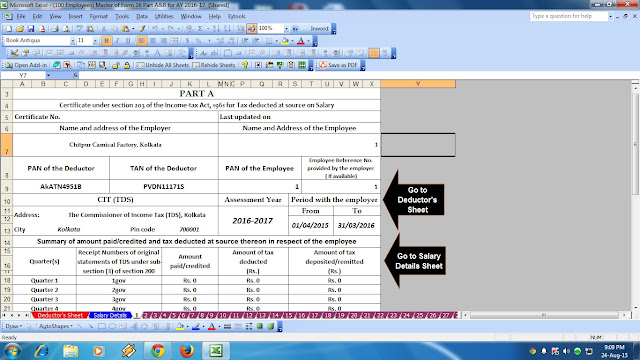 |
Let’s see What’s in Budget 2015 for Salaried Class |
1. No Hike in basic exemption limit |
The tax slab will remain same as the previous Financial Year 2014-15, for the financial year 2015-16 i.e. assessment year 2106-17 but the surcharge rate of 10% is increased to 12% for the tax payers having income above Rs.1 crore. This increment in the surcharge rate is made to compensate the income from the abolished wealth tax. |
2. Section 80C ceiling limit remains Rs.1.50 lakhs per annum |
With the inclusion of Sukanya Samriddhi Yojana, Section 80C ceiling limit remains Rs.1.50 lakhs per annum |
With the inclusion of sukanya samriddhi yojana and equity oriented pension funds, there was an inevitable need of expanding the threshold limit of section 80C but that did not happen. Section 80C remains intact in budget 2015. |
3. Rise in the Health Insurance Premium paid u/s 80D |
To spread the health care awareness among individual tax payers, section 80D has been amended by increasing the deduction limit for the premium paid for health insurance to Rs.25,000 for non-senior individuals, and Rs.30,000 for senior citizens. 4. Additional Tax-Savings under Section Section 80U:-In view of the steep rise in the cost of the medical care, Government has increased deduction limit under section 80U Max Rs. 75,000/- for general, and Rs. 1,25,000/- for Sr.Citizen. Section 80DDB :- Max Rs.80,000/- i.e. medical expense of disabled individual and dependent on Individual. for very senior citizens (aged 80 years or more) under section 80DDB. 5. Transport Allowance Doubled U/s 10The transport allowance cost has witnessed some sharp increase and to cope up with that Government has doubled the transport allowance from existing Rs.800 per month to Rs.1,600 per month which totaled to Rs.19,200 per year for below 80% and Rs. 3200/- P.M. for above 80% Phy.disable persons. |
7. National Pension Scheme u/s 80CCD increased by Rs.50,000 |
Investments towards National Pension Scheme has got some additional tax Deduction limit of investment towards pension plans, annuity plans and new pension scheme is hiked to Rs.1.50 lakhs 8. Section 80TTA :- Remain Un-changed Max Rs. 10,000/-, will be continue in this F.Y.2015-16.9.Section 87A :- Tax Rebate Rs.2,000/- will be continue in this F.Y.2015-16 |


itaxsoftware.net
Itaxsoftware.net |
|
Automated Excel Based Form 16 Part A&B and Part B for FY 2014-15 with Tips for Tax Savings Posted: 27 Aug 2015 08:27 AM PDT Prepare at a time 100 employees Form 16 Part A&B for FY 2014-15 [Who are not able to download Form 16 Part B from the TRACES Portal,they can use this Form 16 Part A&B for FY 2014-15]Do you feel that you are paying excess tax? Do you think that you can save tax? Have you not done proper tax planning? Do you want to know the ways of saving tax? We will learn the most useful tax saving method in this post. Indeed, you or anyone else has the scope of saving tax. There are many ways which can cut your tax outgo. Today I will tell you the 10 best tips of tax saving. 1. Save Tax Through Salary RestructuringThere may be many expenses which you are doing because of your job. If you leave your job today, many of your expenses will end. Such as you wear a uniform just for the sake of your job. You travel to the office daily only for the job. You may be entertaining clients and spending over them to fulfill your job. You must be reading certain newspapers, magazines or books for your job purpose. If you leave the job such expenses would end. It means, these are forced expenses and your employer should pay for them. Such expenses should go to the account of employer expense. Since you are only medium of such expense this should not be part of the income. Talk to your employer and ask to restructure your pay. You should get perks and allowances for such expense. This should not be part of your salary. These perks and allowances or non taxable if incurred actually. However, you need to give proof of these expenses to avail tax-free allowances. Some Allowances Which Save Tax · Conveyance · Driver · Newspaper, Books and Magazine · Medical Treatment · Uniform Allowances · Telephone and Mobile · Personality Development · Office Entertainment However, these allowances are given according to the grade. You can’t ask all of them. Your employer will decide the eligibility of allowances. You can only demand. 2. Save Tax On Rent Payment U/s 10(13A) Click to Download HRA Calculator U/s 10(13A)We get a job in a different city or place. We go there to do our job. If the company does not give us accommodation we have to rent out. We live in rented house because of our job. Therefore, expense of rent should be deducted from the taxable income. Employers do give some part of your remuneration as House Rent Allowance (HRA). You subtract this HRA from your gross income. However, you cannot take full benefit of HRA for tax saving. There is a formula for the HRA tax benefit. You can deduct the lowest of these from gross income. · Actual HRA given by the employer · 50% of the basic salary plus DA if the employee is situated in Delhi, Mumbai, Kolkata and Chennai. Else, 40% of the basic salary plus DA. · Actual house rent paid by you, minus 10% of basic salary+DA. HRA gives you big tax saving. Ask your employer to keep the provision of HRA in your salary structure. Also, Don’t forget to take rent receipts from your house owner. If your total rent of a financial year exceeds 1 lakh then you need to give copies of registered lease agreement and copy of the homeowner’s PAN card. You can also give the rent to your parents. But you have to complete all the formalities of lease as stated above. 3. Leave Travel Allowances and Medical Expense U/s 80DClick to download Master of Form 16 Part B for Govt & Non Govt employees for FY 2014-15 [ This Excel Utility can prepare at a time 50 employees Form 16 Part B for AY 2015-16]Some personal expenses are also eligible for exemptions. These Expenses are deducted from your gross salary. Your employer may give you part of your salary as medical allowance. Check with the HR department. If you produce an actual bill of medical expenses, this allowance becomes tax-free. So, Start collecting medical bills. However, it is limited to Rs 15,000 in a financial year. You can give receipts of medical expense of your dependents as well. Your employer can give you leave travel allowance as well. You are entitled to tax-free leave travel allowances,U/s 10 · It is also limited to two times in a block of 4 years. · The travel should occur while you are on the leave. · It should be within India. · Travel should be from the shortest route. · You can claim the maximum for AC-I of the train journey and economy class of air travel. 4. Invest And Reduce Taxable Income,U/s 80C[ Click to view details of deduction U/s 80C]Certain investments give your tax rebate. These investments come under section 80C of deductions. The amount invested is deducted from your taxable income. Many of such investments come under EEE category. It means you need not to give tax at the time of investment, earning and redemption. However, There is a maximum limit for 80C deductions. It has become 1.5 lakhs after the budget of 2014. List of Investments Which Saves Tax · Contribution to EPF account · Deposit in PPF account · Investments in tax saving mutual funds i. e. Equity Linked Saving Scheme (ELSS) · Deposit in tax saving FD · Investment in National Saving Certificate (NSC) · Deposit into Senior Citizen Saving Scheme There are some expenses which also give a deduction for tax saving. I have listed here only investments. Download Automatic Form 16 Part A&B and Part B for FY 2014-15 [ This Excel utility can prepare One by One Form 16 Part A&B and Part B for AY 2015-16]5. Expenses Eligible For Tax SavingUnder the limit of 1.5 lakh deduction there are some expenses as well. · Tuition fees for self and children · Insurance scheme premium · Home loan principal payment- Home loan EMI has two-part, principal and interest. Principal part gives tax saving benefit under section 80C. These expenses and above mentioned investment in aggregate should not exceed 1.5 lakh limit. 6. Medical Insurance Deduction,U/s 80D Medical Insurance expense gives you the deduction, over and above the 1.5 lakh limit. You can save tax for the health insurance premium of your family and dependent parents. Also, health checkup can also give you tax saving. You can deduce these expenses from your total taxable income. · Up to Rs 15,000 for the health insurance of self and family. You can also include health checkups of up to Rs 5,000 within this limit. · Up to Rs 15,000 for the health insurance of parents. If they are above 60 years, This limit goes up to 20,000. Click here to Download Master of Form 16 Part B for FY 2014-15 [ This Excel Utility Can prepare at a time 100 employees Form 16 Part B for FY 2014-15]7. Enjoy Tax Benefit On Home Loan Interest Payment U/s 24BHome loan interest payment enjoys separate tax saving. The limit of deduction for home loan interest payment is increased to 2.0 lakhs U/s 24B in the first Modified budget. This deduction can give you a very big tax saving. However, the loan amount should be big to get the full benefit. |


|
Posted: 27 Aug 2015 06:52 AM PDT Download All in One TDS on Salary for Govt and Non-Govt Employees for F.Y.2015-16 [Prepare at a time your Tax Compute Sheet + Automatic Arrears Calculator U/s 89(1) + Form 10E + Automatic HRA Exemption Calculation + Automated Form 16 Part A&B and Form 16 Part B for the Financial Year 2015-16 ]As per the new Finance Budget 2015, has some changes in some Tax Section and hike the limit of some Section under chapter VIA, the main changes is given below :-
|
|
Other tax deduction Under Chapter VI A is the same as previous Financial Year, there have no changes. Like U/s 80TTA, 87A |


itaxsoftware.net
|
Check Your Form 26AS before filing Income tax return for Assessment Year 2015-16 Posted: 28 Aug 2015 09:07 AM PDT Form 26AS is the important document issued by the IT department to the taxpayers. I have noticed that the majority of taxpayers are not aware of Form 26AS and its importance. In order to spread awareness about Form 26AS I am here with detail information about Form 26AS and its importance. What is Form 26AS?Form 26S is consolidated annual tax statement issued to the income tax payer by the IT department every year. You can download Form 26AS from Income tax filing website. Form 26AS shows how much tax is credited on your account from various sources like salary, pension, interest income etc. Apart from this Form 26AS contains following information. Part A: Details of Tax Deducted at Source (TDS)Part A1: Details of TDS for 15G/15H Part A2: Details of TDS on sale of immovable property Part B: Details of Tax Collected at Source (TCS) Part C: Details of Advance tax, self-assessment tax or regular assessment Part D: Details of paid Refunds Part E: Details of AIR transactions Why it is Important to check form 26AS before filing Income Tax return?You should cross check detail mentioned in form 26AS against TDS certificate. i.e Form 16 or Form 16AS before filing income tax return. This is to ensure that the TDS deducted on behalf of the taxpayer by deductor is actually deposited with the income tax department. E.g If you are a salaried person and your employer has deducted Rs 50,000 and you have also paid the advance tax of Rs 10,000, form 26AS should reflect these details. If your 26AS is not showing this detail and you are filing a income tax return without checking 26AS it will be misleading information in Income tax return and you may receive demand notice. How 26AS form is useful to you?
What is the reason of mismatch in Form 26AS? Sometimes Form 26AS contain information that is not matching with TDS certificate. The reason of mismatch in form 26AS is given below. Non Filing of TDS Return – Dedcutor has not filed TDS return which will result in non mapping of TDS deducted with form 26AS. Wrong Information in TDS Return– Deductor have punched wrong information in TDS written like PAN number, Amount of TDS deducted, Amount of TDS deposited or Assessment Year. Omission of Information in TDS Return – Mismatch Due to clerical mistake done by theWhat is to be done in case of mismatch in TDS and Form 26AS? In case you find a mismatch in TDS and form 26AS, you don’t have any option but to chase deductor of TDS (employer or bank) to correct the mistake. If the return is not filed you need to ask them to file TDS return. If the return is already filed you need to ask them to locate and correct the mistake. How to view/download Tax Credit Statement Form 26AS? You can view/download this form in 2 different ways. On Income tax site -
On Bank site using Net banking – You can use Net banking facility of the bank to view your Form 26 AS. This facility is available if PAN number is mapped with the respective account. This facility is available for free. Only authorized banks like SBI, ICICI, Axis Bank, Bank of Baroda, UCO Bank etc. are providing this facility. Conclusion – Check your form 26 AS before filing your income tax return. I have seen that many taxpayers are receiving demand notice asking them to pay tax although they have already paid taxes. So please verify your form 26AS against your TDS statement. |


|
How to Check Income Tax Refund Status through Online Posted: 28 Aug 2015 09:05 AM PDT |
How to check income tax refund status online ?Click to this link Tax Information Network of the Income Tax Department of India. You will find a rectangular submission form at the end of the page. To check your tax refund status online, fill in your Permanent Account Number (PAN) and the assessment year for which you want to track the income tax refund status for. Once you have entered the details and clicked on the submit button, you will get to know about the status of your income tax refund. In most of the cases you might see this message. This message indicates that your income tax refund has not been processed yet. Keep checking back, as I mentioned earlier, the Income Tax Department will take its own sweet time to process your tax refund. If you have provided a bank account number for the refund to be deposited in at the time of filing your return, you will see the below status if you tax refund has been processed. If the income tax refund status shows as processed, do check you bank statement to verify if the refund amount has been credited to your account |
|
How to find your Income Tax ward and circle? for filing the Income Tax Return for A.Y.2015-16 Posted: 28 Aug 2015 09:04 AM PDT |
With the advent of online tax filing it is much easier task to file your returns. But sometime there may be situations where you need to interact with income tax department to clarify their doubts or to raise the issues related to your tax filing. At that time you must first know about your tax ward and circle or about your assessing officer. Income tax department made your life easy in finding the tax ward or circle of your PAN Card. But before proceeding further let us understand what do you mean by tax ward and circle and who is assessing officer. Assessing Officer-He is the authorized person who make assessment of your return filed and if some clarification need then he will issue notice to you requesting for more data. Hence to assess each individual’s tax return, Income Tax Department set up different offices across India. These officers sit in these designated offices and will verify depending on the location they allotted and category of tax payers. Designation of such officers may vary based on volume of income, nature of trade assigned by board. It may be like Income Tax Officer, Assistant Commissioner, Deputy Commissioner, Joint Commissioner or Additional Commissioner. Such individual offices of Assessing Officer is allotted a unique number to identify. This number is called Income Tax Ward/Range No./AO Code. They have the powers to scrutinize your returns and if possible request for additional information. Your income tax refund will also be approved by these AOs only. By going by above information, you noticed that how much important for you to know about your AO or tax ward and circle. Below is the procedure to find the same. 1) Visit the link https://incometaxindiaefiling.gov.in/. Screen will be as below. You need to enter your PAN number and enter the Catpcha Code then press on tab “Submit”. 2) Next you will view the below image which mentions PAN holder name, Area Code, AO Type, Range Code, AO Number, Jurisdiction and building. |


itaxsoftware.net
Posted: 29 Aug 2015 06:32 PM PDT |
As the new Financial Year begins, now is the best time to save. From ways to claim maximum tax benefits to various avenues of personal savings that earn attractive income tax rebates, this guide will help you make informed choices.During his Budget speech, Finance Minister Arun Jaitley said an individual tax payer can claim tax benefits for up to Rs. 4,44,200 in addition to the tax exemption. No change in tax slabs for individual payersIncreased exemption limits on health insurance premium and transport allowance were announced in the Union Budget for 2015. Public provident fundThis dependable small saving scheme offers 8.7 per cent interest per annum and comes with a lock-in period of 15 years. Part withdrawal and loan is also possible. Maturity is also exempted from IT. Sukanya-SamriddhiA small savings scheme through India Post for the welfare of girl child, it presently yeilds 9.2 per cent per annum. Being a long-term corpus fund, the amount matures when the daughter turns 21. Till then, you can enjoy IT exemption under Sec. 80(C). Employee Provident FundThe Employee Provident Fund Act is likely to be amended this year. The big change on this front is that the pension option has been withdrawn for new employees. The entire EPF corpus will be given at the time of retirement without tax deducations. National Pension SchemeBudget has granted an additional tax deduction of Rs.50,000 for investment in the New Pension Scheme. So start to save early, for a financially-independent post-retirement life. Home loansRepayment of the Principal amount in entitled for income tax rebate under Section 80 (C). Tax deducation upto a maximum of Rs. 2 lakh can be availed if the property is self-occupied. Whole interest is tax deductible incase the property is not self-occupied. InsurancePremiums paid on ULIP, pension plans, endowment and pure terms are exempted from tax upto Rs. 1.5 lakh under Section 80(C). HealthUnder Section 80(D) premiums paid on health insurance for self, spouse, children are tax deductible upto Rs. 35,000. Additional rebate of Rs. 20,000 for senior-citizen dependent parents. Small Saving SchemesThe once-popular Kisan Vikas Patra is back through India Post. Small contributions in denominations of Rs. 1000, 5000, 10,000 and 50,000, with no upper ceiling on investment, will double in 100 months. |
|
Automatic Arrears Relief Calculator U/s 89(1) with Form 10 E from the FY 2000-01 to FY 2014-15 Posted: 29 Aug 2015 06:31 PM PDT Some Simple Steps to use Income Tax Relief Calculator U/s 89(1) with Form 10E:1. Divide the Arrears amount you have received in the year 2013-14 in to parts and enter those in IT Relief Calculator in the relevant years in which those were actually due. Download Arrears Relief Calculator + 10E with Income Tax Calculator for the Financial Year 2014-15This division of Arrears in to parts can be easily made by Calculating the year wise total of the arrears amount using Pay due & drawn statement supplied to you while paying Pay arrears. For example, if an employee has received an arrears amount in the year 2014-15, being the unpaid pay for the period from March 2000 to Feb 2015, the same has to be distributed as pay arrears relevant to the years 2001-02, 2009-10, 2010-11, 2011-12 and 2014-15. The other fields for arrears in the years 2005-06, 2006-07, and 2007-08 in this case have to be entered with zeros as no arrears are due in these years. 2. Keep the copies of your IT Returns / Form 16 for the years from which the arrears is due. If your arrears is due from the year April 2007 to Feb-2011, copies of IT Returns from the financial years 2007-08, 2008-09, 2009-10, 2010-11 will be required for making entries in the IT relief Calculator as well as for submission to your employer along with Form 10 E. The fields provided for other financial years in this case , i.e 2005-06, 2006-07, and 2007-08 can either be filled up with Net taxable income for that year or with zeros. Net Taxable income refers to Income based on which Income Tax for the year is calculated i.e Net income after all regular deductions and exemptions etc. For the sake of many of readers who are raising the doubt that whether any other arrears received in the previous years has to be shown for calculating IT relief for this year, we clarify that since you are taking net taxable income as per ITR it will be inclusive any other arrears amount received in the previous years. 3. Also, enter the income tax relief amount under section 89 deducted/availed by you during the previous years if any (2008-09, 2009-10, 2010-11, 2011-12, and 2012-13) in the relevant fields provided for this purpose in. As a result, this income tax relief Tool for the year 2013-14 will Calculate your exact income tax liability during these years after deducting income tax relief availed by you. 4. While entering the taxable income for the current year 2013-14, exclude the total arrears received by you this year (2013-14), for which relief under Section 89(1) is intended to be claimed this year. This is because the tool automatically take into account the break-up of arrears entered you in the relevant field provided in the tool From the Financial Year 2000-01 to up to date Financial Year 2014-15 5. Now all mandatory entry work is over. Fill up your Name, PAN, Address etc as these relevant details in Form 10 E. Finally, Click the “Calculate Relief” Button. The tool would calculate the Income Tax Relief available to you if any in the field named as “Relief under Section 89 [B-A]“. Then Click “Generate Statement of Relief to be produced to IT – Form 10 E”. Now the prescribed Form-10E Statement will be generated for the Income Tax Relief Claimed. This statement has to be submitted to your employer along with copies of previous years Form 16 or IT returns. How Income tax relief under Section 89 is calculated?
The following are relevant Sections and Rules for claiming Income Tax Relief for the Arrears of Salary Income Section 89 of IT ActRelief when salary, etc., is paid in arrears or in advance.
89. Where an assessee is in receipt of a sum in the nature of salary 89A, being paid in arrears or in advance or is in receipt, in any one financial year, of salary for more than twelve months or a payment which under the provisions of clause (3) of section 17 is a profit in lieu of salary, or is in receipt of a sum in the nature of family pension as defined in the Explanation to clause (iia) of section 57, being paid in arrears, due to which his total income is assessed at a rate higher than that at which it would otherwise have been assessed, the Assessing Officer shall, on an application made to him in this behalf, grant such relief as may be prescribed Provided that no such relief shall be granted in respect of any amount received or receivable by an assessee on his voluntary retirement or termination of his service, in accordance with any scheme or schemes of voluntary retirement or in the case of a public sector company referred to in sub-clause (i) of clause (10C) of section 10, a scheme of voluntary separation, if an exemption in respect of any amount received or receivable on such voluntary retirement or termination of his service or voluntary separation has been claimed by the assessee under clause (10C) of section 10 in respect of such, or any other, assessment year Rule 21A of IT RulesRelief when salary is paid in arrears or in advance, etc.
21A. (1) Where, by reason of any portion of an assessee’s salary being paid in arrears or in advance or, by reason of any portion of family pension received by an assessee being paid in arrears or, by reason of his having received in any one financial year salary for more than twelve months or a payment which under the provisions of clause (3) of section 17 is a profit in lieu of salary, his income is assessed at a rate higher than that at which it would otherwise have been assessed, the relief to be granted under sub-section (1) of section 89 shall be— (a) where any portion of the assessee’s salary is received in arrears or in advance or, any portion of family pension is received by an assessee in arrears, in accordance with the provisions of sub-rule (2); (b) where the payment is in the nature of gratuity in respect of past services of the assessee extending over a period of not less than five years, in accordance with the provisions of sub-rule (3); (c) where the payment is in the nature of compensation received by the assessee from his employer or former employer at or in connection with the termination of his employment after continuous service for not less than three years and where the unexpired portion of his term of employment is also not less than three years, in accordance with the provisions of sub-rule (4); (d) where the payment is in commutation of pension, in accordance with the provisions of sub-rule (5); and (e) where the payment is not in the nature of salary paid in arrears or in advance or gratuity in respect of past services or compensation received at or in connection with the termination of employment or in commutation of pension, in accordance with the provisions of sub-rule (6). (2)(a) In a case referred to in clause (a) of sub-rule (1), the tax payable by the assessee on his total income of the previous year in which the salary is received in arrears or in advance or, in which the family pension is received in arrears (such salary or family pension being hereafter in this sub-rule referred to respectively as the additional salary or additional family pension, as the case may be, and such previous year being hereafter in this sub-rule referred to as the relevant previous year) shall be reduced by the amount, if any, by which the tax on the additional salary or additional family pension, calculated in the manner specified in clause (b), exceeds the tax or the aggregate tax on the additional salary or additional family pension, calculated in the manner specified in clause (c) or clause (d), as the case may be. (b) Tax shall be calculated on the total income of the relevant previous year as reduced by the additional salary or additional family pension, as the case may be, as if the total income so reduced were the total income of the assessee, and the amount by which the tax so calculated falls short of the tax on the total income before such reduction shall, for the purposes of clause (a), be taken to be the tax on the additional salary or additional family pension, under this clause. (c) Where the additional salary or additional family pension, as the case may be, relates to only one previous year, tax shall be calculated on the total income of the said previous year as increased by the additional salary or additional family pension, as if the total income so increased were the total income of the assessee, and the amount by which the tax so calculated exceeds the tax payable by the assessee in respect of the total income of the said previous year shall, for the purposes of clause (a), be taken to be the tax on the additional salary or additional family pension, under this clause. (d) Where the additional salary or additional family pension, as the case may be, relates to more than one previous year,— (i) the previous years to which the additional salary or additional family pension relates and the amount relating to each such previous year shall first be ascertained; (ii) tax shall, then, be calculated on the total income of each such previous year as increased by the amount relating to such previous year ascertained under sub-clause (i); as if the total income so increased were the total income of that previous year, and the amount by which the aggregate amount of tax in respect of the aforesaid previous years as calculated under sub-clause (ii) exceeds the aggregate amount of tax payable by the assessee in respect of the total income of the said previous years shall, for the purposes of clause (a), be taken to be the aggregate tax on the additional salary or additional family pension, under this clause.] (3) (a) In a case referred to in clause (b) of sub-rule (1), the tax payable by the assessee on his total income of the previous year in which the payment by way of gratuity is received (such previous year being hereafter in this sub-rule referred to as the relevant previous year) shall be reduced by the amount, if any, by which the tax on the amount of the gratuity included in the total income of the relevant previous year, calculated at the average rate of tax applicable to such total income, exceeds the tax on the amount of such gratuity, calculated at the rate of tax determined under clause (b) or, as the case may be, clause (c). (b) Where the payment by way of gratuity is made in respect of past services of the assessee extending over a period of not less than five years but less than fifteen years,— (i) the total income of the assessee in respect of each of the two previous years immediately preceding the relevant previous year shall be increased by an amount equal to one-half of the amount of the gratuity included in the total income of the relevant previous year, and the average rate of tax for each of the said two previous years shall be calculated as if the total income so increased were the total income of that previous year; and (ii) the average of the average rates of tax for the two previous years immediately preceding the relevant previous year, calculated in accordance with sub-clause (i), shall, for the purposes of clause (a), be the rate of tax determined under this clause. (c) Where the payment by way of gratuity is made in respect of past services of the assessee extending over a period of not less than fifteen years,— (i) the total income of the assessee in respect of each of the three previous years immediately preceding the relevant previous year shall be increased by an amount equal to one-third of the amount of the gratuity included in the total income of the relevant previous year, and the average rate of tax for each of the said three previous years shall be calculated as if the total income so increased were the total income of that previous year; and (ii) the average of the average rates of tax for the three previous years immediately preceding the relevant previous year, calculated in accordance with sub-clause (i), shall, for the purposes of clause (a), be the rate of tax determined under this clause. (4) (a) In a case referred to in clause (c) of sub-rule (1), the tax payable by the assessee on his total income of the previous year in which the payment by way of compensation is received (such previous year being hereafter in this sub-rule referred to as the relevant previous year) shall be reduced by the amount, if any, by which the tax on the amount of the compensation included in the total income of the relevant previous year, calculated at the average rate of tax applicable to such total income, exceeds the tax on the amount of such compensation, calculated at the rate of tax determined under clause (b). (b) The total income of the assessee in respect of each of the three previous years immediately preceding the relevant previous year shall be increased by an amount equal to one-third of the amount of the compensation included in the total income of the relevant previous year, and the average rate of tax for each of the said three previous years shall be calculated as if the total income so increased were the total income of that previous year; and the average of the average rates of tax so calculated for the three previous years shall, for the purposes of clause (a), be the rate of tax determined under this clause. (5) (a) In a case referred to in clause (d) of sub-rule (1), the tax payable by the assessee on his total income of the previous year in which the payment in commutation of pension is received (such previous year being hereafter in this sub-rule referred to as the relevant previous year) shall be reduced by the amount, if any, by which the tax on the payment in commutation of pension included in the total income of the relevant previous year, calculated at the average rate of tax applicable to such total income, exceeds the tax on the amount of such payment, calculated at the rate of tax determined under clause (b). (b) The total income of the assessee in respect of each of the three previous years immediately preceding the relevant previous year shall be increased by an amount equal to one-third of the amount of payment in commutation of pension included in the total income of the relevant previous year, and the average rate of tax for each of the said three previous years shall be calculated as if the total income so increased were the total income of that previous year; and the average of the average rates of tax so calculated for the three previous years shall, for the purposes of clause (a), be the rate of tax determined under this clause. (6) In a case referred to in clause (e) of sub-rule (1), the Board may, having regard to the circumstances of the case, allow such relief as it deems fit. Provision for Form 10 EFurnishing of particulars for claiming relief under section 89(1).
Download Relief Calculator 21AA. Where the assessee, being a Government servant or an employee in a company, co-operative society, local authority, university, institution, association or body], is entitled to relief under sub-section (1) of section 89, he may furnish to the person responsible for making the payment referred to in sub-section (1) of section 192, the particulars specified in Form No. 10E. |


itaxsoftware.net
Itaxsoftware.net |
|
Posted: 30 Aug 2015 09:14 AM PDT Download All in One Income Tax Preparation Excel Based Software for Govt & Non-Govt employees for the Financial Year 2015-16 & Ass Year 2016-17 [ This Excel Based Software can prepare at a time your Income Tax Computed Sheet + Automated HRA Exemption Calculation + Automated Arrears Relief Calculation with Form 10E + Automated Form 16 Part A&B and Form 16 Part B as per the Budget 2015] This Excel Utility can Use both of Govt and Private Concerned employees.Most of the Tax payers are known about the Income Tax Section 80C where you can relief Max Rs. 1.5 Lakh. And Common Tax Payers only follow this section 80C, and they always follow whether the limit extended or not, which deduction are include in this Section 80C. Most of the Tax Payers are look this Only this Section. But As per the Income Tax Act 1961, you may get Income Tax Relief from your Source of Income Directly other than Section 80C. Below given a list of Income Tax Section were you can get Relief and this deduction will be reduce your Income Tax. The below given list is shown and follow the New Finance Budget 2015-16. Budget 2015 has been introduced in Parliament. The Finance Minister has kept the Personal Income Tax rates unchanged for the Financial Year 2015 /2016 (Assessment Year 2016-2017). Section 80CCD:- Employee can contribute to Government notified Pension Schemes (like National Pension Scheme – NPS). The contributions can be upto 10% of the salary (or) Gross Income and Rs 50,000 additional tax benefit u/s 80CCD (1b) is proposed in Budget 2015. In FY 2014-2015, the maximum tax exemption allowed under Section 80CCD is Rs 1 Lakh only. In Financial Year 2015-2016 or Assessment Year (2016-2017), this will be Rs 1.5 Lakh (u/s 80 CCD 1 ) and additional exemption of Rs 50,000 u/s 80CCD (1b) will be allowed. ( To claim this deduction, the employee has to contribute to Govt recognized Pension schemes like NPS) (10% of salary is applicable for salaried individuals and Gross income is applicable for non-slaried. The definition of Salary is only ‘Dearness Allowance.’ If your employer also contributes to Pension Scheme, the whole contribution amount (10% of salary) can be claimed as tax deduction under Section 80CCD (2). The ceiling limit of 1.5 Lakh u/s 80CCD is not applicable on employer’s contribution.) Section 80D Medical Insurance :-Deduction u/s 80D on health insurance premium will be Rs 25,000, increased from Rs 15000. For Senior Citizens it has been increased to Rs 30,000 from the existing Rs 20,000. For very senior citizen above the age of 80 years who are not eligible to take health insurance, deduction is allowed for Rs 30,000 toward medical expenditure. Section 80DD :-You can claim up to Rs 75,000 (increased from the existing Rs 50,000) for spending on medical treatments of your dependents (spouse, parents, kids or siblings) who have 40% disability. It is also been proposed to increase the limit of deduction from Rs 1 lakh to Rs 1.25 lakh in case of severe disability. Section 80DDB :- An individual (less than 60 years of age) can claim upto Rs 40,000 for the treatment of specified critical ailments. This can also be claimed on behalf of the dependents. The tax deduction limit under this section for Senior Citizens is proposed as Rs 60,000 and for very Senior Citizens (above 80 years) the limit is Rs 80,000 Section 24 (B):- House Building Loan Interest:- You can claim upto Rs 2 Lakh as tax deduction on the home loan interest payment. If your property is a let-out one then the entire interest amount can be claimed as tax deduction. Section 80EE:- House Building Loan Interest :- You can get another Relief from the House Building Loan Interest U/s 80EE which was introduce in the Financial Year 2013-14 and this Section remain continue for forth comming financial Year. The Max Limit Rs. 1 Lakh and the this relief can get who are HB Interest Paid since 1/4/2013 and onwards. Section 80U :- You can claim up to Rs 75,000 (increased from the existing Rs 50,000) who have 800% disability. It is also increase the limit of deduction from Rs 1 lakh to Rs 1.25 lakh in case of severe disability above 80 % Section 80 TTA :- This Section can get relief from Income Tax from the Savings Bank Interest Max Rs.10,000/- who's taxable Income less than 5 lakh. Section 87A :- This Section can get Relief from Income Tax as Tax Rebate Max. Rs.2,000/- who's Taxable Income Less than 5 Lakh. Section 10(13A) : House Rent Exemption Max Rs. 50%,40% or 10% of Basic pay + D.A. + Spl allowances which ever is less [ Download HRA Exemption Calculator U/s 10(13A) Section 89(1) :- Arrears Relief from Income Tax, some of employees have received the salary amount from his Previous Financial Year, which may break up and can get relief this section and also he have to submit the Form 10e.[ Download the Arrears Relief Exemption Calculator U/s 89(1) with Form 10E, Since 2000-01 to 2014-15 ] |


| You are subscribed to email updates from itaxsoftware.net
|
| To stop receiving these emails, you may unsubscribe now. |
| Email delivery powered by Google |
itaxsoftware.net
Itaxsoftware.net |
|
Posted: 31 Aug 2015 06:23 AM PDT Assessment Year 2016 - 17 General Notes1. Please read the instructions before filling the form. The form needs to be filled in all aspects.
4. For claiming rebate under section 80DD, 80DDB and 80U, please furnish a certificate by an authorized person in the prescribed form as defined by income tax act. 5. Mid Year joiners are required to furnish their previous income details in Form 12B along with the salary certificate (stamped and signed by the employer) i.e. Form 16 & Income Tax computation for calculating the correct tax liability for the current year. In case of any income, other than salary please fill & sign Form 12 C for the same & submit along with the Investment proofs.
Download Excel Based Income Tax Challan 280 ITNS [ This Form is used for the purpose for Self and Advance Tax deposit. Who have still not deposit the amount of Tax which payable through this Challan 280 and submit to the Bank and get the Challan Receipt.] |
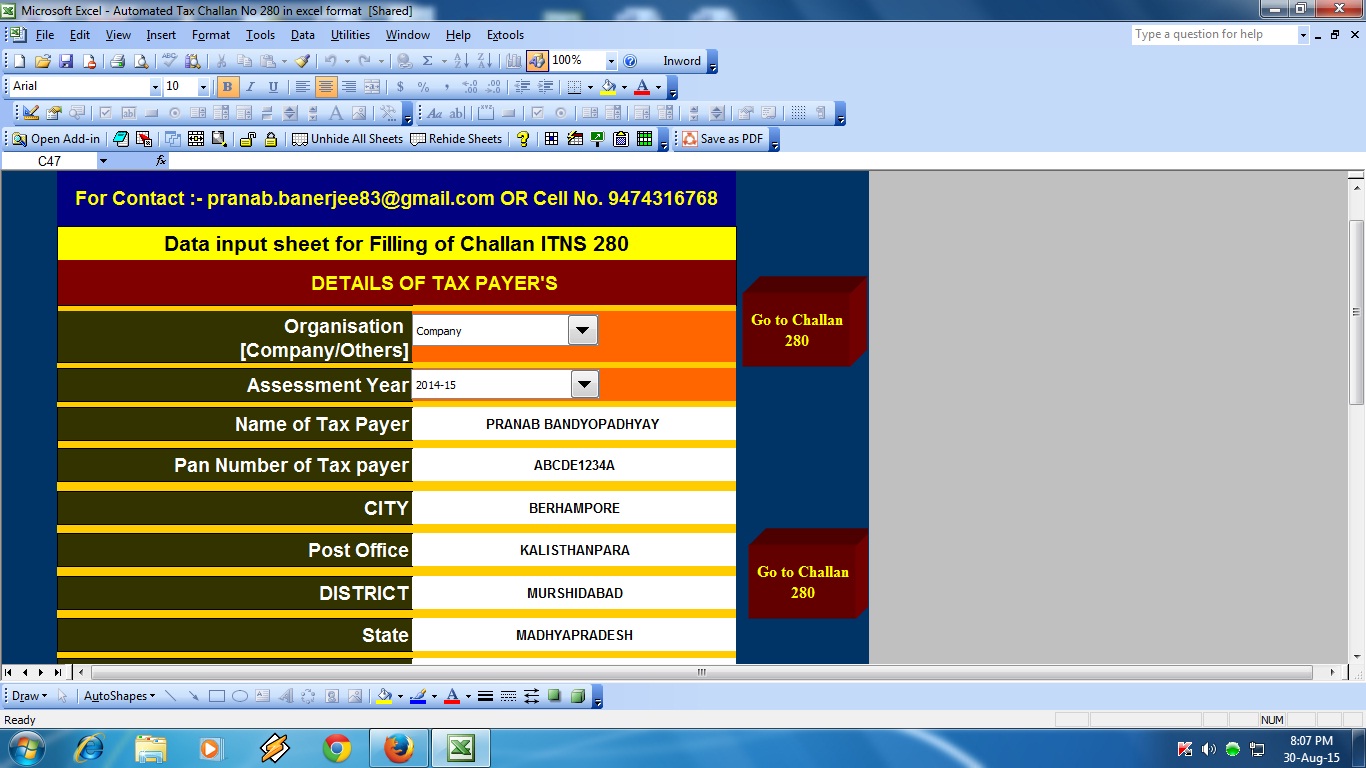
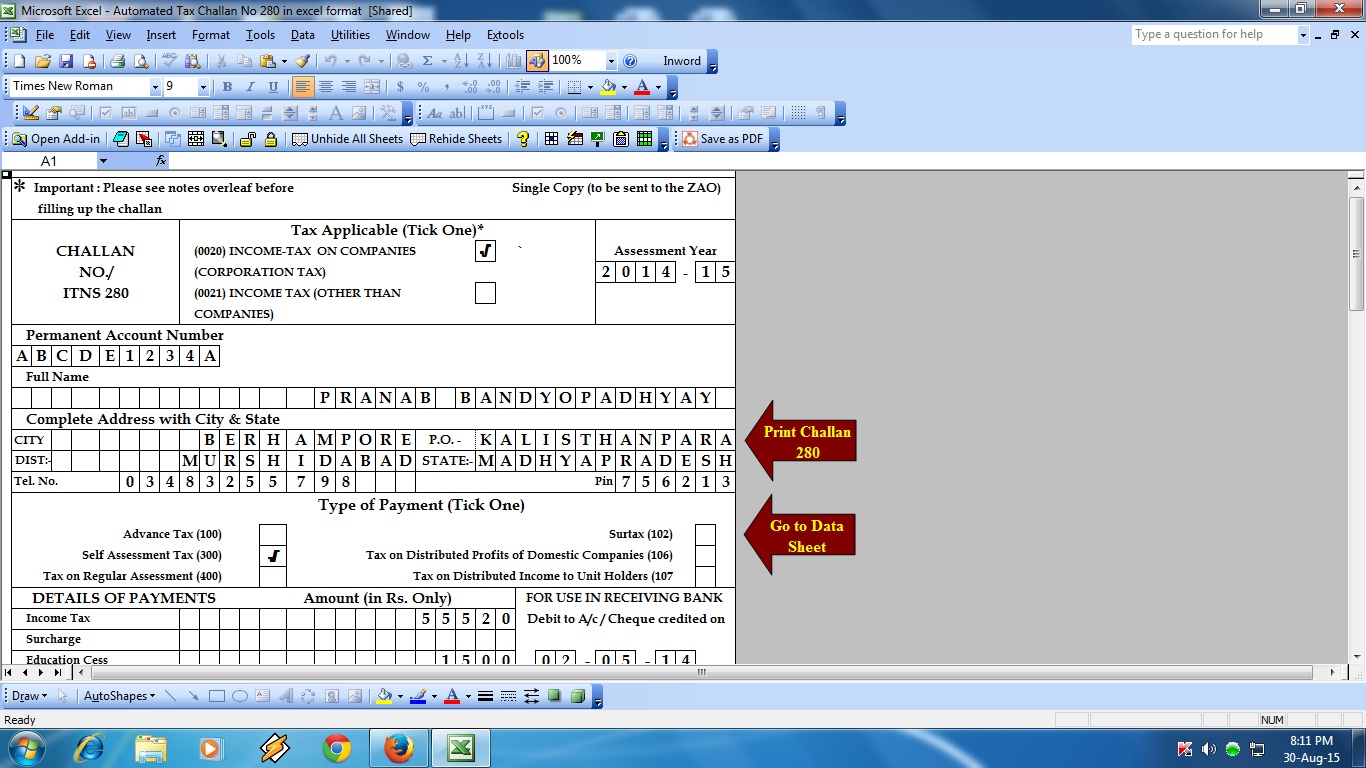


itaxsoftware.net
Itaxsoftware.net |
|
How To File Income Tax Returns After The Due Date? For Assessment Year 2015-16 Posted: 01 Sep 2015 07:37 AM PDT Individuals can file their tax returns after the due date. However, one cannot file a revised return. The due to file income tax returns for the assessment year 2015-16 and Financial Year 2014-15 was August 31, 2015. Now, if you have not met that deadline, here are a few things that you should know. 1) If tax is paid No need to worry, in this case, as you can file the income tax return until March 31, 2017. Means that one can file an IT return of any financial year, till the completion of two years. However, a penalty will be levied for filing late, depending on the status of the tax payment. 2) If tax is not paid. For those who have not paid the taxes there will be a penalty of 1 per cent per month for the number of days or month after August 31. This is because Aug 31, was the cut-off date to file your tax returns. 3) No interest on refund amount If you have filed your returns late you will not receive any interest on the refund amount. Let's say as an example, if you had only interest income and the bank cut a TDS of Rs 25,000, you can claim the same back, by filing your returns. Now, if the IT authorities process the same after Aug 31, you are not going to get any interest on the Rs 25,000, since you have delayed filing your tax return. 4) No carry forward losses Individuals who have filed tax returns late cannot carry forward losses. Businessmen should note that facility to carry forward short term loss is not available for late filers of income tax. If you file your income tax returns on time the authorities allow you to set-off losses in the subsequent year. This will not be allowed if there is a delay in filing tax returns. 5) Penalty for late filing If an individual is filing income tax return after the assessment year, then there can be a penalty of Rs 5000. |


itaxsoftware.net
Itaxsoftware.net |
- Income Tax Return E-Filing date has extended by the CBDT for A.Y.2015-16 Vide Circular No F.No.225/154/2015/ITA.II Dated Dated- 2nd September, 2015
- Automated All in One TDS on Salary for Non-Govt Employees for F.Y. 2015-16 with Tax Planning Tips for A.Y. 2016-17 as per Budget 2015
- Automated All in One TDS on Salary for Non-Govt Employees for F.Y. 2015-16 with Tax Planning Tips for A.Y. 2016-17 as per Budget 2015
|
Posted: 02 Sep 2015 10:26 AM PDT Now feel free to file your Income Tax Return till date 7th September 2015, as per the CBDT Notification which recently published and below give the Notification for information to all of E-Filing Tax Payers for the Assessment year 2015-16. First the CBDT has already published the extended the date up to 7th September 2015 for Only the Gujarat State Govt, But to days i.e. 2/9/2015 has published the Notification and mentioned the all of E-Filling Tax Payers of all over India can file the Income Tax Return from 31/8/2015 to 7/9/2015. F.No.225J154J2015JITA.II |
Government of India Ministry of Finance |
Department of Revenue Central Board of Direct Taxes North-Blpck, .ITA.II Division New Delhi, the .. L"'''IofSeptember, 2015 Order under Section 119 of the Income-tax Act. 1961 For Assessment Year 2015-2016, vide even number order dated 10th June, 2015,the Central Board of Direct Taxes ('CBDT') had extended the 'due-date' for filing Income-tax returns till 31st August, 2015 in cases of those taxpayers who were required to file their tax-return by 31St July, 2015. This date was further extended till 7th September, 2015 in case of taxpayers of Gujarat in view of dislocation of general life in that State in last week of August. CBDT has further received representations that across the country, taxpayers had faced hardships in E-Filing Returns of Income on the last date i.e. 31st August, 2015 due to slowing down of certain e-services. Therefore, after considering the matter, CBDT in exercise of powers conferred under section 119 of the In~ome-tax Act, 1961, hereby extends the 'due-date' for E-Filing Returns of Income from 31st August, 2015 to 7th September, 2015 in respect of all the taxpayers who were required to E-File their returns by 31st August, 2015. Jf- (Rohit Garg) Deputy- Secretary to the Government of India Copyto:-1. PS to F.M./OSD to FM/PS to MOS(R)/OSD to MOS(R) 2. PS to Secretary (Revenue) 3. Chairperson (DT), All Members, Central Board of Direct Taxes. 4. All Pr.CCsIT /CCsIT /Pr.DsGIT /DsGIT S. All Joint Secretaries/CsIT, CBDT 6. Directors/Deputy Secretaries/Under Secretaries of Central Board of Direct Taxes 7. DIT (RSP&PR)/Systems, New Delhi, for appropriate publicity by putting it on departmental website 8. The C&AG of India (30 copies) 9. The JS & Legal Advisor, Min. of Law & Justice, New Delhi 10. The Director General of Income Tax, NADT, Nagpur 11. The Institute of Chartered Accountants of India, IP Estate, New Delhi-ll0003 12. All Chambers of Commerce ~ . 13. CIT (OSD), Official Spokesperson of CBDT ~ (Rohit Garg ) Deputy- Secretary to the Government Click here to download the CBDT’s order dated 02.09.2015 u/s 119 of the Act |


|
Posted: 02 Sep 2015 06:25 AM PDT Download the All in One TDS on Salary for Non Govt Employees for the Financial Year 2015-16 & Assessment Year 2016-17 [ This Excel Utility can prepare at a time your Income Tax Compute Sheet + Individual Salary Structure as per Non-GovtSalary Pattern + Automated HRA Exemption Calculation + Automatic Form 16 Part A&B and Form 16 Part B + 12 BA for F.Y.2015-16 with all the Modification made by the Finance Budget 2015]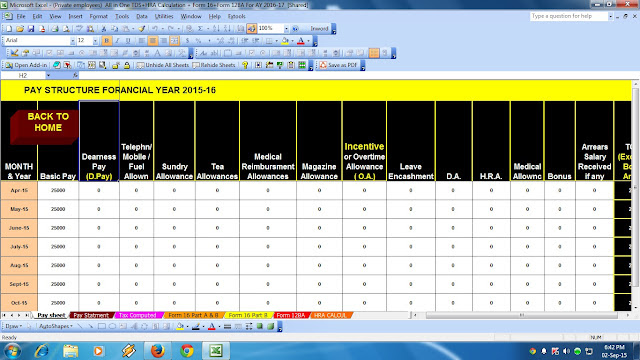 Listed below are some of the best ways to minimize your payable tax and create a pool of savings for yourself. The top tax planning tips which will help to gain in AY 2016-17 are:Consider deductions Under 80CThe section 80C mainly deals in offering deductions to tax payers who invest in sectors like Fixed Deposits (5 years), PFF, Pension plans, EPF, etc. The scope of this deduction will allow the tax payers to claim deductions up to Rs. 1, 50, 000 for the AY 2016-17. Use NPS Under 80CCThe term NPS represents New Pension Scheme. The Government of India has recently introduced this scheme with a view to create better saving habits amongst tax payers. Investing in the NPS will allow the tax payers to claim a deduction of INR 1, 50, 000 in the AY 2016-17. However, if a tax payer withdraws from such investment plan, then the same will become taxable. Medical Insurance Under 80DYour concern for health can increase your wealth! The IT Department offers a deduction of INR 25, 000 for tax payers who invest in Medical Insurance. If you are a senior citizen, then this benefit is extended to INR 30, 000. Note: Deduction for medial insurance premia etc. u/s 80 D raised to Rs. 25,000 (Rs. 30,000 in case of senior citizens for A.Y.2016-17) Help Disabled Dependents Under 80DDBTaking care of a disabled person at home can become a burden. However, the Government of India is offering assistance to you by allowing you to claim a deduction of INR 80, 000 per AY in respect of the expenditure borne for taking care of the disabled person. Repay Higher Education Loans Under 80EAre you still carrying the burden of your higher education loan? Under the Section 80E, the IT Department allows you to claim a deduction up to Rs.1 Lakh towards loan repayment in respect of higher education. Donation Under 80GCharity can be a good area for you to claim deductions. Various charitable organizations accept donations from common men and donating money to one of such organizations can allow you to claim 100% deduction. All that you are required to do is maintain a proof of your donation. Note: Deduction u/s 80G up to 100% for donation to Swachh Bharat Kosh, Clean Ganga Fund and National Fund for Control of Drug Abuse. Payment of Interest for House Building Loans Under 24BThe significance of this section is mammoth Under this section, a tax payer is eligible to claim a deduction of INR 2, 00, 000 as interest on house loan. Additionally, the purview of section 80C can also be combined here, which offers an additional deduction of Rs. 1, 50, 000 for House Building Loan’s principal amount. In total, you can claim a deduction of Rs. 3, 50, 000 for the purpose meeting your house acquisition costs. Transportation Allowance Under 10One of the lesser known areas of deduction is Section 10. Under this section, a tax payer can easily claim a deduction of Rs. 19, 200 P.A. as his transportation charges. If a person is physically disabled, then the benefit of this amount increases to INE 38, 400 P.A. |


|
Posted: 02 Sep 2015 06:15 AM PDT Download the All in One TDS on Salary for Non Govt Employees for the Financial Year 2015-16 & Assessment Year 2016-17 [ This Excel Utility can prepare at a time your Income Tax Compute Sheet + Individual Salary Structure as per Non-Govt Salary Pattern + Automated HRA Exemption Calculation + Automatic Form 16 Part A&B and Form 16 Part B + 12 BA for F.Y.2015-16 with all the Modification made by the Finance Budget 2015]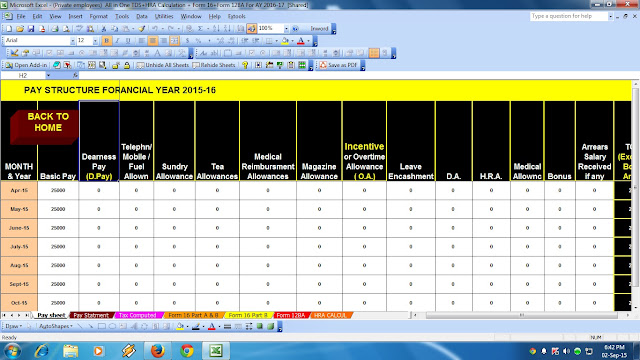 Listed below are some of the best ways to minimize your payable tax and create a pool of savings for yourself. The top tax planning tips which will help to gain in AY 2016-17 are:Consider deductions Under 80CThe section 80C mainly deals in offering deductions to tax payers who invest in sectors like Fixed Deposits (5 years), PFF, Pension plans, EPF, etc. The scope of this deduction will allow the tax payers to claim deductions up to Rs. 1, 50, 000 for the AY 2016-17. Use NPS Under 80CCThe term NPS represents New Pension Scheme. The Government of India has recently introduced this scheme with a view to create better saving habits amongst tax payers. Investing in the NPS will allow the tax payers to claim a deduction of INR 1, 50, 000 in the AY 2016-17. However, if a tax payer withdraws from such investment plan, then the same will become taxable. Medical Insurance Under 80DYour concern for health can increase your wealth! The IT Department offers a deduction of INR 25, 000 for tax payers who invest in Medical Insurance. If you are a senior citizen, then this benefit is extended to INR 30, 000. Note: Deduction for medial insurance premia etc. u/s 80 D raised to Rs. 25,000 (Rs. 30,000 in case of senior citizens for A.Y.2016-17) Help Disabled Dependents Under 80DDBTaking care of a disabled person at home can become a burden. However, the Government of India is offering assistance to you by allowing you to claim a deduction of INR 80, 000 per AY in respect of the expenditure borne for taking care of the disabled person. Repay Higher Education Loans Under 80EAre you still carrying the burden of your higher education loan? Under the Section 80E, the IT Department allows you to claim a deduction up to Rs.1 Lakh towards loan repayment in respect of higher education. Donation Under 80GCharity can be a good area for you to claim deductions. Various charitable organizations accept donations from common men and donating money to one of such organizations can allow you to claim 100% deduction. All that you are required to do is maintain a proof of your donation. Note: Deduction u/s 80G up to 100% for donation to Swachh Bharat Kosh, Clean Ganga Fund and National Fund for Control of Drug Abuse. Payment of Interest for House Building Loans Under 24BThe significance of this section is mammoth Under this section, a tax payer is eligible to claim a deduction of INR 2, 00, 000 as interest on house loan. Additionally, the purview of section 80C can also be combined here, which offers an additional deduction of Rs. 1, 50, 000 for House Building Loan’s principal amount. In total, you can claim a deduction of Rs. 3, 50, 000 for the purpose meeting your house acquisition costs. Transportation Allowance Under 10One of the lesser known areas of deduction is Section 10. Under this section, a tax payer can easily claim a deduction of Rs. 19, 200 P.A. as his transportation charges. If a person is physically disabled, then the benefit of this amount increases to INE 38, 400 P.A. |


itaxsoftware.net
Itaxsoftware.net |
|
Posted: 03 Sep 2015 06:18 AM PDT Download Automated Master of Form 16 Part B for Financial Year 2015-16 and Assessment Year 2016-17 as per New Finance Budget 2015-16 [ This Excel Based Software Can prepare at a time 50 employees Form 16 Part B for F.Y.2015-16 with all modification in Budget 2015 ]
Income Tax Slabs1) In Case of General Assesses (Both Male & Female):
Income Tax Exemptions:1) Section 80 C Limit – No Changes in this Financial Year 2015-16
2) Section 80CCD - Change this Financial Year 2015-16Deduction under this section can be claimed only if the contribution to your NPS account is made by your employer and the deduction is limited to a maximum of Rs. 1.5 Lakh3) Section 80 D –Changed this yearDeduction under section 80D
4) Section 80DD – Unchanged this yearDeduction under section 80DD
5) Section 80DDB - Change this Financial Year 2015-16Deduction under section 80DDB
(i) Neurological Diseases where the disability level has been certified to be of 40% and above,
(ii) Malignant Cancers ; (iii) Full Blown Acquired Immuno-Deficiency Syndrome (AIDS) ; (iv) Chronic Renal failure ; (v) Hematological disorders :
6) Section 80E - Unchanged this yearDeduction under section 80EDeduction is allowed for repayment of interest component of Higher Education loan. All education after Class 12 is allowed, either vocational or Fulltime. But should be from a school/institute/university recognized by the government. 7) Section 80G - Unchanged this year
8) Section 80U - Changed this year 2015-16
9) Section 24B & Section 80EE - Unchanged this year
11) Conveyance/Transport Allowance - Changed this yearAny Conveyance / Transport Allowance given to an employee is tax free upto Rs. 1600 /- P.M and Rs.3200/-P.M.for Sr.Citizen12) Medical Allowance - Unchanged this yearAny Medical Allowance given to an employee is tax free upto Rs. 15,000 /- (Supporting Bills required).13) HRA - Unchanged this yearAny House Rent Allowance given to an employee is tax free upto the minimum value of the following conditions (subject to – when an employee can produce rent paid receipts from landlord for the period and if the employee has not availed of tax exemptions for home loan interest / principal repayment):
14)80CCG – Direct Equity Investment - Unchanged this yearUnder ‘Rajiv Gandhi Equity Savings Scheme‘ – a new equity investor will be able to claim 50% of his investment in direct equity as deduction subject to maximum investment of Rs. 50,000 and provided his taxable income is below Rs. 10 lacs. The investment will be subject to 3 years lock-in.Government has notified this scheme (RGESS). Mutual funds and ETFs that invest in BSE100 or CNX 100 stocks or PSUs which are Navratna, Maharatna and Miniratna will qualify under this scheme. These investments can be traded over stock exchange after 1 year of investment. New equity investor has been defined as someone who has opened a Demat account but has not bought any securities till date of notification of this scheme (22 Sep 2012). 15) Section 80TTA – Savings Bank Interest - Unchanged this yearNo tax will be charged on interest earned on balance in savings bank account subject to a maximum of Rs. 10,000 per year.16) Section 87 A [Tax Rebate Rs.2,000/- - Unchanged this year |


itaxsoftware.net
Itaxsoftware.net |
|
Amended Income Tax 80C as per Finance Budget 2015, with Master of Form 16 Part B for F.Y.2015-16 Posted: 04 Sep 2015 06:39 AM PDT Tax Deductions available under section 80 of Income Tax As per New Finance Budget 2015Section 80CIn all, total deductions under section 80C, 80CCC and 80CCD (1) cannot exceed Rs 1.50 lakh for the current assessment year. Which means total investments, expenses and payments up to a limit of Rs 1.50 lakh are eligible for tax deductions mentioned in the above mentioned sections. These sections cover many savings schemes like National savings certificates (NSCs), Public Provident Fund (PPF) and other pension plans, life insurance premiums, government bond investments. Here’s a section-wise breakup of deductions and exemptions available under the above mentioned codes: Section 80CCCThis section provides tax deductions under any investments made in an annuity plan or Life Insurance Corporation (LIC) or pension received under funds mentioned in Section 10(23AAB), Raised the limit Up to Rs. 1.5 Lakh Section 80CCD (1)The deductions under this section are aimed at encouraging people to save. These deductions are allowed to people who avail the National Pensions savings scheme (NPS). Under this an individual can avail a deduction of up to 10 percent of his/her salary or Rs 1.50 lakh whichever is lower, if the person is employed or the lower of Rs 1.50 lakhs or 10 percent of gross income, if the individual is self employed. Section 80CCD (2)This is applicable in case of employer’s contribution. Maximum deduction of 10% of salary. Section 80CCD (1B)For financial year 2015-16 or assessment year 2016-17, this new section provides for additional tax deduction for amount contributed to NPS of up to Rs 50,000. So for AY2016-17, total deductions under Section 80 are available up to Rs 200,000. Section 80DDeduction up to Rs.25,000 for self, spouse and dependent children and separate deduction of Rs.30,000 for parents is allowed for premium paid towards medical insurance. Section 80DDDeduction of expenses incurred on medical treatment of Dependent Relative is fixed at Rs.75,000 for 40% disability and Rs.1,25,000 for severe i.e. 80% disability. Claimant is required to furnish certificate of disability from prescribed authority. Section 80DDBDeduction in respect of specified disease for self or dependent relatives is allowed lower of Rs.60,000 or actual amount paid. This deduction amount increases to Rs.80,000 in case of senior citizen. Section 80EDeduction is also available on interest outgo on education loan for higher studies. This loan could be taken by the assessee, spouse or children or a student for whom the assessee is a legal guardian. Section 80GDonations given to various specified institutions and organizations are allowed to be deducted from your income. The deductions are segregated under two categories i.e. 100% or 50% but cash donations exceeding Rs.10,000 is not allowed to claim. Section 80GGA deduction on house rent paid is available to those who are not paid house rent allowance (HRA) by the employer. An individual, spouse or minor children shouldn’t own a home at the place of employment of the assessee to claim this deduction. Neither the assessee should have a self-occupied residence at any other place. The deduction available is limited to: rent minus 10% of total income or 25% of total income or Rs 2000 (whichever is lower). Section 80TTAAny interest earned (up to Rs 10,000) on your deposits in a savings bank account, co-operative society or post office is tax deductible. This excludes fixed deposit interest income. Section 80UPhysically Disabled persons can claim deductions under 80U of Rs.75,000/- and Sr.Citizen Rs. 1,25,000/- Assessee is required to obtain certificate from Government Doctor. Download Automated Master of Form 16 Part B for Financial Year 2015-16 and Assessment year 2016-17 [ This Excel Uitility can prepare at a time 100 employees Form 16 Part B as per New Finance Budget 2015] |


itaxsoftware.net
Itaxsoftware.net |
|
You Must Know About Form 16 and Importance of Form 16 Posted: 05 Sep 2015 07:07 AM PDT In this fast moving world, young individuals switch job more often with an aim to get better opportunity and better increment. Form 16, is very vital for the salaried employee while filing tax returns. However, a situation may arise when they have to file returns and are left with multiple Form 16. Here are 10 things you must know on Form 16. 1) Form 16 is issued by the employer to employee. This certificate provides all details of salary earned and tax deducted at source by the employer. 2) If a person has changed job, he needs to collect the Form 16 from both the employer at the year end, with the help of both forms only he would able to file his returns. 3) An individual can have multiple Form 16 in cases such as change in job or working with multiple employers simultaneously. 4) If your salary drawn is below the basic exemption limit, you may not be issued with this certificate by your employer as no TDS is deducted. 5) If your employer has not provided with Form 16, you can check the salary slip as it will mention the same. 6) Form 16 includes key information required such as gross salary, perquisites, various allowances and deductibles. 7) If you have changed the job in the same financial year, authorities require you to sum up the total income from both the employers and file income tax return. 8) If the previous employer has not issued form 16 on account of some reason such as no tax deduction at its end, employee can file the return taking into consideration the pay-slips plus the form 16 issued by the new employer. 9) If you do not wish to furnish form 16 issued by your previous employer to the new employer, you can file tax return taking cues from the two form 16 issued by the previous and new employer. |


itaxsoftware.net
Itaxsoftware.net |
|
Posted: 06 Sep 2015 09:05 AM PDT Prepare at a time 50 employees Tax Computed Sheet + Individual Salary Sheet + Master of Form 16 Part B for F.Y.2015-16 and Assessment Year 2016-17 Download the All in One Master of Form 16 Part B with Individual Salary Structure for F.Y.2015-16 and Assessment Year 2016-17
|
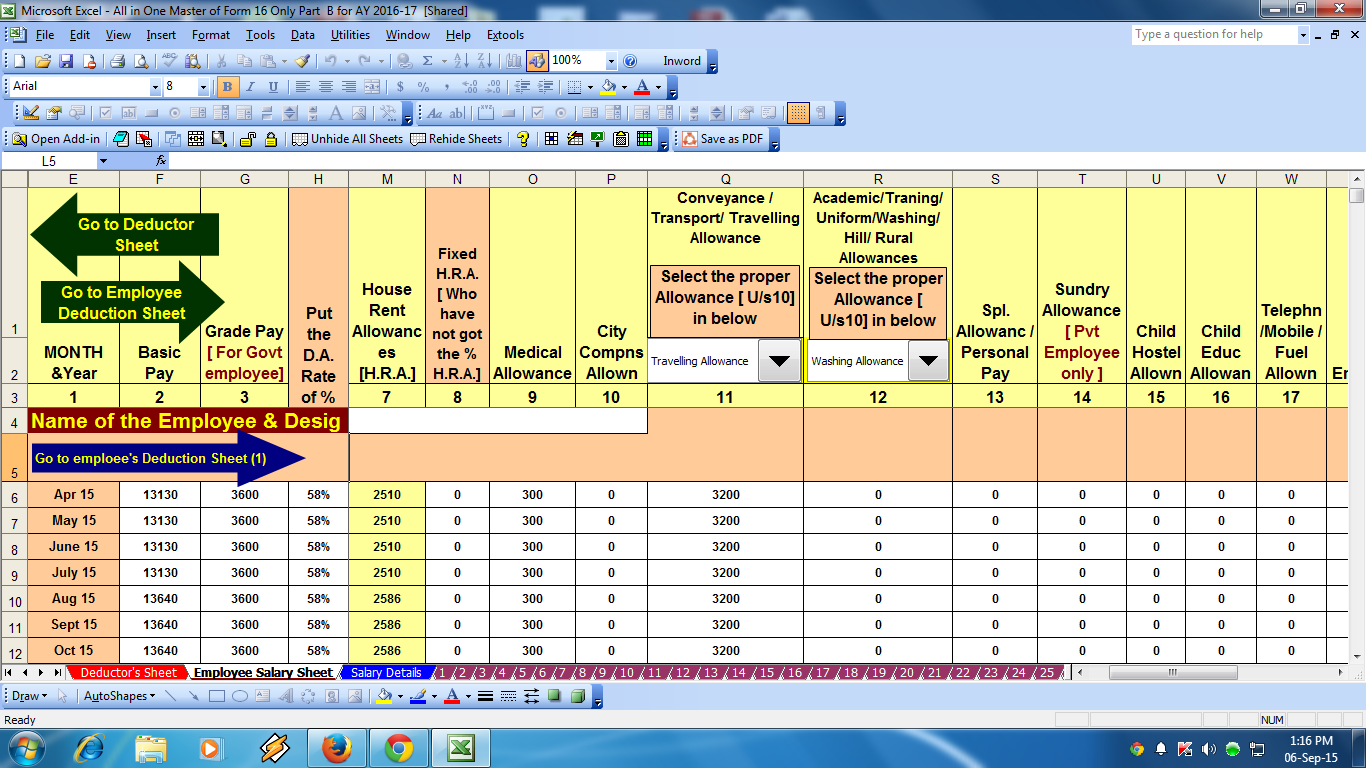
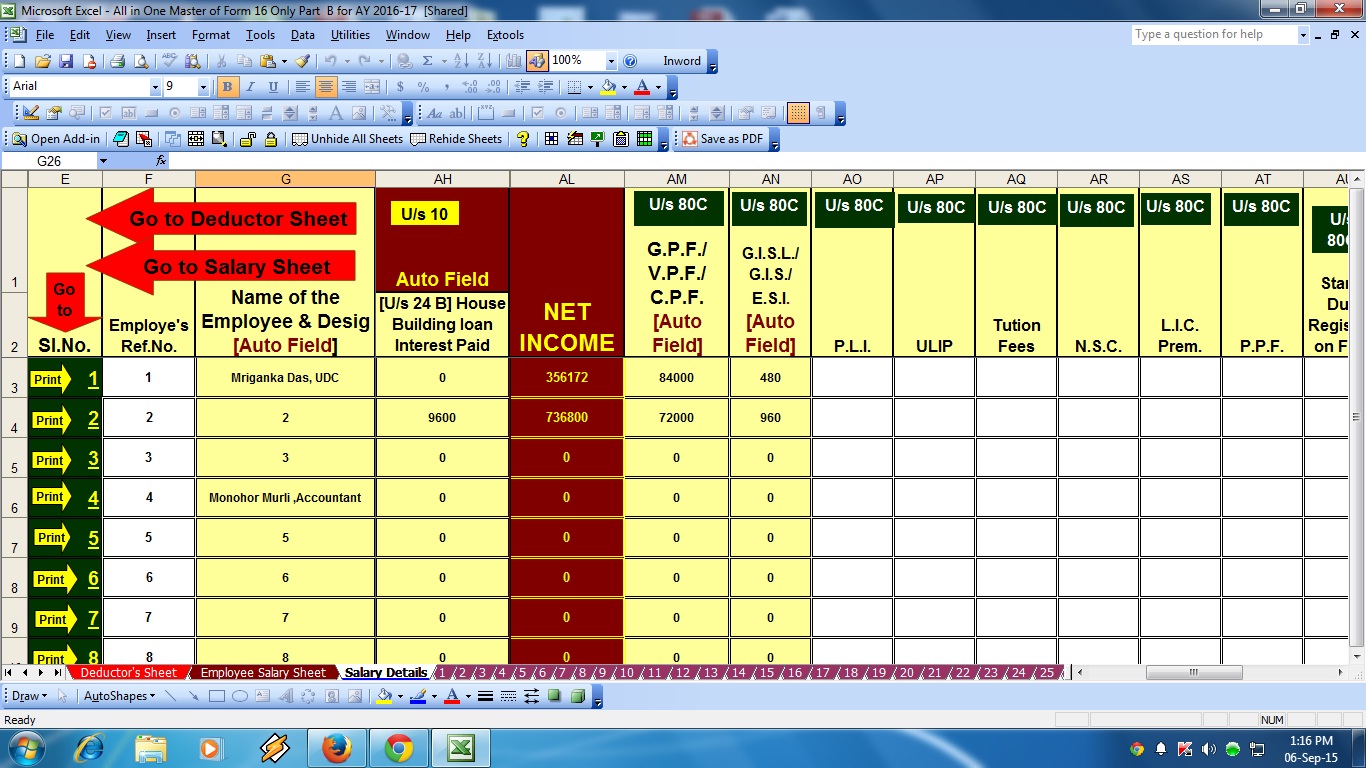
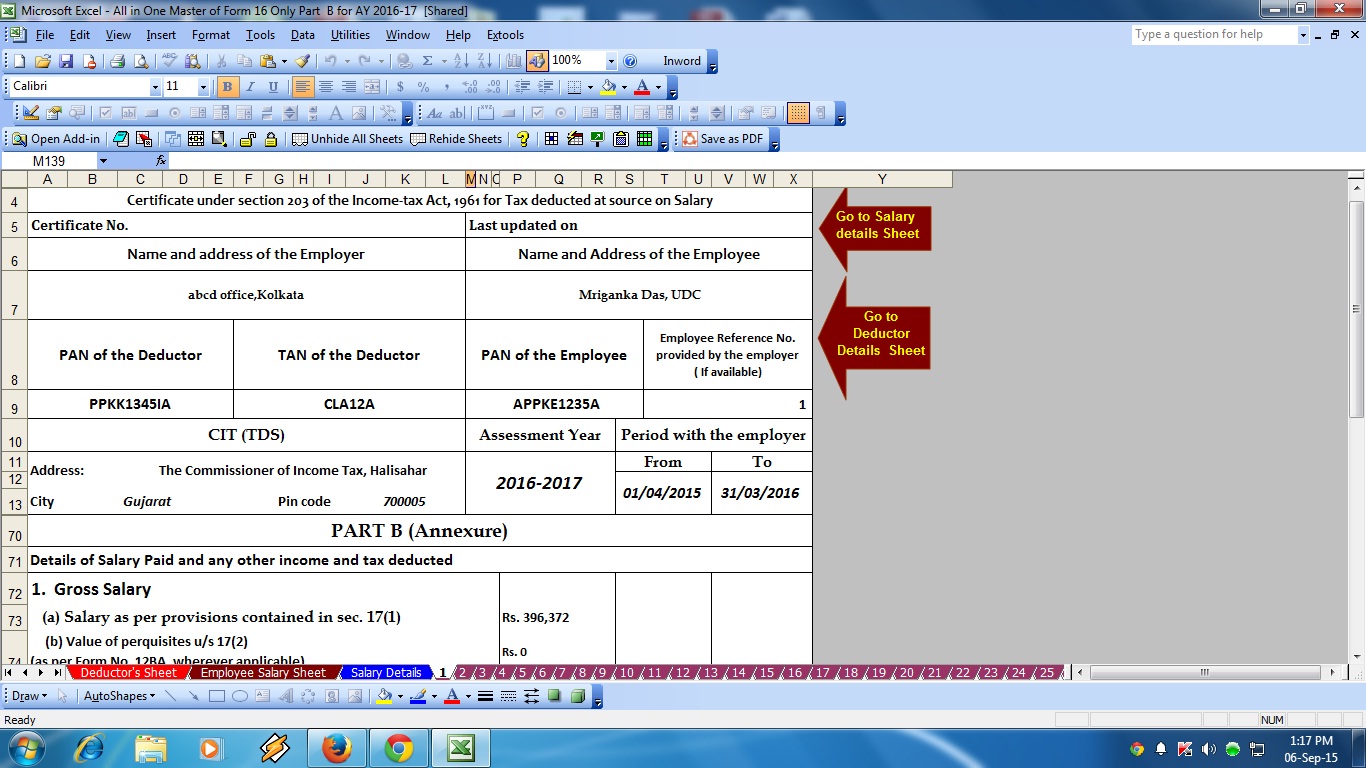
|
The Financial Year 2015-16 and Assessment Year 2016-17 have already started since April 2015 and you can prepare advance the employees Form 16 Part B with the Individual Salary Structure. This Excel Utility can prepare at a time 50 employees Form 16 Part B with 50 employees individual Salary Structure for the Financial Year 2015-16 & Assessment Year 2016-17.All the latest amended in the Income Tax Rate or each Section which was published by the Finance Budget 2015 have in this Excel Utility. This Excel Utility can use both of Govt and Non-Govt employees/concerned, as the Employees Salary Structure have prepare on the basis of Govt and Non Govt Salary pattern. Feature of this Excel Utility :- 1) This Excel utility can prepare at a time 50 employees Form 16 Part B with Individual Salary Structure for F.Y.2015-16. 2)All the Tax amended Section as per the Finance Budget 2015 have modified. 3) This Excel Utility can prevent the Double Entry of Employees Pan Number and Name of Employees 4) Automatic Convert the amount in to the In-Words 5) All the Income Tax Section have in this Excel Utility 7) This Excel Utility easy to install and easy to generate. You can prepare more than 1000 employees Form 16 Part B by this One Software. Download the Excel Utility from the Blow link :- Download the All in One Master of Form 16 Part B with Individual Salary Structure for F.Y.2015-16 and Assessment Year 2016-17 |


itaxsoftware.net
Itaxsoftware.net |
|
Posted: 07 Sep 2015 06:51 AM PDT Understanding Value of Perquisites U/s 17(2),with Value of Perquisite Calculator and Form 16 Part B with 12 BA for F.Y.2015-16 and A.Y.2016-17 For person earning income from Salary , documents Form 16, and Form 12BA provided by employer are needed. We looked into details of Form 16. Form 12BA give details of Perquisites given by the employer to employee in the financial year. Before we look at Form 12BA lets try to understand Perquisites, also known as perks. Download All in One TDS on Salary for Govt & Non-Govt employees for F.Y.2015-16 and A.Y.2016-17 [ This Excel Utility can prepare at a time Tax Compute Sheet + Automatic Arrears Relief Calculation with Form 10E + Automatic HRA Exemption Calculation + Automatic Form 12 BA + Automatic Form 16 Part A&B and Form 16 Part B + Individual Salary Structure for Govt and Non-Govt employees]What are Perquisites?Perquisites are benefits provided by the employers in addition to the normal salary at a free of cost or concession rates. Income tax act defines Perquisite as any casual emolument or benefit attached to an office or position in addition to salary or wages. Value of these perquisites is added to the income of employees. Hence Perquisites are taxable. There are rules for valuation of perquisites. Some of the perquisites are given below: A perquisite can be provided both by way as:- · Monetary payment : Employer either reimburses the expenses incurred by the employee for such facilities or pays on behalf of the employee. Ex:personal gas bills of the employee are in the name of employee and the employer reimburses the amount of such gas bills to him or pays on his behalf to the gas agency, it is in monetary terms and taxable in case of all employees; on the other hand, if such bills are in the name of employer, it will be perquisite in case of specified employee only. OR · Non-monetary payment/benefit : Payments which can be called non-monetary payments are car facility, benefit on account of interest-free loans, rent-free accommodation, furniture provided to employees etc. As defined earlier, Perquisite as any casual emolument or benefit attached to an office or position in addition to salary or wages, Mostly perquisites are associated with position or office. Often distinction is made between employees and specified employees. A Specified employee is the one who satisfies any of the following cases: · He is a director of the company, · He has a substantial interest in the company, ie he is the beneficial owner of equity shares carrying 20% of voting power in the employer company. · His monetary income under the head “Salaries” for the year exceeds Rs.24,000. The amount considered here includes amounts due from, paid or allowed by one or more employers. It excludes all non-monetary benefits. The perquisites and allowances, as aforesaid, shall include accommodation (furnished or otherwise) or house rent allowance in lieu thereof; house maintenance allowance together with reimbursement of expenses and / or allowances for utilisation of gas, electricity, water, furnishing and repairs; medical reimbursement; leave travel concession for self and family including dependents; medical insurance and such other perquisites and / or allowances. Perquisites and Indian Income tax ActDefinition of Perquisites: Perquisites are defined in the section 17(2) of the Indian Income-tax Act of 1961. Section 10(10CC) – Exemption on Non monetary perquisites: With effect from 01.06.2002, employer has given a option to deposit the tax on non monetary perquisites on behalf of employee without deducting the same from the employee {section 192(1A) &192(1b)} As per section 10(10CC), the amount of tax actually paid by an employer, at his option, on non-monetary perquisites on behalf of an employee, is not taxable in the hands of the employee. Such tax paid by the employer shall not be treated as an allowable expenditure in the hands of the employer under section 40. The tax so paid by the employer shall be deemed to be TDS made from the salary of the employee. Statement of Perquisites: 192 (2C) lays down employer, shall furnish to employee a statement giving correct and complete particulars of perquisites or profits in lieu of salary provided to him and the value thereof in form no. 12BA. The form and manner of such particulars are prescribed in Rule 26A, Form 12BA and Form 16 of the Income-tax Rules . Information relating to the nature and value of perquisites is to be provided by the employer in Form no. 12BA in case of salary paid or payable is above Rs.1,80,000/-. In other cases, the information would have to be provided by the employer in Form 16 itself. Type of perquisites, valuation of perquisites are defined in every Finance Act (popularly known as Budget presented by Finance Minister). Valuation of PerquisitesPerquisites are taxable in the hands of employees. There are rules for valuation of perquisites. Let’s look at some of the rules. Please note that these rules keeps changing and are notified by Central Board of Direct Taxes (CBDT). For the financial year 2011-12 or Assessment Year 2012-13 Circular No.08/2010 dated 13.12.2010 . Valuation of some of the perquisites are discussed below: Accommodation :- For purpose of valuation of the perquisite accomdation is divided into various categories like: Rent free Unfurnished Accommodation, Rent-Free Furnished Accommodation, Concession in Rent etc. is explained below:
Interested readers can find about more about Taxable value of Rent-Free Furnished Accommodation, Taxable value of Concession in Rent Gift or Voucher or Token: [Rule 3(7)(iv)]: The value of any gift or voucher or token in lieu of which such gift may be received by the employee or by member of his household on ceremonial occasions or otherwise shall determined as equal to the amount of such gift. However, where the value of such gift, voucher or token, as the case may be, is below Rs.5,000 in the aggregate during the previous year, the value of perquisite shall be taken as Rs.Nil. Medical Reimbursement by the employer exceeding Rs. 15,000/- p.a. u/s. 17(2)(v) is to be taken as perquisites. · Links to details about other perquisites from website accounting-n-taxation are given Exempted Perquisites:- Some of the perquisites are exempted from income tax (free) such as:· Tea, coffee(non-alcoholic beverages), snacks provided during working hours. · Free Meals provided at the office or business premises during office hours or through paid non-transferable vouchers usable only at eating joints. If the value is up to Rs.50 per meal, it is not taxable. Otherwise, taxable. Assuming 2 meals per day and 22 working days in a month, it works out to Rs. 2200/- p.m which at times is given in form food coupons or Sodexo coupons. · Recreational facilities provided. · Good manufactured by employer and sold by him to employees at the concessional (not free) rates. Ex: Motorola providing his employees Motorola mobiles at less than market value or Hindustan Lever giving its products(Surf, Knorr soup) at lesser than market value. · Amount spent on training of employee including the boarding and lodging expenses of the employees on such a training. · Telephone and mobile phone facility. · Computer or laptop whether to use at home or office (ownership is not transferred to employee) · Loan given at nil or concessional rate of interest by the employer provided the aggregate amount of loan does not exceed 20,000. · Health club, sports facility. |


itaxsoftware.net
Itaxsoftware.net |
|
Posted: 08 Sep 2015 06:05 AM PDT All in One TDS on Salary for Central Govt employees for F.Y.2015-16 with Deductions and Exemptions for Salaried Employees - Income Tax 2015-16Download All in One TDS on Salary for Central Govt employees forF.Y.2015-16 [This Excel Utility can prepare at a time Tax Compute Sheet + Automatic HRA Exemption Calculation + Automatic Form 16 Part A&B and Form 16 Part B for F.Y.2015-16]Salaried Employees are a relieved lot now after fulfilling all the formalities for Income Tax 2014-15. But, by that time six months in the new financial year 2015-16 is already over. So, preparation of statement for salary income, deductions and saving under various clauses of Income Tax Act in respect of Financial year 2015-16 is already due for submission to the employer. Tax Planning and submission of statement to that effect to the employer would be mainly useful to avoid additional deduction of Income Tax by the employer over and above income tax estimated by an individual on the basis of his / her savings or deductions. This article summarises Income Tax Structure for the year 2015-16 (Assessment Year 2016-17) and also the Tax exemptions available to salaried class employees in the form of Exempt Income, Deductions and Savings. Tax exemptions in the form of Exempt Income, Deductions and Savings1. Exempt Income under Chapter 10 of Income Tax Act, such as House Rent allowance, Tranport Allowance, LTC etc. 2. Savings which are eligible for Tax Exemption up to Rs. 1.5 lakh under Section 80C, Section 80CCC and Section 80CCD(1) 3. Additional Savings eligible for Tax Exemption up to Rs. 50,000/- under Section 80 CCD (1B) over and above Savings Cap of Rs. Rs. 1.5 lakh, if the amount is invested in NPS (Govt run Contributory Pension System which is known as National Pension System) 4. Deduction (up to 10% of salary) towards Contribution made by Employer in any of Pension fund such as NPS, approved by Central Government, under Section 80CCD(2), which will be over and above savings value cap of Rs. 1.5 lakh under Section 80CCE plus additional savings of Rs.50,000 under Section 80CCD(1B) 5. Eligible deductions from Income from Section 80 D to 80 U towards amount spent on health insurance, medical treatment for disabled dependents, interest on higher education loan etc. 6. Deduction of up to Rs. 2 lakh in respect of loss (interest) incurred on self-occupied House Property (and unlimited interest in respect of rented property) under Section 24 of Income Tax Act. 7. Relief Under Section 89(1) 1. Exempt Income and Allowances under Section 10 of Income Tax ActIncome given below are exempt income and hence these need not included while calculating Total Income of a Salaried Employee
Exemption under Section 10 (13A) in respect of HRA – Calculation Method: Least of the following amount is to be treated as exempt from Income Tax.
[Download HRA Exemption Calculator in Excel]2. Savings which are eligible for Tax Exemption Section 80C, Section 80CCC and Section 80CCDSection 80C, CCC and CCD(1) allow deduction from total income. The total deduction under this section (alongwith section 80CCC and 80CCD(1) is limited to Rs. 1.50 lakh only. Section 80C: Max Rs. 1.5 Lakh Section 80CCC: Deduction in respect of Premium Paid for Annuity Plan of LIC or Other Insurer. Payment of premium for annuity plan of LIC or any other insurer Deduction is available upto a maximum of Rs. 150,000/-. |
The premium must be deposited to keep in force a contract for an annuity plan of the LIC or any other insurer for receiving pension from the fund. |
Section 80CCD (1): Deduction in respect of Contribution to Pension Account (by Assessee). Deduction available for the amount paid or deposited in a pension scheme notified or as may be notified by the Central Government subject to a maximum of : (a) 10% of salary in the previous year in the case of an employee (b) 10% of gross total income in any other case. Section 80CCD(1A): The maximum deduction allowable under this section is Rs. 1.00 lakh. in case of contribution to New Pension Scheme (NPS), it is Rs. 1.50 lakh w.e.f. 01.04.2015 3. Additional Savings eligible for Tax Exemption up to Rs. 50,000/- under Section 80 CCD (1B)Section 80CCD(1B): Contribution in NPS has been given more tax concession in the budget 2015. As per Section 80CCD(1B), an additional deduction of up to Rs. 50,000 over and above the Section 80C, 80CCC and 80CCD savings cap of Rs. 1.5 lakh, is allowed if such amount is contributed by the employee. So, overall tax savings of Rs. 2 lakh can be availed under Section 80C, 80CCC and 80CCD(1). 4. Deduction in respect of Contribution to Pension Account by Employer under Section 80CCD (2):Deduction under Section 80CCD(2) is available for the amount paid or deposited by the employer of the assessee in a pension scheme notified or as may be notified by the Central Government subject to a maximum of 10% of salary in the financial year. This deduction is allowed over and above Savings value cap of Rs. 1.5 lakh under Section 80CCE (in the case of investment in NPS, savings value cap eligible for deduction will be Rs. 2 lakh). 5. Eligible deductions from Income from Section 80 D to 80 U towards amount spent on health insurance, medical treatment etc.Section 80D: Deduction in respect of Medical Insurance: Deduction is available upto Rs. 30,000/- for parents who are senior citizens and upto Rs. 25,000/- in other cases for insurance of self, spouse and dependent children. Amount of up to Rs.5000/- spent on preventive health check-up. So a maxium of Rs. 60,000 can be deducted which is spent towards Health Insurance premium. Section 80DD: Deduction for medical treatment of physically challenged dependents: In the case of salaried employee who is taking care of physically challanged Dependent Relative, an amount with the maximum limit of Rs.75000/- spent towards medical treatment or rehabilitation can be deducted from the income (In the case of severe disability maximum deduction would be Rs. 1,25,000). Section 80DDB: Deduction in respect of specified disease: |
Deduction in respect of specified disease for self or dependent relatives is allowed lower of Rs.60,000 or actual amount paid. This deduction amount increases to Rs.80,000 in case of senior citizen. |
Section 80E: Deduction in respect of Interest on Loan for Higher Studies: Deduction in respect of interest on loan taken for pursuing higher education. The deduction is also available for the purpose of higher education of a relative. |
Section 80G: Deduction for Donations |
|
Section 80 TTA: Deduction from gross total income in respect of any Income by way of Interest on Savings account Maximum of Rs. 10,000/-, in respect of interest on deposits in savings account ( not time deposits ) with a bank, co-operative society or post office |
Section 80U: Deduction in respect of Person suffering from Physical Disability |
Deduction of Rs. 75,000/- in respect of tax payer suffering from a physical disability. In the case of severe disability, deduction of Rs. 125,000/- will be allowed. Certificate from the approved medical authorities regarding the extent of disability will have to be produced (Rule 11D) 6. Deductions Allowable under Section 24 of Income Tax Act in respect of interest on house property :Housing Property bought or constructed on or after 01.04.99 (completed within 3 years from availment of loan) and self occupied will be eligible for deduction of interest paid on housing loan with the maximum limit Rs. 2,00,000/-. In other cases deduction in respect of interest paid up to Rs.30,000 will be allowed. If the said house property is not self-occupied there is no limit in deduction in respect of interest paid on housing loan subject to inclusion of rental income in respect of the house property. 7. Relief Under Section 89(1) [Download Arrears Relief Calculator up to date]Relief u/s 89(1) is available to an employee when he receives salary in advance or in arrear or when in one financial year, he receives salary of more than 12 months, or receives ‘profit in lieu of salary’ covered u/s 17(3). Relief u/s 89(1) is also admissible on family pension, as the same has been allowed by Finance Act, 2002 (with retrospective effect from 1/4/96). To sum-up, over and above the Basic Income Tax Exemption limit of Rs. 2.5 lakh for the financial year 2015-16 available to Salaried Employees, maximum additional income tax exemption for income up to Rs.4,44,200 can be availed. Maximum Amount that can be saved / deducted to avail this income tax exemption benefit are tabulated below. So, a salaried employee who earns gross total income of Rs. 6,94,200/- and avails income tax exemption benefit by way of savings and deductions detailed below, need not pay any income tax.
It is also pertinent to note here that exemptions and deductions detailed above are common to a salaried employee. In addition to this, by way of other deductions provided by Section 80DD to Section 80U based on specific nature of expenditure such as medical, higher studies related or physical status of employee or his / her dependents, more income could be exempted from payment of Income Tax. |


| You are subscribed to email updates from itaxsoftware.net. |
To stop receiving these emails, you may unsubscribe now. |
| Email delivery powered by Google |
itaxsoftware.net
Itaxsoftware.net |
|
Posted: 09 Sep 2015 09:02 AM PDT Tax Planning Tips for F.Y. 2015-16 & A.Y. 2016-17,with Automated All in One TDS on Salary for Govt & Non Govt Employees for FY 2015-16 & AY 2016-17Download All in One TDS on Salary for Govt and Non-Govt Employees for the Financial Year 2015-16 and Assessment Year 2016-17 [ This Excel utility can prepare at a time your Tax Compute Sheet + Salary Structure for Govt and Non-Govt Employees Salary Pattern + Automatic HRA Calculation + Automatic Arrears Relief Calculation with Form 10E + Automated Form 16 Part A&B and Part B ] |
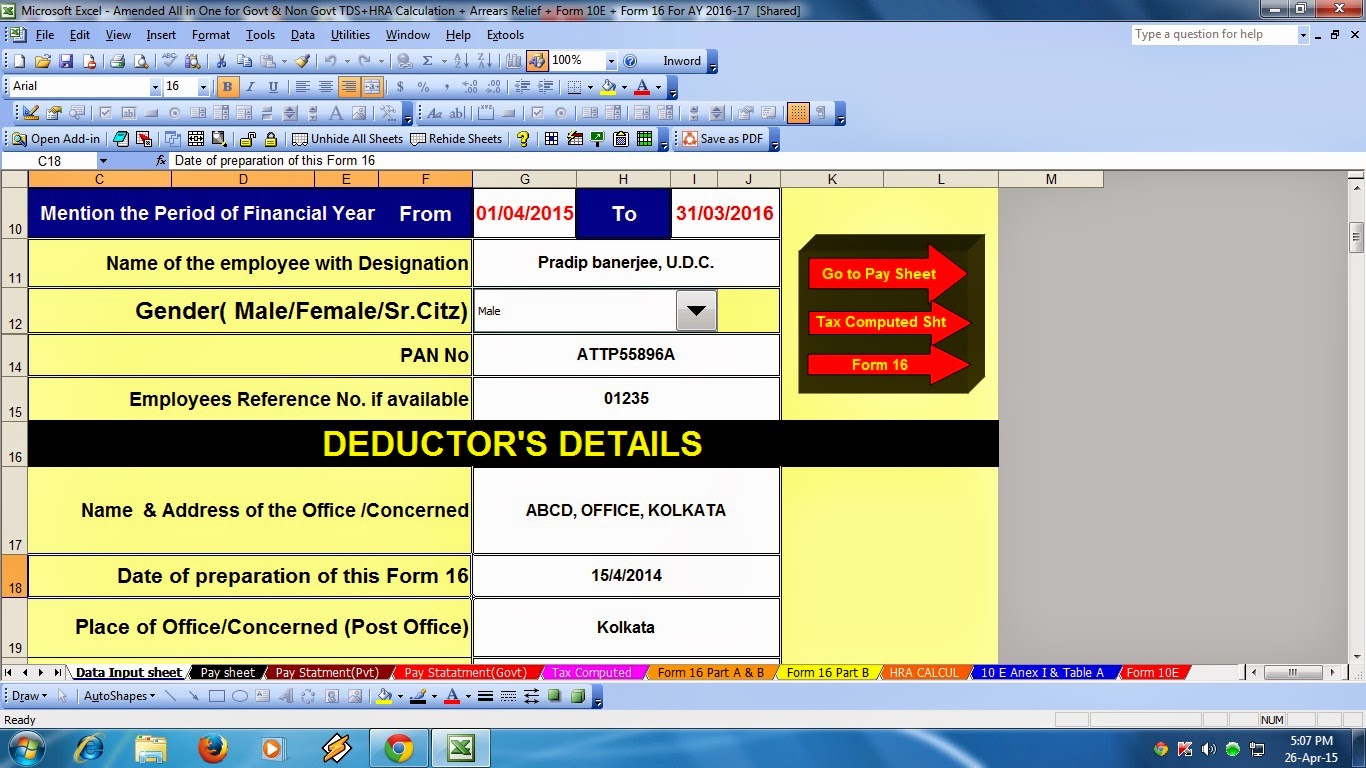 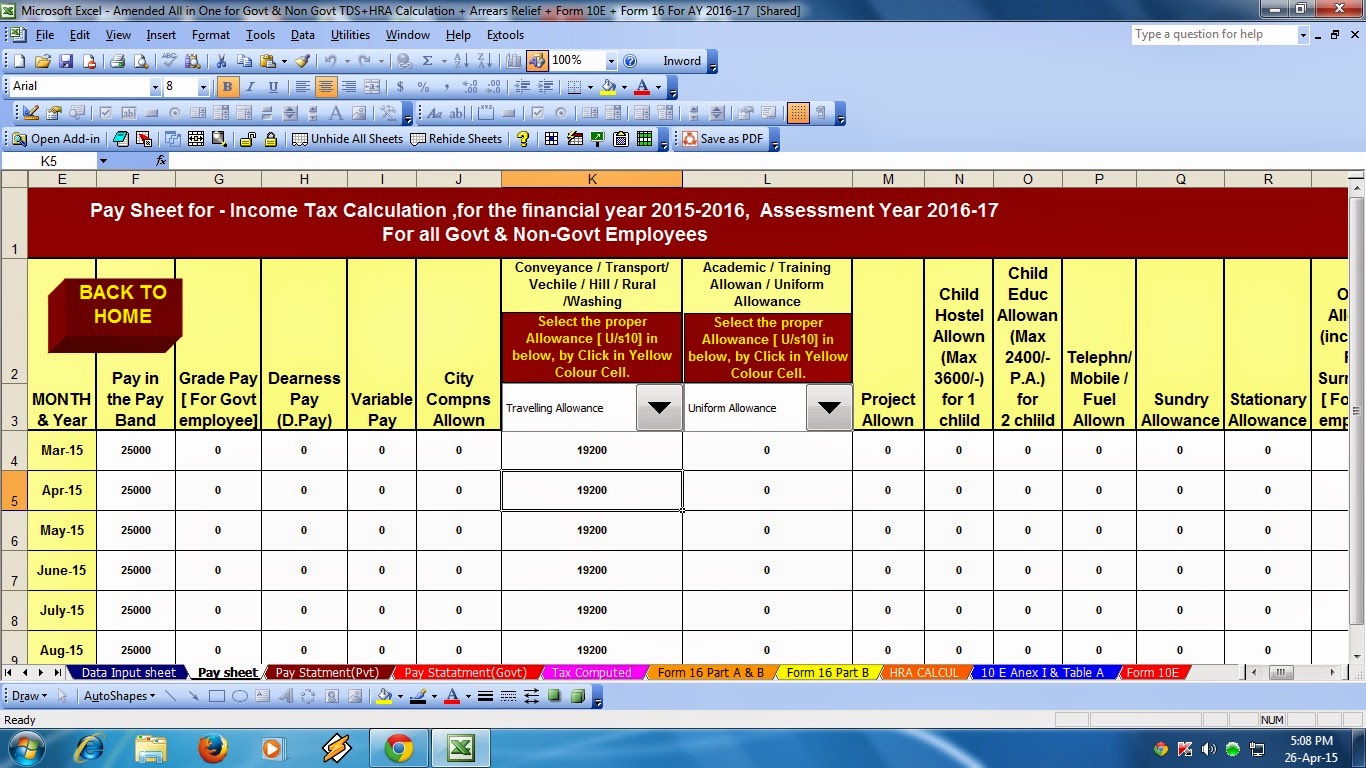 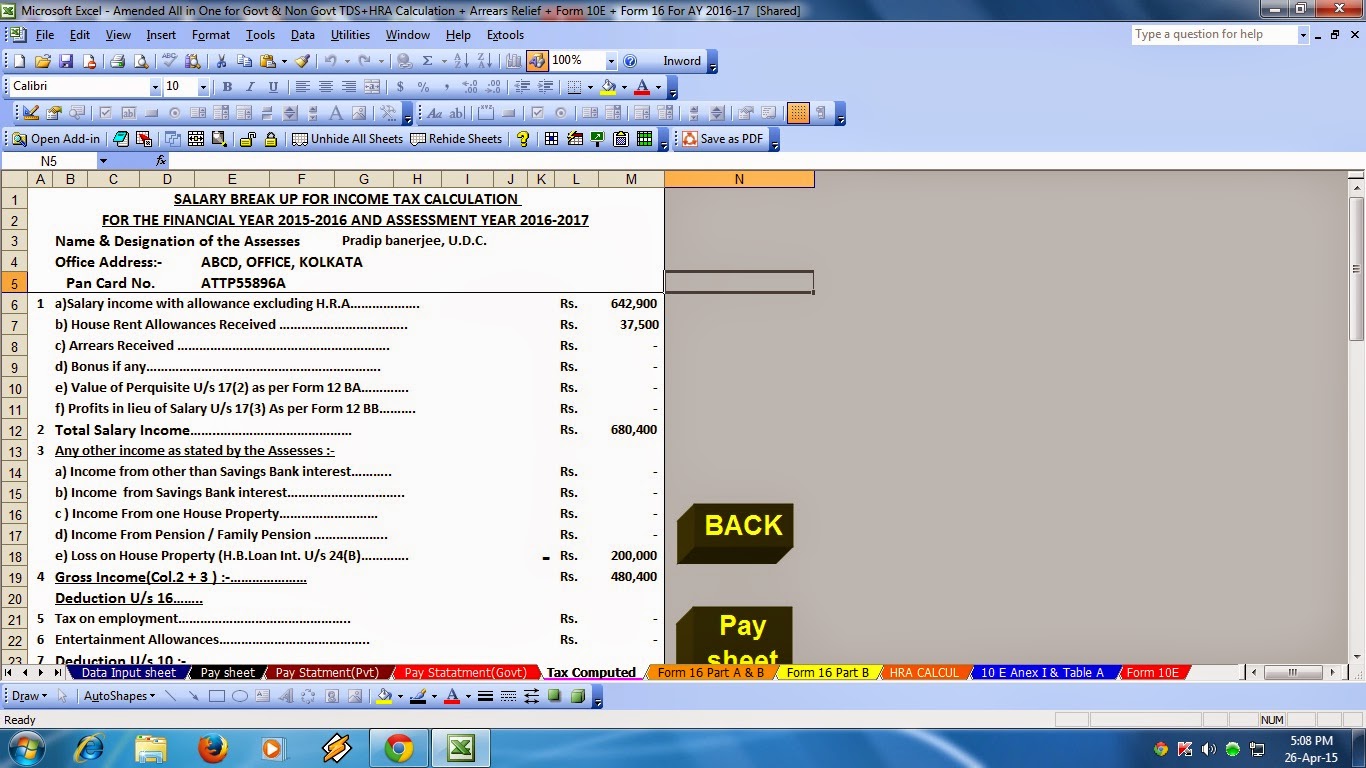 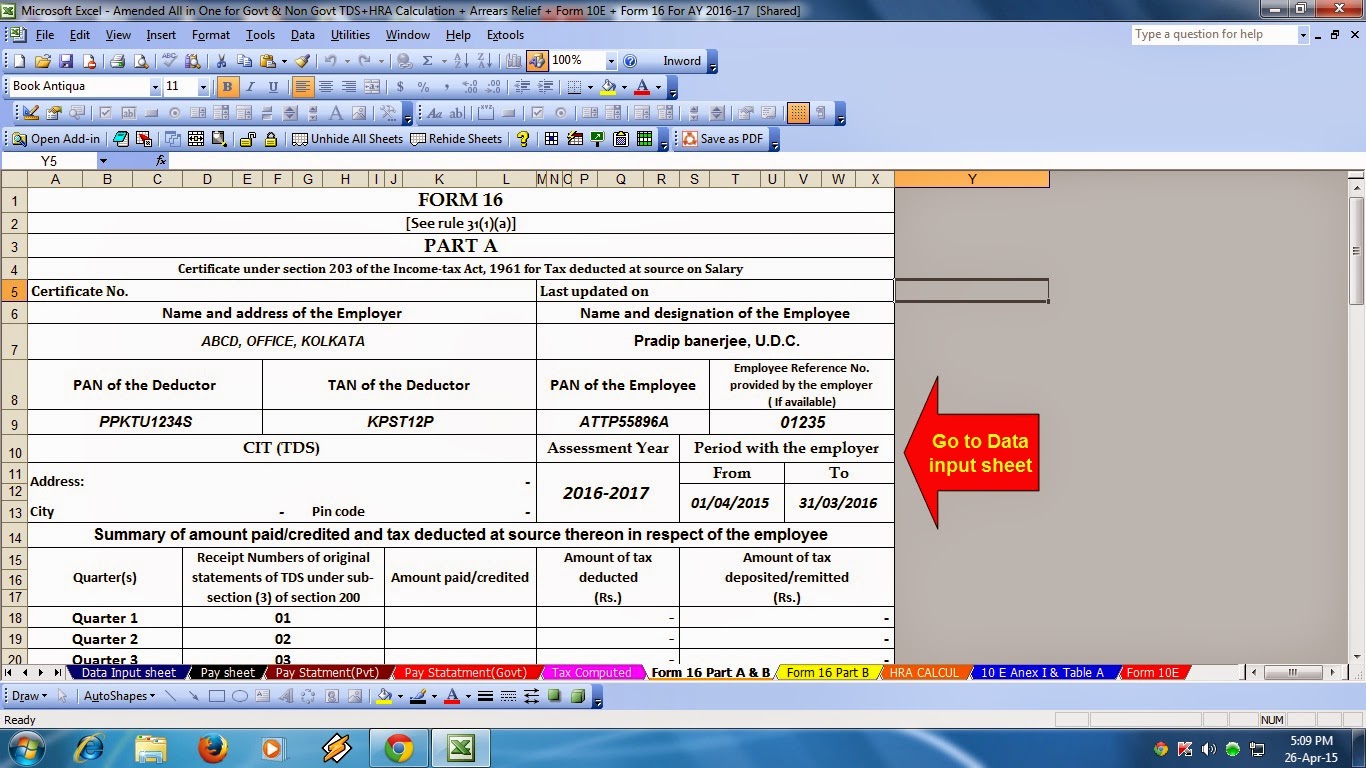 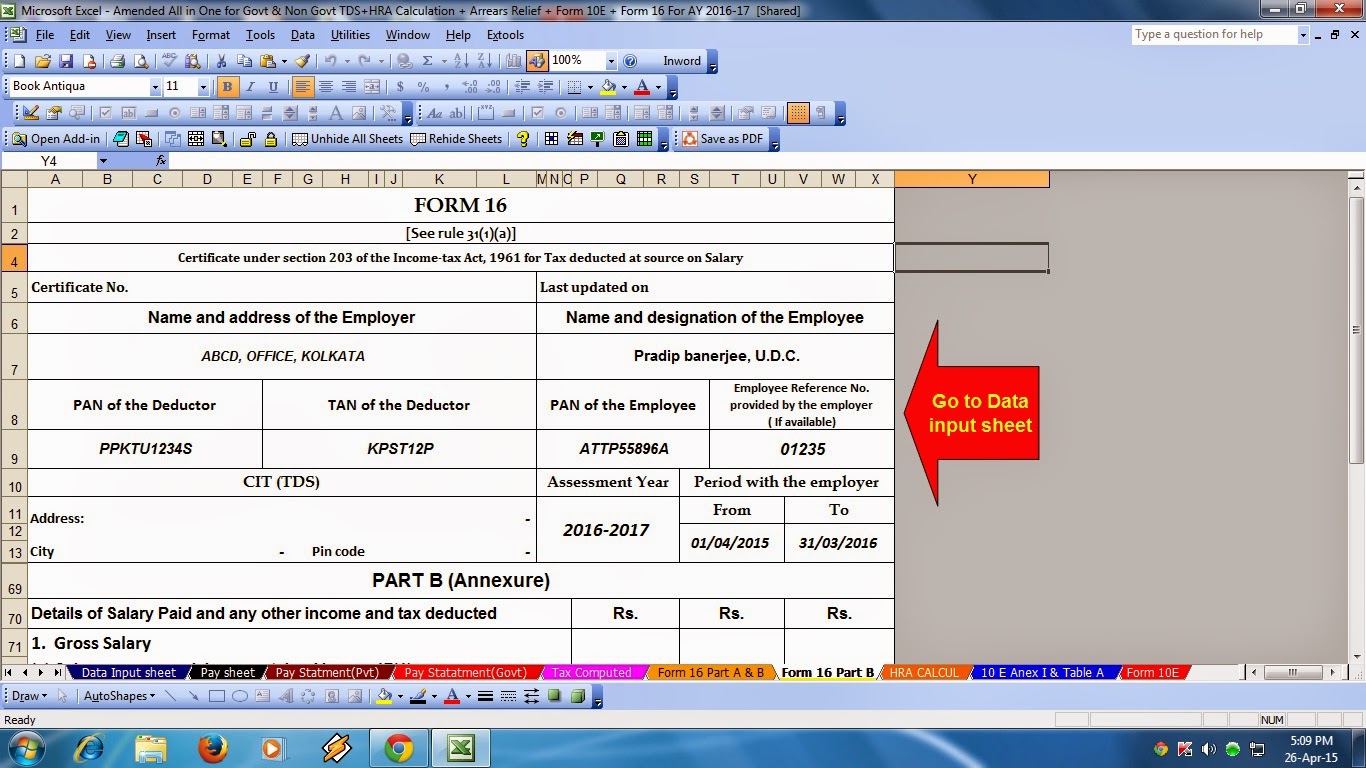 |
Tax planning has always been the test of efficiency for people along with being a test of they can save their taxes in a lawful manner. Here are some of the tips that can help you to plan your taxes for the F.Y. 2015-16 & A.Y. 2016-17. As per the New Finance Budget 2015-16, In this Budget the Tax Slab is same as previous Financial Year 2014-151) Various Investment in :- U/s 80C Policies are a prominent way to save a handful amount of tax. Up to Rs. 1, 50, 000 (A.Y.2016-17) can be saved by way of investing PPF, EPF, Fixed Deposit for 5 years, Pension Plans, etc. as specified u/s 80C, 80CCC and 80CCD. 2) Contribute to NPS U/s 80CC :- Under Chapter VIA NPS stands for New Pension Scheme was has recently been initiated by the Government under which investors can claim a deduction as a have a Tax free NPS return, however, withdrawal under such system is till taxable. Max Rs. 1.5 Lakh 3) The aid of Medical Insurance:- U/s 80D A deduction of Rs. 25, 000 is available for people who wish to invest in medical insurance for self. This deduction increases to Rs. 30, 000 when it is done by senior citizens. 4) Expenditure towards disabled dependent :- U/s 80DDB When certain amount is spent in form medical insurance for a disabled dependent, deduction up to Rs. 80, 000 is available where the disablement is normal in nature. 5) Repayment of Higher Education Loan Interest :- U/s 80E When repayment is carried out for higher education loan, the same is also allowed as a deduction and hence can reduce ample amount of tax liability. Max Rs.1 Lakh 6) Donate :- U/s 80G Donation to charitable trusts and organizations have always been regarded as an auspicious event, therefore, 50% or 100% deduction is available in such context. 7) House Building loan interest U/s 24B People who are liable to pay house loan interest can also claim deduction upto Rs. 2 Lakh U/s 24B and Rs. 1.5 Lakh U/s 80C as HBL Principal amount and Rs. 1 Lakh more can be availed U/s 80EE w.e.f. 01/04/2013 8) Transportation / Conveyance allowance :- U/s 10 A sum of Rs 19200/- P.A. can be claimed as a deduction for transportation and conveyance, additionally, and the Phy. Disable person can get the benefits up to Rs. 38,400/- P.A. |


itaxsoftware.net
Itaxsoftware.net |
|
Posted: 10 Sep 2015 06:43 AM PDT Income Tax deduction has increased some Section for FY 2015-16 i.e. AY 2016-17, with All In TDS on Salary for All State Govt Employees for F.Y.2015-16 Download the Automated All in One TDS on Salary for All State Govt Employees for Financial Year 2015-16 [ This Excel Based Software can prepare at a time your Tax Compute Sheet + Individual Salary Structure + Individual Salary Sheet + Automatic HRA Calculation U/s 10(13A) +Automatic Form 16 Part A& B and Automatic Form 16 Part B as per the new Finance Budget 2015]
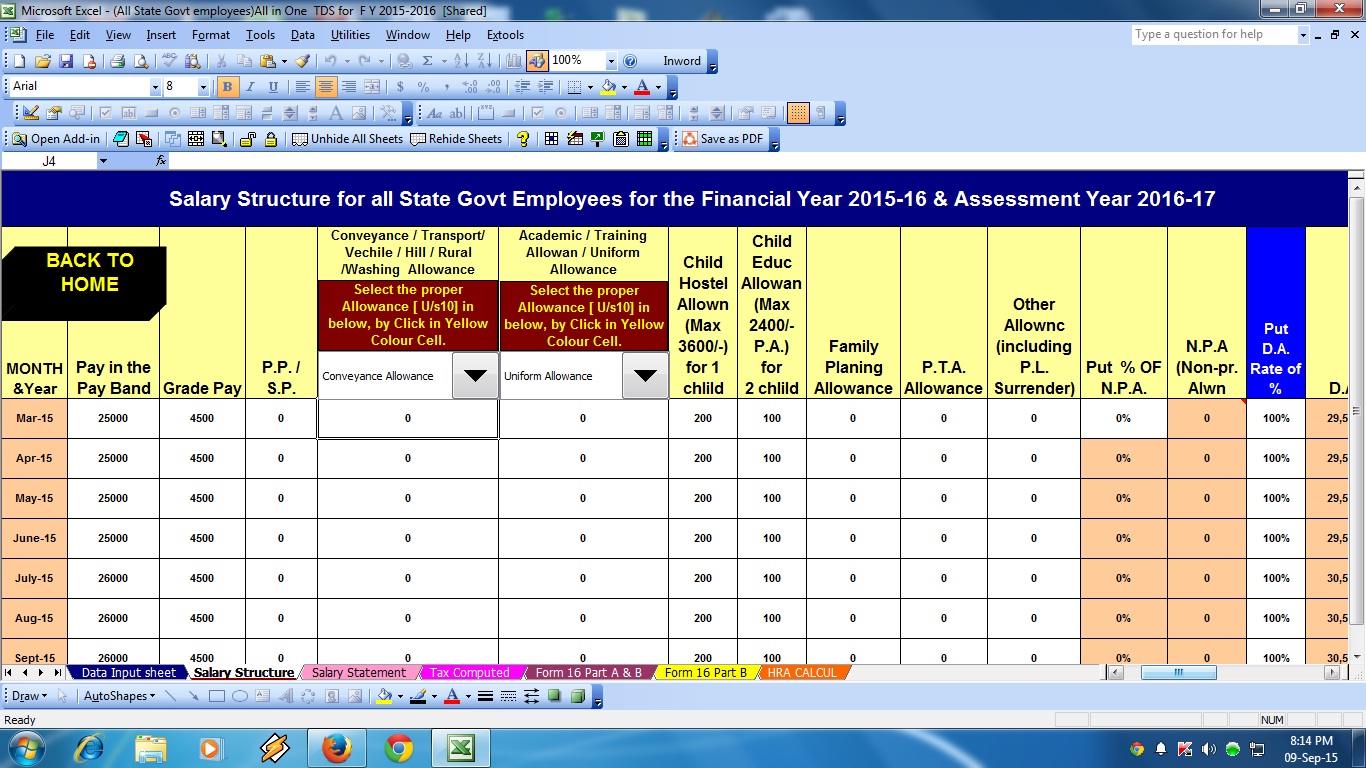 Employee Salary Structure |
No changes in tax slab rate for the F.Y.2015-16. The tax free income remains 2.5 lakh. There is some concession in medical insurance. But 80C limit of Rs 1.5 lakh will remain for another one year. Rather income tax surcharge is increased. However, investment in New Pension Scheme will give you extra tax saving.
|
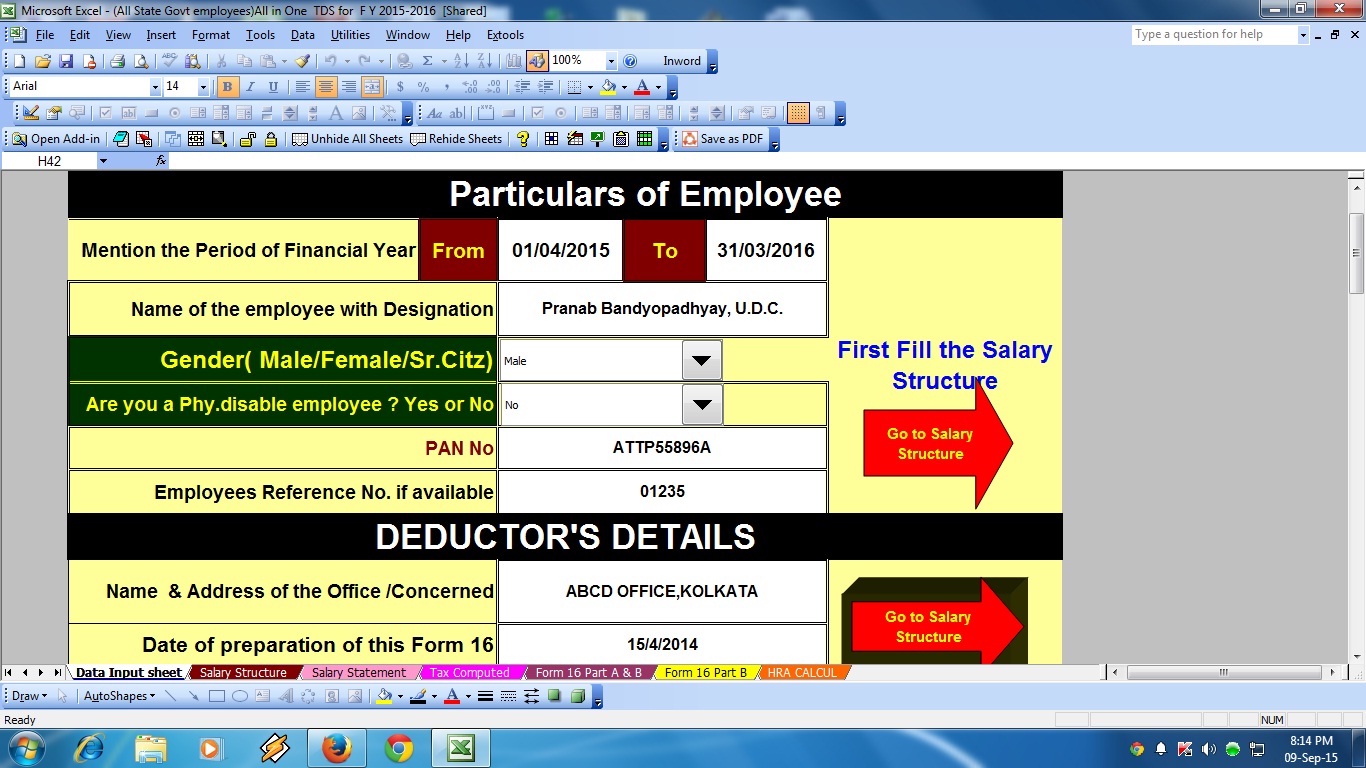
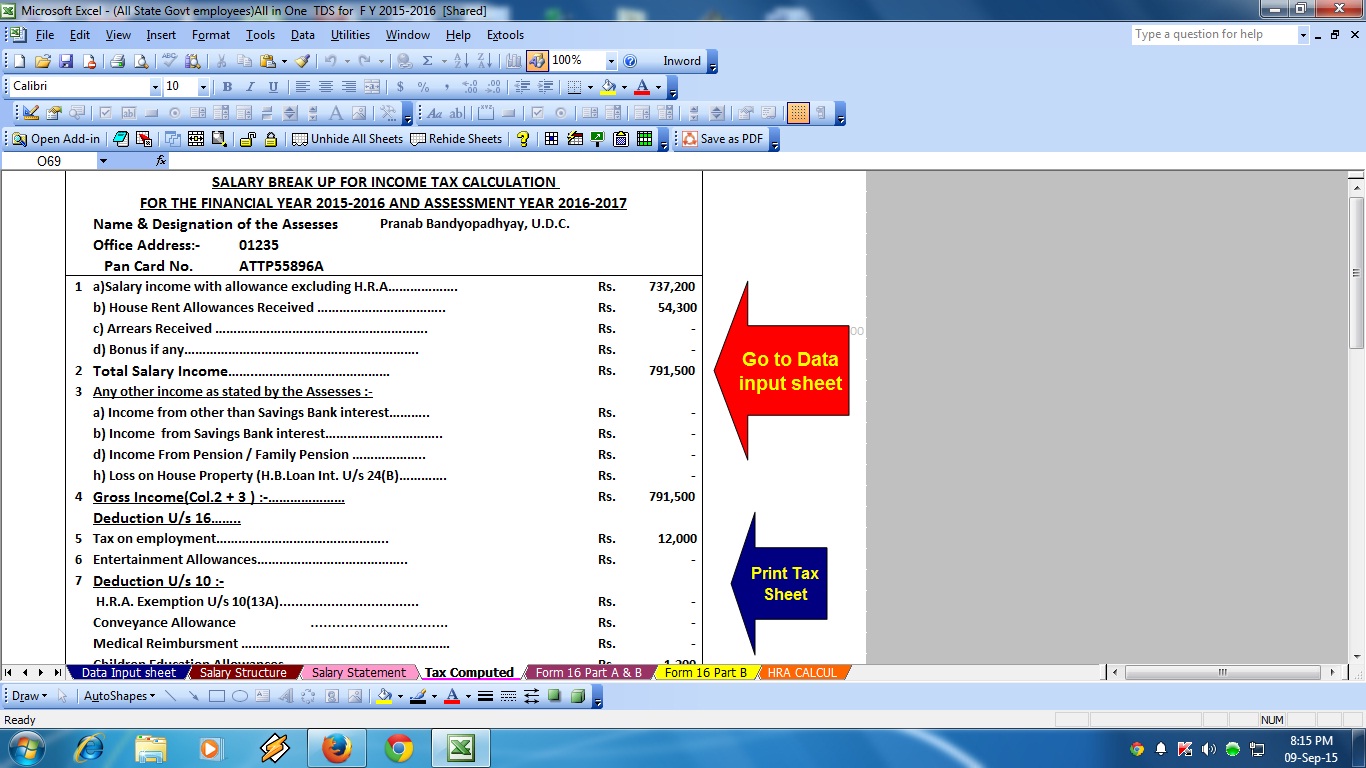
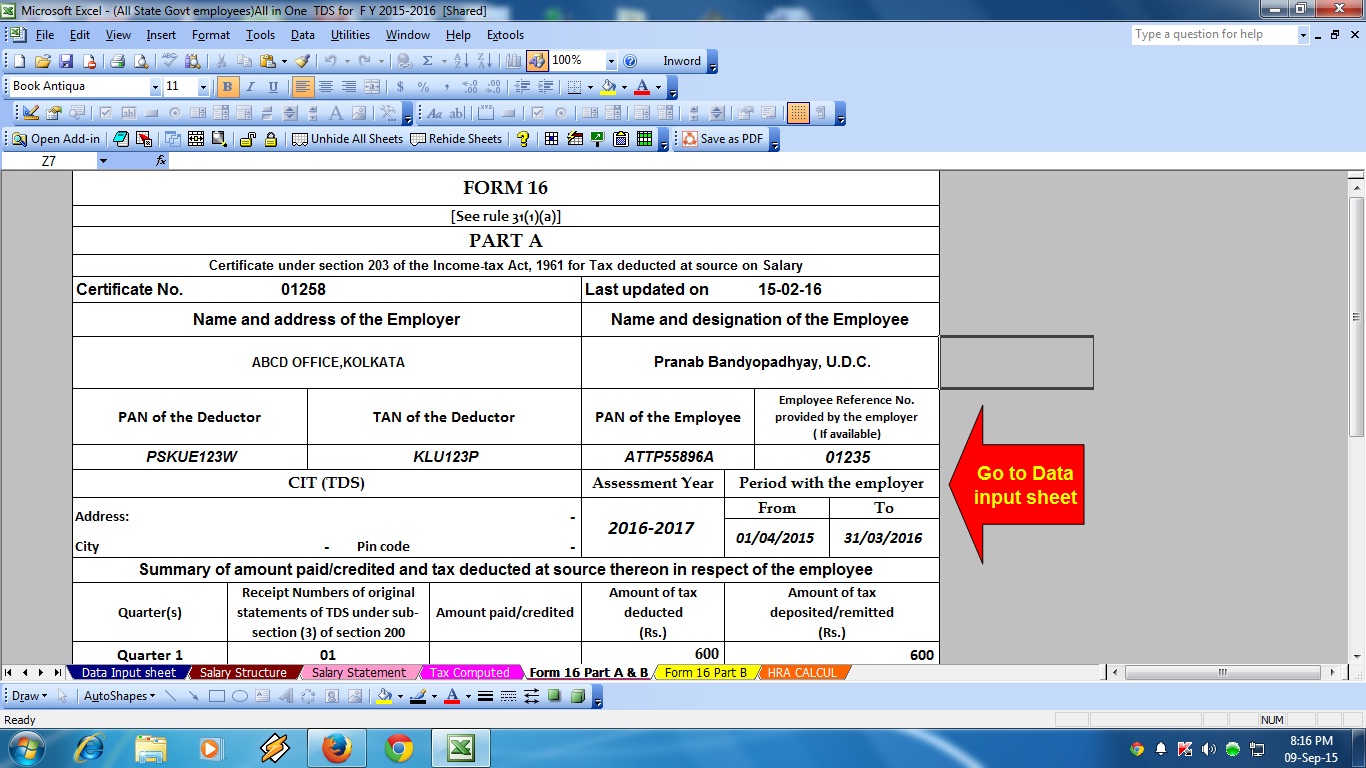
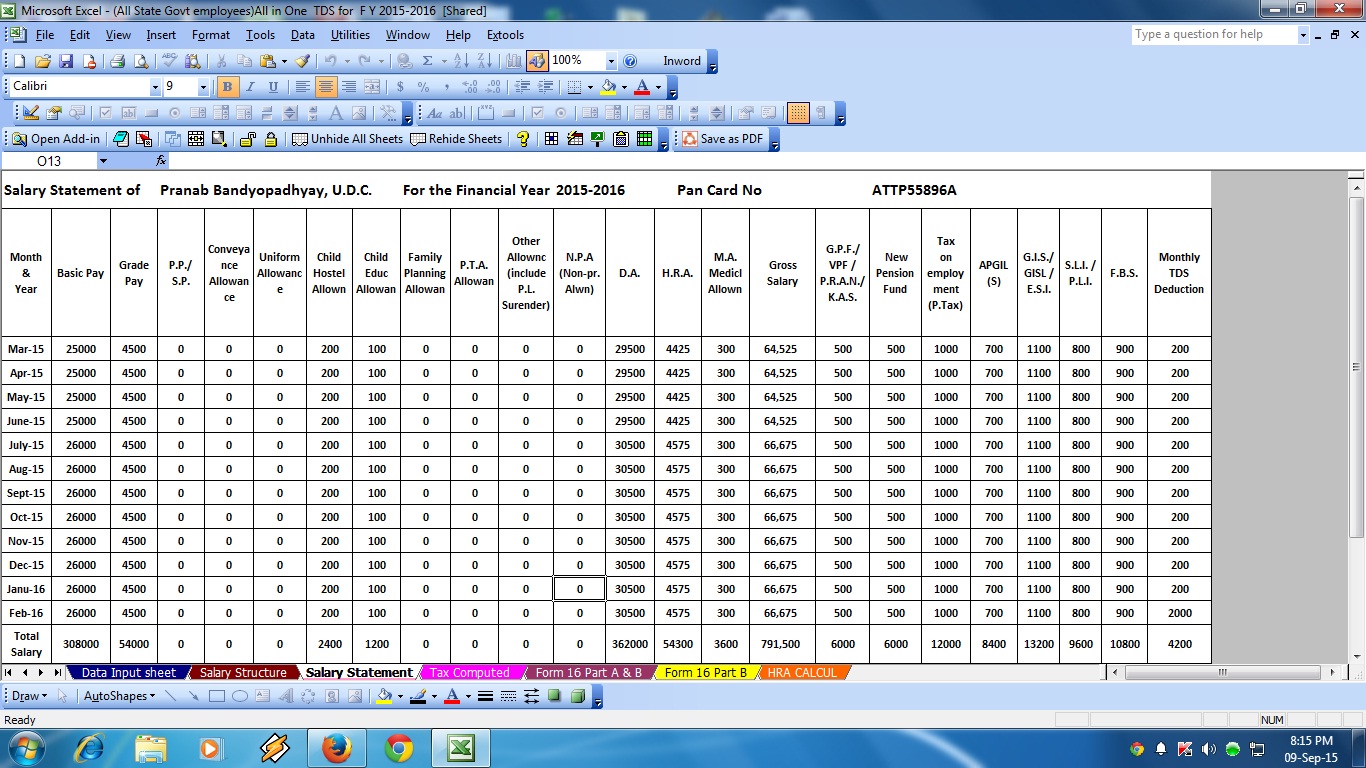


itaxsoftware.net
Itaxsoftware.net |
|
Posted: 11 Sep 2015 08:09 AM PDT Budget FY 2015-16 – Main Benefits of Tax on Salaried Persons for F.Y.2015-16, with Master of Form 16 Part A and B for F.Y.2015-16 Download Master of Form 16 Part A and B for F.Y.2015-16 [ This Excel Utility can prepare at a time 100 employees Form 16 Part A&B for Financial Year 2015-16 & Assessment Year 2016-17]This Utility can easy to generate just like a Excel File, and you can prepare now all of your employees Form 16 and distribute in the end of the Financial Year 2015-16 in the Month April 2016, This work have done in advance] |
The exemption limit has been enhanced to Rs 1,600 per month. You could consider revising the salary structure of your employees to make the amount paid under transport allowance at least Rs 1,600 per month and more than 80% Rs. 3200/- P.M. |


itaxsoftware.net
Itaxsoftware.net |
|
Posted: 12 Sep 2015 08:01 AM PDT Lost PAN Card But Remember Number? Do You Have To Apply For New One? with Automated Excel Based Pan Application Form 49A ( Amended Version)  It's highly possible that you would have lost your PAN Card and do not remember where you have kept the same. It's also possible that your wallet has been stolen or lost and the PAN card was in it. The first thing that you need to do is lodge an FIR. Once you have lodged an FIR make sure that you have a copy of the same. Now there are two things that can happen: One is that you have another photocopy of the PAN Card and the other is that you have no photocopy and you do not know the PAN number. In case you do now know the PAN number it is best to apply for a duplicate PAN Card. Please visit https://tin.tin.nsdl.com/pan/ In case you remember your number or you have a photo copy, you may not need to apply, because in most of the cases you need just a photocopy. It is very rare that somebody will ask you to submit your original PAN card for verification. In fact, the PAN cards issued in the 1990s, were black and white and looked like photocopied PAN Cards, which were later laminated. In any case you might not need an original PAN Card at all, though it's always a good idea to apply for one. There are a number of places where a PAN Card is needed though they may not verify with the original PAN Card. You may need PAN Cards At the Following Places: 1) Bank will ask you for a PAN Card when you open a new account. 2) When you purchase a property, whether buying or selling you may need to furnish it. 3) It would also be needed when you are buying a vehicle 4) When a hotel payment exceeds Rs 25,000, you may need to show your PAN card. 5) In case jewellery purchase exceeds Rs 5 lakhs, you may have to show it to the jeweler. 6) If your bank deposits exceeds Rs 50,000 you may have to furnish your PAN Card. 7) You cannot open a demat and trading account without a PAN Card. Conclusion As mentioned earlier, there maybe a need to apply for a PAN card in case you do not remember the same. If you have to need a New Pan Card and you want to submit the Application Form 49A you can use this Excel Based Automatic Pan Card Application Form which can easily fill your Pan Card Application Form 49ADownload the Amended Version of Pan Card Application Form 49A in Excel |


itaxsoftware.net
Itaxsoftware.net |
|
Banks / NEFT / RTGS to be closed on Second and Fourth Saturday Posted: 13 Sep 2015 05:36 AM PDT Banks / NEFT / RTGS to be closed on Second and Fourth SaturdayEffective September 2015, all banks would be closed on Second and Fourth Saturday every month. But now remaining Saturday’s (first, third and fifth) of the month would be full working day at banks. My initial understanding was that only Government banks would be impacted but no – seems like private banks would also follow similar practice. This is the mail I got from HDFC Bank about their bank following this practice.  NEFT, RTGS also closed on 2nd and 4th Saturday RBI (Reserve bank of India) has clarified that NEFT (National Electronic Funds Transfer) and RTGS (Real Time Gross Settlement) that are used for online fund transfers between banks would also be closed on Second and Fourth Saturday. Now NEFT and RTGS too would not work on Second and Fourth Saturdays. For rest of working days the timing would be as Open. |


itaxsoftware.net
Posted: 14 Sep 2015 06:53 AM PDT |
Automatic Arrears Relief Calculator U/s 89(1) with Form 10 E from the FY 2000-01 to FY 2014-15 |


itaxsoftware.net
Itaxsoftware.net |
|
Posted: 15 Sep 2015 06:28 AM PDT Who are not get HRA Allowances they can get House Rent Exemption U/s 80GG,with Master of Form 16 Part B with Challan 24Q & 26Q for F.Y. 2015-16] |
 Under Section 80GG, an Individual can claim deduction for the rent paid even if he does not get House Rent Allowances. Not many people are aware of this deduction.Section 80GG allows the Individuals to a deduction in respect of house rent paid by him for his own residence. Such deduction is permissible subject to the following conditions :-

B ) at any other place, any residential accommodation being accommodation in the occupation of the Individual, the value of which is to be determined under Section 23(2)(a) or Section 23(4)(a) as the case may be.
2)
|


This posting includes an audio/video/photo media file: Download Now |
| You are subscribed to email updates from itaxsoftware.net. |
To stop receiving these emails, you may unsubscribe now. |
| Email delivery powered by Google |
itaxsoftware.net
Itaxsoftware.net |
|
Posted: 16 Sep 2015 07:22 AM PDT Download Automated All in One TDS on Salary for Govt & Non Govt Employees for FY 2015-16 & AY 2016-17 [ This Excel Utility can prepare at a time your Tax Compute Sheet + HRA Exemption Calculation + Arrears Relief Calculation with Form 10E + Automated Form 16 Part A&B and Part B for FY 2015-16]
|
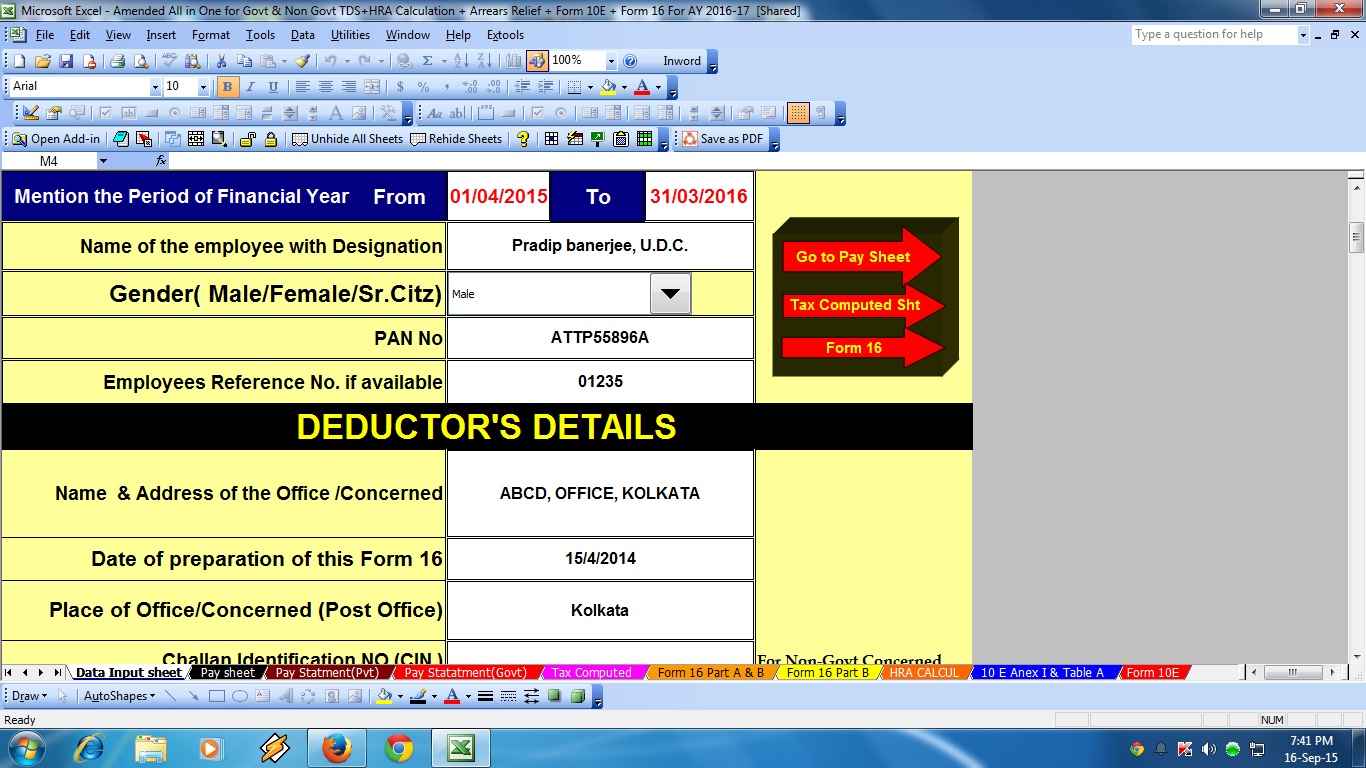
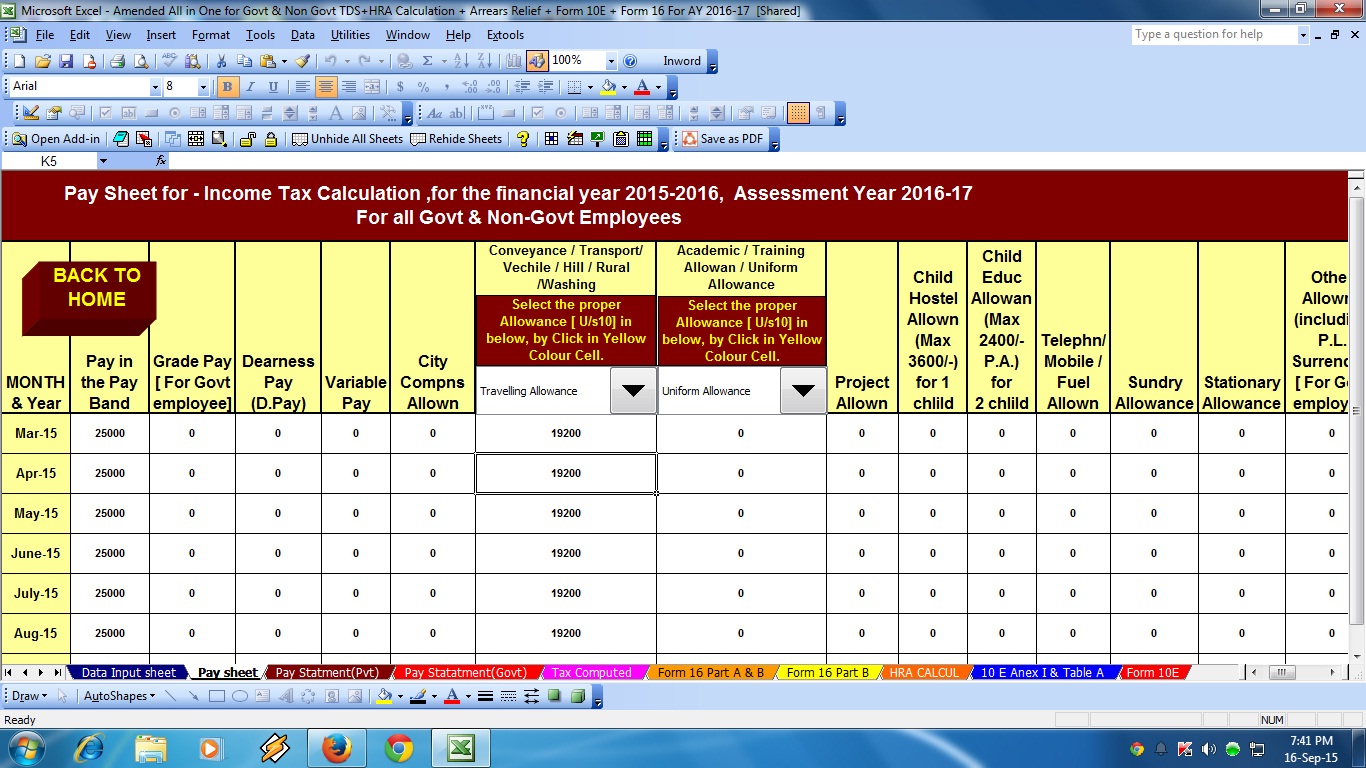

Budget 2015 has been introduced in Parliament. The Finance Minister has kept the Personal Income Tax rates unchanged for the Financial Year 2015 /2016 (Assessment Year 2016-2017). |
He has to introduce or extend the Tax Deduction limits Under few Sections of the Income Tax Act. Let us understand all the important sections and new introduce with respect to ‘Income Tax Deductions 2015′. This list will help you in planning your taxes. Income Tax Deductions 2015Section 80c The maximum tax exemption limit under Section 80C has been retained as Rs 1.5 Lakh only. The various investment avenues under this section are;
Section 80CCC Contribution to annuity plan of LIC (Life Insurance Corporation of India) or any other Life Insurance Company for receiving pension from the fund is considered for tax benefit. The maximum allowable Tax deduction under this section is Rs 1.5 Lakh. Section 80CCD |
Employee can contribute to Government notified Pension Schemes (like National Pension Scheme – NPS). The contributions can be upto 10% of the salary (or) Gross Income and Rs 50,000 additional tax benefit u/s 80CCD (1b) is proposed in Budget 2015. In FY 2014-2015, the maximum tax exemption allowed under Section 80CCD is Rs 1 Lakh only. In Financial Year 2015-2016 or Assessment Year (2016-2017), this will be Rs 1.5 Lakh (u/s 80 CCD 1 ) and additional exemption of Rs 50,000 u/s 80CCD (1b) will be allowed. ( To claim this deduction, the employee has to contribute to Govt recognized Pension schemes like NPS) (10% of salary is applicable for salaried individuals and Gross income is applicable for non-slaried. The definition of Salary is only ‘Dearness Allowance.’ If your employer also contributes to Pension Scheme, the whole contribution amount (10% of salary) can be claimed as tax deduction under Section 80CCD (2). The ceiling limit of 1.5 Lakh u/s 80CCD is not applicable on employer’s contribution.) Section 80D |
Deduction u/s 80D on health insurance premium will be Rs 25,000, increased from Rs 15000. For Senior Citizens it has been increased to Rs 30,000 from the existing Rs 20,000. For very senior citizen above the age of 80 years who are not eligible to take health insurance, deduction is allowed for Rs 30,000 toward medical expenditure. |
Section 80DDB |
An individual (less than 60 years of age) can claim upto Rs 40,000 for the treatment of specified critical ailments. This can also be claimed on behalf of the dependents. The tax deduction limit under this section for Senior Citizens is proposed as Rs 60,000 and for very Senior Citizens (above 80 years) the limit is Rs 80,000 Section 24 (B) |
You can claim upto Rs 2 Lakh as tax deduction on the home loan interest payment. If your property is a let-out one then the entire interest amount can be claimed as tax deduction. |
Section 80U You can claim up to Rs 75,000 (increased from the existing Rs 50,000) for spending who have up to 80% disability. It is also been Introduce to increase the limit of deduction from Rs 1 lakh to Rs 1.25 lakh in case of above 80% severe disability. The other sections are – Section 80E (tax deduction benefit on the interest payment of an education loan), Section 80 G (Donations), Section 80GG (when HRA is not paid by the company but you incur rental expenses) and 100% TAX DEDUCTION on contributions made to SWACHH BHARAT & CLEAN GANGA initiatives have also been proposed. The above ‘Income Tax Deductions 2015′ are applicable for Financial year 2015-2016 (or Assessment Year 2016-2017). |


itaxsoftware.net
Itaxsoftware.net |
|
Automated Excel Based Form 16 Part A&B and Part B for FY 2015-16 with Tips for Tax Savings Posted: 17 Sep 2015 08:35 AM PDT Automated Excel Based Form 16 Part A&B and Part B for FY 2015-16 with Tips for Tax Savings Prepare at a time 100 employees Form 16 Part A&B for FY 2015-16 [Who are not able to download Form 16 Part B from the TRACES Portal,they can use this Form 16 Part A&B for FY 2015-16] |
Click to download Master of Form 16 Part B for Govt & Non Govt employees for FY 2015-16 [ This Excel Utility can prepare at a time 50 employees Form 16 Part B for AY 2016-17] |
Some personal expenses are also eligible for exemptions. These Expenses are deducted from your gross salary. Your employer may give you part of your salary as medical allowance. Check with the HR department. If you produce an actual bill of medical expenses, this allowance becomes tax-free. So, Start collecting medical bills. However, it is limited to Rs 15,000 in a financial year. You can give receipts of medical expense of your dependents as well. Your employer can give you leave travel allowance as well. You are entitled to tax-free leave travel allowances,U/s 10 · It is also limited to two times in a block of 4 years. · The travel should occur while you are on the leave. · It should be within India. · Travel should be from the shortest route. · You can claim the maximum for AC-I of the train journey and economy class of air travel. 4. Invest And Reduce Taxable Income,U/s 80C[ Click to view details of deduction U/s 80C]Certain investments give your tax rebate. These investments come under section 80C of deductions. The amount invested is deducted from your taxable income. Many of such investments come under EEE category. It means you need not to give tax at the time of investment, earning and redemption. However, There is a maximum limit for 80C deductions. It has become 1.5 lakhs after the budget of 2014. List of Investments Which Saves Tax · Contribution to EPF account · Deposit in PPF account · Investments in tax saving mutual funds i. e. Equity Linked Saving Scheme (ELSS) · Deposit in tax saving FD · Investment in National Saving Certificate (NSC) · Deposit into Senior Citizen Saving Scheme There are some expenses which also give a deduction for tax saving. I have listed here only investments. |
Download Automatic Form 16 Part A&B and Part B for FY 2015-16 [ This Excel utility can prepare One by One Form 16 Part A&B and Part B for AY 2016-17] |
5. Expenses Eligible For Tax SavingUnder the limit of 1.5 lakh deduction there are some expenses as well. · Tuition fees for self and children · Insurance scheme premium · Home loan principal payment- Home loan EMI has two-part, principal and interest. Principal part gives tax saving benefit under section 80C. These expenses and above mentioned investment in aggregate should not exceed 1.5 lakh limit. 6. Medical Insurance Deduction,U/s 80D Medical Insurance expense gives you the deduction, over and above the 1.5 lakh limit. You can save tax for the health insurance premium of your family and dependent parents. Also, health checkup can also give you tax saving. You can deduce these expenses from your total taxable income. · Up to Rs 15,000 for the health insurance of self and family. You can also include health checkups of up to Rs 5,000 within this limit. · Up to Rs 15,000 for the health insurance of parents. If they are above 60 years, This limit goes up to 20,000. |
Click here to Download Master of Form 16 Part A&B for FY 2015-16 [ This Excel Utility Can prepare at a time 50 employees Form 16 Part B for FY 2015-16] |
7. Enjoy Tax Benefit On Home Loan Interest Payment U/s 24BHome loan interest payment enjoys separate tax saving. The limit of deduction for home loan interest payment is increased to 2.0 lakhs U/s 24B in the first Modified budget. This deduction can give you a very big tax saving. However, the loan amount should be big to get the full benefit. |


itaxsoftware.net
Itaxsoftware.net |
|
Income Tax refunds to be sent to taxpayers in 7-10 days as per the CBDT news Posted: 18 Sep 2015 07:28 AM PDT Income Tax refunds to be sent to taxpayers in 7-10 days as per the CBDT newsIn what could be a good news for lakhs of taxpayers, the Income Tax Department will now process and send refunds in a short time of 7-10 days as its latest technology upgrade of electronic and Aadhaar-based ITR verification has begun on a successful note. The department’s latest initiative to verify an Income Tax Return (ITR) by Aadhaar or other bank database has received positive response from ITR filers because of which the taxman, for Assessment Year 2015-16, was able to process and send refunds to bank accounts of eligible taxpayers in less than 15 days time. CLICK HERE TO CHECK YOUR INCOME TAX REFUND STATUS FOR ASSESSMENT YEAR 2015-16“The days are gone when getting an I-T refund used to take months or in some cases even a few years. The new electronic verification e-filing system has proved to be very customer-friendly and as a token of thanks to the taxpayers, the department is working to ensure their refunds are sent in a week’s time or a maximum of ten days.“This is surely the way forward in the administration of tax affairs in the country,” a top officer of the department involved in these operations said. According to latest statistics, the department received 2.06 crore returns on its e-filing portal as on September 7, 2015 (last date for ITR filing), which is an increase of 26.12 per cent over the last year when 1.63 crore returns were filed online.The department’s Central Processing Centre (CPC) as on September 7 processed 45.18 lakh returns and issued refunds to 22.14 lakh tax payers relating to assessment year 2015-16, it added. During this period, the department electronically verified over 32.95 lakh e-returns. The data added that peak filing rate touched 3,475 returns per minute this time as compared to 2,901 returns per minute last year. As per some testimonials received by the department from taxpayers, also accessed by PTI, many have reported that they received their refunds in only 11 or 13 days time from the day of filing their ITR. |


itaxsoftware.net
Itaxsoftware.net |
|
Free download Convert Amount to In Words in Excel Posted: 19 Sep 2015 07:02 AM PDT Free download Amount to in word Converter in Excel ToolsMost of Professional mainly in Accounts related persons and who are working in Computer mainly used in Excel, they have need this Excel Tools, which can easily Convert the Amount to In Words automatically. This Excel Tolls mainly valuable for those, who are working in Accounts and where frequently need the Amount to in word manually typing in Computer. Hope this Utility can help and reduce the time and errors of spelling of in word typing. For Download the Same first you should Register in My Blog where you can easily received Free update Excel Utility which are all Accounts Related and Income Tax Related Excel Based Utility. Also you can get this type of Excel Tools through mail delivery system by Feed Burner. After Registering this Blog you can get the Pass Word for Download this Excel Tools through Mail. This Excel Tools can download from the link MediaFire Link. When you click this link Asking a Password which will be supplied by you After REGISTER THIS BLOG.You should first Register this Blog post Via Feed Burner Location and after registering this Blog you can get the Pass Word for Download this Utility.Instruction for install this Utility is given below :- Register for get this Excel toolls "Amount to in words" You can use this Excel Tools for 2003 & 2007 & 2010 Users Instruction for install 1. save it in a Folder permanently.(do not change the location of file after installation) 2. Now open excel Go to Tools>add in >browse (browse the file where you have stored the downloaded the file and select the file>ok. [ For 2003 Users] For 2007 & 2010 Users - Go to File>Open>Excel Option>Add-ins>Manage Excel Add-in>Go>Browse where you have stored the downloaded file and select the file>OK Form 2010 Users - Same as 2007. Also you should first enable Analyses toolpak before install this tools. then press ok that's all Just type the Formula in below given in formula bar=word(Cell No) (cell number in which figure are given)It will be done |


itaxsoftware.net
Itaxsoftware.net |
|
Posted: 20 Sep 2015 10:50 AM PDT Download Automated All in One TDS on Salary for Non-Govt employees for FY 2015-16 & AY 2016-17 [ This Excel Utility can prepare at a time Tax Compute sheet + Automated HRA Calculation + Automated Form 16 Part A&B and Part B + Form 12 BA]
Brief the tax section with deduction Traveling Allowance/Conveyance Allowance:- Raised up to Rs. 1600/- P.M. and Phy. disable persons Rs. 3200/- P.M. Entertainment Allowance: The first deduction which you claim from salary is Entertainment Allowance. Entertainment allowance received is first included in the employee’s income and then a deduction is allowed in case of government employees, for a sum equal to 1/5th of salary (excluding all allowances, benefits and other perquisites) or Rs. 5,000, whichever is less. Professional Tax: Tax on employment by whatever name called, levied by a State under Article 80C 276 of the Constitution shall be allowed as a deduction. [Sec. 16(iii)] Payment of Medical Insurance Premiam (Mediclaim) or contribution to Central Government Health Scheme. [Sec. 80D]: Deductible up to a maximum of Rs. 25,000 (Rs. 30,000 in case the person insured is a senior citizen). Expenditure on medical Treatment etc. and deposit for maintenance of handicapped dependents. [Sec. 80DD]: A deduction is allowed to compensate for any expenditure incurred by an assesses, during a year, for the medical treatment (including nursing), training and rehabilitation of one or more handicapped relatives wholly dependent on him, and for amount deposited in an approved scheme of LIC or UTI, for the benefit of a handicapped dependent. A fixed deduction of Rs. 50,000 is allowable, in aggregate for any or both the purpose specified above, irrespective of the actual amount of expenditure incurred. Expenditure or Medical Treatment of assess/dependant relative [Sec. 80DDB]: Deduction for the amount of expenditure incurred or Rs. 40,000, whichever is less, is allowable for any year during which expenditure is actually incurred for the medical treatment of specified diseases or ailments for the assesses himself or a dependent relative. If the patient is a senior citizen the deduction allowable shall be the expenditure incurred or Rs. 80,000 whichever is less. Besides, any amount received under a medical insurance policy shall be reduced from the amount of deduction allowable. Interest on Loan taken for Higher Education. [Sec. 80E]: Any amount paid by way of interest on a loan taken from any financial institution or any approved charitable institution for the purpose of pursing his higher education, is deduction without any limit. Interest on Loan taken for first residential house. [Sec. 80EE]: Deduction is allowable for interest on housing loan from a bank/housing finance company, for allowable is Rs. 1, 00,000, subject to specified conditions. The deduction is allowable for A.Y. 2014-15 and A.Y. 2015-16 only.] Donation for Charitable Purposes [Sec. 80G]: There are a number of donations in respect of which deduction is permissible under Sec. 80G. Deduction @ 50% is available for donation to Jawaharlal Nehru Memorial Fund, Prime Minister Drought Relief Fund, [National Children’s Fund] Indira Gandhi Memorial Trust or Rajiv Gandhi Foundation etc. 100% deduction is allowed for donations to National Defense Fund, Prime Minister’s National Relief Fund, [National Children’s Fund,]National Foundation for Communal Harmony, Chief Minister’s/Lt. Governor’s Relief Fund etc. Deduction is granted subject to the prescribed maximum ceiling and on furnishing of appropriate certificate from the done organization. Donation of a sum exceeding Rs. 10,000 shall be eligible for deduction, only if it paid by a mode other than cash. Expenditure on Rent. [Sec. 80GG]: Rent paid by an assesses not owning a house and not in receipt of house rent allowance u/s 10(13A) for residential accommodation whether furnished or unfurnished, is deductible subject to the prescribed ceilings. [w.e.f 1-4-2014, for A.Y. 2014-15] Donations to specified institutions/associations for Research or for Rural Development [Sec. 80GGA]: Donation of a sum exceeding Rs. 10,000 shall be eligible for deduction, only if it paid by a mode other than cash. Physical Disability [Sec. 80U]: Rs. 75,000 for disability and Rs. 1, 25,000 for severe disability. Download Automated All in One TDS on Salary for Non-Govt employees for FY 2015-16 & AY 2016-17 [ This Excel Utility can prepare at a time Tax Compute sheet + Automated HRA Calculation + Automated Form 16 Part A&B and Part B + Form 12 BA] |
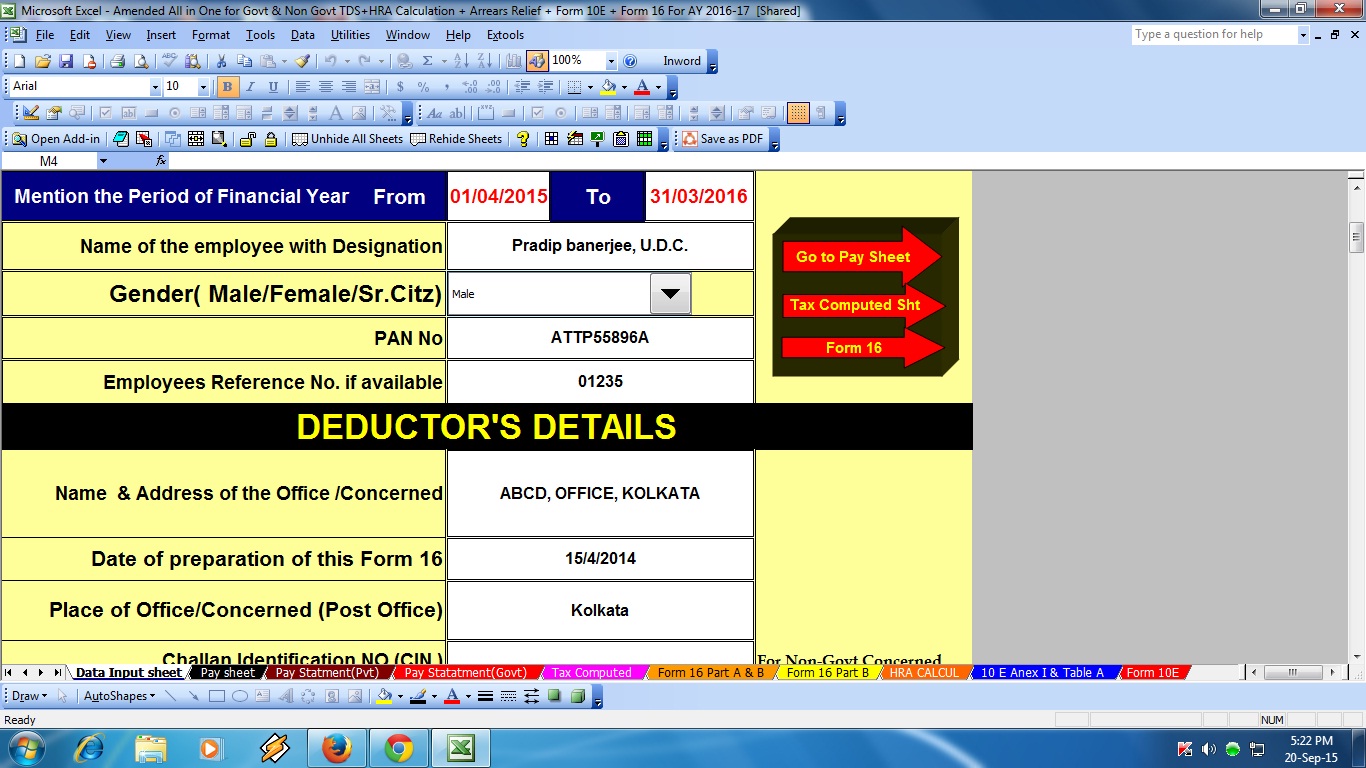
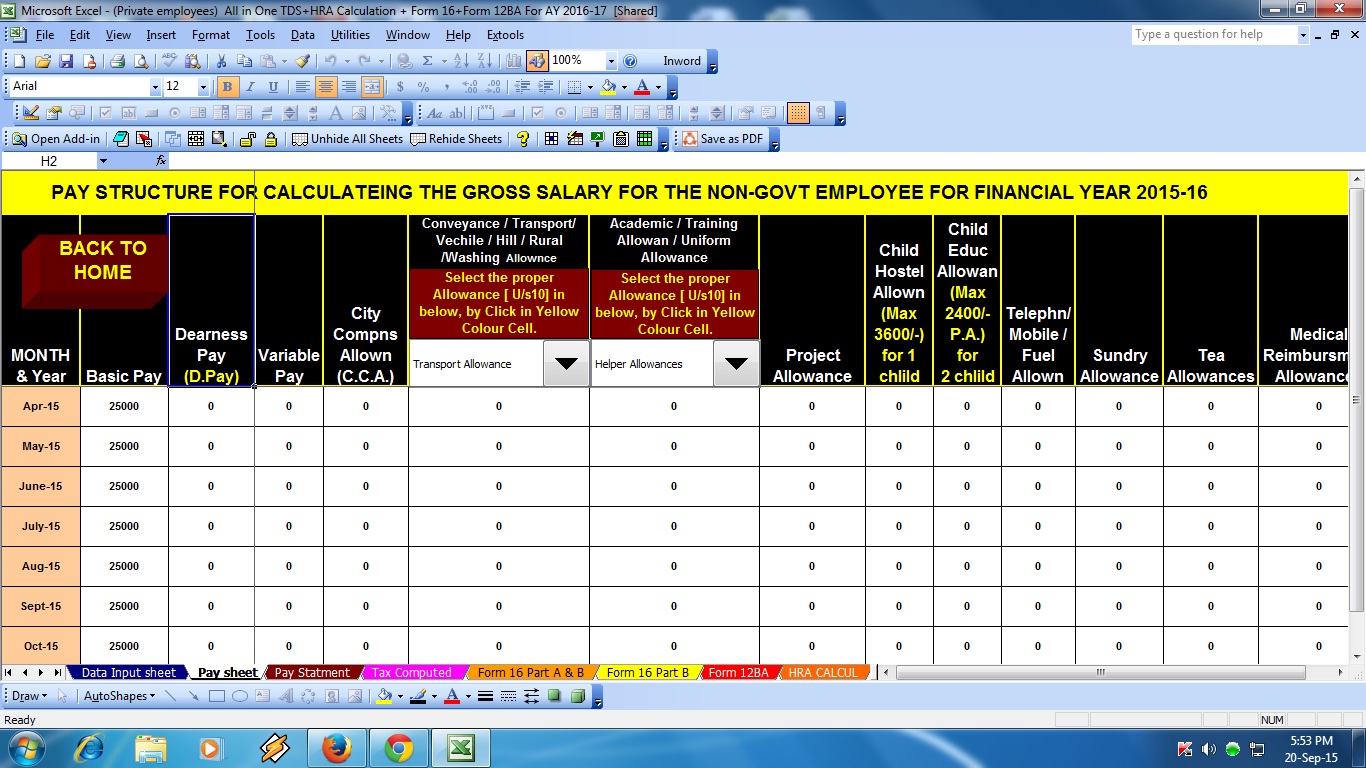


This posting includes an audio/video/photo media file: Download Now |
| You are subscribed to email updates from itaxsoftware.net. |
To stop receiving these emails, you may unsubscribe now. |
| Email delivery powered by Google |
itaxsoftware.net
Itaxsoftware.net |
|
Posted: 21 Sep 2015 07:46 AM PDT Download & Prepare at a time Tax Computed Sheet + Individual Salary Structure + Individual Salary Sheet + Automatic HRA Exemption Calculation + Form 16 Part A&B and Part B for Only West Bengal Govt Employees for Financial Year 2015-16
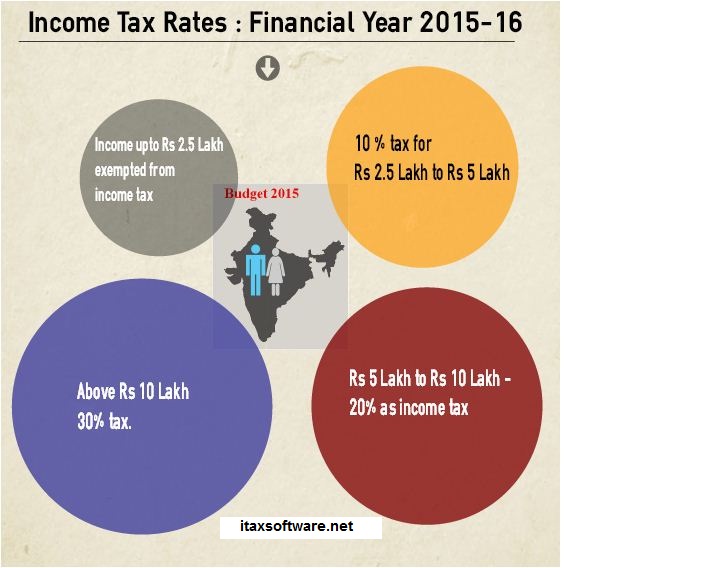 Details of tax deductions as per Budget 2015-16 are as follows:Deduction u/s 80C Rs 1,50,000 is same. Deduction u/s 80CCD has been increased by Rs 50,000 towards New Pension Scheme. The total contribution has been increased from Rs 1 Lakh to Rs 1.5 Lakh Deduction on account of interest on house property loan (Self occupied property) Rs 2,00,000. Deduction u/s 80D on health insurance premium Rs 25,000, increased from Rs 15000. For Senior Citizens it has been increased to Rs 30,000 from the existing Rs 20,000. For very senior citizen above the age of 80 years, not eligible to take health insurance, deduction is allowed for Rs 30,000 toward medical expenditure. Exemption of transport allowance Rs 19,200 (Increased from Rs 800 pm to Rs 1600 pm). & Phy. Disable Persons Rs. 3200/- P.M. Payments (Interest & maturity amounts) on Sukanya Samriddhi Account Deposit Scheme is exempted from Income Tax Under Section 80c. So it comes under Exempt – Exempt – Exempt tax category. It looks better than PPF (Public Provident Fund) now. Other deduction except U/s 80CTax-free infra bonds proposed for funding irrigation, rail & road infrastructure projects. |
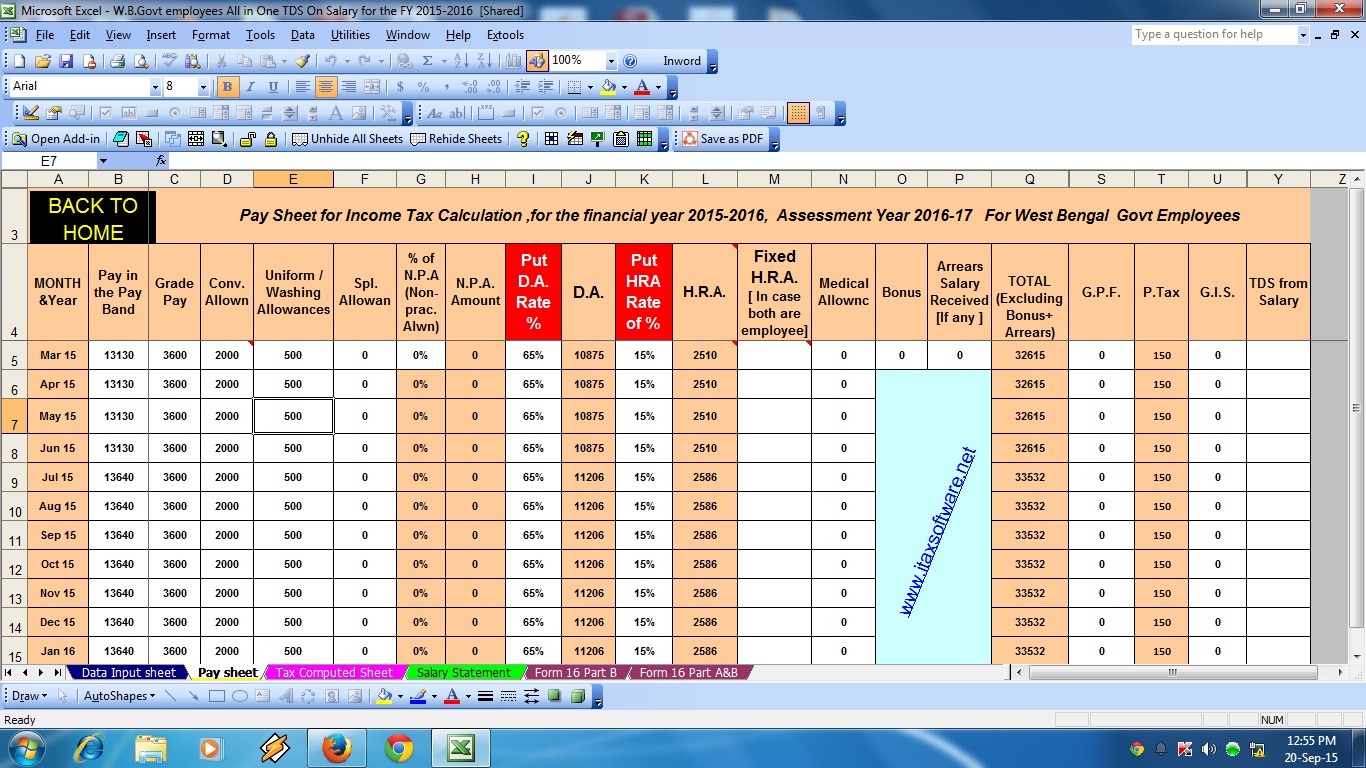
100% TAX DEDUCTION on contributions made to SWACHH BHARAT & CLEAN GANGA initiatives |
Additional deduction of Rs 25,000 is allowed for Phy-disabled persons, increasing the limit from Rs 50,000 to Rs 75,000 (under Section 80 U) . It is also increase the limit of eduction from Rs 1 lakh to Rs 1.25 lakh in case of severe disability. Deduction limit of Rs 60,000 on expenditure on account of specified diseases is enhanced to Rs 80,000 in the case of senior citizens (Under Section 80DD of the Income Tax Act). |


itaxsoftware.net
Itaxsoftware.net |
|
Posted: 22 Sep 2015 06:00 AM PDT Download All in One Income Tax Preparation Excel Based Software for BIHAR STATE EMPLOYEES for Financial Year 2015-16 and Assessment Year 2016-17 [This Excel Utility can prepare at a time Tax Compute Sheet + Individual Salary Structure + Individual Salary Sheet +Automatic HRA Exemption Calculation + Automated Form 16 Part A&B and Form 16 Part B Only for BIHAR State Employees]A home loan borrower can claim Income Tax exemption on interest payments of up to Rs 2 lakh U/s 24B and another Rs 1.5 lakh under Section 80 C towards the principal repayment for a Self-occupied property. And another Rs.1 Lakh can get benefits U/s 80EE, Total benefits Rs. 2 Lakh + 1.5 Lakh + 1 Lakh = 4.5 Lakh..However, you cannot seek these tax benefits in the pre-construction phase (i.e. no tax deductions available for an under construction house), even if you have started repaying the housing loan through EMIs. Often it is seen that housing loan is taken but the possession of the property is received in the next or later financial years. It may be because the property is not completed or constructed. The Section 24B of the Income Tax Act states that if a property is still to be constructed, there will not be any tax deduction on the interest payment for all of those years. However, the interest for the pre-construction period can be availed for deduction in five equal installmentsfrom the year the construction is complete. |


itaxsoftware.net
Itaxsoftware.net |
|
Posted: 23 Sep 2015 08:43 AM PDT As per the Budget 2015-16 as a growth oriented one with due attention to common and poor in India, there were not much changes as far as Income Tax 2015-16 in respect of salaried employees are concerned. Personal Income Tax Rates were untouched and as a result Salaried Class will have to pay same Income Tax that they paid last year. However, following changes have been effected with regard to deductions / exemption allowed from total income of Salaried Employees under various Sections Income Tax Act by which quantum of Income Tax payable this year may get reduced if an employee is eligible for such deduction / exemption. Download Master of Form 16 Part B for Financial Year 2015-16& Ass Year 2016-17 [ This Excel Based Utility can prepare at a time 50 Employees Part B for F.Y.2015-16]Download Master of Form 16 Part A&B for Financial Year 2015-16 [ This Excel Utility can prepare at a time 50 employees Form 16 Part A&B for F.Y.2015-16]Sukanaya Samriddhi Scheme made eligible for deduction under Section 80C.Individuals who are subjected to Personal Income Tax Provisions can now save Sukanaya Samriddhi Scheme, a newly started savings scheme with a view to encourage savings in the name of girl child’s education and marriage, for the purpose of claiming deduction under Section 80C Additional Income Tax Exemption in respect of Health Insurance Premium under Section 80 D:Medical expenditure is getting increased day by day and however awareness towards Health Insurance is very minimal in India. In order to make Health Insurance Schemes more attractive and to cover entire health insurance premium paid by an employee for the purpose of deduction under Section 80 D, limits of Health Insurance Premium for covering individual and a senior citizen for the purpose of Income Tax Exemptionhave been increased to Rs. 25,000 and Rs. 30,000 respectively. Moreover, as far as very senior citizens (aged 80 years or more) are concerned any payment made on account of medical expenditure up to Rs. 30,000 would be eligible for deduction under Section 80D. More Deduction under Section 80DD for very senior citizens (increased from Rs. 50,000 to Rs. 80,000)While an individual is eligible to deduct up Rs. 50,000 which was spent towards medical expenditure under Section 80DD, budget 2015 has brought out an additional provision under this section to allow deduction of Rs. 80,000 for very senior citizens. The condition of producing certificate from a medical doctor under Section 80DDB has been relaxed and it is enough the tax payer produces a prescription from a specialist doctor. Additional Income Tax Exemption for Persons with disability under Section 80U:In view of the rising cost of medical care and special needs of a disabled person, it is proposed to amend section 80DD and section 80U so as to raise the limit of deduction in respect of a person with a disability from Rs. 50,000 to Rs. 75,000. It is also proposed to raise the limit of deduction in respect of a person with severe disability from Rs. 1 lakh to Rs. 1.25 lakhs. Limit under Section 80CCD and Section 80CCC for contribution in NPS and other pension funds raisedWith an agenda to promote social security measures and to bring the existing provision in line with the recently increased overall limit of Rs. 150,000, the deduction for contribution to certain pension funds under section 80CCC has been increased to Rs. 150,000 from present Rs. 100,000. Also, an additional deduction under section 80CCD to the extent of Rs. 50,000 has been introduced for contributions under the National Pension Scheme. Deduction towards Transport Allowance increased from Rs. 800 to Rs. 1600 per month & 3200/- per month for Phy.disable persons.The long due increment in the monthly travel allowance has now finally materialized. In order to commensurate with the increased costs of transportation, it is now proposed to be double the original transport allowance and it shall stand at Rs. 1,600/- per month and Phy.disable person can get 3200/- per month. |


itaxsoftware.net
Posted: 24 Sep 2015 06:23 AM PDT |
Individuals can file their tax returns after the due date. However, one cannot file a revised return. The due to file income tax returns for the assessment year 2015-16 and Financial Year 2014-15 was August 31, 2015. Now, if you have not met that deadline, here are a few things that you should know. 1) If tax is paid No need to worry, in this case, as you can file the income tax return until March 31, 2017. Means that one can file an IT return of any financial year, till the completion of two years. However, a penalty will be levied for filing late, depending on the status of the tax payment. 2) If tax is not paid. For those who have not paid the taxes there will be a penalty of 1 per cent per month for the number of days or month after August 31. This is because Aug 31, was the cut-off date to file your tax returns. 3) No interest on refund amount If you have filed your returns late you will not receive any interest on the refund amount. Let's say as an example, if you had only interest income and the bank cut a TDS of Rs 25,000, you can claim the same back, by filing your returns. Now, if the IT authorities process the same after Aug 31, you are not going to get any interest on the Rs 25,000, since you have delayed filing your tax return. 4) No carry forward losses Individuals who have filed tax returns late cannot carry forward losses. Businessmen should note that facility to carry forward short term loss is not available for late filers of income tax. If you file your income tax returns on time the authorities allow you to set-off losses in the subsequent year. This will not be allowed if there is a delay in filing tax returns. 5) Penalty for late filing If an individual is filing income tax return after the assessment year, then there can be a penalty of Rs 5000. |
itaxsoftware.net
Itaxsoftware.net |
|
Up to date Automatic Arrears Relief Calculator with Form 10E, From FY 2000-01 to FY 2015-16 Posted: 25 Sep 2015 09:02 AM PDT Download Automated Arrears Relief Calculator From The Financial Year 2000-01 to Financial Year 2015-16 with Form 10E.It is the amount deducted from tax payable for the year in which it is received. The detail provision as to applicability and manner of availing this relief is in section 89 and further mode of computation is given in rule 21A. Here an attempt is made to explain this concept with the help of practical case study. When relief can be usedThis relief can be avail in the following cases:
Computation of relief when salary has been received in arrears or in advanceThe relief on salary received in arrears or in advance is computed as under:
No relief is, however admissible if tax computed at (3) is less than tax computed at (6) If the additional salary relates to more than one previous year, salary would be spread over the previous year to which it pertains in the manner explained above. |


itaxsoftware.net
Itaxsoftware.net |
|
Posted: 26 Sep 2015 07:53 AM PDT Download All in One TDS on Salary for W.B.Govt employees for FY 2015-16 [Prepare at a time Tax Compute Sheet + Individual Salary Structure + Automatic HRA Exemption Calculation U/s10(13A) + Automated Form 16 Part A&B and Form 16 Part B for A.Y.2016-17]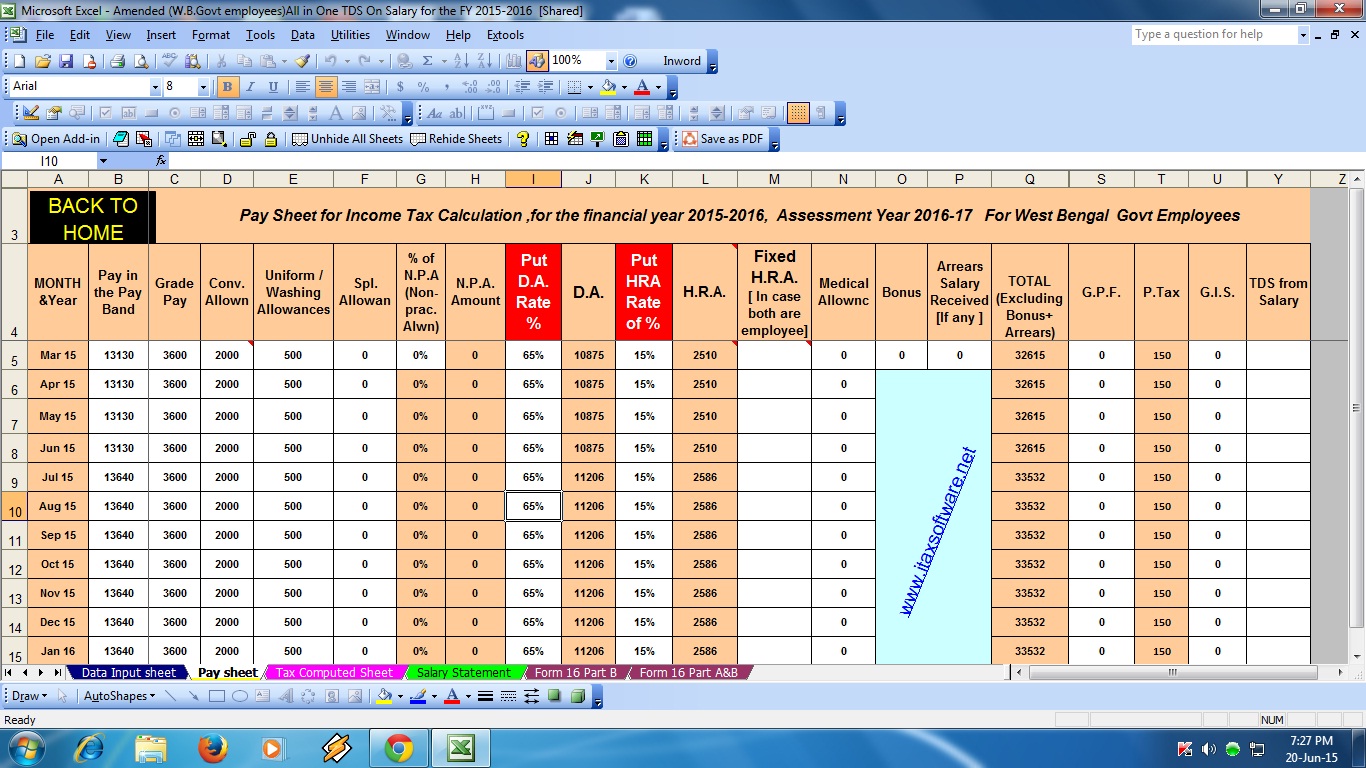 In the Finance Budget 2015 have some changes , but the Tax Slab is Same as previous Financial Year. The Major Changes is Raised the some Tax Section which is given below :-1 U/s 80 U :- Max Limit Rs. 75,000/- for General from 40% to 80% for Phy.Disable Person and Rs. 1,25000/- for more than 80%.2. U/s 10 Transport/Traveling Allowance :- Max Limit Rs. 1600 P.M. for general and Rs. 3200/- P.M. for Phy.Disable persons.3. U/s 80D Medical Health Insurance :- Max Limit Rs. 25,000/- for below 60 years age and Rs. 30,000/- for above 60 years age.4. U/s 80CCC Pension Scheme :- Max Limit Rs. 1,50,000/-5. U/s 80 DDB Sever Medical Treatment :- Max Limit Rs. 80,000/- instead of 40,000/-6. U/s 80C :- One New deduction has incorporate as Sukanya Samriddhi Account for minor girl child who's age below 10 Years, and Max Limit Rs. 1.5000/- 7. U/s 80TTA relief from Savings Bank Interest is also entitled in this financial year up to Rs. 10,000/- who's taxable Income below Rs. 5 Lakh. 8. U/s 87A :- Tax Rebate Rs. 2,000/- is also entitled in this financial year as before. Download All in One TDS on Salary for W.B.Govt employees for FY 2015-16 |


itaxsoftware.net
Salaried Employees are a relieved lot now after fulfilling all the formalities for Income Tax 2014-15. But, by that time six months in the new financial year 2015-16 is already over. So, preparation of statement for salary income, deductions and saving under various clauses of Income Tax Act in respect of Financial year 2015-16 is already due for submission to the employer. |
Tax Planning and submission of statement to that effect to the employer would be mainly useful to avoid additional deduction of Income Taxby the employer over and above income tax estimated by an individual on the basis of his / her savings or deductions. As per the Finance Budget 2015-16 the Income Tax Structure for the year 2015-16 (Assessment Year 2016-17) and also the Tax exemptions available to salaried class employees in the form of Exempt Income, Deductions and Savings. Download All in One TDS on Salary for Govt& Non-Govt employees for Financial Year 2015-16 [ This Excel Based Utility can prepare at a time Govt and Non-Govt employees Tax Compute Sheet + Individual Salary Structure + Individual Salary Sheet + Automated Arrears Relief Calculator with Form 10E + Automated HRA Exemption Calculation + Automated Form 16 Part A&B and Form 16 Part B ] |
Tax exemptions in the form of Exempt Income, Deductions and Savings |
1. Exempt Income and Allowances under Section 10 of Income Tax Act Income given below are exempt income and hence these need not included while calculating Total Income of a Salaried Employee |
|
|
|
Exemption under Section 10 (13A) in respect of HRA – Calculation Method: Least of the following amount is to be treated as exempt from Income Tax.
|
2. Savings which are eligible for Tax Exemption Section 80C, Section 80CCC and Section 80CCDSection 80C, CCC and CCD(1) allow deduction from total income. The total deduction under this section (alongwith section 80CCC and 80CCD(1) is limited to Rs. 1.50 lakh only. Section 80C: |
|
Section 80CCC: Deduction in respect of Premium Paid for Annuity Plan of LIC or Other Insurer. Payment of premium for annuity plan of LIC or any other insurer Deduction is available upto a maximum of Rs. 150,000/-. The premium must be deposited to keep in force a contract for an annuity plan of the LIC or any other insurer for receiving pension from the fund. Section 80CCD (1): Deduction in respect of Contribution to Pension Account (by Assessee). Deduction available for the amount paid or deposited in a pension scheme notified or as may be notified by the Central Government subject to a maximum of : (a) 10% of salary in the previous year in the case of an employee(b) 10% of gross total income in any other case. Section 80CCD(1A): The maximum deduction allowable under this section is Rs. 1.00 lakh. in case of contribution to New Pension Scheme (NPS), it is Rs. 1.50 lakh w.e.f. 01.04.2015 3. Additional Savings eligible for Tax Exemption up to Rs. 50,000/- under Section 80 CCD (1B)Section 80CCD(1B):Contribution in NPS has been given more tax concession in the budget 2015. As per Section 80CCD(1B), an additional deduction of up to Rs. 50,000 over and above the Section 80C, 80CCC and 80CCD savings cap of Rs. 1.5 lakh, is allowed if such amount is contributed by the employee. So, overall tax savings of Rs. 2 lakh can be availed under Section 80C, 80CCC and 80CCD(1). 4. Deduction in respect of Contribution to Pension Account by Employer under Section 80CCD (2):Deduction under Section 80CCD(2) is available for the amount paid or deposited by the employer of the assessee in a pension scheme notified or as may be notified by the Central Government subject to a maximum of 10% of salary in the financial year. This deduction is allowed over and above Savings value cap of Rs. 1.5 lakh under Section 80CCE (in the case of investment in NPS, savings value cap eligible for deduction will be Rs. 2 lakh). 5. Eligible deductions from Income from Section 80 D to 80 U towards amount spent on health insurance, medical treatment etc.Section 80D: Deduction in respect of Medical Insurance:Deduction is available upto Rs. 30,000/- for parents who are senior citizens and upto Rs. 25,000/- in other cases for insurance of self, spouse and dependent children. Amount of up to Rs.5000/- spent on preventive health check-up. So a maxium of Rs. 60,000 can be deducted which is spent towards Health Insurance premium. |
In the case of salaried employee who is taking care of physically challenged Dependent Relative, an amount with the maximum limit of Rs.75000/- spent towards medical treatment or rehabilitation can be deducted from the income (In the case of severe disability maximum deduction would be Rs. 1,25,000). |
Deduction in respect of specified disease for self or dependent relatives is deduction amount Rs.80,000 in case of senior citizen. |
Deduction in respect of interest on loan taken for pursuing higher education. The deduction is also available for the purpose of higher education of a relative. Notified donations under Sec. 80G will be eligible for deduction ( 100% or 50% as per the notification condition) Deduction available is the least of |
|
Section 80 TTA: Deduction from gross total income in respect of any Income by way of Interest on Savings account Maximum of Rs. 10,000/-, in respect of interest on deposits in savings account ( not time deposits ) with a bank, co-operative society or post office Deduction of Rs. 75,000/- in respect of tax payer suffering from a physical disability. In the case of severe disability, deduction of Rs. 125,000/- will be allowed. Certificate from the approved medical authorities regarding the extent of disability will have to be produced (Rule 11D) 6. Deductions Allowable under Section 24 of Income Tax Act in respect of interest on house property : |
Housing Property bought or constructed on or after 01.04.99 (completed within 3 years from a ailment of loan) and self occupied will be eligible for deduction of interest paid on housing loan with the maximum limit Rs. 2,00,000/-. In other cases deduction in respect of interest paid up to Rs.30,000 will be allowed. If the said house property is not self-occupied there is no limit in deduction in respect of interest paid on housing loan subject to inclusion of rental income in respect of the house property. And additional House Building Loan Interest can be relief U/s 80EE Max Rs.1 Lakh w.e.f. 1/4/2013 and onwards |
7. Relief Under Section 89(1) |
Relief u/s 89(1) is available to an employee when he receives salary in advance or in arrear or when in one financial year, he receives salary of more than 12 months, or receives ‘profit in lieu of salary’ covered u/s 17(3). Relief u/s 89(1) is also admissible on family pension, as the same has been allowed by Finance Act, 2002 (with retrospective effect from 1/4/96). [Click here to Download the AutomaticArrears Relief Calculator U/s 89(1) with Form 10E ] 8. Deduction U/s 87A:- Tax Rebate Rs. 2000/- who's Taxable Income less than 5 Lakhs. Sum up of Total Deduction Exemption for F.Y.2015-16 |
|


itaxsoftware.net
Itaxsoftware.net |
|
Posted: 28 Sep 2015 06:35 AM PDT Click here to Download the Automated Income Tax Preparation Excel based software for Govt and Non govt employees for FY 2015-16 ( Prepare at a time Income Tax Computed Sheet + Automatic House Rent Exemption Calculation +Automatic Arrears Relief Calculator + Form 16 Part B and Form 16 Part A&B with Salary Structure for Govt and Non Govt Salary for FY 2015-16)Under Section 80C :-As per the Income Tax Act and further amended Income Tax Department's time to time Notification and amended Section Under Section 80C is given below:- The total limit under this section is Rs 1.5 lakh. Included under this heading are many small savings schemes like NSC, PPF and other pension plans. Payment of life insurance premiums and Sukanya Samriddhi Account are also eligible for deduction under Section 80C Most of the Income Tax payee try to save tax by saving under Section 80C of the Income Tax Act. However, it is important to know the Section in toto so that one can make best use of the options available for exemption under income tax Act. One important point to note here is that one can not only save tax by undertaking the specified investments, but some expenditure which you normally incur can also give you the tax exemptions. Besides these investments, the payments towards the principal amount of your home loan are also eligible for an income deduction. Education expense of children is increasing by the day. Under this section, there is provision that makes payments towards the education fees for children eligible for an income deduction Sec 80C of the Income Tax Act is the section that deals with these tax breaks. It states that qualifying investments, up to a maximum of Rs. 1.5 Lakh, are deductible from your income. This means that your income gets reduced by this investment amount (up to Rs. 1.5 Lakh), and you end up paying no tax on it at all! 80 C Deduction at a glance as per Finance Budget 2015Provident Fund (PF) & Voluntary Provident Fund (VPF)and (PF) is automatically deducted from your salary. Both you and your employer contribute to it. While employer’s contribution is exempt from tax, your contribution (i.e., employee’s contribution) is counted towards section 80C investments. You also have the option to contribute additional amounts through voluntary contributions (VPF). Current rate of interest is 8.5% per annum (p.a.) and is tax-free. Public Provident Fund (PPF): Maximum Limit raised up to Rs. 1.5 Lakh Life Insurance Premiums: Any amount that you pay towards life insurance premium for yourself, your spouse or your children can also be included in Section 80C deduction. Please note that life insurance premium paid by you for your parents (father / mother / both) or your in-laws is not eligible for deduction under section 80C. If you are paying premium for more than one insurance policy, all the premiums can be included. It is not necessary to have the insurance policy from Life Insurance Corporation (LIC) – even insurance bought from private players can be considered here. Equity Linked Savings Scheme (ELSS): There are some mutual fund (MF) schemes specially created for offering you tax savings, and these are called Equity Linked Savings Scheme, or ELSS. The investments that you make in ELSS are eligible for deduction under Sec 80C. Home Loan Principal Repayment: The Equated Monthly Installment (EMI) that you pay every month to repay your home loan consists of two components – Principal and Interest.The principal component of the EMI qualifies for deduction under Sec 80C. Even the interest component can save you significant income tax – but that would be under Section 24 of the Income Tax Act. Please read “Income Tax (IT) Benefits of a Home Loan / Housing Loan / Mortgage”, which presents a full analysis of how you can save income tax through a home loan. Stamp Duty and Registration Charges for a home: The amount you pay as stamp duty when you buy a house, and the amount you pay for the registration of the documents of the house can be claimed as deduction under section 80C in the year of purchase of the house. National Savings Certificate (NSC): National Savings Certificate (NSC) is a 6-Yr small savings instrument eligible for section 80C tax benefit. Rate of interest is eight per cent compounded half-yearly, i.e., the effective annual rate of interest is 8.16%. If you invest Rs 1,000, it becomes Rs 1601 after six years. The interest accrued every year is liable to tax (i.e., to be included in your taxable income) but the interest is also deemed to be reinvested and thus eligible for section 80C deduction. Pension Funds – Section 80CCC: This section – Sec 80CCC – stipulates that an investment in pension funds is eligible for deduction from your income. Section 80CCC investment limit is clubbed with the limit of Section 80C – it maeans that the total deduction available for 80CCC and 80C is Rs. 1.5 Lakh.This also means that your investment in pension funds upto Rs. 1.5 Lakh can be claimed as deduction u/s 80CCC. However, as mentioned earlier, the total deduction u/s 80C and 80CCC can not exceed Rs. 1.5 Lakh. 5-Yr bank fixed deposits (FDs): Tax-saving fixed deposits (FDs) of scheduled banks with tenure of 5 years are also entitled for section 80C deduction. Senior Citizen Savings Scheme 2004 (SCSS): A recent addition to section 80C list, Senior Citizen Savings Scheme (SCSS) is the most lucrative scheme among all the small savings schemes but is meant only for senior citizens. Current rate of interest is 9% per annum payable quarterly. Please note that the interest is payable quarterly instead of compounded quarterly. Thus, unclaimed interest on these deposits won’t earn any further interest. Interest income is chargeable to tax. 5-Yr post office time deposit (POTD) scheme: POTDs are similar to bank fixed deposits. Although available for varying time duration like one year, two year, three year and five year, only 5-Yr post-office time deposit (POTD) – which currently offers 7.5 per cent rate of interest –qualifies for tax saving under section 80C. Effective rate works out to be 7.71% per annum (p.a.) as the rate of interest is compounded quarterly but paid annually. The Interest is entirely taxable. Sukanya Samriddhi Account :- Newly introduce in the Budget 2015 for Minor Girl Child below 10 Years. Children Education Fees :- children’s education expense (for which you need receipts), that can be claimed as deductions under Sec 80C max Rs. 1,50,000/- p.a. |


itaxsoftware.net
Itaxsoftware.net |
|
Posted: 29 Sep 2015 07:09 AM PDT The Central Finance Budget 2015 has made following changes relating to determination of Income Tax payable by Salaried Employees, which provide income tax exemption. 1. Taxable Income eligible for full exemption from income tax Rs. 2.5 lakh same as previous Financial Year, there have no any changed. 2. Tax Rebate Rs. 2,000/- U/s 87A is entitled in this Financial Year 2015-16 as well it will be continued this Financial Year. 3. Include Addition Deduction U/s 80C as Sukanya Samriddhi Account , Max Rs.1.5 Lakh Click to Download Central Govt employees All in One TDS on Salary with automated Form 16 for FY 2015-16 (Ass Year 2016-17)[ This Excel utility can prepare at a time Tax Compute sheet + Individual Salary Sheet + Automatic HRA Calculation + Automated Form 16 Part A&B and Part B for FY 205-16]Snapshot of Salary Structure of Central Govt Employees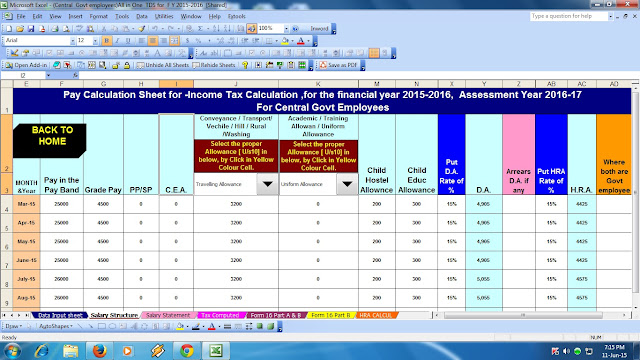 Click to Download all State Govt employees All in One TDS on Salary with automated Form 16 for FY 2015-16 (Ass Year 2016-17)[This Excel Based Utility can prepare at a time your Tax Compute Sheet + Individual Salary Sheet +Automatic HRA Exemption Calculation + Automatic Form 16 Part A&B and Part B for FY 2015-16] Snapshot of Salary Structure of State Govt Employees 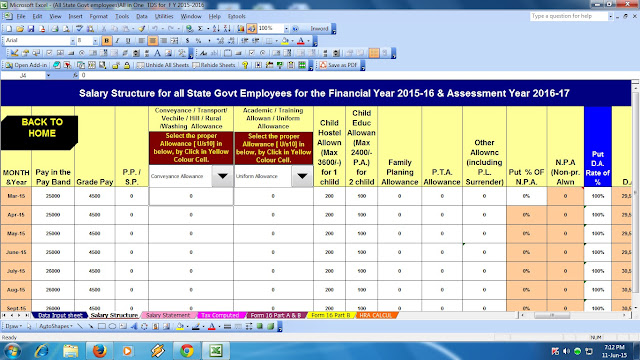 The Main Changes in income tax exemptions applicable for the year 2015-16 is as follows:-Transport Allowance:Transport Allowance granted to an employee to meet expenditure for the purpose of commuting between the place of residence and place of duty. Income Tax Exemption on Transport Allowance is Raised Rs1600/- per month for general and Rs.3200/- P.M. for Phi. Disable persons. Section 80C:The total deduction under this section (along with section 80CCC and 80CCD) is limited to Rs. 1.50 lakh. Some investments, savings, expenditure etc covered under Section 80 C |
Section 80CCD (1): Deduction in respect of Contribution to Pension Account (by Assessee) |
Deduction available for the amount paid or deposited in a pension scheme notified or as may be notified by the Central Government subject to a maximum of : (a) 10% of salary in the previous year in the case of an employee (b) 10% of gross total income in any other case. |
Section 80CCD (2): Deduction in respect of Contribution to Pension Account (by Employer}Deduction available for the amount paid or deposited by the employer of the assessee in a pension scheme notified or as may be notified by the Central Government subject to a maximum of 10% of salary in the financial year. This exemption is in addition to Rs. 1.5 lakh limit provided under Section 80 CCE for deductions under Section 80 C, CCC, and 80CCD(1) Deductions under Chapter VIA of Income Tax Act [ Click here to view all deduction under Chapter VIA updated]Section 80CCG: Rajiv Gandhi Equity Saving Scheme (RGESS)As per the Budget 2012 announcements, a new scheme Rajiv Gandhi Equity Saving Scheme (RGESS) will be launched. Those investors whose annual income is less than Rs. 10 lakh (proposed Rs. 12 lakh from A.Y. 2014-15) can invest in this scheme up to Rs. 50,000 and get adeduction of 50% of the investment. So if you invest Rs. 50,000 (maximum amount eligible forincome tax rebate is Rs. 50,000), you can claim a tax deduction of Rs. 25,000 (50% of Rs. 50,000). |
Section 80D: Deduction in respect of Medical Insurance |
Deduction is available up to Rs. 30,000/- for senior citizens and up to Rs. 25,000/ in other cases for insurance of self, spouse and dependent children. Additionally, a deduction for insurance of parents (father or mother or both) is available to the extent of Rs. 30,000/- if parents are senior Citizen and Rs. 25,000/- in other cases. Therefore, the maximum deduction available under this section is to the extent of Rs. 55,000/-. From AY 2016-17. Section 80DDB: Deduction in respect of Medical Expenditure on Self or Dependent RelativeA deduction to the extent of Rs. 80,000/- or the amount actually paid, whichever is less is available for expenditure actually incurred by resident assessee on himself or dependent relative for medical treatment of specified disease or ailment. The diseases have been specified in Rule 11DD. A certificate in form 10 I is to be furnished by the assessee from any Registered Doctor. |
Section 80 TTA: Deduction from gross total income in respect of any Income by way of Interest on Savings account |
Deduction from gross total income of an individual or HUF, upto a maximum of Rs. 10,000/-, in respect of interest on deposits in savings account ( not time deposits ) with a bank, co-operative society or post office, is allowable (Assessment Year 2016-17). Section 80U: Deduction limit has raised in respect of Person suffering from Physical DisabilityDeduction of Rs.75,000/- to an individual who suffers from a physical disability(including blindness) or mental retardation. Further, if the individual is a person with severe disability, deduction of Rs. 125,000/- shall be available u/s 80U. Certificate should be obtained from a Govt. Doctor. The relevant rule is Rule 11D. |


itaxsoftware.net
Itaxsoftware.net |
|
Posted: 30 Sep 2015 07:01 AM PDT Download Form 16 from the below link :-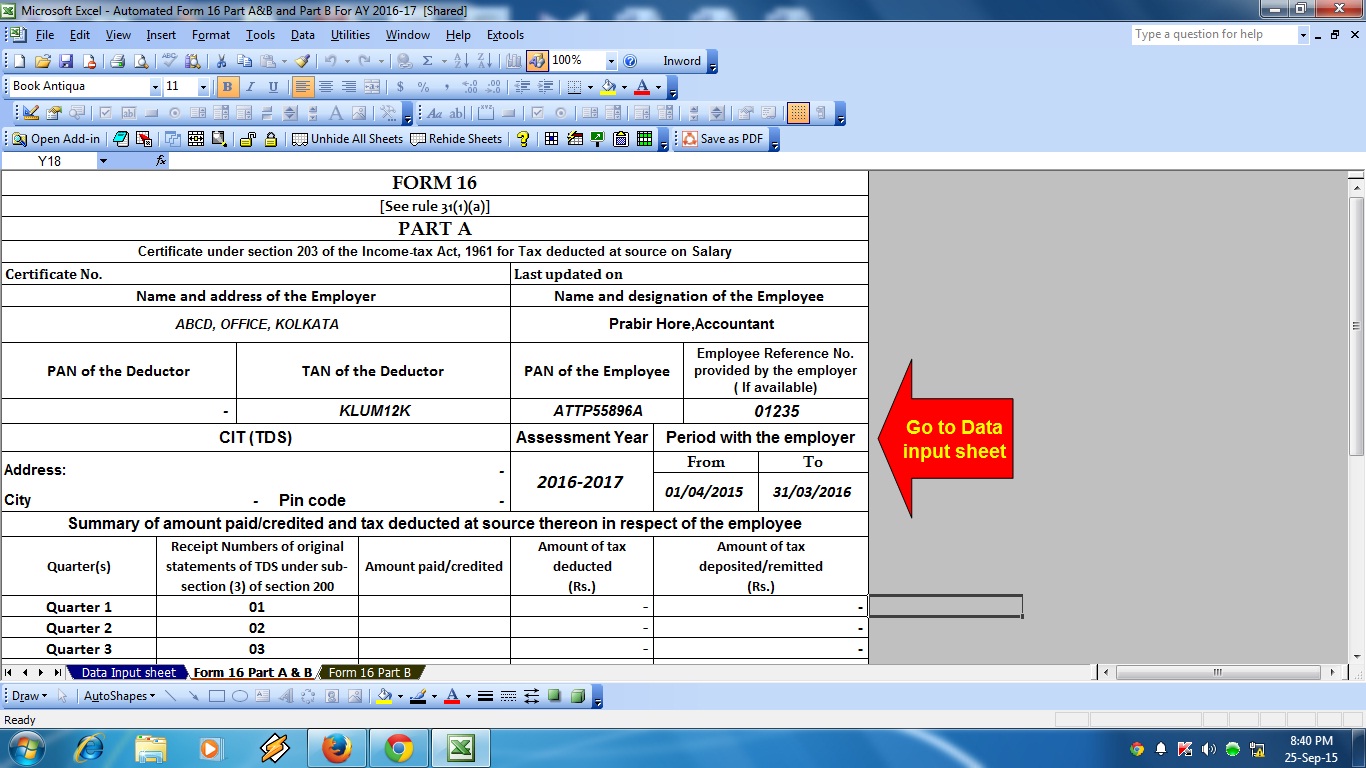 Form 16 Part A&B for F.Y. | Download Automated Income Tax Form 16 Part A and B -and Part B for Financial Year 2015-16 [ This Excel Utility can prepare One by One Form 16 Part A&B and Part B for Assessment Year 2016-17]
This seems to be a dilemma for most tax payers. When pays rent, under the Income tax act, he is definitely allowed to claim both HRA and home loan benefits (interest payment and principal repayment). Many queries about Home loan, HRA and Tax Benefits, Let us try to evaluate various possible situations an individual can find himself in and understand what the income tax act permits him to do. Situation 1: You live in your own house purchased via Home loanYou have taken a home loan and residing in the house purchased with it. Since you are residing in your own house, you will not be able to claim HRA. However, you will be able to claim tax benefits on both, the principal and interest repaid on the home loan. Situation 2: You own a house in another cityThis situation was the one faced by Suresh. He resided in Mumbai but had bought an apartment in Ahmedabad taking a home loan. Suresh will be entitled to HRA exemption and tax benefits on both, the principal and interest repaid on the home loan. Situation 3: Your house cannot be occupied at this pointYou have bought a house in same city of your work by taking a home loan and you’re currently living in same city in a rented apartment because the house is under construction. In such a case, you are eligible to claim HRA. In such case you can take partial tax benefit on the home loan, you can claim tax benefits only for your principal before the completion of your house. Once your house is completed, you can claim tax benefits on the total interest paid up. [Download House Rent Exemption Calculator U/s 10(13A)]
Situation 4: You have a house but you cannot reside in itYou have bought a house in Surat taking a home loan and now you aren’t residing in it but are living in a rented apartment in Surat itself for genuine reasons e.g. the house that you have bought is far away from your office. In such cases, the Income tax act permits the individual to claim HRA and home loan benefits which includes both principal and interest repaid on the home loan. Also, please note that if your house remains vacant, then you will still need to pay tax on a notional rent income. Situation 5: You have rented your own house and currently residing in a rented houseYou took a home loan and your house is now ready for occupation. You have rented the same out while you reside in a rented house. The Income tax act allows you to claim both HRA and home loan benefits. However, in such a case, since you are the recipient of rent because you have let out your own house, that income is taxable at your hands. The Income Tax Act treats HRA and home loan deductions under separate sections independently. The two are not interconnected to each other. HRA is dealt with in section 10(13A) Rule 2A while home loans are entitled for tax benefits under section 80C (tax benefit on principal repayment) and Section 24 (tax benefit on interest payment) of the Income Tax Act. Hence, feel free to avail both tax benefits accordingly. |
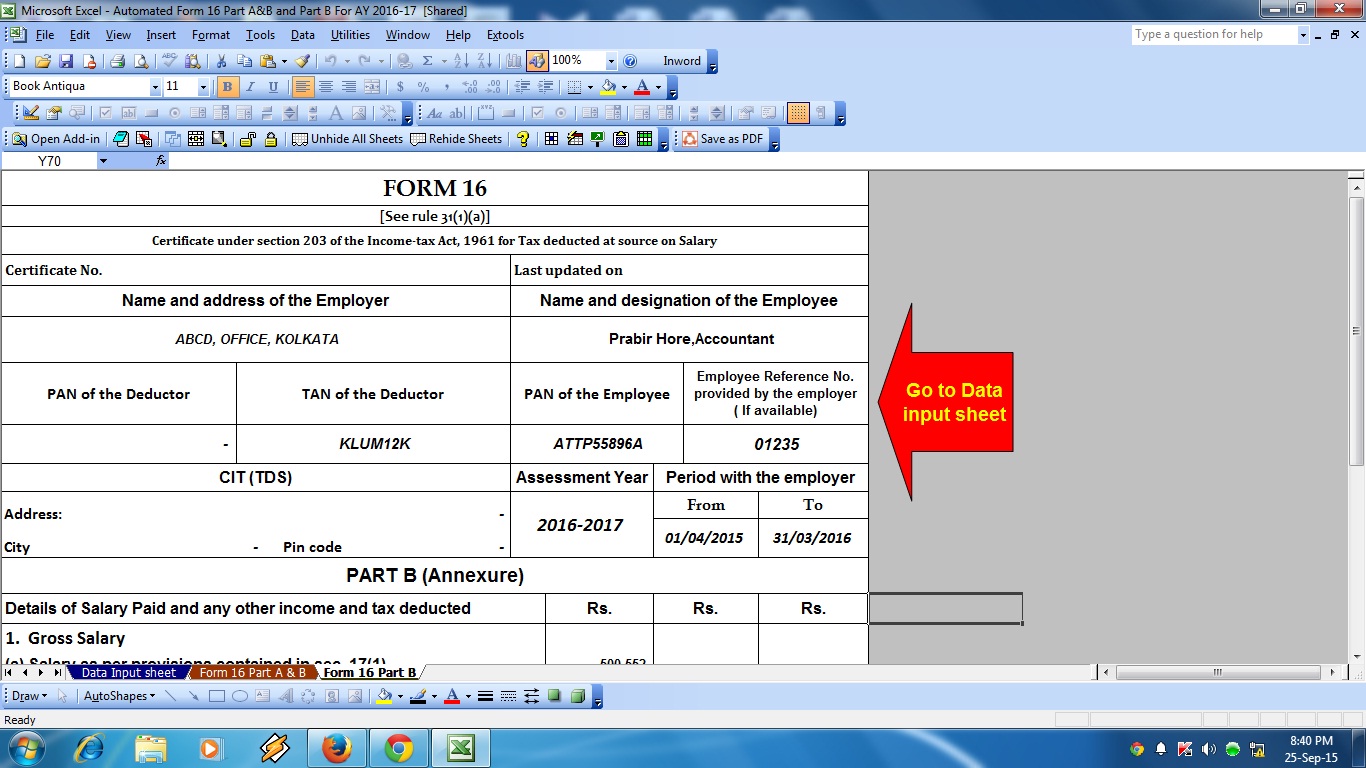
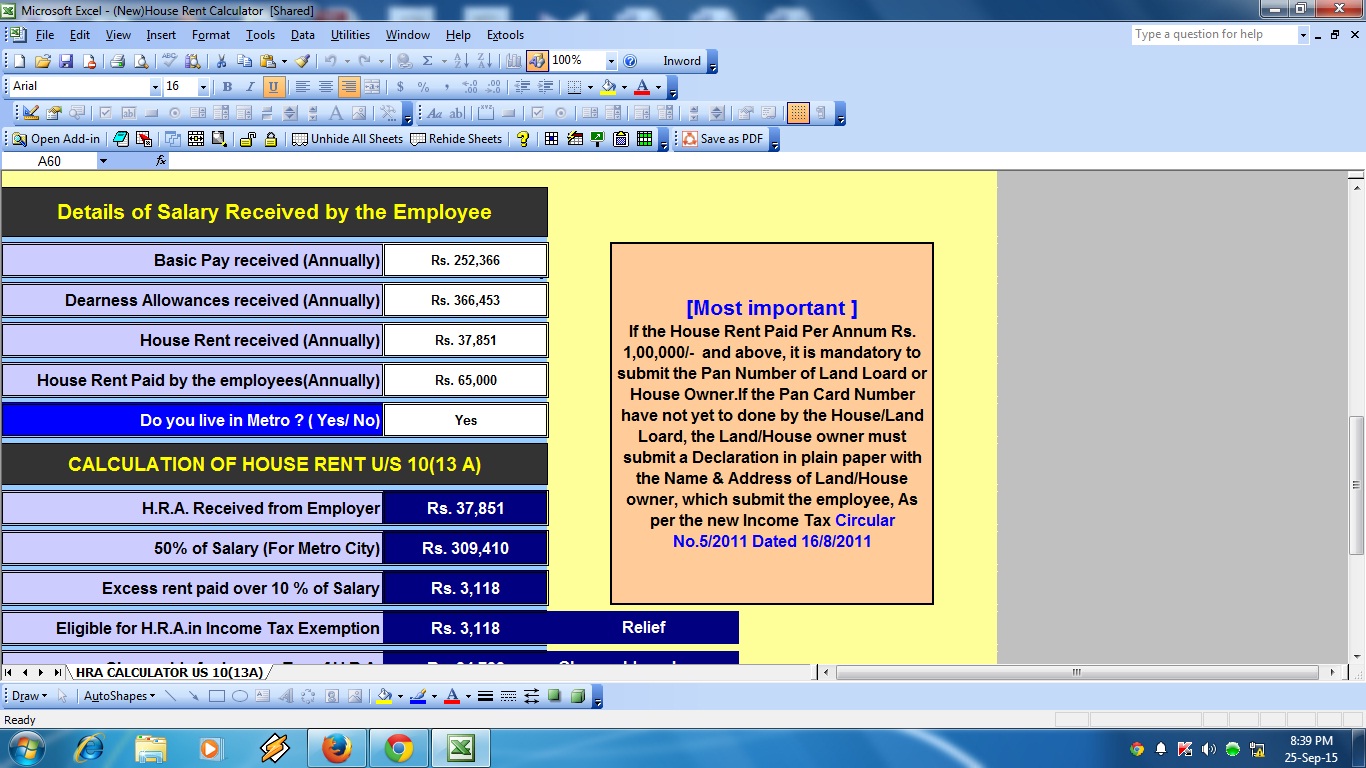


itaxsoftware.net
Itaxsoftware.net |
|
Posted: 01 Oct 2015 07:23 AM PDT As per the Finance Budget 2015-16 as a growth oriented one with due attention to common and poor in India, there were not much changes as far as Income Tax 2015-16 in respect of salaried employees are concerned. Personal Income Tax Rates were untouched and as a result Salaried Class will have to pay same Income Tax that they paid last year.
Download All in One Income Tax preparation Excel Based Software for Govt and Non-Govt Employees for F.Y. 2015-16 [ This Excel Utility can prepare at a time Tax Compute Sheet + Individual Salary Structure + Individual Salary Sheet + Automatic Arrears Relief Calculator with Form 10E + Automatic HRA Exemption Calculation + Form 16 Part A&B and Form 16 Part B for F.Y.2015-16] However, following changes have been effected with regard to deductions / exemption allowed from total income of Salaried Employees under various Sections Income Tax Act by which quantum of Income Tax payable the financial year 2015-16 may get reduced if an employee is eligible for such deduction / exemption. Sukanaya Samriddhi Scheme made eligible for deduction under Section 80CIndividuals who are subjected to Personal Income Tax Provisions can now save Sukanaya Samriddhi Scheme, a newly started savings scheme with a view to encourage savings in the name of girl child’s education and marriage, for the purpose of claiming deduction under Section 80C max. Rs. 1.5 Lakh. |
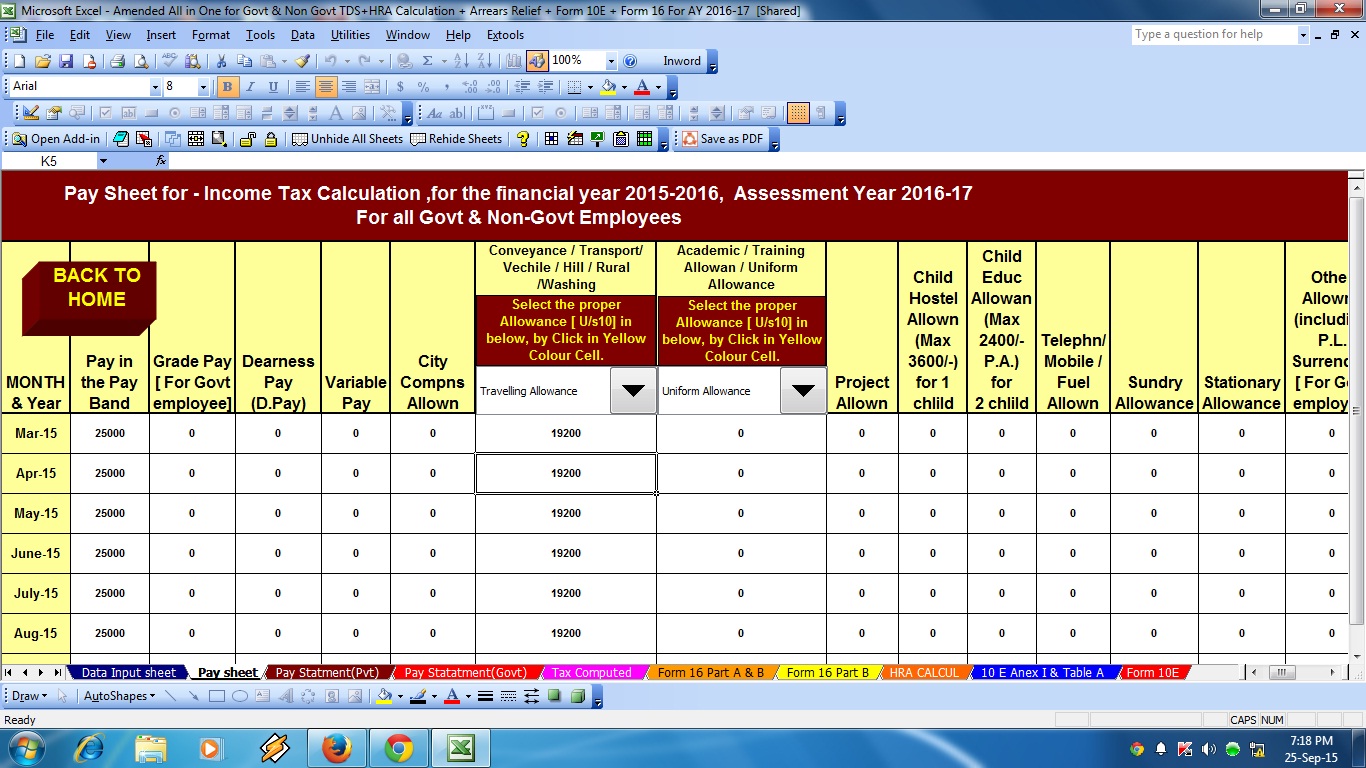
Additional Income Tax Exemption in respect of Health Insurance Premium under Section 80 D: |
Medical expenditure is getting increased day by day and however awareness towards Health Insurance is very minimal in India. In order to make Health Insurance Schemes more attractive and to cover entire health insurance premium paid by an employee for the purpose of deduction under Section 80 D, limits of Health Insurance Premium for covering individual and a senior citizen for the purpose of Income Tax Exemption have been increased to Rs. 25,000 and Rs. 30,000 respectively. |
Moreover, as far as very senior citizens (aged 80 years or more) are concerned any payment made on account of medical expenditure up to Rs. 30,000 would be eligible for deduction under Section 80D. More Deduction under Section 80DD for very senior citizens (increased from Rs. 50,000 to Rs. 80,000)While an individual is eligible to deduct up Rs. 50,000 which was spent towards medical expenditure under Section 80DD, budget 2015 has brought out an additional provision under this section to allow deduction of Rs. 80,000 for very senior citizens. The condition of producing certificate from a medical doctor under Section 80DDB has been relaxed and it is enough the tax payer produces a prescription from a specialist doctor. Additional Income Tax Exemption for Persons with disability under Section 80U: |
In view of the rising cost of medical care and special needs of a disabled person, it is amend section 80DD and section 80U so as to raise the limit of deduction in respect of a person with a disability to Rs. 75,000. It is also raised the limit of deduction in respect of a person with severe disability from Rs. 1 lakh to Rs. 1.25 lakhs. |
Limit under Section 80CCD and Section 80CCC for contribution in NPS and other pension funds raisedWith an agenda to promote social security measures and to bring the existing provision in line with the recently increased overall limit of Rs. 150,000, the deduction for contribution to certain pension funds under section 80CCC has been increased to Rs. 150,000 from present Rs. 100,000. Also, an additional deduction under section 80CCD to the extent of Rs. 50,000 has been introduced for contributions under the National Pension Scheme. |
Deduction towards Transport Allowance increased to Rs. 1600/- P.M. & 3200/- P.M.The long due increment in the monthly travel allowance has now finally materialized. In order to commensurate with the increased costs of transportation, it is now proposed to be double the original transport allowance and it shall stand at Rs. 1,600 per month & Rs.3200/- P.M. for above 80%
Download Income Tax Preparation Excel Based Software for Central Govt Employees for the Financial Year 2015-16 [ This Excel Utility can prepare at a time Tax computed Sheet + Individual Salary Structure + Automatic House Rent Exemption Calculation + Automated Form 16 Part A&B and Form 16 Part B for F.Y.2015-16] |
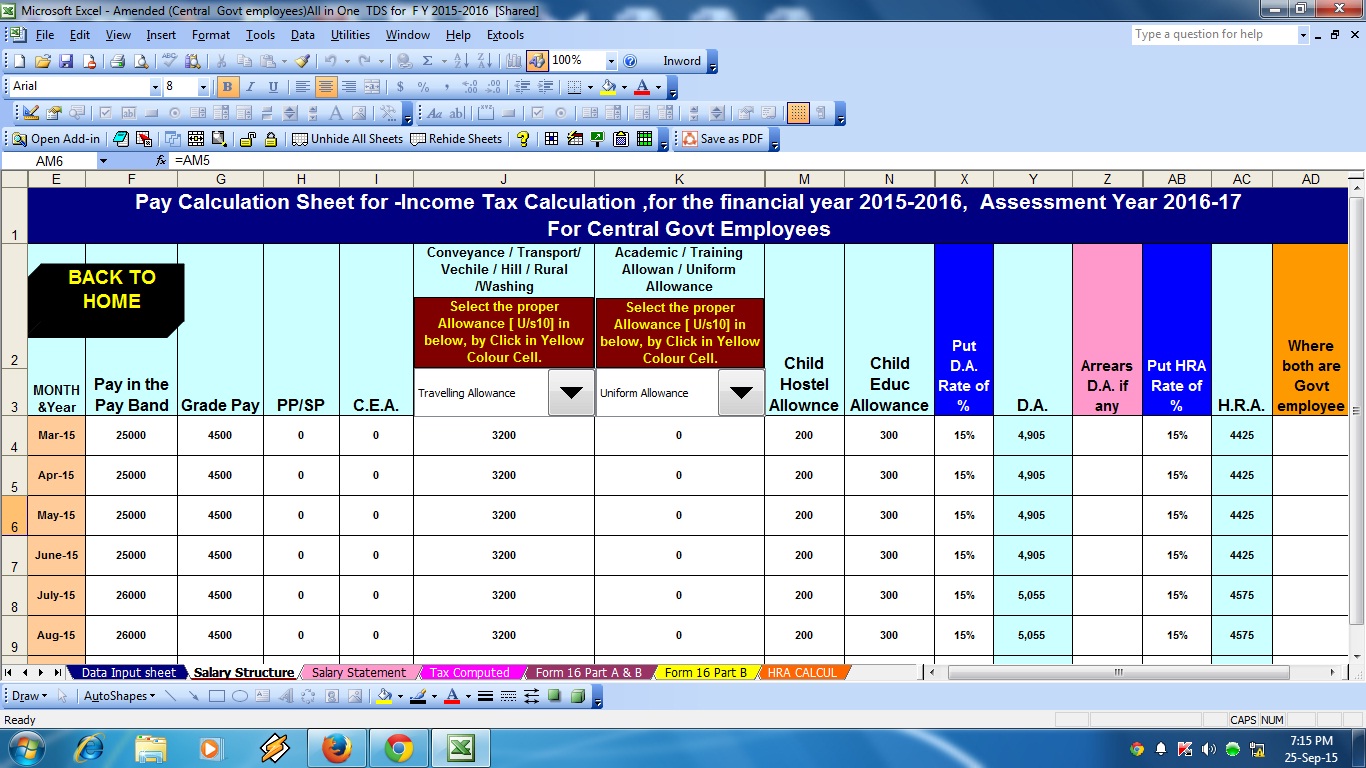


itaxsoftware.net
Itaxsoftware.net |
|
Free download Number to In-Word Converter in Excel with Excel Based Software Posted: 02 Oct 2015 08:10 AM PDT |
Free download Amount to in word Converter in Excel ToolsMost of Professional mainly in Accounts related persons and who are working in Computer mainly used in Excel, they have need this Excel Tools, which can easily Convert the Amount to In Words automatically. This Excel Tolls mainly valuable for those, who are working in Accounts and where frequently need the Amount to in word manually typing in Computer. Hope this Utility can help and reduce the time and errors of spelling of in word typing. For Download the Same first you should Register in My Blog where you can easily received Free update Excel Utility which are all Accounts Related and Income Tax Related Excel Based Utility. Also you can get this type of Excel Tools through mail delivery system by Feed Burner. |
After Registering this Blog you can get the Pass Word for Download this Excel Tools through Mail. |
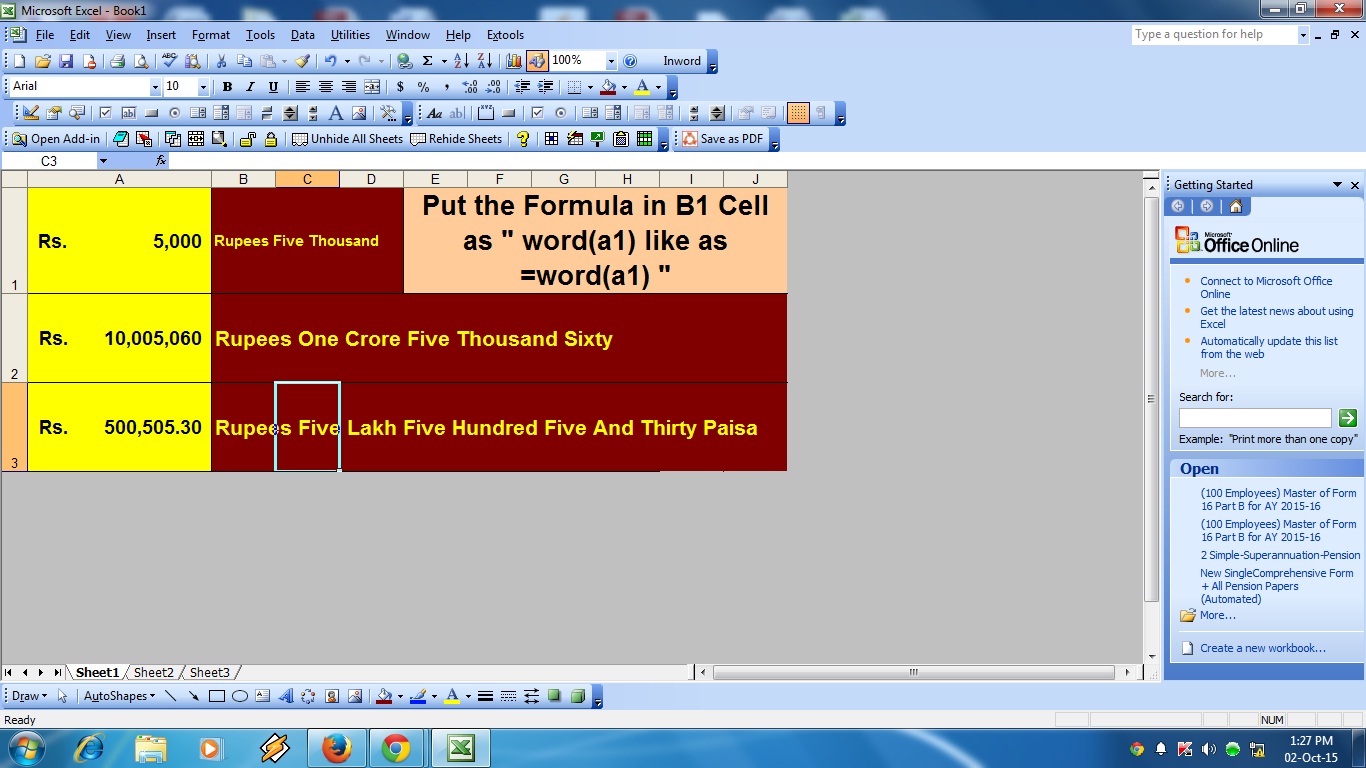 |
Instruction for install this Utility is given below :- Register for get this Excel toolls "Amount to in words" You can use this Excel Tools for 2003 & 2007 & 2010 Users Instruction for install1. save it in a Folder permanently.(do not change the location of file after installation) |
2. Now open excel Go to Tools>add in >browse (browse the file where you have stored the downloaded the file and select the file>ok. [ For 2003 Users] For 2007 & 2010 Users - Go to File>Open>Excel Option>Add-ins>Manage Excel Add-in>Go>Browse where you have stored the downloaded file and select the file>OK Form 2010 Users - Same as 2007. |
Also you should first enable Analyses toolpak before install this tools. |
then press ok ,that's all |
Just type the Formula in below given in formula bar=word(Cell No) (cell number in which figure are given)It will be done |


itaxsoftware.net
Itaxsoftware.net |
|
Posted: 03 Oct 2015 06:04 PM PDT Download Govt and Non Govt employees Automatic Tax Computed sheet + HRA Calculation+Arrears Relief Calculation+Form 16 Part B + Form 16 Part A&B for the Financial Year 2015-16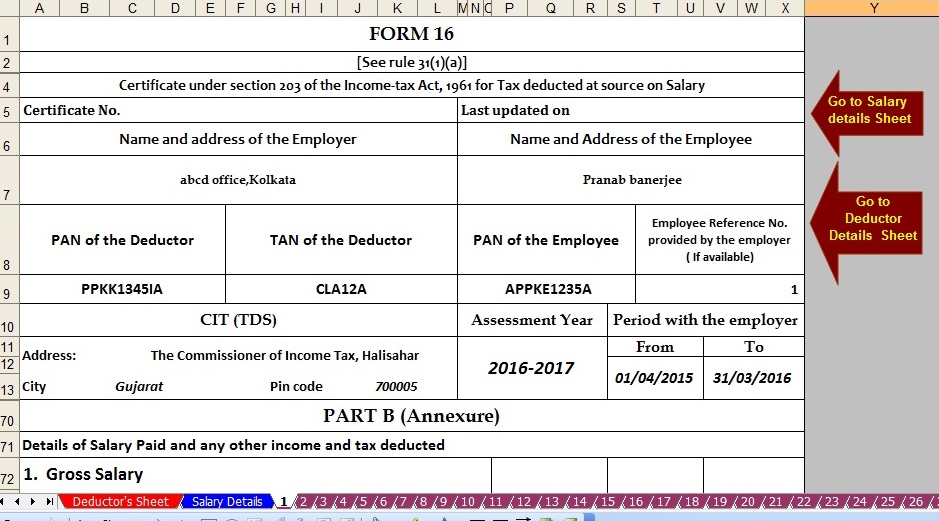 Free download Automatic HRA Exemption Calculator with Brief of SectionUnder section 10(13A) of the Act, any special allowance specifically granted to an assessee by his employer to meet expenditure incurred on payment of rent (by whatever name called) in respect of residential accommodation occupied by the assessee is exempt from Income-tax to the extent as may be prescribed, having regard to the area or place in which such accommodation is situated and other relevant considerations. According to Rule 2A of the Rules, the quantum of exemption allowable on account of grant of special allowance to meet expenditure on payment of rent shall be the least of the following: (a) The actual amount of such allowance received by the assessee in respect of therelevant period i. e. the period during which the accommodation was occupied by the assesse during the financial year; or (b) The actual expenditure incurred in payment of rent in excess of 1/10 of the salary due for the relevant period; or (i) Where such accommodation is situated in Bombay, Calcutta, Delhi or Madras, 50% of the salary due to the employee for the relevant period; or (ii) Where such accommodation is situated in any other places, 40% of the salary due to the employee for the relevant period, For this purpose, "Salary" includes dearness allowance, if the terms of employment so provide,but excludes all other allowances and perquisites. It has to be noted that only the expenditure actually incurred on payment of rent in respect of residential accommodation occupied by the assessee subject to the limits laid down in Rule 2A, qualifies for exemption from income-tax. Thus, house rent allowance granted to an employee who is residing in a house/flat owned by him isnot exempt from income-tax. The disbursing authorities should satisfy themselves in this regard by insisting on productionof evidence of actual payment of rent before excluding the House Rent Allowance or any portion thereof from the total income of the employee. Though incurring actual expenditure on payment of rent is a pre-requisite for claiming deduction under section 10(13A), it has been decided as an administrative measure that salaried employees drawing house rent allowance upto Rs.3000/- per month will be exempted from production of rent receipt. It may, however, be noted that this concession is only for the purpose of tax-deduction at source, and, in the regular assessment of the employee, the Assessing Officer will be free to make such enquiry as he deems fit for the purpose of satisfying himself that the employee has incurred actual expenditure on payment of rent. Further if annual rent paid by the employee exceeds Rs 1,00,000 per annum, it is mandatory for the employee to report PAN of the landlord to the employer. In case the landlord does not have a PAN, a declaration to this effect from the landlord along with the name and address of the landlord should be filed by the employee. |


itaxsoftware.net
Itaxsoftware.net |
|
Posted: 04 Oct 2015 06:10 AM PDT As per the CBDT notification, the Form 16 is now two parts, One Part A and other is Part B. Form 16 Part A is mandatory to download from the TRACES Portal and the Form 16 Part B must be prepare by the Employer/Deductor. The Part A easy to download from the www.tdscpc.gov.in in this Part A have the details of Tax Deduction and Deposited in to the Central Govt Quarterly or Annually. But the Form 16 Part B have the details of employees salary and deduction as per the Income Tax Rules. Now it is necessary to prepare the Form 16 Part B or Part A & B both ( Who are not able to download the Form 16 Part A from the Traces Portal ) by the employer. If you have to prepare advance the Form 16 for the Financial Year 2015-16 which will be needs to the end of the Financial Year 2015-16 i.e. March 2016. As end of the Financial Year 2015-16 will be knocking the door and it is mandatory to prepare and distribute to the employees within 31st March 2016. If your concerned have more than 40 employees, you may ready to prepare the Form 16 Part B for the Financial Year 2015-16. Various Concerned have different type of Allowances and Benefits, some benefits may effect & get the Tax Relief from the Income Tax. Below given a Excel Based handy software which can prepare at a time 50 employees Form 16 Part B and Form 16 Part A&B for the Financial Year 2015-16. In this Utility have all the Tax Deduction Section and the latest Income Tax Slab and New Section as per the Finance Budget 2015-16. This Excel Based Software can reduce your time for preparing the Form 16 Part B and this Form 16 is prepare as per the latest format of Form 16 and also you can treat this as a Income Tax Calculator for F.Y.2015-16 and save the same in your System. Click here to Download Master of Form 16 Part B for F.Y.2015-16 & Ass Year 2016-17 ( This Utility can prepare at a time 50 employees Form 16 Part B for F.Y. 2015-16) Snapshot of Master Data Input Sheet 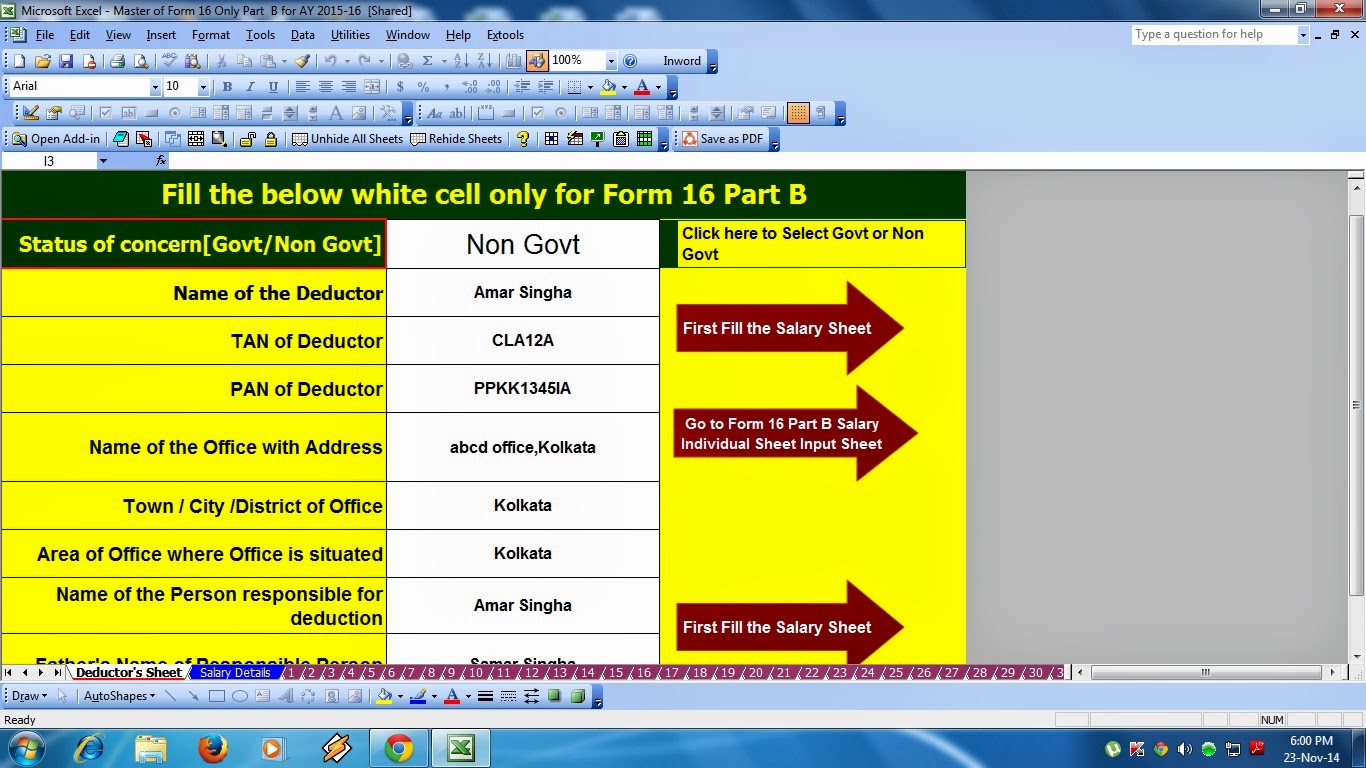 Tax Deduction Sheet 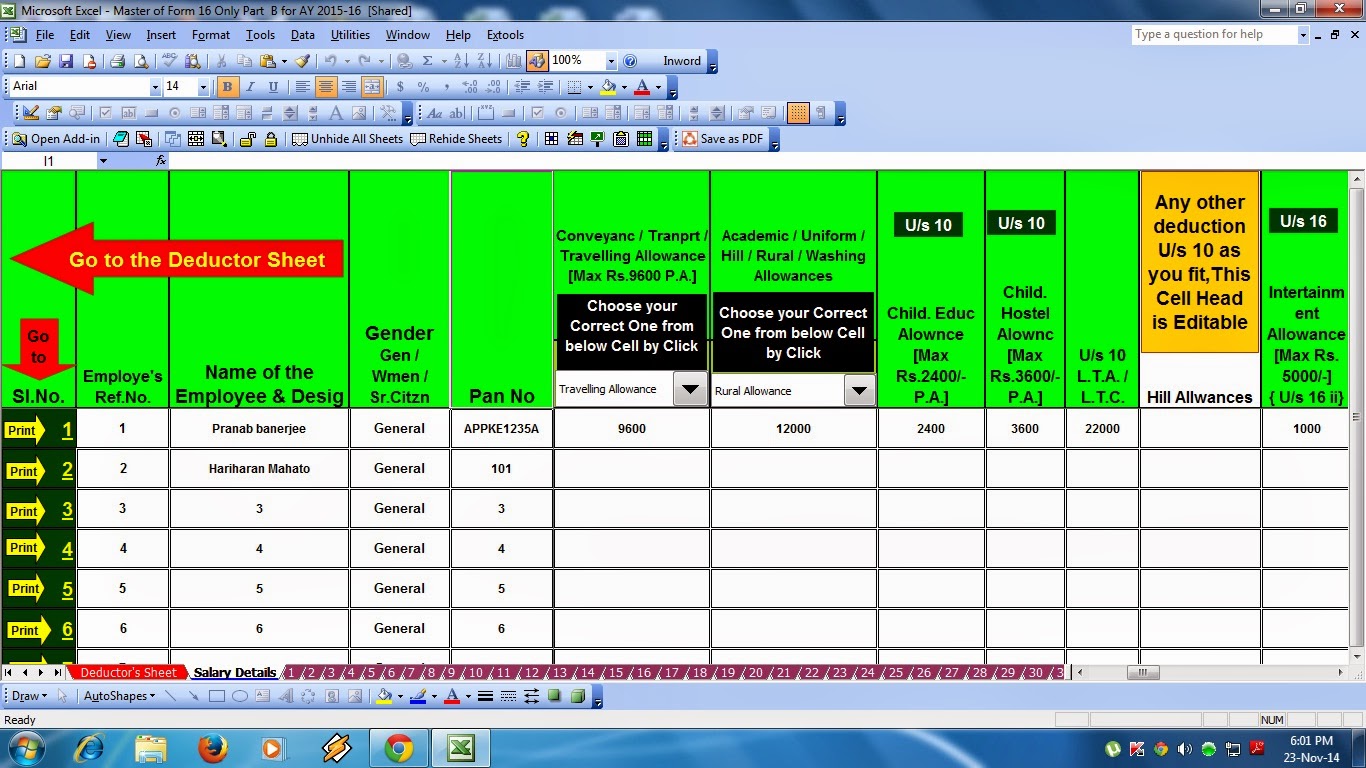 Snapshot of Amended Form 16 Part B 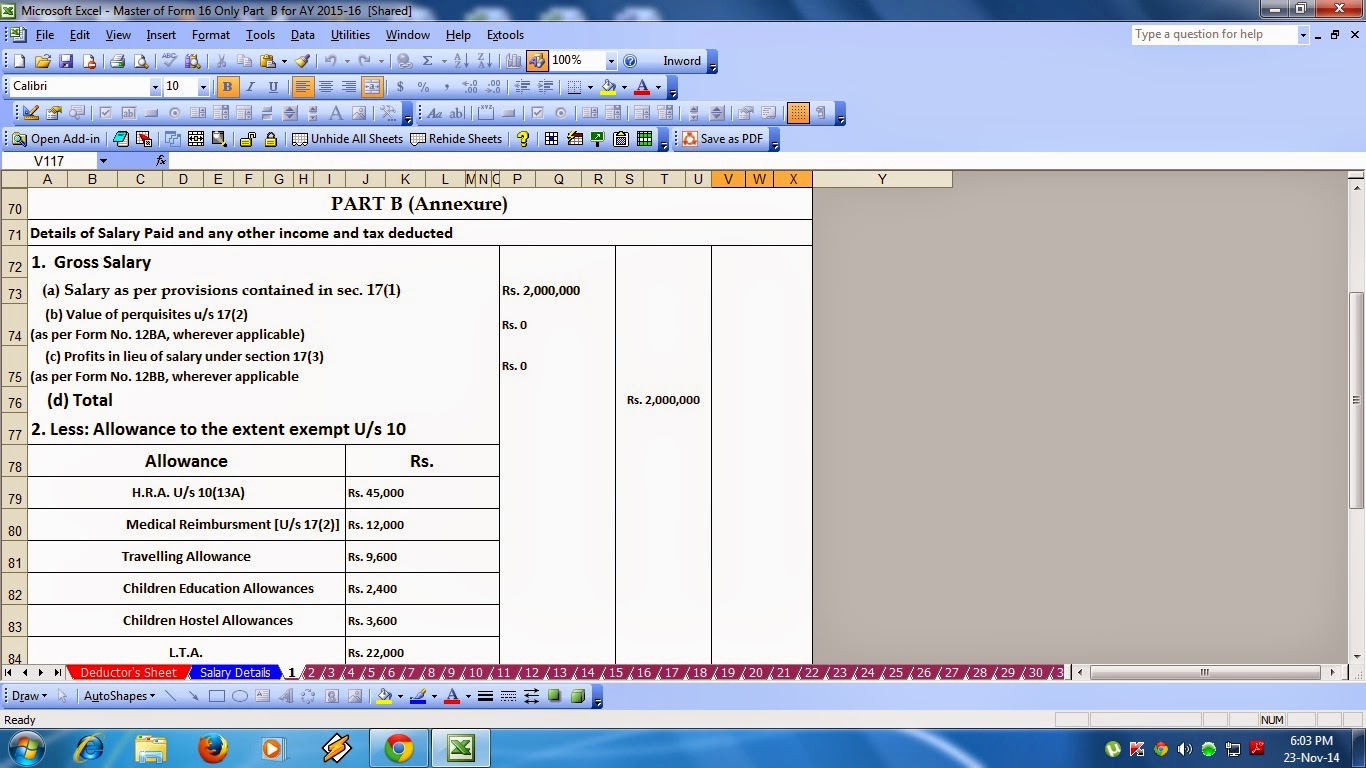 Click here to download Master of Form 16 Part A&B for F.Y.2015-16 & Assessment Year 2016-17 ( This Excel Utility can prepare at a time 50 employees Form 16 Part A&B for FY 2015-16) |


itaxsoftware.net
Itaxsoftware.net |
|
Posted: 05 Oct 2015 07:01 AM PDT The Central Finance Budget has already passed by the Parliament for the Financial Year 2015-16 and the Income Tax Slab Raised from the Previous Financial Year, and also some changes have made in this Finance Budge, The Section 87A will be continue and U/s 80 TTA (the Savings Bank Interest also entitled in this Financial Year 2014-15), K.V.P. has introduce , P.P.F. Limit has increase up to Rs. 1,50,000/- & Pension Fund U/S 80CC Max Rs.1.5 Lakh. For below 60 years Age Salaried Persons can get the maximum Tax Relief up to Rs. 2,50,000/- and the Section 80C has also sane as to Rs. 1,50,000/- The below given Excel based Software which can prepare at a time Income Tax Computed Sheet + Automatic House Rent Exemption calculation + In built Salary Structure for Non Govt employees which can prepared on the basis of Salary Pattern of each Non Govt concerned + Automated Form 16 Part A&B + Automated Form 16 Part B for the Financial Year 2015-16 and Assessment Year 2016-17. Click here to Download the Automated All in One TDS on Salary for Non-Govt employees for the Financial Year 2015-16 and Assessment Year 2016-17 ( This Excel Based Utility Can prepare at a time Income Tax Calculation Sheet + Individual Salary Sheet + Automatic HRA Calculation + Form 16 Part A&B and Form 16 Part B + Form 12 BA Only for Non Govt employees)
It is most hazard to calculate individually HRA Calculation separately a another sheet. This Excel Utility can prepare all the calculation just a moment. Thus your time may reduce for calculating the actual Income Tax of each employee. This Excel Based Software Can prepare more than 500 employees Tax Computed One by One. Feature of this Utility:- · Automatic Calculate Income Tax with Tax Computed sheet individually · Individual Salary Structure for calculating the Gross Salary Income· Salary Structure have prepare on the Basis of Non Govt Salary Pattern· Automatic Calculate the House Rent Exemption Calculation U/s 10(13A)· Automated Form 16 Part A&B· Automated Form 16 Part B· Automatic Convert the Amount in to In Words
|
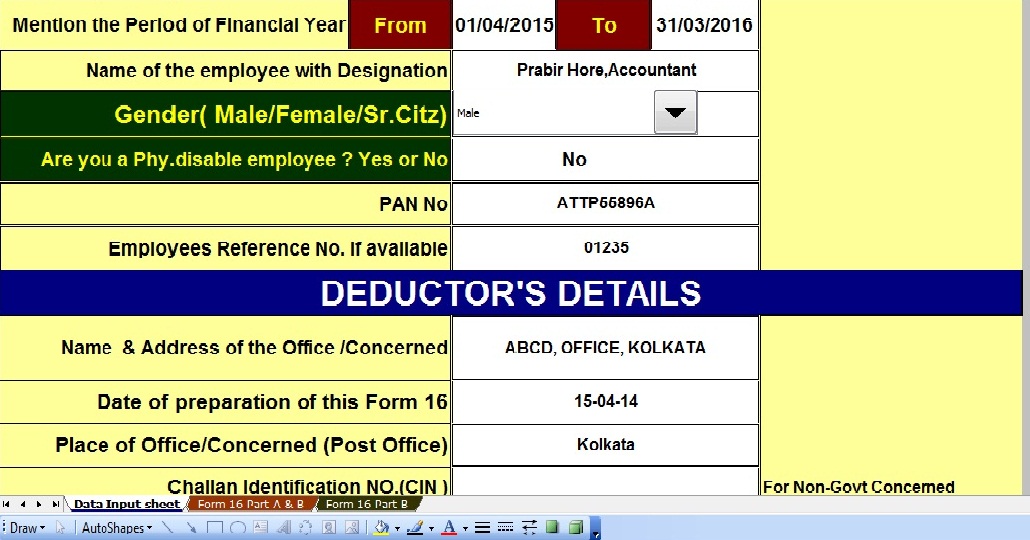
|
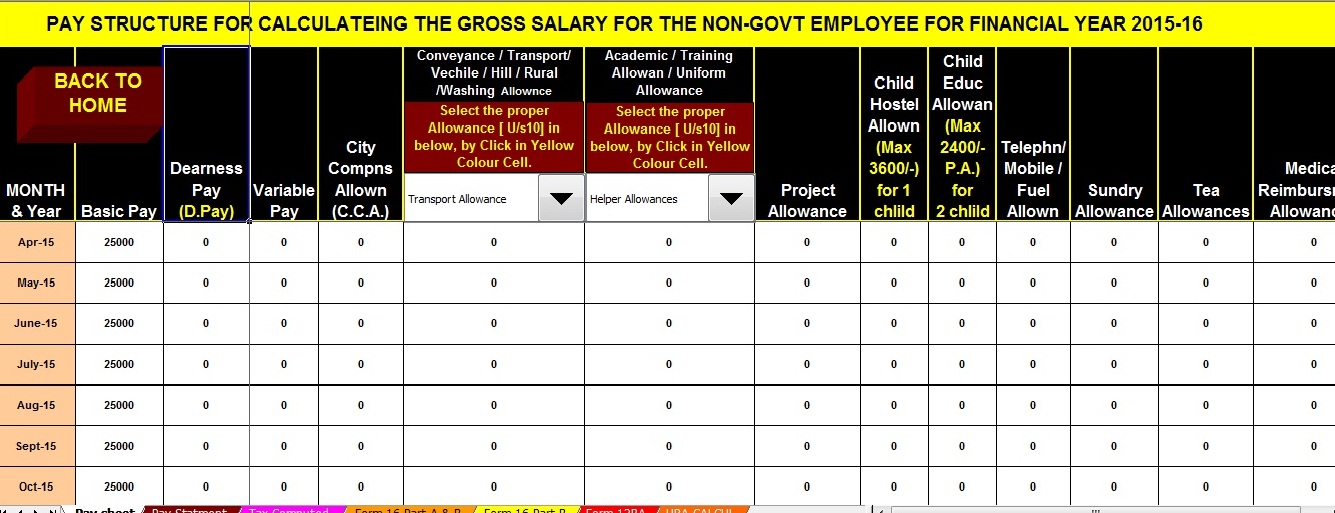
|
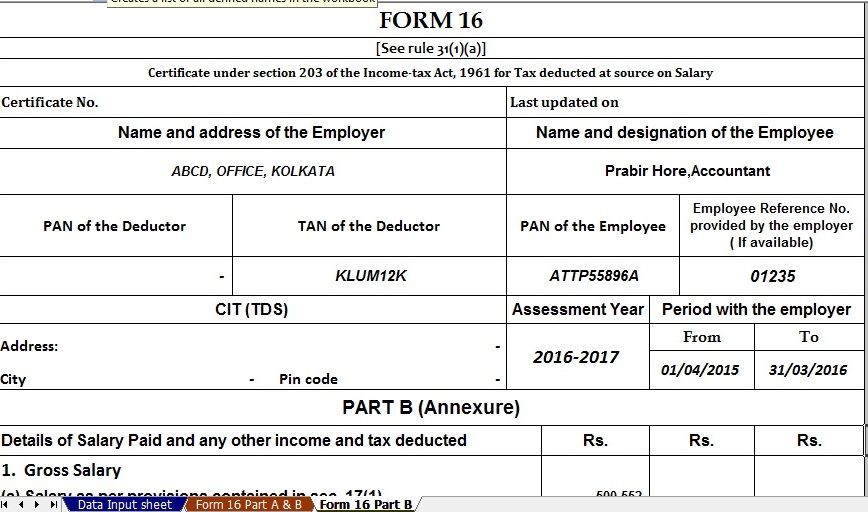
Click here to Download the Automated All in One TDS on Salary for Non-Govt employees for the Financial Year 2015-16 and Assessment Year 2016-17 ( This Excel Based Utility Can prepare at a time Income Tax Calculation Sheet + Individual Salary Sheet + Automatic HRA Calculation + Form 16 Part A&B and Form 16 Part B + Form 12 BA Only for Non Govt employees) |


itaxsoftware.net
Itaxsoftware.net |
|
Posted: 06 Oct 2015 08:20 AM PDT Download Master of Form 16 Part A&B which can prepare at a time 100 employees Form 16 Part A&B for Financial Year 2015-16 and Assessment Year 2016-17 [ This Excel Utility can use both of Govt and Non-Govt Concerned and this utility have prepared as per the Budget 2015 with all amended Income Tax Section ] Some of the Concerned can not able to download the Form 16 Part A from the Traces Portal, they can use this Form 16 Part A&B both in a single file] uunder section 80 As per New Budget 2015, with Arrears Relief Calculator with Form 10E and HRA Exemption CalculatorSection 80C (Individual & HUF)In all, total deductions under section 80C, 80CCC and 80CCD (1) cannot exceed Rs 1.50 lakh for the current assessment year. Which means total investments, expenses and payments up to a limit of Rs 1.50 lakh are eligible for tax deductions mentioned in the above mentioned sections. These sections cover many savings schemes like National savings certificates (NSCs), Public Provident Fund (PPF) and other pension plans, life insurance premiums, government bond investments. Here’s a section-wise breakup of deductions and exemptions available under the above mentioned codes: Section 80CCC (Individual)This section provides tax deductions under any investments made in an annuity plan or Life Insurance Corporation (LIC) or pension received under funds mentioned in Section 10(23AAB). Section 80CCD (1) (Individual)The deductions under this section are aimed at encouraging people to save. These deductions are allowed to people who avail the National Pensions savings scheme (NPS). Under this an individual can avail a deduction of up to 10 percent of his/her salary or Rs 1.50 lakh whichever is lower, if the person is employed or the lower of Rs 1.50 lakhs or 10 percent of gross income, if the individual is self employed. Section 80CCD (2) (Individual)This is applicable in case of employer’s contribution. Maximum deduction of 10% of salary. Section 80CCD (1B) (Individual)For financial year 2015-16 or assessment year 2016-17, this new section provides for additional tax deduction for amount contributed to NPS of up to Rs 50,000. So for AY2016-17, total deductions under Section 80 are available up to Rs 200,000. Section 80D (Individual & HUF)Download Arrears Relief Calculator U/s 89(1) with Form 10EDeduction up to Rs.25,000 for self, spouse and dependent children and separate deduction of Rs.30,000 for parents is allowed for premium paid towards medical insurance. Section 80DD (Individual & HUF)Deduction of expenses incurred on medical treatment of Dependent Relative is fixed at Rs.75,000 for 40% disability and Rs.1,25,000 for severe i.e. 80% disability. Claimant is required to furnish certificate of disability from prescribed authority. Section 80DDB (Individual & HUF)Deduction in respect of specified disease for self or dependent relatives is allowed lower of Rs.60,000 or actual amount paid. This deduction amount increases to Rs.80,000 in case of senior citizen. Section 80E (Individual)Deduction is also available on interest outgo on education loan for higher studies. This loan could be taken by the assessee, spouse or children or a student for whom the assessee is a legal guardian. Section 80G (All Assessee)Donations given to various specified institutions and organizations are allowed to be deducted from your income. The deductions are segregated under two categories i.e. 100% or 50% but cash donations exceeding Rs.10,000 is not allowed to claim. Section 80GG (Individual) |
A deduction on house rent paid is available to those who are not paid house rent allowance (HRA) by the employer. An individual, spouse or minor children shouldn’t own a home at the place of employment of the assessee to claim this deduction. Neither the assessee should have a self-occupied residence at any other place. The deduction available is limited to: rent minus 10% of total income or 25% of total income or Rs 2000 (whichever is lower). Section 80TTA (Individual & HUF)Any interest earned (up to Rs 10,000) on your deposits in a savings bank account, co-operative society or post office is tax deductible. This excludes fixed deposit interest income. Section 80U (Individual & HUF)Physically Disabled persons can claim deductions under 80U of Rs.1,00,000. Assessee is required to obtain certificate from Government Doctor. Tax Rebate under section 87AWhile tabling Union Budget 2013, Finance Minister had introduced a new section 87A to help individual taxpayers in lowering the tax outflow from their pocket. However, the tax rebate benefit had not been made available to all taxpayers but restricted to only Individual Taxpayers and that too for only Indian citizens irrespective of being male or female. Further, the tax rebate could be cherished only by individual taxpayers having the Net Total Income below Rs.5 lakhs. Since there are no proposed changes to tax rebate available under section 87A in the budget 2015, it will continue giving benefit to the medium class taxpayers post budget. Thus, tax rebate under section 87A is available for Assessment Year 20161-7 i.e. Financial Year 2015-16 |


itaxsoftware.net
Itaxsoftware.net |
|
Posted: 07 Oct 2015 06:29 AM PDT Click here to download the Automated Form 16 Part B & Part A&B for the Financial Year 2015-16 & Assessment Year 2016-17 ( This Excel Based Utility can prepare One by One Form 16 Part B & Part A&B for FY 2015-16)
|

 Form 16 Part A&B |
|
As per the Central Finance Budget 2015-16, the famous Income Tax Section 87A, where can get relief as well as Rebate Maximum Rs. 2,000/- who’s taxable income up to 5,00,000/-is continue for the Financial Year 2014-15 also. For more clarification about this new section under clauses 19 & 20 of the Central Budget 2013 as given below:- Clauses 19 & 20 of the Central Budget which have already passed by the Parliament, that The new section 87A in the income tax Act relating to get the rebate of income tax in case of below given certain clauses : A) The section 87A seeks to provide that an tax payer being an individual , whose total Taxable Income does not exceed 5,00,000/-( After deduction of U/s 10,16,80C and under chapter VI A). It is must be great opportunity to tax relief for below tax payers. b) This amendment will take effect from 1st April 2013 which effect for the Financial Year 2013-14 and Assessment Year 2014-15 and on-wards Financial Year. How to deduct the Tax Rebate Rs. 2,000/- and where from the deduct this amount. First Calculate the Net Taxable Income > Calculate the Tax on that Taxable Income as per the Slab > Less the Rebate Rs. 2,000/- ( Who's Taxable Income less than 5 Lakh) > Calculate the Education+Cess @3% , the Total Tax will be appear. Click here to download the Automated Form 16 Part B & Part A&B for the Financial Year 2015-16 & Assessment Year 2016-17 |


itaxsoftware.net
Itaxsoftware.net |
|
Posted: 08 Oct 2015 08:59 AM PDT The CBDT has already changed the Format of Form 16 dated on 19/2/2013. In this Format have two part. Part A which found the Tax Deducted At Source and deposited in to the Central Govt Account and another Part B which is found the details of employee's Salary. This Part B is mandatory to prepare by the employer. This Part A is mandatory to download form the Income Tax TRACES Portal. Most of Employer or deductor yet not well known about this new Format of form 16. Also you most of employer could not able to download the Form 16 Part A from the TRACES portal. Who have not able to download the Form 16 Part A from the TRACES Portal, they can use this below given both in one file Form 16 Part A&B in New Format of Form 16. The below given Excel Based Software can prepare at a time 50 employees Form 16 Part A&B for the Financial Year 2015-16 and Assessment Year 2016-17. This Utility can use both of Govt and Non Govt Concerned. |
Feature of this Utility:- |
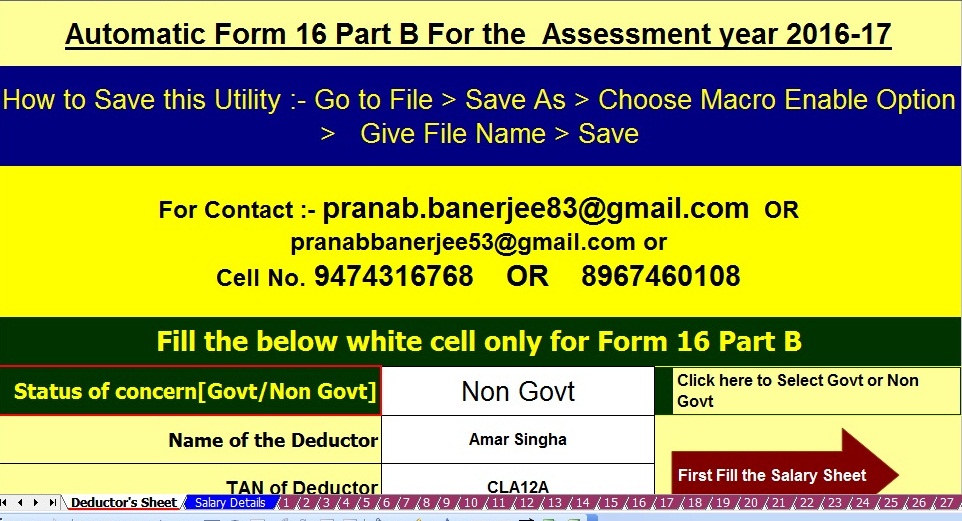 Deductor Sheet |
 Salary Structure for Govt & Non Govt Employees |
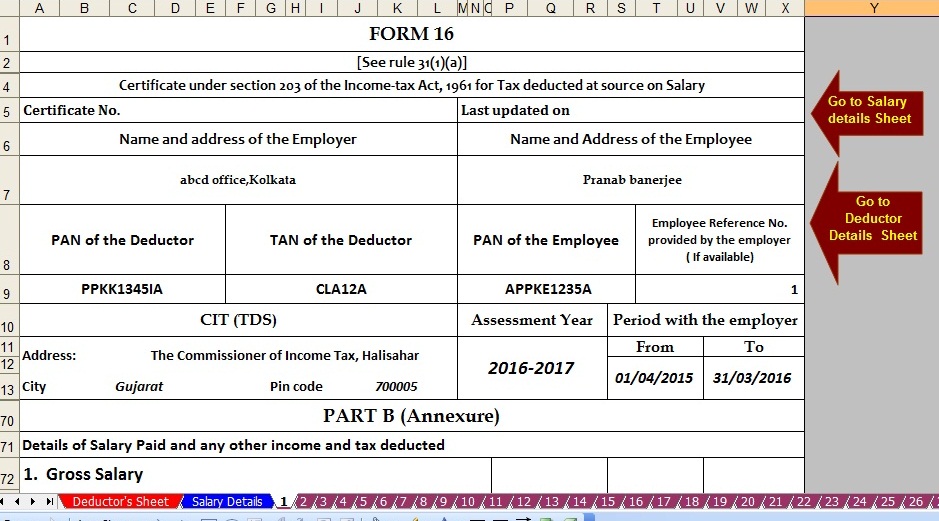 Form 16 Part A&B |
Click here to Download the Automatic Master of Form 16 Part A&B for the Financial Year 2015-16 and Assessment Year 2016-17 [ This Excel Utility can prepare at a time 50 employees Form 16 Part A&B for Govt and Non-Govt employees for F.Y.2015-16] |


itaxsoftware.net
Itaxsoftware.net |
|
Posted: 09 Oct 2015 05:51 AM PDT Income Tax Department has disallowed relief u/s 89(1) which was claimed by Assessee during his/her filing of Income Tax Return for the Assessment Year 2015-16. Earlier there was no doubt in claiming such relief up to A.Y. 2014-15 from Income Tax Department. Simply Assesee claims in ITR form and Income Tax Department allows the same as claimed by Assessee. But now, w.e.f. Assessment Year 2015-16, It is compulsory to upload online 10E form otherwise claim will be rejected and demand will be raised by I.T. Department. All Assessees who had already claimed rebate u/s 89(1) in the A.Y. 2015-16 have been informed by Income Tax Department through intimation order under section 143(1) that claim amount of rebate has been rejected and raised demand along with interest for the same. Procedure to upload 10E Form It is clear without uploading 10E form , relief under section 89(1) can not be claimed. Now question is that how can we upload 10E Form along with ITR-1 (Sahaj), ITR-2 etc Forms. it has been found that 10E form is not ITR forms. 10E form is other than ITR form which is available in income tax website after login for E-Filing of incometaxindiaefiling.gov.inas shown in below Snapshot :-
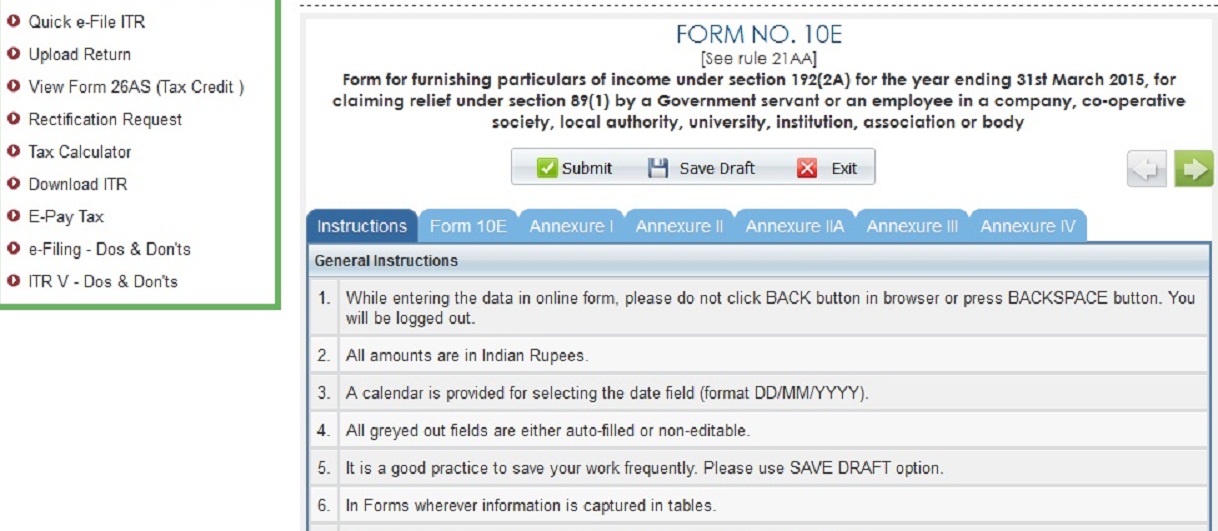 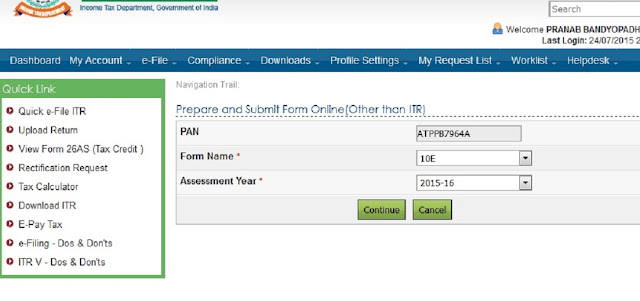 Download Arrears Relief Calculator Since the Financial Year 2000-01 to 2015-16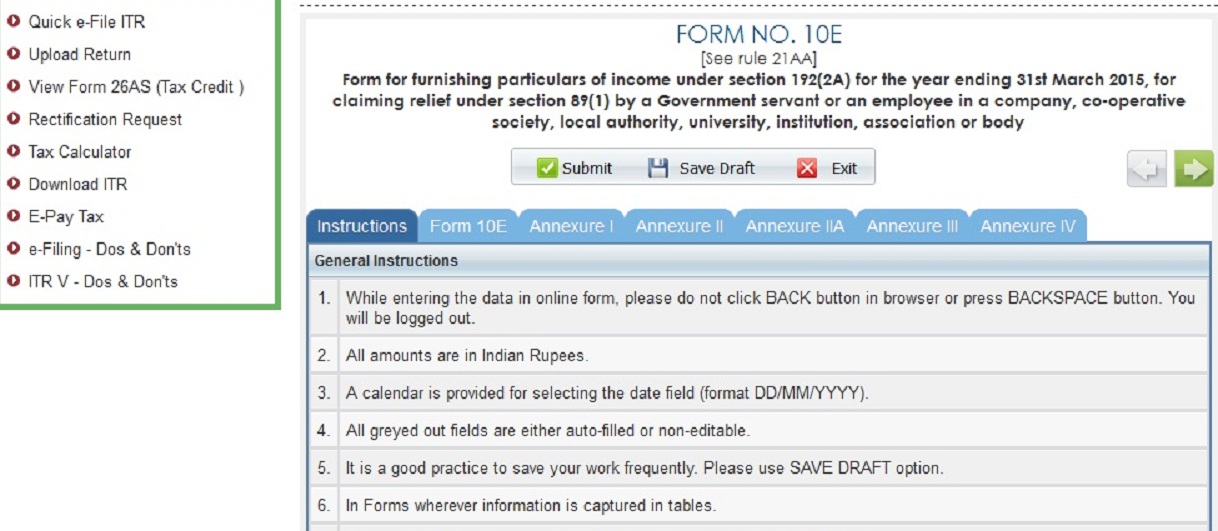 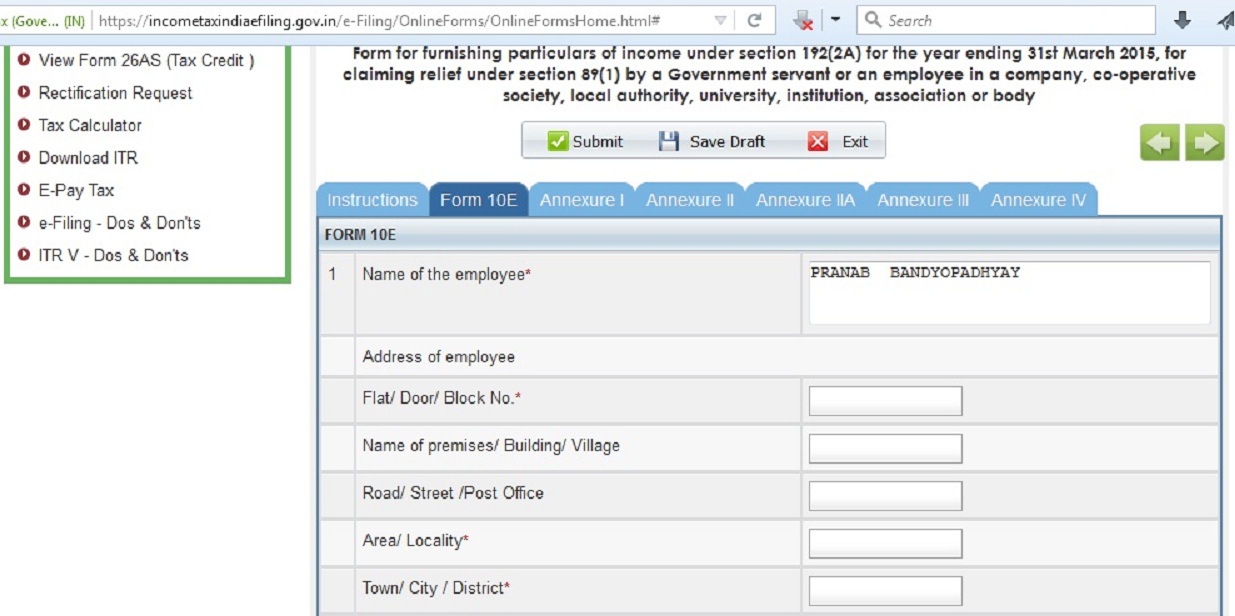 |
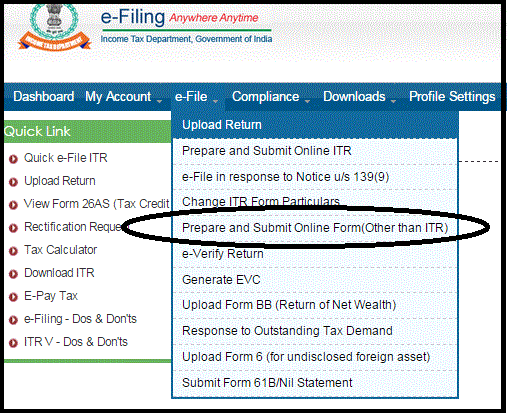


itaxsoftware.net
Itaxsoftware.net |
|
How to deal with Income Tax Notice? Posted: 10 Oct 2015 04:57 AM PDT Why Tax payers get Income Tax Notice? And what can do after got the Income Tax Notice ?  Return not filed or Delay – In case your employer has already deducted tax and you have not filled income tax return you are likely to get income tax notice asking to file Income tax return. You need to respond to this notice in time otherwise you may get penalized. Mismatch in TDS amount – TDS (tax deducted at source) figure mentioned in your form 16 is different compare to tax credit statement form 26 AS. You have filed income tax return without checking this detail. Different in TDS amount in 26AS may be due to your employer might not have deposited tax or deposited amount against different PAN number. Under this case you need to file rectified Income Tax return. Not Reporting Additional Income – You are likely to hear from Income tax department if you have forgotten to declare incomes like interest from fixed deposit or any other source of income. Review of Documents – Sometimes Income tax department wants to review documents based on which you have filed income tax return. You need to submit the documents or proof to income tax within certain time limit. High Value Transaction – Remember all high value transactions are monitored by income tax department. If any mismatch found in your income verses this truncation you are likely to get income tax notice. Following high value transactions are monitored.
Non-Disclosure of Capital Gain – If you have made capital gain by selling stocks/property, but forgot to mention the detail about capital gain in Income tax return you are likely to get Income tax notice. Investment on the name of Spouse or Kid – You have invested money on the name of your spouse of kid and generated income out of it. If you are not reporting clubbing of Income you are likely to get income tax notice. How to deal with Income Tax Notice? In case you have received income tax notice don’t get panic you need to oblige the taxman. Follow the steps given below to deal with Income tax notice. Step-1- Keep calm and read the notice carefully understand first what tax man is trying to communicate by notice. Step-2 – Verify Basic details given in notice.
Step-3 – Find out exact reason for the notice. In order to know exact reason follow steps given below.
You will find information about notice under section “Status as per record” like Return not received, Paid Rs. 2,00,000 or more against credit card spending etc. Step-4 – Take appropriate action based on reason. Few action points are given below. Return Not Received Action 1:- If you have not filed income tax return and it is under preparation. Response – “ITR has not been filed” Reason- “Return is under preparation”  Action 2:- You have already filed income tax return before. Response – “ITR has been filed” Reason- Select “e-Filed or Paper Filing”  Paid Rs. 2,00,000 or more against credit card spending Action – Select Information is related to “Self” or “I need more information”.  Other information summary code mentioned in Income tax notice:
If you find above action steps confusing you may take help of tax expert or chartered accountant. |


itaxsoftware.net
Itaxsoftware.net |
|
Posted: 11 Oct 2015 07:21 AM PDT  Owing a home is a dream of every salary earning individual. It takes a lot of time and efforts to fulfill this dream. The best part of owning a home is not to pay the rent. This the financial benefit and there are many other social benefits too. It sucks when you pay the rent. But then there is a concept of House Rent Allowance (HRA) which comes to our rescue. HRA is an important ingredient of salary. Not only it compensates the rent paid, but also helps in claiming tax exemptions. So let us discuss the calculation of House rent allowance exemption. Many of the salaried class taxpayers remain confused relating to the taxability of HRA received by them. HRA is an allowance a sum of money regularly paid to meet expenditure relating to rent. 1) DOWNLOAD THE AUTOMATIC HOUSE RENT EXEMPTIONCALCULATOR IN EXCEL
2) DOWNLOAD THE ARREARS RELIEF CALCULATOR U/S89(1) WITH FORM 10 E SINCE F.Y.2000-01 TO F.Y.2015-16
EXEMPTION OF HRA UNDER SECTION 10(13A) & Rule 2A Condition Under Section 10(13A), the condition to claim HRA Exemption is that the person who is in receipt of HRA, does not live in his own house, and pays rent in excess of 10% of his salary for his residential accommodation. No Entitlement for Exemption:
Points to be Considered:
HOW TO CLAIM HRA EXEMPTION As per income Tax Act, 1961 the employer need to deduct the TDS on salary of employee. He calls for all deduction/exemption proof from the employee. As an employee you need to provide the House rent receipts duly signed & Stamped to your employer. Generally every employer collects the HRA receipts at the end of the year. As per the Circular 17/2014 issued by CBDT for deduction of TDS on salary, it has been decided that as an administrative measure that salaried employees drawing HRA upto Rs. 3000/- p.m will be exempted from production of rent receipt. However this concession is only for the purpose of TDS, a income tax officer may call for rent receipt below Rs. 3000/-. |

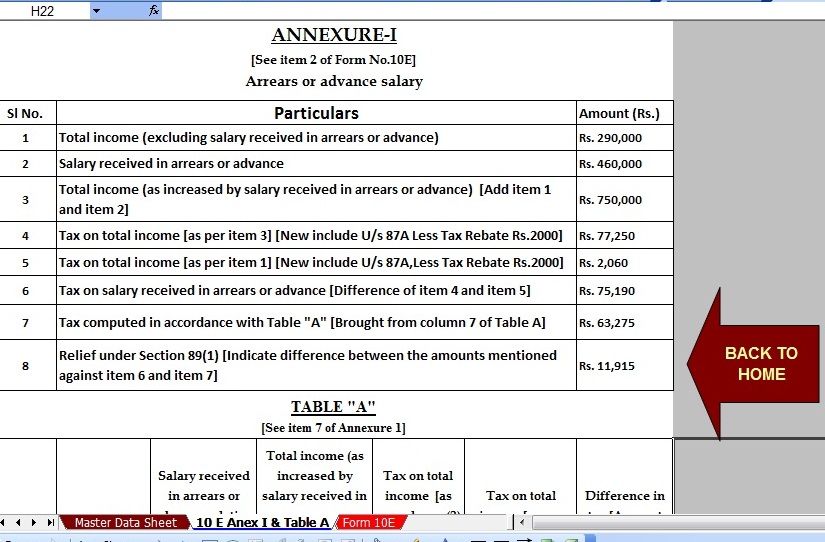

Further if annual rent paid by the employee exceeds Rs 1,00,000 per annum, it is mandatory for the employee to report PAN of the landlord to the employer. In case the landlord does not have a PAN, a declaration to this effect from the landlord along with the name and address of the landlord should be filed by the employee. |


itaxsoftware.net
Itaxsoftware.net |
|
Posted: 12 Oct 2015 04:58 AM PDT The Gross salary of a person includes various benefits given by his employer with different names. These benefit could be monetary or non monetary. Generally we call these benefits as allowances. Allowances which are necessary and which give us the most tax benefit are included in salary structure. We are discussing here the allowances which are fully exempt from tax if they are actually spent on performance of duties. So to plan for your taxes on income from salary, you can take note of following special allowances exempt u/s 10(14) to the extent spent for official performance of duties. These are called special Salary allowances exempt u/s 10(14) & rule 2bb. DOWNLOAD THE ALL IN ONE TDS ON SALARY FOR GOVT AND NON GOVE EMPLOYEES FOR F.Y.- 2015-16 & A.Y. 2016-17[This Excel Utility can prepare at a time Tax Compute Sheet + Individual Salary Structure for Govt and Non-Govt employees + Automatic Arrears Relief Calculation with Form 10E + Automatic Calculation HRA Exemption U/s 10(13A) + Automated Form 16 Part A&B and Form 16 Part B for F.Y.2015-16]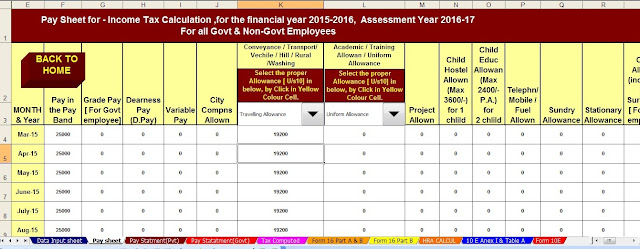 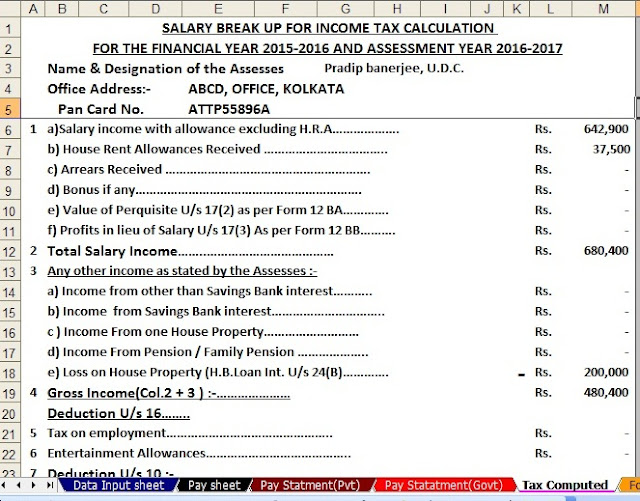  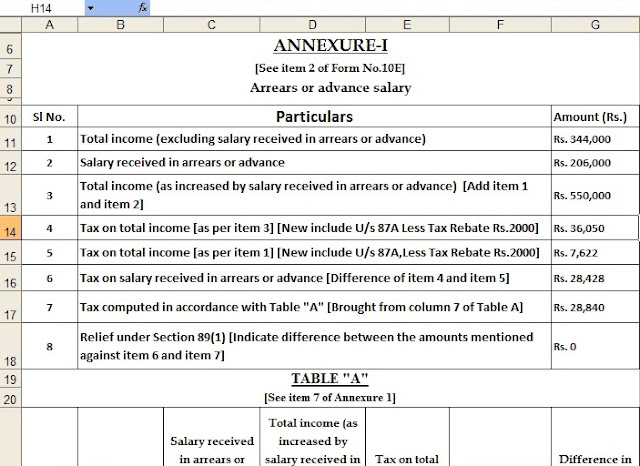 Any salary allowances granted and spent to meet the cost of :-
These all above mentioned allowances can used while formulating the salary structure of an employee/Director. These special allowances exempt u/s 10(14) are fully exempt provided they are actually spent on the performance of duties. While deducting TDS under section 192, your employer will ask for all bills/invoices/evidence related to these special allowances exempt u/s 10(14).  The other important salary allowances which are fully exempted irrespective of the expenditure incurred on it are as follows:
|


itaxsoftware.net
Itaxsoftware.net |
|
Posted: 13 Oct 2015 06:38 AM PDT
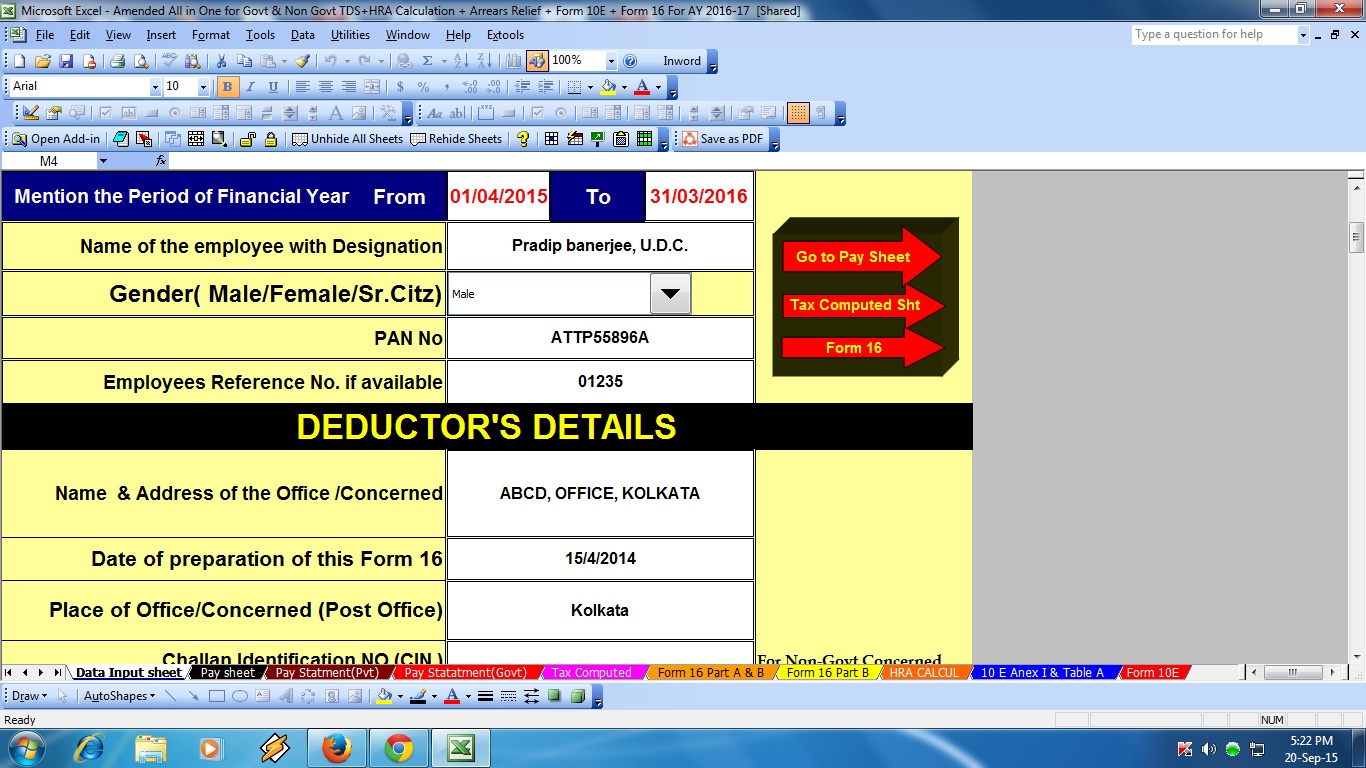 Employee's Details Sheet | DownloadAutomated All in One Tax Preparation Excel Based Software for Govt and Non-GovtEmployees for Financial Year 2015-16 and Ass Year 2016-17 [ This Excel Utility Can prepare both of Govt and Non Govt employees Individual Tax Compute Sheet + Individual Salary Structure +Automated House Rent Exemption Calculation + Automatic Arrears Relief Calculation with Form 10E + Automatic Form 16 Part A&B and Part B for F.Y.2015-16 as per Budget 2015-16]
Important Highlights of The Financial Budget 2015-15 Ay 2016-17
Others Tax Benefits in Budget FY 2015-16 AY 2016-17
|
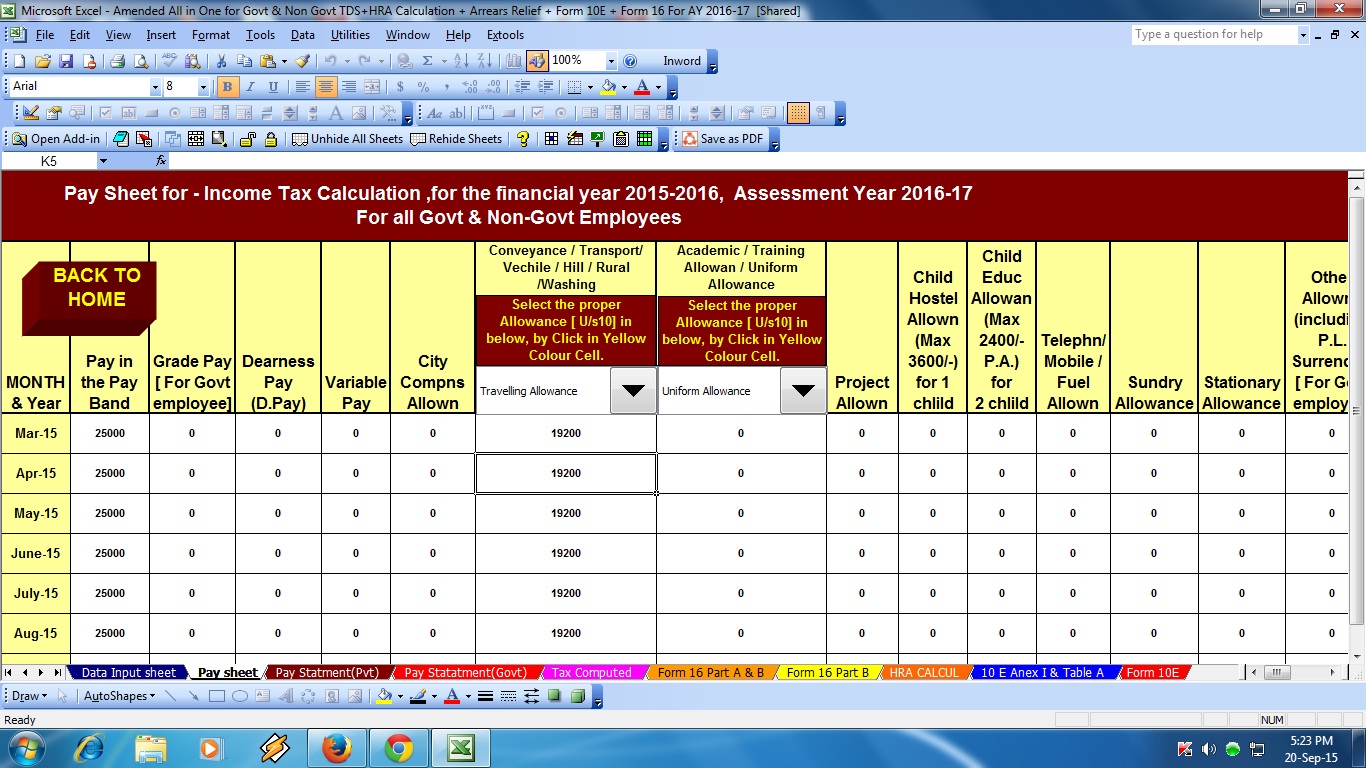


itaxsoftware.net
Itaxsoftware.net |
|
Posted: 14 Oct 2015 09:26 AM PDT  NASA has confirmed that the Earth will experience 15 days of total darkness between November 15 and November 29, 2015. The event, according to NASA, hasn’t occurred in over 1 Million years.  Charles Bolden, who was appointed to head of NASA by President Obama, issued a 1000 page document explaining the event to the White House. NASA Confirms Earth Will Experience 15 Days Of Complete …(THIS EVENT HAS HAPPEN BEFORE. THE AMERICAN INDIANS WITNESSED A SIMILAR EVENT AND IT ALSO HAPPEND DURING THE DARK AGES, THE SUN TURNED A PALE BLUE BEFORE FINALLY GOING DARK, NOT COMPLETELY OUT BUT VERY DIM AND IT LASTED FOR ABOUT 18 MONTHS!) (WE COULD SEE OTHER MAJOR EARTH CHANGES AROUND THIS TIME LIKE VOLCANIC ERUPTIONS, EARTHQUAKES, AND WEIRD EXTREME WEATHER!) Source from Zee News. |


|
Posted: 14 Oct 2015 06:29 AM PDT Click here to Download Automated Form 16 Part A&B which can prepare at a time 100 employees form 16 Part A&B for F.Y.2015-16. [This Excel Based software can use the both of Govt and Non Govt Concerned for the Financial Year 2015-16. In this Utility have the Section 80CCD(1) AND 80CCD(2) WITH NEW TAX BENEFITS AS PER BUDGET 2015]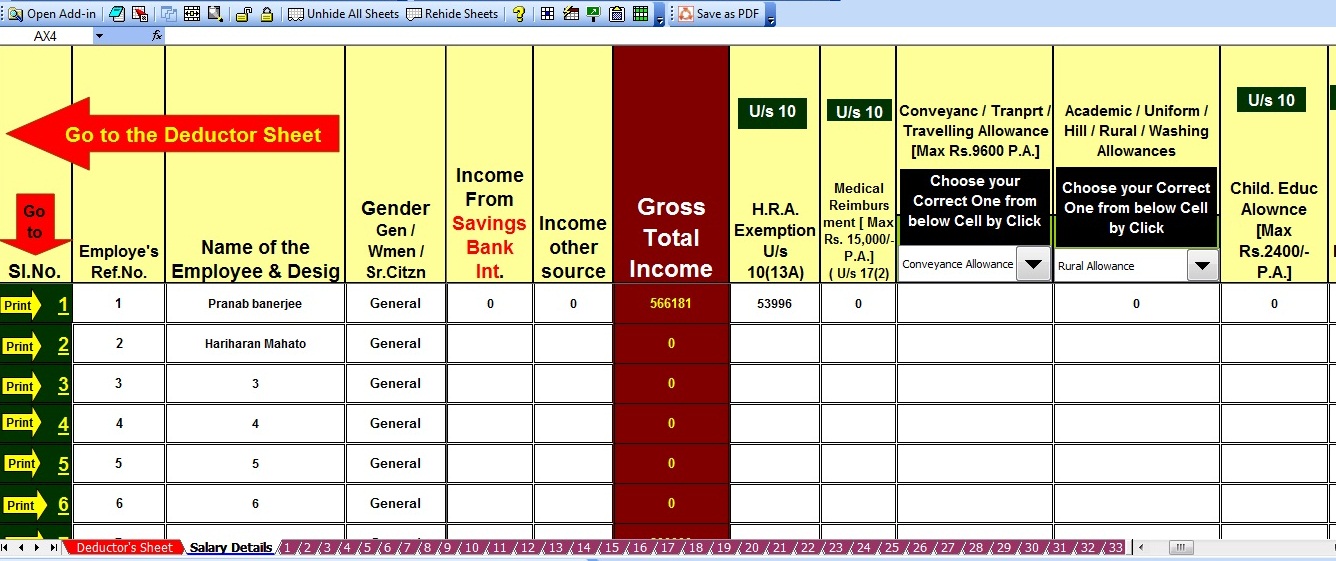 |
Feature of this Utility:- |
Section 80CCD(1) allows an employee, being an individual employed by the Central Government or any other employer, on or after the 01.01.2004, a deduction of an amount paid or deposited out of his income chargeable to tax under a pension scheme as notified vide Notification F. N. 5/7/2003- ECB&PR dated 22.12.2003 or as may be notifed by the Central Government. However, the deduction shall not exceed an amount equal to 10% of his salary(includes Dearness Allowance but excludes all other allowance and perquisites). As per Section 80CCD(2), where an employee receives any contribution in the said pension scheme from the Central Government or any other employer then the employee shall be allowed a deduction from his total income of the whole amount contributed by the Central Government or any other employer subject to limit of 10% of his salary of the previous year. However, if any amount is standing to the credit of the employee in the pension scheme referred above and deduction has been allowed as stated above and the employee or his nominee receives this amount together with the amount accrued thereon, due to the reason of (i) Closure or opting out of the pension scheme or (ii) Pension received from the annuity plan purchased and taken on such closure or opting out then the amount so received during the FYs shall be the income of the employee or his nominee for that Financial Year and accordingly will be charged to tax. Where any amount paid or deposited by the employee has been taken into account for the purposes of this section, a deduction with reference to such amount shall not be allowed under section 80C. Further it has been specified that w.e.f 01.04.09 that any amount received by the employee from the new pension scheme shall be deemed not to have received in the previous year if such amount is used for purchasing an annuity plan in the previous year. It is emphasized that as per the section 80CCE the aggregate amount of deduction under sections 80C, 80CCC and Section 80CCD(1) shall not exceed Rs.1,50,000/-. However the contribution made by the Central Government or any other employer to a pension scheme u/s 80CCD(2) shall be excluded from the limit of Rs.1,50,000/- provided under this Section. |


itaxsoftware.net
Itaxsoftware.net |
|
Posted: 15 Oct 2015 06:14 AM PDT Download the All in One Income Tax Preparation Excel Based Software for Only Central Govt Employees for Financial Year 2015-16 [ This Excel Utility can prepare at a time your Tax Compute Sheet + Individual Salary Sheet + Individual Salary Structure as per Central Govt Salary Pattern + Automatic HRA Calculation + Automated Form 16 Part A&B and Form 16 Part B for F.Y.2015-16 with the all modified section by the Finance Budget 2015-16]
|
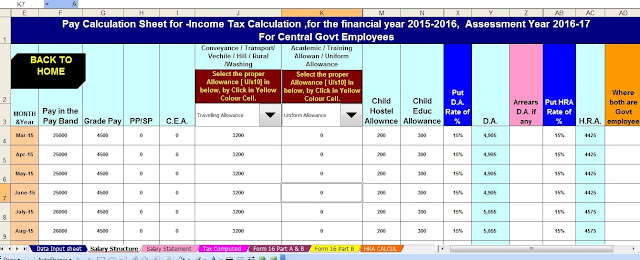


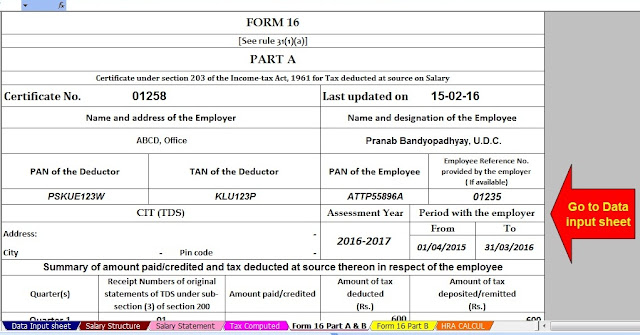
|
| |||||||||||||||||||||||||||||||||||||||||||


itaxsoftware.net
Itaxsoftware.net |
|
Posted: 16 Oct 2015 06:13 AM PDT As per the new Finance Budget 2015-16 the some Income Tax Section limit has raised.Given below the all of Income Tax Deduction Under Chapter VI A including the 80C as per the Finance Budget 2015-16. Here is a unique Income Tax Preparation Excel Based Software which can prepare at a time Tax Compute sheet + Individual Salary Structure + Automatic House Rent Exemption Calculation + Automated Form 16 Part A&B and Form 16 Pat B for the all of State Govt Employees for Financial Year 2015-16.[Click here to Download the Excel Utility]
|


itaxsoftware.net
Itaxsoftware.net |
|
Posted: 17 Oct 2015 05:38 AM PDT With booming salary packages, Indian corporate have also started proving accommodation facility to their top level executives. It is a perquisites as per Income Tax Act, 1961. Let us understand the tax of it.
b. Hotel includes licensed accommodation in the nature of motel , service apartment or guest house. Accommodation provided in a hotel will not be a taxable perquisite if –
3. Value of unfurnished accommodation provided by employer other than govt: as per explanation to sec. 17 (2)a. Owned by the Emloyer
c. Accommodation in hotel
4. Value of furnished accomodation
Download Value of Perquisite calculatorU/s 72(2) only Accomodation.
When the accommodation is provided by the central government or any state government to an employee who is serving on deputation with any body or undertaking under the control of such government – a. The employer of such an employee shall be deemed to be that body or undertaking where the employee is serving on deputation , and b. Value of perquisite of such an accommodation shall be the amount calculated as similar with accommodation is owned by the employer. 8. Fully exempt cases : exempted employees not liable to tax for accommodation provided by employer are- a. Free accommodation facility ( in the form of official residence) given to supreme / high court judge b. Free furnished residence given to a parliament official / union minister/ leader of opposition in parliament c. Value of rent free official residence given to chairman / member of union public service commission in service. d. Accommodation in a remote area for an individual working in a mining or mineral exploration site. e. Accommodation in a hotel for a period upto 15 days for an employee on his transfer. |
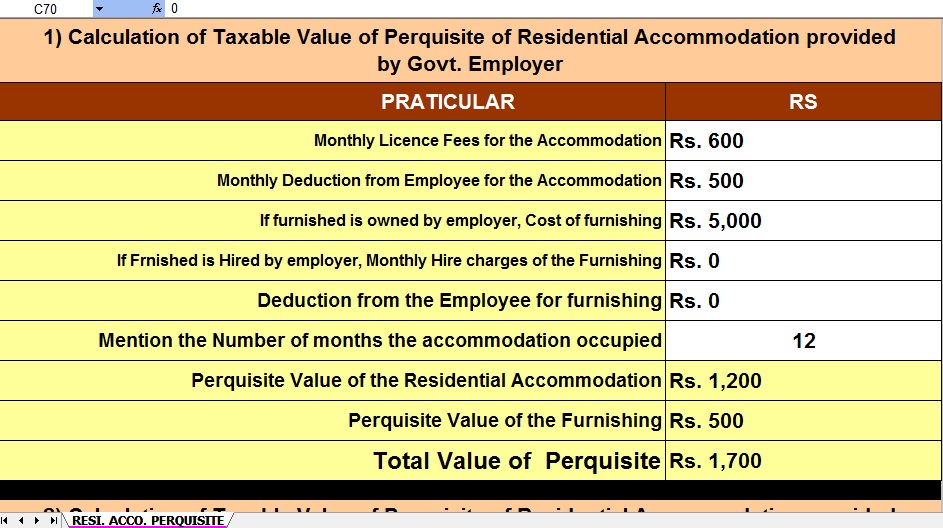


itaxsoftware.net
Posted: 18 Oct 2015 06:49 AM PDT |
Free download Amount to in word Converter in Excel ToolsMost of Professional mainly in Accounts related persons and who are working in Computer mainly used in Excel, they have need this Excel Tools, which can easily Convert the Amount to In Words automatically. This Excel Tolls mainly valuable for those, who are working in Accounts and where frequently need the Amount to in word manually typing in Computer. Hope this Utility can help and reduce the time and errors of spelling of in word typing. For Download the Same first you should Register in My Blog where you can easily received Free update Excel Utility which are all Accounts Related and Income Tax Related Excel Based Utility. Also you can get this type of Excel Tools through mail delivery system by Feed Burner. After Registering this Blog you can get the Pass Word for Download this Excel Tools through Mail. Instruction for install this Utility is given below :- Register for get this Excel toolls "Amount to in words" You can use this Excel Tools for 2003 & 2007 & 2010 Users Instruction for install1. save it in a Folder permanently.(do not change the location of file after installation) 2. Now open excel Go to Tools>add in >browse (browse the file where you have stored the downloaded the file and select the file>ok. [ For 2003 Users] For 2007 & 2010 Users - Go to File>Open>Excel Option>Add-ins>Manage Excel Add-in>Go>Browse where you have stored the downloaded file and select the file>OK Form 2010 Users - Same as 2007. Also you should first enable Analyses toolpak before install this tools. then press ok ,that's all Just type the Formula in below given in formula bar=word(Cell No) (cell number in which figure are given)It will be done |
itaxsoftware.net
Itaxsoftware.net |
|
Posted: 19 Oct 2015 05:40 AM PDT There are many conflicting views and comments in various Web Site that on the budget 2015 A certain section – 80 CCD (1) – has been amended, clarifying that it is available to private & Govt. sector employees as well. As per the Finance Bill for the Financial Year 2014-15 was fixed in the section 80CCD(1) Rs. 1 Lakh and the Total deduction U/s 80C was fixed Rs. 1.5 Lakh. But the deduction made in the section of 80CCD(1) was fixed Rs. 1 Lakh. Below given the Caption of Finance Bill 2014-15 about this 80CCD(1) Sub Section (1) [ Prepare at a time Income Tax Compute Sheet + Individual Salary Structure +Individual Salary Sheet + Automatic Arrears Relief Calculation with Form 10E + Automatic HRA Exemption Calculation + Automated Form 16 Part A&B and Form 16 Part B for Financial Year 2015-16,] Click to Download theExcel Utility. THE FINANCE (No. 2) BILL, 2014 28. In section 80CCD of the Income-tax Act, in sub-section (1), with effect from the 1st day of April, 2015,–– (i) for the words, figures and letters “Where an assessee, being an individual employed by the Central Government or any other employer on or after the 1st day of January, 2004”, the words, figures and letters “Where an assessee, being an individual employed by the Central Government on or after the 1st day of January, 2004 or, being an individual employed by any other employer” shall be substituted; (ii) after sub-section (1), the following sub-section shall be inserted, namely:–– “(1A) The amount of deduction under sub-section (1) shall not exceed one hundred thousand rupees.”. i.e. RS.1.5 LAKH. 29. In section 80CCE of the Income-tax Act, for the words “one lakh rupees”, the words “one hundred and fifty thousand rupees” shall be substituted with effect from the 1st day of April, 2015. [ Prepare at a time 50 employees Form 16 Part A&B for Financial Year 2015-16 as per Finance Budget 2015-16 [This Excel utility can prepare at a time 50 employees Form 16 Part A&B for F.Y.2015-16] Click to Download the Excel Utility80CCE The aggregate amount of deductions under section 80C, section 80CCC and sub-section (1) of section 80CCD shall not, in any case, exceed 1.5 lakh rupees, But the Section 80CCD(1) WHICH IS FIXED Rs.1 Lakh. As per the finance bill 2014-15 changes the 80C, and 80CCE limit to Rs. 150,000. But it also changes the 80 CCD section like this: 28. In section 80CCD of the Income-tax Act, in sub-section (1), with effect from the 1st day of April, 2015,–– (i) for the words, figures and letters “Where an assessee, being an individual employed by the Central Government or any other employer on or after the 1st day of January, 2004”, the words, figures and letters “Where an assessee, being an individual employed by the Central Government on or after the 1st day of January, 2004 or, being an individual employed by any other employer” shall be substituted; (ii) after sub-section (1), the following sub-section shall be inserted, namely:–– “(1A) The amount of deduction under sub-section (1) shall not exceed one hundred thousand rupees.”. The first part basically clarifies that you can be employed anywhere. (In fact you can even be self employed, because the “or any other individual” continues to stay). The second part is critical. It says that amount YOU contribute (which is what is subsection(1) is) is only deductible up to Rs. 1,00,000/-. Clearly: · There is no ADDITIONAL investment deduction under 80CCD for your own contribution. · This deduction, remains locked for your own NPS contributions upto Rs. 100,000 only. · If you invest that, then you get another 50,000 deduction for investing other 80C type assets · If you don’t invest in NPS, you still get the 150,000 to invest in 80C type of assets And NPS is Taxed on ExitNPS contributions may be exempt, but they are one instrument where exits are taxed. Whatever money you received – whether as a lumpsum or a pension – is added to your income and taxed accordingly. Now the Section 80CCD(1A) has omitted by the Finance Bill 2015-16 and amended this Sub Section substitute in 80CCD(1B) AND Raised the amount from Rs. 1 Lakh to 1.5 Lakh including the additional benefits Rs.50 thousand in this new section 80CCD(1B). Below given the what is said by the Finance Bill 2015-16 about this 80CCD and Additional Rs. 50 Thousand. Lets see. THE FINANCE BILL, 2015 16. In section 80CCC of the Income-tax Act, in sub-section (1), for the words “one lakh rupees”, the words “one hundred and fifty thousand rupees” shall be substituted with effect from the 1st day of April, 2016. 17. In section 80CCD of the Income-tax Act, with effect from the 1st day of April, 2016,-—(a) sub-section (1A) shall be omitted; (b) after sub-section (1A), as so omitted the following sub-section shall be inserted, namely:— “(1B) An assesse referred to in sub-section (1), shall be allowed a deduction in computation of his total income, [in addition to the deduction allowed under sub-section (1)], of the whole of the amount paid or deposited in the previous year in his account under a pension scheme notified or as may be notified by the Central Government, which shall not exceed fifty thousand rupees: Provided that no deduction under this sub-section shall be allowed in respect of the amount on which a deduction has been claimed and allowed under sub-section (1);(c) in sub-section (3),—(I) for the words, brackets and figure, “sub-section (1)”,wherever they occur, the words, brackets, figures and letter “sub-section (1) or sub-section (1B)” shall be substituted;(II) for the words “under that sub-section”, the words “under those sub-sections” shall be substituted; (d) in sub-section (4), for the words, brackets and figure, “sub-section (1)”, the words, brackets, figures and letter “sub-section (1) or sub-section (1B)” shall be substituted. However it is clear that no additional amount i.e. Rs. 50 thousand can be claimed as extra benefits in this section 80CCD(1B) OR (1A). The Conclusion is given below as per the new Finance Bill 2015. As per the Financial Year 2014-15 the Section 80CCD(1) was fixed Rs. 1 Lakh under the section 80C where can get the total deduction Rs. 1.5 Lakh, BUT THE SECTION 80CCD(1) WAS FIXEX IN Rs.1 Lakh. As per the Financial Year 2015-16 the section has made chances and rename the Section 80CCD(1A) Substituted by 80CCD(1B) & get additional benefits Rs. 50 thousand in the Section 80CCD(1B) including the previous year’s deduction Rs.1 Lakh. So the Total Deduction will be Rs. 1.5 Lakh not Rs. 2 Lakh, As the Section 80CCE restricted the total amount of U/s 80C,80CCC & 80CCD(1B) Rs. 1.5 Lakh. |


itaxsoftware.net
Itaxsoftware.net |
|
Posted: 20 Oct 2015 09:15 AM PDT Download All in One TDS on Salary Calculator for All State Govt Employees for FY 2015-16 & Ass Year 2016-17 [ This Excel Utility can prepare at a time Tax Compute Sheet + Individual Salary Structure + Individual Salary Sheet + Automatic HRA Exemption Calculation + Automated Form 16 Part A&B and Part B for FY 2015-16 ]What is the new changes in Central Budget 2015-16 and What will be the benefits of Salaried Persons for the Financial Year 2015-16 Listed the major points of Budget 2015 and created a video on this. Please have a look at below:- 1) No revision Tax Slabs and Sec.80C limit-Finance minister has not touched the tax slabs and famous Sec.80C limit. So the earlier FY 2014-15 (AY 2015-16) tax slabs will continue. This is actually a big blow to salaried. They thought FM would revise it to some extent. However, no such magic happened. 2) Sec.80D Health Insurance Premium limit raised-Earlier health insurance premium limit under Sec.80D was Rs.15, 000 for individual and HUF taxpayers. An individual can claim deduction towards the health insurance premium paid to himself, spouse, dependent parents, or dependent children of the assessee. In case of HUF, it is any member of a family. Now this limit is raised to Rs.25, 000 per year for individual and HUF. At the same time, for senior citizens, it is raised to Rs.30, 000 (from the earlier Rs.20, 000). So overall for your family you can save up to Rs.55, 000 (On own family Rs.25, 000+Rs.30, 000 for senior citizen parents). This budget gave some relief to senior citizens whose age is 80 yrs and above. Usually none of health insurance companies offers health insurance to these citizens. Hence, any health expenditure up to Rs.30, 000 can be claimed as deduction under Sec.80D. This upgrading of limit actually a big relief for all. Because you notice the hospitalization cost these days. So buy a proper health insurance, you must go for a higher sum assured. By increasing the premium limit under Sec.80D, the Government actually pushes for health insurance to all. 3) New Pension Scheme (NPS) limit raised to Rs.1, 50,000-Earlier the limit under Sec.80CCD (1) was Rs.1, 00,000. This Sec.80CCD deduction relates to your contribution to NPS (either an individual or employee). Now this limit is raised to Rs.1, 50,000. 4) Transport allowance limit raised-Earlier the monthly limit was Rs.800. Now it is doubled, i.e. Rs.1, 600 per month. Therefore, if you receive a transport allowance in your salary, then this is again a huge advantage for you. I feel this is a good move considering the cost of managing vehicle. 5) Now TDS (Tax Deducted at Source) on your RD (Recurring Deposits) too-Even though interest earned from RDs is taxable, but as of now, there was no TDS. Therefore, many people felt it easy to skip paying taxes on this. However, in this budget Govt amended Sec.194A. So effective from 1st June 2015-TDS of 10% on all your RDs under Sec.194A. However, there will be no TDS on RDs whose total interest is less than Rs.10, 000 in a year. This will protect small investors. Anyhow, it is wrong to believe that NO TDS means NO TAX. You still be liable for tax according to your individual tax slab on RDs. 6) Sukanya Samriddhi Account now with huge tax benefits-Earlier, when the Sukany Samriddhi Account was launched, it was ETE. Means whatever you invest in this scheme will be available for tax benefit under Sec.80C. Interest earned was taxable (as is NSC) but maturity was said as tax-free. However, in this budget FM declared that interest earned from this scheme is full tax-free. Therefore, it is now treated as an EEE scheme (Exempt while investing, interest earned is exempt and maturity exempt). If we consider the current trend then between Sukanya Samriddhi Account Vs PPF, I feel Sukanya Samriddhi Account holds good except on liquidity issue and some other minor features. 7) Service Tax raised to 14% from an earlier 12 %-Earlier the service tax was 12% (excluding cess) and now it is raised to 14%. Along with that 2%, Swachh Bharat Cess also included. So earlier, it is 12.36%. Now it is 14.5% of service tax (14% Service Tax+0.2% Education Cess @ 2%+0.2% Swachh Bharat Cess @2%+0.1% Senior and Higher Education Cess @ 1%). 8) Wealth Tax discontinued, but with a surcharge of 2% if income is Rs.1 Cr or more-Earlier the wealth tax was collected to those individuals and HUF if their Net Wealth exceeds Rs.30 lakh on the last date of the previous year on certain assets. Now such tax was abolished. To compensate the loss, FM introduced 2% surcharge on individual or HUF if their income is Rs.1 Cr or more. This move actually brings in more income to Govt than wealth tax. 9) 100% Tax Deduction under Sec.80G if you donate to Swachh Bharat and Clean Ganga-Whatever you contribute to Swachh Bharat and Clean Ganga schemes, the whole amount can be availed as deduction under Sec.80G. Let us contribute to these noble causes. 10) PAN Card mandatory for all buy or sell of above Rs.1 lakh-From now onward if you want to buy anything, which is more than Rs.1 Lakh, then you have to quote your PAN number. This will bring the transaction into legality and tax angel. Hence there is no escape from avoiding tax or doing illegal transactions. Even FM also pointed that if someone tries to split the amount to make sure that the payment will be within Rs.1 lakh then too it will be tracked and penalize for such misdeed. From now onward, it is prohibited of acceptance or payment of an advance of Rs 20,000 or more in cash for purchase of immovable property. 11) Option to choose between EPF or NPS-From now onward, you have the option to choose between EPF or NPS. This gives some flexibility to employees to choose. However, this option is only meant for certain employees whose income is limited (This limit is not yet cleared as of now). Let us wait for more clarity on this. 12) Introduction of Tax Free Bonds-FM has proposed to introduce Tax Free Bonds. This will be good for those who are looking for tax-free instruments and stable income. FM announced that Rs.20,000 Cr worth of bonds will be issued to cater the infra, railway, and road projects. The interest from these bonds will be tax-free. 13) New Accidental Insurance which cost you Rs.12 a year !!!FM has proposed to introduce the new accidental insurance called Pradhan Matri Suraksham Bima Yojana. Sum Insured under this scheme is Rs.2, 00,000 and yearly premium is just Rs.12 a year. 14) New Life Insurance of Rs.2, 00,000 for the yearly premium of Rs.300-FM has proposed a new Life Insurance Pradhan Mantri Jeevan Jyoti Bima Yojana. This will offer you Rs.2, 00,000 Sum Assured. This covers accidental or natural death. The premium will be Rs.330 per year. Age group eligible to buy this plan are between 18 Yrs to 50 Yrs of age. 15) Unclaimed EPF and PPF amount usage-FM has proposed that unclaimed EPF and PPF amount, which is idle with Govt, would be utilized for Senior Citizen Welfare Fund. This may to some extent give some benefits to seniors. 16) No Changes in Tax Rebate Rs.2000/- U/s 87A17) No Changes in Savings Bank Interest relief Rs.10,000/- U/s 80TTADownload All in One TDS on Salary Calculator for All State Govt Employees for FY 2015-16 & Ass Year 2016-17 [ This Excel Utility can prepare at a time Tax Compute Sheet + Individual Salary Structure + Individual Salary Sheet + Automatic HRA Exemption Calculation + Automated Form 16 Part A&B and Part B for FY 2015-16 ] |


itaxsoftware.net
Itaxsoftware.net |
|
Posted: 21 Oct 2015 06:25 AM PDT Click here to Download Automated Form 16 Part A&B and Part B for the Financial Year 2015-16 and And Assessment Year 2016-17 [ This Excel Utility can prepare One by One Form 16 for FY 2015-16]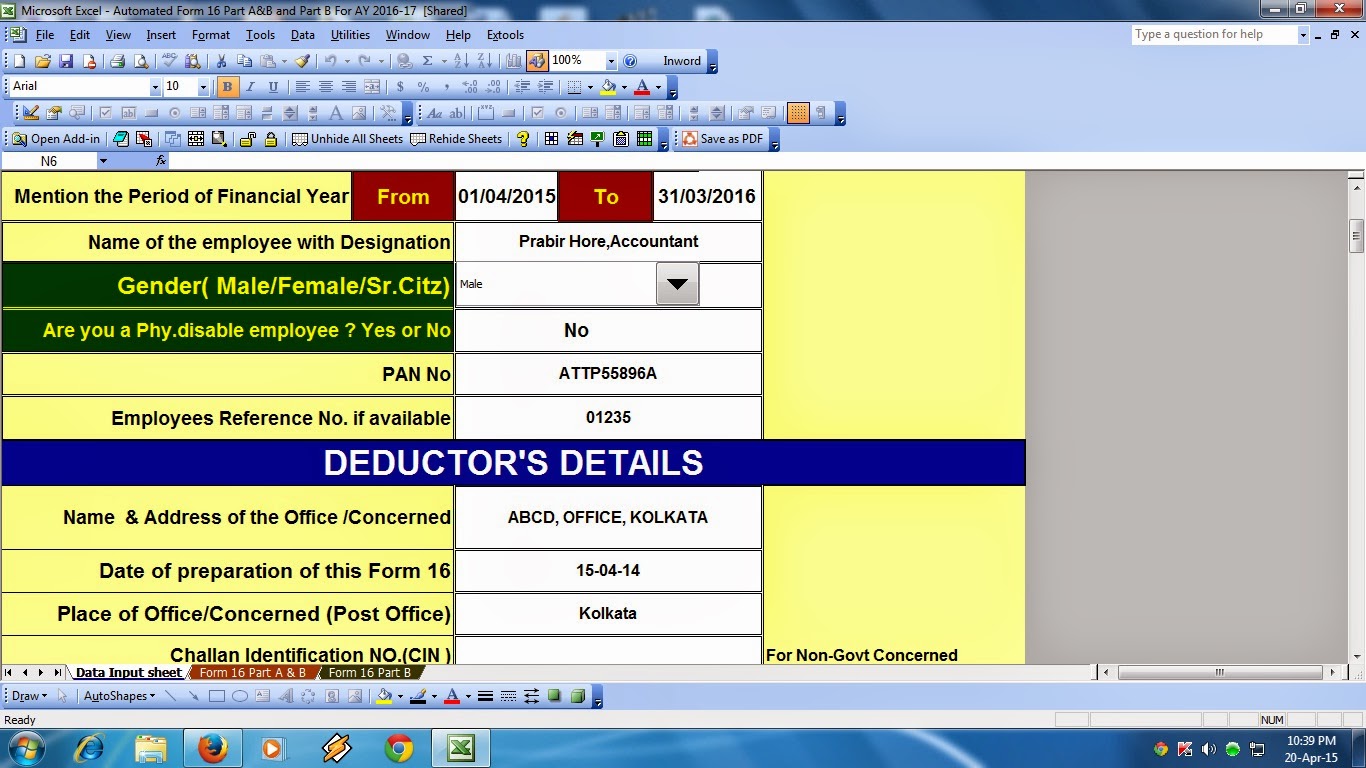 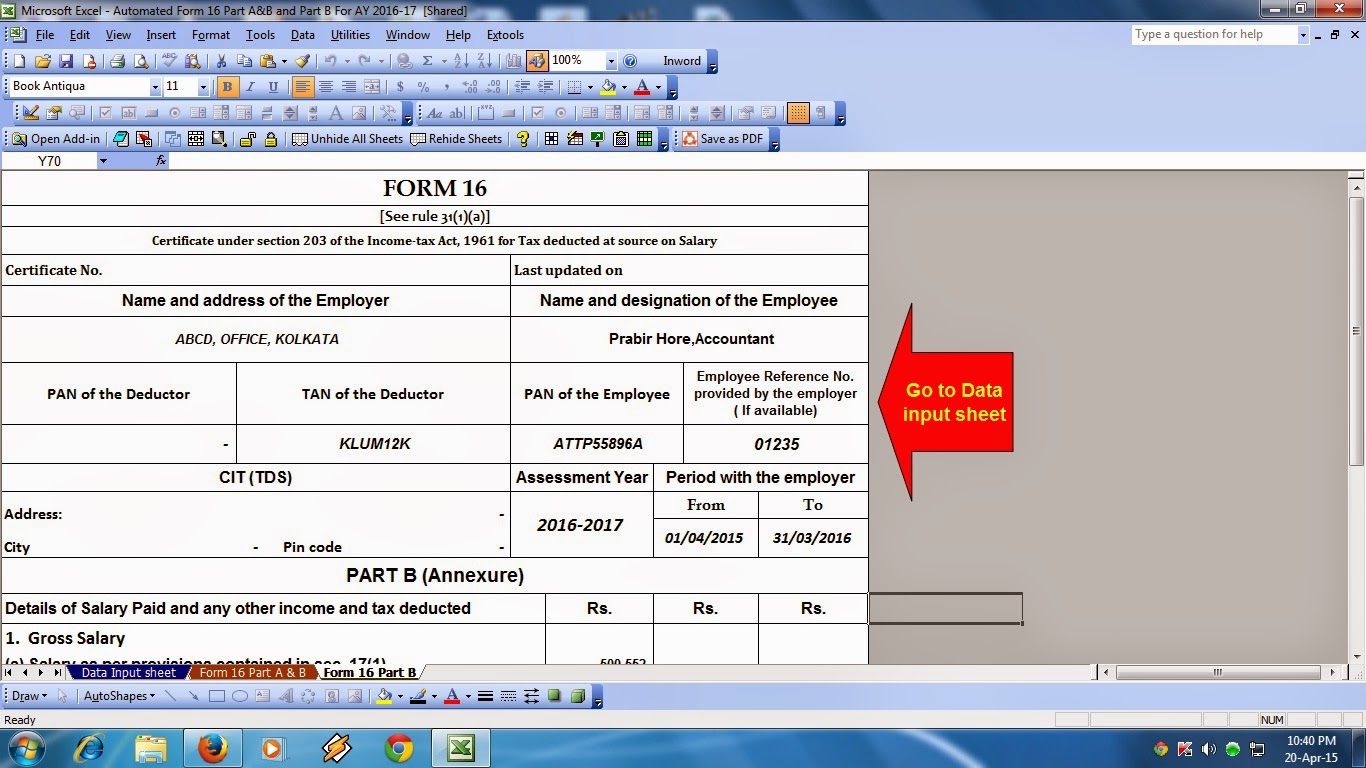 There was nothing much in the Union Budget 2015-16, which will significantly benefit individual tax payers. Here are a few ways in which you may end-up paying marginally lower income tax than last year.Benefits on Health Insurance While benefits on health insurance premium paid gave you tax benefits to the tune of Rs 15,000 until the last year, from financial year 2015-16 you can claim tax benefits up to a sum of Rs 25,000 for health insurance premium paid.
Transport Allowance The Transport Allowance which is at the moment Rs 800 commuting from home to your place of work, will get enhanced to Rs 1600. This means your employer must increase the transport allowance in your salary to give you the benefits. Health Insurance Premium For Senior Citizens The Health Insurance Premium tax exemption for senior citizens has been raised to Rs 30,000. For very senior citizens an amount of Rs 50,000 spent on medical bills is now tax exempt. Contribution To New Pension Scheme Additional deduction of Rs 50,000 will be allowed for contribution to the new pension scheme u/s 80 CCD increasing from Rs 1 lakh to Rs 1.5 lakh. Sukanya Samriddhi Account Max Rs. 1.5 Lakh in Tax Section 80C :For Mionor Girl Child below 10 Years. |


itaxsoftware.net
Itaxsoftware.net |
|
Posted: 22 Oct 2015 07:00 PM PDT The Financial Year 2015-16 has already started and as per the Finance Budget 2015, the Tax Slab have not changed, same as previous financial year 2014-15. But Limit of some Tax Section has Increased by this Finance Budget. The Section 80U have increased 75000/- P.A. and Rs. 125000/- P.A. for Blind persons. Traveling Allowances also raised up to 1600/- P.M. and Blind Person can avail Rs. 3200/- P.M. Section 80D Raised Rs. 25000/- and Sr.Citizen Rs. 30,000/- It is necessary to calculate your Tax Liability for the Financial Year 2015-16 as the D.A. has also increased to the Govt employees time to time. The below given Excel based Software which can prepare at a time Income Tax Computed Sheet + Automatic Arrears Relief Calculator + Automatic House Rent Exemption calculation + In built Salary Structure for both Govt & Non Govt employees which prepared on the basis of Salary Pattern of each Govt and Non Govt concerned + Automated Form 16 Part A&B + Automated Form 16 Part B for the Financial Year 2015-16 and Assessment Year 2016-17.It is most hazard to calculate individually HRA Calculation separately another sheet and also it is hazard to calculate the Arrears Relief Calculation from the financial Year 2000-01 to 2015-16. This Excel Utility can prepare all the calculation just a moment. Thus your time may reduce for calculating the actual Income Tax of each employee. |
This Excel Based Software Can prepare more than 500 employees Tax Computed One by One. |
Feature of this Utility:- |
· Automatic Calculate Income Tax with Tax Computed sheet individually· Individual Salary Structure for calculating the Gross Salary Income |
· Salary Structure have prepare on the Basis of Govt and Non Govt Salary Pattern |
· Automatic Calculate the House Rent Exemption Calculation U/s 10(13A) |
· Automatic Calculate the Arrears Relief Calculation with Form 10E since 2000-01 to 2013-14· Automated Form 16 Part A&B· Automated Form 16 Part B· Automatic Convert the Amount in to In WordsClick Below to Download the Excel Based Software All in One1) Download All in One TDS on Salary for Central Govt employees for F.Y.2015-16
|

