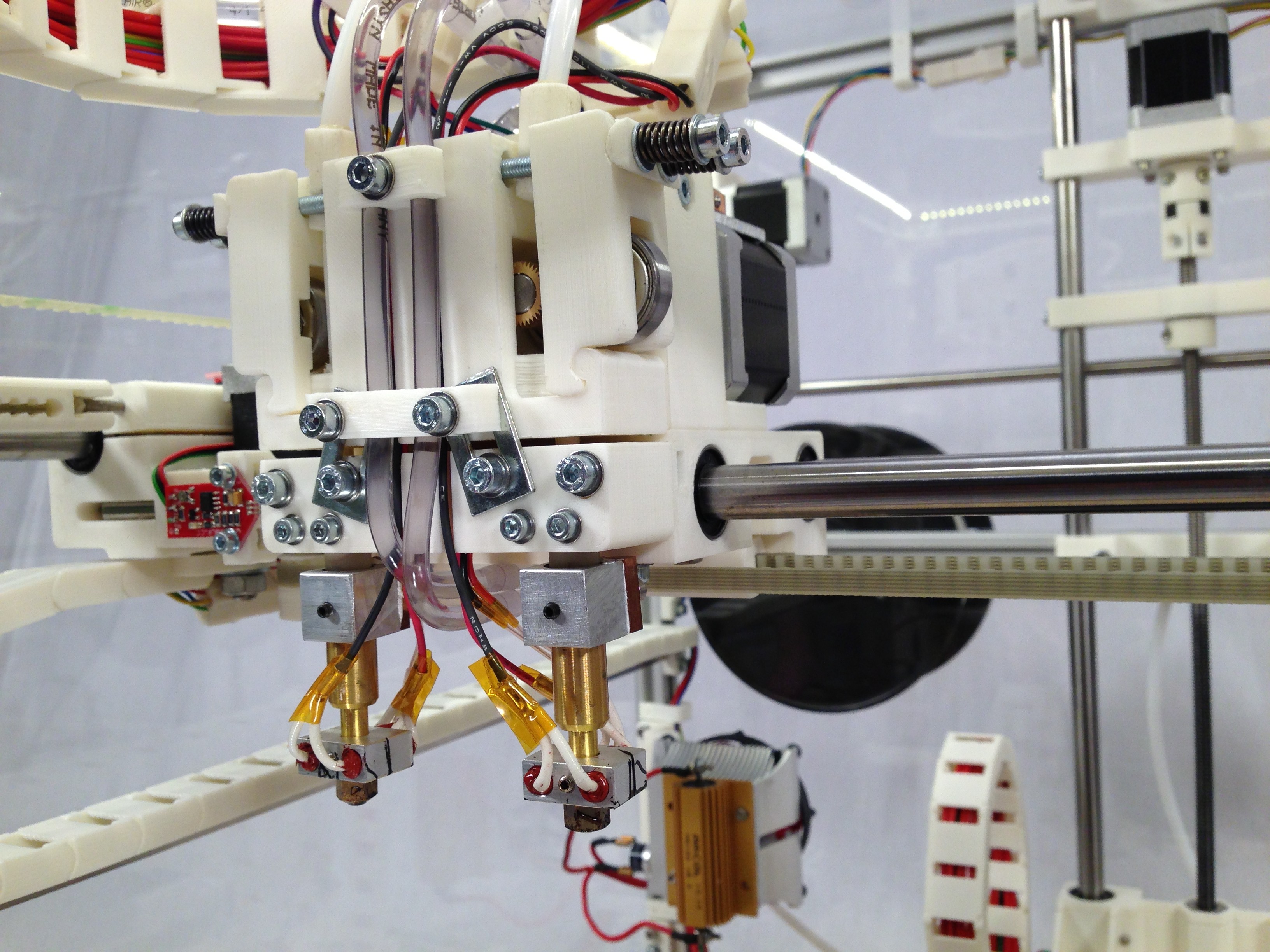
Liquid cooling your hot-end?

Greg. L
Today, while I was waiting for some paperwork, I realized that I could bend some copper 0.25" tubing around the top of a hot-end (in my head, a Trinity Magma, only because they have that long, thin metal neck), a few times to make a simple heat exchanger (I could even solder it on if I was feeling crazy), and leave both ends up the tube pointing "up" a few inches. Clamp on some flexible hose that heads to the top of the printer, where I'd have a standard PC-style watercooling radiator block (I wouldn't want the extra thermal mass on my moving hot end).
I don't think I'd even need a pump - the heat from the hot-end would force the heated water to rise, where it would cool at the radiator. I know I'd get an isothermal point at the point of contact, or at least near enough to one, as the water would boil off at 100C, rising up, cooling, and condensing back down. Admittedly, the first dozen times I'd run this, I'd watch it like a hawk for evaporation (I'd leave it open to the air, as I don't want a pressure vessel). Alternately, I could use a higher-temp rated coolant than water.
As long as the thermal conductivity between the part we want hot and the liquid coolant loop isn't too high (overpowering the resistor) it might really help eliminate PLA jams with some of the higher-speed and high-temp capable hot-ends.
Having said all of this, has anyone tried anything similar? It sounds like the kind of thermo problem a sophomore MechEng could tackle mathematically, so it's not like I'm proposing aetheric science or anything...

Misha

JohnD