Groups
Groups

Fw: [Africanhero] How to live before you die By Steve Jobs /// Learning From Life Experiences.

202 views
Skip to first unread message

H.E. KUM Nelson Bame IV

unread,
Jan 5, 2013, 7:31:59 PM1/5/13
to cameroon...@yahoogroups.com, camero...@yahoogroups.com, camne...@yahoogroups.com, african...@yahoogroups.com, afric...@yahoogroups.com, african...@yahoogroups.com, Menchum Worldwide, WECUD...@yahoogroups.com, Nigerian Politics, African...@yahoogroups.com, Afric...@yahoogroups.com, ub_a...@yahoogroups.com, UB_A...@yahoogroups.com, MENF...@yahoogroups.com, cameroons...@yahoogroups.com


In 12 June, 2005, a year after he was first diagnosed with cancer, Apple CEO Steve Jobs made a candid speech to graduating students at Stanford University. 

I am honoured to be with you today at your commencement from one of the finest universities in the world. I never graduated from college. Truth be told, this is the closest I’ve ever gotten to a college graduation. Today I want to tell you three stories from my life. That’s it. No big deal. Just three stories.

The first story is about connecting the dots.

I dropped out of Reed College [Portland, Oregon] after the first six months, but then stayed around as a drop-in for another 18 months or so before I really quit. So why did I drop out?

It started before I was born. My biological mother was a young, unwed college graduate student, and she decided to put me up for adoption. She felt very strongly that I should be adopted by college graduates, so everything was all set for me to be adopted at birth by a lawyer and his wife. Except that when I popped out they decided at the last minute that they really wanted a girl. So my parents, who were on a waiting list, got a call in the middle of the night asking: “We have an unexpected baby boy; do you want him?” They said: “Of course.” My biological mother later found out that my mother had never graduated from college and that my father had never graduated from high school. She refused to sign the final adoption papers. She only relented a few months later when my parents promised that I would someday go to college.

And 17 years later I did go to college. But I naively chose a college that was almost as expensive as Stanford, and all of my working-class parents’ savings were being spent on my college tuition. After six months I couldn’t see the value in it. I had no idea what I wanted to do with my life and no idea how college was going to help me figure it out. And here I was spending all of the money my parents had saved their entire life. So I decided to drop out and trust that it would all work out OK. It was pretty scary at the time, but looking back it was one of the best decisions I ever made. The minute I dropped out I could stop taking the required classes that didn’t interest me, and begin dropping in on the ones that looked interesting.

It wasn’t all romantic. I didn’t have a dorm room, so I slept on the floor in friends’ rooms, I returned Coke bottles for the 5¢ deposits to buy food with, and I would walk the seven miles across town every Sunday night to get one good meal a week at the Hare Krishna temple. I loved it. And much of what I stumbled into by following my curiosity and intuition turned out to be priceless later on. Let me give you one example:

Reed College at that time offered perhaps the best calligraphy instruction in the country. Throughout the campus every poster, every label on every drawer, was beautifully hand calligraphed. Because I had dropped out and didn’t have to take the normal classes, I decided to take a calligraphy class to learn how to do this. I learned about serif and sans serif typefaces, about varying the amount of space between different letter combinations, about what makes great typography great. It was beautiful, historical, artistically subtle in a way that science can’t capture, and I found it fascinating.

None of this had even a hope of any practical application in my life. But 10 years later, when we were designing the first Macintosh computer, it all came back to me. And we designed it all into the Mac. It was the first computer with beautiful typography. If I had never dropped in on that single course in college, the Mac would have never had multiple typefaces or proportionally spaced fonts. And since Windows just copied the Mac, it’s likely that no personal computer would have them. If I had never dropped out, I would have never dropped in on this calligraphy class, and personal computers might not have the wonderful typography that they do. Of course it was impossible to connect the dots looking forward when I was in college. But it was very, very clear looking backwards 10 years later.

Again, you can’t connect the dots looking forward; you can only connect them looking backwards. So you have to trust that the dots will somehow connect in your future. You have to trust in something – your gut, destiny, life, karma, whatever. This approach has never let me down, and it has made all the difference in my life.

My second story is about love and loss.

I was lucky – I found what I loved to do early in life. Woz [Steve Wozniak] and I started Apple in my parents’ garage when I was 20. We worked hard, and in 10 years Apple had grown from just the two of us in a garage into a $2bn company with over 4,000 employees. We had just released our finest creation – the Macintosh – a year earlier, and I had just turned 30. And then I got fired. How can you get fired from a company you started? Well, as Apple grew we hired someone who I thought was very talented to run the company with me and for the first year or so things went well. But then our visions of the future began to diverge and eventually we had a falling-out. When we did, our board of directors sided with him. So at 30 I was out. And very publicly out. What had been the focus of my entire adult life was gone, and it was devastating.

I really didn’t know what to do for a few months. I felt that I had let the previous generation of entrepreneurs down – that I had dropped the baton as it was being passed to me. I met with David Packard and Bob Noyce and tried to apologise for screwing up so badly. I was a very public failure, and I even thought about running away from the valley. But something slowly began to dawn on me – I still loved what I did. The turn of events at Apple had not changed that one bit. I had been rejected, but I was still in love. And so I decided to start over. I didn’t see it then, but it turned out that getting fired from Apple was the best thing that could have ever happened to me. The heaviness of being successful was replaced by the lightness of being a beginner again, less sure about everything. It freed me to enter one of the most creative periods of my life.

During the next five years, I started a company named NeXT, another company named Pixar, and fell in love with an amazing woman who would become my wife. Pixar went on to create the world’s first computer-animated feature film, Toy Story, and is now the most successful animation studio in the world. In a remarkable turn of events, Apple bought NeXT, I returned to Apple, and the technology we developed at NeXT is at the heart of Apple’s current renaissance. And Laurene and I have a wonderful family together.

I’m pretty sure none of this would have happened if I hadn’t been fired from Apple. It was awful-tasting medicine, but I guess the patient needed it. Sometimes life hits you in the head with a brick. Don’t lose faith. I’m convinced that the only thing that kept me going was that I loved what I did. You’ve got to find what you love. And that is as true for your work as it is for your lovers. Your work is going to fill a large part of your life, and the only way to be truly satisfied is to do what you believe is great work. And the only way to do great work is to love what you do. If you haven’t found it yet, keep looking. Don’t settle. As with all matters of the heart, you’ll know when you find it. And, like any great relationship, it just gets better and better as the years roll on. So keep looking until you find it. Don’t settle.

My third story is about death.

When I was 17, I read a quote that went something like: “If you live each day as if it was your last, some day you’ll most certainly be right.” It made an impression on me, and since then, for the past 33 years, I have looked in the mirror every morning and asked myself: “If today were the last day of my life, would I want to do what I am about to do today?” And whenever the answer has been “no” for too many days in a row, I know I need to change something.

Remembering that I’ll be dead soon is the most important tool I’ve ever encountered to help me make the big choices in life. Because almost everything – all external expectations, all pride, all fear of embarrassment or failure – these things just fall away in the face of death, leaving only what is truly important. Remembering that you are going to die is the best way I know to avoid the trap of thinking you have something to lose. You are already naked. There is no reason not to follow your heart.

About a year ago I was diagnosed with cancer. I had a scan at 7.30 in the morning and it clearly showed a tumour on my pancreas. I didn’t even know what a pancreas was. The doctors told me this was almost certainly a type of cancer that is incurable and that I should expect to live no longer than three to six months. My doctor advised me to go home and get my affairs in order, which is doctor’s code for “prepare to die”. It means to try to tell your kids everything you thought you’d have the next 10 years to tell them in just a few months. It means to make sure everything is buttoned up so that it will be as easy as possible for your family. It means to say your goodbyes.

I lived with that diagnosis all day. Later that evening I had a biopsy, where they stuck an endoscope down my throat, through my stomach and into my intestines, put a needle into my pancreas and got a few cells from the tumour. I was sedated, but my wife, who was there, told me that when they viewed the cells under a microscope the doctors started crying because it turned out to be a very rare form of pancreatic cancer that is curable with surgery. I had the surgery and I’m fine now.

This was the closest I’ve been to facing death, and I hope it’s the closest I get for a few more decades. Having lived through it, I can now say this to you with a bit more certainty than when death was a useful, but purely intellectual, concept:

No one wants to die. Even people who want to go to heaven don’t want to die to get there. And yet death is the destination we all share. No one has ever escaped it. And that is as it should be, because death is very likely the single best invention of life. It is life’s change agent. It clears out the old to make way for the new. Right now the new is you, but some day not too long from now, you will gradually become the old and be cleared away. Sorry to be so dramatic, but it is quite true.

Your time is limited, so don’t waste it living someone else’s life. Don’t be trapped by dogma – which is living with the results of other people’s thinking. Don’t let the noise of others’ opinions drown out your own inner voice. And, most important, have the courage to follow your heart and intuition. They somehow already know what you truly want to become. Everything else is secondary.

When I was young, there was an amazing publication called the Whole Earth Catalog, which was one of the bibles of my generation. It was created by a fellow named Stewart Brand not far from here in Menlo Park, and he brought it to life with his poetic touch. This was in the late 1960s, before personal computers and desktop publishing, so it was all made with typewriters, scissors and Polaroid cameras. It was sort of like Google in paperback form, 35 years before Google came along: it was idealistic, and overflowing with neat tools and great notions.

Stewart and his team put out several issues of the Whole Earth Catalog, and then, when it had run its course, they put out a final issue. It was the mid-1970s, and I was your age. On the back cover of their final issue was a photograph of an early morning country road, the kind you might find yourself hitchhiking on if you were so adventurous. Beneath it were the words “Stay hungry. Stay foolish”. It was their farewell message as they signed off. Stay hungry. Stay foolish. And I have always wished that for myself. And now, as you graduate to begin anew, I wish that for you. Stay hungry. Stay foolish.

Thank you all very much.


__._,_.___
Reply via web post Reply to sender Reply to group Start a New Topic Messages in this topic (1)
Recent Activity:
Appreciation for your participation!
        
Any fellow African may send an email
of subscription request to:

Africanher...@yahoogroups.com

OR visit

http://groups.yahoo.com/group/Africanhero/join         
==

For any one who is already a memmber to post a message
to the group, he or she should send the email to:

Afric...@yahoogroups.com

=======

ETHICS:

"Justice is security for equality"
"Civility is facility for solidarity"
"Stewardship for all can be leadership for all"         
"Equal opportunity for all can be prosperity for all"              
"Relevant information for all can be important education for all"
"The benevolence of education is value creation for community evolution"
"Emotional intelligence is prudence of amicable discussion and cooperation"
"Education is knowledge acquisition and application not mere certification"

Thanks in advance for your
participation and cooperation!

Sincerely,

Directors.
Email: Africanh...@yahoogroups.com

Here is the Mission or Vision of "Africanhero"

http://groups.yahoo.com/group/Africanhero/
.

__,_._,___

H.E. KUM Nelson Bame IV

unread,
Jan 5, 2013, 8:18:59 PM1/5/13
to cameroon...@yahoogroups.com, camero...@yahoogroups.com, camne...@yahoogroups.com, african...@yahoogroups.com, afric...@yahoogroups.com, african...@yahoogroups.com, Menchum Worldwide, WECUD...@yahoogroups.com, Nigerian Politics, African...@yahoogroups.com, Afric...@yahoogroups.com, ub_a...@yahoogroups.com, UB_A...@yahoogroups.com, MENF...@yahoogroups.com, cameroons...@yahoogroups.com

The Brain of a Person tells him what the eyes see; the eyes see not without a brain. Yet the brain knows not the experiences of the legs, the stomach, the arms and the spirit until the spirit and whole body gives it(the brain).  The brain can learn a thousand years behind and a thousand years ahead -- yet only a dream; nonetheless, the brain cannot reach the boundless and infinite time, place and incarnation without the aid of the Spirit.

Fallen man,  growing man, and man/civilization in restoration is a collection of relative consciousness in stages of growth and expansion with quantum of vibrational and emotional energy to restore on earth via the depth of patience and tolerance of chance and free will and most fundamentally the right to life and maturing both on earth and from the spiritual world.

Only the persons whose "gates" of brain and spirit are opened by the living God directly transcend all knowledge, experiences and intelligence and the life of different professions and philosophies and cultures of heart and character, life and death and universes and generations past and present.  Such gates are not given by any institution, military, government, religion, or Messiah; such gates are granted via messiahs and directly by depth and vastness of individual efforts/experiences and connection with the love of God and the imperfect mankind.

Unbounded and trans-denominational intelligence and incarnate knowledge and experience that lives beyond the boundaries of flesh, time, competition, material and earthly education and pride and prejudice is a gift of God to a few chosen; a gift to mankind via One Flesh at a time On Earth; a gift for the speedy transformation of generations lost; a gift from special lineages to special generations; a gift of heaven of the invisible God to men -- both good and evil, limited and unlimited in transcendence and cosmic electrical embrace in thought, heart and life to melt the unconscious ignorance  and to balance the speed and of actions on Earth for both the deprived and the Givers of Life in positions of God (the invisible True yet ever manifesting Parent).

H. E. Prof. KUM Nelson Bame Bame IV,
Ambassador -UPF-UN,  Senior Banker, Manager, Entrepreneur, Engineer
www.bamekum.comwww.bamebame.org, www.bamekum.org, www.bamebame.com

A man does what he must in spite of personal consequences, in spite of obstacles and dangers and pressure -- and that is the basis of all human morality. (JFK)

--- On Sat, 1/5/13, H.E. KUM Nelson Bame IV <nelso...@yahoo.com> wrote:
.

__,_._,___

H.E. KUM Nelson Bame IV

unread,
Jan 8, 2013, 12:03:52 PM1/8/13
to cameroon...@yahoogroups.com, camero...@yahoogroups.com, camne...@yahoogroups.com, african...@yahoogroups.com, afric...@yahoogroups.com, african...@yahoogroups.com, Menchum Worldwide, WECUD...@yahoogroups.com, Nigerian Politics, African...@yahoogroups.com, Afric...@yahoogroups.com, ub_a...@yahoogroups.com, UB_A...@yahoogroups.com, MENF...@yahoogroups.com, cameroons...@yahoogroups.com

Consciousness/Enlightenment Vs Knowledge/Rationality.

Two Conflicting Authorities of the Cosmos.


A man of limited enligtenment, limited experience, limited forces of nature, limited spirits, limited service spheres, limited incarnations, limited clubs, limited lineage and exclusive schooling, limited cosmic authority, limited boundaries appears. 


S/he says:  “Now I have learned, and I know, I have passed through the visible places and institutions and authorities of the kingdoms of the earth, I have arrived the mountain top, no other BEING gets there except through this path established by my earthly masters and parents of Supreme BEINGS (fallen angels) the place that accords the licence to rush over the mushrooms and grass of the fields.    I was crafty and smarter enough than the crowds to dig my way up here.  I am great with my knowledge and acclaimations on these pieces of colored paper.  This is how God created the world to be  - and the crowd and system cannot be faulted, faulty or corrupt with the mass of humans behind it.  I have the Gates and Powers of the Earth.”


That Dead Spirit in Rationalism and belief in the Brain and man as a Robot to be fabricated in the System and Classroom fabricated by just the White-and-today’s old-time barbarian-tribes-developing-system-seeking and learning God slowly, seeks the “dead-dust from the dead-tree whitened by dead spirits and used as standard of governance and judgement of intelligence and knowledge and authority as the ultimate.  Their Consciousness does not see the “white-dust-dead-tree”(paper) as a piece of knife by the frequency of the winds of the living God that can fight a war and kill a pilot in an air plane.  Their knowledge and intellegince and high specializations does not give them the correlative intelligence and knowledge betweetn the Tree and the Paper, neitheir between the ink from the tree and the paper from the Tree.  Their consciousness does not see that piece of paper being transformed into fertilizers for plants to feed humans when fertilizers become very scarce, their consciousness does not see the single piece of paper on which their authority and brains and life was built being used by the “God One” to use that small pieces of papers and the winds and stop their entire air machines and evil plans, their brains do not know how God can use those very pieces of paper in micro seconds and transform it into dust and blind their eyes that look at the material world and materialized humans.  Such fellows and egos are too small for Spirits of heaven on Earth and their intllelligence and Knowledge.


A person of vast enlightenment, vast experience, vast forces of nature, vast cosmos, vast trees-of-life, vast electrical and eclectromagnetic fields, vast spiritual and material fields, vast lineages of indepth loves and sacrifices and vast visible and invisible universes, vast transcendence, …, etc, appears and says:


“this is white colored dust from a tree.  It has been colorated with X, Y, Z chemicals and finely polished with glazed glues from X, Y, Z plants across X, Y, Z, locations of the planet.  The transcendent BEING knows the corner of the globe and the tiny planet via his/her transcendent nature of the whole, where the tree and the glue of the white sheet of paper came from.  The transcendent being knows exactly how the tree and glue were havested and transported and transformed into paper.  The transcendent being as a whole deity knows the life and origin, the production, the distribution, the marketing and usages of the transformed material.  The transcendent being knows that majority of beings under the sun have been brained to use the the paper sheet primary as a plate for inking materials to write on.   The transcendent BEING knows very well that BEINGS that have been caged within four walls of buildings for too long and brained to look at life in one way, and taught to call objects in one way and see them in colors of the brain, specializations of fields and professions,  etc,  and man-made-compiled and stored understanding of substances and values called ‘degrees’ see the cosmos in that way will not understand calling the sheet of paper  “white-dust-from-wood” because of the vibrational frequency of the atmosphere in which their existential life frequencies have perpetuated the vibes of colonial beings “Life-Frequency-tuning” Spirits and Beings.


The True Sons and Daughters of Heaven on Earth look at such BEINGS and system and smile through them.


The transcendent Being Knows equally that their understanding of the Researching  tools with mental crucibles of Statistics and mathematics and Brain mechanisms that are disconnected from the creator is their boundary of operation and motion of thought and energies of the unbounded cosmos.  The unbounded BEING knows that the such beings earn respect by the understanding of classifications of society and brain and the limits of science in mechanical developments for the understanding of fallen trees in differrents stages and speeds of comprehension of the cosmos.   In that World of theirs, if the Spiritual and transcendent person does not prove on “whitened-dust-of-trees” that they have arrived, they are not respected and valued.   And such is the rationalist-exclusivist and the spiritually dead intellectual -- a very slow and stupidly dull being, a BEING that cannot transcend knowledge and intelligence with unbounded connections to the manifest and unmanifest worlds(unmanifest for dead souls though manifest for life souls) – and the dead sons/daughters of the living God.  An intellectual in jail of the “Lucifer invented universe” for the perperpetuation of Hell on Earth, igonorance and barbarism, with all exclusivisms and disrespect, wars and Primitivization of Fallen Angels with no Light of the Living Yaweh – the True parent of all Life and Civilizations that superimpose the restorative and slugglish fallen crowds in their journeys of restoration on the physical cosmos.


The living God is the ultimate force that tells a man with a head-and-a-spirit when to sit like a fool among fools and when to rise as a spirit among spirits and flesh, and among the dead and the living.


Unedited and to be Continued ….

12:00 EST Jan 08, 2013.


Authorized to forward and Store or reproduce in all Universities in the World.

Nelson Kum Bame Bame

H.E. KUM Nelson Bame IV

unread,
Jan 11, 2013, 9:05:00 PM1/11/13
to cameroon...@yahoogroups.com, camero...@yahoogroups.com, camne...@yahoogroups.com, african...@yahoogroups.com, afric...@yahoogroups.com, african...@yahoogroups.com, Menchum Worldwide, WECUD...@yahoogroups.com, Nigerian Politics, African...@yahoogroups.com, Afric...@yahoogroups.com, ub_a...@yahoogroups.com, UB_A...@yahoogroups.com, MENF...@yahoogroups.com, cameroons...@yahoogroups.com

“The Tao that can be told
is not the eternal Tao.
The name that can be named
is not the eternal Name.”

-  Lao Tzu Tao Te King, 


“Can you focus your breath
as supple as a newborn child?


Can you cleanse your vision
till there is no blemish?”


We mold clay into a pot,
but it is the emptiness inside
that makes the vessel useful.


The five colors blind the eye.

The five tones deafen the ear.
The five flavors stale the palate.
The chase for preys deranges the mind,
too much treasure impedes one’s growth.
The Master acts on what he feels not what he sees,
so allows things to come and go.


Tao Te Ching


H. E. Prof. KUM Nelson Bame Bame IV,
Ambassador -UPF-UN,  Senior Banker, Manager, Entrepreneur, Engineer
www.bamekum.comwww.bamebame.org, www.bamekum.org, www.bamebame.com

A man does what he must in spite of personal consequences, in spite of obstacles and dangers and pressure -- and that is the basis of all human morality. (JFK)

H.E. KUM Nelson Bame IV

unread,
Jan 11, 2013, 9:26:57 PM1/11/13
to cameroon...@yahoogroups.com, camero...@yahoogroups.com, camne...@yahoogroups.com, african...@yahoogroups.com, afric...@yahoogroups.com, african...@yahoogroups.com, Menchum Worldwide, WECUD...@yahoogroups.com, Nigerian Politics, African...@yahoogroups.com, Afric...@yahoogroups.com, ub_a...@yahoogroups.com, UB_A...@yahoogroups.com, MENF...@yahoogroups.com, cameroons...@yahoogroups.com
   
    “Being deeply loved by someone gives you strength, while loving someone deeply gives you courage.”
Lao Tzu


“The journey of a thousand miles begins with a single step.”
Lao Tzu

Believe a Child will never walk; use force and beat his legs every day so that s/he will walk, and create a human being that will never walk(cripple); then reap the fruit of force and impatience.  Man has a choice to use the Brain and its delegates(body parts) or use his spirit and the creator's.
--- Nelson Kum Bame Bame


“Simplicity, patience, compassion.
These three are your greatest treasures.

Simple in actions and thoughts, you return to the source of being.
Patient with both friends and enemies,
you accord with the way things are.
Compassionate toward yourself,
you reconcile all beings in the world.”
Lao Tzu


“Knowing others is intelligence; knowing yourself is true wisdom(consciousness).
 Mastering others is strength; mastering yourself is true power(consciousness)
If you realize that you have enough, you are truly rich(conscious).”
Lao Tzu,
Tao Te Ching


H. E. Prof.  KUM Nelson Bame Bame IV,
Ambassador -UPF-UN,  Senior Banker, Manager, Entrepreneur, Engineer
www.bamekum.comwww.bamebame.org, www.bamekum.org, www.bamebame.com

A man does what he must in spite of personal consequences, in spite of obstacles and dangers and pressure -- and that is the basis of all human morality. (JFK)

--- On Tue, 1/8/13, H.E. KUM Nelson Bame IV <nelso...@yahoo.com> wrote:
Date: Tuesday, January 8, 2013, 9:03 AM

H.E. KUM Nelson Bame IV

unread,
Jan 14, 2013, 7:41:53 PM1/14/13
to cameroon...@yahoogroups.com, camero...@yahoogroups.com, camne...@yahoogroups.com, african...@yahoogroups.com, afric...@yahoogroups.com, african...@yahoogroups.com, Menchum Worldwide, WECUD...@yahoogroups.com, Nigerian Politics, African...@yahoogroups.com, Afric...@yahoogroups.com, ub_a...@yahoogroups.com, UB_A...@yahoogroups.com, MENF...@yahoogroups.com, cameroons...@yahoogroups.com

“Because one believes in oneself, one doesn't try to convince others.

 Because one is content with oneself, one doesn't need others' approval.

 Because one accepts oneself, the whole world accepts him or her.”
 ― Lao Tzu


Water is the softest thing, yet it can penetrate mountains and earth. This shows clearly the principle of softness overcoming hardness.”
 ― Lao Tzu


“To a mind that is still(calm, patient, peaceful, positive, blissful) the whole universe surrenders.”
 ― Lao Tzu


“Be careful what you water your dreams with. Water them with worry and fear and you will produce weeds that choke the life from your dream. Water them with optimism and solutions and you will cultivate success. Always be on the lookout for ways to turn a problem into an opportunity for success. Always be on the lookout for ways to nurture your dream.”
 ― Lao Tzu


“A man with outward courage dares to die(suicide); a man with inner courage dares to live(sacrifice).”
 ― Lao Tzu, Tao Te Ching


“Stop thinking, and end your problems.”
 ― Lao Tzu


Kindness in words creates confidence. Kindness in thinking creates profoundness. Kindness in giving creates love.”
 ― Lao Tzu


Silence is a source of Great Strength.”
 ― Lao Tzu


“Accomplish but do not boast, accomplish without show, accomplish without arrogance, accomplish without grabbing, accomplish without forcing.”
 ― Lao Tzu


“To lead people, walk beside them ...
As for the best leaders, the people do not notice their existence.
The next best, the people honor and praise.
The next, the people fear; and the next, the people hate ...
When the best leader's work is done the people say,
We did it ourselves!”
 ― Lao Tzu


H. E. Prof. KUM Nelson Bame Bame IV,
Ambassador -UPF-UN,  Senior Banker, Manager, Entrepreneur, Engineer
www.bamekum.comwww.bamebame.org, www.bamekum.org, www.bamebame.com

A man does what he must in spite of personal consequences, in spite of obstacles and dangers and pressure -- and that is the basis of all human morality. (JFK)

H.E. KUM Nelson Bame IV

unread,
Jan 14, 2013, 7:51:05 PM1/14/13
to cameroon...@yahoogroups.com, camero...@yahoogroups.com, camne...@yahoogroups.com, african...@yahoogroups.com, afric...@yahoogroups.com, african...@yahoogroups.com, Menchum Worldwide, WECUD...@yahoogroups.com, Nigerian Politics, African...@yahoogroups.com, Afric...@yahoogroups.com, ub_a...@yahoogroups.com, UB_A...@yahoogroups.com, MENF...@yahoogroups.com, cameroons...@yahoogroups.com


Top UN official calls for international
 inquiry into human rights abuses in DPR Korea


High Commissioner for Human Rights Navi Pillay. UN Photo/Paulo Filgueiras


 14 January 2013 – A top United Nations official today condemned the “deplorable” human rights situation in the Democratic People’s Republic of Korea (DPRK) and urged the international community to launch an inquiry into serious crimes that have been persistent in the country for decades.

 “There were some initial hopes that the advent of a new leader might bring about some positive change in the human rights situation in DPRK,” said the High Commissioner for Human Rights, Navi Pillay. “But a year after Kim Jong Un became the country’s new supreme leader, we see almost no sign of improvement.”

 Ms. Pillay said she was concerned that international attention focused almost exclusively on the DPRK’s nuclear programme and rocket launches, and not enough on the enforcement of human rights.

 “While these, of course, are issues of enormous importance, they should not be allowed to overshadow the deplorable human rights situation in DPRK, which in one way or another affects almost the entire population and has no parallel anywhere else in the world,” she said.

 Last month, Ms. Pillay met with two survivors of the country’s political prison camps, which are believed to contain more than 200,000 people. The two survivors described the harsh conditions prisoners live in, which include torture, rape, slave labour and other forms of collective punishment. They also lack food supplies, medical care and adequate clothing.

 “Their personal stories were extremely harrowing,” Ms. Pillay said. “They described a system that represents the very antithesis of international human rights norms.”

 The High Commissioner cited the case of one person she met who was born in a camp and spent the first 23 years of his life there, where he was not only tortured and subjected to forced labour but, at the age of 14, was also made to watch the execution of his mother and his brother.

 Ms. Pillay emphasized the importance of obtaining access to the country to be able to provide human rights protection to the most vulnerable populations, since what little is known about the camps comes from those who managed to escape.

 “The highly developed system of international human rights protection that has had at least some positive impact in almost every country in the world seems to have completely bypassed DPRK, where self-imposed isolation has allowed the Government to mistreat its citizens to a degree that should be unthinkable in the 21st century.”

 Ms. Pillay called on the international community to take a “much firmer step” towards finding the truth about the elaborate network of prison camps, and apply pressure on DPRK to bring about change for its 20 million citizens.

 Noting that both the Human Rights Council and the General Assembly have adopted strong resolutions, without a vote, condemning the Government for the systematic human rights abuses taking place, Ms. Pillay said it was time to take stronger action, and that a very significant first step could be made by setting up an independent international inquiry.

 “For years now, the Government of DPRK has persistently refused to cooperate with successive Special Rapporteurs on the situation of human rights in the DPRK appointed by the Human Rights Council, or with my Office,” the High Commissioner said. “For this reason, and because of the enduring gravity of the situation, I believe an in-depth inquiry into one of the worst – but least understood and reported – human rights situations in the world is not only fully justified, but long overdue.”


H. E. Prof. KUM Nelson Bame Bame IV,
Ambassador -UPF-UN,  Senior Banker, Manager, Entrepreneur, Engineer
www.bamekum.comwww.bamebame.org, www.bamekum.org, www.bamebame.com

A man does what he must in spite of personal consequences, in spite of obstacles and dangers and pressure -- and that is the basis of all human morality. (JFK)

H.E. KUM Nelson Bame IV

unread,
Jan 15, 2013, 1:08:32 PM1/15/13
to cameroon...@yahoogroups.com, camero...@yahoogroups.com, camne...@yahoogroups.com, african...@yahoogroups.com, afric...@yahoogroups.com, african...@yahoogroups.com, Menchum Worldwide, WECUD...@yahoogroups.com, Nigerian Politics, African...@yahoogroups.com, Afric...@yahoogroups.com, ub_a...@yahoogroups.com, UB_A...@yahoogroups.com, MENF...@yahoogroups.com, cameroons...@yahoogroups.com
IFC outlines steps for expanding developing-country jobs

 
14th January 2013
TEXT SIZE
Text Smaller Disabled Text Bigger
 

Jobs in developing countries can be created at a faster pace than is currently the case if four key obstacles to private-sector job creation are addressed, a new study by the World Bank’s International Finance Corporation (IFC) shows.

It estimates that 200-million people are unemployed globally and that 600-million jobs will have to be created by 2020, mainly in developing countries, simply to keep up with population growth.


The IFC also stresses that private-sector job creation is critical, as nine out of every ten jobs are created by private enterprises.

Entitled ‘Assessing Private Sector Contributions to Job Creation’, the report’s findings are based on the responses of more than 45 000 companies in 106 developing countries to the ‘World Bank Enterprise Surveys’.


The results show that weak investment climates, inadequate infrastructure, especially electricity, limited access to finance for micro, small, and medium enterprises, and insufficient training and skills are all serious impediments to higher firm-level employment.

Cumbersome and costly regulations, the report states, are preventing companies from operating and growing in the formal sector.


It, therefore, suggests comprehensive investment climate reforms, dealing with multiple issues, from business registrations to tax reform and competition policy.

The lack of infrastructure, especially a reliable power supply, is viewed as another key constraint, particularly in sub-Saharan Africa, where one-fifth of companies identified access to power as their biggest obstacle.


The report argues that interventions to bolster reliable power supply could increase yearly job growth in low-income countries by up to 5%.

Facilitating access to finance, meanwhile, could generate significant numbers of jobs, especially for small enterprises.


Currently, about 70% of the 365-million to 445-million micro, small, and medium enterprises in developing countries, including informal and formal establishments, do not use external finance. That translates to an unmet credit need of about $2.5-trillion, or around 14% of gross domestic product in the developing world.


The IFC says measures that can improve access include reform of financial sector regulation, policies that help financial institutions broaden their lending activities to underserved groups, increased competition in the financial sector, and enhancement and development of financial infrastructure.


The report also proposes a comprehensive approach to deal with the mismatch between available skills and those required by the market.

It notes that, while 45-million job seekers join the labour force yearly, more than one-third of companies in 41 countries around the world report an inability to find the workers they need. “This dynamic suggests a global mismatch between the demand and supply of workers, and the availability of relevant job training.”


The IFC believes the remedy lies in designing a comprehensive approach to decrease the mismatch between existing skills and the employment opportunities available, including through vocational training systems, which combine classroom with on-the-job training.

“Joblessness is a global crisis that is especially urgent in the poorest countries,” IFC executive VP and CEO Jin-Yong Cai asserts.

He adds that job creation offers the surest path out of poverty and that promoting job creation in developing countries “is a top priority for us.”

H.E. KUM Nelson Bame IV

unread,
Jan 15, 2013, 6:30:21 PM1/15/13
to cameroon...@yahoogroups.com, camero...@yahoogroups.com, camne...@yahoogroups.com, african...@yahoogroups.com, afric...@yahoogroups.com, african...@yahoogroups.com, Menchum Worldwide, WECUD...@yahoogroups.com, Nigerian Politics, African...@yahoogroups.com, Afric...@yahoogroups.com, ub_a...@yahoogroups.com, UB_A...@yahoogroups.com, MENF...@yahoogroups.com, cameroons...@yahoogroups.com


“So the unwanting soul
sees what's hidden,
and the ever-wanting soul
sees only what it wants.”
 ― Lao Tzu


“If you correct your mind(not your head), the rest of your life will fall into place.”
 ― Lao Tzu


“Close your mouth,
block off your senses,
blunt your sharpness,
untie your knots,
soften your glare,
settle your dust.
This is the primal identity.”
 ― Lao Tzu, Tao Te Ching:

“Perfection is the willingness to be imperfect.”
 ― Lao Tzu


“Care about people's approval and you will be their prisoner”
 ― Lao Tzu

“The softest things in the world overcome the hardest things in the world.
Through this I know the advantage of taking no action.”
 ― Lao Tzu


“There is no disaster greater than not being content; There is no misfortune greater than being covetous.”
 ― Lao Tzu

“The more laws and order are made prominent, the more thieves and robbers there will be.”
 ― Lao Tzu


“Our enemies are not demons, but human beings like ourselves”
 ― Lao Tzu

“A man is born gentle and weak; at his death he is hard and stiff. All things, including the grass and trees, are soft and pliable in life; dry and brittle in death. Stiffness is thus a companion of death; flexibility a companion of life. An army that cannot yield will be defeated. A tree that cannot bend will crack in the wind. The hard and stiff will be broken; the soft and supple will prevail.”
 ― Lao Tzu


“The past has no power to stop you
from being present now.
Only your grievance about
the past can do that.
What is grievance?
The baggage of old
thought and emotion.”
 ― Lao Tzu


“Hope and fear are both phantoms that arise from thinking of the self. When we don't see the self as self, what do we have to fear?”
 ― Lao Tzu, The Way of Life


“If the force of arms is considered the only means of authority, it is not an auspicious instrument.”
 ― Lao Tzu


“If there is to be peace in the world,
There must be peace in the nations.
If there is to be peace in the nations,
There must be peace in the cities.
If there is to be peace in the cities,
There must be peace between neighbors.
If there is to be peace between neighbors,
There must be peace in the home.
If there is to be peace in the home,
There must be peace in the heart.”
 ― Lao Tzu


Do not conquer the world with force, for force only causes resistance. Thorns spring up when an army passes. Years of misery follow a great victory. Do only what needs to be done without using violence.”
 ― Lao Tzu

“Be still
Stillness reveals the secrets of eternity”
 ― Lao Tzu


H. E. Prof. KUM Nelson Bame Bame IV,
Ambassador -UPF-UN,  Senior Banker, Manager, Entrepreneur, Engineer
www.bamekum.comwww.bamebame.org, www.bamekum.org, www.bamebame.com

A man does what he must in spite of personal consequences, in spite of obstacles and dangers and pressure -- and that is the basis of all human morality. (JFK)


--- On Mon, 1/14/13, H.E. KUM Nelson Bame IV <nelso...@yahoo.com> wrote:
Date: Monday, January 14, 2013, 4:41 PM

H.E. KUM Nelson Bame IV

unread,
Jan 15, 2013, 6:44:11 PM1/15/13
to cameroon...@yahoogroups.com, camero...@yahoogroups.com, camne...@yahoogroups.com, african...@yahoogroups.com, afric...@yahoogroups.com, african...@yahoogroups.com, Menchum Worldwide, WECUD...@yahoogroups.com, Nigerian Politics, African...@yahoogroups.com, Afric...@yahoogroups.com, ub_a...@yahoogroups.com, UB_A...@yahoogroups.com, MENF...@yahoogroups.com, cameroons...@yahoogroups.com

Luke chapter 6: 43-45


No good tree bears bad fruit, nor does a bad tree bear good fruit.  

Each tree is recognized by its own fruit. 

People do not pick figs from thorn-bushes, or grapes from briers.


The good man brings good things out of the good stored up in his heart, and the evil man brings evil things out of the evil stored up in his heart.

 For out of the overflow of his heart his mouth speaks.


At the heart of family up-bringing, education and experience is the Problem of the heart.  At the heart of the problems of the world is the problem of the heart than the brain.  The heart of man stores up things and out of spontaneity it overflows without his/her planning/timing; and so does subconscious value and belief manifest.


The brave and daring evil plans of the heart are manifest in the unconscious overflow of excitement or anger.  The heart of man is a cooking pot that brews accumulations of positivity or negativity and its fruits are not far-fetched.


At the beginning of the first Human Family, the heart of lucifer was brewed with jealousy (feelings of being left out) and anger for a younger BEING Adam to Rule the planets(constellations) over him.  He was a moderator/spiritual guide (spiritual parent/God father) to Adam and Eve.  His feelings of being left out caused jealousy and pain and rebellion against both Adam/Eve and God.  And from such rebellion came arrogance, and rationalsim, distance and time, death, wars and divisions.  He became the subject to Adam/Eve instead of God.  And this is the fallen nature of lost leaders and spiritual guides.  His head (rationalization) failed him; he failed to look back at his position of messenger and servant.  As Old and Knowledgeable as Lucifer was; God created Adam to rise and grow faster than Lucifer and the Entire Universe at the greatest speed and unbounded possibilities. 


The war between the young and the old; the struggle between good and evil is more a problem of heart and feelings and short-sightedness to look back at origin, division and union points/positions  -- better still call it ROLE.  The problem of corruption and intrusion, rape or abuse of position is the same anywhere in the planet.  The problem of shortfalls in Respect, Love Or War and Peace stems from the nuclues of ROLES more than of LAW and Rationality.  The problem of ROLE is connected to LOVE, LIFE and LINEAGE and GOD.  The author of ROLE and principles to maintain proper ROLE with varying degrees of freedom and responsibility is GOD alone. 


Intelligence and knowledge is the ability to discern and see where the lines of freedom and ROLE intersect and give its connecting dots forward or backwards a real chance.

Natural intelligence and wisdom is able to connect dots backwards and forwards by spirit more than brain or circumstances.


Death is sure for the righteous and the unrighteous yet history holds the two separate – how long either the righteous or evil live is not of value.  Substance is what touches the lives and spirits of generations to come.  The real death is disconnection from Life of Unity/Respect and love on Earth and in the spiritual worlds.  The crafty slow, and first-self-thinking/interest individual and unsacrificing person – the irresponsible person and ungrateful ones for the sacrificed sons and daughters of God will live long on earth, yet come to eternal judgement in the after life.


If your heart does not respect your ancestors/predecessors and God then do not Work with their offsprings!


If your heart does not respect another soul 100% then, do not work with that soul!


If your heart does not accept your ROLE 100% then do not accept it/ play it!


If your heart does not accept your uniqueness of birth, growth, life and death, then do not live!


“Life” is the expansion of positive energy and value whereas “death” is the contraction of positive energy and value in spirit and matter.  The life, knowledge and wisdom of God has no limits of possibilities even when quantum destruction occurs.  The Gateways to God and Lifes on Earth is the heart and subconscious thoughts.  Thoughts – negative or positive - bring life or death.  Choose!


H. E. Prof. KUM Nelson Bame Bame IV,
Ambassador -UPF-UN,  Senior Banker, Manager, Entrepreneur, Engineer
www.bamekum.comwww.bamebame.org, www.bamekum.org, www.bamebame.com

A man does what he must in spite of personal consequences, in spite of obstacles and dangers and pressure -- and that is the basis of all human morality. (JFK)

H.E. KUM Nelson Bame IV

unread,
Jan 16, 2013, 5:42:26 PM1/16/13
to cameroon...@yahoogroups.com, camero...@yahoogroups.com, camne...@yahoogroups.com, african...@yahoogroups.com, afric...@yahoogroups.com, african...@yahoogroups.com, Menchum Worldwide, WECUD...@yahoogroups.com, Nigerian Politics, African...@yahoogroups.com, Afric...@yahoogroups.com, ub_a...@yahoogroups.com, UB_A...@yahoogroups.com, MENF...@yahoogroups.com, cameroons...@yahoogroups.com


Syria: UN officials voice condemnation and shock over bombing of University of Aleppo

A busy thoroughfare in the ancient Syrian city of Aleppo. Photo: UNESCO/Ron Van Oers


16 January 2013 – Senior United Nations officials have spoken out today – expressing condemnation and shock – over the deadly Tuesday bombing of Syria’s University of Aleppo which left more than 80 people dead, most of them students.

“The Secretary-General strongly condemns the appalling attack,” a spokesperson for the UN chief said in a statement.


“It is truly shocking and distressing to see so many young people dedicated to pursuing their education in the midst of strife lose their life to senseless violence,” the Director-General of the UN Educational, Scientific and Cultural Organization (UNESCO), Irina Bokova, said in a news release.


Two explosions ripped through the university, Syria’s oldest institution of science and technology, on Tuesday, reportedly killing at least 82 people and wounding more than 160 others. According to reports, the bombs went off as students were taking exams, and it remains unclear who was responsible for the attacks.


“Deliberate targeting of civilians and civilian targets constitutes a war crime. Such heinous attacks are unacceptable and must stop immediately,” Mr. Ban’s spokesperson said. “All combating parties in Syria must abide by their obligations under international humanitarian law.”


Both Ms. Bokova and Mr. Ban expressed their condolences over the attack, with the UNESCO chief calling on “all those involved in the fighting to respect the right to education” and the Secretary-General believing that “this latest atrocity should be promptly and fully investigated.”


“He also calls for a reflection by all Syrians about the degradation of a conflict that is tearing their nation apart, and stresses the urgent need for a peaceful political solution that ends the violence and meets the democratic aspirations of the Syrian people,” Mr. Ban’s spokesperson added.


More than 60,000 people, mostly civilians, have been killed in Syria and hundreds of thousands more have been displaced since the uprising against President Bashar al-Assad began in early 2011. Recent months have witnessed an escalation in the conflict, which is now in its 23rd month.


Meanwhile, also today, the UN agency tasked with assisting Palestinian refugees called on all sides in the conflict in Syria to refrain from taking up positions in or conducting the conflict in civilian areas.


In a statement, the UN Relief and Works Agency for Palestine Refugees in the Near East (UNWRA) appealed to the parties “to ensure the protection of Palestine refugees, other civilians and their property and to comply with their obligations under international law.”

The UNRWA statement also called for respect for “the sanctity of human life,” noting that there was a “duty to avoid arbitrary displacement of civilians.”


The UN agency is particularly concerned about the conflict’s impact on Palestinian refugees in all areas of Syria, including those living in Damascus, Rif Damascus, Dera’a, Aleppo, Latakia, Hama and Homs. UNRWA noted that its concerns are deepening with reports of serious incidents which continue to occur, including in areas under the control of armed opposition elements.


In mid-December 2012, the conflict saw intense armed engagements inside Yarmouk, a suburb south of Damascus, which housed more than 150,000 Palestine refugees. This was followed by the incursion of armed opposition elements into Yarmouk and their taking up of positions in this civilian residential area, in turn attracting a military response more intense than previously seen.


“This has brought new highs of suffering to Palestinian and Syrian residents of Yarmouk who had already endured, since July 2012, the trauma of protracted conflict in their neighbourhood,” UNRWA said in a news release. “Since mid-December 2012, the Yarmouk experience has been played out sequentially in other areas of Rif Damascus.”


The UN estimates that the overall number of people in need of humanitarian assistance inside Syria quadrupled between March 2012 and December 2012, from one million to four million. UN humanitarian aid planning estimates that up to a million Syrian refugees will need help during the first half of 2013, with most of these located in Jordan, Iraq, Lebanon, Turkey and Egypt.


News Tracker: past stories on this issue

Syria: UN official urges protection of children following reports of surge in casualties

Related Stories


In-depth Interviews


H. E. Prof. KUM Nelson Bame Bame IV,
Ambassador -UPF-UN,  Senior Banker, Manager, Entrepreneur, Engineer
www.bamekum.comwww.bamebame.org, www.bamekum.org, www.bamebame.com

A man does what he must in spite of personal consequences, in spite of obstacles and dangers and pressure -- and that is the basis of all human morality. (JFK)

H.E. KUM Nelson Bame IV

unread,
Jan 17, 2013, 7:40:55 PM1/17/13
to cameroon...@yahoogroups.com, camero...@yahoogroups.com, camne...@yahoogroups.com, african...@yahoogroups.com, afric...@yahoogroups.com, african...@yahoogroups.com, Menchum Worldwide, WECUD...@yahoogroups.com, Nigerian Politics, African...@yahoogroups.com, Afric...@yahoogroups.com, ub_a...@yahoogroups.com, UB_A...@yahoogroups.com, MENF...@yahoogroups.com, cameroons...@yahoogroups.com
THE PHILOSOPHY OF FORCE

The forceful removal of Saddam Hussein had a price on Afghanistan, Iran,
and today's Syria.

The forceful removal of Muslim Ruler with Ambitions to establish an African Communications Network independent from the West, and an Independent Bank Independent from the West led to his removal via manipulations of Governments and World Leaders.

The United Nations never gave any Resolution for the overthrow of Gadafi.
The UN granted a Resolution for a no-fly zone to avert a genocide; yet once the militia is on the ground with ARMS that the UN has no equal, then the UN is powerless and manipulated.

The lesson from the bombing of an African Nation that had ambitions to Unify the African people economically, by foreign Interests beyond Government and the AU is the greatest contemporary outfeat of the UN and AU in Common Political and Military Logic.

The head of the African so called "educated" fellows who stood by and so the father of the continent being slaughtered like a chicken has a spiritual path for Indemnity for all the educated men of Africa in the near future.  When men/women collect bribes to sell a continent or nation, the consequences are not far-fetched from their very door steps.

When a man goes to School for 20 years or 15 or 30, it means he/she must use it as a ransom against his/her people?

Mali and Central Africa including the entire Sub-saharan Africa may plunge into a prolonged war with Europe as a result of the mishandling and manipulation of the situations of Governance of Libya for the Profits and Interests of remote aliens among our civilizations.
The war may be terrible if Religious and indigenous leaders are disregarded and branded as terrorists and muslin or Arab fanatics.

The WAR in Mali is a STRUGGLE between two spiritual standards of governance than migrants and non-migrants.

The time for all Educated Africans across the globe to re-think and reconsider the purpose of their education, wallet and continent is at hand. 

If there is a WAR in the United States for example, and RUSSIA bombs and push the mexicans down to MEXICO will you say these Mexicans returning home after 20-40 years of living together in the North with their ancestors of the South, are not citizens or human elements who originated from Mexico?

The problem of divide-and-conquer, bomb and kill, shoot and kill, separate and create factories and plantations, markets and entrepreneurs, etc, superpowers and weak powers, rich and poor, ignorant and brained, etc

will not keep any one under the sun safe or wealthier.   It is a great deception of monumental anarchy.  God is calling on mankind to rethink less and remold its consciousness and spirit more.

Democracy from without is not the same as democracy from within; it has parasites and trojan horses embedded in the blood and spirit of sold-off citizens of nations that did not raise the kids well.  The face is not the man you see; the voice sounds similar but it is not the voice of the Son or Daughter of yours.  It is a Son of yours turned up-side-down in spirit and value.

The rivers and waters have no boundaries, neither do the air and soil but a few Men especially from a small hidden Church came to Rule the World and destroy it against all odds and common sense.  Such men and civilization in this era must descend to let the Sun Shine on mankind as it shines on them from Lucifer yet by the Will and destiny of the Living God the Ultimate Supreme Being of all Inclusions.

The Spirits are descending and mankind will see in the next seven years what it did not see in the past seven thousand years.

Can you change the Constellations that which Science has no power over?
Can you change the Solar Systems repositioning themselves around our solar system?
Can you change the Polar balance with Science and Technology?
Can you go beyond electro-magnetism?
Fallen Man and his Brain is so Limited and confined.
Fallen Man is so stupidly self-secured under useless powers and money and brain, short-lived within shorter generations.

Unbounded Consciousness is the embrace of cosmic and unity Consciousness and Actions. 

Mankind is One Consciousness and One Family Under God.
God is ready to split up the lands and Waters of the Earth if that is what it takes.
God is Ready to break the last straw of Super Evil Powers.
America is God's last Hope; if She fails now she will sink forever.
The Time has come.

Change Or Die.


-- Ambassador For Peace/Prof., Nelson Kum Bame Bame


>>>>>>>>>>>>>>>>>>>>>>>>>>>>>>>>>>>>>>>>>>>>>>>>>>>>>>>>

Libya: UN security council backs no-fly zone and air strikes

UN votes in favour of 'all necessary measures short of an occupation force' as Tripoli regime warns of counterattack

Video no longer available

British and French military aircraft are preparing to protect the Libyan rebel stronghold of Benghazi after the UN security council voted in favour of a no-fly zone and air strikes against Muammar Gaddafi's forces.

With Gaddafi's troops closing in on Benghazi, the French prime minister, François Fillon, said "time is of the essence" and that France would support military action within hours of the vote.

But a US official was more cautious, warning against expectations of imminent action. French planes will operate from bases on its Mediterranean coast. Several Arab countries have promised to join the operation. The US backed the resolution, a complete turnaround after weeks of resisting no-fly zone proposals, but has not yet said what role it would play in military action.

The 15-member security council voted in favour of a resolution authorising all necessary measures to protect civilians under threat of attack, in particular Benghazi. Ten members voted in favour, with five abstaining, including China, Russia and Germany. The resolution ruled out putting troops on the ground.

Rebels in Benghazi celebrated in the streets after the no-fly vote was announced. Gaddafi called the vote "flagrant colonisation" and warned of dire consequences. "This is craziness, madness, arrogance," he told the Portuguese TV channel. RTP. "If the world gets crazy with us, we will get crazy too. We will respond."

In a chilling message earlier, he also threatened that no mercy would be shown to residents of Benghazi who resisted him. Earlier, his regime issued a strong warning that it would target all maritime traffic in the Mediterranean if it is targeted by foreign forces. In a statement broadcast on Libyan television, the defence ministry said: "Any foreign military act against Libya will expose all air and maritime traffic in the Mediterranean Sea to danger and civilian and military [facilities] will become targets of Libya's counterattack."

Residents and a rebel spokesman reported three air strikes on the outskirts of Benghazi on Thursday, including at the airport, and another air raid further south. There was also heavy fighting in residential areas of nearby Ajdabiya, where around 30 people were killed, the TV station al-Arabiya reported.

The UN resolution was co-sponsored by Britain, France and Lebanon, with the US heavily involved in the drafting. A security council source said the resolution would impose a no-fly zone over Libya but that was no longer enough. "The resolution authorises air strikes against tank columns advancing on Benghazi or engaging naval ships bombarding Benghazi," he said.

Nato would have to meet before committing any forces.

The US secretary of state, Hillary Clinton, who is on a visit to Tunisia, said a no-fly zone would "require certain actions taken to protect the planes and the pilots, including bombing targets like the Libyan defence systems".

Speaking outside the UN security council in New York, Alain Juppé, the French foreign minister, said there was "reason to anticipate that some Arab countries will participate". The Wall Street Journal reported that Egypt, with the knowledge of the US, was already sending weapons to the rebels.

Germany, which opposes a no-fly zone, remains sceptical about the value of military action. In an interview with the Guardian, its foreign minister, Guido Westerwelle, said Berlin remained strongly opposed to any military intervention in Libya or the use of air strikes against Gaddafi.

Westerwelle warned that the consequences of western military intervention were 'unpredictable' and could affect freedom movements in the Arab world. "Your own instinct is to say 'We have to do something'. But military intervention is to take part in a civil war that could go on for a long time. Germany has a strong friendship with our European partners, but we won't take part in any military operation and I will not send German troops to Libya," he said.

Instead, Westerwelle said there were non-force options that could still be used against Libya, including 'targeted sanctions, political pressure and international isolation."

"Considering alternatives to military engagement is not the same as doing nothing,' he said. He declined to say how Germany would vote ahead of this evening's vote in the UN security council.William Hague, the foreign secretary, said the resolution was necessary "to avoid greater bloodshed and to try to stop what is happening in terms of attacks on civilians".

The British and EU criteria for a no-fly zone – a demonstrable need, a clear legal basis and broad regional support – had all been met, he added.

"This places a responsibility on members of the United Nations and that is a responsibility to which the United Kingdom will now respond," Hague said at the Foreign Office shortly before heading for talks in Downing Street with the prime minister around 11pm last night.

David Cameron and Barack Obama discussed the operation in a phone call. Ministers were holding talks late into the night in Downing Street to discuss the next steps.

Sir Malcolm Rifkind, the former foreign secretary, told the BBC: "Without action of this kind, Benghazi would have been a bloodbath. By the standards of the last 20 years, this is a remarkable vote. This is a tremendous morale booster for Libyans, not just in Benghazi."

After weeks of stalling by the US, Washington backed the resolution after the Arab League at the weekend joined the calls for a no-fly zone.

The Obama administration had been divided between Clinton, who favoured a no-fly zone, and the defence secretary, Robert Gates. Gates, although opposed to the no-fly zone, redeployed US naval vessels close to the Libyan coast and told the president that the military was capable of fighting on a third front.

Three US senators, representing a cross-section of political opinion, John Kerry, John McCain and Joe Lieberman, issued a joint statement welcoming the vote: "With Gaddafi's forces moving towards Benghazi, we must immediately work with our friends in the Arab League and in Nato to enforce this resolution and turn the tide before it is too late."


<<<<<<<<<<<<<<<<<<<<<<<<<<<<<<<<<<<<<<<<<<<<<<

17 March 2011
Security Council
SC/10200

Department of Public Information • News and Media Division • New York

Security Council

6498th Meeting (Night)


SECURITY COUNCIL APPROVES ‘NO-FLY ZONE’ OVER LIBYA, AUTHORIZING ‘ALL NECESSARY


MEASURES’ TO PROTECT CIVILIANS, BY VOTE OF 10 IN FAVOUR WITH 5 ABSTENTIONS


Demanding an immediate ceasefire in Libya, including an end to the current attacks against civilians, which it said might constitute “crimes against humanity”, the Security Council this evening imposed a ban on all flights in the country’s airspace — a no-fly zone — and tightened sanctions on the Qadhafi regime and its supporters.


Adopting resolution 1973 (2011) by a vote of 10 in favour to none against, with 5 abstentions (Brazil, China, Germany, India, Russian Federation), the Council authorized Member States, acting nationally or through regional organizations or arrangements, to take all necessary measures to protect civilians under threat of attack in the country, including Benghazi, while excluding a foreign occupation force of any form on any part of Libyan territory — requesting them to immediately inform the Secretary-General of such measures.


Recognizing the important role of the League of Arab States in the maintenance of international peace and security in the region, and bearing in mind the United Nations Charter’s Chapter VIII, the Council asked the League’s member States to cooperate with other Member States in implementing the no-fly zone.


The Council stressed the need to intensify efforts to find a solution to the crisis that responded to the legitimate demands of the Libyan people, noting actions being taken on the diplomatic front in that regard.  It further demanded that Libyan authorities comply with their obligations under international law and take all measures to protect civilians and meet their basic needs and to ensure the rapid and unimpeded passage of humanitarian assistance.


In that connection, the Council specified that the flight ban would not apply to flights that had as their sole purpose humanitarian aid, the evacuation of foreign nationals, enforcing the ban or other purposes “deemed necessary for the benefit of the Libyan people”.


It further decided that all States should deny permission to any Libyan commercial aircraft to land in or take off from their territory unless a particular flight had been approved in advance by the committee that was established to monitor sanctions imposed by resolution 1970 (2011).


In tightening the asset freeze and arms embargo established by that resolution, the Council this evening further detailed conditions for inspections of transport suspected to be violating the embargo, requesting States enforcing the embargo to coordinate closely with each other and the Secretary-General on the measures they were taking towards implementation.


It requested the Secretary-Secretary to create an eight-member panel of experts to assist the Security Council committee in monitoring the sanctions.


Introducing the resolution, the Foreign Minister of France, Alain Juppé, said “the situation on the ground is more alarming than ever, marked by the violent re-conquest of cities that have been released”.  The Security Council could not stand by and “let the warmongers flout international legality”.  The world was experiencing “a wave of great revolutions that would change the course of history”, but the will of the Libyan people had been “trampled under the feet of the Qadhafi regime”.  Earlier Council measures had been ignored and violence against Libyan civilians had redoubled.


He said that the urgent need to protect the civilian population had led to the elaboration of the current resolution, which authorized the Arab League and those Member States wishing to do so to take all measures to protect areas that were being threatened by the Qadhafi regime.  “We have very little time left — perhaps only a matter of hours,” he said, adding that each hour and day that passed “increased the weight” on the international community’s shoulders.


Speaking after the vote, representatives who had supported the text agreed that the strong action was made necessary because the Qadhafi regime had not heeded the first actions of the Council and was on the verge of even greater violence against civilians as it closed in on areas previously dominated by opposition in the east of the country.  They stressed that the objective was solely to protect civilians from further harm.


Lebanon’s speaker stressed that the text would not result in the occupation of “one inch” of Libyan territory by foreign forces.  The representative of the United Kingdom pledged that partners in the North Atlantic Treaty Organization (NATO) and the Arab League were now ready to act to support the text.


The representative of the United States said that today, the Council had responded to the Libyan peoples’ cry for help.  The Council’s purpose was clear: to protect Libyan civilians.  The Security Council had authorized the use of force, including enforcement of a no-fly zone, to protect civilians and civilian areas targeted by Colonel Muammar Al-Qadhafi, his allied forces and mercenaries.


The representatives of China and the Russian Federation, explaining their abstentions, prioritized peaceful means of resolving the conflict and said that many questions had not been answered in regard to provisions of the resolution, including, as the Russian representative put it, how and by whom the measures would be enforced and what the limits of the engagement would be.  He said the resolution included a sorely needed ceasefire, which he had called for earlier.  China had not blocked the action with a negative vote in consideration of the wishes of the Arab League and the African Union, its representative said.


The delegations of India, Germany and Brazil, having also abstained, equally stressed the need for peaceful resolution of the conflict and warned against unintended consequences of armed intervention.


Statements were also made made by the representatives of Bosnia and Herzegovina, Colombia, Portugal, Nigeria and South Africa.


The meeting was opened at 6:25 p.m. and closed at 7:20 p.m.


Action on Draft


Speaking before the vote, ALAIN JUPPÉ, Minister for Foreign Affairs of France, said the world was experiencing “a wave of great revolutions that would change the course of history”, as people throughout North Africa and the Middle East were calling for “a breath of fresh air”, for freedom of expression and democracy.  Such calls for democratic transition had echoed through Tunisia, Egypt and Morocco.  Everyone had witnessed the events with great hope and he believed “this new Arab springtime is good news for all”.  The changes required the international community not to “give lessons”, but to help the people of those countries build a new future.


Yet, he said, while such transitions in other countries had not been met with extreme violence, the will of the Libyan people had been “trampled under the feet of the Qadhafi regime”, as Colonel Muammar Al-Qadhafi mercilessly attacked his own people.  In light of those actions, the international community had responded swiftly; the General Assembly had suspended the country from the Human Rights Council, determining that the systematic and widespread attacks could constitute crimes against humanity.  In addition, the Security Council’s earlier resolution had called for an immediate end to the violence and had referred the situation in Libya to the International Criminal Court.


Unfortunately, those measures had not been enough and violence against Libyan civilians had been redoubled, he said.  Again, the international community had acted with unanimity, particularly through the League of Arab States’ call on the Security Council to enact a no-fly zone and the African Union’s strong call for an end to the violence.  “Yet, the situation on the ground is more alarming than ever, marked by the violent re-conquest of cities that have been released,” he said, stressing that the Security Council could not stand by and “let the warmongers flout international legality”.


In light of that, France had been working assiduously with the United Kingdom, the United States and other members of the international community calling for means to protect the civilian population.  Those efforts had led to the elaboration of the current resolution, which authorized the Arab League and those Member States wishing to do so to take all measures to protect areas that were being threatened by the Qadhafi regime.  “We have very little time left — perhaps only a matter of hours,” he said, adding that each hour and day that passed “increased the weight” on the international community’s shoulders.  The Security Council had acted to ensure that democracy prevailed.


The Council then adopted resolution 1973 (2011) by a vote of 10 in favour to none against, with 5 abstentions (Brazil, China, Germany, India, Russian Federation).


NAWAF SALAM (Lebanon) said that Libya was suffering heavily, with hundreds of victims dying and thousands displaced.  Faced with those risks and the great danger of those crimes, the United Nations had acted earlier, but Colonel Qadhafi had not heeded those actions.  Lebanon, agreeing with the League of Arab States, had then called on the Security Council to establish measures to protect civilians.  The Libyan authorities had lost all their legitimacy and the resolution was aimed at protecting Libyan civilians.


He stressed that the resolution would not have as a consequence occupation of “even an inch” of Libyan territory.  He hoped that the resolution would have a deterrent role and end the Libyan authorities’ use of force.  He reaffirmed full support for the county’s sovereignty, the need for full cooperation between the United Nations and the League of Arab States, pursuant to Chapter VIII of the United Nations Charter, and the necessity of a peaceful solution to the situation.  The resolution was fraught with hope for Libya and its people, he concluded.


MARK LYALL GRANT (United Kingdom), agreeing that the Libyan regime had lost legitimacy, had violated the Council’s resolutions and was on the verge of assaulting Benghazi, said he had pressed for the early adoption of the current resolution.  He pledged that partners in the North Atlantic Treaty Organization (NATO) and the Arab League were now ready to act to support the text.  The resolution put the United Nations clearly behind the highest values of the Organization.


PETER WITTIG (Germany) said the Security Council’s intention was to stop the violence in Libya and send a message to Colonel Qadhafi and his associates “that their time is over [and] they must relinquish power immediately”.  While the Council acted on Libya, North Africa was undergoing major political changes, meriting the international community’s full support.  The aim should be to promote political transition in Libya, stop the violence and begin a true political process.  “The people of Libya who have so clearly expressed their aspirations for democracy should be supported,” he said, adding that the Interim National Council was an important interlocutor in that regard.


He said his country was particularly concerned by the plight of the Libyan people and believed it was crucial to tighten existing sanctions to “cut [the Libyan regime] off” from the funds that had propped it up for so long.  Decisions regarding the use of military force were always extremely difficult to take.  Indeed, in the implementation of the resolution just adopted, Germany saw great risks, and the likelihood of large-scale loss of life should not be underestimated.  Those that participated in its implementation could be drawn into a protracted military conflict that could draw in the wider region.  If the resolution failed, it would be wrong to assume that any military intervention would be quickly and efficiently carried out.  Germany had decided not to support the resolution and would not contribute its own forces to any military effort that arose from its implementation.  Germany had abstained from the vote.


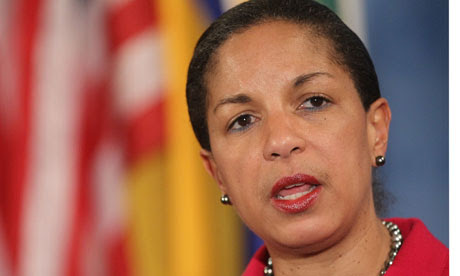
SUSAN RICE (United States) said that today, the Council had responded to the Libyan peoples’ cry for help.  The Council’s purpose was clear: to protect Libyan civilians.  The Council had adopted an earlier resolution that had sent a strong message, but Colonel Qadhafi and those that still stood by him had continued to grossly and systematically violate the most fundamental rights of the Libyan people.  The Arab League had subsequently called on the Council to take more stringent measures, and the current resolution was an answer to that call, as well as a strong response to the situation in the ground.


She said the Security Council had authorized the use of force, including enforcement of a no-fly zone, to protect civilians and civilian areas targeted by Colonel Qadhafi, his allied forces and mercenaries.  The text also tightened measures already approved under resolution 1970 (2011).  In addition, it established a panel of experts to monitor short- and long-term implementation of the sanctions.  She stressed that the future of Libya should be decided by the Libyan people.  The United States stood with the people of Libya in their struggle to exercise their fundamental rights.


MANJEEV SINGH PURI ( India), explaining his abstention, expressed great concern over the welfare of the population of Libya and supported the appointment of the Secretary-General’s Envoy.  The report of that Envoy and that of others had not yet been received.  As a consequence, today’s resolution was based on very little clear information, including a lack of certainty regarding who was going to enforce the measures.  There must be certainty that negative outcomes were not likely before such wide-ranging measures were adopted.  Political efforts must be the priority in resolving the situation.


MARIA LUIZA RIBERIO VIOTTI (Brazil) said her delegation was deeply concerned about the situation in Libya and regretted that the “strong message” sent by resolution 1970 (2011) had note yet been heeded.  The Brazilian Government had earlier condemned the violence being carried out by Libyan authorities and had called on them to uphold and protect the right of free expression of the protesters and to seek a solution to the crisis through meaningful dialogue.  Her delegation’s vote today should in no way be interpreted as condoning the behaviour of the Libyan authorities or as disregard for the need to protect civilians and respect for their rights.


She said that while Brazil stood in solidarity with all movements in the region expressing their legitimate demands for better governance, and had taken into account the Arab League’s call for strong measures to stop the violence through a no-fly zone, it believed that the resolution contemplated measures that went beyond that call.  “We are not convinced that the use of force as provided for in operative paragraph 4 of the present resolution will lead to the realization of our common objective — the immediate end of violence and the protection of civilians,” she said, adding that Brazil was also concerned that the measures approved today might have the unintended effect of exacerbating the current tensions on the ground and “causing more harm than good to the very same civilians we are committed to protecting”.  No military action alone would succeed in ending the conflict.  Protecting civilians, ensuring lasting settlement and addressing the legitimate demands of Libyan citizens demanded a political process.


IVAN BARBALIĆ (Bosnia and Herzegovina) reiterated his delegation’s grave concern about the rapidly deteriorating situation in Libya.  The Libyan people desperately needed humanitarian assistance, and the unimpeded access of that relief was an absolute necessity.  He called on Libyan authorities to end their violence against the Libyan people and he believed the resolution was an answer to their legitimate call and to the call of regional organizations.


NÉSTOR OSORIO (Colombia) said his delegation was convinced that the purpose of the new resolution was essentially humanitarian and was conducive to bringing about conditions that would lead to the protection of civilians under attack from a regime that had lost all legitimacy.  The Council had acted because the Government, through its actions, had shown that it was not up to protecting and promoting the rights of its people.


Colombia deplored the fact that the measures under resolution 1970 (2011) had not been heeded. It was also concerned that the current text had not been adopted unanimously. Colombia believed that the best way to ratchet up the pressure on the Qadhafi regime was to impose a no-fly zone, as called for by the League of Arab States.  The grave situation on the ground made it clear that all conditions were present for the Council to enact further measures and tighten the sanctions approved under resolution 1970 (2011).


VITALY CHURKIN (Russian Federation) said he had abstained, although his country’s position opposing violence against civilians in Libya was clear.  Work on the resolution was not in keeping with Security Council practice, with many questions having remained unanswered, including how it would be enforced and by whom, and what the limits of engagement would be.  His country had not prevented the adoption of the resolution, but he was convinced that an immediate ceasefire was the best way to stop the loss of life.  His country, in fact, had pressed earlier for a resolution calling for such a ceasefire, which could have saved many additional lives.  Cautioning against unpredicted consequences, he stressed that there was a need to avoid further destabilization in the region.


JOSÉ FILIPE MORAES CABRAL (Portugal) said his country had voted in favour of the text because the attacks against civilians had continued after the passage of the last Council resolution, and conditions were deteriorating.  He affirmed that today’s resolution addressed his country’s priorities, including protecting civilians, facilitation of unimpeded humanitarian aid, promotion of a national dialogue and guarantees for the territorial integrity and independence of Libya.  He supported all diplomatic efforts to resolve the situation.


U. JOY OGWU (Nigeria) said the resolution had been necessitated by the persistently grave and dire situation in Libya.  “The current State of affairs leaves an indelible imprint on the conscience and compels us to act,” she said, adding that her delegation’s persistent calls for peace were rooted in the need to ensure the protection of civilians and the delivery of humanitarian assistance to those most in need, many of whom were Nigerian nationals.  The League of Arab States and the African Union had spoken with one voice in condemnation of the situation in Libya.


She said that while her delegation had supported the current text, it also believed that foreign occupation was not an option to ensure peace.  Nigeria supported language in the current text that negated that possibility.  Nigeria was also encouraged by the fact that the political path to a solution was endorsed in the text.  “Today, we have sent an unequivocal message to the Libyan people that the dignity and safety of every man woman and child is paramount,” she said, adding that when the fate of innocent civilians was in question, the international community, undaunted, must be ready to respond.


BASO SANGQU (South Africa) said his delegation was deeply concerned by what was fast becoming a civil war in Libya.  He hoped it could be resolved in a peaceful manner, according to the will of the Libyan people.  Any solution must also preserve the solidarity and integrity of Libya and, as such, South Africa supported the dispatch by the African Union of a special mission to the country.  He encouraged that mission to work closely with the Secretary-General’s newly appointed Special Envoy on finding a peaceful solution.


He said that South Africa regretted that the Council’s previous resolution had not been heeded and believed that by adopting the current text, the Council had acted responsibly to answer the call of Libyan people.  It would also speed humanitarian assistance to those that needed it most.  He hoped the letter and spirit of the present resolution would be implemented in full.


Security Council President LI BAODONG (China), speaking in his national capacity, said that the continuing deterioration of the situation in Libya was of great concern to China.  However, the United Nations Charter must be respected and the current crisis must be ended through peaceful means.  China was always against the use of force when those means were not exhausted.  His delegation had asked specific questions that failed to be answered and, therefore, it had serious difficulty with the resolution.  It had not blocked the passage of the resolution, however, because it attached great importance to the requests of the Arab League and the African Union.  At the same time, he supported the efforts of the Secretary-General’s Envoy to resolve the situation by peaceful means.


Resolution


The full text of resolution 1973 (2011) reads as follows:


The Security Council,


Recalling its resolution 1970 (2011) of 26 February 2011,


Deploring the failure of the Libyan authorities to comply with resolution 1970 (2011),


Expressing grave concern at the deteriorating situation, the escalation of violence, and the heavy civilian casualties,


Reiterating the responsibility of the Libyan authorities to protect the Libyan population and reaffirming that parties to armed conflicts bear the primary responsibility to take all feasible steps to ensure the protection of civilians,


Condemning the gross and systematic violation of human rights, including arbitrary detentions, enforced disappearances, torture and summary executions,


Further condemning acts of violence and intimidation committed by the Libyan authorities against journalists, media professionals and associated personnel and urging these authorities to comply with their obligations under international humanitarian law as outlined in resolution 1738 (2006),


Considering that the widespread and systematic attacks currently taking place in the Libyan Arab Jamahiriya against the civilian population may amount to crimes against humanity,


Recalling paragraph 26 of resolution 1970 (2011) in which the Council expressed its readiness to consider taking additional appropriate measures, as necessary, to facilitate and support the return of humanitarian agencies and make available humanitarian and related assistance in the Libyan Arab Jamahiriya,


Expressing its determination to ensure the protection of civilians and civilian populated areas and the rapid and unimpeded passage of humanitarian assistance and the safety of humanitarian personnel,


Recalling the condemnation by the League of Arab States, the African Union and the Secretary-General of the Organization of the Islamic Conference of the serious violations of human rights and international humanitarian law that have been and are being committed in the Libyan Arab Jamahiriya,


Taking note of the final communiqué of the Organization of the Islamic Conference of 8 March 2011, and the communiqué of the Peace and Security Council of the African Union of 10 March 2011 which established an ad hoc High-Level Committee on Libya,


Taking note also of the decision of the Council of the League of Arab States of 12 March 2011 to call for the imposition of a no-fly zone on Libyan military aviation, and to establish safe areas in places exposed to shelling as a precautionary measure that allows the protection of the Libyan people and foreign nationals residing in the Libyan Arab Jamahiriya,


Taking note further of the Secretary-General’s call on 16 March 2011 for an immediate ceasefire,


Recalling its decision to refer the situation in the Libyan Arab Jamahiriya since 15 February 2011 to the Prosecutor of the International Criminal Court, and stressing that those responsible for or complicit in attacks targeting the civilian population, including aerial and naval attacks, must be held to account,


Reiterating its concern at the plight of refugees and foreign workers forced to flee the violence in the Libyan Arab Jamahiriya, welcoming the response of neighbouring States, in particular Tunisia and Egypt, to address the needs of those refugees and foreign workers, and calling on the international community to support those efforts,


Deploring the continuing use of mercenaries by the Libyan authorities,


Considering that the establishment of a ban on all flights in the airspace of the Libyan Arab Jamahiriya constitutes an important element for the protection of civilians as well as the safety of the delivery of humanitarian assistance and a decisive step for the cessation of hostilities in Libya,


Expressing concern also for the safety of foreign nationals and their rights in the Libyan Arab Jamahiriya,


Welcoming the appointment by the Secretary General of his Special Envoy to Libya, Mr. Abdul Ilah Mohamed Al-Khatib and supporting his efforts to find a sustainable and peaceful solution to the crisis in the Libyan Arab Jamahiriya,


Reaffirming its strong commitment to the sovereignty, independence, territorial integrity and national unity of the Libyan Arab Jamahiriya,


Determining that the situation in the Libyan Arab Jamahiriya continues to constitute a threat to international peace and security,


Acting under Chapter VII of the Charter of the United Nations,


“1.   Demands the immediate establishment of a ceasefire and a complete end to violence and all attacks against, and abuses of, civilians;


“2.   Stresses the need to intensify efforts to find a solution to the crisis which responds to the legitimate demands of the Libyan people and notesthe decisions of the Secretary-General to send his Special Envoy to Libya and of the Peace and Security Council of the African Union to send its ad hoc High-Level Committee to Libya with the aim of facilitating dialogue to lead to the political reforms necessary to find a peaceful and sustainable solution;


“3.   Demands that the Libyan authorities comply with their obligations under international law, including international humanitarian law, human rights and refugee law and take all measures to protect civilians and meet their basic needs, and to ensure the rapid and unimpeded passage of humanitarian assistance;


Protection of civilians


“4.   Authorizes Member States that have notified the Secretary-General, acting nationally or through regional organizations or arrangements, and acting in cooperation with the Secretary-General, to take all necessary measures, notwithstanding paragraph 9 of resolution 1970 (2011), to protect civilians and civilian populated areas under threat of attack in the Libyan Arab Jamahiriya, including Benghazi, while excluding a foreign occupation force of any form on any part of Libyan territory, and requests the Member States concerned to inform the Secretary-General immediately of the measures they take pursuant to the authorization conferred by this paragraph which shall be immediately reported to the Security Council;


“5.   Recognizes the important role of the League of Arab States in matters relating to the maintenance of international peace and security in the region, and bearing in mind Chapter VIII of the Charter of the United Nations, requests the Member States of the League of Arab States to cooperate with other Member States in the implementation of paragraph 4;


No-fly zone


“6.   Decides to establish a ban on all flights in the airspace of the Libyan Arab Jamahiriya in order to help protect civilians;


“7.   Decides further that the ban imposed by paragraph 6 shall not apply to flights whose sole purpose is humanitarian, such as delivering or facilitating the delivery of assistance, including medical supplies, food, humanitarian workers and related assistance, or evacuating foreign nationals from the Libyan Arab Jamahiriya, nor shall it apply to flights authorised by paragraphs 4 or 8, nor other flights which are deemed necessary by States acting under the authorization conferred in paragraph 8 to be for the benefit of the Libyan people, and that these flights shall be coordinated with any mechanism established under paragraph 8;


“8.   Authorizes Member States that have notified the Secretary-General and the Secretary-General of the League of Arab States, acting nationally or through regional organizations or arrangements, to take all necessary measures to enforce compliance with the ban on flights imposed by paragraph 6 above, as necessary, and requests the States concerned in cooperation with the League of Arab States to coordinate closely with the Secretary General on the measures they are taking to implement this ban, including by establishing an appropriate mechanism for implementing the provisions of paragraphs 6 and 7 above,


“9.   Calls upon all Member States, acting nationally or through regional organizations or arrangements, to provide assistance, including any necessary overflight approvals, for the purposes of implementing paragraphs 4, 6, 7 and 8 above;


“10.  Requests the Member States concerned to coordinate closely with each other and the Secretary-General on the measures they are taking to implement paragraphs 4, 6, 7 and 8 above, including practical measures for the monitoring and approval of authorised humanitarian or evacuation flights;


“11.  Decides that the Member States concerned shall inform the Secretary-General and the Secretary-General of the League of Arab States immediately of measures taken in exercise of the authority conferred by paragraph 8 above, including to supply a concept of operations;


“12.  Requests the Secretary-General to inform the Council immediately of any actions taken by the Member States concerned in exercise of the authority conferred by paragraph 8 above and to report to the Council within 7 days and every month thereafter on the implementation of this resolution, including information on any violations of the flight ban imposed by paragraph 6 above;


Enforcement of the arms embargo


“13.  Decides that paragraph 11 of resolution 1970 (2011) shall be replaced by the following paragraph : “Calls upon all Member States, in particular States of the region, acting nationally or through regional organisations or arrangements, in order to ensure strict implementation of the arms embargo established by paragraphs 9 and 10 of resolution 1970 (2011), to inspect in their territory, including seaports and airports, and on the high seas, vessels and aircraft bound to or from the Libyan Arab Jamahiriya, if the State concerned has information that provides reasonable grounds to believe that the cargo contains items the supply, sale, transfer or export of which is prohibited by paragraphs 9 or 10 of resolution 1970 (2011) as modified by this resolution, including the provision of armed mercenary personnel, calls upon all flag States of such vessels and aircraft to cooperate with such inspections and authorises Member States to use all measures commensurate to the specific circumstances to carry out such inspections”;


“14.  Requests Member States which are taking action under paragraph 13 above on the high seas to coordinate closely with each other and the Secretary-General and further requests the States concerned to inform the Secretary-General and the Committee established pursuant to paragraph 24 of resolution 1970 (2011) (“the Committee”) immediately of measures taken in the exercise of the authority conferred by paragraph 13 above;


“15.  Requires any Member State whether acting nationally or through regional organisations or arrangements, when it undertakes an inspection pursuant to paragraph 13 above, to submit promptly an initial written report to the Committee containing, in particular, explanation of the grounds for the inspection, the results of such inspection, and whether or not cooperation was provided, and, if prohibited items for transfer are found, further requires such Member States to submit to the Committee, at a later stage, a subsequent written report containing relevant details on the inspection, seizure, and disposal, and relevant details of the transfer, including a description of the items, their origin and intended destination, if this information is not in the initial report;


“16.  Deplores the continuing flows of mercenaries into the Libyan Arab Jamahiriya and calls upon all Member States to comply strictly with their obligations under paragraph 9 of resolution 1970 (2011) to prevent the provision of armed mercenary personnel to the Libyan Arab Jamahiriya;


Ban on flights


“17.  Decides that all States shall deny permission to any aircraft registered in the Libyan Arab Jamahiriya or owned or operated by Libyan nationals or companies to take off from, land in or overfly their territory unless the particular flight has been approved in advance by the Committee, or in the case of an emergency landing;


“18.  Decides that all States shall deny permission to any aircraft to take off from, land in or overfly their territory, if they have information that provides reasonable grounds to believe that the aircraft contains items the supply, sale, transfer, or export of which is prohibited by paragraphs 9 and 10 of resolution 1970 (2011) as modified by this resolution, including the provision of armed mercenary personnel, except in the case of an emergency landing;


Asset freeze


“19.  Decides that the asset freeze imposed by paragraph 17, 19, 20 and 21 of resolution 1970 (2011) shall apply to all funds, other financial assets and economic resources which are on their territories, which are owned or controlled, directly or indirectly, by the Libyan authorities, as designated by the Committee, or by individuals or entities acting on their behalf or at their direction, or by entities owned or controlled by them, as designated by the Committee, and decides further that all States shall ensure that any funds, financial assets or economic resources are prevented from being made available by their nationals or by any individuals or entities within their territories, to or for the benefit of the Libyan authorities, as designated by the Committee, or individuals or entities acting on their behalf or at their direction, or entities owned or controlled by them, as designated by the Committee, and directs the Committee to designate such Libyan authorities, individuals or entities within 30 days of the date of the adoption of this resolution and as appropriate thereafter;


“20.  Affirms its determination to ensure that assets frozen pursuant to paragraph 17 of resolution 1970 (2011) shall, at a later stage, as soon as possible be made available to and for the benefit of the people of the Libyan Arab Jamahiriya;


“21.  Decides that all States shall require their nationals, persons subject to their jurisdiction and firms incorporated in their territory or subject to their jurisdiction to exercise vigilance when doing business with entities incorporated in the Libyan Arab Jamahiriya or subject to its jurisdiction, and any individuals or entities acting on their behalf or at their direction, and entities owned or controlled by them, if the States have information that provides reasonable grounds to believe that such business could contribute to violence and use of force against civilians;


Designations


“22.  Decides that the individuals listed in Annex I shall be subject to the travel restrictions imposed in paragraphs 15 and 16 of resolution 1970 (2011), and decides further that the individuals and entities listed in Annex II shall be subject to the asset freeze imposed in paragraphs 17, 19, 20 and 21 of resolution 1970 (2011);


“23.  Decides that the measures specified in paragraphs 15, 16, 17, 19, 20 and 21 of resolution 1970 (2011) shall apply also to individuals and entities determined by the Council or the Committee to have violated the provisions of resolution 1970 (2011), particularly paragraphs 9 and 10 thereof, or to have assisted others in doing so;


Panel of Experts


“24.  Requests the Secretary-General to create for an initial period of one year, in consultation with the Committee, a group of up to eight experts (“Panel of Experts”), under the direction of the Committee to carry out the following tasks:


(a)   Assist the Committee in carrying out its mandate as specified in paragraph 24 of resolution 1970 (2011) and this resolution;


(b)   Gather, examine and analyse information from States, relevant United Nations bodies, regional organisations and other interested parties regarding the implementation of the measures decided in resolution 1970 (2011) and this resolution, in particular incidents of non-compliance;


(c)   Make recommendations on actions the Council, or the Committee or State, may consider to improve implementation of the relevant measures;


(d)   Provide to the Council an interim report on its work no later than 90 days after the Panel’s appointment, and a final report to the Council no later than 30 days prior to the termination of its mandate with its findings and recommendations;


“25.  Urges all States, relevant United Nations bodies and other interested parties, to cooperate fully with the Committee and the Panel of Experts, in particular by supplying any information at their disposal on the implementation of the measures decided in resolution 1970 (2011) and this resolution, in particular incidents of non-compliance;


“26.  Decides that the mandate of the Committee as set out in paragraph 24 of resolution 1970 (2011) shall also apply to the measures decided in this resolution;


“27.  Decides that all States, including the Libyan Arab Jamahiriya, shall take the necessary measures to ensure that no claim shall lie at the instance of the Libyan authorities, or of any person or body in the Libyan Arab Jamahiriya, or of any person claiming through or for the benefit of any such person or body, in connection with any contract or other transaction where its performance was affected by reason of the measures taken by the Security Council in resolution 1970 (2011), this resolution and related resolutions;


“28.  Reaffirms its intention to keep the actions of the Libyan authorities under continuous review and underlines its readiness to review at any time the measures imposed by this resolution and resolution 1970 (2011), including by strengthening, suspending or lifting those measures, as appropriate, based on compliance by the Libyan authorities with this resolution and resolution 1970 (2011);


“29.  Decides to remain actively seized of the matter.”


Libya: United Nations Security Council proposed designations


Number

Name

Justification

Identifiers

Annex I: Travel Ban


1

QUREN SALIH QUREN AL QADHAFI

Libyan Ambassador to Chad. Has left Chad for Sabha. Involved directly in recruiting and coordinating mercenaries for the regime.


2

Colonel AMID HUSAIN AL KUNI

Governor of Ghat (South Libya). Directly involved in recruiting mercenaries.


Annex II: Asset Freeze

1

Dorda, Abu Zayd Umar

Position: Director, External Security Organisation 


2

Jabir, Major General AbuBakr Yunis

Position: Defence Minister 

Title: Major General DOB: --/--/1952. POB: Jalo, Libya

3

Matuq, MatuqMohammed

Position: Secretary for Utilities 

DOB: --/--/1956. POB: Khoms 

4

Qadhafi, Mohammed Muammar

Son of Muammar Qadhafi. Closeness of association with regime

DOB: --/--/1970. POB: Tripoli, Libya 

5

Qadhafi, Saadi

Commander Special Forces. Son of Muammar Qadhafi. Closeness of association with regime. Command of military units involved in repression of demonstrations

DOB: 25/05/1973. POB: Tripoli, Libya 

6

Qadhafi, Saif al‑Arab

Son of Muammar Qadhafi. Closeness of association with regime

DOB: --/--/1982. POB: Tripoli, Libya 

7

Al‑Senussi, Colonel Abdullah

Position: Director Military Intelligence 

Title: Colonel DOB: --/--/1949. POB: Sudan 

Entities

1

Central Bank of Libya

Under control of Muammar Qadhafi and his family, and potential source of funding for his regime.


2

Libyan Investment Authority

Under control of Muammar Qadhafi and his family, and potential source of funding for his regime.

a.k.a: Libyan Arab Foreign Investment Company (LAFICO) Address: 1 FatehTower Office, No 99 22nd Floor,Borgaida Street, Tripoli, Libya, 1103

3

Libyan Foreign Bank

Under control of Muammar Qadhafi and his family and a potential source of funding for his regime.


4

Libyan Africa Investment Portfolio

Under control of Muammar Qadhafi and his family, and potential source of funding for his regime.

Address: Jamahiriya Street, LAP Building, PO Box 91330, Tripoli, Libya 

5

Libyan National Oil Corporation

Under control of Muammar Qadhafi and his family, and potential source of funding for his regime.

Address: Bashir Saadwi Street, Tripoli,Tarabulus, Libya


* *** *


For information media • not an official record


<<<<<<<<<<<<<<<<<<<<<<<<<<<<<<<<<<<<<<<<<<<<<<<

Libya resolution: UN security council air strikes vote - as it happened

• UN security council approves Libya military action
• US and Britain support air strikes to protect civilians
• Gaddafi declares: 'There will be no mercy' in Benghazi
• Qatar and UAE governments may add forces

Read the Guardian's latest news coverage

UN security council vote for a no-fly zone over Libya
UN security council vote for a no-fly zone over Libya. Photograph: Stan Honda/AFP/Getty Images

 The UN security council will shortly start its proceedings for a vote on a resolution supporting military action against the Gaddafi regime in Libya. Here's the Guardian's latest coveragereporting today's meeting:

Britain, France and the US, along with several Arab countries, are to join forces to throw a protective ring around the Libyan rebel stronghold of Benghazi as soon as a UN security council vote on military action is authorised, according to security council sources.

We'll be following the UN security council debate, final vote and reactions here as it happens. With France's air force said to be ready to fly missions over Libya within hours of a resolution, we'll be watching what happens in the air and on the ground in Libya, as well as input from the Guardian's correspondents and other international responses.

A live webcast of the security council meeting can be watched here – and of course we welcome comments below.

 Security council members are milling about in the chamber – with the big question being, how will the votes go?

The Guardian's Luke Harding spoke with Germany's foreign minister Guido Westerwelle, and he sounded hostile:

Westerwelle warned the results of western military intervention were "unpredictable" and could have consequences for freedom movements in the Arab world.

"Your own instinct is to say 'We have to do something.' But military intervention is to take part in a civil war that could go on for a long time.

"Germany has a strong friendship with our European partners. But we won't take part in any military operation and I will not send German troops to Libya."

From the sound of those comments, Germany is likely to abstain tonight – but will Angela Merkel want Germany to be out of step with the rest of Europe on this?

 Nine votes are needed tonight for the Libya resolution to pass the security council – the Guardian's Ewen MacAskill thinks it will be 10 for, with five abstentions:

Voting for the resolution

Permanent members: United States, Britain, France
Non-permanent members:: Bosnia and Herzegovina, Colombia, Gabon, Lebanon, Nigeria, Portugal, South Africa

Abstentions

Permanent members: Russia, China
Non-permanent members: Germany, Brazil, India

 Finally, the meeting is called to order, and the agenda is adopted. In these situations the UN security council appears to be something like a council meeting, all agendas and points of order.

The first speaker to introduce the resoltuion is Alain Juppé, the great survivor of French politics now back as minister of foreign affairs after the resignation of Michèle Alliot-Marie, who famously went on holiday for in Tunisia during the protests there.

Juppé is careful to mention that the idea of a no-fly zone is endorsed by many governments in the region, including the Arab League, and urges the adoption of the resolution.

"We are ready and willing to act together with members, including the Arab members," Juppé tells the council, concluding:

"Each day, each hour, increases the weight on our shoulders. We must not wait."

 No other members wish to speak.

The resolution is being put to the vote now. That's very quick moving by the security council.

 Here's the result: 10 in favour, zero against, five abstentions. So the vote went exactly as predicted. "The resolution 1973/2011 is adopted.," says the chairman.

Now there are more statements. Lebanon to speak first.

 Muammar Gaddafi has already made his feelings known, telling the Portuguese TV channel RTP that the UN resolution was an act of "flagrant colonization" for which it had no legal mandate:

This is craziness, madness, arrogance. If the world gets crazy with us we will get crazy too. We will respond. We will make their lives hell because they are making our lives hell. They will never have peace.

There we are: Muammar Gaddafi threatens to "get crazy".

 Now the UK's representative, Ambassador Mark Lyall Grant, is addressing the council:

The Libyan population want the same rights and freedoms that people all across North Africa are demanding.

 The US is preparing to participate in a no-fly zone in Libya "within a few days" with the help of Arab countries, AP reports:

[Congressional] officials said they expected the effort to enforce a no-fly zone and ground Muammar Gaddafi's air force could begin within a few days if the UN takes action by day's end.

They spoke after a briefing for members of the Senate.

One official said Jordan, Qatar and the United Arab Emirates were among possible participants, in a showing designed to demonstrate that the effort to aid anti-Gadhafi rebels had support from other countries in the region.

United Nations Continues Work Towards Imposing No Fly Zone For LibyaUS Ambassador to the United Nations, Susan Rice. Photograph: Mario Tama/Getty Images

 The US's UN ambassador Susan Rice now speaking to the council: "Today the Security Council has responded to the Libyan people's cry for help."

Colonel Gaddafi and those who still stand by him continue to grossly and systematically abuse the most fundamental of the human rights of his people.

Benghazi now throwing what's probably the biggest party in its recent history. #Libyaless than a minute ago via TweetDeckIyad El-Baghdadi
iyad_elbaghdadi


 Blogger Iyad El-Baghdadi – based in Dubai – is watching the scenes of celebration in Benghazi.

 Here's the Guardian's first take on tonight's UN security council vote and what it means:

British, French and US military aircraft are preparing to protect the Libyan rebel stronghold of Benghazi after the United Nations security council voted in favour of a no-fly zone and air strikes against Muammar Gaddafi's forces.

With Gaddafi's troops closing in on Benghazi, the French prime minister, Francois Fillon, said "time is of the essence" and that France would support military action set to take place within hours.

Jets could take off from French military bases along the Mediterranean coast, about 750 miles from Libya. Several Arab countries would join the operation.

Libyans celebrate UN no fly zone resolutionLibyans in Benghazi after the UN Security Council's resolution is passed. Photograph: Patrick Baz/AFP/Getty Images

 There's some very impressive singing in central Benghazi, accompanied by celebratory gunfire, right now, based on al-Jazeera's footage.

An al-Jazeera English reporter, Tony Birtley, later says: "I haven't been hugged by so many people since my daughter's birthday party."

 US enforcement of a no-fly zone in Libya could begin by Sunday or Monday, according to anonymous US officials quoted by AP, and would involve "jet fighters, bombers and surveillance aircraft".

 Italy announces it is opening its air force and naval bases in Sicily for operations against Libya – the obvious spot to base US and British jets.

The Berlusconi government may have had relatively warm relations with Libya, but Italy's Nato obligations gave it little choice but to allow other members to use its bases.

 So what happens next? A meeting of Nato ministers, for example, but the organisation has already drawn up plans for a no-fly zone so that shouldn't take very long.

 The UN resolution just passed by the security council is eight pages long but the key part is point four, "Protection of civilians," which states:

Authorizes Member States that have notified the Secretary-General, acting nationally or through regional organizations or arrangements, and acting in cooperation with the Secretary-General, to take all necessary measures ... to protect civilians and civilian populated areas under threat of attack in the Libyan Arab Jamahiriya, including Benghazi, while excluding a foreign occupation force of any form on any part of Libyan territory, and requests the Member States concerned to inform the Secretary-General immediately of the measures they take pursuant to the authorization conferred by this paragraph which shall be immediately reported to the Security Council

The phrase "take all necessary measures" means this is more than a no-fly zone: it allows air strikes and any military action short of landing troops ("excluding a foreign occupation force of any form") – such as attacking tanks on the road to Benghazi.

 Not all Libyans are delighted by the news of the UN's authorisation of military action. AP has this quote:

In contrast, a dentist in the capital of Tripoli rejected the measure. "You are in fact protecting people carrying weapons against the official forces. This is nonsense," said Mohammed Salah, 33.

 Some reaction from British policy makers:

 Foreign secretary William Hague said the UN resolution was necessary "to avoid greater bloodshed and to try to stop what is happening in terms of attacks on civilians".

This places a responsibility on members of the United Nations and that is a responsibility to which the United Kingdom will now respond.

 Former Conservative defence secretary Malcolm Rifkind, on Newsnight, described the UN vote as "the action the world is waiting for":

I'm absolutely delighted. Without action of this kind, Benghazi would have been a bloodbath. By the standards of the last 20 years, this is a remarkable vote. This is a tremendous morale booster for Libyans, not just in Benghazi.

 Full text of the UN resolution is right here.

Here are the key points in the document:

• "the immediate establishment of a cease-fire and a complete end to violence and all attacks against, and abuses of, civilians."

• authorizes UN member states "to take all necessary measures ... to protect civilians and civilian populated areas under threat of attack in the Libyan Arab Jamahiriya, including Benghazi, while excluding a foreign occupation force of any form on any part of Libyan territory."

• establishes a "ban on all flights in the airspace of the Libyan Arab Jamahiriya in order to help protect civilians," but allows humanitarian flights and flights sanctioned by the UN and the Arab League.

• orders members states to stop any Libyan owned, operated or registered aircraft from taking off, landing or overflying their territory without prior approval from the UN committee monitoring sanctions.

• allows member states "to inspect in their territory, including airports and seaports, and on the high seas, vessels and aircraft bound to or from" Libya if the country has "reasonable grounds" to believe they contain military items or armed mercenaries.

• freezes assets of five financial institutions: Libya's central bank, the Libyan Investment Authority, the Libyan Foreign Bank, Libyan Africa Investment Portfoilio, and the Libyan National Oil Corporation.

 A Libyan official from Gaddafi's government, Khalid Kaim, deputy foreign minister, is addressing journalists in Tripoli, and apologises for waking them up, since it's 1.30am there.

He begins by thanking the UN security council members who abstained, especially Germany, which seemed to amuse him for some reason.

It's a string of bland statements, which complains about the "technical details of such a decision" and says the government will need to study the final text before making a response.

Kaim does say that UN security council members needed to be careful about intervening in an internal matter, and accused the resolution of threatening the unity of Libya and that any country arming the rebels was "inviting Libyans to kill each other".

 The regime's press conference in Tripoli is interrupted. "Don't worry guys, it's just some demonstrators," says the deputy foreign minister, explaining that this is a spontaneous show of support for Gaddafi by ordinary Libyans. At 1.30am in a hotel.

In any case, the tone is very different to the earlier comments by Gaddafi today vowing "no mercy" in Benghazi.

Nick Watt

 The Guardian's UK politics correspondent Nick Watt reports on David Cameron's change of plans in the wake of tonight's UN vote:

The prime minister has ripped up his diary for Friday to hold an emergency cabinet on Libya in the morning. He will then make a statement to MPs in the Commons on Friday.

 Mohammed Abdel Malek, chairman of Libya Watch based in London, said: "I think that the West can rest assured that they did the right moral thing.... It is a little bit late but it's not too late."

He said the west should recognise the transitional national council in Benghazi as the only way to bring about effective action on the ground.

Libyan rebels parade with their guns inLibyan rebels parade their guns in Tobruk, as Gaddafi's forces continue to advance towards Benghazi. Photograph: Patrick Baz/AFP/Getty Images

 The Wall Street Journal reports that Egypt's military has begun shipping arms over the border to Libyan rebels with Washington's knowledge, in a well-timed story:

The shipments – mostly small arms such as assault rifles and ammunition – appear to be the first confirmed case of an outside government arming the rebel fighters. Those fighters have been losing ground for days in the face of a steady westward advance by forces loyal to Libyan leader Moammar Gadhafi.

Further down:

"We know the Egyptian military council is helping us, but they can't be so visible," said Hani Souflakis, a Libyan businessman in Cairo who has been acting as a rebel liaison with the Egyptian government since the uprising began.

"Weapons are getting through," said Mr Souflakis, who says he has regular contacts with Egyptian officials in Cairo and the rebel leadership in Libya. "Americans have given the green light to the Egyptians to help. The Americans don't want to be involved in a direct level, but the Egyptians wouldn't do it if they didn't get the green light."

 British politician Sir Menzies Campbell, a Liberal Democrat member of the foreign affairs committee, told Sky News: "I don't think there is any appetite for putting troops on the ground."

Campbell said UK forces were already overstretched, and suggested that the main military action would be "combat air patrols, regular patrolling of airspace" to block air strikes by Gaddafi's forces.

 Libyan state television has yet to mention the UN security council vote, according to al-Jazeera.

 So when will Nato planes be seen over the skies of Libya. Not long, perhaps, according to AP:

In Britain, a lawmaker with knowledge of defense matters confirmed that British forces were on stand by for air strikes and could be mobilised as soon as Thursday night. The lawmaker declined to be named because the Defense Ministry has not issued official confirmation.

French Prime Minister Francois Fillon told France-2 Television that if the resolution was approved France would support military action against Gaddafi within a matter of hours.

 My colleague David Batty in London looks at the front page headlines of the British national newspapers on Friday:

 The Guardian: Britain, France and US line up for air strikes against Gaddafi

 The Sun: War on Gaddafi

 Financial Times: US joins push for UN action on Libya

 The Times: US set to lead allied attack on Gaddafi

 The Independent: Gaddafi: now it's a fight to the death

 Canada, in an atypical display of aggression, has quickly pledged six CF-18 fighter jets to help impose the no-fly zone in Libya.

I applaud UN Security Council for "authorizing all necessary measures" to impose a no-fly zone in#Libya & protect civilians under attackless than a minute ago via webJohn McCain
SenJohnMcCain

 Republican Senator John McCain applauds the Obama administration's decision to support military action in Libya.

 All the talk of warplanes being in the skies of Libya tonight appears to be somewhat overheated – see the 8.34pm post – and being disputed by US and Nato sources.

 The official Libyan state news agency JANA has issued a response to the UN vote, with dire warnings of military reprisals:

Any foreign military act against Libya will expose all air and maritime traffic in the Mediterranean Sea to danger and civilian and military facilities will become targets of Libya's counter attack. The Mediterranean basin will face danger not just in the short term, but also in the long term.

 President Obama held a conference call this evening with David Cameron and Nicolas Sarkozy to agree on enforcement of the UN resolution.

The trio agreed to co-ordinate closely on the next steps, and to continue working with Arab and other international partners to ensure the enforcement of the UN resolutions.

Libyan rebels direct people fleeing Benghazi as government troops move towards the eastern city.Libyan rebels direct people fleeing Benghazi as government troops move towards the eastern city. Photograph: Patrick Baz/AFP/Getty Images

 We're wrapping up our live coverage of the UN vote and its consequences – but the Guardian's coverage will continue later on Friday morning.

Here is a round-up of the developments tonight at the UN and in Libya:

 The UN security council approved Libya resolution by a 10-5 vote. Permanent council members China and Russia both abstained along with Germany, while the US, Britain, Lebanon and France voted in favour of military action

 Resolution 1973/2011 allows states wide latitude to take "all necessary measures" – short of an occupation force – to protect civilians within in Libya

 News of the UN decision was greeted with scenes of jubilation on the streets of Benghazi, amid singing and gunfire. The Gaddafi regime issued a statement threatening "danger not just in the short term, but also in the long term" for foreign military acts

 David Cameron calls an emergency cabinet meeting for Friday morning and plans on making a statement to parliament

 There are reports that Egypt's military is allowing a flow of arms to the Libyan rebels, with the tacit approval of the US

 Barack Obama, Nicolas Sarkozy and Cameron held a conference call after the vote, and agreed to co-ordinate enforcing the UN resolution

 Jordan, Qatar and the United Arab Emirates may supply forces to help police the no-fly measure


H.E. KUM Nelson Bame IV

unread,
Jan 17, 2013, 7:56:10 PM1/17/13
to cameroon...@yahoogroups.com, camero...@yahoogroups.com, camne...@yahoogroups.com, african...@yahoogroups.com, afric...@yahoogroups.com, african...@yahoogroups.com, Menchum Worldwide, WECUD...@yahoogroups.com, Nigerian Politics, African...@yahoogroups.com, Afric...@yahoogroups.com, ub_a...@yahoogroups.com, UB_A...@yahoogroups.com, MENF...@yahoogroups.com, cameroons...@yahoogroups.com

Upon His Old Age, the Rev Dr. Sun Myung Moon, as the prophesied Lord of the Second Advent, working with the True Jesus Christ, commissioned his Youngest Son
to Head the match forward for Peace and International Relations both for the Church, the Tribes, Nations and Economies of the World.  We urge all our friends and Leaders of Nations, Corporations and Organizations Worldwide to Respect His Divine and Conscious WILL and PURPOSE.  And it was Said and written that the Youngest Son shall be the Center of All for God and mankind.


UPF-UK to Hold Annual Genocide Awareness Forum           
 By UPF - UK    
 Thursday, January 17, 2013


London, UK - The annual Genocide Awareness and Holocaust Commemoration forum will take place in a committee room of the British House of Lords on January 23. The focus will range from the ongoing atrocities in the eastern Democratic Republic of Congo to the situation of Kurds, Jews, Armenians, and other people targeted for persecution.

Charlotte Simon will speak about the ongoing tragedy in her native eastern Democratic Republic of Congo, where more than 10 million people have died in the last 40 years in the greed to exploit its mineral wealth. Philomene Uwamaliya, a survivor of such atrocities and a member of the Survivors Speaking Out network, will consider the health care provision for survivors of atrocities and torture in the UK.

A Kurdish Member of Parliament, Mr. Nadhim Zahawi, will comment on the campaign for the recognition of the tragedies of chemical and other attacks on the Kurdistan region of Iraq during the time of Sadaam Hussein's rule. Edwin Shuker, Vice President of the Sephardic Congress and President of Justice for Jews of Arab Countries, will speak on the plight of migrants and displaced people as a consequence of Holocaust, genocide, and conflict situations worldwide. Rev. Dr. Marcus Braybrooke will also comment on the plight of people targeted for persecution.

Ruth Barnett will explain the significance of the Armenian genocide as the first of the 20th century and, sadly, not the last. She will also discuss the treatment of the 'Traveller Community' (a traditionally nomadic people of ethnic Irish origin), who alongside the European Jewish community suffered the Holocaust during World War II.

The UN General Assembly designated January 27 as an international memorial day for the victims of the Holocaust. UPF-UK holds an annual Genocide Awareness and Holocaust Commemoration forum to promote awareness of 'the path to genocide' to assist the identification of future problems before they occur. The Holocaust was the culmination of a series of social, cultural, and political developments that took place over a period of time. UPF's motto of "One Family Under God" signifies the importance of understanding how such atrocities have happened and the determination to strive to prevent reoccurrences.

For more information, contact Robin Marsh and Margaret Ali by email or telephone: 07956 210 768 or 07723024750.


H. E. Prof. KUM Nelson Bame Bame IV,
Ambassador -UPF-UN,  Senior Banker, Manager, Entrepreneur, Engineer
www.bamekum.comwww.bamebame.org, www.bamekum.org, www.bamebame.com

A man does what he must in spite of personal consequences, in spite of obstacles and dangers and pressure -- and that is the basis of all human morality. (JFK)

--- On Thu, 1/17/13, H.E. KUM Nelson Bame IV <nelso...@yahoo.com> wrote:
__._,_.___
.

__,_._,___

H.E. KUM Nelson Bame IV

unread,
Jan 17, 2013, 8:31:57 PM1/17/13
to cameroon...@yahoogroups.com, camero...@yahoogroups.com, camne...@yahoogroups.com, african...@yahoogroups.com, afric...@yahoogroups.com, african...@yahoogroups.com, Menchum Worldwide, WECUD...@yahoogroups.com, Nigerian Politics, African...@yahoogroups.com, Afric...@yahoogroups.com, ub_a...@yahoogroups.com, UB_A...@yahoogroups.com, MENF...@yahoogroups.com, cameroons...@yahoogroups.com

A bird does not sing because it has an answer. It sings because it has a song.


A bit of fragrance clings to the hand that gives flowers.

Chinese Proverb
A book holds a house of gold.

Chinese Proverb
A book is like a garden carried in the pocket.

Chinese Proverb
A book tightly shut is but a block of paper.

Chinese Proverb
A child's life is like a piece of paper on which every person leaves a mark.

Chinese Proverb
A diamond with a flaw is worth more than a pebble without imperfections.

Chinese Proverb
A filthy mouth will not utter decent language.

Chinese Proverb
A fool judges people by the presents they give him.

Chinese Proverb
A gem is not polished without rubbing, nor a man perfected without trials.

Chinese Proverb
A nation's treasure is in its scholars.

Chinese Proverb
A rat who gnaws at a cat's tail invites destruction.

Chinese Proverb
Be not afraid of growing slowly, be afraid only of standing still.

Chinese Proverb
 - More quotations on: [Proverbs]
Be the first to the field and the last to the couch.

Chinese Proverb
Deep doubts, deep wisdom; small doubts, little wisdom.

Chinese Proverb
Dig the well before you are thirsty.

Chinese Proverb
Do good, reap good; do evil, reap evil.

Chinese Proverb
Do not employ handsome servants.

Chinese Proverb
Do not fear going forward slowly; fear only to stand still.

Chinese Proverb
Do not remove a fly from your friend's forehead with a hatchet.

Chinese Proverb
 - More quotations on: [Proverbs]
Don't open a shop unless you like to smile.

Chinese Proverb
Each generation will reap what the former generation has sown.

Chinese Proverb
Give a man a fish and you feed him for a day. Teach a man to fish and you feed him for a lifetime.

Chinese Proverb
 - More quotations on: [Proverbs]
He who asks is a fool for five minutes, but he who does not ask remains a fool forever.

Chinese Proverb
 - More quotations on: [Proverbs]
He who is drowned is not troubled by the rain.

Chinese Proverb
He who strikes the first blow admits he's lost the argument.

Chinese Proverb
 - More quotations on: [Argument]
If heaven made him, earth can find some use for him.

Chinese Proverb
If you are patient in one moment of anger, you will escape a hundred days of sorrow.

If you don't want anyone to know, don't do it.


H. E. Prof. KUM Nelson Bame Bame IV,
Ambassador -UPF-UN,  Senior Banker, Manager, Entrepreneur, Engineer
www.bamekum.comwww.bamebame.org, www.bamekum.org, www.bamebame.com

A man does what he must in spite of personal consequences, in spite of obstacles and dangers and pressure -- and that is the basis of all human morality. (JFK)

--- On Tue, 1/15/13, H.E. KUM Nelson Bame IV <nelso...@yahoo.com> wrote:
Date: Tuesday, January 15, 2013, 3:30 PM

H.E. KUM Nelson Bame IV

unread,
Jan 18, 2013, 5:38:57 PM1/18/13
to cameroon...@yahoogroups.com, camero...@yahoogroups.com, camne...@yahoogroups.com, african...@yahoogroups.com, afric...@yahoogroups.com, african...@yahoogroups.com, Menchum Worldwide, WECUD...@yahoogroups.com, Nigerian Politics, African...@yahoogroups.com, Afric...@yahoogroups.com, ub_a...@yahoogroups.com, UB_A...@yahoogroups.com, MENF...@yahoogroups.com, cameroons...@yahoogroups.com

Don't think you can attain total awareness and whole enlightenment without proper discipline and practice. This is egomania. Appropriate rituals channel your emotions and life energy toward the light. Without the discipline to practice them, you will tumble constantly backward into darkness.
-- Lao-tzu


A scholar who cherishes the love of comfort is not fit to be deemed a scholar.
-- Lao-Tzu

“She does not show herself, and therefore is apparent. She does not affirm herself, and therefore is acknowledged. She does not boast and therefore has merit. She does not strive and therefore is successful. It is exactly because she does not contend, that nobody can contend with her.”
 ― Lao Tzu


Embracing Tao, you become embraced.
Supple, breathing gently, you become reborn.
Clearing your vision, you become clear.
Nurturing your beloved, you become impartial.
Opening your heart, you become accepted.
Accepting the World, you embrace Tao.
Bearing and nurturing,
Creating but not owning,
Giving without demanding,
Controlling without authority,
This is love.”
 ― Lao Tzu, The Teachings of Lao-Tzu: The Tao-Te Ching


“If you are depressed you are living in the past.
If you are anxious you are living in the future.
If you are at peace you are living in the present.”
 ― Lao Tzu

“True words aren't eloquent;
eloquent words aren't true.
Wise men don't need to prove their point;
men who need to prove their point aren't wise.

The Master has no possessions.
The more he does for others,
the happier he is.
The more he gives to others,
the wealthier he is.”
 ― Lao Tzu, Tao Te Ching


“To become learned, each day add something. To become enlightened, each day drop something.”
 ― Lao Tzu


“Heaven and Earth (under its guidance) unite together and send down the sweet dew, which, without the directions of men, reaches equally everywhere as of its own accord.”
 ― Lao Tzu, Tao Te Ching

“Love is of all the passions the strongest, for it attacks simultaneously the head, the heart, and the senses.”
 ― Lao Tzu


There is a time for being ahead,
a time for being behind;
a time for being in motion,
a time for being at rest;
a time for being vigorous,
a time for being exhausted;
a time for being safe,
a time for being in danger.

The Master sees things as they are,
without trying to control them.
She lets them go their own way,
and resides at the center of the circle.”
 ― Lao Tzu, Tao Te Ching

“Scholars of the highest class, when they hear about the Tao, earnestly carry it into practice.”
 ― Lao Tzu, Tao Te Ching

“The excellence of water appears in its benefiting all things, and in its occupying, without striving (to the contrary), the low place which all men dislike.”
 ― Lao Tzu, Tao Te Ching

H. E. Prof. KUM Nelson Bame Bame IV,
Ambassador -UPF-UN,  Senior Banker, Manager, Entrepreneur, Engineer
www.bamekum.comwww.bamebame.org, www.bamekum.org, www.bamebame.com


A man does what he must in spite of personal consequences, in spite of obstacles and dangers and pressure -- and that is the basis of all human morality. (JFK)

H.E. KUM Nelson Bame IV

unread,
Jan 18, 2013, 5:49:52 PM1/18/13
to cameroon...@yahoogroups.com, camero...@yahoogroups.com, camne...@yahoogroups.com, african...@yahoogroups.com, afric...@yahoogroups.com, african...@yahoogroups.com, Menchum Worldwide, WECUD...@yahoogroups.com, Nigerian Politics, African...@yahoogroups.com, Afric...@yahoogroups.com, ub_a...@yahoogroups.com, UB_A...@yahoogroups.com, MENF...@yahoogroups.com, cameroons...@yahoogroups.com

Rape and torture among serious rights violations spawned by Mali crisis – UN report

Displaced children in the Mali capital, Bamako, eat a welcome meal. Photo: UNHCR/H. Caux

18 January 2013 – The ongoing crisis in Mali has led to serious human rights violations, including extrajudicial killings, rape and torture, says a United Nations report released today, which warns that increasing ethnic tensions could have alarming consequences on the North African nation.


The report, released by the Office of the UN High Commissioner for Human Rights (OHCHR), was compiled by a mission deployed to Mali and its neighbouring countries in November, and details how rights violations have been taking place since January 2012, when fighting between Government forces and Tuareg rebels broke out in the country’s north, later resulting in radical Islamists seizing control of the area.

The report shows that the current human rights situation is linked to longstanding and unresolved issues, and that human rights violations have been committed both in the North, and in the area under Government control.


Members of the National Movement for the Liberation of Azawad allegedly used students as human shields to force military forces to surrender and later executed 94 of the 153 captured soldiers. Several Tuareg soldiers were also victims of reprisals by members of the Malian army in the North, who reportedly killed nine soldiers in Timbuktu in February.

The report stresses that women in particular have suffered degrading treatment by extremist groups based on an extreme interpretation of Sharia law. They have suffered from harassment, abuses and sexual violence due to accusations of being improperly veiled or dressed, or for riding a motorbike.


“Rapes of women and girls, at times in front of family members and often apparently carried out on an ethnic basis, have been repeatedly used in the North to intimidate people and break any form of resistance, in a culture where rape is considered as taboo and victims often suffer from social exclusion,” OHCHR spokesperson Rupert Colville told reporters in Geneva, adding that girls as young as 12 or 13 have been forcibly married to radical Islamists and sexually abused.


Other reported human rights violations described in the report include amputations, arbitrary detentions, torture, forced disappearances and the recruitment of child soldiers.

The OHCHR mission highlighted the increasing presence of self-defence militia and expressed alarm at the growing ethnic tensions in Mali, which could also lead to possible acts of revenge against the Tuareg and Arab communities perceived as being linked to the armed groups.


OHCHR called on all parties “to abide by international human rights and humanitarian law standards,” and welcomed the announcement on Wednesday by the Prosecutor of the International Criminal Court (ICC) that she has opened an investigation into the situation in Mali.


“This is an important step for victims of human rights violations, and also sends an important message to perpetrators of human rights violations that they will be held accountable for the crimes committed,” Mr. Colville said.


“We also call for the initiation of a reconciliation process to address current human rights challenges as well as long-standing unresolved issues, and urge the Malian army and its supporters to take extreme care not to carry out further reprisals as and when they retake territory in the North,” he added, reiterating OHCHR’s readiness to assist the Government by supporting the establishment of a transitional justice mechanism to facilitate national reconciliation.


The clashes in the North, as well as the proliferation of armed groups in the region, drought and political instability have uprooted hundreds of thousands of civilians over the course of 2012.


During the same briefing in Geneva, the UN High Commissioner for Refugees (UNHCR) announced that it is reinforcing its resources in the country in anticipation of further new displacement.

UNHCR spokesperson Melissa Fleming said the agency is estimating there will be an additional displacement of 300,000 inside Mali, while a further 407,000 Malians will flee to neighbouring Burkina Faso, Niger and Mauritania.


“In Burkina Faso, we have sent staff from Ouagadougou to monitor the border and to boost assistance in the refugee camps in Burkina’s Sahel administrative region,” Ms. Fleming said.

“The refugees said they fled the recent military intervention, the lack of any means of subsistence, and fear of the strict application of Sharia law. They reported having witnessed executions and amputations, and mentioned that large amounts of money are being offered to civilians to fight against the Malian army and its supporters.”

In Niger, UNHCR continues to provide help to the 52,875 refugees in camps and sites in Mangaize, Banibangou, Ayorou, Abala and Tillia areas.


Meanwhile, the World Food Programme (WFP) said that its presence had been reduced to a minimum in northern Mali due to violence and the limited humanitarian presence, but that it would resume its food distribution as soon as the situation allows it and would continue to explore ways to deliver assistance.


In the meantime, the agency continues to distribute food assistance to internally displaced persons in Bamako, the Malian capital, where it is assisting a total of 12,000 persons in cooperation with its partners.


News Tracker: past stories on this issue

H. E. Prof. KUM Nelson Bame Bame IV,
Ambassador -UPF-UN,  Senior Banker, Manager, Entrepreneur, Engineer
www.bamekum.comwww.bamebame.org, www.bamekum.org, www.bamebame.com

A man does what he must in spite of personal consequences, in spite of obstacles and dangers and pressure -- and that is the basis of all human morality. (JFK)

H.E. KUM Nelson Bame IV

unread,
Jan 18, 2013, 6:04:28 PM1/18/13
to cameroon...@yahoogroups.com, camero...@yahoogroups.com, camne...@yahoogroups.com, african...@yahoogroups.com, afric...@yahoogroups.com, african...@yahoogroups.com, Menchum Worldwide, WECUD...@yahoogroups.com, Nigerian Politics, African...@yahoogroups.com, Afric...@yahoogroups.com, ub_a...@yahoogroups.com, UB_A...@yahoogroups.com, MENF...@yahoogroups.com, cameroons...@yahoogroups.com


Success in anything is through happiness.
--- Maharishi Mahesh Yogi


 Be happy, healthy, and let all that love flow through your heart.
 ----  Maharishi Mahesh Yogi


 That which comes slow comes solid.
 ----- Maharishi Mahesh Yogi


Ideal relationship is based on giving.
  ----  Maharishi Mahesh Yogi


There is nothing in life to take seriously except the joy of life.
   ----- Maharishi Mahesh Yogi


 Allow your love to nourish yourself as well as others.
  ------  Maharishi Mahesh Yogi


Whatever we put our attention on will grow stronger in our life.
    ----  Maharishi Mahesh Yogi


There is nothing difficult, there is nothing complicated, only one has to have a desire to have a better quality of life.
     ------  Maharishi Mahesh Yogi


People are influenced by what we are, what we radiate. This has greater appeal than what we say.
     ------  Maharishi Mahesh Yogi


Enjoy your life and be happy.
     ----  Maharishi Mahesh Yogi


Being happy is of the utmost importance.
   ----- Maharishi Mahesh Yogi


You may not always have an ocean of bliss, but think that way anyway and it will help it come.
    ------ Maharishi Mahesh Yogi


What you see you become.
    ------ Maharishi Mahesh Yogi


The secret of success in business is creativity. The urgent need in business today is to develop the field of creativity that lies deep within each individual. Through Transcendental Meditation the awareness of the individual comes into contact with this field of unlimited creativity, pure consciousness, the Constitution of the Universe.
   ------ Maharishi Mahesh Yogi


The most effective teachers embody the teaching they give out.
    ----- Maharishi Mahesh Yogi


Responsibility can never be given.
 It can only be taken.
   ----- Maharishi Mahesh Yogi


H. E. Prof. KUM Nelson Bame Bame IV,
Ambassador -UPF-UN,  Senior Banker, Manager, Entrepreneur, Engineer
www.bamekum.comwww.bamebame.org, www.bamekum.org, www.bamebame.com

A man does what he must in spite of personal consequences, in spite of obstacles and dangers and pressure -- and that is the basis of all human morality. (JFK)

H.E. KUM Nelson Bame IV

unread,
Jan 19, 2013, 2:34:21 PM1/19/13
to cameroon...@yahoogroups.com, camero...@yahoogroups.com, camne...@yahoogroups.com, african...@yahoogroups.com, afric...@yahoogroups.com, african...@yahoogroups.com, Menchum Worldwide, WECUD...@yahoogroups.com, Nigerian Politics, African...@yahoogroups.com, Afric...@yahoogroups.com, ub_a...@yahoogroups.com, UB_A...@yahoogroups.com, MENF...@yahoogroups.com, cameroons...@yahoogroups.com

A good teacher will appreciate the good qualities of his students. If one good quality is allowed to emerge, a world of good qualities will emerge from that one.

---- Maharishi Mahesh Yogi


When you are appreciating creation as much as the Creator, then the Creator will ask, 'Who is appreciating my creation as much as me. Let me see this person.

----- Maharishi Mahesh Yogi


When we think of failure; Failure will be ours. If we remain undecided; Nothing will ever change. All we need to do is want to achieve something great and then simply to do it. Never think of failure For what we think, will come about.

----- Maharishi Mahesh Yogi


When the elephant decides to walk through the village, all the dogs come out and bark.

----- Maharishi Mahesh Yogi


We must take situations as they are. We must only change our mental attitudes towards them.

----- Maharishi Mahesh Yogi


The important thing is this: to be able, at any moment, to sacrifice what we are for what we could become.

----- Maharishi Mahesh Yogi


Only a new seed will yield a new crop.

----- Maharishi Mahesh Yogi


Life finds its purpose and fulfillment in the expansion of happiness.

------ Maharishi Mahesh Yogi


It is the focus on the highest ideal day after day that saves life from being wrapped up in small whirlwinds.

----- Maharishi Mahesh Yogi


If we think of defeat, that's what we'll get. If we are undecided then nothing will happen for us. We must just pick something great to do, and then do it. Never think of failure at all, for as we think now, that's what we'll get.

----- Maharishi Mahesh Yogi


We are born only to bless, not to punish. This you should never forget. We should always see good things in others - very important. We are not in a position to criticize anyone. The existence of enemies means for us that our friendliness has not been sufficient enough. 'God helps those who help themselves.' - it's a very true saying. We are aware of darkness but for our own community we want to have Enlightenment.

----- Maharishi Mahesh Yogi


So transcendental meditation brings about transcendental consciousness, which is self-referral consciousness, the source of all intelligence.

----- Maharishi Mahesh Yogi


Harmony, precision and order are characteristic of the vast cosmos. For millions of years, the cycles of life, nature and the universe have repeated themselves with remarkable consistency. It cannot be that this marvelous universe was formed as the result of an accident. Everything which exists, even the smallest particle or cell, has some meaning and purpose. For example, every part of the human body has a distinct, individual function and interacts with other parts to achieve the higher purpose of sustaining life. There must be an origin of universal purpose and design, a first cause, which gave purpose to everything and maintains harmony in the universe. We call this first cause, God.

-          --- The Rev. Sun Myung Moon, True Father of Heaven and Earth & Lord of the Second Advent.


The purpose of all Knowledge, intelligence, material and power is for the perfection of lineage, civilizations, character, harmony and above all, love, beyond time, place, and consciousness. 


Such love and respect does not emerge without the process of seeking and taking enlightenment and responsibility and working every day to serve, respect and love others from the individual, family, community to universal and cosmic levels.  Even the person who stands next to the Messiah or God who fails to embrace responsibility, due process, character, respect and Love eventually comes to the lowest points of the Universe irrespective of the highest positions and titles/coronations given him/her even by God.

--- H.E. Prof. Kum Nelson Bame Bame


H. E. Prof. KUM Nelson Bame Bame IV,
Ambassador -UPF-UN,  Senior Banker, Manager, Entrepreneur, Engineer
www.bamekum.comwww.bamebame.org, www.bamekum.org, www.bamebame.com

A man does what he must in spite of personal consequences, in spite of obstacles and dangers and pressure -- and that is the basis of all human morality. (JFK)

H.E. KUM Nelson Bame IV

unread,
Jan 20, 2013, 4:45:16 PM1/20/13
to cameroon...@yahoogroups.com, camero...@yahoogroups.com, camne...@yahoogroups.com, african...@yahoogroups.com, afric...@yahoogroups.com, african...@yahoogroups.com, Menchum Worldwide, WECUD...@yahoogroups.com, Nigerian Politics, African...@yahoogroups.com, Afric...@yahoogroups.com, ub_a...@yahoogroups.com, UB_A...@yahoogroups.com, MENF...@yahoogroups.com, cameroons...@yahoogroups.com


May the best of men and their source prove to be a blessing!

 --- Maharishi Mahesh Yogi


"Action is always based on the level of consciousness. A man can only see red when he has red glasses on, and then he cannot see anything other than red. In the same way, when we raise a person's level of consciousness, he can only behave rightly. An ideal society will result from people's spontaneous right behavior, which will take within its fold all the necessary considerations for the proper sense of values for their own interests and for the interests of other people.

----- Maharishi Mahesh Yogi


 An ideal society can never be created by telling people the importance of caring for the interests of others. A balanced life can only grow in society when every action is spontaneously able to accommodate both the interests of the individual and the interests of those around him, and this will be on the basis of his ability to perform action that is spontaneously in accordance with all the laws of nature. Only action in accordance with nature will simultaneously satisfy the interests of the individual, society, and the cosmos."

 ---- Maharishi Mahesh Yogi


"Competition is for the competent."  (i.e. not the complete)

----- Maharishi Mahesh Yogi


Competition is for the competent – specialists of one box of tasks, acrobats of heads, blood, and muscles, de-godified into animals or robots --  creatures of one limited level of consciousness; the transcendent being oscillating across all materials, spirits, and knowledge/intelligence, lives beyond all states and activities and beyond competition, the relativity of fallen man under fallen rulers.

--- H.E. Prof. Kum Nelson Bame Bame


"The golden gate to peace in life is the experience of bliss, and it is easy for everyone to acquire this great glory and live it throughout life."  "You are the master of all the laws of nature if you know the transcendental field."

----  Maharishi Mahesh Yogi

The Menchumnian, the Cameroonian, the African, the American --- is s/he not intelligent and fast enough?  Michael Bame Bame was stupid and weak enough to build universities and give degrees and P hDs and create Professors and universities – yet very stupid to let go his only Son, and show him another route. 

---- Nelson Kum Bame Bame


"If we are all strong, stable, we can set our sail with any wind in the world that comes along. We make up our own direction. If we are not strong, we are like a leaf in the wind and the world's winds will take us where they wish, not where we wish. So we meditate, every day, regularly, and gain transcendental being in our everyday life and then we are strong. When we are all infused with Being, we need not think which course is right, we just take the one that is automatically. Being is the wind-resister and the sail-setter..."

---- Maharishi Mahesh Yogi


"It is the purity of man's heart and mind, and his innocent and faithful approach to action with the purpose of all good to everyone, which really succeeds in yielding maximum results with minimum effort."

--- Maharishi Mahesh Yogi


The brain and life of the exclusive-rationalist gathers knowledge and intelligence of  dead souls  as a hammer breaks the rocks piece by piece – one particle at a time over days and centuries and millennia – such knowledge is never enough;  the knowledge and intelligence of a living soul is gathered spontaneously just as X-ray light travels across all solids and sees across all matter created by the immaterial God – such knowledge and intelligence is ever full.

--- H.E. Prof.  Kum Nelson Bame Bame


H. E. Prof. KUM Nelson Bame Bame IV,
Ambassador -UPF-UN,  Senior Banker, Manager, Entrepreneur, Engineer
www.bamekum.comwww.bamebame.org, www.bamekum.org, www.bamebame.com

A man does what he must in spite of personal consequences, in spite of obstacles and dangers and pressure -- and that is the basis of all human morality. (JFK)

H.E. KUM Nelson Bame IV

unread,
Jan 20, 2013, 9:28:52 PM1/20/13
to cameroon...@yahoogroups.com, camero...@yahoogroups.com, camne...@yahoogroups.com, african...@yahoogroups.com, afric...@yahoogroups.com, african...@yahoogroups.com, Menchum Worldwide, WECUD...@yahoogroups.com, Nigerian Politics, African...@yahoogroups.com, Afric...@yahoogroups.com, ub_a...@yahoogroups.com, UB_A...@yahoogroups.com, MENF...@yahoogroups.com, cameroons...@yahoogroups.com

Quote of the day

The United Nations is an extremely important and useful institution provided the peoples and governments of the world realize that it is merely a transitional system toward the final goal, which is the establishment of a supranational authority vested with sufficient legislative and executive powers to keep the peace.

Albert Einstein


JAN 20, 1960 PRESIDENTIAL SPEECH:


Vice President Johnson, Mr. Speaker, Mr. Chief Justice, President Eisenhower, Vice president Nixon, President Truman, Reverend Clergy, fellow citizens: 

We observe today not a victory of party but a celebration of freedom--symbolizing an end as well as a beginning--signifying renewal as well as change. For I have sworn before you and Almighty God the same solemn oath our forebears prescribed nearly a century and three quarters ago. 

The world is very different now. For man holds in his mortal hands the power to abolish all forms of human poverty and all forms of human life. And yet the same revolutionary beliefs for which our forebears fought are still at issue around the globe-the belief that the rights of man come not from the generosity of the state but from the hand of God. 

We dare not forget today that we are the heirs of that first revolution. Let the word go forth from this time and place, to friend and foe alike, that the torch has been passed to a new generation of Americans--born in this century, tempered by war, disciplined by a hard and bitter peace, proud of our ancient heritage--and unwilling to witness or permit the slow undoing of those human rights to which this nation has always been committed, and to which we are committed today at home and around the world. 

Let every nation know, whether it wishes us well or ill, that we shall pay any price, bear any burden, meet any hardship, support any friend, oppose any foe to assure the survival and the success of liberty. 

This much we pledge--and more. 

To those old allies whose cultural and spiritual origins we share, we pledge the loyalty of faithful friends. United, there is little we cannot do in a host of cooperative ventures. Divided, there is little we can do--for we dare not meet a powerful challenge at odds and split asunder. 

To those new states whom we welcome to the ranks of the free, we pledge our word that one form of colonial control shall not have passed away merely to be replaced by a far more iron tyranny. We shall not always expect to find them supporting our view. But we shall always hope to find them strongly supporting their own freedom-and to remember that, in the past, those who foolishly sought power by riding the back of the tiger ended up inside. 

To those peoples in the huts and villages of half the globe struggling to break the bonds of mass misery, we pledge our best efforts to help them help themselves, for whatever period is required--not because the communists may be doing it, not because we seek their votes, but because it is right. If a free society cannot help the many who are poor, it cannot save the few who are rich. 

To our sister republics south of our border, we offer a special pledge--to convert our good words into good deeds--in a new alliance for progress--to assist free men and free governments in casting off the chains of poverty. But this peaceful revolution of hope cannot become the prey of hostile powers. Let all our neighbors know that we shall join with them to oppose aggression or subversion anywhere in the Americas. And let every other power know that this Hemisphere intends to remain the master of its own house. 

To that world assembly of sovereign states, the United Nations, our last best hope in an age where the instruments of war have far outpaced the instruments of peace, we renew our pledge of support--to prevent it from becoming merely a forum for invective--to strengthen its shield of the new and the weak--and to enlarge the area in which its writ may run. 

Finally, to those nations who would make themselves our adversary, we offer not a pledge but a request: that both sides begin anew the quest for peace, before the dark powers of destruction unleashed by science engulf all humanity in planned or accidental self-destruction. 

We dare not tempt them with weakness. For only when our arms are sufficient beyond doubt can we be certain beyond doubt that they will never be employed. 

But neither can two great and powerful groups of nations take comfort from our present course--both sides overburdened by the cost of modern weapons, both rightly alarmed by the steady spread of the deadly atom, yet both racing to alter that uncertain balance of terror that stays the hand of mankind's final war. 

So let us begin anew--remembering on both sides that civility is not a sign of weakness, and sincerity is always subject to proof. Let us never negotiate out of fear. But let us never fear to negotiate. 

Let both sides explore what problems unite us instead of belaboring those problems which divide us. 

Let both sides, for the first time, formulate serious and precise proposals for the inspection and control of arms--and bring the absolute power to destroy other nations under the absolute control of all nations. 

Let both sides seek to invoke the wonders of science instead of its terrors. Together let us explore the stars, conquer the deserts, eradicate disease, tap the ocean depths and encourage the arts and commerce. 

Let both sides unite to heed in all corners of the earth the command of Isaiah--to "undo the heavy burdens . . . (and) let the oppressed go free." 

And if a beach-head of cooperation may push back the jungle of suspicion, let both sides join in creating a new endeavor, not a new balance of power, but a new world of law, where the strong are just and the weak secure and the peace preserved. 

All this will not be finished in the first one hundred days. Nor will it be finished in the first one thousand days, nor in the life of this Administration, nor even perhaps in our lifetime on this planet. But let us begin. 

In your hands, my fellow citizens, more than mine, will rest the final success or failure of our course. Since this country was founded, each generation of Americans has been summoned to give testimony to its national loyalty. The graves of young Americans who answered the call to service surround the globe. 

Now the trumpet summons us again-not as a call to bear arms, though arms we need--not as a call to battle, though embattled we are--but a call to bear the burden of a long twilight struggle, year in and year out, "rejoicing in hope, patient in tribulation"--a struggle against the common enemies of man: tyranny, poverty, disease and war itself. 

Can we forge against these enemies a grand and global alliance, North and South, East and West, that can assure a more fruitful life for all mankind? Will you join in that historic effort? 

In the long history of the world, only a few generations have been granted the role of defending freedom in its hour of maximum danger. I do not shrink from this responsibility--I welcome it. I do not believe that any of us would exchange places with any other people or any other generation. The energy, the faith, the devotion which we bring to this endeavor will light our country and all who serve it--and the glow from that fire can truly light the world. 

And so, my fellow Americans: ask not what your country can do for you--ask what you can do for your country. 

My fellow citizens of the world: ask not what America will do for you, but what together we can do for the freedom of man. 

Finally, whether you are citizens of America or citizens of the world, ask of us here the same high standards of strength and sacrifice which we ask of you. With a good conscience our only sure reward, with history the final judge of our deeds, let us go forth to lead the land we love, asking His blessing and His help, but knowing that here on earth God's work must truly be our own.


Note: The President spoke at 12:52 p.m. from a platform erected at the east front of the Capitol. Immediately before the address the oath of office was administered by Chief Justice Warren. 


The President's opening words "Reverend Clergy" referred to His Eminence Richard Cardinal Cushing, Archbishop of Boston; His Eminence Archbishop Iakovos, head of the Greek Archdiocese of North and South America; the Reverend Dr. John Barclay, pastor of the Central Christian Church, Austin, Tex.; and Rabbi Dr. Nelson Glueck, President of the Hebrew Union College, Cincinnati, Ohio.
Citation: John F. Kennedy: "Inaugural Address," January 20, 1961. Online by Gerhard Peters and John T. Woolley, The American Presidency Project. http://www.presidency.ucsb.edu/ws/?pid=8032.

H. E. Prof. KUM Nelson Bame Bame IV,
Ambassador -UPF-UN,  Senior Banker, Manager, Entrepreneur, Engineer
www.bamekum.comwww.bamebame.org, www.bamekum.org, www.bamebame.com

A man does what he must in spite of personal consequences, in spite of obstacles and dangers and pressure -- and that is the basis of all human morality. (JFK)

--- On Wed, 1/16/13, H.E. KUM Nelson Bame IV <nelso...@yahoo.com> wrote:
Date: Wednesday, January 16, 2013, 2:42 PM

H.E. KUM Nelson Bame IV

unread,
Jan 21, 2013, 9:38:15 AM1/21/13
to cameroon...@yahoogroups.com, camero...@yahoogroups.com, camne...@yahoogroups.com, african...@yahoogroups.com, afric...@yahoogroups.com, african...@yahoogroups.com, Menchum Worldwide, WECUD...@yahoogroups.com, Nigerian Politics, African...@yahoogroups.com, Afric...@yahoogroups.com, ub_a...@yahoogroups.com, UB_A...@yahoogroups.com, MENF...@yahoogroups.com, cameroons...@yahoogroups.com

http://www.youtube.com/watch?v=BLmiOEk59n8


Quote of the day

The United Nations is an extremely important and useful institution provided the peoples and governments of the world realize that it is merely a transitional system toward the final goal, which is the establishment of a supranational authority vested with sufficient legislative and executive powers to keep the peace.

Albert Einstein


JAN 20, 1961 PRESIDENTIAL SPEECH:

JOHN F. KENNEDY, "INAUGURAL ADDRESS" (20 JANUARY 1961)


Sara Ann Mehltretter

The Pennsylvania State University


The Inaugural Address of John F. Kennedy is considered one of the greatest speeches in twentieth-century American public address. Communication scholars have ranked the speech second in a list of the hundred "top speeches" of the twentieth century based on its impact and artistry.[1] It is famous for its eloquence and for its call to duty: "Ask not what your country can do for you--ask what you can do for your country (26).[2] The young president spoke to the nation after a close, divisive election, and at a time when the American people were growing increasingly fearful of a long, drawn-out cold war. Yet instead of reassuring his audience by minimizing the dangers, Kennedy warned of a long, difficult struggle, emphasized differences between the United States and its enemies, and outlined the specific responsibilities and obligations of the United States and its citizens.


Historians of the cold war and biographers of Kennedy agree about the quality and significance of the speech. Thurston Clarke claims that Kennedy's address is "generally acknowledged to have been the greatest oration of any twentieth-century politician."[3] Robert Dallek writes that the speech "thrilled the crowd of twenty thousand dignitaries and ordinary citizens" gathered in front of the Capitol building.[4] Arthur Schlesinger, who served as a Special Assistant to the president and later wrote a best-selling history of the Kennedy administration, calls the Inaugural Address a "splendid speech."[5] And James C. Humes identifies the speech as one of those rare presidential addresses that truly shaped history, calling it a speech of "brilliant eloquence" that inspired "American hopes" for the future.[6]


The tradition of the presidential inaugural address in the United States is well established. Inaugural addresses typically aim to unify the nation and provide a vision for the future. They are supposed to be eloquent and pleasing to the ear.[7] Kennedy's Inaugural Address was certainly a well-crafted speech stylistically, and that alone may account for some of its fame. Yet there was much more to the speech than its stylistic eloquence. Kennedy's speech also created a bolder vision for American foreign policy, a vision that raised the stakes of the cold war competition and foreshadowed decades of diplomatic, economic, and even military action to support and defend freedom and liberty around the world.

This essay will examine Kennedy's Inaugural Address and its legacy. Building on the existing scholarly literature, I acknowledge and account for the perceived eloquence of the speech. At the same time, however, I will assess the address as an example of hard-line cold war rhetoric that reduced global politics to an apocalyptic battle between democracy and communism--indeed, between good and evil--discursive features that Kennedy inherited from the country's earliest cold warriors. A close reading of the Kennedy inaugural and an analysis of its legacy in American politics will foster greater understanding of the intersections between U.S. foreign policy and presidential rhetoric. In his inaugural, Kennedy continued the polarizing rhetoric of the earliest cold war presidents, rhetoric that helped escalate cold war tensions and perpetuated a dichotomous world view. Kennedy called for increased U.S. expansion and intervention around the globe, ostensibly on behalf of freedom, pledging U.S. support to any nation or individuals seeking to pursue liberty and democracy. The rhetorical force of Kennedy’s inaugural persisted for decades during the cold war and is reflected, at least in part, in the rationalizations of U.S. military actions in the war on terror.


Biography of John F. Kennedy


John Fitzgerald Kennedy was born May 29, 1917, in Brookline, Massachusetts. He was the second child and second son of Joseph P. and Rose Kennedy. The Kennedys represented a new, wealthy Catholic urban class in American society. Joe Kennedy, a third-generation Irish-American Catholic, made his fortune investing on Wall Street, producing movies, and importing liquor.[8] Kennedy's young life was one of privilege and ease. He was born outside Boston, but in 1926, his father moved the family to a suburb of New York City. The Kennedys spent vacations in Hyannis Port and later on Martha's Vineyard, maintaining a summer residence in Massachusetts.[9]

Kennedy's early academic record was unimpressive for a man who would later be considered one of America's most intellectual presidents. After enrolling in parochial grammar schools, JFK attended Choate, a prestigious boarding school in Wallingford, Connecticut. At Choate, he was more likely to be found socializing or playing sports than studying, and he graduated sixty-fifth in a class of 110.[10] Still, his family name--and fortune--earned him a place at Harvard University, where he again was best known for his social status and dubbed the "Play-boy."[11] Kennedy himself later admitted that in high school he was "just a drifter" and that he "didn't really settle down" until near the end of his college career.[12]

A trip to Europe changed JFK's perspective on education and his purpose in life. Joe Kennedy was ambassador to Great Britain, and his status opened doors for Jack across the European continent. The young Harvard student spent the summer of 1937 traveling around Europe with a college friend, and he began to take a genuine interest in politics and international relations. Returning to Harvard the following fall, Kennedy became a strong student in his government and politics courses.[13] In the summer of 1939, Joe Kennedy arranged for his son to accept an internship with the London embassy. Taking a leave from his studies at Harvard, he spent the next semester traveling and assisting various American diplomats around Europe, the Soviet Union, the Balkans, and the Middle East.

Kennedy's experiences in pre-World War II Europe represented the genesis for a 151-page undergraduate honors thesis addressing the isolationist tendencies of Great Britain in the years before the war. The thesis argued that the "self-indulgent British democracy could not be awakened by a few shouts but only by . . . cannon fire."[14] The thesis--although receiving the lowest of honors grades at Harvard--was revised for publication with the help of New York Times columnist Arthur Krock.[15] In the final manuscript, JFK took his father's advice and placed the blame less on democracy as a system of government and more on the leaders of Great Britain.[16] In 1940, the publishing house Wilfred Funk, Incorporated published the thesis as Why England Slept, a deliberate play on the words of Winston Churchill's While England Slept.[17] The first printing of Why England Slept sold about 12,000 copies, although father Joe Kennedy may have bought several hundred copies in an attempt to boost sales.[18] Kennedy's book became a warning to Americans about the dangers of complacency and isolationism in the modern world.

Once the United States became involved in World War II, Kennedy was determined to become part of the military effort to repel the Axis. His poor health and bad back, however, prevented him from enlisting in the Army. With his father's help, Kennedy obtained a naval officer's commission and served as an ensign in the Naval Intelligence Office. In 1942, he requested sea duty and was admitted into the training program for PT boat officers. After just sixty days of training, Kennedy was sent to the South Pacific.[19]

His experience in the war catapulted him into national fame. On August 1, 1943, PT-109 set off to attack the "Tokyo Express"--the regular convoy of Japanese cargo vessels attempting to supply their forces. Kennedy, now a lieutenant, was the skipper of the motor torpedo boat. Japan sent several destroyers to accompany the Tokyo Express, and PT-109 was ambushed. A Japanese destroyer sliced the American boat in half, killing two sailors instantly and leaving the other eleven in the dark, cold water. Kennedy led the survivors to a nearby island, towing one severely injured sailor by his life vest.[20] After the survivors were rescued, Kennedy became a media hero. The New York Times, the Boston Globe, The New Yorker, and other major media featured stories on the young officer's daring rescue of his injured comrade. He earned the Navy and Marine Corps Medal for his lifesaving efforts. Later, his political campaign team used the story to portray him as a war hero.[21]

Kennedy's life in politics had a tragic beginning. As the second son, JFK never expected to be the one who would fulfill his father's dream of raising the first Catholic president. Kennedy's older brother, Joe Jr., had seemed destined for that honor since birth. But the eldest Kennedy son, a naval aviator, was killed in a flying accident off the coast of Great Britain in 1944. JFK thus became the heir to his father's political ambitions.[22] Fifteen years after the death of his brother, Kennedy remarked, "I never would have run for office if Joe [Jr.] had lived."[23]

In 1946, Kennedy began the first of his many campaigns for public office. Running on the slogan, "A New Generation Offers a Leader," he marshaled the support of veterans and young people during a campaign for U.S. Representative from the 11th congressional district of Massachusetts. The Kennedys built an impressive campaign machine, and the twenty-nine year old handily won his first election. [24] He subsequently served three terms in the House of Representatives. In 1952, he challenged Senator Henry Cabot Lodge, Jr. and won, becoming the junior U.S. Senator from the state of Massachusetts. Kennedy's congressional record was unimpressive, but he did serve on the influential Senate Foreign Relations Committee while also gaining public notice from the publication of his 1956 book, Profiles in Courage.[25]

While still in Congress, Kennedy's eyes were already focused on higher things. He lobbied heavily to become Democratic nominee Adlai Stevenson's vice presidential running mate in 1956, but he graciously backed out when it became clear that Stevenson--and the convention in general--would not support putting him on the ticket.[26] Kennedy's initial setback at the Chicago convention in 1956 positioned him for a presidential bid of his own in 1960. After Stevenson's humiliating defeat in 1956, Democrats were ready for a new, more vibrant candidate. As Arthur Schlesinger commented, "In later years, Kennedy rejoiced that he had lost in Chicago."[27] That loss helped set the stage for one of the most dramatic and memorable presidential campaigns in U.S. history.


The Election of 1960


After the nominating conventions in 1960, neither candidate was on firm political ground. John F. Kennedy narrowly won his party's nomination at the Democratic convention; the final state to announce their vote, Wyoming, secured him the necessary delegates.[28] Many of the Southern Democrats were wary of Kennedy due to his liberal, pro-civil rights stance and, admittedly, because he was a Catholic. JFK chose Lyndon Johnson as his running mate in an attempt to unite the party behind the ticket. The Republican nominee, Richard Nixon, won his nomination uncontested but still faced significant problems in the general election. He was the sitting vice president of an administration that was well-liked and respected by Americans, but he did not have the full support of President Dwight D. Eisenhower on the campaign trail. Kennedy was young, vulnerable to charges of inexperience, and a staunch supporter of civil rights--a stance that hurt him in the Democratic South. And, of course, he was Catholic. Nixon was abrasive and abrupt at times, but he also had a strong anti-communist record and significant foreign policy experience--an important issue in the 1960 campaign. Polls during the fall of 1960 "showed Nixon and Kennedy locked in a dead heat."[29]

The Kennedy campaign recognized that there were two major concerns about his candidacy: his religion and his youth. Kennedy addressed the "Catholic Question" before a hostile audience of protestant ministers in Houston, Texas on September 12, 1960. He failed to persuade many conservative evangelicals to vote for him, but his campaign later used footage from the Houston Ministerial Address as television advertisements in key states. As Arthur Schlesinger writes in his account of the Kennedy presidency, Kennedy's smooth, effective performance in the first televised presidential debate on September 26, 1960, helped answer concerns about his maturity and undermined "Nixon's key issue--Kennedy's supposed youth and inexperience."[30] Kennedy also framed his foreign policy discussions in tough, cold war terms. He attacked Nixon and the current administration for allowing the Soviet Union to gain dominance in the late 1950s. In speeches and television appearances, Kennedy spoke of a "missile gap" between the United States and the Soviet Union and reminded voters of the successful launch of Sputnik. He also blamed the administration for the ascendancy of a communist regime in Cuba. These issues played on the fears of many Americans that the Soviet Union was the "primary problem facing the nation" in 1960.[31]

After the hotly contested campaign, John F. Kennedy won the presidency, defeating Nixon by an electoral count of 303 to 219. The popular vote, however, indicated that the race was far closer. The people chose Kennedy by a margin of just 118,574 votes, with more than sixty-eight million cast. JFK won only 49.72 percent of the popular vote, since a third candidate, Senator Harry F. Byrd, garnered more than 500,000 votes. Kennedy was appalled that the margin was so small but attributed his narrow victory to a false sense of hope and confidence in Eisenhower, as well as to anti-Catholic sentiment.[32]

As Kennedy prepared his Inaugural Address, he was acutely aware of the mood in the United States. The 1950s had brought concern and even pessimism to the United States. Eisenhower had suffered a heart attack, bungled the U-2 spy plane incident, and dispatched federal troops to Little Rock to enforce school desegregation. Fidel Castro had established a communist regime just ninety miles off the coast of Florida. The Soviets had launched Sputnik, and their leader, Nikita Khrushchev, had threatened to "bury" the United States.[33] In his Inaugural Address, Kennedy would announce the start of a new era in American politics, one in which Americans could look forward with optimism and confidence despite all these challenges. In his acceptance speech at the Democratic National Convention, Kennedy had spoken of the "new frontier of the 1960s."[34] His task in his Inaugural Address, then, was to explain what that "new frontier" might entail and to unite the nation behind his new, more aggressive approach to cold war politics.


Kennedy's Inaugural Address


John F. Kennedy is routinely characterized as one of America's greatest orators and his Inaugural Address is generally counted among the great speeches in U.S. history. Virtually all who have commented on the speech consider it a success. In a 1965 essay, rhetorical scholar Edward B. Kenny recalled "the splendor of the occasion and the forceful manner in which the newly elected president delivered his marks."[35] In Speech Education, Takato Sugino went even further, proclaiming the speech a "success all over the world."[36] Other critics have emphasized the sincerity of the address and Kennedy's high hopes that it would be remembered as one of the great inaugurals in U.S. history. Rhetorical critic Sam Meyer, for example, commented, "We can be sure that the inaugural oration was the product of Kennedy's deepest convictions and embodied his fervent hopes that it would win a high place as one of the lasting documents of American history."[37] Similarly, Sugino concluded that Kennedy's "bright and vivid personality" was "reflected through his unique style" in the inaugural, and that Kennedy's "ideas, personality, and his emotional feelings were skillfully woven into refined language and well-balanced sentences." In short, "President Kennedy said all that he wanted to in that brief speech on January 20, 1961."[38]


A few critics have noted the ways in which Kennedy's speech differed from the typical inaugural address. Focusing on Kennedy's use of antithesis, for example, Edward B. Kenny emphasized how the speech cast global events as a simplistic struggle between two opposing forces, the United States and the Soviet Union.[39] Similarly, Meyer observed that Kennedy polarized the world into "two camps with opposing ideologies," concluding that even the salutations within the speech--e.g., "To those old allies," or "Let both sides"--contained "revelations of Kennedy's central thrust and meaning."[40] Other scholars have noted that the speech was shorter and perhaps more succinct than other inaugurals, and Donald L Wolfarth observed that it also was more focused on foreign policy than most inaugural addresses. Despite these differences, however, Wolfarth judged the speech to be "quite consistent" with the "broad outline of inaugural tradition," although perhaps a bit "above the average inaugural" because of its "emotional color."[41]


Karlyn Kohrs Campbell and Kathleen Hall Jamieson have written extensively about the inaugural address as a rhetorical genre, and their theories help illuminate the specific virtues of Kennedy's speech. Defining genres as recurrent forms of speech with common "pragmatic ends and typified by their substantive, stylistic, and strategic similarities," they identify four generic elements that distinguish inaugural addresses.[42] First, inaugurals aim to unify their audience after a politically divisive election by rhetorically constructing a portrait of "the people" as committed not to partisanship but the common good. Second, they typically rehearse a set of communal values drawn from the collective memory of the American people. Third, inaugurals set forth the ideals and political principles that will guide the new administration's policies and actions. Finally, inaugurals demonstrate that the president understands and appreciates the requirements and limits of his executive power.[43]


By these generic standards, Campbell and Jamieson have declared Kennedy's speech "one of the more eloquent inaugurals." According to Campbell and Jamieson, the speech reflected the "ritualistic nature of the occasion," phrasing each assertion or promise as "a pledge jointly made by leader or people." It also "achieved timelessness" by reflecting on "the history of the cold war" and by expressing "the resoluteness required under any circumstances to sustain a struggle against a menacing ideology." By using parallelism, Kennedy invited his listeners "to ponder these ideas, ideas less suited to contemplation when stated in more mundane language." In short, Campbell and Jamieson count Kennedy's speech among the "great" presidential inaugurals. It not only fulfilled the generic requirements of a presidential inaugural address, but it did so in language that invited deep reflection on the ideas it articulated.[44]

Kennedy's speech was no doubt a fine example of the inaugural genre. But it also was a forceful, persuasive response to a particular situation--an escalating cold war that, in Kennedy's view, would demand commitment and sacrifice from all Americans. Kennedy's Inaugural Address was not merely ceremonial or ritualistic. To the contrary, it crafted a vision of public service that inspired a whole generation of political and civic leaders, boldly announced an ambitious and far-reaching policy of defending freedom around the globe, and influenced American presidential discourse for decades to come. In the process, the address also may have exacerbated cold war tensions and encouraged a more rigid, hard-line American foreign policy. In dividing the world between the forces of good and evil and committing the United States to a "long twilight struggle," Kennedy employed a polarizing rhetoric that not only put the Russians on the defensive, but also foreshadowed the rhetoric of later American presidents, including Ronald Reagan, Bill Clinton, and George W. Bush. Such divisive rhetoric was not new to the American presidency and the rhetoric surrounding the cold war; Kennedy, however, used the polarized worldview to ground his bold foreign policy plan.


Kennedy delivered his Inaugural Address on a cold, windy afternoon--January 20, 1961-- before an audience of some twenty thousand people outside the U.S. Capitol building. As both journalists at the time and later historians have noted, there seemed to be something different about that day, something that suggested a new sense of optimism and hope for the dawning of a new era. Kennedy's youth and vigor plainly contrasted with that of the outgoing president sitting near him on the platform. Dwight Eisenhower was now seventy years old--the oldest sitting president in the history of the United States. He, like others on the platform, was bundled in a coat and scarf on that blustery day. Kennedy, in contrast, was twenty-seven years Eisenhower's junior. Eisenhower was born in the nineteenth century, Kennedy in the twentieth. Eisenhower was balding and had suffered two strokes during the second term of his presidency. Kennedy was young and glamorous, and, as historian Thurston Clarke notes, "one of the most handsome men to become president."[45] As Kennedy rose to take the oath of office, he left behind his hat, coat, and scarf, thereby reinforcing his image of youthful vigor.

Kennedy delivered the strong, eloquent words of his Inaugural Address slowly and deliberately, trying to deemphasize his pronounced Boston accent. The language was artistic and formal--appropriate for a presidential inaugural. His successful style, however, rested more on the simple elegance of his phrasing than particular word choices. Kennedy used repetition to add emphasis to important sections, such as when he reminded Americans that man "holds in his mortal hands the power to abolish all forms of human poverty and all forms of human life" (3).[46] He used anaphora, or repetition of a word or phrase at the beginning of a sentence, to create a rhythmic flow in his speech. Kennedy's speech also is filled with visual imagery, such as when he referred to the developing world "struggling to break the bonds of mass misery" (9). Of course, the most memorable rhetorical device in Kennedy's speech was his use of antithesis or "inversion" in two famous lines: "Let us never negotiate out of fear, but let us never fear to negotiate" (15), and "Ask not what your country can do for you, but what you can do for your country" (26). These "inversions sound deceptively easy and inevitable, as do all such concise and pointed expressions," according to rhetoric critic Burham Carter, Jr. In Carter's assessment, Kennedy's inversions were "short, witty, and precise."[47]

While Kennedy's style was no doubt impressive, his speech also fulfilled the substantive, generic functions of an American presidential inaugural address. From the opening of his address, Kennedy placed his listeners within the communal memory of the American experience. To encourage his audience to transcend their differences, he redefined the occasion of the inaugural as "not a victory of party but a celebration of freedom" (2). The American people, both Democrats and Republicans, were urged to celebrate the historic past of their nation and to face the future together, as a united people. In reminding them of their common heritage, Kennedy declared his audience the "heirs of the first revolution" (4), a phrase that reminded his listeners of the special character of the American experience.


Kennedy placed special emphasis on his role as the voice of a new generation, a group with exceptional values and qualities. The "torch" had been passed to them (4), symbolic not just of the transfer of power but of generational change. This new generation was "born in this century," suggesting that they possessed a spirit of innovation. They were "tempered by war" and "disciplined by a hard and bitter peace," suggesting fortitude and strength. They recognized the importance of the American democratic experience and were forward-looking, yet "proud of [their] ancient heritage" (4). As Campbell and Jamieson noted in their study of presidential inaugurals, Kennedy portrayed this new generation of Americans as a people "willing to sacrifice for an ideal"[48]--the ideal of freedom at home and around the globe. His portrait of the people was no doubt attractive to his audience, motivating them to embrace the communal values, political principles, and ambitions that Kennedy articulated in the remainder of the speech.

Kennedy appeared to accept the limitations of his own powers as head of the executive branch by acknowledging historical tradition and attributing his power to the people. He reminded the audience that he was swearing the "same solemn oath our forebears prescribed nearly a century and three-quarters ago" (2), and he suggested that the ultimate power to enact his vision of protecting and defending freedom rested with the people: "In your hands, my fellow citizens, more than mine, will rest the final success or failure of our course" (22). Thus, Kennedy challenged the people themselves to determine their own future. Any proposals or promises that Kennedy made as the leader of the nation were witnessed by--and jointly pledged to--by his "fellow Americans."[49] Even in urging Americans to "ask not what your country can do for you" but what "you can do for your country" (26), he displayed an understanding and respect for the limitations of the executive office. The people had elected him, and Kennedy pledged that his role would be to empower and inspire the people to act for the good of the nation.

Yet while Kennedy's speech met the generic expectations of an inaugural address and appeared to defer to the people, it also suggested a different global role for the United States. Polarizing the world into two antagonistic camps, Kennedy depicted world politics as a life-or-death struggle between the forces of freedom and democracy and the forces of totalitarianism—cold war depictions that were more commonplace by the time of JFK's presidency. Truman and Eisenhower both used a variety of rhetorical devices to persuade the public that the Soviet Union was the ultimate enemy other.[50] Kennedy continued to employ polarizing rhetoric, and also used such rhetoric to propose a more active, more aggressive foreign policy. Kennedy’s foreign policy vision was committed not only to peaceful co-existence or the containment of communism but to the spread of freedom and democracy, perhaps even the liberation of those already under communist domination.


Kennedy's commitment to this vision came early in the speech. In perhaps the most controversial line of the address, he made a forceful pronouncement: "Let every nation know, whether it wishes us well or ill, that we shall pay any price, bear any burden, meet any hardship, support any friend, oppose any foe to assure the survival and the success of liberty" (5). The repetition of the word "any" suggested a total commitment to defending freedom and democracy, wherever it might be threatened. The implications of the statement were far-reaching indeed. Kennedy, of course, did not start the cold war, nor did he create the antagonism towards communism that fueled its escalation. Yet while previous presidents had responded to perceived communist threats with economic programs (like the Marshall Plan) or defensive military postures (like Truman's "containment" policy), Kennedy seemed to be suggesting something more: an all-out crusade to promote the ideals of freedom, liberty, and democracy around the world.

Kennedy elaborated on this commitment to promoting liberty throughout the address. Promising "loyalty" to those "faithful friends" who joined with the United States in "a host of cooperative ventures" (7), he offered U.S. aid to developing nations in Asia and Africa: "To those new states whom we welcome to the ranks of the free, we pledge our word that one form of colonial control shall not have passed away merely to be replaced by a far more iron tyranny" (8). To those people "struggling to break the bonds of mass misery," he promised "our best efforts to help them help themselves, for whatever period is required" (9). In the Western hemisphere, Kennedy promised to "convert good words into good deeds" and to "assist free men and free governments in casting off the chains of poverty" (10). Kennedy's promise to "bear any burden," it seemed, was no empty promise; it opened the door for a wide variety of never-ending international commitments. The promise to assure liberty's survival was vague, encompassing a wide range of possible responses to those actions that threatened human freedom around the globe. Kennedy's pledge to protect, assist, and encourage nations struggling to be free seemed open-ended and permanent--a bold departure from the cautious policies of the past.


Kennedy's use of antithesis highlighted the dramatic scope of that commitment. Antithesis as a literary form highlights a contrast between two opposing objects or ideas. As Edward B. Kenny notes in his analysis of the Kennedy inaugural, antithesis is "reminiscent of courtly conceits and self-conscious writers who strove after a deliberate effect."[51] In contemporary discourse, antithesis sometimes comes across as artificial or trite. In Kennedy's speech, however, the prolific use of antithesis--at least fifteen times, by Kenny's count--emphasized the stark dichotomy between the forces of freedom, led by the United States, and the communist world. The United States represented freedom and liberty, while the Soviet Union and its satellites represented "aggression" and "subversion" (10)—common cold war constructions that Kennedy inherited from his two presidential predecessors and other political leaders.

Kennedy also used antithesis to suggest that the United States was morally superior to the Soviet Union. The United States was committed to peace; it was only responding to Soviet acts of aggression. The communists were attempting to bait the free world into war, but not the kind of war Americans historically had fought. Kennedy explained:


Now the trumpet summons us again--not as a call to bear arms, though arms we need--not as a call to battle, though embattled we are--but as a call to bear the burden of a long twilight struggle, year in and year out, rejoicing in hope, patient in tribulation--a struggle against the common enemies of man: tyranny, poverty, disease and war itself. (23)


In Kennedy's dichotomous world view, the battle was not just between the United States and the Soviet Union, but between the United States and the "common enemies" of mankind: tyranny, poverty, disease, and war itself. And that would not be a "war" that would end anytime soon or with victory parades in the streets of America. Instead, it would be a "long twilight struggle"--one with few obvious victories and no end in sight.

Kennedy spoke of abstract ideals, like freedom and democracy; the enemies he had in mind would also have been clear to anybody in his audience. The "iron tyranny" threatening the developing world was obviously a reference to what Winston Churchill had earlier dubbed the Iron Curtain of communism. The "nations who would make themselves our adversary" were clearly the Soviet Union and its allies (12). Those nations, presumably opposed to the ideals of the United States, could not be appeased or trusted to act in good faith. Kennedy warned, "We dare not tempt them with weakness. For only when our arms are sufficient beyond doubt can we be certain beyond doubt that they will never be employed" (13). The Eisenhower administration, as Martin J. Medhurst has shown, had built up America's nuclear arsenal behind a propaganda campaign emphasizing "Atoms for Peace."[52] Kennedy seemed to go even further, pledging to "bear any burden" and create "arms sufficient beyond doubt" in an effort to roll back communism's advances and promote liberty and democracy around the world.

Towards the end of his Inaugural Address, Kennedy appeared more conciliatory while subtly reinforcing the dichotomous worldview he had created. He encouraged both sides to "begin anew" in the search for peace, while "remembering on both sides that civility is not a sign of weakness, and sincerity is always subject to proof" (15). Yet Kennedy's appeals to "both sides" apparently required that the Soviet Union abandon its own communist principles and values and instead embrace the American ideals of freedom and liberty. "Let both sides explore what problems unite us instead of belaboring those problems which divide us," Kennedy intoned (16). He also called for "both sides" to "invoke the wonders of science" instead of promoting "its terrors" (18), and he imagined "both sides" creating a "new world of law, where the strong are just and the weak secure and the peace preserved" (20). Yet his repeated references to "both sides" subtly reinforced a polarized worldview that was characteristic of earlier cold war depictions. He also called upon "both sides" to heed "the command of Isaiah--to 'undo the heavy burdens . . . (and) let the oppressed go free'" (19). The biblical injunction was an odd appeal to make to the explicitly atheistic Soviet Union. It seemed unlikely the Soviets would be persuaded by religious quotations and calls for peace. Moreover, the statement implied an open-ended commitment to liberating those already under the domination of totalitarian regimes in "all corners of the earth."

In sum, Kennedy's speech no doubt possessed the literary style and elegance of a great inaugural address. It rehearsed the communal values of the typical inaugural, and it aimed to unite the public in common cause. In terms of its generic qualities, it clearly ranked among the best inaugural addresses in U.S. history. Contextualizing the speech historically, however, casts it in a somewhat different light. With its polarized world view and its implicit claims to moral superiority, Kennedy’s Inaugural Address proposed a new vision of American foreign policy that one could imagine the Soviets interpreting as disrespectful and even threatening. And, in fact, the Soviets responded to the speech, not with conciliatory gestures, but by stationing "defensive" missiles in Cuba. In short, the speech appears to have escalated cold war tensions and contributed to a legacy of heightened American interventionism that persists to this day. In the remainder of this essay, I examine the legacy of Kennedy's speech in subsequent events and in the rhetoric of presidents as diverse as Ronald Reagan, Bill Clinton, and George W. Bush.


The Legacy of JFK's Inaugural Address


Evaluating the legacy of John F. Kennedy's Inaugural Address is difficult. Kennedy will always be seen as a man whose young, vibrant life--and presidency--was tragically cut short. His assassination in Dallas on November 22, 1963, is still shrouded in mystery; every few years a new conspiracy theory emerges to explain who shot the president and why.[53] Kennedy remains the iconic figure of America's Camelot--an era we remember for the energy and idealism emanating from the White House. He was the youthful, earnest visionary who might have changed the world, if not for his cruel fate. In A Thousand Days, Arthur Schlesinger captured the sense of loss that many felt after Kennedy's death: "It was all gone now--the life-affirming, the life-enhancing zest, the brilliance, the wit, the cool commitment, the steady purpose."[54] For many Americans, the assassination of America's youngest president was a tragedy of almost unimaginable proportions, and public memories of Kennedy's life and death have colored our assessments of his Inaugural Address.

Kennedy's Inaugural Address was clearly much more than "merely" a ceremonial speech. It engaged in the classical epideictic topoi of praise and blame, yet it also included a vision of America's role in the world with profound political implications. Cynthia Miecznikowski Sheard has written that epideictic speeches are not only "an invitation and an opportunity for participation and engagement," but also can be seen "as a means of envisioning and urging change for the better."[55] Similarly, rhetorical scholar John Murphy has argued that epideictic rhetoric often "provides the backdrop of values and beliefs, heroes and villains, triumphs and tragedies against which and through which deliberative and forensic judgments are made in a ceaseless swirl of discourse."[56] Kennedy's speech created just such a "backdrop" by articulating the beliefs and values of a committed cold warrior. In his speech, Kennedy identified the heroes and villains of the "long twilight struggle" between the forces of freedom and tyranny, and he foreshadowed the triumphs and tragedies that would define American foreign policy for years to come.

From the start, Kennedy's Inaugural Address was recognized as a well-written and successful speech. Former president Harry S Truman told journalists that history would remember it as one of the greatest speeches of all time. The address, Truman proclaimed at a dinner party the night of the inauguration, was "a magnificent political speech." He elaborated the following day: "It was short, to the point, and in language anyone can understand . . . Even I could understand it, and therefore, the people can."[57] The same day, the New York Times quoted Senator Mike Mansfield (D-Montana) calling the speech "magnificent," while Senator Thomas H. Kuchel (R-California) expressed his hope that all Americans would "subscribe to the splendid goals outlined" in Kennedy's speech. Senator Kenneth B. Keating (R-NY) called the speech "brilliant" and opined that the president had "said to both our friends and foes abroad exactly what needed to be said."[58] The New York Times also published a collection of largely celebratory editorials on the speech from across the nation. The Pittsburgh Post-Gazette called the speech "an inspirational message that should do much to rally the American people and set the Kennedy administration on the high road to the New Frontier." Similarly, Cleveland's Plain Dealer editorialized that "seldom has the torch of liberty burned more brightly than it did yesterday" and called the new president "bold, courageous, and confident." Even the conservative Chicago Tribune admitted, "[r]hetorically, it was very good," although the editors warned Kennedy to be cautious about accepting any "expressions of good will" from the Kremlin.[59]

In some ways, the longer-term legacy of Kennedy's speech was even more positive than the immediate reactions. Kennedy's vision of improving the lives of people around the world inspired many young Americans to dedicate their lives to public service. Heeding Kennedy's call to fight against the "enemies of man: tyranny, poverty, disease, and war itself" (22), many joined efforts to fight poverty and despair in America's inner cities and rural areas.[60] Others went overseas as part of the Peace Corps' effort to "help foreign countries meet their urgent needs for skilled manpower."[61] By the end of Kennedy's presidency, more than 7,000 mostly young Americans were "in the field," bringing both material aid and "democratic cooperation" to poor, underdeveloped countries around the world.[62]

Many Americans, including some who later rose to political prominence, were personally inspired by Kennedy's Inaugural Address. Donna Shalala, who later served as President Clinton's Secretary of Health and Human Services, watched the inaugural on the television in her college dormitory and was "inspired to pursue a career in public service." She graduated college, became a Peace Corps volunteer in Iran, and would later serve as Chancellor of the University of Wisconsin before joining Clinton's cabinet.[63] The night after Kennedy's address, James Meredith, an African-American Air Force veteran, was inspired to apply for admission to the all-white University of Mississippi. In 1963, Kennedy would order thousands of U.S. Army troops to the UM campus to protect the young man inspired by his words.[64]

Kennedy was praised by the literary community as well. Novelist Carson McCullers wrote to the White House, saying, "I think that I have never been moved by words more than I was by your inaugural address." Writer Eudora Welty wrote that after hearing the speech, she had felt "a surge of hope about life in general." John Steinbeck observed that Kennedy's words were "nobly conceived and excellently written and delivered."[65] Others dedicating their lives to Kennedy's New Frontier program included researchers and inventors who created exciting new innovations in science and technology. Rosemary Dew, one of the first female FBI Special Agents, opened her memoir by recounting how she was "inspired by John F. Kennedy and hoped to make a difference in the world. Kennedy's challenge--'Ask not what your country can do for you but what you can do for your country'--affected me deeply . . . I wanted to serve my country."[66] Clearly, the "new generation" connected to the young president's words and seemed to welcome the challenge to "light the world" with the fire of American principles and ideals (25).

Still, there is a darker side to the legacy of Kennedy's Inaugural Address, particularly in foreign affairs. While JFK's call to public service was inspirational, his pledge to "pay any price, bear any burden" in the defense of liberty laid the groundwork for a series of foreign policy disasters in the 1960s. The Kennedy administration struggled to fashion policies consistent with the ideals of the inaugural, sometimes resulting in embarrassing military blunders. First came the Bay of Pigs invasion, in which a group of Cuban refugees, with support from American advisers, launched an ill-planned invasion of Cuba in hopes that it would inspire a popular uprising against Cuba's communist dictator Fidel Castro. The invasion proved to be a fiasco.[67] On April 17, 1961, 1,400 Cuban rebels, trained and equipped by the U.S. military, landed at the Bay of Pigs in Cuba and were promptly met by Castro's much larger and better prepared army. The rebels failed to establish their position on the beach, and Kennedy refused to provide U.S. planes for air support.[68] The following day, more than 1,200 of the rebels surrendered to Castro's 20,000 men army. Castro also arrested more than 20,000 Cuban civilians to prevent any movement towards an internal uprising.[69] In retrospect, the Bay of Pigs invasion was an ill-conceived and ill-advised military action. Political scientist Piero Gleijeses argues that Kennedy's campaign rhetoric--including the inaugural--left him with no options except to support the "fighters for freedom" in their attempt to overthrow the "Communist menace."[70] Indeed, Kennedy did not see the Bay of Pigs as a reason to leave Cuba alone, but rather as evidence of the need to "intensify his efforts to overthrow [Castro]."[71]

A year later came the Cuban Missile Crisis, during which Kennedy stood toe-to-toe with Soviet leader Nikita Khrushchev in a conflict over the Soviet's stationing of nuclear missiles in Cuba, just ninety miles off America's shore. For nearly two weeks, Americans, Soviets, and the entire world watched as Kennedy and Khruschev brought their nations closer and closer to nuclear war. In the end, Kennedy gave assurances against any future U.S.-supported invasions of Cuba in exchange for Khruschev removing the missiles.[72] Some characterized the missile crisis as Kennedy's finest hour, a time when a man of principle stood his ground and forced the Russians to remove their missiles from the Western hemisphere. Schlesinger, for example, praised Kennedy's actions in the crisis, insisting that the president "saw more penetratingly into the mists and terrors of the future than anyone else."[73] Historian Robert Dallek agrees, writing: "October 1962 was not only Kennedy's finest hour in the White House; it was also an imperishable example of how one man prevented a catastrophe that may yet afflict the world."[74] Yet the case can be made that the crisis might have been avoided in the first place had Kennedy assumed a more peaceful, less aggressive attitude toward the Soviets that he articulated in his Inaugural Address. Historian Gary Wills, for example, is among those who consider Kennedy's rhetoric inflammatory and provocative: "If the Russians had made even a limited attack in Europe or elsewhere, the Kennedy buildup of crisis rhetoric would have made it hard to refrain from nuclear response."[75]

Kennedy's pledge to defend liberty around the world also likely inspired him to escalate the U.S. involvement in the war in Vietnam. The Vietnamese under communist rule and influence were apparently among the "people in the huts and villages . . . struggling to break the bonds of mass misery" that JFK spoke about in his Inaugural Address. America, therefore, had an obligation to help them "help themselves" (9). Despite warnings from advisors that South Vietnam was "a can of snakes" and could involve years and years of guerilla warfare, Kennedy "himself personally decided that South Vietnam was strategically important" in the global struggle between communism and the free world.[76] Thus began one of the longest, costliest, and ultimately unsuccessful wars in American history, and the legacy of that failed U.S. intervention still haunts us today.

Kennedy's vision also is clearly reflected in the discourse of those presidents seeking to justify U.S. foreign policy in the aftermath of the Vietnam War. Ronald Reagan employed Kennedy's themes throughout his presidency, referring to the Soviet Union as the Evil Empire and pledging every effort to help bring down the iron curtain of communism in Eastern Europe. On the night before he was elected president, Reagan promised that his America would not be "turned inward but outward--toward others. Let it be clear that we have not lessened our commitment to peace or to the hope that someday all of the people of the world will enjoy lives of decency, lives with a degree of freedom, with a measure of dignity."[77] Echoing Kennedy's commitment to liberating the oppressed around the globe, Reagan promised in his first inaugural that America would once again be "the exemplar of freedom and a beacon of hope for those who do not now have freedom." Repeating Kennedy's assurances that Americans desired peace and would "negotiate for it, sacrifice for it," Reagan also pledged that the United States would never "surrender" just for the sake of peace--not "now or ever."[78] Reagan, like Kennedy, committed the nation to supporting "freedom fighters" around the globe, echoing Kennedy's own explanation for his support of the Cuban rebels more than twenty years earlier.[79]

Even after the cold war was over, Bill Clinton took up the mantle of advancing liberty and democracy in a rapidly changing world. In his first inaugural address, President Clinton proclaimed, "Communism's collapse has called forth old animosities and new dangers. Clearly, America must continue to lead the world we did so much to make." Like Kennedy, Clinton pledged to promote freedom around the globe, and that commitment led to U.S. military action in Iraq (1993, 1998), Haiti (1994), the Sudan (1998), Afghanistan (1998), and, most significantly, in Bosnia, Serbia, and Kosovo in the Balkans (1994, 1998).[80] Clinton justified these actions in his 1995 State of the Union Address, arguing, "Our security still depends upon our continued world leadership for peace and freedom and democracy. We still can't be strong at home unless we're strong abroad."[81] In the 1998 document, "A National Security Strategy for a New Century" (NSSR-98), the Clinton administration articulated a vision for U.S. foreign policy clearly in the tradition of Kennedy's inaugural: "At this moment in history, the United States is called upon to lead--to organize the forces of freedom and progress; to channel the unruly energies of the global economy into positive avenues; and to advance our prosperity, reinforce our democratic ideals and values, and enhance our security."[82] Promoting freedom and liberty abroad--with U.S. dollars and U.S. soldiers--had become firmly entrenched, not only as a strategic or economic principle, but as a moral obligation.

Echoes of Kennedy's Inaugural Address could even be heard in George W. Bush's rhetoric on the war against terrorism. Casting the United States as the defender of freedom and liberty around the world, Bush has redefined the enemy as "rogue states" and "terrorists," yet his basic message remained the same: the United States will defend democracy wherever it may be threatened. Addressing "all who live in tyranny and oppression" in his second Inaugural Address, Bush promised that "the United States will not ignore your oppression, or excuse your oppressors," and he made the same sort of sweeping pledge that Kennedy made to those living under communism in Eastern Europe, Cuba, and elsewhere: "When you stand for your liberty, we will stand with you." Indeed, the Bush administration has gone beyond Kennedy's policy of helping others to defend their own freedom by taking the offensive in the war on terror. Launching preemptive wars in Afghanistan and Iraq, Bush may not possess the eloquence of John F. Kennedy, but his commitment to defending democracy harkens back to Kennedy's pledge to "pay any price" and "bear any burden" to assure "the survival and the success of liberty" (5).

America's role as the world's champion of freedom and democracy did not begin with Kennedy, of course. JFK's commitment to preserving American principles and ideals might, in turn, be traced back to Wilsonian internationalism or even to the Monroe Doctrine. American presidents have long celebrated American "exceptionalism" and claimed a special, perhaps even God-given right to define and defend the "rule of law" in international affairs. Still, Kennedy's vision of American foreign policy--a vision explicitly expressed in his inaugural and carried out in his administration's policies--raised the stakes of America's global leadership by pledging a whole generation to the defense of freedom and liberty around the globe. Kennedy's eloquence inspired many Americans to public service, yet he also committed the United States to a "new frontier" of international responsibilities that has cost the nation dearly in both resources and lives.


Sara Ann Mehltretter is a graduate student at the Pennsylvania State University. She would like to thank J. Michael Hogan and Shawn J. Parry-Giles for their guidance and editorial assistance on this unit.


Abstract: John F. Kennedy’s Inaugural Address is frequently praised as one of the greatest speeches in American public address, but the speech also set the tone for Kennedy's foreign policy plan. Kennedy’s rhetoric upheld a polarized worldview of the Soviet Union and United States. Moreover, Kennedy proposed a vision of U.S. foreign policy that would increase U.S. expansion, protection, and involvement around the globe, a vision that influenced U.S. foreign policy for decades.


Keywords: John F. Kennedy, cold war, inaugural address, presidential rhetoric, foreign policy


[1] Stephen E. Lucas and Martin J. Medhurst, eds., Words of a Century: The Top 100 American Speeches, 1900-1999 (New York: Oxford University Press, 2008).

[2] All quotations from the Kennedy's Inaugural Address are cited by paragraph numbers in the text that accompanies this essay.

[3] Thurston Clarke, Ask Not: The Inauguration of John F. Kennedy and the Speech that Changed America, 1st ed. (New York: Henry Holt and Co., 2004), 9.

[4] Robert Dallek, An Unfinished Life: John F. Kennedy 1917-1963, 1st ed. (Boston, MA: Little, Brown, and Co., 2003), 326.

[5] Arthur M. Schlesinger, A Thousand Days: John F. Kennedy in the White House (Boston, MA: Houghton Mifflin, 1965), 165.

[6] James C. Humes, My Fellow Americans: Presidential Addresses That Shaped History (New York: Praeger Publishers, 1992), 207.

[7] Karlyn Kohrs Campbell and Kathleen Hall Jamieson, Deeds Done in Words (Chicago, IL: University of Chicago Press, 1990), 29-30.

[8] James M. Giglio, The Presidency of John F. Kennedy (Lawrence: University Press of Kansas, 1991), 2.

[9] Garry Wills, The Kennedy Imprisonment: A Meditation on Power (Boston, MA: Atlantic Monthly Press, 1981), 62.

[10] Michael O'Brien, John F. Kennedy: A Biography (New York: St. Martin's Press, 2005), 75.

[11] Dallek, An Unfinished Life: John F. Kennedy, 1917-1963, 45.

[12] John F. Kennedy, as quoted in O'Brien, John F. Kennedy: A Biography, 75.

[13] Dallek, An Unfinished Life: John F. Kennedy, 1917-1963, 64-65.

[14] Laurence Leamer, The Kennedy Men (New York: Harper Collins Publishers, 2001), 151.

[15] Dallek, An Unfinished Life: John F. Kennedy, 1917-1963, 65.

[16] Leamer, The Kennedy Men, 145.

[17] Dallek, An Unfinished Life: John F. Kennedy, 1917-1963, 64.

[18] Leamer, The Kennedy Men, 145.

[19] Dallek, An Unfinished Life: John F. Kennedy, 1917-1963, 87.

[20] Theodore C. Sorensen, Kennedy (New York: Harper & Row, 1965), 15-16.

[21] O'Brien, John F. Kennedy: A Biography, 160. Kennedy's commander, Alvin Cluster, recommended him for the more prestigious Silver Star and felt "burned" when Kennedy received the lesser commendation.

[22] Leamer, The Kennedy Men, 215.

[23] Kennedy, quoted in Sorensen, Kennedy, 15.

[24] Leamer, The Kennedy Men, 234.

[25] Dallek, An Unfinished Life: John F. Kennedy, 1917-1963, 131.

[26] Giglio, The Presidency of John F. Kennedy, 8.

[27] Schlesinger, A Thousand Days: John F. Kennedy in the White House, 9.

[28] Dallek, An Unfinished Life: John F. Kennedy, 1917-1963, 266.

[29] Ibid., 280.

[30] Schlesinger, A Thousand Days: John F. Kennedy in the White House, 69.

[31] Dallek, An Unfinished Life: John F. Kennedy, 1917-1963, 286-288.

[32] Schlesinger, A Thousand Days: John F. Kennedy in the White House, 118.

[33] Clarke, Ask Not: The Inauguration of John F. Kennedy and the Speech that Changed America, 171.

[34] Dallek, An Unfinished Life: John F. Kennedy, 1917-1963, 203.

[35] Edward B. Kenny, "Another Look at Kennedy's Inaugural Address," Today's Speech 13 (1965): 17.

[36] Takako Sugino, "Stylistic Aspects of John F. Kennedy's Inaugural Address," Speech Education 2 (1974): 48.

[37] Sam Meyer, "The John F. Kennedy Inauguration Speech: Function and Importance of Its 'Address System,'" Rhetoric Society Quarterly 12 (1982): 241.

[38] Sugino, "Stylistic Aspects of John F. Kennedy's Inaugural Address," 49, 52.

[39] Kenny, "Another Look at Kennedy's Inaugural Address," 17.

[40] Meyer, "The John F. Kennedy Inauguration Speech: Function and Importance of Its 'Address System," 242, 247.

[41] Donald L. Wolfarth, "John F. Kennedy in the Traditional of Inaugural Speeches," Quarterly Journal of Speech 47 (1961): 132.

[42] Karlyn Kohrs Campbell and Kathleen Hall Jamieson, Deeds Done in Words (Chicago, IL: University of Chicago Press, 1990), 7.

[43] Karlyn Kohrs Campbell and Kathleen Hall Jamieson, Presidents Creating the Presidency: Deeds Done in Words (Chicago, IL: University of Chicago Press, 1990, 2008), 31.

[44] Ibid., 35, 36, 47, 48.

[45] Clarke, Ask Not: The Inauguration of John F. Kennedy and the Speech that Changed America 178.

[46] Emphasis added.

[47] Burham Carter, Jr., "President Kennedy's Inaugural Address," College Composition and Communication 14 (1963): 37.

[48] Campbell and Jamieson, Deeds Done in Words, 17.

[49] Campbell and Jamieson, Deeds Done in Words, 18.

[50] For more on Truman and Eisenhower’s cold war rhetoric, see Cold War Rhetoric: Strategy, Metaphor, and Ideology, eds. Martin J. Medhurst, Robert L. Ivie, Philip Wander, and Robert L. Scott (East Lansing: Michigan State University Press, 1990, 1997); Martin J. Medhurst, ed., Eisenhower’s War of Words: Rhetoric and Leadership (East Lansing: Michigan State University Press, 1994); Robert L. Ivie, "Fire, Flood, and Red Fever: Motivating Metaphors of Global Emergency in the Truman Doctrine Speech," Presidential Studies Quarterly 29 (1999): 570-591; and Shawn J. Parry-Giles, The Rhetorical Presidency, Propaganda, and the Cold War, 1945-1955 (Westport, CT: Praeger, 2002).

[51] Kenny, "Another Look at Kennedy's Inaugural Address," 17.

[52] Martin J. Medhurst, "Eisenhower's 'Atoms for Peace' Speech: A Case Study in the Strategic Use of Language," Communication Monographs 54 (1987): 209-211. For other interpretations of Eisenhower's "Atoms for Peace" speech, see Shawn J. Parry-Giles, "Dwight D. Eisenhower, 'Atoms for Peace' (8 December 1953)," available at http://www.voicesofdemocracy.umd.edu/internat/eisenhowerdeltop.htm.

[53] While these accounts vary in accuracy and conspiracy, some of the most well-known (and outrageous) books include: Josiah Thompson, Six Seconds in Dallas (New York: Bernard Geis, 1967); Jim Marrs, Crossfire (New York: Carroll & Graf, 1993), Gerald Posner, Case Closed (New York: Anchor Books, 1994), and Harrison Livingstone and Robert Groden, High Treason (New York: Carroll & Graf, 1998). See also John McAdam's website on the JFK Assassination, available at http://mcadams.posc.mu.edu/home.htm, accessed January 5, 2009.

[54] Schlesinger, A Thousand Days: John F. Kennedy in the White House, 1030.

[55] Cynthia Miecznikowski Shread, "The Public Value of Epideictic Rhetoric," College English 58 (1996): 788.

[56] John M. Murphy, "Our Mission and Our Moment," Quarterly Journal of Speech 6 (2003): 610.

[57] Quoted in Clarke, Ask Not: The Inauguration of John F. Kennedy and the Speech that Changed America, 205.

[58] John D. Morris, "Inaugural Widely Praised by Both Sides of Congress," New York Times January 12, 1961, 8.

[59] All quotations are from "Editorial Comment Across the Nation on President Kennedy's Inauguration," New York Times, January 21, 1961, 10.

[60] Schlesinger, A Thousand Days: John F. Kennedy in the White House, 166.

[61] Kennedy, quoted in Dallek, An Unfinished Life: John F. Kennedy, 1917-1963, 338.

[62] Elizabeth Cobbs Hoffmann, All You Need is Love: The Peace Corps and the Spirit of the 1960s (Cambridge, MA: Harvard University Press, 1998), 143-144.

[63] Clarke, Ask Not: The Inauguration of John F. Kennedy and the Speech that Changed America, 6.

[64] Jonathan Rosenberg and Zachary Karabell, Kennedy, Johnson, and the Quest for Justice: The Civil Rights Tapes (New York: W. W. Norton & Company, 2003), 32.

[65] Literary authors quoted in Clarke, Ask Not: The Inauguration of John F. Kennedy and the Speech that Changed America, 207.

[66] Rosemary Dew, No Backup: My Life as a Female FBI Special Agent (New York: Carroll & Graf Publishers, 2003), 1.

[67] Schlesinger, A Thousand Days: John F. Kennedy in the White House, 228.

[68] Robert Dallek, An Unfinished Life, 364.

[69] Ibid., 365.

[70] Kennedy, in Piero Gleijeses, "Ships in the Night: The CIA, the White House, and the Bay of Pigs," Journal of Latin American Studies 27 (1995): 24-25.

[71] Ibid., 42.

[72] See Schlesinger, A Thousand Days, 715; and Jim Hersberg, "The Cuban Missile Crisis, 1962: Anatomy of a Controversy," The National Security Archive, available at http://www.gwu.edu/~nsarchiv/nsa/cuba_mis_cri/moment.htm, accessed January 5, 2009. Later, when Fidel Castro refused to allow the United Nations to monitor his nation, JFK was able justify the reinstatement of reinstate spy plane missions over Cuba.

[73] Schlesinger, A Thousand Days, 830.

[74] Dallek, An Unfinished Life, 574.

[75] Wills, The Kennedy Imprisonment, 270-271.

[76] Lawrence J. Bassett and Stephen E. Pelz, "The Failed Search for Victory: Vietnam and the Politics of War," in Kennedy's Quest for Victory: American Foreign Policy 1961-1963, ed. Thomas G. Paterson (New York: Oxford University Press, 1989), 223.

[77] Ronald Reagan, "Election Eve Address: A Vision for America," November 3, 1980, Ronald Reagan's Major Speeches, available at http://www.reagan.utexas.edu/archives/reference/11.3.80.html, accessed January 5, 2009.

[78] Ronald Reagan, "First Inaugural Address," January 20, 1981, Ronald Reagan's Major Speeches, available at http://www.reaganlibrary.com/reagan/speeches/first.asp, accessed January 5, 2009.

[79] Ronald Reagan, "Address to the Nation on Nicaragua," March 16, 1986, Ronald Reagan's Major Speeches, available at http://www.reagan.utexas.edu/archives/speeches/1986/31686a.htm, accessed January 5, 2009.

[80] See Stephen M. Walt, "Two cheers for Clinton's Foreign Policy," Foreign Affairs 79 (March/April 2000): 63-80; and Richard N. Haass, "The Squandered Presidency," Foreign Affairs 79 (May/June 2000): 136-141.

[81] William J. Clinton, "Address Before a Joint Session of Congress on the State of the Union," January 24, 1995, available at http://www.presidency.ucsb.edu/ws/index.php?pid=51634, , accessed January 5, 2009.

[82] "A National Security Strategy for a New Century," NSSR-98, Clinton administration, October 1998, available at http://www.fas.org/man/docs/nssr-98.pdf, accessed January 5, 2009.

H.E. KUM Nelson Bame IV

unread,
Jan 21, 2013, 10:10:56 AM1/21/13
to cameroon...@yahoogroups.com, camero...@yahoogroups.com, camne...@yahoogroups.com, african...@yahoogroups.com, afric...@yahoogroups.com, african...@yahoogroups.com, Menchum Worldwide, WECUD...@yahoogroups.com, Nigerian Politics, African...@yahoogroups.com, Afric...@yahoogroups.com, ub_a...@yahoogroups.com, UB_A...@yahoogroups.com, MENF...@yahoogroups.com, cameroons...@yahoogroups.com
Humanity's Inherent Disease
 Through the fall, Adam and Eve, the first human ancestors, lost their purity and acquired an inclination toward selfishness which they passed on like a hereditary disease to their children. The consequences were tragic: Abel could not share God's blessing with his elder brother, and Cain's jealousy led to the first murder in human history. This was the beginning of a cycle of hatred and violence that has continued to this day.

 The original fall of man was actually the distortion and destruction of true love. True love for the sake of others was meant to be the very center of human life and the essence of the kingdom of Heaven on earth. Instead, selfish love has become the way of human life and has created a kingdom of hell on earth. Sexual relations were to be the most beautiful and holy expression of the eternal love between a husband and wife. Sadly many people think that love is sex and thereby reduce both to a purely physical act. Whereas sexuality can be truly fulfilled only through the sacred relationship of marriage, today love has been so distorted that sex has become a casual recreation. Because of the misuse of sexual intimacy, celibacy has been practiced in various religions as a means to come closer to God.

 The degradation of sexuality has always been a tragic phenomenon in human society, but the problem has perhaps never been so acute as in our modern age. Today, while parents, teachers and religious leaders may strive to instill the value of sexual abstinence in young people, they have to contend with the formidable influence of the commercial entertainment industry, which often relies on sexual themes and images in order to sell its wares.
The Hidden Dimension of History

 The mystery of why God did not intervene to prevent the fall is connected with the principle of human freedom. God has given humankind the gift of freedom. God has given humankind the gift of freedom so that we can respond to Him in love. Freedom brings with it responsibility. God gave human beings a portion of responsibility which is ours alone to fulfill.

 Some people think that God controls human history. But, in fact, progress in human history is dependent upon us fulfilling our portion of responsibility. God's grace is forever beckoning; God's heart longs to save all His children. But as it is we who fell away from God, there is a certain foundation which is ours alone to lay.

 The record of the Bible reveals that history has purpose and direction. The purpose driving history is to reverse the sin of the original family, and thus create the foundation to receive the Messiah. The goal of history is to purify human love, making possible God's ideal world of joy. To do this, God sends the Messiah, who is to solve the sin of the original family and establish the model of true love. Careful preparation is needed if the Messiah is to find a receptive environment in which to accomplish his task. The direction of history is to prepare a foundation for the Messiah. We call this hidden dimension of history "the providence of restoration."
---- The Rev. Sun Myung Moon


God does not intervene within the freedom of man directly within the periods of growth to perfection to avert an action.  God does not intervene by force to stop evil human actions as well as Good human actions.  God always allows for the motivation, direction, purpose and action to manifest and fulfill.  This is the mystery of human freedom and the freedom within responsibility. Only through the heart and wisdom of man with intention of goodness do all men come to melt with God and goodness.  A violent theocrat never understands this principle.  The head and hands of man is very limited in the infinite cosmos.

 --- H.E. Prof. Kum Nelson Bame Bame

H.E. KUM Nelson Bame IV

unread,
Jan 21, 2013, 10:48:42 AM1/21/13
to cameroon...@yahoogroups.com, camero...@yahoogroups.com, camne...@yahoogroups.com, african...@yahoogroups.com, afric...@yahoogroups.com, african...@yahoogroups.com, Menchum Worldwide, WECUD...@yahoogroups.com, Nigerian Politics, African...@yahoogroups.com, Afric...@yahoogroups.com, ub_a...@yahoogroups.com, UB_A...@yahoogroups.com, MENF...@yahoogroups.com, cameroons...@yahoogroups.com

One can be the master of one's own destiny if one follows the Vedic way of life, which is life according to natural law, which can prevent disorders.
   ---- Maharishi Mahesh Yogi


Problems are not solved on the level of problems. Analysing a problem to find its solution is like trying to restore freshness to a leaf by treating the leaf itself, whereas the solution lies in watering the root.
----   Maharishi Mahesh Yogi

God's Will and World Peace
 In 1945, Christian Churches were in the position to create a world of peace. In fact, Christians led the way in creating global organizations such as the United Nations and the World Council of Churches. But because Christianity did not recognize the advent of the Messiah, the blessing of God could not fully abide with these things. Despite all their accomplishments, these organizations have not bridged the gaps between races, nations and religions. Since 1945, the Christian economic sphere has increasingly heeded man's materialistic and hedonistic drives, while neglecting the problem of poverty among the poor of all races and nations. The Christian political sphere has gradually lost its vitality and we have seen the erosion of social justice, traditional values and common decency.

 Recognizing this problem, Reverend Moon took upon himself the regeneration of the Christian foundation through the Unification Church. With the church at the core, God inspired him to create anew institutions of peace. These institutions, religious, academic, political and cultural, transcend the bounds of race, religion and nation. They were all created to manifest the ideals of God's kingdom on the earth. This is the common thread running through this diverse set of organizations.
-- Rev. Sun Myung Moon

Man’s history is a path of restoration collectively and individually.

The fall of man meant the destruction of love, the destruction of sex and pure lineage, the destruction of positions of God, True Adam/Eve, the destruction of natural power and dominion order; and most importantly the destruction of heart and character of descendants of Adam/Eve.


The physical and spiritual fall of man was preceded by ego-centric sentiments; oblivion of the natural order and positions in the cosmos lineally, breakage/violations of small and big laws of God, violations of laws of the Loving as God loves, violations of the principle of the old first serving the young(old angel first serving God’s son/daughter) and patiently waiting for greater blessings from the young(Adam/Eve) upon completion of growth and maturity.


The process of restoration must occur in the reverse order, there must be restoration of character and heart of the old or young fallen man, then followed by the restoration sex and love,  followed by the restoration of family, then the restoration of dominion.  Restoration of Heart, Love, and dominion are three cardinal points that come from and connect into the infinite world from three locations of the human being: the heart/mind of man, the sexual organs between the legs and head and muscles (dominion points).


The restoration of dominion and position in nations and the cosmos comes with the responsbility and foundations left behind by previous lineages.  No single man is a God or super leader of his own.  For even Christ, or Abraham lincoln, Budha, or Sun Myung Moon had the lineal foundations.  Rascals and egomaniacs who jump from trees to grap power/authority without the demonstration of individual and lineal sacrificial foundations are short-lived and vanish with the winds.


The purpose of purity of Heart/thoughts, purity of muscles and the head, purity of sexual organs, purity of lineage, and purity of sex/love is for the manifestation of perfect Character and expansion of the Character and Nature of the invisible God.


For a man to be born-again on the planet beyond materials and spirit, such a being must transcend all the sporous electrical ejaculations from the soul/mouth, the sexual organs, the head and muscles and the purification of thought and character.  Such a BEING knows his/her boundaries with others(people) and God.  The obedience of the law of the Messiah without character translates in mental states without profound spiritual and spontaneous connections to the unified field of the cosmos – God. 


--- Nelson Kum Bame Bame


H. E. Prof. KUM Nelson Bame Bame IV,
Ambassador -UPF-UN,  Senior Banker, Manager, Entrepreneur, Engineer
www.bamekum.comwww.bamebame.org, www.bamekum.org, www.bamebame.com

A man does what he must in spite of personal consequences, in spite of obstacles and dangers and pressure -- and that is the basis of all human morality. (JFK)

H.E. KUM Nelson Bame IV

unread,
Jan 22, 2013, 2:50:28 PM1/22/13
to cameroon...@yahoogroups.com, camero...@yahoogroups.com, camne...@yahoogroups.com, african...@yahoogroups.com, afric...@yahoogroups.com, african...@yahoogroups.com, Menchum Worldwide, WECUD...@yahoogroups.com, Nigerian Politics, African...@yahoogroups.com, Afric...@yahoogroups.com, ub_a...@yahoogroups.com, UB_A...@yahoogroups.com, MENF...@yahoogroups.com, cameroons...@yahoogroups.com


THE CLOUD OF THE LIVING GOD


The nuclues of the Information Age, an age bound to last across seven millenia from the last seven millenia is the email.  The “email” is an electronic virtual encapsulation that lives across generations of millenium – the hardware gets old and falls apart, mainframes die and change structural design and speeds; different applications software and robotic programs change size and algorithms; websites rise and fall; electronic, electrical and energy equipment come and go; different human languages and manchine languages come and go; different types of networks and topologies come and go; different types of satellites, radio frequency channels, and data communication media rise and set; solar systems rise and fall within constellations yet,


the email will port all data, light or heavy;

the email will port websites, graphics, sounds, video and life streams;

the email will port civilizations within the quantum of central emails between civilizations;

the email lives beyond nation, individual, tribe, government, civilian, military, club, network, and planetary spheres.

the email will encapsulate all human and generational data and transport it to another civilization;

the email is the inter-looping force and media between generations, technological generations, including but not limited to all electronic, digital, energy fields, virtual and spiritual spheres and inter-stellar/inter-galatic/inter-constellation recording of human civilization and communications.


Man has come of age to put the military into a laptop, a mainframe from three story buildings into a pocket book.  Man has come to carry the church with him from a large building into a tiny scroll and digital voice apparel; man has come to carry the bank with him everywhere with digital mobile apparatus connected to fiber and geo-sychronous satellites; man has come to carry the library in a half size wallet and take the whole university with him everywhere; man has come to carry the hospital and central commands of the world in a small bag size devices; man has come to carry the atom life or destruction and control thunder and lightening from fractions of his fingers; man has come to see the world with lenses and digital devices that encapsulate the essence of all powerful and all present BEINGS – yet man has not dug deep within himself to tap the Breath of life  -- the nuclues of the physical and spiritual life and unbounded constellations.


Wherever there is encapsulation of energy across any entity, natural or human, into present and absent forms (zeros and ones) irrespective of the frequency layer of the energy, so long as such energy fields can congregate while maintaining fine lines –even within light -- and execute a central processing core of any form or matter, there communications and actions will emerge and will be stored for billions and trillions of years to come.  Mankind will be able to do more and more in less and less space, light and consciousness.  Such power and intelligence will liberate the weakest from the most powerful.  Such power will be given only the highly conscious to save and defend the powerless masses and weak when grassroot faith meet at the roundabout with chosen leaders of history.


Within and across all these, the email will travel and live and re-travel and re-emerge over the thousands of years across inter-civilization networks and constellations.


The Age is here when and where no single tribe alone (but all tribes) or civilizations will send unmanned objects across territories and nations and galaxies.  It is the democracy and empowerment of God to mankind.  Mankind cannot untie its inextricable original fabric of interdependence, love and respect as designed from the origin.


Through this medium, no single race or power or group will torment the children of heaven any longer under the solar systems.  The Unified Field of Cosmic Consciousness will manifest more and more into the manifest layers of the cosmos as technology unveils its marvels and principles from the Creator of all matter, life and intelligence.  Man, civilians, corporations and Governments with their violences and limitations cannot find hidding place from “the hands and priniciples” of the governing forces of the Universal Prime Governing Force – the Unified Field of the Cosmos.


It is just the beginning.   Mankind has seen nothing yet!!!


--- Nelson Kum Bame Bame

02:50pm EST, Jan 22nd 2013.


H. E. Prof. KUM Nelson Bame Bame IV,
Ambassador -UPF-UN,  Senior Banker, Manager, Entrepreneur, Engineer
www.bamekum.comwww.bamebame.org, www.bamekum.org, www.bamebame.com

A man does what he must in spite of personal consequences, in spite of obstacles and dangers and pressure -- and that is the basis of all human morality. (JFK)

H.E. KUM Nelson Bame IV

unread,
Jan 22, 2013, 3:48:40 PM1/22/13
to cameroon...@yahoogroups.com, camero...@yahoogroups.com, camne...@yahoogroups.com, african...@yahoogroups.com, afric...@yahoogroups.com, african...@yahoogroups.com, Menchum Worldwide, WECUD...@yahoogroups.com, Nigerian Politics, African...@yahoogroups.com, Afric...@yahoogroups.com, ub_a...@yahoogroups.com, UB_A...@yahoogroups.com, MENF...@yahoogroups.com, cameroons...@yahoogroups.com

The original order of love

The original order of love begins with God, goes to Adam, and then to the archangel. For this order to be restored, love must flow first from God to Abel representing Adam, and from Abel to Cain representing the archangel. God could restore His lost Principle by accomplishing this formula first. Actually the blood lineage was crossed by the act of the fall. In other words, the human race came to be in Satan's blood lineage instead of God's. Therefore, restoration must be done by tracing back to the origin.

For this purpose, the second son, Abel, was to restore the birthright from the first son, who could hold the birthright illicitly in Satan's unprincipled dominion.

Cain had to go down to the position of the second son, and Abel had to go up to the position of the first son where he could inherit the birthright. However, Cain killed Abel. This act was a repetition of the act of the fall at the time of Adam and Eve. Contrary to the intended course of restoration, it signified again that the archangel stood in the position to dominate Adam.

Cain and Abel received evil elements when they were within Eve's womb. If God were to use two brothers who were very different in age, their distance from each other would be too far; so God sought closer brothers. In other words, God had to carry out this dispensation of restoration on a level closer to the cause. The best way would be to bring the lives of Cain and Abel back into the mother's womb, but that is physically impossible. So, God's dispensation came to appear through twin brothers, Esau and Jacob. Jacob had to be restored to the position of elder brother, while Esau had to go down to the position of younger brother. It is the same principle that was applied in the case of Cain and Abel.

The mother of these twin brothers was Rebecca. While she was pregnant, the two children struggled with each other in her womb. When she inquired of the Lord about this, the Lord replied,

'Two nations are in your womb, and two peoples, born of you, shall be divided; the one shall be stronger than the other, the older shall serve the younger' ( Gen 25:23 )

-- Rev. Sun Myung Moon


When ministers listen to the Principle their attitudes naturally become softened. In an atmosphere of love, all the elements in ourselves will harmonize and become tempered. To make all our dimensions harmonious, we should keep them free. When elements are kept free, they can be united into one. So when we create an atmosphere of love, people will begin to open themselves, even unconsciously.

-- Rev. Sun Myung Moon


Nations also must be united. A nation means a state and a sovereignty. We must certainly have the determining point for establishing our Fatherland. Sovereignty represents God. A God-centered state — the state whose sovereignty represents God — was a task that Adam and Eve were supposed to have accomplished. They fell, however, and left the indemnity to be paid on the worldwide level; therefore, some nation in the world should indemnify and accomplish it, going through the necessary suffering course of indemnity.

--- Rev. Sun Myung Moon


Passing on of Love

The reason why parents desire their children to marry is because they want their children to pass on the love they inherited from them, the parents. Parents will die sometime, so they seek to leave their substance to their descendants. Parents need their descendants, since love should last forever and is the highest desire of mankind. Because parents leave behind such a precious thing, they can proudly go in front of God in the spiritual world. The family is the: place where they can accomplish leaving behind a wonderful heritage of love. Through the bonds of love generated in the family, people can go to the Heavenly Kingdom. Without learning such embracing love, it is absolutely impossible to go to heaven.

--- The Rev. Sun Myung Moon


If a man is born not because of his own wishes, then by whose? By the wish of his father and mother? No. A man is born by the wish of heaven. A person is born due to the love of his parents, who are heaven's proxies. In essence then, when a person is conceived, he receives all of the love of the universe, and is born as the being who stands at the central position of the entire universe. Man is born by love, and is meant to grow by love, to live by love, to be loved and to give love. This is the highest purpose of our life. It doesn't matter whether you conquer the world or even the cosmos. To fulfill in your own family the mission of love, which is the center of the universe, is the most wonderful thing. The purpose of creation is the perfection of the four position foundation of the family centering on love.

--- Rev. Sun Myung Moon.


"Express my delight for all the millenium to come that the world is going to be a happy world... The future of the world is bright, and that is my delight."—
--- Maharishi Mahesh Yogi


"We should know that the purpose of creation is the expansion of happiness."

—Maharishi, Thirty years around the world, dawn of the age of enlightenment, Vol 1 page 171, Sept. 1964, Emerald Lake, Canada.


“There are only two ways to live your life. One is as though nothing is a miracle. The other is as though everything is a miracle.” 
 Albert Einstein


“I am enough of an artist to draw freely upon my imagination. Imagination is more important than knowledge. Knowledge is limited. Imagination encircles the world.” 
 Albert Einstein


“Life is like riding a bicycle. To keep your balance, you must keep moving.” 
 Albert Einstein


“Everybody is a genius. But if you judge a fish by its ability to climb a tree, it will live its whole life believing that it is stupid.” 
 Albert Einstein


“The practice of Transcendental Meditation creates a natural situation in the mind so that the mind entertains right thoughts, useful thoughts, thoughts that are cherished by nature and whose fulfillment is worked out by all the laws of nature."
—Maharishi. Science of Being and Art of Living p. 143. Begin here :)


"Go for it individually, whether you are a student or parent, wherever you are, whatever you are. It is your birthright to enjoy bliss. That is there in the quiet recess of your brain or heart or mind. Everywhere there is total Natural Law functioning for you. It is a matter of closing the eyes and taking our attention to That..."
—Maharishi. Global Press Conference, 8 December, 2004,MERU, Holland


"If a man can permanently establish his awareness in contact with that pure field (of consciousness), then problems wither away. It's a very simple thing. When the light comes, then where is the darkness?"

—Maharishi, Celebrating the Dawn p. 130. Regular practise of Transcendental Meditation® cultures the active awareness to be able to maintain pure consciousness at all times.


“A human being is a part of the whole called by us universe, a part limited in time and space. He experiences himself, his thoughts and feeling as something separated from the rest, a kind of optical delusion of his consciousness. This delusion is a kind of prison for us, restricting us to our personal desires and to affection for a few persons nearest to us. Our task must be to free ourselves from this prison by widening our circle of compassion to embrace all living creatures and the whole of nature in its beauty.” 
 Albert Einstein


One billion men cannot get pregnant in a universe of one billion men vs one woman over one woman;
one billion men cannot get pregnant in a universe with no woman;
one trillion men/women cannot see in a galaxy of blind persons with only One human with eyes;


One Trillion Human Beings cannot destroy the Spirit and Consciousness of One Man of Light and Consciousness with responsibility in a Universe of a trillion Unenlightened souls -- even the destruction of all matter and flesh does not bring to end the Life-Spirit across mass and matter, spiritual and physical/mental worlds -- and this is the mystery of God in fashioning the Spiritual/physical person, the microcosm of the manifest and unmanifest cosmos!!!

--- Nelson Kum Bame Bame
H. E. Prof. KUM Nelson Bame Bame IV,
Ambassador -UPF-UN,  Senior Banker, Manager, Entrepreneur, Engineer
www.bamekum.comwww.bamebame.org, www.bamekum.org, www.bamebame.com

A man does what he must in spite of personal consequences, in spite of obstacles and dangers and pressure -- and that is the basis of all human morality. (JFK)

--- On Mon, 1/21/13, H.E. KUM Nelson Bame IV <nelso...@yahoo.com> wrote:
Date: Monday, January 21, 2013, 7:48 AM

H.E. KUM Nelson Bame IV

unread,
Jan 23, 2013, 5:14:53 PM1/23/13
to cameroon...@yahoogroups.com, camero...@yahoogroups.com, camne...@yahoogroups.com, african...@yahoogroups.com, afric...@yahoogroups.com, african...@yahoogroups.com, Menchum Worldwide, WECUD...@yahoogroups.com, Nigerian Politics, African...@yahoogroups.com, Afric...@yahoogroups.com, ub_a...@yahoogroups.com, UB_A...@yahoogroups.com, MENF...@yahoogroups.com, cameroons...@yahoogroups.com

Dissolve the resentments of history

We must first dissolve the resentment of God. Next is the dissolution of resentment of True Parents. We must also solve the resentment of Mrs. Won Pok Choi, who is celebrating her 60th birthday. Mrs. Choi stands in the position of a mother and true woman in the fallen world. In this ceremony she will establish the condition to indemnify all the failures of women in history. So the spiritual world and the fallen world up until today must all be indemnified centering upon Mrs. Choi.

In the original-world, parents would not have been responsible to pay indemnity because good, perfect parents would-not have laid a condition for the fall. As a man, I have been preparing everything up until now; however, since a woman still could not stand alone, everything must be indemnified at one time centering upon this condition by Mrs. Choi. There are many historical resentments to be indemnified. For example, there have been many religions, such as Christianity, Islam, Buddhism and Confucianism, and many good soldiers and loyal subjects throughout history. Even now, there are good soldiers fighting for goodness, and loyal subjects united together in many nations. Also, there have been many philosophers and others who did not believe in any religion, but who took a conscientious position. Also, there is a Cain world where people are connected from Lucifer to Judas and Nero all the way through to the Communist Party today. We must gather all of these people, good and bad, and open a path through which they can be subjugated and can follow the Principle. We must gather them to one point and open such a path. Today we- must perform this significant ceremony centering upon Mrs. Choi. The liberation of True Parents and the liberation of God begins upon the standard in which all grudges are dissolved.

--- Rev. Sun Myung Moon


"The whole purpose of life is to gain enlightenment. 
Nothing else is significant compared to that completely natural, exalted state of consciousness. 
So always strive for that. 
Set your life around that goal. 
Don't get caught up in small things, and then it will be yours."

------  Maharishi Mahesh Yogi


“Creativity is knowing how to hide your sources” 
 Albert Einstein


“I speak to everyone in the same way, whether he is the garbage man or the president of the university.” 
 Albert Einstein


"All freedom to man, but freedom is useful when we know what life is, when we know what past is, what present is, when we know how to go about things, not that every man should be left to experiment by himself."

---  Maharishi Mahesh Yogi


“When you are courting a nice girl an hour seems like a second. When you sit on a red-hot cinder a second seems like an hour. That's relativity.” 
 Albert Einstein


“Coincidence is God's way of remaining anonymous.” 
 Albert Einstein, The World as I See It


“Science without religion is lame, religion without science is blind.” 
 Albert Einstein


“Education is what remains after one has forgotten what one has learned in school.” 
 Albert Einstein


“The measure of intelligence is the ability to change.” 
 Albert Einstein


“Peace cannot be kept by force; it can only be achieved by understanding.” 
 Albert Einstein


“The intuitive mind is a sacred gift and the rational mind is a faithful servant. We have created a society that honors the servant and has forgotten the gift.” 
 Albert Einstein


The genius is the one with maximum speed(yet least effort) and spontaneity in understanding structure and beyond structure; the genius has a better grasp of the absolute behind the relative, and relative structures and their limitations, and thereby positions the SELF where it fulfills the needs of all BEING..  The genius does not live to impress the crowd; the genius lives to fulfill his/her purpose of creation and his/her bliss under the cosmos as defined by the creator and personal qualities, inclinations, ability and direct sourcing from the absolute unifying layers within the macro structures of the cosmos. 

----- Nelson Kum Bame Bame


That which is known and established is not the craving of the genius; that which is crowdy and time-controlled is not the interest of the genius; that which is existent but unknown  and that which is self-referring and beyond the comprehension and apprenhension of fractional rationalist is the interest of the genius.  For the genius understands the connection between himself/herself and the entire creation and the creator -- the unified field.

---  Nelson Kum Bame Bame


The man inside and the man outside(for the physical eyes) are two different beings by the sight and limited intelligence of the exclusively materialistic rationalist; the man for the eyes is grasped within the limitations of the head and eyes, the man of the inner core can be perceived only by a person with enlivened inner cores of the unified field of cosmic consciousness.


The cosmic unified and self-realized individual transcends the maximum relative intelligence of any philosophy or professional underpinnings.

---- Nelson Kum Bame Bame


I receive and treat people according to what and where they have come through into self-realization, creativity, positivity, consciousness and character; I do not treat and embrace people according to where they stand, what colors they put on, what names they are called, who they worship, how many people they have, how many possessions they hold, how young or old they are, and who or what acknowledges them.

---- Nelson Kum Bame Bame


The Children of God or the Children of Bame?  The Children of the universe or the children of a brother or Sister?  The men especially of this world?  I sure will love them but I will never let them destroy my bliss, cosmic esteem and consciousness, that which is not existent for the relativity of this cosmos. This, I will neither batter, nor trade for a second neither nor for all the diamond and gold of the cosmos.

--- Nelson Kum Bame Bame


 "Fulfilment is structured in achievement,
•  Achievement is structured in action,
•  Action is structured in thinking,
•  Thinking is structured in knowledge,
•  Knowledge is structured in consciousness"

------  Maharishi Mahesh Yogi


H. E. Prof. KUM Nelson Bame Bame IV,
Ambassador -UPF-UN,  Senior Banker, Manager, Entrepreneur, Engineer
www.bamekum.comwww.bamebame.org, www.bamekum.org, www.bamebame.com

A man does what he must in spite of personal consequences, in spite of obstacles and dangers and pressure -- and that is the basis of all human morality. (JFK)

H.E. KUM Nelson Bame IV

unread,
Jan 24, 2013, 11:05:53 AM1/24/13
to cameroon...@yahoogroups.com, camero...@yahoogroups.com, camne...@yahoogroups.com, african...@yahoogroups.com, afric...@yahoogroups.com, african...@yahoogroups.com, Menchum Worldwide, WECUD...@yahoogroups.com, Nigerian Politics, African...@yahoogroups.com, Afric...@yahoogroups.com, ub_a...@yahoogroups.com, UB_A...@yahoogroups.com, MENF...@yahoogroups.com, cameroons...@yahoogroups.com


The OVA and Spermatozoa is not structured in the heads and thinking of man neither nor in the classrooms of the religious or scientific before it is given a go-ahead to produce a BEING of autonomous and cosmic consciousness --- called man!  No perceptible structures of the intelligence of the new born baby is perceived while the baby is spermatozoa; no complete perceptible structure of physique and total physical adult structure, not even by genetic sciences and rational analysis forecasts the entire physical and spiritual BEING to grow into PERSON of BEING.
----  Nelson Kum Bame Bame

The entire universe and without the purposeful fusion of ova and spermatozoa cannot produce a human being.  Even the fusion of all electro-magnetism, all mass and matter, all rationalism, all mental knowledge, all mental intelligence and all vibrations within relativity will realize this CREATION without the proper points of unity and action. The entirety of rationalism and spiritism without the human fusing as a "conscious being" from self-consciousness into cosmic/unity consciousness cannot produce/reflect  manifest life of the unmanifest life within the field/frequency of beings of death-consciousness


 And so, just as a drop of water finds its maximum purpose by melting into the ocean of all drops of water;  a person of highest knowledge, highest fulfillment, highest thinking, highest intelligence, highest life finds and melts into ALL(vacuum/being ) only by complete Self-immersion via self-actions and self-development into the Unified Field of Cosmic Unity and BEING.  When two BEINGS - male and female - have arrived this point of consciousness, perfection/self-realization, only then will such two BEINGS produce off springs (children) who then possess the totality of flesh and conscious lineage of the ALL BEING - called GOD. Such emancipation of life, of fulfillment, of intelligence, of knowledge, of BEINGS and of GOD is presentable from multi-varied angles and is the most vital GIFT to this generation of people inhabiting the Earth at this time.
---- Nelson Kum Bame Bame


Consciousness is not structured in Knowledge;
knowledge is not structured in thinking;
thinking is not structured in action;
action is not structured in achievement;
achievement is not structured in fulfillment;
Yet all fulfillment of Clubs, Governments, schools, books, intelligence, power, knowledge, relative and absolute and BEING is structured in consciousness.
---  Nelson Kum Bame Bame


"Fulfillment is structured in achievement,


•  Achievement is structured in action,
•  Action is structured in thinking,
•  Thinking is structured in knowledge,
•  Knowledge is structured in consciousness"

------  Maharishi Mahesh Yogi


H.E. KUM Nelson Bame IV

unread,
Jan 24, 2013, 7:50:50 PM1/24/13
to cameroon...@yahoogroups.com, camero...@yahoogroups.com, camne...@yahoogroups.com, african...@yahoogroups.com, afric...@yahoogroups.com, african...@yahoogroups.com, Menchum Worldwide, WECUD...@yahoogroups.com, Nigerian Politics, African...@yahoogroups.com, Afric...@yahoogroups.com, ub_a...@yahoogroups.com, UB_A...@yahoogroups.com, MENF...@yahoogroups.com, cameroons...@yahoogroups.com


In creation we have left and right. Is that the same as good and evil? Is the universe dualistic? No, they exist in order for them to become one. All of created things exist in these coupled relationships and their purpose is to become one. Birds are male and female. When the male moves, the female follows and when the female moves, the male follows. Why do birds sing? They sing because they want to attract each other, they sing because there is male and female. Why do people cry? We cry sometimes for joy and sometimes for sorrow. But the fundamental quality underlying joy and sorrow is the same. The source of all motivation is always love. A patriot who dies for his country does so because he thinks the nation he loves will love him in return because of his sacrifice.

So the conclusion is that if there is love, the unification of earth and heaven will be automatic. The liberation of God, then, is only possible through love.

--- The Rev. Sun Myung Moon – Lord of the Second Advent.


“Laws alone can not secure freedom of expression; in order that every man present his views without penalty there must be spirit of tolerance in the entire population.” 
 Albert Einstein


“It is my view that the vegetarian manner of living, by its purely physical effect on the human temperament, would most beneficially influence the lot of mankind.” 
 Albert Einstein


“Happiness radiates like the fragrance from a flower, and draws all good things toward you. Allow your love to nourish yourself as well as others. Do not strain after the needs of life. It is sufficient to be quietly alert and aware of them. In this way life proceeds more naturally and effortlessly. Life is here to Enjoy!”

--- Maharishi Mahesh Yogi


“Intellectual growth should commence at birth and cease only at death.” 
 Albert Einstein


The process of education takes place in the field of consciousness; the prerequisite to complete education is therefore the full development of consciousness - enlightenment.  Knowledge is not the basis of enlightenment, enlightenment is the basis of knowledge.

---  (Maharishi Mahesh Yogi)


“Everything that can be counted does not necessarily count; everything that counts cannot necessarily be counted.” 
 Albert Einstein


As brain functioning becomes more and more integrated, consciousness - the mind - becomes more and more invincible, and then any dictate of the mind is immediately followed by the body.

---  (Maharishi Mahesh Yogi)


“If at first the idea is not absurd, then there is no hope for it.” 
 Albert Einstein


“The tragedy of life is what dies inside a man while he lives.” 
 Albert Einstein


“My religion consists of a humble admiration of the illimitable superior spirit who reveals himself in the slight details we are able to perceive with our frail and feeble mind.” 
 Albert Einstein


“Somebody who only reads newspapers and at best books of contemporary authors looks to me like an extremely near-sighted person who scorns eyeglasses. He is completely dependent on the prejudices and fashions of his times, since he never gets to see or hear anything else.” 
 Albert Einstein


“It would be my greatest sadness to see Zionists (Jews) do to Palestinian Arabs much of what Nazis did to Jews.” 
 Albert Einstein


“Wisdom is not a product of schooling but of the lifelong attempt to acquire it.” 
 Albert Einstein


“If my theory of relativity is proven successful, Germany will claim me as a German and France will declare me a citizen of the world. Should my theory prove untrue, France will say that I am a German, and Germany will declare that I am a Jew.” 
 Albert Einstein


“The human spirit must prevail over technology.” 
 Albert Einstein


“The most beautiful thing we can experience is the mysterious. It is the source of all true art and all science. He to whom this emotion is a stranger, who can no longer pause to wonder and stand rapt in awe, is as good as dead: his eyes are closed.” 
 Albert Einstein


“Older men start wars, but younger men fight them. ” 
 Albert Einstein


The OVA and Spermatozoa is not structured in the heads and thinking of man neither nor in the classrooms of the religious or scientific before it is given a go-ahead to produce a BEING of autonomous and cosmic consciousness --- called man!  No perceptible structures of the intelligence of the new born baby is perceived while the baby is spermatozoa; no complete perceptible structure of physique and total physical adult structure, not even by genetic sciences and rational analysis forecasts the entire physical and spiritual BEING to grow into PERSON of BEING.

----  Nelson Kum Bame Bame


The entire universe and without the purposeful fusion of ova and spermatozoa cannot produce a human being.  Even the fusion of all electro-magnetism, all mass and matter, all rationalism, all mental knowledge, all mental intelligence and all vibrations within relativity will NOT realize this CREATION without the proper points of unity and action. The entirety of rationalism and spiritism without the human fusing as a "conscious being" from self-consciousness into cosmic/unity consciousness cannot produce/reflect  manifest life of the unmanifest life within the field/frequency of beings of death-consciousness


 And so, just as a drop of water finds its maximum purpose by melting into the ocean of all drops of water; a person highest fulfillment, of highest knowledge, highest thinking, highest intelligence, highest life finds and melts into ALL(vacuum/being ) only by complete Self-immersion via self-actions and self-development into the Unified Field of Cosmic Unity and BEING.  When two BEINGS - male and female - have arrived this point of consciousness, perfection/self-realization, only then will such two BEINGS produce off-springs (children) who then possess the totality of flesh and conscious lineage of the ALL BEING - called GOD. Such emancipation of life, of fulfillment, of intelligence, of knowledge, of BEINGS and of GOD is presentable from multi-varied angles and is the most vital GIFT to this generation of people inhabiting the Earth at this time.

---- Nelson Kum Bame Bame


Consciousness is not structured in Knowledge;

knowledge is not structured in thinking;

thinking is not structured in action;

action is not structured in achievement;

achievement is not structured in fulfillment;

Yet all fulfillment of Clubs, Governments, schools, books, intelligence, power, knowledge, relative and absolute and BEING is structured in consciousness.

---  Nelson Kum Bame Bame


"Fulfillment is structured in achievement,


•  Achievement is structured in action,
•  Action is structured in thinking,
•  Thinking is structured in knowledge,
•  Knowledge is structured in consciousness"

------  Maharishi Mahesh Yogi


H. E. Prof. KUM Nelson Bame Bame IV,
Ambassador -UPF-UN,  Senior Banker, Manager, Entrepreneur, Engineer
www.bamekum.comwww.bamebame.org, www.bamekum.org, www.bamebame.com

A man does what he must in spite of personal consequences, in spite of obstacles and dangers and pressure -- and that is the basis of all human morality. (JFK)

H.E. KUM Nelson Bame IV

unread,
Jan 25, 2013, 3:57:25 PM1/25/13
to cameroon...@yahoogroups.com, camero...@yahoogroups.com, camne...@yahoogroups.com, african...@yahoogroups.com, afric...@yahoogroups.com, african...@yahoogroups.com, Menchum Worldwide, WECUD...@yahoogroups.com, Nigerian Politics, African...@yahoogroups.com, Afric...@yahoogroups.com, ub_a...@yahoogroups.com, UB_A...@yahoogroups.com, MENF...@yahoogroups.com, cameroons...@yahoogroups.com


The Root of Sin and Evil across all scientific and religious teachings is the desire of the older being, lucifer, nurturing feelings and thoughts that would not let him stand in second place.  A feeling of being left out, a feeling of being servant to a younger being, a feeling, of being lost, a feeling of self – not loving as God loves, a feeling of LINE where God is spherical, a feeling of hierarchy of time/position where God is spontaneous, a feeling of fulfilling love second, where Adam and Eve fulfills it first, a feeling of being third in power and command whereas He was created second in command, a feeling of having suffered very long and tough with God yet having to enjoy in third position.


 A false feeling of being left-out, LUST and a feeling of rebellion and destruction of ALL if HE does not come second in command after God --- It is (ME first) or all creation is destroyed.  A feeling of impatience, a feeling of untangling of SELF from the Whole and NOT as part of the whole circle instead of a straight line.  This fallen nature has transpired through-out history in critical moments of the advancement of God’s providence and centrally chosen persons and their CAIN or ABEL.  Lucifer looked at a straight line instead of the quantum cycles.

----- Nelson Kum Bame Bame


"Strange is our situation here upon this earth. Each of us comes for a short visit, not knowing why, yet sometimes seeming to a divine purpose."

 - Albert Einstein


"There remains something subtle, intangible and inexplicable. Veneration for this force beyond anything that we can comprehend is my religion."

 - Albert Einstein


Through the fall, Adam and Eve, the first human ancestors, lost their purity and acquired an inclination toward selfishness which they passed on like a hereditary disease to their children. The consequences were tragic: Abel could not share God's blessing with his elder brother, and Cain's jealousy led to the first murder in human history. This was the beginning of a cycle of hatred and violence that has continued to this day.

----   The Rev. Sun Myung Moon.


"Scientists were rated as great heretics by the church, but they were truly religious men because of their faith in the orderliness of the universe."

- Albert Einstein


"When the solution is simple, God is answering."

 - Albert Einstein


"We know nothing at all. All our knowledge is but the knowledge of schoolchildren. The real nature of things we shall never know."

 - Albert Einstein


"I know not with what weapons World War III will be fought, but World War IV will be fought with sticks and stones."

 - Albert Einstein


"The search for truth is more precious than its possession."

 - Albert Einstein


"Insanity: doing the same thing over and over again and expecting different results." - Albert Einstein


"Any intelligent fool can make things bigger and more complex... It takes a touch of genius --- and a lot of courage to move in the opposite direction."

 --- Albert Einstein


"Quantum mechanics is very impressive. But an inner voice tells me that it is not yet the real thing. The theory yields a lot, but it hardly brings us any closer to the secret of the Old One. In any case I am convinced that He doesn't play dice."

 - Albert Einstein


"Great spirits have always found violent opposition from mediocre minds. The latter cannot understand it when a [person] does not thoughtlessly submit to hereditary prejudices but honestly and courageously uses their intelligence." - Albert Einstein


“When silence functions, it is beyond any speech, it is beyond any action, it is spontaneous. It is the spontaneous function of silence. Everything comes to our lap; everything comes to our lap in the waves of thought, in the waves of our understanding, in the waves of realization”.

 -Maharishi Mahesh Yogi

When Einstein died on April 18, 1955 he left a piece of writing ending in an unfinished sentence.

These were his last words:

In essence, the conflict that exists today is no more than an old-style struggle for power, once again presented to mankind in semi religious trappings. The difference is that, this time, the development of atomic power has imbued the struggle with a ghostly character; for both parties know and admit that, should the quarrel deteriorate into actual war, mankind is doomed. Despite this knowledge, statesmen in responsible positions on both sides continue to employ the well-known technique of seeking to intimidate and demoralize the opponent by marshaling superior military strength. They do so even though such a policy entails the risk of war and doom. Not one statesman in a position of responsibility has dared to pursue the only course that holds out any promise of peace, the course of supranational security, since for a statesman to follow such a course would be tantamount to political suicide. Political passions, once they have been fanned into flame, exact their victims ... Citater fra...


In August 2007, Dr. John Hagelin spoke about the development of human creativity through the direct experience of Nature's infinite creativity within our own transcendental consciousness.


Dr. Hagelin explained that the recent discovery of the Unified Field (or E8 x E8 heterotic superstring field as it is known in the language of Unified Quantum Field Theory), represents the fulfillment of Einstein's lifelong dream of a single unified source of the diversified laws of nature. Unified Field theory is the crowning achievement of fifty years of advanced research in quantum gravity theory.


"This is not a philosophical discovery, It is a precise mathematical discovery of the foremost magnitude. This 'super-formula' as it is called, or Lagrangian, expresses this unified reality at the basis of Nature's functioning. All the atoms and molecules, macroscopic objects, stars and galaxies, everything in the universe emerges from the self-interacting dynamics of the Unified Field. Creativity is defined in terms of that which can create, and there's nothing as creative as the Unified Field which gives rise to the entire universe, and not just ours."

--- John Hagelin, (Quantum & Unifield Field Physicist)


"A galaxy like our Milky Way has about 400 billion suns, in this picture we are looking across the radius of the universe and every tiny dot in the chart is a cluster of galaxies. What you see, when you model exactly this shape, is a scale-invariant distribution. This means it is just a macroscopic blow-up of the microscopic structure of the vacuum fluctuations of the Unified Field—which confirms that all of this came from that.... And this field, at the basis of mind and matter, is a field of pure creativity, because it's the origin of the entire universe.... All of this simply came from that, establishing that the Unified Field is a field of infinite creativity."

--- John Hagelin, (Quantum & Unifield Field Physicist)


"From fullness, fullness emerges, and taking out fullness from fullness, fullness yet remains."  "The fullness of the universe with its infinity of galaxies emerges from the fullness of utter emptiness, the absolute, transcendental, unmanifest Unified Field. Yet, taking the universe out of the Unified Field, the Unified Field eternally remains.

 --- John Hagelin, (Quantum & Unifield Field Physicist)


I know the African and mankind not from the root of vast thousands of books read and magnetized or knowledge, but from Consciousness; I know the enslaved and liberated mindsets; I know their wave lengths of thinking, knowledge, intelligence and vibrations of the average African Philosopher or scholar, I know the predicament and virtues of the African in journeys toward liberation in thought, survival and living --- I know them by the wave lengths of Consciousness that transcends ALL.  I know them not from my head but from my whole being from the field of all being.  Yet, I was not born to pull ropes with anyone under this constellation.  Do not walk across me; walk side-by-side me  whoever you are!

--- Nelson Kum Bame Bame.


“From the window of my heart
The Light of Thine Altar shines.
From the window of my heart
The Light of Thine Altar comes.
It comes, it comes
My Lord
And spreads around
Illumines the earth and sky
It brightens the sun and the moon
It blesses man and the angels too.
The earth and the heavens enjoy
Thy Glory that shines
Thy Glory that shines in full”.
 ------  Maharishi Mahesh Yogi


H. E. Prof. KUM Nelson Bame Bame IV,
Ambassador -UPF-UN,  Senior Banker, Manager, Entrepreneur, Engineer
www.bamekum.comwww.bamebame.org, www.bamekum.org, www.bamebame.com

A man does what he must in spite of personal consequences, in spite of obstacles and dangers and pressure -- and that is the basis of all human morality. (JFK)

H.E. KUM Nelson Bame IV

unread,
Jan 25, 2013, 6:11:05 PM1/25/13
to cameroon...@yahoogroups.com, camero...@yahoogroups.com, camne...@yahoogroups.com, african...@yahoogroups.com, afric...@yahoogroups.com, african...@yahoogroups.com, Menchum Worldwide, WECUD...@yahoogroups.com, Nigerian Politics, African...@yahoogroups.com, Afric...@yahoogroups.com, ub_a...@yahoogroups.com, UB_A...@yahoogroups.com, MENF...@yahoogroups.com, cameroons...@yahoogroups.com

U.S. homeland chief: cyber 9/11 could happen "imminently"

Reuters – Thu, Jan 24, 2013


WASHINGTON (Reuters) - Homeland Security Secretary Janet Napolitano warned on Thursday that a major cyber attack is a looming threat and could have the same sort of impact as last year's Superstorm Sandy, which knocked out electricity in a large swathe of the Northeast.


Napolitano said a "cyber 9/11" could happen "imminently" and that critical infrastructure - including water, electricity and gas - was very vulnerable to such a strike.

"We shouldn't wait until there is a 9/11 in the cyber world. There are things we can and should be doing right now that, if not prevent, would mitigate the extent of damage," said Napolitano, speaking at the Wilson Center think tank in Washington and referring to the September 11, 2001, attacks.


Napolitano runs the sprawling Homeland Security Department that was created 10 years ago in the aftermath of September 11 and charged with preventing another such event.

She urged Congress to pass legislation governing cyber security so the government could share information with the private sector to prevent an attack on infrastructure, much of which is privately owned.


A cyber security bill failed in Congress last year after business and privacy groups opposed it. The measure would have increased information-sharing between private companies and U.S. intelligence agencies and established voluntary standards for businesses that control power grids or water treatment plants.

Business groups said the legislation was government overreach. Privacy groups feared it might lead to Internet eavesdropping.


New cyber legislation is being considered, but it is unclear whether it will get through the gridlocked Congress.

President Barack Obama is expected to soon issue an executive order that would set up a voluntary system to help protect some critical infrastructure and offer incentives to companies that participate.


But without a new law, companies cannot be granted any kind of legal immunity for sharing information with the government and within the industry about potential threats.

Officials have pointed to recent hacking attacks on U.S. banks as a sign that the cyber threat is real and growing.


"The clarion call is here and we need to be dealing with this very urgently," said Napolitano. "Attacks are coming all the time. They are coming from different sources, they take different forms. But they are increasing in seriousness and sophistication."

(Reporting by Deborah Charles; Editing by Xavier Briand)

,,,,,,,,,,,,,,,,,,,,,,,,,,,,,,,,,,,,,,,,,,,,,,,,,,,,,,,,,,,,,,,,,,,,,,,,,,,,,,,,,,,,,,,,,,,,,,


WATCH THIS YEAR!!!

H.E. KUM Nelson Bame IV

unread,
Jan 26, 2013, 4:01:09 PM1/26/13
to cameroon...@yahoogroups.com, camero...@yahoogroups.com, camne...@yahoogroups.com, african...@yahoogroups.com, afric...@yahoogroups.com, african...@yahoogroups.com, Menchum Worldwide, WECUD...@yahoogroups.com, Nigerian Politics, African...@yahoogroups.com, Afric...@yahoogroups.com, ub_a...@yahoogroups.com, UB_A...@yahoogroups.com, MENF...@yahoogroups.com, cameroons...@yahoogroups.com


Even though conceived on the same day, the baby that stays six months in the womb and comes into the physical world and survives is ahead and “older” than the other baby that lasted nine months in the womb;


eventhough conceived on the same day and at the same time, the baby that stays eleven or twelve months in the womb of the mother is born into the universe late after the baby that stayed the average nine months, still the baby that came into the world just nine months after fertilization is older and ahead of the baby that lasted twelve months in the womb, upon the counting of time and life from the date of birth and breath.

-----   Kum Nelson Bame Bame


Even if school is the only place defined by governments and clubs, is it the only place where men and women and read and write books and connect to the globe and consciousness?  Where and how did the first Profess(ors) come from and about?   Who taught them and called them “Great Teachers”(Professors)?  Even if a voice in man(professor) teaches man(student); is that the only voice and medium for voices and intelligences to teach a human BEING under the galaxy?  Have you ever heard voices with no human flesh?  How did a voice come to Moses in the Bible?  Can that voice teach and direct more than all humans put together?

----  Kum Nelson Bame Bame


Conversely, a person with all rational intelligence void of “heterotic-supersting” experience is millions of years behind the transcendent BEING.  Congruently, since the field of Consciousness structures all “knowledge and intelligence” of all levels and life, the younger person of the world who maybe twelve, twenty or thirty years old,  who fuses into the field of “heterotic Superstring” also known as “Unified Field of Cosmic Consciousness” comes into birth into a new World --- a World that is the mother/father of this physical world; and thus is older and more knowledgeable/intelligent than the mechanical/rational BEING of any mechanical echelon –-- call it Bachelors, Masters, or P hD or Super Rational Intelligence.   This is called “CHRISTENING”. It is the Christ-Consciousness.  It is the Science of all sciences.  It is the purity of purity of intention+living.  It is Sunlight of Human within Human.  Just as electricity can be inter-connected across all lands/continents and fuse into one force with one energy and intelligence, the Realization of Consciousness unites such a Human into Superflous unbounded knowledge and intelligence that is unquantifiable by BEINGS that have never ever experienced such wave-lengths of LIFE and Consciousness across the manifest and unmanifest fields of LIFE. It is the PEACE of God and Ancestors;  It is the technlogy of all technologies and the PEACE of God Amongst mankind.   Just like the rays of the Sun shines upon the earth, such intelligence sees across all human activity, knowledge, intelligence and professions and can actually dive into any such fields within the shortest time, with the least energy yet with maximum results.  Such knowledge and intelligence is grasped by the spontaneity in Unity of the Knowledge and intelligence of the WHOLESOME Being, called Unified Field of the Cosmos, or God.


The time has come for all men and women; the time has come for all leaders and educators of all echeclons, for all engineers and entrepreneurs, for all scientests and all clergy, and for all mankind to define and determine themselves and structure their influence in unification and super-unification not by $billlions, not by Bachelors, Master or P hD degrees, not by Professorships or exclusive rational experiences but most fundamentally the “Unified Quantum Field Experience and Consciousness”.

---  Kum Nelson Bame Bame


I am BAME, I am not what governments or Schools define on a piece of paper/rational brain; I am not what mankind sees with the “eyes” or the “heads”.  I am far away beyond the BEING of such definition and comprehension.  I am a BEING of the COSMIC BEING – Son of the Living God, and a Son of mankind crowned by the Rev. Sun Myung Moon & Maharishi Mahesh Yogi, and a BEING of great Consciousness beyond rational intelligence/comprehension.  Yet, I am humbled to serve across all levels, mankind and God from all angles.

-----   Kum Nelson Bame Bame


“The scientific knowledge and technologies are now available to end terrorism and conflict, to achieve indomitable individual, community, national and global strength and security, and to create permanent world peace. By implementing these technologies, every government/mankind can rise to invincibility and secure the peace and safety of its citizens. But the time to act is now.”

----  John Hagelin.


The atomic age has clocked over half a century from the death of Einstein; yet, the last dying dream of Einstein was born and is alive.  The Super-String, long-nerved age, the age of super-unification, the age Consciousness over the mechanics/rationalism of the industrial age, born at the hub of the clouds of the information age.


And just as predicted by all philosophies and prophecies, the last great scientists and prophets have come and gone and just a few left.  The age is the age of personal responsibility and personal experiences not just from the “human-head” but from the whole human Body and spirit down to intention and fusion of sexual organs.  The purpose of the flesh and the head is to develop (not the cerebrum) the “lagarian” to become the light-bulb into infinity.

----  Kum Nelson Bame Bame


The atomic bomb can shatter all matter except electromagnetism and consciousness.  Bomb against bomb will never save mankind.  Today, the atomic bomb can be “de-electrified” by the “electro-magnetism” of the BEINGS that transcend the field of "heterotic Superstring".  Only these BEINGS can save mankind and America.

---  Kum Nelson Bame Bame


From infinity and conscious silence we all came, the conscious PARENT of the cosmos and unto INFINITY and silence we shall all return.  Now I can return into infinity from this violent generation!

--- Long Live God, Mankind and America.

--- Kum Nelson Bame Bame.


Look Within to Understand the Universe

------   John Hagelin


H. E. Prof. KUM Nelson Bame Bame IV,
Ambassador -UPF-UN,  Senior Banker, Manager, Entrepreneur, Engineer
www.bamekum.comwww.bamebame.org, www.bamekum.org, www.bamebame.com

A man does what he must in spite of personal consequences, in spite of obstacles and dangers and pressure -- and that is the basis of all human morality. (JFK)

H.E. KUM Nelson Bame IV

unread,
Jan 27, 2013, 11:17:59 AM1/27/13
to cameroon...@yahoogroups.com, camero...@yahoogroups.com, camne...@yahoogroups.com, african...@yahoogroups.com, afric...@yahoogroups.com, african...@yahoogroups.com, Menchum Worldwide, WECUD...@yahoogroups.com, Nigerian Politics, African...@yahoogroups.com, Afric...@yahoogroups.com, ub_a...@yahoogroups.com, UB_A...@yahoogroups.com, MENF...@yahoogroups.com, cameroons...@yahoogroups.com
God is Shifting the Poles and Constellations and the New Age is here!!!

--- Nelson Kum Bame Bame


   The twentieth century has been the most intense period humankind has ever known. Our century has witnessed the first footsteps on the moon, the birth of the robot and the development of nuclear power. Computers enable us to access a wealth of data and the mass media disseminates information on worldwide events almost instantaneously.


We can now produce a vast array of consumer goods and services, yet millions of people still live in abject poverty, struggling each day to find the basic necessities of life. In addition, mismanaged industrial expansion during this century has caused immeasurable damage to our environment, and the devastation brought about by two world wars and the many other regional and international conflicts has been unprecedented.

The question we have to ask ourselves as we enter the new millennium is: Have we as individuals become better and happier people? Have we become more loving, caring and responsible individuals? The answer, unfortunately, is no. Technology has not improved the well-being of our families and communities. Even though our knowledge of the physical world has increased, our understanding of life's spiritual dimension has changed little. The hatred that separates people, nations and races is the same as it has always been.

Where can we look for hope? Government institutions certainly do not have the answers. Should we expect them to? Nor will the ultimate solution be found in a scientific research institute or laboratory. The established religious institutions, for all their vigor and long-standing dedication, have been unable too prevent this crisis from developing. They will be hard-pressed to reverse it.

---- Rev. Sun Myung Moon ( The Messiah of the Second Advent)


Even though conceived on the same day, the baby that stays six months in the womb and comes into the physical world and survives is ahead and “older” than the other baby that lasted nine months in the womb;

Even though conceived one month ahead of time, the child that stays eleven months in the womb is not the same as the child that stayed eight months in the womb, for the latter sees the air, sunlight and vibrations of the physical universe on its own BEING and self ahead of the baby that lives eleven months in the womb and comes out later;


even though conceived on the same day and at the same time, the baby that stays eleven or twelve months in the womb of the mother is born into the universe late after the baby that stayed the average nine months, still the baby that came into the world just nine months after fertilization is older and ahead of the baby that lasted twelve months in the womb, upon the counting of time and life from the date of birth and breath.

-----   Kum Nelson Bame Bame


Even if school is the only place defined by governments and clubs, is it the only place where men and women can read and write books and connect to the globe and consciousness?  Where and how did the first Profess(ors) come from and about?   Who taught them and called them “Great Teachers”(Professors)?  Even if a voice in man(professor) teaches man(student); is that the only voice and medium for voices and intelligences to teach a human BEING under the galaxy?  Have you ever heard voices with no human flesh?  How did a voice come to Moses in the Bible?  Can that voice teach and direct more than all humans put together?

----  Kum Nelson Bame Bame


Conversely, a person with all rational intelligence void of “heterotic-supersting” experience is millions of years behind the transcendent BEING.  Congruently, since the field of Consciousness structures all “knowledge and intelligence” of all levels and life, the younger person of the world who maybe twelve, twenty or thirty years old,  who fuses into the field of “heterotic Superstring” also known as “Unified Field of Cosmic Consciousness” comes into birth into a new World --- a World that is the mother/father of this physical world; and thus is older and more knowledgeable/intelligent than the mechanical/rational BEING of any mechanical echelon –-- call it Bachelors, Masters, or P hD or Super Rational Intelligence.   This is called “CHRISTENING”. It is the Christ-Consciousness.  It is the Science of all sciences.  It is the purity of purity of intention+living.  It is Sunlight of Human within Human.  Just as electricity can be inter-connected across all lands/continents and fuse into one force with one energy and intelligence, the Realization of Consciousness unites such a Human into Superflous unbounded knowledge and intelligence that is unquantifiable by BEINGS that have never ever experienced such wave-lengths of LIFE and Consciousness across the manifest and unmanifest fields of LIFE. It is the PEACE of God and Ancestors;  It is the technology of all technologies and the PEACE of God Amongst mankind.   Just like the rays of the Sun shines upon the earth, such intelligence sees across all human activity, knowledge, intelligence and professions and can actually dive into any such fields within the shortest time, with the least energy yet with maximum results.  Such knowledge and intelligence is grasped by the spontaneity in Unity of the Knowledge and intelligence of the WHOLESOME Being, called Unified Field of the Cosmos, or God.


The time has come for all men and women; the time has come for all leaders and educators of all echeclons, for all engineers and entrepreneurs, for all scientests and all clergy, and for all mankind to define and determine themselves and structure their influence in unification and super-unification not by $billlions, not by Bachelors, Master or P hD degrees, not by Professorships or exclusive rational experiences but most fundamentally the “Unified Quantum Field Experience and Consciousness”.

---  Kum Nelson Bame Bame


I am BAME, I am not what governments or Schools define on a piece of paper/rational brain; I am not what mankind sees with the “eyes” or the “heads”.  I am far away beyond the BEING of such definition and comprehension.  I am a BEING of the COSMIC BEING – Son of the Living God, and a Son of mankind crowned by the Rev. Sun Myung Moon & Maharishi Mahesh Yogi, and a BEING of great Consciousness beyond rational intelligence/comprehension.  Yet, I am humbled to serve across all levels, mankind and God from all angles.

-----   Kum Nelson Bame Bame


“The scientific knowledge and technologies are now available to end terrorism and conflict, to achieve indomitable individual, community, national and global strength and security, and to create permanent world peace. By implementing these technologies, every government/mankind can rise to invincibility and secure the peace and safety of its citizens. But the time to act is now.”

----  John Hagelin.

 The first Messiah and First True-Parent of mankind, Adam/Eve fell and the seed, Adam, lost his postion due to compassion for the fallen Eve who lost order of sex, love and lineage by integrating with an older BEING an angel, she then transposed this fallen nature and craft upon Adam, thereby causing a fall of consciousness, knowledge, intelligence, thinking and acting, fufilment, power, lineage and dominion within the material and spiritual spheres.

----   Kum Nelson Bame Bame

The atomic age has clocked over half a century from the death of Einstein; yet, the last dying dream of Einstein was born and is alive.  The Super-String, long-nerved age, the age of super-unification, the age Consciousness over the mechanics/rationalism of the industrial age, born at the hub of the clouds of the information age.

One Man can be the seed of God, and so comes the seed of the Messiah to produce many seeds.   The First Adam fell by using his BRAIN and not using his spirit to listen to EVE/Lucifer over God.  The second Adam (Christ) listened with the Spirit and not the BRAIN to God and brought the seed of spiritual salvation.  The Third Adam (Sun Myung Moon) listened to God with the Spirit and did not yield to his first Fallen Eve with compassion of the head and flesh.  The third Adam/Eve thus was nurtured from the seed of God and consciousness of the supreme Unified Field.  The division the first Adam/Eve brought the fall/divisions/limitations of a man, nations, races, mankind and hell on earth.  The victory of Christ brought Spiritual worldwide victory for the Unification of the Original Adam and Eve after two thousand years of indemnification and worldwide building.   Upon this foundation God sent the four great Prophets in the Universe to pioneer the purification of consciousness and the Development of “Christs” on Earth from within this cloud, the Messiah could be born and erected with True King and Queen of heaven.  The Third Adam or the second “Christ” comes and is born in consciousness before many followers of his.  He lays the foundation as the Messiah for all to be born in knowledge, intelligence and family, lineage and consciousness of the Supreme BEING over fallen angels.  Such consciousness is not born of the HEAD but is born of the Spirit(Consciousness) and the nurturing of postive thought and energy in the growth and rebuilding of the fallen universe.  He who stands by the Messiah stands not by Degree of the HEAD but by degree of total BEING.  You can know the Messiah and God by books and degrees – call them Diploma, Certificates, Bachelors, Masters, P hD. Research, etc  -- but you will never really KNOW (Experience) God if you are not Perfect in thoughts and actions ( Unified Field Consciousness Development).


The Messiah, Christ I, came as second Adam with a Spiritual seed; the third Adam, “Christ II”,  comes not just with spritual seed but with physical and spiritual seed i.e. with a spouse and lineage,  the third Adam comes so all can reclaim the position of True Adams/Eves on earth in front of God and Lucifer.  The third Adamic Messiah comes as “Male/Female” Messiah. So, the 2nd Christ is Purifed Conscious Adam/EVE on Earth. The fourth Adam/Eve is the worldwide mankind to be restored as generations of “CHRISTS” i.e. men and women of Christ-consciousness(those that have become exactly in consciousness and spirituality as Christ and fulfill the blessing of Love with woman, mankind and God(unified field) on Earth substantively) not Christians (followers of Christ).  Prepaid Christians thus, must rise into Christ-likeness and meet God directly.  The Messiah pays the indemnity and lays the foundation to inherit such blessings, however his followers must develop not just the BRAIN and knowledge or sacrifice to serve the Messiah – most essentially in the age of settlement, the Age of Super-Unificationism, the followers of the Messiah must purify their sexual organs and lineage, their desires and judgements, their brains, their nerves of dominion, their source of thought, their source desires for the material world, their LIFE and new-found intelligence by immersion with the energy fields where they know God and mankind and the creation by immersion and SPIRIT while on this physical planet.

---       Kum Nelson Bame Bame.


And just as predicted by all philosophies and prophecies, the last great scientists and prophets have come and gone and just a few left.  The age is the age of personal responsibility and personal experiences not just from the “human-head” but from the whole human Body and spirit down to intention and fusion of sexual organs.  The purpose of the flesh and the head is to develop (not the cerebrum) the “lagarian” to become the light-bulb into infinity.

----  Kum Nelson Bame Bame


The atomic bomb can shatter all matter except electromagnetism and consciousness.  Bomb against bomb will never save mankind.  In so far as the Field of Unified Quantum Consciousness, transcends all particles, molecules and atoms, this field and its purposeful energy can counter evil spiritual forces, as well as material forces including but not limited to atomic built-matter and its effects.  Today, the atomic bomb can be “de-electrified” or de-materialized by the “electro-magnetism”(unified energy frequency) of the BEINGS that transcend the field of "heterotic Superstring".  Only these BEINGS can save mankind and America.

·         New Members 3

Visit Your Group

Camnetwork is the premier Cameroon/Cameroun forum since 1997.

__,_._,___


H. E. Prof. KUM Nelson Bame Bame IV,
Ambassador -UPF-UN,  Senior Banker, Manager, Entrepreneur, Engineer
www.bamekum.comwww.bamebame.org, www.bamekum.org, www.bamebame.com

A man does what he must in spite of personal consequences, in spite of obstacles and dangers and pressure -- and that is the basis of all human morality. (JFK)

Recent Activity:
Camnetwork is the premier Cameroon/Cameroun forum since 1997.
.

__,_._,___

H.E. KUM Nelson Bame IV

unread,
Jan 27, 2013, 5:10:31 PM1/27/13
to cameroon...@yahoogroups.com, camero...@yahoogroups.com, camne...@yahoogroups.com, african...@yahoogroups.com, afric...@yahoogroups.com, african...@yahoogroups.com, Menchum Worldwide, WECUD...@yahoogroups.com, Nigerian Politics, African...@yahoogroups.com, Afric...@yahoogroups.com, ub_a...@yahoogroups.com, UB_A...@yahoogroups.com, MENF...@yahoogroups.com, cameroons...@yahoogroups.com

Ban calls on African leaders to end cycle of poverty and violence

Secretary-General Ban Ki-moons addresses opening ceremony of the 18th Ordinary Session of the Assembly of the African Union. UN Photo

27 January 2013 – Speaking at the African Union Summit in Addis Ababa, Ethiopia, Secretary-General Ban Ki-moon today called on the continent's leaders to boost efforts to lift millions out of poverty and end recurrent cycles of violence to accelerate development in the region.

“Africa has the experience to forge solutions to its own challenges and contribute to our global goals of inclusive growth, social justice and protecting our environment,” Mr. Ban said in his address to the Summit's opening session.


He noted that many countries have made important gains to achieve the anti-poverty targets known as the Millennium Development Goals (MDGs). The eight MDGs set specific targets on poverty alleviation, education, gender equality, child and maternal health, environmental stability, HIV/AIDS reduction, and a 'Global Partnership for Development.'

“More African children are in schools, especially girls. More clinics are helping more women survive childbirth. More African women sit in Government and key decision-making positions,” Mr. Ban said, adding that in spite of this progress, he is still concerned about hundreds of millions of Africans living in poverty.

Mr. Ban urged African leaders to accelerate efforts to achieve the MDGs before their 2015 deadline, and stressed that success will depend on ownership by governments and civil society.


“Our destination is clear: A future where Africa's wealth enriches all of Africa's people. Where misrule is only found in history books. Where Africa's goods get a fair price on the global market. Where global partnerships mean shared prosperity.”

Young people and women will be key to drive peace and development in the continent, Mr. Ban said, underlining the importance of investing in their health and education, and providing them with a secure environment.


“We especially need to speak out against rape and sexual violence in conflict. Governments must support victims and end the culture of impunity,” he said.

Mr. Ban underscored that peace is essential for development, and reaffirmed the UN's commitment to work with countries in the region to address conflict and violence.

Regarding the crisis in Mali, Mr. Ban said the UN is determined to do all it can to help the people in the country, with humanitarian agencies currently assisting civilians in need. “The United Nations has also sent specialists on the military and political tracks. This is a moral imperative for all in the international community,” he said.


Fighting between Government forces and Tuareg rebels broke out in northern Mali last January, after which radical Islamists seized control of the area. The renewed clashes in the north, as well as the proliferation of armed groups in the region, drought and political instability in the wake of a military coup d'état in March have uprooted hundreds of thousands of civilians.

Last month, the Security Council authorized the deployment of an African-led International Support Mission in Mali, known as AFISMA, for an initial period of one year to assist the authorities in recovering rebel-held regions in the north and restoring the unity of the country.


Mr. Ban called on Malian authorities to embrace a comprehensive political process, and agree on a roadmap leading to full restoration of constitutional order. In addition, he reiterated his full commitment to ensure that the UN stands read to undertake major peacebuilding efforts as well as security sector reform, reconstruction and regional cooperation once the combat operations come to an end.


In the Democratic Republic of the Congo (DRC), Mr. Ban said the UN Stabilization Mission in the country (MONUSCO) is doing everything it can to protect civilians, and encouraged regional leaders to endorse a peace, security and cooperation framework to address the causes of violence in the country.


During the Summit, Mr. Ban also addressed a special event on the Campaign for Accelerated Reduction of Maternal Mortality in Africa (CARMMA), where he pledged the UN's support to expand the campaign so that pregnant and nursing mothers in the continent have access to nutrition and healthcare.


The Secretary-General also met with various African leaders on the margins of the Summit, including Ethiopian Prime Minister Hailemariam Desalegn, with whom he discussed the situation in Somalia, Sudan and South Sudan, Mali and DRC. Mr. Ban also met with the President of Côte d'Ivoire, Alassane Ouattara, and commended the progress in the country, while stressing the need for reconciliation and disarmament to ensure stability.


In a meeting with Palestinian President Mahmoud Abbas, Mr. Ban reiterated his strong support for the Palestinian people and discussed the need for renewed momentum on the peace process. In addition, Mr. Ban met with the Chairperson of the AU Summit, Nkosazana Dlamini-Zuma, with whom he exchanged views on collective efforts to address the situation in the DRC and Mali


News Tracker: past stories on this issue

China, Russia, U.S. raise Mediterranean naval focus

By Peter Apps, Political Risk Correspondent

PORT SAID, Egypt | Thu Jan 24, 2013 6:17am EST

(Reuters) - Egypt has seen no shortage of empires come and go, from its own ancient civilizations to those of Greece, Rome, Britain and France. Now, it is among the outposts of the latest Mediterranean power: China.


Situated at the northern end of the Suez Canal, the Port Said Container Terminal is one of the busiest in the region, vital for shipments not only to Egypt but also much of Europe and the Middle East.

Like several other key ports in the region - including Piraeus in Greece and Naples in Italy - it is now partially owned by China. The state-owned Cosco Pacific holds 20 percent the terminal, helping make it one of the dominant - if not the dominant - Mediterranean port operators.


Cosco stresses that it is a purely commercial venture and many analysts agree. But few doubt that Beijing has made a wider geopolitical decision to become much more involved in the region.

For the last two years, the People's Liberation Army Navy has sent one or more warships through the Suez Canal to visit southern European ports, the furthest its fleet has ever operated from home.


But China is not the only great power now increasing its involvement in the area. With Russia sending warships to positions off Syria and the United States signaling it too intends to take the region more seriously, the Mediterranean is clearly no longer seen as the strategic backwater many believed it had become.

"The assumption that the Mediterranean would become a purely Western sphere of influence appears to have been premature," says Nikolas Gvosdev, professor of national security studies at the United States Naval War College in Rhode Island.

"The Chinese are showing their flag in an area far from their traditional area of operations in part to show that they are a global power. The renewed Russian deployments are part intended as a sign that Moscow has not gone away."


Other strategic shifts are also taking place in the region.

The "Arab Spring" has unleashed a period of unrest and instability across North Africa and beyond while the euro zone crisis has left troubled southern European states struggling with debt and searching for ready investment.

Meanwhile, the gas platforms beginning to dot the disputed waters of the eastern Mediterranean have unleashed a scramble for resources that has further exacerbated pre-existing tensions between Cyprus, Turkey and Israel.


The U.S. had hoped it could pull back from the area, helping transfer military resources to the Pacific and South China Sea as part of a pivot to Asia aimed heavily at containing a rising China. But last year's Libya conflict provided stark warning that European states had distinctly limited capacity, and as the financial crisis bites defense budgets have been further cut.


"I don't see a conflict," says Gvosdev at the Naval War College. "But... (it) does make it more difficult to do an Asia pivot on the cheap."

U.S. DESTROYERS TO SPAIN

In 2011 Admiral Gary Roughead - at the time Chief of Naval Operations and the professional head of the U.S. Navy - told senior officers the U.S. needed to return to the Mediterranean.


In the years since the end of the Cold War and Balkan conflicts that followed, the U.S. had quietly stopped maintaining a permanent aircraft carrier there as it focused on Iraq and Afghanistan and confrontation with Iran.


Limited resources mean putting a permanent carrier back in the region is all but impossible. But other ships now look set to take up a much more permanent presence.

Last year, the Pentagon announced it was deploying four state-of-the-art missile destroyers to the Spanish port of Rota, in part to counter any missile threat to Europe from Iran or elsewhere in the Middle East.


In November, as Israeli forces pounded Gaza in their brief air campaign against Hamas, several U.S. assault ships and escorts entered the eastern Mediterranean in what was seen as a precursor to any evacuation of U.S. citizens. It was the sort of deployment military officials say will likely become more common in the years to come.

Nor, current and former officials say, does Washington have any intention of letting gas tensions between its various Eastern Mediterranean allies turn into open conflict.

"The Maghreb and Levant are clearly going to be unstable for some time," Roughead, now retired and a senior visiting fellow at the Hoover Institution at Stanford University, told Reuters. "The eastern Mediterranean is also worrying. There's no doubt it's going to require more attention."


SYRIA WORRIES DRIVE RUSSIAN PRESENCE

It was the positioning of a U.S. carrier off Syria in November 2011 that appeared to prompt one of the largest Russian naval moves in recent years. As Bashar al-Assad's crackdown on rebels and protesters became ever bloodier, Washington had quietly moved it and its battle group towards Syria.

In what may or may not have been a direct response, Moscow sent its only aircraft carrier - the Soviet era Admiral Kuznetzov - into the same area to visit its naval base at Tartus. In Moscow, Russian officials gave distinctly conflicting signals to local and international media, some denying any link to the Syrian conflict while others saying it was a deliberate warning to the West to back off.


On January 17, Russian news agencies again reported two warships were heading to Syria for exercises and to deliver munitions to Tartus, although it was not immediately clear whether that meant the undisclosed weaponry was headed for Assad's forces or Russia's own stockpiles there.

The Russian naval base at Tartus remains Moscow's only Mediterranean port. Retaining access to it is seen as a major factor in Russia's refusal to abandon Assad.

When a Chinese destroyer and frigate sailed through Suez into the Mediterranean in August last year, several analysts suggested they were aiming to join joint naval exercises being held between Moscow and Damascus.

But instead, they sailed up through the Bosporus to the Black Sea to visit Ukraine, Bulgaria and Romania.


CHINA'S "STRATEGIC AMBIVALENCE"

"The fact that it did not seize the opportunity to hold drills together with the Russians could confirm that Beijing is not warming to the prospect of a new Cold War and continues to prefer strategic ambivalence about polarization," Jonathan Holsag, research fellow at the Brussels Institute of Contemporary China Studies, wrote in Chinese state-owned newspaper the Global Times in August.


Some European and U.S. security analysts remain nervous over the Chinese expansion - particularly in Naples, where the Chinese-owned terminal directly overlooks NATO's main Mediterranean naval base. But in Greece, the Chinese investment remains relatively popular. With the purchase of new cranes and other equipment, Cosco has increased container traffic through its terminal by some 70 percent each of the three years of operation.


The vast majority of containers handled by the port are shipped on elsewhere in the world, turning Piraeus into a much more significant international hub.

"This investment has been very important for Greece," says Tassos Vamvakidis, deputy manager of the Cosco-run container terminal. "At a time of economic difficulty, it is very important."


One veteran British naval officer compared China's approaching the Mediterranean to that of Britain in the 18th and 19th centuries, when its commercial expansion was at least as important as its military.

Chinese officials might object to that comparison. But there seems little doubt they intend to stay - and that includes a high profile if occasional military presence.


"There are many good reasons for Beijing to show its flag," wrote Hoslag in "Global Times", a nationalist tabloid published by the Communist Party mouthpiece the "People's Daily. "It is better to make countries around the Mediterranean used to Chinese naval presence than to alarm them later on."

(Reporting by Peter Apps)


<<<<<<<<<<<<<<<<<<<<<<<<<<<<<<<<<<<<<<<<<<<
<<<<<<<<<<<<<<<<<<<<<<<<<<<<<<<<<<<<<<<<<<<

Bulgarians support nuclear plant construction - exit polls

­The construction of a new nuclear power plant in Bulgaria has been backed by a majority of votes in the country’s first referendum since the fall of the communism, exit polls showed Sunday. The referendum has been regarded as the precursor to a general election scheduled for later this year. The turnout, between 19.5 and 20.3 per cent, will mean the results aren’t binding and that PM Boyko Borisov’s polices put off many voters and have complicated his election campaign. However, earlier he told local media that the question of the plant’s construction would remain the case, even if Bulgarians voted in favor of a new plant.

22:40 permalink

EU pays tribute to Holocaust victims and survivors

­The survivors of the Holocaust “remind us of this tragedy that we must never forget,” EU foreign policy chief Catherine Ashton said in a statement released on International Holocaust Remembrance Day on Sunday. Ashton stressed that responsibility for genocide of the 6 million Jews does not lie just with a few, as it was “caused by the violence of some and the indifference of others.” Ashton however, went on to praise the acts of courage and sacrifice of some of the Holocaust survivors, saying it was “proof that we are not powerless against evil,” and as a lesson that must “guide us today,” January the 27th marks the date when Soviet troops liberated Auschwitz, the largest Nazi concentration camp. Germany carries an “everlasting responsibility” for the Holocaust, German Chancellor Angela Merkel said in a video message earlier on Saturday.

21:52 permalink

Attack on Syria to be considered attack on Iran – top official

­An attack on Syria will be "considered (an) attack on Iran and Iran's allies," Ali Akbar Velayati, an advisor on International Affairs to Iran’s Supreme Leader told Mehr news agency. Velayati explained his statement by saying that Syria plays “a very key role” in supporting or destabilizing the resistance front in the region. For this same reason, Iran is the strongest Syria ally in the Middle East, providing the country with military and political support for years, he added. This comes as the UN humanitarian chief Valerie Amos arrives in Damascus for a two-day visit to hold talks with the Syrian government about the current situation in the country, which she dubbed “catastrophic”.

20:34 permalink

Hundreds of Iranian workers rally to urge S. Korea return funds

­At least 1,000 Iranian workers in Tehran have taken to the streets to protest in front of the South Korean embassy. Demonstrators demanded Seoul return a down payment of $70 million, after the South Korean government allegedly held onto it following a business deal going sour. The decision was taken after a failed bid to buy shares in the Korean firm, Daewoo Electronics, employees of Iran’s Entekhab Industrial group claimed. The 2010 deal was blocked because of South Korea’s escalating concerns about mounting international sanctions against Iran over its nuclear program.

20:00 permalink

Twenty sailors missing as Russian vessel capsizes off Japan

­Thirteen Russian and seven Indonesian crew members are pronounced missing after the Russian fishing vessel Shans-101 capsized in the Sea of Japan. Ten crew members – six Russians and four Indonesian sailors - were recently found on a life boat and rescued by the freighter, said the Russia’s emergency service. The search began by air and sea as the ship owner claimed that the fishing vessel failed to contact at the scheduled time on Sunday afternoon.

19:34 permalink

UAE to try 94 citizens on plot to seize power

­Ninety-four UAE citizens, suspected in plotting to take over the oil-producing country under the guise of adherence to the Islamic religion, will be tried, the attorney general said on Sunday as quoted by local WAM news agency. Their aims were to seize power in the US-allied Gulf Arab countries and confront the main principles the rule is based on, the state news agency WAM said. Last year the UAE authorities raided about 60 people, who were mostly the members of al-Islah, the Islamist group, linked to the Muslim Brotherhood organization banned in the country, the privately-owned newspaper stated.

19:28 permalink

Israel confirms Syria preventive strike plan talks

­The moment Israelis “begin to understand” Syria’s chemical weapons are about to fall into Hezbollah’s or rebels’ arms, a preventive military intervention would be launched, Israeli Deputy Prime Minister Silvan Shalom said on Sunday. The statement confirms reports that Israeli PM Netanyahu had discussed a possibility of strike on Syria at a meeting with security chiefs last week, which comes as the latest in a series of threats made by the Israeli government against Syria. Israel and NATO claim that Syria has multiple sites where chemical weapons are stocked.

18:36 permalink

UK urges immediate evacuation of its citizens from Somalia

­The specific threat to Westerners in the Somaliland region of Somalia has prompted the UK to urge Britons located in this area to leave it, British diplomats said Sunday. No further details were stated in the emailed statement of the British Foreign Office to the reporters, but the "kidnapping for financial or political gain, motivated by criminality or terrorism" was mentioned as the main threat. This threat came only days after Western governments, Germany, Italy and the United Kingdom among them, urged their nationals to leave the city of Benghazi, Libya.

18:27 permalink

Syrian rebels clash with Assad forces in Damascus - reports

­The main highway of the southern town of Deraa was closed, as Syrian rebels fought with Bashar al-Assad’s forces in southwest of Damascus, the activists said. The clashes started as the UN humanitarian chief Valerie Amos arrived in the country ahead of the UN aid conference which looks forward to raise $1.5 billion for those left homeless and hungry in the long-lasting Syrian conflict. At least 50,000 people were killed since the conflict developed into the civil war in the country.  Last month 25 foreign aid workers from Syria were withdrawn by the UN, as fighting intensified.

17:22 permalink

Al-Qaeda plots to kidnap Germans and Britons in Libya - report

­Al-Qaeda is targeting to kidnap German and British citizens, located in Libya, Der Spiegel quoted a German intelligence source as saying. In this regard Germany, Great Britain and several other Western countries urged their nationals to leave the city of Benghazi, Libya, on Thursday. Last week Italy suspended activity at its Benghazi consulate and withdrew staff after a gun attack on its consul. The details of Al-Qaeda plotting are still unknown and the German Federal Intelligence Service declined to provide any comments on the situation. The country entered the period of instability since its dictator Muammar Gaddafi was killed in October 2011.

16:44 permalink

French, Malian forces approach Timbuktu

­French and Malian troops that held a strategic town of Gao on Sunday have reached Timbuktu as advancing against Islamist rebels in northern Mali, a Malian military source said on Sunday. The joint troops had paused outside Timbuktu to work out a strategy for entering the town and removing any Islamist fighters who might still be in town. As the troops advance towards northern Mali with US and Europe to back this operation, African troops to be flown into the country are expected to number 7,700.

16:29 permalink

Japan to boost military personnel as territorial spat with China rises

­Japan will increase the number of military personnel, which now stands at 225,000, by 287 in the next fiscal year starting in April. This measure is taken to stand tough on the dispute over the Senkaku Islands in Japan (known as Diaoyu in China), Defense Minister Itsunori Onodera said on Sunday. This increase will be the biggest in two decades. He added that the defense budget will grow to $440 million.


France destroys militant commander home in Mali

Overnight French airstrikes have destroyed the home of the leader of Tuareg group Ansar Dine, Iyad Ag Ghaly, as the warplanes were bombing the city of Timbuktu in the militant-controlled north of the country, local sources reported. French-led troops are advancing after seizing Gao, the most-populous city in the region. Tuareg rebels captured Mali's North months after the fall of Libyan leader Muammar Gaddafi, who used to recruit members of the nomadic ethnic group into his army. However Tuaregs' attempt to create a national state in the territories of Mali, Algeria and Libya failed as they were sidelined by hardcore Islamist militants.


H. E. Prof. KUM Nelson Bame Bame IV,
Ambassador -UPF-UN,  Senior Banker, Manager, Entrepreneur, Engineer
www.bamekum.comwww.bamebame.org, www.bamekum.org, www.bamebame.com

A man does what he must in spite of personal consequences, in spite of obstacles and dangers and pressure -- and that is the basis of all human morality. (JFK)


--- On Thu, 1/17/13, H.E. KUM Nelson Bame IV <nelso...@yahoo.com> wrote:
Date: Thursday, January 17, 2013, 4:40 PM

H.E. KUM Nelson Bame IV

unread,
Jan 28, 2013, 12:12:07 PM1/28/13
to cameroon...@yahoogroups.com, camero...@yahoogroups.com, camne...@yahoogroups.com, african...@yahoogroups.com, afric...@yahoogroups.com, african...@yahoogroups.com, Menchum Worldwide, WECUD...@yahoogroups.com, Nigerian Politics, African...@yahoogroups.com, Afric...@yahoogroups.com, ub_a...@yahoogroups.com, UB_A...@yahoogroups.com, MENF...@yahoogroups.com, cameroons...@yahoogroups.com


In our cosmos in stages of transitions and growth both for the fallen human race and planet earth in stages of spiritual/energy/frequency adjustments/consciousness, and the skewed/skewing physical planet in the hands of autonomous unified consciousness, the man who came from the forest to be educated from the hands of BEINGS that divided and conquered the waters, the lands and skies, the spiritual inheritance, the electrical and electro-magnetic inheritance and its COSMOSIS is a hardworking BEING;


 the BEINGS that came from forest and study rationally very deep to go through University have worked harder indeed in the world of slaves and slave-masters;


the BEINGS that came from within the DIVISIONS and lost consciousness and fragmented cosmos and universe to study across Colonized(quantified) Masters

and P hDs using the BRAIN have worked hardest indeed with the BRAIN, rationally;


the BEINGS that came from the fragmented flesh and souls, framented spirit/material World, fragmented families, fragmented communities, fragmented governments, fragmented Schools, fragmented Nations, fragmented races, fragmented Intelligence, fragmented Military, Knowledge and Intelligence of the Earth, fragmented LOVE (tapped as a particle from the field of unbounded consciousness, Intelligence and knowledge) and this EVIL world and transcended the colonized Degrees of all levels into Consciousness have worked exceptionally and extra-ordinarily indeed;


the BEINGS that came from across the forest to pierce across the colonial and fragmented cosmos directly into Cosmic and Unity Consciousness, transcending all colonial, institutional and material SYSTEMS and STRUCTURES, grasp the consciousness of the “ALL BEING”,  you have worked not just exceptionally and hard but you have most essentially worked TRANSCENDENTALLY and most divinely.

---  Kum Nelson Bame Bame


And to those in the field of rationalism and relativity, kindly understand that very hard working persons work hard beyond all that is learned even with the head.  The depth and quantum of the quantified (curriculized) knowledge and intelligence whose main objective is to keep mankind divided and ignorant is appreciated from the point of view of living in abject death and total physical/spiritual colonization and death consciousness.


The man who learns in a classroom, within the restrictive spheres of the eyes and public approbbation (as a tool to be improved in economic marginal utility of human capital in the factory of slaves-vs-slavemasters) is a learned man in deed; the man who learns within the same spheres of rationalism and goes beyond quantified quantum of the SYSTEM and does not search for commendations and approvals or recognition is a PERSON at the doorsteps of total BEING and Consciousness.  Beyond the School for divisions, wars, hatred, arrogance, jealousy, exclusions, rational research, social structuring, death and hell on earth, factories and Colonial masters is the “School” of the individual and the COSMOS.


To the arrogant and ignorant believers of structured Ignorance and slavery, if you are looking for a very “Big Head”, a HEAD that gives you “the right” to trample down all of humankind and become a Super-Being defined by the World, there is only One Place in the United States beyond Harvard --- One that pulled men/women from across all nations and racial backgrounds, who thought and looked at the World beyong Harvard from Harvard, men and women who outgrew Harvard and America --- a place that makes your HEAD very Big Inside and gives you the external Arrogance you need over the rational World,  it is a small place in America, called FAIRFIELD Iowa.  It is a place with the oldest history and congressional funding for human brain development and consciousness since 1970.  Your “head” may become deeper indeed than consciousness therefrom.

H.E. KUM Nelson Bame IV

unread,
Jan 28, 2013, 12:22:05 PM1/28/13
to cameroon...@yahoogroups.com, camero...@yahoogroups.com, camne...@yahoogroups.com, african...@yahoogroups.com, afric...@yahoogroups.com, african...@yahoogroups.com, Menchum Worldwide, WECUD...@yahoogroups.com, Nigerian Politics, African...@yahoogroups.com, Afric...@yahoogroups.com, ub_a...@yahoogroups.com, UB_A...@yahoogroups.com, MENF...@yahoogroups.com, cameroons...@yahoogroups.com

Explanation: How Brain Training Can Make You Significantly Smarter

Explanation: How Brain Training Can Make You Significantly Smarter

As many people hit middle age, they often start to notice that their memory and mental clarity are not what they used to be.  We suddenly can't remember where we put the keys just a moment ago, or an old acquaintance's name, or the name of an old band we used to love.  As the brain fades, we euphemistically refer to these occurrences as "senior moments."


While seemingly innocent, this loss of mental focus can potentially have a detrimental impact on our professional, social, and personal well-being.


It happens to most of us, but is it inevitable? 

Neuroscientists are increasingly showing that there's actually a lot that can be done.  It turns that the brain needs exercise in much the same way our muscles do, and the right mental workouts can significantly improve our basic cognitive functions.  Thinking is essentially a process of making neural connections in the brain.  To a certain extent, our ability to excel in making the neural connections that drive intelligence is inherited.  However, because these connections are made through effort and practice, scientists believe that intelligence can expand and fluctuate according to mental effort.

Now, a new San Francisco Web-based company has taken it a step further and developed the first "brain training program" designed to actually help people improve and regain their mental sharpness.  Called Lumosity, it was designed by some of the leading experts in neuroscience and cognitive psychology from Stanford University.


Lumosity, is far more than an online place to exercise your mental skills.  That's because they have integrated these exercises into a Web-based program that allows you to systematically improve your memory and attention skills.  The program keeps track of your progress and provides detailed feedback on your performance and improvement.  Most importantly, it constantly modifies and enhances the games you play to build on the strengths you are developing--much like an effective exercise routine requires you to increase resistance and vary your muscle use.


Does it work?

Apparently it does. In randomized, controlled clinical trials, Lumosity was shown to significantly improve basic cognitive functions. One study showed students improved their scores on math tests by 34 percent after using Lumosity for six weeks, significantly greater gains than those made by other students in the same class, who were not training with the Lumosity program.


The company says its users have reported clearer and quicker thinking, improved memory for names, numbers, directions, increased alertness and awareness, elevated mood, and better concentration at work or while driving.

While many of the games at Lumosity are free, a modest subscription fee is required to use the full program over the long term.


However, Lumosity is currently offering a free trial of their program to new users so that you can see how well it works before you decide to subscribe.  The trial is completely free (no credit card required) and the company believes the results will speak for themselves.

Recent Activity:
.

__,_._,___

H.E. KUM Nelson Bame IV

unread,
Jan 29, 2013, 10:01:24 AM1/29/13
to cameroon...@yahoogroups.com, camero...@yahoogroups.com, camne...@yahoogroups.com, african...@yahoogroups.com, afric...@yahoogroups.com, african...@yahoogroups.com, Menchum Worldwide, WECUD...@yahoogroups.com, Nigerian Politics, African...@yahoogroups.com, Afric...@yahoogroups.com, ub_a...@yahoogroups.com, UB_A...@yahoogroups.com, MENF...@yahoogroups.com, cameroons...@yahoogroups.com


The "Fallen Man", Dead-living Spirit, went to Harvard and Yale, and went to George Town, and Columbia, etc, and jet-rushed back into the "forest" like a he-goat or horse injected with steroids.  He said, "I have arrived, many were called Philosophers, Masters, Bachelors and Seers of the World, me-too, I have arrive indeed.  I can trample the forest"  But the simple question HE failed to ask himself was:

"Where do all these bricks holding this building come from?"  Are these Bricks and paint different from those holding the huts and shanty towns of the forest?

Where do all these Big Teachers who taught me come from?
  
Do they come from under the floors of this building or from afar?

Where do all these Great Teachers lecturing me come from -- are they the flesh I see or are they the voices I hear?

Where do all these ideas from the teachers come from -- are the ideas from Men of Nations or men of common interest?

Are those ideas from Professors of two types of Spirits and Intelligence or One?

Are those ideas transferrable from the Root Source into my BEING or do I have to Keep going into such BUILDINGS and PROFESSORS?

Are those ideas and knowledge I got, material or Thought and energy elements that I carry in basket or Bucket?

Are those ideas I gathered transferrable to Humans from another level of frequency and existence?

And such was the learned material dead-spirit -- the exclusive, rationally-relatively-alive spiritually-dead intellectual, de-tangled and extricated from the source of all thoughts and intelligence.  A colonized and maddened limited mental BEING that put his life on a plate for sale to unholy industrialists and fallen governments,  a worse fool than the innocent BEING that left the Forest.

H.E. KUM Nelson Bame IV

unread,
Jan 29, 2013, 1:30:40 PM1/29/13
to cameroon...@yahoogroups.com, camero...@yahoogroups.com, camne...@yahoogroups.com, african...@yahoogroups.com, afric...@yahoogroups.com, african...@yahoogroups.com, Menchum Worldwide, WECUD...@yahoogroups.com, Nigerian Politics, African...@yahoogroups.com, Afric...@yahoogroups.com, ub_a...@yahoogroups.com, UB_A...@yahoogroups.com, MENF...@yahoogroups.com, cameroons...@yahoogroups.com

THE HAGUE, Netherlands (AP) — The Netherlands' Queen Beatrix announced Monday that she is ending her reign after 33 years and passing the crown to her eldest son, who has long been groomed to be king but who will have to work hard to match his mother's popularity.


The widely expected abdication comes at a time of debate over the future of the largely ceremonial Dutch monarchy, but also as calm has descended upon the Netherlands after a decade of turmoil that saw Beatrix act as the glue that held together an increasingly divided society.


"Responsibility for our country must now lie in the hands of a new generation," Beatrix, one of Europe's longest-serving monarchs, said in the simple, televised speech announcing her abdication.


The queen, who turns 75 in just a few days, said she will step down from the throne on April 30. That same day, her eldest son, Willem-Alexander, will be appointed king at an inauguration in Amsterdam. He will be the Netherlands' first king since Willem III died in 1890.


Willem-Alexander is a 45-year-old father of three young daughters, an International Olympic Committee member, a pilot and a water management expert.

Over the years, he has struggled to win the affection of this nation of 16 million, but his immensely popular wife, the Argentine-born Maxima, has helped him gain more acceptance ever since she brushed away a tear during their wedding in 2002.

They are a hard-working couple: Willem-Alexander regularly gives speeches at water conferences, sharing his low-lying nation's centuries of experience battling to stay dry, while soon-to-be Queen Maxima, a former investment banker, has carved out a career as a microfinance expert.


Together, the pair has often been seen cheering on Dutch sportsmen and women at Olympics from Beijing, to Vancouver and London.

"He's known as 'Mister Water,' isn't he? He seems like a reliable person, just like his mother," said Desiree Hoving, an Amsterdam resident. "I don't really have an emotional response to him, but I do think it's nice that Maxima is going to be queen."

Despite regular public appearances, Willem-Alexander is also fiercely private, giving reporters and photographers brief, choreographed glimpses of his family in return for being left in peace the rest of the time.


"He and Princess Maxima are fully prepared for their future roles," Beatrix said. "They will serve our nation with dedication, faithfully preserve the constitution and bring all their talents to the monarchy."


Despite her popularity, Maxima has always carried an air of controversy because her father was an agriculture minister in the military junta that ruled Argentina with an iron fist in the late 1970s and early 1980s.


In a move that may curtail possible protests, the Royal House said that Maxima told Prime Minister Mark Rutte that her parents will not attend the inauguration.

In her brief, prerecorded speech from her Huis ten Bosch Palace in The Hague, Beatrix said she was, "deeply grateful for the great faith you have shown in me in the many years that I could be your queen."


The queen's departure is sure to bring about an outpouring of sentimental and patriotic feelings among the Dutch, most of whom adore Beatrix. In everyday conversation, many of her subjects refer to her simply by the nickname "Bea."


Well-wishers immediately gathered outside the palace Monday.

One of them, Laura Dinkshof, took along a homemade orange banner. "We hope the queen will see it," she said. "It says we were very happy with our queen and we wish her a nice retirement and that we have trust in our new king."


Rutte, a staunch monarchist, said that ever since her coronation in 1980, Beatrix — the nation's oldest-ever monarch — "applied herself heart and soul for Dutch society."

Beatrix succeeded her mother, Juliana, as head of state, and her reign has been marked by tumultuous shifts in Dutch society and, more recently, by personal tragedy.

Observers believe Beatrix remained on the throne for so long in part because of unrest in Dutch society as the country struggled to assimilate more and more immigrants, mainly Muslims from North Africa, and shifted away from its traditional reputation as one of the world's most tolerant nations.


Beatrix was also thought to be giving time for her son to enjoy fatherhood before taking the throne.

The abdication also comes at a time of trial for Beatrix. A year ago, she was struck by personal tragedy when the second of her three sons, Prince Friso, was left in a coma after being engulfed by an avalanche while skiing in Austria.

And even in a job that is mostly symbolic to begin with, the previous government stripped her of one of her few remaining powers: the ability to name a candidate to begin Cabinet formation after the election of the national parliament.


Beatrix's reign began in difficult economic times and there were riots in Amsterdam at her inauguration, as thousands of demonstrators protesting the city's housing shortages fought pitched battles with police just a few hundred meters (yards) from the downtown palace where she was crowned.


But throughout her tenure she was a calming influence on society, particularly in the aftermath of the 2002 assassination of populist politician Pim Fortuyn and the murder two years later of filmmaker Theo van Gogh by a Muslim extremist.

Personal tragedies have exposed a softer side of the queen and brought her closer to her subjects.


The 2002 death of her German-born husband, Prince Claus, took a toll on her, and it was apparent how deep her reliance on the quiet man had been: she was filmed leaning heavily, almost hanging, on Prince Friso's arm as they entered the church for her spouse's funeral.

In another blow, a deranged loner tried to slam a car into an open-topped bus carrying members of the royal family as they celebrated the Queens Day national holiday in 2009. The driver killed seven people who had gathered to watch the royals, a brazen attack that shocked the nation.


Friso, who had been such a support after Claus' death, remains in a coma. Late last year, the Royal House said he showed "very minimal" signs of consciousness.

"I think it's a good time for her to leave, with all that happened in her life recently," said 44-year-old Bert Duesenberg of The Hague as he stood at the queen's palace gates. "I also think that Alexander is ready to take over, and he has to do that. It is good news, and it's time for the change."

____

Associated Press writer Toby Sterling contributed from Amsterdam and Alex Furtula contributed from The Hague.

H.E. KUM Nelson Bame IV

unread,
Jan 29, 2013, 1:33:50 PM1/29/13
to cameroon...@yahoogroups.com, camero...@yahoogroups.com, camne...@yahoogroups.com, african...@yahoogroups.com, afric...@yahoogroups.com, african...@yahoogroups.com, Menchum Worldwide, WECUD...@yahoogroups.com, Nigerian Politics, African...@yahoogroups.com, Afric...@yahoogroups.com, ub_a...@yahoogroups.com, UB_A...@yahoogroups.com, MENF...@yahoogroups.com, cameroons...@yahoogroups.com

International Leadership Conference Held in Manila Print E-mail
By UPF - Philippines   
Saturday, January 12, 2013

Manila, Philippines - A two-day International Leadership Conference with the theme “Universal Principles of Peace and Leadership: A New Paradigm for Building a World of Peace” was held at the Manila Hotel from January 11 to 12. More than 400 distinguished delegates from 26 nations, including former and current government officials, parliamentarians, women, civil, youth, and religious leaders, participated in the event.


January 11

With great anticipation for the day, international participants together with other seminar day guests filled the four corners of the hotel's Centennial Hall to the brim as they gathered for the Opening Plenary. Dr. Chung Sik Yong, Regional Chair of UPF-Asia, and Dr. Chang Shik Yang, Executive Vice President, Family Federation for World Peace and Unification, delivered the Welcome Message and the Special Remarks, respectively. This was followed by the well-applauded speech of Hon. Tara Gandhi Bhattacharjee, Vice Chair of the Gandhi Smriti and Darshan Samiti of India, who is a granddaughter of the late Mahatma Gandhi.


Dr. Thomas Walsh, President of UPF International, delivered the Keynote Speech, which set the tone for the conference. In his message, he explained the various programs related to the conference, including women and youth gatherings, the inauguration of the International Peace Leadership College, and the Interfaith Peace Marriage Blessing Festival. He noted the importance of the Philippines as a nation dedicated to peace, moderation, and human development for all of its people and how its government is recognized at the United Nations and throughout the world for its promotion of interfaith harmony, strong families, and a prosperous society for all.


In the subsequent sessions during the day, several high-caliber speakers addressed the topics of “The Need to Find a Common Ground for Good” as well as “Finding Our Original Human Value" and "Interfaith Cooperation for Peace.” Dr. Robert S. Kittel, UPF-Asia Director for Education; Hon. Mamta Sharma, Chairperson of the National Women’s Commission in India; Mrs. Ursula McLackland, Secretary General of UPF-Asia; Archbishop Deogracia S. Iñiguez, Chairman of the Episcopal Commission on Public Affairs for the Catholic Bishops' Conference of the Philippines; and Prof. Dr. Quanyi Zhang, Associate Professor of Zhejiang Wanli University in the People's Republic of China, delivered impressive presentations on the topics.


These were followed with presentations by Prof. Celestino Jose V. Navalta, Jr., President of UPF-Philippines; Justice Saaduddin Alauya, Juristic Consultant on Islamic Law in the Philippines; Prof. Dr. Aruna Gopinath of the National Defense University of Malaysia; as well as Hon. Thalatha Athukorale, a Member of the Parliament in Sri Lanka, and H.E. Chou Bun Eng, Secretary of State, Ministry of Interior of the Government of Cambodia. They all shared compelling insights on “Human Development and the Culture of Peace” and “Understanding the Roots of Social Ills and Injustice.” Hon. Athukorale, for instance, talked about how Sri Lanka has emerged from three decades of uncertainty, in-fighting, and killing, and offered a woman's perspective the roots of social ills and injustice. She expressed gratitude for the opportunity to share her views on how to create a peaceful environment that can enable people to live under a common umbrella irrespective of caste, creed, nationality, ethnicity, or race.


That evening, the delegates joined the Inaugural Convocation of the Global Women’s Peace Network in Asia, which was held at the Fiesta Pavilion of the Manila Hotel. Hundreds of high-level women leaders, dignitaries, and other distinguished people attended the event, which featured addresses by Dr. Lan Young Moon, President of the Women’s Federation for World Peace, and former Vice President Annette Lu of the Republic of China (Taiwan). Former Senator Jamby Madrigal also came, representing H.E. Benigno S. Aquino III, President of the Republic of the Philippines.


January 12

The second day of the conference opened with Mayor Alfredo S. Lim of the City of Manila warmly welcoming the delegates to the capital of the Philippines. He stressed that Manila has always been ecumenical and universal because it is where many different cultures, religions, and influences have converged. He especially acknowledged his good friend, Former Senator Atty. Rene Saguisag, who was instrumental in his coming to the conference and explaining the work that UPF and the Unification Movement have been doing for the sake of peace and ecumenism not only in the Philippines but in close to 200 other nations around the world.


Hon. Ek Nath Dhakal, Minister of Cooperatives and Poverty Alleviation from the Government of Nepal, as well as Gen. Terdsak Marrome, President of UPF-Thailand, spoke on the models of peacebuilding that they have initiated in their respective countries. In the final plenary, Bishop Lucrecio Alaban from the Capitol United Evangelical Church in the Philippines gave special remarks about Innovative Approaches to Peace after a video presentation on the Philippine Interfaith Peace Blessing Festivals. Then Dr. Walsh again took the floor and spoke on “Marriage and Family as the Foundation for World Peace”; he invited everyone to join in a toast for peace as a prelude to attending the Interfaith Peace Blessing Festival at the Smart Araneta Coliseum in the afternoon.


After lunch, the delegates travelled by bus to the Coliseum to join the 13,000 couples gathered there to renew their marriage vows. During the program, leaders of various faiths offered prayers of blessing. Dr. and Mrs. Yong officiated on behalf of Rev. and Mrs. Sun Myung Moon. One of the highlights of the event was the powerful and inspiring speech delivered by former Speaker of the Philippine House of Representatives Hon. Jose C. De Venecia, Jr., who underscored the importance of the great work of Rev. and Mrs. Moon in bringing together people of many religions and civilizations around the world through the marriage blessing. He congratulated the organizers and the participants and stated that Father Moon would be very proud to see how the movement for peace which he started has gained ground, expanded, and developed not only in the Philippines but all corners of the world.


The International Leadership Conference was capped with a closing dinner at the ballroom of the Manila Hotel. Ambassador for Peace appointments were given to selected participants from different nations. In the end, people expressed appreciation for the conference and a desire to work together to promote peace in their own communities and nations.

H.E. KUM Nelson Bame IV

unread,
Jan 30, 2013, 10:41:39 AM1/30/13
to cameroon...@yahoogroups.com, camero...@yahoogroups.com, camne...@yahoogroups.com, african...@yahoogroups.com, afric...@yahoogroups.com, african...@yahoogroups.com, Menchum Worldwide, WECUD...@yahoogroups.com, Nigerian Politics, African...@yahoogroups.com, Afric...@yahoogroups.com, ub_a...@yahoogroups.com, UB_A...@yahoogroups.com, MENF...@yahoogroups.com, cameroons...@yahoogroups.com

"It has become appallingly obvious that our technology has exceeded our humanity." - Albert Einstein


"The world is a dangerous place, not because of those who do evil, but because of those who look on and do nothing." - Albert Einstein


"The value of a man resides in what he gives and not in what he is capable receiving." - Albert Einstein


"Try not to be a person of success, but rather a person of virtue." - Albert Einstein


"Try not to become a man of success but rather to become a man of value." - Albert Einstein


"So long as there are men there will be wars." - Albert Einstein


"Nationalism is an infantile disease, the measles of mankind." - Albert Einstein


"I believe in standardizing automobiles, not human beings." - Albert Einstein


"Weakness of attitude becomes weakness of character." - Albert Einstein

"The true value of a human being is determined primarily by the measure and the sense in which he has attained liberation from the self." - Albert Einstein

"It is not by sitting still at a grand distance and calling the human race larvae that men are to be helped." - Albert Einstein

"A man's ethical behavior should be based effectually on sympathy, education, and social ties; no religious basis is necessary. Man would indeed be in a poor way if he had to be restrained by fear of punishment and hope of reward after death." - Albert Einstein


"America is today the hope of all honorable men who respect the rights of their fellow men and who believe in the principle of freedom and justice."

 - Albert Einstein


"Perfection of means and confusion of ends seem to characterize our age."

- Albert Einstein


THE TRIBAL MESSIAH
REVEREND SUN MYUNG MOON

Chapter 1
Key Words Regarding Tribal Messiah

How is restoration through indemnity possible without knowing the Principle clearly? The messiah as the tribal messiah does not come automatically. You need to know clearly about Cain and Abel. The mistakes committed by brothers should be reversed. Due to Adam and Eve's fall, the elder brother was positioned on Satan's side. This should be reversed. This reversal of dominion has reached the summit of the world. The satanic world has developed until now centering upon the nation. That is why the Messiah cannot come unless there is a rational level of unity between Cain and Abel. You should know this clearly. Cain and Abel must unite in order to prepare a firm foundation for the tribal messiah to stand on.

--- Sun Myung Moon


This was true with Jesus' coming. Jesus came to earth 4,000 biblical years later than Cain and Abel. What did he seek? He came to look for a Judaism united with the nation of Israel, which were in a Cain and Abel relationship with each other. Nothing is possible without considering Cain and Abel's story. Satan's blood lineage came first. That is why the heavenly blood lineage could not be passed down. Without restoring the heavenly blood lineage, God's salvation providence is impossible. Therefore, the returning Messiah must deal with the blood relationship. The Messiah is in Adam's position. That is why a parent is restored through Abel, as the Principle makes clear.

What should Abel do? Abel should make Cain surrender at the national level. The nation of Israel is Cain while Judaism is Abel, so Judaism should control the Israel nation. On that foundation, Judaism was supposed to become one with Jesus. If John the Baptist had become one with Jesus Judaism would have been one with Jesus. John the Baptist was in the position of Abel in his relationship to Judaism. He was Abel from the horizontal viewpoint. Centering upon the unity between John the Baptist and Judaism, Judaism and Israel should have united. Then, the national level foundation for the Messiah could have been established. The parental position at the national level was to be set up on that foundation of oneness.

Do you understand that Parents cannot come without the oneness of Cain and Abel? On the foundation of unity, Abel should take the lead. The king of the Israel nation was not under the control of a high priest. If John the Baptist had united with Judaism, the Israel nation would have followed, That was the original order of what should have happened.

Isn't that so in America now? A minister blesses a president in the presidential inaugural ceremony. The minister is in the high priest's (Abel's) position and the president is in Cain's position. Cain cannot directly receive absolute authority from Heaven. He should receive it through Abel. Likewise, Parents cannot stand as Parents unless Cain and Abel's positions are set. God cannot dwell in your mind and body if they are not united. Do you understand what I mean?


Parents cannot be restored without the oneness of Cain and Abel.

 Why?  Because the elder son, inheriting blood from the satanic world, became the root of evil. No life has been planted centering upon Heaven until now. All of the satanic blood lineage should be cut off, simultaneously, by centering upon the Heavenly Parents; then it should be engrafted into the original lineage before the fall. That is why there must be a resolution of the Cain and Abel conflict. On the foundation of restoring the birthright through indemnity, Abel is to play the role of the elder brother. The elder brother Cain should play the role of the younger brother. That means Satan completely surrenders to Abel.

Abel has to surrender to Adam. That is the Principle. Without that Principle, Parents cannot come. The Cain and Abel relationship was not to be indemnified centering upon Zachariah's family and Joseph's family, but was rather to be restored centering upon Judaism and the nation of Israel. The tribes are included in that. Joseph's family and Zachariah's family were not a problem for the Messiah. Judaism and Israel were supposed to become one. On that foundation of unity, the people of Israel were to follow the absolute authority of Judaism.

History has been the history of restoring the birthright. Nothing is possible without this concept, Immediately following World War II, the foundation was prepared to restore the birthright. At that time, centering upon the mother, Abel, representing the heavenly side, was to become the elder son and to make Cain, Satan's side, follow him. Only after Cain surrendered to Abel could the Second Coming occur. Abel was the realm of the Christian culture, which was composed of Christianity, and America. Who was to be the center? Abel was to be the center. Centering upon Christianity, America created world unity. Because Cain and Abel unity was established on the worldwide level, Parents could come.

--- Rev. Sun Myung Moon


"What this power is I cannot say. 

All I know is that it exists."


-----  Alexander Graham Bell (1847-1922)


"Take the first step in faith.  You don't have to see the whole staircase.  Just take the first step".

----  Martin Luther King (1929-1968)


"You create your own universe as you go along".

-----  Winston Leonard Spencer Churchill

 "All that we are is a result of what we have thought."

----  Buddha (563 BCE-483 BCE)


"Every great teacher who has ever walked the planet has told you that life was meant to be abundant".

----   James Ray

 A Natural Person is a BEING shaped in consciousness and knowledge with intelligence from energy waves of thoughts -  the earlier the family engages in shaping the thoughts (in the head/mind, contained within the flesh) in this child who becomes adult, the better.  The statistical frequency of sources/directions of thoughts shape life and actions/results more than fed information/data from a room or hall.

---  Nelson Kum Bame Bame


H. E. Prof. KUM Nelson Bame Bame IV,
Ambassador -UPF-UN,  Senior Banker, Manager, Entrepreneur, Engineer
www.bamekum.comwww.bamebame.org, www.bamekum.org, www.bamebame.com

A man does what he must in spite of personal consequences, in spite of obstacles and dangers and pressure -- and that is the basis of all human morality. (JFK)

H.E. KUM Nelson Bame IV

unread,
Jan 30, 2013, 11:06:05 AM1/30/13
to cameroon...@yahoogroups.com, camero...@yahoogroups.com, camne...@yahoogroups.com, african...@yahoogroups.com, afric...@yahoogroups.com, african...@yahoogroups.com, Menchum Worldwide, WECUD...@yahoogroups.com, Nigerian Politics, African...@yahoogroups.com, Afric...@yahoogroups.com, ub_a...@yahoogroups.com, UB_A...@yahoogroups.com, MENF...@yahoogroups.com, cameroons...@yahoogroups.com

Tensions linger in US over 'comfort women' plaques

By SAMANTHA HENRY | Associated Press – 3 hrs ago

  • A memorial, left, honoring comfort women of WWII stands next to a public library, Thursday, Jan. 17, 2013, in Palisades Park, N.J. Comfort women refers to the women mostly from the
 Korean peninsula and China who were forced to provide sex for Japanese soldiers during WWII. A dispute has risen over different historical definitions of the so-called comfort women. Japan's current nationalist Prime Minister has suggested he may disavow a 1993 apology for the practice, and Japanese government officials even tried pressuring the small Palisades Park town to remove its memorial, which was the first of its kind in the U.S. Now, the backers of that memorial are planning to unveil a second one at the Bergen County Courthouse in Hackensack, N.J., and engaging in an education campaign around the issue. (AP Photo/Julio Cortez)
    View Photo

    Associated Press/Julio Cortez - A memorial, left, honoring comfort women of WWII stands next to a public library, Thursday, Jan. 17, 2013, in Palisades Park, N.J. Comfort women refers to the women mostly from …more 

Related Content

HACKENSACK, N.J. (AP) — Four years ago, noticing plaques at the county courthouse commemorating slavery, the Holocaust and other atrocities, Korean-American community leader Chejin Park struck upon the idea of adding a tribute to the "comfort women" of World War II.


To his surprise, the seemingly small, local gesture — to honor the more than 200,000 mostly Korean and Chinese women forced to provide sex for Japanese soldiers — would make a tiny northern New Jersey town a flashpoint in an international controversy.

Local officials would rebuff a request by Japanese officials to take down the first plaque put up just over two years ago in the town of Palisades Park, a square-mile borough outside New York where a majority of residents are of Korean descent.


But now the dedication of a second marker, this one at the courthouse whose memorials had inspired Park, has been held up until the wording can be changed to remove a reference to the Japanese government.


The top government official in Bergen County, Kathleen Donovan, said the delay is due to a mix-up, not any new pressure from Japanese officials.

Donovan and the county's legislative body, the freeholder board, had asked that the second plaque state that Japan's Imperial army, not the Japanese government, was responsible for what happened to those women, she said.


"Our monument is not anti-Japanese government; it is pro-comfort women," said Donovan, the county executive. "We want to be very clear that it was the Imperial Japanese armed forces and not the government that, according to our historical research, committed these acts."


Historians say the women, mostly from the Korean peninsula and China, were forced to provide sex for Japanese soldiers in military brothels. But rightists in Japan have questioned whether the women were coerced by the military to be prostitutes.

Some surviving women and their supporters have held a weekly vigil in front of the Japanese embassy in Seoul for more than two decades, saying that an apology issued by a Japanese government official in 1993 has failed to convince South Koreans that Japan is truly contrite.


The issue is an important one for Bergen County, where the Korean population has quadrupled since 1990 and now accounts for nearly 8 percent of the county's more than 900,000 residents. Last year, Donovan made an official visit to the county's sister city of Dangjin, South Korea, and met with some elderly women who, decades ago, were forced to provide sex for the soldiers.


"It was quite an amazing experience to sit with them and have tea," Donovan said. "I asked them if I could tell their story; these are women who lived through that horrible experience and wanted the world to know."


Park, an attorney with a group that seeks to get Koreans more involved in community affairs in the New York metro area, worked with a memorial committee to build and finance the memorials to these women in Palisades Park and Hackensack.

"These memorials are simply stating the fact that it happened, and Japan is arguing that it didn't happen," Park said. "We just see the issue as a human rights issue. We see comfort women survivors screaming for justice."


A similar memorial has since been built in Los Angeles, and plans are also under way to build them in San Francisco, Georgia, New York, Illinois and Massachusetts, he said.

When the first plaque went up on a small boulder next to the library in Palisades Park, the mayor said he received a perplexing visit from Japanese consular officials, followed by a delegation of members of Japan's parliament.


They offered to donate books to the library of the small suburban hamlet. They wanted to plant Japanese cherry blossom trees along the borough's main thoroughfare. They offered to engage in activities with townspeople to "promote U.S.-Japan relations."

"In the meantime," Mayor James Rotundo recalled, the visiting officials also told him: "It would be nice if we'd take the monument down."


The first plaque reads: "In memory of the more than 200,000 women and girls who were abducted by the armed forces of the government of Imperial Japan 1930s - 1945 known as comfort women, they endured human rights violations that no peoples should leave unrecognized. Let us never forget the horrors of crimes against humanity."

The second plaque is being reworded to lay the blame on the Imperial armed forces of Japan instead of the armed forces of the government of Imperial Japan, removing the government reference.


The Japanese consulate in New York, asked about the controversy in New Jersey, issued a statement on behalf of the government stating that Prime Minister Shinzo Abe "is deeply pained when thinking of the 'comfort women' who experienced immeasurable pain and suffering, a feeling shared by his predecessors."


The statement adds that Japan has apologized for the suffering it caused to "the people of many countries, particularly to those in Asian nations."

On the issue of the women, the Japanese government said: "It is our sincere hope that we can focus on working constructively together and move forward, and not politicize this issue."

Park said he believes the women's struggles have a place alongside history's greatest injustices.


"Human trafficking is a serious human rights violation, and the comfort women were the largest government-organized human trafficking case in the 20th century," he said. "We should understand the comfort women memorial as something like the other memorials in the United States that memorialize many other human rights violations that happened in many places in the world."


H. E. Prof. KUM Nelson Bame Bame IV,
Ambassador -UPF-UN,  Senior Banker, Manager, Entrepreneur, Engineer
www.bamekum.comwww.bamebame.org, www.bamekum.org, www.bamebame.com

A man does what he must in spite of personal consequences, in spite of obstacles and dangers and pressure -- and that is the basis of all human morality. (JFK)


--- On Sun, 1/27/13, H.E. KUM Nelson Bame IV <nelso...@yahoo.com> wrote:

From: H.E. KUM Nelson Bame IV <nelso...@yahoo.com>
Subject: Re: Peace & International Relations.
Date: Sunday, January 27, 2013, 2:10 PM

H.E. KUM Nelson Bame IV

unread,
Jan 31, 2013, 7:28:33 PM1/31/13
to cameroon...@yahoogroups.com, camero...@yahoogroups.com, camne...@yahoogroups.com, african...@yahoogroups.com, afric...@yahoogroups.com, african...@yahoogroups.com, Menchum Worldwide, WECUD...@yahoogroups.com, Nigerian Politics, African...@yahoogroups.com, Afric...@yahoogroups.com, ub_a...@yahoogroups.com, UB_A...@yahoogroups.com, MENF...@yahoogroups.com, cameroons...@yahoogroups.com


There literally are different worlds in which we live. The macroscopic world that we see is the world of ourselves, is the world of our atoms, the world of our nuclei. These are each totally different worlds. They have their own language, they have their own mathematics. They're not just smaller. Each is totally different, but they're complimentary because I am my atoms, but I am also myself. I am also my macroscopic physiology. It's all true. They're just different levels of truth. The deepest level of truth covered by science and by philosophy is the fundamental truth of unity.  At that deepest sub-level of our reality you and I are literally  one,. One, ONE, ONE..


----- John Hagelin (Quantum Unified Physicist).


We build too many walls and not enough bridges.
--- Isaac Newton


I can calculate the motion of heavenly bodies, but not the madness of people.
---  Isaac Newton


Noah's wife must have packed his lunch basket every day, using only a little food. Noah was so busy with the ark he could not find time to provide for his family. Within only a few months the family squabbles must have begun, but it was not just for 12 months or 12 years that Noah's wife had to sustain her situation, but for 120 years. Why, then, did God ask of Noah such an incomprehensible mission? Why does God have to work that way? There is a reason. It is because of evil.

--- Rev. Sun Myung Moon, Lord of the Second Advent.


Where there is love there is life.
---  Mahatma Gandhi


I was like a boy playing on the sea-shore, and diverting myself now and then finding a smoother pebble or a prettier shell than ordinary, whilst the great ocean of truth lay all undiscovered before me.
----  Isaac Newton


A man is but the product of his thoughts what he thinks, he becomes.
---  Mahatma Gandhi


I dream of the realization of the unity of Africa, whereby its leaders combine in their efforts to solve the problems of this continent. I dream of our vast deserts, of our forests, of all our great wildernesses.
----  Nelson Mandela


A man may imagine things that are false, but he can only understand things that are true, for if the things be false, the apprehension of them is not understanding.
---  Isaac Newton


I like your Christ, I do not like your Christians. Your Christians are so unlike your Christ.
----  Mahatma Gandhi


A man who was completely innocent, offered himself as a sacrifice for the good of others, including his enemies, and became the ransom of the world. It was a perfect act.
---  Mahatma Gandhi


First they ignore you, then they laugh at you, then they fight you, then you win.
---  Mahatma Gandhi


Live as if you were to die tomorrow. Learn as if you were to live forever.
 ----  Mahatma Gandhi


Tact is the art of making a point without making an enemy.
---  Isaac Newton


Happiness is when what you think, what you say, and what you do are in harmony.
---  Mahatma Gandhi


If I have done the public any service, it is due to my patient thought.
---  Isaac Newton


\

A small body of determined spirits fired by an unquenchable faith in their mission can alter the course of history.
--- Mahatma Gandhi


Money won't create success, the freedom to make it will.
---  Nelson Mandela


Always aim at complete harmony of thought and word and deed. Always aim at purifying your thoughts and everything will be well.
--   Mahatma Gandhi


For to be free is not merely to cast off one's chains, but to live in a way that respects and enhances the freedom of others.
---   Nelson Mandela


An ounce of practice is worth more than tons of preaching.
---  Mahatma Gandhi


If the United States of America or Britain is having elections, they don't ask for observers from Africa or from Asia. But when we have elections, they want observers.
--- Nelson Mandela


A good head and a good heart are always a formidable combination.
---- Nelson Mandela


I learned that courage was not the absence of fear, but the triumph over it. The brave man is not he who does not feel afraid, but he who conquers that fear.
---  Nelson Mandela


It is better to lead from behind and to put others in front, especially when you celebrate victory when nice things occur. You take the front line when there is danger. Then people will appreciate your leadership.
---  Nelson Mandela


H. E. Prof. KUM Nelson Bame Bame IV,
Ambassador -UPF-UN,  Senior Banker, Manager, Entrepreneur, Engineer
www.bamekum.comwww.bamebame.org, www.bamekum.org, www.bamebame.com

A man does what he must in spite of personal consequences, in spite of obstacles and dangers and pressure -- and that is the basis of all human morality. (JFK)

H.E. KUM Nelson Bame IV

unread,
Feb 1, 2013, 8:14:48 PM2/1/13
to cameroon...@yahoogroups.com, camero...@yahoogroups.com, camne...@yahoogroups.com, african...@yahoogroups.com, afric...@yahoogroups.com, african...@yahoogroups.com, Menchum Worldwide, WECUD...@yahoogroups.com, Nigerian Politics, African...@yahoogroups.com, Afric...@yahoogroups.com, ub_a...@yahoogroups.com, UB_A...@yahoogroups.com, MENF...@yahoogroups.com, cameroons...@yahoogroups.com

A clear and innocent conscience fears nothing.
----  Queen Elizabeth I


And when immorality prevails, O Krishna, the women of the family become corrupted; when women are corrupted, social problems arise.

  --  Bhagavad Gita


The British Constitution has always been puzzling and always will be.
Queen Elizabeth II


Genius is one percent inspiration and ninety-nine percent perspiration.
---  Thomas A. Edison


O Krishna, the stillness of divine union which you describe is beyond my comprehension. How can the mind, which is so restless, attain lasting peace? Krishna, the mind is restless, turbulent, powerful, violent; trying to control it is like trying to tame the wind.

---  Bhagavad Gita


Opportunity is missed by most people because it is dressed in overalls and looks like work.
---- Thomas A. Edison


To invent, you need a good imagination and a pile of junk.
---- Thomas A. Edison


As long as you have attachment to the body and attachment to objects, fear and suffering will be with you. Therefore, Krishna told Arjuna to develop his discrimination and rid himself of body consciousness. He told him that once he was free of body consciousness he would be able to develop integral vision. Embodiments of Love, Mankind today has three types of vision. The first is body oriented vision, which is totally superficial. When you have this kind of vision you see only the external appearance of others, such as the clothes and the ornaments they wear, their facial features, their body characteristics, their peculiarities of speech, etc. This type of vision is oriented only towards the phenomenal world. The second kind of vision is insightful vision.


 Sri Sathya Sai Baba quotes (Indian Spiritual leader, b.1926)


In remembering the appalling suffering of war on both sides, we recognise how precious is the peace we have built in Europe since 1945.
Queen Elizabeth II


This scientific discovery of higher states of consciousness—and their universal accessibility through specific meditative practices—radically changes our understanding of the limits of human potential and has far-reaching implications for the transformation of society.

----  John Hagelin


I dream of an Africa which is in peace with itself.
---   Nelson Mandela


We, the great mass of the people think only of the

love we have for our land, we do love the land

where we were brought up. We will never let our hold

to this land go, to let it go it will be like throwing

away (our) mother that gave (us) birth.

Letter from Aitooweyah to John Ross,

Principal Chief of the Cherokees.


We must use time wisely and forever realize that the time is always ripe to do right.
---  Nelson Mandela


Grown men can learn from very little children

for the hearts of the little children are pure.

Therefore, the Great Spirit may show to them

many things which older people miss.

Black Elk

~~~~~~

A very great vision is needed and the man

who has it must follow it as the eagle seeks

the deepest blue of the sky.

Crazy Horse


A person once crooked from small, a ragamuffin in youth, unpolished and a radical on the streets as a man, sometimes will never CHANGE with all the education/money in the world.

---  Kum Nelson Bame Bame


After climbing a great hill, one only finds that there are many more hills to climb.
Nelson Mandela


A person may read and write all the books in the world and gather all the degrees of the universe but if he is not groomed on Wall Street even once, if he is not given serious executive training and practice,  he simply does not know how to “turn off the cell phone and take off its battery” in serious business – because his life has been overtuned to the radio frequencies of written down procedures.


There is no easy walk to freedom anywhere, and many of us will have to pass through the valley of the shadow of death again and again before we reach the mountaintop of our desires.
Nelson Mandela


I know I have the body of a weak and feeble woman, but I have the heart and stomach of a king, and of a king of England too.
---    Elizabeth I


There can be no keener revelation of a society's soul than the way in which it treats its children.
  -----  Nelson Mandela


I do not want a husband who honours me as a queen, if he does not love me as a woman.
--- Elizabeth I


I shall lend credit to nothing against my people which parents would not believe against their own children.
----  Elizabeth I


Where minds differ and opinions swerve there is scant a friend in that company.
----  Elizabeth I


God has given such brave soldiers to this Crown that, if they do not frighten our neighbours, at least they prevent us from being frightened by them.
---  Elizabeth I


I know this world is ruled by infinite intelligence. Everything that surrounds us- everything that exists - proves that there are infinite laws behind it. There can be no denying this fact. It is mathematical in its precision.
  ---  Thomas A. Edison


John the Baptist actually did become faithless194(cf. Messiah 2.3) and Satan invaded the foundation of faith which John had laid. This was the immediate cause of Jesus undertaking a dispensation of forty for the separation of Satan by fasting for forty days and overcoming the three temptations. By doing this from the position of John the Baptist, Jesus restored through indemnity the foundation of faith.

It is written that after forty days, Satan tested Jesus three times. First, he showed Jesus stones and tempted him to turn them into loaves of bread. Next, he took Jesus to the pinnacle of the Temple and challenged him to throw himself down. Finally, Satan took Jesus to a very high mountain and offered to give Jesus all the kingdoms of the world if he would fall down and worship him.195(Matt. 4:1-10)CEV|KJ|NI

What was Satan's purpose in giving Jesus the three temptations? In the beginning, God created human beings and gave them three great blessings - perfection of individual character, multiplication of children, and dominion over the natural world196(Gen. 1:28)CEV|KJ|NI - by which they might accomplish the purpose of creation. By inducing the first human ancestors to fall, Satan deprived humankind of the three great blessings and thus prevented the fulfillment of the purpose of creation. Jesus came into the world to accomplish the purpose of creation by restoring these blessings. Therefore, Satan tempted Jesus three times in an attempt to prevent him from restoring the three blessings and accomplishing the purpose of creation.

--- Rev. Sun Myung Moon, Lord of the Second Advent


H. E. Prof. KUM Nelson Bame Bame IV,
Ambassador -UPF-UN,  Senior Banker, Manager, Entrepreneur, Engineer
www.bamekum.comwww.bamebame.org, www.bamekum.org, www.bamebame.com

A man does what he must in spite of personal consequences, in spite of obstacles and dangers and pressure -- and that is the basis of all human morality. (JFK)

H.E. KUM Nelson Bame IV

unread,
Feb 1, 2013, 8:24:02 PM2/1/13
to cameroon...@yahoogroups.com, camero...@yahoogroups.com, camne...@yahoogroups.com, african...@yahoogroups.com, afric...@yahoogroups.com, african...@yahoogroups.com, Menchum Worldwide, WECUD...@yahoogroups.com, Nigerian Politics, African...@yahoogroups.com, Afric...@yahoogroups.com, ub_a...@yahoogroups.com, UB_A...@yahoogroups.com, MENF...@yahoogroups.com, cameroons...@yahoogroups.com

Mali: UN genocide adviser warns of reprisals against Tuareg and Arab populations

In Diabaly, Mali, citizens tell of two Tuareg families who were forced to flee their village and are now hiding in the town. Photo: IRIN/Katarina Hoije


1 February 2013 – A senior United Nations official today warned of the risk of reprisal attacks against Tuareg and Arab civilians in various regions of northern Mali and urged the country’s military to protect all citizens regardless of their ethnic affiliation.

“While the liberation of towns once under the control of the rebel and extremist groups has brought hope to the populations of northern Mali, I am deeply concerned at the risk of reprisal attacks against ethnic Tuareg and Arab civilians,” the UN Special Adviser on the Prevention of Genocide, Adama Dieng, said in a statement.


Fighting between Government forces and Tuareg rebels broke out in northern Mali last January, after which radical Islamists seized control of the area. The conflict uprooted thousands of people and prompted the Malian Government to request military assistance from France to stop the progression of extremist groups.


Mr. Dieng said he was concerned over allegations of human rights violations committed by the Malian army, including summary executions and disappearances, in Sevaré, Mopti, Niono and other towns close to the areas where fighting has occurred. There have also been reports of incidents of mob lynching and looting of properties belonging to Arab and Tuareg communities, who have reportedly been accused of supporting armed groups based on their ethnicity.

“I am deeply disturbed by reports of violations committed by the army, and by reports that the armed forces have been recruiting and arming proxy militia groups to instigate attacks against particular ethnic and national groups in northern Mali,” Mr. Dieng said.

“I call on the Malian army to discharge its responsibility to protect all populations, irrespective of their race or ethnicity.”


Last month, the Prosecutor of the International Criminal Court (ICC), Fatou Bensouda, opened an investigation into alleged crimes committed in Mali since January 2012 – including murder, torture and rape – with a focus on the northern part of the country.

Mr. Dieng welcomed that decision and urged all parties in the country to adhere to international humanitarian and human rights law.


Meanwhile, the UN High Commissioner for Refugees (UNHCR) today warned that while many displaced people are eager to return home, reports of unrest and revenge attacks against Tuaregs and Arabs, as well as closed roads and a lack of bus services to certain cities, are posing challenges for them to return safely.


“In the capital, Bamako, we have interviewed displaced families who say they are ready to return to their homes in the Gao, Timbuktu and Kidal regions, as soon as the roads to the north are re-opened,” UNHCR spokesperson Adrian Edwards told reporters in Geneva.

“Shortages of food, fuel and electricity, as well as disruption to basic services such as health and education, are also mentioned by those people who at present prefer to wait and see before returning to the north.”


Many internally displaced people have reported that their houses in the north have been damaged or destroyed and families with children attending schools in Bamako said they will not return to the north after the end of the school year in June.

Another concern is the presence of anti-personnel landmines and unexploded ordnance threatening the civilian population and aid agencies hoping to help them, Mr. Edwards said.

UNHCR also reported that Malian refugees continue to cross into neighbouring countries to flee the fighting or because of fear of reprisals.


H. E. Prof. KUM Nelson Bame Bame IV,
Ambassador -UPF-UN,  Senior Banker, Manager, Entrepreneur, Engineer
www.bamekum.comwww.bamebame.org, www.bamekum.org, www.bamebame.com

A man does what he must in spite of personal consequences, in spite of obstacles and dangers and pressure -- and that is the basis of all human morality. (JFK)

H.E. KUM Nelson Bame IV

unread,
Feb 3, 2013, 3:10:53 PM2/3/13
to cameroon...@yahoogroups.com, camero...@yahoogroups.com, camne...@yahoogroups.com, african...@yahoogroups.com, afric...@yahoogroups.com, african...@yahoogroups.com, Menchum Worldwide, WECUD...@yahoogroups.com, Nigerian Politics, African...@yahoogroups.com, Afric...@yahoogroups.com, ub_a...@yahoogroups.com, UB_A...@yahoogroups.com, MENF...@yahoogroups.com, cameroons...@yahoogroups.com


A human being is composed of an outer form, the body, and an inner quality, the mind. The body is a visible reflection of the invisible mind. Because the mind possesses a certain structure, the body which reflects it also takes on a particular appearance. This is the idea behind a person's character and destiny being perceived through examining his outward appearance by such methods as physiognomy or palm reading. Here, mind is the internal nature and body is the external form. Mind and body are two correlative aspects of a human being; hence, the body may be understood as a second mind. Together, they constitute the dual characteristics of a human being. Similarly, all beings exist through the reciprocal relationships between their dual characteristics of internal nature and external form.

--- Rev. Sun  Myung Moon


“I am fundamentally an optimist. Whether that comes from nature or nurture, I cannot say. Part of being optimistic is keeping one’s head pointed toward the sun, one’s feet moving forward. There were many dark moments when my faith in humanity was sorely tested, but I would not and could not give myself up to despair. That way lays defeat and death.”

--- Nelson Mandela


Since the objective encounter with God takes place not in the Scriptures but beyond them, the reality of God has to be experienced before the Scriptures are known to be God's word.

--- Michael Bame Bame


There is no Church after the True Christ without the holy Ghost; there is no True nation of True Men and women who are BEINGS that have not experienced the “Unifed Field” or Holy Ghost.   Anything rational and bucketed in the head or structure is Hell on earth.  The ultimate purpose of all Religions, Hindus, Budhists, Muslims, Catholicis, Christians and “Godists” etc is to directly experience (not know with the head only) the phenomenon of God personally.

---  Kum Nelson Bame Bame


As a young man in a Nation, I looked around the Churches, the Government, the Civil Society, the Corporations and Banks and decided out of my free will and God-conscience not to build and rush for cash-cows as  the Nation’s Premier Financier/Banker, not as other Bankers do; I decided to help the whole Nation and the whole people and invest in National Economic and Humanitarian development for God and the Messiah and Humanity leveraging all the Historical accumulations of my Father and their High Friends across continents. 

--- Kum Nelson Bame Bame


What we are doing to the forests of the world is but a mirror reflection of what we are doing to ourselves and to one another.

25 up, 12 down

 Mahatma Gandhi quotes 

I was called a terrorist yesterday, but when I came out of jail, many people embraced me, including my enemies, and that is what I normally tell other people who say those who are struggling for liberation in their country are terrorists. I tell them that I was also a terrorist yesterday, but, today, I am admired by the very people who said I was one.

NELSON MANDELA, Larry King Live, May 16, 2000


Judge not, that you be not judged. For with the judgment you pronounce you will be judged, and the measure you give will be the measure you get. -Matt. 7:1-2CEV|KJ|NI

So whatever you wish that men would do to you, do so to them; for this is the law and the prophets. -Matt. 7:12CEV|KJ|NI

So everyone who acknowledges me before men, I will also acknowledge before my Father who is in heaven. -Matt. 10:32CEV|KJ|NI

He who receives a prophet because he is a prophet shall receive a prophet's reward, and he who receives a righteous man because he is a righteous man shall receive a righteous man's reward. -Matt. 10:41CEV|KJ|NI

And whoever gives to one of these little ones even a cup of cold water because he is a disciple, truly, I say to you, he shall not lose his reward. -Matt. 10:42


The Nation whereinto we brought American top-most economists to re-organize and redevelop, the Nation we worked extra-ordinarily hard/smart to build in our youth, the nation we worked with all Civil Society, corporations, governments and agencies worldwide to aid, to improve, with all ambassadors to educate and send the young and old overseas to open up their eyes, the nation we worked with the French, the English, the Japanese, the Koreans, the Canadians, the Americans, the Africans to purify and improve and with Hilary Clinton at ICPD+5 (the Hague)  to render more fruitful, more transparent, more productive, more embracing, more loving and more peaceful has only become more and more abusive, abysmally divided & corrupt and decadent over the last two decades.  The only solution for that nation is a complete overhauling of its leaders and systems.

--- Kum Nelson Bame Bame


“No one is born hating another person because of the color of his skin, or his background, or his religion. People must learn to hate, and if they can learn to hate, they can be taught to love, for love comes more naturally to the human heart than its opposite.”

--- Nelson Mandela


Keep your thoughts positive because your thoughts become your words. Keep your words positive because your words become your behavior. Keep your behavior positive because your behavior becomes your habits. Keep your habits positive because your habits become your values. Keep your values positive because your values become your destiny.


 ---  Mahatma Gandhi quotes 

Man's goodness is a flame that can be hidden but never extinguished.

NELSON MANDELA


You must radiate and shine forth the light and BE the CHANGE you want to create in the world whether in heaven or in hell, whether in head or spirit, whether in a palace or on the street, whether before God or Satan, whether in extreme rage or extreme excitement, whether in extreme poverty or extreme wealth, whether in extreme ignorance or extreme knowledge, whether in a City or in a forest --- in all your thoughts, solitude or crowds, processes, principles, laws, actions, gossips, family, tribes, race, philosophy, organizations, nations, governments, traditions, corporations and clubs, Churches, and Cosmos.

--- Kum Nelson Bame Bame


[A] new society cannot be created by reproducing the repugnant past, however refined or enticingly repackaged.

NELSON MANDELA, Nobel lecture, 1993


However, if what the Church teaches and preaches is to be considered true and having its origin in God, it would have to be shown that the Scriptures from which this teaching and preaching are derived are also true and also have their origin in God. In exercising her teaching and preaching ministries, the Church carries the additional burden of making the true nature of the Scriptures known. She has to explain to her listeners (both supporters and detractors) in what way the Scriptures differ from other books: whether it is simply by their subject matter, or whether they have a distinctive feature that sets them over against any other document written by human beings. The faith that is inspired in human beings if the Scriptures are known to come from God differs qualitatively from that which they might have were the Scriptures merely an expression of human wisdom.

--- Michael Bame Bame


Sometimes you can leave a place and find that the only thing that has changed after all the years is yourself.

--- Nelson Mandela


During the past five decades or so, some biblical critics have made remorseless efforts to refute the orthodox claim that the Holy Scriptures are the inspired word of God. Their arguments have, however, had little impact on the fundamental role the Scriptures play in the life of the Church. Today, as ever before, the Scriptures remain the source from which the Church derives her preaching, teaching, and doctrine. Conservatives, liberals, and fundamentalists equally turn to the Scriptures to find support for their particular interpretation of the Christian faith.

--- Michael Bame Bame


 "You can have, do, or be anything you want".

 Dr. Joe Vitale (a teacher featured in "The Secret") http://www.mrfire.com/

 "If you look very carefully when it come to  "The Secret", and the power of our mind and the power of our intention in our daily lives, it's all around us.  All we have to do is open our eyes and look".

Dr. John Demartini (a teacher featured in "The Secret") http://www.drdemartini.com/

“Where is the money going to come from?
From wherever it is at the moment.”

 Maharishi Mahesh Yogi


Encounter with the Divine: The Truth-Context of Scripture

The reality of God, which the Scriptures as a whole seek to convey, transcends the Scriptures themselves. The Scriptures are the outcome of the human encounter with God, who is transcendent by nature. For this reason, the human-divine encounter precedes the Scriptures in time and overrides them in terms of their cognitive function. This encounter constitutes what we might call the truth-context of the Scriptures.

---- Michael Bame Bame


"The good news is that the moment you decide that what you know is more important than what you have been taught to believe, you will have shifted gears in your quest for abundance.  Success comes from within, not from without".

Ralph Waldo Emerson (1803-1882)


In Life, never rush for power, materials or knowledge; rather rush for consciousness, intelligence, creativity and eternal LOVE.

--- Kum Nelson Bame Bame


H. E. Prof. KUM Nelson Bame Bame IV,
Ambassador -UPF-UN,  Senior Banker, Manager, Entrepreneur, Engineer
www.bamekum.comwww.bamebame.org, www.bamekum.org, www.bamebame.com

A man does what he must in spite of personal consequences, in spite of obstacles and dangers and pressure -- and that is the basis of all human morality. (JFK)

H.E. KUM Nelson Bame IV

unread,
Feb 4, 2013, 5:06:34 PM2/4/13
to cameroon...@yahoogroups.com, camero...@yahoogroups.com, camne...@yahoogroups.com, african...@yahoogroups.com, afric...@yahoogroups.com, african...@yahoogroups.com, Menchum Worldwide, WECUD...@yahoogroups.com, Nigerian Politics, African...@yahoogroups.com, Afric...@yahoogroups.com, ub_a...@yahoogroups.com, UB_A...@yahoogroups.com, MENF...@yahoogroups.com, cameroons...@yahoogroups.com

The human mind has three faculties: emotion, intellect and will. The human body acts in response to the commands of the mind. When the body responds to the mind's emotion, intellect and will, its actions pursue the values of beauty, truth and goodness respectively. God is the subject partner to the human mind; hence, He is also the subject partner to human emotion, intellect and will. Desiring to realize his original value, a person responds to the perfect emotion, perfect intellect and perfect will of God through his mind, and acts accordingly through his body. Thus, he manifests the values of original beauty, original truth and original goodness.
-- Rev. Sun Myung Moon (Lord of the Second Advent)


Radical changes in world politics leave America with a heightened responsibility to be, for the world, an example of a genuinely free, democratic, just and humane society.
---  Pope John Paul II


As the family goes, so goes the nation and so goes the whole world in which we live.
---   Pope John Paul II


A nation that continues year after year to spend more money on military defense than on programs of social uplift is approaching spiritual doom.
   --- Martin Luther King, Jr.


Stupidity is also a gift of God, but one mustn't misuse it.
----  Pope John Paul II


The use of solar energy has not been opened up because the oil industry does not own the sun.

----  Ralph Nader


The use of free-tuition education worldwide, natural and spontaneous intelligence and knowledge has not been opened because the Banking Industry ( and Satan's Club) does not support globalized decentralization, and does not own neither knowledge nor consciousness.

--- Kum Nelson Bame Bame


The ultimate measure of a man is not where he stands in moments of comfort and convenience, but where he stands at times of challenge and controversy.
----  Martin Luther King, Jr.


“I have walked that long road to freedom. I have tried not to falter; I have made missteps along the way. But I have discovered the secret that after climbing a great hill, one only finds that there are many more hills to climb. I have taken a moment here to rest, to steal a view of the glorious vista that surrounds me, to look back on the distance I have come. But I can only rest for a moment, for with freedom come responsibilities, and I dare not linger, for my long walk is not ended.”
Nelson Mandela


The more you fight the "chosen ones" the more you will come face-to-face with either God or Satan and truly understand the limits of man-made Systems vis-a-vis God-destined Systems. 
---- Kum Nelson Bame Bame


“Resentment is like drinking poison and then hoping it will kill your enemies.”
Nelson Mandela


The mystery of this universe and enlightenment vs "primitivization"(darkness) is the paradox of Lucifer and his SYSTEM claiming to have systematized the quality and quantity of pieces of knowledge and intelligence to give human beings  -- the transcendent Children of the living God.
---- Kum Nelson Bame Bame


A man who won't die for something is not fit to live.
---  Martin Luther King, Jr.


When the person who hopes, thinks and works everyday for charity and mankind comes to the cross-roads with policyholders of a different philosophy, and nonchalant executives, you discover that even though you work and pray day and night for a new society for all, the more you work to alleviate the suffering of the masses, the closer you come to persons who take more and more from the masses; only then you begin to understand that suffering, ignorance and poverty is not destined but contained by a few for the majority.

---- Kum Nelson Bame Bame
----

A genuine leader is not a searcher for consensus but a molder of consensus.
---  Martin Luther King, Jr.


“Overcoming poverty is not a task of charity, it is an act of justice. Like Slavery and Apartheid, poverty is not natural. It is man-made and it can be overcome and eradicated by the actions of human beings. Sometimes it falls on a generation to be great. YOU can be that great generation. Let your greatness blossom.”
Nelson Mandela


I have traveled the world and read and written for many and for myself, the mystery of the variations of encapsulations of the universe by man(person) is a wonderful phenomenon of the infusion of the central forces of the cosmos in variable lengths and quantities yet in the relativity of time from the absolute.  The time differential in the hands of the infinite forces is a factor beyond the basic comprehension of the finite human being.

---- Kum Nelson Bame Bame


“There is nothing like returning to a place that remains unchanged to find the ways in which you yourself have altered.”
Nelson Mandela

Nelson My Son, I have studied and traveled the world.  I know its fulness and emptiness.  I urge you to go the way I push you to; jump over the youthful life and do greater things, I know the limits of the whiteman's way of education.  You will face terrible challenges and jealousies and must be able to walk through a mountain when all papers and pens are dropped, when all money and machines are lost.  You must study both ways as we give you and you must be stronger than me physically and spiritually.
--- Michael Bame Bame


In the years of my patience, to wait on the government to CHANGE, to wait for God to bring the blessings and give free time and attention to build institutions of learning, I came across many persons from different backgrounds and continents -- some with double or triple degrees and very knowledgeable; I learned a lot more from coaching and Lecturing (the old&young, the black&white, the sick&healthy, the fast&slow, the poor&rich, the atheist&theist, etc), about human nature and desires, the world and the invisible hands from these persons than any amount of reading for a whole century put together could offer.

--- Kum Nelson Bame Bame


All labor that uplifts humanity has dignity and importance and should be undertaken with painstaking excellence.
----  Martin Luther King, Jr.


“I am not a saint, unless you think of a saint as a sinner who keeps on trying.”
Nelson Mandela


The termination of School begins only when One is Truthful and mature enough to take the responsibility to carry schools with them wherever they go; such termination is purpose of the "information age" sent by God to mankind. 
--- Kum Nelson Bame Bame

I have a dream that my four little children will one day live in a nation where they will not be judged by the color of their skin, but by the content of their character.
------  Martin Luther King, Jr.


H. E. Prof. KUM Nelson Bame Bame IV,
Ambassador -UPF-UN,  Senior Banker, Manager, Entrepreneur, Engineer
www.bamekum.comwww.bamebame.org, www.bamekum.org, www.bamebame.com

A man does what he must in spite of personal consequences, in spite of obstacles and dangers and pressure -- and that is the basis of all human morality. (JFK)

H.E. KUM Nelson Bame IV

unread,
Feb 5, 2013, 5:58:48 PM2/5/13
to cameroon...@yahoogroups.com, camero...@yahoogroups.com, camne...@yahoogroups.com, african...@yahoogroups.com, afric...@yahoogroups.com, african...@yahoogroups.com, Menchum Worldwide, WECUD...@yahoogroups.com, Nigerian Politics, African...@yahoogroups.com, Afric...@yahoogroups.com, ub_a...@yahoogroups.com, UB_A...@yahoogroups.com, MENF...@yahoogroups.com, cameroons...@yahoogroups.com

As the Sun rises and sets, as winter and summer come and go, so must all men good and evil.  As the Sun Springs forth in burning faces and sets on the path of the horizon bringing in new light and life so does the invisible God send his “chosen ones” again and again; yet, all must struggle through the darkness and dawn in purposeful travail and momentum.   The era of the Hope of the Living Unified God is here.  The era of Peace, the era of Victory over all evil men, evil clubs, evil churches, evil governments, evil race, evil systems and nations.  The time is fully ripe!  I see the Returns of Saints and my fathers and the Messiah on the Earth – I see them by day and by night; wake up my people, children of Africa, children of the Universe!  God never dies!!!

----  Kum Nelson Bame Bame


PARTICLES OF Cameroon(S) HISTORY IN VIDEOS.


The videos of Cameroon’s End.


http://www.youtube.com/watch?v=fQGef-n2hzg


http://www.youtube.com/watch?v=3R7Y_8Uibjc


http://www.youtube.com/watch?v=BzL1s-1XiCU


http://www.youtube.com/watch?v=wth5yxBaSno


http://www.youtube.com/watch?v=h_BGV36rWYY


http://www.youtube.com/watch?v=hSjddbxwb2Q


http://www.youtube.com/watch?v=7aTd1vbcXRo


http://www.youtube.com/watch?v=E5GzTLTlokY


http://www.youtube.com/watch?v=qOLuQI8VCwo


http://www.youtube.com/watch?v=SVtqhd07DVU


http://www.youtube.com/watch?v=bbskP6b9J9w


http://www.youtube.com/watch?v=AMzGPmtrd7Q


http://www.youtube.com/watch?v=Iu4E0j4k89Y


http://www.youtube.com/watch?v=aEPar5oK1sk


http://www.youtube.com/watch?v=0g1uqPirZWU


http://www.youtube.com/watch?v=qO_cxTapmR4


http://www.youtube.com/watch?v=lNujJr-06ag


http://www.youtube.com/watch?v=aiquJrXnuwc


http://www.youtube.com/watch?v=uuLuo0BOoRE


http://www.youtube.com/watch?v=BHPjEWwb3-g


http://www.youtube.com/watch?v=4npp9yHaUa4

http://www.youtube.com/watch?v=_zXsWrbsTig


http://www.youtube.com/watch?v=ESnibsHYssQ


http://www.youtube.com/watch?v=IDso_TpRixM


http://www.youtube.com/watch?v=6yP74fbUmwU


http://www.youtube.com/watch?v=UckhD80jgZY


http://www.youtube.com/watch?v=ccRHzbxn0Ko


http://www.youtube.com/watch?v=W6MMuP98zjU


http://www.youtube.com/watch?v=KraWcC3c-I8


http://www.youtube.com/watch?v=G8uycuro8X4


http://www.youtube.com/watch?v=Thqb_aTByAE


http://www.youtube.com/watch?v=SoTEX-IxMec


http://www.youtube.com/watch?v=agPyqP1ouMs


http://www.youtube.com/watch?v=Z-F9alUpRhQ


http://www.youtube.com/watch?v=xvQPjVePQdg


http://www.youtube.com/watch?v=v08M30h0v20


http://www.youtube.com/watch?v=VhCVXEy8WF8


http://www.youtube.com/watch?v=yacgO3Lc2_w


http://www.youtube.com/watch?v=oeS-Q1oHP-w


http://www.youtube.com/watch?v=yacgO3Lc2_w


http://www.youtube.com/watch?v=Dj9-S1Xyt-M


http://www.youtube.com/watch?v=7mPHgyB0D9U


http://www.youtube.com/watch?v=F-w2iY7Gn2Q


http://www.youtube.com/watch?v=EYpxfBlnEWA


http://www.youtube.com/watch?v=XWEpnHZ9XFE


http://www.youtube.com/watch?v=33HTGBpUYH0


http://www.youtube.com/watch?v=WzD-mSxMXHc


slave village Cameroon

http://www.youtube.com/watch?v=EV-LfzkTyA4


H. E. Prof. KUM Nelson Bame Bame IV,
Ambassador -UPF-UN,  Senior Banker, Manager, Entrepreneur, Engineer
www.bamekum.comwww.bamebame.org, www.bamekum.org, www.bamebame.com

A man does what he must in spite of personal consequences, in spite of obstacles and dangers and pressure -- and that is the basis of all human morality. (JFK)

H.E. KUM Nelson Bame IV

unread,
Feb 6, 2013, 10:59:56 AM2/6/13
to cameroon...@yahoogroups.com, camero...@yahoogroups.com, camne...@yahoogroups.com, african...@yahoogroups.com, afric...@yahoogroups.com, african...@yahoogroups.com, Menchum Worldwide, WECUD...@yahoogroups.com, Nigerian Politics, African...@yahoogroups.com, Afric...@yahoogroups.com, ub_a...@yahoogroups.com, UB_A...@yahoogroups.com, MENF...@yahoogroups.com, cameroons...@yahoogroups.com


:


As the Sun rises and sets, as winter and summer come and go, so must all men good and evil.  As the Sun Springs forth in burning faces and sets on the path of the horizon bringing in new light and life so does the invisible God send his “chosen ones” again and again; yet, all must struggle through the darkness and dawn in purposeful travail and momentum.   The era of the Hope of the Living Unified God is here.  The era of Peace, the era of Victory over all evil men, evil clubs, evil churches, evil governments, evil race, evil systems and nations.  The time is fully ripe!  I see the Returns of Saints and my fathers and the Messiah on the Earth – I see them by day and by night; wake up my people, children of Africa, children of the Universe!  God never dies!!!

----  Kum Nelson Bame Bame


PARTICLES OF Cameroon(S) HISTORY IN VIDEOS.


Cameroon: Make human rights a reality
Amnesty  International:


"People in Cameroon are being subjected to a raft of abuses including unlawful killings and torture as the authorities seek to use the criminal justice system to clamp down on political opponents, human rights defenders and journalists......"

------  Amnesty International


http://www.youtube.com/watch?v=aVqwjosZ06M


The videos of Cameroon’s End & A New Beginning.

H.E. KUM Nelson Bame IV

unread,
Feb 6, 2013, 11:07:03 AM2/6/13
to cameroon...@yahoogroups.com, camero...@yahoogroups.com, camne...@yahoogroups.com, african...@yahoogroups.com, afric...@yahoogroups.com, african...@yahoogroups.com, Menchum Worldwide, WECUD...@yahoogroups.com, Nigerian Politics, African...@yahoogroups.com, Afric...@yahoogroups.com, ub_a...@yahoogroups.com, UB_A...@yahoogroups.com, MENF...@yahoogroups.com, cameroons...@yahoogroups.com
Make Human Rights and Economic & Social Justice a Reality for the Cameroons, for God's sake!
--- Ambassador Kum Nelson Bame Bame

.

__,_._,___

H.E. KUM Nelson Bame IV

unread,
Feb 6, 2013, 3:32:53 PM2/6/13
to cameroon...@yahoogroups.com, camero...@yahoogroups.com, camne...@yahoogroups.com, african...@yahoogroups.com, afric...@yahoogroups.com, african...@yahoogroups.com, Menchum Worldwide, WECUD...@yahoogroups.com, Nigerian Politics, African...@yahoogroups.com, Afric...@yahoogroups.com, ub_a...@yahoogroups.com, UB_A...@yahoogroups.com, MENF...@yahoogroups.com, cameroons...@yahoogroups.com

FRANCAFRIQUE: LA RAISON D’ETAT


http://www.youtube.com/watch?v=i0QkZ_GsA7I


http://www.youtube.com/watch?v=qU8HOPscpeA


http://www.youtube.com/watch?v=i0QkZ_GsA7I


http://www.youtube.com/watch?v=F2kuUctlshY


http://www.youtube.com/watch?v=CtD4DlpEXF8


http://www.youtube.com/watch?v=zIt47Gf1nbU


http://www.youtube.com/watch?v=5gDrJwmJ3Aw


http://www.youtube.com/watch?v=0_oHtALXfgs


http://www.youtube.com/watch?v=5gDrJwmJ3Aw


http://www.youtube.com/watch?v=fNuvPcjqNrk


http://www.youtube.com/watch?v=Hrteo3RkeY0


http://www.youtube.com/watch?v=fJQDrSJE_C4


http://www.youtube.com/watch?v=P46_YfCcCoQ


http://www.youtube.com/watch?v=cOYQjegItnM


http://www.youtube.com/watch?v=1uPc2YKDQ7Q


http://www.youtube.com/watch?v=HrcX3XUm7eA


http://www.youtube.com/watch?v=Gqr63P_1ikA


http://www.youtube.com/watch?v=ZMElq6Pj580


http://www.youtube.com/watch?v=HdETJWhLDwc


http://www.youtube.com/watch?v=3zEcJdy-mw8


http://www.youtube.com/watch?v=mYWYQHz_vMs


http://www.youtube.com/watch?v=MXiP-p3q7jI


http://www.youtube.com/watch?v=ejzS5Dr1xIw


http://www.youtube.com/watch?v=rW3aR3n9Gq8


http://www.youtube.com/watch?v=ajjnweZe14A


http://www.youtube.com/watch?v=Q1MoHeCSOkk


http://www.youtube.com/watch?v=_bzMrxVwl74


http://www.youtube.com/watch?v=nbv5i4gWqNo


http://www.youtube.com/watch?v=G7rOYoRMYdU


http://www.youtube.com/watch?v=rDqTddLqo-w


http://www.youtube.com/watch?v=075rcGXwon0


http://www.youtube.com/watch?v=HsWXncO4jVQ


http://www.youtube.com/watch?v=YnTbuVRn24I


http://www.youtube.com/watch?v=YfTeWhSZiFM


http://www.youtube.com/watch?v=u3DrvrrSgHI


http://www.youtube.com/watch?v=5j8VAEbANsM


http://www.youtube.com/watch?v=ZRuSS0iiFyo

http://www.youtube.com/watch?v=UckhD80jgZY


http://www.youtube.com/watch?v=au9Aqd_-2hc


http://www.youtube.com/watch?v=C7lmjjDlzp0


http://www.youtube.com/watch?v=aaqQjIzIbiY


http://www.youtube.com/watch?v=qr8_-oJ0mLU

http://www.youtube.com/watch?v=JgALlSPlZC8

http://www.youtube.com/watch?v=wwPMHM3qC9w


H. E. Prof. KUM Nelson Bame Bame IV,
Ambassador -UPF-UN,  Senior Banker, Manager, Entrepreneur, Engineer
www.bamekum.comwww.bamebame.org, www.bamekum.org, www.bamebame.com

A man does what he must in spite of personal consequences, in spite of obstacles and dangers and pressure -- and that is the basis of all human morality. (JFK)

H.E. KUM Nelson Bame IV

unread,
Feb 18, 2013, 5:05:38 PM2/18/13
to cameroon...@yahoogroups.com, camero...@yahoogroups.com, camne...@yahoogroups.com, african...@yahoogroups.com, afric...@yahoogroups.com, african...@yahoogroups.com, Menchum Worldwide, WECUD...@yahoogroups.com, Nigerian Politics, African...@yahoogroups.com, Afric...@yahoogroups.com, ub_a...@yahoogroups.com, UB_A...@yahoogroups.com, MENF...@yahoogroups.com, cameroons...@yahoogroups.com

Through the windows of science man will see spirit world and God more and more; through the pointers of spiritualists and transcendentals, science will know what windows to use to seek God more and more -- yet the God is never going to be containable, God and his external universal prime energy is beyond encapsulation.
God and his Will and Purpose for mankind is absolute and resolute - beyond eternity. 
--- Kum Nelson Bame Bame


Big News in the Search for Dark Matter May be Coming in Just Two Weeks

February 18, 2013 - 9:35am by Leader Staff

Has dark matter finally been found? The leader of the space-based particle physics experiment said on Monday at the annual meeting of the American Association for the Advancement of Science that big news in the search for dark matter may be coming in about two weeks.


Two weeks is when the first paper results from the Alpha Magnetic Spectrometer, a particle collector mounted on the outside of the International Space Station, will be submitted to a scientific journal, says MIT physicist Samuel Tig, AMS principle investigator.

Ting did not reveal exactly what the experiment has found, but did note that the results bear on the mystery of dark matter. Dark matter is the invisible stuff that is thought to outnumber regular matter in the universe by a factor of about six to one.

Ting teased:

"It will not be a minor paper."

Ting said that the scientists rewrote the paper 30 times before they were satisfied with it, and said that it represents a "small step" in figuring out what dark matter is, and perhaps is not the final answer.


According to some physics theories, dark matter is made up of something called WIMPS, or weakly interacting massive particles, which is a class of particles that are their own antimatter partner particles. When matter and antimatter particles meet, they annihilate each other. If two WIMPs collided, they would be destroyed and would then release a pair of daughter particles - an electron and its antimater counterpart.


The $2 billion Alpha Magnetic Spectrometer has the potential to detect positrons and electrons that are produced by dark matter annihilations in the Milky Way. So far, since the AMS was installed at the ISS in May 2011, it has detected 25 billion particle events, including about 8 billion electrons and positrons.


This first paper will report o how many of each were found, and what their energies are.

Even if AMS hasn't found dark matter yet, scientists say they expect the question of dark matter's origin to become clearer soon. The AMS could make the discovery, but so could the Large Hadron Collider in Switzerland and various underground dark matter detectors buried around the world.

H.E. KUM Nelson Bame IV

unread,
Feb 19, 2013, 2:13:33 PM2/19/13
to cameroon...@yahoogroups.com, camero...@yahoogroups.com, camne...@yahoogroups.com, african...@yahoogroups.com, afric...@yahoogroups.com, african...@yahoogroups.com, Menchum Worldwide, WECUD...@yahoogroups.com, Nigerian Politics, African...@yahoogroups.com, Afric...@yahoogroups.com, ub_a...@yahoogroups.com, UB_A...@yahoogroups.com, MENF...@yahoogroups.com, cameroons...@yahoogroups.com

Everything in the created universe will some day disappear into dust and air particles, yet the Spirit of God and the spirit of man alone shall remain.  The manifest, relative and tangible world is finite and object of the infinite world; thus the finite world shall give way as the subjective unmanifest cosmos adjusts civilization and matter for the recreation of another constellation with solar systems for mankind -- generations to come.  Materialism is not the eternal goal of life(for wars and divisions, bloodshed and hell on earth) and the physical cosmos that chops off just as the flesh on the skin of man chops off seasonally shall come to an end.  The Sun and the Moon shall all pass away in a few million years.  Man shall still need God to continue to exist on other constellations.  Mankind will reach an apex of self-destruction where s/he starts being reborn to embrace all of creation and the creator as the only means of continuity.
------ Kum Nelson Bame Bame


Subatomic calculations indicate finite

BOSTON (Reuters) - Scientists are still sorting out the details of last year's discovery of the Higgs boson particle, but add up the numbers and it's not looking good for the future of the universe, scientists said Monday.


"If you use all the physics that we know now and you do what you think is a straightforward calculation, it's bad news," Joseph Lykken, a theoretical physicist with the Fermi National Accelerator Laboratory in Batavia, Illinois, told reporters.

Lykeen spoke before presenting his research at the American Association for the Advancement of Science meeting in Boston.


"It may be that the universe we live in is inherently unstable and at some point billions of years from now it's all going to get wiped out," said Lykken, who is also on the science team at Europe's Large Hadron Collider, or LHC, the world's largest and highest-energy particle accelerator.


Physicists last year announced they had discovered what appears to be a long-sought subatomic particle called the Higgs boson, which is believed to give matter its mass.

Work to study the Higgs' related particles, necessary for confirmation, is ongoing.

If confirmed, the discovery would help resolve a key puzzle about how the universe came into existence some 13.7 billion years ago - and perhaps how it will end.

"This calculation tells you that many tens of billions of years from now, there'll be a catastrophe," Lykken said.


"A little bubble of what you might think of as an ‘alternative' universe will appear somewhere and then it will expand out and destroy us," Lykken said, adding that the event will unfold at the speed of light.


Scientists had grappled with the idea of the universe's long-term stability before the Higgs discovery, but stepped up calculations once its mass began settling in at around 126 billion electron volts - a critical number it turns out for figuring out the fate of the universe.

The calculation requires knowing the mass of the Higgs to within one percent, as well as the precise mass of other related subatomic particles.


"You change any of these parameters to the Standard Model (of particle physics) by a tiny bit and you get a different end of the universe," Lyyken said.

Earth will likely be long gone before any Higgs boson particles set off an apocalyptic assault on the universe. Physicists expect the sun to burn out in 4.5 billion years or so, and expand, likely engulfing Earth in the process.

(Editing by David Adams and Todd Eastham)


H. E. Prof. KUM Nelson Bame Bame IV,
Ambassador -UPF-UN,  Senior Banker, Manager, Entrepreneur, Engineer
www.bamekum.comwww.bamebame.org, www.bamekum.org, www.bamebame.com

A man does what he must in spite of personal consequences, in spite of obstacles and dangers and pressure -- and that is the basis of all human morality. (JFK)


H.E. KUM Nelson Bame IV

unread,
Feb 20, 2013, 9:24:58 PM2/20/13
to cameroon...@yahoogroups.com, camero...@yahoogroups.com, camne...@yahoogroups.com, african...@yahoogroups.com, afric...@yahoogroups.com, african...@yahoogroups.com, Menchum Worldwide, WECUD...@yahoogroups.com, Nigerian Politics, African...@yahoogroups.com, Afric...@yahoogroups.com, ub_a...@yahoogroups.com, UB_A...@yahoogroups.com, MENF...@yahoogroups.com, cameroons...@yahoogroups.com

Threat of space objects demands international coordination, UN team says

This full view of the giant asteroid Vesta was taken by NASA’s Dawn spacecraft. Photo: NASA/JPL-Caltech

20 February 2013 – In the wake of a meteor impact in Russia that shattered windows over a wide area, injuring hundreds of people and terrifying thousands, a United Nations team today called for international cooperation to face the threat of near space objects.


“If the proposed coordination mechanism was in place, then at minimum it would have allowed for more observation and better understanding and education of the population on what to expect rather than having a surprise effect with people not knowing what was happening,” Sergio Camacho, Chairman of the Action Team on Near-Earth Objects of the UN Office for Outer Space Affairs (UNOOSA), said at a press conference in Vienna.

Mr. Camacho’s team, also known as Action Team 14, recommended the formation of an International Asteroid Warning Network (IAWN), which would pool together the expertise of the world’s many existing scientific agencies and organizations to discover and track objects and generate early warnings of potential impacts.


It also recommended forming advisory groups for disaster mitigation and for combining the technological resources of all space-faring nations to develop protocols that may include collision-prevention missions.


The group emphasized the value of finding hazardous near-earth objects, or NEOs, as soon as possible in order to better understand their orbits. This would help to avoid unnecessary NEO “threat mitigation missions” should it be deemed necessary, it said.

Near-Earth objects made headlines last Friday, with not only the meteor impact in the Russian region of Chelyabinsk, but also given the fly-by – on the same day – of an asteroid, widely described as being the size of an office building, that passed within 17,200 miles (27,000 kilometres) of Earth.


However, UNOOSA has long been preoccupied with the issue, given the potential devastation of an object that size hitting the Earth and the enormous resources required to prevent a collision if the need arises.

“Already in 1995, UNOOSA organized the United Nations International Conference on Near-Earth Objects in New York to sensitize Member States about the potential threat of near-Earth objects, given the global consequences of their impact,” Mazlan Othman, Director of UNOOSA, said at today’s press conference.

Action Team 14 was established in 2001 by the UN Committee on the Peaceful Uses of Outer Space (COPUOS), in response to recommendation 14 of the Third UN Conference on the Exploration and Peaceful Uses of Outer Space (UNISPACE III) that was held in Vienna in 1999.


The team has been mandated to review ongoing efforts in the field of NEOs, identify gaps that could be filled by coordination and propose steps for such coordination in collaboration with specialized bodies.


The team is currently discussing their recommendations in the framework of the Scientific and Technical Subcommittee of the Committee on the Peaceful Uses of Outer Space. The recommendations are expected to be adopted during the Subcommittee’s current session, which ends Friday, and then endorsed by the Committee itself during its session in June.

According to the team, an agreement by that date should still prove valuable. “No object larger than a kilometre is expected to pose a threat to Earth in the next few hundred years,” according to one of today’s briefers, Lindley Johnson, Executive of the Near Earth Object Observation Program of the United States National Aeronautics and Space Administration (NASA).


H. E. Prof. KUM Nelson Bame Bame IV,
Ambassador -UPF-UN,  Senior Banker, Manager, Entrepreneur, Engineer
www.bamekum.comwww.bamebame.org, www.bamekum.org, www.bamebame.com

A man does what he must in spite of personal consequences, in spite of obstacles and dangers and pressure -- and that is the basis of all human morality. (JFK)


ppppppppppppppppppppppppppppppppppppppppppppppppppp


Insight: Rome will burn, regardless of Italian election result


Five-Star Movement leader and comedian Beppe Grillo gestures during a rally in Turin in this February 16, 2013 file photo. ITALY-ELECTION- REUTERS-Giorgio Perottino-Files
A combination photo shows puppets of
 Italian politicians (clockwise, from L to R) Silvio Berlusconi, Pier Luigi Bersani, Beppe Grillo, Mario Monti during the filming of a television show in Rome February 7, 2013. REUTERS-Tony Gentile-Files
A woman pushes her Fiat 500 car as her dog sits inside, in a neighbourhood of Rome in this March 23, 2012 file photo. ITALY-ELECTION-
 REUTERS-Alessandro Bianchi-Files


By Michael Stott

ROME | Wed Feb 20, 2013 9:26am EST


(Reuters) - Regardless of who wins next weekend's parliamentary election, Italy's long economic decline is likely to continue because the next government won't be strong enough to pursue the tough reforms needed to make its economy competitive again.

Bankers, diplomats and industrialists in Rome and Milan despair at how Italians are shifting allegiances ahead of the February 24-25 vote to favor anti-establishment upstarts and show disgust with the established parties.


That makes it more likely that no bloc will have the political strength to tackle Italy's deep-rooted economic crisis, which has made it Europe's most sluggish large economy for the past two decades.

Final opinion polls predict that the vote will deliver a working majority in both houses for a centre-left coalition governing in alliance with technocrat former prime minister Mario Monti. Political risk consultancy Eurasia assigns this scenario a 50-60 percent probability.

But Italy's election for both chambers of parliament has the potential to tip the euro zone back into instability if the outcome does not produce that result.

The colorful cast of candidates includes disgraced media tycoon Silvio Berlusconi, one of the world's richest men, the bespectacled academic Monti, anti-establishment comedian Beppe Grillo who campaigns from a camper van, and Nichi Vendola, a former communist poet who is the governor of Puglia.

Investors have so far taken a relaxed view, relying on polls produced until the legal deadline for surveys of Feb 10.


One of the best indicators that they are not worried: Italian benchmark 10-year bond yields, which topped six percent during the country's worst political moments in 2011, are now trading around 4.4 percent, almost a full percentage point lower than those of Spain.

Italian stocks have performed broadly in line with the wider European market since January, despite the election and a wave of scandals which has engulfed several leading Italian groups.

But observers in Italy are increasingly nervous that the rosy election scenario favored by investors may not work out.

A jaded electorate, angry about political corruption, economic mismanagement and a national crisis that has impoverished a once-wealthy member of the G7 club of rich nations, could produce a surprise.

Pier Luigi Bersani, the standard-bearer for the centre-left, is a worthy but lackluster former minister whose party has been linked to a banking scandal in the mediaeval Tuscan town of Siena. Support for his party now seems to be fading.

Opponents have latched on to the fact that the ailing bank, Monte dei Paschi, was run by a foundation dominated by political appointees from the centre-left and accused Bersani's party of presiding over a debacle that will cost taxpayers hundreds of millions of euros.


CAMPER VAN POLITICS

Monti, dubbed "Rigor Montis" by one opponent for his austerity policies which critics say hurt growth, is stuck in fourth place and slipping. Detractors say he comes across poorly on the hustings and has been hurt because he formed an election alliance with two discredited centrist politicians who are emblematic of the traditional politics which Monti disavows.

The big gainer in the final days before the election, according to private surveys quoted by experts, is stand-up comedian Beppe Grillo and his anti-establishment 5-Star Movement. Grillo has been on a "tsunami tour" of Italy in a camper van, filling piazzas with his ringing denunciations of the country's political class. He campaigns mainly on the Internet, where his widely read blog features a list of Italy's parliamentarians convicted of a crime (it features 24 names).


"The big question is: what happens to Grillo?" said one senior banker in Milan, speaking on condition of anonymity. "He won't win but he could stop Bersani and Monti from getting enough seats to form an effective government."

Under the electoral law in force for this poll, which almost all Italians agree is in need of reform, voters cast ballots for a party list. The coalition with the most votes is awarded top-up seats in the lower house to give it a 55 percent majority. But in the Senate, the top-up premium applies by region.

Pollsters say the race is too close to call in a few battleground regions but there is a good chance the centre-left will fall short of a majority in the Senate, which has equal law-making powers to the lower house.


A substantial vote for Grillo's movement - and some experts suggest he could top 20 percent - could mean the new parliament is filled with new, inexperienced, anti-establishment deputies who may refuse to do deals with other politicians and block legislation. Bersani and Monti could find themselves without a workable majority in the Senate even in alliance - a scenario which Eurasia believe has a 20-30 percent probability.

"It's hard to see Grillo's movement as a source of stability," said one diplomat, speaking off the record. "There is no chance they would be part of a coalition."


CONVICTION POLITICIAN

Ironically Grillo himself will not be entering parliament regardless of how well his movement does. The shaggy-haired 63-year-old was convicted of manslaughter after three passengers died when a jeep he was driving crashed in 1981, making him ineligible for election under his own party's rules barring convicted criminals from parliament.


"Grillo's agenda is just silly," said one leading Italian columnist, speaking anonymously because his publication did not allow him to be quoted in other media before the vote.

"It's a fuck off policy. He wants to leave Europe, set up people's tribunals, halve public employees. It's the most visible symptom of Italy's political crisis."


The 5-Star Movement is not the only anti-establishment force threatening to make Italy ungovernable. The federalist Northern League, which favors greater autonomy for northern Italy, is polling around five percent nationally. Its leader Roberto Maroni told Reuters last week he would use his seats in parliament in alliance with the centre-right to block a centre-left coalition and prevent it from governing.

The League is particularly important in the Senate as its home region of Lombardy, where the party polls about 15 percent, returns by far the most senators - 49 out of a chamber of 319.


Should Grillo's movement and the Northern League win enough seats to deprive a centre-left coalition with Monti of an overall majority, the most likely outcome is a "grand coalition" of left and right, experts say.

Such a result would unsettle investors because it would be likely to bring centre-right leader former premier Berlusconi, 76, back into government in a key role and Monti would be unlikely to join it.


Berlusconi's own party has boosted its standing in polls over the past month, helped by the former premier's veteran campaigning skill and his dominance of the country's private TV channels. But nobody apart from his own supporters believes he is likely to win this time.

POPE FACTOR

Pope Benedict's unexpected resignation this month has pushed the parliamentary election off the front pages in Italy, giving Berlusconi less print space and TV air time to press his populist message. The main beneficiary appears to be Grillo, whose strategy of ignoring mainstream media and campaigning on the Internet has been unaffected by the news from the Vatican.


Investors above all want a government which will tackle the reasons for Italy's lackluster performance. Italy has hardly grown since the birth of the euro in 1999 and its economy has slumped faster since the 2007 financial crisis than any other in Europe except Greece. Last year, Italy contracted by 2.2 percent, according to official statistics.

Businessmen complain of three main obstacles: stifling bureaucracy, labor laws which offer workers so much protection that they encourage slack performance, and a dysfunctional court system which makes it hard to enforce contracts and collect debts. All are deep-rooted problems and none is likely to be tackled effectively by a weak and divided government.


"Nobody in Italy is ready to make the reforms our country needs right now," said the chief executive of a major Italian company, speaking off the record.

"I am deeply convinced that without a major change in labor flexibility, we will not be able to increase productivity. My personal experience is that Italian labor is fantastic. But if you take a very good worker and tell him his job is completely safe, you will turn him into a slacker."


Italy's byzantine court system - where cases can languish for years - and its legendary bureaucracy are major obstacles to foreign investment and competitiveness, business people and diplomats say. "Foreign companies are surprised by how hard it is to get things done here which we all thought had been agreed in Brussels 20 years ago," said one senior European diplomat.

Monti's technocratic government won plaudits from business for reforming Italy's pension system but its efforts to reform labor laws did not enjoy similar success. Monti's government lasted 13 months until Berlusconi's bloc triggered its collapse by withdrawing support. Some observers in Italy don't believe that the next parliament's make-up will be nearly as conducive to reform as the outgoing one.


MUDDLE-THROUGH OUTCOME

"I want to be optimistic but my best guess is that they will keep to this muddle-through scenario in the next parliament with lackluster results for the economy," said a second senior diplomat. "This country needs a new generation of political leaders."

Key among the concerns of diplomats and business people is the disparate nature of the centre-left coalition leading in polls.


Bersani's election alliance is made up of four main parties, stretching from the former communist Vendola through the Christian left to socialists and centrists. If it is unable to govern alone, as most polls predict, it will need the support of Monti's bloc - itself made up of three parties.


Bankers fear that a government made up of seven different groups of widely varying political hues is highly unlikely to agree on the tough, radical reform measures the country needs.

"If we have a government made up of Bersani, Monti and Vendola, they will argue all the time," said the chief executive. "Bersani and Vendola's capacity for reform is almost zero." Comparing the present Italian centre-left candidate to the former German chancellor whose successful labor reforms belied his socialist roots, he added: "Bersani is no Schroeder".

Bersani's economic spokesman Stefano Fassina insists that the centre-left fully understands the urgency of Italy's economic plight and is committed to deliver on measures to stop the rot. But he puts the emphasis on making the public sector more efficient and persuading Berlin to tone down budget austerity at a European level rather than pursuing labor reform in Italy. Fassina insists that public commitments by Bersani and Vendola on an agreed program will minimize disagreements but he does admit to concern about how a centre-left administration could work with Grillo's unpredictable forces.

"It's impossible to have any discussions with Grillo as a party," he said. "We hope that in parliament some of his MPs will be pragmatic enough to agree on reasonable measures."

With so much uncertainty about the election and the chances fading of it returning a strong, stable reformist government, it is hard to avoid the conclusion that Italy's slow, steady economic decline will continue regardless of the result.


"We've seen a steady economic decline in Italy over the past 20 years and it's very hard to see any outcome from this election which will reverse that. The reforms which would really get the country going again are out of reach," concluded the European diplomat.

(Editing by Peter Millership and Giles Elgood)


-

H.E. KUM Nelson Bame IV

unread,
Feb 20, 2013, 9:29:20 PM2/20/13
to cameroon...@yahoogroups.com, camero...@yahoogroups.com, camne...@yahoogroups.com, african...@yahoogroups.com, afric...@yahoogroups.com, Menchum Worldwide, WECUD...@yahoogroups.com, Nigerian Politics, African...@yahoogroups.com, Afric...@yahoogroups.com, ub_a...@yahoogroups.com, UB_A...@yahoogroups.com, MENF...@yahoogroups.com, cameroons...@yahoogroups.com
Forum in Acre Advances Interfaith Understanding and Cooperation Print E-mail
By UPF - Israel   
Monday, January 28, 2013

Acre, Israel - A group of 25 academic and religious leaders as well as social activists gathered in the second largest mosque in Israel (after Al-Aqsa), the Aljazar Mosque in Acre, for an interfaith dialogue on January 28. The ancient port city was built on the shores of the Mediterranean Sea in the northern part of Israel. Thirty percent of Acre's inhabitants are Muslims, living peacefully side by side with the Jewish population. This successful model is largely attributed to the warm personal relationships between the two prominent religious leaders of both communities, the chief imam and the chief rabbi of the city.

The Chief Imam of Acre, Sheik Samir Aasi, opened the forum by greeting the guests, followed by a short slide show describing the dialogue and peace activities he initiated.


Next to greet the guests was the Chief Rabbi of the city, Rabbi Yosef Yashar. He talked about the responsibility of the religious leaders in Acre. He gave as an example the riots that took place in Acre several years ago. Those riots, he said, were the exception, and they were instigated by political extremists who wanted to disrupt the calm and harmonious life in Acre. However, they eventually failed to do so and the heated spirits were calmed down thanks to the cooperation of the chief religious leadership of the city.


Following the greetings, participants resumed the forum's pattern of studying religious texts. Rabbi Yaakov Luft was the first speaker. He read from the comments of the renowned Rabbi Abraham Kook, the first Ashkenazi chief rabbi of the British Mandatory Palestine. Kook, a Jewish thinker, famous Torah scholar, and one of the most influential rabbis of the 20th century, is considered one of the fathers of religious Zionism.


Rabbi Luft shared with the participants an intriguing idea of Rabbi Kook in which he depicts three aspects in each community: the national, the religious, and the universal aspect. He believes that each of the aspects is necessary for the existence of a nation, and therefore he sees them not as contradicting one another but completing one another. Moreover, according to Rabbi Kook's concept, each person should appreciate the other person who is different from him, seeing the differences not as a cause for enmity but as a needed completing aspect of himself.


Rabbi Luft explained while reading that to accept this concept means that the one who is different than me and who opposes my opinions is at the same time also strengthening me, since he supports other important aspects of my life and my nation. More than that, accepting the other, and seeing the positive aspects in the one who opposes me, saves me from my pride and my arrogance. That is so because I understand that the other, by being different from me, is also supporting me as I define myself, just as there is no day if night doesn't exist and the meaning of light can be understood only through the existence of darkness.


Rabbi Luft concluded his presentation by applying Rabbi Kook's idea to the interfaith challenge: The world is a combination of contrasts and opposites, and each culture and religion has its spiritual way to reach God. We should accept the differences as part of the variety of the world and as part of what preserves and defines my uniqueness.  

The participants showed deep interest in those ideas and expressed the wish that this thought would be accepted and expressed as much as possible in any aspect of life.


Professor Efraim Meir, the head of the department of Jewish philosophy at Bar-Ilan University, said that he is happy to hear those ideas, since they express that we are always connected in different ways and aspects, and yet, at the same time we are special and unique individuals.

Sheik Samich Natur from Dalyet el-Carmel said that he was surprised to hear those ideas, since Rabbi Kook identified with religious nationalism and linked to nationalists movements who tend to be intolerant to other religions. Rabbi Luft responded to the question with the answer that Rabbi Kook had a wide thought and had students from the entire political spectrum.


The second speaker was the Druze representative, Sheik Jaber Mansur, who gave a fascinating lecture about the prophet Jethro, Moses' father-in-law, who plays a main role in the Druze religion and is known in Arabic as Nebi-Shueb. Sheik Jaber Mansur talked about the way Jethro supported Moses even though they were from different nations and religions and thus demonstrated a model of cooperation and mutual relationship between religions.


Jethro preached against idolatry and oppression and was known as a judge who pursued justice. He advised Moses about ways to carry out justice: he advised Moses to let other people judge the people in minor issues and he should be the supreme judge for the major issues; otherwise, he wouldn't be able to bear all the burden of leading the nation. Jethro said that the people Moses anointed should be "People of truth, people who hate greed." (Exodus 18:21)

Jethro believed in being a role model of justice, first in his own nation and then for other nations. He believed in universal justice, according to which one should respect the other, regardless of the others' religion, and behave in dignity and fairness.


Since the common knowledge about the Druze religion is usually limited, the participants were very attentive and happy to learn new things about the Druze religion.


At noon time the participants were invited to attend the prayer at the mosque. After the prayer, the forum resumed, hearing from Sheik Samir Aasi about the Muslim prayer tradition and the Friday sermon. A Muslim must pray five times a day. He can pray in any place, not only in the mosque, but on Friday he is obliged to come to the mosque for prayer and to listen to the sermon. The women can come and hear the prayer, but they are not obliged to do so, since their work with the children at home is considered to be as important for them as prayer.


Before prayer the Muslim washes his face, his hands, and his feet, as a symbol of cleansing the heart before the prayer. The prayer starts with raising one's hands up and proclaiming "God is great," thus expressing the idea that God is in me, I put everything else aside, and I am present in prayer only with God.


The bow of the Muslims during their prayer is meant to express in front of God: "We wish to be with you even if our head is cut off." Also, by bowing to the ground the Muslim reminds himself that he came from the soil, created by God, and his life will also end with God. The prayer is the same prayer all five times a day, including Fridays.


The religious discussion was concluded by reading a chapter from the New Testament, 1 Corinthians 13: "If I speak in the tongues of mortals and of angels, but do not have love, I am a noisy gong … Love is patient; love is kind; love is not envious or boastful or arrogant or rude... It bears all things, believes all things, hopes all things, endures all things… "

During lunch a lively discussion among the participants took place. A gracious host, Sheik Aasi, set a traditional table and served all the participants, as a proper response to the spiritual food from the early session. The participants were happy to talk with each other and found it difficult to depart.

H.E. KUM Nelson Bame IV

unread,
Feb 22, 2013, 6:29:10 PM2/22/13
to cameroon...@yahoogroups.com, camero...@yahoogroups.com, camne...@yahoogroups.com, african...@yahoogroups.com, afric...@yahoogroups.com, Menchum Worldwide, WECUD...@yahoogroups.com, Nigerian Politics, African...@yahoogroups.com, Afric...@yahoogroups.com, ub_a...@yahoogroups.com, UB_A...@yahoogroups.com, MENF...@yahoogroups.com, cameroons...@yahoogroups.com

God has put the responsibility in the hands of the U.S. to protect without profits the South Korea(s), the land of the Messiah; any destabilization of the progress of S. Korea will severely impact the entire Western World and America, and God's hands across the planet.  America must use both soft and hard power to its fullest extent to subdue N. Korea and unite her with the South.

---  Kum Nelson Bame Bame


Nigerians Remember Holocaust and Genocide Victims  By UPF - Nigeria    

 Sunday, February 03, 2013


Abuja, Nigeria - For UPF-Nigeria to commemorate the UN Day to remember the Holocaust and genocide victims was viewed by Ambassadors for Peace and other guests as “a welcome and pertinent effort and activity by the Universal Peace Federation, not only to remember Auschwitz and the Rwandan, Sudanese, and Bosnian experiences but also to sound a clear warning to many other nations (notably in Africa) who are engaged in ethnic, tribal, racial, and religious strife and violence."


At the February 3 program, the stories of the destruction of lives and properties - and in particular, the decimation and elimination of families, including children, women, and the aged - became a spotlight of attention and greater lessons for other nations and leaders, “especially for us in Nigeria.” This was noted by the participants.


Based on the UN Secretary-General’s statement addressing the value of “the courage to care,” UPF-Nigeria organized a roundtable discussion for Ambassadors for Peace and other dignitaries on the theme: “Remembering the Holocaust Victims: One Family under God.”


Presentations included –

Welcoming Remarks by the Secretary General of UPF–Nigeria, Mr. Olaleye Alao, who after his remarks read the address of the Secretary-General of the United Nations, Mr. Ban Ki-moon.

A message entitled “Leaving Behind a Legacy of Love” presented by Rev. George M. Ogurie, the Deputy Secretary General of UPF-Nigeria.


In this message, the UPF founder Dr. Sun Myung Moon emphasized that “A true life is a life in which we abandon our private desires and live for the public good. This is a truth taught by all major religious leaders past and present, East and West, whether it be Jesus, Buddha, or the Prophet Mohammed. It is a truth that is so widely known that, sadly, it seems to have been devalued. The passage of time or changes in the world cannot diminish the value of this truth.”


The keynote lecture entitled: “Loving Families: The Core for Peaceful Nations and a Peaceful World,” was presented by Dr. Raphael Oko, National Coordinator of the Family Federation for World Peace and Unification – Nigeria. He stated that a world of true peace can only be realized through peaceful men and women who are able to form ideal, peaceful families that expand to form peaceful communities and eventually peaceful nations. He concluded by urging Ambassadors for Peace and other participants and their spouses to attend the upcoming Global Marriage Festivals on February 17 and 22.


There was also a presentation by a prominent international artist who uses art and culture to promote peace – Mrs. Ifeoma Ejiogu. Mrs. Ejiogu presented a lecture titled “Art and Culture as Instruments to Promote Peace.”


The National Coordinator of UPF–Nigeria, Dr. George Ikpot, convened the roundtable discussion by showing a video presentation of the Rwandan genocide to the audience of 50 participants. Many expressed shock and sadness as they watched gory sights of human beings massacred during the Tutsi-Hutu ethnic war. He called on the Ambassadors for Peace in the country to wake up and be proactive in order to turn around the genocidal atmosphere hanging over the nation with the spate of incessant killings in recent times.


The president and founder of a peace organization, OBUTIV Peace and National Reconciliation Organization, which has partnered and worked with UPF over the years, King Tom Adie, described the peace initiatives and activities of UPF in collaboration with his organization that have helped to resolve many violent crises and clashes among people in the boundary communities in certain areas of the country. This effort has been recognized by governmental bodies, including the Federal National Boundaries Commission.


As part of the commemorative event and to encourage individual contribution and participation in peace activities, five distinguished Nigerians were appointed as Ambassadors for Peace.


The end of the event witnessed four awardees being inducted as Ambassadors for Peace including, Prince Akunna Anthony Nnamdi Azikiwe (son of the first President of Nigeria); a former Director General, Federal Ministry of Science and Technologies, Mr. Robinson Collins Oghasoro; Barr. Gabriel Akpan Fan, Assistant Director of the Office of the Attorney General and Minister of Justice, Federal Republic of Nigeria; Mrs. Ngozi Cordyl John-Anigbogu, Assistant Director of the Voice of Nigeria (the foremost Federal Government Broadcasting Organization); and Prince Emma Anyanwu, a prominent Nigerian businessman and philanthropist. The newly appointed Ambassadors for Peace made very useful contributions to the roundtable discussion.


The event ended with a prayer by a Muslim community leader and traditional ruler, the Vice President of the National Association of Nigerian Traditional Rulers, Dalatu Abubakar Lawal (Dallatun Kauran Katsina).


South Korea unveils new cruise missile that could take out North command


South Korea’s defense ministry responded to its northern neighbor’s nuclear test with a showcase of its newest cruise missile, capable of striking Pyongyang's command post.

“The cruise missile unveiled today is a precision-guided weapon that can identify and strike the office window of the North’s command headquarters,” said South Korean defense ministry spokesman Kim Min-Seok, in a video presentation of the new missile, according to a report in Agence France-Presse.

The ministry official added that the missile has “deadly destructive power” that could “restrain the enemy headquarters’ activities in a war situation,” according to AFP.

South Korea has been on military alert since North Korea’s nuclear test on Tuesday, various media reported.


UN hopes China will exert influence on DPR Korea, says Deputy Secretary-General


Deputy Secretary-General Jan Eliasson. UN Photo/Rick Bajornas


0


 Print


 22 February 2013 – Deputy Secretary-General Jan Eliasson today said the United Nations hopes that China will exert its influence on the Democratic People’s Republic of Korea (DPRK) to de-escalate tensions after the recent nuclear test but was also aware of the limits of that influence.


 Speaking to reporters in Beijing, China, Mr. Eliasson said that given the difficulties of reaching into the decision-making processes in DPRK, there is hope from the outside world that China could have a positive influence “not least in the direction of de-escalation but also to convey the message to the leadership in DPRK how dangerous this development could be.”


 “There is much at stake, not only for the people of Korea, of both Koreas, but also for the region,” he added.


 Following high-level meetings today in Beijing, Mr. Eliasson said that China is a great neighbour of DPRK and knows it better than most other nations, but that the Government claims not to wield the kind of pressure that others believe it has.


 “The answer from my Chinese friends is that they will do what they can, but that we should not exaggerate their influence,” Mr. Eliasson told reporters.


 The Government of DPRK reportedly conducted its third, long-threatened nuclear test on 12 February to international condemnation, including from the Security Council, Secretary-General Ban Ki-moon, the International Atomic Energy Agency (IAEA) and the Comprehensive Nuclear-Test-Ban Treaty Organization (CTBTO).


 The Security Council is currently considering what actions to take on the matter. A test is a violation of sanctions imposed on DPRK by the Council following nuclear tests in 2006 and 2009, including a ban on the import of nuclear and missile technology. The sanctions were further tightened last month in a unanimous decision by the Council after DPRK reportedly launched a long-range Unha-3 rocket from its west coast in December 2012.


 Mr. Eliasson underscored today that neither he nor Mr. Ban are part of the Council’s deliberations, and that “we will adapt accordingly” to any actions taken by the 15-member body in line with Council resolutions, international law and the UN Charter.


 From Beijing, the deputy UN chief travels next to the Republic of Korea and Japan. Following talks in Tokyo, he will visit the disaster areas where an earthquake and tsunami struck on 11 March 2011, to show solidarity with the people affected and to learn from the response efforts. In1991, Mr. Eliasson served as chairman of the UN General Assembly working group on emergency relief.


News Tracker: past stories on this issue


Security Council and UN officials condemn DPR Korea’s nuclear test


South Korea Shows Military Muscle in Sparring With North

By CHOE SANG-HUN
Published: February 14, 2013

SEOUL, South Korea — South Korea staged large military drills and disclosed a new cruise missile capable of hitting any target in North Korea, just days after the North said it detonated its third nuclear device and as Pyongyang became increasingly candid about its intentions to build intercontinental ballistic missiles tipped with nuclear warheads.

Enlarge This Image

http://graphics8.nytimes.com/images/2013/02/15/world/15korea_inline/15korea_inline-articleInline.jpg

Ahn Young-Joon/Associated Press

South Korean army soldiers set up a barbed wire fence during an exercise near the demilitarized zone of Panmunjom in Paju, South Korea, on Thursday. 

Multimedia

http://graphics8.nytimes.com/images/2013/02/05/world/asia/northkorea.jpgMultimedia Feature

North Korea’s Nuclear Program

World Twitter Logo.

Connect With Us on Twitter

Follow @nytimesworld for international breaking news and headlines.

Twitter List: Reporters and Editors

“We no longer hide but publicly declare: If the imperialists have nuclear weapons, we must have them, and if they have intercontinental ballistic missiles, we must have them, too,” the North’s state-run Rodong Sinmun newspaper, the most authoritative mouthpiece for the North’s leadership, said in a commentary published Thursday. “Anger seeks weapons.”

North Korea uses the word “imperialist” to refer to the United States.

Washington and its allies have condemned North Korea’s rocket launching in December as a cover for developing the technology needed to build ballistic missiles capable of reaching North America. But only recently did the North begin publicly indicating that it intended to build such missiles.

Last month, the North said that Washington’s attitude toward it, pushing for United Nations sanctions against the country, was forcing it to redirect its rocket and nuclear programs to “target against the U.S.”

Although blustering is a common propaganda tactic for North Korea, its increasingly public boasting comes amid growing concerns that the country is moving closer to building workable long-range nuclear missiles.

If unchecked, American officials fear, the North’s drive will embolden Iran to pursue its own nuclear ambitions despite stiff sanctions.

“It’s important for the world to have credibility with respect to our nonproliferation efforts,” Secretary of State John Kerry said on Wednesday in urging the world to make a “swift, clear, strong and credible response” to the North’s third nuclear test. “What our response is with respect to this will have an impact on all other nonproliferation efforts.”

South Korea’s reaction has been a rapid attempt to show North Korea its own military strength. On Thursday, the South’s political parties put aside their bickering over domestic politics and passed nearly unanimously a parliamentary resolution condemning the North’s nuclear test. Its navy deployed destroyers and submarines off its eastern coast to test their combat readiness.

South Korea started a similar naval drill off the western coast on Wednesday and planned on Friday to begin live-fire drills involving rockets and artillery near the land border with North Korea. The American military, which keeps 28,500 troops in South Korea, was staging an air drill mobilizing jet fighters of the two allies.

Also on Thursday, the South’s Defense Ministry offered a rare glimpse of its military abilities by releasing a 50-second video clip that showed two cruise missiles blasting targets after they were launched by a South Korean submarine and destroyer. It was the first time the South Korean military had publicly disclosed the recently deployed missiles, believed to have a range of 620 miles, and it did so with a bravado that reflected the tension on the divided peninsula after the North Korean test.

“Our cruise missile shown today is a precision-guided weapon so accurate that it can be directed to smash through the window of a North Korean command post from anywhere on the Korean Peninsula,” Kim Min-seok, a ministry spokesman, said during a news briefing.

On the same day, Defense Minister Kim Kwan-jin of South Korea visited his military’s rocket command, as well as its Agency for Defense Development, which is in charge of developing ballistic missiles able to reach any target in the North.

“North Korea as a whole is a hopeless rogue state, and it will continue to launch provocations,” Mr. Kim was quoted as saying by the national news agency Yonhap during his visit to the rocket command.

The North’s nuclear test deepened doubts about the effectiveness of the efforts by the United States, China and other regional powers to curb its nuclear and missile ambitions. North Korea has recently warned that United Nations sanctions would cause it to take “second and third measures of greater intensity” and could even ignite an “all-out war.”

“We are neither surprised nor confused by them; they were imposed on us regularly and countless times,” Rodong, the North Korean newspaper, said Thursday, about the prospects of more United Nations sanctions, which it called part of Washington’s long effort to subjugate the recalcitrant nation. “They are not fighting against our nuclear weapons or satellites but against our sovereignty.”


Nuclear Power in South Korea

(Updated February 2013)  

  • South Korea is set to become a major world nuclear energy country, exporting technology. It won a $20 billion contract to supply four nuclear reactors to UAE, and the first of these is under construction. 
  • Today 23 reactors provide one third of South Korea's electricity from 20.7 GWe of plant. The aim reaffirmed in mid 2011 is to provide 59% of electricity from 40 units by 2030. 
  • Nuclear energy remains a strategic priority for South Korea, and capacity is planned to increase by 56% to 27.3 GWe by 2020, and then to 43 GWe by 2030.  

South Korea imports almost all of its energy, by ship. 

Power demand in the Republic of Korea (South Korea) has increased by more than 9% per year since 1990 but slowed to about 2.8% pa 2006-10 and projected 2.5% pa to 2020.  Per capita consumption in 2010 was 9200 kWh, up from 850 kWh/yr in 1980.  Over the last three decades, South Korea has enjoyed 8.6% average annual growth in GDP, which has caused corresponding growth in electricity consumption - from 33 billion kWh in 1980 to 406 billion kWh in 2009.  

In 2011 electricity production was 519 TWh gross, with 233 TWh of this from coal, 150 TWh (29%) from nuclear, 109 TWh from gas, 15 TWh from oil and 8 TWh from hydro.

Generation capacity of 80.5 GWe in 2010 is expected to grow to 101 GWe total in 2022. In 2010 nuclear capacity was 17.7 GWe net (21% of total), supplying 30% of total (149 billion kWh gross). By April 2012 it was 20.7 GWe. In 2020 nuclear capacity of 27.3 GWe is expected to supply 226 billion kWh - 43.4% of electricity, rising to 48% in 2022, though more recent projections suggest 50% by 2020, with the use of gas strongly reduced. By 2030 the government expects nuclear to supply 59% of the power (333 TWh), from 41% of the installed capacity. This will require expanding nuclear capacity from 26% of total, adding about 24 GWe nuclear by 2030. In 2022 nuclear capacity of 32.9 GWe is expected to be 32.6% of the national total of 100.9 GWe.

Nuclear power costs are low in Korea: for 2008 KHNP reports 39 won (KRW) per kWh (about 3c/kWh), compared with coal 53.7 won, LNG 143.6 won and hydro 162 won. KHNP average price to KEPCO is 68.3 won (about 5c) per kWh. 

From 1961 until April 2001 South Korea's sole electric power utility was Korea Electric Power Company - KEPCO. Set up as a government corporation, 49% of its shares are now held by public and foreign investors. The power generation part of KEPCO was then split into six entities and all the nuclear generation capacity, with a small amount of hydro, became part of the largest of these, Korea Hydro & Nuclear Power Co Ltd Ð KHNP. KEPCO remains a transmission and distribution monopoly.  Korea Power Engineering Company is another KEPCO subsidiary. 

KHNP expects to spend 4.7 trillion won ($3.68 billion) on nuclear plants in 2009. It plans to complete 18 nuclear power plants by 2030 at a cost of 40 - 50 trillion won ($32 to 40 billion), to provide 59% of the country's electricity.  This target was endorsed by the Prime Minister in March 2010.  In December 2010 the Ministry of Knowledge Economy (MKE) projected 14 new nuclear reactors on line by 2024, to provide almost half of the country's electricity.

Development of nuclear program & policy 

Shortly following its sale of four modern nuclear power reactors to the United Arab Emirates (UAE), the South Korean Ministry of Knowledge Economy (MKE) declared in January 2010 that it aimed to achieve exports of 80 nuclear power reactors worth $400 billion by 2030, in the course of becoming the world's third largest supplier of such technology, with a 20% share of the world market, behind the USA and France or Russia. "Nuclear power-related business will be the most profitable market after automobiles, semiconductors and shipbuilding," It said, adding that: "We will promote the industry as a major export business." The Korean industry aims to be 100% self-sufficient by 2012, with no residual intellectual property constraints. Following the UAE sale, it is marketing to Turkey, Jordan, Romania and Ukraine, as well as South East Asian countries. In addition to exporting reactors, it also plans to enter the $78 billion market for the operation, maintenance and repair of reactors.

Nuclear activities were initiated when South Korea became a member of the International Atomic Energy Agency in 1957. In 1958 the Atomic Energy Law was passed and in 1959 the Office of Atomic Energy was established by the government. The first nuclear reactor to achieve criticality in South Korea was a small research unit in 1962.

Ten years later construction began of the first nuclear power plant - Kori-1, a Westinghouse unit built on turnkey contract. It started up in 1977 and achieved commercial operation in 1978. After this there was a burst of activity, with eight reactors under construction in the early 1980s.

South Korean energy policy has been driven by considerations of energy security and the need to minimise dependence on current imports. Policy is to continue to have nuclear power as a major element of electricity production.

After drawing on Westinghouse and Framatome (now Areva) technology for its first eight PWR units, and Combustion Engineering (which became part of Westinghouse) for two more, the Korean Standard Nuclear Power Plant (KSNP) became a recognised design, and evolved a little to KSNP+.  In 2005 the KSNP/KSNP+ was rebranded as OPR-1000 (Optimised Power Reactor) apparently for Asian markets, particularly Indonesia and Vietnam.  Six operating units and four under construction are now designated OPR-1000.

Under the country's 5th long-term power development plan, finalised in January 2000, eight more nuclear units (9200 MWe) were to be constructed by 2015 (in addition to the four then under construction), while two units would be decommissioned about 2008 if licences were not extended. This would bring nuclear to one third of the country's total generating capacity and it would supply 45% of the electricity.

The Ministry of Education, Science & Technology's third comprehensive nuclear energy development plan, for 2007-11, projected that South Korea should develop its nuclear industry into one of the top five in the world, with about 60% of electricity from nuclear by 2035. As well as emphasis on production of nuclear fuel, the report envisaged construction of the Korean APR-1400 reactor, which was in fact also sold to UAE.  In the country's 2008 Energy Plan to 2030, totalling some $100 billion, the increase was quantified as ten or eleven new nuclear power units.

In November 2011 the government reaffirmed it commitment to nuclear energy, and targeted completion of six new reactors by 2016. The Ministry for Knowledge Economy announced plans for 59% of domestic electricity to be from nuclear by 2030, and for South Korea to be the third largest rector exporter by 2030, supplying 20% of the market, under a plan known as Nu-Tech 2030. This involves the development of indigenous reactor technology with full intellectual property rights known as the Innovative, Passive, Optimised, Worldwide Economical Reactor (I-POWER) by late 2012.  

KHNP and MEST are negotiating licence renewals to extend 30-year operating lifetimes by ten years, starting with Kori-1 and Wolsong-1.  A six-month upgrading and inspection outage at Kori-1 in the second half of 2007 concluded a major refurbishment program and enabled its relicensing for a further ten years.  At Wolsong-1, considerable refurbishment was undertaken in a longer outage from April 2009 to to July 2011, including replacement of all 308 calandria tubes, to give it a further 25 years operational life. It had been operating at slightly derated capacity (622 MWe gross) since 2004, but the refurbishment restored it to design level of 691 MWe gross.

Power uprates of most units occurred at the end of 2005, totalling 693 MWe and reflecting the fact that may had been declaring load factors of over 100% for some time.

Power reactors operating in South Korea 


Reactor

Type

Net capacity

Commercial
Operation
 

Planned
Close
 

Kori 1

PWR - Westinghouse

576 MWe

4/78

2017

Kori 2

PWR - Westinghouse

637 MWe

7/83


Wolsong 1

PHWR - Candu 6

666 MWe

4/83

2036

Kori 3

PWR - Westinghouse

1007 MWe

9/85


Kori 4

 PWR - Westinghouse

1007 MWe

4/86


Yonggwang 1

PWR - Westinghouse

953 MWe

8/86


Yonggwang 2


PWR - Westinghouse

947 MWe

6/87


Ulchin 1

PWR - Framatome

945 MWe

9/88


Ulchin 2

PWR - Framatome

942 MWe

9/89


Yonggwang 3

PWR (Syst 80)

997 MWe

12/95


Yonggwang 4

PWR (Syst 80)

994 MWe

3/96


Wolsong 2

PHWR - Candu

710 MWe

7/97


Wolsong 3

PHWR - Candu

707 MWe

7/98


Wolsong 4

PHWR - Candu

708 MWe

10/99


Ulchin 3

OPR-1000

994 MWe

8/98


Ulchin 4

OPR-1000

998 MWe

12/99


Yonggwang 5

OPR-1000

988 MWe

5/02


Yonggwang 6

OPR-1000

996 MWe

12/02


Ulchin 5

OPR-1000

1001 MWe

7/04


Ulchin 6

OPR-1000

1001 MWe

4/05


Shin Kori 1

OPR-1000

1001 MWe

2/11


 Shin Kori 2

OPR-1000

1001 MWe

7/12


 Shin Wolsong 1

OPR-1000

1001 MWe

7/12


Total: 23

20,787 MWe


Net capacities updated from PRIS Jan 2011, and re Wolsong 1 in July 2011, but for last five OPR units there is some confusion regarding net output.  KHNP web site shows actual gross around 1050 MWe.


In recent years the capacity factor for South Korean power reactors has averaged up to 96.5% - some of the highest figures in the world. 

In 2005 permits for construction of Shin Kori 1 & 2 and Shin Wolsong 1 & 2 (all basically 1000 MWe gross) were authorised. First concrete for Shin Kori-1 & 2 was in June 2006 and August 2007 respectively. For Shin Wolsong first concrete for unit 1 was December 2007 and for unit 2 September 2008.   Shin Kori 1 started up in July, was grid connected in August 2010, and entered commercial operation at the end of February 2011. Unit 2 started up at the end of December 2011, was grid connected in January 2012 and entered commercial operation in July. Shin Wolsong 1 started up in January 2012, was grid connected later in the month and entered commercial operation at the end of July. Shin Wolsong 2 is expected to start up in mid 2013 and enter commercial operation in October 2013.

South Korean reactors under construction or planned  

Reactor

Type

Gross capacity

Start construction

Commercial operation

Shin Wolsong 2

OPR-1000

1050 MWe

September 2008 

10/2013

Shin Kori 3

APR-1400

1350 MWe

October 2008 

12/2013

Shin Kori 4

APR-1400

1350 MWe

August 2009 

9/2014

Shin Ulchin 1

APR-1400

1350 MWe

July 2012 

4/2017

Shin Ulchin 2

APR-1400

1350 MWe

August 2013

2/2018

Shin Kori 5

APR-1400

1350 MWe

8/2014

12/2019

Shin Kori 6

APR-1400

1350 MWe

8/2015

12/2020

Shin Ulchin 3

APR-1400

1350 MWe


6/2021

Shin Ulchin 4

APR-1400

1350 MWe


6/2022

Total 9


12,250 MWe 

(c 11,680 MWe net)  


Those not under construction are listed as planned in the WNA reactor table.   Bold dates = under construction. 

Construction of the first pair of third-generation APR-1400 reactors - Shin Kori 3 & 4 - was authorised in 2006 though the actual construction licence was not issued until April 2008.  In anticipation of it KHNP placed a US$ 1.2 billion order with Doosan Heavy Industries for major components of these in August 2006.  Westinghouse has a $300 million contract with Doosan for part of this order.  In February 2007 a contract was let to a consortium led by Hyundai to build the two plants, subsuming the Doosan order.  KHNP expects the APR-1400 reactors to cost a total of around $6.3 billion ($2333/kW).  Site works started in November 2007 and first concrete for unit 3 was poured at the end of October 2008 and that for unit 4 in mid September 2009.  Construction time of 51 months is envisaged for these first units.

In April 2009 the government authorised construction of Shin Ulchin 1 & 2 and contracts for major components were signed in March 2010. First concrete for unit 1 was poured at the end of July 2012, with completion expected in April 2017. Unit 2 is a year behind it. The two units will be the first to be virtually free of Westinghouse IP content and are expected to cost US$ 4.7 billion.  Site works commenced in May 2012.

A further plant at either Samcheok or Yeongdeok, 190 km east of Seoul, is envisaged, with the site to be decided at the end of 2012.

KEPCO is actively marketing OPR-1000 and APR-1400 units in Middle East and North African countries.  In December 2009 the APR-1400 was selected as the basis of the United Arab Emirates (UAE) nuclear power program, with the first four reactors to be operating by 2020 under a $20.4 billion contact, and another ten to follow.  Construction has commenced.  The choice was on the basis of cost and reliability of building schedule. An application for US Design Certification is likely. 

Korean government data is reported to put the overnight cost of APR-1400 at the end of 2009 as $2300/kW, compared with $2900/kW for EPR and $3580/kW for the GE Hitachi ABWR. The same data puts the generation cost for the APR-1400 at US$ 3.03 cents per kilowatt-hour, compared with an estimated 3.93 cents/kWh for EPR, and 6.86 cents/kWh for ABWR.

South Korea is very constrained in its fuel cycle policy by the 1970s Korea-US Atomic Energy Agreement. This constrains raw material supply and disallows uranium enrichment and reprocessing used fuel. Following the UAE agreement, the government has described these US constraints as "excessive", and will continue to push for them to be eased, preferably before the Agreement is due for renewal in 2014.  The main Korean concern appears to be reprocessing.

Reactor development, intellectual property  

The first three commercial units - Kori 1 & 2 and Wolsong-1, were bought as turnkey projects. The next six, Kori 3 & 4, Yonggwang 1 & 2, Ulchin 1 & 2, comprised the country's second generation of plants and involved local contractors and manufacturers. At that stage the country had six PWR units derived from Combustion Engineering in USA, two from Framatome in Europe and one from AECL in Canada Ð of radically different design.

Then in the mid 1980s the Korean nuclear industry embarked upon a plan to standardise the design of nuclear plants and to achieve much greater self-sufficiency in building them. In 1987 the industry entered a ten-year technology transfer program with Combustion Engineering (now Westinghouse) to achieve technical self-reliance, and this was extended in 1997.

A sidetrack from this was the ordering of three more Candu-6 Pressurised Heavy Water Reactor (PHWR) units from AECL in Canada, to complete the Wolsong power plant. These units were built with substantial local input and were commissioned 1997-99. (see also DUPIC in R&D section below)

In 1987 the industry selected the CE System 80 (2-loop) steam supply system as the basis of standardisation. Yonggwang 3 & 4 were the first to use this, with great success, and they marked significant technical independence for Korea. A further step in standardisation was the Korean Standard Nuclear Plant (KSNP), which from 1984 brought in some further CE System 80 features and incorporated many of the US Advanced Light Water Reactor design requirements. It is the type used for all further 1000 MWe units as well as the two under construction in North Korea.

In the late 1990s, to meet evolving requirements, a program to produce an Improved KSNP, or KSNP+, was started. This involved design improvement of many components, improved safety and economic competitiveness, and optimising plant layout with streamlining of construction programs to reduce capital cost. Shin-Kori 1&2 will represent the first units of the KSNP+ Program.  This Generation II design is being offered for export as the Optimised Power Reactor - OPR-1000.

Beyond this, the Generation III Advanced Pressurised Reactor-1400 draws on CE System 80+ innovations, which are evolutionary rather than radical. The System 80+ has US Nuclear Regulatory Commission design certification as a third-generation reactor. The APR-1400 was originally known as the Korean Next-Generation Reactor when work started on the project in 1992. The basic design was completed in 1999 and design certification by the Korean Institute of Nuclear Safety was awarded in May 2003. It offers enhanced safety with seismic design to withstand 300 Gal ground acceleration, and has a 60-year design life.  Cost is expected to be 10-20% less than KSNP/OPR-1000.  The first APR-1400 units - Shin Kori 3 & 4, are under construction, and operation is expected in 2013 and 2014.  A 48-month construction period is envisaged.  Korea Power Engineering Company (KOPEC) is the main designer, and Doosan the main manufacturer.  In June 2010 it signed a $3.9 billion contract to supply heavy reactor components and turbines to KEPCO for four APR-1400 reactors in UAE.

KHNP decided not to renew its reactor technology licence agreement with Westinghouse in 2007 but to embark upon a business cooperation agreement instead, whereby KHNP would join with Westinghouse in marketing jointly-developed technology while KHNP completes the development of its own components to replace those, eg in the APR-1400, dependent on the licensing. This will lead into a KHNP $200 million program to develop an exportable advanced APR+ large (1500 MWe net) reactor design by 2015, though Westinghouse is not likely to let it compete in main markets such as USA and China without KEPCO buying the rights to the design.  However, securing the $20.4 billion contract to build four APR-1400 reactors in UAE is a major boost for KEPCO.  Moving on from that, KOPEC is developing an APR1400-EUR for the European market, specifically Finland. This will have double containment, core-catcher and extra safety train.

Early in 2010 KEPCO announced that it was designing an APR-1000 as a Generation III type, based on the OPR-1000 but incorporating APR performance and safety features and with 60-year operating life. Basic design was due to be finished in August 2011, but there is no schedule for detailed design. The APR-1000 is intended for overseas markets, notably Middle East and Southeast Asia, and will be able to operate with an ultimate heat sink of 40°C, instead of 35°C for the OPR-1000. Improved safety and performance would raise the capital cost above that of the OPR, but it this would be offset by reduced construction time (40 months instead of 46) due to modular construction.

KEPCO signed an agreement with Indonesia's PT Medco Energi Internasional, an independent power producer, in 2007 to conduct a feasibility study - with KHNP - for Indonesia's first nuclear power plant. This would probably be one or more OPR-1000 units. 

KEPCO and Doosan were reported to be offering Jordan their OPR-1000 nuclear reactor. However, the OPR is designed for 200 Gal seismic acceleration and would need to be upgraded to at least 300 Gal for Jordan and Turkey. Jordan then considered the APR-1400, but did not proceed with it.

The Korea Atomic Energy Research Institute (KAERI) has been developing the SMART (System-integrated Modular Advanced Reactor) - a 330 MWt pressurised water reactor with integral steam generators and advanced passive safety features. It is designed for generating electricity (up to 100 MWe) and/or thermal applications such as seawater desalination. Design life is 60 years, with a 3-year refuelling cycle. While the basic design is complete, the absence of any orders for an initial reference unit has stalled development. KAERI is proceeding with licensing the design and expects design approval from NSSC in May 2012, with a view to then building a 90 MWe demonstration plant to operate from 2017.  In mid 2010 a consortium of 13 South Korean companies led by Kepco pledged 100 billion won ($ 83 million) to complete the design work.  US-based engineering company URS is providing technical services to KAERI. Cost is expected to be about $5000/kW.

KAERI has designed an integrated desalination plant based on the SMART reactor to produce 40,000 m3/day of water and 90 MWe at less than the cost of gas turbine. The first of these was envisaged for Madura Island, Indonesia.

Fuel cycle 

South Korea has had an open fuel cycle, without enrichment or reprocessing, due to the terms of its 1974 nuclear cooperation agreement with the USA, which needs to be renewed in 2014. In recent years diplomatic efforts have sought to remove these constraints so as to get some 30% more energy from imported uranium and reduce the amount of high-level wastes.  Reprocessing is the main issue, but recent reports suggest that a Korean enrichment plant under international control is a possibility, with reprocessing being done in a third country such as Japan. Both questions are sensitive due to US efforts to constrain North Korea’s nuclear activities.

Uranium for fuel comes from Kazakhstan, Canada, Australia, Niger and elsewhere - 4500 tU being required in 2011, and 8900 tU being anticipated demand in 2020.   KEPCO, KNFC, Hanwha and KHNP are together becoming involved with uranium exploration in Canada.  The state-owned Korea Resources Corporation (KORES) has declared an intention to invest heavily in uranium and copper mines in Africa and South America.  In December 2009 KEPCO agreed to take a 20% interest in the Imouraren operating company in Niger, along with 10% of the product - expected to be 500 tU/yr over 35 years.  The figure of US$ 360 million in uranium projects to 2026 has been mentioned. KEPCO also owns 17% of Denison Mines and is entitled to 20% of its product.

Korea had no known and quantified uranium resources, though Perth-based Stonehenge Metals has acquired Chong Ma Mines Inc which holds the rights to the Daejon uranium deposit, identified by the Korean Institute of Energy and Resources (KIER) in a 1986 report. A JORC-compliant inferred resource of 25,000 tU at 0.027%U was announced in 2011.  Uranium mining is now planned from 2015, and test work on recovering vanadium by-product is proceeding. The Korean Resources Corporation (KORES), which discovered Daejon in 1979, holds the adjoining Gumsan deposit along strike to the south from Daejon. Stonehenge has two other deposits further north in the same Ogchon geological formation: Miwon and Gwesan.

In 2006 enrichment demand was 1.8 million SWU, supplied from overseas. Tenex, Urenco and USEC have previously supplied this, but in mid 2007 KHNP signed a long-term (10+ years) EUR 1 billion contract with Areva NC for enrichment services at the new Georges Besse II plant in France.  Then in mid 2009 it took a 2.5% equity stake in the plant. In 2012 Kepco was considering investment in phase 2 of Urenco USA’s New Mexico plant, according to MKE.

KAERI has developed both PWR and Candu fuel technology. It and KEPCO Nuclear Fuel Company (KNFC) have supplied PWR fuel since 1990 and Candu PHWR fuel (unenriched) since 1987. KNFC has capacity of 700 t/yr for PWR fuel and 700 t/yr for Candu PHWR fuel, and supplies all KHNP's needs.  From 2015 KNFC plans to supply HIPER and X-gen design code fuel.

In February 2009 Westinghouse announced that it and KNFC will manufacture control element assemblies for Combustion Engineering-design power reactors in the USA and South Korea.  A new joint venture (Westinghouse 55%, KNFC 45%), KW Nuclear Components, will make the elements at KNFC's fuel fabrication facility in Daejeon.  The Shin Kori-4 APR-1400 under construction is likely to include the first control elements manufactured by the venture.

Radioactive Waste Management

The Korea Radioactive Waste Management Co. Ltd (KRWM) was set up early in 2009 as an umbrella organisation to resolve South Korea's waste management issues and waste disposition, and particularly to forge a national consensus on high-level wastes.  Until then, KHNP had been responsible for managing all its radioactive wastes. 

The Atomic Energy Act of 1988 established a 'polluter pays' principle under which KHNP was levied a fee based on power generated. A fee was also levied on KNFC. The fees were collected by MEST and paid into a national Nuclear Waste Management Fund. A revised waste program was drawn up by the Nuclear Environment Technology Institute (NETEC) and approved by the Atomic Energy Commission in 1998.  These arrangements are superseded by KRWM, and KHNP now contributes a fee of 900,000 won (US$ 705) per kilogram of used fuel to KRWM.

Used fuel is stored on the reactor site pending construction of a centralised interim storage facility which is planned to be operational by 2024, eventually with 20,000 tonne capacity.  About 12,300 t was stored in mid 2012, with onsite pool capacity being 12,000 t, about half of both figures being for Candu fuel at Wolsong.  About 6000 t was stored at end of 2002.  Dry storage is used for Candu fuel after 6 years cooling.  Long-term, deep geological disposal is envisaged, though whether this is for used fuel as such or simply separated high-level wastes depends on national policy. 

Reprocessing, either domestic or overseas, is not possible under constraints imposed by the country's cooperation agreement with the USA which expires in March 2014. However this is being appealed in the renegotiations.  KHNP has considered offshore reprocessing to be too expensive, and recent figures based on Japanese contracts with Areva in France support this view, largely due to transport costs.  A public consultation on storage of used fuel pending disposal was announced in November 2012, since at-reactor storage was said to be already 71% full. 

Low and intermediate-level wastes (LILW) are also stored at each reactor site, the total being about 60,000 drums of 200 litres. Volume reduction (drying, compaction) is undertaken at each site. A 200 ha central disposal repository at Gyeongju is now being built for all this.

NETEC took over the task of finding repository sites after several abortive attempts by KAERI and MEST 1988-96. In 2000 it called for local communities to volunteer to host a disposal facility. Seven did so, including Yonggwang county with 44% citizen support, but in 2001 all local governments vetoed the proposal. The Ministry of Commerce, Industry & Energy (now the Ministry of Knowledge Economy - MKE)  then in 2003 selected four sites for detailed consideration and preliminary environmental review with a view to negotiating acceptance with local governments from 2004.  Buan, in North Jeolla province was reported to be favoured.

The area selected for the LILW facility will get 300 billion won (US$ 260 million) in community support according to "The Act for Promoting the Radioactive Waste Management Project and Financial Support for the Local Community" 2000. The aim of this is to compensate for the psychological burden on residents, to reward a community participating in an important national project, and to facilitate amicable implementation of radioactive waste management.

In November 2005, after votes in four provincial cities, Kyongju /Gyeonju on the east coast 370 km SE from Seoul was designated as the site. Almost 90% of its voters approved, compared with 67 to 84% in the other contender locations.  It is close to Wolsong. 

In June 2006 the government announced that the Gyeongju LILW repository would provide shallow geological disposal of conditioned wastes, with vitrification being used on ILW to increase public acceptability. It will have a number of silos and caverns some 80m below the surface, initially with capacity for 100,000 drums and costing US$ 730 million. Construction started in April 2008.  Further 700,000 drum capacity would be built later, total cost amounting to US$ 1.15 billion.  As well as the initial US$ 260 million grant, annual fees will be paid to the local community. 

In December 2010 KRWM commenced operation of the Gyeongju facility, accepting the first 1000 drums of wastes there from the Ulchin plant. These will be held in outdoor storage until the underground repository itself is commissioned in mid 2014. About nine such shipments are expected annually. The site covers 2.1 sq km.

Regulation and safety

The Atomic Energy Commission (AEC) is the highest decision-making body for nuclear energy policy and is chaired by the Prime Minister. It was set up under the Atomic Energy Act.

The Ministry of Education, Science & Technology (MEST) has overall responsibility for nuclear R&D, nuclear safety and nuclear safeguards.

The high-level Nuclear Safety Commission (NSC) chaired by the Minister of Education, Science & Technology was responsible for nuclear safety regulation until 2011. It was independent of the AEC and was set up by amendment of the Atomic Energy Act in 1996. The regulatory framework is largely modelled on the US NRC.

The government launched the new Nuclear Safety and Security Commission (NSSC) in October 2011. It is the new independent regulator, reporting to the president, and its chairman has ministerial rank. The Korean Institute of Nuclear Safety (KINS), formerly the expert safety regulator under MEST, became a technical support organisation under it, while MEST simply promotes nuclear power. The NSSC's scope covers licensing, inspection, enforcement, incident response and emergency response, non-proliferation and safeguards, export/import control and physical protection.  In 2012 the NSSC signed an agreement with its Canadian counterpart (CNSC) to strengthen cooperation.

The Korea Atomic Energy Research Institute (KAERI), responsible for R&D, comes under the Korea Research Council of Public Science & Technology (KORP).

The Technology Centre for Nuclear Control, responsible for nuclear material accounting and the international safeguards regime, was transferred from KAERI to KINS at the end of 2004 and was then replaced by the National Nuclear Management and Control Agency (NNCA). In June 2006 this was replaced by the Korean Institute of Nuclear Non-proliferation and Control (KINAC), with greater independence, under MEST.  However this role has now apparently been transferred to NSSC.

The Ministry of Knowledge Economy (MKE) is responsible for energy policy, for the construction and operation of nuclear power plants, nuclear fuel supply and radioactive waste management.  KEPCO, KHNP, KNFC, NETEC and heavy engineering operations come under MKE, and KEPCO seems to have a controlling role re the others.  The Korea Nuclear Energy Foundation (KNEF) is a public information body also under MKE.

After the Fukushima accident there was immediate assessment of each site followed by a MEST special safety review of all plants (with special attention to Kori-1) and then IAEA Integrated Regulatory Review Service check of the whole South Korean situation. A number of measures were initiated: the coastal barrier at Kori 1 was raised to 10m, watertight doors were fitted to emergency diesel generator buildings, battery power supplies were secured form possibility of flooding, a vehicle with portable diesel generator was situated at each site, pumps were waterproofed, passive hydrogen removal systems not dependent on electricity were installed, exhaust and decompression equipment was improved, and the seismic performance of automatic shutdown and cooling systems was improved. All this represents an investment of about US$ 1 billion over five years.

R&D

The main roles of nuclear R&D are to ensure that the national energy supply is secure, and to build the country's nuclear technology base so that it becomes a nuclear exporting country by early in the 21st century. KAERI is the main body responsible for R&D.

Particular goals established in 1997 include reactor design and nuclear fuel, nuclear safety, radioactive waste management, radiation and radioisotopes application, and basic technology research. The last, taking 27% of the funds, includes: development of liquid metal reactors, Direct Use of spent PWR fuel In Candu reactors (DUPIC), application of lasers, and research reactor utilisation.

The DUPIC program is the subject of South Korea's national case study for the IAEA's INPRO project, evaluating new fuel cycle technologies. It involves taking used fuel from light water reactors such as PWRs, crushing it, heating it in oxygen to drive off some 40% of the fission products, and re-forming it into PHWR fuel. It still contains all the actinides including about 1% plutonium, and about 96% uranium including approx 1% U-235. So the fissile content is about 1.5%, more than double that of natural uranium usually used for today's PHWRs. DUPIC research has been supported by Canada and is described more fully in the Processing Used Nuclear Fuel paper. 

The other major research initiative by KAERI related to used fuel is an advanced spent fuel conditioning process - ACP.  Development of this process involves substantial US-South Korean nuclear cooperation, since the USA effectively controls what is done with the country's used fuel, and will be central to the renewal of the US-ROK agreement in 2014.  Much of the R&D has been done in the USA, based on earlier US work in 1970s, but paid for by KAERI.  However, the US government then suspended this.  South Korea has declined an approach from China to cooperate on electrolytic reprocessing, and it has been rebuffed by Japan's CRIEPI due to government policy.

The US Department of Energy included in its 2008 budget funding for pyroprocessing R&D. This is significant in that the USA had strongly discouraged reprocessing in Korea previously. But after the USA announced its Global Nuclear Energy Partnership (GNEP) early in 2006, the S. Korean government pressed it to include KAERI's R&D in GNEP, including particularly ACP. The DOE funding request for KAERI links pyroprocessing research to GNEP, while US DOE laboratories work with KAERI staff on ACP.

Using electrometallurgical pyroprocessing to close the fuel cycle with oxide fuels however requires them to be reduced to the metal on a commercial basis.  It involves heating the pulverised used fuel to drive off volatile fission products and then reducing it to metal. This is put into a bath of molten lithium and potassium chloride, and uranium is recovered electrolytically. The remaining tranuranics (Pu, Np, Am, Cm) are concentrated and removed with the remaining fission products (notably cerium, neodymium & lanthanum) to be fabricated into fast reactor fuel without any further treatment. This is intrinsically proliferation-resistant because it is so hot radiologically, and the curium provides a high level of spontaneous neutrons. Also it recycles about 95% of the used fuel.

In 2008 IAEA approved an electrorefining laboratory - the Advanced Spent Fuel Conditioning Process Facility (ACPF) at KAERI, which was to be built and expanded to engineering scale by 2012. Demonstration work is to proceed to 2016. This is envisaged as the first stage of a Korea Advanced Pyroprocessing Facility (KAPF) to start experimentally in 2016 and become a commercial-scale demonstration plant in 2025.  In connection with renewal of the US-ROK agreement in or by 2014, discussions are proceeding on pyroprocessing.

Closely related to this, and designed to be fueled by the product of it, KAERI has proposed development of a sodium-cooled fast reactor, the SFR, which will operate in burner (not breeder) mode.  This was supported by the USA in connection with GNEP and a demonstration Korean fast reactor is planned for 2028. 

As well as the fast reactor means of burning actinides, KAERI is researching HYPER (HYbrid Power Extraction Reactor), a kind of subcritical reactor which will be activated by a proton accelerator.

KAERI has constructed 30 MW thermal research reactor based on the Canadian Maple design called HANARO, which started up in 1995.  In  contrast to Canada's experience with Maple, this apparently works very well. It is the basis of the JRTR being designed for and built in Jordan, the contract being signed in March 2010. It will be 5 MW with potential to upgrade to 10 MW.

In February 2012 MST announced that 20 MW research reactor and radioisotope facility (notably for Mo-99) would be built in Busan by 2016, with the 290 billion won ($259 million) project partly funded by Busan. The justification includes export of radioisotopes.

KALIMER (Korea Advanced LIquid MEtal Reactor) is a 600 MWe pool type sodium-cooled fast reactor designed since 1992 to operate at 510ºC.  A transmuter core consisting of uranium and transuranics in metal form from pyro-processing is being designed, and no breeding blanket is involved.  Future deployment of KALIMER as a Generation IV type is envisaged.

A 150 MW fast reactor has also been designed by KAERI.

A second stream of fast reactor development is via the Nuclear Transmutation Energy Research Centre of Korea (NuTrECK) at Seoul University (SNU), drawing on Russian experience.  It is working on lead-bismuth cooled designs of 35, 300 and 550 MW which would operate on pyro-processed fuel.  The 35 MW unit is designed to be leased for 20 years and operated without refuelling, and then returned to the supplier.  It would be refuelled at the pyro-processing plant and have a design life of 60 years.

KAERI has also submitted a Very High Temperature Reactor (VHTR) design to the Generation IV International Forum with a view to hydrogen production from it. This is envisaged as 300 MWt modules operating at 950ºC each producing 30,000 tonnes of hydrogen per year. KAERI expects the engineering design to be completed in 2014, construction start 2016 and operation in 2020.  An agreement with steelmaker Posco envisages using the VHTR for smelting iron. 

In 2005 KAERI embarked upon a US$ 1 billion R&D and demonstration program aiming to produce commercial hydrogen using nuclear heat around 2020. KAERI has close links on hydrogen with the Institute of Nuclear & New Energy Technology (INET) at Tsinghua University in China, based on China's HTR-10 reactor, and is forming other links with its counterpart in Japan. In 2005 it set up a South Korea-US Nuclear Hydrogen Joint Development Center involving General Atomics.

It plans to develop the sulfur-iodine (SI) process for hydrogen production while also developing high-temperature reactors and the alloys enabling them to be used with heat exchangers for chemical plants. Prototype SI hydrogen production is expected about 2011, followed by a pilot plant in 2016, which will then be connected to a high-temperature reactor. Which type of reactor will be decided in 2006.

Beyond fission, KSTAR (Korea Superconducting Tokamak Advanced Research) was launched in December 1995 and began operating in September 2007 at Daejeon. The US$ 330 million facility is the world's eight fusion device and will be a major contribution to world fusion research, contributing to the ITER project taking shape in France.

Non-proliferation

South Korea is a party to the Nuclear Non-Proliferation Treaty (NPT) as a non-nuclear weapons state. Its safeguards agreement under the NPT came into force in 1975 and it has signed the Additional Protocol in relation to this.

North Korea

In the 1990s there was a proposal to build two KSNP reactors at Sinpo in North Korea. See: North Korea section of Emerging Nuclear Energy Countries paper for details.

References:
Country Nuclear Power Profiles, IAEA, 1998, p.331-346.
OECD/IEA 1994 Energy Policies of the Republic of Korea
Westinghouse World View, August 2002, Korea's Nuclear Strategy.
Chung, Bum-Chin, 2001, Growth in Korean Nuclear Activity, The Nuclear Engineer 42,3.
KHNP Trust 2002 and web site.
Song, M-J. 2003, Radioactive Waste Management and Disposal in Korea, KAIF/KNS conference.
Hong J-H 2006, Status and plans for nuclear power in Korea, WNFC conference April 2006.
Presentation at WNU Summer Institute, Cheongju, August 2007.

Korea Atomic industrial Forum, 2008, Nuclear Industry in the Republic of Korea.


US, South Korea to stage major joint exercises

AFP NewsAFP News – Thu, Feb 21, 2013

Related Content

US Army M109A6 Paladin self-propelled howitzers of the Second Infantry Division of …

More World Stories »

  • Outcome of Italy election deeply uncertain

Outcome of Italy election deeply uncertain

  • Syria opposition to choose provisional PM on March 2

Syria opposition to choose provisional PM on March 2

  • Cuba's Raul Castro jokingly hints at possible retirement

Cuba's Raul Castro jokingly hints at possible retirement

  • Obama, Japan PM firm on N.Korea, measured on China

Obama, Japan PM firm on N.Korea, measured on China

  • US joins Armstrong suit seeking 'tens of millions'

US joins Armstrong suit seeking 'tens of millions'

More »

The United States and South Korea announced plans on Thursday for major annual joint military exercises as regional tensions run high following North Korea's third nuclear test.

A joint air, ground and naval field training exercise known as Foal Eagle will be held from March 1 to April 30. Separately, US and South Korean troops will stage a computer-simulated drill named Key Resolve from March 11-21.

Pyongyang habitually denounces the joint drills as a rehearsal for invasion.

Seoul and Washington insist the manoeuvres are defensive in nature. "The exercises are designed to enhance the security and readiness of (South Korea) and are deterrent in nature," they said in a statement.

Foal Eagle will include about 10,000 US forces along with a far bigger number of South Korean troops. Key Resolve involves about 3,500 US and 10,000 South Korean soldiers.

The United States has based troops in the South since the 1950-53 war and the force currently numbers 28,500.

South Korea has staged a series of military drills separately or jointly with the United States since the North launched a long-range rocket in December.

Earlier this month Seoul and Washington conducted a joint naval exercise with a US nuclear submarine off South Korea's east coast, followed by a joint air force drill.

Pyongyang insists the December launch put a satellite into orbit for peaceful research, but critics said it amounted to a banned ballistic missile test that marked a major advance for the communist state's nuclear weapons programme.

Tension grew further on the Korean peninsula following the North's nuclear test on February 12.

North Korea said the test -- widely condemned by the international community -- was a direct response to UN sanctions imposed on Pyongyang after last year's rocket launch.

Pyongyang is already under international sanctions for conducting two nuclear tests in 2006 and 2009, which both came after long-range rocket launches.


South Korea Says It Has New Missile

By CHOE SANG-HUN
Published: April 19, 2012
  • Facebook
  • Twitter
  • Google+
  • E-mail
  • Share
  • Print
  • Reprints
  • http://graphics8.nytimes.com/ads/articletools/THEEAST_NYT120x60.gif

SEOUL, South Korea — South Korea said Thursday that it had developed and deployed a new cruise missile capable of a precision strike anywhere in North Korea.

World Twitter Logo.

Connect With Us on Twitter

Follow @nytimesworld for international breaking news and headlines.

Twitter List: Reporters and Editors

Although it had been widely reported that South Korea had developed its Hyunmoo series of cruise missiles with a range of up to 930 miles, it was the first time that the government had publicly confirmed the deployment of such a missile and released video of it hitting a target during a test launching.

The disclosure came just days after North Korea launched a long-range rocket to put a satellite into orbit. Although the rocket failed, the United States and its allies condemned the launching as a cover for developing intercontinental ballistic missiles capable of eventually carrying nuclear weapons.

The North followed that test with the display on Sunday of what looked like a powerful new missile during a military parade. Weapons experts who have pored over photographs of what appeared to be a launcher for the missile have said that it might have come from China, and that if true, China might have violated United Nations sanctions to keep the North from developing its missile program.

On Thursday, Defense Secretary Leon E. Panetta said in a Congressional hearing that “I’m sure there’s been some help coming from China,” though he declined to elaborate because of the “sensitivity of that information.”

Also on Thursday, a Chinese Foreign Ministry spokesman, Liu Weimin, said in a news conference in Beijing that China was “firmly against the spread of weapons of mass destruction and carriers of such weapons.” He added that China follows all related laws issued by the United Nations Security Council.

South Korea’s acknowledgment of its cruise missile was meant to send a message to the North, and its own people, as tensions mount over fears the North will stage a third nuclear test.

Edward Wong contributed reporting from Beijing.


South Korea calls for development of nuclear weapons

US ambassador responds that it would be a "huge mistake."


Facebook


133


0


164


http://www.globalpost.com/dispatch/news/regions/asia-pacific/south-korea/130221/F

this story is part of globalpost's continuing coverage of world business. for more visit our new business page.


http://ts3.mm.bing.net/th?id=H.4913572321495142&pid=15.1

http://ts3.mm.bing.net/th?id=H.4851527225574482&pid=15.1


South korea anti north korea protest 2013 02 21Enlarge

A South Korean protester sprays on a North Korean national flag during a rally a day after North Korea announced they conducted a third nuclear test on Feb. 13, 2013 in Seoul. (Chung Sung-Jun/Getty Images)

What do you think?

2


http://cdns.gigya.com/gs/i/reactions/icons/MustRead_Icon_Up.png

Must read


2


http://cdn.gigya.com/gs/i/reactions/icons/OMG_Icon_Up.png

Suprising


4


http://cdn.gigya.com/gs/i/reactions/icons/Annoying_Icon_Up.png

Tragic


1


http://cdns.gigya.com/gs/i/reactions/icons/Amazing_Icon_Up.png

Inspiring


1


http://cdn.gigya.com/gs/i/reactions/icons/Crazy_Icon_Up.png

Odd!


SEOUL, South Korea — South Korean lawmakers from the Saenuri Party, the country's conservative ruling party, stepped up their battle cry at the National Assembly this week: It's time for South Korea to man up and make its own nuclear weapons, they said.

“The only way to defend our survival would be to maintain a balance of terror that confronts nuclear with nuclear,” said Representative Shim Jae-cheol at a National Assembly meeting in Seoul on Tuesday, as quoted in the Joongang Ilbo.

Lawmakers also called for greater measures in launching preemptive strikes on critical targets and lifting the maximum limit on South Korean ballistic missiles as mandated by law.

The proclamation comes in response to North Korea's third nuclear test on Feb. 12, sparking a war of words between the divided peninsula.

Some analysts are speculating that North Korea could carry out a fourth test soon as a show of strength. The allegation isn't certain despite satellite imagery of increasing activity at the Punggye-ri test site, in the country's far north.

KBS reports:

"The images KBS secured from US-based Digital Globe show signs of snow being removed and materials being transported around key facilities and roads along the site’s southern tunnel. Snow on the road along the perimeter of the site also appears to have been cleared."

Government officials in Seoul, however, do not believe North Korea will carry out another test soon.

That's not reassuring for regular South Koreans. Two-thirds of the country supports the creation of a nuclear program in response to the North Korean threat, according to a Gallup poll released Wednesday.

The popular sentiment comes at a touchy time for president-elect Park Geun-hye, who is set to take office on Monday. Park has promised to warm ties with the hermit kingdom, hoping that tit-for-tat gestures from both sides will improve relations on the peninsula.

But Park condemned the nuclear test, saying her incoming government would not tolerate a nuclear-armed North.

The US has taken its usual role, urging restraint from Seoul after a provocation from the North. The US ambassador to South Korea, Sung Kim, said that the country developing its own nuclear capability, or the US redeploying tactical nuclear weapons, would be a "huge mistake."

Fearing a peninsular arms race, Washington has sought to limit South Korean military capabilities since the Korean War of 1950 to 1953.

http://www.globalpost.com/dispatch/news/regions/asia-pacific/south-korea/130221/south-korea-nuclear-weapons


Obama tells Congress U.S. military personnel arrive in Niger

Reuters – 7 hrs ago

Reuters/Reuters - U.S. President Barack Obama speaks against automatic budget cuts scheduled to take effect next week, while in the South Court Auditorium in the Eisenhower Executive Office Building in the …more 

Related Content

Video: US plans to open new drone base in North Africa5:11

Video: Troops from Niger and Chad on the ground in Mali0:56

Sat, Feb 16, 2013

Wed, Feb 20, 2013

Thu, Feb 21, 2013

7 hrs ago

WASHINGTON (Reuters) - About 40 U.S. military personnel have arrived in Niger, President Barack Obama told Congress on Friday, the last of a deployment of about 100 to help coordinate intelligence sharing with French forces operating in Mali.

The U.S. forces are equipped with "weapons for the purpose of providing their own force protection and security," Obama said, and are there with Niger's consent.

France intervened in Niger's neighbor Mali last month as Islamist forces, who seized control of the north in the confusion following a military coup in March 2012, pushed towards the capital Bamako.

That had pushed Mali to the forefront of U.S. and European security concerns, with fears the Islamists would turn the country into a base for international attacks.

Niger gave permission for U.S. surveillance drones to be stationed on its territory to improve intelligence on al Qaeda-linked Islamist fighters in northern Mali and the wider Sahara, a senior Niger government source said in January.

The U.S. ambassador to Niger, Bisa Williams, made the request at a meeting with President Mahamadou Issoufou, who immediately accepted it, the source said.

(Reporting by Mark Felsenthal; Editing by Vicki Allen


Russia accuses U.S. of double standards over Syria

By Alessandra Prentice | Reuters – 1 hr 13 mins ago


Reuters/Reuters - Russian Foreign Minister Sergei Lavrov speaks at a news conference after a meeting of the Russia-Arab cooperation forum in Moscow February 20, 2013. REUTERS/Sergei Karpukhin

3 hrs ago

51 mins ago

4 hrs ago

MOSCOW (Reuters) - Russian Foreign Minister Sergei Lavrov accused the United States on Friday of having double standards on Syria, saying it had blocked a U.N. Security Council statement condemning a car bomb attack in Damascus.

Washington denied it had blocked the statement and said it had only asked for balance. The disagreement was likely to sour the atmosphere before Lavrov meets newly appointed U.S. Secretary of State John Kerry next week in Berlin.

Lavrov told a news conference Washington had disappointed Moscow by blocking a statement condemning "terrorist attacks" near the Russian embassy in Damascus that killed more than 50 people and that Washington was threatening international unity in the "war on terror".

"We believe these are double standards," Lavrov said after talks with China's foreign minister.

"And we see in it a very dangerous tendency by our American colleagues to depart from the fundamental principle of unconditional condemnation of any terrorist act, a principle which secures the unity of the international community in the fight against terrorism," he said.

A spokeswoman for the U.S. mission at the United Nations said it had not blocked any statement of condemnation but had sought to balance the text with criticism of Syrian President Bashar al-Assad's forces, which it said Russia had rejected.

"We strongly condemn all indiscriminate terrorist attacks against civilians or against diplomatic facilities," said Erin Pelton, spokeswoman for the U.S. mission.

Ties between Washington and Moscow have worsened since Vladimir Putin returned to Russia's presidency last May.

The passage of U.S. legislation intended to punish Russian officials accused of human rights abuses and a Russian ban on American families adopting Russian children have also contributed to the deterioration in recent weeks.

CHINESE AND RUSSIAN UNITY

Lavrov made his comments at a joint news conference with Chinese Foreign Minister Yang Jiechi after talks that underlined the closeness of their views on policy in Syria and North Korea.

China and Russia, both permanent members of the U.N. Security Council, have blocked attempts by the West to mount pressure on Assad to end the violence in the nearly two-year-old conflict that has killed some 70,000 people.

The two ministers condemned North Korea's nuclear test last week but said that any response should go through the U.N. Security Council.

China and Russia had agreed that it was "vitally important not to ... allow the situation to be used as a pretext for military intervention," Lavrov said.

North Korea's latest test, its third since 2006, prompted warnings from Washington and others that more sanctions would be imposed on the isolated state. The U.N. Security Council has only just tightened sanctions on Pyongyang after it launched a long-range rocket in December.

The North is banned under U.N. sanctions from developing missile or nuclear technology.

Fyodor Lukyanov, editor of the magazine Russia in Global Affairs, said the alignment of Russian and Chinese positions was meant to give them more leverage when negotiating with the West.

"Chinese and Russian positions so far on a global level are almost identical. This is an important factor, because if Russia were alone it would be much less powerful. This is a factor Western powers cannot ignore, that Russia and China act together," said Lukyanov.

He added: "China is ready to support Russia in the Middle East on issues which are politically important for Russia, so when it comes to questions of vital importance to China, like North Korea, of course it expects reciprocity - that Russia endorse China's position."

(Writing by Thomas Grove; Editing by Timothy Heritage and Sonya Hepinstall)


========================


Russia, China oppose military intervention in North Korea

Reuters – 7 hrs ago

Russian Foreign Minister Sergei Lavrov speaks at a news conference after a meeting of the Russia-Arab cooperation forum in Moscow February 20, 2013. REUTERS/Sergei Karpukhin

View Photo

Reuters/Reuters - Russian Foreign Minister Sergei Lavrov speaks at a news conference after a meeting of the Russia-Arab cooperation forum in Moscow February 20, 2013. REUTERS/Sergei Karpukhin

MOSCOW (Reuters) - Russia and China said on Friday they would oppose any foreign military intervention in North Korea over its recent nuclear test.

The two countries' foreign ministers condemned last week's test but said any action against North Korea had to be agreed at the United Nations, where Russia and China have the right of veto as permanent members of the Security Council.

"We are against the carrying out of a nuclear test in North Korea," Chinese Foreign Minister Yang Jiechi told a joint news conference after talks with Russian Foreign Minister Sergei Lavrov in Moscow.

"The U.N. Security Council should give an adequate response ... but the action should be directed towards peace on the Korean peninsula," he said.

Lavrov said China and Russia had agreed that it was "vitally important not to ... allow the situation to be used as a pretext for military intervention."

North Korea's latest test, its third since 2006, prompted warnings from Washington and others that more sanctions would be imposed on the isolated state.

The U.N. Security Council has only just tightened sanctions on Pyongyang after it launched a long-range rocket in December.

The North is banned under U.N. sanctions from developing missile or nuclear technology after its 2006 and 2009 nuclear tests.

(Reporting by Alessandra Prentice, Writing by Thomas Grove, Editing by Timothy Heri


North Korea cites "tragedy" of countries that give up nuclear programs

Reuters – 2 hrs 46 mins ago


North Korean leader Kim Jong-Un (4th R) and officials attend a wreath laying ceremony in front of a statue of North's founder Kim Il-Sung and his son and late leader Kim Jong-Il at the Mangyongdae Revolutionary School in Pyongyang on the occasion of birth anniversary of the late leader Kim Jong-Il, which falls on Saturday, in this undated recent picture released by the North's official KCNA news agency on February 16, 2013. REUTERS/KCNA

View Photo

Reuters/Reuters - North Korean leader Kim Jong-Un (4th R) and officials attend a wreath laying ceremony in front of a statue of North's founder Kim Il-Sung and his son and late leader Kim Jong-Il at the Mangyongdae …more 

SEOUL (Reuters) - North Korea has bolstered its defenses against a "hostile" United States with its third nuclear test, it said on Thursday, noting that countries that had bowed to U.S. pressure to abandon their nuclear plans had suffered "tragic consequences".

The North carried out its largest nuclear test to date last week, in defiance of U.N. resolutions, prompting warnings of tougher sanctions for the isolated and impoverished state and its young ruler, Kim Jong-un.

Libya abandoned its nuclear program in 2003 in a bid to mend relations with the United States and later saw leader Muammar Gaddafi overthrown in an uprising that was eventually supported militarily by Washington.

In apparent reference to Libya, North Korea said it never backed down.

"The tragic consequences in those countries which abandoned halfway their nuclear programs... clearly prove that the DPRK (Democratic People's Republic of Korea) was very far-sighted and just when it made the (nuclear) option," North Korea's KCNA news agency said.

North Korea has told China, its sole major ally, that it plans to stage more nuclear tests, according to a source with close connections to the top leadership in both countries.

It staged the latest test in response to tighter U.N. sanctions imposed in January after the country launched a long-range rocket last year in a move that critics said was designed to prove technology for an intercontinental ballistic missile.

North Korea has recently stepped up its rhetoric against South Korea, threatening to destroy its rich, democratic neighbor.

Most military assessments suggest that North Korea would lose any war against the U.S.-backed South and that its leaders would not risk a major conflict.

In 2010, North Korea was blamed for sinking a South Korean naval vessel and in the same year it shelled a South Korean island, killing four people, including two civilians.

(Reporting by David Chance; Editing by Nick Macfie)


North Korea Launches Third Nuclear Missile Test: U.S., U.N., China Condemn

By Cole Hill | First Posted: Feb 12, 2013 11:15 AM EST

Tags North Korea

http://images.latinospost.com/data/images/full/9222/a-screen-shows-a-rocket-being-launched-from-a-launch-pad-at-the-west-sea-satellite-launch-site-at-north-koreas-satellite-control-centre-in-cholsan-county-north-pyongan-province.jpg?w=600

(Photo : Reuters) A screen shows a rocket being launched from a launch pad at the West Sea Satellite Launch Site, at North Korea's satellite control centre in Cholsan county, North Pyongan province, in this photo released by Kyodo December 12, 2012.

North Korea made good on its promise Tuesday, conducting a third nuclear missile test launch in defiance of U.N. international law. 

"The test was conducted in a safe and perfect way on a high level, with the use of a smaller and light A-bomb, unlike the previous ones, yet with great explosive power," announced North Korea's official Korean Central News Agency, according to Reuters.

Like Us on Facebook

The missile launch test proves to the rest of the world that North Korea is a "nuclear weapons state that no one can irritate," 42-year-old Pyongyang resident Kim Mun Chol said to the Associated Press. "Now we have nothing to be afraid of in the world."

North Korea claimed the missile test was just the "first response" to threats from the U.S., and vowed it would move forward with "second and third measures of greater intensity" if America remains hostile toward the nation, USA Today reported

The "explosion-like" nuclear missile test launch produced a seismic magnitude about twice the size of a 2009 test, the Comprehensive Nuclear-Test Ban Treaty Organization said at a news conference, Reuters reported.

The test quickly drew condemnation from numerous countries such as the U.S. and North Korea's only major ally, China, with many nations pressing for increased sanctions to stop the insular country from continuing its nuclear program. The U.N. assembled for an emergency meeting Tuesday to determine the best course of action to respond to North Korea's insistence on violating the harsh sanctions already levied against the country. 

Scheduled to deliver his State of the Union address later Tuesday, President Barack Obama denounced the nuclear launch, saying such tests "do not make North Korea more secure," the Associated Press reported. Rather, North Korea's continued nuclear missile focus has "increasingly isolated and impoverished its people through its ill-advised pursuit of weapons of mass destruction," President Obama announced in a statement. 

North Korea denounced the U.S. as its "sworn enemy" and announced more nuclear tests earlier in January in retaliation for the United Nations Security Council's unanimous decision to tighten sanctions in the insular nation. North Korean leader Kim Jong-un was said to have ordered his military and government to take "high-profile" measures earlier in the month, according to the country's media, the New York Times reported, that indicated a third nuclear test could happen soon.

Experts believe gauging the intensity of China's objection to the missile test could suggest the likelihood of the country supporting sterner measures against North Korea in the future, according to USA Today.

While China had only vaguely opposed North Korea's testing efforts in the past, the country's Foreign Minister firmly came down in opposition of the most recent test, imploring North Korea's ambassador to demand his government stop threatening others with its nuclear program. 

"Yang Jiechi demanded that the Democratic People's Republic of Korea side cease talk that further escalates the situation and swiftly return to the correct channel of dialogue and negotiation," a statement from the Chinese Foreign Ministry said, according to Associated Press. 

Prior to the most recent test, China's state-run Global Times newspaper, a publication many in the country view as symbolic of the opinions of the Chinese government, also voiced its opposition to North Korea's nuclear testing through a strongly-worded editorial.

"If North Korea insists on a third nuclear test despite attempts to dissuade it, it must pay a heavy price," wrote the Global Times. The paper also called on China to cease giving North Korea financial aid as punishment.  


H.E. KUM Nelson Bame IV

unread,
Feb 25, 2013, 4:52:38 PM2/25/13
to cameroon...@yahoogroups.com, camero...@yahoogroups.com, camne...@yahoogroups.com, african...@yahoogroups.com, afric...@yahoogroups.com, Menchum Worldwide, WECUD...@yahoogroups.com, Nigerian Politics, African...@yahoogroups.com, Afric...@yahoogroups.com, ub_a...@yahoogroups.com, UB_A...@yahoogroups.com, MENF...@yahoogroups.com, cameroons...@yahoogroups.com

UN Human Rights Council opens with call to strengthen international justice system

High Commissioner for Human Rights Navy Pillay addresses the 22nd session of the Human Rights Council in Geneva. UN Photo/Jean-Marc Ferré

25 February 2013 – As the main United Nations human rights body began its work today, senior UN officials stressed the importance of strengthening international processes that will monitor and prevent rights violations around the world as well as hold perpetrators accountable for their crimes.

Addressing the opening of the 22nd session of the Human Rights Council in Geneva, UN High Commissioner for Human Rights Navi Pillay said that despite significant progress over the past two decades on issues such as the elimination of violence against women and tackling impunity for international crimes, there continue to be systematic human rights violations around the world.

“The promise of respecting all human rights for all people is still a dream for too many,” Ms. Pillay said. “Hundreds of thousands of people have died in genocides in Rwanda and Bosnia and Herzegovina; the Palestinian territories are still occupied; massive violations have occurred in Iraq and Sri Lanka; and war crimes continue to be committed in numerous internal conflicts, including those continuing in Afghanistan, the Democratic Republic of the Congo, Mali, Sudan and Syria.

“We must continue to nurture and strengthen the system designed to deal with such crimes and violations, and those who commit them. It is also critical that we in the international community do our utmost to prevent such situations from developing or deteriorating,” she said.

Ms. Pillay underlined that while many instances of human rights violations have been referred to the International Criminal Court (ICC) – the world’s first permanent tribunal with the powers to prosecute suspected perpetrators of war crimes – this can only happen if the State concerned is among the 122 States Parties of the Rome Statute, or if a situation is referred to it by the Security Council.

In particular, Ms. Pillay said this had not happened in the case of Syria, where there have been constant allegations of human right violations committed by the Government forces and the opposition since the uprising against President Bashar al-Assad began in March 2011.

“Two important situations – Darfur in 2008 and Libya in 2011 – have been referred, but the Security Council has so far failed with regard to Syria, despite the repeated reports of widespread or systematic crimes and violations by my office, the International Commission of Inquiry on Syria, civil society organizations and Special Procedures,” she said.

In September, Ms. Pillay urged the Security Council to refer the case of Syria to the ICC. Since then, the High Commissioner has repeated this call, warning that possibly up to 70,000 people have been killed, hundreds of thousands have been displaced, and over 4 million people have been affected by the violence and are in dire need of humanitarian assistance.

“Again, despite the truly inspiring advances in combating impunity and ensuring accountability both at the international and national levels, including through transitional justice processes, there are still far too many people with command responsibility who escape justice for serious crimes and gross human rights violations,” Ms. Pillay said.

The President of the General Assembly, Vuk Jeremic, told the Council that, like Ms. Pillay, he was gravely concerned with the situation in Syria, and emphasized the need to act immediately to achieve a political solution.

“For close to two years, the international community has failed to put a stop to the carnage,” he said. “The immediate cessation of hostilities should be our foremost priority.”

Mr. Jeremic appealed to all sides to cease the violence, and warned that without a political solution the consequences would be devastating for the country and the international community as a whole. “There is a manifest danger that the violence will simply be allowed to run its course – a scenario that would continue to disproportionately affect the civilian population.”

In her address to the Council, Ms. Pillay also noted that while the increased involvement of civil society in defending human rights is a welcome development, there have been an alarming number of reports of governments persecuting human rights defenders because of the nature of their work.


“I continue to hear of brave human rights defenders, journalists or bloggers who have been threatened, harassed, arrested or killed because of their work on behalf of the human rights of others,” Ms. Pillay said. “Such intimidation has sometimes even occurred during the proceedings of this Council. We must never tolerate such pressure, or reprisals against those who rightly seek to engage the international human rights system.”

Ms. Pillay also urged Member States to continue to support the work of her office (OHCHR) by providing the necessary resources it requires to fulfil its mandate “to promote and protect the human rights of everyone everywhere.”

H.E. KUM Nelson Bame IV

unread,
Feb 25, 2013, 4:59:13 PM2/25/13
to cameroon...@yahoogroups.com, camero...@yahoogroups.com, camne...@yahoogroups.com, african...@yahoogroups.com, afric...@yahoogroups.com, Menchum Worldwide, WECUD...@yahoogroups.com, Nigerian Politics, African...@yahoogroups.com, Afric...@yahoogroups.com, ub_a...@yahoogroups.com, UB_A...@yahoogroups.com, MENF...@yahoogroups.com, cameroons...@yahoogroups.com

Top UN officials mark 20th anniversary of declaration strengthening human rights

Video message by Secretary-General Ban Ki-moon marking the 20th anniversary of the Vienna Declaration and Programme of Action that led to the creation of the High Commissioner for Human Rights. UN Photo/Jean-Marc Ferré


25 February 2013 – Top United Nations officials today praised the 1993 Vienna Declaration, which led to the creation of the post of the UN High Commissioner for Human Rights, strengthened human rights work, and reinforced the universality of human rights and the duty of States to uphold them.


“Human rights and fundamental freedoms are the lifeblood of the United Nations,” Secretary-General Ban Ki-moon said in a video message to panel discussion in Geneva to commemorate the 20th anniversary of the Vienna Declaration and Programme of Action.

“Since the Organization was founded, Member States and civil society partners have worked to build a body of human rights instruments that can uphold the principles of the UN Charter and the Universal Declaration of Human Rights,” he noted.

The declaration – adopted at the World Conference on Human Rights, held in Vienna in June 1993, and later endorsed by the General Assembly – led to the creation of the post of the High Commissioner for Human Rights.


As a member of a women’s rights organization who participated in a side event at the 1993 Conference, High Commissioner for Human Rights Navi Pillay recalled that the event took place amid a “time of transformation” with the end of the Cold War and as progress had been made in dismantling apartheid in South Africa.


In remarks read out on her behalf by Bacre Ndiaye, Director of the Human Rights Council and Special Procedures Division in the Office of the UN High Commissioner for Human Rights (OHCHR), Ms. Pillay said the Conference was also the first time that representatives of governments and civil society spoke about women’s rights at a conference dedicated to human issues and not specially women’s issues.


“This shift in human rights thinking paved the way for key advances,” she noted, including the adoption of the UN Declaration on violence against women, and the Optional Protocol to the Convention on the Elimination of All Forms of Discrimination against Women. It also contributed to how the gender perspective was integrated into human rights work and the Organization as a whole.


“However, much remains to be done. As was the case 20 years ago, women and girls continue to be sexually and physically abused, and their abusers go unpunished,” Ms. Pillay said, adding that women’s political participation and full empowerment are a “work in progress.”


The High Commissioner also urged civil society to continue its strong engagement with the UN, noting the vital role non-governmental organizations played in the Vienna Declaration and Programme of Action


“The United Nations cannot attain its lofty objectives without the participation of those it is supposed to serve. It is only by listening to their concerns that we can we ensure that our action is grounded in the real lives of real people,” she said.

The panel was held as part of the 22nd session of the UN Human Rights Council which began in Geneva today.


H. E. Prof. KUM Nelson Bame Bame IV,
Ambassador -UPF-UN,  Senior Banker, Manager, Entrepreneur, Engineer
www.bamekum.comwww.bamebame.org, www.bamekum.org, www.bamebame.com

A man does what he must in spite of personal consequences, in spite of obstacles and dangers and pressure -- and that is the basis of all human morality. (JFK)

.

__,_._,___

H.E. KUM Nelson Bame IV

unread,
Feb 26, 2013, 3:11:25 PM2/26/13
to cameroon...@yahoogroups.com, camero...@yahoogroups.com, camne...@yahoogroups.com, african...@yahoogroups.com, afric...@yahoogroups.com, Menchum Worldwide, WECUD...@yahoogroups.com, Nigerian Politics, African...@yahoogroups.com, Afric...@yahoogroups.com, ub_a...@yahoogroups.com, UB_A...@yahoogroups.com, MENF...@yahoogroups.com, cameroons...@yahoogroups.com

UPF Summit Addresses Peace, Security, and Development Print E-mail
By Joy Pople, UPF International   
Sunday, February 24, 2013

Seoul, Korea - National flags flanked a hall of the Sheraton Grande Walkerhill Hotel filled with 800 delegates from 91 nations attending UPF's World Summit 2013 in Seoul, Korea, February 22 to 25.

"Peace and security are blessings from God, and it is vital to use all the teachings that come from God and take wise and bold measures to establish lasting peace and security," declared H.E. Mohammad Karim Khalili, Vice President of Afghanistan. He opened summit sessions addressed by current heads of state and government from Europe, Africa, and Asia as well as First Ladies and Presidents of the National Assemblies.


The Chairman of UPF International, Rev. Hyung Jin Moon, welcomed participants and described his parents' vision of a new global era in which all people would come together in love, "overcoming the barriers of nationality, race, and religion."


UPF President Dr. Thomas Walsh explained that the Summit was dedicated to the vision, life work, and legacy of the late UPF Founder, Rev. Dr. Sun Myung Moon, who passed away September 3, 2012. Rev. Moon often spoke of February 22 as a providential turning point in history, launching a new era of peace, a world in which all people live together as one family under God. This spiritual vision found resonance in speakers who described remarkable changes taking place all over the world.


For example, the First Lady of Mali, Mme Mintou Doucoure Traore, lamented the invasion of the northern part of her country by Jihadists and drug traffickers and the displacement of large numbers of people, who are suffering not only from lack of food and resources, but rape of women and girls and cutting off of the hands of accused robbers.


Speaking in French, she expressed appreciation for the intervention of France and neighboring nations and friends of Mali. "In the name of our common human family, in the name of humanity, that I appeal for your help for my country, OUR country, Mali, to come out of this dangerous impasse."

The Minister of Information of the Democratic Republic of the Congo, Hon. Lambert Mende Omalanga, reported that "for the first time the international community is taking into account external actors who are the main sources of disorder in our country." That same day in Addis Ababa, Ethiopia, the African Union announced a plan by neighboring nations to bolster security in the Eastern Democratic Republic of the Congo.


Egyptian Sonia Ramzi, former Head of the Promotion of Cultural Heritage of UNESCO, and Egypt's Deputy Minister of Foreign Affairs, Hon. Hisham Badr, gave insights into current developments in their nation. Hon. Ran Cohen, former member of the Israeli Knesset, drew applause from the audience when he said "You cannot imagine what it means for a man like me coming from Israel to sit down with someone from neighboring East Jerusalem and to meet my brother Imam Murad from Jordan, and people from Egypt and Iran. UPF makes this possible. I don't want Iranian bombs on Jerusalem," he added. "Neither do I want Israeli bombs landing on Iran."


He then embraced his companion at the head table, Dr. Hamdi Murad, who had previously made an impassioned appeal for a resolution to the Palestinian problem. During the question and answer period, people in the audience were eager to add their perspectives, resonating with Ran Cohen's statement that scientific polling reveals that 75 percent of both the Palestinians and Israelis are for a two-state solution, but regrettably they elect political leaders who do not share that conviction.


Other speakers talked about the rocky transition from colonialism to independence. "The numerous challenges our young nations faced at the time made it difficult for them to cast away the contagion of the past," said Rt. Hon. Morgan R. Tsvangirai, Prime Minister of Zimbabwe. He reported that Zimbabwe, with the help of international organs such as the African Union, is emerging from a period of instability and has drafted a new Constitution, which redefines a new value system for his country, including the development of a system of separation of powers, checks and balances, and rule of law.


The President of Guinea-Bissau, H.E. Manuel Serifo Nhamadjo, described a slow process of development in his West African nation after five centuries of Portuguese colonization, but he expressed strong faith in God and hope in the future of his nation.


On the other side of the planet, in a region normally thought of as idyllic, Mme Bronwyn Noda Lilo, wife of the Prime Minister of the Solomon Islands in the Pacific Ocean, described a time of conflict between the people of the two largest islands beginning in 1999. The women of the islands, she said, banded together to help defuse conflict. Colin Craig, a businessman from New Zealand, and Hon. John David Clarke, a member of the Parliament of New South Wales, Australia, spoke strongly in support of Christian values and caring for others.


Several of the speakers have been at the forefront of building good neighborly relations between nations. Hon. Hashim Thaci, Prime Minister of Kosovo, reported that he had just returned from Brussels, where he had met with Serbian Prime Minister Dacic: "He was my former adversary, but today, under the leadership of the European Union and with the support of the US, we have met five times to ensure that they recognize the reality on the ground." He described a gradual process of recognition of Europe's newest state, adding that "It is a difficult process, especially because we are still lacking a formal apology for the past horrible crimes." He closed by saying that, "For the sake of the future of our children, I will meet with whomever and wherever to ensure that our peoples can focus on development and growth, growth of families, growth of the economy and the growth of values."


H.E. Zivko Budimir, President of the nearby Federation of Bosnia and Herzegovina, referred to his earlier role as a Croatian general in the wars in Croatia, Bosnia, and Herzegovina. Referring to the wisdom of ancient Greek philosophers and the UN Declaration of Human Rights, he concluded with a quote by a famous Nobel Laureate from the Balkans, Mother Teresa, who said "Love begins in our homes."

Former South Korean General Dong Won Lim talked about the long impasse on the Korean Peninsula and the current concerns about North Korea's nuclear tests. He had served as Minister of Unification under former South Korean president Kim Dae-jung. "The normalization of relations is important," he declared. "It can stabilize the peace process. We have to make efforts to reduce tensions." He expressed hope that South Korea's newly elected president, Park Geun-hye, will reopen talks with the North.


These hopes were echoed by Amb. Tetsuya Endo, Japan's former Ambassador in Charge of Japan-North Korea Normalization Talks, as well as Hon. Dennis Hastert, Former Speaker of the US House of Representatives and a veteran of the Korean War, who paid tribute to the host nation of the summit: "Today the world beats a pathway to the free people of Korea for the production of nuclear energy, high-tech engineering, and the latest techniques in automotive engineering." He also paid tribute to The Washington Times newspaper for encouraging a "fair and balanced economic and political dialogue."


"Sometimes it seems to me that I do not have a lot of companions along this way," Zivko Budimir said, "and that it would be much simpler and easier to walk the way of the loud minority, the way of hypocrisy, lies, and injustice." Surely this summit increased the number of companions accompanying him and others on their journey and gave them renewed confidence in the power of the spirit to overcome the forces that hinder peace, security, and development.


Speakers at the World Assembly 2013, Seoul, Korea, February 22-25, 2013


Plenary Session I


Global Assembly Part I


Global Assembly Part II


Global Assembly Part III

SATURDAY, FEBRUARY 23, 2013

Plenary Session I: World Summit Global Assembly

Chair: Dr. Thomas G. Walsh, President, UPF International

Interfaith Prayer and Candle Lighting
Congratulatory Remarks: Hon. Choung Byoung Gug, Member of the National Assembly, Korea
Welcome Remarks: Dr. Chang Shik Yang, Vice Chair, UPF International
Opening Address: Rev. Hyung Jin Moon, Chairman, UPF International

Global Assembly Part I

Keynote Speakers:
Afghanistan: H.E. Mohammad Karim Khalili, Vice President
Federation of Bosnia and Herzegovina: H.E. Zivko Budimir, President [text]
Guinea-Bissau: H.E. Manuel Serifo Nhamajo, President
Kosovo:
H.E. Hashim Thaci, Prime Minister [text]
Mali: H.E. Mintou Doucoure Traore, First Lady [text in English, French]
Sao Tome and Principe: H.E. Alcino Martinho de Barros Pinto, President of the National Assembly

Global Assembly Part II

Chair: Mr. Tajeldin Hamad, Secretary General, UPF International

Keynote Speakers:
Solomon Islands: Mme Bronwyn Noda Lilo, Wife of Prime Minister Gordon Darcy Lilo
Sri Lanka: H.E. D. M. Jayaratne, Prime Minister [text]
Tanzania: Mme Tunu Rehani Pinda, Wife of the Prime Minister [text]
Timor-Leste: H.E. Xanana Gusmao, Prime Minister [text]
Zimbabwe:
H.E. Morgan R. Tsvangirai, Prime Minister [text]

Plenary Session III: Peace and Security in East Asia

Chair: Dr. Anthony J. Guerra, President, The Washington Times Foundation, USA [text]

Speakers:
Rev. Jeung Rho Yoon, Chair, UPF Korea
Hon. Dong Won Lim, Former Minister of Unification, Korea
Amb. Tetsuo Endo, Former Ambassador in Charge of Japan-North Korea Normalization Talks, Japan [text]
Hon. Dennis Hastert, Former Speaker, House of Representatives, USA [text]

SUNDAY, FEBRUARY 24, 2013

Focus on Africa and the Middle East

Chair: H.E. Jean Ping, Former Chairperson of the Commission of the African Union; Former UN General Assembly President

Speakers:
Prof. Ibrahim Gambari, Former Under-Secretary-General for Political Affairs, UN [text]
H.E. Domitien Ndayizeye, Former President, Burundi [text in French]
H.E. Jerry Rawlings, Former President, Ghana [text]
H.E. Hisham Badr, Deputy Minister of Foreign Affairs, Egypt [text]
Dr. Sonia Ramzi, Former Head of the Promotion of Cultural Heritage, UNESCO [text in French]
Hon. Ran Cohen, Former Knesset Member, Israel [text]
Dr. Hamdi Murad, Professor, World Islamic Sciences and Education University, Jordan [text]
H.E. Mr. Lambert Mende Omalanga, Minister of Information, Democratic Republic of Congo [text]

Focus on the Americas

Chair: Mr. Thomas McDevitt, Chairman, The Washington Times, USA

Speakers:
Amb. Sam Zakhem, Former Ambassador to Bahrain, USA
Hon. Dan Burton, Former Member of Congress, USA [text]
H.E. Arnoldo Aleman Lacayo, Former President, Nicaragua [text in Spanish, English]
Hon. Roxana Mendez Obarrio, Mayor, Panama City, Panama [text in Spanish, English]
Hon. David Kilgour, Former Canadian Secretary of State for Latin America and Africa [text]
Hon. Dr. Donald Meredith, Senator, Canada

Focus on Europe and Eurasia

Chair: Mr. Mark Brann, Regional Secretary General, UPF-Europe

Speakers:
Prof. Dr. Arta Musaraj, Deputy Minister of Defense, Albania [text]
Dr. Werner Fasslabend, Former Defense Minister, Austria
Dr. Willem van Eekelen, Former Defense Minister, Netherlands
Rev. Dr. Marcus Braybrooke, President, World Congress of Faiths, UK
H.E. Stanislav Shushkevich, Former Chair of the Supreme Council, Belarus [text]
H.E. Punsalmaagiin Ochirbat, Former President, Mongolia [text]
H.E. Elena Drapeko, First Vice Chair of the Committee of Culture, State Parliament, Russian Federation [text]

Focus on the Asia-Pacific

Chair: Hon. Jose De Venecia, Former Speaker, House of Representatives, Philippines; Chairman, International Conference of Asian Political Parties

Speakers:
Amb. Yoichi Yamaguchi, Former Ambassador to Turkey and Myanmar, Japan [text]
Dr. Mingjun Jiang, General Director, International Eco-Safety Cooperative Organization, People’s Republic of China [text]
Hon. David John Clarke, Parliament of New South Wales, Australia [text]
Mr. Colin Craig, Founding Leader of the Conservative Party, New Zealand [text]
Hon Ek Nath Dhakal, Minister of Cooperatives and Poverty Alleviation, Nepal [text]

Additional Commentaries

Mme Debbie Remengesau, First Lady, Palau


H. E. Prof. KUM Nelson Bame Bame IV,
Ambassador -UPF-UN,  Senior Banker, Manager, Entrepreneur, Engineer
www.bamekum.comwww.bamebame.org, www.bamekum.org, www.bamebame.com

A man does what he must in spite of personal consequences, in spite of obstacles and dangers and pressure -- and that is the basis of all human morality. (JFK)

--- On Wed, 2/20/13, H.E. KUM Nelson Bame IV <nelso...@yahoo.com> wrote:

From: H.E. KUM Nelson Bame IV <nelso...@yahoo.com>

H.E. KUM Nelson Bame IV

unread,
Mar 1, 2013, 6:55:13 PM3/1/13
to cameroon...@yahoogroups.com, camero...@yahoogroups.com, camne...@yahoogroups.com, african...@yahoogroups.com, afric...@yahoogroups.com, Menchum Worldwide, WECUD...@yahoogroups.com, Nigerian Politics, African...@yahoogroups.com, Afric...@yahoogroups.com, ub_a...@yahoogroups.com, UB_A...@yahoogroups.com, MENF...@yahoogroups.com, cameroons...@yahoogroups.com

Guinea: Ban calls for calm following reports of violent clashes in capital

Secretary-General Ban Ki-moon meets with President Alpha Condé of the Republic of Guinea (Sep 2011). UN Photo/Paulo Filgueiras


1 March 2013 – United Nations Secretary-General Ban Ki-moon called today for calm following reports of continuing violent clashes in the Guinean capital of Conakry, urging political actors in the West African country to pursue dialogue to create conditions for peaceful May elections.

According to media reports, one person was killed and over 100 injured in protests against President Alpha Conde's preparations for the legislative polls.

“The Secretary-General calls for calm and urges Guineans to refrain from all acts likely to undermine the ongoing peaceful and democratic process in the country,” according to a statement issued by his spokesperson.


“He urges all political actors to pursue the path of dialogue in order to address outstanding issues related to the electoral process and create the conditions for the holding of peaceful and democratic legislative elections,” the spokesperson added.


Flare-ups of political violence have occurred before in the country. On 28 September 2009, Guinean security forces opened fire on civilians in an opposition rally in a soccer stadium in Conakry, killing at least 150 and resulting in the rape and sexual abuse of 109 women.

========================================

Fallen UN official should inspire action to ‘transform our world,’ Ban says in Geneva

In Geneva, Secretary-General Ban delivers the annual lecture dedicated to Sergio Vieira de Mello, a UN official who died in a 2003 terrorist bombing in Baghdad. UN Photo/E. Schneider

1 March 2013 – Delivering the annual lecture dedicated to Sergio Vieira de Mello, a United Nations official who died in a 2003 terrorist bombing in Baghdad, Secretary-General Ban Ki-moon today called for leaders everywhere to demonstrate the fallen envoy’s commitment to action to help people beset by war and want.

“Let his example and that of all our fallen colleagues continue to inspire us to believe – push us to act – and remind us that the power to transform our world is in our hands if we have the courage to use it,” Mr. Ban said in his remarks, which noted a wide range of challenges in which the resultant humanitarian misery must be addressed, from the crisis destroying Syria to what he called a “pandemic” of sexual violence around the world.

Let his example and that of all our fallen colleagues continue to inspire us to believe – push us to act – and remind us that the power to transform our world is in our hands if we have the courage to use it.

The 2003 Canal Hotel bombing wounded more than 150 people and claimed the lives of 22 UN staff members, including Mr. Vieira de Mello, who was then the UN’s chief envoy to Iraq but was also well known for the various posts he had held with the Organization around the world.

“As Sergio and our fallen colleagues proved in their too-short lifetimes, and as UN staff and our partners show today on the front-lines of war and disaster, the UN is dedicated to fulfilling its humanitarian imperative,” Mr. Ban said.

“You can turn despair around. Never give up,” he urged, citing what he said was the lasting message of Mr. Vieira de Mello.

In relation to Syria, where he noted that the UN and its humanitarian partners are doing all they can to provide assistance, Mr. Ban said, however, that “those with the political power to change things must answer to every mother and every girl and explain why they are not losing sleep over the relentless killing.”

He stressed that the effort to pursue a military solution in Syria is leading to the dissolution of the Middle East country.

Action was also needed to end the humanitarian misery in Mali, the Democratic Republic of the Congo (DRC) and Gaza, he said, calling them “headline crises,” that were the subject of steady media attention, which had not brought about decisive solutions.

Less attention had been devoted to what he called forgotten crises, including the hostilities in the Central African Republic (CAR), where hundreds of thousands were in need and children were forced into fighting.

In response to the UN appeal to donors for $129 million to relieve suffering in the CAR, he said, “to date, not one penny has been received. Not one penny.”

Still less attention was devoted to what he called silent crises, such as sexual violence and the death of nearly one and a half million children suffering from easily preventable diseases, in addition to the thousands who die every day from hunger.

“Where is the outrage?” he asked.

“Whether headline crisis... forgotten crisis... or silent crisis... there should be no more indifference; no more neglect of early warning signs; no more excuses that problems are too big, too costly, too difficult,” he said.

He said that the example of Timor-Leste, where Mr. Vieira de Mello served as transitional administrator and which successfully emerged from an independence struggle and several security crises in its short history, showed that the most difficult crises can end.

Mr. Vieira de Mello did not shy away from those tough challenges and his example must be followed, Mr. Ban said. “Our shared challenge is to translate our humanitarian imperative into action.”


News Tracker: past stories on this issue

Related Stories


In-depth Interviews


====================================================

Cambodia: UN official welcomes genocide court’s decision to prosecute rape

Special Representative Zainab Hawa Bangura. UN Photo/Cristina Silveiro


1 March 2013 – A senior United Nations official today welcomed the recent decision by Cambodia’s genocide tribunal to annul a previous ruling that would have prevented it from trying crimes of sexual violence committed during the Khmer Rouge regime.

“This ruling provides an opportunity to send a clear message that conflict-related sexual violence is a crime against humanity and that no matter how long it takes perpetrators will be prosecuted and punished,” said the Special Representative of the Secretary-General on Sexual Violence in Conflict, Zainab Hawa Bangura.


This latest ruling of the UN-backed Extraordinary Chambers in the Courts of Cambodia (ECCC) will allow acts of sexual violence, namely forced marriage and rape, to be included in its case against three former Khmer Rouge officials who have been charged with crimes against humanity and genocide.


Nearly two million people are thought to have died during the Khmer Rouge regime between 1975 and 1979. Since then, countless victims have come forward to tell their stories of forced marriage, sexual slavery, rape and other forms of sexual violence.


“The use of forced marriage in particular was systematic and widespread, employed by the regime to secure loyalty to the Government by breaking family bonds and taking a major life decision, who to marry, out of the hands of citizens and entrusting it to the State,” Ms. Bangura said.


“By not including forced marriage in the current case, the court ignores the pain and suffering of all these victims. The brave women who have stepped out of the shadow of shame and stigma represent just a fraction of the thousands of cases of sexual brutality that took place during this time.”


Ms. Bangura stressed that the ruling sends a message to victims that they have not been forgotten and that they will receive justice, and called on the court to give their cases the attention they deserve.


“Those who suffered under the Khmer Rouge should not be victimized again by having their cries for justice ignored,” she added.

The ECCC is an independent court set up under an agreement signed in 2003 by the UN and the Government, and uses a mixture of Cambodian staff and judges and foreign personnel.

H.E. KUM Nelson Bame IV

unread,
Mar 6, 2013, 5:02:40 PM3/6/13
to cameroon...@yahoogroups.com, camero...@yahoogroups.com, camne...@yahoogroups.com, african...@yahoogroups.com, afric...@yahoogroups.com, Menchum Worldwide, WECUD...@yahoogroups.com, Nigerian Politics, African...@yahoogroups.com, Afric...@yahoogroups.com, ub_a...@yahoogroups.com, UB_A...@yahoogroups.com, MENF...@yahoogroups.com, cameroons...@yahoogroups.com

Ban and Security Council demand release of UN peacekeepers held in Golan Heights

UNDOF peacekeepers on patrol in the Golan Heights. UN Photo/Gernot Payer


6 March 2013 – Secretary-General Ban Ki-moon and the Security Council strongly condemned the detention today by “armed elements of the Syrian opposition” of a group of United Nations peacekeepers who monitor the ceasefire in the Golan Heights between Israel and Syria, and demanded their immediate release.


A statement issued by Mr. Ban’s spokesperson said that 21 peacekeepers from the UN Disengagement Observer Force (UNDOF) were detained in the vicinity of Al Jamla in the area of limitation.


“The Secretary-General reminds all actors in Syria that UNDOF is mandated to monitor the Disengagement of Forces Agreement between Israel and Syria. UNDOF’s freedom of movement and safety and security must be respected by all parties,” said the statement.

The Council also spoke out about the incident, in a statement read out to the press by Ambassador Vitaly Churkin of Russia, which holds the March presidency of the 15-member body, following a closed-door meeting.


“The members of the Security Council demanded the unconditional and immediate release of all the detained UN peacekeepers and called upon all parties to cooperate with UNDOF in good faith to enable it to operate freely and to ensure full security of its personnel,” Mr. Churkin said.


UN spokesperson Eduardo del Buey told reporters that approximately 30 armed fighters had stopped and detained the peacekeepers.

“The mission is dispatching a team to assess the situation and attempt a resolution,” he said.

Peacekeepers serving with UNDOF monitor the 1974 disengagement accord between Syria and Israel after their 1973 war. In December, the Security Council extended the mission’s mandate for another six months, until 30 June 2013.


################################################


Syrian rebels seize U.N. peacekeepers near Golan Heights

A member of the Al Yarmouk Martyr brigade makes a statement in front of a white vehicle with 'UN' written on it at what said to be Jamla, Syria near Golan Heights on March 6, 2013 in this still image taken from video posted on social media website. Syrian rebels have seized a convoy of U.N. peacekeepers near the Golan Heights and say they will hold them captive until President Bashar al-Assad's forces pull back from a rebel-held village which has seen heavy recent fighting. The capture was announced in rebel videos posted on the Internet and confirmed on Wednesday by the United Nations in New York, which said about 20
 peacekeepers had been detained. REUTERS-Social Media Website via Reuters TV
An armed member of the Al Yarmouk Martyr brigade is seen in front of a white
 vehicle with 'UN' written on it at what said to be Jamla, Syria near Golan Heights on March 6, 2013 in this still image taken from video posted on social media website. REUTERS-Social Media Website via Reuters TV

By Oliver Holmes

BEIRUT | Wed Mar 6, 2013 4:40pm EST

(Reuters) - Syrian rebels have seized a convoy of U.N. peacekeepers near the Golan Heights and say they will hold them captive until President Bashar al-Assad's forces pull back from a rebel-held village which has seen heavy recent fighting.

The capture was announced in rebel videos posted on the Internet and confirmed on Wednesday by the United Nations, which said about 20 peacekeepers had been detained.

The seizure is the most direct threat to U.N. personnel in the nearly two-year-old uprising against Assad, and Human Rights Watch said it was investigating the same brigade for past executions.

It came on the day Britain said it would increase aid to the opposition forces and the Arab League gave a green light to member states to arm the rebels.

The Arab League also invited the opposition Syrian coalition to take Syria's seat at a meeting of the regional body in Doha later this month.Syria was suspended in November 2011 in response to its crackdown on protests which has since spiraled into civil war.

In the latest attack by the Syrian military, warplanes bombarded the northeastern provincial capital of Raqqa for a second consecutive day on Wednesday, killing at least 39 people, opposition activists said. Video footage showed fighters putting dismembered bodies in an ambulance.

The peacekeepers of the UNDOF mission have been monitoring a ceasefire line between Syria and the Israeli-occupied Golan Heights, captured by the Jewish state in a 1967 war, for nearly four decades.

Israel has warned that it will not "stand idle" as Syria's civil war spills over into the Golan region.

The United Nations in New York said its peacekeepers had been detained by around 30 fighters in the Golan Heights. The Security Council and Secretary-General Ban Ki-moon condemned the seizure of U.N. observers and demanded their immediate release.

"The U.N. observers were on a regular supply mission and were stopped near Observation Post 58, which had sustained damage and was evacuated this past weekend following heavy combat in close proximity at Al Jamla," the United Nations said, referring to a village which saw fierce clashes on Sunday.

It did not mention the nationality of the observers, but the Syrian Observatory for Human Rights monitoring group, which is in contact with the rebel brigade, said they were Filipino.

In one rebel video, a young man saying he was from the "Martyrs of Yarmouk" brigade stood surrounded by several rebel fighters with assault rifles in front of two white armored vehicles and a truck with "UN" markings.

"The command of the Martyrs of Yarmouk ... is holding forces of the United Nations Disengagement Observer Force until the withdrawal of forces of the regime of Bashar al-Assad from the outskirts of the village of Jamla," said the man, who was wearing civilian clothes.

At least five people could be seen sitting in the vehicles wearing light blue U.N. helmets and bulletproof vests.

"If no withdrawal is made within 24 hours we will treat them as prisoners," the man said, accusing them of collaborating with Assad's forces to push the rebels out of Jamla.

Nearly two years after the uprising started, rebels are distrustful of the United Nations, which they say has failed to support their cause.

MILITARY AID

Earlier on Wednesday, the United Nations said the number of refugees who have fled Syria had reached 1 million, part of an accelerating exodus from a conflict which is approaching its second anniversary with no prospect of an end to the bloodshed.

British Foreign Secretary William Hague, pledging support for Assad's opponents, said the civil war had reached catastrophic proportions and that international efforts to stem the violence had been an abject failure.

Senior U.S. and Russian diplomats will discuss the conflict at a meeting in London on Thursday,Russia said, the latest in a series of meetings aimed at seeking an end to the fighting.

But Hague said the chances of getting an immediate political solution to the crisis were slim and that diplomacy was taking too long.

"If a political solution to the crisis in Syria is not found and the conflict continues, we and the rest of the European Union will have to be ready to move further, and we should not rule out any option for saving lives," he said.

However, Hague played down the prospect of direct Western military intervention.

While Moscow has been one of Assad's main protectors, members of an Islamist insurgency involved in daily clashes in Russia's predominantly Muslim North Caucasus and their compatriots have trickled into Syria to fight on the rebels' side.

A Syrian rebel leader sought to persuade European governments to lift an arms embargo for the rebels, saying any weapons provided would be accounted for and possibly returned.

"The weapons are registered on lists with numbers on each weapon. We distribute those weapons. And we know precisely who has received them," Brigadier Selim Idris told a news conference in Brussels.

ONE MILLION REFUGEES

At a registration center for Syrians in the northern Lebanese city of Tripoli, a 19-year-old mother of two registered on Wednesday as the millionth refugee to flee her country.

"The situation is very bad for us. We can't find work," said the teenage mother, wearing a green headscarf and holding her daughter as she spoke to reporters.

"I live with 20 people in one room. We can't find any other house as it is too expensive. We want to return to Syria. We wish for the crisis to be resolved."

Syrians started trickling out of the country 23 months ago when Assad's forces shot at pro-democracy protests inspired by Arab revolts elsewhere.

The uprising has since turned into an increasingly sectarian struggle between armed rebels and government soldiers and militias. An estimated 70,000 people have been killed.

Around half the refugees are children, most of them aged under 11, and the numbers leaving are mounting every week, the United Nations refugee agency said in statement.

"With a million people in flight, millions more displaced internally, and thousands of people continuing to cross the border every day, Syria is spiraling towards full-scale disaster," U.N. High Commissioner for Refugees António Guterres said in a statement.

(Additional reporting by Dominic Evans and Laila Bassam in Beirut and Jonathon Burch in Anakara; Editing by Michael Roddy and Mohammad Zargham)


####################################################################

UN warns of ‘full-scale disaster’ as Syrian refugees reach one million

A line of Syrian refugee women, some carrying children, cross into Jordan from southern Syria. Photo: UNHCR/N. Daoud

6 March 2013 – One million Syrians have fled their homeland, the head of the United Nations refugee agency today said, warning that in the absence of a political solution, humanitarian workers need additional funds to help the refugees and support the countries hosting them.

“With a million people in flight, millions more displaced internally, and thousands of people continuing to cross the border every day, Syria is spiralling towards full-scale disaster,” the UN High Commissioner for Refugees, António Guterres, said in a press release.

“We are doing everything we can to help, but the international humanitarian response capacity is dangerously stretched. This tragedy has to be stopped.”

The number of refugees increased dramatically since the start of the year, with more than 400,000 people fleeing Syria to neighbouring countries – Lebanon, Jordan, Turkey, Iraq and Egypt, and increasingly to North Africa and Europe, according to figures reported by the UN refugee agency (UNHCR).

“This number translates into one million people who are dependent on the generosity of host countries, the response of humanitarian agencies and the financial support of governments and individuals,” said Mr. Guterres, who will be travelling to the region later this week to visit UNHCR operations in Turkey, Jordan, and Lebanon.

In Lebanon, the population has increased by as much as 10 per cent. Jordan’s energy, water, health and education services are being strained to the limit. Turkey has spent over $600 million setting up 17 refugee camps, with more under construction. Iraq, already stressed by a population of one million internally displaced persons (IDPs), received over 100,000 Syrian refugees in the past year.

“These countries should not only be recognized for their unstinting commitment to keeping their borders open for Syrian refugees, they should be massively supported as well,” Mr. Guterres noted.

Meanwhile, the UN Regional Response Plan for Syrian Refugees is approximately 25 per cent funded, UNHCR announced.

The plan was originally launched in March 2012 with plans for six-month assistance to 96,500 refugees. It was revised to $1 billion for the first half of 2013 for an expected 1.1 million refugees. UNHCR today announced that given the dramatic increase in the figures so far this year, it is now again revising the plan.

The Geneva-based agency said most of the refugees arrive traumatized, without possessions and having lost members of their families. Half of the refugees are children, the majority under the age of 11.


News Tracker: past stories on this issue


#################################################


22 December 2010
Security Council
SC/10140

Department of Public Information • News and Media Division • New York

Security Council

6462nd Meeting (AM)


Security Council Grants Sixth-Month Mandate Renewal for United Nations


Disengagement Observer Force in Golan Heights


The Security Council today renewed the mandate of the United Nations Disengagement Observer Force (UNDOF), which has supervised the ceasefire between Israel and Syria since 1974, for the next sixth months, until 30 June 2011.


Unanimously adopting resolution 1965 (2010), the Council also called for implementation of its resolution 338 (1973), which required immediate negotiations between the parties, aimed at establishing a just and lasting peace in the Middle East.


In connection with the text adopted today, Council President Susan Rice (United States) read out a statement reiterating comments by Secretary-General Ban Ki-moon, in his latest report on UNDOF (document S/2010/30), describing the situation in the region as tense and likely to remain so until a comprehensive settlement covering all aspects of the Middle East problem could be reached.


Also in that report, the Secretary-General recommends extending UNDOF’s mandate, noting that while the situation in the Golan Heights has been “generally quiet”, the overall region is tense.  Pointing out the absence of peace talks since those initiated by Turkey broke off in December 2008, he encourages the parties to resume negotiations as soon as possible with the aim of reaching a comprehensive peace, in accordance with the Madrid Conference terms of reference.


The meeting began at 10:57 a.m. and ended at 11 a.m.


Resolution


The full text of resolution 1965 (2010) reads as follows:


The Security Council,


Having considered the report of the Secretary-General on the United Nations Disengagement Observer Force of 1 December 2010 (S/2010/607), and also reaffirming its resolution 1308 (2000) of 17 July 2000,


“1.   Calls upon the parties concerned to implement immediately its resolution 338 (1973) of 22 October 1973;


“2.   Welcomes the efforts being undertaken by the United Nations Disengagement Observer Force to implement the Secretary-General’s zero-tolerance policy on sexual exploitation and abuse and to ensure full compliance of its personnel with the United Nations code of conduct, requests the Secretary-General to continue to take all necessary action in this regard and to keep the Security Council informed, and urges troop-contributing countries to take preventive and disciplinary action to ensure that such acts are properly investigated and punished in cases involving their personnel;


“3.   Decides to renew the mandate of the United Nations Disengagement Observer Force for a period of six months, that is, until 30 June 2011;


“4.   Requests the Secretary-General to submit, at the end of this period, a report on developments in the situation and the measures taken to implement resolution 338 (1973).”


Presidential Statement


The full text of presidential statement S/PRST/2010/30 reads as follows:


“As is known, the report of the Secretary-General on the United Nations Disengagement Observer Force (S/2010/607) states in paragraph 13 ‘[…] the situation in the Middle East is tense and is likely to remain so, unless and until a comprehensive settlement covering all aspects of the Middle East problem can be reached’.  That statement of the Secretary-General reflects the view of the Security Council.”


H. E. Prof. KUM Nelson Bame Bame IV,
Ambassador -UPF-UN,  Senior Banker, Manager, Entrepreneur, Engineer
www.bamekum.comwww.bamebame.org, www.bamekum.org, www.bamebame.com


A man does what he must in spite of personal consequences, in spite of obstacles and dangers and pressure -- and that is the basis of all human morality. (JFK)

H.E. KUM Nelson Bame IV

unread,
Mar 8, 2013, 6:46:15 PM3/8/13
to cameroon...@yahoogroups.com, camero...@yahoogroups.com, camne...@yahoogroups.com, african...@yahoogroups.com, afric...@yahoogroups.com, Menchum Worldwide, WECUD...@yahoogroups.com, Nigerian Politics, African...@yahoogroups.com, Afric...@yahoogroups.com, ub_a...@yahoogroups.com, UB_A...@yahoogroups.com, MENF...@yahoogroups.com, cameroons...@yahoogroups.com


Marking International Day, UN calls for eliminating violence against women

A women’s group in Cental African Republic joins UN Special Representative on Sexual Violence in Conflict, Zainab Hawa Bangura, in the "stop rape in war" campaign. UN Photo/C. Silveiro

8 March 2013 – United Nations officials today issued a call to governments and citizens across the world to take action to end violence against women in all its forms and in all its contexts.

“Look around at the women you are with. Think of those you cherish in your families and your communities, and understand that there is a statistical likelihood that many of them have suffered violence in their lifetime,” Secretary-General Ban Ki-moon said in his messageto mark International Women's Day, observed annually on 8 March.

The focus of the Day this year is on ending violence against women and girls. According to UN figures, up to 7 in 10 women globally will be beaten, raped, abused, or mutilated in their lifetimes, and while some 125 countries have laws that penalize domestic violence, there are still 603 million women that live in countries where it is not a crime.

Mr. Ban recalled that 2012 was a year of “shocking” crimes of violence against women and girls. “One young woman was gang-raped to death. Another committed suicide out of a sense of shame that should have been attached to the perpetrators. Young teens were shot at close range for daring to seek an education.

“These atrocities, which rightly sparked global outrage, were part of a much larger problem that pervades virtually every society and every realm of life.”

The Executive Director of the UN Entity for Gender Equality and the Empowerment of Women (UN Women), Michelle Bachelet, welcomed the progress countries have made in the past years to eliminate violence against women, but stressed much more needs to done.

“I have hope because awareness and action are rising for women's rights. A belief is growing that enough is enough,” Ms. Bachelet said in her message. “But I am outraged because women and girls continue to suffer high levels of discrimination, violence, and exclusion. They are routinely blamed and made to feel shame for the violence committed against them, and they too often search in vain for justice.”

She called on governments to keep their promises and protect human rights in line with international agreements and promote a change in attitudes that encourages equal participation and decision-making in their societies.

“Women's issues are global issues that deserve urgent priority. There can be no peace, no progress as long as women live under the fear of violence,” she added.

In her message for the Day, UN High Commissioner for Human Rights Navi Pillay noted that while violence against women is one of the most pervasive violations of human rights, it is often met with indifference by authorities in many countries, leading to a lack of protection of victims and prosecution of perpetrators.

Public outcry is a first step that can lead to change in this regard, Ms. Pillay said, pointing to cases in India, South Africa and Papua New Guinea where public outrage has prompted authorities to act.

“Public demands for action to end the routine atrocities so often experienced by women and girls have inspired government leaders to make important statements of intent, and stung apathetic police forces into launching investigations,” Ms. Pillay said.

However, she warned that temporary outrage and passing legislation is not enough, and underlined that eliminating gender violence must be a sustained effort.

“We must not allow this attention to fade,” she said. “Each country will need to find its own response to ensure accountability for sexual and gender-based crimes, but continuing to turn our backs on what is happening to millions of women across the world is not the answer.”

UN Development Programme (UNDP) Administrator Helen Clark said violence against women remains a huge obstacle to equality, peace, and the achievement of the anti-poverty targets known as the Millennium Development Goals (MDGs).

“This fight is not just an important end in itself,” she said. “Gender-based violence is a means by which inequalities between men and women are perpetuated throughout the world. As such, it is essential to address if we are to achieve the Millennium Development Goals and accelerate development progress more broadly.”

In addition to immediate health consequences, violence has a long-term impact on women and girls, ranging from education to employment and economic status, to participation in politics, Miss Clark said.

It is also costly for countries as responses to survivors and lost productivity can be as high as $32.9 billion in countries such Canada, the United Kingdom and the United States. In developing countries, domestic violence also causes a loss in earnings. In Uganda for example, its cost was estimated at $2.5 million in 2007.

The heads of the Food and Agriculture Organization (FAO), the International Fund for Agricultural Development (IFAD) and the World Food Programme (WFP) also highlighted the link between gender-based violence and development, in particular how it affects countries' food security, as women make up more than 40 per cent of the agricultural labour force in developing countries.

In a joint statement, FAO Director-General José Graziano da Silva, IFAD President Kanayo F. Nwanze and WFP Executive Director Ertharin Cousin underscored that “in spite of the major role played by women in producing food and feeding their families, little attention has been paid to the connection between gender, violence and food security.”

They pointed to the link between discrimination against women and malnutrition, since boys are prioritized over girls when receiving food in their households, and daughters are many times married off during times of famine so there is one less mouth to feed.

Women are also vulnerable to being forced to trade sex for food, and are at risk of rape whilst spending hours collecting firewood. In addition, they often lack land ownership rights.

“Improving equality in women's access to agricultural inputs such as seeds, tools, fertilisers, education and public services would contribute significantly to achieving food security and better nutrition for all,” they said.

Ensuring women are safe in their workplace must also be a priority, said the Director General of the UN Industrial Development Organization (UNIDO), Kandeh K. Yumkella. With millions of women being employed in the manufacturing sector, violence and sexual harassment prevents them from engaging in productive work.

Mr. Yumkella said empowerment is important to provide women with access to entrepreneurial and business skills, technologies and credit, so that they can bring about economic change for themselves. “The economic empowerment of women indirectly reduces violence against women by increasing women's choices and bargaining power at work and in the home,” he said.

The Executive Director of the UN Office on Drugs and Crime (UNODC), Yury Fedotov, called on countries to develop innovative crime prevention policies that target domestic and family-related violence.

According to UNODC statistics, some 84,000 females were the victims of homicide globally in 2010. In Europe alone, 18 women are killed every day on average and 12 of them are murdered at the hands of their intimate partners or other family members.

Violence or the fear of violence can also prevent women from negotiating safer sex, said the Executive Director of the Joint UN Programme on HIV/AIDS (UNAIDS), Michel Sidibé, which makes them more vulnerable to contracting HIV.

“Today, half of all people living with HIV are women. Every minute one young woman is infected with HIV,” he said. “This is not acceptable. Only when we value a girl's health and welfare as highly as a boy's, only when we listen and act equally to women's voices – then can we have a chance at ending this epidemic.”


H. E. Prof. KUM Nelson Bame Bame IV,
Ambassador -UPF-UN,  Senior Banker, Manager, Entrepreneur, Engineer
www.bamekum.comwww.bamebame.org, www.bamekum.org, www.bamebame.com

A man does what he must in spite of personal consequences, in spite of obstacles and dangers and pressure -- and that is the basis of all human morality. (JFK)

--- On Mon, 2/25/13, H.E. KUM Nelson Bame IV <nelso...@yahoo.com> wrote:
Date: Monday, February 25, 2013, 1:52 PM

H.E. KUM Nelson Bame IV

unread,
Mar 11, 2013, 6:41:17 PM3/11/13
to cameroon...@yahoogroups.com, camero...@yahoogroups.com, camne...@yahoogroups.com, african...@yahoogroups.com, afric...@yahoogroups.com, Menchum Worldwide, WECUD...@yahoogroups.com, Nigerian Politics, African...@yahoogroups.com, Afric...@yahoogroups.com, ub_a...@yahoogroups.com, UB_A...@yahoogroups.com, MENF...@yahoogroups.com, cameroons...@yahoogroups.com

UN chief reaffirms call for moratorium on death penalty

Secretary-General Ban Ki-moon. UN Photo/Rick Bajornas

25 February 2013 – Secretary-General Ban Ki-moon today reiterated his call for a global moratorium on applying the death penalty, stressing the United Nations’ long history of opposing the practice and the growing momentum among the international community to permanently end it.

“A global moratorium is a crucial stepping stone towards full worldwide abolition,” Mr. Ban said in a message delivered by the Deputy High Commissioner for Human Rights, Kyung-wha Kang.

“Capital punishment is inconsistent with the mission of the United Nations to reaffirm faith in fundamental human rights and the dignity and worth of the human person,” Ms. Kang read, during an event at the Human Rights Council in Geneva organized by the International Commission against the Death Penalty, an independent body opposed to capital punishment.

The UN General Assembly first voted on a moratorium in 2007, and again in December 2012 with the support of 111 countries, 41 against and 34 abstentions. The resolution called for a progressive restriction on the use of capital punishment and eliminating it entirely for felons below the age of 18 and pregnant women.

Although not legally binding, the UN moratorium on executions carries moral and political weight.

“The United Nations system has long advocated the abolition of the death penalty. International and hybrid tribunals supported by the UN do not provide for capital punishment, nor does the International Criminal Court,” Mr. Ban’s message noted.

Approximately150 countries have either abolished the death penalty or do not practice it, but Mr. Ban noted that some recently reinstated the practice.

Thousands of people are executed each year, “often in violation of international standards, such as the right to fair trial and due process,” Mr. Ban said.

He added that the death penalty is still used for a wide range of crimes that do not meet the threshold of “most serious crimes” and based on information that is not transparent.

In addition, sometimes “wrongful convictions and miscarriages of justice” can occur in well-functioning legal systems that sentence and execute persons who have been ultimately proven innocent, Mr. Ban said.

H.E. KUM Nelson Bame IV

unread,
Mar 15, 2013, 5:16:03 PM3/15/13
to cameroon...@yahoogroups.com, camero...@yahoogroups.com, camne...@yahoogroups.com, african...@yahoogroups.com, afric...@yahoogroups.com, Menchum Worldwide, WECUD...@yahoogroups.com, Nigerian Politics, African...@yahoogroups.com, Afric...@yahoogroups.com, ub_a...@yahoogroups.com, UB_A...@yahoogroups.com, MENF...@yahoogroups.com, cameroons...@yahoogroups.com
God has put the responsibility in the hands of the U.S. to protect without profits the South Korea(s), the land of the Messiah; any destabilization of the progress of S. Korea will severely impact the entire Western World and America, and God's hands across the planet.  America must use both soft and hard power to its fullest extent to subdue N. Korea and unite her with the South. 

All Christian Nations must gather in Spirit and Intelligence to bring all of North Korean Arsenal under minute-by-minute surveillance and control.  America cannot take any chances with North Korea.  Give them not one inch of a step ahead.  These are not normal human beings -- beings that kill and staff its own millions of citizens to death just to acquire weapons (WMDs).  Even without major defense contractors benefiting, America must halt and constructively de-muscle the North Korean Military Might at any cost within moral framework and international relations. It is time to break down the walls of North Korea and integrate her with the community of Nations.

 
---  Kum Nelson Bame Bame


WASHINGTON (AP) — The Pentagon announced Friday it will spend $1 billion to add 14 interceptors to a West Coast-based missile defense system, responding to what it called faster-than-anticipated North Korean progress on nuclear weapons and missiles.


In announcing the decision, Defense Secretary Chuck Hagel said he is determined to ensure protection of the U.S. homeland and stay ahead of the North Korean missile threat. He acknowledged that the interceptors already in place to defend against potential North Korean missile launches have had poor test performances.

"We will strengthen our homeland defense, maintain our commitment to our allies and partners, and make clear to the world that the United States stands firm against aggression," Hagel told a Pentagon news conference.


The Pentagon intends to add the 14 interceptors to 26 already in place at Fort Greely, Alaska. That will expand the system's ability to shoot down long-range missiles in flight before they could reach U.S. territory. In addition to those at Greely, the U.S. also has four missile interceptors at Vandenberg Air Force Base, Calif.

Hagel said the 14 extras should be in place by September 2017 but will not be deployed until they have been adequately tested.

James Miller, the undersecretary of defense for policy, said the project would cost about $1 billion.


Miller and Hagel said the U.S. will conduct environmental studies on three additional potential locations for interceptors in the United States, including on the East Coast, as required by Congress. Hagel said no decision on a particular site has been made, but the studies would shorten the timeline should a decision be made.


Miller said that would provide options for building an interceptor base on the East Coast or adding more interceptors in Alaska, should either approach become necessary due to further future increases in the threat from Iran and North Korea.

The threat of a missile strike from North Korea was the rationale for building the missile defense sites in Alaska and California during the administration of President George W. Bush. Technical difficulties with the interceptors slowed the pace at which they were installed at Greely and Vandenberg.


"Our policy is to stay ahead of the threat — and to continue to ensure that we are ahead of any potential future Iranian or North Korean ICBM (intercontinental ballistic missile) capability," Miller said in a speech Tuesday at the Atlantic Council.

Miller noted that last December, North Korea launched a satellite into space, demonstrating its mastery of some of the same technologies required for development of an intercontinental ballistic missile.


"Our concern about Pyongyang's potential ICBM capability is compounded by the regime's focus on developing nuclear weapons," he said. "North Korea's third nuclear test last month is obviously a serious concern for all nations."

North Korea recently threatened to reduce Seoul to a "sea of fire" and stage pre-emptive nuclear attacks on Washington.


"North Korea's shrill public pronouncements underscore the need for the U.S. to continue to take prudent steps to defeat any future North Korean ICBM," Miller said in his speech Tuesday.

___

Follow Robert burns on Twitter at http://www.twitter.com/robertburnsAP

H.E. KUM Nelson Bame IV

unread,
Mar 19, 2013, 2:54:34 PM3/19/13
to cameroon...@yahoogroups.com, camero...@yahoogroups.com, camne...@yahoogroups.com, african...@yahoogroups.com, afric...@yahoogroups.com, Menchum Worldwide, WECUD...@yahoogroups.com, Nigerian Politics, African...@yahoogroups.com, Afric...@yahoogroups.com, ub_a...@yahoogroups.com, UB_A...@yahoogroups.com, MENF...@yahoogroups.com, cameroons...@yahoogroups.com

UN chief urges consensus on robust arms trade treaty as conference begins

Opening of the Final Conference on The Arms Trade Treaty at UN Headquarters in New York. UN Photo/Eskinder Debebe


18 March 2013 – Secretary-General Ban Ki-moon today urged participants of the United Nations Final Conference on the Arms Trade Treaty (ATT) to conclude work by 28 March on a comprehensive instrument that would establish standards for international trade in conventional weapons.


“You are not here to initiate new negotiations. You are here to strengthen and conclude the work that has been done in earnest since the beginning of the ATT process in 2006,” Mr. Ban told representatives from 193 Member States in his opening remarks to the conference in New York.


He added that now is the time for the focus and political will to negotiate the final details and arrive at a consensus outcome during the nine-day conference. “That is the clear message of the General Assembly when it decided that this is the Final United Nations Conference on the ATT.”


The last negotiations on the ATT ended in July of last year without agreement. Disappointed, Mr. Ban described it as a “setback” but also noted that States had reached considerable common ground that can be built on.

In today’s speech, Mr. Ban noted that international standards regulate everything from t-shirts to toys and tomatoes, and he questioned why “there are common standards for the global trade in armchairs but not the global trade in arms.”


An effective and strong ATT will put on notice warlords, pirates, human rights abusers, organized criminals, terrorists and gun runners, Mr. Ban said, and require exporting countries to assess the risk that weapons will be used to commit grave violations of international humanitarian law or even fuel conflict.


Armed violence, he noted, kills more than half a million people each year, including 66,000 women and girls.

In addition, between 2000 and 2010, almost 800 humanitarian workers were killed in armed attacks and another 689 injured, according to the UN Office for Disarmament Affairs.

“We owe this landmark UN treaty to those who have fallen victim to armed conflict and violence, to all the children deprived of a better future, and to all those risking their lives to build peace and make this a better world,” Mr. Ban said.


Some 2,000 representatives of Governments, international and regional organizations and civil society have gathered at UN Headquarters to take part in the negotiations and related events.


The process is overseen by Ambassador Peter Woolcott of Australia who took over today as president of the conference.


“My door will always be open,” he told participants during his opening statement, adding that by “working together we can make the Arms Trade Treaty a reality.”

Mr. Woolcott urged participants to focus and to reach a consensus, reminding them that “expectations are high and time is limited.”


According to the conference’s website, the proposed treaty will not interfere with the domestic arms trade and the way a country regulates civilian possession; ban, or prohibit the export of, any type of weapons; impair States’ legitimate right to self-defence; or lower arms regulation standards in countries where these are already at a high level.


An arms trade treaty will, it pointed out, “aim to create a level playing field for international arms transfers by requiring all States to abide by a set of standards for transfer controls, which will ultimately benefit the safety and security of people everywhere in the world.”


H. E. Prof. KUM Nelson Bame Bame IV,
Ambassador -UPF-UN,  Senior Banker, Manager, Entrepreneur, Engineer
www.bamekum.comwww.bamebame.org, www.bamekum.org, www.bamebame.com

A man does what he must in spite of personal consequences, in spite of obstacles and dangers and pressure -- and that is the basis of all human morality. (JFK)

H.E. KUM Nelson Bame IV

unread,
Mar 20, 2013, 6:56:12 PM3/20/13
to cameroon...@yahoogroups.com, camero...@yahoogroups.com, camne...@yahoogroups.com, african...@yahoogroups.com, afric...@yahoogroups.com, Menchum Worldwide, WECUD...@yahoogroups.com, Nigerian Politics, African...@yahoogroups.com, Afric...@yahoogroups.com, ub_a...@yahoogroups.com, UB_A...@yahoogroups.com, MENF...@yahoogroups.com, cameroons...@yahoogroups.com

Haiti must break political impasse to achieve progress, UN envoy tells Security Council

Acting Special Representative of the Secretary-General and head of the UN Stabilization Mission in Haiti (MINUSTAH), Nigel Fisher (right), briefs the Security Council. UN Photo/Eskinder Debebe

20 March 2013 – Breaking the political impasse that has plagued Haiti for some 16 months is crucial to achieve progress and consolidate democracy in the country, the head of the United Nations peacekeeping mission in the country told the Security Council today.

Legislative and elections were due to take place in January 2012 at the latest, but in spite of an agreement signed in December between the executive and legislative branches to form an electoral commission, there have been no new developments.

“In the absence of these elections, over the past year we have seen the replacement of some 130 elected municipal governments with Presidential appointees,” said the Acting Special Representative of the Secretary-General and head of the UN Stabilization Mission in Haiti (MINUSTAH), Nigel Fisher.

At the legislative level, the mandate of one-third of Haiti’s senators expired in May 2012 and more terms will end in early 2014, impairing the Senate’s functions, Mr. Fisher warned.

“Holding credible elections in 2013 is fundamental to reinforce Haiti’s democratic institutions, strengthen the rule of law and respond to the urgent needs of Haiti’s citizens such as employment and social protection.”

The Caribbean nation has been re-building since the earthquake that struck in early January 2010, killing some 220,000 people and making 1.5 million others homeless, in addition to causing widespread destruction – particularly in the capital, Port-au-Prince – and a major humanitarian crisis.

Mr. Fisher added that, over the past year, Haiti has continued to face many challenges, including a slow economic growth rate that fell below forecasted levels, high unemployment rates, a recent spike in cholera cases, two tropical storms, and regional droughts that have exacerbated the high levels of food insecurity facing many households.

“Progress on elections has become the barometer for measuring progress towards a more inclusive political culture and for addressing institutional and development challenges, but Haiti faces many challenges beyond the electoral process alone,” Mr. Fisher said, adding that in spite of these obstacles, advances are still being made and the security situation remains stable overall.

Regarding the cholera epidemic, Mr. Fisher said the UN is committed to continue its support and to redouble efforts to mobilize the significant additional resources needed to fight this disease, improve water and sanitation, and strengthen the national health care network.

“I remain convinced that Haiti can and will make great progress in overcoming the political divisions, engaging in important and necessary reforms in the institutional and State law and responding to the urgent needs of its citizens,” he added.


H. E. Prof. KUM Nelson Bame Bame IV,
Ambassador -UPF-UN,  Senior Banker, Manager, Entrepreneur, Engineer
www.bamekum.comwww.bamebame.org, www.bamekum.org, www.bamebame.com

A man does what he must in spite of personal consequences, in spite of obstacles and dangers and pressure -- and that is the basis of all human morality. (JFK)

H.E. KUM Nelson Bame IV

unread,
Mar 20, 2013, 6:52:03 PM3/20/13
to cameroon...@yahoogroups.com, camero...@yahoogroups.com, camne...@yahoogroups.com, african...@yahoogroups.com, afric...@yahoogroups.com, african...@yahoogroups.com, Menchum Worldwide, WECUD...@yahoogroups.com, Nigerian Politics, African...@yahoogroups.com, Afric...@yahoogroups.com, ub_a...@yahoogroups.com, UB_A...@yahoogroups.com, MENF...@yahoogroups.com, cameroons...@yahoogroups.com


Spring is one of the four conventional temperate seasons, following winter and precedingsummer. The specific definition of the exact timing of "spring" varies according to local climate, cultures and customs. At the spring equinoxdays are close to 12 hours long with day length increasing as the season progresses. Spring and "springtime" refer to the season, and also to ideas of rebirth, rejuvenation, renewal, resurrection, and regrowth.


H. E. Prof. KUM Nelson Bame Bame IV,
Ambassador -UPF-UN,  Senior Banker, Manager, Entrepreneur, Engineer
www.bamekum.comwww.bamebame.org, www.bamekum.org, www.bamebame.com

A man does what he must in spite of personal consequences, in spite of obstacles and dangers and pressure -- and that is the basis of all human morality. (JFK)


--- On Tue, 2/19/13, H.E. KUM Nelson Bame IV <nelso...@yahoo.com> wrote:

From: H.E. KUM Nelson Bame IV <nelso...@yahoo.com>
Subject: Re: Dark Matter and Invisible Energy around our solar systems. // Subatomic rational Calculations comes closer to the divine.
Date: Tuesday, February 19, 2013, 11:13 AM

H.E. KUM Nelson Bame IV

unread,
Mar 21, 2013, 2:34:22 PM3/21/13
to cameroon...@yahoogroups.com, camero...@yahoogroups.com, camne...@yahoogroups.com, african...@yahoogroups.com, afric...@yahoogroups.com, Menchum Worldwide, WECUD...@yahoogroups.com, Nigerian Politics, African...@yahoogroups.com, Afric...@yahoogroups.com, ub_a...@yahoogroups.com, UB_A...@yahoogroups.com, MENF...@yahoogroups.com, cameroons...@yahoogroups.com

Obama makes direct peace appeal to the Israeli people


U.S. President Barack Obama acknowledges the audience after delivering a speech on policy at the Jerusalem Convention Center, March 21, 2013. REUTERS-Jason Reed
U.S. President Barack Obama delivers a speech on policy at the Jerusalem Convention Center, March 21,
 2013. REUTERS-Jason Reed
Soldiers from the Palestinian Territories march into place before a welcoming ceremony for U.S. President Barack Obama, hosted by Palestinian President Mahmoud Abbas, at the Muqata Presidential Compound in the West Bank City of Ramallah March 21, 2013. REUTERS-Larry Downing

By Ste


Holland and Jeffrey Heller

JERUSALEM | Thu Mar 21, 2013 2:03pm EDT


(Reuters) - U.S. President Barack Obama appealed directly on Thursday to the Israeli people to put themselves in the shoes of stateless Palestinians and recognize that Jewish settlement activity in occupied territory hurts prospects for peace.


In a showcase speech in Jerusalem to Israeli university students, Obama coupled his plea with an acknowledgement of the Jewish state's security concerns in a region destabilized by the West's nuclear standoff with Iran and civil war in Syria.


But he urged Israel's younger generation to demand that their politicians take risks for peace in an address interrupted frequently by applause, including a standing ovation for the president during a brief outburst by a heckler.


"You must create the change that you want to see," he told his youthful audience.

Obama, on his first official visit to Israel and the occupied West Bank, said only peace could bring true security, but he did not offer any new ideas on how to revive Israeli-Palestinian peace negotiations, stalled since 2010.


"Given the demographics west of the Jordan River, the only way for Israel to endure and thrive as a Jewish and democratic state is through the realization of an independent and viable Palestine," he said.

It was a clear warning that Israel's continued hold over the West Bank, territory captured along with the Gaza Strip and East Jerusalem in the 1967 Middle East war, would ultimately lead to an Arab majority in land controlled by the Jewish state.

"Israelis must recognize that continued settlement activity is counterproductive to the cause of peace, and that an independent Palestine must be viable, that real borders will have to be drawn," Obama said, stopping short of calling for a construction freeze.


"Put yourself in their (Palestinians') shoes. Look at the world through their eyes," he said. "It is not fair that a Palestinian child cannot grow up in a state of her own, and lives with the presence of a foreign army that controls the movements of her parents every single day."

Obama has received an effusive welcome in Israel since his arrival on Wednesday, hoping to reset his often troubled relationship with Israeli Prime Minister Benjamin Netanyahu.

"America will do what we must to prevent a nuclear Iran," he told his enthusiastic audience, reinforcing a main theme of his visit to Israel and adding that Washington and its allies still thought there was time for a diplomatic solution.


Sprinkling in Hebrew words meaning "you are not alone", Obama said: "Today, I want to tell you - particularly the young people - that so long as there is a United States of America, 'ahtem lo levad'."

In a brief statement after Obama's speech, Netanyahu thanked him for "his unconditional support for the state of Israel" and said he shared the president's view that peace, ensuring Israelis' security, should be sought.


Obama has faced the tough task of winning over skeptical Israelis after he bypassed their country in 2009 when visiting Egypt and offered a "new beginning" to the Muslim world in a speech at Cairo University.


Four years on, students at the school said Obama had not lived up to his promises.

"I don't see any change in American policy toward the Middle East since Obama's speech," said Mayada Mohammad Yousef, 19. "This is because Obama promised the implementation of a two-state solution and to stop settlements ... and he has not achieved any of this."


WEST BANK VISIT

The mood was also tinged with disappointment in the West Bank city of Ramallah, which Obama visited before his Jerusalem speech. Meeting Palestinian President Mahmoud Abbas for three hours, Obama pressed the Western-backed leader to drop his demand for a settlement freeze before peace talks can resume.

The core issue now, Obama said at a news conference with Abbas, was hot to achieve sovereignty for Palestinians and security for Israelis.

"That's not to say settlements are important. That's to say if we solve those problems, the settlement issue will be resolved," Obama said.


About 500,000 Israelis live in the West Bank and East Jerusalem, home to 2.5 million Palestinians. Most countries regard Israel's settlements as illegal. Israel cites historical and Biblical roots to the West Bank and Jerusalem.

In Ramallah, about 150 Palestinian demonstrators protested against Obama's visit. Held back by ranks of police from nearing Abbas's compound, they raised their hands to wave away the helicopter that brought Obama to the city.


"We want RPGs (rocket-propelled grenades), not collaboration with the CIA," they shouted.

Obama, embarking on a second and final four-year term in the White House, has made clear he is not bringing any new peace initiatives and has instead has come to Israel and the Palestinian Territories on a "listening" tour.

But he said his new secretary of state, John Kerry, would spend a significant amount of time and energy trying to narrow differences between the two sides as the United States seeks to move them back to the negotiating table.


A U.S. official said Kerry would return to Israel for talks after accompanying Obama to Jordan on Friday and Saturday.

As a reminder of the ever-present risks in the region, Iranian state television quoted Supreme Leader Ayatollah Ali Khamenei as saying Tehran would raze Tel Aviv and the city of Haifa if Israel carried out veiled threats to attack Iran.


And Palestinians in the Gaza Strip fired two rockets into Sderot, a southern Israeli town that Obama visited when running for president in 2008. Police said no one was hurt.

A small Islamist militant group, Magles Shoura al-Mujahddin, claimed responsibility. Obama is not going to visit Gaza, which is controlled by the Islamist group Hamas, a rival to Abbas, who condemned the attack.


(Additional reporting by Noah Browning in Ramallah, Nidal al-Mughrabi in Gaza, Matt Spetalnick, Allyn Fisher-Ilan and Crispian Balmer in Jerusalem and Ayman Samir in Cairo; Writing by Jeffrey Heller; Editing by Will Waterman)


============================================


North Korea issues fresh threat to U.S., South probes hacking


Employees of the Korean Broadcasting System (KBS) inspect a server to recover it at the company's main office in Seoul March 21, 2013 in this picture taken by KBS. REUTERS-KBS-Handout
North Korean soldiers attend military drills in this picture released by the
 North's official KCNA news agency in Pyongyang March 20, 2013. REUTERS-KCNA


By Jack Kim

SEOUL | Thu Mar 21, 2013 6:29am EDT

(Reuters) - North Korea said it would attack U.S. military bases on Japan and the Pacific island of Guam if provoked, a day after leader Kim Jong-un oversaw a mock drone strike on South Korea.


The North also held an air raid drill on Thursday after accusing the United States of preparing a military strike using bombers that have overflown the Korean peninsula as part of drills between South Korean and U.S. forces.


North Korea has stepped up its rhetoric in response to what it calls "hostile" drills between South Korea and the United States. It has also been angered by the imposition of fresh U.N. sanctions that followed its February 12 nuclear test.


Separately, South Korea said a hacking attack on the servers of local broadcasters and banks on Wednesday originated from an IP address in China, raising suspicions the intrusion came from North Korea.


"The United States is advised not to forget that our precision target tools have within their range the Anderson Air Force base on Guam where the B-52 takes off, as well as the Japanese mainland where nuclear powered submarines are deployed and the navy bases on Okinawa," the North's supreme military command spokesman was quoted as saying by the KCNA news agency.


Japan and U.S. Pacific bases are in range of Pyongyang's medium-range missiles.

It is not known if North Korea possesses drones, although a report on South Korea's Yonhap news agency last year said it had obtained 1970s-era U.S. target drones from Syria to develop into attack drones.


"The (drone) planes were assigned the flight route and time with the targets in South Korea in mind, Kim Jong-un said, adding with great satisfaction that they were proved to be able to mount (a) super-precision attack on any enemy targets," KCNA reported.

It is extremely rare for KCNA to specify the day on which Kim attended a drill. It also said a rocket defense unit had successfully shot down a target that mimicked an "enemy" Tomahawk cruise missile.

North Korea has said it has abrogated an armistice that ended the 1950-53 Korean War and threatened a nuclear attack on the United States.


Although North Korea lacks the technology to carry out such an attack, Washington said it would deploy more anti-missile batteries in Alaska to counter any threat.


PYONGYANG HAS HACKED SOUTH KOREA BEFORE

The hacking attack brought down the servers of South Korean broadcasters YTN, MBC and KBS as well as two major commercial banks, Shinhan Bank and NongHyup Bank.

South Korean communications regulators said the attack originated from an IP address based in China.

An unnamed official from South Korea's presidential office was quoted by the Yonhap news agency as saying the discovery of the Chinese IP address indicated Pyongyang was responsible.


Investigations of past hacking incidents on South Korean organizations have been traced to Pyongyang's large army of computer engineers trained to infiltrate the South's computer networks.


At least one previous attack was traced to a Chinese IP address.

South Korea's defense ministry said it was too early to blame the North but said such a cyber capability was a key part of its arsenal. Experts say thousands of North Korean engineers may have been recruited for the purpose.


"Throughout the world, states that create cyber warfare and engage in those types of activities are precisely the same countries that develop nuclear weapons," Defense Ministry spokesman Kim Min-seok said.


"North Korea has strongly stepped up development of asymmetrical strategy with nuclear development and many types of ballistic missiles as well as a special forces of 200,000 strong."

(Additional reporting by Ju-min Park. Editing by Dean Yates)


====================================================


Bernanke hints that he's tired of being Fed chairman

Published time: March 21, 2013 17:13
Ben Bernanke (Alex Wong / Getty Images / AFP)

Federal Reserve Chairman Ben Bernanke’s role overseeing the United States’ central bank could be over in under a year: the economist alluded this week to stepping down at the end of his current and second term.

Speaking at a routine press conference on Wednesday, Mr. Bernanke hinted at ending his reign as chairman of the Fed as early as next January, retiring from his role without seeking a third term in office.

Should the chairman exit the bank early next year, he will likely step away from the Fed before the policies he enacted to revive the US economy are fully completed. Under Bernanke’s rule, the Federal Reserve has launched several rounds of quantitative easing, controversial programs that the chairman himself credits with saving the economy. Critics, however, claim that these programs are creating another market bubble that might result in as much as $500 billion blown in only three years.

In September, Bernanke rolled out the third round of quantitative easing, or QE3, a decision that involves spending $40 billion a month on bond purchases while keeping interest rates at near-record-low rates through at least mid-2015. If Bernanke elects to avoid a third term, however, he will exit the bank before QE3 is scheduled to end.

“I don’t think that I’m the only person in the world who can manage the exit,” the chairman said during this week’s conference.


At his last news conference on December 12, 2012, Bernanke said that he had not “had any conversations” with US President Barack Obama or members of his administration regarding plans for a potential departure. On Wednesday, however, the chairman implied that things have changed during the last four months. During this week’s briefing, Bernanke admitted that he’s “spoken to the president a bit” and feels no personal responsibility in regards to asking for a third term in office.


Bernanke shied away from saying what opinion the president may have as far as another term as chairman is concerned, but did say that the commander-in-chief has bigger fish to fry at the moment in terms of the US S economy.


“I think the president has got quite a few issues he needs to be thinking about, from the fiscal cliff to many other appointments and so on,” Bernanke said.

The New York Times reported last September that, according to anonymous acquaintances of Bernanke, the chairman will likely not seek a third term. Should he step down next January, that would mean both the position of Federal Reserve chief and secretary of the US Treasury would be up for the taking.

“That would be a one-two punch, with two of the most important jobs in the nation up for grabs,” Times columnist Andrew Sorkin wrote last year.


====================================================

Cyber attacks leading threat against U.S.: spy agencies

FBI Director Robert Mueller (L), Director of National Intelligence James Clapper (C) and CIA Director John Brennan testify before a Senate Intelligence Committee hearing on ''Current and Projected National Security Threats to the United States'' on Capitol Hill in Washington March 12, 2013. REUTERS/Kevin Lamarque

By Mark Hosenball and Patricia Zengerle

WASHINGTON | Tue Mar 12, 2013 3:07pm EDT

(Reuters) - Intelligence leaders said for the first time on Tuesday that cyber attacks and cyber espionage have supplanted terrorism as the top security threat facing the United States.

That stark assessment, in an annual "worldwide threat" briefing that covered concerns as diverse as North Korea's belligerence and Syria's civil war, was reinforced in remarks by the spy chiefs before the Senate Intelligence Committee.


They expressed concern that computer technology is evolving so quickly it is hard for security experts to keep up.

"In some cases, the world is applying digital technologies faster than our ability to understand the security implications and mitigate potential risks," James Clapper, the Director of National Intelligence, told the committee.

In written testimony, Clapper softened his analysis somewhat, playing down the likelihood of catastrophic attacks on the United States in the near term - either through digital technologies, or from foreign or domestic militants employing traditional violence.

But this year's annual threat briefing underscored how, a decade after the Iraq war began and nearly two years after the killing of al Qaeda leader Osama bin Laden, digital assaults on government and computer networks have supplanted earlier security fears.

On Monday, White House national security adviser Tom Donilon, citing complaints from U.S. businesses about alleged Chinese cyber espionage, said the issue is a growing challenge to economic relations between the United States and China.

China said on Tuesday it was willing to meet Donilon's request that Beijing talk with the United States about cyber security.

ECONOMIC COSTS

Last month, a private U.S. computer security company issued a study accusing a secretive Chinese military unit of being behind hacking attacks on a wide range of American industries.

China has denied such reports, and says it is a victim of cyber spying by the U.S. government.

The annual economic loss from cyber attacks is estimated to be in the tens of billions of dollars.

In a separate hearing on Tuesday before the Senate Armed Services committee, Army General Keith Alexander, head of the U.S. military's Cyber Command, said cyber attacks on private companies and in particular on the U.S. banking sector were getting worse. He predicted that the intensity and number of attacks will grow significantly throughout the year.

Alexander said the military was beefing up its cyber warrior team, adding troops from across the military as well as civilians. He said there would be three teams: a Cyber National Mission force which will deploy teams to defend against national-level threats; a Cyber Combat Mission force in charge of operational control; and a Cyber Protection force which will defend the military's information systems.

The goal is to add the new resources to the teams by the end of 2015, but one third of them are planned to be in place by this September.

BUDGET CUTS

Clapper also used Tuesday's Intelligence Committee hearing to give an alarming account of how U.S. intelligence capabilities will be damaged if Congress does not move to ease financial pressures caused by automatic across-the-board budget cuts known as sequestration.

Due to funding cutbacks, thousands of FBI employees could face furloughs, five thousand intelligence contractors could be terminated, cyber security efforts could be affected and older overhead intelligence collection systems - spy satellites - could face cutbacks, he said.

Intelligence agencies at a minimum want Congress to give them the authority to redistribute cuts among programs "to minimize the damage," he said.

Clapper presented to the Senate panel a 34-page paper that ran through a wide variety of threats covered by U.S. intelligence agencies, from continuing Middle East instability to what is predicted to be China's continuing domination of the world's supply of rare earth elements.

On two of the most volatile global crisis points, the U.S. spy agencies' assessment was restrained.


While Iran is improving its expertise in technologies including uranium enrichment and ballistic missiles, which could be used in a nuclear weapons program, the intelligence community does not believe Iran's leadership has decided to build a nuclear weapon and does not know if or when it might do so.


This assessment is consistent with a controversial 2007 finding, known as a National Intelligence Estimate, which concluded Tehran had "halted its nuclear weapons program" in fall 2003 and had not restarted it as of mid-2007, although it was keeping open the option of building nuclear weapons.


SYRIA

On Syria, U.S. spy agencies assessed that the erosion of the government of President Bashar al-Assad's ability to defend itself is accelerating.

Assad's forces have stopped insurgents from seizing cities such as Aleppo, Damascus and Homs, but the agencies say insurgents have been gaining strength in rural areas. This could ultimately lead to the establishment of a "more permanent base" for the rebels in Idlib province along the border with Turkey.


The listing of cyber-related attacks as the top item in the annual threat assessment is a departure from assessments offered previously. In 2011 and 2012, the first threat listed in the agencies' annual assessment to Congress was terrorism.

(Editing by Warren Strobel, Xavier Briand and Todd Eastham)


========================================================

H.E. KUM Nelson Bame IV

unread,
Mar 22, 2013, 1:25:05 PM3/22/13
to cameroon...@yahoogroups.com, camero...@yahoogroups.com, camne...@yahoogroups.com, african...@yahoogroups.com, afric...@yahoogroups.com, Menchum Worldwide, WECUD...@yahoogroups.com, Nigerian Politics, African...@yahoogroups.com, Afric...@yahoogroups.com, ub_a...@yahoogroups.com, UB_A...@yahoogroups.com, MENF...@yahoogroups.com, cameroons...@yahoogroups.com

Obama brokers Israel-Turkey rapprochement

By Jeffrey Heller | Reuters – 1 hr 15 mins ago

By Jeffrey Heller

JERUSALEM (Reuters) - Israel apologized to Turkey on Friday for killing nine Turkish citizens in a 2010 naval raid on a Gaza-bound flotilla and both feuding U.S. allies agreed to normalize relations in a surprise breakthrough announced by U.S. President Barack Obama.


The rapprochement could help regional coordination to contain spillover from the Syrian civil war and ease Israel's diplomatic isolation in the Middle East as it faces challenges posed by Iran's nuclear program.


In a statement released by the White House only minutes before Obama ended a visit to Israel, the president said Prime Minister Benjamin Netanyahu and his Turkish counterpart Tayyip Erodgan had spoken by telephone.


"The United States deeply values our close partnerships with both Turkey and Israel, and we attach great importance to the restoration of positive relations between them in order to advance regional peace and security," Obama said.


The first conversation between the two leaders since 2011, when Netanyahu phoned to offer help after an earthquake struck Turkey, gave Obama a diplomatic triumph in a visit to Israel and the Palestinian Territories in which he offered no new plan to revive peace talks frozen for nearly three years.


The 30-minute call was made in a runway trailer at Tel Aviv airport, where Obama and Netanyahu huddled before the president boarded Air Force One for a flight to Jordan, U.S. officials said.

Israel bowed to a long-standing demand by Ankara, once a close strategic partner, to apologize formally for the deaths aboard the Turkish vessel Mavi Marmara, which was boarded by Israeli marines who intercepted a flotilla challenging Israel's naval blockade of the Palestinian-run Gaza Strip.


"Prime Minister Netanyahu expressed an apology to the Turkish people for any error that may have led to the loss of life, and agreed to complete the agreement for compensation," an official Israeli statement said.


Netanyahu and Erdogan "agreed to restore normalization between the two countries, including returning their ambassadors (to their posts)," the statement added.

A U.S. official said "Erdogan accepted the apology on behalf of Turkey."


FRAYED TIES

Ankara expelled Israel's ambassador and froze military cooperation after a U.N. report into the Mavi Marmara incident, released in September 2011, largely exonerated the Jewish state.


Israel had previously balked at apologizing to the Turks, saying this would be tantamount to admitting moral culpability and would invite lawsuits against its troops.

Voicing until now only "regret" over the Mavi Marmara incident, Israel has offered to pay into what it called a "humanitarian fund" through which casualties and their relatives could be compensated.


A source in Netanyahu's office said opening a new chapter with Turkey "can be very, very important for the future, regarding what happens with Syria but not just what happens with Syria".


Before the diplomatic break, Israeli pilots trained in Turkish skies, exercises widely seen as improving their capability to carry out long-range missions such as possible strikes against Iran's nuclear facilities.

(Additional reporting by Dan Williams, Crispian Balmer and Matt Spetalnick; Editing by Angus MacSwan)


:


=======================================================

H.E. KUM Nelson Bame IV

unread,
Mar 26, 2013, 10:59:27 PM3/26/13
to cameroon...@yahoogroups.com, camero...@yahoogroups.com, camne...@yahoogroups.com, african...@yahoogroups.com, afric...@yahoogroups.com, Menchum Worldwide, WECUD...@yahoogroups.com, Nigerian Politics, African...@yahoogroups.com, Afric...@yahoogroups.com, ub_a...@yahoogroups.com, UB_A...@yahoogroups.com, MENF...@yahoogroups.com, cameroons...@yahoogroups.com


U.S. President Barack Obama designates the Harriet Tubman Underground Railroad National Monument in Maryland as a new National Monument using his authority under the Antiquities Act in a signing ceremony in the Oval Office at the White House in Washington, March 25, 2013. REUTERS/Mary F. Calvert (UNITED STATES
---------------------------------------------------------------------------------------------

This is a  measure of the social inclusion and recognition of the struggles of all races and major tribes in the history of common cause and common existence on the territory of North America.  Those who struggle for humankind and for the rights of any human being come to be recognized eventually.

It is a commendable initiative and gesture.  Sometimes, the recognition of the efforts of others is more than any amount of material prize award accorded to humans.

It is should ring a bell loud and clear again that this world is not just for one race neither nor are the Economies, banks, companies, and the most powerful military and financial instruments under the sun.  History will always come to judge and make things inclusive and better!


H. E. Prof. KUM Nelson Bame Bame IV,
Ambassador -UPF-UN,  Senior Banker, Manager, Entrepreneur, Engineer
www.bamekum.comwww.bamebame.org, www.bamekum.org, www.bamebame.com

A man does what he must in spite of personal consequences, in spite of obstacles and dangers and pressure -- and that is the basis of all human morality. (JFK)

--- On Thu, 3/21/13, H.E. KUM Nelson Bame IV <nelso...@yahoo.com> wrote:

From: H.E. KUM Nelson Bame IV <nelso...@yahoo.com>

H.E. KUM Nelson Bame IV

unread,
Mar 29, 2013, 8:29:30 PM3/29/13
to cameroon...@yahoogroups.com, camero...@yahoogroups.com, camne...@yahoogroups.com, african...@yahoogroups.com, afric...@yahoogroups.com, Menchum Worldwide, WECUD...@yahoogroups.com, Nigerian Politics, African...@yahoogroups.com, Afric...@yahoogroups.com, ub_a...@yahoogroups.com, UB_A...@yahoogroups.com, MENF...@yahoogroups.com, cameroons...@yahoogroups.com

UN calls Canada's pullout from drought convention 'regrettable'

Photo: FAO/Giulio Napolitano


29 March 2013 – The United Nations today said it was 'regrettable' that the Government of Canada is withdrawing from the UN Convention to Combat Desertification (UNCCD), the only legally binding instrument that addresses desertification, land degradation and drought.


“The Convention is stronger than ever before, which makes Canada's decision to withdraw from the Convention all the more regrettable,” the UNCCD secretariat said in a press release from Bonn, Germany.


“The UNCCD and its institutions works with all stakeholders and will continue to do so to safeguard the key resource base for food, water and energy security, and to sharply reduce poverty and build the resilience of rural ecosystems to expected climatic shocks like droughts,” the press release continued.


The UNCCD thanked the Government of Canada and Canadian civil society for playing “significant roles in moving the Convention to where it is today.” It also noted its annual contribution of about 3.127 per cent of the current Convention's budget, or $290,644 in 2011.


The Convention also praised Canada for being a “major actor in global efforts to address food security in developing countries” while also being “frequently subjected to drought” with 60 per cent of its cropland in dry areas.


“We believe Canada will seize every opportunity to support efforts to sustain the implementation of the Convention for the good of present and future generations,” the UNCCD said.


The Germany-based secretariat and the office of UN Secretary General Ban Ki-moon were informed of the Government's decision to withdraw from the Convention on 28 March, according to the press release.


Canada is now the only one of 193 Member State not party to the Convention.

========================================


Arab States seek agreement on reducing disaster risk at UN-backed conference

Photo: UNISDR


19 March 2013 – Given the risks in Arab States of earthquakes, landslides and other disasters, hundreds of senior officials and civil society leaders are meeting at the first United Nations-backed conference for the region aimed at agreeing on a common position on disaster risk reduction.


“Arab countries have made significant progress on the development front over the past decades,” said Jordan Ryan, Director of the Bureau for Crisis Prevention and Recovery at the UN Development Programme (UNDP).


“However, such gains are put in jeopardy because of weak systems for disaster preparedness, which make the population vulnerable to a multitude of environmental disasters, especially in urban areas.”

Over the course of three days, participants at the First Arab Conference on Disaster Risk Reduction, being held in Aqaba, Jordan, will work on creating benchmarks for reducing disaster risk in their cities. The conference is expected to transition into a consultative forum which meets on a regular basis, according to organizers.


“A shocking absence of enforced building construction standards, a sharp rise in urban poverty, and the growing and unchecked impact of climate change are among other factors that must make us even more determined to act decisively,” Princess Sumaya bint El Hassan, President of the Royal Scientific Society and co-host of the conference, said in her opening statement.


Addressing national ministers, senior government officials, city mayors, and representatives of civil society, bilateral development agencies and the UN, Princess Sumaya said the meeting comes at a crucial time in the Arab world and necessitates a disaster risk plan specifically suited for the region.


Different parts of the Arab region are regularly exposed to a number of risks, according to the UN Office for Disaster Risk Reduction (UNISDR), which co-organized the conference, along with UNDP, the League of Arab States and partners.

In addition to earthquakes and landslides, regional risks include flash floods, extreme temperature events, drought, sand storms, wildfires and cyclones.


Over the last 30 years in the Arab States, more than 164,000 people were killed, 70 million people affected and reported economic damages of $19.2 billion due to disasters triggered by natural hazards, according to the latest data provided to UNISDR by the Belgium-based Centre for Research on the Epidemiology of Disasters (CRED).


“UNISDR is encouraged to see the Arab States coming together to discuss disaster risk reduction and create a regional platform. The timing could not be better as we are looking forward to the Arab region making a significant contribution towards revising and renewing the existing framework for disaster risk reduction, the Hyogo Framework for Action,” said the Special Representative of the Secretary-General for Disaster Risk Reduction and head of UNISDR, Margareta Wahlström.


The goal of the Hyogo Framework for Action is to substantially reduce disaster losses by 2015 by building the resilience of nations and communities to disasters. It will be discussed at the Global Platform for Disaster Risk Reduction in Geneva starting on 19 May. The outcome from the Arab conference now underway will be presented during the meeting.


H. E. Prof. KUM Nelson Bame Bame IV,
Ambassador -UPF-UN,  Senior Banker, Manager, Entrepreneur, Engineer
www.bamekum.comwww.bamebame.org, www.bamekum.org, www.bamebame.com

A man does what he must in spite of personal consequences, in spite of obstacles and dangers and pressure -- and that is the basis of all human morality. (JFK)

--- On Tue, 3/19/13, H.E. KUM Nelson Bame IV <nelso...@yahoo.com> wrote:
Date: Tuesday, March 19, 2013, 11:54 AM

H.E. KUM Nelson Bame IV

unread,
Mar 29, 2013, 8:35:23 PM3/29/13
to cameroon...@yahoogroups.com, camero...@yahoogroups.com, camne...@yahoogroups.com, african...@yahoogroups.com, afric...@yahoogroups.com, Menchum Worldwide, WECUD...@yahoogroups.com, Nigerian Politics, African...@yahoogroups.com, Afric...@yahoogroups.com, ub_a...@yahoogroups.com, UB_A...@yahoogroups.com, MENF...@yahoogroups.com, cameroons...@yahoogroups.com

Remarks to the Economic and Social Council Youth Forum "Shaping Tomorrow's Innovators: Leveraging Science, Technology, Innovation and Culture for Today's Youth"

Secretary-General Ban Ki-moon, UN Headquarters, 27 March 2013


Good morning!

It is wonderful to see you here. Welcome to the United Nations. This is your home.

I want to start with two questions. And I want you to shout your answers. Let me hear what you think.


First: Is the United Nations doing enough for young people?

Next: Can the United Nations do more for young people?

My answer is Yes!


Working with youth is one of my top priorities as Secretary-General. That is because young leaders have the energy and ideas we need to change our world.

We need to marshal your expertise and your compassion to address the terrible problems in our world.


Global crises are hitting young people especially hard.

Youth unemployment is an enormous problem affecting nearly 74 million people from their mid-teens to their mid-twenties.


Hundreds of millions of young people are directly affected by conflict, which can rob them of their homes, their families and their futures..


And young people will inherit the planet – our one planet earth – from older generations who are too often exploiting natural resources instead of protecting them.

These are serious problems. We live at a time of transition and turmoil. But there are also great opportunities. You can help us rise to the challenges by being a global citizen.

Youth have always had ideals. The difference with all of you – the largest generation of youth in history – is that you can use social networks to demand change. You can mobilize. You can raise your voices. And you can achieve meaningful results.


I am happy to see so many tablets and phones here today, but many young people do not have access to this technology. We must work to close the digital divide. And we have to pay special attention to women and girls. They have every bit as much potential as men and boys when it comes to science and technology. Anyone can wear a lab coat regardless of their gender. Anyone can look through a microscope.


Education is essential. I personally witnessed the power of education in my life and in my country, Korea. The United Nations provided schoolbooks to me when I was growing up. The whole society was torn apart by war. We studied in the open. If it rained, we looked for trees to take shelter. But we never stopped studying.

Books, teachers and lessons are great drivers of development. I read on paper and maybe now you read e-books but the result is the same – when you work at your education, you enrich yourself.


I started a new initiative called Education First to put every child in school, improve the quality of learning and foster global citizenship.

When we give children and youth the education they deserve, they will help transform our world.


Distinguished delegates,
Ladies and gentlemen,

To unleash the power of young people, you need to help drive our work.

The United Nations is ready to partner with you.

That is why I appointed the first-ever United Nations Envoy for Youth.

Ahmad Alhendawi will speak to you later today. He is dynamic and inspiring. I am confident he will help young people understand the United Nations, and incorporate their ideas into our work.


Earlier this week, we had an in-depth discussion about his plans for change. I was deeply impressed by his approach. He has spelled out a detailed plan based on four key principles: Participation, Advocacy, Partnerships and Harmonization.

Mr. Alhendawi has goals to give real meaning to these words.


For example, to promote participation, the Envoy will open many channels of communication between young people and the United Nations – in meeting places and cyberspace. I hope you will follow the United Nations on Twitter @UN [“at UN”] and also tweet to my Envoy @AhmadAlhendawi [“at Ahmad Alhendawi”]

He is even working on an App so you can easily track UN events on your mobile phone.


This Economic and Social Council is critical. But we are developing exciting plans to convene regional ECOSOC meetings to boost our global work.

To boost advocacy, the Envoy is striving to make sure that youth have a say in the development of our post-2015 development goals. He wants young people’s concerns to be heard – and more than that, he wants to make sure that decision-makers really listen and take action based on what they hear.


Partnerships are another key component of his work plan. This means joining forces with government representatives, academics, CEOs and especially youth-led organizations.

Finally: harmonization. This is especially important to me. The United Nations does excellent work on behalf of young people. But we have to make the most of our efforts. My Envoy has specific plans to help coordinate our activities so they have the greatest possible impact.


I fully endorse his plan. I call on the international community – including senior officials at the United Nations – to give my Youth Envoy their full support.


Distinguished delegates,
Dear friends,

When you work for a better world for all, you create a better future for yourselves.

I hope you will stay engaged with the United Nations long after you leave here. You do not need to study international relations to be dismayed at the wars in our world. You do not have to get a law degree to take a stand on human rights. You do not need to study economics to know that poverty is wrong.


I encourage you to pursue your own path. That may be in public service, medicine or law… or in the arts, literature or history. No matter where you end up, you can carry the ideals of the United Nations with you.


Find your own mission in life. You may not be able to change the entire world, but you can change something to make it a better place for all of us. Everyone has a share in this.

Whether you want to be a scientist or a superstar, study hard. Give it your best.

And along the way, never forget the UN’s ideals of peace, development and human rights.

Be part of creating a new vision. It is not only about telling us what kind of world you want. It is about partnering with us to realize a better future.

Thank you.

=========================


H. E. Prof. KUM Nelson Bame Bame IV,
Ambassador -UPF-UN,  Senior Banker, Manager, Entrepreneur, Engineer
www.bamekum.comwww.bamebame.org, www.bamekum.org, www.bamebame.com

A man does what he must in spite of personal consequences, in spite of obstacles and dangers and pressure -- and that is the basis of all human morality. (JFK)

H.E. KUM Nelson Bame IV

unread,
Apr 1, 2013, 8:30:57 PM4/1/13
to cameroon...@yahoogroups.com, camero...@yahoogroups.com, camne...@yahoogroups.com, african...@yahoogroups.com, afric...@yahoogroups.com, Menchum Worldwide, WECUD...@yahoogroups.com, Nigerian Politics, African...@yahoogroups.com, Afric...@yahoogroups.com, ub_a...@yahoogroups.com, UB_A...@yahoogroups.com, MENF...@yahoogroups.com, cameroons...@yahoogroups.com

World can learn from San Marino’s democratic system, says UN chief

Secretary-General Ban Ki-moon (right) greeting the Captains Regent Teodoro Lonfernini I and Denise Bronzetti at the Palazzo Pubblico in San Marino. UN Photo/Rick Bajornas

1 April 2013 – Countries around the world have much to learn from San Marino’s democratic system, Secretary-General Ban Ki-moon said today, lauding the European nation’s efforts to strengthen its Government while listening to the demands of its citizens.

“Today we celebrate more than the investiture of two leaders. Here, in the oldest republic in the world, we prove the enduring power of democracy,” Mr. Ban said at the inauguration ceremony of the two newly elected Captains Regent, who rotate every six months as the heads of State.

Mr. Ban noted that San Marino’s system of having two heads of State at once is an example of how not all countries must follow the same type of democratic system.

“Other countries can learn from your model. The lesson is not that they should have two heads of State who rotate every six months. The lesson is that each country should adopt whatever model of democracy works for them – as long as it truly empowers all citizens,” he said.

Mr. Ban also praised San Marino’s system that allows citizens to make petitions to the Captains Regent on topics of public interest. He noted that engaging with civil society is particularly important in countries where a lack of communication between the government and its people has led to social unrest.

“I am deeply disturbed by the growing pressures and restrictions on civil society groups in some countries. Authorities have introduced troubling legislation making it almost impossible for civil society organizations to operate. Champions of democracy are up against new confrontational measures,” Mr. Ban said.

“I have repeatedly called on leaders to listen to their voices. Listen carefully what their people’s genuine aspirations are, and how leaders can help them realize their aspirations. The past two years have taught us that you cannot ignore the voice of the people. Demands for justice cannot be silenced,” he added.

Mr. Ban encouraged San Marino to share its experiences and act as a global citizen, helping spread transparency and civic engagement beyond its borders. He also pledged his full support to help raise the profile and take into account the views of small States like San Marino, which is the third smallest country in Europe.

The Secretary-General’s visit to San Marino is the first stop in his five-nation European trip. He will next travel to Andorra and Monaco, two countries that are commemorating the 20th anniversary of their membership in the UN. That will be followed by Spain and the Netherlands.

H.E. KUM Nelson Bame IV

unread,
Apr 1, 2013, 8:35:26 PM4/1/13
to cameroon...@yahoogroups.com, camero...@yahoogroups.com, camne...@yahoogroups.com, african...@yahoogroups.com, afric...@yahoogroups.com, Menchum Worldwide, WECUD...@yahoogroups.com, Nigerian Politics, African...@yahoogroups.com, Afric...@yahoogroups.com, ub_a...@yahoogroups.com, UB_A...@yahoogroups.com, MENF...@yahoogroups.com, cameroons...@yahoogroups.com

Interview with former UN official Brian Urquhart (Part 2)

Sir Brian Urquhart, photographed as Under-Secretary-General for Special Political Affairs in 1984. UN Photo/John Isaac

26 February 2013 – Sir Brian Urquhart, who celebrates his 94th birthday in February, is a living chronicle of a large chunk of 20th century history.

Throughout his four decades of service to the United Nations, starting as one of its very first staff members and ending as an Under-Secretary-General for Special Political Affairs, he also helped shape history-making moments. He was present for the birth of the United Nations in 1945, and was witness to many of the Organization’s – and the world’s – seminal milestones.

All of these easily amount to a front-row seat on history. But Sir Brian’s links to history go even further. As a youth, his experiences include attending a lecture given by Indian independence leader Mohandas Karamchand Gandhi while in primary school and taking part in the coronation of King George VI.

As a soldier in World War II, he was involved in the surrender of German scientists working in nuclear research; he was one of the first Allied troops to liberate the Bergen-Belsen concentration camp; and he even helped Danish author Karen Blixen, of 'Out of Africa' fame, out of a predicament at the end of the war. To top it off, his role in 'Operation Market Garden' – one of the most well-known military actions of the later stages of the war – was immortalized in an epic film.

I think I’d like to be remembered as an exemplary international civil servant – if there is such a thing. No, take out exemplary. As a good international civil servant, because I think it’s very important.

As Secretary-General Ban Ki-moon said in a tribute message on the occasion of Sir Brian’s 90th birthday four years ago, “You have had an enormous influence on every Secretary-General. Even today, staffers everywhere seek to live up to your example. And you remain one of our wisest and staunchest advocates.”

Here, in the second installment of a two-part feature, the UN News Centre spotlights the experiences and views of Sir Brian throughout his decades of service with the world.

*****

The then-Belgian Congo became an independent state on 30 June 1960, under the name of Republic of the Congo. Post-independence chaos, including an attempt at secession by the mineral-rich province of Katanga, led to a request for UN intervention, which the Security Council authorized over 13-14 July 1960.

UN staff are often exposed to danger in the course of their work. Here, Sir Brian reflects on his own experience with violence while serving in the Congo's breakaway province of Katanga in the early 1960s. Credit: UNTV Archives

“The violent interaction between the Belgian troops and the Congolese destroyed all hope of restoring calm and normality… We also had to help the new and totally inexperienced Congolese administration to take hold of the reins of government in a chaotic situation,” Sir Brian wrote of this perion in his autobiography.

Service in the Republic of the Congo was a hazardous assignment for UN staff. During the life of the United Nations Operation in the Congo (ONUC), there were 250 civilian and military fatalities.

Sir Brian’s first service in the African country was in 1960 as an assistant to Ralph Bunche, who was then serving as the Secretary-General's Special Representative in the Congo.

Ireland’s Conor Cruise O’Brien was then serving as the UN Representative in Katanga, but eventually left, partly due to threats against his life. In late 1961, Sir Brian replaced Mr. Cruise O’Brien in the sensitive position in the secessionist province.

Soon after his arrival in Elizabethville, as the capital of Katanga province was then known, Sir Brian was kidnapped and beaten by disaffected Katangese troops, coming close to being killed.

Thousands of soldiers from more than ten countries served with the UN Force in the Republic of the Congo, helping to restore order and calm in the country in relation to the breakaway province of Katanga. Here, a Swedish Army carrier crosses a bridge built by UN peacekeepers. (3 September 1963) UN Photo/BZ

UN News Centre: In the wake of Conor Cruise O’Brien’s departure from the post of UN Representative in Katanga, you said that it was a job that no one in their right mind would have wanted. Yet you took it. Why?

Sir Brian Urquhart: Well, there wasn’t any way that I wouldn’t take it! I was asked to take it by Ralph Bunche, who was my boss and in whom I had enormous confidence. We were in a hopeless mess at that time. The morale of that whole force had completely gone to bits. And we’d had to take Conor Cruise O’Brien out because he was in physical danger of being seriously damaged – and there wasn’t any way that you could say no. I wouldn’t have dreamt of saying no. I got kidnapped the second night I was there, actually, which was unfortunate.

UN News Centre: In your kidnapping, you were alone and far from any help. How did you save yourself? Did that experience shake your faith and dedication to the UN?

Sir Brian Urquhart: Not at all! On the contrary, it made me anxious to get back and try to fix the situation. I was lucky because the colonel of the Gurkhas [serving as UN peacekeepers], S.S. Maitra, who was my great friend, was a fantastic soldier. The Gurkhas had this unbelievable reputation in Katanga. They were supposed to be able to cut people’s limbs off in mid-air with their kukris [a machete-like knife used by the Gurkhas], this kind of thing, but they were wonderful soldiers. So I really survived by saying, “You can kill me – but don’t think the Gurkhas will not come and get you if you do it.” Actually, since nobody had the foggiest idea where I was, it wasn’t true, but nonetheless it worked. And I really think it’s what saved me.

As a result of the fighting and general unrest in the Republic of Congo's Katanga province, tens of thousands of people sought shelter and assistance from UN peacekeepers until they were able to return to their homes. Here, a view of some of the refugees and the make-shift living quarters outside the city Elizabethville. (8 September 1961) UN Photo/BZ

Throughout the first decades of the UN’s existence, Sir Brian worked very closely with Ralph Bunche, an academic who had been active in the US civil rights movement and had been working in the US State Department when Secretary-General Trygve Lie had him come to the UN to oversee the Department of Trusteeship. He was awarded the 1950 Nobel Peace Prize for his mediation work in the Middle East. The two colleagues became close friends over the years. In addition to penning a biography of the UN’s second Secretary-General, Dag Hammarskjöld, Sir Brian also wrote a biography of Mr. Bunche.

UN News Centre: Your link to Dag Hammarskjöld is quite well known, perhaps more so than your ties to Ralph Bunche. Can you tell us about Mr.  Bunche and his impact on the UN?

Sir Brian Urquhart: I first met Ralph Bunche just when I got into the Preparatory Commission in London in 1945. I was still in uniform because I didn’t have any civilian clothes. I remember my wife and I took him to the London Zoo on a Sunday because he didn’t have anything to do. I didn’t know it, but he was already a famous figure in the United States.

Sir Brian Urquhart. (16 September 2011) UN Photo/Mark Garten

He was the original writer for what is now the civil rights movement. He had conducted, along with a few other people, a number of very successful, original civil rights demonstrations. He had written the first draft of An American Dilemma [full title: An American Dilemma: The Negro Problem and Modern Democracy] which is still the classic work on the problem of the negro in the United States. He was very modest, so he would never tell you he’d done anything. He was incapable of blowing his own horn, which is terrible. So I didn’t know any of this. And then, time went by and when [the UN’s second Secretary-General Dag] Hammarskjöld arrived, he took Ralph into his own office.

When I joined Ralph, I became his chief assistant. He was what was called the Under-Secretary-General for Special Political Affairs [one of two officials in that role]. At that time, he had just got the Nobel Peace Prize for the armistice agreements in Israel and the five Arab states.

Senior UN official Ralph J. Bunche. A colleague and close friend of Sir Brian, Mr. Bunche was awarded the Nobel Peace Prize in 1950 for his mediation activities in the Middle East. UN Photo/Marvin Bolotsky

He was a very, very famous person and he didn’t like it. He wanted to go back to Harvard where he was a professor and kept on saying he was going to do it, but had just one more thing to do. And then Israel declared statehood and he was immediately sent to the Middle East to try to umpire the 1948 war between the Arabs and Israel. He became – when [Swedish UN mediator Count Folke] Bernadotte was assassinated – the mediator and produced this fantastic result. Ralph was a really, absolutely remarkable person, and he became my closest friend, as a matter of fact. That is the difference between him and Hammarskjöld… It took Ralph three years to get used to anybody and those three years were spent in testing you, by giving you really impossible things to do and then tearing up whatever you wrote or said or suggested as a result, and starting all over again. And if you got through that, you were in! And I realized this, fortunately, so I enjoyed it.

And I must say that we had a wonderful 20 years. Ralph, after Hammarskjöld, probably deserves more than anyone else for establishing a standard of international [civil] service. He minded passionately about [the role of] an international civil servant, to the extent that the United States said that Ralph was always much more resistant to anything they suggested, more than that from any other country. And it was probably true.

He was determined to be independent. He was, like Hammarskjöld, an intellectual with a fantastic capacity for seeing round corners into the future, for having alternative courses of action, for never being caught flat-footed. And he was also totally honest. He would never, ever tell anyone something that wasn’t true, which annoyed people at first but then they discovered that it was quite good, because it worked both ways. 

In this archival film clip, Sir Brian is shown with Secretary-General Dag Hammarskjöld and his colleague and friend, Ralph Bunche, while on mission in Africa. "It took Ralph three years to get used to anybody and that three years were spent in testing you, by giving you really impossible things to do and then tearing up whatever you wrote or said or suggested as a result, and starting all over again. And if you got through that, you were in!," Sir Brian said of Mr. Bunche. Credit: UNTV Archives

I would say that, in his own way, Ralph was one of the most extraordinary people I have ever met and he taught me everything I know about politics and international affairs. He was absolutely remarkable and I wish that he was more remembered than he is. But that was hopeless. For example, Ralph wouldn’t allow anybody to publish that he’d written the first draft of An American Dilemma.

He tried to turn down the Nobel Peace Prize, which upset the Norwegians, but then they got Trgve Lie to order him to take it. I mean, he thought this all interfered with doing the job – the job was it. It wasn’t you. And everything you had went into that and anything that distracted was out, like good public relations or flattery or anything like that. He was a very remarkable person and also, personally, one of the most delightful, funny… he was a marvellous fellow.

Sir Brian was instrumental to the development of UN peacekeeping. As the Suez crisis of 1956 unfolded, the idea of a UN force was discussed by Secretary-General Dag Hammarskjöld and Lester Pearson of Canada, who headed the Canadian delegation to the UN from 1946 to 1956, and served as President of the General Assembly’s seventh session.

Mr. Pearson proposed and sponsored a resolution which created the United Nations Emergency Force – the UN’s first deployment of peacekeepers – to police the area involved. Sir Brian, one of the few people with extensive military experience within the UN Secretariat’s political offices, was heavily involved in assembling this first ever UN peacekeeping deployment and its subsequent development as a tool in international relations.

In his autobiography, he wrote that “the real strength of a UN peacekeeping operation lies not in its capacity to use force, but precisely in its not using force and thereby remaining above the conflict and preserving its unique position and prestige. The moment a peacekeeping force starts killing people it becomes a part of the conflict it is supposed to be controlling, and therefore, part of the problem. It loses the one quality which distinguishes it from, and sets it above, the people it is dealing with.” In 1988, the Norwegian Nobel Committee awarded the 1988 Nobel Peace Prize to UN Peacekeeping Forces, noting that through their efforts they have made important contributions towards the realization of one of the fundamental tenets of the United Nations.

In addition, peacekeeping was the part of his job that Sir Brian loved more than any other and he felt a strong rapport with the 'blue helmets,' as UN peacekeepers became popularly known.

“Although, as their civilian chief, I had often had to prod or to restrain them, we had had, on the whole, the happiest of relationships, and I was very sad to leave them,” he wrote in his autobiography.

UN News Centre: You were there for the birth and later development of UN peacekeeping operations in various locations. Some of those – like in Lebanon and Cyprus – are still there, decades after they started. What do you say to criticism that these are examples of how peacekeeping is not bringing about a peaceful conclusion to conflict?

Some roles in the UN system can be demanding. Here, Sir Brian shares his views on the personal toll that serving with the world body can have. Credit: UNTV Archives

Sir Brian Urquhart: Peacekeeping was never...a peaceful conclusion, it was for making the conditions for a peaceful conclusion. And if you had something like Cyprus, where the Cyprus problem is sort of national industry and sport by now, on both sides, it’s very difficult to do.

The question is whether it’s better to have Cyprus held in a state of more or less equilibrium but not solve the problem, or just getting out of there and letting the two sides fight it out, in which case the Greeks will lose. And I think that it’s no question, we have to stay there. The most amazing example of this is the [UN] observers in Kashmir, who the Indians would like to get rid of, [and] the Pakistanis will never allow to, because they indicate the problem is not settled.

UN News Centre: You have described a UN peacekeeping force “like a family friend who has moved into a household stricken by disaster. It must conciliate, console and discreetly run the household without ever appearing to dominate or usurp the natural rights of those it is helping.” Do you think peacekeeping has maintained that incarnation today?

Sir Brian Urquhart: This is what it was like in the Cold War, when we would try to stop regional conflicts from setting fire to the east-west nuclear conflict, which was very important, particularly in places like the Middle East and Africa.

It is changing now because the UN now does much more complicated civilian-military operations inside countries. We used to be on the borders, stopping conflicts between nations. They were mostly border conflicts from the period of decolonization .

Now we’re inside countries dealing with political, human rights, humanitarian problems of all kinds, including… I mean in the Congo, we were virtually running the government of the Congo in 1960; something we’d never done before. And I think that this is the form that peacekeeping is taking. Kofi Annan once said that the United Nations is the only fire brigade in the world which only buys a fire engine after the fire has stared. Think about it. It’s a good point.

UN News Centre: Like many who have followed in your steps, you have experienced violence during your service as a UN civilian peacekeeper. What do you make of the growing targeting of UN peacekeepers whereas once they were widely considered neutral players in a conflict?

The issue of Cyprus was and is of major concern to the United Nations. In this footage from the 1970s, Sir Brian, then serving as Under-Secretary-General for Special Political Affairs, accompanies Secretary-General Kurt Waldheim on a mission to the divided Mediterranean island. Credit: UNTV Archives

Sir Brian Urquhart: This is very serious. You used to get shot at quite bit, but at least you weren’t officially targeted by a highly effective terrorist organization. I think this is a disastrous thing – I don’t know what can be done about that…

If you fortify all the UN headquarters, the UN people have less and less contact with the people they’re trying to help and then their performance will go down. For what it’s worth, our great good fortune was that you could walk out the door, wander down the street and talk to people. You can’t do that now and that, I think, is a very, very serious problem for anyone trying to help.

On the Security Council, Sir Brian wrote that “… as one who had watched the Security Council from the beginning I sometimes felt that only an invasion from outer space would be a sufficiently non-controversial disaster to bring the Council back to the great power unanimity that the Charter required in order to make the United Nations effective.”

UN News Centre: What is your view on calls to reform the Security Council, on the grounds that it no longer represents the world we live in?

Sir Brian Urquhart: I think it’s terrible, but this is the problem of regional identity, isn’t it? Because if you’re going to have the Security Council more representative, you’re going to have to possibly have a permanent regional representative for each region, but who is the top [one] in each region? Nobody knows. Not in Latin America, not in Africa. For Asia, they’ve already got China but then there’s Japan. It’s a very complicated problem and unless they make it much, much larger, which I think would be probably very inefficient… I don’t know who is going to solve that. I don’t know what the solution to that is. People have suggested all sorts of complicated solutions, but they’re too complicated.

What you have to hang on to is the Council’s feeling that it has a serious mission which is over and above what nationality you are. If you can only get that – and I think to some extent it does have that now – I think a lot of the give or take on these recent so-called Arab Spring problems and problems in Cote d’Ivoire have had the makings of a kind of corporate responsibility in the Council itself, for actually trying to do something. That’s good. You couldn’t do that in the Cold War. It was impossible.

UN News Centre: What role do you see for the UN in the 21st century, especially compared to when it first began in the late 1940s?

Sir Brian Urquhart: I would like to see it as a much more international organization than it is now. I mean, I think it’s nice for governments to be taking the initiative in the Security Council, for example, that’s fine. And they’re actually doing some very interesting stuff now with the responsibility to protect and everything.

I would like to see a much more solid international leadership, which would really look at problems which are going to affect the future completely. I already mentioned the so-called global problems like climate change and global warming, and certainly some of the effects of the population and communications revolution. I think the UN does have a huge role to play there, quite apart from its role in peace and security which I think it is making progress on.

I still think that the UN needs to have a standing establishment to do emergency things – at least a core establishment for peacekeeping, a core establishment for humanitarian rescue and so on. It’s beginning to get there but hasn’t gotten there and until it does that, it’s going to be regarded as second-rate, which is bad.

The second UN Secretary-General, Dag Hammarskjöld, was killed in a plane crash in 1961. "I think he should also be remembered as the person who, to some extent, put the UN on the map as an organization that could actually take action in crises, one that didn’t just pass resolutions, but actually got into the field and did things," Sir Brian has said of him. In this footage, Sir Brian can be seen - at the end of the clip - with other mourners awaiting the return of his remains. Credit: UNTV Archives

I think that it’s absolutely essential to have at the top of the organization – and after all, the Secretary-General is the only person chosen by all the members – you really need to have someone who is not only a leader, but an intellectual leader. And if governments don’t like that, they’ll get used to it. I mean, to look back to Hammarskjöld: Hammarskjöld’s first objection was to the American CIA coup in Guatemala – that was the first brush he had with a great power when he came to the office. The United States was furious. John Foster Dulles and Eisenhower: they were livid. But then they discovered that if you had somebody independent like that, he could go to China – with which they had no relations with – and negotiate 17 American airmen out of captivity because people in China knew the guy was independent!

This is what I would like to see … but we’re in different times now. And I think it would be a very great pity if the UN doesn’t play a much more active role in really getting after these long-term problems which governments often can’t face because they’re so busy with the short-term rigmarole that they don’t get ‘round to it.

Sir Brian was appointed Under-Secretary-General for Special Political Affairs in 1974. The post had been vacant since the death of its previous holder – Sir Brian’s close friend and colleague, Dr. Ralph Bunche – in 1971.

“It meant a great deal to me to follow in Bunche’s footsteps, and I was also proud to have got to the top in the Secretariat under my own steam, instead of being a political appointee as most of my senior colleagues had been,” Sir Brian wrote in his autobiography. "What followed were busy years, particularly with events in Lebanon, Cyprus, the Middle East and Namibia."

In the wake of the UN’s 40th anniversary in 1985, Sir Brian decided it was time to retire. “Much as I loved the work and was dedicated to the organization, I had 40 years of fairly continuous pressure and enforced discretion, and I wanted a little freedom of action and speech before I got too old to enjoy it. I was also anxious to hand over in an orderly fashion to a properly designated successor,” he wrote.

UN News Centre: You have had a very unique position in being able to observe Secretaries-General, from up close and afar, for all of the United Nations’ 66 years.  In brief, your thoughts on Trgve Lie, the UN’s first Secretary-General?

Trygve Lie. UN Photo

Sir Brian Urquhart: Well, Trygve Lie, you know, actually says in his memoirs, “Why has this horrible job fallen to a labour lawyer from Oslo?” He was absolutely right. He didn’t want to be Secretary-General. He didn’t run for it. He wanted to be President of the General Assembly.

I liked Trygve very much. He was a very decent guy and if you think he did nothing, you’re now sitting in something he did do, which was to get the Headquarters. I mean, we were like the Flying Dutchman when we got to the United States; we were always moving from the gym in Hunter College to the gyroscope plant at Lake Success on Long Island, it was terrible. He got the UN settled in New York, which was absolutely essential. If we had gone and settled in some of those resort places that were offered, this organization would be dead. This is very important place to be. It’s a very abrasive hub of world affairs and that’s good for everybody.

Dag Hammarskjöld. UN Photo/ES

UN News Centre: Your thoughts on Dag Hammarskjöld?

Sir Brian Urquhart: I think Hammarskjöld was the most impressive international leader so far anywhere. He was quite remarkable and he was genuinely international and I think he was a person of some genius which has created this flame which is still running, more or less.

UN News Centre: Your thoughts on U Thant?

U Thant. UN Photo/Yutaka Nagata

Sir Brian Urquhart: U Thant was, in one way, the opposite to Hammarskjöld, but in a funny way, he was very courageous. It was U Thant who, during the India-Pakistan war – which was extremely serious because you had China, Russia and the United States involved – went there, and got it sort of put on hold. He took a very important initiative in the Cuban missile crisis, which I think greatly helped in the resolution of it. He never told anybody about it. But he also did something which nobody else did in the Cuban missile crisis, which was actually go to Cuba and sit on Castro’s head before Castro got something going, which really would have got the thing off to a nuclear start. I had a huge regard for U Thant. He was a Buddhist. He was a very highly moral person. He believed that it was more important than politics, which didn’t go down too well with diplomats. He was excellent. A good man.

UN News Centre: Your thoughts on Kurt Waldheim?

Kurt Waldheim. UN Photo/D. Burnett

Sir Brian Urquhart: Not my favourite Secretary-General, I have to say, but I also have to say that he was a dedicated worker – he worked like hell. I was running the peacekeeping business then and I must say that he was very supportive of what we did, and if you suggested a good idea to him, he would do his level-best to carry it out. And I think he got a very bad rap for all this business of denying he was in the German Army. It was a great pity. It did nobody any good. It was ridiculous. He didn’t need to do it.

UN News Centre: Your thoughts on Javier Perez de Cuellar?

Javier Perez de Cuellar. UN Photo/Backrach

Sir Brian Urquhart: Javier, I think was much more effective than people ever realized. Like U Thant, he was a very quiet man at a very key period – after all, this was the end of the Cold War. It was very tricky. He was a cerebral person, he had very good people working for him. He was very, very good in dealing with the nightmare situation going on in the late 80s, and I think he will, in history, come out extremely well.

UN News Centre: Your thoughts on Boutros Boutros-Ghali?

Boutros Boutros-Ghali. UN Photo/Milton Grant

Sir Brian Urquhart: You know, Boutros Boutros-Ghali is somebody I knew very well before [he became the UN’s sixth Secretary-General]. He’s a brilliant, extremely likable, brilliant man – perhaps too brilliant for his own good in this kind of job. I don’t know how it was that he managed to become a factor in American electoral politics, but he did. They were determined to get rid of him. I think it was a shame, but I think he was a little too much of a prima donna to do this kind of job – and I say that as somebody who likes him very much. If you were going in to a competition on who you’d like to spend an evening talking with, then Boutros-Ghali would be right at the very top.

UN News Centre: Your thoughts on Kofi Annan?

Kofi Annan. UN Photo/John Isaac

Sir Brian Urquhart: Kofi, you know, came from the Secretariat, like me. I think he did a remarkable job and he became quite an important public personality – which was important. He was very articulate. He had very, very good people working for him. He started quite a few ideas, notably the responsibility to protect, which he actually introduced in a speech in the General Assembly long before it became a sort of a fashionable thing. And that led to all these people studying it and it actually being endorsed by the Millennium Summit. I think he did a wonderful job. I think he had a terrible time over Iraq, where he was honest. That was very difficult and he managed to run right into Washington, DC.

UN News Centre: Your thoughts on Ban Ki-moon?

Ban Ki-moon. UN Photo/Eskinder Debebe

Sir Brian Urquhart: I’ve always made a principle of never publicly commenting on the serving Secretary-General. The serving Secretary-General has enough to do anyway without jokers like me making neat remarks about them, so I’m not going to do that!

Following his retirement, Sir Brian has devoted himself to writing on international affairs, including the United Nations. In an editorial earlier this year, The Guardian newspaper described Sir Brian as “one whose life is an allegory of international co-operation…He was the anti-bureaucrat: plain-speaking and even once criticised for keeping too small a staff... He is a rare argument for the unity of the virtues and a mark of what the UN could and should be. He says sovereignty needs to be reconciled ‘with the demands of human survival and decency in the astonishingly dangerous world we have absentmindedly created.’ Governments should listen.”

UN News Centre: In years to come, how would you like to be remembered?

Sir Brian briefing journalists at UN Headquarters following an official mission to the Middle East in 1978. UN Photo

Sir Brian Urquhart: I think I’d like to be remembered as an exemplary international civil servant – if there is such a thing. No, take out exemplary. As a good international civil servant, because I think it’s very important. Sooner or later, we’re going to have to develop it.

UN News Centre: Looking back at your time at the UN, do you have any regrets about things that could have been done better?

Sir Brian Urquhart: If you were brought up as a Unitarian like me, you always have regrets! Of course, I think we could have done things better. But I’m not sure one needs to dwell on that too much. I think one has to dwell, when one gets old, first of all, on trying to leave something behind that’s of some use to other people. And I’ve tried to do that in by writing about Hammarskjöld, Bunche and indeed about myself, and also in a whole number of books on trying to reform the UN – which nobody has ever read, but that’s alright. I think one needs to do that. It’s like what you say to people; you always think [afterwards] of something you might have said which was infinitely smarter. It’s the same in life. After the fuss has died [down] and you’ve somehow managed to muddle your way through some problem; you think, “God damn it, if only I’d thought of… !” or “If I’d just thought of so and so, he would have been just the person.” But it doesn’t happen like that.

UN News Centre: What’s it like to be considered a living legend in international affairs and a link to a different time, or so many different times, in the UN’s history?

Sir Brian Urquhart: Well, in the first place, I’m very sceptical of remarks like this “living legend” business. Everybody’s a living legend to somebody! I mean, come on! I don’t want to be thought of as just a relic from an ancient time – although, I must say, sometimes I slightly feel that – but I think we all put our little footprint in the sand, and sometimes we push forward a plank to build a bridge to whatever it is in the future and all this stuff that people say in obituaries. You know, that’s nice, if you can do that. I would have loved to have been Picasso or something like that, but I wasn’t. I had a wonderful time working for the UN. It was quite difficult sometimes, but it was what I wanted to do. I was incredibly lucky in who I worked for and I was incredibly lucky in the jobs that I was given. You can’t really fault that. I don’t know that I had much to do with that, I was just very lucky. I loved the job, I believed in it. I still believe in it. What’s more fun than serving an organization like the UN?


H.E. KUM Nelson Bame IV

unread,
Apr 1, 2013, 8:42:01 PM4/1/13
to cameroon...@yahoogroups.com, camero...@yahoogroups.com, camne...@yahoogroups.com, african...@yahoogroups.com, afric...@yahoogroups.com, Menchum Worldwide, WECUD...@yahoogroups.com, Nigerian Politics, African...@yahoogroups.com, Afric...@yahoogroups.com, ub_a...@yahoogroups.com, UB_A...@yahoogroups.com, MENF...@yahoogroups.com, cameroons...@yahoogroups.com

Any Nation of Group of people who feel grosslu abused, and/or para-neo-colonized by failed unions of STATES, failed governments with  inappropriate laws and practise of governance can call on the UN de-colonization committee.  It is the innate right of any innate people or innately relegated non-self-governing people(NSO/NSP).

--- Kum Nelson Bame Bame

1 April 2013
General Assembly
GA/COL/3247

Department of Public Information • News and Media Division • New York

Special Committee on Decolonization

2nd Meeting (AM)


SPECIAL COMMITTEE ON DECOLONIZATION TO HOLD REGIONAL SEMINAR


IN GUAYAQUIL, ECUADOR, 28-30 MAY


The Special Committee on Decolonization — also known as the Special Committee of 24 — today decided to hold its Pacific Regional Seminar in Guayaquil, Ecuador, from 28 to 30 May 2013, to review progress in the United Nations decolonization process.


The Seminar will seek to assess the past decade and focus on goals and expected accomplishments in decolonization over the coming years within the framework of the Third International Decade for the Eradication of Colonialism (2011-2020), which was declared by the General Assembly in December 2010.  Discussions at the seminar will assist the Special Committee in making a realistic analysis and evaluation of the situation in the Non-Self-Governing Territories, on a case-by-case basis, as well as the ways in which the United Nations system and the international community at large could enhance programmes of assistance to the Territories.  The Seminar’s conclusions and recommendations will then be considered at the Committee’s substantive session in June and were expected to be transmitted to the General Assembly.


Committee Chairman Diego Morejón ( Ecuador) said that, as in the past, the Committee would also celebrate the Week of Solidarity with the Peoples’ of the Non-Self-Governing Territories at that Seminar.


The Seminar’s participants will include a formal delegation of the Committee, United Nations Member States, representatives of the Non-Self-Governing Territories, the nations administering them, as well as experts from civil society and non-governmental organizations.


With the question of the seminar venue now settled, the Secretariat will be able to proceed expeditiously with the logistical preparations for that Seminar, in close consultation with the Committee’s Bureau and the Ecuadorian Government, Mr. Morejón said.


The Committee agreed that the composition of its eight-member delegation to the seminar will include members representing the four regional groups — the African Group; the Asia-Pacific Group; the Eastern European Group, represented by the Russian Federation, as the only member in that group; and the Group of the Latin American and Caribbean States; all of which were still consulting with regard to their respective nominations.


Today’s session — the Committee’s second meeting for 2013 — also discussed related items, such as the Seminar’s agenda and travelling costs, including the endorsement of English and Spanish as the official languages to be used, among other guidelines and rules of procedure.


The members of the Committee are Antigua and Barbuda, Bolivia, Chile, China, Congo, Côte d’Ivoire, Cuba, Dominica, Ecuador, Ethiopia, Fiji, Grenada, India, Indonesia, Iran, Iraq, Mali, Nicaragua, Papua New Guinea, Russian Federation, Saint Kitts and Nevis, Saint Lucia, Saint Vincent and the Grenadines, Sierra Leone, Syria, Timor-Leste, Tunisia, United Republic of Tanzania and Venezuela.


In a vast political reshaping of the world, more than 80 former colonies comprising some 750 million people, have gained independence since the creation of the United Nations.  At present, 16 Non-Self-Governing Territories across the globe remain to be decolonized, home to nearly 2 million people.  Those territories are American Samoa, Anguilla, Bermuda, British Virgin Islands, Cayman Islands, Falkland Islands (Malvinas), Gibraltar, Guam, Montserrat, New Caledonia, Pitcairn, Saint Helena, Tokelau, Turks and Caicos Islands, United States Virgin Islands and Western Sahara.


* *** *


For information media • not an official record

H. E. Prof. KUM Nelson Bame Bame IV,
Ambassador -UPF-UN,  Senior Banker, Manager, Entrepreneur, Engineer
www.bamekum.comwww.bamebame.org, www.bamekum.org, www.bamebame.com

A man does what he must in spite of personal consequences, in spite of obstacles and dangers and pressure -- and that is the basis of all human morality. (JFK)

H.E. KUM Nelson Bame IV

unread,
Apr 2, 2013, 9:08:05 PM4/2/13
to cameroon...@yahoogroups.com, camero...@yahoogroups.com, camne...@yahoogroups.com, african...@yahoogroups.com, afric...@yahoogroups.com, Menchum Worldwide, WECUD...@yahoogroups.com, Nigerian Politics, African...@yahoogroups.com, Afric...@yahoogroups.com, ub_a...@yahoogroups.com, UB_A...@yahoogroups.com, MENF...@yahoogroups.com, cameroons...@yahoogroups.com

Korean peninsula crisis has ‘gone too far,’ warns UN chief

Secretary-General Ban Ki-moon at press conference with Prime Minister Antoni Martí of Andorra. Photo: Government of Andorra


2 April 2013 – Secretary-General Ban Ki-moon today stressed the current crisis on the Korean peninsula “has already gone too far,” following an announcement by the Democratic People’s Republic of Korea (DPRK) to restart its Yongbyon nuclear reactor.

“I am deeply troubled. As Secretary-General, it is my duty to prevent war and to pursue peace. It is also my responsibility to state that the current crisis has already gone too far,” Mr. Ban said at a news conference during his visit to Andorra.

“Nuclear threats are not a game. Aggressive rhetoric and military posturing only result in counter-actions, and fuel fear and instability.”

Nuclear threats are not a game. Aggressive rhetoric and military posturing only result in counter-actions, and fuel fear and instability.

Mr. Ban called for dialogue and negotiations, underlining that this is “the only way to resolve the crisis,” and expressed his readiness to help all the parties involved to this end.

In February, the DPRK conducted its third, long threatened nuclear test, a move that was in violation of Security Council sanctions and drew widespread condemnation, including from Mr. Ban.


The test prompted the Security Council to tighten sanctions on the country’s trade and banking, as well as travel by targeted officials. The DPRK then reportedly said it was cancelling the 1953 Armistice Agreement that ended the Korean War.

“Things must begin to calm down, as this situation, made worse by the lack of communication, could lead down a path that nobody should want to follow,” he said.

“There is no need for the Democratic People’s Republic of Korea to be on a collision course with the international community. I am convinced that nobody intends to attack DPRK because of disagreements about its political system or foreign policy. However, I am afraid that others will respond firmly to any direct military provocation.”


H. E. Prof. KUM Nelson Bame Bame IV,
Ambassador -UPF-UN,  Senior Banker, Manager, Entrepreneur, Engineer
www.bamekum.comwww.bamebame.org, www.bamekum.org, www.bamebame.com

A man does what he must in spite of personal consequences, in spite of obstacles and dangers and pressure -- and that is the basis of all human morality. (JFK)


--- On Mon, 4/1/13, H.E. KUM Nelson Bame IV <nelso...@yahoo.com> wrote:
Date: Monday, April 1, 2013, 5:30 PM

H.E. KUM Nelson Bame IV

unread,
Apr 2, 2013, 9:11:32 PM4/2/13
to cameroon...@yahoogroups.com, camero...@yahoogroups.com, camne...@yahoogroups.com, african...@yahoogroups.com, afric...@yahoogroups.com, Menchum Worldwide, WECUD...@yahoogroups.com, Nigerian Politics, African...@yahoogroups.com, Afric...@yahoogroups.com, ub_a...@yahoogroups.com, UB_A...@yahoogroups.com, MENF...@yahoogroups.com, cameroons...@yahoogroups.com

Revitalization can ensure General Assembly becomes ‘parliament of nations’ – President

General Assembly President Vuk Jeremic. UN Photo/Rick Bajornas


2 April 2013 – Revitalizing the General Assembly can help ensure that the chief deliberative and policy-making body of the United Nations becomes a true, universal “parliament of nations” where the world’s most important issues are discussed and decisions taken, its President said today.


Addressing the first meeting of the Ad Hoc Working Group on the Revitalization of the Work of the General Assembly, Vuk Jeremic said he believed this is “a conditio sine qua non for an international system that aspires to justice, and pledges not only equal rights to all nations, but aims to safeguard their equal dignity as well.”

He said he strongly believed that revitalization is fundamentally about empowering the Member States to make the fullest possible use of the broad capacities provided by the UN Charter to the General Assembly


The Assembly, which comprises representatives of all 193 Member States, is the main deliberative body of the UN and one of its six principal organs. The work of the Organization year-round derives largely from the mandates given by the Assembly. The revitalization process aims to enhance its role, authority, effectiveness and efficiency.

The discussions in the Ad Hoc Working Group are organized by Ambassador Mootaz Ahmadein Khalil of Egypt who has proposed a plan of work that is grouped into four clusters.


The first cluster is focused on the Assembly’s role and responsibilities, as well as its relationship to the other principal organs of the UN and regional organizations.

The second relates to significant technical matters, such as working methods, implementation of resolutions, and agenda streamlining, in addition to discussing options for more time-conscious and secure balloting in the plenary.


The third revolves around a consideration of the role of the Assembly in the selection of the Secretary-General, as well as other executive heads within the UN system.

The fourth cluster includes an examination of the functions of the Office of the President of the General Assembly, its relationship with the Secretariat, and ways in which the Office’s institutional memory can be enhanced. Within this context, the Group will also look at options for increasing the assignment of permanent UN staff to the Office, as well as its level of funding.


“I believe that the current apportionment is manifestly inadequate,” Mr. Jeremic said in his remarks today, maintaining that the lack of funding discourages some countries from presenting candidates for Assemble President.

“For most small- and medium-sized countries – particularly those from the developing world – this one-year position is perhaps the most important multilateral post for which they have the opportunity to run,” he noted.


In deliberating whether to present a candidature for Assembly President, no Member State should be constrained by the possible financial implications of victory, Mr. Jeremic stated.

“In my view, this constitutes an undue burden. In this institution, where each member is equal to every other, all must have an equal opportunity to exercise the duties of the PGA to the best of their ability, not their country’s capacity to finance them.

“I therefore respectively appeal to this Group to make a strong recommendation to level the fiscal playing field, by calling for a larger allocation of funds from the regular UN budget to be granted to the Office of the President.”


H. E. Prof. KUM Nelson Bame Bame IV,
Ambassador -UPF-UN,  Senior Banker, Manager, Entrepreneur, Engineer
www.bamekum.comwww.bamebame.org, www.bamekum.org, www.bamebame.com

A man does what he must in spite of personal consequences, in spite of obstacles and dangers and pressure -- and that is the basis of all human morality. (JFK)

--- On Mon, 4/1/13, H.E. KUM Nelson Bame IV <nelso...@yahoo.com> wrote:

H.E. KUM Nelson Bame IV

unread,
Apr 2, 2013, 9:31:18 PM4/2/13
to cameroon...@yahoogroups.com, camero...@yahoogroups.com, camne...@yahoogroups.com, african...@yahoogroups.com, afric...@yahoogroups.com, Menchum Worldwide, WECUD...@yahoogroups.com, Nigerian Politics, African...@yahoogroups.com, Afric...@yahoogroups.com, ub_a...@yahoogroups.com, UB_A...@yahoogroups.com, MENF...@yahoogroups.com, cameroons...@yahoogroups.com


UN passes ‘landmark’ Arms Trade Treaty, despite key abstentions


Published time: April 02, 2013 20:13
Edited time: April 03, 2013 00:50
Delegates to the United Nations General Assembly April 2, 2013 applaud the passage of the first UN treaty regulating the international arms trade (AFP Photo / Timothy A. Clary)

The United Nations General Assembly has overwhelmingly voted to adopt the first ever treaty regulating international arms trade. Nonetheless, abstentions from major exporters and importers may limit its effectiveness.

154 countries voted for the treaty in New York, while Iran, Syria and North Korea voted against, and 23 countries abstained.


The treaty – which will be open to signatories from June – encourages exporters to openly publish their trade deals to avoid conventional weapons falling into the arms of terrorists, unscrupulous middlemen and criminals. The deal contains no mechanisms for punishing those who do not comply with its terms.

UK Prime Minister David Cameron said the vote produced a  "landmark agreement that will save lives and ease the immense human suffering caused by armed conflict around the world."


The treaty was only taken to the floor after a UN arms conference on it – which required unanimity to pass the treaty - collapsed last week. Objections were initially raised by Iran and North Korea, which are already subject to heavy weapons embargoes, who claimed the accord might be used to restrict their access to the international weapons market even further. Syria, which is in the midst of a civil conflict, later joined them.

Syrian rebels prepare to launch a rocket towards an adjacent government held building in Hwaka, a neighborhood of Deir Ezzor (AFP Photo / Zac Baillie)

Once a complete consensus was no longer required, other doubters emerged.

Russia and China – which both abstained during Tuesday’s vote – said that the vague criteria defined in the document may lead it to being manipulated for political ends, with various hostile countries defined as “human-rights abusers”. Russia also wanted the document to ban the supply of arms to non-state actors, such as rebels in the recent Arab uprisings.


India, another country that refused to endorse the treaty, and a major importer of arms, claimed the treaty gave excessive leverage to exporting states, who would be allowed to unilaterally break contracts for supposed ethical violations.

The United States – the biggest exporter in a worldwide market worth $70 billion dollars annually – did vote for the proposal, despite a sustained campaign from the National Rifle Association, which claimed that it would endanger the rights of Americans to bear arms (something the treaty text explicitly denies).

Journalist Pepe Escobar thinks the treaty is a mere spectacle put on by the United Nations, whose chief mistake is having no mechanism for enforcing the rules stipulated in the treaty, while the short-term impact of the treaty itself is questionable at best. He added that some will only see the agreement as a business opportunity. Speaking to RT, he had the following to say about it:

This looks like the UN putting up a good show for worldwide consumption, but it won't fool anyone; not to mention it will have virtually no impact short-term. There's no binding mechanism; scores of countries simply will refuse to detail what kind of lethal stuff they're trading."

"The key point may be that the US voted in favor and both Russia and China abstained. Washington's take is that the Treaty will benefit the immense US weapons industry (number one in the world); so this is no more than strictly business self-interest."

"Finally, some African nations apparently seem to believe that the Treaty will sort of reign in the black market; that's pure wishful thinking. As if black marketers would care for a country's human rights record, or where it stands on "terrorism"; once again, it's just big business
.”

=============================================
=============================================

BRICS dumping euro amid simmering EU banking crisis

Published time: April 01, 2013 08:35
 People withdraw money from Bank of Cyprus ATM's while employees gather outside the bank's headquarters in Athens (AFP Photo / Louisa Goulouimaki)
People withdraw money from Bank of Cyprus ATM's while employees gather outside the bank's headquarters in Athens (AFP Photo / Louisa Goulouimaki)

Tags


Brussels has been forced to eat a generous slice of humble pie: A massive sell-off of the euro is underway in the wake of a persistent financial crisis, as holdings in the European currency by emerging economies were slashed by almost 8 percent last year.

Emerging economies – including Brazil, Russia, India, China and South Africa (BRICS) – are dumping the euro, having sold €45 billion of the currency in 2012, according to data gathered by the International Monetary Fund.


The euro represents just 24 percent of their reserves, the lowest level since 2002 – the year when euro coins and banknotes first entered circulation – and down from a peak of 31 percent in 2009. At the same time, the euro's share of total global reserves has also fallen. This change of fortune for the euro is blamed on several factors, including sovereign debt crises and rapid growth by BRICS nations.


Last week, China and Brazil agreed to a $30-billion swap deal that would give each the ability to borrow the other's currency in the event of future turbulence in the global financial system. The move undercuts the need to use the dollar as a reserve currency; given China’s increasing economic might, Beijing appears to be steadily promoting its national currency, the renminbi.

The US dollar, which has been designated the world’s reserve currency since the Bretton Woods agreement in 1944, continues to hold ground at about 60 percent of emerging markets’ reserves.

This ‘euro flight’ is disturbing news for Brussels and the eurozone: The euro's challenge to the international status of the US dollar has been “set back a generation,” as new data show developing countries dumping the European currency from their official reserves, FT reported, citing IMF data.


This retreat of the European currency, once heralded as a serious rival to the ubiquitous dollar, offers a shocking glimpse at the severity of Europe's sovereign debt crisis, which recently saw Cyprus take the unprecedented step of penalizing wealthy bank depositors in order to avoid bankruptcy.

"It'll be the number-two international currency, but I wouldn't say there are any prospects of it challenging the dollar," Jeffrey Frankel, professor of economics at Harvard's Kennedy School of Government told FT.


However, the sheer size of the eurozone – 17 EU member-states that have officially accepted the euro as their common currency – continues to make the euro competitive as a reserve currency, Frankel emphasized.

At the same time, investors are becoming nervous about whether the euro will remain attractive over the long haul, haunted as they are by the ghosts of the Spain, Italy, Greece and Cyprus disruptions.


The euro may regain its shine if Europe moves towards “fiscal union and a single sovereign bond market,” FT noted. However, the EU may have missed its chance to act as “big shifts in the global economy boost new emerging market currencies,” such as China’s renminbi, presenting a bold challenge to both the euro and the dollar.

"The dollar is holding its own for now, and we are moving towards a multicurrency system," Edwin Truman, senior fellow at the Peterson Institute think-tank in Washington told the UK business paper.

Currently, the euro is used daily by some 332 million Europeans.


===============================================
===============================================

Eurozone unemployment hits all-time high: 19 million out of work

Published time: April 02, 2013 09:25
Edited time: April 02, 2013 12:27
People queue outside a government employment office in Burgos.(AFP Photo / Cesar Manso)

Eurozone unemployment levels have hit 12 percent – the highest in the history of eurozone record-keeping, since the currency was launched in 1999.

The average unemployment rate across the eurozone’s 17 constituent European Union countries rose from January’s initial 11.9 percent high to 12 percent in February, meaning a further 33,000 people were put out of work. Overall, 19.071 million are jobless across Europe.

Some countries, including Spain and Greece suffered unemployment rates as high as 26 percent over the month of February.

Spain and Greece have both been shaken by violent protests, with Greece experiencing a massive increase in suicides and attempted suicides in 2010 and 2011.

Conversely, the lowest unemployment rates are still to be found in Luxembourg (5.5 percent), Germany (5.4 percent), Austria (4.8 percent) and the Netherlands (6.2 percent).

Youth unemployment (under-25s) has also soared, leaving 5.694 million out of work in the EU 27 (3.581 million of whom were in the euro area).

In Greece, the figure of unemployed under-25s borders on 60 percent, while in Spain, 55.7 percent of the nation’s youth are still out of work.

In January, unemployment in the eurozone had reached a previous record high of 11.8 percent, according to the original Eurostat report, meaning it is continuing to rise, fueling concerns over the region’s economic crisis.

Some economic experts had forecast the rise in unemployment, especially after the earlier January figure was later revised upwards, to verge on 12 percent.

As the statistics relate to February, they do not yet take the impact of Cyprus’ bailout into account.

A separate survey, also released on Tuesday, indicated that the eurozone recession continued in the first quarter.

Workers and trade union representatives from all over Europe hold a demonstration against austerity near the European Commission and Council headquarters in Brussels March 14, 2013.(Reuters / Yves Herman)

Within the last two weeks, Markit's chief economist Chris Williamson aired serious concerns to AFP.

“Instead of the eurozone economy stabilizing in the second quarter, as many - including the ECB - have been hoping to see, the downturn could therefore intensify in coming months,”  he said, expressing unease over the prospect.

The eurozone PMI shrank in March. Although not as bad as estimated a couple of weeks ago, the PMI stood at 46.8 points in the most recent survey. A figure below 50 is indicative of economic contraction. The overwhelming worry is that manufacturing activity has weakened across the region.

While there has been steady trade and good gains with non-EU countries, the drag on manufacturing order from within the eurozone is still significant.

Spanish manufacturing hit an especially steep slump in February, which follows news that the government plans to revise its economic forecasts for 2013, from an initially anticipated 0.5 per cent decline to a 1 per cent decline.

They Cyprus crisis in the last week of March seems to have had little overall impact so far. However, its effects could potentially strike later on in the year.

“While in some respects it is reassuring to see the events in Cyprus did not cause an immediate impact on business activity, the concern is that the latest chapter in the region's crisis will have hit demand further in April,” Chris Williamson told Reuters on Tuesday.


===============================================
===============================================

Cypriot Finance Minister Michalis Sarris quit on Tuesday after concluding talks with foreign lenders on a bailout, and the resignation was accepted by the government. Cyprus also announced a partial relaxation of currency controls, raising the ceiling for financial transactions that do not require central bank approval, Reuters said. Most other restrictions were kept in place. Sarris said it was also appropriate to resign since he was among several people under scrutiny by investigators looking into the collapse of the country's banking system.

==============================================
==============================================


Gitmo hunger strike spreads amid protests at US embassies

Published time: April 02, 2013 12:48
Edited time: April 02, 2013 13:21
Guantanamo Bay.(AFP Photo / Randall Mikkelsen)

On Day 56 of the Gitmo hunger strike, officials report the number of strikers has risen to 39, with 11 being force-fed. However, detainees say the number stands at some 130. Demonstrators in Yemen say US authorities are downplaying real numbers.

A prison spokesperson alleges that the number of self-starving strikers now stands at 39, rising from the previously stated numbers of 28 a week ago and 37 on Friday. However, one of the most widely-know prisoners, Shaker Aamer, has said through his lawyer that that the protest now encompasses some 130 men.

Saudi-born Aamer says he has lost 32lbs (14.5kg) since it began on February 6. He was confined in Guantanamo in 2002, and has since been the subject of an Amnesty International campaign requesting an end to his indefinite detention.

Lawyers say prisoners’ lives are at risk. Three were hospitalized last Tuesday as a result of the strike.

Representatives of the International Committee of the Red Cross arrived on March 26 to investigate activities at the camp.

Of the 166 currently imprisoned in Guantanamo, only six are facing trial.

Carlos Warner, a defense lawyer for a Kuwaiti detainee called the hunger strike the biggest in the history of Guantanamo.

“The entire camp is striking as of today,” he told TruthOut on Monday.

Hundreds of protesters flocked to the streets of both Kuwait and Yemen over the weekend, with Yemeni demonstrators taking their banners to the US embassy.

The Yemeni government has requested that the US government send its nationals imprisoned in the US to Sana’a for possible rehabilitation – a practice employed with repatriated Saudis. However, the request has not yet received a response from Washington.

Relatives of Yemeni inmates held in the US detention center "Camp Delta" at the US Naval Base in Guantanamo Bay, Cuba, brandish their portraits during a protest to demand their release, outside the American Embassy in Sanaa, on April 1, 2013.(AFP Photo / Mohammed Huwais)

Some 90 protesters in the Yemeni capital were relatives of Guantanamo inmates.

Some banners mentioned prisoners by name, most notably Kuwait’s Fouzi Khalid Abdullah al Awda, who has also been detained without charge since February 2002. Most have been imprisoned for more than a decade.


There are two Kuwaiti prisoners in Guantanamo, and both have been subject to force-feeding – a practice which is tantamount to torture, according to a UN Human Rights Commission report in 2006.

Lawyers have reported that their dire situation matches that of the other striking detainees, and are prepared to die in the process of securing assurance that their requests will be met.


However, spokespeople continue to maintain a veneer of nonchalance. Earlier this month, Captain Robert Durand, a Guantanamo spokesperson, downplayed the plight of the prisoners to RT, saying that prisoners were housed in a “safe and humane environment.” Warner says that the severity of the strike is still being downplayed.


=====================================

=====================================


China mobilizes military, on 'high alert' over N. Korea threats

Published time: April 02, 2013 04:16
Edited time: April 02, 2013 07:21
AFP Photo / China Photo

China has started mobilizing military forces around the Korean peninsula in response to rising tensions that follow recent threats by North Korea to launch missile attacks against its southern neighbor and the United States.

According to US officials, Pyongyang’s declaration of a ‘state of war’ against South Korea has led to the Chinese People’s Liberation Army (PLA) to increase its military presence on the border with the North. The officials say the process has been going on since mid-March, and includes troop movements and readying fighter jets. The PLA is now at ‘Level One’ readiness, its highest.

Chinese forces, including tanks and armored personnel carriers, have been spotted in the city of Ji’an and near the Yalu River, which splits China and North Korea. Other border regions were also reportedly being patrolled by planes.

China has also been conducting live-firing naval exercises in the Yellow Sea, scheduled to end on Monday. The move is widely viewed as open support for North Korea, which continues to show extreme opposition to the US-South Korean military drills that are to last until May.

The news comes as the US deployed its USS Fitzgerald destroyer off the coast of North Korea, adding to its Sunday deployment of F-22 fighter jets to take part in the drills with the friendly South, which has further served to heighten tensions on the peninsula.

Meanwhile, North Korea has been mobilizing its short and medium-range missile arsenal, according to analyses of satellite imagery. Officials say Pyongyang is set to test its new KN-08 medium-range mobile missile; they say preparations have been spotted in the past. Pyongyang claims that since March 26, its forces have been placed on their highest possible status of alert.

Although officials believe Pyongyang will not provoke Seoul during the war games, they also fear that a miscalculation by South Korea could lead to all-out war, following its promise of retaliation against the North, should it launch its missiles first.

South Korean anti-aircraft armoured vehicles move over a temporary bridge during a river-crossing military drill in Hwacheon near the border with North Korea on April 1, 2013 (AFP Photo / KIim Jae-Hwan)

North Korea and China have maintained a long-standing defense treaty under which Beijing is to come to Pyongyang’s aid in the event of an attack. The last time this was put into practice was during the Korean War, when tens of thousands of Chinese volunteer forces were deployed on the Korean Peninsula. The relationship between the two countries is often referred to as being “as close as lips and teeth” by Chinese military spokesmen.

Despite the heated tensions leading to an apparent disruption in trade and commerce between China and North Korea, the two are already making future plans to bolster their economic ties. March 27 saw the announcement of a new high-speed railway, as well as a special highway passenger line.


Still, many in Chinese circles have shown displeasure at Pyongyang’s seemingly aggressive relationship with Seoul and Washington. A Chinese official, speaking to Reuters on condition of anonymity, has testified that US presence in the region is a helpful restraint against an unpredictable Kim Jong-un, which many believe to be the real reason Beijing has not been strong in its criticism of the amassing of US forces in the region.

Furthermore, Chinese websites and blogs could sometimes be found openly bashing the North Korean leader for an apparent mishandling of the situation in the region, playing diplomatic games amid chronic food shortages in his country. An editor at the country’s Study Times newspaper was recently suspended for openly criticizing China for abandoning North Korea.

North Korean leader Kim Jong-Un attending the plenary meeting of the Central Committee of the Workers' Party of Korea in Pyongyang (AFP Photo / KCNA via KNS)

Expert opinion differs on what China’s exact position is in the unfolding regional crisis.

US officials claim the China’s main fear is a collapse of order in North Korea, which would lead to a large-scale refugee flow into China.


Another possible reason for China to worry is advanced by journalist James Corbett, host of the Corbett Report, who believes that foreign military presence in the region is just as unnerving to China as it is to Pyongyang. He discussed this in the light of the latest war drills.


“I think that this has the possibility of ratcheting things up to the point where tensions might actually spill over as a result of this, and we saw that recently with the deployment of B-2 nuclear armed bombers in South Korea which is not only, I think, worrying to Pyongyang, but also to China, to have nuclear bombers that close to the peninsula there, on China’s southern border. I think that China wouldn’t be pleased with that either, so this is quite an escalation that’s taking place.”


Others believe openly that the US strategy is geared not towards the destabilization of North Korea, but that of China. Li Jie, an expert with a Chinese navy research institution, has told Reuters that “the ultimate strategic aim is to contain and blockade China, to distract China's attention and slow its development. What the US is most worried about is the further development of China's economy and military strength."

Retired Major General Luo Yuan, who is one of China’s foremost military authorities, believes, however that "once the joint US-South Korean exercises have finished and with birthday celebrations for (late founder of North Korea) Kim Il-sung imminent, the temperature will gradually cool and get back to the status quo of no war, no unification."

While it has been urging calm and peace in the region, Beijing has been very obliging at the UN Security Council, when it helped push through the latest round of sanctions against North Korea in March, following its third nuclear test the previous month. Despite being Pyongyang’s greatest ally in the region, some experts believe this is a sign of Beijing’s growing impatience. American diplomat Christopher R. Hill, who helped under the Bush administration to negotiate a deal for the dismantling of North Korea’s nuclear facilities (which didn’t last), says that the Chinese strategy is“not about the words, it is about the music.”


The resolution came hours after North Korea, angered at both the US-South Korean war games, and at the proposed UN plan, threatened pre-emptive nuclear action against the South and US military bases in the region.

This latest standoff between North and South Korea and the US is credited to have started on February 12, when Pyongyang supposedly performed its latest underground nuclear weapons test. Just this weekend, North Korea vowed to boost its nuclear arsenal, calling it a “treasure of a reunified country” which it would never trade for anything, even “billions of dollars” worth of aid.


===================================


H. E. Prof. KUM Nelson Bame Bame IV,
Ambassador -UPF-UN,  Senior Banker, Manager, Entrepreneur, Engineer
www.bamekum.comwww.bamebame.org, www.bamekum.org, www.bamebame.com

A man does what he must in spite of personal consequences, in spite of obstacles and dangers and pressure -- and that is the basis of all human morality. (JFK)


--- On Fri, 3/22/13, H.E. KUM Nelson Bame IV <nelso...@yahoo.com> wrote:

H.E. KUM Nelson Bame IV

unread,
Apr 6, 2013, 6:52:48 PM4/6/13
to cameroon...@yahoogroups.com, camero...@yahoogroups.com, camne...@yahoogroups.com, african...@yahoogroups.com, afric...@yahoogroups.com, Menchum Worldwide, WECUD...@yahoogroups.com, Nigerian Politics, African...@yahoogroups.com, Afric...@yahoogroups.com, ub_a...@yahoogroups.com, UB_A...@yahoogroups.com, MENF...@yahoogroups.com, cameroons...@yahoogroups.com

1,000 days and counting: UN calls for accelerated action on the Millennium Development Goals

Secretary-General Ban Ki-moon (right, seated) marks 1,000 days to the end of 2015 – the target date for achieving the Millennium Development Goals (MDGs). UN Photo/Rick Bajornas


5 April 2013 – The United Nations today called for accelerated action in the next 1,000 days from governments, international organizations and civil society groups to reach the eight anti-poverty targets known as the Millennium Development Goals (MDGs) by their deadline at the end of 2015.

“The MDGs are the most successful global anti-poverty push in history,” UN Secretary-General Ban Ki-moon said from Madrid, where later today he will formally kick off the campaign tagged “MDG Momentum – 1,000 Days of Action.”

“The Goals have helped set global and national priorities, mobilize action, and achieve remarkable results,” he added.

The eight time-bound MDGs address poverty and hunger, education, gender equality, child mortality, maternal health, combating AIDS, malaria and other diseases, environmental sustainability and a global partnership for development.

According to UN figures, since the MDGs were adopted by all UN Member States in 2000, global extreme poverty rate has been cut in half and two billion more people have gained access to safe drinking water.

In addition, according to those figures, maternal and child mortality have dropped. The world continues to fight killer diseases, such as malaria, tuberculosis and AIDS.

Plus, a record number of children are in primary school, with the number of girls equalling the boys for the first time.

Given the importance of education in the MDGs, Mr. Ban chose today to speak by Skype with Malala Yousufzai, who was shot in the head and neck for opposing Pakistani Taliban restrictions on female education in the Swat area of Pakistan.

Ms. Yousufzai told Mr. Ban that she is in good health and wants to use education “to achieve peace and happiness”.

At a joint press conference with Prime Minister Mariano Rajoy of Spain in Madrid, where he will today accept the New Economy Forum Award, Mr. Ban said, “We all have a responsibility to make the most of the next 1000 days and fulfil the millennium promise to the world’s poorest and most vulnerable people.”

Starting today, the UN will work with partners around the world to spur momentum to achieve greater gains by the 2015 target date.

On social media platforms, UN agencies, partners, and individuals are participating in 1,000 minutes of online programming about building momentum under the Twitter hashtag #MDGmomentum. Organized in partnership with UN Foundation, participants are invited to be active in Google hang-outs, Facebook chats and Twitter dialogues about the MDGs from across the world through Saturday, 6 April, at 1pm EDT.

Among the events is a Twitter photo rally asking UN staff and partners to tweet photos that illustrate the local impacts that MDGs have for communities around the world.

Meanwhile, Mr. Ban and youth from the Spanish and European Youth Councils yesterday highlighted the MDGs at a special event joined by heads of UN agencies, funds and programmes who are visiting Spain for a senior-level UN meeting.

In an opinion piece he penned for Spain’s main newspaper, ‘El Pais’, Mr. Ban urges the international community to accelerate progress towards the goals by increasing targeted investments in health, education, energy and sanitation; empower women and girls; focus on the most vulnerable people; keep up aid commitments; and re-energize efforts from governments to grassroots groups to make a difference.

Mr. Ban wrote that “cynics expected the MDGs to be abandoned as too ambitious. Instead, the Goals have helped set global and national priorities, mobilize action, and achieve remarkable results.”

He adds that success in the next 1,000 days “will not only improve the lives of millions, it will add momentum as we plan for beyond 2015 and the challenges of sustainable development.”


Also today, Achim Steiner, UN Under-Secretary General and UN Environment Programme (UNEP) Executive Director, praised the MDGs, particularly Goal 7 on environmental sustainability, for contributing to “considerable progress in respect to the provision of water and the extension of National Parks and other protected areas on land and, to an extent, at sea.”

He cautioned that challenges remain, particularly in putting the environment and its natural or nature-based assets at the heart of sustainable development.


“The post 2015 development agenda affords a further opportunity to deliver goals based on broader notions of wealth - from the planet’s freshwaters to its forests, soils and atmosphere - and the urgency to decouple economic growth from pollution footprints and over-exploitation of humanity’s finite natural resources,” Mr. Steiner said.

Following his visit in Madrid, Mr. Ban will travel to The Hague, Netherlands. He then heads to the Vatican City in a trip announced today by his spokespeople. Mr. Ban will meet Pope Francis on 9 April, with whom he will discuss the continuing cooperation between the United Nations and the Holy See.


He will also meet Italian officials in Rome, including the President, the Prime Minister, the President of the Senate and the President of the Chamber of Deputies.

H.E. KUM Nelson Bame IV

unread,
Apr 6, 2013, 6:57:39 PM4/6/13
to cameroon...@yahoogroups.com, camero...@yahoogroups.com, camne...@yahoogroups.com, african...@yahoogroups.com, afric...@yahoogroups.com, Menchum Worldwide, WECUD...@yahoogroups.com, Nigerian Politics, African...@yahoogroups.com, Afric...@yahoogroups.com, ub_a...@yahoogroups.com, UB_A...@yahoogroups.com, MENF...@yahoogroups.com, cameroons...@yahoogroups.com

Pastor Rick Warren's son commits suicide

5:36p.m. EDT April 6, 2013

Services held for popular evangelical pastor's son

LAKE FOREST, California (AP) — The Southern California church headed by popular evangelical Pastor Rick Warren says his 27-year-old son has committed suicide.

Warren's Saddleback Valley Community Church in Lake Forest, California, said in a statement Saturday that Matthew Warren had struggled with mental illness and deep depression.

"You who watched Matthew grow up knew he was an incredibly kind, gentle, and compassionate man," Rick Warren said in a tweet to church members. "But only those closest knew that he struggled with mental illness, dark holes of depression, and even suicidal thoughts."

He added, "In spite of America"s best doctors, meds, counselors, and prayers for healing, the torture of mental illness never subsided. Today, after a fun evening together with Kay and me, in a momentary wave of despair at his home, he took his life."

Rick Warren is the author of "The Purpose Driven Life." In 2008, his church sponsored a presidential forum with Democrat Barack Obama and Republican John McCain. Obama and Republican nominee Mitt Romney had been invited to a similar forum last fall, but Warren canceled it, saying the campaign had become too uncivil.

Saddleback's website says that about 20,000 people attend weekend services at the church near Los Angeles.

Copyright 2012 The Associated Press. All rights reserved. This material may not be published, broadcast, rewritten or redistributed.

__._,_.___
Messages in this topic (3)
Recent Activity:
Camnetwork is the premier Cameroon/Cameroun forum since 1997.
.

__,_._,___

H.E. KUM Nelson Bame IV

unread,
Apr 6, 2013, 8:15:47 PM4/6/13
to cameroon...@yahoogroups.com, camero...@yahoogroups.com, camne...@yahoogroups.com, african...@yahoogroups.com, afric...@yahoogroups.com, Menchum Worldwide, WECUD...@yahoogroups.com, Nigerian Politics, African...@yahoogroups.com, Afric...@yahoogroups.com, ub_a...@yahoogroups.com, UB_A...@yahoogroups.com, MENF...@yahoogroups.com, cameroons...@yahoogroups.com

Stop North Korea For God & mankind!

God has put the responsibility in the hands of the U.S. to most urgently de-muscle the North Koreans and Unite them to the South Korea, the land of the Messiah.  These two Nations are the frontline between God and Satan; between old&new, East&West, the old Christianity and the new Christianity.  The Former U.S. President who ought to resolve this problem once and for all, and proclaim the "The Lord of the Second Advent" failed and instead treacherously went hunting for oil, instead of resolving the strategic problems and direction for mankind.  The North Korean Spirit is very dangerous and perhaps out of normalcy for an average citizen in America to understand.  North Korea would, if possible, be worse than the former USSR in its philosophical and economic/material quests/ambitions.  Just like child-play, this nation can level China, take over South Korea and embark on an expansionist mission worse than that of the former USSR, and destroy the Hope of God for a new Era on Earth.  The North Korea must be brought to terms with least possible destruction and collateral cost to unite with the South Korea – that is the WILL of the Late Rev. Sun Myung Moon; that is the WILL of God --- and the Obama Administration should neither delay nor fault in that mission.  These two nations – North and South Korea each carry a different Seed to influence the lifeblood of civilizations and quantum of vibes, spirits and standards lie behind each one of them  -- extreme evil or extreme goodness.  The Faith of mankind and the Future of Christendom is at crossroads if the G8 allows the N. Koreans to strengthen their muscles.  There is nothing the U.N can do directly and promptly at this point without the prompt and precise intervention of the U.S.  The People who use the Leader of N. Korea, the Spirit that lingers around the leadership is not young  -- it is an old(millennia) creepy but very very dangerously powerful/interest seeking spirit – Satan – with global ambitions.   If America delays at this juncture, the fate of Asia, Europe, America and mankind will be in dire straits in years to come; if America over-reacts, a bigger problem may ensue.  A timely and very careful yet purposeful least destructive approach is called to action from all angles – spiritual, political, economic and military.   No nuclear ARMS in N. Korea!  --- that land vibrates with the SPIRIT that devours its own kindred and the kindred of Christianity, Godism and mankind.  That Spirit and Power is fueled for SATAN’s use.  Stop it on time before the rest of mankind bleeds.  Stop it for PEACE and for God and for True Unity to the South Korea; Stop it at any cost without any secondary direct profits or motives.  

--- Kum Nelson Bame Bame

No New North Korean Threats as More South Koreans Leave Joint Factory

PHOTO: A South Korean Army soldier walks on Unification Bridge in Paju, South Korea, near the border village of Panmunjom, Saturday, April 6, 2013.

North Korea Warning: Evacuate Embassies


By JOOHEE CHO (@jooheecho)

SEOUL, South Korea, April 6, 2013

After several weeks of non-stop daily threats of a nuclear attack, North Korea's mouthpiece Korean Central TV Broadcast appeared to take a break on Saturday as more South Korean workers left the joint North-South factory complex located north of the Demilitarized Zone.

With no new provocative messages to the world, the station ran an old documentary film of Kim Jong Un dated March 17. The North Korean leader was featured ordering arms industry workers to increase production of artillery.

"Once the war breaks out, we have to destroy the enemies' key military locations and government institutions with a quick and sudden strike," he said in the film.

PHOTOS: Kim Jong Un Through the Years

On Wednesday, North Korean authorities banned South Korean workers from entering the Kaesong Industrial Zone, an inter-Korean project just above the border.

Nearly 100 South Korean workers left Kaesong Saturday as another company operating in the zone closed, The Associated Press reported.

RELATED: North Korea Blocks South Korean Workers From Entering Factory

South Korean officials closely monitoring North Korea's military movements said they believe the recent threats are rhetorical and confirmed that there are no signs of preparations for a full-scale conflict, local media reported.

"There's nothing going on the North Korean conventional side, zero, other than the missiles," officials in Washington confirmed to ABC News.

RELATED: U.S. General Says North Korea Situation Is 'Volatile' and 'Dangerous'

PHOTO: A South Korean Army soldier walks on Unification Bridge in Paju, South Korea, near the border village of Panmunjom, Saturday, April 6, 2013.

AP Photo/AhnnYoung-joon

A South Korean Army soldier walks on... View Full Size

North Korea on High Alert Watch Video

North Korea 'Can Outcrazy' US, Nuke Expert Says Watch Video

North Korea Raises Threats by Relocating Missiles Watch Video

Foreign tourist groups flying back from Pyongyang to Beijing said the situation there remained normal and calm.

North Korean authorities on Friday had warned foreign embassies and international organizations in Pyongyang to consider leaving the country by April 10, saying they would be unable to guarantee safety for staff members if a conflict breaks out.

RELATED: North Korea Warns Embassies to Evacuate Before April 10

They reportedly explained that it was because the United States wants war and the current question is not whether a war would break out, but when.

None of the embassies have expressed immediate plans to evacuate so far. That includes the Swedish embassy, the protecting power to the U.S. in North Korea.

It is unclear whether there were any Americans there but the Swedish diplomats would be in contact, State Department spokeswoman Victoria Nuland said.

RELATED: N. Korea's Real Power, Kim Jong Un's Aunt, Uncle

The Pentagon and the State Department on Friday urged North Korea to step back and adhere to international obligations and not launch a missile test.

"We still want to leave the door open if the DPRK's (North Korea) willing to make a different choice," Nuland said.

RELATED: North Korea Relocates Long-Range Missile in Latest 'Rhetorical Threat'

Is North Korea Preparing Missile Launch?

North Korea is believed to have moved one or two Musudan missiles to its eastern coast. The missiles have a range of 1,800 miles, capable of reaching American military bases in Okinawa, Japan and Guam.

U.S. officials told ABC News that the exact location has not been confirmed, but said the fact that North Korea has moved the missile or missiles is a clear indication of a potential launch.

The intermediate-range Musudan type was showcased in a North Korean military parade but is yet to be tested.

SEOUL, South Korea, April 6, 2013

North Korea experts said they expect the missile launch, if it does occur, would come around around April 15, the day Kim Jong Un's grandfather, Kim Il Sung -- the founder of North Korea was born. The launch could be another test, or a military strike attempt, experts said.

April 15 is considered the most important holiday to North Koreans who have been celebrating it with bonus rations of meat and rice, and candy treats for children.

North Korea on High Alert Watch Video

North Korea 'Can Outcrazy' US, Nuke Expert Says Watch Video

North Korea Raises Threats by Relocating Missiles Watch Video

PHOTOS: An Inside Look at North Korea

The U.S. and its allies in the region are weighing possible responses should a missile launch occur.

Retired Marine Corps Col. Steve Ganyard, an ABC News military consultant, said the U.S. has never attempted to shoot down a rocket similar to North Korea's.

"Until you actually do it for real there's no knowing that we have 100 percent certainty of knocking this down," Ganyard said.

ABC News' Luis E. Martinez and The Associated Press contributed to this report.


@@@@@@@@@@@@@@@@@@@


North Korea: Beyond the Cold War Theatrics, what is the real threat?

Patrick Henningsen is a writer, investigative journalist, and filmmaker and founder of the news website 21stCentury Wire.com.

Get short URL

Published time: April 06, 2013 14:02

A South Korean soldier stands on a road linked to North Korea at a military check point in Paju near the demilitarized zone (DMZ) dividing the two Koreas on April 3, 2013.(AFP Photo / Jung Yeon-Je)

A South Korean soldier stands on a road linked to North Korea at a military check point in Paju near the demilitarized zone (DMZ) dividing the two Koreas on April 3, 2013.(AFP Photo / Jung Yeon-Je)

Share on Tumblr

Tags

China, Conflict, Military, North Korea, Nuclear, South Korea, USA

The recent show of force by the United States marks one of the lowest points in modern diplomacy, but beyond the geopolitical theatrics it turns out that very little is known about the North Korean threat.

North Korea’s recent series of weekly verbal provocations towards Seoul and their ally the US - should be taken seriously in diplomatic terms, but is Pyongyang’s bark much worse than its bite?

Instead of taking the high road of international diplomacy, Obama’s war hawks chose a more neo-conservative approach by baiting the North with a nuclear-capable B-2 Stealth flyover of the country, by F-22 aerial exercises and a US Navy destroyer parked off the South Korean peninsula this week. Further fanning the flames, China also mobilized some of its own troops and military assets along the North Korean border.

The regime in Pyongyang is clearly one on the brink of collapse. The reality is that the crypto-Marxist North Korean nation is one of the planet’s most marginalized states, not only on a diplomatic level, but also economically – as evidenced by the state’s extreme internal propaganda designed to reinforce the state’s unworldly narrative for its own population.

Knowing full well that North Korea is already being strangled economically - effectively being starved by blanket UN and other sanctions, is it such a wise move for the US to poke them further?

A North Korean nuclear plant is seen before demolishing a cooling tower (R) in Yongbyon, in this photo taken June 27, 2008 and released by Kyodo. North Korea is to restart the mothballed Yongbyon nuclear reactor that has been closed since 2007 in a move that could produce more plutonium for nuclear weapons as well as for domestic electricity production, its KCNA news agency said on April 2, 2013.(Reuters / Kyodo)

A North Korean nuclear plant is seen before demolishing a cooling tower (R) in Yongbyon, in this photo taken June 27, 2008 and released by Kyodo. North Korea is to restart the mothballed Yongbyon nuclear reactor that has been closed since 2007 in a move that could produce more plutonium for nuclear weapons as well as for domestic electricity production, its KCNA news agency said on April 2, 2013.(Reuters / Kyodo)

As the young Kim Jung-un carries on his late father’s tradition of surreal state-run propaganda campaigns, so does the United States carry on with its own, slightly more sophisticated brand of propaganda as well. For the average American, their general grasp of geopolitical risk and strategy is still on the level of the film Team America, and Washington knows this, and has regularly attempted to pass off shallow intelligence as definitive, and building its foreign policy on top of this.

Still, amongst all the public war chatter back and forth between the US, South Korea and North Korea, one serious question is being mostly ignored - with regards to Pyongyang, what is exactly real, and what is fiction? If we ask this question, then the next most logical question naturally follows: to what degree is Washington DC inflating the threat from North Korea, and why?

The US ‘War Economy’

One can also argue there are very powerful vested interests in the US corporate structure who have, and will continue to benefit from a heated arms build-up, and will certainly use the North Korea threat as a justification to push forward spending, especially in light of Washington’s new found austerity culture ushered in through recent budget sequestrations. America’s new pivot towards Asia provides the catch-all policy net, while the two-way propaganda duel between the two countries provides the fear needed to justify a new military build up in the region.

In recent weeks and months, experts in Washington and the UN have been at pains to clarify and actually prove the full scope and ability of the North Korean nuclear threat, which so far are mostly theatre and little substance.

Pyongyang’s nuclear tests

Beyond all the flamboyant rhetoric from the succession of Dear Leaders, and beyond all of their spectacular military parades, there is very little proof that North Korea is advanced in its military prowess and nuclear abilities than many are led to fear in the United States and Western Europe.

Their recent nuclear test on February 19th of this year is a perfect example.

As is the case with Iran, politicians in Washington and their corporate media partners have sought to validate the nuclear threat in such a way that suggests a pre-emptive strike may be necessary in order to save lives. Although we are used to hearing this every day in the US and Europe, that concept of a pre-emptive strike has been used as far back as Japan, and most recently in the context of Weapons of Mass Destruction (WMDs) in Iraq and now again in Syria.

US officials have speculated that North Korea has upgraded its nuclear capabilities from plutonium, to much more effective enriched uranium ‘HEU’ type warhead.

When no such evidence, or tell-tale physical data, was picked up from North Korea’s recent test – including readings taken from Japanese aircraft and multiple monitoring stations in South Korea, it prompted US officials to claim that the North Koreans merely “

went to some length to try to contain releases. One possible reason to try to contain releases is secrecy, so we don’t know very much about their nuclear testing .”

In a report published in the Washington Post today, a former senior Obama administration official admitted there is no evidence of any such advancement, saying, “We’re worried about it, but we haven’t seen it.

They cooperate in many areas, especially missiles. Why it hasn’t yet extended to the nuclear program is frankly a mystery.

These type of statements leaked into the media are seemingly always done under anonymity, perhaps because those people issuing them are in fear in of losing their jobs because their intelligence assessment does not jibe with US foreign policy rhetoric, nor does it promote the need for an expensive arms race.

An Iranian security guard stands in front of the building housing the reactor of Bushehr nuclear power plant at the Iranian port town of Bushehr, 1200 Kms south of Tehran, on February 25, 2009.(AFP Photo / Behrouz Mehri)

An Iranian security guard stands in front of the building housing the reactor of Bushehr nuclear power plant at the Iranian port town of Bushehr, 1200 Kms south of Tehran, on February 25, 2009.(AFP Photo / Behrouz Mehri)

Likewise, following North Korea’s previous test in 2009, US officials were on record as saying that unfortunately, the blast ‘left no detectable traces’.

Not convinced that North Korea’s capabilities are anything less than the most advanced, one U.S. official with access to the classified data on the tests derides the lack of evidence, claiming that: “

Still, it would not be surprising for North Korea to take extra steps to prevent outsiders from gaining insights into its nuclear capability, said a third. "

Constantly, we see US officials sculpting the narrative in order to fit into a preconceived conclusion. Very sophisticated propaganda indeed.

Attaching North Korea to Iran

The big danger with Washington and its allies’ polarizing approach to foreign policy today is that it is eerily remnant of the type of power-politics that led the world into two previous world wars.

In order to join North Korea and Iran at the hip, links are needed, and speculation is then used in order to build the type of theoretical case that one often sees emanating from the mouths of both hosts and guests on networks such as FOX News, CNN and the BBC, which is then taken on by the general populace as a genuine threat, skillfully articulated by an official source. Although less blunt than Kim Jung-un’s style of state-run propaganda, it’s just as effective in the end.

Still, there is no actual hard evidence to show that North Korea and Iran are sharing uranium enrichment technology, which is of course countered by US officials by claiming that, ‘the sharing of enrichment know-how would be harder to spot than missile know-how’.

Again with Syria, the North Koreans are thought to have signed a technology exchange agreement with Damascus over a decade ago, which U.S. officials ‘think’ led to the construction of a secret reactor near Deir al-Zour which the Israelis bombed in 2007. Did this facility have anything to do with nuclear weapons? We’ll never know for sure, and neither will the intelligence community based on the ambiguous comments by US officials.

This file photo dated 07 August 2002 shows officials of the Korean Peninsula Energy Development Organization placing the first concrete in the foundation for a nuclear reactor in the Light Water Reactor project, being built under the so-called Agreed Framework signed by Pyongyang and Washington in 1994, at Kumho in North Korea's northeastern coastal. (AFP Photo)

This file photo dated 07 August 2002 shows officials of the Korean Peninsula Energy Development Organization placing the first concrete in the foundation for a nuclear reactor in the Light Water Reactor project, being built under the so-called Agreed Framework signed by Pyongyang and Washington in 1994, at Kumho in North Korea's northeastern coastal. (AFP Photo)

Breaking the international nuclear monopoly

Most of the western narrative of rogue nuclear threats stems from the alleged exploits of Pakistani scientist A.Q. Khan, who is accused of peddling black-market enrichment technology to various foreign governments. The reality is much more complex and might surprise followers of A.Q. Khan’s résumé of international intrigue. Both North Korea and Iran’s nuclear programs have made strides mostly through the help of two countries… the US and Britain.

Former US Secretary of Defense Donald Rumsfeld was key in doing the deal which allowed Swiss technology giant ABB to supply North Korea with two nuclear power plants located near Kumho, on North Korea's east coast. The US would have known full well when this took place in 2000, that any waste material from the two reactors might eventually be used towards creating weapons-grade material.

Likewise, Iran’s first functional nuclear reactor at the University of Tehran was designed and built by the US and Britain during the Shah's regime. From this technology, Iran was able to replicate and expand the domestic nuclear energy and medical isotope capabilities.

Linking either Iran, or Syria, to the nuclear activities of North Korea based on conjecture and half-baked intelligence would be a mistake by US politicians and overzealous policy think tanks in Washington. If we continue to see this happening, then you can wager that the west may be working hard to create an Axis of Evil with whom to do battle with at a future date.

The reality behind all of the nuclear arms rhetoric from the west is that there exists an international cartel monopoly on the building, engineering and fuel transportation in the nuclear power industry. Notice that North Korea said on Tuesday that it would restart its nuclear reactor. Some report that this is to feed its atomic weapons programme, but it’s hardly mentioned in the western media and political circles that North Korea has energy independence needs too. The situation with Iran is almost identical, who itself is also being starved and put under extreme economic sanctions as well.

Both countries need energy independence and both countries are more or less operating outside of the international nuclear cartel. The nuclear industry’s global cartel has three main players who divide the trade amongst themselves exclusively. Production material is handled by France, production systems are handled by the United States, and reprocessing is done by the British. One could easily argue then, that both North Korea and Iran have been labeled as ‘Axis of Evil’ because it is seen as competition.

China’s stewardship of North Korea

It stands to reason that Pyongyang sits in the shadow of its superpower neighbor and chief, China. Many an analyst or pundit will tell you that they cannot make a move, much less pick a fight with the West without China knowing or endorsing such a move.

Even a major nuclear test carried out by Pyongyang is of interest to China considering its proximity and the many risks involved in testing nuclear weapons.

If North Korea launched any nuclear strike against the US, South Korea or Japan, if would almost certainly result in retaliation by the US. The fall-out from any military nuclear detonation by the United States inside North Korea, would certainly be of chief concern to the Chinese. Central planners in Washington also know that any major escalation with North Korea will not only involve China, but Japan and Russia too, which would also be a pretext more a multi-regional war.

Taking all this into account, it’s highly unlikely that unless North Korea wanted to become extinct, or the US and its allies wanted to spark an all-out third world war intentionally, it’s hard to see this drama playing out in the way that the US media and Washington DC politicians and experts are alluding to.

This photo taken and released by North Korea's official Korean Central News Agency (KCNA) on March 29, 2013 shows a gathering at Kim Il Sung Square in Pyongyang. (AFP Photo / KNS)

This photo taken and released by North Korea's official Korean Central News Agency (KCNA) on March 29, 2013 shows a gathering at Kim Il Sung Square in Pyongyang. (AFP Photo / KNS)

Risks of military confrontation

The regime in Pyongyang is one of the most over-the-top and bizarre governments on earth, and they are certainly totalitarian in nature. North Korea may have the motivation to lash out at an international community that has imposed collective economic punishment upon them for so long, it’s clear that should they challenge the US and its allies in the region, they have neither the resources, nor the capability to sustain any kind of meaningful military campaign. What they probably need right now, more than anything is food.

The US B-2 fly-by of North Korea should tell the world all they need to know about the true nature of the North Korean threat.

Perhaps the most dangerous aspect of this hyping of a confrontation in the region is that either side – is that the North Koreans or the US might make just one fatal technical error or mistake resulting in a shooting match, followed by a nuclear strike. Even worse and much less remote than some would care to admit, is the possibility of a staged false flag event that could be used to plunge the situation into a new war (it would not be the first time in history that the US has chosen such a route to war).

People can speculate on the risks of war from either side of any potential conflict, but in this case, Washington DC’s ‘pivot towards Asia’ is very real indeed, and more and more assets are being deployed to US bases around China, as well as the Middle East and Africa. The United States already occupies and maintains hundreds, if not thousands of military installations and sites all over the world – and in these times of economic cuts, the military industrial complex requires more deployments of troops and more orders of equipment, as well as new conflicts in which to test newer technology. Leases on bases in places like the DMZ, Japan and the Philippines need to be renewed also, in order to preserve those dollar havens overseas. This is how the machine has functioned since World War II, through the Cold War, and this is exactly how it is functioning today. To fuel this giant military economy there needs to be a constant threat of an enemy attack.

Many have argued that in 2013, this empire is unsustainable. Some have even gone so far as to call it insane, but it will carry on nonetheless - unless American voters decide otherwise. It is the most dangerous game of monopoly the world has ever seen.

How long can it continue? Presently, there are more conflicts and resource wars going on around the globe than at any other time in history, and the danger of a multi-regional conflict is drawing nearer with every day that our international leadership fails to see how 21st century power-politics are threatening global stability and peace.

Let’s seriously hope that cooler heads, and some common sense, prevails in the end.

The statements, views and opinions expressed in this column are solely those of the author and do not necessarily represent those of RT.


@@@@@@@@@@@@@@@@@


By JOOHEE CHO (@jooheecho)

SEOUL, April 3, 2013

North Korean authorities today banned South Korean workers from entering the Kaesong Industrial Zone, an inter-Korean project just above the border.

The move was widely expected as Pyongyang has slowly ratcheted up tensions with a series of threats in the past few months, putting the South Korean government on edge over the safety of more than 800 workers still inside North Korea.

"We should stop this from going into the worst-case scenario," South Korean Defense Minister Kim Kwan-Jin said at a meeting of ruling party lawmakers. "But in case of crisis, we consider all options, including military actions".

This is the second time North Korea shut down borders to Kaesong commuters. The last time was in March 2009, also in protest to the annual U.S-South Korean military drills. Hundreds of South Korean workers were stranded in the park for four days with dwindling supplies that could not be restocked because of the blockade. They were allowed to return home as soon as the military exercises were over.

US General in North Korea: 'We'll Defend Ourselves' Watch Video

South Korea Will Respond Militarily to Attack from North Watch Video

North Korea Leader Vows Nuclear Weapons Are 'Nation's Life' Watch Video

The South Korean government expressed "deep regret" to the entry ban and urged it to be lifted immediately.

"In order to promote investment in North Korea as North Korea itself hopes, it is necessary for North Korea to build trust not only with the South, but also with the international community," Kim Hyung-suk, spokesman for South Korea's Ministry of Unification, said.

In an official statement, the ministry pointed out that North Korea should be "more predictable" in doing business to attract investments from abroad and warned the second ban today will have "negative repercussions."


By JOOHEE CHO (@jooheecho)

SEOUL, April 2, 2013


North Korea Says It Will Restart Nuclear Facilities


North Korea has pledged to strengthen its nuclear weaponry by refurbishing its shelved operations at the Yongbyon nuclear facilities.

Analysts say this is simply another step toward clarifying its message to the world.

"They're saying, 'We are a nuclear power, acknowledge it, and treat us as one of the nuclear power players,'" said Shin Beom Chul, director of North Korea Military Studies at the Korea Institute for Defense Analyses in Seoul.

The 5-megawatt, graphite-moderated reactor is to be refurbished and restarted, along with the uranium enrichment factory and other nuclear facilities in Yongbyon, Pyongyang's spokesman for the General Department of Atomic Energy said today.

Its cooling tower was blown up in front of invited international media in 2008 as part of international nuclear disarmament talks agreed in October 2007.

PHOTO: North Korean leader Kim Jong Un gives a speech during a plenary meeting of the central committee of the ruling Workers' Party in Pyongyang, North Korea, March 31, 2013.

KCNA/KNS/AP Photo

North Korean leader Kim Jong Un gives a... View Full Size

South Korea Will Respond Militarily to Attack from North Watch Video

North Korea Leader Vows Nuclear Weapons Are 'Nation's Life' Watch Video

North Korea Declares 'State of War' Watch Video

"What they are saying is that they will first quantitatively increase plutonium production to build more nuclear weapons no matter what," Shin said. "Nuclear deterrence has officially become their national motto this weekend."

North Korean leader Kim Jong Un declared Monday at its parliamentary session that building nuclear weapons and reviving the economy will be nation's top priorities. He adopted a declaration Sunday calling nuclear weapons "the nation's life" and would not be traded even for "billions of dollars."

Analysts believe North Korea has racked up 40 kilograms of plutonium, enough to make six to 10 nuclear bombs, depending on the level of sophistication in processing technology.

North Korea has long said the reactor operation is aimed at generating electricity. It takes about 8,000 fuel rods to run the reactor. Reprocessing the spent fuel rods after a year of reactor operation could yield about 7 kilograms of plutonium, enough to make at least one nuclear bomb, experts say.

North Korea added the reactor to its nuclear complex in 1986 after seven years of construction. The country began building a 50- and a 200-megawatt reactor in 1984, but its construction was suspended under a 1994 nuclear deal with Washington.


=======================

U.S. General Says North Korea Situation Is 'Volatile' and 'Dangerous'

PHOTO: In an exclusive interview with Martha Raddatz, Gen. James Thurman, the top U.S. commander in South Korea, said he has never seen things as bad as they are now.

Trying to Prevent War on the Korea Border

By MARTHA RADDATZ (@martharaddatz) and LUIS MARTINEZ (@LMartinezABC)

April 2, 2013

Gen. James Thurman, the top U.S. commander in South Korea, said that in his two years on the job he has never seen things as tense as they are right now, telling ABC News the situation on the Korean peninsula is "volatile" and "dangerous."

Thurman said in his exclusive interview with ABC News that his " job is to prevent war," but that his greatest fear is a "miscalculation" that causes "a kinetic provocation." In military parlance, kinetic refers to combat.

Thurman said North Korea's recent rhetoric has made the situation on the Korean peninsula "a dangerous period," but he added, "I think we're managing it quite well because on this side of the line we're very calm. And we're confident."

Thurman commands the 28,500 American military forces based in South Korea and also serves as the commander of United Nations Command.

The interview was conducted in one of the buildings at Panmunjon along the Demilitarized Zone (DMZ) where South Korean and North Korean military forces face off just steps away from each other.

Thurman believes the "tough talk" from Kim Jong Un, North Korea's young leader, is him "trying to play to his internal audience." However, Thurman said that more importantly Kim is also trying "to intimidate the South Koreans and intimidate the region And we're not going to let that happen."

PHOTO: In an exclusive interview with Martha Raddatz, Gen. James Thurman, the top U.S. commander in South Korea, said he has never seen things as bad as they are now.

ABC News

In an exclusive interview with Martha... View Full Size

North Korea Enhances Nuclear Threats in Propaganda Video Watch Video

US Flexes Muscles: Stealth Bombers in South Korea Watch Video

RELATED: North Korea Says It Will Restart Nuclear Facilities The general thinks South Korea is serious when it says it will respond militarily to any offensive action by North Korea.

"I believe they will because we have a right to protect ourselves. And again we're not going to let the North Koreans intimidate us," said Thurman.

Thurman said with the North Korean rhetoric at such a high level his greatest fear is "a miscalculation. An impulsive decision that causes a kinetic provocation."

The general said he has to take North Korea's rhetoric seriously. Asked if he thought they were empty threats Thurman said "No, I don't think that they are. We've got to take every threat seriously."

With so little known about Kim Jong Un, Thurman said he is not sure what his true intentions are :because he's kind of reckless right now with his talk and all that."

North Korea's latest provocation came today when it announced that it was restarting the nuclear reactor at Yongbyon that it had closed down in 2007. The plant could be used to produce additional plutonium for its nuclear weapons program.

While he described North Korea's missiles as their largest threat, Thurman pointed across the DMZ and noted "there's 14,000 tubes of artillery just across this line beyond that far mountain range over there." That artillery poses a direct threat to Seoul, the South Korean capital which is located just 27 miles from the DMZ.

But if North Korea launches an offensive operation against South Korea Thurman said "I think we got to be ready to go."

"We will defend ourselves. We don't want to respond to some type of deceptive move into a rapid escalation into a conflict ... My job is to prevent war."

Thurman said the North Korean ballistic missile threat have the range to potentially hit the United States though "they haven't demonstrated the full capabilities that they can do an intercontinental ballistic missile as far as the delivery... I think they have a long way to go in my assessment."

"I think as we look at the missile portfolio North Korea has, we protect the homeland number one and make sure all our assets are available so we can provide protection if necessary." Thurman would not discuss what those protection options might be though "everything is on the table."

On Monday the U.S. Navy confirmed that it had sent the guided missile destroyer, USS John S McCain, to the waters off of South Korea. The ship carries SM-3 missiles capable of shooting down North Korean ballistic missiles. And today the Pentagon confirmed that an additional destroyer, the USS Decatur, was ordered to remain in the Pacific region.

North Korea Enhances Nuclear Threats in Propaganda Video Watch Video

US Flexes Muscles: Stealth Bombers in South Korea Watch Video

RELATED: North Korea Says It Is in 'State of War' with South Korea

Thurman explained that the ships' movements, as well as the public acknowledgement that long range American bombers had conducted training missions over South Korea, were about sending a message of deterrence to North Korea.

"Defending the Republic of Korea against aggression is all about deterrence. And I think we've got good deterrence," said Thurman. "I'm confident as the commander here in what we need to do should hostilities break out."

While North Korea's rhetoric has raised tensions Thurman believes the situation will "calm down. I'm confident it will. I'm optimistic about it."

He pointed to the practical reason that North Korea routinely uses its military to work the fields during the farming season "so that they can have a good harvest." SEE MORE: North Korea Puts Artillery Forces on High Alert, Threatens US


Embassies remain in N. Korea after warnings to evacuate

Published time: April 06, 2013 12:39
Edited time: April 06, 2013 17:39

This photo taken and released by North Korea's official Korean Central News Agency AFP Photo / KCNA via KNS)

Foreign embassies seem to have no immediate intentions to withdraw their staff from Pyongyang, despite the North Korean government warning they could not guarantee safety and suggesting they evacuate.

Currently, about two dozen countries have embassies in North Korea. Most of the represented governments have already made it clear they had no immediate plans to withdraw personnel; some suggested the advisory was just a ruse to fuel growing global anxiety over the current crisis on the Korean Peninsula.

We believe they have taken this step as part of their country's rhetoric that the US poses a threat to them,” a British Foreign Office spokeswoman said.

North Korea's proposal of evacuations was sent to all foreign embassies on Friday. It has left an uneasy feeling in the air.

We are very worried by inciting of tensions, even though it's verbal so far,” Russian Foreign Minister Sergey Lavrov said. “We would like to understand the reasons behind the proposal to evacuate the embassies, whether it's a decision of the North Korean leadership or a proposal. We were told it's a proposal.”

So far no embassy has announced moving its staff.

The security of the German embassy and its exposure to danger are continually being evaluated,” the German Foreign Ministry said in a statement. “For now, the embassy can continue working.”

‘No particular developments in Pyongyang or other cities’

South Korea's presidential office said Saturday it had detected no noticeable developments in its review of the latest situation in the North.

It was determined at the meeting that for now, there are no particular signs of changes or developments in Pyongyang or in any other cities,” a South Korean official was quoted by Yonhap news agency.

Western tourists returning from Pyongyang confirm the situation on the ground is calm, with life going on as normal.

We didn't feel frightened when we were there,” said Tina Krabbe, from Denmark, arriving in Beijing after five days in North Korea.

' alt="Athletes attend a torch-lighting ceremony for the 5th International Martial Arts Games on Chongchun Street in Pyongyang April 3, 2013. (AFP Photo / KCNA)" v:shapes="_x0000_i1025">

Athletes attend a torch-lighting ceremony for the 5th International Martial Arts Games on Chongchun Street in Pyongyang April 3, 2013. (AFP Photo / KCNA)

The embassy warning on Friday coincided with reports that North Korea had loaded two intermediate-range missiles on mobile launchers and hidden them in underground facilities near its east coast. North Korea has repeatedly issued threats it aims to hit South Korea and the US.

Geopolitical analyst at 21stCentury Wire.com, Patrick Henningsen, admits that “there is a very real danger for the embassies” in the DPRK, as well as danger for South Korea and other nearby countries.

But the big question is how this hyped up at the beginning, had it to do with nuclear threat from North Korea,” he noted to RT. “I can’t help but remember that in the run-up to the Iraq war everyone was asking whether Saddam Hussein would use chemical weapons or not, but no one actually asked the question if he really had them in the first place,” the expert observed.

In his view, “there is no nuclear threat or inter-ballistic missile threat to the US” from North Korea and the whole situation is “very much overhyped in a Cold War theatrical sense.”

At the same time, Henningsen observed, “the pivot towards Asia from United States is very real.” Since the beginning of the Korean crisis, the Philippines have already approved the use of more bases for the US. Besides that, “there was a deal to decommission some of the Okinawa sites in Japan,” and now, thanks to the conflict it “might be off the table.

The military-industrial complex needs reason to exist,” the analyst pointed out. “And I believe the North Korean threat – be it theatrical or real – gives us that reason, gives a pre-text for the expansion of the military economy from the US side,” he concluded.

Tensions in the region have flared up since February, when North Korea conducted its third nuclear test. The launch was condemned by the UN and much of the international community, prompting the UN to approve a new round of sanctions in early March.

Pyongyang reacted to sanctions by threatening to launch a nuclear strike on the US.

Last week, Pyongyang declared it had entered a state of war with its southern neighbor following an earlier decision to withdrawal from the 60-year armistice that ended the Korean War.

North Korea had previously threatened to pull out of the 1953 armistice if the South did not halt a joint annual military exercise with the US.

On Friday, South Korean media reported that its northern neighbor had positioned two medium-ranged Musudan missiles on mobile launchers along the country’s east coast.

South Korea responded by deploying two battleships capable of intercepting and destroying ballistic missiles.

The US for its part has bolstered its missile defense system in the region by deploying interceptor missiles and warships.


Germany ‘tracks down 50 suspected Auschwitz guards’

Published time: April 06, 2013 18:58

' alt="A sign that reads "Stop" placed near a barb wire is seen at the concentration camp during a ceremony marking the 68th anniversary of the liberation of the Auschwitz by Soviet troops and to remember the victims of the Holocaust, in Auschwitz Birkenau.(Reuters / Peter Andrews)" title="" v:shapes="_x0000_i1026">

A sign that reads "Stop" placed near a barb wire is seen at the concentration camp during a ceremony marking the 68th anniversary of the liberation of the Auschwitz by Soviet troops and to remember the victims of the Holocaust, in Auschwitz Birkenau.(Reuters / Peter Andrews)

Fifty alleged former Auschwitz guards may face prison terms in Germany, sixty-eight years after the end of World War II, local media have reported.

The former Auschwitz guards, who’ve never faced prosecution for their posts, were tracked down by the Central Office for the Investigation of National Socialist Crimes in Ludwigsburg.

The suspects may be charged with accessory to murder. The investigators possess the names and location details of the suspects, men in their 90s, who originate from all over Germany, the chief prosecutor Kurt Schrimm confirmed to WAZ-Mediengruppe on Friday.

He did not specify where the suspects are, but said some possibly moved to South America with the help of the Catholic Church. The federal law enforcement body is set to launch a preliminary investigation into the issue in the coming weeks.

The sentencing in 2011 of John Demjanjuk, a former guard at Sobibor concentration camp, set a precedent that allows authorities to bring proceedings against former concentration camp guards, even if the investigators cannot prove their direct involvement in the crime due to lack of witnesses, Schrimm told Westdeutsche Allgemeine Zeitung.

"From now on, any activity in a concentration camp is enough to stand trial for complicity in murder," the chief prosecutor said.

Kurt Schrimm.(Reuters / Alex Grimm)

Kurt Schrimm.(Reuters / Alex Grimm)

Demjanjuk, a native of Ukraine, lived in the United States after the war, but was stripped of citizenship and deported to Germany, where he was convicted of accessory to murder of about 28,000 people who died at Sobibor concentration camp based in occupied Poland. He was sentenced to 5 years in prison in May 2011.

The Munich Court then held that, although Demjanjuk cannot be imputed to any specific criminal acts, he “was part of the machine of destruction,” according to the verdict. He died in March last year in before the ruling came into effect.

The Auschwitz-Birkenau camp operated by the Third Reich in occupied Poland was the largest Nazi concentration camp during WWII. It was established by Third Reich's Minister of the Interior Heinrich Himmler as the place of the "final solution” in the policy to annihilate the Jewish people in Europe.

There the Nazis killed about 1.3 million people of diverse nationalities, around 90 percent of whom were Jewish, according to data given by the Memorial and Museum Auschwitz-Birkenau. Those not killed in the gas chambers died of starvation, forced labor, infectious diseases, individual executions, and medical experiments.

The center for solving crimes of National Socialism in Ludwigsburg was founded in 1958. Since then it has tracked down a total of 7,485 Nazi criminals, according to Westdeutsche Allgemeine Zeitung.


Soros calls Japan’s aggressive stimulus plan ‘dangerous’

Published time: April 05, 2013 09:43
Edited time: April 05, 2013 10:45

' alt="Soros Fund Management Chairman George Soros (AFP Photo/Thomas Peter)" title="" v:shapes="_x0000_i1032">

Soros Fund Management Chairman George Soros (AFP Photo/Thomas Peter)

Thursday’s announcement by the Bank of Japan to deepen its aggressive economy stimulus plan was a sensation for the markets. George Soros called the move “a very daring undertaking,” anticipating capital flight as the yen falls.

Adopting a plan against deflation was the first thing the bank’s newly appointed Governor Haruhiko Kuroda did in his new post. The BoJ said on Thursday that it hopes the new monetary policy will “lead Japan’s economy to overcome deflation that has lasted nearly 15 years.”  Kuroda unveiled the plan to double government bonds to 30 percent of Japan’s GDP by the end of 2014.

Billionaire George Soros in an interview with CNBC said the BoJ’s aggressive monetary easing may cause “an avalanche” in the yen, which will be hard to control, as the Japanese will likely move their money elsewhere, expecting a steady decline of their domestic currency. The investor believes that under such circumstances massive capital flight is inevitable. 

“What Japan is doing is actually quite dangerous because they’re doing it after 25 years of just simply accumulating deficits and not getting the economy going,” Soros said in Hong Kong. “If the yen starts to fall, which it has done, and people in Japan realize that it’s liable to continue and want to put their money abroad, then the fall may become like an avalanche.”

BoJ’s plan to buy 7 trillion yen ($74 billion) of bonds every month brought turmoil to the markets. As a result the yen lost 2.5% against the dollar, at 95.40 yen, marking the steepest drop since October 2011, the last time Japan purposely downgraded its currency. The yen has slipped almost 21% since November. Currency strategists expect it could drop to 100-110 yen per dollar area by the end of this year.

"Nobody believed Kuroda would have the courage to do what he did," he said. "The amount of quantitative easing that he's introducing is the same as in the United States, but Japan is only one-third the size.  So it's three time more powerful than what's happening in the US…I'm not sure that [Kuroda] is going to be able to create inflation and I'm really not quite certain that he will be able to stimulate the economy," Soros added. “We've been through two decades of – for lack of a better term – depression in Japan and the mere attempt to do so, may not succeed."

Abenomics - a dangerous bend

Shortly after taking office in December 2012, Japanese Prime Minister Shinzo Abe, who previously served as Prime Minister from 2006 to 2007, announced plans to amend the state’s economic policy to drag the country out of two decades of deflation. Over the years all government attempts to stimulate the economy have failed. 

Abe's plan dubbed "Abenomics” is aimed to stimulate the economy through a series of radical monetary, fiscal, and structural reforms aimed at spurring inflation.

In January the government has doubled its inflation target to 2%. The plan presumes that the weaker yen will help companies that produce in Japan to boost exports. 

The Bank of Japan’s Thursday announcement on the aggressive monetary easing, meant to raise asset prices and depress interest rates, proves the government is ready to commit to quite dangerous measures in a bid to stimulate economy.  

Within the plan the government also aims to create 600,000 jobs in just two years. 

"The previous approach of incremental easing wasn't enough to pull Japan out of deflation and achieve 2% inflation in two years," Kuroda said on Thursday, confirming that the country needs more drastic stimulus measures.


Sberbank expands its defense loan portfolio to $14.6bn

Get short URL

Published time: April 05, 2013 11:12
Edited time: April 05, 2013 14:15

' alt="A general view shows the headquarters of Sberbank in Moscow (Reuters/Sergei Karpukhin)" title="" v:shapes="_x0000_i1028">

A general view shows the headquarters of Sberbank in Moscow (Reuters/Sergei

Russia’s biggest lender, Sberbank, announced Thursday it will increase its loan portfolio for defense industry investments to 464 billion roubles ($14.6 billion), which are expected to boost the sector by a projected 38%.

Though the military equipment sector often yields low returns, Sberbank reports it controls 36.4%  market share. Thursday’s announcement reaffirmed it would facilitate loans to military equipment manufacturers.

"This kind of financing doesn't bring big revenues, but it works well for us since there is very little default taking place," Sberbank’s deputy chief Vladimir Yashin commented.

One of Sberbank's funding projects is upgrading the former Soviet aircraft carrier Admiral Gorshkov (Image from 1.bp.blogspot.com)

One of Sberbank's funding projects is upgrading the former Soviet aircraft carrier Admiral Gorshkov (Image from 1.bp.blogspot.com)

According to Yashin, the defense industry is also a major account holder at the bank, with deposits up 77 percent to 131 billion roubles at the end of 2012. The bank now services almost 1,400 defense industry companies, or half of Russia’s defense contractors.

"While there is a defense sector, there is Russia; without it, Russia will not exist," said Yashin, stressing the importance of defense services for Sberbank.

Russia's defense industry is heavily subsidized by the federal government.


Through 2020 it is slated to receive 20 trillion roubles ($632 billion), and in November the Kremlin decided to increase its military spending to about 3% of its GDP.

Compared to the world’s largest military super spender, Russia’s allocation is still relatively small. President Putin plans to allocate $69 billion for defense spending for 2013, whereas Obama will spend $550 billion.

Aleksey Kudrin, Russia’s former finance minister, voiced concern for the swelling support the government is pumping into the arms industry.

We are approaching the allowable limit on expenditure,” Kudrin said at a finance conference hosted by Sberbank in Moscow.

The increase in the defense budget is not supported by additional funding,” he added.


Iraq to resume $4.2bn Russian arms deal

Published time: April 01, 2013 10:24

' alt="Helicopter MI-28NZ (RIA Novosti / Alexander Polyakov)" title="" v:shapes="_x0000_i1030">

Helicopter MI-28NZ (RIA Novosti / Alexander Polyakov)

Baghdad and Moscow have agreed to renew an arms deal worth $4.2 billion that was put on ice in 2012 amid corruption allegations. Russia reportedly agreed to send four extra assault helicopters as part of the renegotiations.

It will be post-Saddam Iraq’s largest arms deal with a partner other than the US and its key allies. The agreement has not yet been formally signed, but will be soon, Russian newspaper Vedomosti reported, citing a source in the Russian arms export industry.

The trade agreement was initially signed in October 2012 during Iraqi Prime Minister Nouri al-Maliki’s visit to Moscow. Russia agreed to supply Iraq with 48 Pantsir-S1 short-to-medium-range air defense systems and 28 Mil Mi-28NE strike helicopters, among other arms.

But the deal faced scrutiny in Iraq over corruption allegations. At the time, conflicting reports emerged over whether the contract had been scrapped entirely or subjected to renegotiation.

The situation was aggravated by turmoil in the Iraqi parliament, which saw heated debate over the national general budget for 2013. The disagreement was finally shelved in March 2013 after months of debate, as the country’s Defense Ministry was given a free hand in procuring military hardware.

A new version of the multibillion-dollar arms deal was presented in Moscow last Monday after a delegation of top Iraqi military officials visited Russia, according to Iraqi news agency Al-Mada Press. 

Moscow met the corruption concerns undermining the deal by offering four extra Mi-28 attack helicopters, the source told Vedomosti. An Iraqi MP reported similar terms last week to Russian news agency RIA Novosti. Ali al-Sha'la from al-Maliki’s Rule of Law coalition said the new deal covers more advanced technology, including aircraft weapons and instruments that will beef up Iraq’s air capabilities.

Russian Air force received first 10 of the new air-defense missile systems SA-22 Greyhound (Pantsir-S1) (RIA Novosti / Alexey Kudenko)

Russian Air force received first 10 of the new air-defense missile systems SA-22 Greyhound (Pantsir-S1) (RIA Novosti / Alexey Kudenko)

Some Iraqi lawmakers have expressed resistance to signing the contract. Deputy Parliament Speaker Aref Taifour of the Kurdistan Alliance faction criticized the deal days after it was renegotiated, calling it a "waste of public funds and continuation of the corruption in the country" in a statement.

The Mil Mi-28NE ‘night hunger’ is the export version of an upgraded variant of the Mi-28 attack helicopter. Compared to the older Mil-28 helicopter, a ‘tank killer,’ it has all-weather and night combat capabilities, allowing it to strike at more targets.

The Pantsir-S1 combines surface-to-air missiles and anti-aircraft dual auto-cannons capable of engaging aerial targets at medium- and short-range. The Pantsir is designed to work in tandem with long-range SAM systems like Russia’s S-400 to protect critical infrastructure against air strikes.

The first batch of arms under the contract is expected to be delivered shortly after the agreement is signed later this year. Iraq is reportedly seeking to purchase other advanced Russian hardware, including Mikoyan Mig-29 fighter jets.


China bird flu sends Europe, Asia stocks down

Published time: April 05, 2013 10:20
Edited time: April 06, 2013 18:31

alt="A man wears a face mask as he walks in a shopping area in downtown Shanghai April 5, 2013. (Reuters/Carlos Barria)" title="" v:shapes="_x0000_i1033">

A man wears a face mask as he walks in a shopping area in downtown Shanghai April 5, 2013. (Reuters/Carlos Barria)

China's newest strain of avian flu, which has killed at least six people, has sent stock markets downhill. Local stocks were first to suffer, with shockwaves heading across Asia and into Europe. The news mainly hurt tourism and travel-related shares.

Shares in Chinese airlines declined to their lowest in nearly four years following the news of six deaths from the H7N9 bird flu virus.

The deaths are more than a third of the 14 confirmed human infection cases in China. Most of the affected were on the eastern coast near Shanghai. Mass slaughter of poultry has been ordered in the region and all live poultry markets are closed.

Earlier in the week Shanghai issued a level 3 flu alert, the second lowest stage of four.

The number of flu victims has been low, it's believed, due to the fact the H7N9 virus cannot be transmitted from human to human. The WHO says no such cases have been registered so far.

Guangzhou-based China Southern Airlines Co. which deploys around 78 per cent of its capacity on the domestic market, was down 10.6 per cent on Friday, the stock's biggest one-day decline since April 27, 2009.

European airlines are also down over the flu fears. Air France-KLM, Lufthansa, IAG and Ryanair fell by between 3.3 and 4.7 per cent.

"The sector is reacting to fears of a new pandemic of bird flu in China, which would hurt air traffic," a Paris-based airline sector analyst told Reuters. "For now, investors are pricing in a bad scenario, although if you look back four years ago, Chinese authorities did a good job dealing with the pandemic back then, and the airline sector didn't suffer much."

In Hong Kong, the overall index closed at a four-month low, led by falls in airline shares over fears of reduced demand for air travel. Shares of Air China dropped 9.8 per cent, which was company's worst single-day loss in nearly four years.

People are worried the new bird flu would develop into a disaster like SARS ['Severe acute respiratory syndrome', which killed thousands in 2003],” Davin Wu, a transportation analyst at Credit Suisse Group AG, told Bloomberg. “At least leisure travelers will be cutting back their trips to China.” 

Analysts say the situation will only improve as the Chinese flu danger is over.

Though geopolitical analyst and author William Engdahl told RT that it is way too early to start the alarm, as the symptoms of the H7N9 are rather common.

“I think it’s way too early. WHO lists the symptoms of H7N9 as pneumonia, severe cough, fever and shortness of breath. These are symptoms that can apply to a myriad of illnesses. 6 people have died in China in a population of 1.3 billion, but we haven’t conclusive proof of what exactly they died of. They may have had severe pneumonia and other respiratory complications and simply died of those. But because doctors identified this H7N9, they claim it’s the death owing to the bird flu” he said.

He supposes that the pharmaceutical industry might be flaring up the hysteria and influencing health organizations.  

“It’s interesting WHO is again recommending ‘Tamiflu’, a company that Donald Rumsfeld has huge interest in. And it was involved when he was Secretary of Defense, buying loads of this Tamiflu to American soldiers. Look in detail what happened during the 2008 flu hysteria. WHO was corrupt to the top levels. The scientific advisory board of the WHO was influenced. Most of the members were receiving money from the big pharm industry. The pharm industry was sitting on the recommendation meetings to tell Margaret Chan of the WHO to declare a pandemic. They changed the definition of pandemic in April of that year to include only geographical spread of certain symptoms which were the common cold,” Engdahl told RT.


May all Angles of plans, thoughts, meditation, profits, interests, and Actions lead to Peace and Unity by the Love, common cause, common co-existence, and common capitalism for all of mankind!!!  Mankind is One Family Under One God and One consciousness!!! 


H. E. Prof. KUM Nelson Bame Bame IV,
Ambassador -UPF-UN,  Senior Banker, Manager, Entrepreneur, Engineer
www.bamekum.comwww.bamebame.org, www.bamekum.org, www.bamebame.com

A man does what he must in spite of personal consequences, in spite of obstacles and dangers and pressure -- and that is the basis of all human morality. (JFK)


--- On Thu, 3/21/13, H.E. KUM Nelson Bame IV <nelso...@yahoo.com> wrote:
Date: Thursday, March 21, 2013, 11:34 AM

H.E. KUM Nelson Bame IV

unread,
Apr 8, 2013, 7:04:27 PM4/8/13
to cameroon...@yahoogroups.com, camero...@yahoogroups.com, camne...@yahoogroups.com, african...@yahoogroups.com, afric...@yahoogroups.com, Menchum Worldwide, WECUD...@yahoogroups.com, Nigerian Politics, African...@yahoogroups.com, Afric...@yahoogroups.com, ub_a...@yahoogroups.com, UB_A...@yahoogroups.com, MENF...@yahoogroups.com, cameroons...@yahoogroups.com

Praising ‘Iron Lady,’ Ban says ‘We will owe a great deal to her leadership’

Prime Minister Margaret Thatcher at a press conference at the United Nations in June 1982. UN Photo/Yutaka Nagata

8 April 2013 – A ‘pioneering leader’ and a ‘great model’ are among the praises Secretary-General Ban Ki-moon bestowed on Baroness Margaret Thatcher today following news of the death of the former British Prime Minister known as the ‘Iron Lady,’ as he expressed his deepest condolences to her family and country.

“We will miss her great leadership. She was a pioneering leader for her contribution to peace and security, particularly at the height of the Cold War,” the Secretary-General told journalists at The Hague.

“She was also a great model as the first woman Prime Minister of the United Kingdom, who not only demonstrated her leadership but has given such great hope for many women for equality, gender equality in Parliament,” Mr. Ban continued.

“We will owe a great deal to her leadership,” he said, adding that Ms. Thatcher’s leadership “will inspire many people around the world for peace and security and human rights.”

On 8 November 1989, Ms. Thatcher addressed the UN General Assembly for the last time in her official capacity as prime minister. She focused her speech on the global environment and the need to preserve air, water and land.

“We know more clearly than ever before that we carry common burdens, face common problems, and must respond with common action,” Ms. Thatcher had said. “It is life itself – human life, the innumerable species of our planet – that we wantonly destroy. It is life itself that we must battle to preserve.”

In a statement issued later today, Mr. Ban paid tribute to the Baroness as one of the first world leaders to issue a warning about the effects of climate change by calling for action in the UN General Assembly.

According to her spokesperson, Ms. Thatcher suffered a stroke earlier today and died at the age of 87.

Her funeral will be at St. Paul’s Cathedral, with full military honours, followed by a private cremation, the British prime minister's office announced.


News Tracker: past stories on this issue


H.E. KUM Nelson Bame IV

unread,
Apr 8, 2013, 7:07:52 PM4/8/13
to cameroon...@yahoogroups.com, camero...@yahoogroups.com, camne...@yahoogroups.com, african...@yahoogroups.com, afric...@yahoogroups.com, Menchum Worldwide, WECUD...@yahoogroups.com, Nigerian Politics, African...@yahoogroups.com, Afric...@yahoogroups.com, ub_a...@yahoogroups.com, UB_A...@yahoogroups.com, MENF...@yahoogroups.com, cameroons...@yahoogroups.com

Ban calls for total elimination of chemical weapons within five years

Secretary-General Ban Ki-moon opens the Third Review Conference of the States Parties of the Chemical Weapons Convention in The Hague. UN Photo/Rick Bajornas


8 April 2013 – Warning that the fog of war must never again be composed of poison gas, Secretary-General Ban Ki-moon today appealed to the 188 States Parties to the United Nations-backed treaty outlawing chemical weapons to do all in their power to bring on board the eight nations that still have not signed on.


Eight countries remain outside of the Chemical Weapons Convention (CWC) – Angola, the Democratic People’s Republic of Korea, Egypt, Israel, Myanmar, Somalia, South Sudan, and Syria – and Mr. Ban has repeatedly urged them to join.

“I urge all of you who are in a position to do so to show political leadership and encouraging these countries to join the Convention,” he told Third Review Conference of the States Parties to the Chemical Weapons Convention in The Hague today.

Let me reiterate my conviction: As long as chemical weapons exist, so, too, does the risk of their use - by accident or design. There are no right hands for the wrong weapons.

“Nothing can justify the possession of this heinous category of weapons of mass destruction. Nothing,” he said, noting that 80 per cent of declared chemical weapons stockpiles have already been destroyed thanks to CWC. He voiced the hope that the 100 per cent target will be reached by the next review conference in five years’ time.

Mr. Ban’s words gained added urgency following allegations that chemical weapons have been used in the Syrian conflict, and he announced today that arrangements are now ready for an advance UN-team to investigate the reports in the Middle Eastern country, where over 70,000 people have been killed and more than three million displaced since the uprising against President al-Assad began in March 2011.


“We know that until the last stockpiles have been destroyed – and until the Convention is binding worldwide – the threat posed by chemical weapons will remain. Look no further than today’s headlines,” he said.

“Let me reiterate my conviction: As long as chemical weapons exist, so, too, does the risk of their use – by accident or design. There are no right hands for the wrong weapons,” Mr. Ban added, noting that the probe of allegations in Syria would be the first into the use of weapons of mass destruction in the 21st century.


He called on the Parties to focus us on three issues: to build on CWC’s achievements so that it remains an effective bulwark against the re-emergence and proliferation of chemical weapons, including to terrorists; to forge a stronger partnership with the chemical industry to address safety and security issues; and to make full use of the treaty’s robust and reliable monitoring and verification mechanism.


“With that expertise, your Organization can play a constructive role in the process of establishing a Middle East zone free of nuclear weapons and all other weapons of mass destruction,” Mr. Ban declared, referring to the Organisation for the Prohibition of Chemical Weapons, the implementing body of CWC, which entered into force in 1997.

“Let me take this opportunity to express my sincere hope that that important conference convene without further delay,” he added.


An international conference on setting up a nuclear-weapon-free zone in the Middle East, which was initially planned for December 2012 in Helsinki, Finland, was postponed last year at the request of the United States, Russia and United Kingdom – the three depositary States of the Nuclear Non-Proliferation Treaty – which felt that conditions were not being met for such a conference.


H. E. Prof. KUM Nelson Bame Bame IV,
Ambassador -UPF-UN,  Senior Banker, Manager, Entrepreneur, Engineer
www.bamekum.comwww.bamebame.org, www.bamekum.org, www.bamebame.com

A man does what he must in spite of personal consequences, in spite of obstacles and dangers and pressure -- and that is the basis of all human morality. (JFK)


--- On Mon, 4/8/13, H.E. KUM Nelson Bame IV <nelso...@yahoo.com> wrote:

H.E. KUM Nelson Bame IV

unread,
Apr 12, 2013, 4:26:25 PM4/12/13
to cameroon...@yahoogroups.com, camero...@yahoogroups.com, camne...@yahoogroups.com, african...@yahoogroups.com, afric...@yahoogroups.com, Menchum Worldwide, WECUD...@yahoogroups.com, Nigerian Politics, African...@yahoogroups.com, Afric...@yahoogroups.com, ub_a...@yahoogroups.com, UB_A...@yahoogroups.com, MENF...@yahoogroups.com, cameroons...@yahoogroups.com

The yellow Race has a Military Force; the White Race (NATO) has a Military Force; the Black Race has no Military Force except One that will be headed by the Satanic Bloodline the the Super Satanic RACE under the Sun.  African men each fight to Stand under the Super White currency, the superwhite technology, the super white Powerful Nations, the Superwhite book, the super white builings/roads --- Africa cannot Unite unless they pass through the Whiteman.  Every follower or leader in/from Africa wants to be number One.  The Center can no longer hold for the confused crowds and dead Union of True Sons and daughters of Africa for Africa. The true lineage and culture is lost.  Sold out for pride and currency.  Cling on to the Messiah, the Son of God, as Leaders of Nations of Africa, then your continent will see peace, liberation and redemption. 

-- Kum Nelson Bame Bame


Mali: UN reaffirms support for African military force after deadly terrorist attack

A displaced Malian woman prepares dinner for her family in the capital, Bamako. Photo: UNHCR/H. Caux

12 April 2013 – The United Nations today reaffirmed its determination to back the African-led International Support Mission in Mali (AFISMA) after a terrorist suicide bombing killed three Chadian members of the force, which is helping national efforts to recover the northern Sahara region of the trouble-wracked country from insurgents.

At the same time UN humanitarian officials warned that the food situation in the north of the West African country is alarming, while an international humanitarian aid appeal is grossly underfunded.

“The United Nations condemns the bomb attack which has also injured several members of the same contingent serving under the AFISMA Force,” the UN Office in Mali (UNOM) said in a statement on the attack, which occurred in Kidal, in the far north-east of the country.

“These terrorist acts, however, shall not undermine the United Nations’ determination to support AFISMA in its effort to restore peace and territorial integrity in Mali,” it added, expressing its deep sorrow at the deaths.

In his most recent report on the situation in Mali last week, Secretary-General Ban Ki-moon proposed two options for UN engagement in the country, where renewed fighting since January 2012 has uprooted hundreds of thousands of people and prompted the Government to request assistance from France to stop the military advance of extremist groups.

Under the first option, a UN multidimensional integrated political presence would operate alongside AFISMA, which the Security Council authorized in December, at the request of the Government, to support national efforts to recover the north from the insurgents.

The second option involves the establishment of a UN multidimensional integrated stabilization mission under Chapter VII, which authorizes the use of force, alongside a parallel force. In addition to a political mandate, the mission would carry out security-related stabilization tasks, protect civilians and create the conditions for the provision of humanitarian assistance.

Also today, the UN Office for the Coordination of Humanitarian Affairs (OCHA) said the Central Emergency Response Fund (CERF) has allocated $16 million over the past few weeks to kick-start life-saving humanitarian projects in Mali.

It noted that Mali is at the beginning of the lean season and the food situation in the northern regions of Timbuktu, Gao and Kidal is alarming.

The Consolidated Humanitarian Appeal for Mali has only received about a quarter of the $410 million requested. The CERF’s allocations are therefore critical stop-gap measures pending more substantial funding for the appeal.

H.E. KUM Nelson Bame IV

unread,
Apr 18, 2013, 2:42:25 PM4/18/13
to cameroon...@yahoogroups.com, camero...@yahoogroups.com, camne...@yahoogroups.com, african...@yahoogroups.com, afric...@yahoogroups.com, Menchum Worldwide, WECUD...@yahoogroups.com, Nigerian Politics, African...@yahoogroups.com, Afric...@yahoogroups.com, ub_a...@yahoogroups.com, UB_A...@yahoogroups.com, MENF...@yahoogroups.com, cameroons...@yahoogroups.com

UN experts urge World Bank to adopt human rights standards in its policies

Roundtable of World Bank Chief Economists Council ahead of 2013 Spring meetings with IMF. Photo: World Bank/Simone D. McCourtie


18 April 2013 – Ahead of a key meeting to review the World Bank’s social policies, a group of United Nations independent experts called on the organization to adopt human rights standards to ensure its measures do not unintentionally harm the world’s most vulnerable populations.


“All activities supported by the World Bank, not only its investment lending, should be included in the review to ensure consistency with international human rights standards,” said the group of experts in a news release.

“Doing so would improve development outcomes and strengthen the protection of the world’s poorest from unintended adverse impacts of activities financed by the Bank,” they said.


The group consists of: the Special Rapporteur on extreme poverty and human rights, Magdalena Sepúlveda, the Special Rapporteur on the rights of indigenous peoples, James Anaya, the Special Rapporteur on the right to food, Olivier De Schutter and the Independent Expert on foreign debt and human rights, Cephas Lumina.

Their call was made ahead of the conclusion of the first consultation period this weekend of a two-year review of the World Bank’s social and environmental policies – also known as safeguard policies.

The review is an opportunity to broaden the World Bank’s scope in areas related to human rights such as disability, gender, labour, land tenure, and the rights of indigenous people. A first draft of the revised policies, which will be open for public comment, is expected in the next few months.


“Unfortunately, economic development can have negative as well as positive impacts,” said Ms. Sepúlveda. “Often, the poorest of the poor do not benefit from development, or even worse, it is undertaken at their expense.”


For Mr. Anaya, the review “is an opportunity for the World Bank to heed the call of the United Nations Declaration on the Rights of Indigenous Peoples, which provides that States, intergovernmental organizations, and UN specialized agencies, including the World Bank, shall promote respect for full application and realization of, its provisions.”

Mr. De Schutter said that large-scale World Bank projects often have a negative impact on land used by small-scale farmers, affecting their right to food.


“The updated safeguard policies must ensure that the voice of affected communities is more effectively heard, through inclusive and participatory impact assessments and through effective accountability mechanisms that provide effective remedies for any harm caused,” he said.

Mr. Lumina said it was no longer acceptable to use the excuse that the World Bank is precluded by its Articles of Agreement from taking human rights into consideration in the design and implementation of its policies and projects.


“The Articles allow, and in some circumstances, enjoin the Bank to recognize the human rights implications of its development policies and activities,” Mr. Lumina said. “We should not forget that States must also adhere to their international law obligations when they act through international organizations. The World Bank is no exception.”


=======================================


The World Bank is a "Private Interest Seeking and Self-preservatory Group" that superimposes itself over Nations, Clubs, Churches, Governments, Corporations and Central Banks, in so far as this Institution has the tools and mechanisms to create war or peace, economic crashes or economic booms and burst, policies and measures for life and/or death that outweighs the powers of any military, political, religious, civil and intellectual/moral power under the Sun.   This Institution and its affiliates (IMF) must be called to guard the human and moral, (including capital) material survival and actualization rights of individuals, corporations, nations and races.  T his single Institution has over decades and centuries tossed the life of Nations and races, individuals and mankind by the inherent power vested in its material and spiritual activities worldwide.

---- Kum Nelson Bame Bame


H.E. KUM Nelson Bame IV

unread,
Apr 22, 2013, 9:48:29 PM4/22/13
to cameroon...@yahoogroups.com, camero...@yahoogroups.com, camne...@yahoogroups.com, african...@yahoogroups.com, afric...@yahoogroups.com, Menchum Worldwide, WECUD...@yahoogroups.com, Nigerian Politics, African...@yahoogroups.com, Afric...@yahoogroups.com, ub_a...@yahoogroups.com, UB_A...@yahoogroups.com, MENF...@yahoogroups.com, cameroons...@yahoogroups.com

Stronger joint action of UN, international financial institutions urged at development forum

ECOSOC President Néstor Osorio. UN Photo/JC McIlwaine

22 April 2013 – Poverty reduction, trade growth and job creation require greater coordination between the United Nations and the Bretton Woods institutions, the head of the Economic and Social Council (ECOSOC) today urged at the opening of a special high-level meeting on sustainable development and the post-2015 development agenda.

Given the current high unemployment, geopolitical tensions and the possibility of a climate shock, there was a need for “more forceful and concerted policy actions at both national and international levels to mitigate major risks and ensure a stronger and sustained economic recovery,” ECOSOC President, Néstor Osorio said.

The meeting in New York, under the theme of ‘Coherence, coordination and cooperation in the context of financing for sustainable development and the post-2015 development agenda’, brought ECOSOC together with the UN Conference on Trade and Development (UNCTAD), World Trade Organization (WTO), the World Bank and the International Monetary Fund (IMF).

In his presentation, Mr. Osorio highlighted the importance of an effective strategy of financing for sustainable development in the follow-up to the outcome of the UN Conference on Sustainable Development (Rio+20). Hosted in Rio de Janeiro, Brazil, in June of last year, the Rio+20 conference was a follow-up to the 1992 UN Conference on Environment and Development which was meant to reconcile economic and environmental goals of the international community.

While there, participating Member States decided to develop a set of Sustainable Development Goals which will build on the MDGs and be part of the post-2015 development agenda which is included in ECOSOC’s agenda.

In addition, Mr. Osorio urged the increase of official development assistance (ODA) to the level of 0.7 per cent of national income of developed countries. It currently stands at 0.31 per cent.

The ECOSOC President also highlighted the importance of a “renewed global partnership” beyond 2015, the deadline for the Millennium Development Goals (MDGs). He said the new development agenda needs to be “more structural, inclusive and systematic.”

He urged “greater accountability, cooperation and coherent policy-making among Member States with regard to the framing, monitoring and implementation of the renewed global partnership for development.”

This morning’s session of the high-level meeting includes panel discussions among ministers of finance, central bank governors and senior officials for development cooperation, on the world economic situation and prospects in the wake of the global crisis.

Participants will also meet in a private luncheon hosted by the Mr. Osorio with key note addresses from Deputy Secretary-General Jan Eliasson, among others.

A thematic debate on financing for sustainable development is scheduled for the afternoon, covering such topics as leveraging of private capital in the context of Rio+20, followed by a presentation on global partnerships in the post-2015 context, with representatives of the UN Department of Economic and Social Affairs (UN-DESA), UNCTAD, WTO, World Bank and IMF.

The ECOSOC chamber where the special meeting is taking place is a part of UN Headquarters that has recently reopened following multi-year renovations. Speaking at inauguration ceremony in the chamber earlier today, Secretary-General Ban Ki-moon said he was encouraged that the first meeting in the renovated chamber was with UNCTAD, WTO and the Bretton Woods Institutions.

He deeply valued the cooperation between those organizations, he said, noting that he had just returned from the World Bank’s spring session. “Our global partnership can advance progress on poverty, disease, environment degradation, and the many other problems on ECOSOC’s agenda,” he stressed.


Mr. Ban also noted the vital role ECOSOC plays in addressing some of the key problems today plaguing the world. Quoting a predecessor, Secretary-General Dag Hammarskjöld, he said that economic and social concerns were as important, if not more so, than political ones. “While the Security Council exists primarily for settling conflicts which have arisen, the Economic and Social Council exists primarily to eliminate the causes of conflict,” he said.


Today’s meeting comes a week after the UN General Assembly held a thematic debate with the Group of 20 major economies, or G20, to strengthen interaction between the two bodies and to improve global economic governance.

H.E. KUM Nelson Bame IV

unread,
Apr 22, 2013, 9:53:34 PM4/22/13
to cameroon...@yahoogroups.com, camero...@yahoogroups.com, camne...@yahoogroups.com, african...@yahoogroups.com, afric...@yahoogroups.com, Menchum Worldwide, WECUD...@yahoogroups.com, Nigerian Politics, African...@yahoogroups.com, Afric...@yahoogroups.com, ub_a...@yahoogroups.com, UB_A...@yahoogroups.com, MENF...@yahoogroups.com, cameroons...@yahoogroups.com

ECOSOC president holds first ever meeting with Pope to advance humanitarian agenda

UN Economic and Social Council (ECOSOC) President Néstor Osorio meets with Pope Francis at the Vatican in Rome, 13 April 2013. Photo: Photographic Service, L'Osservatore Romano, Vatican


13 April 2013 – The president of the Economic and Social Council (ECOSOC), Néstor Osorio, met today with newly elected Pope Francis to discuss the global fight against poverty, the first time the head of the United Nations’ development body has ever met with a leader of the world’s 1.2 billion Catholics.

The two focussed on achieving the Millennium Development Goals (MDGs), adopted by the UN Millennium Summit of 2000, that seek to slash a host of social ills, including extreme poverty and hunger, diseases and lack of access to health care and universal primary education, all by 2015.


Mr. Osorio noted that ECOSOC, a founding UN Charter body which focuses on the economic, social and environmental challenges facing the world, works with many UN agencies that collaborate with faith based organizations to tackle humanitarian and developments needs around the globe.


He voiced the hope that the Vatican can see in the Council a useful platform to pursue its efforts towards a fair international order, noting that many of the UN’s humanitarian targets echo calls made by the Holy See to build a more humane world for all.


#########################################################################

Fighting international crime is key to sustainable development, UN official says

UNODC Executive Director Yury Fedotov. Photo: UNODC

22 April 2013 – International crime undermines sustainable development, hinders access to education and discourages investment opportunities, the head of the United Nations Office on Drugs and Crime (UNODC) said today, adding that disrupting the flow of illegal profits had become a crucial for successful crime fighting.

Speaking at the opening of the 22nd session of the Commission on Crime Prevention and Criminal Justice in Vienna, Austria, UNODC Executive Director Yury Fedotov warned that uninterrupted criminal activities could ultimately affect the achievement of the 2015 anti-poverty targets known as the Millennium Development Goals (MDGs), in those countries which needed improvement the most.

“We know that weak and fragile states, especially those damaged by conflict, are more vulnerable to drugs and crime,” Mr. Fedotov said. “And we know that crime undermines sustainable development, hinders access to education and employment, and drives away foreign and domestic investors.”

He noted that an international consensus was steadily emerging for the rule of law to be integrated into the post-2015 MDG agenda in what would be a crucial move for promoting development.

“We must take advantage of this to ensure that our work in the area of rule of law and justice is properly aligned to sustainable social and economic development.”

Returning to the issue of international crime, the UN crime chief stated that UNODC was continuing to confront new and emerging crimes as well as existing ones that were taking on new, lucrative forms throughout the world.

In particular, Mr. Fedotov pointed to the growth of fraudulent medicines, terrorism, human trafficking and the illegal trade in wildlife, small arms and cultural artefacts.

“Interrupting the flow of crime proceeds is a necessity,” he continued. “We cannot allow the criminals and their networks to prosper from their crimes or to fund other illicit activities.”

Mr. Fedotov underscored the UNODC’s ongoing efforts in combating global criminal networks through its seven regional programmes, announcing the creation of three new programmes to be launched in the Caribbean, South Asia and Southern Africa.

“Regional programmes offer a delivery system for crime prevention and criminal justice activities to be mainstreamed into areas such as development, security, and governance,” he said.

##################################################################

__._,_.___
Recent Activity:
MARKETPLACE


.

__,_._,___

H.E. KUM Nelson Bame IV

unread,
Apr 24, 2013, 4:03:28 PM4/24/13
to cameroon...@yahoogroups.com, camero...@yahoogroups.com, camne...@yahoogroups.com, african...@yahoogroups.com, afric...@yahoogroups.com, Menchum Worldwide, WECUD...@yahoogroups.com, Nigerian Politics, African...@yahoogroups.com, Afric...@yahoogroups.com, ub_a...@yahoogroups.com, UB_A...@yahoogroups.com, MENF...@yahoogroups.com, cameroons...@yahoogroups.com

Diverse partnerships key to solving sustainable development challenges, UN forum told

ECOSOC discusses ‘Partnering for Innovative Solutions for Sustainable Development.’ UN Photo/Eskinder Debebe


24 April 2013 – The United Nations is looking to harness the benefits of science, technology and innovation to create jobs, end poverty, reduce inequality and address other challenges in sustainable development, senior officials today told UN partners in a special event during the 1,000 Days of Action for achieving the Millennium Development Goals (MDGs) by 2015.


“I appreciate this opportunity to discuss the overarching global challenge of sustainable development – and how we can bring all partners together to advance this cause,” Secretary-General Ban Ki-moon said in his remarks at the UN Headquarters in New York entitled ‘Partnering for Innovative Solutions for Sustainable Development.’

The special ECOSOC event is organized by the Department of Economic and Social Affairs (DESA), in collaboration with the World Intellectual Property Organization (WIPO), the International Telecommunication Union (ITU), the UN Educational, Scientific and Cultural Organization (UNESCO), the UN Children’s Fund (UNICEF), the UN Office for Partnerships, the UN Global Compact and the Global Partnerships Forum.


The event brought together these bodies as well as Member States, the private sector, foundations and civil society to boost efforts towards reaching the MDGs by the target deadline and to promote thinking on the post-2015 sustainable development agenda.

“Technological learning and innovation capacity is critical to enable the provision of essential amenities to all and is therefore fundamental to ensuring overall sustainable development,” Néstor Osorio, president of the Economic and Social Council (ECOSOC) said in his opening remarks.


“The absence of such capabilities results in limitations to application of existing technologies in all sectors, including those of public importance such as health, education, agriculture and climate change, to name but a few,” Mr. Osorio continued.

He noted that the messages emerging in today’s meeting dovetail with the key outcomes of yesterday’s ECOSOC Development Cooperation Forum special policy dialogue on private philanthropic foundations in the post-2015 setting.

“To achieve robust development results in future, a renewed global partnership for development must embrace diversity and recognize the roles of all stakeholders, including those of philanthropic organizations,” Mr. Osorio said to that group.


Today’s event features policy dialogues held in the morning and “partnerships clinics” in the afternoon focusing on potential solutions to development challenges facing Africa, as well as a keynote address from Mo Ibrahim, Chair of the Mo Ibrahim Foundation which awards a prize for good governance and leadership in Africa.


Given the importance of partnerships in the UN’s work, Mr. Ban announced today that he will propose the creation of a new UN Partnership Facility “to capture the full potential for partnership.”


“The Facility would help us deliver at scale – globally and at country level– across the range of UN mandates, goals and values,” Mr. Ban said. He added that the UN agencies, funds, programmes and departments would continue to conduct the majority of related activities, but the Facility would strategically and systematically fill in any gaps, as well as build and strengthen partnership services.

The recommendations from today’s events will be presented to ECOSOC’s high-level ministerial meeting in July.


H. E. Prof. KUM Nelson Bame Bame IV,
Ambassador -UPF-UN,  Senior Banker, Manager, Entrepreneur, Engineer
www.bamekum.comwww.bamebame.org, www.bamekum.org, www.bamebame.com

A man does what he must in spite of personal consequences, in spite of obstacles and dangers and pressure -- and that is the basis of all human morality. (JFK)


H.E. KUM Nelson Bame IV

unread,
Apr 26, 2013, 1:31:37 PM4/26/13
to cameroon...@yahoogroups.com, camero...@yahoogroups.com, camne...@yahoogroups.com, african...@yahoogroups.com, afric...@yahoogroups.com, Menchum Worldwide, WECUD...@yahoogroups.com, Nigerian Politics, African...@yahoogroups.com, Afric...@yahoogroups.com, ub_a...@yahoogroups.com, UB_A...@yahoogroups.com, MENF...@yahoogroups.com, cameroons...@yahoogroups.com

Syrian refugees straining health services in region, UN warns in new report

A Syrian father watches as Turkish medical staff examine his child who has developed breathing difficulties. Photo: UNHCR/A. Branthwaite


26 April 2013 – The refugee crisis sparked by the conflict in Syria is increasingly straining health services in surrounding countries, while refugees are finding it harder to access the quality treatment they need, the United Nations refugee agency warns in report released today.


The report, which covers the first three months of 2013 in Iraq, Jordan and Lebanon, shows that more than 1 million refugees need treatment for a wide range of both common and conflict-related conditions, Adrian Edwards, spokesman for the UN High Commissioner for Refugees (UNHCR) told journalists in Geneva.


Mr. Edwards explained that the situation is particularly challenging for those with chronic and other costly health conditions, such as diabetes, hypertension and cardiovascular illnesses, as well as expensive referral care more commonly diagnosed and treated in middle-income countries. The report was primarily based on information from established refugee camps, except for data from Lebanon.


He said that as of last night, 1,401,435 Syrians had registered as refugees in the region or were pending registration. This corresponds to 30 per cent more than the total envisaged under the current Regional Refugee Response Plan by end June 2013 – for which around 55 per cent of funding has so far been received.


“An updated plan is due to be presented to donors in late May. UNHCR continues to roll out additional capacity as funding comes in,” he added.

With nearly 2.5 million Syrian refugees throughout the entire region, the report cites two major problems facing the health system. First, with low funding for the refugee crisis, the challenge of providing access to quality health care for Syrian refugees is growing – particularly for people living outside of camps.

Secondly, the increasing numbers of people needing medical help is straining existing health services in each of the affected countries.

“Both issues are a matter of serious concern to UNHCR,” Mr. Edwards stressed, adding: “We continue, with our partners, to provide medical care for refugees in the camps in Jordan and Iraq. But for those refugees who live outside of camps, often in urban settings, the situation is more difficult.”


In terms of the overall health situation of Syrian refugees, the UNHCR report shows a “mixed” picture. Syrian refugees are not reported to be suffering from high rates of mortality and acute malnutrition. Mortality at the Za’atri camp in Jordan, for example, is reported at 0.1 per 1,000 people per month, while global acute malnutrition in children below five years is less than 5.8 per cent – neither rate being outside norms seen in the region. This is in contrast to many other humanitarian situations in other parts of the world.


“However, preventive services, chronic disease treatment and expensive referral care are not sufficiently provided at a cost that refugees, despite the support provided by governments and humanitarian agencies, can afford,” he said.

Meanwhile, at a reception and concert in New York last night for Syrian children, Secretary-General Ban Ki-moon recalled his visit to Za’atari camp last December. He was struck by how many children there were, lining the road “cheering, running and full of fun and mischief.”


Yet, he said, there was no disguising that their lives had been massively disrupted. “Most had fled with their families with only what they could carry. Many had witnessed or ensured unspeakable atrocities.” Almost 2 million children are internally displaced, and more than 600,000 have fled Syria as refugees, he added.


With no end to the conflict in sight, the Secretary-General called on the Security Council and countries in the region to come up with a unified position that can persuade all actors to come to the negotiating table. “We risk an entire generation of children being scarred for life. The children of Syria are our children. They need our help,” he implored.


H. E. Prof. KUM Nelson Bame Bame IV,
Ambassador -UPF-UN,  Senior Banker, Manager, Entrepreneur, Engineer
www.bamekum.comwww.bamebame.org, www.bamekum.org, www.bamebame.com

A man does what he must in spite of personal consequences, in spite of obstacles and dangers and pressure -- and that is the basis of all human morality. (JFK)


--- On Mon, 4/22/13, H.E. KUM Nelson Bame IV <nelso...@yahoo.com> wrote:
Date: Monday, April 22, 2013, 6:48 PM

H.E. KUM Nelson Bame IV

unread,
Apr 26, 2013, 2:22:23 PM4/26/13
to cameroon...@yahoogroups.com, camero...@yahoogroups.com, camne...@yahoogroups.com, african...@yahoogroups.com, afric...@yahoogroups.com, Menchum Worldwide, WECUD...@yahoogroups.com, Nigerian Politics, African...@yahoogroups.com, Afric...@yahoogroups.com, ub_a...@yahoogroups.com, UB_A...@yahoogroups.com, MENF...@yahoogroups.com, cameroons...@yahoogroups.com

North Korea loses popularity among Russians amid ongoing crisis


Published time: April 26, 2013 14:02
Soldiers march past the podium during a military parade to celebrate the centenary of the birth of DPRK's founder Kim Il-sung in Pyongyang (Reuters)
Soldiers march past the podium during a military parade to celebrate the centenary of the birth of DPRK's founder Ki

The popularity of North Korea among Russians has almost halved in a month even though Pyongyang’s belligerent statements have not been aimed against Russia.

According to the latest poll released by the Public Opinion Foundation (FOM) only 34 percent of Russians think North Korea is friendly compared to 58 percent in early April.

Russians in general are concerned by North Korea’s active military preparations and its staunch refusal to stop the development of nuclear weapons.


60 percent of respondents hold that North Korea’s nuclear arms pose a threat to other countries with 28 percent having the opposite opinion and 13 percent undecided. 44 percent of those who think North Korea could use its nuclear weapons also think that Russia could become a target of such an attack.

At the same time, only 17 percent of respondents estimated the probability of war as high and 39 percent claimed that in their view the start of the war in Korea was impossible regardless of any developments. 25 percent said that the probability of the war existed but was extremely low.


The majority of Russians said that even if war breaks out on the Korean Peninsula their country must remain neutral, with only 8 percent saying that Moscow should offer its support to Pyongyang and 4 percent voicing support for North Korea’s supposed future opponents.


North Korean leader Kim Jong-Un (AFP Photo/KCNA via KNS)

Another poll conducted by the All-Russian Public Opinion Center (VTSIOM) at the same time showed that 47 percent of Russians see North Korean activities as a real threat and 39 percent saying that Pyongyang was bluffing.

Russian officials also do not believe in the possibility of war between North and South Korea in the near future. Deputy secretary of Russia’s supreme security body – the Security Council – said this week that no one would profit from such war and therefore it will never happen.


Yevgeniy Lukyanov told the press that North Korea’s leader Kim Chong-un was a very young politician and if he wanted his rule to be long he had to evade the unnecessary risks and threats.

Meanwhile, the North Korean authorities continue apparent preparations for war, creating anti-tank barricades near the border.


Last week Pyonyang demanded that South Korea and the USA removed all nuclear weapons from the region setting this as a condition for future dialogue. Both Seoul and Washington rejected this demand as absurd.

H.E. KUM Nelson Bame IV

unread,
Apr 29, 2013, 3:56:29 PM4/29/13
to cameroon...@yahoogroups.com, camero...@yahoogroups.com, camne...@yahoogroups.com, african...@yahoogroups.com, afric...@yahoogroups.com, Menchum Worldwide, WECUD...@yahoogroups.com, Nigerian Politics, African...@yahoogroups.com, Afric...@yahoogroups.com, ub_a...@yahoogroups.com, UB_A...@yahoogroups.com, MENF...@yahoogroups.com, cameroons...@yahoogroups.com


Syria: Ban renews call for on-site access for chemical weapons probe team

Secretary-General Ban Ki-moon (at lectern) speaks to reporters before his meeting with ?ke Sellström (left), head of the UN technical mission to investigate the possible use of chemical weapons in Syria. UN Photo/Eskinder Debebe

29 April 2013 – Secretary-General Ban Ki-moon today renewed his appeal for unfettered access to Syria for the United Nations team probing the alleged use of chemical weapons during the conflict, as he met in New York with the head of the investigation.

“A credible and comprehensive inquiry requires full access to the sites where chemical weapons are alleged to have been used. I again urge the Syrian authorities to allow the investigation to proceed without delay and without any conditions,” Mr. Ban told reporters ahead of a meeting at UN Headquarters with Åke Sellström.

Mr. Sellström, a Swedish scientist, was appointed a month ago to head the fact-finding mission, which was launched following a formal request from the Syrian Government. The initial focus of the probe will be an incident involving the alleged use of chemical weapons in Kfar Dael region in Khan Al-Asal area in Aleppo governorate.

The fact-finding team has been on stand-by and is ready to deploy within 24 to 48 hours, with an advance team positioned in Cyprus.

“This is a crucial moment in our efforts to get the team on the ground to carry out its important task,” said Mr. Ban. “I take seriously the recent intelligence report of the United States about the use of chemical weapons in Syria. On-site activities are essential if the United Nations is to be able to establish the facts and clear up all the doubts surrounding this issue.”

He noted that even while waiting for Syrian consent to enter the country, Mr. Sellström and his colleagues have been doing what they can to gather and analyze available information. These activities include possible visits to relevant capitals.

Today, 29 April, is also the annual Day of Remembrance for the Victims of Chemical Warfare. “As we address these allegations, I encourage all involved to uphold their responsibilities in enabling us to properly police these heinous weapons of massive destruction,” said the Secretary-General.

In a separate message for the Day, Mr. Ban urged the international community to intensify efforts to rid the world of chemical weapons, along with all other weapons of mass destruction.

“This year’s observance is especially timely, as the spectre of chemical weapons is once again casting its ominous shadow,” he said, adding that the allegations of chemical weapons use in Syria serve as a reminder of the continuing importance of the Chemical Weapons Convention.

“The Convention is both practical and aspirational. It provides a framework for implementing chemical weapons disarmament and facilitating the peaceful uses of chemistry. It is also a highly symbolic instrument – representing a determined refusal of States Parties to allow the atrocities of the past to be repeated.”

Noting that close to 80 per cent of declared chemical warfare agents had been verifiably destroyed, Mr. Ban said this continuing progress is a testament to the effectiveness of the Convention and the work of the Organisation for the Prohibition of Chemical Weapons (OPCW).


“But, as current events attest, we must stay vigilant. The threat of chemical weapons persists, and eight States remain outside the Convention. Until the Convention is universal and the last stockpiles have been destroyed, our debt to the victims of chemical warfare will remain unpaid.”


Earlier this month, Mr. Ban appealed to the 188 States Parties to the Convention to do all in their power to bring on board the eight nations that still have not signed on – Angola, the Democratic People’s Republic of Korea, Egypt, Israel, Myanmar, Somalia, South Sudan, and Syria.

H.E. KUM Nelson Bame IV

unread,
Apr 29, 2013, 4:05:29 PM4/29/13
to cameroon...@yahoogroups.com, camero...@yahoogroups.com, camne...@yahoogroups.com, african...@yahoogroups.com, afric...@yahoogroups.com, Menchum Worldwide, WECUD...@yahoogroups.com, Nigerian Politics, African...@yahoogroups.com, Afric...@yahoogroups.com, ub_a...@yahoogroups.com, UB_A...@yahoogroups.com, MENF...@yahoogroups.com, cameroons...@yahoogroups.com

'Missiles fired at' Russian plane with 159 passengers onboard flying over Syria


Published time: April 29, 2013 16:14
Edited time: April 29, 2013 19:26
AFP Photo / Pascal Pavani

Trends

Syria unrest

Two missiles were reportedly fired at a Russian plane with at least 159 passengers on board that was flying over Syrian territory. Russian officials admit the jet faced danger, but are not talking of a targeted attack.

The news broke in on Monday as Interfax, citing “an informed source in Moscow,” reported that a Russian passenger plane was attacked.


Syrian [officials] informed us that on Monday morning, unidentified forces launched two ground-to-air missiles which exploded in the air very close to a civilian aircraft belonging to a Russian airline,” the source told the Russian agency.

The pilots reportedly managed to maneuver the plane in time however, “saving the lives of passengers.”


It is believed the aircraft was intentionally targeted, “but it remains unclear whether the attackers knew it was Russian or not,” the source added.

However, Russian officials, though admitting the plane might have been endangered, are not yet talking of a targeted attack.


The Russian Foreign Ministry’s said on its website the plane’s crew at 4.55 PM Moscow time (12.55 GMT) “detected battle action on the ground that, according to the crew, could constitute a threat to the 159 passengers on board the plane.”


The Russian Foreign Ministry is now “taking emergency measures to clarify all the circumstances of this situation, including making contact with the Syrian authorities,” the ministry’s spokesperson Aleksandr Lukashevich said.


The plane that was allegedly targeted belonged to Nordwind Airlines – a Russian charter air carrier – and was identified as an Airbus A320. On April 29 it was en route to the city of Kazan, in Russia’s republic of Tatarstan, from Egypt's resort city of Sharm el-Sheikh.

Airbus A320 specifications


Cockpit crew: 2
Seating capacity: up to 180
Length: 37.57 m
Wingspan: 34.10 m
Operating empty weight: 42,600 kg
Cruising speed: 828 km/h
Maximum speed: 871 km/h
Maximum range: 5,900 km
Service ceiling: 12,000 m

So far, there are no grounds to claim that the aircraft became a target of a missile attack, experts say.


It was flying over a mountainous area in Syria when one of the pilots noticed “flashes on the ground.” After that, to keep safe, it was decided to increase the height of the flight, Irina Tyurina, a spokeswoman for Russian Union of Tourist Industry told RIA Novosti.

No one was injured, and the plane was not damaged. The aircraft landed in Kazan as had been planned,” the Russian Federal Agency for Tourism told news agencies. There were 159 passengers and eight crew members on-board the aircraft.


Meanwhile, Syrian aviation authorities received no indication of the alleged attack on the Russian plane, says the director of Syrian Airlines, Ghaida Abdullatif:

We contacted the service that monitors traffic within Syrian airspace. None of the air traffic control services or other ground services at the airports in Damascus and Latakia have confirmed the information of a Russian plane being fired at".

Russian experts have already voiced their doubts that a passenger plane can actually perform kind of maneuvers that could help it avoid a missile attack.


Planes are usually attacked either from the side or from above. A pilot could not have seen the missiles ,” Vladimir Gerasimov, a Russian pilot and an expert on flight security told RT. “


A passenger plane crew simply couldn’t see what’s behind. And if something is approaching the plane from the opposite direction – the speed doubles, so there is no time to do anything, ” he added.


The civil war in Syria between the government of President Bashar Assad and opposition forces has been raging for over two years, claiming the lives of more than 70,000 people according to UN estimates. Assad says he is fighting an insurgency that has been sponsored from abroad.

--------------------------------------------------------------


It is time for the U.S. to do something more substantive to ease the pain of the majority of civilians and innocent people dying in Syria.  It is most urgent time for the U.N and America to step in.  No President should kill or allow for the death of over 70,000 people, even if that President is a majority leader.  The Age of Peace necessitates leaders to be more inclusive than exclusive and barbarically nonchalant of destabilized nations/tribes.


H.E. KUM Nelson Bame IV

unread,
May 14, 2013, 11:15:46 PM5/14/13
to cameroon...@yahoogroups.com, camero...@yahoogroups.com, camne...@yahoogroups.com, african...@yahoogroups.com, afric...@yahoogroups.com, Menchum Worldwide, WECUD...@yahoogroups.com, Nigerian Politics, African...@yahoogroups.com, Afric...@yahoogroups.com, ub_a...@yahoogroups.com, UB_A...@yahoogroups.com, MENF...@yahoogroups.com, cameroons...@yahoogroups.com


UN human rights chief urges Syrian rebels to end abuses after gruesome video hits Internet

High Commissioner for Human Rights Navi Pillay. UN Photo/Violaine Martin

14 May 2013 – The mutilation of a Syrian soldier purportedly shown in an internet video is a “truly atrocious act” which should be investigated as a potential war crime, the United Nations human rights chief said today, urging the armed opposition to stop such gross crimes.


“The video that has just emerged from Syria, apparently showing a rebel leader cutting out and biting the heart of a dead soldier, depicts a truly atrocious act,” UN High Commissioner for Human Rights Navi Pillay said in comments from Geneva, noting that it is not yet possible to fully authenticate the clip.


“Mutilating or desecrating corpses during a conflict is a war crime,” Ms. Pillay stressed. “I urge the armed opposition groups in Syria to do everything in their power to halt such gross crimes.”


The High Commissioner urged an investigation of the incident, along with other alleged very serious violations by opposition fighters, including acts of torture and a succession of apparent summary executions and extra-judicial killings.


“I have repeatedly called for the case of Syria to be referred by the Security Council to the International Criminal Court, so that legal proceedings can begin against people believed to be responsible for serious international crimes, including war crimes and crimes against humanity, irrespective of whether they are on the side of the Government or are in opposition to it.”


Since 2011, fighting between the Government and opposition forces seeking to oust President Bashar Al-Assad has killed more than 70,000 people, and left 6.8 million in need.


H. E. Prof. KUM Nelson Bame Bame IV,
Ambassador -UPF-UN,  Senior Banker, Manager, Entrepreneur, Engineer
www.bamekum.comwww.bamebame.org, www.bamekum.org, www.bamebame.com

A man does what he must in spite of personal consequences, in spite of obstacles and dangers and pressure -- and that is the basis of all human morality. (JFK)

H.E. KUM Nelson Bame IV

unread,
May 17, 2013, 8:35:15 PM5/17/13
to cameroon...@yahoogroups.com, camero...@yahoogroups.com, camne...@yahoogroups.com, african...@yahoogroups.com, afric...@yahoogroups.com, Menchum Worldwide, WECUD...@yahoogroups.com, Nigerian Politics, African...@yahoogroups.com, Afric...@yahoogroups.com, ub_a...@yahoogroups.com, UB_A...@yahoogroups.com, MENF...@yahoogroups.com, cameroons...@yahoogroups.com


The inclusion of LGBT is a humanitarian act to offer all a chance to change and grow; this does not however translate into the normalization of society to become a LGBT immoral and profane world.  The lines need to be drawn straight and men and women of all creed and sexual orientations must seek the highest standard of spiritual, social and developmental cohesion.  The LGBT habit is a malady that needs not the crucifixion of the groups involved in such acts, neither nor in the extermination of witches and wizards; yet, human progress and enlightenment must be sought to the highest point of life.  The existence of LGBT demonstrates the failure/limitations of the self-righteous, Churches, religions, governments, civilian leaderships/organizations and all who ought to raise mankind into God's complete and blissfully harmonious flock of the cosmos.  The collective responsibility to transform rather than kill the LGBT flesh is incumbent on all of us as associates, friends, relations and managers of communities, and nations.
--- Kum Nelson Bame Bame


Countries must repeal laws that discriminate against LGBT individuals – UN officials

Photo: UNAIDS

17 May 2013 – Marking the International Day Against Homophobia, United Nations officials today issued a call on Governments worldwide to protect the rights of lesbian, gay, bisexual and transgender (LGBT) individuals, and strike laws that discriminate against them.

“The fight against homophobia is a core part of the broader battle for human rights for all,”Secretary-General Ban Ki-moon said in his remarks to the International Forum on the International Day Against Homophobia and Transphobia (IDAHO), held in The Hague, the Netherlands.

“The Universal Declaration of Human Rights promises a world that is free and equal, and we will only honour that promise if everyone – without exception – enjoys the protection they deserve.”

In his message, which was delivered by the UN High Commissioner for Human Rights, Navi Pillay on Thursday, Mr. Ban called for more public education to end negative stereotypes and underlined Governments’ responsibility to the take the lead in promoting greater understanding of the issue.

“We know what needs to be done. Draconian laws used to criminalize and punish LGBT people must be replaced by new laws that are in harmony with universal human rights conventions and protect everyone from discrimination on grounds of their sexual orientation and gender identity.”

During the same forum, Ms. Pillay stressed that while there has been progress in recent years in overcoming homophobia “many States are still reluctant to acknowledge the extent of violence and discrimination meted out to those who are lesbian, gay, bisexual, transgender and intersex.”

Ms. Pillay highlighted three areas that require immediate attention. The first is hate crimes, which “take place with alarming regularity in all regions of the world,” and range from bullying to physical assault, torture, kidnapping and murder.

The second concern is the criminalization of homosexuality. Some 76 countries continue to outlaw same sex relationships, violating citizen’s right to privacy. Penalties range from jail sentences to execution.

The prevalence of discriminatory practices against LGBT is the third area of concern, and Ms. Pillay noted that in many countries, LGBT individuals lack legal protection by national laws and in some instances States are actively contributing to this type of discrimination.

In 2011, 85 States signed a statement expressing their concern at human rights violations perpetrated against LGBT people, and the UN Human Rights Council adopted the first ever resolution to specifically address the issue.

Last year, the UN Human Rights Office produced a guide to LGBT rights entitled ‘Born Free and Equal’ that sets out States’ core legal obligations.

Administrator of the UN Development Programme (UNDP) Helen Clark said that in spite of recent progress, much remains to be done to secure LGBT rights. She noted that UNDP is on the ground in over 170 countries and territories, implementing programmes focusing on the rights of all people to access important services and live lives of dignity.

“Many of the people we work with are excluded from development opportunities specifically because of their sexual orientation or gender expression, contributing to the staggering levels of inequality around the world. Such inequalities impede development progress for society as a whole.”

Miss Clark added that through its work in human rights, access to justice, and HIV law reform, UNDP is partnering with Government, civil society and the LGBT community in many countries to tackle these gross inequities.

The Executive Director of the Joint United Nations Programme on HIV/AIDS (UNAIDS) Michel Sidibé said that if the HIV/AIDS epidemic is to be eliminated, there need to be greater efforts to ensure LGBT individuals are not prevented from receiving health services.

“If we are going to end AIDS we need the LGBT community more than ever,” Mr. Sidibé told reporters during a press conference at UN Headquarters in New York.

“I am outraged that we still have to fight prejudice, stigma, discrimination, exclusion, criminalization of gay, lesbian, bisexual and transgender people, not only in their homes, but in their streets, police stations and court rooms.

“It is unacceptable that only one in 10 gay men have access to life-saving HIV services. HIV prevalence among men who have sex with men is 19 times higher than in the general population.”

To mark the Day, OHCHR has released a video entitled ‘The Riddle’ which asks: What exists in every corner of the world but remains illegal in more than 70 countries? The answer: Being gay, being lesbian, bisexual or transgender.

Produced in collaboration with the Purpose Foundation, ‘The Riddle’ was watched by more than 60,000 people within 24 hours of its release on YouTube.

While not an officially observed UN day, the majority of which have been established by the UN General Assembly or designated by UN specialized agencies, the International Day Against Homophobia has become an important day for millions around the world to pause and remember the victims of homophobic violence and discrimination, and to make the case for genuine equality for LGBT people.


H. E. Prof. KUM Nelson Bame Bame IV,
Ambassador -UPF-UN,  Senior Banker, Manager, Entrepreneur, Engineer
www.bamekum.comwww.bamebame.org, www.bamekum.org, www.bamebame.com

A man does what he must in spite of personal consequences, in spite of obstacles and dangers and pressure -- and that is the basis of all human morality. (JFK)


--- On Mon, 4/22/13, H.E. KUM Nelson Bame IV <nelso...@yahoo.com> wrote:

From: H.E. KUM Nelson Bame IV <nelso...@yahoo.com>
Subject: UN and The Papacy: Developmental Stakes and Cooperation.
MARKETPLACE
<img width="1" height="1" alt="" src="http://us.bc.yahoo.com/b?P=e707117c-abb7-11e2-9078-1fb03dc20ef3&T=1dp8ttt2a%2fX%3d1366681711%2fE%3d1705116291%2fR%3dgroups%2fK%3d5%2fV%3d2.1%2fW%3dH%2fY%3dYAHOO%2fF%3d2079285469%2fH%3dY29udGVudD0iR3JvdXBzO1lhaG9vX1NlYXJjaF9NYXJrZXRpbmc7TWFpbDtCb29rbWFyaztHZW9jaXRpZXM7QnJpZWZjYXNlO0FsZXJ0cztLbm93bGVkZ2VfU2VhcmNoO0hvdGpvYnM7TWVtYmVyX0RpcmVjdG9yeTsiIGRpc2FibGVzaHVmZmxpbmc9IjEiIHNlcnZlSWQ9ImU3MDcxMTdjLWFiYjctMTFlMi05MDc4LTFmYjAzZGMyMGVmMyIgc2l0ZUlkPSI0NDUyNTUxIiB0U3RtcD0iMTM2NjY4MTcxMTc5MDUxMCIg%2fQ%3d-1%2fS%3d1%2fJ%3d0627C10A&U=128jcbfa8%2fN%3dDAA8JmKL5RM-%2fC%3d-2%2fD%3dMKP1%2fB%3d-2%2fV%3d0"><img width="1" height="1" alt="" src="http://csc.beap.bc.yahoo.com/yi?bv=1.0.0&bs=(132tae17t(gid$e707117c-abb7-11e2-9078-1fb03dc20ef3,st$1366681711790510,si$4452551,sp$1705116291,pv$1,v$2.0))&t=J_3-D_3&al=(as$121mbr8fe,aid$_HMCB2KL4HE-,cr$-1,ct$25,at$H,eob$-1)">

<img width="1" height="1" alt="" src="http://us.bc.yahoo.com/b?P=e707117c-abb7-11e2-9078-1fb03dc20ef3&T=1dpd4k9rc%2fX%3d1366681711%2fE%3d1705116291%2fR%3dgroups%2fK%3d5%2fV%3d2.1%2fW%3dH%2fY%3dYAHOO%2fF%3d3065744034%2fH%3dY29udGVudD0iR3JvdXBzO1lhaG9vX1NlYXJjaF9NYXJrZXRpbmc7TWFpbDtCb29rbWFyaztHZW9jaXRpZXM7QnJpZWZjYXNlO0FsZXJ0cztLbm93bGVkZ2VfU2VhcmNoO0hvdGpvYnM7TWVtYmVyX0RpcmVjdG9yeTsiIGRpc2FibGVzaHVmZmxpbmc9IjEiIHNlcnZlSWQ9ImU3MDcxMTdjLWFiYjctMTFlMi05MDc4LTFmYjAzZGMyMGVmMyIgc2l0ZUlkPSI0NDUyNTUxIiB0U3RtcD0iMTM2NjY4MTcxMTc5MDUxMCIg%2fQ%3d-1%2fS%3d1%2fJ%3d0627C10A&U=1285bc13v%2fN%3dDQA8JmKL5RM-%2fC%3d-2%2fD%3dMKP1%2fB%3d-2%2fV%3d0"><img width="1" height="1" alt="" src="http://csc.beap.bc.yahoo.com/yi?bv=1.0.0&bs=(132tae17t(gid$e707117c-abb7-11e2-9078-1fb03dc20ef3,st$1366681711790510,si$4452551,sp$1705116291,pv$1,v$2.0))&t=J_3-D_3&al=(as$12113e0vs,aid$YpECB2KL4HE-,cr$-1,ct$25,at$H,eob$-1)">

<img width="1" height="1" alt="" src="http://us.bc.yahoo.com/b?P=e707117c-abb7-11e2-9078-1fb03dc20ef3&T=1dohi5635%2fX%3d1366681711%2fE%3d1705116291%2fR%3dgroups%2fK%3d5%2fV%3d2.1%2fW%3dH%2fY%3dYAHOO%2fF%3d717727419%2fH%3dY29udGVudD0iR3JvdXBzO1lhaG9vX1NlYXJjaF9NYXJrZXRpbmc7TWFpbDtCb29rbWFyaztHZW9jaXRpZXM7QnJpZWZjYXNlO0FsZXJ0cztLbm93bGVkZ2VfU2VhcmNoO0hvdGpvYnM7TWVtYmVyX0RpcmVjdG9yeTsiIGRpc2FibGVzaHVmZmxpbmc9IjEiIHNlcnZlSWQ9ImU3MDcxMTdjLWFiYjctMTFlMi05MDc4LTFmYjAzZGMyMGVmMyIgc2l0ZUlkPSI0NDUyNTUxIiB0U3RtcD0iMTM2NjY4MTcxMTc5MDUxMCIg%2fQ%3d-1%2fS%3d1%2fJ%3d0627C10A&U=12888h7c9%2fN%3dCwA8JmKL5RM-%2fC%3d-2%2fD%3dMKP1%2fB%3d-2%2fV%3d0"><img width="1" height="1" alt="" src="http://csc.beap.bc.yahoo.com/yi?bv=1.0.0&bs=(132tae17t(gid$e707117c-abb7-11e2-9078-1fb03dc20ef3,st$1366681711790510,si$4452551,sp$1705116291,pv$1,v$2.0))&t=J_3-D_3&al=(as$121gclum1,aid$yK4CB2KL4HE-,cr$-1,ct$25,at$H,eob$-1)">
.

__,_._,___

H.E. KUM Nelson Bame IV

unread,
May 17, 2013, 8:42:21 PM5/17/13
to cameroon...@yahoogroups.com, camero...@yahoogroups.com, camne...@yahoogroups.com, african...@yahoogroups.com, afric...@yahoogroups.com, Menchum Worldwide, WECUD...@yahoogroups.com, Nigerian Politics, African...@yahoogroups.com, Afric...@yahoogroups.com, ub_a...@yahoogroups.com, UB_A...@yahoogroups.com, MENF...@yahoogroups.com, cameroons...@yahoogroups.com

Science, technology and innovation

Overview

In 2013, the Economic and Social Council (ECOSOC) will have the chance to put a spotlight on the role of science, technology and innovation, and the potential of culture – and related national and international policies – in promoting sustainable development and achieving the Millennium Development Goals (MDGs). Indeed, science, technology and innovation can play a critical role in each and every MDG, including by:

  • fostering access to knowledge;
  • increasing productivity, industrialization, economic growth and the creation of decent jobs;
  • promoting health and access to essential drugs;
  • achieving food security through sustainable, equitable agricultural systems and by raising production and incomes, especially of smallholder farms;
  • promoting renewable energy technologies in order to respond to the dual challenge of reducing energy poverty while mitigating climate change. 

  •  

Focusing on science, technology and innovation is also an opportunity to follow up to the Rio +20 outcome, which will have a significant focus on green technologies.

Science and technology are continuously evolving, influenced by structural shifts in the world economy, the steady globalization of innovative activity, the rise in new actors and new ways of innovating. Managing existing technology and non-technological innovation also counts. National and international policies, including intellectual property systems, need to adapt to this evolving environment and address the special needs of different countries, especially the least developed countries (LDCs).


ECOSOC

In 2013, ECOSOC will organize its work for the Annual Ministerial Review (AMR) around the theme, “Science, technology and innovation, and the potential of culture, for promoting sustainable development and achieving the Millennium Development Goals”.


UN System

Given the significant potential of the 2013 AMR theme in promoting the global development agenda, ECOSOC could effectively use its role as a coordination body by placing science and technology and innovation-related issues high on national and international priorities.  Principal partners from the UN system will include the International Telecommunication Union (ITU), UN Conference on Trade and Development (UNCTAD), UN Educational, Scientific and Cultural Organization (UNESCO), UN Industrial Development Organization (UNIDO), World Intellectual Property Organization (WIPO) and UN Regional Commissions.  Additional UN entities with specific expertise in certain focus areas will also be consulted.

H.E. KUM Nelson Bame IV

unread,
May 22, 2013, 6:10:19 PM5/22/13
to cameroon...@yahoogroups.com, camero...@yahoogroups.com, camne...@yahoogroups.com, african...@yahoogroups.com, afric...@yahoogroups.com, Menchum Worldwide, WECUD...@yahoogroups.com, Nigerian Politics, African...@yahoogroups.com, Afric...@yahoogroups.com, ub_a...@yahoogroups.com, UB_A...@yahoogroups.com, MENF...@yahoogroups.com, cameroons...@yahoogroups.com


Amid turmoil in Mideast, UN envoy urges ‘concerted action’ to resume Israeli-Palestinian talks

Special Coordinator for the Middle East Peace Process Robert Serry briefs the Security Council. UN Photo/Evan Schneider

22 May 2013 – While international attention is understandably on the tragedy that continues to unfold in Syria, it is equally important to ensure the resumption of negotiations aimed at resolving the Israeli-Palestinian conflict, a senior United Nations envoy stressed to the Security Council today.

“Ending the conflict in Syria is a matter of great urgency and must be the top priority of the international community,” said Robert Serry, Special Coordinator for the Middle East Peace Process. “At the same time, it would be mistaken, and dangerous, to assume that a resolution of the Palestinian-Israeli conflict is less important.

“Now is not the time to relent in our commitment to advancing the prospects for the resumption of meaningful talks towards the realization of a two-State solution. This is the time for concerted action in support of a substantive initiative lest we miss the slight opening that has been offered in recent months.”

Mr. Serry said he was encouraged by the renewed United States effort and sustained personal engagement of its Secretary of State, John Kerry. Secretary-General Ban Ki-moon has also remained in close contact with the parties and there has been renewed interest by regional stakeholders.

In separate conversations last week with Israeli Prime Minister Benjamin Netanyahu and Palestinian President Mahmoud Abbas, Mr. Ban strongly encouraged the ongoing efforts towards the resumption of peace talks, and expressed his hope that they will lead to a substantial peace initiative soon.

Amid efforts to revive the peace process, Mr. Serry stressed the importance for the parties to create the conditions conducive to a resumption of meaningful negotiations and avoid actions that would risk undermining such prospects.

“The risk to both sides is clear… it is crucial that both sides reverse negative trends on the ground and restore confidence in each other and in the possibility of a solution.”

The Special Coordinator said he was troubled by “recent tensions around the sensitive issue of Jerusalem, particularly when it came to restrictions of access to holy sites.” He echoed Mr. Ban’s call to respect religious freedom for worshippers of all faiths to have access to their holy sites, and called on religious and other leaders to refrain from inflammatory statements.

“As the efforts underway to develop a meaningful initiative to achieve the negotiated two-State solution are likely to reach a critical point in the coming weeks, we sincerely hope that the leaders on both sides will demonstrate this time their commitment and realize that this is a moment of opportunity they cannot afford to lose,” said Mr. Serry.

On Gaza, the envoy warned that the “ceasefire understanding” brokered by Egypt six months earlier had brought a marked improvement during the first three months of its implementation, but that developments over the past three months risked jeopardizing the security and humanitarian improvements made.

He called for maximum efforts to preserve the understanding and to adhere to a full calm, as well as for lifting the remaining closures on Gaza.


===================================


UN expert urges Israel to stop highway construction through Palestinian community

Special Rapporteur Richard Falk. UN Photo/Jess Hoffman

13 May 2013 – A United Nations independent expert today called on Israel to immediately halt construction of a settlement highway that he said would cut through the Palestinian community of Beit Safafa endangering the livelihoods of some 9,300 people.

“The projected six-lane highway extending 1.5 kilometres will do irreparable damage to the community, cutting off local roads and blocking access to kindergartens, schools, health clinics, offices, and places of worship,” warned the Special Rapporteur on the situation of human rights in the Palestinian territories occupied since 1967, Richard Falk.

“The residents of Beit Safafa, who were not consulted at any stage of the planning, will be placed in an absurd situation where places within their own community – previously accessible within ten minutes' walk – would require travel by car on bypass roads and a bridge.”

Mr. Falk noted that the purpose of the highway, known as 'Begin Highway,' is to annex the Gush Etzion settlement bloc and pave the way for further expansion of Israel's illegal settlements around East Jerusalem.

“It will consolidate the highway network from Gush Etzion settlement in the southern West Bank through West and East Jerusalem, leading to the Ma'ale Adumim settlement bloc and the E1 area,” he said.

Mr. Falk recalled the recent findings of the International Fact Finding Mission on Israeli settlements, which recommended that private companies should no longer be able to profit from their involvement in the illegal Israeli settlement enterprise.

“Companies taking part in the construction of the illegal highway in Beit Safafa, under the auspices of the Moriah Jerusalem Development Company and their implementing partner, D.Y. Barazani Ltd., must be held responsible,” he stressed. “Earth moving equipment of Volvo, CAT, Hyundai and JCB has been seen at the construction sites.”

The project, which began in September, was challenged in the Jerusalem District Court last December, but the residents' petition to stop construction was rejected. An appeal filed with the Israeli High Court against the District Court's decision was also rejected in March. An appeal hearing as to the petition has been scheduled in the High Court for 26 June.

H.E. KUM Nelson Bame IV

unread,
May 22, 2013, 6:17:05 PM5/22/13
to cameroon...@yahoogroups.com, camero...@yahoogroups.com, camne...@yahoogroups.com, african...@yahoogroups.com, afric...@yahoogroups.com, Menchum Worldwide, WECUD...@yahoogroups.com, Nigerian Politics, African...@yahoogroups.com, Afric...@yahoogroups.com, ub_a...@yahoogroups.com, UB_A...@yahoogroups.com, MENF...@yahoogroups.com, cameroons...@yahoogroups.com
30 April 2013
General Assembly
GA/PAL/1268

Department of Public Information • News and Media Division • New York

AFRICA’S SUPPORT, ANTI-APARTHEID STRATEGIES, ROLE OF DONOR AID IN ACHIEVING PALESTINIAN


INDEPENDENCE, SOVEREIGNTY SPOTLIGHTED DURING ADDIS ABABA MEETING


Participants Urge Africa to Create Regional Peace Initiative;

‘Respond Vociferously’ to Call to Boycott, Divest, Sanction Israel


ADDIS ABABA, 30 April — As the United Nations International Meeting on the Question of Palestine wrapped up its session today,experts urged African Governments to share their negotiating and institution-building tactics, create a continent-wide solidarity movement, and launch a regional peace initiative to help Palestinians remove barriers to statehood.


“We have a story to tell that we could share with our brothers and sisters of Palestine,” said Ndumiso Ndima Ntshinga, Ambassador of South Africa to Ethiopia and Permanent Representative to the African Union and the Economic Commission for Africa (ECA).


South Africans, who only 19 years ago were subjected to discrimination and oppression by their minority apartheid rulers, today reaped the benefits of freedom and reconciliation, including a well-developed civil service, after enduring hard, painful negotiations with their political opponents, he said.


Just as unity had played a key role in South Africa’s independence, unity between Fatah and Hamas was critical for the future of Palestine, he said, urging Palestine’s fractured leadership to permanently reconcile and hold broad-based Palestinian elections.  The recent appointment of Tzipi Livni as Minister of Justice and Chief Negotiator for the Middle East Peace Process in Israel’s new coalition Government, which Palestinian President Mahmoud Abbas had called “a positive development”, also could be an important move, he said, urging Palestinian leaders to pressure Israel to return to the negotiating table.


Mr. Ndima Ntshinga made his comments during the afternoon plenary session, which focused on the contribution of international organization, as well as bilateral, multilateral and civil society support for Palestine.  Speakers during the morning plenary session, which was devoted to lessons drawn from ending colonization and achieving sovereignty and independence, echoed Mr. Ndima Ntshinga’s sentiment.


“Africa’s lessons are important for Palestine as it deals with its internal conflicts, particularly those which divide the polities of the West Bank and Gaza,” said Collin Stewart,Deputy Head of the United Nations Office in Addis Ababa to the African Union.


In much of post-colonial Africa, the first few years of independence had been met with jubilation and hope, but economic development and political stability had posed many challenges, he said.  Palestine too faced the uphill battle of generating common national objectives and confidence in national democratic systems as a way to resolve conflicts.


To achieve full sovereignty and territorial integrity, the Palestinians must form a national unity Government, he said, warning that divisions only served to weaken and destabilize a nascent State already beset by enormous roadblocks, notably the physical separation of the West Bank and Gaza that made it nearly impossible to have one economic policy.  Moreover, the lack of control over its borders and restrictions on the movement of persons and goods hindered Palestine’s ability to quickly create infrastructure, an effective banking system and policies to attract investment — a constraint most independent African States fortunately had not faced.


African States had always strongly supported the Palestinian people and their right to self-determination, he said.  The African Union supported Palestine’s bid for full United Nations membership; 49 African Union members, the majority, now recognized Palestine as a State.  Equally encouraging was the fact that most African States had full diplomatic relations with Palestine, which could generate political support for its recognition by other international organizations, as well as create opportunities for trade, commercial and cultural exchange.


While lauding Africa’s strong show of support for Palestine, Naeem Jeenah, Executive Director of the Afro-Middle East Centre in Johannesburg, said the continent’s civil society network could and should do more, starting with the creation of an Africa-wide solidarity network that could make the activities of national solidarity movements more effective.


Moreover, Africa should do its part to help the global community to expand the campaign for the world to boycott, divest from and sanction Israel, known as BDS, until Israel fully ended the occupation and recognized all Palestinian fundamental rights.  “African civil society has been somewhat lacking in this regard and it is about time civil society groups on this continent responded vociferously to the BDS call,” he said.


He hailed the BDS movement — which focused its attention on the Israeli State, institutions and companies linked to settlement activity and academic institutions — for achieving more success in the eight years since its inception than Africa’s anti-apartheid movement had in 20 years.  For example, last year global boycotts had forced the Israeli company Agrexco into bankruptcy.  The University of Johannesburg had decided not to form institutional relations with Israeli institutions, churches and other civil society groups had divested, and South Africa and some European Governments were set to pass legislation to label settlement products.


Riyad Mansour, Permanent Observer for the State of Palestine to the United Nations, backed Mr. Jeenah’s call for a massive, Africa-wide solidarity movement to support Palestine, while calling on Governments to determine the source of products from Israel to make sure they were not produced in Israeli settlements.


It was not enough just to characterize Israel’s settlements as illegal and an obstacle to peace, he said.  “Friends”, such as countries that provided financial and economic support to the Palestinians, must also implement legal instruments that held Israel to account.  Settlers who committed crimes against Palestinians should pay a price and countries should deny entry to them.


Meanwhile, Ilan Baruch, former Ambassador of Israel to South Africa, called on Africa, drawing on its rich heritage of struggle against colonialism, to launch an African Peace Initiative modelled after the Arab initiative to help the parties to the conflict remove the barriers to Palestinian self-determination, sovereignty and statehood.


Then, instead of repeatedly condemning Israel on the world stage, which only exacerbated Israelis’ sense that there was a cynical “automatic majority” against them, Africa and the Non-Aligned Movement should extend their hand to Israel “with a message of acceptance and recognition”, he said.  Such a move would resonate boldly in the Israeli peace camp, the Israeli civil society and hopefully with the Israeli Government.


Turning to the issue of donor aid, Iman Shawwa, Acting Head of Office of the Local Aid Coordination Secretariat in Ramallah, said that, despite making impressive strides in creating a functioning State in key areas, the Palestinian Authority still suffered from a fiscal crisis, due in large part to the $1 billion drop in donor aid in the last four years, coupled with continued restrictions on Palestinians’ movement and access.  She implored donors to ensure adequate, predictable funds to help the Palestinian Authority meet its estimated $1.2 billion in financing requirements for 2013.


Also speaking during the sessions were representatives of Namibia, Kuwait, Saudi Arabia and the World Council of Churches.


Plenary II


Participating in the morning session, titled “From colonial yoke to sovereignty — lessons drawn from ending colonization and achieving sovereignty and independence”, were Collin Stewart,Deputy Head of the United Nations Office to the African Union in Addis Ababa; Tuliameni Kalomoh, Special Adviser on Foreign Affairs of Namibia’s Ministry of Foreign Affairs; Ilan Baruch, former Ambassador of Israel to South Africa; and Iman Shawwa, Acting Head of Office of the Local Aid Coordination Secretariat in Ramallah.


Mr. STEWART welcomed the Palestinian Rights Committee’s decision to hold the conference in Africa, as African solidarity with Palestine continued to be crucial to Palestinian self-determination.  African States, drawing on their own anti-colonial experiences and post-colonial struggles to build effective Governments and sustainable economies, had much to offer.  In much of post-colonial Africa, the first few years of independence were met with jubilation and hope, but economic development and political stability posed many challenges.  Generating common national objectives and confidence in national democratic systems as a means to resolve conflicts were challenges Palestine faced as well.  “Africa’s lessons are important for Palestine as it deals with its internal conflicts, particularly those which divide the polities of the West Bank and Gaza,” he said.


Forming a Government of national unity was vital for Palestinians to achieve full sovereignty and territorial integrity, he said, encouraging the Palestinian leaders’ renewed efforts towards that end.  Divisions only served to weaken and destabilize a nascent State already beset by enormous challenges, further complicating the economy.  Any emerging State struggled with creating the structures and policies necessary to encourage growth.  With its two physically divided and independently functioning polities in the West Bank and Gaza, Palestine’s ability to have one national economic policy or strategy was nearly impossible.  The reception and use of donor support could not be equally or effectively invested in improving Government services.


The challenges of an emerging State to quickly create infrastructure, an effective banking system and policies to attract local and international investment were more pronounced in Palestine because it had yet to free itself from its colonial legacy and exercise full control of its borders, he said.  The constraint on the movement of persons and goods in Palestine was one that most newly independent African States fortunately had not faced.  Moreover, the cantonization within Palestine itself that inhibited movement within State-controlled areas must be addressed if Palestine was to achieve full sovereignty.   He pointed to other numerous challenges unique to Palestine, such as its reliance on a third State for the transfer of its own tax revenue.  There were even limitations on how far fishing vessels could move off the coast of Gaza.


African States and the African Union had always strongly supported the Palestinian people and their right to self-determination, he said.  In January 2012, the African Union General Assembly had affirmed its full support to the Palestinian people in their legitimate struggle to end the Israeli occupation and to establish an independent State, under the leadership of the Palestine Liberation Organization (PLO).  The African Union supported Palestine’s bid for full United Nations membership.  Forty-nine African Union member States, the majority, now recognized Palestine as a State.  It was encouraging that most African States had full diplomatic relations with Palestine, which could generate political support for its recognition by other international organizations, as well as create opportunities for trade, commercial and cultural exchange.


Mr. BARUCH said that, as an Israeli diplomat to several African countries from 2005 to 2011, he had witnessed those States’ deep commitment to Middle East peace and a sincere concern for the Palestinian people.  But he resigned his post “in pain and anguish” at the Netanyahu Government’s decision to dismiss as superfluous any effort to achieve a lasting settlement based on the land-for-peace principle.  Recent opinion polls showed that most Israelis and Palestinians desired a negotiated peace in line with the two-State solution, but hawks on both sides of the conflict had refused to compromise, capitalizing on the support of a fearful public.  Rather than the peace process, Israel’s Government was focused on self-reliant security and was primarily preoccupied with Iran’s nuclear programme.


In a historic visit to the region last month, United States President Barack Obama had told ordinary Israelis in Hebrew that they were “not alone, in isolation”, Mr. Baruch said.  But on the world stage Israel was consistently condemned, isolated and de-legitimized.  The global narrative of anti-colonialism had skipped Israel, even though Israel too had fought for its independence.  Instead, the Afro-Asian bloc, later the Non-Aligned Movement, had embarked on a marathon campaign to secure self-determination, sovereignty and statehood for the Palestinians, leaving Israelis feeling that there was a cynical “automatic majority” against them.


“The UN is the theatre where Israel’s defeat repeatedly gets played out. That is […] the way Israelis perceive multilateralism, not without reason,” Mr. Baruch said.  Aiming to change that, the Arab Peace Initiative had sent a message to Israel that once it completed peace negotiations with the Palestinians and resolved all pending disputes, Arab League countries would make peace with Israel and normalize diplomatic and trade relations.  The Israeli Government had not responded to that offer, but Israeli civil society had, so much so that the “Israel Peace Initiative” campaign launched by one Israeli NGO to complement the Arab Peace Initiative had been well received internationally.


Mr. Baruch suggested that Africa, drawing on its rich heritage of struggle against colonialism, launch an African Peace Initiative modelled after the Arab initiative to help the parties to the conflict remove the barriers to Palestinian self-determination, sovereignty and statehood.  Africa and the Non-Aligned Movement should then make a commitment.  “Extend your hand to Israel with a message of acceptance and recognition, saying atem lo levad, you are not isolated, undermined, de-legitimized.  This move, undoubtedly, will resonate boldly in the Israeli peace camp, the Israeli civil society and, so we should hope, with the Israeli Government as well,” he said.


Mr. KALOMOH also emphasized the value and power of international solidarity.  During Namibia’s independence movement, supporters around the world had never lost faith in supporting Namibia’s struggle for freedom, and that persistence had eventually prevailed on their Governments to impose sanctions on the South African regime.  The same faith in solidarity should be applied to the Palestinian cause.  Solidarity with Palestine should be further expanded to Africa to include the masses, especially university students.  The oppressed must unite beyond individual affinity in order to mobilize ordinary people worldwide to put pressure on their Governments.  The Palestinian people should unite behind the Palestinian Authority to force Israel to comply with resolutions and decisions of the international community.


In the Caracas Declaration, adopted at its special meeting in Venezuela in April 2013, the Palestinian Rights Committee had asked the General Assembly to proclaim 2014 as the International Year of Solidarity with the Palestinian People, he said.  This would be a great opportunity to send a message to people around the world to pressure their Governments to change their policies in support of Palestine.  Moreover, the General Assembly should endorse a meaningful increase in the budget of the Committee to reinforce its activities during such a year.


Turning to donor aid, Ms. SHAWWA said that, despite its upgraded United Nations status, Palestine was not permitted full control of its territory, forcing it to rely heavily on outside funds.  In 2005, the Ad Hoc Liaison Committee had set up a Local Aid Coordination Structure so the Palestinian Authority could better set priorities and distribute aid, in line with the Paris Declaration on Aid Effectiveness.  Thanks to impressive strides in self-governance, by September 2011, the World Bank, the International Monetary Fund (IMF) and the United Nations had deemed the Palestinian Authority’s governmental functions sufficient for a functioning State in six key areas:  governance, human rights and the rule of law; education and culture; health; social protection; livelihoods, food security and employment; and infrastructure, water and sanitation.  By 2012, most donors, except large ones, had fully untied their aid to Palestine.


Still, the peace process remained at a stalemate and the $1 billion drop in donor aid in the last four years, coupled with continued restrictions on Palestinians’ movement and access, had exacerbated the Palestinian Authority’s fiscal crisis, she said.  It also had caused the Palestinian economy to slow from 11 per cent real growth in 2011 to 6 per cent in 2012.  Moreover, in 2011, the Palestinian Authority suffered from a $200 million to $220 million donor financing shortfall, while its 2012 budget finance gap was estimated at $500 million.  In March 2013, the Ad Hoc Liaison Committee called on donors to ensure adequate, predictable funds to meet the Palestinian Authority’s 2013 financing requirements of an estimated $1.2 billion.


“It is important that this momentum be kept up and that key players in aid coordination continue to steadfastly support the [Palestinian Authority],” she said, pointing to the Authority’s many challenges, among them programme fragmentation and duplication, and the lack of accurate data on funding.  Donor aid must be in line with the Palestinian National Development Plan, coordinated through the Ministry of Finance’s Aid Management and Coordination Unit, and monitored through such mechanisms as the Paris Declaration Monitoring Survey, the Gender Mainstreaming Survey and the Security Sector Working Group Survey.  Additionally, donors should continue sharing information on their disbursements by updating the national aid information management system.


Plenary III


Joining the Meeting’s final panel discussion titled “International efforts at achieving Israeli-Palestinian peace — Africa’s support for Palestinian sovereignty and independence” were Ndumiso Ndima Ntshinga, Ambassador of South Africa to Ethiopia and Permanent Representative to the African Union and the Economic Commission for Africa (ECA)Ibra Deguene Ka, former Chairman of the Committee on the Exercise of the Inalienable Rights of the Palestinian People; and Naeem Jeenah, Executive Director of the Afro-Middle East Centre in Johannesburg.


Mr. NDIMA NTSHINGA said the meeting was timely as it came a few weeks before the fiftieth anniversary of the founding of the Organization of African Unity (OAU).  Today, Africa was free, because it had managed to shake off the yoke of slavery, colonialism and apartheid.  South Africa had supported global efforts to establish a viable Palestinian State based on pre-1967 borders and was deeply concerned about Israeli settlement expansion, especially in East Jerusalem.  On various occasions, his Government had called on Israel to abandon all settlement activity, which made the two-State solution increasingly difficult to achieve.  “The halting of settlement construction is seen by the South African Government as a commitment already agreed to by Israel during preceding peace negotiations,” he said, citing the November 2007 Annapolis Conference.


During the Non-Aligned Movement Ministerial Meeting in Sharm el-Sheikh in May 2012, South Africa had reiterated its unwavering commitment to and called for recognition of the Palestinian State, he said.  He condemned all acts of violence and expressed particular concern over the continued violence perpetrated by Israeli settlers against Palestinians and their property, including the uprooting of trees, assaulting of and firing on Palestinians, and the demolition of Palestinian homes, mosques, churches and cemeteries.  South Africa had urged the Israeli authorities on many occasions to take action against the perpetrators.


South Africans, who only 19 years ago were subjected to discrimination and oppression by their minority apartheid rulers, were passionate about the Palestinian cause, he said.  Their experience with dialogue and negotiation with their political opponents had been hard and painful, but they had reaped the benefits of freedom and reconciliation.  “We have a story to tell that we could share with our brothers and sisters of Palestine,” he said, pointing to the strong civil service that was built forming the birth of a democratic State in 1994.


Just as unity had played a key role in South Africa’s independence, unity between Fatah and Hamas was critical for the future of Palestine, he said.  A united Palestine and Palestinian leadership and the holding of broad-based Palestinian elections were critical for creating an independent Palestinian State, as was one of the agreed outcomes of the 2012 reconciliation talks in Doha, which would bring about a new, stronger mandate for negotiations with Israel.  In that regard, the appointment of Tzipi Livni as Minister of Justice and Chief Negotiator for the Middle East Peace Process in Israel’s new coalition Government, which Palestinian President Mahmoud Abbas had called “a positive development”, could be an important move.  Palestine should now pressure Israel to return to the negotiating table.


Mr. KA said that Africa, with its shared geography and history of legitimate struggle, was at the forefront of the fight for Palestinian self-determination and independence.  The future of Arab nations was inextricably linked to that of Africa, which was home to 60 per cent of Arabs and 40 per cent of Arab land.   Since its inception in 1963, the OAU had unequivocally supported the Palestinian people’s legitimate struggle in multilateral forums such as the United Nations, the Non-Aligned Movement and the Organization of the Islamic Conference.  Since 1967 several African countries had strongly advocated Israel’s withdrawal from Arab lands.


In 1973, African nations severed diplomatic ties with Israel after the Yom Kippur war at a time when Israel had invested heavily in several African countries, he said.  A year later, under an African Presidency, the General Assembly adopted resolution 3236, which reaffirmed the Palestinian people’s right to self-determination, independence and return.  In 1975, the Palestinian Rights Committee was created, with Senegal as its first chair.  Most recently, African nations had rallied behind Palestine’s upgraded status in the United Nations.


For almost 40 years, the Palestinian Rights Committee had greatly helped advance the Palestinian cause and raised global public awareness about Israel’s illegal and inhumane practices in occupied Palestine, which amounted to the collective punishment of the Palestinian people and offended the conscience of mankind, he said.  The Palestinian Rights Committee had constantly berated in international forums Israel’s unpunished violations of Security Council resolutions and rejection of any peace effort in the region.


Hadn’t the dismantling of the segregationist apartheid regime helped South African society reconcile? he asked.  Hadn’t the end of the cold war, the collapse of the Soviet Union and the Gulf War paved the way for the Madrid Conference and the Oslo agreements?  The parties to the conflict must be pushed to save the peace process until peace reigned in the Middle East.  Africa, drawing on its own victory against colonization, would continue to make every effort to bring peace and self-determination to Palestine.


Mr. JEENAH said that on 9 July 2005 about 200 Palestinian civil society and political organizations had called on the world to boycott, divest from and sanction Israel.  Four days later, the United Nations International Conference of Civil Society in Support of Middle East Peace, held in Paris, had endorsed the call in its Action Plan 2005.  Known as the “BDS” movement, the call demanded that Israel end its occupation and colonization of all Arab lands and dismantle its separation wall; recognize the fundamental rights of Israel’s Arab-Palestinian citizens to full equality; and respect, protect and promote the rights of Palestinian refugees to return to their homes and properties as stipulated in General Assembly resolution 194.


The basis for South Africa’s anti-apartheid campaign had been armed struggle; the internal underground; international solidarity and international isolation of the South African State; and mass mobilization within the country, he said.  But it had taken decades to make gains.  By the time South African liberation movements had been unbanned, many Western countries, in particular, had still staunchly been refusing to adopt sanctions.  “Over the past almost eight years, the Palestinian BDS campaign has achieved more successes in various parts of the world than South Africa’s campaign had in about 20 years,” he said.


When the occupier was strong militarily, economically and diplomatically, as was the case in apartheid South Africa and in Israel today, strategies to isolate it were wise, he said.  The BDS campaign, which focused its attention on the Israeli State, institutions and companies linked to settlement activity and academic institutions, had scored many victories.  For example, the Israeli company Agrexco had filed for liquidation in 2011 and Ahava closed its main London store after being boycotted by retailers in the United Kingdom, Norway, Japan, Canada and South Africa.  In 2011, the University of Johannesburg had decided not to form institutional relations with Israeli institutions.  An increasing number of artists and writers worldwide had refused to perform in Israel, while churches and other civil society groups had divested.  South Africa and some European countries’ Governments were poised to pass legislation to label settlement products.


A group of South African Jews had set up an organization called “Stop the JNF” to convince their countrymen not to support the Jewish National Fund, which supported settlement building in Palestine and which was active in agricultural projects in South Africa and other parts of the continent, he said.  While many African countries had Palestinian solidarity organizations, they had failed thus far to develop a continent-wide solidarity network that could make their activities more effective.  The global community should broaden and deepen the BDS campaign. “African civil society has been somewhat lacking in this regard and it is about time civil society groups on this continent responded vociferously to the BDS Call,” he said.


Closing Remarks


RIYAD MANSOUR, Permanent Observer for the State of Palestine to the United Nations, said the adoption of General Assembly resolution 67/19 had been vital for the Palestinian struggle for freedom.  Palestine’s status as a full Member State or an observer State was not as important as the fact that the international community had recognized the existence of a Palestinian State.  Now the pillars of that State must be strengthened.  The notion that self-determination could not be accorded to Palestinians until negotiations with Israel were finalized was completely unacceptable.  “When Israel declared independence, it did not ask for permission by other countries.  When the US declared independence, it did not negotiate with the British.  They just exercised their right,” he said, adding that the Palestinians were ready to negotiate with Israel on all issues, as long as Israel was ready to do the same in good faith.


The Palestinians were grateful to African countries, most of whom, with the exception of Eritrea and Cameroon, had recognized the State of Palestine, he said.  While South Africa’s civil society had a very strong basis, civil society in Africa as a whole was not united as a strong regional force.  African civil society players should build a massive popularity movement in support of Palestine.  For things to improve, the State of Palestine needed to join United Nations agencies and international conventions and utilize any available international instruments.


It was not enough to characterize settlements as illegal and an obstacle to peace, he said.  Practical steps must be taken.  “Friends”, such as those countries that provided financial and economic support to Palestinians, should implement legal instruments that held Israel to account.  He called on countries to determine the source of products from Israel to make sure they were not produced in Israeli settlements.  Settlers who committed crimes against Palestinians should pay a price, and countries should deny entry to them.


Participation in the Meeting was not just about listening to good speeches, he said.  “You are going home with a responsibility — not only to advocate for freedom and independence, but also to show to the world that occupation is ugly,” he told the audience, adding that “it is the collective responsibility of the international community to make the world a better place, by eradicating occupation, by eradicating apartheid from this world”.  The State of Palestine needed support when it attempted to join United Nations agencies and exercise international legal options.  It needed support in every possible way so that the occupation ended in the near future and so Israelis and Palestinians could live in peace and security in two independent States, free from hatred and resentment.


Formally closing the Meeting, ABDOU SALAM DIALLO, Chairman of the Committee on the Exercise of the Inalienable Rights of the Palestinian People, said the historic adoption of General Assembly resolution 67/19 last November that had granted Palestine observer State status in the United Nations had created a new dimension to the search for a solution to the question of Palestine and had been an important first step.  Still, Palestine faced a difficult path ahead to full membership.  Moreover, the Palestinian Authority’s precarious financial situation endangered the sustainability of its institution-building programme.  “The Palestinian people and leadership need our continued and increased support,” he said, warning that “mere criticism of Israel’s occupation and colonization policies will not stop their continuation”.


He welcomed ongoing meaningful talks facilitated by third parties aimed at resuming negotiations between Israel and Palestine.  A major global effort, including by regional parties and the Quartet, that included practical steps to force Israel to reverse its detrimental policies and accept coexistence with all its neighbours was needed to drive the peace process forward.  He was also convinced of African States’ support for the Palestinian people, particularly their important role at the United Nations as part of the African Group and the Non-Aligned Movement.


* *** *


For information media • not an official record

H.E. KUM Nelson Bame IV

unread,
May 22, 2013, 6:30:01 PM5/22/13
to cameroon...@yahoogroups.com, camero...@yahoogroups.com, camne...@yahoogroups.com, african...@yahoogroups.com, afric...@yahoogroups.com, Menchum Worldwide, WECUD...@yahoogroups.com, Nigerian Politics, African...@yahoogroups.com, Afric...@yahoogroups.com, ub_a...@yahoogroups.com, UB_A...@yahoogroups.com, MENF...@yahoogroups.com, cameroons...@yahoogroups.com


The International Day of Families, May 15, is celebrated at the United Nations headquarters and around the world. The Universal Peace Federation joins in commemorating this day because it considers the family as a microcosm of the global community and because sustainable peace is grounded in the family as the most intimate social unit, the school of love. The theme for 2013 was:

Advancing Social Integration and Intergenerational Solidarity


UN Secretary-General Ban Ki-moon issued a statement in English and Spanish.

Read UPF's statement on the Role of the Family in Advancing Social Integration and Intergenerational Solidarity. For further insights on the theme, click here.

Observances of the International Day of Families 2013 organized by UPF in:

   Argentina    Armenia    Azerbaijan   Austria   Belgium    Brazil   Burkina Faso    Cote d'Ivoire
   Ecuador    Estonia    Germany   Japan   Latvia   Lithuania   Malaysia    Moldova
   Nepal    Netherlands    New Zealand   Norway   Pakistan   Peru  
   Russia    Sri Lanka    Suriname     UK    
        

NOTE: A new UN day, the Global Day of Parents, was established by the UN General Assembly resolution 66/292 on October 15, 2012. June 1 is a date to "honor parents throughout the world," and Member States are encouraged to "celebrate the Global Day of Parents in full partnership with civil society, particularly involving young people and children."


This presentation can be downloaded from slideshare.net
International Day of Families observances may include:
A seminar with presentations such as

Recognition of couples who have achieved a milestone in married life (such as 25 or 50 years)

A forum on a topic of local or national concern

Additional suggestions

  • Invite families to enjoy an outing at a park.
  • Organize families working together on a community project.
  • Organize an outing for children and their fathers.
  • Offer a family-type experience for disadvantaged people such as orphans.
  • Promote the 20th anniversary of the International Year of the Family: 2014.

Note: A UN Report on family issues recommends that the preparations for the observance of the 20th anniversary of the International Year of the Family in 2014 focus on developing and implementing policies in the areas of reducing family poverty and social exclusion; ensuring work and family balance; and advancing social integration and intergenerational solidarity. Governments, UN Agencies and bodies, civil society organizations, and academic institutions are encouraged to share good practices and data on family policy development, especially in the areas mentioned above. For more information, click here. Print and distribute the Declaration of the Civil Society on the Occasion of the 20th Anniversary of the International Year of the Family(2014). Read it aloud during the program and invite participants to sign it.


International Day of Families, 15 May

UN Family Photo

The Division for Social Policy and Development (DSPD) supports the worldwide observance of the International Day of Families (15 May) by preparing background information on the family for use by Governments, the UN system, including the regional commissions, and UN Information Centres and NGOs. An annual message of the Secretary-General is prepared for wide distribution.

International Day by Year and Theme:

New 2013: Advancing Social Integration and Intergenerational Solidarity
 

  • 2012: "Ensuring Work-Family Balance"  
     
  • 2011: "Confronting Family Poverty and Social Exclusion"  
     
  • 2010: "The impact of migration on families around the world" 
     
  • 2009: "Mothers and Families: Challenges in a Changing World" 
     
  • 2008: "Fathers and Families: Responsibilities and Challenges" 
     
  • 2007: "Families and Persons with Disabilities" 
     
  • 2006: "Changing Families: Challenges and Opportunities" 
     
  • 2005: "HIV/AIDS and Family Well-being" 
     
  • 2004: "The Tenth Anniversary of the International Year of the Family: A Framework for Action" 
     
  • 2003: "Preparations for the observance of the Tenth Anniversary of the International Year of the Family in 2004" 
     
  • 2002:  "Families and Ageing: Opportunities and Challenges" 
     
  • 2001: "Families and Volunteers: Building Social Cohesion" 
     
  • 2000: "Families: Agents and Beneficiaries of Development" 
     
  • 1999: "Families for all ages" 
     
  • 1998: "Families: Educators and Providers of Human Rights" 
     
  • 1997: "Building Families Based on Partnership" 
     
  • 1996: "Families: First Victims of Poverty and Homelessness

International Day of Families 2011
“Confronting family poverty and social exclusion"
15 May (observed 12 May)

Background Note

Family poverty

Family poverty usually refers to households earning less than a minimum amount of income. In high and medium-income countries family poverty levels refer to incomes falling below specific annual income levels or falling below 50-60 per cent of the national median income. In low-income countries, the standard measure involves income of $1.25 per person a day. With insufficient income families are not able to perform their multiple functions, like providing nutrition, education and security for their children or adequately care for other family members. Families are vulnerable to poverty at certain stages in the family life cycle, e.g. starting a new family and during retirement. They are also more likely to fall into poverty during times of financial and economic crises.

Social exclusion

Poverty means more than income and material deprivation. Social exclusion can be seen as a form of poverty as they both originate in discrimination on the basis of race, ethnicity and gender, inequality, unbalanced rural/urban development, unequal distribution of assets or unequal access to services. The excluded are mostly unable to improve their well-being due to socio-political structures of the societies they live in. Indigenous and ethnic minorities are often most affected by exclusion.

Families at risk of poverty

Recent research in the EU indicate that the persistence of poverty is higher in certain groups and types of households which continue to show a higher risk of exposure to poverty (above EU 27 median – 17 per cent): unemployed people (43 per cent), immigrants from outside EU (30-45 per cent), children in single parent households (34 per cent), persons with low educational levels (23 per cent), elderly women (22 per cent), young adults 16-24 years old (20 per cent), children (20 per cent), single parent families (34 per cent), large families (25 per cent), and single person households (25 per cent). In developing countries families most at risk of poverty are those living in rural areas, urban slums, migrant families and those affected by HIV/AIDS.

Child poverty

The cycle of poverty continues when a family remains in poverty over successive generation. Investing in children is then seen as a priority to break the cycle of intergenerational poverty. Priorities in this area include: improving access to and quality of education, ensuring access to health services as well as investing in family stability. There is a strong correlation between social expenditures on children and family welfare and lower risk of families being in poverty.

Gender equality

Gender inequality continues to be a major impediment to poverty eradication. Research in developing countries indicate that the greater a woman contributes to household income, the more money is spent on food, childcare and overall family well-being. At the same time, it is important to take measures encouraging men to take up bigger share of household and care responsibilities within families.

Family-oriented anti-poverty strategies

Family-focused strategies aiming at poverty reduction often include income support policies, such as universal child allowances or child-focused earnings supplements. There is also a growing interest in specific policies in support of single-parent families, through cash allowances, tax incentives, tougher child support enforcement or by discouraging marriage dissolution. Benefits for family members caring for older persons and persons with disabilities have also been considered to help families cope with caring responsibilities and promote intergenerational support.

The importance of family-oriented strategies for poverty eradication has been increasingly gaining ground in development efforts around the world. In particular gender and child-sensitive social protection policies addressing family poverty and reducing the vulnerability of younger and older generations have been a focus of attention of increasing number of countries in developed and developing world alike.

A variety of income transfer programmes have also been enacted to help the poorest families with a main goal of addressing child poverty and breaking the intergenerational transfer of poverty and inequality. Social transfer programmes in developing countries provide cash transfers to families living in poverty or at risk of poverty. Conditional and unconditional cash transfers target families living in poverty but differ in scope and context. Initially introduced in Latin America, they are increasingly being implemented in Africa and Asia. The level of the benefit varies from 20 per cent of mean household consumption in Mexico to 4 per cent in Honduras and lower amounts for similar programmes in other countries.

Cash transfer programmes for families have been effective at improving a number of key welfare indicators of their beneficiaries. Families receiving cash transfers are more likely to use health services for both children and women and improve their nutrition. In terms of education impact, they have also been found to improve school attendance.

The most established and rigorously evaluated cash transfer programme is Mexico’s Oportunidades. Over the past ten years Oportunidades has increased the educational and health outcomes of its participants, including significant increases in school attendance, educational achievement and preventive health visits.

Opportunity NYC is the first conditional cash transfer initiative currently being  implemented in the United States. The programme provides monetary incentives to families living in poverty when they complete activities aimed at increasing human capital development and breaking the cycle of poverty.

Research and practice demonstrate that the effective delivery of social transfer programmes depends on efficient administrative structure and adequate financial capacity. Their success is also more likely if they are accompanied by adequate provision of basic social services, in particular health services, especially to those most vulnerable.

Sources:

Family Platform. Social Inequality and Diversity of Families.

(http://www.familyplatform.eu/en/1-major-trends/reports/7-social-inequality-and-diversity-of-families)

International Poverty Center (2008). Cash Transfers. Lessons from Africa and Latin America, Brasilia.

Opportunity NYC website (http://www.nyc.gov/html/ceo/html/programs/opportunity_nyc.shtml)

United Nations (2009). Rethinking Poverty. Report on the World Social Situation, New York.

United Nations (2010). Report of the Secretary-General on the Follow-up to the tenth anniversary of the International Year of the Family and beyond, New York.

Waldfogel, J. The role of family policies in antipoverty policy. Focus, vol. 26, No. 2, Fall 2009.

H.E. KUM Nelson Bame IV

unread,
May 27, 2013, 3:54:07 PM5/27/13
to cameroon...@yahoogroups.com, camero...@yahoogroups.com, camne...@yahoogroups.com, african...@yahoogroups.com, afric...@yahoogroups.com, Menchum Worldwide, WECUD...@yahoogroups.com, Nigerian Politics, African...@yahoogroups.com, Afric...@yahoogroups.com, ub_a...@yahoogroups.com, UB_A...@yahoogroups.com, MENF...@yahoogroups.com, cameroons...@yahoogroups.com


UN rights chief urges end to 'intolerable' suffering in Syria

High Commissioner for Human Rights Navi Pillay. UN Photo/Jean-Marc Ferré


27 May 2013 – The United Nations human rights chief today urged the international community to stop the escalating bloodshed and suffering in Syria, stressing it has become “an intolerable affront to the human conscience.”

Addressing the 23rd session of the Human Rights Council in Geneva, UN High Commissioner for Human Rights Navi Pillay emphasized that countries cannot continue to ignore the plea of civilians who are in dire need of protection and assistance.

“A humanitarian, political and social disaster is already upon us, and what looms is truly a nightmare,” she said. “Civilians bear the brunt of this crisis in which human rights violations have reached horrific dimensions. Confronted with the flagrant disregard of international law and human life on every side, I feel utter dismay.”

Since March 2011, fighting between the Syrian Government and opposition forces seeking to oust Mr. Al-Assad has killed more than 70,000 people, and left 6.8 million people in need. In addition, the UN estimates that some 1.5 million Syrians have fled their country to escape conflict.

Ms. Pillay noted that the team dispatched by her Office in March to monitor the situation in Syria and in neighbouring countries has received information suggesting the Syrian Government continues to us indiscriminate force in residential areas, and that anti-Government forces are also committing human rights violations.

“I am extremely concerned at current reports suggesting that hundreds of civilians have been killed or injured, and thousands may remain trapped, by indiscriminate shelling and aerial attacks by Government forces in Al Qusayr. Safe passage must be given to any civilians wishing to leave,” she said.

“Wanton human rights violations are also being committed by anti-Government groups. Accounts gathered by our monitoring team suggest that armed groups have apparently used civilians as human shields, and that abductions are increasing. The accounts include allegations that certain opposition groups have forced young women and minor girls to marry combatants. And we continue to receive reports of anti-Government groups committing gruesome crimes such as torture and extrajudicial executions.”

Ms. Pillay urged the Security Council to refer the Syrian crisis to the International Criminal Court, emphasizing that war crimes committed by all parties cannot go unpunished.

“We must make it clear to both the Government and the armed opposition groups that there will be consequences for those responsible. And the world must take action to end this terrible conflict,” she said.

“One out of three people in Syria today needs international aid. Yet the international community seems unable to make a strong commitment to resolving the crisis. I urge States to make every effort to forge an end to this humanitarian disaster, for it sometimes seems that we can do little more than cry out in the darkness and try to count the dead,” she added.


Syria fighting rages, more chemical attacks reported


By Erika Solomon

BEIRUT (Reuters) - Heavy fighting raged around the strategic Syrian border town of Qusair and the capital Damascus on Monday and further reports surfaced of chemical weapons attacks by President Bashar al-Assad's forces on rebel areas.

The Syrian military pounded eastern suburbs of Damascus with air strikes and artillery and loud explosions echoed around al-Nabak, 80 km (50 miles) north of the capital, where fighting has cut the highway running north to the central city of Homs, the pro-opposition Syrian Observatory for Human Rights group said.

Government offensives in recent weeks are widely seen as a campaign to strengthen Assad's negotiating position before a proposed international peace conference sponsored by the United States and Russia and planned for next month.

Opposition activists said Syrian troops backed by Lebanese Hezbollah fighters were pressing a sustained assault on Qusair, a town long used by insurgents as a way station for arms and other supplies from Lebanon.

For Assad, Qusair is a crucial link between Damascus and loyalist strongholds on the Mediterranean coast. Recapturing the town, in central Homs province, could also sever connections between rebel-held areas in the north and south of Syria.

Each side gave conflicting accounts of the fighting.

The Homs branch of the National Defence Forces, formed of pro-Assad militiamen, said on its Facebook page that government forces had now divided Qusair into four sectors and had made major gains in all but the one that includes the town centre.

"All of the mercenaries' supply routes were cut off completely," it said, referring to the rebels.

Islamist rebel groups, including the Nusra Front and Ahrar al-Sham, said they had sent reinforcements to Qusair. But one opposition activist said these were stuck on the outskirts and had yet to link up with the town's defenders.

"So far they are just fighting and dying, their assault hasn't resulted in much yet, unfortunately," the activist said.

Rebels posted a video of fighters in what they said was central Qusair. "We will keep fighting to the last man here who can say 'there is no god but God'," one insurgent said.

Hezbollah's deepening involvement in Qusair has raised the prospect of renewed civil war in adjacent Lebanon, where two rockets hit the Shi'ite Muslim movement's stronghold in south Beirut on Sunday and one was fired from south Lebanon towards Israel.

The rockets struck hours after Hezbollah leader Sayyed Hassan Nasrallah promised that his anti-Israel guerrillas, fighting alongside Assad's forces, would win whatever the cost.

A Lebanese security source said another 107mm rocket, which did not go off, had been aimed at Beirut airport. The launch sites were near Aitat, in the hills just south of the capital.

U.N. Secretary-General Ban Ki-moon voiced "deep concern" at Hezbollah's admitted combat role and the risk that the Syrian conflict will spill into Lebanon and other neighboring states.

"CHEMICAL ATTACK" AFFECTS DOZENS

The U.S.-Russian initiative so far appears only to have intensified the violence, especially around Qusair and Damascus.

In Harasta, an eastern Damascus suburb largely under rebel control, dozens of people were afflicted by respiratory difficulties after an apparent overnight chemical attack, according to opposition sources. Video showed victims lying on the floor of a room, breathing from oxygen masks.

The sides in the conflict, now in its third year, have accused each other of using chemical weapons. France's Le Monde newspaper published first-hand accounts on Monday of apparent chemical attacks by Assad's forces in April.

The newspaper said one of its photographers had suffered blurred vision and breathing problems for four days after an attack on April 13 on the Jobar front, in central Damascus.

Another video from Harasta overnight showed at least two fighters being put into a van, their eyes watering and struggling to breathe while medics put tubes into their throats.

It was not possible to verify the videos independently.

Syria, which is not a member of the anti-chemical weapons convention, is believed to have one of the world's last remaining stockpiles of undeclared chemical arms.

French Foreign Minister Laurent Fabius told reporters in Brussels there was "increasingly strong evidence of localized use of chemical weapons" in Syria and said Paris would consult its partners on what action ought to be taken.

In Brussels later on Monday, an EU foreign ministers meeting on whether to relax an EU embargo on arming the Syrian rebels ended without agreement, Austria's foreign minister said.

Britain and France had pushed for a deal to deliver arms while Austria and several other EU capitals opposed this.

Other EU diplomats said more discussions would be held later in the evening. It was not initially clear whether a new attempt at finding a compromise would be made.

All EU sanctions on Syria could collapse unless the 27-nation bloc agrees on the fate of the arms embargo before it expires on Saturday.

OPPOSITION DISARRAY

The U.S.-Russian initiative provides the first slim hope in almost a year for a diplomatic end to a conflict that has cost more than 80,000 lives and caused a refugee exodus that the U.N. refugee agency expects to top 3.5 million by the end of 2013.

U.S. Secretary of State John Kerry and Russian Foreign Minister Sergei Lavrov met in Paris on Monday to discuss the conference they want to hold in Geneva in June.

U.S. officials said little about the talks in advance and played down expectations of any announcements, suggesting the peace conference's timing and venue - widely expected to be in Geneva - will be announced by the United Nations.

China, which along with Russia, has three times blocked U.N. Security Council action on Syria, said on Monday it would join the proposed talks and would push all concerned towards peace.

Damascus has indicated it will take part in the talks. But the fractured opposition, which has previously required Assad's exit to be guaranteed before any negotiations, has yet to lay out its position and remains mired in internal quarrels.

The opposition crisis deepened on Monday when liberals were offered only token representation, undermining international efforts to lend the Islamist-dominated alliance greater support.

To the dismay of envoys of Western and Arab nations monitoring four days of opposition talks in Istanbul, the 60-member Syrian National Coalition thwarted a deal to admit a liberal bloc headed by opposition campaigner Michel Kilo.

The failure to broaden the coalition, in which a Qatari-backed bloc influenced by the Muslim Brotherhood is prominent, could sap Saudi support for the revolt.

The coalition's Western backers had wanted more seats for liberals, an idea backed by Saudi Arabia, which had been uneasy about Qatar's rising influence, coalition insiders said.

(Additional reporting by Ingrid Melander and Brian Love in Paris, Costas Pitas in London, Ben Blanchard in Beijing, Adrian Croft and Justyna Pawlak in Brussels and Tom Miles in Geneva; Writing by Alistair Lyon; Editing by Mark Heinrich)


H. E. Prof. KUM Nelson Bame Bame IV,
Ambassador -UPF-UN,  Senior Banker, Manager, Entrepreneur, Engineer
www.bamekum.comwww.bamebame.org, www.bamekum.org, www.bamebame.com

A man does what he must in spite of personal consequences, in spite of obstacles and dangers and pressure -- and that is the basis of all human morality. (JFK)


--- On Mon, 4/29/13, H.E. KUM Nelson Bame IV <nelso...@yahoo.com> wrote:
Date: Monday, April 29, 2013, 12:56 PM

H.E. KUM Nelson Bame IV

unread,
May 27, 2013, 3:57:47 PM5/27/13
to cameroon...@yahoogroups.com, camero...@yahoogroups.com, camne...@yahoogroups.com, african...@yahoogroups.com, afric...@yahoogroups.com, Menchum Worldwide, WECUD...@yahoogroups.com, Nigerian Politics, African...@yahoogroups.com, Afric...@yahoogroups.com, ub_a...@yahoogroups.com, UB_A...@yahoogroups.com, MENF...@yahoogroups.com, cameroons...@yahoogroups.com

On Africa Day, UN chief says continent's future full of opportunity and hope

Secretary-General Ban Ki-moon with students at Sansão Muthemba Secondary School in Polana Caniço, Maputo, Mozambique. UN Photo/Eskinder Debebe

25 May 2013 – Secretary-General Ban Ki-moon today declared that while Africans forge ahead with “a new narrative” for their continent, the United Nations will support them as they faced any challenges that remain on the path towards a prosperous future.

In his message to mark Africa Day, which commemorates the founding in 1963 of the Organization of African Unity, now known as the African Union (AU), Mr. Ban acknowledged that over the past decade, the continent had witnessed “unprecedented progress,” largely at the hands of the AU.

“The launch of the AU's Partnership for Africa's Development and Peer Review Mechanism has helped to advance economic, social, political and institutional reforms,” he stated, referring to the self-monitoring mechanism by which participating African nations promote and re-enforce high standards of governance.

“Similarly, the African Union is playing an increasingly more dynamic leadership role in preventing, managing, and resolving Africa's conflicts through its revamped Peace and Security Architecture,” Mr. Ban added, while noting that many countries were also seeking to energize their private sectors.

The Secretary-General pointed out, however, that despite Africa's gains and achievements, “numerous and serious challenges remain including conflict, environmental degradation, and the need for strengthened infrastructure and institutions.”

“We must accelerate efforts towards the Millennium Development Goals (MDGs), from maternal health to HIV/AIDS, and keep Africa's needs and aspirations front and centre in discussion on the post-2015 development agenda,” he continued.

This year's Africa Day has particular significance because it also marks 50 years of the Organization of African Unity's founding.

Mr. Ban declared that while Africans forge ahead with “a new narrative” for their continent's future, the United Nations would support them along the way.

“The United Nations will proudly continue to work in partnership with the African Union and the peoples of Africa to help build a continent of opportunity and hope for all,” he concluded.

Mr. Ban is currently attending the 21st African Union Summit in Addis Ababa, Ethiopia.

In his remarks at the ceremony marking the 50th anniversary of the AU, he reiterated the UN's support for the continent and praised it for its efforts to improve the lives of its citizens.

“I see a rising Africa rising to the challenges,” he said. “There is no problem in Africa that cannot be solved by the potential of Africa.”

On the margins of the Summit he met with United States Secretary of State John Kerry, with whom he discussed various topics including Syria, the Middle East peace process and developments in the Democratic Republic of the Congo and the Great Lakes region.

He also met with the Norwegian Foreign Minister, Espen Barth Eide, with whom he discussed

the situation in Somali and Mali, including the recent deployment of the Multidimensional Integrated Stabilization Mission in Mali (MINUSMA).

In addition, Mr. Ban met with Mauritania's Foreign Minister Hamadi Ould Baba Ould Hamadi. The two mendiscussed the upcoming elections in the country as well as the situation in the Sahel and the humanitarian impact of the Malian crisis in Mauritania.

H.E. KUM Nelson Bame IV

unread,
May 27, 2013, 4:59:02 PM5/27/13
to cameroon...@yahoogroups.com, camero...@yahoogroups.com, camne...@yahoogroups.com, african...@yahoogroups.com, afric...@yahoogroups.com, Menchum Worldwide, WECUD...@yahoogroups.com, Nigerian Politics, African...@yahoogroups.com, Afric...@yahoogroups.com, ub_a...@yahoogroups.com, UB_A...@yahoogroups.com, MENF...@yahoogroups.com, cameroons...@yahoogroups.com
HAPPY MEMORIAL DAY!!
Memorial Day is not a day to advance the course of wars in honoring those who stand forward as cowards on the frontline of ideology, nationalism or racism, ..., and all the isms of separatism, divisions and endless wars, ...

Memorial Day is a Day the Nation of God honors those who truly served the Nations that stood by the side of God WITH wars only as a last resort and defense, by the ideology of God and by the Love and Truth with Moral Authority of Heaven On Earth, with One Family Under God to espouse the cosmos for God and mankind before any thought and action of self-interest and exclusivism for material profits.

Memorial Day is a day of Hope For Permanent Peace --   peace not by arms but by the crucible of Truth, Conscience and COSMIC love that melts in the vessels of Transcendental Cosmic Unity Consciousness of unbounded quantum, proportions and spheres with the all unifying Parent of Humankind at the Center of such Unity -- not lucifer and his cohort.

The Unity of Mankind, the unity of nations, the Unity and memorial of all systems and development with cosmic and unity consciousness finds Purpose of Living and Moral authority of the heavens and the earth within the lands, within the tribes, within the races, within the sexes, within the flesh, within  spheres, within the philosophies, within the economies, within the cultures, within the spirits, within the clubs that accept the original crossings of God and unity of male-female, spirit&flesh, colors and languages, ..., etc.

The metamorphic destruction of civilizations is not far fetched but from the origins of the spirit and use of the sexual organs.  As the unity of male/female sexual organs go, as the unity of spirit/flesh centered on God goes, so the community/nation/race and individual comes to loose all things/life by division and destruction of the original XP (exponential formula of love, growth and progress) of Peace.  Lasting Peace cannot be sought and grounded in a flesh or land or nation where the flesh does not honor the spirit and God in opposite unity of Sex, multiplication and transcendence of heavenly love centered on God and family first before the derailing attractions of gayism over familyism.  The eradication of wars and economic-interest differentials leading to social and human pollution of communities of nations and tribes will never find  hope in societies where the use of sex and definition of marriage is altered by governments (as mountains to cover sinners).  Such nations will see no peace and hope neither nor from other nations and tribes, neither nor from God and nature, neither nor from within their very clubs and families of Satan.   The reduction of wars that perpetuate memorial (painful) days and the consumption of memorial days in the centuries and millennia ahead lie not in honoring warriors but most fundamentally emanates from persons/nations that have attained the UNITY of Sex and actions that propel good fortune for current and future generations by uniting with the creator in the Spirit, then in the flesh, then in the family, then society and across nations. Only then will wars come to an end.   The owner of the sex organs of the man is the woman and the owner of the sex organs of the woman is the man -- this is the nucleus of peace and consummation of memorial days.  This is the nucleus of give-and-take atomic power of superpowers.  Until then, memorial days will never be consummated.  The world and mankind will remain in hell on earth and in the world/life after here.

There is no realization of a God-centered nation that lasts thousands of years and remains a super power without the realization of peace in the spirit of man/woman within the absolute unity consciousness of God and transcendence of self to melt in the opposite sex with God at the center.  America is at the cross-roads of thousands of years.  As you divide your sexual organs as male only, female only, familessness, etc, so will the greatest power/spirit that holds the wealth, the intelligence, the knowledge and consciousness of a leading people, so will God and Satan divide and conquer your land, your money, your technology, your economy, your materials, your children, your life/flesh and your BEING will dissipate into atoms of history.

To find God, Spirit and Nature always behind you, you must cross all boundaries of race, culture, color, language, material, class, sexism, and all forms of exclusivisms and bow down your heads/sexual organs into Godism without rationalizations of any sort.  The heart and cell of Satanism is sexism and classism.  Male/male or female/female prostitution is Satan worship.  Money should not deceive -- for money can be crushed into dust with all the gold and diamond particles of the cosmos -- yet the spirit of consciousness and purpose of love of the Creator must never wane.

The waters, the fires, the Sun and Moon, the winds and dust, the planets far off beyond the comprehension of sciences of today, will turn against your lands and cities that engage in ungodly marriages  and your memorial days will increase without end...., the memorials will eat up every city, every school, every party, every club, every family and every male/female being and finally every living soul.  The memorial will become your water and food.

The Living God and the Messiah has Warned America and the World and this current secularized youth of this era.

Luciferism has consumed mankind in the name of "rationalism" "heroism" "individualism" "nationalism" "fashion" and "freedom".

Be born again in the heart then in the brain and in spirit then flesh and discover a super-nation and super-universe where men and women can live and love as ONE Consciousness.  The infinite power of creation/creativity is the ultimate gift to pure souls.  Men were not created to die for materials or dust and sparkling matter of gold/diamonds.  Your flesh was molded more preciously than diamonds over billions of years!  Die for love before you die for fashion, pride, heroism, hate/competition!!!

We are One Consciousness Under God!!
We are One Flesh under One Sex and One Marriage Under God.
We are One Economy under One Creator of all Materials!!!
We are One Spirit and One life under the Universal Life of God.
God is spirit and so are we all!


Wake up America, wake up mandind!!!!

Happy Memorial Day!!!!!
 -- Kum Nelson Bame Bame


 [Publications]

                          White House Publications


                          THE WHITE HOUSE

                    Office of the Press Secretary

  _______________________________________________________________

  For Immediate Release                              May 28, 1993

                PRAYER FOR PEACE, MEMORIAL DAY, 1993

                            - - - - - - -

          BY THE PRESIDENT OF THE UNITED STATES OF AMERICA

                           A PROCLAMATION


       Each spring, our Nation pauses to remember those who
  have died securing our peace and freedom.  Across our country,
  Americans are holding ceremonies in remembrance of those who
  have died under the colors of our Nation.  We remember the brave
  men and women whose sacrifices have paved the way for us to live
  in a country like America.  We remember the families of our
  fallen heroes, and we grieve for their losses.  And we remember
  the men and women who are now serving in our Armed Forces.

       In the war with Iraq and more recently in our peacekeeping
  operations in Somalia, more names of young Americans have been
  added to the roster of our departed heroes.  Young service men
  and women who died in the Persian Gulf joined Americans who left
  their mark on history at places like the Argonne in World War I,
  Omaha Beach in World War II, and Pork Chop Hill in Korea, and in
  the jungles and rice paddies of Vietnam.

       Through two centuries and several wars, America has
  remained the land of the free and the home of the brave.
  The Persian Gulf war reaffirmed that international peace and
  security depend on our Nation's vigilance and on the sacrifices
  of our service men and women.  Even in this post-Cold War era,
  we must be wary, for the world still remains a dangerous place.

        By showing our understanding, we can help further the
  sense of lives well lived, a time on earth well spent, and a
  heritage of service of lasting meaning.

       In respect and recognition of those Americans to whom we
  pay tribute today, the Congress, by joint resolution of May 11,
  1950 (64 Stat. 158), has requested the President to issue a
  proclamation calling upon the people of the United States to
  observe each Memorial Day as a day of prayer for permanent peace
  and designating a period on that day when the people of the
  United States might unite in prayer.

       NOW, THEREFORE, I, WILLIAM J. CLINTON, President of the
  United States of America, do hereby designate Memorial Day,
  May 31, 1993, as a day of prayer for permanent peace, and I
  designate the hour beginning in each locality at 11 o'clock in
  the morning of that day as a time to unite in prayer.  I urge
  the press, radio, television, and all other information media to
  cooperate in this observance.

       I also request the Governors of the United States and the
  Commonwealth of Puerto Rico, and the appropriate officials of
  all units of government, to direct that the flag be flown at
  half-staff until noon during this Memorial Day on all buildings,
  grounds, and naval vessels throughout the United States and in
  all areas under its jurisdiction and control, and I request the
  people of the United States to display the flag at half-staff
  from their homes for the customary forenoon period.

       IN WITNESS WHEREOF, I have hereunto set my hand
  this twenty-eighth day of May, in the year of our Lord
  nineteen hundred and ninety-three, and of the Independence of
  the United States of America the two hundred and seventeenth.


                                     WILLIAM J. CLINTON

                               #  #  #


 THE WHITE HOUSE


                     Office of the Press Secretary
________________________________________________________________________
For Immediate Release                                       May 2, 2000


Memorandum on the White House Program for the National Moment
of Remembrance


Memorandum for the Heads of Executive Departments and Agencies

Subject:  White House Program for the National Moment of Remembrance

    As Memorial Day approaches, it is time to pause and consider the 
true meaning of this holiday. Memorial Day represents one day of 
national awareness and reverence, honoring those Americans who died 
while defending our Nation and its values. While we should honor these 
heroes every day for the profound contribution they have made to 
securing our Nation's freedom, we should honor them especially on 
Memorial Day.
    In this time of unprecedented success and prosperity throughout our 
land, I ask that all Americans come together to recognize how fortunate 
we are to live in freedom and to observe a universal ``National Moment 
of Remembrance'' on each Memorial Day. This memorial observance 
represents a simple and unifying way to commemorate our history and 
honor the struggle to protect our freedoms.
    Accordingly, I hereby direct all executive departments and agencies, 
in consultation with the White House Program for the National Moment of 
Remembrance (Program), to promote a ``National Moment of Remembrance'' 
to occur at 3 p.m. (local time) on each Memorial Day.
    Recognizing that Memorial Day is a Federal holiday, all executive 
departments and agencies, in coordination with the Program and to the 
extent possible and permitted by law, shall promote and provide 
resources to support a National Moment of Remembrance, including:
  <bullet>   Encouraging individual department and agency personnel, and 
            Americans everywhere, to pause for one minute at 3:00 p.m. 
            (local time) on Memorial Day, to remember and reflect on the 
            sacrifices made by so many to provide freedom for all.
  <bullet>   Recognizing, in conjunction with Memorial Day, department 
            and agency personnel whose family members have made the 
            ultimate sacrifice for this Nation.
  <bullet>   Providing such information and assistance as may be 
            necessary for the Program to carry out its functions.
    I have asked the Director of the White House Millennium Council to 
issue additional guidance, pursuant to this Memorandum, to the heads of 
executive departments and agencies regarding specific activities and 
events to commemorate the National Moment of Remembrance.

                                            William J. Clinton

 Note:  This memorandum was released by the Office of the Press 
Secretary on May 3.


Memorial DayHistory


Memorial Day, originally called Decoration Day, is a day of remembrance for those who have died in our nation's service. There are many stories as to its actual beginnings, with over two dozen cities and towns laying claim to being the birthplace of Memorial Day. There is also evidence that organized women's groups in the South were decorating graves before the end of the Civil War: a hymn published in 1867, "Kneel Where Our Loves are Sleeping" by Nella L. Sweet carried the dedication "To The Ladies of the South who are Decorating the Graves of the Confederate Dead" (Source: Duke University's Historic American Sheet Music, 1850-1920). While Waterloo N.Y. was officially declared the birthplace of Memorial Day by President Lyndon Johnson in May 1966, it's difficult to prove conclusively the origins of the day. It is more likely that it had many separate beginnings; each of those towns and every planned or spontaneous gathering of people to honor the war dead in the 1860's tapped into the general human need to honor our dead, each contributed honorably to the growing movement that culminated in Gen Logan giving his official proclamation in 1868. It is not important who was the very first, what is important is that Memorial Day was established. Memorial Day is not about division. It is about reconciliation; it is about coming together to honor those who gave their all.

General John A. Logan
Library of Congress, Prints & Photographs Division, [LC-B8172- 6403 DLC (b&w film neg.)]
Memorial Day was officially proclaimed on 5 May 1868 by General John Logan, national commander of the Grand Army of the Republic, in hisGeneral Order No. 11, and was first observed on 30 May 1868, when flowers were placed on the graves of Union and Confederate soldiers at Arlington National Cemetery. The first state to officially recognize the holiday was New York in 1873. By 1890 it was recognized by all of the northern states. The South refused to acknowledge the day, honoring their dead on separate days until after World War I (when the holiday changed from honoring just those who died fighting in the Civil War to honoring Americans who died fighting in any war). It is now celebrated in almost every State on the last Monday in May (passed by Congress with the National Holiday Act of 1971 (P.L. 90 - 363) to ensure a three day weekend for Federal holidays), though several southern states have an additional separate day for honoring the Confederate war dead: January 19 in Texas, April 26 in Alabama, Florida, Georgia, and Mississippi; May 10 in South Carolina; and June 3 (Jefferson Davis' birthday) in Louisiana and Tennessee.

In 1915, inspired by the poem "In Flanders Fields," Moina Michael replied with her own poem: 

We cherish too, the Poppy red
That grows on fields where valor led,
It seems to signal to the skies
That blood of heroes never dies.

She then conceived of an idea to wear red poppies on Memorial day in honor of those who died serving the nation during war. She was the first to wear one, and sold poppies to her friends and co-workers with the money going to benefit servicemen in need. Later a Madam Guerin from France was visiting the United States and learned of this new custom started by Ms.Michael and when she returned to France, made artificial red poppies to raise money for war orphaned children and widowed women. This tradition spread to other countries. In 1921, the Franco-American Children's League sold poppies nationally to benefit war orphans of France and Belgium. The League disbanded a year later and Madam Guerin approached the VFW for help. Shortly before Memorial Day in 1922 the VFW became the first veterans' organization to nationally sell poppies. Two years later their "Buddy" Poppy program was selling artificial poppies made by disabled veterans. In 1948 the US Post Office honored Ms Michael for her role in founding the National Poppy movement by issuing a red 3 cent postage stamp with her likeness on it.

Traditional observance of Memorial day has diminished over the years. Many Americans nowadays have forgotten the meaning and traditions of Memorial Day. At many cemeteries, the graves of the fallen are increasingly ignored, neglected. Most people no longer remember the proper flag etiquette for the day. While there are towns and cities that still hold Memorial Day parades, many have not held a parade in decades. Some people think the day is for honoring any and all dead, and not just those fallen in service to our country.

There are a few notable exceptions. Since the late 50's on the Thursday before Memorial Day, the 1,200 soldiers of the 3d U.S. Infantry place small American flags at each of the more than 260,000 gravestones at Arlington National Cemetery. They then patrol 24 hours a day during the weekend to ensure that each flag remains standing. In 1951, the Boy Scouts and Cub Scouts of St. Louis began placing flags on the 150,000 graves at Jefferson Barracks National Cemetery as an annual Good Turn, a practice that continues to this day. More recently, beginning in 1998, on the Saturday before the observed day for Memorial Day, the Boys Scouts and Girl Scouts place a candle at each of approximately 15,300 grave sites of soldiers buried at Fredericksburg and Spotsylvania National Military Park on Marye's Heights (the Luminaria Program). And in 2004, Washington D.C. held its first Memorial Day parade in over 60 years.

To help re-educate and remind Americans of the true meaning of Memorial Day, the "National Moment of Remembrance" resolution was passed on Dec 2000 which asks that at 3 p.m. local time, for all Americans "To voluntarily and informally observe in their own way a Moment of remembrance and respect, pausing from whatever they are doing for a moment of silence or listening to 'Taps."

The Moment of Remembrance is a step in the right direction to returning the meaning back to the day. What is needed is a full return to the original day of observance. Set aside one day out of the year for the nation to get together to remember, reflect and honor those who have given their all in service to their country.

But what may be needed to return the solemn, and even sacred, spirit back to Memorial Day is for a return to its traditional day of observance. Many feel that when Congress made the day into a three-day weekend in with the National Holiday Act of 1971, it made it all the easier for people to be distracted from the spirit and meaning of the day. As the VFW stated in its 2002 Memorial Day address: "Changing the date merely to create three-day weekends has undermined the very meaning of the day. No doubt, this has contributed greatly to the general public's nonchalant observance of Memorial Day."

On January 19, 1999 Senator Inouye introduced bill S 189 to the Senate which proposes to restore the traditional day of observance of Memorial Day back to May 30th instead of "the last Monday in May". On April 19, 1999 Representative Gibbons introduced the bill to the House (H.R. 1474). The bills were referred the Committee on the Judiciary and the Committee on Government Reform.

To date, there has been no further developments on the bill. Please write your Representative and your Senators, urging them to support these bills. You can also contact Mr. Inouye to let him know of your support.

Visit our Help Restore the Traditional Day of Observance page for more information on this issue, and for more ways you can help. 

To see what day Memorial Day falls on for the next 10 years, visit the Memorial Day Calendar page


Sources and related links:


H. E. Prof. KUM Nelson Bame Bame IV,
Ambassador -UPF-UN,  Senior Banker, Manager, Entrepreneur, Engineer
www.bamekum.comwww.bamebame.org, www.bamekum.org, www.bamebame.com

A man does what he must in spite of personal consequences, in spite of obstacles and dangers and pressure -- and that is the basis of all human morality. (JFK)


--- On Wed, 5/22/13, H.E. KUM Nelson Bame IV <nelso...@yahoo.com> wrote:
Date: Wednesday, May 22, 2013, 3:30 PM

H.E. KUM Nelson Bame IV

unread,
Jun 1, 2013, 5:16:54 PM6/1/13
to cameroon...@yahoogroups.com, camero...@yahoogroups.com, camne...@yahoogroups.com, african...@yahoogroups.com, afric...@yahoogroups.com, Menchum Worldwide, WECUD...@yahoogroups.com, Nigerian Politics, African...@yahoogroups.com, Afric...@yahoogroups.com, ub_a...@yahoogroups.com, UB_A...@yahoogroups.com, MENF...@yahoogroups.com, cameroons...@yahoogroups.com
UPF Chapters Observe the New UN Global Day of Parents Print E-mail
By UPF International   
Saturday, June 01, 2013

The Global Day of Parents is observed on June 1 every year. The Day was proclaimed by the UN General Assembly Resolution A/RES/66/292 and honors parents throughout the world. This annual observance provides an opportunity to appreciate all parents in all parts of the world for their selfless commitment to children and their lifelong sacrifice towards nurturing this relationship.


In its resolution, the General Assembly also noted that the family has the primary responsibility for the nurturing and protection of children and that children, for the full and harmonious development of their personality, should grow up in a family environment and in an atmosphere of happiness, love, and understanding.


The resolution recognizes the role of parents in the rearing of children and invites Member States to celebrate the Day in full partnership with civil society, particularly involving young people and children. [See translations of this announcement in Arabic, Chinese, French, Spanish, and Russian.]

Read the UN's background statement on the Global Day of Parents and UPF's Statement on the Global Day of Parents.


World Day of Cultural Diversity Celebrated in Russia Print E-mail
By UPF - Russia   
Tuesday, May 21, 2013

The World Day for Cultural Diversity for Dialogue and Development was observed in Russia through an international concert for veterans in Siberia and a lesson about Azerbaijani culture in Russia's Far East.


Novosibirsk

A May 21 concert in Novosibirsk for veterans featured performers from Altai, Mongolia, Novosibirsk, and the USA in celebration of the UN World Day for Cultural Diversity for Dialogue and Development.

The program was opened by the creative team of CARP, a youth organization; they sang the "Family Hymn." Then the students of the Novosibirsk State Conservatory named after Glinka performed a Mongolian song to accompaniment of the piano. Then the USA missionaries from the Church of Jesus Christ of Latter-day Saints came to the stage. Veterans enjoyed the sounds of the trumpet and accordion and the beautiful voices of the young performers.


May 15 was the International Day of Families, so the program also had a family theme. Besides the musical performances, the veterans together with young people guessed riddles and listened to international proverbs and poems about the family. To the sounds of accordion, the veterans joined in singing songs reminiscent of their military years. The atmosphere of the performance was so touching, that there arose a natural desire to keep a minute of silence in honor of those who were killed during the Great Patriotic War.


"You are right to raise the topic of family values! Because today there is no TV channel that shows the standard of good families." The performers were thus encouraged after the concert by a 93-year-old woman, a veteran of labor camps and resident of the Novosibirsk Veterans Home.

Organizers sincerely wished joy and good health to the veterans and sang for them the song "We Wish You Happiness." The meeting was a memorable opportunity to experience the joy of communicating with veterans, and the veterans enthusiastically applauded during the whole performance!


Khabarovsk

Usually, local children know next to nothing about the cultural differences and traditions of their classmates who came from afar, such as the Azerbaijani girls and boys enrolled in gymnasium № 8 of Khabarovsk. On May 21, for the World Day for Cultural Diversity for Dialogue and Development, UPF activists taught children about the Republic of Azerbaijan, its culture, and national features.

First-grade students prepared flags, and their invited guests, the second-grade students, tried to guess which countries the flags belonged to. Together they watched a video about Azerbaijan and listened to Seyran Salakhov share about the life in the mountain villages. Then little Fidan taught students some words in the Azerbaijani language. At the end of the program, children learned the well-known Azerbaijani song “Jip, jip, jujalarim” (“Cluck-cluck, My Little Chickens”).


The lesson was very interesting and helpful for all those who participated in the event. Through understanding others, it is much easier to build friendships and develop relationships with those who are somewhat different.

It is loading more messages.
0 new messages
Search
Clear search
Close search
Google apps
Main menu