
RE: 78] RE: [Pressure Vessel] MDMT-ASME Code and Brittle-Fracture Evaluation

Bathula Raghuram (Mumbai - PIPING)
Further to our discussion thought of sharing with you all an excerpt from ASME career development series material
ASME Code and Brittle-Fracture Evaluation
The following pressure vessel components must be considered in brittle fracture evaluations:
· Shells
· Man ways
· Heads
· Reinforcing pads
· Nozzles
· Tube sheets
· Flanges
· Flat cover plates
· Backing strips that remain in place
· Attachments that are essential to the structural integrity of the vessel when welded to pressure-containing components (e.g., vessel supports)
The Minimum Design Metal Temperature (MDMT) is the lowest temperature at which the component is designed to have adequate fracture toughness. It is a function of the component’s material specification and thickness. The Critical Exposure Temperature (CET) is the minimum metal temperature that can occur at the same time as a significant membrane stress in the vessel (e.g., at a pressure that is greater than 25% of the design pressure). The CET is determined by either ambient conditions or process conditions, whichever results in the lowest metal temperature. While the terms MDMT and CET are often used interchangeably, they are separate parameters.
Each component must be evaluated separately for impact test requirements based on its material, thickness, and MDMT. In all cases, the MDMT must be no greater than the CET.
Division 1 contains a simplified approach to evaluate the potential for brittle fracture in carbon and low-alloy steel. Material specifications are classified within Material Groups A through D for the purpose of brittle fracture evaluation (See below, excerpted from Figure UCS-66 of Division 1). The Code contains exemption curves for these Material Groups that identify the acceptable MDMT versus thickness (0 in. through 6 in.) where impact testing (Charpy V-notch) is not required. The curves shown in Figure are excerpted from Figure UCS-66. If the design conditions do not permit exemption in accordance with this basis, then material impact testing at the specified CET is required to permit its use. The Code specifies the necessary impact test procedure and acceptance criteria.
Material Groups for Impact Test Exemptions
Applicable Materials
Curve A
· All carbon and low alloy steel plates, structural shapes, and bars not listed in Curves B, C, and D.
· SA-216 Gr. WCB and WCC, SA-217 Gr. WC6, if normalized and tempered or water-quenched and tempered.
Curve B
· SA-216 Gr. WCA if normalized and tempered or water-quenched and tempered
· SA-216 Gr. WCB and WCC for maximum thickness of 2 in., if produced to fine grain practice and water-quenched and tempered
· SA-217 Gr. WC9 if normalized and tempered
· SA-285 Gr. A and B
· SA-414 Gr. A
· SA-515 Gr. 60
· SA-516 Gr. 65 and 70 if not normalized
· SA-612 if not normalized
· SA-662 Gr. B if not normalized
· Except for cast steels, all materials of Curve A if produced to fine grain practice and normalized which are not included in Curves C and D
· All pipe, fittings, forgings, and tubing which are not included in Curves C and D
· Parts permitted under Para. UG-11 shall be included in Curve B even when fabricated from plate that otherwise would be assigned to a different curve
Curve C
· SA-182 Gr. 21 and 22 if normalized and tempered
· SA-302 Gr. C and D
· SA-336 Gr. F21 and F22 if normalized and tempered
· SA-387 Gr. 21 and 22 if normalized and tempered
· SA-516 Gr. 55 and 60 if not normalized
· SA-533 Gr. B and C
· SA-662 Gr. A
· All material of Curve B if produced to fine grain practice and normalized which are not included in Curve D
Curve D
· SA-203
· SA-508 Cl. 1
· SA-516 if normalized
· SA-524 Cl. 1 and 2
· SA-537 Cl. 1, 2, and 3
· SA-612 if normalized
· SA-662 if normalized
· SA-738 Gr. A
Bolting and Nuts
See Figure UCS-66 of Division 1for impact test exemption temperatures for specified material specifications.
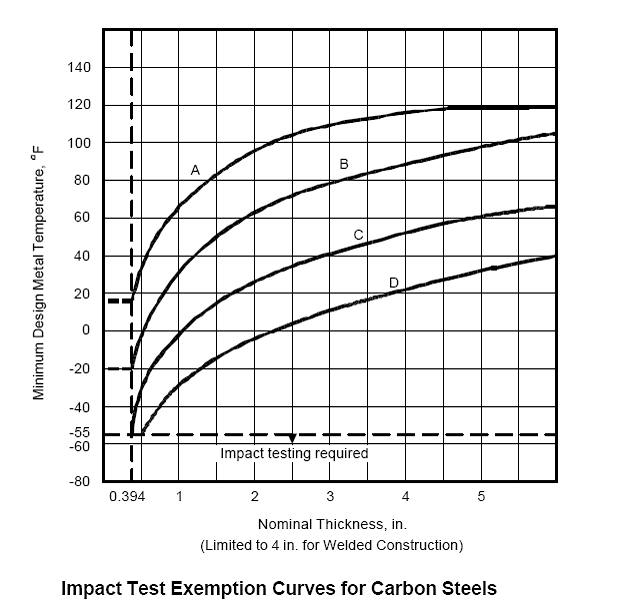
A capital letter that designates the corresponding Material Group appears above each curve in Figure. If the CET of a pressure vessel is equal to or above that shown by the intersection of the Material Group curve and component thickness, then impact testing is not required. For example, a Group B material that is 1.5 in. thick does not require impact testing as long as the CET of the vessel is approximately 50°F or higher. Division 1 has additional impact test requirements, some of which are highlighted below. Refer to the code for additional information.
· Impact testing is required for all welded construction that is over 4 in. thick if the MDMT is below 120°F.
· Impact testing is required for non-welded construction (e.g., a seamless, bolted heat exchanger cover plate) if the component is over 6 in. thick and the MDMT is below 120°F.
· Impact testing is not required for ASME B16.5 or B16.47 ferritic steel flanges if the design metal temperature is no colder than -20°F.
· Unless specifically exempt by Fig. UCS-66, materials with a minimum yield strength greater than 65 ksi must be impact tested.
· Low temperature grades of steel that are impact tested to conform to the particular material specification (e.g., SA-333 or SA-350) may be used at design metal temperatures as low as the impact test temperature.
· If PWHT is done on P-1 material when it is not required by ASME Code rules, its impact test exemption temperature may be reduced by 30°F from that provided in Fig. UCS-66 (Ref. Para. UCS-68), as long as the resulting exemption temperature is no lower than -55°F. This recognizes the fact that a material’s fracture toughness is improved after stress relief.
· The MDMT of a vessel component may be further reduced if the general primary membrane stress in the vessel component is less than the design allowable stress. This could occur in situations where the nominal thickness of the component is greater than that required for the design conditions plus corrosion allowance (Ref. Fig. UCS-66.1)
Division 1 also contains impact-testing procedures and impact energy requirements for cases that are subject to impact testing.
Refer to Division 1 for details.
From: material...@googlegroups.com [mailto:material...@googlegroups.com] On Behalf Of Bathula
Raghuram (Mumbai - PIPING)
Sent: Monday, August 06, 2007 9:31
AM
To: Pressur...@yahoogroups.com;
material...@googlegroups.com
Subject: [MW:78] RE: [Pressure
Vessel] MDMT
Mr. Masood
Please refer UG20 (in case you are designing as per ASME Sec VIII div1)
Shall be determined based on the mean metal temperature expected under operating conditions (generally given by client/process licenser) for the part considered, If necessary the metal temperature shall be determined by computation or by measurement from equipment in service under equivalent operating conditions.
MDMT will be lowest of operating temperature or atmospheric temperature (lowest possible temperature during entire year where the vessel being installed for operation) and/or any other source of cooling.
A rated MDMT can be found using the rules of UCS 66 to determine the coldest possible MDMT without requiring impact testing (Fig UCS66.2), but this need not be put on the name plate, name plate MDMT shall be a client’s/Design MDMT as described above.
Regards
Raghuram Bathula
From: Pressur...@yahoogroups.com [mailto:Pressur...@yahoogroups.com] On Behalf Of Bayat, Masood
Sent: Sunday, August 05, 2007 3:38
PM
To: Pressur...@yahoogroups.com
Subject: [Pressure Vessel] MDMT
Dear All
Can you help me about MDMT (min metal design temp)? can you help me how I can calculate it for known material and pressure?
Thanks
Masood