Odor & Ventilation: AVS / PLA / PVA / Nylon

636 views
Skip to first unread message

David Celento

unread,
Mar 14, 2013, 10:43:03 AM3/14/13
to make...@googlegroups.com
Assume printing in a classroom setting: does ABS need separate external ventilation? PLA?

Thought yes, for ABS, and no for PLA. Is this correct or not? No idea about PVA or Nylon
(or others?).

Thanks!

Wingcommander whpthomas

unread,
Mar 14, 2013, 11:03:37 AM3/14/13
to make...@googlegroups.com
This is my view on this - others may chime in here and disagree.

I have a Replicator 2 so I am only printing PLA and Nylon at the moment. My wife also works for the regional Cancer council as a legal/policy analyst in cancer prevention, so these issues were raise in my house with perhaps some heightened sensitivity.

As I see it, PLA has a melting temperature range between 190c and 220c, but the Replicator 2 routinely prints at 230c and its is clear from looking under the nozzle that there are carbon deposits forming.

This suggests to me that some PLA is burning, and if you look up the MSDS "Burning produces obnoxious and toxic fumes, Aldehydes, Carbon Monoxide (CO), Carbon Dioxide (CO2)." 

The US EPA has designated carbon monoxide  as a hazardous air pollutant http://www.atsdr.cdc.gov/toxprofiles/tp201-c8.pdf

There are also convincing evidence of carcinogenic potential in experimental animals that various aldehydes are also harmful.

Now I do not no what the concentrations are, so I am simply being cautious. However I do know that for instance there is no safe exposure level to second hand smoke from cigarettes for instance. In addition, smoke and other chemical by products form smouldering cigarettes are over 10 times more toxic than what you inhale, because of their less complete combustion. So to my way of thinking, a slightly smouldering hot end poses potentially greater risk than actually burning PLA with a propane torch. I am personally not willing to take the risk of having a the printer in my office un-ventelated, so I purchase an enclosure and have a fan ducting the fumes outside http://www.thingiverse.com/thing:46069.

So the short of it is, form the reading that I have done on the matter, I would stick the printer under and extraction hood if you already have one set up in your science lab.

Rob Griesbeck

unread,
Mar 14, 2013, 11:41:16 AM3/14/13
to make...@googlegroups.com
I print in a classroom, and I only notice a smell with ABS if I stick my nose in the machine. I've yet to find anyone who can provide proof either way if ABS fumes are harmful, but I've been pretty busy sniffing super glue and model paint =)

Wingcommander whpthomas

unread,
Mar 14, 2013, 11:49:42 AM3/14/13
to make...@googlegroups.com
I print in a classroom, and I only notice a smell with ABS if I stick my nose in the machine. I've yet to find anyone who can provide proof either way if ABS fumes are harmful, but I've been pretty busy sniffing super glue and model paint =)

Yes, but a classroom also has a much much larger volume of air for fumes to disperse into - my home office is much smaller I think.

David Celento

unread,
Mar 14, 2013, 12:21:12 PM3/14/13
to make...@googlegroups.com
Very interesting. Thanks for the MSDS info and carcinogenic aspects on PLA, Wingcommander. Good approach. 

I see that MBI lists the MSDS for ABS as a possible eye irritant. Burning can create toxic levels of CO, HCN, AN, and SM.

I mention "classrooms" because I imagine the Replicators being considered for such environments, yet I rarely, if ever, see any mention of ventilation.

David Celento

unread,
Mar 14, 2013, 12:27:33 PM3/14/13
to make...@googlegroups.com
PLA MSDS here: https://groups.google.com/forum/?fromgroups=#!topic/makerbot/bSlwh5f-y6E

 Sensitization: Did not cause sensitisation on laboratory animals


Apparently, another concern for PLA is inhalation of dust, where a positive pressure respirator is recommended. GOOD TO KNOW!!!


 Respiratory

protection:

Respirator must be worn if exposed to dust. Wear respirator

with dust filter. Respiratory protection is needed if any of

the exposure limits in Section 3 are exceeded. Consult an

industrial hygiene professional prior to respirator selection

and use. Use a postive-pressure air supplied respirator if

there is any potential for an uncontrolled release, exposure

levels are not known, or any other circumstances where airpurifying

respirators may not provide adequate protection.

WARNING: Air purifying

AKron

unread,
Mar 14, 2013, 1:06:18 PM3/14/13
to MakerBot Operators
The extruder doesn't "smolder".

Wingcommander whpthomas

unread,
Mar 14, 2013, 1:28:04 PM3/14/13
to make...@googlegroups.com
The extruder doesn't "smolder".

It does out-gas though - just manually push some filament through the nozzle and you can see a clear stream of gasses being ejected from the tip - my point is that slow combustion produces more nasties than burning with a blue flame. I am not trying to be alarmist, but this is a new industry, with new products, and I would hate to see people 20 years form now developing problems and calming they didn't know there was a risk.

There are potential hazards - I am not entirely sure of their magnitude, but judging from what I have read, slow combustion producing similar harmful substances in other work environments are considered harmful.

Regarding the dust, I have plexiglass on the side walls, and it gets plastered with fine wispy particles of filament that I am sure we could be breathing in.

Thanks for the MSDS info and carcinogenic aspects on PLA.

I think I would classify it as "potentially" carcinogenic, there just isn't enough detail in the MSDS to say for certain - describing them as aldehydes is very general we would really need to know which ones are being produced and in what quantities to gauge how harmful they may be.

 
enclosure mounting hardware 3.jpg

TaErog

unread,
Mar 14, 2013, 5:37:13 PM3/14/13
to make...@googlegroups.com
I always go on the tact that everything is toxic at some amount. (Got that from some of my DR friends, They have fun demonstrating that, And that how our bodies are FULL of very toxic substances and you require them to live!!  some strange people :P but very cool )

So thinking about out loud here  . .
So what you need to do is determine (simplistically) how much is required to be toxic and method of exposure.  (things that are considered Non-toxic are toxic in such large quantities that it is unlikely to be a problem or only toxic in difficult method of exposure)

I think we are talking mainly fumes/combustion (dust of ANY type is bad, and the smaller the worse it is, an issue but I think not a big one here unless you are sanding and then WTF you should have a mask sanding anything)
With strictly fumes if you have a enclosed printer chances are what it will condense inside your printer (though sticking your face in right after a finished print may defeat that )
And then we are talking plastic that burns on the print head . . some always does but a rather small about.  Probably making the nastiness byproducts.

So, how much fumes and combustion byproducts are made?  (no idea here)
How much volume of Air is needed to lower the concentration to non toxic levels?  (do we even know what is considered toxic levels?)
Are we already ok given the small amount made???  (no idea here)
or do we need a large room, ventilation, filtering?  (probably not a bad idea)

Other relatively toxic hobbies (photography development) has some rather nasty chemicals . . but with ventilation and simple procedures (use tongs or gloves) it is rather safe.
To be safe I would expect just be sure you have allot of air volume (or barring that good circulation in a small room)
Without more information though it would be hard to gauge how much or if further steps are needed . . 

A great topic, I would love to see some of these questions answered so we can make a good judgement call.

Wingcommander whpthomas

unread,
Mar 14, 2013, 9:10:31 PM3/14/13
to make...@googlegroups.com
TaErog: your summary it pretty much on par with how I see it. Potential risk, but not sure how much of a hazard. However there are some by products of some types of slow combustion where there are no known safe exposure levels - does it produce these? MSDS is not detailed enough to know - it only provides the general class - not the specifics.

Someone posted in a different thread that maybe one could have a fan push air through a respirator cartridge designed to filter out such substances. 

TaErog

unread,
Mar 14, 2013, 11:51:46 PM3/14/13
to make...@googlegroups.com
"However there are some by products of some types of slow combustion where there are no known safe exposure levels" even nerve agents have a less then lethal amount, and even lesser amount can be not noticeably toxic,  just crazy small amount (but these are extremes no sense going there) . no known safe exposure levels can also also mean not tested, Coffee and other foods have both beneficial and possible carcinogenic elements. I again I see "safe" and "toxic" as a matter of degrees.
Any way, I would be good to be sure the respirator cartridge does indeed reduce the amount of potential toxins. so need to find out how much is made, how much is remove given X air flow, determine how long the filter will last, etc. . make a setup that would do that.  (and not just making an assembly that is costing $$ making the air cleaner in all the wrong ways :) )

Or we can guess, pick something close set it up and hope it does something beneficial might not be a bad idea? how much are the cartridge and how wide a selection of chemicals do they filter?

Herm, it is looking that unless allot of effort goes into determining this it is going to allot of guess work.
what I have found is that there is not allot of info, most of it is general and shows potential in large amounts if burning (effectively and industrial accident level).  Nothing much about fumes. Color also seems to be a wild card.
Burning makes hydrogen cyanide classified as a Class 2B carcinogen (possibly carcinogenic) but again the dose seems to need to be large and chronic to make an possible effect.
It would REALLY be good if we could find the amount per gram produced. And really not much is being burnt on the nozzle.

For the 2x I expect a blower to get the needed airflow (normal fans do not handle allot of back pressure) and the right respirator cartridge. then recirculate the air that is inside as the temperature needs to keep stable. With PLA it could suck through allowing outside air to cool the print.

Wingcommander whpthomas

unread,
Mar 15, 2013, 12:21:07 AM3/15/13
to make...@googlegroups.com
"However there are some by products of some types of slow combustion where there are no known safe exposure levels"

Sorry that was with respect to long term repeated exposure - i.e. small amounts daily as opposed to one big exposure from a single event like the nerve agent you speak of. 

TaErog

unread,
Mar 15, 2013, 9:51:06 AM3/15/13
to make...@googlegroups.com
Sure got ya  . .
There seems to be just not many long term studies (for anything really)  kinda disheartening.
Do you have any access to any journals?

Wingcommander whpthomas

unread,
Mar 15, 2013, 11:55:48 AM3/15/13
to make...@googlegroups.com
Do you have any access to any journals?

Sort of do, but not really in this field. My wife does too, but mostly focused on the big 5, cigarettes, alcohol, obesity etc. No pro-longed exposure in an OH&S context.

That being said, she just did a whole bunch of research on second hand smoke in a body corporate/apartment setting. That's where a lot of this general info came from.

Like I said, I will probably have a 3D printer in my office for the forceable future, its not a big office, so the fumes could very well be a problem. Still not sure the setup is perfect, but it is working.

jee...@gmail.com

unread,
Mar 15, 2013, 4:06:40 PM3/15/13
to make...@googlegroups.com
Right now the Makerbot is in my laser printer room. I have a laser printer room because the toner dust from laser printers is pretty nasty stuff. I'm not sure if the fumes from a 3D printer are necessarily worse...

That being said, I have been contemplating building a fume hood for the printer (in which case I will probably open-source the design). The issue is of course that an active fume hood removing air from the chamber is not ideal for use with ABS while printing, so it would have to be used after printing, and since the MB 2X isn't very well sealed a large amount of fumes will still escape during use.

A short term fix may be to run a charcoal soldering filter inside the machine with an 80mm fan behind it (if there is room). This way the air doesn't move outside of the build chamber, but you still achieve some crude air filtering. 

-FDP

Wingcommander whpthomas

unread,
Mar 15, 2013, 7:05:40 PM3/15/13
to make...@googlegroups.com
The issue is of course that an active fume hood removing air from the chamber is not ideal for use with ABS while printing
 
 Not sure if removing a small volume of air using a 40 x 40 x 10mm fan will effect printing that much - in my case printing PLA i, the surface finish is very even, and it seems to provide just enough of a pressure differential to keep the fumes inside the printer, gradually flowing outside through the ducting. The fortunately, the window in question is on the leeward facing wall of the house for the prevailing wind direction.

FDP

unread,
Mar 17, 2013, 10:37:35 PM3/17/13
to make...@googlegroups.com
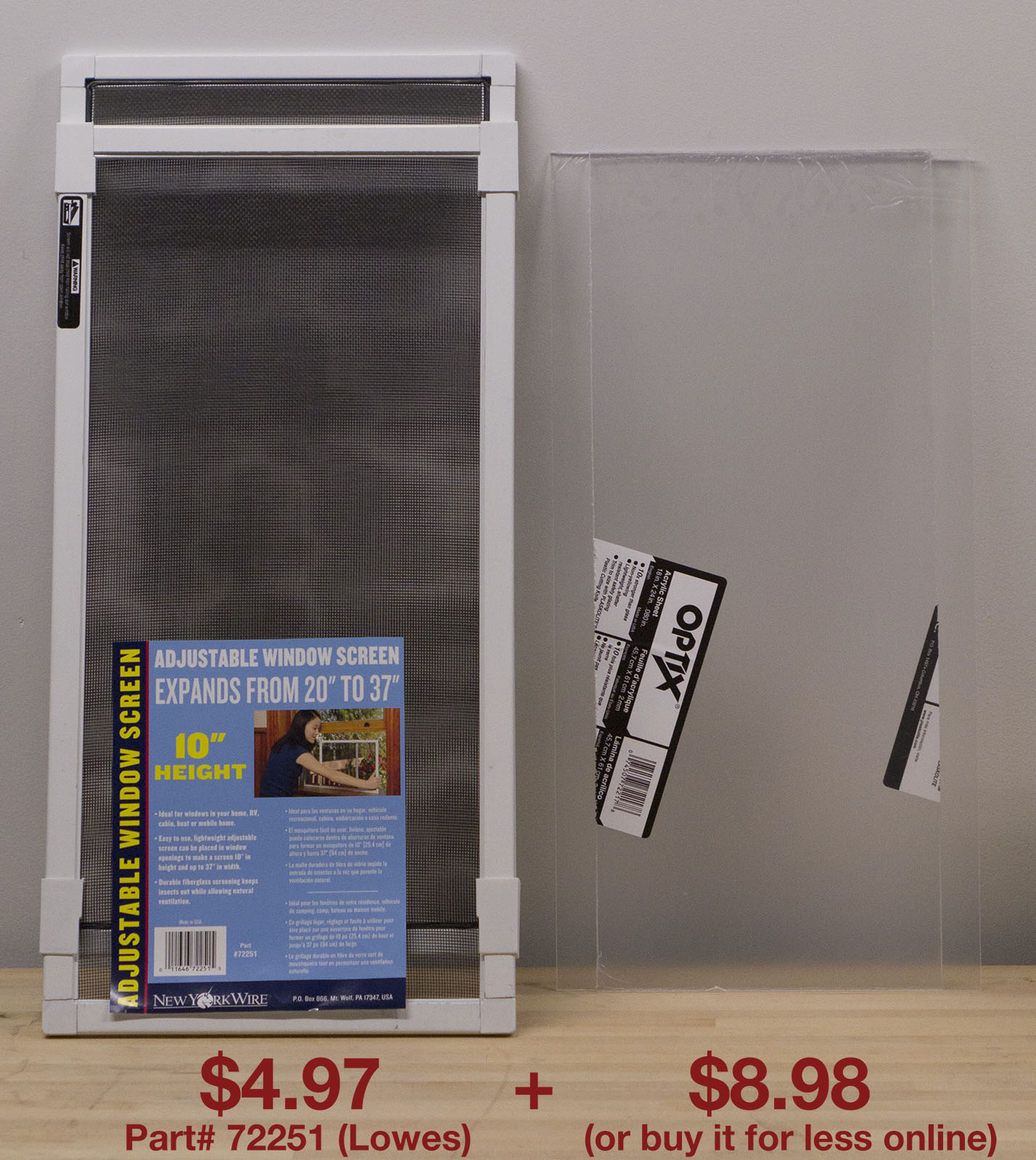
I've found a rather cheap/nice solution for a (poorly) sealed window frame unit. I'm attaching a fume extractor (the cheap charcoal + 120mm fan type) via a 2" vacuum to the window so that I can experiment with ABS and not fill my work space with unhealthy fumes. This will still be thermally inefficient, but should help keep drafts out. The best part is that it costs USD $13.95 or less, and then end result looks only half ugly. 

The trick is using a wire mesh adjustable window screen, and sliding pieces of polycarbonate or acrylic (I went the cheap route) underneath the clips (there should be just enough room) that hold the two halves of the screen together. I added a little caulk for good measure, but a careful cut should make this unnecessary. This is super obvious once you think about it, but I spent about half an hour contemplating building my own window screen before realizing that this was a better/cheaper/faster option. 


Step two is once my printer is working, print out this: http://www.thingiverse.com/thing:38813   then drill some holes, and I think the end result will be practical and look very clean. 

-FDP

FDP

unread,
Mar 17, 2013, 10:57:50 PM3/17/13
to make...@googlegroups.com
I should have mentioned it. For this particular window unit the sheet should be 0.08" thick. I would recommend that you cut it yourself, even though in theory the window cutter at the big box stores should be able to do it faster and accurately, most of the time those machines are badly misaligned and the cuts come out with very poor accuracy. 

TobyCWoods

unread,
Mar 18, 2013, 5:31:28 PM3/18/13
to make...@googlegroups.com
I open a window.

Joel Edelstein

unread,
Mar 18, 2013, 5:39:47 PM3/18/13
to make...@googlegroups.com
I would love to open a window. Unfortunately where I live it is several degrees below freezing and we are having a snowstorm. On the plus side this hacked together ventilation setup seems to be doing a decent job. I can't really smell the ABS.

-FDP

--
You received this message because you are subscribed to a topic in the Google Groups "MakerBot Operators" group.
To unsubscribe from this topic, visit https://groups.google.com/d/topic/makerbot/bSlwh5f-y6E/unsubscribe?hl=en-US.
To unsubscribe from this group and all its topics, send an email to makerbot+u...@googlegroups.com.
For more options, visit https://groups.google.com/groups/opt_out.


Reply all
Reply to author
Forward
0 new messages