
Printing nylon on a Replicator 2X
3,653 views
Skip to first unread message

SurlyMonkey
Jul 3, 2013, 3:52:45 PM7/3/13
to make...@googlegroups.com
I got my rep 2x in a few weeks ago and Ive been printing with ABS like its going out of style. I was considering trying to make some zip ties with Nylon filament but wanted to check here and see if anyone has had success with nylon on a 2x before I buy some. If anyone has had success what temperatures did you use for the extruder and HBP?

MBuser
Jul 3, 2013, 11:09:46 PM7/3/13
to make...@googlegroups.com
Wouldn't nylon need a higher-temp (metal) extruder?

Jetguy
Jul 4, 2013, 1:12:00 AM7/4/13
to make...@googlegroups.com
The 2X IS an all metal extruder, so is the Replicator 2 and the Replicator 1. Heck, the only bot not with an all metal extruder is the older T-O-M with the MK6. Later MK7 equipped T-O-Ms and the same basic extruder designed used up until the Replicator 2 is identical, heck even the parts swap out. The 2X is still an all metal extruder, but is different than the Replicator 2 and all before it.
That said,
A metal carriage is recommended for Nylon most of time because the higher temps of the hot ends do bleed some heat into the plastic x carriage, especially on longer prints with nylon.
The 2X may or may not be subject to the same recommendation because of the changed design compared to all previous bots, who really knows?
The fact Carl made and has sold a lot of aluminum carriages for the 2X (and the other series as well) should say something. I'm not saying it's required, just saying people are buying it for some reason-you make up your own mind.
Jetguy
Jul 4, 2013, 1:31:19 AM7/4/13
to make...@googlegroups.com
And sorry, I'm mixing terms since you started it.
What I'm really saying is all metal hot end- AKA NO PTFE AKA Teflon in the hot end.
The reason is, at nylon temps, PTFE can gas off poison that is known to kill animals such as birds and may make humans sick as well.
Simply put, PTFE has a safe max temp and is just fine for ABS and PLA, but dangerous above 240C (I'm just throwing out a realistic Do Not Exceed temp).
There are 2 major groups of parts to an extruder.
The hot end: nozzle, heater block, thermal barrier tube, mounting block, insulation, heater core, and temperature measuring device.
The filament drive or pusher: motor, knurled pinchwheel, some type of guide for the filament, a pressure system pushing the filament into the wheel (plunger or other).
Almost all extruders use plastic of some kind in the filament drive because it never should get much hotter than warm to the touch and is fine in all cases, even for printing nylon.
The problem part with nylon printing has been the plastic piece that connects the entire extruder assembly (motors, hot end, etc) to the linear bearings that side on the rod in the X direction.
That plastic carriage has deformed on some folks printing nylon since the heat from the extruders being at 260C conducts, radiates, and convects,to the plastic carriage made of ABS which melts at a known 230C (the temp we use to extrude ABS). Basically, the idea is the carriage is always a few degrees cooler than a given extruder temp on long prints (and really, we are just talking about parts of the carriage right next to the heater blocks for the most part). Thus, at normal ABS and PLA temps, well below the point where it gets soft and can deform.
Moving to nylon temps at 260C can in theory, eventually conduct and radiate enough heat to soften the carriage and result in carriage sag (reminiscent of a Salvador Dali painting).
So again, ANY MakerBot extruder sold in the last 2 years has been "nylon" safe because they use an all metal hot end. Only the MK6 had PTFE insert.
That said, if you intend to do a lot of it, the carriage from Carl is an extra level of safety to protect a part of the motion frame of the bot (namely, the X carriage).
The 2X version is halfway down.

Damian Gto
Jul 4, 2013, 10:52:53 AM7/4/13
to make...@googlegroups.com
Nylon needs about 260 degree celsius to melt.
This is little high for the carriage, but its very very easy to fix.
Its the radiated heat you need to remove.
Buy a good aluminium tape and put it on the carriage, cooling block holes and all area that can be exposed to the heat from the nozzle.
This will reduce the heat that goes to the plastic part a lot.
There is ZERO need to use a aluminium carriage for Nylon.
Aluminium Tape and thin aluminium sheets has been used for a very very long time in both the computer industry and car industry to shield stuff from heat.
Jetguy
Jul 4, 2013, 11:40:44 AM7/4/13
to make...@googlegroups.com
"There is ZERO need to use a aluminium carriage for Nylon."
Can you prove just aluminum tape is enough?
The reason behind being defensive on this is, what happens to the poor user who follows your advice?
If it doesn't work and they melt the carriage, then it's not really covered under warranty and they either have to buy a new one from MakerBot and suffer some down time in the process, or they then in fact are forced to buy the metal carriage you told them they didn't need.
Or look at it from an investment standpoint. MakerBot is not likely to start selling these aluminum upgrades. These are rare items and highly sought after due to limited production. Purchasing one, even if you later decided you don't need it means that for someone who does want one, they might fetch a premium price. Since it fits more than one series of bot, that too increases the potential sale value.
So, say I'm wrong and you absolutely do not need it. Fine, you still have a non-melted plastic carriage and an upgrade part that will sell in minutes due to demand should you decide you do not need it.The alternative is, you listen to Damian, it doesn't work, the carriage does melt, and now, you are forced to either buy the upgrade if you still want to print nylon or buy the replacement part from MakerBot since they won't cover you melting it under warranty. You loose several times over due to downtime, frustration, and BTW, might not be able to get another aluminum carriage since they are limited production and be seriously "Sorry Out of Luck".
I'm not selling the upgrade nor affiliated in any way, I just think given the machine cost, a user should know what is at stake.
SurlyMonkey
Jul 4, 2013, 11:55:37 AM7/4/13
to make...@googlegroups.com
Thank you guys for your advice. So to be safe I need some additional heat sink maybe even aluminum carriage. Does the rep 2 have a different carriage? I've seen results from printing nylon zip ties on a rep 2. It can't be more than a 30 minute long print, do you think it would melt my 2x plastic carriage in 30 minutes? Does anyone have personal experience using nylon on a 2x?

Carl
Jul 4, 2013, 1:20:29 PM7/4/13
to make...@googlegroups.com
The lowest temperature that you can print 618 Nylon at is around 245 deg C... below that the properties change and it has a embroidery type of look - which can be very nice for certain applications... Although I have no experience printing on a Rep 2X... I have hundreds of hours printing on a Rep 2...
A 30 minute print at 245 deg C... I would say your carriage will be fine... the ABS carriage might begin to droop but not noticeably... Once it cools down it will return to almost its original shape... The problem is that it might take you hours to get your settings correct to do that 30 minute print...
Just be observant... the carriage wont just suddenly melt and fall apart... the most likely scenarios is that your print will suffer due to the carriage drooping and affecting lower layers - but even that shouldn't happen on a short print...
Just have fun with it... after all... the 2X was marketed as 'experimental' !:-)
A 30 minute print at 245 deg C... I would say your carriage will be fine... the ABS carriage might begin to droop but not noticeably... Once it cools down it will return to almost its original shape... The problem is that it might take you hours to get your settings correct to do that 30 minute print...
Just be observant... the carriage wont just suddenly melt and fall apart... the most likely scenarios is that your print will suffer due to the carriage drooping and affecting lower layers - but even that shouldn't happen on a short print...
Just have fun with it... after all... the 2X was marketed as 'experimental' !:-)
Damian Gto
Jul 4, 2013, 1:49:21 PM7/4/13
to make...@googlegroups.com
On Thursday, July 4, 2013 5:40:44 PM UTC+2, Jetguy wrote:
"There is ZERO need to use a aluminium carriage for Nylon."Can you prove just aluminum tape is enough?
Can you prove it dont?
The fact is that we already print stuff around 240 degree without problem, with unprotected plastic carriage.
If you protect it with aluminium tape( a good one, They are little thicker and the glue can withstand up to 500 degree(on the best ones) you will reduce the heat that the plastic gets.

You can read little hera about it.
Do you still think it could not make the carriage handle about 20 degree more?.
The fact is that aluminium tape is used is so many things, just to remove heat and protect sensitivity objects.
I am 100% sure it will work just fine and I would gladly pay anyone that use good quality aluminium tape to protect the carriage, if it start to melt at 260 degree celsius.
MBuser
Jul 4, 2013, 6:47:22 PM7/4/13
to make...@googlegroups.com
The tape would help with radiation, if it could be put in front of the source. The tape would probably not help much with convection, since all the parts are in the same tight air space. And of course, the tape could not do anything for conduction through the parts.
Damian Gto
Jul 5, 2013, 6:11:36 AM7/5/13
to make...@googlegroups.com
You know that the glue also acting like a heat barrier?
Look at the picture I did attached to my last post.
The design of the carrier and where the heat is, make it very easy to use aluminium tape to deflect the heat.
Like I already written about, this has been made so many time in many areas and its not a problem.
So why do you and some other think it do not work?
Radiant heat from the nozzle is the main problem, but it is precisely the aluminum tape is so good at protecting from.
It becomes a protective barrier from radiation heat the nozzle emits.
Carl
Jul 5, 2013, 9:45:28 AM7/5/13
to make...@googlegroups.com
Based on how difficult Rep 2X users found printing PLA... there is every chance they might battle to print 618 Nylon... Although I believe the exact reasons they were battling to print PLA will be beneficial to them when printing 618 Nylon (enclosed environment, no active cooling fan and excessive heat).
The AluCarriage Dual will assists in providing a safer operating environment when printing - even at normal printing temperatures... In itself, it won't help you print Nylon - most of that is down to your extruder, software settings and build plate...
It would be nice if someone with actual Rep 2X 618 Nylon experience would respond to this post... Bjorn... Maybe you should order yourself some 618 Nylon - do a few prints (if you can) and report back with videos, photos and useful tips based on actual experience.
At any rate... the AluCarriage Dual order I will be placing on Monday will be the last AluCarriage Dual order that I will be placing for the foreseeable future... So I really do hope that the aluminium tape Bjorn is proposing (which is not very cheap either...) does successfully protect the stock carriage! :-)
The AluCarriage Dual will assists in providing a safer operating environment when printing - even at normal printing temperatures... In itself, it won't help you print Nylon - most of that is down to your extruder, software settings and build plate...
It would be nice if someone with actual Rep 2X 618 Nylon experience would respond to this post... Bjorn... Maybe you should order yourself some 618 Nylon - do a few prints (if you can) and report back with videos, photos and useful tips based on actual experience.
At any rate... the AluCarriage Dual order I will be placing on Monday will be the last AluCarriage Dual order that I will be placing for the foreseeable future... So I really do hope that the aluminium tape Bjorn is proposing (which is not very cheap either...) does successfully protect the stock carriage! :-)
Damian Gto
Jul 5, 2013, 10:42:40 AM7/5/13
to make...@googlegroups.com
Sure the AluCarriage is a good thing that I do think will be better then stock, but I feel its not anything you must have to print Nylon.
You are also right that a good aluminium tape is not cheap, but you will get a lot that you can use in many areas that you want to protect from heat.
I am very tempted to try out Nylon and see how it do work. For me PLA is nothing that is useful for me so I am sure I will not invest much in that.
I am also tempted to do an experiment and show how aluminium tape do protect stuff from heat.
Message has been deleted

S Scherrer
Sep 25, 2013, 4:21:59 PM9/25/13
to make...@googlegroups.com
on 2X
Printed Nylon Taulman 645 yesterday first time, no single issue. Used Blue tape to ensure no warping. No bed heat. I used the Gnome model from the Thingiverse. I need to try some other models, but sw not issues in printing.
Tonight I printed stone laybrick filament, same no issues. Directly on Kapton, extrusiton temp at 180. Beautifull result
On Wednesday, July 3, 2013 9:52:45 PM UTC+2, SurlyMonkey wrote:
S Scherrer
Sep 25, 2013, 4:28:37 PM9/25/13
to make...@googlegroups.com
You can modify retraction setting in Makerware. Create a custom profile and edit the file. You can find settings there..."retractDistance": 1.3, "retractRate": 25
For details on those makerware settings check this page :
and this one
When you start looking at this you can start some tweaking... and you do have some control on slicer..
Hope this helps
On Wednesday, September 25, 2013 8:59:53 PM UTC+2, Teresa Bee wrote:
Has anyone made any further progress with taulman 618 on rep2x?? i have been able to print almost the full height of the printer. I have a nylon pipe that is 6 inches tall by 2 inches. the only thing i'm experiencing now that is a problem is bleeding. I haven't used any open source slicers i've been sticking to MakerWare so far, but a few people have said that manipulating the "retraction" might be a viable solution. I'm guessing this is something that can only be done with an open source slicer. I tried exporting my stl with slic3r as a 3gx and no such luck. It seems i can only export raw GCODE or as an obj. Am i approaching this in the wrong manor? please any help is much appreciated.

Ben Bryson
Sep 25, 2013, 7:48:07 PM9/25/13
to make...@googlegroups.com
If you get chance post some pics. Also, what layer resolution are you printing. I have 2x on the way and nylon is going to be interesting once i've run some abs for a while.
Message has been deleted

Enginwiz
Sep 26, 2013, 3:32:41 PM9/26/13
to make...@googlegroups.com
Hello Teresa,
the excessive stringing of Taulman 618 seems to be related to humidity in the filament.
Nylon is hygroscopic - it sucks water vapour out of the air in your room into the filament.
When sitting idly in the hot end of the nozzle the water turns into steam and pushes
a string of filament out of the nozzle. This quickly happens when your extruder makes
short jumps during the print and you get a lot of strings. Retraction does not help here.
Put your roll of Taulman 618 filament into a hot air oven in the kitchen at 80 degrees Celsius
for two hours and let it dry there. Take the still warm filament and print your part again.
You will see a huge difference. These two deprime tests were printed off the same roll.

Guess which has been printed with still warm dried Taulman 618 right out of the oven?
After sitting some hours behind your printer the Nylon will again start to collect humidity out of the air
and the stringing issues will reappear. I always keep my rolls of Taulman 618 in
a nearly closed ZIPLOC bag with some bags of desiccant during printing.
Message has been deleted

Eighty
Sep 27, 2013, 9:29:17 AM9/27/13
to make...@googlegroups.com
Teresa Bee,
I'd be very careful with installing your 3d-printed pipe in any homes. There are lots and lots of building codes that govern the allowable materials you can use. There are flammability considerations as well as drinking-water standards. If you're already aware of these standards, then disregard this. But in case you aren't, it may be worth some research before you open yourself up to a lawsuit.
I'd be very careful with installing your 3d-printed pipe in any homes. There are lots and lots of building codes that govern the allowable materials you can use. There are flammability considerations as well as drinking-water standards. If you're already aware of these standards, then disregard this. But in case you aren't, it may be worth some research before you open yourself up to a lawsuit.
Message has been deleted
Message has been deleted
Enginwiz
Sep 27, 2013, 3:01:39 PM9/27/13
to make...@googlegroups.com
To prevent humidity getting into the nylon filament during printing
I keep the roll of Taulman 618 in a nearly closed ZIPLOC bag
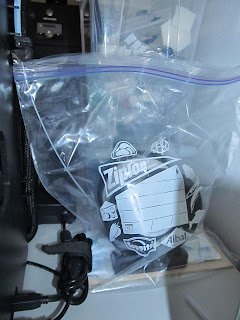
together with some bags of desiccant.
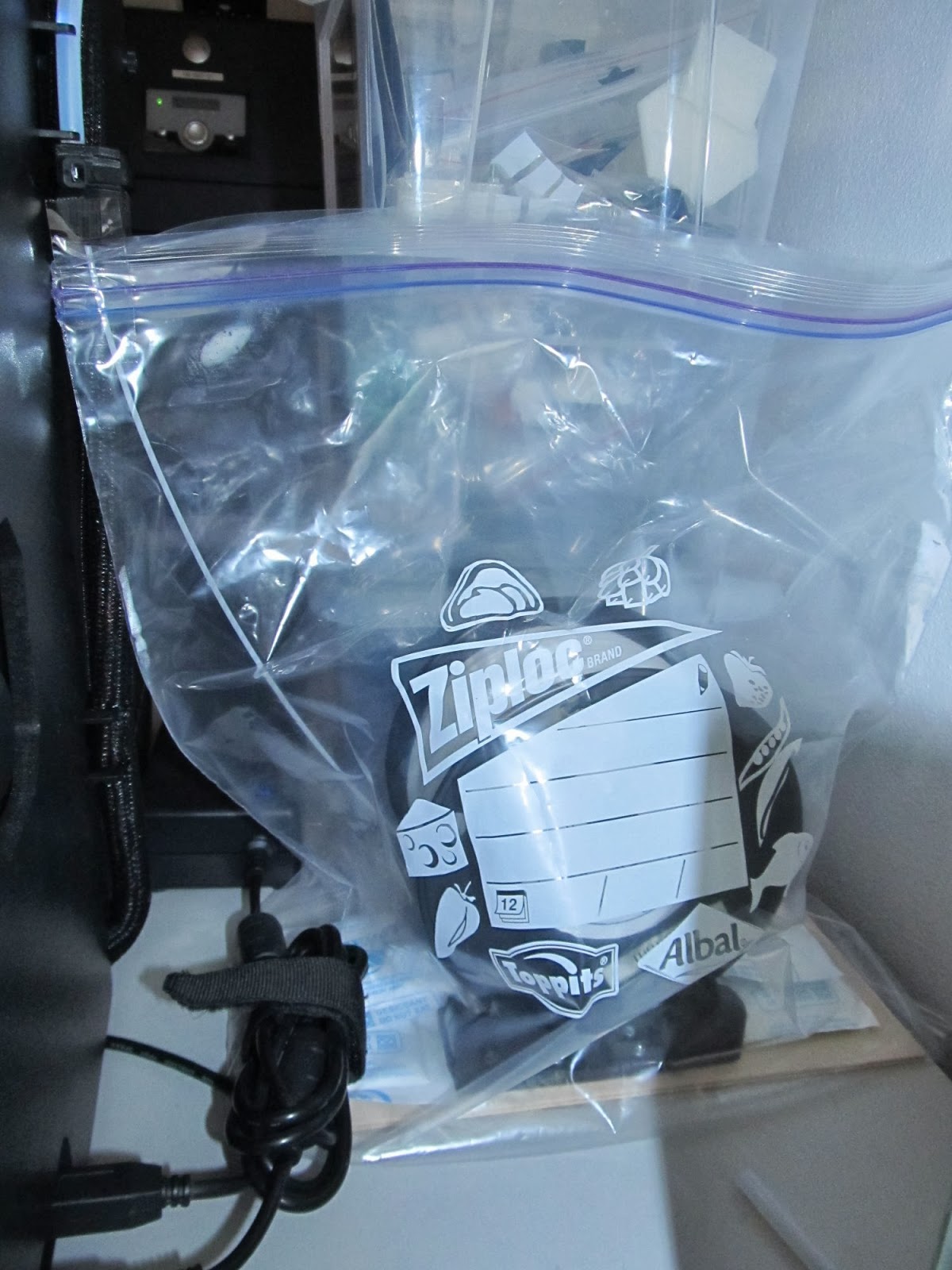
The roll of filament sits on a small spool roller with ball bearings.
Only the last inch of the ZIPLOC stays open during the print.
After printing I unload the filament and close the ZIPLOC bag.
I calibrated my Taulman 618 settings in Simplify3D Creator
for layer heights 0,10mm, 0,15 mm, 0,20 mm and 0,25 mm
with solid calibration cubes and Wingcommanders deprime test.
The picture of the two deprime tests I posted earlier were
both calibration prints for a layer height of 0,15 mm. This is
my preferred layer height for a good balance between speed and quality.
Currently I experiment with layer heights of 0,09 mm
and stacked infill every 0,27 mm. Wingcommander
recently published his KISSlicer settings and I like
the concept of high surface resolution and sturdy infill
printed only every third layer. Very efficient. Printing at
layer heights below 0,10 mm consumes a lot of time
if you print infill every layer. I did avoid that until now.
My Taulman 618 needs temperatures above 230°C to achieve
proper layer bonding. What temperature settings do you use for
your big print? Maybe your bonding problems at thicker layer heights
would disappear at a slightly higher print temperature.
Good luck with your big print. Please post a picture of the print if you are allowed to do so.

Wingcommander
Sep 28, 2013, 2:45:04 AM9/28/13
to make...@googlegroups.com
Enginwiz wrote: To prevent humidity getting into the nylon filament during printing I keep the roll of Taulman 618 in a nearly closed ZIPLOC bag together with some bags of desiccant.
Here is an approach that I am looking into using for my Nylon printing, its basically an air tight container with desiccant inside, PVC pipe to hold the spool, and a printed feeder hole to keep it all relatively well sealed http://www.thingiverse.com/thing:62826
Message has been deleted
Message has been deleted

billyd60
Oct 16, 2013, 3:25:59 PM10/16/13
to make...@googlegroups.com
Try increasing your extruder temperature. I've printed at 260° and 270°C with Nylon. Make sure your extruder can handle that before you try it though. What kind of printer do you have? Are you using a heated bed and enclosure?
On Wednesday, October 16, 2013 3:06:38 PM UTC-4, Teresa Bee wrote:
Okay, so I believe I have found a more viable solution to the bleeding. Living in Florida, humidity is inescapable >.<, So no matter what, any print at .05 layer height would show signs of bleeding.The solution to this was to feed the filament through the vents from within the oven directly to the printer. I had purchased http://www.shop.certifiedmtp.com/Lab-Companion-ON-22G-Natural-Convection-Oven-135L-120V-BCL-ON-22G.htm?gclid=CKaJltWB6bgCFaXm7AodvxUATA . I simply hang the Taulman 618 inside and feed it through the vent into the printer while keeping the oven at a constant 80*c. the filament spool is made up of low grade ABS so it has started to warp, but the nylon has a much higher thresh hold. I can now successfully print at .05 layer height with no bleeding! ^_^
Now the issue I'm running into is the build time. the last print at .05 layer height took me 35h35m >.<
Is there a way to achieve the same layer bonding at a larger layer height? I noticed that when printing at .25 the layers can literally be peeled off by hand.. This is not good, lol. Is there a way to manipulate the extrusion speed? I think accelerating the speed of extrusion perhaps the layer bonding might give more success?
Has anyone figured out a way to mess with these parameters?

TaErog
Oct 16, 2013, 3:28:32 PM10/16/13
to make...@googlegroups.com
Wait what?
I think I need some clarification . . Are we talking about the carriage? Not the cooling block?
If so how is anyone here getting such high temps on there carriage?
Even with the stock fans the cooling block is not even close (before some minor mods ie better fans and thermal paste etc) it was <100c - I will have to look at my notes for the exact number. Now it is closer to ~<60c after a long print.
Also the carriage is very close to ambient of the chamber at all times??
Or am I missing part of the conversation or something? as I can't see how a hotend temp of 230-260 is going to do much to the carriage temp in a correctly working rep2x?!
Jetguy
Oct 16, 2013, 3:33:01 PM10/16/13
to make...@googlegroups.com
Simple, the other 2 factors you failed to mention.
Radiated heat
Convected heat
Just because conduction is limited doesn't mean the other two factors are reduced in any way.
billyd60
Oct 16, 2013, 3:40:56 PM10/16/13
to make...@googlegroups.com
I'll jump in. I'm pretty sure he's talking about the extruder temperature, what you set in the slicer settings.
At least that's what I've been talking about.
The carriage gets hot through conduction and radiation heat transfer from the heating block of the extruder.
On Wednesday, October 16, 2013 3:28:32 PM UTC-4, TaErog wrote:
Enginwiz
Oct 16, 2013, 3:52:41 PM10/16/13
to make...@googlegroups.com
Printing hot Nylon from a spool sitting in a drying oven is an innovative idea!
No stringing when printing Taulman 618 at 0,05 mm layer height sounds great.
Thank you for your feedback.
No stringing when printing Taulman 618 at 0,05 mm layer height sounds great.
Thank you for your feedback.
To speed up printing you could use KISSlicers stacked infill and print infill
every third layer at a height of 0,15 mm. You might save about one third
of print time by using stacked infill. Skeinforge also has this function, but
might take forever to slice.
Message has been deleted

3DwannaB
Oct 17, 2013, 6:43:10 PM10/17/13
to make...@googlegroups.com
cool. Gotta try that!
Question... does the smaller layer height help it from shrinking and pulling up???
Message has been deleted

Ken Hecker
Oct 20, 2013, 11:47:26 PM10/20/13
to make...@googlegroups.com
The Rep 2 is a single extruder, and the 2X is a dual extruder. The plastic carriages are basically the same, but the 2X is wider to accommodate the 2nd extruder. Carl makes the Alu Carriage and the Alu Carriage Dual to fit either of these.
On Thursday, July 4, 2013 8:55:37 AM UTC-7, SurlyMonkey wrote:
On Thursday, July 4, 2013 8:55:37 AM UTC-7, SurlyMonkey wrote:
Thank you guys for your advice. So to be safe I need some additional heat sink maybe even aluminum carriage. Does the rep 2 have a different carriage? I've seen results from printing nylon zip ties on a rep 2. It can't be more than a 30 minute long print, do you think it would melt my 2x plastic carriage in 30 minutes? Does anyone have personal experience using nylon on a 2x?
TaErog
Nov 5, 2013, 4:56:08 PM11/5/13
to make...@googlegroups.com
Sure I understand that, but does it add anything to the discussion? as they play no real role here.
The Radiated heat is minimal at best (and easily sampled) , and the "Convected heat"? the air temp is not high at all near the head (the head moves allot) and elsewhere IS the ambient enclosure temp I am taking about.
So conductive heat is really the only vector to take the arms/carriage to any SIGNIFICANTLY higher temp. (the reason I did not touch on the others is that 1-3c is not significant)
Also Speculation COMPLETELY aside I measured the temperatures at quite a few locations and found the temperature gradient to be massive and the arms getting VERY little heat from the tool head and stays at the ambient temp of the enclosure + a deg or two which should never ever be above <50c even after a 8+ hour print. My Heat sinks stay below 50c and they are in direct contact!
So again I am not seeing the problem here. The arms/carriage just do not get hot (ie hot enough to deform).
So conductive heat is really the only vector to take the arms/carriage to any SIGNIFICANTLY higher temp. (the reason I did not touch on the others is that 1-3c is not significant)
Also Speculation COMPLETELY aside I measured the temperatures at quite a few locations and found the temperature gradient to be massive and the arms getting VERY little heat from the tool head and stays at the ambient temp of the enclosure + a deg or two which should never ever be above <50c even after a 8+ hour print. My Heat sinks stay below 50c and they are in direct contact!
So again I am not seeing the problem here. The arms/carriage just do not get hot (ie hot enough to deform).
SO, I ask again?
Thanks @billyd60 I got what they where talking about but trying to find the reasoning as the physical evidence is lacking.
Carl
Nov 6, 2013, 4:15:42 AM11/6/13
to make...@googlegroups.com
I designed and manufactured the AluCarriage to solve a problem I was having with my machine... the stock carriage was drooping over the duration of relatively long prints - resulting in inconsistent layer heights and layer compression. It took me a long time to identify the problem as the ABS carriage would return to virtually its original shape once it cooled.
This was before I started printing with Nylon... once I did... the issue was unmistakable!
I initially posted my solution on this forum in response to a post about someone whose stock carriage had completely melted. I had numerous requests to make these for members of the group... and as a result I have offered them ever since - constantly trying to improve the design.
Since this is my hobby and not my primary source of income... I operate using a non-profit logic... any 'profits' made go straight back into buying more stock and developing components that might help solve other problems that users have with their machines - thus the reason I now have a website and a steadily growing range of components.
Safety is still the primary reason I offer the AluCarriage components. There are no safety systems built into these machines - at the very least it would be nice to know that the carriage cannot melt! :-)
Wingcommander
Nov 6, 2013, 5:54:54 AM11/6/13
to make...@googlegroups.com
I am going to back up Carl here. I started printing Nylon with the stock carriage, very early on in the peace with my enclosed Replicator 2, and noticed that the heat build up over the duration of a print to the point that the carriage became pliable. It was summer here at the time, and I suspect that the ambient temp outside the printer was already 35c.
I was actually the first to approach Carl about getting hold of one of his Aluminium carriages - even though he originally had no plans to sell them - because the freight costs in SA were exorbitant. But I was very insistent ;)
Once installed the AluCarrage worked as expected - and I have printed a lot of Nylon parts with it, most use 250-500 grams of filament at a time and run for 10-20 hours - so I have burnt through many rolls Nylon and my extruder normally runs at 255-260 to get complete layer adhesion. I would not consider this type of printing with the stock carriage it just gets too hot.
TaErog
Nov 6, 2013, 11:27:37 AM11/6/13
to make...@googlegroups.com
I am not saying the AluCarriage is bad or useless (hell I want one!!!)
If it is speculation and AluCarriage replacement is a more robust and very cool upgrade that MAY also help here, I am also cool with that also as long as it is stated it is just speculation.
Just trying to understand that what you are all saying is that the ABS carriage physically Droops at 35-60c to the point that is effects the print then returns to the previous shape. Is this what you are all saying?
If so I want to measure it. As I am a bit skeptical of this happening at those low temperatures.
Also regardless of how long your build is there is going to be a internal temp plateau. and it should not ever be too high or you will get a jam/stripping of filament, and after that then have the real possibility of drooping ( internal temp should not keep climbing unchecked duiring a print if so open your enclosure more or add a fan) Again my Heat-sinks never get above 60c and average below 50c
If so I want to measure it. As I am a bit skeptical of this happening at those low temperatures.
Also regardless of how long your build is there is going to be a internal temp plateau. and it should not ever be too high or you will get a jam/stripping of filament, and after that then have the real possibility of drooping ( internal temp should not keep climbing unchecked duiring a print if so open your enclosure more or add a fan) Again my Heat-sinks never get above 60c and average below 50c
If it is speculation and AluCarriage replacement is a more robust and very cool upgrade that MAY also help here, I am also cool with that also as long as it is stated it is just speculation.
The safety part is also interesting and have not looked into that as much. Though the specs show a runaway temp will top out and blow the board. A wrong overly high set temp with 2 fan failures? I could see that going badly. :) Good point.
Wingcommander
Nov 6, 2013, 12:02:31 PM11/6/13
to make...@googlegroups.com
It may also be that much like the arms, there is some head absorption that is uneven causing the stock carriage to warp - but I remember very clearly that my carriage was very hot to touch and pliable - not like melted plastic, but bendy like a hose left out in the sun.
Message has been deleted

Elizabeth Whitsitt
Jan 1, 2014, 1:40:57 AM1/1/14
to make...@googlegroups.com
It sounds like you hit the heat deflection temperature of the material. Is the part under load? I need to look more closely at my bot. I just got it for Christmas and have ordered Nylon filament...may be buying an Al part.
This is great board. Happy New Year All.

John Steven Jacob
May 2, 2014, 3:33:28 AM5/2/14
to make...@googlegroups.com
Expect Nylon filament to be a little tricky to print. Some people really find it quite hard to use compared to standard filaments. However, when you get the exact setting for printing this material, the output is definitely worth it. Unlike standard filament, this one is tougher and provides quality print for any items you want to print. For optimal bonding of this filament, make sure its temperature is at a 245C.
Noong Huwebes, Hulyo 04 2013 03:52:45 UTC+8, si SurlyMonkey ay sumulat:
Noong Huwebes, Hulyo 04 2013 03:52:45 UTC+8, si SurlyMonkey ay sumulat:
I got my rep 2x in a few weeks ago and Ive been printing with ABS like its going out of style. I was considering trying to make some zip ties with Nylon filament but wanted to check here and see if anyone has had success with nylon on a 2x before I buy some. If anyone has had success what temperatures did you use for the extruder and HBP?

Ryan Carlyle
May 2, 2014, 10:46:36 AM5/2/14
to make...@googlegroups.com
I wouldn't mind JSJ shilling his website so much if his posts weren't low-content and the website terrible.
Reply all
Reply to author
Forward
0 new messages