
best way to store partially used rolls of PLA when not in use?
2,084 views
Skip to first unread message

sylvia
Jan 1, 2014, 10:09:17 AM1/1/14
to make...@googlegroups.com
right now we're keeping them in individual ziplock bags with whatever desiccant package they came with but some of the rolls start out great and then start having issues when we're about 1/2 - 2/3 used up.
could the issues be related to how they're stored and is there a better way to store them?
these rolls are the Matterhackers "pro" and Makerbot's own....we've had issues with both.

flackmonkey
Jan 6, 2014, 1:18:51 PM1/6/14
to make...@googlegroups.com
I would suggest posting the question to the supplier in this case matterhackers. I uses matter hackers also and I think they are great and would trust that they can provide optimal storage information. I also used the same method that you mention and store them in my office in a closed cabinet and have not seen any noticeable issues at the end of the roll. I am using mostly PLA and I know its more sensitive to moisture uptake than ABS.

Fozzie
Jan 6, 2014, 1:43:56 PM1/6/14
to make...@googlegroups.com
I got a Ziploc tub from Walmart that has a foam liner so that it seals airtight. I keep several rolls in that along with a large dessicant package I bought at a sporting goods store (typically used in gun cabinets). So far so good. Most of my PLA comes from Matterhackers. So far, so good. I have only had my machine since October, however, but, on the other hand, I live in a VERY humid area in the deep south.

MrChad
Jan 6, 2014, 2:57:19 PM1/6/14
to make...@googlegroups.com
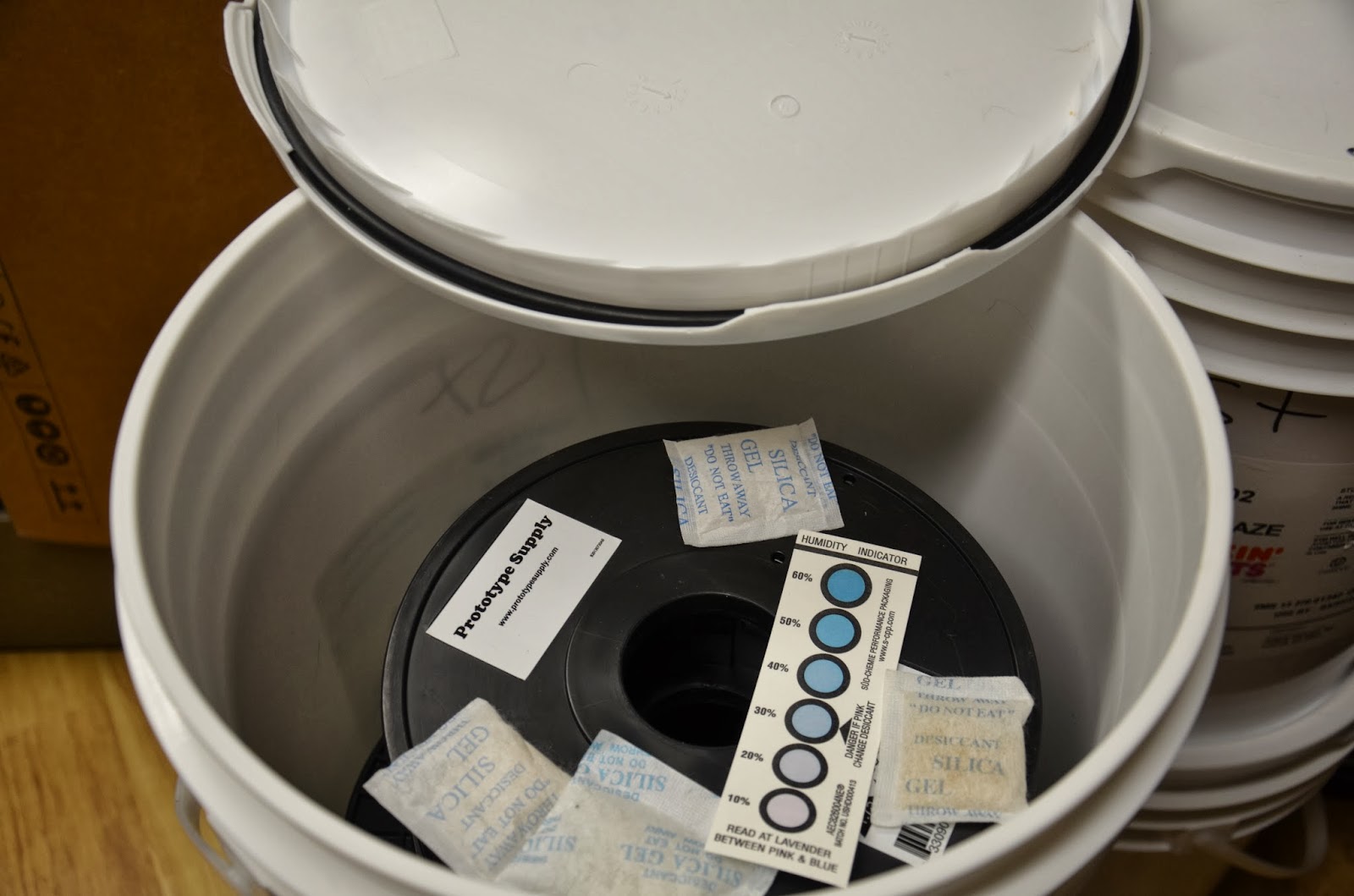
5 gallon bucket + Gamma Seal Lid + bag of rice. Holds 5 rolls. The gamma seal lid is easy screw off, but air tight, got mine at Lows. Rice is just a cheep desiccant.
If I had to guess, I would say it's the desiccant, it's too wet already to re-dry out the ziplock your using. Assuming the problem really is moisture. You can supposedly bake it for 6 - 12 hours at 200 - 250 to re-initialize it.
On Wednesday, January 1, 2014 9:09:17 AM UTC-6, sylvia wrote:

Dan Newman
Jan 6, 2014, 3:27:42 PM1/6/14
to make...@googlegroups.com
On 06/01/2014, 11:57 AM, MrChad wrote:
> 5 gallon bucket + Gamma Seal Lid + bag of rice. Holds 5 rolls. The gamma
> seal lid is easy screw off, but air tight, got mine at Lows. Rice is just
> a cheep desiccant.
I use the same thing. I have plenty of those buckets with similar
> 5 gallon bucket + Gamma Seal Lid + bag of rice. Holds 5 rolls. The gamma
> seal lid is easy screw off, but air tight, got mine at Lows. Rice is just
> a cheep desiccant.
screw on/off seals since they are useful for storing livestock feed,
human food, etc. as well and nothing gets into it yet the lids are
a breeze to open and close.
Dan

yournam...@yahoo.com
Jan 6, 2014, 3:35:31 PM1/6/14
to make...@googlegroups.com
I leave my ABS totally unprotected and have had zero issues from any of my filament (except one roll that arrived unusable). I think most people way overdo it when it comes to storage. 6 rolls and 6 months, no problems. The roll is unprotected on the back of your machine isn't it? But for those who insist on using desiccant, you can buy a large bag of Damp Rid for around $5. I bought one after dropping a phone in the toilet, works a charm and cheap too. The only thing cheaper is rice and I have to believe that calcium chloride is more absorbent.

Enginwiz
Jan 6, 2014, 3:39:37 PM1/6/14
to make...@googlegroups.com
Hello Sylvia,
What kind of issues did you experience with your PLA?
Dan Newman
Jan 6, 2014, 3:44:17 PM1/6/14
to make...@googlegroups.com
On 06/01/2014, 12:35 PM, yournam...@gmail.com wrote:
> I leave my ABS totally unprotected and have had zero issues from any of my filament (except one roll that arrived unusable). I think most people way overdo it when it comes to storage. 6 rolls and 6 months, no problems. The roll is unprotected on the back of your machine isn't it? But for those who insist on using desiccant, you can buy a large bag of Damp Rid for around $5. I bought one after dropping a phone in the toilet, works a charm and cheap too. The only thing cheaper is rice and I have to believe that calcium chloride is more absorbent.
This is entirely a YMMV situation with obvious and non-obvious
> I leave my ABS totally unprotected and have had zero issues from any of my filament (except one roll that arrived unusable). I think most people way overdo it when it comes to storage. 6 rolls and 6 months, no problems. The roll is unprotected on the back of your machine isn't it? But for those who insist on using desiccant, you can buy a large bag of Damp Rid for around $5. I bought one after dropping a phone in the toilet, works a charm and cheap too. The only thing cheaper is rice and I have to believe that calcium chloride is more absorbent.
variables. Obvious: the atmospheric conditions where you live
and store your plastic. Non obvious: the formulation of the
specific plastic in your filament. There's plenty of co-polymers
and other additives (especially in the case of ABS). Some are
much less well behaved when not kept in a humidity controlled
environment. And, since these formulations tend to be treated
as trade secrets it's hard to know in advance what new spool
of plastic will be tolerant or not.
And if you go through this list over the years, you will see definite
cases of people getting too much moisture in/on their filament and
having printing issues -- usually lots of nasty, big zits. Issue
then solved by tossing the roll or a length in a dry, warm oven for
an hour or so.
So, again, YMMV. While I live high in arid mountains where
the humidity is typically around 15 - 20%, we have a wet time
of the year (now) and in the past I too had moisture issues with
ABS filament. So, in general I keep my spools in sealed containers
with desiccant. It's one of those "an ounce of prevention is worth
a pound of spoiled prints".
Dan
Dan Newman
Jan 6, 2014, 3:54:21 PM1/6/14
to make...@googlegroups.com
On 06/01/2014, 12:44 PM, Dan Newman wrote:
> On 06/01/2014, 12:35 PM, yournam...@gmail.com wrote:
>> I leave my ABS totally unprotected and have had zero issues from any of my filament (except one roll that arrived unusable). I think most people way overdo it when it comes to storage. 6 rolls and 6 months, no problems. The roll is unprotected on the back of your machine isn't it? But for those who insist on using desiccant, you can buy a large bag of Damp Rid for around $5. I bought one after dropping a phone in the toilet, works a charm and cheap too. The only thing cheaper is rice and I have to believe that calcium chloride is more absorbent.
>
> This is entirely a YMMV situation with obvious and non-obvious
> variables.
And some 3D printing plastics have to be stored in a sealed container, preferrably
> On 06/01/2014, 12:35 PM, yournam...@gmail.com wrote:
>> I leave my ABS totally unprotected and have had zero issues from any of my filament (except one roll that arrived unusable). I think most people way overdo it when it comes to storage. 6 rolls and 6 months, no problems. The roll is unprotected on the back of your machine isn't it? But for those who insist on using desiccant, you can buy a large bag of Damp Rid for around $5. I bought one after dropping a phone in the toilet, works a charm and cheap too. The only thing cheaper is rice and I have to believe that calcium chloride is more absorbent.
>
> This is entirely a YMMV situation with obvious and non-obvious
> variables.
with desiccant. For example PVA which will suck moisture out of the air. After
all, it's marketed as a hydrophilic polymer plastic along with PAM, PEI, and some
others.
Dan
Dan Newman
Jan 6, 2014, 4:01:33 PM1/6/14
to make...@googlegroups.com
On 06/01/2014, 12:54 PM, Dan Newman wrote:
> On 06/01/2014, 12:44 PM, Dan Newman wrote:
>> On 06/01/2014, 12:35 PM, yournam...@gmail.com wrote:
>>> I leave my ABS totally unprotected and have had zero issues from any of my filament (except one roll that arrived unusable). I think most people way overdo it when it comes to storage. 6 rolls and 6 months, no problems. The roll is unprotected on the back of your machine isn't it? But for those who insist on using desiccant, you can buy a large bag of Damp Rid for around $5. I bought one after dropping a phone in the toilet, works a charm and cheap too. The only thing cheaper is rice and I have to believe that calcium chloride is more absorbent.
>>
>> This is entirely a YMMV situation with obvious and non-obvious
>> variables.
And a related subject is storing filaments away from UV light sources.
> On 06/01/2014, 12:44 PM, Dan Newman wrote:
>> On 06/01/2014, 12:35 PM, yournam...@gmail.com wrote:
>>> I leave my ABS totally unprotected and have had zero issues from any of my filament (except one roll that arrived unusable). I think most people way overdo it when it comes to storage. 6 rolls and 6 months, no problems. The roll is unprotected on the back of your machine isn't it? But for those who insist on using desiccant, you can buy a large bag of Damp Rid for around $5. I bought one after dropping a phone in the toilet, works a charm and cheap too. The only thing cheaper is rice and I have to believe that calcium chloride is more absorbent.
>>
>> This is entirely a YMMV situation with obvious and non-obvious
>> variables.
Folks are starting to print with High Impact Polystyrene (HIPS). And,
my recollection is that HIPS is not UV stable and becomes brittle after
being left out in the natural light after half a year or so. And
sure enough, a couple of the sellers of HIPS filament do warn about
the lack of UV stability. So, that's a filament which is best stored
in a manner which will cut down on it's UV exposure. E.g., an opaque
container.
Dan

Jetguy
Jan 6, 2014, 4:18:34 PM1/6/14
to make...@googlegroups.com
You mean printing a bird feeder http://www.thingiverse.com/thing:77439 or better yet, a replacement doorbell button http://www.thingiverse.com/thing:10697 from HIPS could be a bad idea???
Sorry for being slightly OT.
Not every plastic is for every job........

Bryon Miller
Jan 8, 2014, 4:09:46 AM1/8/14
to make...@googlegroups.com
I don't store my PLA in anything. My spools are in a box on the floor in no bags. But there's almost no humidity at all where I live. I buy from Rainbot 3d, Matterhackers and a 3rd party seller on Amazon. Rainbot3D has excellent filament, some of what I have is almost a year old, was stored the way I described when not in use and still works fine right now. The plastic bends nicely. The filament from the Amazon seller is very good as well, the spool looks very cheap because it's made of a tube and two cardboard discs, but it works just fine. Matterhackers filament has been problematic for me. I've had several rolls where the PLA just snapped when the extruder was just pulling in the plastic. It snapped by the roll before the plastic enters the guide tube. It snapped inside the guide tube, it snapped at the top of the extruder, and it has also snapped inside the extruder by the pinch wheel. This has all happened while using white PLA. When I bend the plastic from matterhackers the quality is not uniform, parts of the roll are good, then other parts are very bad. The good parts will bend just like the Rainbot and Amazon filament, then other parts of the PLA are so brittle, it's weak like a twig. The matterhackers filament has also caused many clogs on my nozzle that I had to clear out. Maybe I got a batch of bad rolls, even though I ordered them all on seperate occassions. I guess the could be from the same lot.
Of those 3 suppliers, Rainbot and the Amazon seller both used the type of packaging material used to tape items on a pallet to cover the PLA on the roll so it was snugg as though it were vacuum sealed. The Matterhackers had plastic that was not snug to the roll. I don't know if this matters at all though because all 3 were then sealed in another bag. They all had those desiccant packs.
If I were in a humid area, I'd probably save the stretch material that comes on the rolls from rainbot or the amazon seller and wrap it around the unused plastic like it was shipped and put it in a ziplock bag with the desiccant pack.
Of those 3 suppliers, Rainbot and the Amazon seller both used the type of packaging material used to tape items on a pallet to cover the PLA on the roll so it was snugg as though it were vacuum sealed. The Matterhackers had plastic that was not snug to the roll. I don't know if this matters at all though because all 3 were then sealed in another bag. They all had those desiccant packs.
If I were in a humid area, I'd probably save the stretch material that comes on the rolls from rainbot or the amazon seller and wrap it around the unused plastic like it was shipped and put it in a ziplock bag with the desiccant pack.

Jay
Jan 8, 2014, 10:12:32 AM1/8/14
to make...@googlegroups.com
Same as Fozzie...I live in the middle of NC...so it's not 'that' humid right now.
I've got rolls that have been stored in the tub for almost 5 months that print fine....I do double bag my Nylon and T-glase though. I've had a little spitting from the Nylon...I think it's VERY hydoscopic.
Cheers..
Jay

Th0mas
Jan 8, 2014, 11:04:21 AM1/8/14
to make...@googlegroups.com
I save the original salt bags which came with the fillament and pack them together with the fillament in a vacuum bag (like you can buy them on ebay or as 'Space Bag' in Walmart) - one bag per fillament role.
Afterwards I use the vacuum cleaner to remove the air.
Never had problems on aging PLA since I act that way.
Location of printer: A garage in Germany next to my house.
Best regards,
Thomas
Afterwards I use the vacuum cleaner to remove the air.
Never had problems on aging PLA since I act that way.
Location of printer: A garage in Germany next to my house.
Best regards,
Thomas

David Kessner
Jan 9, 2014, 5:27:36 PM1/9/14
to make...@googlegroups.com
I don't do anything special. Some of my spools have been sitting in the open on my desk for 4-6 months. Humidity in my home is usually 20-50%, and the vast majority of time is very close to 35%.
Details: Rep2. Most of my PLA was purchased from Ultimachine. I'm near Denver, Colorado.
I keep thinking that I should just submerge some PLA in water for a week and then print with it-- just to see if it really matters. Some day if I get really bored...
-David K
On Wednesday, January 1, 2014 8:09:17 AM UTC-7, sylvia wrote:

AL M
Jan 9, 2014, 7:06:34 PM1/9/14
to make...@googlegroups.com
My wife is a night baker at Dunkin Donuts they throw out buckets every day they come with icing in them they have a good snap on lid and a rubber seal 1 gal 2 gal and 5 gal they will give them to you for free if you ask and IMO rice is the best
On Wednesday, January 1, 2014 10:09:17 AM UTC-5, sylvia wrote:

Joseph Chiu
Mar 9, 2014, 3:09:07 PM3/9/14
to make...@googlegroups.com
Ooooh, how did I miss this post before? I've recently got off a near-daily donut habit that I developed for about a month or so. I'll have to see about going in for the buckets without falling back into the donut habit...
--
You received this message because you are subscribed to the Google Groups "MakerBot Operators" group.
To unsubscribe from this group and stop receiving emails from it, send an email to makerbot+u...@googlegroups.com.
For more options, visit https://groups.google.com/groups/opt_out.
AL M
Mar 9, 2014, 3:47:18 PM3/9/14
to make...@googlegroups.com
On Wednesday, January 1, 2014 10:09:17 AM UTC-5, sylvia wrote:

Robo
Mar 9, 2014, 4:44:53 PM3/9/14
to make...@googlegroups.com
I put them in the gallon size Ziploc bags with a dessicant pack. Then they're neatly stacked in the box my HPB kit came in. It's pretty high tech really.

Kelly Crittenden
Mar 10, 2014, 11:04:16 AM3/10/14
to make...@googlegroups.com
I have an old dorm room refrigerator that I use to store PLA. I live in Louisiana, where it is pretty humid most of the time and this seems to work pretty well.
Don't turn the refrigerator on though. :)
On Wednesday, January 1, 2014 9:09:17 AM UTC-6, sylvia wrote:

Eighty
Mar 10, 2014, 8:36:46 PM3/10/14
to make...@googlegroups.com
Ha! An old refrigerator - but don't turn on the refrigerator. I love it...
You're not an LSU grad by chance, are you?
You're not an LSU grad by chance, are you?
Sorry, gotta poke fun when I can.
AL M
Mar 10, 2014, 8:52:05 PM3/10/14
to make...@googlegroups.com
Well to start with you need good dry filament to begin with like ToyBuilders ABS or PLA but no mater how or what you store it in IMO temp and keeping it dry is most important i like the fridg deal air tight insulated and shelf's
On Wednesday, January 1, 2014 10:09:17 AM UTC-5, sylvia wrote:
Kelly Crittenden
Mar 11, 2014, 2:05:48 PM3/11/14
to make...@googlegroups.com
No LSU here at all!
Reply all
Reply to author
Forward
0 new messages