
What does the future hold? (Thinking about principles for Loxone in combination with surrounding solutions)
636 views
Skip to first unread message

Jakob Ventzel
Mar 10, 2021, 7:46:55 AM3/10/21
to Loxone English
Hi all
Earlier today I saw community member Jan De Bock write about using NodeRed with his Loxone installation to tie Sonos speakers in. That triggered me thinking about the following which I hope is something that you have some perspective on which you are willing to spend a bit of time on writing about :-)
My overall question is how all of you, today, are handling Loxone in your larger ecosystem of smart house component (like Sonos in the above example)?
I'm especially interested in your principles for the solutions/integrations you create and for example if you expect to be able to have other people than yourself come to your house to fix issues with them?
I ask because I have an extensive Loxone installation which was put in about four year ago when we did a full renovation of our house. Back then I was new to smarthouse automation and wanted a setup/install which was comprehensive (i.e. covering electricals, water, access, security, heating, and ventilation) and backed by a vendor who future house owners (should we choose to sell) could call for support should anything need service.
In other words, I believe whatever I setup of solutions in our house, then these must be of a nature, documentation, and support constellation which makes the setup credible and worthy of trust and value for someone looking into buying our house. If this cannot be achieved, then a future buyer will be hesitant to buy the house if they get the idea that their use of and joy with that house could be jeopardized by unexpected issues and costs.
Since we put in the Loxone solution I have become more knowledgeable about smart house stuff and have with a keen eye been following the coming of Home Assistant from an enthusiast solution towards a more credible solution which future owners of a house would appreciate buying. I now have a Synology NAS running docker containers with Home Assistant, NodeRed, InfluxDB, Grafana, ESPHome, NodeRed, VSCode, Portainer and WatchTower and I am messing around with various experiments while thinking about how the solutions I can and will deploy using the above stack will continue to live years from now :-P
So there it is, I hope this will spark a bit of discussion as I think I am part of only a handful of Loxone customers in Denmark, so there is not many kindred spirts here to talk with and get perspetives :-)
Kind regards Jakob

Rob_in
Mar 11, 2021, 2:46:08 AM3/11/21
to Loxone English
So many options available in this space and think you might have opened a can of worms here, but here's my thoughts anyhow...
On Wednesday, 10 March 2021 at 13:46:55 UTC+1 Jakob Ventzel wrote:
Earlier today I saw community member Jan De Bock write about using NodeRed with his Loxone installation to tie Sonos speakers in.
Personally I'd never use either of those products but each to their own ;)
My overall question is how all of you, today, are handling Loxone in your larger ecosystem of smart house component (like Sonos in the above example)?
We have a Loxone install and I consider it's running 'mission critical' as it works the lighting, heating & ventilation.
Anything above this I consider part of the furniture. Ie. if our ceiling speakers or system driving them stops working or are removed that isn't important as it's not really part of the core house function.
I'm especially interested in your principles for the solutions/integrations you create and for example if you expect to be able to have other people than yourself come to your house to fix issues with them?
Funnily enough I recently completely re-wired our electrical cabinet because the 'professional' sparky our builder insisted we hired left it looking like a rats nest. Now nice and clean and everything is labelled and easy to work on. I tell you this to point out easy maintenance by someone other than me is important to us.
Loxone is a commercial system that will hopefully be supported for a long time so the 'core' should be good. Even if that isn't the case, if it goes wrong and I'm not around someone should be able to replace it with something else (ie. any KNX logic controller) easily enough.
What I describe above as 'furniture' are the 'nice to have' features so I don't really worry too much about their maintainability. When you sell your house you take your furniture and that's how I see any additional features above and beyond what Loxone can do.
My opinion is basically: if you *need* something to work all the time then your core Loxone system should handle that. If it's a 'nice to have' then go ahead and tinker with other stuff.
Bearing this in mind, I originally wrote a load of standalone code (running on an RPi) to do some extra things. I tried Home Assistant as a Z-Wave bridge which I really didn't like. Since then though, have decided that any functions Loxone can't handle will be done using a single platform, which is ioBroker on Raspberry Pi hardware. I really like IOB and it can be programmed with a graphical drag and drop 'blocks' interface or with proper code. This way, there is a 3rd party web interface to get to all our 'nice to have' features (rather than having to login to a shell and mess with my custom code).
I did write a bit here about all the 'nice to have' things IOB does for us, but that's really not important here. What is important is that now we have Loxone for critical functions and IOB for everything else. I am pretty happy with this and how it works. If you don't like IOB then use LoxBerry, NodeRed, HomeAssistant, etc. but the point is think it's best to stick with as few extra systems as possible - preferably only one if you can.
Cheers,
Robin

Techdoctor
Mar 11, 2021, 3:44:32 AM3/11/21
to Loxone English
Have to agree with Rob_in.
For a while I was of the, if Loxone can't do it then I don't want a third party controller/app or external piece of hardware to do it. And more often than not with a bit of work I can get Loxone to at least give me status updates. Examples of this is my washing machine, Loxone can report its status, how long is left to go and several other washing and drying related things. The other is using Openweather for weather updates.
Mind you this view point has now changed a bit. I have just recently invested in a Rasberry Pi 4 4Gb model. This is running something called Firestorm, which allows me to control my Pixel Blaze LED controller. Its not been a straight forward process, but I got there. So I can change patterns, brightness and style of light for the strip all from Loxone.
If you have too many add ons then fault finding can be a nightmare, as more often than not an update to one device can cause all sorts of problems in your eco system.
I try and keep my professional installs as standalone as possible, so only Loxone and that is it. Just makes things easier to maintain.

Jan De Bock
Mar 12, 2021, 2:02:06 AM3/12/21
to Loxone English
That is exactly also how I look at this:
* Loxone is the core / "mission critical"
* Other system(s) are nice extras but not needed
For the other systems:
* till now I am running a few things on my NAS (synology), but I will change this because I want an independent system for the house, not mixed with personal stuff. Easier for future evolutions
* I am using other soft mainly for
> stats / analytics (can be stopped all time, not essential for operating the house) (currently using influx, but moving to postgres/timescale DB)
> linking loxone with sonos (is easy, nut not necessary. Sonos has it's own interface)
> offloading work from Loxone for less essential topics
> weather interface (open weather map)
> energy monitoring (eg solar edge and solar forcasting)
* currently using nodered and python, but Rob started my interest in IOBroker
* currently using nodered and python, but Rob started my interest in IOBroker
Hope this helps,
Jan

John Verdicchio
Mar 12, 2021, 7:38:10 AM3/12/21
to Loxone English
I'm using a Loxone miniserver to control everything that can sensibly be controlled (lights and temperature, we have no air conditioning). It is also connected to a smoke alarm and a heat-rise sensor in the kitchen. I brought the Loxone light switches but I'm not using Loxone hardware for all my lighting (DMX and various 3rd party 24V and 240V drivers ; there is some Sonoff + ESPEasy for non-dimeable lighting). I've found temperature and humidity monitoring much cheaper via the sonof+ESPEasy route.
Having followed Andrew B (and others) with grafana, I'm using a Raspberry pi4 with grafana/iobroker/influxdb. I've found this A) useful just to see how warm/humid/powerful everything in the house is B) a good way to check everything is working correctly. If a Sonoff stops responding after losing its Wifi connection the graphical output is a good check. I'm sure with some better logic in the Loxone I could build some of these warnings into the main control.
Having followed Andrew B (and others) with grafana, I'm using a Raspberry pi4 with grafana/iobroker/influxdb. I've found this A) useful just to see how warm/humid/powerful everything in the house is B) a good way to check everything is working correctly. If a Sonoff stops responding after losing its Wifi connection the graphical output is a good check. I'm sure with some better logic in the Loxone I could build some of these warnings into the main control.
I've also started playing with IOBroker and its capabilities that extend beyond extracting data from the Loxone server. I've sent a message to my LG television via the IOBroker coding - this may be a useful mechanism to tell my son "it's dinner time!". As more stuff acquires a publicly accessible API, I'm sure one can find more uses for control. I'm not quite sure of having Wifi on my fridge; it can't hand me food, tell me what food I have in my fridge or even if it is out-of-date. A similar argument is true of washing machines and coffee makers. Perhaps having an Asimo robot that can load and unload the washing machine and put the wet clothes in the tumble drier and then start on the dishwasher, that would be useful.
I've found voice activation less useful. I tried the 1Home for less than a week. The setup was not great with no obvious naming convention for the various lights, temperatures and rooms in the house. That, coupled with the rather high price, I didn't proceed. I have been using HABridge successfully with Amazone Alexa but that can't do diming or colours. I've seen some potential apps in IOBroker that allow communication with Alexa, perhaps I'll try that in time.
There are other things I'd like to automate, curtains for windows ; windows opening and closing and control of my Velux windows but that is all very expensive. Also, my wife thinks spending any money on something she can do her self is a waste of money - so no automatic garage door opener either.
A summary: I'm not sure the Internet of Things is really useful at this point in time. My current home automation is serving my family well and I'm not sure what else I'd want to be controlled (windows and curtains would be). Perhaps a better question to ask is "money no object, what would you like to have" and then wait for the economies of scale to enable it to happen.
Rob_in
Mar 13, 2021, 3:25:11 AM3/13/21
to Loxone English
On Friday, 12 March 2021 at 13:38:10 UTC+1 John Verdicchio wrote:
I've found voice activation less useful. I tried the 1Home for less than a week. The setup was not great with no obvious naming convention for the various lights, temperatures and rooms in the house. That, coupled with the rather high price, I didn't proceed. I have been using HABridge successfully with Amazone Alexa but that can't do diming or colours. I've seen some potential apps in IOBroker that allow communication with Alexa, perhaps I'll try that in time.
I actually built a Google Smart Home Fulfilment server that runs inside ioBroker and have been using it here for quite some time. Seems to work well, at least for us. You can check that out here if you are interested:
Cheers,
Robin

Andrew B
Mar 13, 2021, 7:39:50 PM3/13/21
to Loxone English
Definitely opened a can of worms with this one. :)
I haven’t put much energy into my project for the past year and a half or so, but there have been quite a few lessons learned in this time that will be reflected in system changes. And I feel like this year will likely see me putting effort back into the project. My intention is still to remove the Loxone entirely. That will leave me with a bespoke system built out of off-the-shelf components and interconnected with standard tech (Ethernet and 1-wire, mostly). The core of the system will be an ARM SBC, like it is now but with the remaining Loxone functionality moved into my custom software. The Loxone programming is just too much of a nightmare at the scale I need it.
For resale, I’ve accepted that a buyer will either jump onboard the idea and dyi spirit of what I’ve built, or will demand a discount so that they can hire a pro outfit to come in and replace it with something “professional” (and the associated maintenance contract). The wiring in place is all home run and doing a replacement wouldn’t be difficult, so there is no obstacle to this. Housing prices are still climbing, so oh well, I don’t care about the relatively small potential value hit. And for me, having a bespoke system is oh sooooo preferable!
Collecting data from the house at this scale has really been extremely valuable. I now have on the order of 50GB of sensor and power consumption data, all easily queried via SQL (from TimescaleDB). In addition to being useful for figuring out how to improve the hvac, it has also spotted problems immediately after they happened (eg the water meter told me of a leak, the power monitor tells me when the heat pump failed to reset after a brown out, specific sensors let me know a hydronic valve failed, etc). The multichannel power monitor is also useful for attribution of power to uses such as a home business and work from home during the pandemic.
The latest addition to my system is a solar PV install, and I still need to write the software to pull the data from the data collection box that came with it. My HomeKit integration has been working well for years, although it generally only gets used for a couple of specific things. At this point I don’t really know what else I would want to integrate, but I do have a fair list of refinements, many of which are fancier automatic ways to detect and notify us of problems. And when the hvac logic moves to my software it will include functionality that is just too hard to do via Loxone... one example: automatically exercising pumps and valves daily to avoid seizing. Plus I have some ideas about how to use machine learning to improve efficiency.
Oh, and replacing the Loxone means ditching their app. Fortunately in the past year the options for quickly building good mobile UI without a horrendous amount of effort have improved greatly. So doing a web UI and an Apple UI is now much more feasible for me. And I’ve determined that it’s performance will be vastly better than the existing app, which is frustratingly slow.
Jakob Ventzel
Mar 14, 2021, 4:41:31 PM3/14/21
to Loxone English
Hi all
Great input and I'm so happy that you are pitching in 👍
Rob's analogy of a house with embedded functionality versus furniture makes a lot of sense for me and, I think, summarizes well how one can think about the solutions we create and implement.
Great input and I'm so happy that you are pitching in 👍
Rob's analogy of a house with embedded functionality versus furniture makes a lot of sense for me and, I think, summarizes well how one can think about the solutions we create and implement.
I guess my mounting apprehension with Loxone is that rate of (relevant/interesting) innovation seems to be declining coupled with them pushing DIY-customers out to partners for access to their hardware which (to me) appears to be steeply increasing in price. I worry this this is early indications of them have become too comfortable with what they have achieved and the hunger for outcompeting their competitors has been stilled, while customers like me are reigned in.
In the meantime, open source centric competitors like Home Assistant are maturing their product and with now more than 1700+ integrations, I have been thinking that were I to start over, I would dive deep into where manufacturers like https://www.unipi.technology/ have gotten to in terms of industrial grade solutions which are designed to be components in an automation solution built by someone else rather than an ecosystem on their own.
I get the points that many of you are making in terms of what you want to get from your home automation. Prior to getting going with Loxone in 2016, the furthest I had gone with home automation was a lot of Philips Hue lights, some WiFi outlet switches, a Smappee for energy monitor and IFTTT for tying everything together. I knew when we bought our house that I wanted to get a comprehensive automation solution and one which wasn't susceptible to software (e.g. integration) or hardware issues. I felt Loxone really met these requirements and back then I was really impressed with the many new extension modules they were bringing to market in rapid succession.
Now I have the house running with all the basics (heat, lighting, water, ventilation) and over the last two years I have been getting familiar with microcontroller and the possibilities for creating unnecessary but fun solutions like linear actuators which push our bed tables up inclining drawer runners from their daytime storage place in the wall and a microcontroller monitoring if the flag has been raised on our flag pole, when someone on the street has a birthday. If Loxone was an official ESPHome partner with a native integration, I would having so much fun with my solutions in Loxone instead of in Home Assistant :-)
I guess, Andrew B and I are in the same ball park in terms of our itch for tinkering, but I think I'm staying over in the corner of the ball park where the cautious players hang out camp out ;-)
As mentioned great input 🙏 and please continue the conversation as I find this really helpful, and I hope other Loxone enthusiasts do as well :-)
Kind regards Jakob
Jakob Ventzel
Mar 14, 2021, 5:20:09 PM3/14/21
to Loxone English
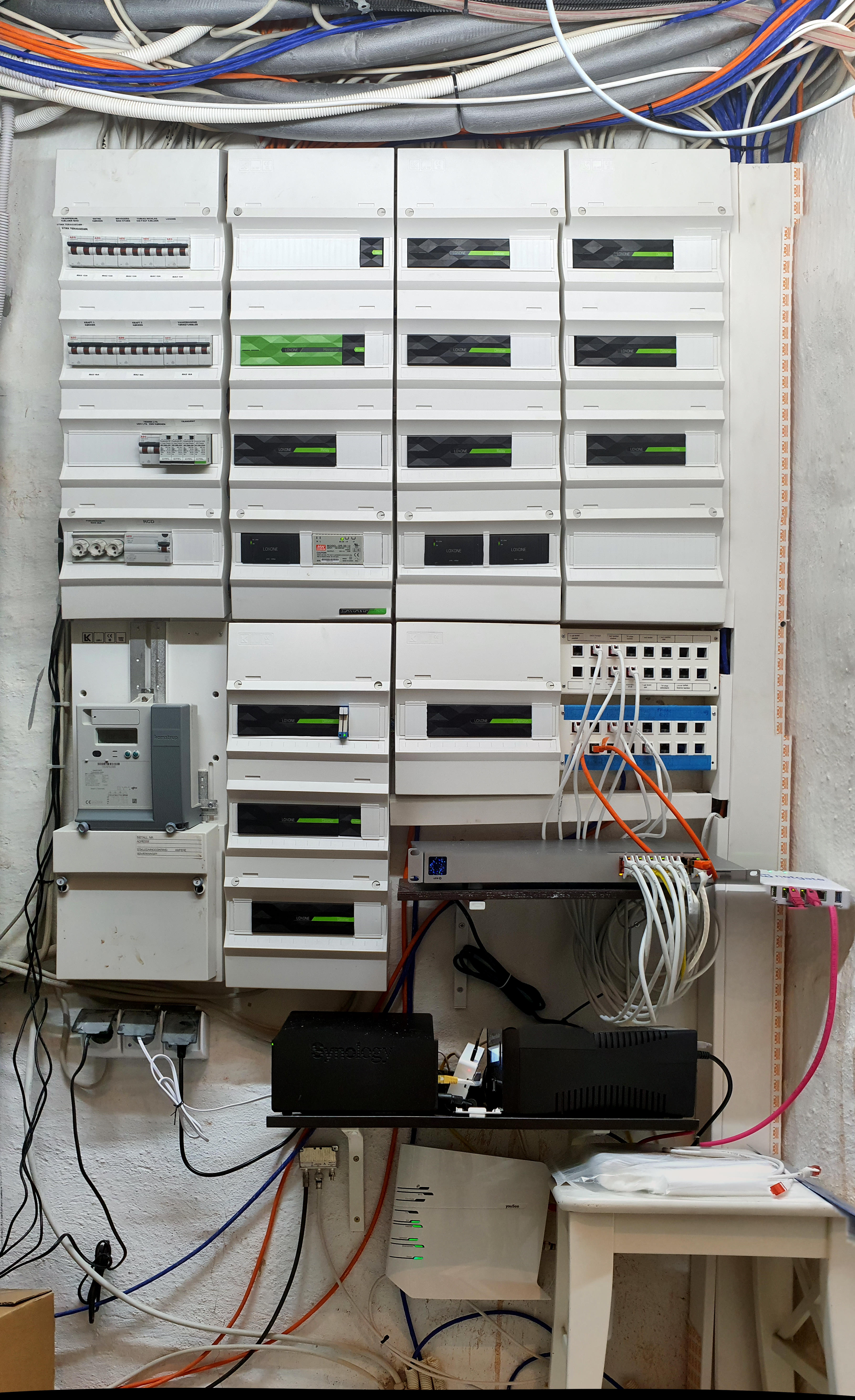
NB: Here is how my installation looks after 4 years. I am considering Robs idea with taking everything apart to make all cables and wires flow nicely... but it's not likely to happen before I retire I think...

hidde....@gmail.com
Mar 15, 2021, 4:47:54 AM3/15/21
to Loxone English
I'm mostly aligned with the vision of Rob, with the difference that I want my heating/lighting/ventilation to be working (mostly) without relying on a single component which can mess up everything in one go, or worse becomes a mess if one vendor does something unpredictable/stupid.... therefore I've moved these to KNX or standalone controllers which integrate with KNX. Worst thing that can happen there is that my KNX PSU dies... I do have one spare around to fix this quickly if needed (low cost anyway).
I do like the logic editor in loxone for somewhat more complex items (e.g. garden irrigation based on historic rain and future outlook) and also for a (non-certified) burglar alarm. Given the prices of burglar alarms, having loxone for just this is already cost effective, the rest is bonus.
I've found the attitude of Loxone to have changed too much in the past few years, which made me move to KNX. I just don't feel comfortable with their unpredictable behavior. With my current installation on KNX, with ETS inside with BAB-tec app module, things are fairly easy to trasfer to a new owner and some professional installer if the new owner wants this.
When we started all this we thought that a good app on the phone would be really important, a few years in we've found that we make very little use of the app, motion sensors and self running systems make the use of the app less important (We may not touch it for weeks sometimes). Given this, I'd likely prefer to have no app, but instead have a better integration with homekit....
Hidde
Op zondag 14 maart 2021 om 22:20:09 UTC+1 schreef Jakob Ventzel:
Jakob Ventzel
Mar 15, 2021, 5:43:19 AM3/15/21
to Loxone English
Hi Hidde
Would you happen to have a link to a resource which describes how a KNX centeret setup like what you mention would work?
My wife and I use the Loxone app several time every day, e.g. for opening and closing the garage door when arriving and leaving in the car or when turning outlets on and off, but not bothering to get up from the couch and when opening outer doors where we haven't installed a fingerprint reader. I find the app useful and easy to navigate, but not super inspiring and flashy, which is of course not the primary purpose of it, but a bit more modern look wouldn't hurt.
You mention wanting to or already using Homekit. What are your use cases here?
/Jakob
hidde....@gmail.com
Mar 15, 2021, 6:32:37 AM3/15/21
to Loxone English
Hi Jakob,
We may be a bit old fashioned. we don't do RGBW lights. only white LEDs that dim to warm.I don't want any electonics to open doors or lock them, I simply don't trust it enough. So all of these are mechanical for us. We also still have a lot of wall switches (contrary to the loxone filosophy). however we do have movement/presence sensors in all our general spaces. these have all been programmed to take lux levels and presence into consideration to switch the lights. After some tuning this is now at the point that we don't use the wall switches or the app for this (they're still there if we need them).
I've moved all my actuators to KNX actuators, and am in the final stages of moving all my sensors also to KNX sensors. The next step for me will be to move the thermostat function from loxone over to my knx actuator thermostats (MDT AKH) and to move the loxone lighting control to KNX directly. For this stage I'll keep Lxone and the app around for visualisation. Once this is working then I'll be going into the next stage which will be to try to move away from the loxone direct KNX connection, either through the BAB-tec module or possibly some other means, which allows me to connect Loxone to the KNX provided capabilities via some IP interface.... this will then prepare me to be able to move from a gen1 miniserver to a gen2 miniserver without KNX extension, if ever needed....
Finally I plan to add homekit support on top, this may be through the bab-tec module (currently in beta for homekit), 1home (benefit of supporting both KNX and Loxone if needed, and providing BAOS interface), or who knows what else I come across as option.
In the end it won't be cheaper to do things this way, however I now do get the freedom to move with loxone or move away from loxone if needed... I can use the native mobiel integrations (homekit) or I can use the loxone app... or some other visualization.
The thing here is that I want to have options, and don't be constrained to a single vendor that may do strage things (E.g. just look at the last revision of the loxone software. there's no technical reason why some functions aren't on the gen1 server, which makes me suspicious about their intentions).
just hedging my bets.
Hidde
Op maandag 15 maart 2021 om 10:43:19 UTC+1 schreef Jakob Ventzel:

Aljaz
Mar 16, 2021, 9:54:39 AM3/16/21
to Loxone English
Hi Hidde,
I know this is not exactly on the topic, but I am really interested in how you have managed to configure your sensors well enough, that they can completely replace wall switches and the mobile app. As I see this it is fairly easy to do that well for pass-through rooms like staircase, hallway etc., but it is way more complex for recreational rooms such as living room or kitchen.
I am planning to implement something similar in my apartment and would appreciate some tips and maybe some more details on how you have achieved it. :)
Otherwise I agree on importance of having multiple options available for smart home owners, as you have mentioned above.
Thanks,
Aljaz
Aljaz
Jakob Ventzel
Mar 16, 2021, 10:31:26 AM3/16/21
to Loxone English
Hi Aljaz
Yes, this is definitely an interesting point. I have the first version Loxone Presence Sensor Tree devices in all rooms, but in our living rooms like our TV-watching room the family can been moving so little (e.g. while lying on the couch) that the sensor does not detect them for too long an interval at times. The new version of the sensor (https://shop.loxone.com/enuk/presence-sensor-tree-white.html) is listed as also supporting acoustic pickup as signals of the room being occupied, which I think is a great idea. I wish this version was the one I have as I think that would have allowed me more precise control. As it is, I have simply increased the timeout values, so the light stays on for 45 minutes after the last movement was detected.
Besides the presence information from the sensors I also use them for information on what the light level is in the room.
With the Home Assistant platform, I have been experimenting with the https://www.room-assistant.io/ solution to use Bluetooth presence as indicators of presence in the room, but the Raspberry PI Zero devices I have deployed for this are not functioning as well I would have hoped (too many false negatives).
In all rooms I have at least one Touch Tree device (https://shop.loxone.com/enuk/touch-tree-white.html) to get temperature which is controlling the central heating for that room and the Touch tree devices allows the family to turn on/off wall outlets and task-oriented lights.
Kind regards Jakob
hidde....@gmail.com
Mar 16, 2021, 5:53:41 PM3/16/21
to Loxone English
Few things I want to add here.
1) the presence sensors have improved a fair bit in recent years. it's no longer just movement, also sound and CO2 are added. Worth taking a good look at this. Also besides the loxone sensors.
2) we have shelly plug to check if the TV is used.
3) we have a CO2 sensor in the living room, based on the sensed value we know that there are people in the room, or at least recently have been.
In other words, finetuning of presence sensors combined with other information helps.... still not perfect, but for us good enough.
Hidde
Op dinsdag 16 maart 2021 om 15:31:26 UTC+1 schreef Jakob Ventzel:
Aljaz
Mar 17, 2021, 5:09:06 AM3/17/21
to Loxone English
Thank you both Hidde and Jakob for the input. It definitely helps.
Reply all
Reply to author
Forward
0 new messages