
.wav file for SDR testing

Leif Asbrink
Modern hardwares like Perseus, SDR-IP, Excalibur, QS1R and others
have a dynamic range that beats most everything analog. These
hardwares supply data to a PC computer at a modest data rate and
it is assumed (by me at least) that the SDR software will not
corrupt the signal by using inadequate filters.
The quality of softwares is however not necessarily compatible
with the quality of hardwares. I have generated a .wav file that
can be played in perseus.exe, Winrad and Linrad. The file contains
a strong signal that is swept across the spectrum as well as a weak
signal (120 dB down) which is on-off keyed.
There are some profound differences:
http://www.sm5bsz.com/lir/sim1/sim1.htm
I plan to make similar tests available for other SDR packages.
Some (e.g. SpectraVue and sdr-radio) do not perform well today,
but I have no reason to believe it would be difficult to apply
appropriate filtering before decimation in a PC computer.
The problem just needs some attention....
73
Leif / SM5BSZ

f6dro
interesting measurements.. Have U been testing with noise blanker on for the
various softwares U tried with? It looks like here that strong signal
problems are much worse on Winrad and Spectravue when the noise blanker is
switched on
73
Dom
Leif Asbrink
I have of course made tests:-)
Noise blanker operation is complicated matter however. I could
make files that show that other SDR softwares are totally
useless compared to Linrad, but that would not be fair.
Real noise problems that are encountered on the bands are
complicated. I do not want to demonstarte an artificial test
that might be unfair.
I would however VERY MUCH like to present some typical bad
cases in the form of real life recordings. Something like
what is demonstrated here:
http://www.youtube.com/watch?v=SD0V2D5S1dU&feature=player_embedded
There would have to be a really strong signal present also.
Preferabbly a CW station so one can hear whether the keying
on-off of the strong signal matters. Best would be with
a couple of strong signals since a blanker might cause
intermodulation between them.
I have repeatedly asked for such recordings over the years
but the interest is very small.
The best example so far is this one from w3sz:
http://sm5bsz.com/linuxdsp/spur/autospur.htm#CHALLENGE
The QRN is not really bad and the strong station is not
really strong. Someone, on some band, should have experienced
something more challenging. Something that could be used
for comparisons and software improvements.
I can provide an ftp site for uploads:-)
73
Leif / SM5BSZ

AdB
I did some tests with the Leif WAV file, and using WRplus, which has better anti-alias filters than the original Winrad.Hello Leif, please include WRplus in your planned tests (if you can). 73 Sandro
I also optimized a little the program's parameters for better display and better audio rendering.
A few screen captures
The weak signal and the sliding huge signal
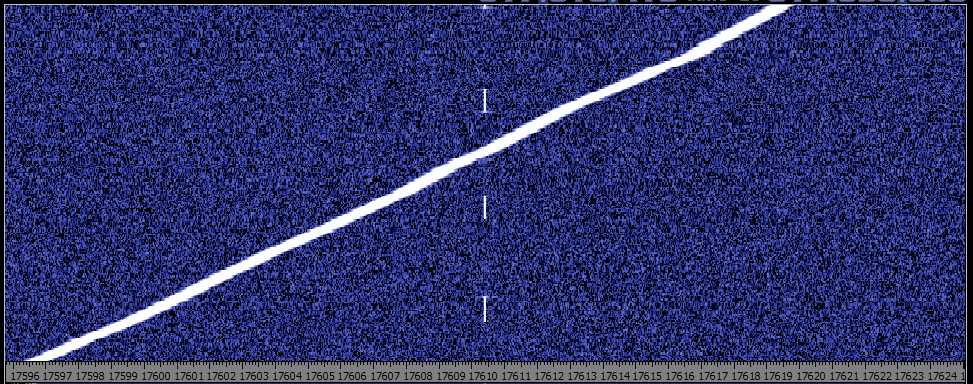
The time domain waveform of the weak signal, as captured with Adobe Audition
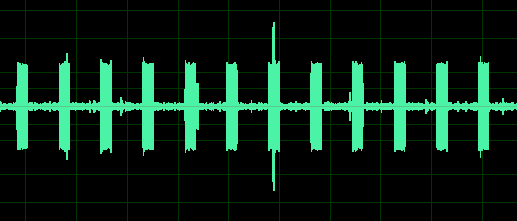
The time domain waveform while the huge disturbance is in the passband
And lastly the MP3 file with the captured audio
http://www.sdradio.eu/audio/sim1_wrplus.mp3
73 Alberto I2PHD
AdB
> Hello Leif,
>
> please include WRplus in your planned tests (if you can).
>
> 73 Sandro
I did some tests with the Leif WAV file, and using WRplus, which has better anti-alias filters than the original Winrad.
I also optimized a little the program's parameters for better display and better audio rendering.
A few screen captures
_*The weak signal and the sliding huge signal*_
http://www.sdradio.eu/images/leif1.gif
_*The time domain waveform of the weak signal, as captured with Adobe Audition
http://www.sdradio.eu/images/leif2.gif
The time domain waveform while the huge disturbance is in the passband
http://www.sdradio.eu/images/leif3.gif
And lastly the MP3 file with the captured audio*_
http://www.sdradio.eu/audio/sim1_wrplus.mp3
--
/*73 Alberto I2PHD*/
Leif Asbrink
> I also optimized a little the program's parameters for better
> display and better audio rendering.
The purpose of the test is to find out whether aliases and
spurs will affect performance.
The test file requires a detect bandwidth in the order of 1 kHz
because the strong signal sweeps rapidly. It is not ok for this
test to set a very narrow bandwidth to enhance the on-off
keyed signal. With a much slower sweep rate the true level
of the spurs would become visible, but the file size and time
of testing would become impractical.
It would be a good thing if you could make a better version of
Winrad available. Many hams prefer it because they like the
user interface. From what I can hear in your recorded
file the spurs are very strong but attenuated due to the
narrow filter that a rapidly sweeping signal will not go through.
That is cheating because the real problem is frequency stable
spurs and they are not attenuated by the use of narrower filters.
73
Leif / SM5BSZ

Nico Palermo
It's always a pleasure to read your tests.
There's always something to learn from them.
Have a Happy New Year,
Nico / IV3NWV

Simon HB9DRV
Hi Leif,
The decimation stages in my software have been optimised to have > 140dB of rejection. Using your test signal there are *no* visible images anywhere, anytime, anyhow J .
The Linrad code should be getting worried, there will be competition for the number 1 slot soon !
Simon HB9DRV
AdB
> The purpose of the test is to find out whether aliases and
> spurs will affect performance.
> because the strong signal sweeps rapidly. It is not ok for this
> test to set a very narrow bandwidth to enhance the on-off
> keyed signal. With a much slower sweep rate the true level
> of the spurs would become visible, but the file size and time
> of testing would become impractical.
>
> It would be a good thing if you could make a better version of
> Winrad available. Many hams prefer it because they like the
> user interface. From what I can hear in your recorded
> file the spurs are very strong but attenuated due to the
> narrow filter that a rapidly sweeping signal will not go through.
> That is cheating because the real problem is frequency stable
> spurs and they are not attenuated by the use of narrower filters.
>
> 73
>
> Leif / SM5BSZ
well, it wasn't my intention to cheat, of course. I didn't realize that your test needs a 1 kHz passband
in the demodulated audio.
About a better version of Winrad, I am (somewhat) working on it. It won't be called Winrad anymore...
The problem is that I am a bit (and this is an understatement...) lazy... but these your tests and also
others done in the past are an invaluable input for that...
Happy New Year 2011 !
--
73 Alberto I2PHD
Simon HB9DRV
Sorry,
With the help of those who know what they are doing it’s now > 155dB of rejection J
Simon HB9DRV
Simon HB9DRV
How good is PowerSDR in this area?
Simon HB9DRV
http://sdr-radio.com
-----Original Message-----
From: lin...@googlegroups.com [mailto:lin...@googlegroups.com] On Behalf Of
Leif Asbrink
Sent: 31 December 2010 05:16
Leif Asbrink
> How good is PowerSDR in this area?
I have no idea. I have installed PowerSDR but I can not make
it read the soundcard on my laptop (I say I have a softrock
but I do not...) For that reason I can not write a .wav
file so I have no prototype file to start from.
Right now I am trying to modify the header of the sim1.wav
file to make it play in the QS1R software. I think a little
program sim2qs1r that anyone can run with sim1.wav as the
input file would do the job:-)
I do not think PowerSDR can read 500 kHz 16 bit files so I
will make another file for that. I will need a short
PowerSDR recording to start from. Maybe 1 second of
the noise floor with a dummy load so I can see what the
header looks like.
73
Leif / SM5BSZ
Simon HB9DRV
OK - enjoy hacking into PowerSDR :)
Your file was excellent, it made me finally improve the decimation with
Pieter @ RFspace's help and in fact I ended up with better decimation which
used less CPU. It runs very smoothly on my ASUS EEE Netbook.
I think the PowerSDR only goes up to 192kHz bandwidth. Ideally we would all
support VITA-49 files.
Simon HB9DRV
http://sdr-radio.com
-----Original Message-----
From: lin...@googlegroups.com [mailto:lin...@googlegroups.com] On Behalf Of
Leif Asbrink
Sent: 01 January 2011 21:03
To: lin...@googlegroups.com
Subject: [Linrad] Re: .wav file for SDR testing
AdB
> I have generated a .wav file that
> can be played in perseus.exe, Winrad and Linrad. The file contains
> a strong signal that is swept across the spectrum as well as a weak
> signal (120 dB down) which is on-off keyed.
file produced by Leif have been completely fixed.
I have just run that file with WRplus V1.04, and have captured in real time the screen and the audio.
http://www.sdradio.eu/wrplus/WRplus_sim1.html
Dial up and slow ADSL will have some stuttering on this video... I didn't want to sacrifice the quality too much...
After clicking on the link above, wait a few seconds until you see a small image with a black arrow in the center.
I suggest to wait still a few seconds before pressing that start symbol, so that buffering can advance a little.
73 Alberto I2PHD
Leif Asbrink
I tried the link. It is useless here but I do not know wheter the
problem is Linux or a slow Internet connection. I can nbot see
anything except black screen.

I have tested WRplus 1.04 and I will upload the results in the near
future. SDRMAXIV is also improved and I will upload tests on it
also.
73
Leif / SM5BSZ
AdB
I tried the link. It is useless here but I do not know wheter the problem is Linux or a slow Internet connection. I can nbot see anything except black screen. I have tested WRplus 1.04 and I will upload the results in the near future. SDRMAXIV is also improved and I will upload tests on it also.
yes, on a slow Internet connection it takes some time before you can see the initial screen...
If you have under Linux a way to play an mp4 video file, this is a direct link where you can
download the video file from :
http://www.sdradio.eu/wrplus/WRplus_sim1.mp4 (about 6.7 MB)
You can download that file e.g. while you are on the beach :-) , and see it when you return home...
To summarize the results, there are no spurs whatsoever, nor birdies while of course the moving
big carrier is outside the demodulation passband. It looks like Sandro did a good job...
73 Alberto i2PHD
Leif Asbrink
> yes, on a slow Internet connection it takes some time before you can see the initial screen...
> If you have under Linux a way to play an mp4 video file, this is a direct link where you can
> download the video file from :
>
> http://www.sdradio.eu/wrplus/WRplus_sim1.mp4 (about 6.7 MB)
>
> You can download that file e.g. while you are on the beach :-) , and see it when you return home...
>
> To summarize the results, there are no spurs whatsoever, nor birdies while of course the moving
> big carrier is outside the demodulation passband. It looks like Sandro did a good job...
I was able to see the video, but I do not agree on the conclusions.
The wide range spurs are not present any more,
but the close range spurs are unchanged.
They are of course not anywhere near as harmful as the wide ones,
but for e.g.160m CW operators they could be a serious problem.
I have updated the information on my site, but only within my lqaptop
at this time. My Internet connection does not allof ftp from here.
I will try to find another connection.
73
Leif / SM5BSZ
AdB
I was able to see the video, but I do not agree on the conclusions. The wide range spurs are not present any more, but the close range spurs are unchanged. They are of course not anywhere near as harmful as the wide ones, but for e.g.160m CW operators they could be a serious problem.
to better evaluate the close range spurs, it would be quite useful to have a similar WAV file
as sim1 but with the carrier moving much more slowly, taking e.g. 30 seconds to traverse the
passband....
How did you produce that file ? I suppose it can be synthesized with an adequate audio editor,
like the excellent Adobe Audition. I will perform some experiments in this direction.
On Linux, where there is no Audition, you could use Audacity, but, while being a good program,
it has nowhere the capabilities of Adobe Audition.
If I succeed in producing such a file, I will make it available to everybody.
73 Alberto I2PHD
Leif Asbrink
> to better evaluate the close range spurs, it would be quite useful to have a similar WAV file
> as sim1 but with the carrier moving much more slowly, taking e.g. 30 seconds to traverse the
> passband....
>
> How did you produce that file ?
It is easy.
Run Linrad with a 500 kHz .wav file as the input.
Press F11
Start recording by pressing 'S'
Stop by pressing 'S' again
The file created will be e.g. C:/linrad_data/myfile.raw
Then run linrad, main menu '5' for raw to wav converter.
Enter C:\linrad_data\myfile.raw
then e.g. myfile for the output.
Answer yes on the question "do you want to save in 24 bit format"
The file C:\linrad_data.wav will be the test file.
To change sweep rate, sweep width, amplitude etc, edit rxin.c around
line 990.
You will need Linrad-03.19 or later for this (not yet uploaded.)
Earlier versions will give a 16 bit file only. I think you will
see the spurs well on 16 bit data also....
The narrowband spurs are well visible in WRplus with a steady carrier.
Easy to write sin and cos at full amplitude into the .wav file
replacing whatever data that was there originally:-)
73
Leif
AdB
passband when a -0.2 dB big signal passes through it, in presence of a -125 dB CW signal.
So I generated synthetically, no SDR software was used for this, two WAV files, one sampled at 480 kS/s and the other at
500 kS/s. Both with 24 bit amplitude resolution. The reasons why I needed two will be clear in a moment.
Both files have a -0.2 dB signal sweeping a band width of 2200 Hz in 30 seconds. I added white noise at a very low
level, surely lower than that of a typical direct sampling SDR, and added also a simulated CW signal at about -125 dB
from full scale.
Then I played both files through WRplus. The results are very interesting, and thanks to them the culprit for the
generation of some spurs is now very clear.
As the final output audio sampling frequency is 12 kS/s, when playing the file sampled at 480 kS/s the total
downsampling ratio is an integer number, and the fractional resampler is simply asked to divide by 2.5 a rather nice
number. Instead, when playing the 500 kS/s signal, now the total ratio is no more an integer number and the fractional
resampler is asked to divide by 2.604, which requires the addition of more samples weighted with the sin(x)/x function...
The net result is that with the signal sampled at 480 kS/s the spurs visible in the passband are at least 140 dB below
full scale, while with the 500 kS/s signal the level of the spurs is barely 100 dB below full scale....
WRplus uses the same fractional resampler as the original Winrad, and originally, when designing it, I reckoned that a
suppression of 100 dB could be considered enough. But apparently this is not the case... Sandro (the author of WRplus)
is informed of the above, and he will take countermeasures.
I recorded two MP4 videos, each less than 4 MB, to show in details what happens when that big signal sweeps through the
passband of WRplus.
Interested parties can download the two MP4 videos from here :
http://www.sdradio.eu/audio/t1n24_480k.mp4
http://www.sdradio.eu/audio/t1n24_500k.mp4
I uploaded also the original I/Q WAV files used for the test. In doing this, I discovered that ZIP is almost useless to
compress a WAV file, while instead the RAR compressor is excellent, reaching a 50% reduction in the file size. As I am
not sure if under Linux it does exist a RAR decompressor, I uploaded both the ZIPped and the RARed version of each file.
http://www.sdradio.eu/audio/t1n24_480k.rar about 41 MB
http://www.sdradio.eu/audio/t1n24_480k.zip about 82 MB
http://www.sdradio.eu/audio/t1n24_500k.rar about 42 MB
http://www.sdradio.eu/audio/t1n24_500k.zip about 86 MB
The WAV files have a typical Winrad header. If need be, I can change that with a Perseus header, for compatibility reasons.
I hope this can be of help to better investigate on the behavior of SDR software.
73 Alberto I2PHD
AdB
Upon request from some, I have produced the two WAV files also with the Perseus header.
They can be get from here :
http://www.sdradio.eu/audio/t1n24_480kP.rar
http://www.sdradio.eu/audio/t1n24_500kP.rar
Note the final 'P' in the name...
73 Alberto I2PHD