|
|
|
Ornithological
Society of the
Middle East,
the Caucasus
and central
Asia
Quarterly Newsletter
|
|
|
|
Promoting
conservation,
education and
birding in the
region.
|
|
|
|
|
Welcome
to the new
OSME
e-newsletter
No. 6
Chairman's
introduction
I’m delighted
to introduce
OSME’s 6th
e-newsletter,
and in this
issue it is
really
inspiring to
read about the
wide diversity
of projects
that OSME have
supported in
recent years.
Our ability to
support these
projects is
only possible
with the
ongoing
commitment of
our members,
corporate
sponsors and
donors. If you
aren’t already
a member of
OSME then
please
consider
joining us or
making a
donation.
Thanks to your
support, since
2014 we’ve
been able to
increase our
expenditure
through the
Conservation
Fund to record
levels (see
“Spotlight on
the OSME
Council” for
more on this),
and I’m
delighted to
see some
recent
projects
highlighted in
this
newsletter.
OSME’s support
has enabled
some exciting
discoveries in
Kyrgyzstan
relating to
the globally
Near
Threatened
Little
Bustard. The
OSME region is
home to
several
important
populations of
the globally
Endangered
Egyptian
Vulture and
I’m pleased
that we’ve
been able to
support
activities on
Socotra as
part of the
annual Vulture
Awareness Day.
OSME’s Youth
Development
Fund goes from
strength to
strength, and
thanks to a
grant from
BirdLife
International’s
European and
Central Asian
office, we’ve
continued to
support
emerging local
conservationists in Azerbaijan in delivering some preliminary surveys of
the globally
Vulnerable
Marbled Teal.
You can read
more details
about these
projects in
the following
pages of this
newsletter.
Thanks for
your continued
support, and
happy birding
to everyone
across the
OSME region
and beyond.
Dr Rob
Sheldon, chai...@osme.org
|
|
|
|
Spotlight
on the OSME
Council – The
Treasurer

Chris Hughes,
OSME
co-Treasurer
We’ve all sat
at meetings
when the
Treasurer’s
report comes
up and a
glazed
expression
descends as
the words
balance sheet,
depreciation,
bank
reconciliation,
SOFA and the
like drift off
the
Treasurer’s
tongue. You’re
looking at the
paperwork and
try to
understand the
accountant’s
language and
then happily
approve it all
just to move
on to what
you’re really
interested in,
the birds and
what we’re
doing to make
a difference.
Looking after
the money I
have to tell
you, really
does make a
difference and
I’m just as
passionate
about the
birds.
It’s essential
that OSME’s
Council and
our members
are aware of
our finances
or to put it
simply how
much money
have we got
and what have
we got
available to
spend, not
just today,
but into the
future.
We prepare
quarterly
accounts that
show what we
have spent,
but far more
importantly
forecasts
telling us
what we will
look like for
the rest of
the year and
then three
years into the
future. Doing
this enables
us to plan
ahead and work
with our
partners
across the
region
guaranteeing
funding for
their
astonishing
work. It has
meant that
over the past
few years we
have been able
to
dramatically
increase our
conservation
spend. In 2020
it was around
sixty pounds
per member
this year with
a stable
membership
that will rise
dramatically
by 50% to
ninety pounds.
That will be a
figure
approaching
fifty thousand
pounds!
Our accounts
have been
crucial, they
are
independently
verified,
published and
freely
available via
the Charity
Commission (https://register-of-charities.charitycommission.gov.uk/charity-search/-/charity-details/282938)
website giving
enormous
confidence to
both our
members and
donors who
look for both
effectiveness
and robust
stewardship.
Day to day the
administration
is taxing but
with John Warr
at the helm it
is in very
safe and sure
hands with a
detailed
record of all
that we do,
around 1200
lines and 25
columns of an
excel
spreadsheet in
a normal
year.
Too often in
many
organisations
spending
decisions are
made solely by
the Treasurer,
but actually
the
Treasurer’s
job is to
provide both
Council and
our members
the
information
they need to
make and own
those
decisions.
Please don’t
glaze over
next time
finance is
mentioned,
your input is
critical to a
successful
organisation.
Contribution by:
Chris Hughes,
co-Treasurer
|
|
|
OSME Conservation
Fund Update –
Documenting
nesting little
bustards (Tetrax tetrax) in the Tulek
Valley IBA of
Northern
Kyrgyzstan

Little
Bustard:
Photo
Louis-Phillippe
Campeau
In May 2021the
Ornithological
Society KG
(OSKG), a
local
birdwatching
organisation
based out of
Bishkek in
Kyrgyzstan,
obtained a
grant to
monitor three
steppe species
in the Tulek
Valley
Important Bird
Area (IBA).
The area,
which was last
investigated
by Soviet
biologists
back in the
1970s, was
supposed to
host a small
population of
the vulnerable
yellow-eyed
pigeon, as
well as
passing
imperial
eagles. It
also used to
be a breeding
site for the
little
bustard,
before
intensive
Soviet
agricultural
practices did
away with the
field of long,
wild grass,
making
breeding
impossible.
The catalyst
for our
project was
the discovery
of a bustard
nest about 20
km from the
IBA by
relatives of
one of our
members. The
quest was on:
was this an
isolated
incident? Or
could the
little bustard
be breeding in
the area
again? Over
five weeks in
May and early
June 2021, we
spent three
days a week in
the IBA
looking for
our species.
Spoiler alert:
no imperial
eagles were
found and the
closest we got
to a
yellow-eyed
pigeon was a
lone European
turtle dove (a
very rare find
in Kyrgyzstan,
to the
excitement of
our expert Dr.
Sergey
Kulagin). This
is a rather
sad finding,
as a stuffed
individual
bird housed at
Bishkek’s
Academy of
Science’s
Zoological
Museum
confirmed the
historical
presence of
the
yellow-eyed
pigeon.
Luckily, we
had much more
success with
the bustards!
During our
fieldwork, we
mapped 149
encounters
with the
species, which
represented up
to 80
individuals.
17 of them
were seen
defending the
same territory
over three or
more weeks and
were thus
assumed to be
attempting to
breed. Indeed,
little
bustards
establish
“loose leks”
in which males
defend a
territory of
roughly
0.5km², which
are then
visited by
females. Males
can be spotted
because of
their very
audible
vocalisations
– PRRRT!
-
and jumping
displays,
while females
are much more
elusive
(although we
still
succeeded in
mapping nine
of them).

Little
Bustard:
Photo
Louis-Phillippe
Campeau
The centre of
this lek
seemed to be
series of dry
hills mainly
used for dry
cereal
cultivation,
an unusual
feature in an
area
consisting
largely of
irrigated
agriculture
(water melons,
alfalfa etc.).
In early May
2021, the
birds were
much more
spread-out and
seemed to
favour
pastures and
fields of
alfalfa (a
perennial crop
that provides
early cover
and tends to
be rich in the
insects,
particularly
grasshoppers,
on which the
bustards
feed), but as
alfalfa was
harvested
later in the
season, the
density over
the hills
increased with
the bustards
seeking longer
grass and
greater cover
for their
nesting. We
therefore
argue that
these alfalfa
fields
represent an
ecological
trap, an
environment
promising
perfect
nesting
conditions
which is then
destroyed at a
crucial point
in the breed
period: using
satellite
imagery we
determined
that only 10%
of them were
not harvested
during the
bustard’s
laying period
between
mid-May and
mid-July.
Indeed, a
friendly
tractor driver
with whom we
made contact
pointed out
two abandoned
nests with
eggs in these
fields. We
hypothesise
that birds
have more
success in the
dry cereal
hills, once
the grass
there reaches
a sufficient
height, as
they are only
harvested
after the end
of the rearing
period in
September. A
repeat visit
in early May
2022 seemed to
follow this
pattern: only
four bustards
were seen in
the main
“lekking” area
on the dry
hills, where
cereals were
still fairly
short, while
many more
males were
calling and
displaying
from alfalfa
fields further
south in the
irrigated
valley.
This return of
the little
bustard to
this area of
Kyrgyzstan is
clearly a
recent
phenomenon.
Very few local
inhabitants
were aware of
them – on one
occasion, a
local farmer
declined
having ever
seen the bird
while a male
was distinctly
displaying
behind us.
Only some of
the local
hunters seemed
to have
noticed the
recent
increase,
which is also
revealing
since pheasant
hunting is
very popular
in the area
and bustards
and pheasants
can use
similar areas.
The bustards
seem to be
very tolerant
of human
activities:
males were
defending
territories in
busy
agricultural
areas and one
was seen less
than 100
meters from a
combine
harvester!
Indeed, one
tractor driver
called bustard
females
“stupid new
birds” for
their tendency
to fly away
from their
nest at the
very last
minute, or not
at all.
Another
consequence of
this research
project was to
build the
capacity of
OSKG to
undertake such
research and
raise
awareness of
our work and
expertise, as
well as
introducing
others to the
birds we love
and seek to
protect. We
founded the
organisation
on 13 March
2020, a
particularly
bad timing
since it was
only a week
before a
strict
COVID-19
lockdown in
Kyrgyzstan.
This
OSME-funded
project was
thus a great
occasion to
get our
members
together and
introduce the
organisation
to new people.
Every week, we
took the
opportunity to
introduce
birdwatching
and bird
monitoring to
new people,
many of whom
are now
members.
The research
phase of our
project is now
over. Our
final report
can be seen
here and is
currently
being
translated
into Russian
and Kyrgyz. We
plan to
conclude the
project with a
visit to the
area to share
our findings
and raise the
profile of
these
fascinating
species in
local
communities.
We recently
made contact
with a local
expert, who
hopefully will
help us reach
concerned
individuals
and hunters (a
key issue is
to make sure
they are aware
of the
difference
between
pheasants and
bustards when
hunting, since
the bustards
are red-listed
birds and
therefore
technically
protected by
law). Finally,
we plan to
hold a wrap-up
meeting with
stakeholders
and media
representatives
at the Academy
of Science in
Bishkek.
In the future,
we hope to
follow this
new bustard
population.
Many questions
remain: how
extensive is
this return? A
local nature
guard in
Milyanfan, 20
km north-east
of Bishkek,
was made aware
by tractor
drivers last
year of four
“nesting birds
that don’t fly
away”. The
phenomenon
could thus be
more
widespread
than expected.
To what extent
are bustards
successful in
their nesting
attempts? What
is the link
between
pesticides,
insects’
(mainly
arthropods’)
abundance and
chick
survival?
Answering
these would
require
finding and
monitoring
nests and
following
post-breeding
flocks, for
which we hope
to seek
additional
financial and
capacity-building support in the future. In the meantime, and although
this
population is
probably
facing its
fair share of
issues, it
remains
reassuring to
see little
bustards
return to
their
historical
territory.

Little
Bustard: Photo
Louis-Phillippe Campeau
Contribution by:
Louis-Phillippe
Campeau
|
|
|
OSME Conservation
Fund Supports
Socotra’s
International
Vulture and
Bird of Prey
Day
Each year, the
first Saturday
of September
is
International
Vulture
Awareness Day
(IVAD), and
for the first
time Socotra
(WHS) has
joined the
world in
celebrating
this
international
event for
three years in
the year of
2018, 2019 and
2020. Together
with my
colleagues in
Socotra
Wildlife
Association I
helped to
organize
several events
to highlight
the importance
of our
Egyptian
Vultures Neophron
percnopterus
and Socotran
Bird of Prey
which include
the endemic
Socotran
Buzzard Buteo socotraensis.

Official
Inauguration
of the
International
Vulture
Awareness Day
on Socotra:
Photo by Ali
Yahya
Through such
activities,
Socotra is
actively
taking part in
helping the
Egyptian
Vulture and
birds of prey
through local
awareness and
community
engagement
activities and
programs, and
setting a
remarkable
example for
international
conservation.
That would not
have been
implemented
successfully
without
generous
grants and
funding
awarded by
both Birdlife
International
(through their
Saving
Extinctions
Programme) and
OSME with a
contribution
by UNE-GEF
Socotra
Project.
All three
wonderful
events aimed
to raise
awareness and
engage the
local
community in
the
conservation
of the
Socotran
vulture and
birds of prey
as well as to
protect the
island's
unique
biodiversity.
With close
collaboration
and
coordination
with
governmental
institutions
including
local
authorities in
both districts
Hadibu and
Qalansiya, the
Environmental
Protection
Authority
(EPA),
Education
Office,
together with
youth
initiatives,
women unions
and
associations
and some
private
sectors
represented by
the two
prestigious
English
Training
Centres such
as that of
Al-Tafwouk and
the Socotra
Institute for
Languages and
Computers. All
the three
special events
were well
attended and
numerous local
community
groups such as
officials,
high ranking
community
figures,
youths, school
students,
women and
members of
local NGOs
participated.
This made sure
of local
participation
and
involvement at
these
internationally
recognized
events.
Among the
activities
that had been
implemented to
raise the
environmental
awareness of
the local
community, the
events teams
carried out
workshops both
in Hadibu and
Qalansiyah ;
plenty of
lessons,
presentations
and lectures
on relevant
topics e.g. on
vultures,
birds of prey
and Socotra
birds and
their habitats
were
delivered.
Environmental
video clips
were displayed
to the
participants,
and awareness
materials such
as posters on
endemic birds
of prey and
vultures were
displayed and
distributed to
the attendants
as well.
Besides the
awareness
activities,
engagement
activities and
programs had
been
implemented
throughout
three
fascinating
events. Three
artwork
competitions
on Socotra
endemic birds,
vultures and
birds of prey
were held
among schools
pupils in
Socotra.
Additionally,
photography
and video
competitions
among the
local young
talented
photographers
and video
makes were
conducted. The
three top
winners of all
the
competitions
had been
rewarded in
cash and
in-kind
prizes.

School
children
artworks
(Hadibu
District):
Photo by Ali
Yahya

School
children
artworks
(Qalansiyah
District):
Photo by Ali
Yahya

School
children
plastic
recycling
artworks (
Hadibu
District):
Photo by
Mahmood Fathi
The vulture
events
conducted a
training
program for
young Socotris
on eco-tourism
guiding. The
young Socotris
were trained
on the
eco-tourism
industry,
guiding
skills,
biodiversity,
marine and
natural
sanctuaries as
well as flora
and fauna of
Socotra. A
number of
field visits
and tours to
important bird
sites and
habitats such
as Sirhen and
Qaria lagoons
were made, and
the
participants
were given
the
opportunity to
learn about
birds species,
their
habitats and
their threats
in the field.
The team held
a discussion
panel covering
several
environmental
issues. These
included
threats to
vultures and
birds of prey,
as well as
threats to
bird habitats
on Socotra. We
also discussed
the importance
of raising
environmental
awareness and
the importance
of law
enforcement
for the
conservation
of the unique
biodiversity
of our island.
The discussion
panel resulted
in a number of
outcomes and
recommendations,
which will be
shared with
the relevant
government
bodies and
NGOs. Several
cleaning
campaigns were
carried out in
extremely
important
birds sites on
Socotra such
as Hadibu
lagoon, Sirhen
lagoon,
Qalansiyah
lagoon. All
these plastic
clearing and
collecting
campaigns saw
strong
participation
by officials,
students,
women, and
soldiers.
Hosting events
such as the
International
Vulture
Awareness Day
creates
popular
avenues to
bring
awareness to
the Socotri
community,
ensuring the
protection of
not only the
vultures but
also the
encompassing
biodiverse
ecosystems
found here in
Socotra. It is
with great
honour we
participate in
IVAD with
support from
Dr. Richard
Porter, the
Socotra
Wildlife
Association,
Birdlife
International,
OSME and the
UNE-GEF
Socotra
Project.
Contribution by:
Ali Yahya
Mahrous
|
|
|
|
OSME
Youth
Development
Fund Supports
Marbled Teal
Surveys in
Azerbaijan

Marbled Teal (Marmaronetta
angustirostris)
OSME has been
supporting the
development of
a cohort of
young
birdwatchers
and
conservationists
in Azerbaijan
since
September
2016, working
closely with
the monitoring
programme at
Besh Barmeg
(see Sandgrouse 42,
pp 29-45).
Thanks to
collaboration
with BirdLife
International
we’re able to
build on that
initial work
and support a
local team to
undertake
preliminary
surveys of the
globally
threatened
Marbled Teal. This
work is being
delivered
through the
OSME Youth
Development
Fund with
support and
mentoring
provided by
Tomas Axén
Haraldsson
(OSME’s Youth
Development
Officer), Kai
Gauger and
others. The
surveys are
being
undertaken by
Azeri OSME
Supported
Members, Elvin
Memmedsoy and
Abdin Abbasov
and spring
counts took
will take
place in April
2022, with
follow up
monitoring of
post-breeding
flocks due in
August.
Surveys in
April were
mixed with
some sites
where Marbled
Teal had been
recorded in
the past no
longer
occupied.
There were
good numbers
recorded at
Aghgol
National Park.
This is an
exciting
collaboration
between OSME,
BirdLife
International,
international
birdwatchers
and local
conservationists,
and we’ll
provide an
update on this
project in a
future issue
of Sandgrouse and
via our
website.
Contribution by: Dr
Rob Sheldon
|
|
|
|
OSME
YDF – how your
support makes
a difference

Omima during
Shutdown on
demand at a
wind farm.
Towards the
end of last
year, the OSME
Youth
Development
Fund supported
its first
project in
Egypt. As part
of the project
report that
was submitted
to us, one of
the young
participants
reported how
the funding
helped them:
I am Omima
Sayed Dawy, I
have studied
Environmental
science at the
faculty
of science,
Aswan
University. I
started
searching for
a field in
which my study
background
would be
applied. My
passion was
conservation
and natural
resources
management in
general. I had
questions but
the available
information
was not enough
to answer my
questions.
And the
difficulty of
the situation
was increasing
because of my
presence in
Aswan, and the
activities
related to
birds weren't
always
available, and
they were
almost
unavailable.
Through my
follow-up to
Subic Planet
and their
activities,
which help
people get
Knowledge of
their
environment by
conducting
different
activities
from that
time, I began
to believe
that they
would be able
to help me
too.
The first step
in my journey
started by
applying for
training in
the “Basic
skills for
observing and
identifying
waterbirds” a
collaboration
between Sobek
Planet, Nature
Conservation
Egypt (NCE),
and South Area
Protectorate
Office, funded
by the
Ornithological
Society of The
Middle East
(OSME). As a
result my
enthusiasm
began to be
recognized,
and indeed, I
was selected
to attend the
training, from
which my
enthusiasm
multiplied and
I started
attending the
training.
Training, in
the beginning,
could open the
way for me to
find many
answers to my
questions and
also more
questions
began
permeating my
thoughts, and
the way I saw
birds
afterward was
different. The
activities and
content were
enough to make
me with all my
senses able to
be active and
define my
destination.
The content of
the training
was more
accurate in
directing my
thoughts as it
started with
activities A
mentality that
makes us know
we direct the
classification
of birds,
after which
biological
diversity, the
importance of
birds, and
from them to
the basic
skills of bird
watching, and
then only the
simpler method
of
classification
through the
practical work
that is
applied during
the training
days daily and
with the
presence of
all the
necessary
equipment for
work. The
attention of
those who
present the
content to all
the details of
communicating
the
information in
an easy and
accessible way
made the
experience the
best image it
could become.
Choosing the
trainees is no
less important
than
presenting the
content
because from
here I found a
family that
shares my
interests with
me and
transfers to
me different
experiences
and we help
each other.
The training
has ended, but
its extension
with me has
not ended yet,
as I joined
the
winter
Bird-Count
trips
(Big-Day) in
Aswan in
cooperation
with Nature
Conversation
Egypt (NCE)
and Aswan
protectorates
office,
Environmental
Affairs
Agency. During
it, I had the
ground rules
to be able to
help with the
annual Winter
Count in
Aswan.
But now I'm
here
participating
in the On-Job
training of
the "Shut-down
On-Demand
(SOD), and
Bird
Monitoring
Program (BMP)
activities at
LEKELA West
Bakr Wind Farm
(250MW). In
cooperation
with The
Regional
Center for
Renewable
Energy and
Energy
Efficiency
(RCREEE) Ras
Gharib. After
I got to
participate in
the training
course on
“Identification
and
Classification
of Birds”
organized by
the Center of
Environmental
Excellence,
Conservation
of Soaring and
Migratory
Birds Project,
UNDP/GEF.
And in the
end, thanks
for Sobek
Planet, thanks
for Mr. Amr
Hady, who has
always
followed and
supported me
in every step
of my journey
in the last
months until
continued my
education and
his presence
with me as a
senior bird
watcher in the
same field and
the same
location.
The main risky
challenge in
the field was
when I became
one of the
first female
members of the
staff. Went
to the shelter
daily and
started to
observe birds
in very
different
conditions on
my body, such
as the
unevenness in
very high and
very low
temperatures,
high wind
speeds, and
sand and dust
storms, but
the experience
began and my
love for
wildlife began
to multiply
with it. I
still cross
boundaries
that may seem
societal, but
these are the
physiological
limits we set
for ourselves.
OSME’s Youth
Development
Officer Tomas
Haraldsson
comments as
follows:
"It’s
incredibly
inspiring and
reassuring to
hear Omima’s
experiences
and how she
enjoyed the
activities in
Aswan. I
believe we are
on the right
track to
support such
local grass
root Bird
Camps, planned
and run by
local talent
and key
stakeholders.
She
also refers to
the challenges
of being one
of the very
few female
birdwatchers
around that
makes her
sharing these
reflections so
much more
important!
Like patient
flower seeds
in the dry
desert
awaiting rain
to help them
flourish. If
the OSME Youth
Development
Fund can be
some of that
rain we have
succeeded."
|
|
|
|
Call
for Volunteers
– Global
Birdfair
After a two
year hiatus
due to the
Corona Virus
Pandemic,
Birdfair is
back for 2022
and will take
place on 15,
16 and 17 July
2022 at the
Rutland
Showground,
Oakham, UK.
For more
details and
tickets see:
www.globalbirdfair.org
As at previous
Birdfairs OSME
will be
promoting its
work with a
stand and is
seeking
volunteers to
help man the
stand. If you
are planning
to attend
Global
Birdfair and
have a few
hours to spare
to help
promote our
important work
then please
contact OSME
co-Treasurer
Chris Hughes
at trea...@osme.org
to register
your interest.
Even if you
are unable to
help but will
be attending
then please
make sure you
visit the
stand. Council
members will
be available
and would love
to hear your
views on
OSME’s work
and any
suggestions
you may have
that will help
us with our
vital
conservation
work going
forward.
|
|
|
|
Sandgrouse
– Focus on
Great Bustard
(Otis
tarda)
The spring
2022 edition
of Sandgrouse
focuses on the
Great Bustard
with with a
special
feature
covering the
“Proceedings
of the
International
Conference ‘Advancing
the
Conservation
of the Great
Bustard in
Asia’
(Editors: Mimi
Kessler &
Nigel J
Collar)”.

Great Bustard
is a species
that occurs in
the OSME
region and is
now considered
Vulnerable
(population
trend:
Decreasing) on
the IUCN Red
List. Please
see below the
full
Sandgrouse
Table of
Contents
including
other
fascinating
articles
providing
insights into
the regions
fascinating
birdlife:
SANDGROUSE
VOLUME
44 (1) 2022
TABLE OF CONTENTS
Special
feature:
Proceedings of
the
International
Conference
‘Advancing the
Conservation
of the Great
Bustard in
Asia’
(Editors: Mimi
Kessler &
Nigel J
Collar)
Proceedings of
the
International
Conference
“Advancing the
Conservation
of the Great
Bustard in
Asia”:
Editors’
preface. MIMI
KESSLER &
NIGEL J.
COLLAR
Status of the
Western Great
Bustard Otis tarda tarda
in Asia and
its
significance
to an updated
estimate of
the global
population of
Great
Bustards. MIMI
KESSLER
The Great
Bustard Otis tarda tarda
is faced with
extinction in
Iran. RAHIM
ABDULKARIMI
The Great
Bustard Otis tarda tarda
is Critically
Endangered in
Turkmenistan.
ELDAR
ANVEROVICH
RUSTAMOV
The historical
and current
status of the
Great Bustard
Otis
tarda tarda
in Uzbekistan,
a key winter
refuge. ROMAN
DANIILOVICH
KASHKAROV,
YULIA OLEGOVNA
MITROPOLSKAYA
& ANNA
GENNADYEVNA
TEN
The
historically
abundant Great
Bustard Otis tarda tarda
is almost
extirpated
from western
Kazakhstan.
MIMI KESSLER
& FEDOR
GRIGORIEVICH
BIDASHKO
The diminished
status of
Great Bustard
Otis tarda tarda
in central
Kazakhstan.
MAXIM KOSHKIN,
ALEKSEI
TIMOSHENKO
& ALBERT
SALEMGAREEV
Southern
Kazakhstan is
crucial to the
survival of
Central Asia's
remaining
Great Bustard
Otis
tarda tarda populations.
GEORGIY
SHAKULA, FEDOR
SHAKULA,
VLADIMIR
SHAKULA,
SVETLANA
BASKAKOVA
& MIMI
KESSLER
A
comprehensive
review of
records shows
eastern
Kazakhstan has
multiple
opportunities
to conserve
the Great
Bustard Otis tarda tarda
year-round.
GEORGIY
SHAKULA, FEDOR
SHAKULA,
SVETLANA
BASKAKOVA
& MIMI
KESSLER
Breeding and
migratory
Great Bustards
Otis
tarda tarda
persist in the
Zaisan lake
basin, eastern
Kazakhstan.
KONSTANTIN
PAVLOVICH
PROKOPOV
The
near-extirpation
of the Great
Bustard Otis tarda tarda
as a wintering
and breeding
species in
Tajikistan.
RUSTAM
SHARIFOVICH
MURATOV &
KHURSAND
MIRZOSHOEVICH
TALBONOV
Status of the
Great Bustard
Otis
tarda
in Kyrgyzstan.
SERGEI V
KULAGIN
The urgent
need for a
transboundary
steppe
zapovednik to
secure the
last Great
Bustard Otis tarda tarda
populations in
western
Siberia and
northern
Kazakhstan.
ALEKSANDR
ALEKSEEVICH
NEFEDOV
The
diminishing
status of
Great Bustard
Otis
tarda tarda
in Xinjiang
province,
north-west
China. MUYANG
WANG &
WEIKANG YANG
The loss of
wintering
Great Bustards
Otis
tarda tarda
from the
steppes of
Azerbaijan.
ZULFU FARAJLI
The steady
decline of the
Great Bustard
Otis
tarda tarda
in the Russian
Caucasus.
VIKTOR FEDOSOV
&
GADZHIBEK
DZHAMIRZOYEV
Unconventional
habitat
choices by
some Great
Bustard Otis tarda tarda
populations in
Turkey.
İBRAHİM KAAN
ÖZGENCİL,
MELİSA
SOYLUER,
MEHMET MAHİR
KARATAŞ &
FERDİ AKARSU
Other
articles:
Tracking of an
Egyptian
Vulture Neophron
percnopterus
as it
transitions
from being a
floater to a
territory-holder.
MICHAEL
MCGRADY,
MATTHIAS
SCHMIDT, ZAHRA
ELAHI RAD
&
BERND-ULRICH
MEYBURG
Breeding of
Icterine
Warbler Hippolais icterina
in
the North
Caucasus.
PAVEL V
KVARTALNOV
& YURY E
KOMAROV
Migration
dynamics of
soaring birds
between autumn
2015 and
spring 2019 at
the Belen pass
and associated
threats.
MELTEM ÜNAL
ALTUNDAĞ
Recent status
of Caspian
Penduline Tit
Remiz
pendulinus
caspius
and
Black-headed
Penduline Tit
Remiz
(pendulinus)
macronyx
in Azerbaijan.
MICHAEL HEISS
&
CHRISTOPH
HIMMEL
Updates on the
avifauna of
the State of
Palestine.
SIMON AWAD,
MICHAEL
FARHOUD &
BASHAR
JARAYSEH
First breeding
records of
Steppe Eagles
Aquila
nipalensis in
Turkey in the
twenty-first
century.
MÁRTON
HORVÁTH, IGOR
KARYAKIN,
TIBOR JUHÁSZ,
LUDMILA
ZINEVICH, BÉLA
KALOCSA &
LÁSZLÓ
HARASZTHY
Significant
breeding bird
records from
the United
Arab Emirates
from 2020 and
2021,
including the
first
confirmed
breeding
record of Barn
Swallow Hirundo rustica.
OSCAR
CAMPBELL,
AHMED AL-ALI
& MOHAMED
ALMAZROUIE
First evidence
of breeding
White’s Thrush
Zoothera
aurea
in Kyrgyzstan,
with notes on
additional
records. PAUL
VAN ELS &
CARMEN HIDDES
Birds of
Kazakhstan -
an update.
AREND WASSINK
First
documented
record of
Namaqua Dove Oena capensis
in Armenia.
LUIS MARIO
ARCE &
ALEXANDER
RUKHAIA
Lichtenstein’s
Sandgrouse in
southern Oman:
Pterocles
lichtensteinii
ingramsi
is not endemic
to Yemen. JUAN
ANTONIO
RABANAL &
STEPHEN MENZIE
From the
Rarities
Committees.
IAN HARRISON
(COMPILER)
Letter from
the Chairman.
ROB SHELDON
Obituary:
Michael John
Everett
(1941–2021)
RICHARD PORTER
Obituary: DIM
Wallace
(1933–2021)
ANDREW LASSEY
Obituary:
Alexey
Valentinovich
Koshkin
(1958–2022) SN
EROHOV &
VV KHROKOV
Obituary:
Andrew Grieve
(1947–2022)
ANDREW LASSEY
Around the
Region. IAN
HARRISON
(COMPILER)
|
|
|
|
Call
for proposals:
Small Grant
for the
Conservation
of the Great
Bustard in the
OSME region
OSME in
collaboration
with the http://eurasianbustardalliance.org,
announces a
special grant
competition
focused on
projects
supporting the
conservation
of the Great
Bustard within
the OSME
region.
Project
Criteria
- Projects
must take
place inside
the OSME
region.
Unfortunately,
due to
international
sanctions,
projects in
Iran and
Russia cannot
currently be
funded.
- Projects
must focus on
the
conservation
of the Great
Bustard, or
research
closely tied
to the
species’
conservation.
Activities may
include, but
are not
limited to:
- Work
to reduce
threats, such
as illegal
killing,
powerline
collisions,
and predation
- Improvement
of conditions
for
reproduction,
e.g. reduction
of nest
destruction
and
depredation
- Relevant
improvements
to protected
areas relevant
to the
survival of
this species
- One
project will
be selected to
receive up to
£5000 pounds;
alternatively,
depending on
the
applications
received, two
smaller
projects may
be selected.
For further
details and
information on
the
application
process please
visit the OSME
website (https://osme.org/2022/06/call-for-proposals-small-grant-for-the-conservation-of-the-great-bustard-in-the-osme-region/)
Contribution by:
Rob Sheldon
|
|
|
|
Species
Profile:
Socotra
Bunting
Emberiza
socotrana
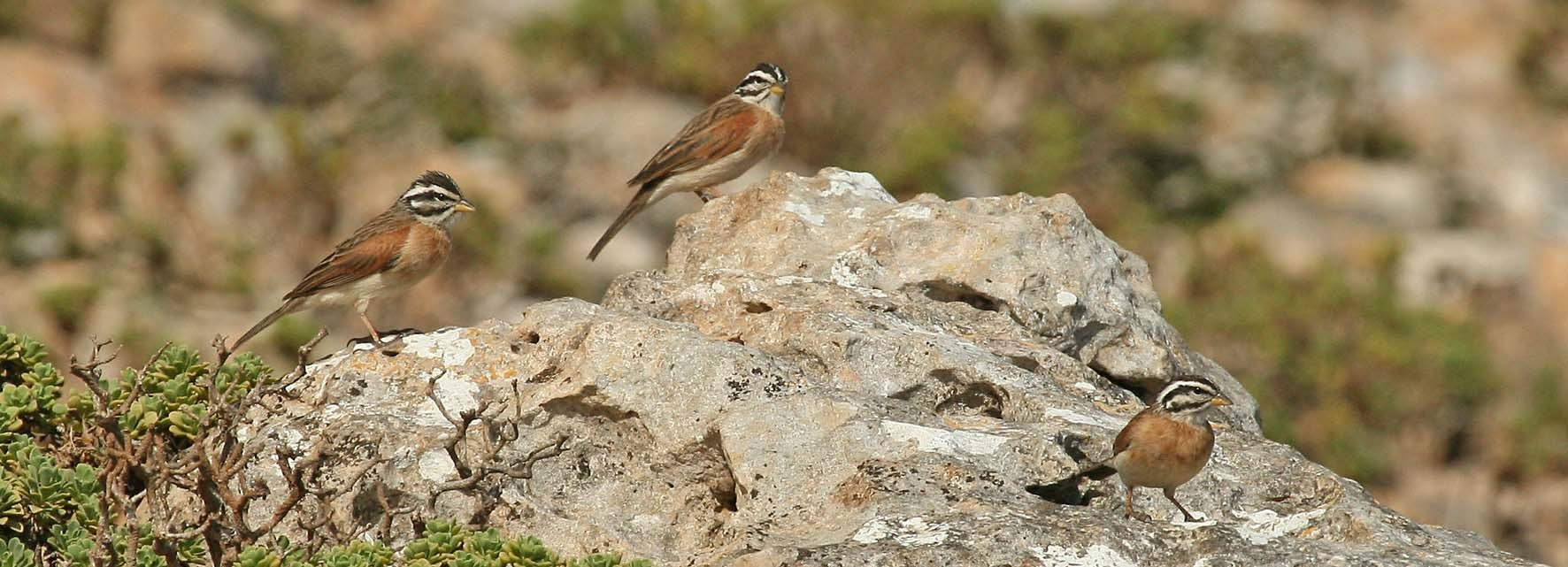
Adult Socotra
Buntings
There are very
few birds in
the world
whose nest and
eggs have
never been
found, let
alone
described. The
Socotra
Bunting is one
of them.
With twelve
endemic
breeding bird
species, the
Socotra
archipelago
has the
highest bird
endemism of
any area in
the whole of
the Middle
East, Europe,
North Africa
and Central
Asia. Leaving
aside the
Jouanin’s
Petrel Bulweria fallax,
as its
population is
unknown, the
Socotra
Bunting is the
second rarest,
beaten only by
the recently
split Abd-al
Kuri Sparrow Passer hemileucus.
Named by
Ogilvy-Grant
& Forbes
in 1899, this
bunting is not
always easy to
find. In their
Birds
of Sokotra and
Abd-El-Kuri (1903),
Ogilvy-Grant
writes ‘Though I believe I
saw this
Sokotran
Bunting on top
of one of the
high limestone
hills above
our camp at
Homhil, it was
not until we
reached Adho
Dimellus, at
an elevation
of about 4,000
feet, that I
obtained a
specimen.’
He then goes
on to describe
the song,
which like all
the
vocalisations
of species
described in
the book, is
rendered as a
musical
notation:

One of only
two buntings
found on
Socotra, the
Socotra
Bunting is
superficially
similar to its
commoner
congener, the
Cinnamon-breasted Bunting Emberiza
tahapisi. It
is however
smaller –
indeed it is
the smallest
bunting in the
Middle East –
and told by
its rufous
coverts, white
throat and
underparts
with pale
rufous-pink
wash on the
breast and a
black and
white ‘humbug’
head-pattern.

Adult Socotra
Bunting.
Photo: Hanne
& Jens
Eriksen
Occurring only
on the main
island, it is
typically
found breeding
at about 600 m
asl, though it
moves to lower
levels outside
the breeding
season.
Detailed
surveys from
1999 to 2011
indicate a
population of
over 3,700
individuals,
say less than
1,000 pairs.
The highest
densities are
in the
submontane
shrubland on
the slopes and
cliffs of the
granite
Haggeher
Mountains that
dominate the
Socotran
skyline. A
small
population is
also found on
the Jabal
Ma’alah
limestone
slopes in the
extreme west
of the island.
Both sites
have been
identified as
Important Bird
and
Biodiversity
Areas (IBAs).

The breeding
distribution
of Socotra
Bunting as
determined by
surveys from
1999 to 2011.

The Haggeher
Mountains – a
prime breeding
site for the
Socotra
Bunting.
The Socotra
Bunting is
given the Red
List
conservation
rating of Near
Threatened by
BirdLife
International
and IUCN.
Their
justification
reads:
This
poorly known
species is
known from
very few
locations in
suitable
breeding
habitat. Given
its scarcity
within its
known range,
it is likely
to have a
small or very
small
population,
but this is
likely to be
stable since
the species is
not known to
be facing any
threats at
present.
However, there
are potential
threats that
could mean
that the
range, area
and quality of
habitat and
population
size of the
species may be
likely to
undergo
declines in
the near
future.
Therefore, the
species is
listed as Near
Threatened.
A seed eater,
like all
buntings,
mainly feeding
on grass
seeds, which
if too high,
will reach up
to capture a
stem to bend
it over. Alec
Forbes-Watson
collected 17
birds on
Socotra in
1964, examined
their stomach
contents and
found they
contained just
seed and grit.

Grass seeds
are important
in the diet of
the Socotra
Bunting.
As already
mentioned the
nest and eggs
of this
bunting are
yet to be
described.
However we do
know that
breeding
season is very
short,
November to
February, the
shortest of
any of the
breeding birds
on Socotra.
Song has been
recorded
during this
same period,
an adult
incubating in
January, a
female with a
brood patch in
February when
recently
fledged young
– fed by
adults – have
also been
observed.
So now the
challenge is
to find and
describe the
nest and eggs
of this
charming
little
bunting.
Further reading
BirdLife
International
(2022) Species
factsheet: Emberiza socotrana.
Downloaded
from http://www.birdlife.org
Ogilvie-Grant,
WR & HO
Forbes. 1903.
Birds of
Sokotra and
Abd-el-Kuri.
Pp. 21– 63. In
Forbes, HO
(ed.) The Natural History
of Sokotra and
Abd-el-Kuri.
Porter,
London.
Porter, RF
& AS
Suleiman.
2013. The
populations
and
distribution
of the
breeding birds
of the Socotra
archipelago,
Yemen: 1.
Sandgrouse to
Buntings. Sandgrouse
35: 43 – 81.
Porter, RF
& AS
Suleiman.
2016. The
Important Bird
and
Biodiversity
Areas of the
Socotra
Archipelago,
Yemen. Sandgrouse 38(2):
169 – 191.
Ripley, SD
& GM Bond.
1966. The
Birds of
Socotra and
‘Abd al-Kuri.
Smithsonian
Miscellaneous
Collections 151
(7).

Socotra
Bunting Photo:
Lars Petersson
Contribution by:
Richard Porter
|
|
|
|
OSME
Corporate
Sponsor
Spotlight –
Rockjumper
Tours

Wallcreeper (Tichodroma
muraria): Photo
Clayton Burne
Rockjumper
Birding Tours
is proud to be
an OSME
Corporate
Sponsor.
Rockjumper
offers quality
birding
adventures,
expertly
guided by our
passionate and
experienced
professional
tour leaders.
Our 300
scheduled
tours annually
explore the
world’s prime
birding areas,
and our
Tailor-made
department can
custom design
your dream
birding
vacation. We
seek to
deliver the
ultimate
birding
experience by
ensuring our
tours are
seamlessly
arranged, fun,
educational
and support
conservation
initiatives,
and our tours
are further
enhanced by
our unrivalled
customer
loyalty
program.
Rockjumper
operates
several
birding tours
covering the
OSME region,
including:
Georgia
& Armenia
- Birding the
Caucasus 2023
- 01 May 2023
- 14 May 2023
(14 days)
Offered at
prime time
this 2-week
birding tour
offers some
high-quality
species for
the global
birder and
heaps of
additional
interest for
those focused
on the Western
Palearctic.
Highlights
abound and
include
White-headed
Duck,
Caucasian
Snowcock,
Pygmy
Cormorant,
Demoiselle
Crane,
White-tailed
Lapwing,
Armenian Gull,
Western Rock
Nuthatch,
Grey-necked
Bunting and
many more.
Turkey
- Birding
Eastern
Anatolia 2023
- 08 Jun - 18
Jun 2023 (11
days)
One of the
regions most
famous birding
locations
Turkey offers
a plethora of
specials
including the
likes of
Caspian
Snowcock,
Caucasian
Grouse,
Mongolian
Finch,
Krueper’s
Nuthatch and
Wallcreeper.
We focus
primarily on
the eastern
part of the
country where
the scenery,
food,
accommodations,
and birding
are all
excellent.
Kazakhstan
&
Uzbekistan -
Best of
Central Asia
2023 - 06 - 22
May 2023 (17
days)
This special
tour offers
some of the
very best
birding in
Central Asia.
Explore the
Tien Shan
Mountains for
Himalayan
Snowcock,
Güldenstädt’s
Redstart, and
Ibisbill while
the remote
Kyzyl-Kum
Desert holds
the
range-restricted
Pander’s
Ground Jay. We
also venture
out to the
scenic hills
south of
Samarkand
where
White-throated
Robin and
Eastern Rock
Nuthatch can
be found
before
exploring the
remote Taukum
Desert for
Macqueen’s
Bustard, Azure
Tit and
Pallas’s
Sandgrouse.
Oman
& UAE -
Arabian
Birding
Adventure 2023
- 01 - 14 Oct
2023 (14 days)
The Arabian
countries of
Oman and UAE
offer some
very rewarding
birding, with
fabulous
infrastructure
and are well
regarded as
one of the
best locations
to look for
the enigmatic
Grey
Hypocolius.
Other
highlights
include
Pharoah
Eagle-Owl,
Pallid Scops
Owl, Egyptian
Nightjar,
Arabian
Partridge,
Little Crake,
Crab-plover,
Lichtenstein’s
Sandgrouse,
and Greater
Hoopoe-Lark.
Egypt
- Birds &
Antiquities
2023 - 20 Apr
2023 - 07 May
2023 (18 days)
Superb and
easy birding,
combined with
breath-taking
antiquities,
are augmented
by luxurious
hotels, a
three-day Nile
cruise from
Aswan to
Luxor,
incredible
snorkelling
and exciting
shopping
opportunities,
make this a
thoroughly
enjoyable tour
for both keen
birders and
non-birding
spouses.
Rockjumper
also offers
tours to Iran
and Saudi
Arabia however
for 2023 these
will be on a
tailor made
basis only.
Feel free to
e-mail us at tailo...@rockjumper.com
for more
information.
Website: www.rockjumperbirding.com
Contribution by
Keith
Valentine
|
|
|
|
UAE
National Red
List of Birds

Jouanin’s
Petrel (Bulweria fallax):
Photo
Oscar Campbell
The IUCN Red
List of
Threatened
Species™ is
internationally
recognised as
the most
respected and
robust
inventory of
global
conservation
status of
plants and
animals. It
provides a
standard and
repeatable
method for
assessing the
extinction
risk of a
species around
the world.
National Red
Lists provide
an equivalent
method to
assess species
status at
smaller
spatial scales
and are
valuable tools
for national
conservation
planning. In
2018 the UAE
Ministry of
Climate Change
and
Environment
(MOCCAE)
commissioned
BirdLife
International
and IUCN to
develop a
National Red
List of birds
for the UAE.
Data collation
and expert
consultation
commenced in
2018 and a
workshop was
held in Dubai
in July 2019.
The final
National Red
List and
accompanying
policy brief
are now
available on
the UAE MOCCAE
website here:
https://www.moccae.gov.ae/en/knowledge-and-statistics/knowledge-details.aspx?q=eyJjIjoiMTk3IiwibSI6InJlcCIsInAiOiJCaW9kaXZlcnNpdHkiLCJiYyI6ImsiLCJtaSI6MzA4fQ==#page=1
A pdf of the
red-list
report is
available here
The policy
brief is
available here
Contribution by:
Dr. Rob
Sheldon
|
|
|
|
Conservation
success:
illegal
wildlife trade
market
shutdown in
Egypt
Egypt's
biggest black
market for
wildlife trade
in the city of
Aswan was
recently
closed by the
country's
government, in
part due to
the efforts of
Nature
Conservation
Egypt. Animals
illegally
traded
included the
threatened
Endangered
Egyptian and
Griffon
Vultures.
Congratulations to the Ministry of Environment in Egypt, Nature
Conservation
Egypt and the
Egyptian
Vulture New
LIFE project.
|
|
|
|
Choroki
Delta under
threat

Choroki Delta:
Photo
Katherine
Khamhaengwong
The Choroki
Delta on the
outskirts of
Batumi is
under threat
of development
despite a
biodiversity
promise to the
European
Union. The
Delta is an
excellent
place for
birding and
attracts good
numbers of
birds on
migration.
There is an
excellent
article by
Katharine
Khamhaengwong
on Eurasianet
that outlines
the current
situation: https://eurasianet.org/batumi-development-would-break-georgias-biodiversity-promise-to-eu
|
|
|
|
John
Burton 1944 -
2022
I’d fleetingly
met John
Burton many
times
throughout my
career, but it
wasn’t until
2016 that I
had several
long
conversations
with him about
the World Land
Trust’s work
in Armenia.
Our
discussions
started at the
Birdfair and
more followed
usually over a
glass (or two)
of red wine,
and this led
to several
grants from
OSME to
support the
SunChild Eco
Project of
FPWC in
Armenia
(Foundation
for the
Preservation
of Wildlife
and Cultural
Assets). On
reflection
supporting
this project,
which I
visited in
2017, helped
influence the
development of
OSME’s Youth
Development
Fund.
Our
discussions
were always
thought
provoking and
I wished I’d
had more of
them. Dr Mark
Avery has
written a
touching
obituary on
his blog: John Burton 1944 –
2022 – Mark
Avery
Contribution by:
Dr. Rob
Sheldon
|
|
|
|
Did
you know?
That there is
a wealth of
information
concerning the
work of OSME
Council under
the “About
OSME” tab of
the OSME
Website. This
includes:
- The
OSME
Constitution –
a document
that informs
our work.
- Minutes
of OSME’s
Annual General
Meetings; and
- Copies
of OSME’s
Annual Reports
Go ahead and
browse the
documents to
learn more
about our
work.
|
|
|
|
|
|
Copyright
© 2019 Ornithological
Society Of The
Middle East
The Caucasus
And Central
Asia, All rights
reserved.
Our mailing address
is:
The Lodge,
Sandy,
Bedfordshire,
SG19 2DL,
United Kingdom
UK registered
charity no.
282938
Want to change
how you
receive these
emails?
You can update your
preferences
or unsubscribe from this
list.
|
|
|
|
|
|