
Solving one problem - Learning many things
2 views
Skip to first unread message

Rupesh Gesota
Sep 17, 2018, 1:26:36 PM9/17/18
to Rupesh Gesota
It
didn't take much time for them to figure out, with reasoning, that the
total number of numbers in a given range is 'one more than the
difference of boundary numbers.'
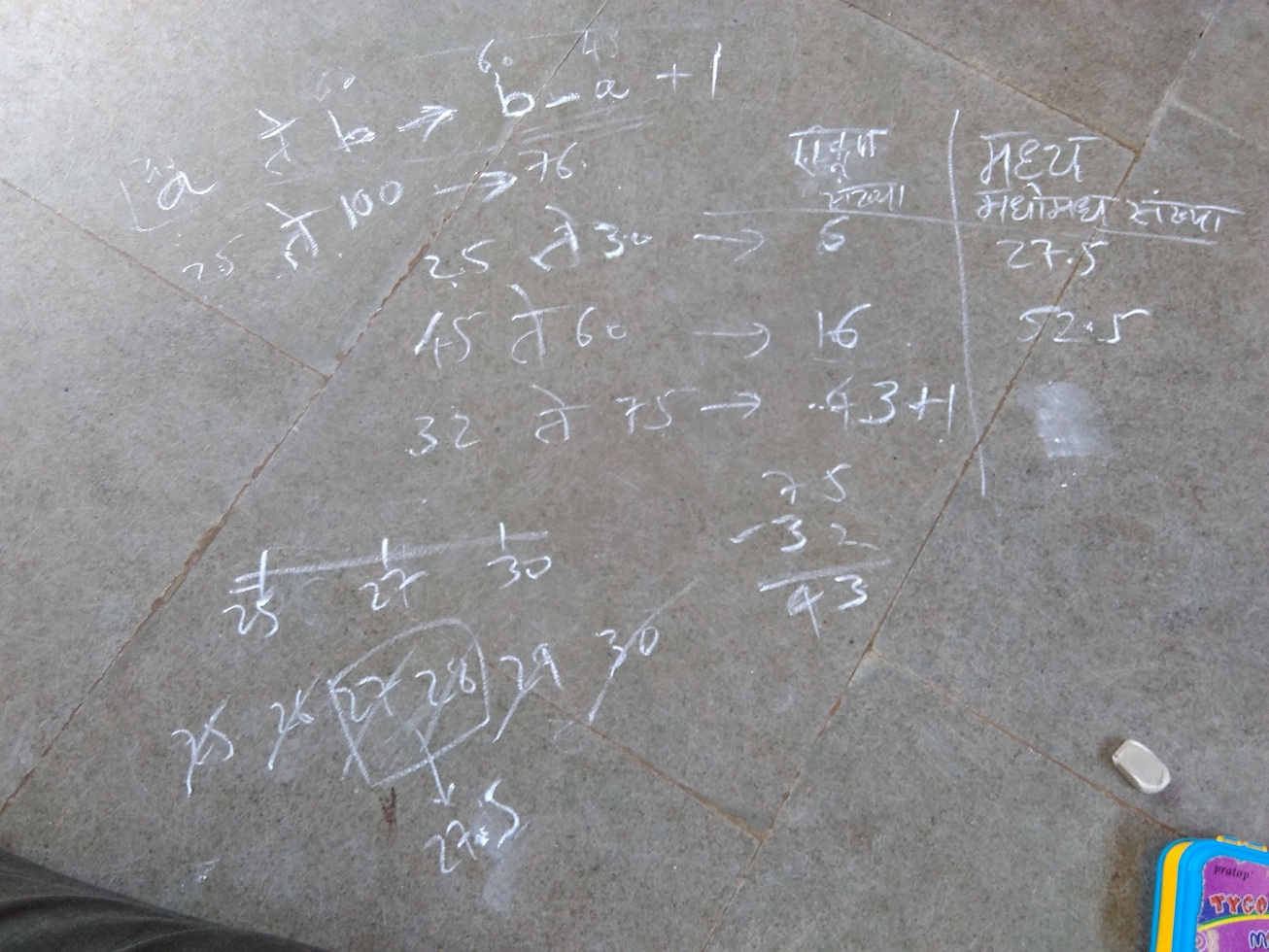
However,
this 'formula' (of difference +1) became visible only when I gave them
some 'difficult' numbers to deal with (from 32 to 75). You may also
notice how the opportunity of generalization was grabbed at this moment.
It was students who made me write 'b - a +1'.
So now I encouraged them to find the number in the Center of this range 25 to 30. I did not use the words 'mean' or 'average'.
Kajal quickly answered it as 27. While Tanushri said, there is no one number, but two numbers 27 and 28 in the centre. She
figured out this by writing down all the numbers and then cancelling
out numbers in pairs - one from left and one from right - while
approaching the centre. And to this, Yash immediately said that the
central number would be 27.5
I
asked others, if they agreed with this result. One of them related this
situation with the cm / mm markings of a ruler and explained to the
class how 27.5 would be between 27 and 28. I ensured that also knew the
meaning of 27.5 i.e. 27 and half.
I
asked them to solve the next problem: Central number in the range 45
to 60. All of them quickly resorted to the previous method (cancelling
numbers from both the ends) and figured out the answer as 52.5
So
now I challenged them to figure out the central number in the range 32
to 75 without making the list as above. This slowed them down to think. I could see some just staring at the problem while others scribbling something on their book.
After a while, Yash came forward to show his solution:
There
are 44 numbers from 32 to 75. Now half of 44 is 22. So there will be 22
numbers above and below the central number. Hence the central number is
22.5
1) I will be thankful if you can share your comments / views about this post...
2) If you find this post helpful, then you may even share it with other teachers and parents in your circle...
Thanks and Regards
| Rupesh Gesota Maths Educator, Program MENTOR | |
| Mobile: +91 9594 02 03 04 Email: rupesh...@gmail.com Website: www.supportmentor.weebly.com Blog: www.rupeshgesota.blogspot.com |    |


Get a signature like this: Click here!
Reply all
Reply to author
Forward
0 new messages