
Psi installation
452 views
Skip to first unread message

Marco Bombonato
Apr 8, 2021, 4:44:15 AM4/8/21
to THERM
Good morning to all,
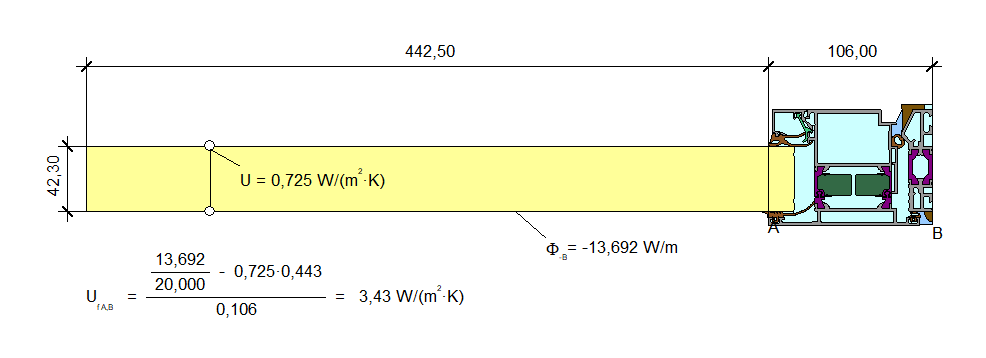

i would like to understand the best way to find the Psi install value for a threshold in a glazed assembly. Following picture shows the geometry and the BCs:
in my opinion the best way is to calculate the Uf value of the aluminium element and then to calculate the Psi installation as follow:
My concern is related to the U value of the slab that is multiplied by 0 (same temperature) and so the resulting Psi installation value is very high.
does anybody know if there is a best method to obtain this value?
thank you in advance.
best regards,

Vladimir Pezel
Apr 8, 2021, 11:29:18 AM4/8/21
to Marco Bombonato, THERM
Hi Marco,


first a few questions...is there a wall section somewhere adjacent to the glazed door?
In principal, the Psi value calculation of the situation where a door is installed on the floor, is a difference between the Psi-value of a situation with the door and the situation without a door. You basically calculate Psi-value for a situation with a door, and separately a Psi-value for a situation without a door (with a wall) and then subtract the wall situation from the door situation. Something like this:
You calculated correctly the Uf, but you do not need to use separately Uf and Ug-panel values times their lengths. You
simply
use the heat flow through the whole door/window.
Secondly, it looks like a conditioned space below the door? Therefore there is no heat flow between the conditioned space below and above the floor. There is only heat flow between conditioned space below and unconditioned space above/outside. Therefore, that non-existent heat flow is not included in the calculation.
Hope this helps...
-Vlad
--
You can view the THERM forum online at:
https://groups.google.com/g/LBNL-THERM
---
You received this message because you are subscribed to the Google Groups "THERM" group.
To unsubscribe from this group and stop receiving emails from it, send an email to LBNL-THERM+...@googlegroups.com.
To view this discussion on the web visit https://groups.google.com/d/msgid/LBNL-THERM/f14f13ec-de15-4db7-bebe-2f6f893621c5n%40googlegroups.com.
Message has been deleted
Marco Bombonato
Apr 8, 2021, 1:14:09 PM4/8/21
to THERM
Hi Vlad,


thanks for the suggestions, very helpful.
If I understodd correctly:
1: calculation of the heat flow thorugh the internal floor and of the doors separately
2: calculation of the Psi value subtracting the two previous values to the total heat flow:
3: calculate psi value of the frame + spacer
the total Psi value of the thermal joint will be: 0.322 + 0.087 = 0.409 W/(mK).
even if the space below is heated at the same temperature in the first model I see an heat flow of 5,6 W/m.
Do you agree with this approach?
thank you,
M
Vladimir Pezel
Apr 8, 2021, 7:13:49 PM4/8/21
to Marco Bombonato, THERM
Hi Marco,
Well, your approach is not quite right. I am not absolutely sure how to deal with your particular situation, due that floor between two conditioned spaces, but I would try this approach. What I meant by calculating 2 Psi-values is this:
1. Calculate Psi with a wall that the glass door is replacing:
- there should be some wall, right?:

2. Then calculate Psi-value with glass door
:
- you can use glass replacement panel; don't need to use actual glass...

3. Final result is a difference between the two:

Now, some questions about the situation:
- I don't know exactly the whole geometry, but am wondering why is the concrete deck going from all the way from left (unconditioned space above) to the right (conditioned up and down)? You have a massive thermal bridge that way - that horizontal concrete going left to right.
- What are all those the materials in the model?
-Vlad
To view this discussion on the web visit https://groups.google.com/d/msgid/LBNL-THERM/1a8f6d74-4741-4b94-8581-c7158b3d60d7n%40googlegroups.com.
Marco Bombonato
Apr 9, 2021, 6:39:27 AM4/9/21
to THERM
Thanks Vlad,
Probably i was not clear enough in the first message. I am focusing at the curtain wall so I need to find the thermal bridge related only to the threshold made by the thermal bridge of the joint (frame+glass edge) plus the thermal bridge due to installation of the threshold into the system.
best,
Marco
Vladimir Pezel
Apr 9, 2021, 10:18:24 AM4/9/21
to Marco Bombonato, THERM
Yes Marco, I believe I understood your first email. I am trying to convey the methodology usually used for installing door/window at threshold in the building assembly.


"I need to find the thermal bridge related only to the threshold made by the thermal bridge of the joint (frame+glass edge)..."
I understand you need to find Psi glass edge, which is needed to get the overall U-window value. For that, you use actual glass panes, spacer, argon gas... Calculation looks like this:
But calculating Psi of glass edge in a window/door is totally separate and unrelated to calculating Psi of installation of that door/window in the building. You do not mix Psi-edge with Psi-install.
"...plus the thermal bridge due to installation of the threshold into the system."
For calculating Psi-install of the door/window in the building, you use a replacement panel (yellow) with Lambda=0.035 in the window/door unit, which you already correctly have done.
For that calculation, I was suggesting you use the method I already illustrated. Maybe I am assuming there is somewhere a small portion of a wall on the sides of the glass wall. If there is, the method I showed is the one to go. If there isn't, I am not sure how to do the calculation.
Is there a wall on the sides?
-Vlad
To view this discussion on the web visit https://groups.google.com/d/msgid/LBNL-THERM/e44f5c18-7513-43dc-a3f2-3c48b3d97e97n%40googlegroups.com.
Marco Bombonato
Apr 11, 2021, 9:22:04 AM4/11/21
to THERM
Thanks Vlad.
Yes, there is a portion of wall after the curtain wall. I'll do in the way you suggested.
many thanks for the replies.
best,
M
Reply all
Reply to author
Forward
0 new messages