
Look Big, Grow Big - 使用 Google 工具栏发送

刘扬
Look Big, Grow Big Small Business Advice from Root Orange
Internet Marketing for Small Business in 4 Easy Steps
February 17, 2010by Aparna Agarwal
With the advent of savvy web development software, special domain names, networking websites such as Twitter and increasing competition in the online marketing arena, small businesses are finding it increasingly harder to stand out from the crowd.
More so for those that may not be comfortable with either using site maps or spending tons of money on designers who would do it for them. Seth Godin’s recent blog post provides a simple and cheap solution to entrepreneurs who can take advantage of the internet without having to become software geniuses.
The main idea is to make sure that your business shows up in search results when someone Googles it. You can achieve the same results without buying your own domain name or getting involved with creating and maintaining a website. Here are some of Seth’s suggestions:
- Create your own blog using a simple tool such as Typepad. It’s a simple interactive tool that lets a user select their blog layout and design, write their own blogs and then features this blog in search results. It’s a cheap service that costs about $5/month. In essence, it creates a website which can easily be updated whenever you want to feature new services or new pricing etc. Seth suggests your first post be basic information about your business such as name, hours, services provided and specialties. This then becomes the main post that all visitors will see on the top of your website.
- Next, create your own web page using Squidoo lens and assimilate all your digital information into one place. It allows you to not only list information such as hours and services, but also lets you insert a Google map with your location. There are numerous other features such as a list of books you can suggest to your customers to help them understand your business, a guest book that they can write in, an RSS feed from the blog you created in the previous step which will show up every time you update your blog. The last feature functions similar to Twitter except that you do not have to create an account and your updates will be visible across the web instead of being limited to Twitter members.
- Images go a long way and provide a human touch to the information you put out there about your business. An easy and fun idea is to use a 1ft x 2ft sign with your name and phone number and go around taking photographs with people holding the sign. You can use your staff, your office space or your happy customers holding the sign. You can post these pictures on Flickr, pull them into the Squidoo lens you created in the previous step and also include them in your blog.
- Ask some of your loyal customers to chip in as well by building Squidoo lenses about you, mentioning you in their blogs or commenting on your blog posts. This increases your web presence and improves your credibility,
None of the steps highlighted above require you to become an expert in any technologies. All of them are relatively simple, require a few hours of your time and a very small amount of money. They do, however, ensure that your business shows up in Google search results and provide you with a real shot at dramatically increasing your customer base.
Survey: People Are Searching Online for Local Businesses
February 4, 2010By Aparna Agarwal
Nielsen recently conducted a survey on the Internet usage habits of U.S. consumers. Two hundred randomly selected consumers were quizzed about their preferences when it comes to searching for information about local businesses and their attitudes towards advertising.
There has been an increase in the number of people using the Internet to look for information on local business in the past year, with 86% of the respondents having used it. 81% of the respondents called the Internet “vital” to their lives.
Among the various tools, search engines were rated as the top resource. Most people prefer businesses that are close to their homes with 70% of the respondents saying they like to stay within a 20 minute drive from home. While most consumers use multiple information sources, 75% of people said they read user reviews about local business’s products or services with the popularity of online reviews increasing with the age of respondents. People also trusted blogs as a source of information though most do not contribute to them. Blogs tend to provide a balanced opinion. The survey shows that 45% of the blogs provide negative reviews, 15% provide mixed and 40% provide positive reviews. These reviews can be very important in the consumer’s decision making process as 70% of the respondents said they bought a product/ service from a local business after having researched it online.
The survey also questioned consumers about their attitudes toward online advertising or SEM (Search Engine Marketing). There seems to be a clear preference toward SEM as compared to “push” advertising. 73% of the respondents feel that they have been “over-exposed” to advertising. However, this does not imply that these ads have been ineffective in achieving their goals. Only 24% of the consumers said that they have never been influenced by an ad, but most consumers would still prefer to search for the products or services themselves rather than have an overwhelming number of ads thrown toward them.
Small Businesses Poised to Triple Website Spending
January 14, 2010By Margalit Gould
Borrell Associates, a research and consulting firm specializing in advertising and media strategies, recently reported that small and medium-sized businesses (SMBs) spent approximately $6.7 billion in interactive advertising during 2008, accounting for more than half the US total. Borrell speculates that this upwards trend will continue, particularly with respect to the online forum. As evidence, in 2008, SMBs allocated 11% of their advertising expenditures to online media, a boost from an average of 4% just three years earlier.
However these marketing expenses are increasingly related to investments in firms’ websites – technology and design – rather than online advertising such as banner ads, which are on the decline. Additionally becoming exceedingly important to SMBs is Search Engine Optimization (SEO), and Borrell forecasts increases in this type of spending, from 8% in 2008 to 18% in 2013.
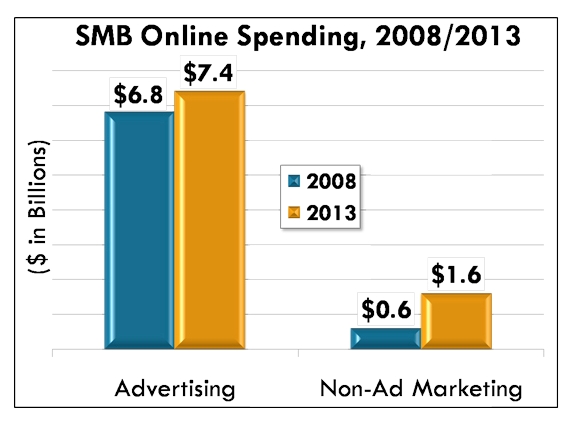
Borrell surveyed SMBs to discover what online source performs most strongly for the firms. 56.8% of respondents stated that search engines are the most effective, and as such, spending related to SEO and “non-advertising” marketing is expected to triple, reports Borrell.
There are a plethora of online marketing options for SMBs, including listings in online directories, acquiring a fitting domain name, bidding for keywords on search engines, setting up email marketing campaigns, and purchasing display ads. However, it is important for an SMB to do its homework to find out how it can stand out from the competition.
The Weight of Keywords in Domain Names
January 12, 2010By Margalit Gould
A recent survey published in Search Engine Journal (SEJ) revealed that 51% of people “notice [keywords in domain names] all the time.” This reinforces the conspicuous nature of keywords in the online community and suggests the continued importance that keywords play in Search Engine Optimization (SEO). SEJ writer Ann Smarty argues that there should be less emphasis on keywords in Google Search Engine Results Pages (SERPs) because, “Today it is almost impossible to get hold of any ‘exact match’ domains that wouldn’t be too long or pointless.”
Of course this was very interesting to us at Root Orange! We think Ms. Smarty would be excited to know it is now possible for any business to use an “exact match” domain using our patent-pending domain technology. Google will always rank keywords highly in domain names and Root Orange allows businesses to use that to their advantage with our products. Small businesses around the country (and world) can now use generic domains to drive exclusive, local traffic to their websites. Sorry to get sales-y out of the blue but it’s hard to resist with such a tantalizing survey!
The Role of Social Media in Small Business Marketing Spending
January 12, 2010By Tiffany Simms
Increasingly, small business managers are noticing the changing tide of internet marketing heavily rooted in social media and email. Not only does this medium offer greater exposure to a customer base, but it’s also much cheaper than traditional means of print, television, and radio advertising. To illustrate just how businesses of every size are capturing the social media revolution, Swedish furniture giant IKEA, launched a highly successful low-cost photo-tagging promotion on Facebook due to a limited advertising budget for the opening of their store in Malmo, Sweden.
By allowing Facebook friends to compete for first place in tagging furniture in uploaded pictures (and thus win the item), the company built a viral marketing campaign that generated tremendous advance buzz for the new location.
Research Proves Change
According to eMarketer.com, “Campaigner and Hurwitz & Associates studied small businesses with 20 employees or fewer in July 2009 and found 28% of those that used e-mail marketing considered it an inexpensive and effective way to reach new customers.”
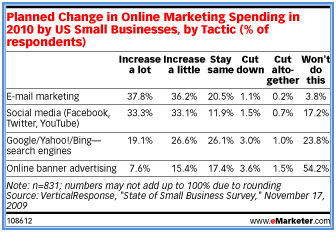
Coupled with the research cited in our earlier blog post “The Best Marketing May Be the Cheapest,” where it was noted that consumers spend 23% of their time consuming media online, business owners’ affinity for cheap and functional social and email marketing campaigns has led the reallocation of marketing dollars. Even in a slow economy, the chart above from eMarketer.com shows more than 70% polled plan to increase their email and social media spending.
Facebook: It’s Worth it for Small Business
December 10, 2009by Tiffany Simms
If you’re like many other small businesses these days, you’re trying to figure out where your company fits in the Facebook universe. It may appear to be quite a bit to take in—keeping your profile up to date, posting content, and engaging your fans—but studies show it is well worth the effort.
According to a 2009 study by the Pew Internet & American Life Project, 19% of internet users use sites like Facebook and Twitter to update their status and view the status of others compared to 11% just a year earlier. As noted in a recent article by Ron Jones on Searchenginewatch.com, a Chitika study found that out of thirty-three million unique visitors, Facebook provides the most loyal visitors, with 20 percent of those who originate from the social network in turn visiting the site they landed on four or more times in a week. Loyalty is key to developing relationships with your Facebook fans but first business owners must reach their target audience. Paul suggests three steps to gaining a loyal base following:
- Promote Your Page
- Run Promotions
- Encourage Feedback
- Engage & Converse
- Focus on Conversations
- Monitor Content Customers Like
- Use Search Optimization
- Use Keyword Search Terms (SEO)
- Use Keywords on Your Fan Page
So, the lesson of the day is don’t be afraid to tackle social marketing sites. It will take some time to get used to maintaining your business’ fan page and to build a network but the benefits will fortify your company’s brand and build relationships. Become a fan of Root Orange on Facebook or follow us on Twitter to discover more ways to market your small business in a crowded marketplace.
Is ROO the new ROI?
November 24, 2009by Tiffany Simms
We all know that measuring the performance of marketing initiatives has always been tough to pinpoint but, just when one gets the hang of how to quantify the industry standard, Return on Investment (ROI), along comes the concept of ROO, or Return on Objective. The good news is, the latter may be a lot easier to manage. According to a ThomasNet study on website management, site owners need to take a step back to see the broader picture of their website’s role in sales generation. In other words, are customers getting the information they need, where they need it, and when they need it? In Get Content, Get Customers by Joe Pulizzi and Newt Barrett, the authors subscribe to the belief that along with using ROI, ROO-centric measurements provide a more holistic view:
- Tracking conversions for everything published online and measuring new or increased sales
- Measuring [time spent] through online research or by using analytic measures on e-newsletters or web portal products
However, the conventional ways to measure ROI are still quite relevant:
- Number of Leads Generated
- Total Sales Revenue
- Incremental Sales Revenue from Existing Customers
- Cost Per Sales
- Conversion Rate
- Time to Conversion
Objective-based performance measurements allow decision makers to take a closer look at how customers gather the information they need and whether sales inquiries and transactions are produced. By focusing marketing efforts on both ROI and ROO, one can easily manage how the flow of that information to customers produces tangible results—sales revenue.
The Evolution of E-Commerce
November 24, 2009by Tiffany Simms
Once upon a time, businesses featured simple websites with the most basic details about products and services in hope of enticing customers to contact them to make the hard sell. Unfortunately or not, those days are long gone. According to a ThomasNet survey, with over 93% of industrial buyers conducting research on prospective purchases completely online, those who don’t offer the information buyers are looking for will find themselves losing out to their competitors without a single instance of personal contact. That’s because 91% of industrial buyers will switch to the website that gives them the most information to make a purchase decision. In ThomasNet’s recent white paper, Aligning Your Online Marketing Strategy with Your Business Plan, they suggest asking these questions:
- Is your website designed with your prospective buyers’ needs in mind?
- Could they find the detailed information that they need to do business with you?
- What changes could you make to your website so it can act as a 24/7 sales channel for your business?
ThomasNet noted that an industrial seller’s website is the #1 factor influencing buying decisions followed closely by search engine leads. Therefore, once a business’ website is geared up to serve as a true e-commerce channel, it must have strategies in place to draw prospective buyers to their online portal. Author CJ Newton noted in Defining SEO Optimization, “[w]inning on the search engines for the searches your customers are doing is hands down the best return on investment for getting your customers and potential customers to your web site. SEOs exist to help companies reach the top.” Using companies like Root Orange, who offer search engine optimization solutions, allow businesses to capitalize on a fully functional consumer-focused website and an increase in web traffic.
The Best Marketing May Be the Cheapest Marketing
November 24, 2009by Tiffany Simms
Thanks to the constant evolution of the internet and how people interact with it, marketing for small businesses may be getting cheaper. According to Scott Davis, author of an Advertising Age article, “Don’t Be Afraid to Plunge into Emerging Media,” on average consumers spent 23% percent of their time consuming media online in 2007, which means this is where they should be targeted for advertising exposure.
The explosion of Web 2.0 has granted small businesses the opportunity to reach customers via social networking sites like Twitter, Facebook, and Linkedin, which costs significantly less than say, through an advertisement in their local newspaper (a full-page ad in the LA Times can run $70,000 compared to $1,000 in a small town’s newspaper). “[T]he use of low-cost web-based marketing tools is playing a strategic role in helping businesses succeed,” stated Laurie McCabe with Hurwitz & Associates in a recent article from eMarketer.com, “Marketing Spending Pays Off for Small Biz.” Hurwitz’s 2009 small business marketing survey revealed two key findings:
- Small businesses are shifting to cheaper, digital-based marketing like social media, e-newsletters, and search engines instead of traditional channels
- 66% of small businesses expect a revenue jump this year and had increased, or planned to increase their marketing spending, versus those that expect a decline or no change
With low-cost social media and search engine optimization (SEO) marketing solutions now available, the exposure to customer leads isn’t far behind.
The Root Orange Blog is Finally Here!
November 24, 2009Thanks for visiting our blog! We are just getting started, and will have content up in a jiffy. In the meantime, you are welcome to visit our corporate website.
Blogroll
-
Archives
-
Misc
 RSS Feed