
Non-linear system of equations Julia

David Zentler-Munro
'm trying to solve a large number (50) of non-linear simultaneous equations in Julia. For the moment I'm just trying to make this work with 2 equations to get the syntax right etc. However, I've tried a variety of packages/tools - NLsolve, nsolve in SymPy and NLOpt in JuMP (where I ignore the objective function and just enter equality constraints)- without much luck. I guess I should probably focus on making it work in one. I'd appreciate any advice on choice of packages and if possible code.
Here's how I tried to do it in NLsolve (using it in mcpsolve mode so I can impose constraints on the variables I am solving for - x[1] and x[2] - which are unemployment rates and so bounded between zero and 1) :
using Distributions
using Devectorize
using Distances
using StatsBase
using NumericExtensions
using NLsolve

beta = 0.95
xmin= 0.73;
xmax = xmin+1;
sigma = 0.023;
eta = 0.3;
delta = 0.01;
gamma=0.5
kappa = 1
psi=0.5
prod=linspace(xmin,xmax,ns)
l1=0.7
l2=0.3
assets = linspace(0,amaximum,na);
wbar=1
r=((1/beta)-1-1e-6 +delta)


## Test code

function f!(x, fvec)

ps1= wbar + ((kappa*(1-beta*(1-sigma*((1-x[1])/x[1]))))/
(beta*((x[1]/(sigma*(1-x[1])))^(gamma/(1-gamma)))*(1/(2-x[1]))))

ps2= wbar + ((kappa*(1-beta*(1-sigma*((1-x[2])/x[1]))))/
(beta*((x[2]/(sigma*(1-x[2])))^(gamma/(1-gamma)))*(1/(2-x[2]))))

prod1=prod[1]
prod2=prod[50]
y1=(1-x[1])*l1
y2=(1-x[2])*l2
M=(((prod1*y1)^((psi-1)/psi))+((prod2*y2)^((psi-1)/psi)))^(psi/(psi-1))
K=((r/eta)^(1/(eta-1)))*M

pd1=(1-eta)*(K^eta)*(M^(-eta))*((((prod1*y1)^((psi-1)/psi))+
((prod2*y2)^((psi- 1)/psi)))^(1/(psi-1)))*
((prod1*y1)^(-1/psi))*prod1

pd2=(1-eta)*(K^eta)*(M^(-eta))*((((prod1*y1)^((psi-1)/psi))+
((prod2*y2)^((psi-1)/psi)))^(1/(psi-1)))*
((prod2*y2)^(-1/psi))*prod2

fvec[1]=pd1-ps1
fvec[2]=pd2-ps2
end

mcpsolve(f!,[0.0,0.0],[1.0,1.0], [ 0.3, 0.3])
However, I get this error
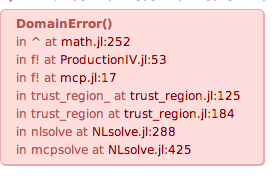
As I understand it, this occurs because I am trying to take the root of a negative number. However, the bounds on x[1] and x[2] should stop this happening. Any advice very welcome. I appreciate the formulas are pretty ugly so let me know if any further simplifications helpful (I have tried!)
David

Mauro
then take the real part at the end (after checking that im==0)?
Alternatively, you could file an issue at NLsolve stating that the
objective function is evaluated outside the bounds. Maybe it is
possible improve the algorithm, maybe not.
(Also, to get better feedback and be kinder to the reviewers, try to
make a smaller example which does only uses the minimal number of
dependencies. And make sure it works as, I think, your example does not
work, unless `ns` is something which is exported by one of the used
packages I don't have installed.)
David Zentler-Munro

Tim Holy
bounds.
If you want to find a solution very near such a boundary, your performance will
presumably stink. I'm not sure what the state of the art here is (for
minimization, I'd suggest an interior-point method).
Best,
--Tim
David Zentler-Munro
beta = 0.95;                                                                % Discount Factor(Krusell, Mukoyama, Sahin)lambda0 = .90;                                                              % Exog contact Rate @inbounds for unemployed to job (DZM)lambda1 = 0.05;                                                             % Exog job to job contact (DZM)tao = .5;                                                                   % Proportion of job contacts resulting in move (JM Robin)mu = 2;                                                                     % First shape parameter of beta productivity distribution (JM Robin)rho = 5.56;                                                                 % Second shape parameter of beta productivity distribution (JM Robin)xmin= 0.73;                                                                 % Lower bound @inbounds for beta human capital distribution (JM Robin)xmax = xmin+1;                                                              % Upper bound @inbounds for beta human capital distribution (JM Robin)z0 = 0.0;                                                                   % parameter @inbounds for unemployed income (JM Robin)nu = 0.64;                                                                  % parameter @inbounds for unemployed income (DZM)sigma = 0.023;                                                              % Job Destruction Rate (DZM)alpha = 2;                                                                  % Coef of risk aversion in utility function (Krusell, Mukoyama, Sahin)TFP = 1;                                                                    % TFP (Krusell, Mukoyama, Sahin)eta = 0.3;                                                                  % Index of labour @inbounds for CD production function (Krusell, Mukoyama, Sahin)delta = 0.01;                                                               % Capital Depreciation Rate (Krusell, Mukoyama, Sahin)tol1=1e-5;                                                                  % Tolerance parameter @inbounds for value function iterationtol2=1e-5;                                                                  % Tolerance parameter @inbounds for eveything elsena=500;                                                                     % Number of points on household assets gridns=50;                                                                      % Number of points on human capital gridamaximum=500;                                                               % Max point on assets gridmaxiter1=10000;maxiter=20000;                                                              % Max number of iterationsbins=25;                                                                    % Number of bins @inbounds for wage and income distributionszeta=0.97;                                                                  % Damping parameter (=weight put on new guess when updating in algorithms)zeta1=0.6;zeta2=0.1;zeta3=0.01;mwruns=15;gamma=0.5;                                                                   % Matching Function Parameterkappa = 1;                                                                   % Vacancy Costpsi=0.5;prod=linspace(xmin,xmax,ns);                                                 % Human Capital Grid (Values)l1=0.7;l2=0.3;wbar=0.2;r=((1/beta)-1-1e-6 +delta);
syms x1 x2
ps1= wbar + ((kappa*(1-beta*(1-sigma*((1-x1)/x1))))/(beta*((x1/(sigma*(1-x1)))^(gamma/(1-gamma)))*(1/(2-x1))));ps2= wbar + ((kappa*(1-beta*(1-sigma*((1-x2)/x2))))/(beta*((x2/(sigma*(1-x2)))^(gamma/(1-gamma)))*(1/(2-x2))));
prod1=prod(1);prod2=prod(50);y1=(1-x1)*l1;y2=(1-x2)*l2;M=(((prod1*y1)^((psi-1)/psi))+((prod2*y2)^((psi-1)/psi)))^(psi/(psi-1));Mprime=(((prod1*y1)^((psi-1)/psi))+((prod2*y2)^((psi-1)/psi)))^(1/(psi-1));K=((r/eta)^(1/(eta-1)))*M;
pd1=(1-eta)*(K^eta)*(M^(-eta))*Mprime*((prod1*y1)^(-1/psi))*prod1;pd2=(1-eta)*(K^eta)*(M^(-eta))*Mprime*((prod2*y2)^(-1/psi))*prod2;
eqn1=pd1-ps1;eqn2=pd2-ps2;
sol=vpasolve([0==eqn1, 0==eqn2], [x1 x2],[0 1;0 1]);[sol.x1 sol.x2]
If anyone has an idea how I can replicate this e.g. the vpasolve call, in Julia I would be very grateful.

j verzani
julia> sol
2x1 Array{Float64,2}:
214.956
300.851
julia> subs(eqn1, (x1, sol[1]), (x2, sol[2]))
-1.11022302462516e-16
julia> subs(eqn2, (x1, sol[1]), (x2, sol[2]))
-2.77555756156289e-17
David Zentler-Munro
j verzani
sol=SymPy.sympy_meth(:nsolve, [eqn1, eqn2], [x1,x2], tuple(x0...))
One way to get a decent initial guess would be to plot the functions. With PyPlot installed, the `plot_implicit` function shows roughly the location of your answer:
plot_implicit(eqn1 * eqn2, (x1, 0, 1), (x2,0,1))
The zeros of eqn1 and eqn2 seem to cross at (1,1) and your answer.