
Kachin New

SinLi Brang
The Irrawaddy: Despite Donor Love-in and Ceasefire Pledge, Kachin War Continues
By SIMON ROUGHNEEN
SINGAPORE — Despite a government ceasefire called on Friday evening, fighting continued over the weekend between the Burmese government forces and rebels from the Kachin ethnic minority based close to the border with China.
On Saturday, fighting raged near the Kachin Independence Army (KIA) stronghold of Laiza even as the government was telling international donors at a two-day conference in the capital Naypyidaw that it would work to end the conflict.
When the ceasefire was unexpectedly announced by state media on Friday, the Kachin initially saw it as a ploy to try resupply government soldiers. There was also confusion over the extent of the ceasefire, which appeared to be confined to the vicinity of Laiza, where fighting has been fierce since the final week of December.
The KIA, which resumed fighting for greater autonomy for the roughly 1 million ethnic Kachin in Burma’s rugged northernmost state after a 17-year-old ceasefire broke down in June 2011, said that the Burmese army’s offensive over the weekend centered on the militia’s Hkaya Bum outpost, which appeared to be its next target after taking three other KIA outposts on Friday. Reports by Irrawaddy correspondents on the front line confirmed the KIA’s accounts of the weekend’s fighting in the area.
Burmese authorities accused the rebels of killing two police officers in the town of Kamaing on the morning of Jan. 19, after the ceasefire was supposed to take effect. The same morning, KIA landmines injured 22 people traveling on buses in Kachin State, according to the government mouthpiece The New Light of Myanmar.
The government says that the ceasefire breakdown is because the KIA continued to attack army positions. Speaking to The Irrawaddy on Monday, President’s Office spokesperson Ye Htut said that “current fighting in Lajayang after the [ceasefire] statement is because our troops have to shoot back at the KIA. They attacked the outposts which we secured last week.”
Despite the latest clashes, President Thein Sein again pledged peace on Saturday in a speech to representatives of Western governments and international organizations such as the United Nations and the World Bank. “Our government will make genuine and lasting peace with the KIA. We plan to hold a political dialogue in early 2013 after signing ceasefire agreements with 10 other armed groups,” he said.
In stark contrast to the president’s tempered tone, however, state media continues to attack the KIA and its political wing, the Kachin Independence Organization (KIO), engaging in “Nazi-like propaganda” against the group, according to the United Nationalities Federal Council (UNFC), a coalition of Burma’s ethnic minority militias of which the KIA is a member.
The UNFC, which includes several militias which already have ceasefires with the government, accused the same government of trying to “paint the KIO/KIA black in the eyes of the people of Burma and international community” and accused Naypyidaw of trying to isolate the Kachin, emulating a tactic used prior to the Burmese army’s storming of the Karen National Union (KNU) headquarters at Manerplaw in 1995.
The KIA says that it wants any forthcoming peace talks with the government to be conducted via the UNFC. “We want the UNFC to take a leading role in the political dialogue. We have agreed in the UNFC that it will take that role if the dialogue takes place,” KIA spokesperson La Nan told The Irrawaddy on Monday.
The KIA conceded in late December that an upsurge in attacks by the Burmese armed forces—including airstrikes and fatal artillery shelling of civilian areas—means that there is now a direct threat to Laiza.
Dr Nyo Tun Awng, deputy head of the small contingent of Arakan Army militia fighting alongside the KIA, said that the fighting was taking a heavy toll on the rebels.
“I have not slept in two days,” he said, audibly fatigued, speaking by telephone from an undisclosed location.
The latest upsurge in fighting around the rebel headquarters came when the Kachin—supported on the front line by the All Burma Students Democratic Front (ABSDF)—countered a Burma Army attempt to resupply soldiers near the front line on Dec. 14.
The Kachin overran a Burmese army position near a Buddhist temple on the main road from Laiza to the state capital Myitkyina, upping the ante in a grueling 18-month war but sparking an aerial counterattack by Burmese forces and subsequent loss of several KIA-held positions close to Laiza.
Kachin-based parliamentarians have twice proposed peace talks in recent days in Burma’s Parliament, in an attempt to stop fighting in the resource-rich northern region.
China, which shares a border with the war-torn region and has substantial economic interests in Kachin State, has also voiced concern over the conflict, and particularly the possibility of a refugee influx should fighting worsen. After meeting with Burma’s President Thein Sein over the weekend, China’s Vice Foreign Minister Fu Ying told China Central Television that both sides had “reached consensus and will strive for” a stable and peaceful border to ensure that people’s lives are not affected by the conflict.
Meanwhile, the Myanmar National Human Rights Commission said on Friday that it was concerned that insufficient aid was reaching Kachin civilians in camps inside KIA-held areas.
“It is a great concern that the humanitarian situation in Kachin State is worsening as a result of the conflict while access to humanitarian aid in conflict areas and along the border [between China] and Kachin State is difficult,” the commission said.
The Burmese government says it limits aid getting into KIA areas as it fears the assistance could bolster the rebels, rather than help civilians.
On Saturday, the US embassy in Rangoon tweeted that America has to date provided $5 million in aid to assist civilians displaced by the Kachin conflict. Asked how much of this had gone to support the tens of thousands sheltering in camps inside KIA territory, the embassy had not responded by the time of writing.
After the weekend conference in Naypyidaw, international donors are expected to allocate around a half a billion dollars a year in aid to Burma in the coming years, as the country’s government outlines changes in key sectors of the economy in an attempt to woo Western investors and secure a write-off for at least some of the $3.5 billion debt it owes donors, excluding Japan.
###
Jan. 22, 2013
AFP: UN chief urges end to Myanmar conflict
Yangon: UN Secretary-General Ban Ki-moon has called for a "serious effort" to end the conflict raging in northern Myanmar, where ethnic minority Kachin rebels accused the military of breaking its ceasefire.
Prime Minister Thein Sein's reformist government announced on Friday that it was ending a military offensive against the Kachin rebels, but fresh fighting erupted over the weekend.
Ban "calls upon both sides to make serious effort to create conditions for sustained peace in Kachin through enhanced confidence building measures and political dialogue", the UN said in a statement released in New York on Sunday.
About a dozen peace activists meanwhile set off Monday on a planned 1,300-kilometre walk from Yangon to the rebel stronghold of Laiza to call for an end to the conflict.
Yan Naing Tun said he was spurred to make the long journey after learning of "the horrible effects of the war and the difficulties of the war victims".
"Walking shows our sacrifice," he said, adding that the group expected the trek to take nearly two months.
"We're worried about our security but it's more important to stop the civil war and to get peace," he said.
The recent use of military air strikes against the rebel Kachin Independence Army (KIA) triggered growing international concern, although there have been no reports of air raids since the government's ceasefire vow.
Rebels said Sunday that the military was battling to retake control of a strategically important hilltop just several kilometres away from the KIA headquarters in Laiza, and was using artillery shells and ground forces.
The Kachin rebels have not announced any ceasefire of their own, saying any negotiations should also address their demands for greater political rights.
Tens of thousands of people have been displaced in Kachin state since June 2011, when a 17-year ceasefire between the government and the KIA broke down.
Myanmar's quasi-civilian government has reached tentative ceasefires with a number of ethnic rebel groups since taking power in early 2011, but several rounds of talks with the Kachin rebels have failed to reach a breakthrough.
###
Jan. 21, 2013
Democratic Voice of Burma: Dozens detained for ‘unlawful’ contact with Kachin rebels
By HANNA HINDSTROM
Dozens of people were arrested and tortured by security forces in northern Burma last year, for allegedly having “unlawful” contact with the Kachin Independence Army (KIA), despite a government pledge to end the practice, a human rights organisation warned on Monday.
A 69-page dossier by the Asian Human Rights Commission (AHRC) outlines 36 cases from 2012, where local Kachins have been detained and often tortured by state forces under Burma’s draconian Unlawful Associations Act, which bans contact with the KIA and most other ethnic rebel groups.
Last year, the government’s main peace negotiator, Aung Min, claimed the law would no longer be used to target rebel supporters. But the report warns that Kachin people continue to be “detained, tortured, charged and extorted irrespective of what they have or have not done” on the sole basis of their ethnic identity.
“The problem as we see it today is that the government is very reluctant to take away the arbitrary power that state agencies are operating throughout Burma, and in particular in Kachin state,” Bijo Francis, acting executive director of the AHRC told DVB on Monday. “The impunity enjoyed by state agents in Burma at the moment can be used to silence any opposition.”
AHRC ascribes the ongoing abuses as a systematic and “institutionalised” policy of impunity perpetrated and enforced by the Burmese military. “The military poses the single largest impediment to removing any of these legislations from operation, because they have been misusing it,” Francis told DVB on Monday. “As long as the law continues they can take action against anyone they suspect of being involved in anti-state activities.”
Since a 17-year ceasefire between the government and Kachin rebels broke down in June 2011, dozens of reports have surfaced of arbitrary and unfair arrests of civilians. Lashi Lu Mai told AHRC how her husband, a displaced villager from northern Shan state, was accused of working for the KIA and beaten into submission.
“He later told me that he would have been murdered if he had not made the confession and he would not be home again,” she said. “He also told me how he was hit with an iron bar, hit with the butt of gun, and confined to a cell.”
Another woman describes the arrest of her husband, Lahtaw Brang Shawng, who was accused of plotting a bomb attack last year. “They bound his hands behind his back and began to torture him,” she said. “They hit his head many times and his nose was bleeding a lot.”
President Thein Sein, who is credited for introducing democratic reforms in the former pariah state, has come under fire for failing to stop abuses in Burma’s northernmost state, where a bloody conflict has raged for nearly two years. On Friday, the government announced a unilateral ceasefire, but rebels, who are fighting for greater autonomy and ethnic rights in Burma, say that attacks continue.
In an interview with DVB on Monday, the president’s spokesperson Ye Htut blamed the KIA for ongoing hostilities, including recent attacks on civilians, trains and police stations in Kachin state. “You just can’t sit there and take it when someone’s attacking you. You have to defend yourself – drive them away to a safe distance,” he said.
But Francis insists this is not a valid reason to arbitrarily arrest alleged criminals. “It is not at all a justifiable reason unless you have a mechanism with a clear mandate to investigate crimes independently and undertake investigations independently,” he said. “The crux of the matter is that you have a state agency which is given statutory power to decide who is a criminal and who is not.”
The International Committee of the Red Cross recently inked a deal with the government to resume visits to Burma’s notorious jails, which the agency described as the start of a “new chapter”. But AHRC says the deal is unlikely to effect change in the country’s unstable north, and called for a complete overhaul of the military’s role in public policy and judicial affairs.
Last week, the Myanmar National Human Rights Commission – a domestic body tasked with monitoring abuses in Burma – also criticised the government for failing to provide humanitarian aid to many of the 75,000 people displaced in the conflict. The government has responded that humanitarian aid could be used to “bolster” the rebel movement.
###
Jan. 21, 2013
Wall Street Journal: Rebels in Myanmar Seek Wider Cease-Fire
By SHIBANI MAHTANI
Ethnic Kachin rebels demanded that Myanmar's military widen a proposed cease-fire and end weeks of fighting in the troubled north, underscoring continued conflict as President Thein Sein sought to assure international donors of his government's commitment to stability.
The Kachin Independence Organization said the military's unilaterally declared cease-fire over the weekend, on the eve of a development conference, should be extended to cover all contested areas of Kachin State and not just areas around the military's bases as proposed.
Myanmar's military has pounded rebel areas with airstrikes and artillery in recent weeks, raising international calls for a halt to fighting. The demands were especially pointed from neighboring China, which was struck by stray bombs and had refugees from the battles cross into its territory.
Fighting continued in the region during the weekend, rebel and government officials said, though it appeared less intense than in recent weeks.
Speaking at the development conference in the capital, Naypyitaw, on Saturday, Mr. Thein Sein pledged his government would "engage in peace-building activities with all ethnic armed groups" and "turn cease-fire agreements into lasting peace." He urged the Kachin rebels to work with the government to cease hostilities.
The development-cooperation conference was the first of its kind held in Myanmar in decades, and marked a milestone for Mr. Thein Sein, who heads a quasi-civilian government leading a transition away from military dictatorship. It was attended by more than 600 delegates, including representatives from the World Bank and International Monetary Fund, the U.S., China and Myanmar's neighbors in Southeast Asia. No money was pledged, but the government hopes to instill confidence in potential donors and win more support.
Mr. Thein Sein set out a timeline including aspirations to grow the country's gross domestic product by 7.7% every year for the next five years. He promised to work toward a "modern, industrialized country" and said his government will undertake a census in 2014 to improve data collection, long lacking in the sprawling, ethnically diverse nation.
Development agencies welcomed Mr. Thein Sein's timeline—including efforts toward peace in long-troubled areas like Kachin State—which consists of five-year plans covering a 20-year period up to 2031. They said it was a further indication of the government's commitment to opening the politics and economy of the long-isolated state.
Bert Hofman, the World Bank's chief economist for East Asia and the Pacific region, said the changes were "comprehensive" and "should make a real difference for the people of Myanmar." The bank predicts somewhat less robust growth, Mr. Hofman noted, but said growth should reach 6.3% in the year ending March 31, and 6.5% in the 2013–2014 fiscal year, up from 5.5% last year.
"Myanmar is well-positioned to reap benefits of reforms," Mr. Hofman said. "The country is rich in natural resources, which, if used well, can provide the financial resources to deliver quality social services to the Myanmar people."
Among the most important steps will be cementing peace with the myriad ethnic militias along Myanmar's borders. The previous military government had reached cease-fires with most of them in the past two decades, but tensions persist. The renewed fighting with the Kachins erupted 18 months ago, breaking a 17-year cease-fire.
The planned overhauls include some "quick wins," as described by Mr. Thein Sein, such as improving public transport in Yangon by possibly lifting a ban on motorcycles.Longer-term goals include strengthening the agricultural, manufacturing and industrial sectors, fully implementing the newly passed foreign-investment law, and removing nontariff restrictions on imports.
"Mr. Thein Sein deserves a great deal of credit," said Putu Kamayana, head of the Asian Development Bank's Myanmar mission. Mindsets and business practices will require a seismic change to make the overhauls work, he noted. "You have to appreciate the ambition of these changes."
###
Jan. 21, 2013
Reuters: Myanmar rebels: Govt troops ignoring president’s cease-fire
YANGON: Myanmar’s president said yesterday he wanted peace talks with all ethnic rebel groups in the country, but government troops again attacked rebel positions in Kachin State in the northeast despite his order to cease fire, rebels and a local source said.
President Thein Sein had issued the cease-fire order on Friday to troops in the La Ja Yang area of Kachin State near the border with China, where fighting has been fiercest.
It was due to take effect on Saturday morning, but Col. James Lum Dau, Thai-based spokesman for the Kachin Independence Army (KIA), told Reuters the army had continued to attack over the weekend, both in La Ja Yang and elsewhere in the state.
Thein Sein denied that the army, known as the Tamadaw, aimed to capture Laiza, where the KIA and its political arm, the Kachin Independence Organization (KIO), have their headquarters.
“Now the Tamadaw members are an arm’s length from the KIA/KIO headquarters in Laiza but I have ordered them not to occupy Laiza,” he said at a meeting with non-governmental groups in Yangon, the commercial capital.
“In order to gain sustainable peace all over the country, there is no other way but to hold talks at the negotiating table as soon as possible,” he added. A 17-year cease-fire with the KIA broke down in June 2011 and fighting has been particularly intense in recent weeks.
Twenty months of fighting has displaced tens of thousands of people and, for some analysts, raised doubts about the sincerity of all the political and economic reforms pursued by Thein Sein in Myanmar, also known as Burma. On Saturday, addressing a development forum attended by donor countries and international aid organizations,
Thein Sein had invited the Kachin rebels to a “political dialogue” with the government and ethnic rebel groups from other states. No date was given.
Ten other major rebel groups have already agreed cease-fires.
The KIA’s Lum Dau said an offensive in La Ja Yang from about 8 a.m. on Sunday morning (0130 GMT) had involved artillery and infantry.
A local source in Kachin, who did not want to be identified, confirmed the army attacks on Sunday, including one on a rebel position about five miles (eight km) from Laiza.
Fighter jets had flown over the area but had not attacked, the source said. New York-based Human Rights Watch last week accused the army of indiscriminately shelling Laiza.
Loud explosions were also heard by residents of the town of Mai Ja Yang who felt the vibrations, the source said.
Lum Dau said the KIA had sent the president a reply saying it would not attend talks until there was more evidence of goodwill on the government side, involving a cease-fire in the whole state, or at least a big reduction in fighting.
“We already agreed to a cease-fire in 1994 and look at where we are now ... We didn’t break any agreement,” he said, expressing KIA mistrust of central government that has persisted even after Thein Sein took office in 2011 at the head of a quasi-civilian government after half a century of military rule.
The KIO said in a statement that “the government should reduce offensive operations all over Kachin State instead of suspending operations in La Ja Yang region.” Further clarification of its demands was not immediately available.
Lum Dau said the government was simply buying time and would use any cease-fire to prepare another assault on rebel positions.
He argued that it had only agreed to the partial cease-fire in response to diplomatic pressure from the United States and others, including China, which called for a halt to fighting on Jan. 15 after a shell landed on its side of the border.
There was no immediate response from the government to the accusations of continued attacks in La Ja Yang but it said rebels were responsible for violence elsewhere in Kachin.
Presidential spokesman Ye Htut said rebels attacked Kamine police station in the Phakant area early on Saturday, killing two policemen, wounding five and setting the building on fire.
He also blamed rebels for setting off mines that wounded about 20 people in cars on the road from Bamaw to Lwejei on Saturday.
###
January 21, 2013
Financial Times: China-Myanmar pipeline completed by May
By Jamil Anderlini in Beijing and Gwen Robinson in Yangon
A pipeline connecting the Indian Ocean coast of Myanmar with southwest China will begin pumping gas at the end of May, according to the Chinese company that built it.
The new pipeline will help free China from its over-dependence on the Strait of Malacca as transit way for its energy imports, giving the country an alternate and shorter supply route.
CNPC, the parent of publicly listed PetroChina, published state media reports on its website on Monday saying that the 793km pipeline would be fully operational by May 30, less than three years after construction began.
A parallel pipeline that will transport crude oil imports from the Middle East and north Africa across the width of Myanmar and into China is expected to be finished by next year, the reports said.
At present, about 80 per cent of China’s crude oil imports are transported through the strategically important Strait of Malacca, but the new oil pipeline is expected to reduce China’s reliance on that route by about one-third.
The new pipeline should cut the transport distance for African and Arabian oil shipments by about 1,200km.
But far more important to Beijing than the shorter distance will be reducing the vulnerability that comes from so much of the country’s energy supply being transported through a geographical chokepoint that is effectively controlled by the US, which remains the strongest naval power in the region, despite China’s growing investment in its own military.
The new pipelines “provide China with an alternative supply route should the Strait of Malacca ever be blocked because of piracy, terrorism or conflict”, said Stephanie Kleine-Ahlbrandt, northeast Asia director at International Crisis Group. “Beijing also fears that the straits could be threatened or cut off by the US if there was ever a conflict between the countries in the Taiwan Strait or elsewhere.”
The new gas pipeline will have the capacity to carry 12bn cubic metres of gas a year to China, with most of that supply to come from Myanmar’s gasfields in the Indian Ocean.
As China tries to diversify away from a heavy reliance on coal, its natural gas demand is forecast to grow by an average of 20 per cent a year between 2010 and 2015, with the main constraint being a lack of supply.
The crude oil pipeline scheduled to go into operation next year will be able to carry 22m tonnes a year of imported crude to China. The country imported a total 271m tonnes of crude oil in 2012.
Myanmar will take no more than 2m tonnes of crude oil and 2bn cubic metres of gas a year from the pipeline for its domestic consumption.
Human rights and environmental groups have criticised the pipeline for safety concerns, environmental damage and inadequate compensation for residents affected by its construction.
Chinese state media reports laud the project for contributing to the economy of Myanmar and solidifying the “brotherly” bond between the two countries.
But Beijing has discreetly signalled growing anxiety about the future of various big infrastructure and natural resources projects in Myanmar – particularly the gas pipeline and its Kyaukpyu port and industrial zone development, as well as the controversial Monywa copper mine, a joint venture between Chinese weapons maker Norinco and the Myanmar military. The mine was the scene of a violent government crackdown on protesters late last year.
In recent weeks, clashes in Myanmar’s northern Kachin state, which borders China, have further complicated the traditionally close ties between the two countries. On Monday, China repeated warnings about the impact of the Kachin conflict, as the Chinese side of the border has been hit several times in the past month by artillery shells believed to have been fired at Kachin targets by Myanmar’s military.
The Kachin situation figured prominently in high level bilateral discussions at the weekend, attended by Qi Jianguo, the deputy chief of general staff of the Chinese People ‘s Liberation Army.
###
Jan. 21, 2013
The Irrawaddy: Kachin Conflict a Conundrum for China
By PATRICK BOEHLER
HONG KONG—Burma’s President Thein Sein met with Chinese special envoy Fu Ying and a high-ranking Chinese military delegation in Rangoon on Saturday to discuss the ongoing Kachin conflict, which is raging near China’s southwestern border.
The outcome of the talks remain unclear as Chinese authorities have not spelled out their strategy for addressing the ethnic conflict. But there are signs that China is growing increasingly concerned over the unrest, which could spill over into its territory.
Following Saturday’s meeting, the Chinese Foreign Affairs Ministry released a statement saying that Thein Sein and Fu Ying had “exchanged views on deepening the Sino-Burmese strategic partnership and have agreed to protect peace and stability in the Sino-Burmese border areas.”
“We hope to maintain peace in the border areas, so that the border population can go about their ordinary lives,” Fu told Chinese Central Television. “Both sides agree on this point.”
Thein Sein’s office provided few details on the meeting and only mentioned that the president and Chinese officials discussed “matters related to amity and cooperation between the two countries, assistance to Myanmar and border area stability.”
A ceasefire between the Burmese government and the Kachin Independence Army (KIA) broke down in 2011 and fighting escalated last month, when the Burmese army began launching airstrikes on rebel positions using helicopter gunships and jet fighters.
The battles have focused on the mountains around Laiza, a town of about 20,000 residents where another 15,000 displaced villagers are seeking refuge. Kachin rebels have their headquarters in Laiza, which is located on the Burma-China border.
On Dec. 30 and Jan. 17, Burmese artillery shells landed on Chinese soil, prompting an irritated response by China’s foreign ministry, which asked for an “immediate ceasefire” on Jan. 18.
Although the shells caused no damage, Chinese security forces were sent to increase their patrols and surveillance along the border, according to local Chinese reports.
Qi Jianguo, the new Deputy Chief of Staff of the Chinese People’s Liberation Army, also met with Thein Sein in Rangoon as part of bilateral strategic security consultations between the two countries’ armed forces.
Following the meeting, he addressed the conflict, telling Chinese state-run Xinhua news agency that he hoped the Burmese government would “adopt effective measures to achieve stability” in Kachin state. But he added that, “China will not interfere in the internal affairs of Myanmar.”
One particular concern for Chinese authorities has been the potential influx of thousands of Kachin refugees, which could occur if the Burmese army captures Laiza town.
In early January, local Chinese authorities reportedly started preparing four refugee shelters in Nabang town, which is separated from Laiza only by a small river that demarcates the border.
A local medical official told China News Service on Sunday that authorities in Yunnan Province’s Yinjiang County set aside 21 medical staff, five ambulances, tents, food and cooking oil to provide assistance for any potential Kachin refugees.
Such preparations are reminiscent of a situation in 2008, when the Burmese military attacked another ethnic group in Burma, the Kokang, and some 30,000 Kokang refugees from northern Shan State fled across the border into China.
Chinese economic interests are also put at risk by the Kachin fighting, as it has several large hydropower projects in the state, while a Chinese an important gas and oil pipeline runs from Burma’s western coast to China, passing just south of the war zone.
The unrest along its southwestern border presents a challenge to China’s foreign policy and Chinese authorities still seem to be in the process of formulating a coherent response. Some Chinese media have recently begun to address this issue.
“How our government should react is a question worth considering, this is also a new kind of test of what role China should play in the world,” Chinese right-wing daily Global Times said in an article on Friday.
The newspaper said China should not become directly involved in the conflict, as it could strain the country’s relations with Burma and put at risk Chinese investments. It warned against siding with the Kachin movement, which gets support from Chinese ethnic Kachin, who are called Jingpo in China and number about 132,000.
However, an opinion survey on the Global Times’ website on Saturday indicated that 53 percent of its readers think that “China should become involved in the ethnic conflict in northern Burma”. Another 63 percent said they believed that the conflict was affecting bilateral relations between Burma and China. The survey has since been removed from the site.
Zhang Huagang, a scholar at Yunnan University in Kunming, said in a reaction that China’s options in dealing with the Kachin conflict were limited. “The visit by Fu Ying and the high-level talks will not be able to change the situation, the fact is that the Burmese army is besieging the KIA,” he said.
Zhang Huagang said China also had to contend with other foreign powers in dealing with the conflict. “The question of security at the Sino-Burmese border areas is no longer solely an issue in Sino-Burmese relations. The West, led by the United States, now also has stakes in it,” he added.
In other areas along Burma’s long border with China meanwhile, ethnic groups are in a precarious ceasefire agreements with the Burmese government, which could be destabilized by the Kachin conflict.
The local administrations of Burma’s Special Regions II, III, IV in Shan State, all bordering China, recently issued a statement, warning that the Burmese offensive against the Kachin could cause a return to more conflict in the border areas.
Among the ethnic Wa, who control Special Region II with their powerful United Wa State Army, concerns over the Kachin conflict are growing, as they fear that the Burmese army will come after their territory next.
These concerns have not gone unnoticed in China. “Once the Burmese control the Kachin, the next target will be the Wa,” a local Wa source told Chinese Shenzhen TV on Sept. 9.
###
Jan. 21, 2013
Xinhua: FM spokesman: south Myanmar conflict requires negotiation
BEIJING, Jan. 21 (Xinhua) -- A Foreign Ministry spokesman on Monday called on concerned parties in Myanmar to begin negotiating in order to end the violence in the region.
"We believe that talks are the only correct solution to the north Myanmar conflict and expect all related parties to seek a ceasefire and start negotiations," spokesman Hong Lei said at a daily press briefing.
Hong's comments came after the Myanmar government announced on Friday that it would cease fighting with the ethnic Kachin Independence Army.
Hong's comments also came after the Chinese government's special envoy Fu Ying traveled to Yangon and met with Myanmar President U Thein Sein on Saturday.
As neighbors, China and Myanmar share a 2,200-km border and citizens of both nations living on the border are closely linked, Hong said.
"Turmoil in one country will definitely affect the other country along the border," Hong said. "The Chinese government is closely watching the development of the situation along the China-Myanmar border."
Hong said China will continue to play a constructive role and effectively safeguard peace along the border.
"We sincerely expect the parties concerned to resolve their differences through negotiations, realize the peaceful coexistence of all ethnic groups and make the China-Myanmar border area a source of cooperation between the two countries," Hong said.
###
Jan. 22, 2013
AFP: China hopes for Myanmar ceasefire
BEIJING (AFP) - China hopes to see a ceasefire between Myanmar government forces and Kachin ethnic minority rebels, it said Monday after fresh fighting broke out near its southern border at the weekend.
The clashes came despite President Thein Sein offering peace talks to end Myanmar's last active civil war, which could see large numbers of displaced people fleeing into China if the fighting escalates.
Beijing's vice foreign minister Fu Ying visited Myanmar at the weekend for talks with Thein Sein, foreign ministry spokesman Hong Lei told reporters, saying they "agreed to maintain peace and stability of the border areas between them".
He added at a regular briefing: "China hopes that relevant parties can realise a ceasefire and start peace negotiations so as to restore peace and stability in the China-Myanmar border areas."
China wanted to "play a positive and constructive role" in the process, he said.
"We sincerely hope that relevant parties can resolve this issue through peace negotiations... so that border areas can become a bridge of friendship and cooperation of the two countries."
The military junta that ruled Myanmar for decades had a close relationship with China, but since taking power in March 2011 the country's new government has introduced wide-ranging reforms and seen ties with the West improve dramatically.
The recent use of air strikes against the Kachin Independence Army (KIA) triggered growing international concern, but the rebels have not announced any ceasefire of their own, saying negotiations should also address their demands for greater political rights.
Rebels said Sunday that the military was battling to retake control of a strategically important hilltop just several kilometres away from the KIA headquarters in Laiza, and was using artillery shells and ground forces.
Laiza is next to the frontier and according to Chinese state-run media officials in the neighbouring province of Yunnan say they are planning camps for 10,000 people in case large numbers flee the conflict.
Tens of thousands have been displaced in Kachin state since June 2011, when a 17-year ceasefire between the government and the KIA broke down.
###
Jan. 21, 2013
Mizzima: Burma govt meets with Chinese military team
Qi Jianguo, a senior officer in the Chinese armed forces, expressed his government’s hope that Burma would settle peacefully its conflict with the Kachin ethnic group and safeguard tranquility along the two countries’ mutual border, according to a report on Sunday in China’s official Xinhua News Agency.
In Beijing in May 2012, Qi Jianguo (right), then assistant to the chief of general staff of the Chinese People’s Liberation Army, met with a study-tour delegation of Burmese senior officers headed by Lt. Gen. Aung Than Tut (left). (PHOTO: mod.gov.cn)
Qi, the deputy chief of general staff in the Chinese People's Liberation Army, and his party met with Burma’s President Thein Sein on Saturday in Rangoon at what was billed “the first Strategic Security Consultation” between the armed forces of China and Burma.
Xinhua quoted Qi saying that “China will not interfere in the internal affairs of Myanmar.” However, he reportedly added that Beijing hopes the Burmese government “will take care of the security needs in Sino-Myanmar border areas, and adopt effective measures to achieve stability there.”
Qi also met with Burma’s Lower House Speaker Shwe Mann, Commander-in-Chief of the Defense Services Vice Snr-Gen. Min Aung Hlaing, and his deputy, Gen. Soe Win.
Beijing last week reprimanded the Burmese authorities after artillery shells and at least one bomb landed on the Chinese side of the border in a series of ground assaults and air strikes on Kachin positions near the Kachin Independence Organization headquarters of Laiza, a town which straddles the Sino-Burmese border.
A spokesman for China's Foreign Ministry, Hong Lei, confirmed on Thursday that a bomb was dropped about 500 meters inside China two days earlier, but that no one was injured.
He said in a statement that China had expressed “grave concerns and dissatisfaction,” and noted that Thursday’s was the fourth bomb to land on Chinese soil, following three others on the evening of December 30.
He called for both sides to “realize a ceasefire soon.”
Naypyitaw on Friday unilaterally announced a ceasefire, although Kachin military sources claimed on Sunday that hostilities are continuing in strategic areas near Laiza.
Burma’s state-run media did not elaborate on the substance of the military meeting on Saturday, simply noting that following a Guard of Honor for Lt-Gen Qi Jianguo, he and Burma’s Gen. Soe Win “exchanged views on regional and global conflicts, and promotion of joint drills and ties between the two armed forces.”
###
Jan. 21, 2013
Xinhua/Reuters: Myanmar pledges to maintain border peace
Myanmar pledged to maintain peace and security on its border with China when President U Thein Sein met visiting Chinese officials in Yangon on Saturday.
The promise to China came shortly after the Myanmar government announced a cease-fire following a recent escalation of clashes in the country's north.
Chinese Vice-Minister of Foreign Affairs Fu Ying, special envoy of the Chinese government, visited Myanmar on Saturday. During her meeting with U Thein Sein, Fu raised China's concerns about Myanmar and U Thein Sein briefed Fu the latest conflict.
Fu told China Central Television after the two-hour meeting that the two sides "reached consensus and will strive for" a stable and peaceful border to ensure people's lives are not affected by the conflict.
U Thein Sein met a Chinese military delegation led by Deputy Chief of General Staff of the Chinese People's Liberation Army Qi Jianguo on Saturday. Qi was in Yangon for the first round of China-Myanmar strategic security consultation.
Qi said China hopes the Myanmar government will make Myanmar's domestic social harmony and peace in its northern region a high priority. He said the Chinese government will take care of the security needs in the China-Myanmar border areas, and adopt effective measures to achieve stability. U Thein Sein said he hopes the two sides will make joint efforts to safeguard common interests and maintain peace and stability in their border regions.
Armed clashes have been escalating since the end of December in northern Myanmar's Kachin State. The fighting has resulted in four bombs landing on the Chinese side, prompting China to lodge serious representations with Myanmar, requiring its government to take effective measures to stop such incidents from happening again.
While continuing its policy of non-interference in other countries' domestic affairs, China can assist Myanmar by providing channels for the two sides of its conflict to return to the negotiation table, and to guarantee trade across the border and the normal lives of Chinese citizens living near the region, said Zhao Gancheng, director of South Asia Studies at the Shanghai Institute for International Studies. The Myanmar government has invited the Kachin Independence Organization, the parent organization of the Kachin Independence Army, to resume peace talks, official media reported on Sunday.
The peace talk proposal came after a Jan 11 proposal in the Lower House of the Parliament to hold the peace negotiations in a public online forum, as both sides of the conflict find it difficult to meet at a table to discuss the ongoing conflicts in Kachin State.
The Myanmar government announced a unilateral cease-fire on Friday with the KIA, saying government troops will stop military offensives in the area of Lajayan from Saturday at 6:00 am local time.
Thai-based spokesman for KIA said Myanmar troops attacked rebels in northeast Kachin on Sunday despite the cease-fire order from the president.
The current situation may cast a shadow on the country's ongoing reforms and raise doubts over the government's sincerity to reform, said Song Qingrun, an expert on Myanmar at the China Institutes of Contemporary International Relations.
"The reforms require a continuous and nationwide peaceful environment. And above all, the conflicts pose a threat to people who want to invest in Myanmar," Song said, adding that despite the ongoing efforts in dialogue and negotiation, further exchange of gunfire will be inevitable.
--

SinLi Brang
Is The Union Of Burma Finished If Laiza Falls? – OpEd
By: Kanbawza Win
January 20, 2013That there cannot be the Union of Burma, but only the Union of Myanmar with the imperial Mahar Myanmar race lording perpetuity over the ethnic nationalities was authentically proven to the world when “The decision to use air power against ethnic militias, a tactic unheard of even under military rule, runs counter to reformist President Thein Sein’s assurances that troops were acting only in self defense,” wrote Martin Petty of Reuters.1 Very lately there was indiscriminate shelling kills some civilians including some women and children in Laiza.2
Most of the international communities tactically approve this by staying numb in this inhuman atrocities because of Burma’s rich natural and human resources couple with a potential virgin market, dubbed as the last frontier, which they have set their hearts to exploit. It was only yesterday that EU Foreign Affairs Catherine Ashlon announced EU position as it was dominated by the Nazi ancestors just like in the southern hemisphere led by the ancestors of the former prisoners are out and out to exploit the former colony.. The hypocrisy of these Western nations were matched by the ancestors of fascist couple with the ancestors of the dictatorships of the proletariat whose Asian values pale miserably in the universal declaration of human rights, not to mention the ASEAN values that has been encouraging the Burmese Generals all these years with its Constructive Engagement. It was only US, UK and the UN that have the moral courage to protest.
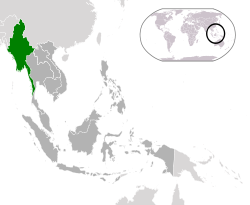
Burma
When the modern Union of Burma was born in 1948, the different nationalities of Shan, Chin, and Kachin had willingly joined the Union led by Myanmar leader Bogyoke Aung San (father of Aung San Suu Kyi) with the promise that they will run on federal lines but after his assassination the concordat was broken and the central government spearheaded by the Imperial Myanmar Tatmadaw dominated by the Myanmar embarked on a divide and rule policy in their ethnic cleansing policy. The Karen had experienced the atrocities of the Burmese army in World War II. at that time under the name of BIA (Burma Independence Army) wanted to stay clean and was about to overthrow the government, when the Chin and the Kachin rally behind the Union and resolutely defended the Union of Burma where thousands of their sons made supreme sacrifices and now this very Myanmar Tatmadaw is using modern weaponry coordinating aerial attack and heavy artillery fire indiscriminately using 81mm, 105mm and 120mm mortar shells and occasionally using chemical weapons in killing Caching and injuring several innocent citizens..3 What an irony that the patriotic Union Burmese army has become and Imperial Myanmar Tamadaw under the guidance of the Myanmar Generals?
No doubt the Kachin had made a mistake when it broke away from the other ethnic nationalities and signed a truce in 1994 leaving the other ethnic nationalities at the mercy of the Junta and now it is vice versa as the other ethnic nationalities have signed ceasefires and the Imperial Myanmar Tatmadaw has turned their wrath on the Kachin. Taking a leaf out of the Fascist Japanese, the Imperial Myanmar Tatmadaw has chosen to mount a major military offensive on Christmas season.4 The weakness of the unity of the ethnic nationalities, now under UNFC (United Nationalities Federal Council) this divide and rule policy worked admirably for the Myanmar dominated government. It was perfectly timed because on December 14, just the day after the government offered a new round of peace talks it launched a major offensive. Since then, in an all out effort to capture the KIO administration center of Laiza has begun after 1,360 skirmishes with the Kachin Independence Army.5.
The government’s ceasefire announcement, came only hours after Parliament approved a resolution calling for an end to a year and a half of fighting as the Imperial Myanmar Tatmadaw actions have come under increased international scrutiny.6 But it is unclear whether the military will comply with the order because the Burmese Army is a state within a state as the 2008 Nargis Constitution has stipulated that it have its own tribunal and will listen to it only, and not to the President who had ordered several ceasefires. Rev. Samson Hkalam, the General Secretary of the Kachin Baptist Convention, said “According to our experience, the declarations by the government are one thing, What the army does is another.”7 This was proven to be true when the fighting stop in Lajayang area only but intensifies in Hka Pot and Hka Ya Bhum, both rebel-held hilltop posts located to the north and west of Laiza, respectively.8 However, the announcement can be influenced by a UN donor Conference in Naypyidaw which could result in a multimillion dollars aid package for Burma.9 The disturbing image of civilian causalities and fresh atrocities has compel the rights groups to call on an international investigation into possible commission of war crimes against humanity and other serious human rights abuses in Burma. The quasi military government of Thein Sein’s can lose all its international legitimacy just as quickly as it has regained it in the last two years.
If the Burmese government continues the fight to capture Laiza, it will be a pyrrhic victory, as there is every possibility that the Kachin who are experts in guerilla warfare since 2nd World War will continue to fight relentlessly and can easily became an urban warfare. The ongoing offensive may cripple the KIA militarily, but it will likely not defeat the Kachin resistance. The outcome will be intense ethnic hatred on the Myanmar by the Non Myanmar, making it even more difficult to establish a lasting peace. Many Kachin now feel that there is no place for them in Burma.10
According to the UNFC there will be no peace talk as long as the War in Kachin continues but more effective is the declaration of the WA communiqué which clearly says that there is every possibility that the other ethnic nationalities will have no choice but to follow the Kachin lead and take up arms again, maybe another 600 years of civil war as Burma has fought only 60 years. With the fall of Laiza it will prove that the Imperial Myanmar Tatmadaw is not the people’s army to defend the country from outside enemies but an occupational army implementing the Myanmar imperialism over the Non Myanmar ethnic nationalities.
1. Neighboring Countries Reactions
(a) China is the most responsible country in this Kachin crisis. It has sustain the Burmese Juntas all these years not only militarily but also diplomatically not only for its strategic values but also to exploit its human and material resources. Now that Burma has opened up and competition from the West has come in, it is forced to find a new strategy to control Naypyidaw. Clearly in the implementation of Myanmar imperialism over the non Myanmar it was using two way strategy somewhat a two edged sword which in Burmese we say “Ye Mote Ta Phet Mee Sa Ta Phet” literally translated meaning a can of water in one hand and a fire in another to keep the crisis going as only then she can control the Burmese generals.
When the KIO signed a cease-fire agreement with the Junta it did not result in disarmament, but give the KIO enough room to consolidate its regional hold and develop a working bureaucracy as well as relative economic autonomy. This allowed the KIO to establish a toll system on the roads linking Burma to China, providing the Kachin with a secure source of income and making them the de facto intermediaries of cross-border trade. The fundamental fact of Kachin state is that the Burmese government has very little real control over it. Historically, geographically, culturally and politically, the state is different, and that difference makes it restive and resistant to Myanmar’s influence.11
China has taken advantage of that difference, positioning itself as moderator and in effect translator between the ethnic opposition and the Burmese administrations.
Since Burma’s isolation from the West, China has been Burma’s only major ally, investor and trading partner. China’s approach to Burma is grounded in its need for energy and alternate international trade routes to the South China Sea. As Burma’s value grows China eyes warily any domestic political shift that could affect those interests. This entails a two-fold tactic: build strong relations with the central government while maintaining a balance of power between the government and ethnic opposition groups. That is why it allow the Burma Air force planes to use the Chinese airspace to attack the Kachin in view of the fact that this year that its oil and natural gas pipelines begin coastal port of Kyaukphyu run through both Shan- and Kachin-dominated territories on their way to Kunming in Yunnan province, leaving them open to sabotage from a variety of potential antagonists. On the other hand it has protested the falling of the shells into China’s territory and sent reinforcement to paint the picture that China is neutral in Burma’s internal affairs.12
For now, Burma is poised for greater openness boosting Burma’s new democratic image, and outwardly Beijing encourages peace negotiations. But genuine reconciliation between Burma’s ethnic opposition groups and the central government is not necessarily in China’s immediate interest because China will likely suffer from Burma’s attempts to improve its reputation on the international stage, as Thein Sein’s move to halt the Chinese-financed Myitsone dam projects. The relationship between China and Burma, which might look cozy from the outside, is not without tension. Because ‘China is a partner of last resort the Burmese junta has to turn to China. They don’t like it, but it helps them stay in power.13
Therefore, it can be predicted that China will continue to openly support political stability in Burma, while simultaneously working to maintain a balance of power within the country. This way China reaffirms its importance for Burma’s efforts to maintain stability without relinquishing its role as arbiter between Myanmar’s center and the Non Myanmar periphery. As the only remaining major ethnic opposition group to have refused a peace agreement with the government and China’s closest cultural and historical link to the region, the Kachin crisis may be in the doldrums for sometime.
(b) ASEAN’s main aim of Constructive Engagement was two fold, first to exploit Burma’s natural and human resources as the architect of ASEAN leaders, especially those from Singapore, Malaysia and Thailand knew the potential of Burmese people and only by shoring up the dictators can they keep the people of Burma suppress and able to exploit the country and its people. In this aspect ASEAN is very successful as most of the workers in these three countries (both skilled and unskilled workers) are from Burma which they are able to exploit to their heart’s desire. The second is to draw Burma from the Chinese orbit which they found it increasingly difficult and this led the Burmese government to operate freely in ASEAN without any restrictions for decades.14 It seems that ASEAN leaders knows more about the West and Northeast Asia rather than Burma, misperceptions and miscalculations on the various Burmese Juntas led the Burmese people to hate vehemently to these core ASEAN countries. When Thein Sein suspended the Myitsone Dam ASEAN heartedly applauded because most of the ASEAN members except Laos and Cambodia have been engage in a myriad of conflict with China,15as even now they are trying to garland support from Burma in the Spratly Island crisis vis a vis China. Now with Burma in the ASEAN Chair in 2014 it will have some aspect to claim that their globally hated Constructive Engagement is bearing fruits in fulfilling the community building process and the quasi military government will get the legitimacy which they crave so much.
But ASEAN has served Burma’s primary goal of gaining legitimacy from the international community and to ensure that it would lead to the lifting of sanctions by the West, however with the determined attack on Kachin by the Tatmadaw ASEAN is at a loss of what to do and continue remain numb.
(3) India. Burma’s relation with India is entirely different from China basically because India is a working democracy. The different systems of political economy in China and India might also pull the two countries in divergent directions. Now that Burma is inching towards democracy, the Indian way of doing things may become more attractive than the Chinese provided the Burmese pro democracy groups prevail over the hardliners Burmese Generals.
Instead of India and China helping their fellow Asian countries to identify common norms and values — which undergird other regional formations such as the European Union – and America the two countries are on different strategic ways.16 This became the core of the Asian values in the perspective of the Foreign Policy.
After 1988, India with missionary zeal cut off all contact with the Burmese junta and gave the Nehru Award to Daw Aung San Suu Kyi, soon reverse its policy when India realized that it had lost Burma to China. So, this shift from a moral, value-based foreign policy to realpolitik is typically the Indian mentality. After a radical change in 1992 India started supplying weaponry and equipment including 105 mm guns, T-55 tanks, light helicopters, transport planes, artillery ammunition and some naval craft. Swedish Carl Gustaf M-3 anti-tank rifles and related ammunition originally exported to India have ended up in the hands of the Burmese Army using them in its operations against the KIA followed by a media coverage brought India in the bad light of the people of Burma and the world.17 One could not comprehend of why the biggest democratic country in the world is on the wrong side Burmese ethnic community and the NLD that represent the 55 million people Burma. Perhaps realpolitik and greed which the Burmese label as Indian mentality compel India to be on the side of the Imperial Myanmar Tatmadaw who is using 260 out of 340 Army battalions in its ethnic cleansing policy.
The competition between India and China for influence in Burma reflects a larger jockeying for power between the two Asian giants. Hence in Asia the two blocs could well emerge: a China-led coalition that values centralized domestic control and whose favorite institution is the Shanghai Cooperation Organization and countries like Laos, Vietnam, Cambodia, North Korea, Afghanistan, Pakistan etc versus a constellation of democracies loosely tied together by a web of strategic partnerships led by India and Japan and core ASEAN countries, Taiwan and the rest.
Unlike India, China has real economic and security interests in Burma but is sensitive to international criticisms of its positions. Burma might evolve from a point of contention to an opportunity for even greater cooperation. A stable Burma that is part of the international community could benefit both China and India. China has demonstrated its ability in the North Korea crisis to serve as a catalyst for compromise in a regional negotiating framework.
Because of historical accidents that occurred at the end of the colonial period, many ethnic nationalities and their homelands are divided into different countries of Burma and India such as Chin, Kachin and Naga. Globalization effects currently represented by India’s “Look East Policy” and the Burmese military response to it. Ethnic nationalities in Burma and Northeast India have been fighting against their respective governments. These problems cannot be solved through military means alone, and a political solution is needed and the basic aspect is for the government to recognize the pre-colonial independent status of the Chin (Mizo in India), the Kachin and the Naga their autonomy and practice “self-rule”.18 Not colonial Myanmar over the Non-Myanmar people as it is doing now with the sustain attack on the KIO the Kachin people nearer to India have seek asylum there.
2. The West and the Rest
It seems that the Brussels based organizations led by ICG are either cockeye to the economic potentials or sympathetic to the military as even now President Thein Sein who eulogizes the Imperial Myanmar Tatmadaw in their military offensive against the Kachin using Air power is being nominated for the prestigious prize “In Pursuit of Peace”. The EU follow suit and could not give much thought about it, because they themselves are so engross in saving itself from disintegrating. It was influence by Germany who stood tall, having the strongest economy. It was under their directions that the Euro Burma office has to implement their policies and every body knows it out come. Only the UK a former colonial power sense sees the writings on the wall of what the quasi military government is up to and came out strongly against it. The rest of the EU members, like the French (because of TOTAL) Scandinavian, Nordic, Benelux, Eastern Europe, Italy, Spain has to kowtow to the mighty Germany’s decision.
The Obama administration was tricked when the Burmese government skillfully plays the China Card. The US has known that Burma has only one patron, China in the world. In this context it must be construed that that it is not only for influence and loyalty but economic competition where US is on the defensive. But when Thein Sein decided to stop the Myitsone Dam, the US jumped into the fray. While on the other hand the end of the Afghanistan conflict with Osama bin Laden’s death, along with those of many of his lieutenants, also means that the campaign against terrorists is no longer a super-priority. The 2nd Obama administration has a window of opportunity not seen since the end of the Cold War to refocus its strategy in South and South East Asia. America needs a long-term strategy has rarely been implemented towards this crucial region and there is no better time for the U.S. to focus on a holistic Asia strategy than 2013.
The picture painted by ASEAN including Burma that China is a threat to the world order drives home to the American policy makers to woo Burma. The US is stepping up its strategic engagement in the Asia Pacific and intended to target China’s “string of pearls” strategy, which could help China gain a strong maritime presence in the Indian Ocean, an area covering crucial sea lines of communication en route to the mainland.19 So US is refocusing on “swing players”, like Burma which is balancing the interests of the US and China without taking the side of either in order to maximize their own national interests and keep the military in power. The US fears that if it fails to counter the rise of China, it may have to be withdrawn from the region. So, it appears intent on developing ways to weaken China’s power projection capabilities. While China has conducted active diplomacy designed to strengthen the friendly relations with ASEAN particularly Burma with the use of soft power it has struggle to erase the image of a threat because of the ideological idea of Communism. Burma has engaged China based on the principles of peaceful coexistence and Pauk Phaw friendship and enjoyed considerable space in its conduct of foreign affairs and has constantly repositioned in its relations with China to its best advantage. 20
3. The Good, the Bad and the Ugly Myanmar
Burma, like any other country has good and bad leaders, the good Myanmar like Bogyoke Aung San and his cabinet are all gone, while the bad Myanmar led by U Nu, Ba Swe, Ne Win although gone, their ancestors, particularly the Generals are still using the armed forces as their pocket army and are still deeply entrenched in their imperialist feudal nature of their thinking.21 All these 60 years the good Myanmar like Daw Aung San Suu Kyi, U Win Tin and the 88 generation are still attempting to build the Genuine Union of Burma but are of little success.
Daw Aung San Suu Kyi has said that she would not step in to help end the conflict between the Imperial Myanmar Tatmadaw and the ethnic Kachin freedom fighters without Government approval.22 This hand off attitude by a leading good Myanmar is putting in a bad light and the international community should start thinking the liberation of the ethnic communities from the clutches of the Imperial Myanmar Tatmadaw who are bent upon weakening the Kachin by military action to force them to cease fire and participate in the peace process without a political dialogue. The 23 Kachin Organizations has solicited the help of Daw Aung San Suu Kyi to settle the dispute remain unanswered.23 And if the good Myanmar stays silent, it will be like the Muslims of the world. The numerous good Muslims did not do anything and so the bad Muslims take over and tarnish their image. Not every Muslim is a terrorist but every terrorist is a Muslim. So if this hypothesis is true not every Myanmar commit human right violation but every human right violation in Burma is committed by the Myanmar soldiers.
Now it has become clear, that these Burmese generals are not only against the very grain of Democracy and the Union of Burma itself, but also still continue practicing “Lying the very concept of Truth” as the lame excuse of self defense against the Kachin as using massive air power and chemical weapons? This typical colonial war is bound to unleash a new vicious cycle of civil war.24 Viewed from a historical perspective, the government’s escalation of its ethnic war against the Kachin reveals that the celebrated reformist president and his comrades-in-arm are the newest in a long line of Myanmar imperialists who pursue a pathological militarism towards weaker, non-Myanmar ethnic communities. Thus Dr Zarni wrote:-
“The ruling elites of all stripes and colours since independence have always looked for easy scapegoats to blame for their own failures in pursuing lasting peace and building a healthy web of ethnic relations among pockets of multiethnic peoples. Among the official scapegoats were the ‘power-mad’ Communists, secessionist minorities, Maoists in China, rightists in Thailand, Islamists in Bangladesh, Yankee imperialists and old colonialists in London.”
Aung San in a speech he delivered to the executive committee of the Anti-fascist People’s Freedom League, which he headed in May 1946 said “I am opposed to British imperialism, Japanese imperialism, and Myanmar imperialism,” The current Burmese leaders are very much afraid to quote it and if his daughter did not apply it and remain silent, there may be no choice but the ethnic nationalities of Burma should form the Union of Ethnic Nationalities and leave the Myanmar out. Let the good, the bad and the ugly Myanmar who stays on the side lines fought it out among themselves.
The architect of modern Burma Aung San believed that the only workable formula to build a healthy multi-ethnic country was to enshrine the principle of ethnic equality among different ethnic communities and improve the conditions among the ethnic nationalities in peripheral but strategic borderlands populated by the Kachin, the Shan, the Karenni, the Chin, Rakhine, Mon and so on. Therefore, the escalated wars against the Kachin represent a fully imperialist campaign. Last week, a Karen National Union delegation led Gen Mutu Say Poe, traveled to Naypyidaw and said that peace talks can begin only when the guns stop smoking.25 The US Ambassador Derek Mitchell after visiting Kachin State in early Dec. remarked.
“I think both sides have to recognize that there is no military solution to this question, and that an eye for an eye will leave everyone blind, I don’t see a viable political strategy here if escalation of military hostilities leads to further alienation of the Kachin people.”26
In conclusion, may I humbly call on the international community that the bad Myanmar mentality of imperialism existing in the existing and retired generals it is far better to help the ethnic nationalities in their war of liberation against the Imperial Myanmar Tatmadaw and start dealing with the ethnic nationalities not only to save them from the carnage and extinction but also to create a much better world in that part of the globe where free trade and justice reigns.
The views expressed are the author’s own.
Notes:
1. C. S. Kuppuswamy; C.S The War with Kachin, Analysis Asian Review 11-1-2013
2. Myat::Laphai Zen. Burma Army Strikes Hits Laiza, three civilians killed Irrawaddy 14-1-2013
3. Letter by Kachin Alliance of United States of America to President Obama 9-1-2013 con...@kachinalliance.org
4. 15th Imperial Japanese army bombed Rangoon on Christmas day 1942
5. Mizzima News – 14 December 2012
6. Burma Announces Unilateral cease-fire, New York Times18-1-2013
7. Ibid Link: http://www.nytimes.com/2013/01/19/world/asia/kachin-refugees-reported-to-flee-myanmar-to-china.html
8. Win; Aye Aye, Kachin Ethnic Says fighting continues Irrawaddy 19-1-2013
9. Burma’s Kachin advance may be its own undoing Chinland Guardian 19-1-2013
10. Lintner;Bertil, A wider war looms in Myanmar Asia Times 12-1-2013
11. Stratford Analysis; The Kachin’s Role in Myanmar-Chinese Relations. (2012)., 36.
12. ee Sino Burma Treaty and the famous Bandung Conference of the five precepts of peaceful coexistence
13. Feefer;John, India-China Eying Burma FIFA
14. Chachavalpongpan;Pavin, The vexing strategic tug of war over Naypyidaw; ASEAN view of the Sino Burmese Ties. Journal of Current Southeast Asian Affairs.
15. See Bertil Lintner writings 2011
16. Feefer;John, India-China Eying Burma FIFA
17. Sen;Gautam, Cooperation between India and Burma Armed forces- EuroAsia Review 18-1-2013
18. Sakhong; Lian H.The future of Indo=Burma Relations, a view from divided people
19. Sang –ho;Song US Step up Asia Pacific Pivot Korea Herald, 18-1-2013
20. See, Maung Aung Myo 2011 Chapter V
21. Maung Zarni, How Feudal imperialism continues to destroy the Union of Burma in DVB 15-1-2013
22. Mizzima News 7-1- 2013
23. Missima News 10-1-2013
24. Maung Zarni, How Feudal imperialism continues to destroy the Union of Burma in DVB 15-1-2013
25. ‘When the Guns Stop, the Talks Can Begin’ an Interview by Irrawaddy 12-1-2013
26. C. S. Kuppuswamy; C.S The War with Kachin, Analysis Asian Review 11-1-2013 About the author: Kanbawza Win
--