
Srila Bhaktivinode Thakur was INITIATED by Srila Jagannath Das Babaji Maharaja confirmed in BACK TO GODHEAD

Joseph Y Langevin
Why did BBT made radical changes to Page 1 of Caitanya-caritamrta?
Changes — By Dhira Govinda dasa on August 7, 2010 9:16 pm
Below is an exchange of correspondence, referred to in the Caitanya-caritamrta-Page 1 section of Srila Prabhupada: The Prominent Link, between Dhira Govinda dasa and a BBT representative. The topic is a change that was made on the first page of the most recent edition of Sri-Caitanya-caritamrita. Following the correspondence I make some comments.
Dec. 19, 1999
Dear Dravida Prabhu,
Please accept my humble obeisances. All glories to Srila Prabhuapda.
Below is the letter I sent to … with the BBT question that he has referred to you. Thank for your attention in this matter. Hare Krsna.
Your servant,
Dhira Govinda dasa


December 13, 1999
Dear …,
Please accept my humble obeisances. All glories to Srila Prabhupada.
I have a BBT-related question.
On my Prabhupada Vedabase, which I obtained from the BBT archives in 1996, a paragraph from the introduction to Chapter One of the Caitanya-caritamrta reads:
“The direct disciple of Srila Krsnadasa Kaviraja Gosvami was Srila Narottama dasa Thakura, who accepted Srila Visvanatha Cakravarti as his servitor. Srila Visvanatha Cakravarti Thakura accepted Srila Jagannatha dasa Babaji, who initiated Srila Bhaktivinoda Thakura, who in turn initiated Srila Gaurakisora dasa Babaji, the spiritual master of Om Visnupada Srila Bhaktisiddhanta Sarasvati Gosvami Maharaja, the divine master of our humble self.”
In the recent edition of Caitanya-caritamrta (9-volume edition) the passage reads:
“The direct disciple of Srila Krsnadasa Kaviraja Gosvami was Srila Narottama dasa Thakura, who accepted Srila Visvanatha Cakravarti as his servitor. Srila Visvanatha Cakravarti Thakura accepted Srila Jagannatha dasa Babaji, the spiritual master of Srila Bhaktivinoda Thakura, who in turn accepted Srila Gaurakisora dasa Babaji, the spiritual master of Om Visnupada Srila Bhaktisiddhanta Sarasvati Gosvami Maharaja, the divine master of our humble self.”
On the Vedabase edition, which I assume is the original version dating back to the 1970s, it is stated that Srila Jagannatha dasa Babaji initiated Srila Bhaktivinoda Thakura, who in turn initiated Srila Gaurakisora dasa Babaji. In the 9-volume edition it is stated “…Srila Jagannatha dasa Babaji, the spiritual master of Srila Bhaktivinoda Thakura, who in turn accepted Srila Gaurakisora dasa Babaji…”
I’m curious about the reason for the change. Did the original editors make a mistake–e.g., not properly hearing Srila Prabhupada’s voice on tape? Or is it assumed that Srila Prabhupada made a historical mistake when he stated that Srila Jagannatha dasa Babaji initiated Srila Bhaktivinoda Thakura, and the 9-volume editors corrected this mistake? Or for some other reason?
Thank you for your attention in this matter. Hare Krsna.
Your servant,
Dhira Govinda dasa
[end of letter written by Dhira Govinda dasa]
Haribol Dhira Govinda Prabhu
Please accept my humble obeisances. All glories to Srila Prabhupada!
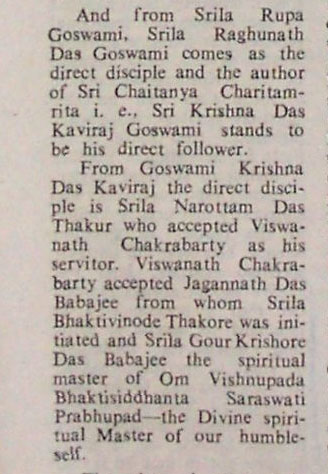
Thank you for your inquiry concerning the Caitanya-caritamrta changes. I agonized over this one for some time, consulting several senior devotees before making this change. Here was my thinking: First of all, there is no tape of this passage. Rather, it derives from an excerpt of the CC Srila Prabhupada published in March of 1960 in the BTG. Here is how the passage read there (from the latest VedaBase):
 ———
———
Viswanath Chakrabarty accepted Jagannath Das Babajee from whom Srila Bhaktivinode Thakore was initiated and Srila Gour Kishore Das Babajee the spiritual master of Om Vishnupada Bhaktisiddhanta Saraswati Prabhupad–the Divine spiritual Master of our humble self.
——–
Notice that while Srila Prabhupada does say that Bhaktivinode Thakura was initiated by Jagannatha das Babaji, he doesn’t say that Gaura Kishora das Babaji was initiated by Bhaktivinode, which was added in the 1975 edition of the CC. Historically, neither is accurate if we accept the usual sense in which Srila Prabhupada used the word “initiated.” So just on the grounds of bringing the new edition closer to the original words Srila Prabhupada wrote, no longer having Bhaktivinode initiating Gaurakisora is justified. But we are still left with Jagannatha das initiating Bhaktivinode.
Before we proceed, I tracked down the source upon which Srila Prabhupada based this passage in his BTG and CC, and that is the song by Bhaktisiddhanta Sarasvati called “Sri Guru-parampara”. You’ll find it in the latest edition of the Songs of the Vaisnava Acaryas, and it is included in the supplementary literature on the latest Vedabase. The actual relationship among all the principals is illuminated there.
The final bit of research that went into my decision was finding support for Srila Prabhupada’s strict use of the word “initiated”. I found this at Adi11.13:
Among his many disciples, Sriman Srinivasa Acarya was the most famous and the most dear, but it is doubtful that he was his initiated disciple.
This indicates that in this very book (CC) Srila Prabhupada reserved the phrase “initiated disciple” for a formal initiation, and that he felt that the word “disciple” is perfectly appropriate for someone who receives siksa but not diksa from a superior.
So now we have these considerations:
On the side of not changing the “initiated” phrases we have the strong bias against changing the books unless absolutely necessary and the fact that Srila Prabhupada did indeed say that Jagannatha das Babaji initiated Bhaktivinode.
On the side of changing we have this:
How the parampara is listed and perceived is very significant for all devotees. Many devotees know, and soon all devotees will know, that Jagannatha das Babaji did not initiate Bhaktivinode Thakur in any way that is normally understood from Srila Prabhupada’s books, other statements, or practice.
Removing the idea that Bhaktivinode initiated Gaura-kisora (a removal supported by the ms) but leaving the other “initiated” will seem to be a gross oversight, since neither initiation is historically accurate.
Leaving one or both “initiated”s will strongly imply that the use of the phrases “direct disciple” and even “accepted [as his disciple]” indicate formal initiation as we know it in ISKCON, which is far from the truth. (Narottama may have “accepted” Visvanatha as his servitor, but it wasn’t on the physical plane, since there is a gap between their lifetimes; likewise between Visvanath and Jagannatha das.)
This last was the weightiest argument, in my view, for changing the passage.
——–
So, after weighing these arguments carefully and consulting with several learned Godbrothers (who came out in favor of change, but not unanimously) and agonizing for several days, I decided to remove the “initiated”s.
Hoping this meets you well, I remain
Your servant,
Dravida dasa
[end of letter written by the BBT representative]
Of concern is that the explanation for deleting the word “initiated” seems to be largely based on the understanding of the word “initiated”, “as we know it in ISKCON”. Perhaps when Srila Prabhupada used the word “initiated”, he did so deliberately, and the meaning of the term as it has come to be understood in ISKCON is faulty. That is, instead of making changes in this passage based on what we think Srila Prabhupada may have meant, it may be fruitful to consider that the current conception in the organization of the word “initiated” is not perfectly consistent with Srila Prabhupada’s understanding of the concept.
One possible way that this could be true is by referring to one of the definitions that Srila Prabhupada often gave for diksa, or initiation. Namely, Srila Prabhupada frequently equated diksa with the process of imparting transcendental knowledge, or divya-jnana. In the purport of Madhya-lila, 15:108, Srila Prabhupada quotes Srila Jiva Goswami as follows. “Diksa is the process by which one can awaken his transcendental knowledge and vanquish all reactions caused by sinful activity. A person expert in the study of the revealed scriptures knows this process as diksa.” Also, in the purport to Madhya-lila, 4:112, Srila Prabhupada writes “Diksa actually means initiating a disciple with transcendental knowledge by which he becomes freed from all material contamination.” In a lecture on July 29, 1968, Srila Prabhupada said “This is called initiation. Or initiation from the very beginning. This is called diksa. The Sanskrit term is called diksa. Diksa means… Di, divya-jnanam, transcendental knowledge, and ksa, iksa. Iksa means darsana, to see, or ksapayati, explain. That is called diksa.” This is similarly confirmed in several lectures and conversations (e.g., June 17, 1976 initiation lecture; July 11, 1976 lecture; February 22, 1973 lecture; December 29, 1973 lecture; January 27, 1977 conversation).
Perhaps Srila Prabhupada was referring to diksa, or initiation, in the sense of “transmitting transcendental knowledge” when he used the word “initiated” to describe the relationship between Srila Jagannatha Dasa Babaji and Srila Bhaktivinode Thakur. The ISKCON Governing Body Commission has asserted that Srila Prabhupada is the “preeminent siksa guru” for all ISKCON members and that “ISKCON members shall be trained to place their faith, trust and allegiance first and foremost in the Founder-Acarya who is the preeminent siksa guru for every member of ISKCON.” The Vaisnava who is the preeminent instructor, or siksa guru, and who, more than any other Vaisnava, is worthy of faith, trust and allegiance, may also be considered to be the primary deliverer of transcendental knowledge. Imparting transcendental knowledge, or divya-jnana, is the essence of initiation, and thus the primary deliverer of transcendental knowledge may be considered to be the diksa guru, at least in a transcendental sense, though not necessarily in a formal sense.
In expounding these thoughts my hope is that, with a clearer, deeper, and perhaps synthetic understanding of initiation, or diksa, our Vaisnava society may be able to bridge some gaps and resolve some divisive conflicts. This paper makes no pretense to resolve issues, though I believe that the points described herein are important for discussion. Srila Prabhupada wrote (CC Adi 1:35 purport) “A devotee must have only one initiating spiritual master because in the scriptures acceptance of more than one is always forbidden.” We know that Vipina Vihari Goswami initiated Srila Bhaktivinode Thakur, but Srila Prabhupada also wrote, in the original version of Caitanya-Caritamrita, that Srila Jagannatha dasa Babaji initiated Srila Bhaktivinode Thakur. Perhaps changing Srila Prabhupada’s words is the appropriate solution to resolve this, though perhaps it may also be fruitful to consider other solutions by looking more closely at various definitions of “diksa” and “initiation”. Hare Krsna.
The Weightiest Argument
May 17, 2006
by Dhira Govinda dasa
“Leaving one or both ‘initiated’s will strongly imply that the use of the phrases ‘direct disciple’ and even ‘accepted [as his disciple]‘ indicate formal initiation as we know it in ISKCON, which is far from the truth… This last was the weightiest argument, in my view, for changing the passage” [Letter excerpt from Dravida das regarding the change on Sri-Caitanya-caritamrta page 1].
“The revision is small and in itself, we believe, of no great consequence” [Jayadvaita Swami, regarding the revision on Sri-Caitanya-caritamrta, page 1].
In May, 2005 I fortuitously encountered Jayadvaita Maharaja at a Sunday feast program in Alachua, and he shared with me about recent, somewhat extended deliberations, and conclusions, of the Bhaktivedanta Book Trust (BBT) directors concerning the revision on the first page of Sri-Caitanya-caritamrta. In July, 2005 I received the article that he wrote, on behalf of the BBT, about this matter. This article is now apparently receiving increased attention. Jayadvaita Maharaja wrote “In particular, Dhira Govinda Prabhu questioned it and asked us to reconsider it. We took his request seriously.” The BBT directors did devote extended hours to this topic, and I sincerely appreciate their earnest attention to the matter.
My perspective is that the revision is of profound consequence. Perhaps of even greater moment is the fact that the BBT directors believe that the revision is “in itself,… of no great consequence.”
On June 16, 2000, about half a year after he wrote the letter from which the excerpt at the start of this posting is taken, Dravida das who had written “This last was the weightiest argument…”, wrote to me as follows:
“Aside from the passage itself, I can easily see the following syllogism flowing from your notes on diksa: Diksa is really the imparting of transcendental knowledge. Srila Prabhupada is the pre-eminent imparter of transcendental knowledge for all generations of ISKCON devotees, now and in the future. So Srila Prabhupada is giving diksa to all who take knowledge from his books, tapes and other media. He who gives diksa is the diksa-guru. One is enjoined to have only one diksa-guru because the acceptance of more than one is strictly forbidden in the sastra. Therefore Srila Prabhupada is the only diksa-guru for all ISKCON devotees for the next ten thousand years.
“I don’t think I want to go down that road.”
[end of letter excerpt from BBT representative]
I feel compelled to state that this article is not about whether “Srila Prabhupada is the only diksa-guru for all ISKCON devotees for the next ten thousand years.” My views about Srila Prabhupada’s relationship with the members of his movement are expressed in Srila Prabhupada: The Prominent Link and other essays. My original correspondence with BBT representatives concerning the book change on the first page of Sri-Caitanya-caritamrta is available in Appendix C of the second printing of Srila Prabhupada: The Prominent Link, and a short chapter discussing ramifications of this change is included as Chapter Three in Srila Prabhupada: The Prominent Link.
This article is about an apparent knowledge filter that is active in decisions regarding revisions to Srila Prabhupada’s books. From what I am able to discern, the psychology underlying the emendation under discussion embraces a priori assumptions regarding which roads may be traversed. Rather than impartially presenting Srila Prabhupada’s words with an eagerness to discover which roads open, there seems to be an attitude, albeit subconscious, of pre-determining which paths are permissible for visitation, and accordingly adjusting Srila Prabhupada’s writings.
While recognizing the attempts of the BBT representatives to transparently represent Srila Prabhupada, it seems that in this instance Srila Prabhupada’s clear intentions are obscured for the reader due to a filter composed of presuppositions. These assumptions perhaps have not been closely examined, or at least are not readily apparent to many current and future readers of Srila Prabhupada’s books.
In an article dated May 6, 2006, Bala dasa Prabhu similarly addresses the topic. “This is a very troubling development for yet another reason. For this justification is laying the ground for making ANY further change to Srila Prabhupada’s teachings that the GBC deems fit.” Notwithstanding the distinction between the GBC and BBT, Bala dasa’s essential point seems to be a caution regarding the peril implied by application over time of this “weightiest argument” to revising Srila Prabhupada’s books.
Apart from future considerations of damage caused by this gatekeeper mentality, I believe it relevant to contemplate present effects. The revision to the first page of Sri-Caitanya-caritamrta (CC) is one of thousands of changes to Srila Prabhupada’s books. Perhaps the knowledge filter has been productive in more than this one case. Maybe it has had its effect in two or three, or perhaps dozens, of the changes to Srila Prabhupada’s books. We might fruitfully deliberate on the influence this has had on the Vaisnava society.
I suggest that sober reflection on the substance of this one change, to CC page 1, and the paradigm of thought that engendered this change, would tremendously impact the philosophical, political, economic, social and spiritual culture of persons and groups that are influenced by the consciousness and determinations of the BBT and GBC. Acknowledgement of this “great consequence” by the BBT directors, or any one of them, would in itself provide momentum for this impact, and would launch torpedoes at embedded institutional structures.
In his Foreword to Srila Prabhupada: The Prominent Link Ambarisa dasa Prabhu quotes Herbert Spencer. “There is principle which is a bar against all information, which is proof against all information, which is proof against all arguments, and which cannot fail to keep a man in everlasting ignorance. That is contempt prior to investigation.” Contemporary ISKCON policy and thought as a basis for changing Srila Prabhupada’s books carries serious risk of “contempt prior to investigation.” Such a strategy seems to be dedicated to institutional preservation more than to authentically representing Srila Prabhupada. I assert that we may trust that authentic representation of Srila Prabhupada is the strongest assurance of protection, integrity and healthy expansion that an organization may enjoy
Kindly postSrila Bhaktivinode Thakur was INITIATED by Srila Jagannath Das Babaji Maharaja confirmed in BACK TO GODHEAD - March 20, 1960
“The direct disciple of Srila Krsnadasa Kaviraja Gosvami was Srila Narottama dasa Thakura, who accepted Srila Visvanatha Cakravarti as his servitor. Srila Visvanatha Cakravarti Thakura accepted Srila Jagannatha dasa Babaji, who initiated Srila Bhaktivinoda Thakura, who in turn initiated Srila Gaurakisora dasa Babaji, the spiritual master of Om Visnupada Srila Bhaktisiddhanta Sarasvati Gosvami Maharaja, the divine master of our humble self.” [Chapter 1, Volume 1, Adi Lila,Caitanya Caritamrta, 1974 Edition]
From Goswami Krishna Das Kaviraj the direct disciple is Srila Narottam Das Thakur who accepted Viswanath Chakrabarty as his servitor. Viswanath Chakrabarty accepted Jagannath Das Babajee from whom Srila Bhaktivinode Thakore was initiated and Srila Gour Kishore Das Babajee the spiritual master of Om Vishnupada Bhaktisiddhanta Saraswati Prabhupad-the Divine spiritual Master of our humbleself.
[Identity of Lord Chaitanya, Back To Godhead Magazine, Volume 3, Part 16, March 20, 1960]Link to this page: https://prabhupadabooks.com/btg/20/20a
BBT Admits Books Changed To Fit GBC Philosophy
The BBT could not allow Srila Prabhupada to teach that Jagannatha Dasa Babaji actually *initiated* Srila Bhaktivinoda Thakura, for that would indirectly sanction Srila Prabhupada *initiating* for many generations to come simply via his transcendental knowledge, with the 'formal initiation' administered via the Ritvik system that he set up. IRM Adridharana Dasa (01-02-09)We highlighted previously in newsletter No. 20, how Bhakti Caru Swami's Bengali translation of the Srimad Bhagavatam had omitted a very key verse from Srila Prabhupada's original version. The omitted verse in question would itself have destroyed the GBC's position that they were duly authorised to be Diksa Gurus in ISKCON. This of course was shocking, since it showed that Srila Prabhupada's books were being 'edited' not to bring them closer to the originals as claimed, but rather doctored to prop up the GBC's bogus Guru philosophy.
Though we had also been aware of many other controversial changes made to Srila Prabhupada's books, the BBT had always claimed that they were made to actually correct 'errors' made by Srila Prabhupada's 'hippie' editors. Thus they were not actually changing Srila Prabhupada's books, but Hayagriva's 'incorrect version' of the books, and thereby actually RESTORING the books BACK to how Srila Prabhupada actually wanted them. However, thanks to the diligent efforts of His Grace Dhira Govinda Prabhu, the Chairman of the ISKCON Office of Child Protection, we now have evidence that the current BBT, which is controlled by GBC supporters, are making changes motivated slowly by the desire to doctor Srila Prabhupada's books so that they fit in with whatever happens to be the prevailing view instituted in ISKCON by the GBC.
Some time back many devotees had noticed that the new 9 Volume edition of the Caitanya Caritamrta had made a deliberate change from Srila Prabhupada's original version, not unlike the one made by Bhakti Caru Swami mentioned earlier. Srila Prabhupada's Caitanya Caritamrta states the following:
"Srila Visvanatha Cakravarti Thakura accepted Srila Jagannatha dasa Babaji, who *initiated* Srila Bhaktivinoda Thakura, who in turn initiated Srila Gaurakisora dasa Babaji"
(C:C, Chapter 1)
In the new BBT doctored 9-volume edition, the same passage reads:
"Srila Visvanatha Cakravarti Thakura accepted Srila Jagannatha dasa Babaji, the spiritual master of Srila Bhaktivinoda Thakura, who in turn accepted Srila Gaurakisora dasa Babaji"In other words it has been decided that contrary to what Srila Prabhupada states, Jagannatha Das Babaji did not really INITIATE Srila Bhaktivinoda Thakura after all. Now the reason for the BBT changing Srila Prabhupada's teaching here is very significant since the GBC maintain that the relationship between Jagannatha Das Babaji and Srila Bhaktivinoda Thakura was based not on 'formal initiation' but rather only on the transmission of transcendental knowledge'. Once it is accepted that the transmission of divine transcendental knowledge ALONE constitutes INITIATION - then the objections made by the GBC to the Ritvik system of initiation crumble, since Srila Prabhupada could also *initiate* us with transcendental knowledge.
Thus the BBT could not allow Srila Prabhupada to teach that Jagannatha Dasa Babaji actually *initiated* Srila Bhaktivinoda Thakura, for that would indirectly sanction Srila Prabhupada *initiating* for many generations to come simply via his transcendental knowledge, with the 'formal initiation' administered via the Ritvik system that he set up. In any case the teaching given by Srila Prabhupada above is totally consistent with what Srila Prabhupada has taught about Diksa and initiation in the Caitanya Caritamrta itself:
"Diksa actually means *initiating* a disciple *with transcendental knowledge* by which he becomes freed from all material contamination." (Madhya-lila, 4:112, Purport)
Of course just the very fact that the BBT is deliberately changing the main legacy left by Srila Prabhupada - his teachings - is horrendous enough.
However the fact that it was done specifically to keep the positions of the GBC within the crumbling Guru system intact, is totally shameful.
But just when you though it could not get any worse, it does. For the BBT have now become so arrogant in their campaign against Srila Prabhuada's teachings, that they have even tried to JUSTIFY this change. Dravida Das, the BBT editor, upon being asked by Dhira Govinda Prabhu to justify the change, first sums up the reason for NOT changing Srila Prabhupada's teachings as follows:
"On the side of not changing the "initiated" phrases we have the strong bias against changing the books unless absolutely necessary and the fact that Srila Prabhupada did indeed say that Jagannatha das Babaji initiated Bhaktivinode."
(BBT Editor, Dravida Das)
Please note that Dravida clearly ADMITS that Srila Prabhupada "DID indeed say that Jagannatha das Babaji initiated Bhaktivinode".To any sane person, this would be the ONLY reason required to NOT tamper with Srila Prabhupada's teachings in any manner whatsoever. But hold on.
Dravida Das has a reason that far outweighs a mere detail such as what Srila Prabhupada himself actually taught. Rather he states we must change Srila Prabhupada's teachings to ensure they conform with what is currently understood within ISKCON in regards to initiation:
"Leaving one or both "initiated"s will strongly imply that the use of the phrases "direct disciple" and even "accepted [as his disciple]" indicate formal initiation as we know it in ISKCON, which is far from the truth." (BBT Editor, Dravida Das)
Dravida then adds that this reason was paramount in justifying the change:
This last was the weightiest argument, in my view, for changing the passage.
(BBT Editor, Dravida Das)
Thus to summarise, what Dravida is saying is this: That whenever Srila Prabhupada's teachings differ from the way 'we know it in ISKCON', then they must be changed to conform with the way we DO 'know it in ISKCON'. And of course the way 'we know it in ISKCON' is dictated by whatever ridiculous philosophy the GBC happens to be preaching at the time.So the fact that we have had a bogus Guru system imposed on us in ISKCON by the GBC means that even though we may find that Srila Prabhupada teaches something else, we must modify Srila Prabhupada's teachings to agree with the way things are understood in ISKCON. Instead of changing the practices and understanding of ISKCON to conform with Srila Prabhupada's teachings - which of course is what a spiritual society based on following Srila Prabhupada would do. Not only is it bad enough that ISKCON is NOT run according to Srila Prabhupada's teachings, but now Srila Prabhupada's teachings must also be changed to fit in with the way we happen to be doing things in ISKCON.
What makes this shocking state of affairs even more ludicrous is that the way things are 'known in ISKCON' are themselves constantly changing anyway.
1) Thus from 1978-onwards, in ISKCON we 'knew' one thing in regards to the process of initiation - that you could ONLY take it from 11 people, and then ONLY whichever of the 11 people 'owned' your geographical area.
2) Then from 1986 we 'knew' something else about initiation - that you could take it from many others providing they had received the necessary number of votes.
3) Now we 'know' something else - that whoever you get initiated from, do not forget that you must not worship him too much and that Srila Prabhupada is also doing some important things, and indeed maybe even more important than the person who does initiate us.
4) And what's the betting that this 'understanding' will also change in the next year or so?
5) And just because we happen to 'know' at the moment that initiation must mean the 'formal ceremony', therefore any teaching in Srila Prabhupada's books that imply otherwise must be doctored.And this is a very sinister development for yet another reason. For this justification is laying the ground for making ANY further change to Srila Prabhupada's teachings that the GBC deems fit. Thus in the future if it is 'known in ISKCON' that 'women are as intelligent as men' say, then we will be able to alter all of Srila Prabhupada's statements where he says that women are less intelligent, since then it would not conform with the way things are 'known in ISKCON'. Or if in the future we begin to 'know in ISKCON' that Lord Siva is just as worshipable as Krishna say, then whenever we encounter the word 'Demi-God' in Srila Prabhupada's books, then all those instances must be changed. And so on.
Of course someone may argue that the philosophy as 'we know it in ISKCON' will never change and will always be faithful to Srila Prabhupada's teachings, and the above fear is unfounded. (Of course Pigs May Also Fly).
If the last 23 years is anything to go by, the only thing we can say with certainty is that the GBC will ALWAYS be deviating from Srila Prabhupada's teachings, and the ONLY SAFEGUARD WE HAVE IS SRILA PRABHUPADA'S TEACHINGS.
And once we change Srila Prabhupada's teachings to fit in with whatever nonsense we happen to believe, then all will be lost - as seems to be happening now.
How much longer must we put up this with this madness that is leading to the destruction of Srila Prabhupada's movement. No wonder devotees, life members and members of the public, are turning to support the IRM in their droves.
From: Adridharana Dasa, Temple President ISKCON Calcutta