
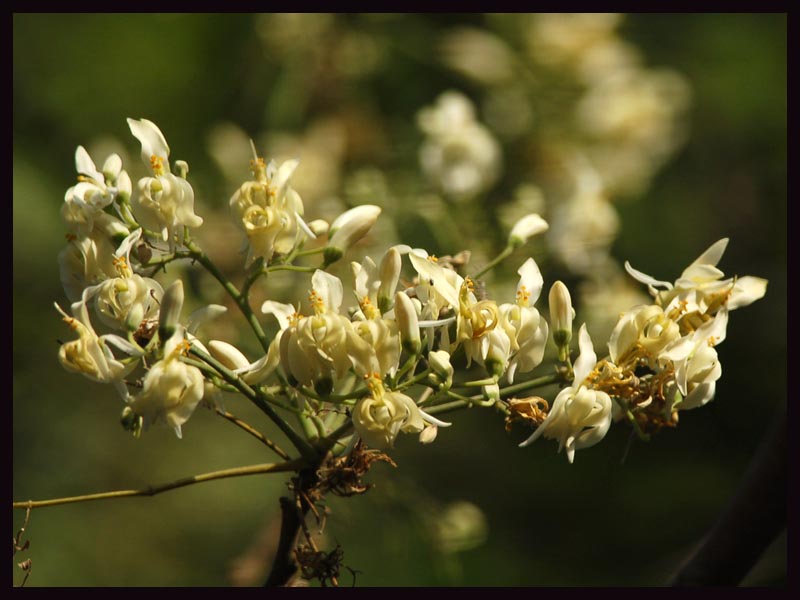
Drumstick(moringa oleifera) flowering


Anand Kumar Bhatt
sahjan ati jo phuliye/ Daar paat ki hani
Means Sahjan flowers so much that even the branches break.
It attracts birds for the honey in the flower, and the drum stick is good for health in so many ways.
akbhatt
Taken at nehru park on 5.4.9Vinod
Anand Kumar Bhatt
A-59, B.S.F.Colony, Airport Road
Gwalior. 474 005.
Tele: 0751-247 2233. Mobile 0 94253 09780.
My blogsite is at:
http://anandkbhatt.blogspot.com
And the photo site:
www.flickr.com/photos/akbhatt/

J.M. Garg
Moringa oleifera, commonly referred to simply as Moringa (Tamil murungai, முருங்கை),(Kannada Nuggekai) (Mulakkaya in Telugu), (Marathi Shevaga), (Malunggay in Tagalog) is the most widely cultivated variety of the genus Moringa. It is of the family Moringaceae. It is an exceptionally nutritious vegetable tree with a variety of potential uses. The tree itself is rather slender with drooping branches that grows to approximately 10 m in height; however, it normally is cut back annually to one meter or less, and allowed to regrow, so that pods and leaves remain within arm's reach.
Considered one of the world’s most useful trees, as almost every part of the Moringa tree can be used for food, or has some other beneficial property. In the tropics it is used as forage for livestock. And in many countries, Moringa is used as a micronutrient powder to treat indigenous diseases.A traditional food plant in Africa, this little-known vegetable has potential to improve nutrition, boost food security, foster rural development and support sustainable landcare.[2]
The immature green pods, called “drumsticks” are probably the most valued and widely used part of the tree. They are commonly consumed in India, and are generally prepared in a similar fashion to green beans and have a slight asparagus taste. The seeds are sometimes removed from more mature pods and eaten like peas or roasted like nuts. The flowers are edible when cooked, and are said to taste like mushrooms. The roots are shredded and used as a condiment in the same way as horseradish, however it contains the alkaloid spirochin, a potentially fatal nerve paralyzing agent, so such practices should be strongly discouraged.
The leaves are highly nutritious, being a significant source of beta-carotene, Vitamin C, protein, iron and potassium. The leaves are cooked and used like spinach. In addition to being used fresh as a substitute for spinach, its leaves are commonly dried and crushed into a powder, and used in soups and sauces. Murungakai as it is locally known in Tamil Nadu and Kerala is used in Siddha medicine. Its leaves are full of medicinal properties. The tree is a good source for calcium and phosphorus. In Siddha medicine, the drumstick seeds are used as a sexual virility drug for treating erectile dysfunction in men and also in women for prolonging sexual activity.
The bark, sap, roots, leaves, seeds, oil and flowers are used in traditional medicine in several countries. In Jamaica, the sap is used for a blue dye.
The flowers are also cooked and relished as a delicacy in West Bengal and Bangladesh, especially during early spring. There it is called sojne ful and is usually cooked with green peas and potato.
For learning about our trees & plants, please visit/ join Google e-group (Indiantreepix) http://groups.google.co.in/group/indiantreepix?hl=en

satish phadke
--
http:// satishphadke.blogspot.com