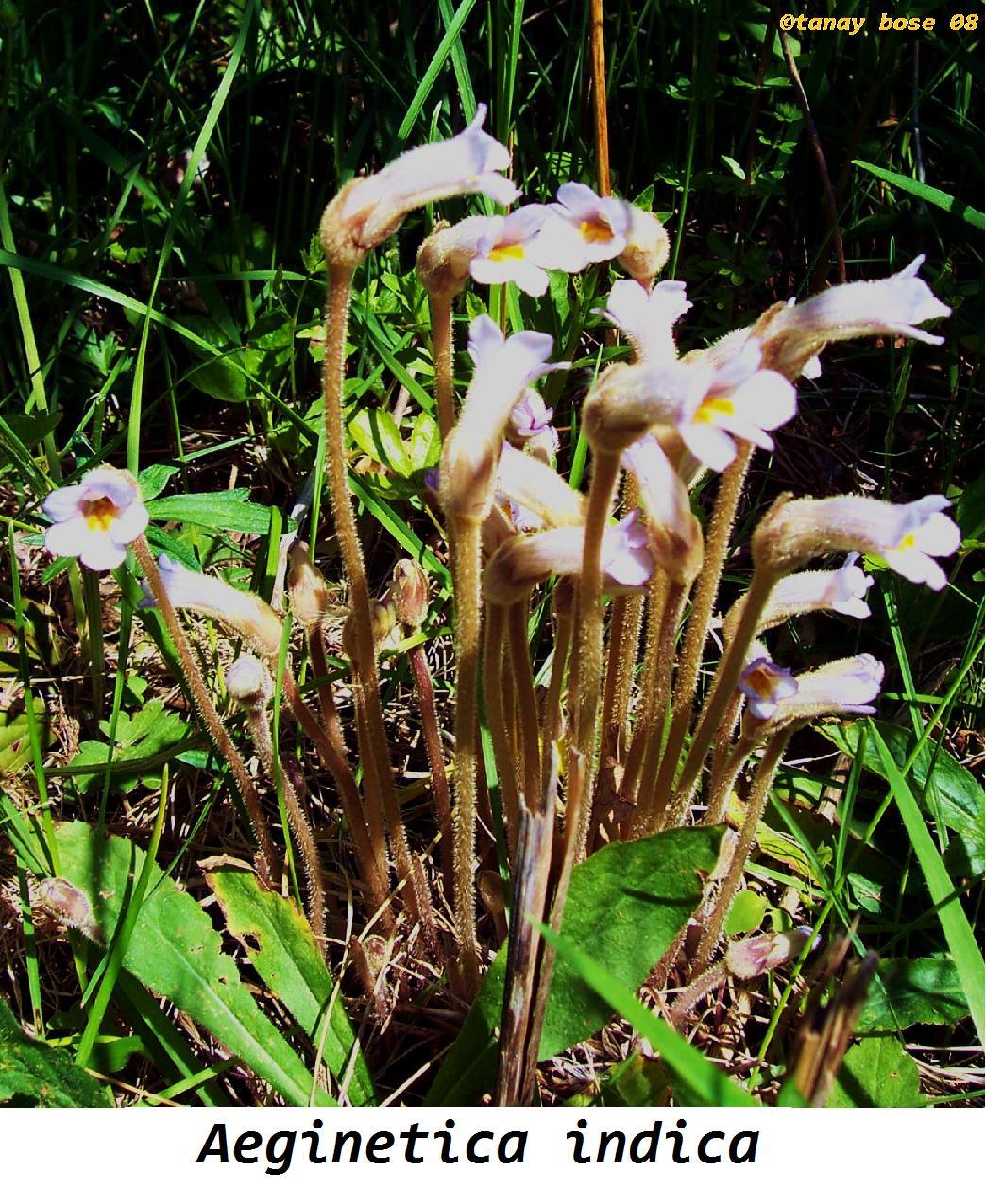
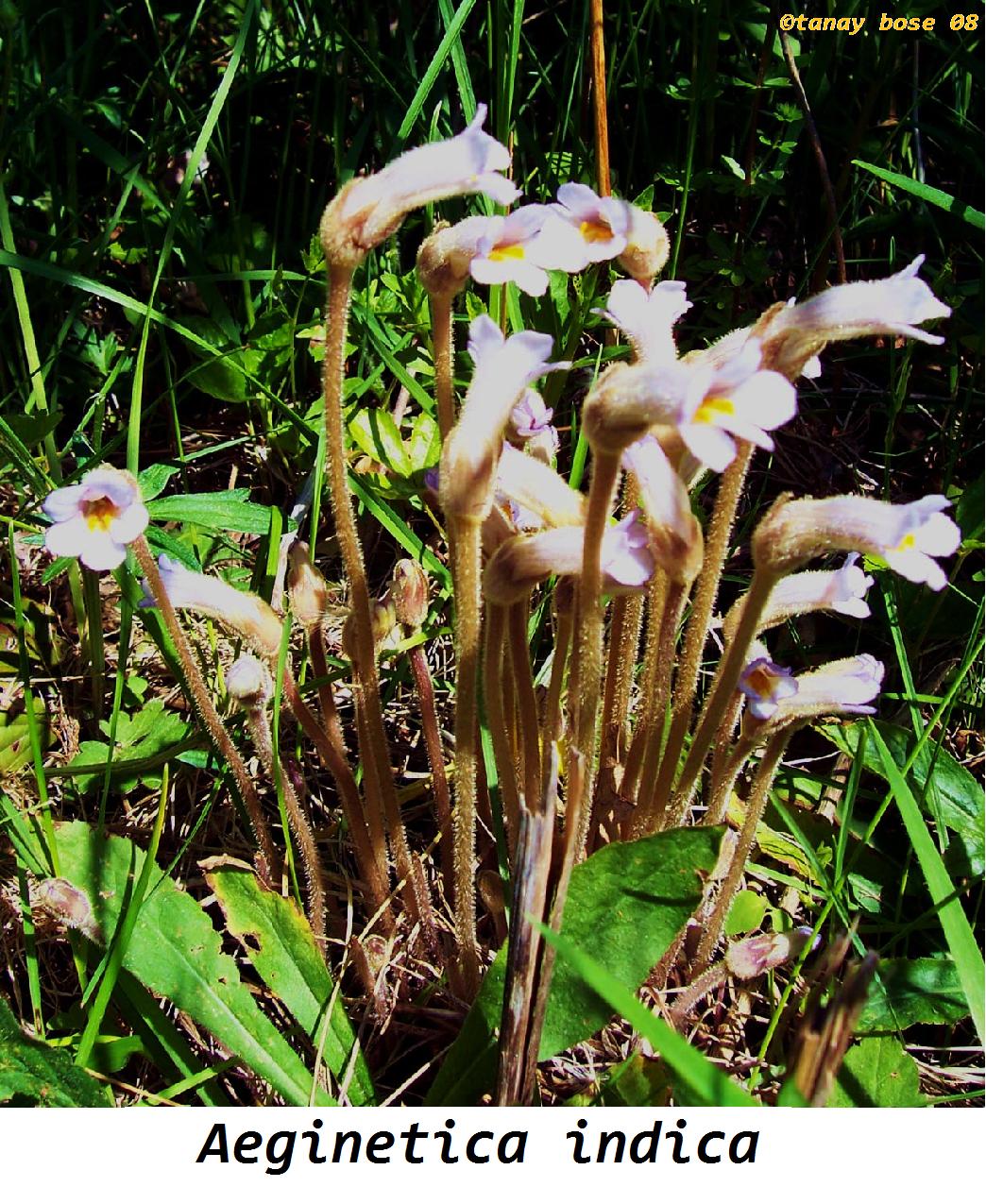
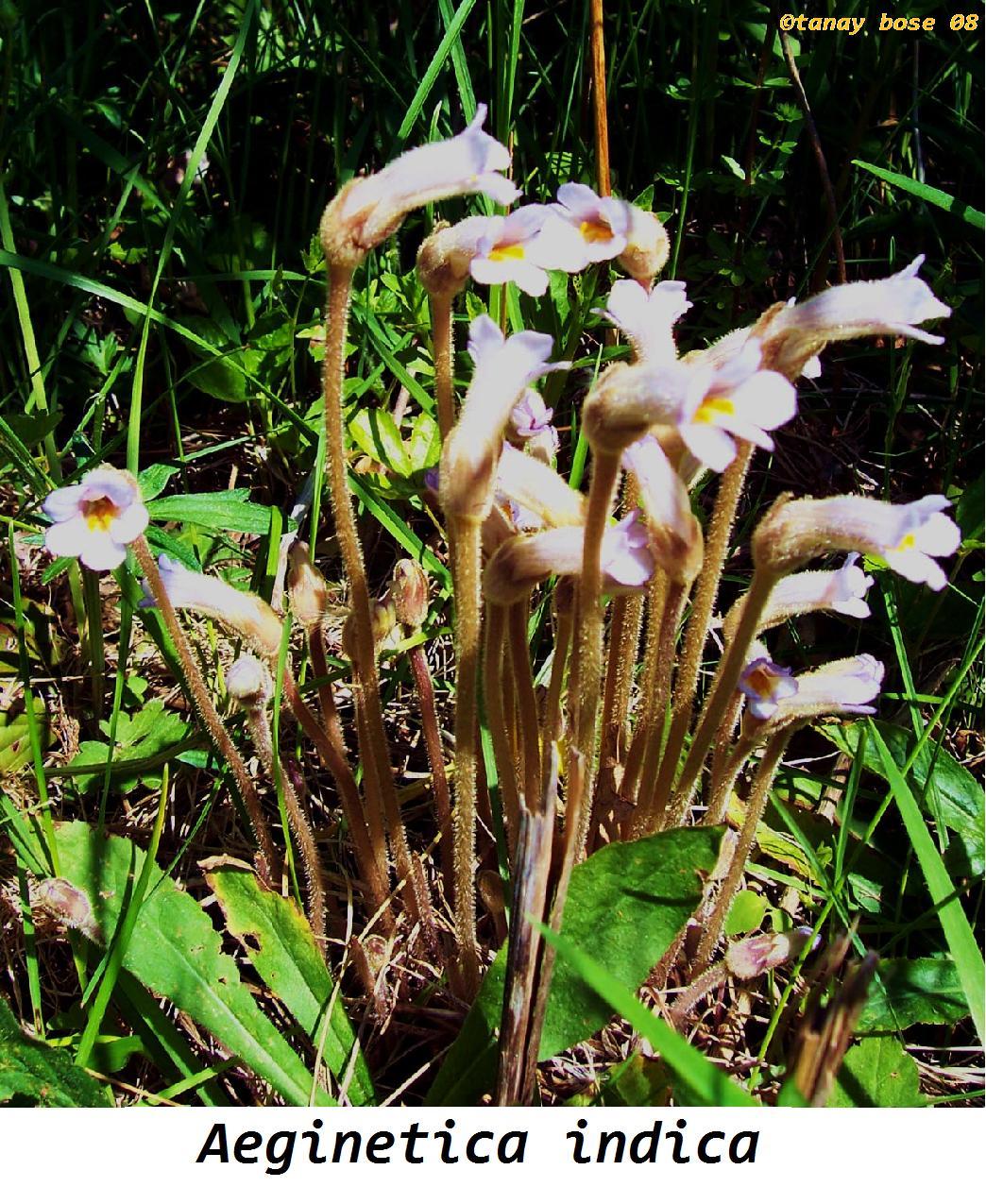
Aeginetia indica

tanay bose
Plant Name: Aeginetia indica L.
Family: Orobanchaceae
Date/Time- November 2008
Location- Place, Altitude, GPS- Panchmari Reserve Forest, Panchmari (Madhya Pradesh)
Habitat- Garden/ Urban/ Wild/ Type- Wild
Plant Habit- Tree/ Shrub/ Climber/ Herb- Herbaceous.
Height/Length- 10-30 meters
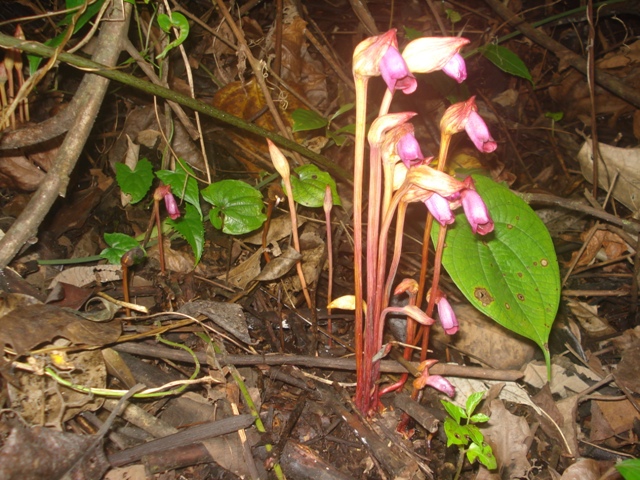
Plants 15-40(-50) cm tall. Root slightly fleshy, with small branches. Stems unbranched or branched from near base. Leaves red, ovate-lanceolate or lanceolate, 5-10 X 3-4 mm, glabrous. Flowers usually solitary. Pedicel usually erect, 10-30(-40) cm, ca. 3 mm in diam. Calyx apex acute or acuminate. Corolla purple-red striate, indistinctly bilabiate, tubular-campanulate, 2-4.5 cm; tube slightly curved; lobes subentire. Filaments purple, 7-9 mm, glabrous; anthers yellow. Ovary 1-locular; parietal placentas 4. Style 1-1.5 cm; stigma pale yellow. Capsule conical, or long ovoid-globose, 2-3 cm. Seeds yellow, ellipsoid, ca. 0.04 mm. Fl. Apr-Aug, fr. Aug-Oct. 2n = 30.
The roots and flowers are used medicinally for clearing away heat and toxic materials
--
Tanay Bose
+91(033) 25550676 (Resi)
9830439691(Mobile)
9674221362 (Mobile)

shrikant ingalhalikar
Differences are peduncles hairy (glabrous), calyx lobed (spatheceus),
corolla white and yellow (purple) smaller and distinctly lobed. Please
reconfirm. Rgds, Shrikant
On Mar 10, 9:32 pm, tanay bose <tanaybos...@gmail.com> wrote:
> *Plant Name: Aeginetia indica L.*
>
> *Family:** **Orobanchaceae***
>
> *Date/Time- November 2008*
>
> *Location- Place, Altitude, GPS- Panchmari Reserve Forest, Panchmari (Madhya
> Pradesh) *
>
> *Habitat- Garden/ Urban/ Wild/ Type- Wild*
>
> *Plant Habit- Tree/ Shrub/ Climber/ Herb-** **Herbaceous.***
>
> *Height/Length- 10-30 meters*
>
> Plants 15-40(-50) cm tall. Root slightly fleshy, with small branches. Stems
> unbranched or branched from near base. Leaves red, ovate-lanceolate or
> lanceolate, 5-10 X 3-4 mm, glabrous. Flowers usually solitary. Pedicel
> usually erect, 10-30(-40) cm, ca. 3 mm in diam. Calyx apex acute or
> acuminate. Corolla purple-red striate, indistinctly bilabiate,
> tubular-campanulate, 2-4.5 cm; tube slightly curved; lobes subentire.
> Filaments purple, 7-9 mm, glabrous; anthers yellow. Ovary 1-locular;
> parietal placentas 4. Style 1-1.5 cm; stigma pale yellow. Capsule conical,
> or long ovoid-globose, 2-3 cm. Seeds yellow, ellipsoid, ca. 0.04 mm. Fl.
> Apr-Aug, fr. Aug-Oct. 2*n* = 30.
>
> The roots and flowers are used medicinally for clearing away heat and toxic
> materials
>
> --
> Tanay Bose
> +91(033) 25550676 (Resi)
> 9830439691(Mobile)
> 9674221362 (Mobile)
>
> Aeginetia indica.jpg
> 447KViewDownload
tanay bose
--
You received this message because you are subscribed to the Google Groups "efloraofindia" group.
To post to this group, send email to indian...@googlegroups.com.
To unsubscribe from this group, send email to indiantreepi...@googlegroups.com.
For more options, visit this group at http://groups.google.com/group/indiantreepix?hl=en.

Pravir Deshmukh
Recorded from West Kameng Dist of Arunachal Pradesh in Month of September 2009.
--
Pravir Deshmukh
09717611977
tanay bose

R. Vijayasankar
R. Vijayasankar
National Center for Natural Products Research,
The University of Mississippi,
Oxford, MS-38677, USA.
tanay bose

Vijayadas D
--
You received this message because you are subscribed to the Google Groups "efloraofindia" group.
To post to this group, send email to indian...@googlegroups.com.
To unsubscribe from this group, send email to indiantreepi...@googlegroups.com.
For more options, visit this group at http://groups.google.com/group/indiantreepix?hl=en.
--
VijayadasD
Horticulturalist / Estates Supervisor Deputy
Electro Saudi Services Ltd
Salwa Garden Village
Riyadh-11462,PBNO-7210
KSA
vijayadas.wetpaint.com
Ferns are funniest plants..............!!!!!

J.M. Garg
Forwarding again for any assistance in the matter please.
"whether it is a parasitic plant ?" from Vijayadas ji.You received this message because you are subscribed to the Google Groups "efloraofindia" group.
To post to this group, send email to indian...@googlegroups.com.
To unsubscribe from this group, send email to indiantreepi...@googlegroups.com.
For more options, visit this group at http://groups.google.com/group/indiantreepix?hl=en.
--
With regards,
J.M.Garg (jmg...@gmail.com)
http://en.wikipedia.org/wiki/User:Jmgarg1
'Creating awareness of Indian Flora & Fauna'
Image Resource of more than a thousand species of Birds, Butterflies, Plants etc. (arranged alphabetically & place-wise): http://commons.wikimedia.org/wiki/Category:J.M.Garg
For learning about Indian Flora, visit/ join Google e-group- Efloraofindia:http://groups.google.co.in/group/indiantreepix
Pravir Deshmukh
--
Pravir Deshmukh
09717611977

Dinesh Valke
Regards.
--
Pravir Deshmukh
09717611977
--
J.M. Garg
Forwarding again for Id confirmation or otherwise please.
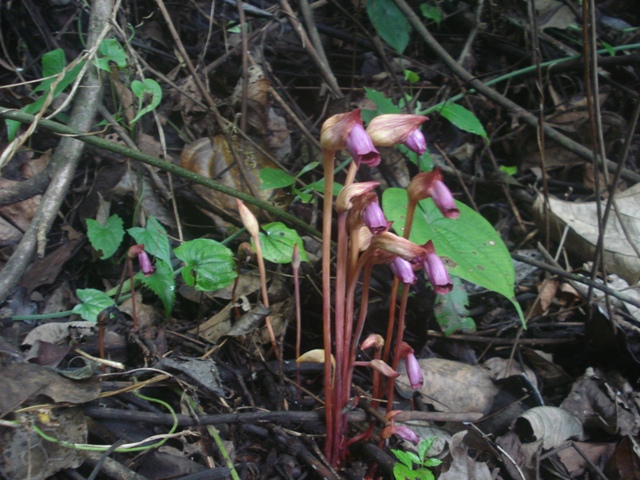
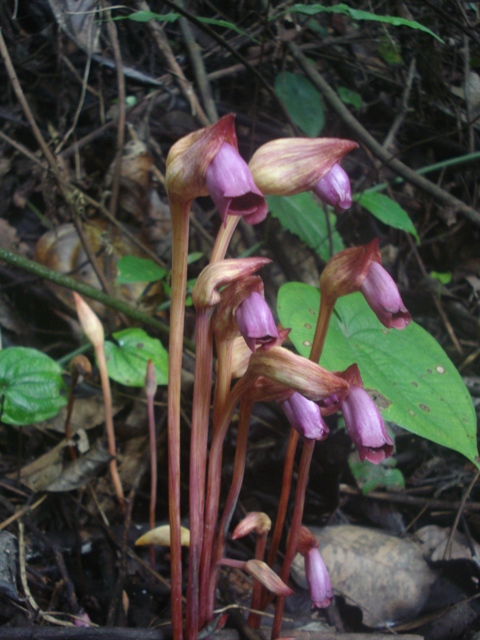
Some earlier relevant feedback:
“I doubt if this plant is A. indica though it is Aeginetia no doubt.
Differences are peduncles hairy (glabrous), calyx lobed (spatheceus),
corolla white and yellow (purple) smaller and distinctly lobed. Please
reconfirm. Rgds, Shrikant”
“Another possibility is Aeginetia pedunculata!” from Vijayasankar ji.
To post to this group, send email to indian...@googlegroups.com.
To unsubscribe from this group, send email to indiantreepi...@googlegroups.com.
For more options, visit this group at http://groups.google.com/group/indiantreepix?hl=en.
--
With regards,
J.M.Garg (jmg...@gmail.com)
http://en.wikipedia.org/wiki/User:Jmgarg1
'Creating awareness of Indian Flora & Fauna'
Image Resource of more than a thousand species of Birds, Butterflies, Plants etc. (arranged alphabetically & place-wise): http://commons.wikimedia.org/wiki/Category:J.M.Garg
For learning about Indian Flora, visit/ join Google e-group- Efloraofindia:http://groups.google.co.in/group/indiantreepix




Pardeshi S.
it was identified earlier....
Regards
On Apr 29, 1:37 pm, "J.M. Garg" <jmga...@gmail.com> wrote:
> Forwarding again for Id confirmation or otherwise please.
>
> Some earlier relevant feedback:
>
> corolla white and yellow (purple) smaller and distinctly lobed. Please
> reconfirm. Rgds, Shrikant”
>
>
>
> ---------- Forwarded message ----------
> From: tanay bose <tanaybos...@gmail.com>
> Date: 10 March 2010 22:02
> Subject: [efloraofindia:29388] Aeginetia indica
> To: efloraofindia <indian...@googlegroups.com>
>
>
> *Family:** **Orobanchaceae***
>
> *Date/Time- November 2008*
>
>
> *Habitat- Garden/ Urban/ Wild/ Type- Wild*
>
> *Plant Habit- Tree/ Shrub/ Climber/ Herb-** **Herbaceous.***
>
> *Height/Length- 10-30 meters*
>
> unbranched or branched from near base. Leaves red, ovate-lanceolate or
> lanceolate, 5-10 X 3-4 mm, glabrous. Flowers usually solitary. Pedicel
> usually erect, 10-30(-40) cm, ca. 3 mm in diam. Calyx apex acute or
> acuminate. Corolla purple-red striate, indistinctly bilabiate,
> tubular-campanulate, 2-4.5 cm; tube slightly curved; lobes subentire.
> Filaments purple, 7-9 mm, glabrous; anthers yellow. Ovary 1-locular;
> parietal placentas 4. Style 1-1.5 cm; stigma pale yellow. Capsule conical,
> or long ovoid-globose, 2-3 cm. Seeds yellow, ellipsoid, ca. 0.04 mm. Fl.
> The roots and flowers are used medicinally for clearing away heat and toxic
> materials
>
> --
> Tanay Bose
> +91(033) 25550676 (Resi)
> 9830439691(Mobile)
> 9674221362 (Mobile)
>
> --
> You received this message because you are subscribed to the Google Groups
> "efloraofindia" group.
> To post to this group, send email to indian...@googlegroups.com.
> To unsubscribe from this group, send email to
> .
> For more options, visit this group athttp://groups.google.com/group/indiantreepix?hl=en.
>
> --
> With regards,
> J.M.Garg (jmga...@gmail.com)http://en.wikipedia.org/wiki/User:Jmgarg1
> Image Resource of more than a thousand species of Birds, Butterflies, Plants
> etc. (arranged alphabetically & place-wise):http://commons.wikimedia.org/wiki/Category:J.M.Garg
> For learning about Indian Flora, visit/ join Google e-group- Efloraofindia:http://groups.google.co.in/group/indiantreepix
>
> --
> You received this message because you are subscribed to the Google Groups "efloraofindia" group.
> To post to this group, send email to indian...@googlegroups.com.
> To unsubscribe from this group, send email to indiantreepi...@googlegroups.com.
> For more options, visit this group athttp://groups.google.com/group/indiantreepix?hl=en.
>
>
>
> 452KViewDownload
J.M. Garg
Forwarding again for Id confirmation or otherwise please.
Some earlier relevant feedback:
“I doubt if this plant is A. indica though it is Aeginetia no doubt. Differences are peduncles hairy (glabrous), calyx lobed (spatheceus),
corolla white and yellow (purple) smaller and distinctly lobed. Please reconfirm. Rgds, Shrikant”
From: JM Garg <jmg...@gmail.com>
Date: 1 November 2015 at 21:24
Subject: [efloraofindia:235195] Fwd: Aeginetia indica
To: efloraofindia <indian...@googlegroups.com>
You received this message because you are subscribed to the Google Groups "efloraofindia" group.
To post to this group, send email to indian...@googlegroups.com.
For more options, visit https://groups.google.com/d/optout.
--
J.M.Garg
The whole world uses my Image Resource of more than a thousand species & eight thousand images of Birds, Butterflies, Plants etc. (arranged alphabetically & place-wise). You can also use them for free as per Creative Commons license attached with each image.
For identification, learning, discussion & documentation of Indian Flora, please visit/ join our Efloraofindia Google e-group (largest in the world- more than 2500 members & 2,25,000 messages on 18.6.15) or Efloraofindia website (with a species database of more than 11,000 species & 2,00,000 images). Winner of Wipro-NFS Sparrow Awards 2014 for efloraofindia.
Also author of 'A Photoguide to the Birds of Kolkata & Common Birds of India'.