
Fwd: PARIJAT TREE

sibdas ghosh
From: Pradyot Bhanja <pbh...@gmail.com>
Date: 3 March 2010 21:12
Subject: PARIJAT TREE
To: Sibdas Ghosh <sibda...@gmail.com>
PARIJAT TREE

Plants of India: Parijata
Parijata-The Wish-Granting Tree
by Christopher
McMahon
* Part 1: Collecting Parijat
[নিচের* এইটা শিউলী সম্বন্ধেই লেখা হয়েছে সে বিষয়ে কোনও সন্দেহের অবকাশ নেই ! ~ প্রদ্যোত।]
This January(1998) we(Ramakant Harlalka and I) were on our morning walk in the Matunga section of Mumbai. Along a busy thoroughfare we spotted a beautiful parijat tree(Nycanthes arbortrisis) growing near an apartment complex. As it was the sunrise hour, the delicate flowers were gently falling to the ground and covering the pavement with elegant beauty. We carefully collected a few of them and placing them in my palm I inhaled a lovely bouquet that reminded one of the essense of orange flowers and jasmine. It had a slightly sharper penetrating note but the overall effect was soft and sweet. We decided to collect a small basket of them so we could photograph them in the small studio we had set-up in the flat I was staying. As we picked up one ethereal flower after another, I felt as if I was joining hands with generation after generations of Indians who have collected them for offering at home alters or in the numerous temples that are to be found in countryside, town and city. In ancient Hindu literature the parijatak tree appears as one of the first gifts to humankind hence its sacred status. It was a simple, pleasurable activity that did not harm the tree and gave us a lot of joy because we could come close to the plant and appreciate a little more what a special role it played in the lives of the Indian people.
 The tree we were collecting flowers from was located on a main street
and even at that early hour the constant flow of buses, trucks, scooters, and
cars with their accompanying noise had commenced. The enviroment in which the
tree was living was far from ideal both from the viewpoint of air and sound
pollution and the neglected soil in which it was growing yet it gave of its
fragrant essence for one and all to enjoy. Its concern was not for caste, color
or creed but only to serve the purpose for which it had been created. Its
scattered fragrant flower, for the most part, were neglected and trod underfoot
as the people rushed to their various jobs, unaware of the refined beauty and
aroma within easy reach of their hands. I found in its example a very good
lesson for my own life in that a person should always strive to do good no
matter how adverse the outer circumstances may be. It is not an easy lesson to
learn but one well worth considering as through it nobility of character is
built and inner peace is attained.
The tree we were collecting flowers from was located on a main street
and even at that early hour the constant flow of buses, trucks, scooters, and
cars with their accompanying noise had commenced. The enviroment in which the
tree was living was far from ideal both from the viewpoint of air and sound
pollution and the neglected soil in which it was growing yet it gave of its
fragrant essence for one and all to enjoy. Its concern was not for caste, color
or creed but only to serve the purpose for which it had been created. Its
scattered fragrant flower, for the most part, were neglected and trod underfoot
as the people rushed to their various jobs, unaware of the refined beauty and
aroma within easy reach of their hands. I found in its example a very good
lesson for my own life in that a person should always strive to do good no
matter how adverse the outer circumstances may be. It is not an easy lesson to
learn but one well worth considering as through it nobility of character is
built and inner peace is attained.
 The parijatak tree is known in Hindi as harsinghar and Bengali as
shifali. It bears the botanical name of Nycathus arbortristis. It is a hardy
large shrub or small tree sometimes reaching a height of 30 feet. Its bark is
green is grey to greenish-white in color and a bit rough in texture. It has a
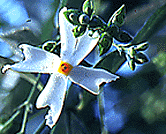
thick branching structure with green oval-shaped leaves. Its 4 to 8 flower
petals are arranged about a vibrant orange tube in a pinwheel pattern. These
highly fragrant flowers open at night perfuming the surrounding area with an
intensely sweet floral aroma. The morning following the night bloom, the flowers
fall to the earth carpeting it with their fragile beauty. In the ancient times
sages and seers noted each intesting quality of individual plants and in order
to teach the people to closely observe their life cycles they created beautiful
stories
The parijatak tree is known in Hindi as harsinghar and Bengali as
shifali. It bears the botanical name of Nycathus arbortristis. It is a hardy
large shrub or small tree sometimes reaching a height of 30 feet. Its bark is
green is grey to greenish-white in color and a bit rough in texture. It has a
thick branching structure with green oval-shaped leaves. Its 4 to 8 flower
petals are arranged about a vibrant orange tube in a pinwheel pattern. These
highly fragrant flowers open at night perfuming the surrounding area with an
intensely sweet floral aroma. The morning following the night bloom, the flowers
fall to the earth carpeting it with their fragile beauty. In the ancient times
sages and seers noted each intesting quality of individual plants and in order
to teach the people to closely observe their life cycles they created beautiful
stories
http://www.whitelotusaromatics.com/fragrant/parijat2.html
Plants of India:
Parijata
Parijata-The Wish-Granting Tree
by Christopher
McMahon
Part 2: Stories of Parijata
With regards to the parijatak tree this story is often narrated in certain communities.
Once a royal princess fell in love with the sun god-Surya Dev. She was enamored of his brilliance and beauty as he daily passed through the sky from east to west in his fiery chariot. Her devotion attracted his attention and for a while he favored her with his attention but after awhile he was distracted with other interests and she was deserted. In despair she killed herself and from her cremated ashes the parijatak tree arose. Since she was rejected by Surya Dev, the flowers of the tree only bloom at night. Then before the sun rises the flowers fall so its rays will not strike her. Based on this story the tree was given the species name ëarbortristisí which means ëtree of sorrowí.
Another story surrounding the treesí origin is found in several ancient Indian scriptures called the Puranas. It is said that when the celestial beings, at the behest of Hari-the Preserver of the Universe, churned the cosmic ocean to obtain certain boons that would help alleviate suffering and protect the powers of good from the powers of evil one of the parijatak tree appeared as one of the divine treasures. Its perfume was said to permeate the entire universe. Because the tree holds such a elevated place in Indiaís sacred lore, the tree is revered by devote Hindus. The story, on one level, clearly illustrates that trees, flowers and fragrance represent some of the finest boons for humankind.
After the parijatak
tree emerged from the ocean of existence it taken to the heaven worlds and  planted in the pleasure garden of Indra- the lord of the gods. One
day a great sage of ancient times named Narad Muni visited this garden in his
meditations visited this garden and saw this lovely tree emitting its divine
perfume. Using his yogic powers he gathered up some of these ethereal blossoms
and brought them back to the physical plane and gave them to Rukmini, the
favorite wife of the renowned avatar of Vishnu, Lord Krishna, who was at that
time dwelling in Dwaraka in north India. The flowers were so lovely and the
fragrance so delicate that Satyabhama another wife of Lord Krishna became
desirous of possessing that celestial tree and having it planted in her own
garden. She was jealous of the attention Krishna was showing to Rukmini and
wanted him to give more time to her. She implored him to obtain the tree for
her. To satisfy her desire he entered into a state of deep meditation and in
that state plucked up the tree from the garden. Before leaving that place he was
accosted by the keepers of the garden and was told he would incur the wrath of
Indra as the tree belonged to his wife Sachi. But Satyabhama would not be put
off by any obstacle and said that the tree was the common property of all and
had as much place on earth as it had in the heavens. As a result Krishna waged a
great war with Indra and his celestial army. In the end Krishnaís strength
prevailed and Indra was forced to retreat. At that time Satyabhama taunted him
as being a coward but decided to give back his celestial tree. Krishna also
consented to return the tree to its celestial abode. But Indra said that there
was no shame in being defeated by the avatar of Vishnu and that the tree should
be taken to earth and planted in Dwarka where its fragrance could be enjoined by
all the people of the earth. Thus the first parijatak tree was planted and its
divine fragrance was said to spread for three furlongs. Its aroma was charged
with so much power that it would help people enhaling it to remember events of
their past lives. In this instance also we can see that the sages were
explaining to the people that fragrance was a valuable means of accessing stored
memories. In the East memory has a much more comprehensive meaning than in the
West as it can include past lives as it is believed that the soul takes
countless births on its journey to perfection but the same basic principal is
explained in this story as is encountered in western literature regarding how
fragrance stimulates memories of past events in ones life.
planted in the pleasure garden of Indra- the lord of the gods. One
day a great sage of ancient times named Narad Muni visited this garden in his
meditations visited this garden and saw this lovely tree emitting its divine
perfume. Using his yogic powers he gathered up some of these ethereal blossoms
and brought them back to the physical plane and gave them to Rukmini, the
favorite wife of the renowned avatar of Vishnu, Lord Krishna, who was at that
time dwelling in Dwaraka in north India. The flowers were so lovely and the
fragrance so delicate that Satyabhama another wife of Lord Krishna became
desirous of possessing that celestial tree and having it planted in her own
garden. She was jealous of the attention Krishna was showing to Rukmini and
wanted him to give more time to her. She implored him to obtain the tree for
her. To satisfy her desire he entered into a state of deep meditation and in
that state plucked up the tree from the garden. Before leaving that place he was
accosted by the keepers of the garden and was told he would incur the wrath of
Indra as the tree belonged to his wife Sachi. But Satyabhama would not be put
off by any obstacle and said that the tree was the common property of all and
had as much place on earth as it had in the heavens. As a result Krishna waged a
great war with Indra and his celestial army. In the end Krishnaís strength
prevailed and Indra was forced to retreat. At that time Satyabhama taunted him
as being a coward but decided to give back his celestial tree. Krishna also
consented to return the tree to its celestial abode. But Indra said that there
was no shame in being defeated by the avatar of Vishnu and that the tree should
be taken to earth and planted in Dwarka where its fragrance could be enjoined by
all the people of the earth. Thus the first parijatak tree was planted and its
divine fragrance was said to spread for three furlongs. Its aroma was charged
with so much power that it would help people enhaling it to remember events of
their past lives. In this instance also we can see that the sages were
explaining to the people that fragrance was a valuable means of accessing stored
memories. In the East memory has a much more comprehensive meaning than in the
West as it can include past lives as it is believed that the soul takes
countless births on its journey to perfection but the same basic principal is
explained in this story as is encountered in western literature regarding how
fragrance stimulates memories of past events in ones life.
The above mentioned stories come down to us out of Indiaís rich cultural and spiritual heritage and are charged with tremendous meaning. The key to understanding can only be obtained by deep thought and contemplation and even this process may not totally unlock their secret is much is lost in translation or in change in the story over a period of time. Still, on a very basic level we can say that sages were trying to create in the mindís of the people a powerful remembrance of the plants that surrounded them so that they would learn to observe them minutely and learn to love and appreciate them. If a person could be encouraged to do this then they would definitely learn that every created object had numerous qualities that could prove beneficial in the form of foods, medicines, condiments, construction materials, cosmetics, and the like. Knowing this a simple hearted person would want to nourish, protect and propogate such plants so that their would be a constant supply of its beneficial products for one and all to use. It is in this way that a refined social consciousness was developed that did not depend on any external agencies but rather on the individuals efforts to keep the environment healthy and intact.
by Christopher McMahon
Part 3: Cultural Significance of Parijata
The parijatak tree is native to India and in its natural habitat is found growing up to an altitude of 1,500 meters. It adapts well to dry slopes and rocky ground. Because of its fragrant flowers it is cultivated in gardens throughout the country. Even when neglected it still produces fragrant flowers in abundance. Its greatest enemy is standing water which causes the roots to rot and die. If a little care is given to the plant in the form of periodic deep waterings, well rotted compost, and judicious pruning it can take on the form of a trully elegant specimen. Its flowering season is quite long, extending from August to December in most regions. It is an excellent selection for planting in semi-shady situations.
Aside from its esteemed position in the home garden parijatak has sometimes been planted in the precincts of temples as its fragrance creates a devotional atmosphere that aids in the remembrance of the sublime power embodied by the particular diety worshipped in that place. The flowers are particularly offered to Lord Ganesh, Satyanaryana, Samba and Swarna Gowri. In the Indian system of belief these dieties are embodiments of particular qualities or virtues which assist in the aspirants spiritual quest and so the offering of particlar flowers is highly significant. As with many of the ancient traditions the reasons for offering a flower with a particular shape, color and fragrance have been lost or is in the hands of a rare few individuals but one thing we now know is that specific odors can stimulate certain centers in the brain to act in a particular way. It is not an exact science as it can vary from individual from individual and from culture to culture. But in India the science of fragrance was highly evolved and could serve to evoke a particular response on a large group of people who commonly shared in the worship of a particular diety. That particular fragrance could bring the minds of those people a shared devotional aspiration. In that atmosphere fragrance along with several other rites and rituals could produce a state of profound concentration that would allow an openess to occur that would refresh a persons heart and mind and bring them into unity with the community in which they lived and with the mystery of life in which everyone was a participant. It is also possible that the sages knew that the perfume of a particular flower when inhaled could help stimulate the immune system against certain disease organisms prevailing at the season of the year in which it was blooming. We now know that natural fragrances do have some anti-bacterial and anti-viral properties so it is not impossible that ancient sages discovered these properties, not with technical instruments which they did not posses, but through the powers of keen observation which they had in abundance.
In India the parijat tree is planted in the precincts of temples because of the sublime atmosphere created by the aroma of its flowers. I know the fragrance of parijatak is dear to my wife, Suzanne and I, as we use fo go for a walk about a small temple in the suburbs of Bombay every evening during the month of January. A number of parijatak trees were planted in the shrines vicinity as we would inhale the delicious odor of the last flowers of the season as we slowly strolled about the complex. The refreshing odor helped sustain the beautiful time we had just spent listening create a mood of peace and relaxation that allowed us to quietly digest the words of a great sage whose discourse we had just listened too. To this day the memory of that time is quickly awakened when we smell the fragrance of parijat. The flower itself conveys a very special message to those who know how to read its language. If one closely observes its delicate beauty one will observe that it has a vibrant orange center. This color is a symbol of fire in the Hindu tradition. Fire, in turn, is considered that power which purifies a persons heart and mind so that all desires for the world are consumed. leaving only a pure consciousness which directly communes with the Hidden Power within that has been and is called by many names. The white petals which surround the orange center symbolic of that pure consciousness. In the ancient times Buddhist monks and Hindu ascetics dyed their robes a rich fiery color to show that they had renounced the world. This dye was produced from the very same orange centers of the parijat. When the flowers would fall to the ground, people would collect them and separte the orange tube from the white petals and dry them. Once they were dried they could be used for making this saffron-colored dye. At one time an attempt was made to commercialize this dye as it gave a fine color to cotton and silk but due to the labor intensive nature of its collection and the fact that a good means of fixing it were not obtained the concept was abandoned. Perhaps in the future the study of this dye will be resumed and a cottage industry developed where its beautiful color could be extracted.
The Muslim people, too, have an affection for the flower and it is said that it is planted in their grave yards. In the morning the ethereal flowers carpet the tombs with a natural aromatic floral display. The story that this tells is simple and beautiful. In nature, the parijat tree grows to a mature specimen which produces innummerable flowers. These flowers grow to maturity and for a brief time give off their fragrance for one and all to enjoy. When the perfume is exhausted, they fall to the earth, wither, and die having fulfilled the mission of their life. Our lives, in the ideal sense, should follow their example. We, as part of the human family, are like the flowers of the mother plant. In the beginning our innate beauty is hidden as it can only be developed through the experiences of life both good and bad. Through the ups and downs of life, if we are fortunate, we come to the point where out of the heart comes a sweet perfume of love and compassion for one and all. Having given of that perfume in a quiet, unassuming way, the time comes when the bodies resources are exhausted and we depart from this plane of existences and our soul essence reunites with the invisible essence from which we come.
--
sibdas ghosh

tanay bose
--
You received this message because you are subscribed to the Google Groups "efloraofindia" group.
To post to this group, send email to indian...@googlegroups.com.
To unsubscribe from this group, send email to indiantreepi...@googlegroups.com.
For more options, visit this group at http://groups.google.com/group/indiantreepix?hl=en.
--
Tanay Bose
+91(033) 25550676 (Resi)
9830439691(Mobile)
9674221362 (Mobile)

Dinesh Valke
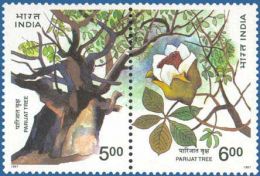
Not sure whether it agrees with the tree on the Indian stamp.
Regards.
tanay bose

Gurcharan Singh
--
Dr. Gurcharan Singh
Retired Associate Professor
SGTB Khalsa College, University of Delhi, Delhi-110007
Res: 932 Anand Kunj, Vikas Puri, New Delhi-110018.
Phone: 011-25518297 Mob: 9810359089
http://people.du.ac.in/~singhg45/
tanay bose

Pankaj Oudhia
http://www.khabarexpress.com/04/08/2009/Chennai-School-children-tie-Rakhi-to-trees-news_97439.html
It is new information for me.
Pankaj Oudhia

R. Vijayasankar
So, which is the actual Parijatha - Adansonia or Nyctanthes? eager to know. By the way, anyone has copy of the book titled "The problem of the introduction of Adansonia digitata into India"? and what was the 'problem'? http://indianmedicine.eldoc.ub.rug.nl/root/B/7967/?pFullItemRecord=ON
R. Vijayasankar
National Center for Natural Products Research,
The University of Mississippi,
Oxford, MS-38677, USA.
Gurcharan Singh
--
Dr. Gurcharan Singh
Retired Associate Professor
SGTB Khalsa College, University of Delhi, Delhi-110007
Res: 932 Anand Kunj, Vikas Puri, New Delhi-110018.
Phone: 011-25518297 Mob: 9810359089
http://people.du.ac.in/~singhg45/
tanay bose
TRYING TO BRING A CONCLUSION TO POSSIBLE MIGRATION OF Adansonia sp FROM AFRICA & AUSTRALIA TO INDIA.
One theory proposes that Adansonia spp. share a common origin in Western Gondwana (Wickens 2008). However, recent molecular analysis has demonstrated that the Australian baobab, A. gregorii, is very closely related to the African species, A. digitata (Baum 1998). The genetic distance between the two species is far smaller than would be expected for a >100 Myr Gondwana connection. This led to the suggestion that the baobab must have undergone transoceanic dispersal (Baum et al 1998), presumably via floating seed pods. However, this theory is mechanistically constrained by several factors: (a) A. gregorii seed pod has the thinnest shell of all Adansonia spp., making it unlikely that seed pods would survive such a long oceanic journey (b) oceanic currents are unfavourable for the observed dispersal pattern and (c) A. gregorii is not present at other locations on the North-West Australian coast where it would readily grow and where oceanic dispersal would be expected to have delivered seeds.
While investigating a third scenario based on the very close genetic relationship between A. gregorii and A. digitata: transoceanic dispersal mediated by human migrations out of Africa around 60-70,000 yrs ago [during this time Homo sapiens evolved in Africa and later stared migrating to Asia and Europe]. Interestingly, the geographical distribution of the Kimberley species overlaps almost perfectly with a particular type of ancient rock art known as Bradshaw paintings. The aetiology of these painting is under hot debate: some maintain that they are part of the extensive Aboriginal rock art found across Australia, and some maintain that these images were painted by a distinct culture which no longer survives in Australia. Bradshaw rock art is significantly different from other rock art in Australia in terms of style and materials used. Scenes from daily life are strikingly well executed and fauna is very accurately depicted (Pettigrew et al 2008). Moreover, there are many references in art that support a relationship between the artists, the baobab trees and intercontinental travel, for example: (1) the fruit and flowers of baobabs appear to be well represented in the images (2) large boats are featured in some paintings; these boats carry up to 30 passengers and have a very high prow indicating oceanic capability. One of the most striking things about these paintings is that they are remarkably reminiscent of modern African culture. It seems very likely that a stone-age African oceanic migrant might have chosen such a useful cargo as baobab, with its two dozen separate roles , not to mention the durability of the nutritious fruit (the Vitamin C-rich pulp lasts more than a year).
-
PLEASE SEE THE PAPER OF BRAUM ET.AL 1998 SUGGESTING THE EVOLUTIONARY PATTERN OF Adansonia sp.
-
HYPOTHETICAL MAP TO SUPPORT THE ADANSONIA MIGRATION THEORY.

Bhatt Sweta
--
Pankaj Oudhia
http://groups.google.com/group/indiantreepix/browse_thread/thread/e9b3d18349b59b6e/bf404ca7ce64d2f0?hl=en&lnk=gst&q=adansonia#bf404ca7ce64d2f0
Pankaj Oudhia
sibdas ghosh
sibdas ghosh

Anand Kumar Bhatt
The only place where I have seen a large number of baobab trees is residency in Indore, where now the VIP guest house and other rest houses ar situated. My guess is that they were planted by some Englishman who had earlier been to Africa.
ak
A-59, B.S.F.Colony, Airport Road
Gwalior. 474 005.
Tele: 0751-247 2233. Mobile 0 94253 09780.
My blogsite is at:
http://anandkbhatt.blogspot.com
And the photo site:
www.flickr.com/photos/akbhatt/
~~~~~~~~~~~~~~~
Ten most common surnames of Indians: Singh, Kumar, Sharma,Patel, Shah, Lal, Gupta, Bhat, Rao, Reddy. Cheers!
Anand Kumar Bhatt
From: Anand Kumar Bhatt <anand...@gmail.com>
Date: Sun, Mar 7, 2010 at 6:42 PM
Subject: Re: [efloraofindia:28786] Fwd: PARIJAT TREE
To: tanay bose <tanay...@gmail.com>
yes the link to earlier discussion is:
https://mail.google.com/mail/?shva=1#search/parijat+tree/11cc8d5e45c9ded6
ak
Thank you very much for mailing me. I will reply as soon as possible.
This is an automated mail. Please do not reply to it
Print this mail only if you need. Save Paper. Save Environment
Tanay Bose.
A-59, B.S.F.Colony, Airport Road
Gwalior. 474 005.
Tele: 0751-247 2233. Mobile 0 94253 09780.
My blogsite is at:
http://anandkbhatt.blogspot.com
And the photo site:
www.flickr.com/photos/akbhatt/
~~~~~~~~~~~~~~~
Ten most common surnames of Indians: Singh, Kumar, Sharma,Patel, Shah, Lal, Gupta, Bhat, Rao, Reddy. Cheers!



promila chaturvedi
Nalilni ji's version of the story is correct. I also read it.
Promila
Date: Sun, 7 Mar 2010 18:38:47 +0530
Subject: Re: [efloraofindia:29027] Fwd: PARIJAT TREE
From: anand...@gmail.com
To: sibda...@gmail.com
CC: pankaj...@gmail.com; sing...@gmail.com; vijay.b...@gmail.com; tanay...@gmail.com; indian...@googlegroups.com
Sena, Shah Rukh and the fight over Mumbai Sign up now.