
Phytolacca acinosa from Kashmir
109 views
Skip to first unread message

Gurcharan Singh
Aug 17, 2010, 11:01:09 PM8/17/10
to efloraofindia, Flowers of India
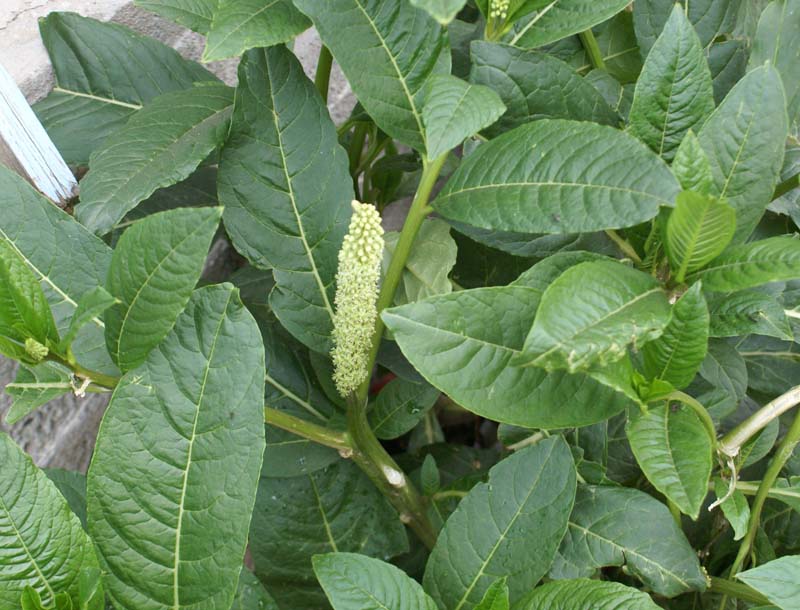
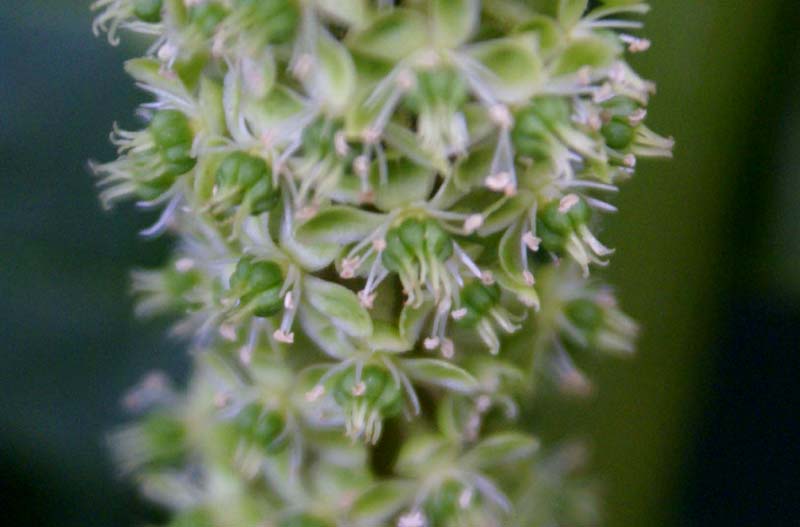
Phytolacca acinosa from Kashmir, common at altitudes above 2000 m in grazed areas, roadsides. Photographed from Pahalgam on June 20, 2010.
--
Dr. Gurcharan Singh
Retired Associate Professor
SGTB Khalsa College, University of Delhi, Delhi-110007
Res: 932 Anand Kunj, Vikas Puri, New Delhi-110018.
Phone: 011-25518297 Mob: 9810359089
http://people.du.ac.in/~singhg45/
Common names:
English:India pokeweed, Indian poke, Sweet belladona
Chinese: Shaug lu
Hindi: Matazor, Sarangum
Kashmir: Lubar sag
Punjab: Lubar, Rinsag
Kamaon: Jarak, Jirrag
Assam: Jaiong
Young leaves and twigs cooked as vegetable, but should be carefully used as plant can be easily mistaken with Atropa belladona whose consumption can causeserious food poisoning (plants of Phytolacca are taller with larger and broader leaves; inflorescence totally different; narcotic, but effect destroyed on boiling; roots and leaves are often mixed in consignments of Atropa accidently/unknowingly or purposely.
--
Dr. Gurcharan Singh
Retired Associate Professor
SGTB Khalsa College, University of Delhi, Delhi-110007
Res: 932 Anand Kunj, Vikas Puri, New Delhi-110018.
Phone: 011-25518297 Mob: 9810359089
http://people.du.ac.in/~singhg45/

tanay bose
Aug 18, 2010, 12:26:27 AM8/18/10
to Gurcharan Singh, efloraofindia, Flowers of India
Really nice close up Sir ji
tanay
Tanay Bose
Research Assistant & Teaching Assistant
Department of Botany
University of British Columbia
3529-6270 University Blvd.
Vancouver, B.C. V6T 1Z4 (Canada)
Phone: 778-323-4036

Nayan Singh
Aug 18, 2010, 1:35:41 AM8/18/10
to Gurcharan Singh, efloraofindia
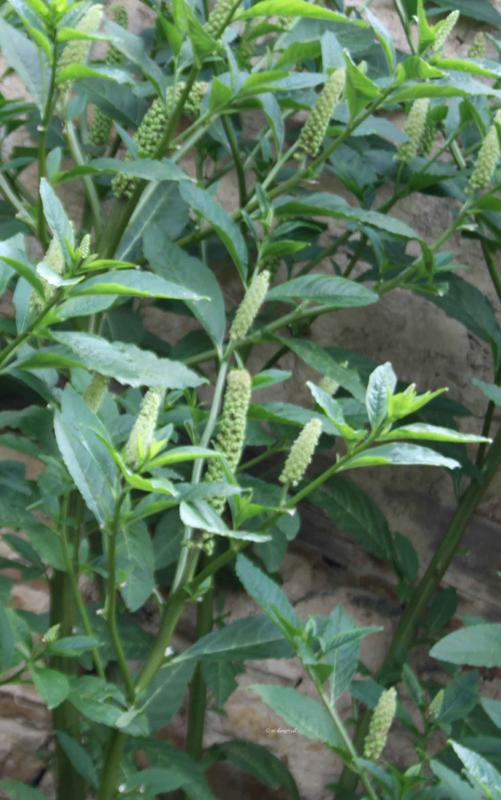
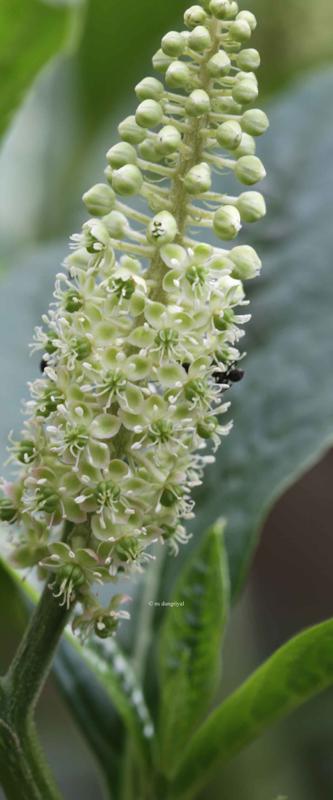
Thanks a lot Gurcharan Singh ji for posting this plant. It helped me in ID of my pix taken recently during my visit of higher Himalaya in Uttarakhand. I am attaching my pics, I think ID is correct.
thanks again
Nayan.
N.S.Dungriyal IFSChief Conservator of Forests
and Field Director
Satpura Tiger Reserve Hoshangabad
M.P.
09424792100
From: tanay bose <tanay...@gmail.com>
To: Gurcharan Singh <sing...@gmail.com>
Cc: efloraofindia <indian...@googlegroups.com>; Flowers of India <flowers...@gmail.com>
Sent: Wed, 18 August, 2010 9:56:27 AM
Subject: Re: [efloraofindia:44680] Phytolacca acinosa from Kashmir
Gurcharan Singh
Aug 18, 2010, 2:07:55 AM8/18/10
to Nayan Singh, efloraofindia
You are on dot, Nayan ji
--
Dr. Gurcharan Singh
Retired Associate Professor
SGTB Khalsa College, University of Delhi, Delhi-110007
Res: 932 Anand Kunj, Vikas Puri, New Delhi-110018.
Phone: 011-25518297 Mob: 9810359089
http://people.du.ac.in/~singhg45/
It is clearly Phytolacca acinosa
--
Dr. Gurcharan Singh
Retired Associate Professor
SGTB Khalsa College, University of Delhi, Delhi-110007
Res: 932 Anand Kunj, Vikas Puri, New Delhi-110018.
Phone: 011-25518297 Mob: 9810359089
http://people.du.ac.in/~singhg45/

Pankaj Oudhia
Aug 18, 2010, 7:02:37 AM8/18/10
to efloraofindia
Thanks Gurcharan ji for nice pictures. My Guru Dr.Guha of Raipur was using it as Homoeo-medicine in treatment of breast cancer with much success.
regards
Pankaj Oudhia
regards
Pankaj Oudhia
On Wed, Aug 18, 2010 at 8:31 AM, Gurcharan Singh <sing...@gmail.com> wrote:


Tabish
Aug 21, 2010, 5:19:15 AM8/21/10
to efloraofindia
Dear Gurcharan ji,
I am having doubts about this being Phytolacca acinosa, mainly
because the flower-spikes look too densely-flowered for Phytolacca
acinosa. See the illustration and image here:
http://www.efloras.org/object_page.aspx?object_id=51021&flora_id=2
http://www.efloras.org/object_page.aspx?object_id=52603&flora_id=2
What we found in Uttaranchal, and believe to be P. acinosa, is also
not as densely flowered:
http://www.flowersofindia.net/catalog/slides/Indian%20Pokeweed.html
I am, for the moment, overlooking the fact that the leaves of your
plant do not look long-pointed.
Nayan's plant does look like Phytolacca acinosa to me too.
The other species I am aware of, Phytolacca octandra, also doesn't
agree with your pictures.
Your comments are solcited.
- Tabish
On Aug 18, 4:02 pm, Pankaj Oudhia <pankajoud...@gmail.com> wrote:
> Thanks Gurcharan ji for nice pictures. My Guru Dr.Guha of Raipur was using
> it as Homoeo-medicine in treatment of breast cancer with much success.
>
> regards
>
> Pankaj Oudhia
>
I am having doubts about this being Phytolacca acinosa, mainly
because the flower-spikes look too densely-flowered for Phytolacca
acinosa. See the illustration and image here:
http://www.efloras.org/object_page.aspx?object_id=51021&flora_id=2
http://www.efloras.org/object_page.aspx?object_id=52603&flora_id=2
What we found in Uttaranchal, and believe to be P. acinosa, is also
not as densely flowered:
http://www.flowersofindia.net/catalog/slides/Indian%20Pokeweed.html
I am, for the moment, overlooking the fact that the leaves of your
plant do not look long-pointed.
Nayan's plant does look like Phytolacca acinosa to me too.
The other species I am aware of, Phytolacca octandra, also doesn't
agree with your pictures.
Your comments are solcited.
- Tabish
On Aug 18, 4:02 pm, Pankaj Oudhia <pankajoud...@gmail.com> wrote:
> Thanks Gurcharan ji for nice pictures. My Guru Dr.Guha of Raipur was using
> it as Homoeo-medicine in treatment of breast cancer with much success.
>
> regards
>
> Pankaj Oudhia
>
> On Wed, Aug 18, 2010 at 8:31 AM, Gurcharan Singh <singh...@gmail.com> wrote:
> > Phytolacca acinosa from Kashmir, common at altitudes above 2000 m in grazed
> > areas, roadsides. Photographed from Pahalgam on June 20, 2010.
>
> > Common names:
> > English:India pokeweed, Indian poke, Sweet belladona
> > Chinese: Shaug lu
> > Hindi: Matazor, Sarangum
> > Kashmir: Lubar sag
> > Punjab: Lubar, Rinsag
> > Kamaon: Jarak, Jirrag
> > Assam: Jaiong
>
> > Young leaves and twigs cooked as vegetable, but should be carefully used as
> > plant can be easily mistaken with Atropa belladona whose consumption can
> > causeserious food poisoning (plants of Phytolacca are taller with larger and
> > broader leaves; inflorescence totally different; narcotic, but effect
> > destroyed on boiling; roots and leaves are often mixed in consignments of
> > Atropa accidently/unknowingly or purposely.
>
> > --
> > Dr. Gurcharan Singh
> > Retired Associate Professor
> > SGTB Khalsa College, University of Delhi, Delhi-110007
> > Res: 932 Anand Kunj, Vikas Puri, New Delhi-110018.
> > Phone: 011-25518297 Mob: 9810359089
> >http://people.du.ac.in/~singhg45/<http://people.du.ac.in/%7Esinghg45/>> > Phytolacca acinosa from Kashmir, common at altitudes above 2000 m in grazed
> > areas, roadsides. Photographed from Pahalgam on June 20, 2010.
>
> > Common names:
> > English:India pokeweed, Indian poke, Sweet belladona
> > Chinese: Shaug lu
> > Hindi: Matazor, Sarangum
> > Kashmir: Lubar sag
> > Punjab: Lubar, Rinsag
> > Kamaon: Jarak, Jirrag
> > Assam: Jaiong
>
> > Young leaves and twigs cooked as vegetable, but should be carefully used as
> > plant can be easily mistaken with Atropa belladona whose consumption can
> > causeserious food poisoning (plants of Phytolacca are taller with larger and
> > broader leaves; inflorescence totally different; narcotic, but effect
> > destroyed on boiling; roots and leaves are often mixed in consignments of
> > Atropa accidently/unknowingly or purposely.
>
> > --
> > Dr. Gurcharan Singh
> > Retired Associate Professor
> > SGTB Khalsa College, University of Delhi, Delhi-110007
> > Res: 932 Anand Kunj, Vikas Puri, New Delhi-110018.
> > Phone: 011-25518297 Mob: 9810359089
Gurcharan Singh
Aug 21, 2010, 6:40:22 AM8/21/10
to Tabish, efloraofindia
Tabish ji
--
Dr. Gurcharan Singh
Retired Associate Professor
SGTB Khalsa College, University of Delhi, Delhi-110007
Res: 932 Anand Kunj, Vikas Puri, New Delhi-110018.
Phone: 011-25518297 Mob: 9810359089
http://people.du.ac.in/~singhg45/
I hope you missed my mail to Nalini ji in which I had discussed Himalayan plant and the European plant uploaded by Nalini. Our plant has much narrower leaves, rarely broader than 10 cm and inflorescence much dense, whereas specimens of P. acinosa are much broader often as broad as 30 cm and almost ellpic-ovate in shape. It was why our plant was treated as P. latbenia Walters by Flora of Pakistan (1971 publication) but more recent treatments "enumeration of Flowering plants of Nepal" (1978-84), and Flowers of Himalyas (1984) consider it inclusive of P. acinosa.
--
Dr. Gurcharan Singh
Retired Associate Professor
SGTB Khalsa College, University of Delhi, Delhi-110007
Res: 932 Anand Kunj, Vikas Puri, New Delhi-110018.
Phone: 011-25518297 Mob: 9810359089
http://people.du.ac.in/~singhg45/
Gurcharan Singh
Aug 21, 2010, 6:54:58 AM8/21/10
to Tabish, efloraofindia
Tabish ji
--
Dr. Gurcharan Singh
Retired Associate Professor
SGTB Khalsa College, University of Delhi, Delhi-110007
Res: 932 Anand Kunj, Vikas Puri, New Delhi-110018.
Phone: 011-25518297 Mob: 9810359089
http://people.du.ac.in/~singhg45/
Here is something more on this
--
Dr. Gurcharan Singh
Retired Associate Professor
SGTB Khalsa College, University of Delhi, Delhi-110007
Res: 932 Anand Kunj, Vikas Puri, New Delhi-110018.
Phone: 011-25518297 Mob: 9810359089
http://people.du.ac.in/~singhg45/
Gurcharan Singh
Aug 21, 2010, 7:57:58 AM8/21/10
to Tabish, efloraofindia
Tabish ji
--
Dr. Gurcharan Singh
Retired Associate Professor
SGTB Khalsa College, University of Delhi, Delhi-110007
Res: 932 Anand Kunj, Vikas Puri, New Delhi-110018.
Phone: 011-25518297 Mob: 9810359089
http://people.du.ac.in/~singhg45/
Further to above I have been able to lay hands on identification key given by Walters in 1908 in his monograph for Asian species:
Carpels,7-(9- 10) ,free to their base; 3-5ft tall ;Ea Asian spp.
Stamens 10-16; perianth uniformly light green………………P. latbenia (Buch.-Ham.) H . Walt.
Stamens(7 -)8(-9)
Pedicels and infl axis almost glabrous; perianth normally white; anthers rose . . . . ……... P. esculenta VanHout te
Pedicels and
infl axis scabrid-glandular perianth greenish white to pinkish; anthers white .
. . . . . P. acinosa Roxb
If you have a look at four different kind of specimens, no character is stable. Eflora link plant identified has most greenish flowers (supposed to be a character of P. acinosa), mine appear greenish-white, those of Nayan ji much more whiter and those of FOI with creamish tinge. Please also note that this monograph treats P. esculenta and P. acinosa as distinct, but all modern treatments including Eflora of China treat former as simple synonym of P. acinosa.
It is best solution to treat them as synonyms of one Asian species with free carpels P. acinosa.
--
Dr. Gurcharan Singh
Retired Associate Professor
SGTB Khalsa College, University of Delhi, Delhi-110007
Res: 932 Anand Kunj, Vikas Puri, New Delhi-110018.
Phone: 011-25518297 Mob: 9810359089
http://people.du.ac.in/~singhg45/
Reply all
Reply to author
Forward
0 new messages