
Habenaria marginata_NBR_Teh_Aug 2010

Ninad Raut
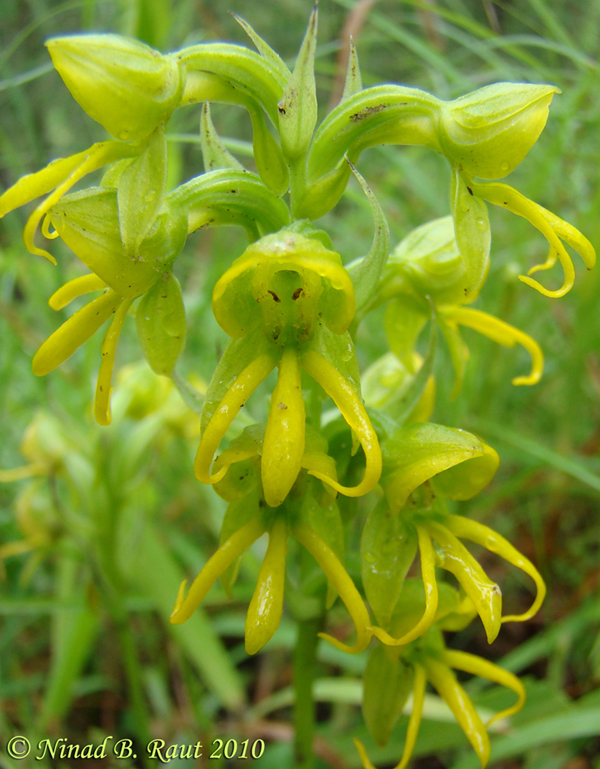
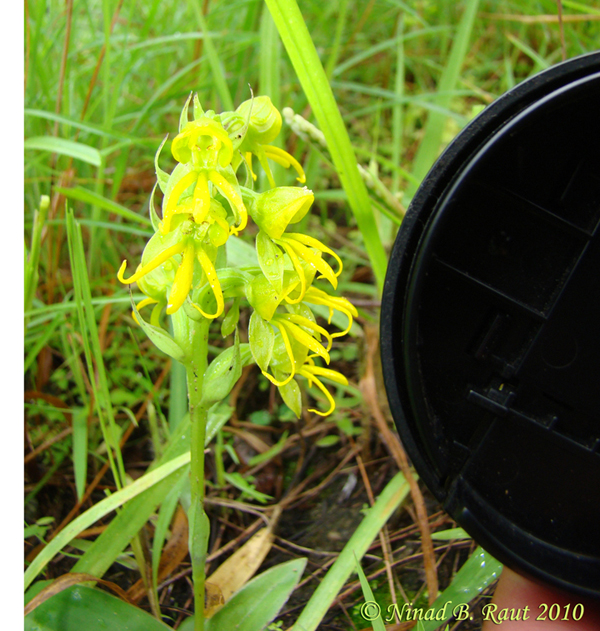
Sharing Habenaria marginata with you all.
Details: Common name: (English) Golden Yellow Habenaria; (Marathi) पिवली हबेआमरी (Pivali habe amri)
Photographed at: District Tehri, Uttarakhand on August 14, 2010.
Forest type: Pine Forest
Elevation: 1300m
Additional info:
Acc. to eFlora of China:
Habenaria marginata Colebrooke in Hooker, Exot. Fl. 2: ad t. 136. 1824.
Platanthera marginata (Colebrooke) Lindley.
Plants 8-37 cm tall. Tubers ellipsoid or narrowly ellipsoid, 2-4 × 1-2.5 cm, fleshy. Stem erect, terete, glabrous, with 1 or 2 tubular sheaths at base, 3-5 leaves below middle, and 3-5 bractlike leaves above. Leaf blade narrowly oblong or oblong-lanceolate, 4-9 × 1-2 cm, base contracted into amplexicaul sheath, margin yellow when dried, apex acuminate or subobtuse. Raceme 3-15-flowered, 2.5-10 cm; floral bracts lanceolate, apex long acuminate; ovary twisted, arching, cylindric-fusiform, including pedicel 8-13 mm. Sepals green, petals and lip yellow. Dorsal sepal forming a hood with petals, erect, cordate or broadly ovate, concave, 7-7.5 × 5-6 mm, 3-veined, apex acute; lateral sepals reflexed, obliquely ovate or narrowly ovate-oblong, 7.5-8.5 × 2.5-3.5 mm, 3-veined, apex acute. Petals obliquely ovate-triangular, 6.5-7.3 × 3-3.8 mm, 2-veined, apex acute; lip spreading, 11-13 mm, deeply 3-lobed above base; lateral lobes spreading at acute angles to mid-lobe, linear or linear-lanceolate, 7-8 × 1-1.4 mm; mid-lobe ligulate, 8-9 × 2-2.3 mm; spur pendulous, clavate, 8-13 mm, apical half dilated and 1.5-2 mm in diam.; stigmas falcate, long. Fl. Oct-Nov. 2n = 42.
Forests, grasslands at forest margins; 500-1200 m. S Yunnan [Bhutan, India, Kashmir, Myanmar, Nepal, Thailand].
[http://www.efloras.org/florataxon.aspx?flora_id=2&taxon_id=242422762]
Acc. to eFlora of Pakistan
Type: Botanical Garden, Calcutta (Introduced by accident according to Mr. Cole¬brooke, obs. July 1814).
Distribution: Northwestern Himalaya, eastwards to Bhutan and Burma, up to 3000 m.
[http://www.efloras.org/florataxon.aspx?flora_id=5&taxon_id=242422762]
Many Regards,
Ninad
--
Ninad B. Raut
Senior Research Fellow
"Survey and Mapping of Medicinal Plants in Uttarakhand"
Department of Habitat Ecology
Wildlife Institute of India
P.O. Box # 18, Chandrabani
Dehradun - 248 001. India
Tel: 0135 26401 11 - 15

Pankaj Kumar
Thanks a lot for sharing. This is one of the very few Habenarias in
India which has yellow flowers. Till evening I thought that this plant
is
Habenaria marginata Colebr. in W.J.Hooker, Exot. Fl.: t. 136 (1824).
but when I saw Dr. Almeida's Flora of Maharastra, I got shocked and my
over 8 years of Orchid research went in vain, because he calls this
plant as
Habenaria heyneana Lindl., Gen. Sp. Orchid. Pl.: 320 (1835), Almeida,
Orchidaceae in, Flora of Maharastra vol 5A, t. 18, f. 52, p. 58
(2009).
and according to him this is the plant which is called Tooth Brush
Orchid. At first I thought there was a mistake in attaching the pics
in the book, but then I realised that he has described this plant with
yellow flowers, but the original H. heyneana which I had known was
having white flowers which were secund.
God save me!
Pankaj
Ninad Raut
Thanks for correction but I even checked on Flowers of India
Mr. Pravin Kawale's photo which was identified by Pravin ji and Mr.
Navendu Page.
http://www.flowersofindia.net/catalog/slides/Golden%20Yellow%20Habenaria.html
Regards
Ninad Raut
SRF, WII (Dehra Dun)
On Aug 19, 11:38 pm, Pankaj Kumar <sahanipan...@gmail.com> wrote:
> Dear Ninad
>
> Thanks a lot for sharing. This is one of the very few Habenarias in
> India which has yellow flowers. Till evening I thought that this plant
> is
>
> Habenaria marginata Colebr. in W.J.Hooker, Exot. Fl.: t. 136 (1824).
>
> but when I saw Dr. Almeida's Flora of Maharastra, I got shocked and my
> over 8 years of Orchid research went in vain, because he calls this
> plant as
>
> Habenaria heyneana Lindl., Gen. Sp. Orchid. Pl.: 320 (1835), Almeida,
> Orchidaceae in, Flora of Maharastra vol 5A, t. 18, f. 52, p. 58
> (2009).
>
> and according to him this is the plant which is called Tooth Brush
> Orchid. At first I thought there was a mistake in attaching the pics
> in the book, but then I realised that he has described this plant with
> yellow flowers, but the original H. heyneana which I had known was
> having white flowers which were secund.
>
> God save me!
> Pankaj
>
Pankaj Kumar
Pankaj

Gurcharan Singh
--
Dr. Gurcharan Singh
Retired Associate Professor
SGTB Khalsa College, University of Delhi, Delhi-110007
Res: 932 Anand Kunj, Vikas Puri, New Delhi-110018.
Phone: 011-25518297 Mob: 9810359089
http://people.du.ac.in/~singhg45/
Pankaj Kumar
Habenaria marginata Colebr. I respect Dr. Almeida so I dont wish to
comment on his work....
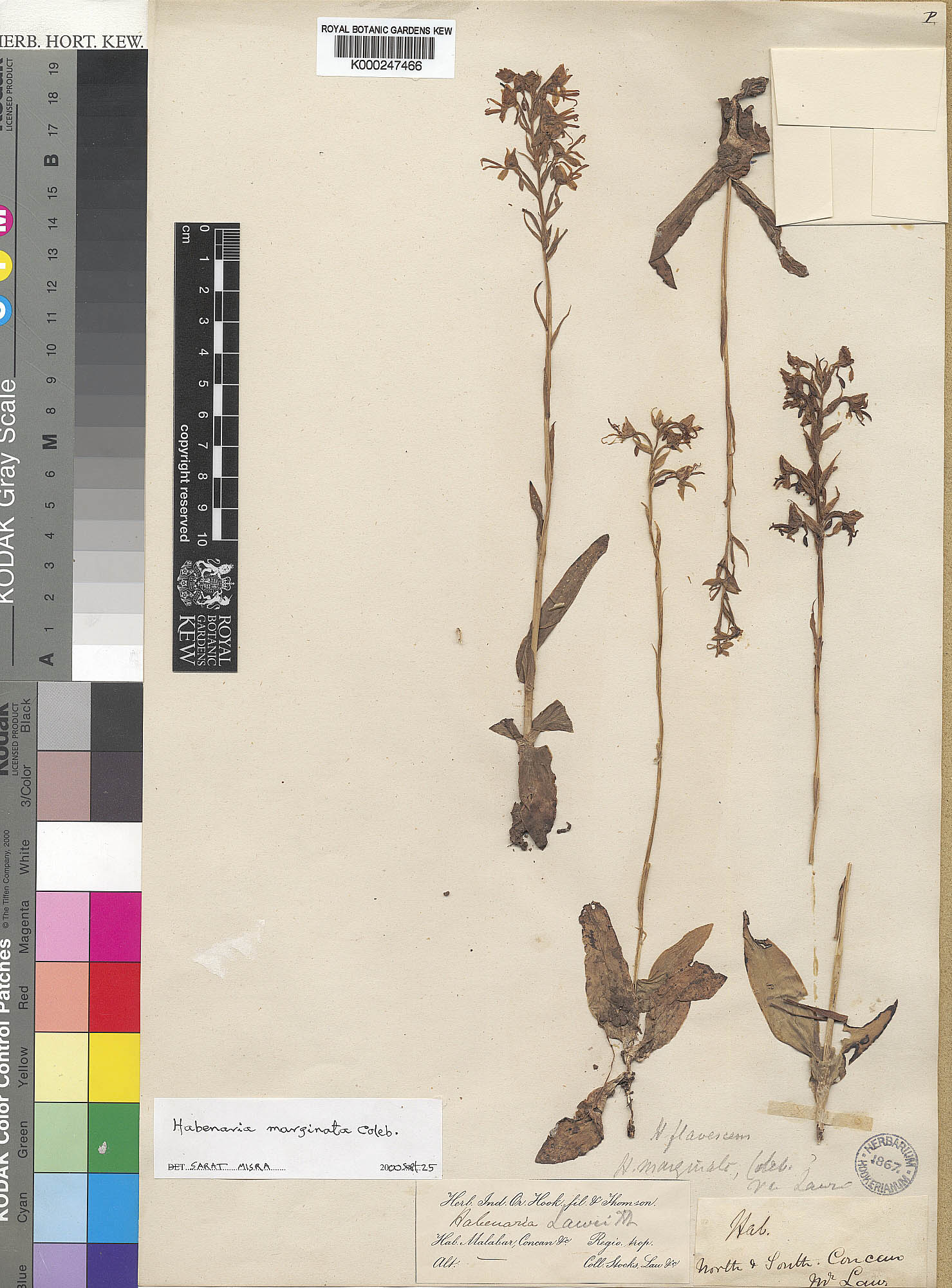
For the convenience of all I am attaching the type of both Habenaria
marginata and Habenaria heyneana. There is no need to check Flora of
Bombay Presidency by Cooke if the images of Type are available for
free on internet.
I would certainly like to check the past floras to know where the
mistake arose from.
Regards
Pankaj
--
***********************************************
"TAXONOMISTS GETTING EXTINCT AND SPECIES DATA DEFICIENT !!"
Pankaj Kumar Ph.D. (Orchidaceae)
Research Associate
Greater Kailash Sacred Landscape Project
Department of Habitat Ecology
Wildlife Institute of India
Post Box # 18
Dehradun - 248001, India


Smita Raskar
Smita raskar
Pankaj Kumar
I agree with Ms. Smita's point, it can be typographic error. Sometimes
just today happened with me, I wrote description of an orchid under
the name of different species unknowingly.
But, my point was something different. To confirm the identity of a
species we should first try to look at the original description and
then we may think of looking the latter descriptions from other floras
or whatever publication we get. Other floras may be wrong, but the
first description or the type description is the best thing to look
into. Now a days lots of original references are available on net.
Trust me, they are more easily available than Flora of Maharastra!! of
Flora of India fascicles by BSI....that too for free!! You just need
to search on internet.
Yes, for daily use purpose, you may use the local floras whatever is available.
Thank you and hope my point will be taken in good spirits.
Regards
Pankaj
--
***********************************************
"TAXONOMISTS GETTING EXTINCT AND SPECIES DATA DEFICIENT !!"
Pankaj Kumar Ph.D. (Orchidaceae)
Research Associate
Greater Kailash Sacred Landscape Project
Department of Habitat Ecology
Wildlife Institute of India
Post Box # 18
Dehradun - 248001, India
rent

Gurcharan Singh
--
Dr. Gurcharan Singh
Retired Associate Professor
SGTB Khalsa College, University of Delhi, Delhi-110007
Res: 932 Anand Kunj, Vikas Puri, New Delhi-110018.
Phone: 011-25518297 Mob: 9810359089
http://people.du.ac.in/~singhg45/