
Paṭṭa-Mahiṣī: Proto-Koṟṟavai goddess in Indus civilization (Banawali and Mohenjadaro)

N. Ganesan
Paṭṭa-Mahiṣī: Proto-Koṟṟavai goddess in Indus civilization (Banawali and Mohenjadaro)
Depictions of the
divine couple, Makara & Koṟṟavai depictions in Art continue up to
Megalithic (Iron Age) Tamil Nadu [2]. Pongal (Makara Sankranti) festival celebrations in the farms of Kongu
Nadu seem connected with celebration of these deities (cf. Paripāṭal verse 5). Interestingly, only buffalos
are shown sacrificed in Proto-Durga seals and zebu bulls are never shown being
killed by spears in Indus seals. Also, in the buffalo seals, a crowing rooster/cockerel
along with a warrior is shown indicating that buffalo sacrifice was performed
for the War goddess, Koṟṟavai. Later, rooster becomes the symbol of the war god, Kārtikeya and also seen in Greek warriors’
shields as chicken went from India to Europe via Persia. Koṟṟavai name itself derives from kol- 'to kill', and Kolli means Koṟṟavai.
In Sangam literature, Kolli Hill in Kongu Nadu is the 'kula-parvatam'
of Chera kings, and their family deity, Durga (the beguiling kollippāvai) resides there. Chera kings issued coins with legend, Kollippuṟai and Kollirumpuṟai.

Fig. 1. Proto-Koṟṟavai vs. Buffalo (a) Mohenjadaro, M-312 (b) Banawali, ASI collection
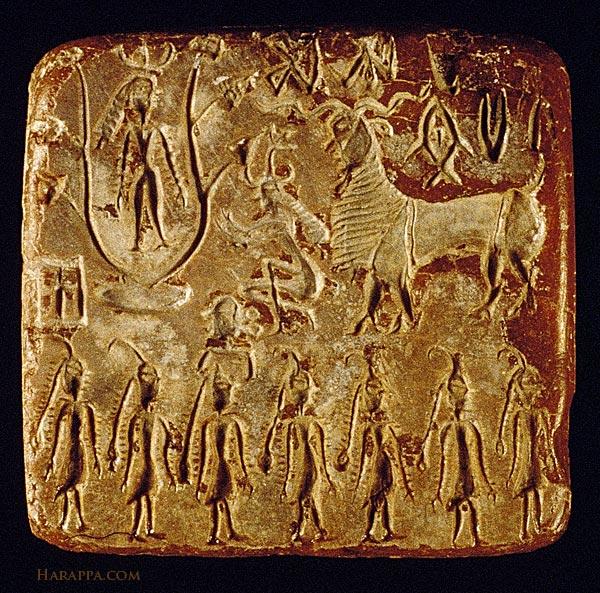
The West Asian sacrifice of the taurus bull is paralleled in the Indus civilization with the sacrifice of a water buffalo bull by spearing in Indus civilization. The Harappan water buffalo, imported from the Indus Valley, is the counterpart of the West Asian urus bull in the Sargonid “contest” seals, and that the “victor’s pose,” one foot placed on the head of the buffalo, is replicated in Mesopotamia from the Indus Valley sacrifice of the water buffalo in front of the hut-like temples dedicated to the goddess. Mohenjadaro and Banawali seals in Fig.1 show girls with ēka-vēṇī ‘single braid’ hairstyle and wearing skirts. The skirt is also seen in the tiger goddess seal, K-65 from Kalibangan, Rajasthan.

Fig.3. Kalibangan tiger goddess (K-65)
Impression
of a Harappan cylinder seal from Kalibangan (K-65). "Two warriors,
distinguished by the hair worn in a divided bun at the back of the head,
are spearing each other, while they are both being held by the hand by a
goddess wearing a head-dress with a long pendant (comparable to the
ones decorated with cowry shells and turquoise that are worn by the
women of Ladakh and Chitral), bangles on the arms, and a skirt. Next to
the combat scene (where space appears to have prevented the depiction of
those details), her body merges with that of the tiger (later the Hindu
goddess of war) and her head-dress is elaborated with animal horns and a
tree branch," A. Parpola, Deciphering the Indus Script, p. 253.
"The
Harappans had a goddess of war connected with the tiger, another large
feline that was once native to the Indus Valley. On a cylinder seal from
Kalibangan (Image 1, 2), a goddess in long skirt and plaited hair holds
the hands of two warriors in the process of spearing each other. Next
to this scene, the same deity is shown with an elaborate horn crown and
the back part of a tiger as a continuation of her body. The hair of the
two warriors is arranged into the double bun' or chignon at the back of
the head, characteristic of Late Early Dynastic Mesopotamian kings on
the warpath. As in the later South Asian tradition, this tiger-riding
goddess of war apparently received water buffaloes in sacrifice. There
are several Harappan images of a man who spears a water buffalo while
placing one of his feet on the head of the beast. This pose came to
signify 'victory' in Mesopotamian glyptic art during the reign of Sargon
the Great (2334-2279 BCE)." A. Parpola, The Harappan Unicorn in
Eurasian and South Asian perspectives, p. 158.
References:
(1) Indus seal, M-312, Proto-Koṟṟavai war with Mahisha: http://nganesan.blogspot.com/2021/01/m312-seal-is-not-jallikkattu.html
(2)
N. Ganesan, Indus Crocodile Religion as seen in the Iron Age Tamil
Nadu, 16th World Sanskrit Conference Proceedings, Bangkok, Thailand,
2016. https://archive.org/stream/IVCReligionInIronAgeTamilNaduByNGanesan-2016-16thWSC/IVC_Religion_in_IronAge_TamilNadu_by_NGanesan_2016_16th_WSC#page/n0/mode/2up
(3) Kavari in Tirukkuṟaḷ and Sangam Texts: Dravidian word for Gauṛ bison and Tibetan yak http://nganesan.blogspot.com/2017/11/kavarimaa-tirukkural-conference-2017.html
தொன்று நிகழ்ந்தது அனைத்தும் உணர்த்திடு
சூழ்கலை வாணர்களும் -இவள்
என்று பிறந்தவள் என்று ணராத
இயல்பின ளாம் எங்கள் தாய் -பாரதி