
Sanauli chariot drawn by mythological animals

N. Ganesan
The Death of Tamil Nadu’s ‘Rekla’ Races: A Past Master Speaks
A ‘rekla’ bull owner speaks about the dying of bullock-cart races, and the culture that is fading away with them
Both bull and rider are conditioned for years, before they are ready for a rekla (bullock-cart) race. I've been rearing bullocks for the race for over twenty years now. I had a different name while in government service. After I retired though, I have taken on a different name. When my bulls win they race, they say, "Nagarampatti Vaiththiyar's bulls have won.”
The Breed
The area around Theni, where hills abound, is called Varshanadu. There are frequent rains. The cattle roams free on the hills, drinking that water, breathing in that air. They are guided by herders and protected from wolves. They are not tame. You will be gored if you go near. We call this breed the naattu inam (local breed). We take calves from this breed for the rekla race, and for our ploughs and transport.
The Jallikattu bulls, even the ‘Kangeyam’ variety, cannot run this race, or plough as well as this breed.
Conditioning
The age of the bulls is determined by the number of incisors. Two, four, six and eight. At two incisors, the calf is too young for tough training. By eight, it is too mature. At four, it is made to run for a little while each day. Every fifteen days, it is made to plough on dry soil, to strengthen the grip of the hooves. Every day, it is made to swim for an hour, to strengthen the muscles in the leg and neck.
Fodder, fresh grass, millets and pulses soaked overnight to germinate – all of these are fed to it each day. Every activity and each item of food is designed to increase its stamina.
Once a year, sixteen medicinal herbs, crushed and made into a ball, are fed to it to improve blood circulation.
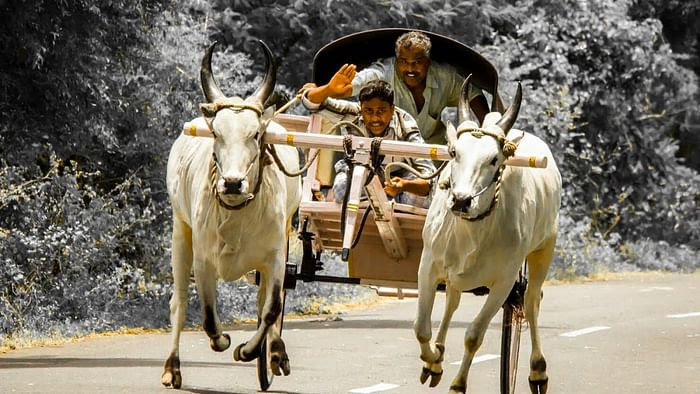
The Race
Both rider and the bull eat their last meal 24 hours before the race. A cow has four stomachs, and it takes a long time for food ingested to leave the body. The bull is given only water for that day, so it runs on an empty stomach, light on its feet and completely alert.
Like races for humans, there is a dash, a sprint and a marathon. Bulls run in pairs, and these pairs stay together for life, to plough, to carry. In the dash, the bulls run full-out, in a gallop. You cannot imagine the speed. You need to see it to believe. In the other two races, the pacing is deliberate and well-timed.
Mode of Transport in a Bygone Age
The people of Karaikkudi are called 'Nagaraththars'. Their culture is rich, and most of them are affluent, thanks to their business acumen and an affinity for hard labour. The bullocks that are trained for the rekla race were also used for transport in the old days. The groom's village would be ten or fifteen miles away. The newlyweds, along with the bride's possessions, heirlooms and produce from her village, would be taken on twenty or so reklas to the groom's village. This practice died away after the advent of mechanised vehicles.
Even today, there are many occasions in the year when we Nagaraththars travel by rekla though we may have cars. The yearly visit to our temple, for example. The temple is near Thiruththani, around sixty miles away. It would take us five days of travel each way. We do this to uphold the tradition and to protect the breed of cattle.
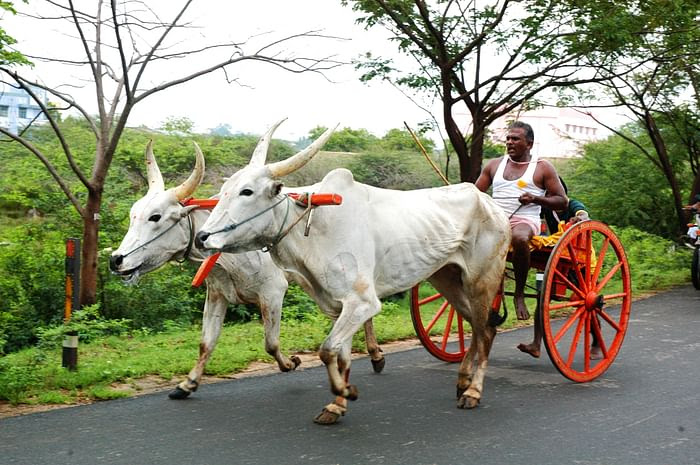
A Village Sans ‘Rekla’
It has been three years since there has been a rekla race. I still have four pairs of rekla bulls. I still condition and train them. I still spend forty thousand rupees a month on them. I can afford it. Most of the others have sold them off.
Why will a farmer keep his bulls if he cannot afford them? How can the breed survive if the farmer cannot care for it? So far, there has been no initiative by the government to protect them.
All of their efforts so far have been directed towards replacing them with Jerseys. An entire web of culture and economy is on its way to extinction. Culture, economy, the science of breeding, the relationship between man and cattle; all of these are inseparable. You break one, everything falls apart.
Natural Calamity
Where are the cowherds? Even thirty years ago, there would be herds of fifty or hundred cows that would be sent out to graze in fallow land, to return at sunset. The dung of these cows would be natural manure for the fields.
The dung of the Jersey cow is poisonous. It’s watery, green in colour, doesn’t mix with the soil, and is full of chemicals. Drop it in a potted plant and the plant will die. This, I think, is a natural calamity.
What else do you want to know?
(The author is a rekla bull owner and a vet. The opinion expressed in the piece are of the author’s own. The Quint neither endorses nor takes responsibility for the same.)
(The Quint is available on Telegram. For handpicked stories every day, subscribe to us on Telegram)
N. Ganesan
https://en.wikipedia.org/wiki/Madhukar_Keshav_Dhavalikar
Since the 1960s, and increasingly in the past decade, physicists like Baumann have used a technique known as the “bootstrap” to infer what the laws of nature must be. This approach assumes that the laws essentially dictate one another through their mutual consistency — that nature “pulls itself up by its own bootstraps.” The idea turns out to explain a huge amount about the universe."
Good morning. In 2006, you wrote about the Crocodile theory that I explained. After that, I did not correspond.
https://www.suppressedhistories.net/Gallery/indus/tigers.html
Now things have become lot more clear: about Copper Hoard Culture's "Anthropomorphic Axe" bronzes (called MazhuvaaL Nediyon in Sangam Tamil, for VaruNa), and the same sculpture made with iron chisels as huge monoliths, facing South, in the megaliths of Tamil Nadu, Andhra and Karnataka. At Sanauli, a wooden coffin with symbols of KoRRavai/Durga are found - wearing buffalo/Gaur horns with peepul leaf in between the horns. In Daimabad chariot, the animals drawing "chariot" are mythical animals: composite of Nilgai antelope at the back (look at the tail and hindlegs) and in the front Zebu, but with protruding horns of the taurus cattle, exotic imports from Sumeria. I believe wooden models of these mythical composite animals for Sanauli chariot might have been there. They draw the dead warriors' coffin to the Durga/KoRRavai's heaven. will write a detailed essay on the animals of Daimabad and Sanauli ``chariots". In the later phase of Unicorn seals, you can see Nilgai (maraiyaan in Sangam Tamil) head replacing the taurus head, and the extension of which we see in Daimabad chariot.
Buffalo's war with a Little girl in Indus seals:
Paṭṭa-Mahiṣī: Proto-Koṟṟavai goddess in Indus civilization (Banawali and Mohenjadaro)
http://nganesan.blogspot.com/2021/01/banawali-mohenjadaro-proto-durga.html
Indus seal, M-312 - Proto-Koṟṟavai war with Mahiṣa
http://nganesan.blogspot.com/2021/01/m312-seal-is-not-jallikkattu.html
Kavari in Tirukkuṟaḷ and Sangam Texts: Dravidian word for Gauṛ bison and Tibetan yak
http://nganesan.blogspot.com/2017/11/kavarimaa-tirukkural-conference-2017.html
Here is an amulet from Binjor, Rajasthan - about 4700 years ago (Early Harappan period) -
with Indian blackbuck as symbol of RohiNi star and Gharial crocodile for the Pole Star.
Divine Couple in Ancient Indian Astronomy from Binjor to Adichanallur: Makara Viṭaṅkar & Kolli/Koṟṟavai
http://nganesan.blogspot.com/2021/02/divine-couple-binjor-amulet-to.html
The hourglass shape of both male and female bodies, from Bhirrana, an Indus site, to Iron Age Edakkal caves
and in Adichanallur burial urn pottery,
http://nganesan.blogspot.com/2020/08/civasvami-in-edakkal-cave-brahmi.html
Some K-initial Dravidian Loan Words in Sanskrit:
Preliminary Observations on the Indus Language.
International Journal of Dravidian Linguistics, 1-20, Vol. XLVII, Number 2, June 2018.
https://archive.org/details/NGanesan_IJDL_2018/page/n1 )
Indus Crocodile Religion as seen in the Iron Age Tamil Nadu
https://archive.org/details/IVCReligionInIronAgeTamilNaduByNGanesan-2016-16thWSC/page/n1/mode/2up
Makara - A Dravidian Etymology,
Prof. V. I. Subramanian Commemoration Volume, Int. School of Dravidian Linguistics, Tiruvananthapuram, Kerala, 2011
https://archive.org/details/MakaraADravidianEtymology2011
Gharial god and Tiger goddess in the Indus valley,
Some aspects of Bronze Age Indian Religion, 2007
https://archive.org/details/IVCReligionByNagaGanesan2007
Regards,
N. Ganesan
In Bombay, Portuguese introduced spring-loaded rekla carts. You can see a whip in the carter's hand. http://www.gutenberg.org/files/40708/40708-h/40708-h.htm#CHAPTER_VI Beast and Man in India, by John Lockwood Kipling, 1904. All this is done to tell more about Sanauli chariot where like mythological animals (zebu + Nilgai (maraiyaan antelope of Sangam literature, the largest antelope of India: maraiyaan, lit. "antelope-bull") would have been there. You can see parallels with Daimabad chariot where these mythological chimeras are drawing the chariot. Also, see KoRRavi (possibly) riding two bulls in Post-Harappan OCP culture: https://en.wikipedia.org/wiki/Ochre_Coloured_Pottery_culture . Daimabad charioteer has a whip, we need to get photos of the whip found in Sanauli. It will be like that of Daimabad chariot. I am glad Sri. TSS liked my explanation of KoRRavai face with buffalo horn and peepul leaf in between (this symbol later became Nandipada, actually, Gowrii-mukha in Coinage) in Sanauli, and the buffalo horn worshiped by cattle herders in Mullai tiNai during their wedding rituals in Kalittokai (Sangam text): https://groups.google.com/g/santhavasantham/c/g395-ayPD0k/m/Ec3GQjeWAwAJ