
The Three Meanings for the Name RAMA and the Meaning of NARAYANA

Brahmachari Muktachaitanya
The Three Meanings for the Name RAMA and the Meaning of NARAYANA
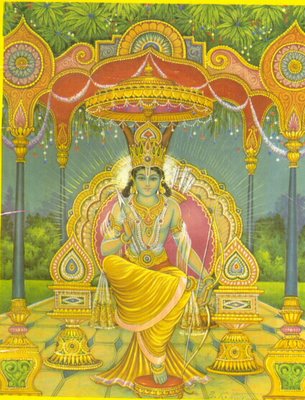
The word Rama has
three meanings:
One meaning is "the only entity from which yogis attain bliss". Spiritual aspirants do not get happiness from finite, worldly objects. They want something infinite. Bliss cannot be obtained from finite objects.
The infinite object which supplies them with infinite happiness is
nothing but Rama. The Ananda Sutram says infinite happiness is anandam not
sukham.
Another meaning of Rama is: Rama is the most glittering entity of
the entire universe. It is the first syllable of rati, that is, 'ra' or
glittering.
The first letter of the word Mahidhara, is ma, meaning, the world.
Hence Rama. All glittering entities get their glitter from Him, no entity
posses-ses glitter of its own.
The moon gets its glitter from the earth; the earth in turn
derives its glitter from the sun. The sun gets energy from the cosmological
nucleus. There are countless solar systems in the cosmos and the hub of all is
Parama Purusha. He is the nucleus of all energy.
Scriptures say: "Before that effulgent Supreme Entity,
neither the sun shines, nor the moon nor stars nor the lightning flash, what to
speak of fire. In Parama Purusha's light all other entities shine. His
effulgence illuminates all entities".
The third meaning of Rama is 'Ravanasya maranam'. The first
syllable of Ravanasya and the first syllable of maranam make up
"Rama". Ravana means a mind that moves away from the nucleus drifting
away by the centrifugal force, dissipating mental energies in all 10
directions.
He is depicted as a 10-faced demon. Ravana can be defeated or
destroyed, only when one takes shelter in Rama. So one under whom Ravana
automatically dies is "Rama".
The meaning of Rama and Narayana is the same. Hanuman was asked
why he insisted on taking the name of Rama and not of Narayana. He replied:
"I know that philosophically there is no difference between Narayana and
Rama, yet I will channelise my mind towards One Entity with all my sincerity
and devotion and not many.
For me there is no Narayana, there is only Rama". In
spiritual parlance such a word is called Ishta mantra and the spiritual
aspirants treasure their Ishta mantra.
Narayana and Rama are the same Entity; only their names differ.
The word Narayan comes from nara,
that has three meanings: Parama, Prakrti and devotion or bhakti.
Nara + da = Narada,
the distributor of bhakti. Nara
means devotion. And 'ayana' means ashraya. Narayana means Parama Purusha - the
Cosmic Consciousness, the shelter of Parama Prakrti.
Is the name more powerful or the nami (named). Who is more
powerful, Parama Purusha or His name? The bhava, or ideation, for an object
goes together with its name. One cannot name oneself. You need somebody else to
name you.
Before leaping across the ocean, Hanuman consulted Rama. Rama replied, "Go
ahead, Hanuman. You can jump across the ocean. But I cannot". And Rama
asked him, "How will you cross it?
"Hanuman replied, "With your power" Rama asked,
"How will you get My power?" And Hanuman replied, "I will take
your Name and jump". Hence the nama is more powerful than the nami. The
named, before being named, remains nameless. When there were no devotees, God
had no name He was nameless.

Sandeep Das
"Listen, Swaroopa and Ramananda! I tell you about the mental attitude with which the Name should be recited. "
"Hari's Name should always be chanted by him who must be humbler than a blade of grass (which is trodden upon); who is more patient, forbearing and charitable than a tree (which does not cry out even when it is cut down, and which does not beg for water even when scorched to death, but on the contrary, offers its treasure to whosoever seeks it, bears the sun and rain itself but protects those who take shelter under it from rain and sunshine); who, however worthy of esteem should, instead of claiming respect for himself, give respect to all (from a sense of God's immanency in all beings). He who thus takes Krishna's Name gets Krishna-prem " .
Lord Gauranga became more humble in spirit and recited the following Sloka:-
"Oh Lord, I ask not for wealth or followers, or for poetic genius. May my motiveless devotion to Thee continue in me whenever I take birth."
OM TAT SAT (That (Lord) is the Only Reality)