|
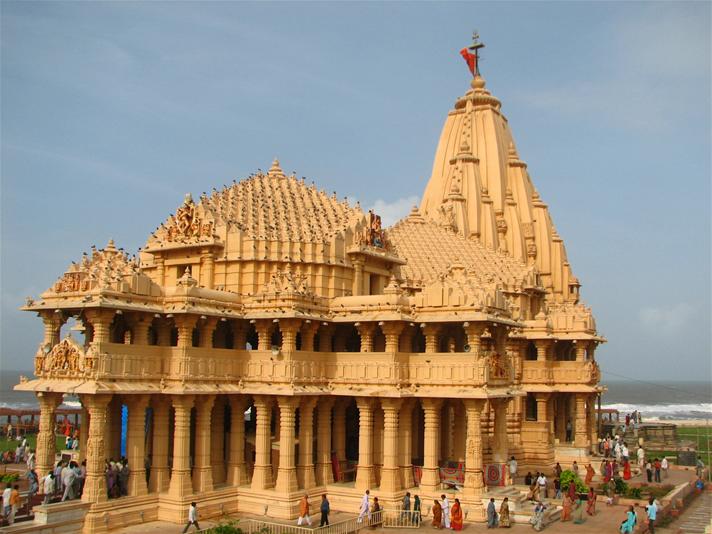
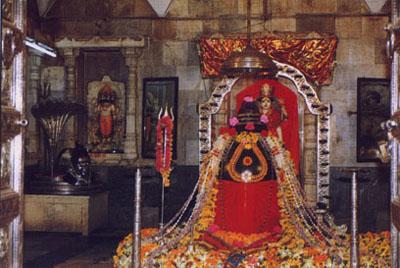
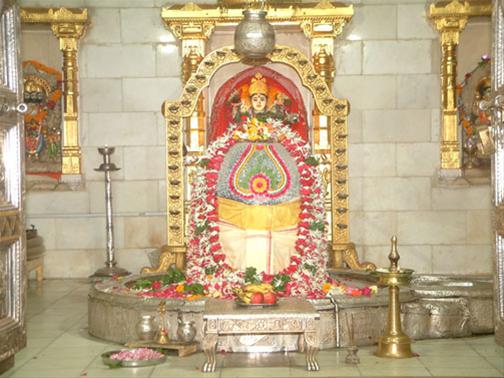
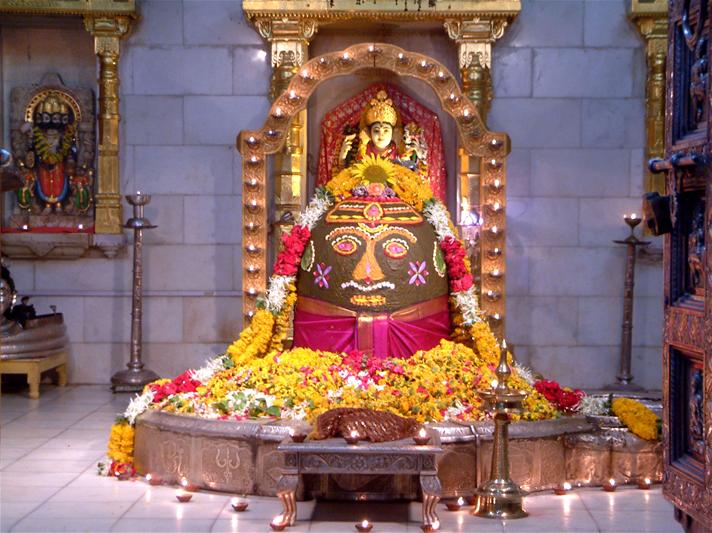
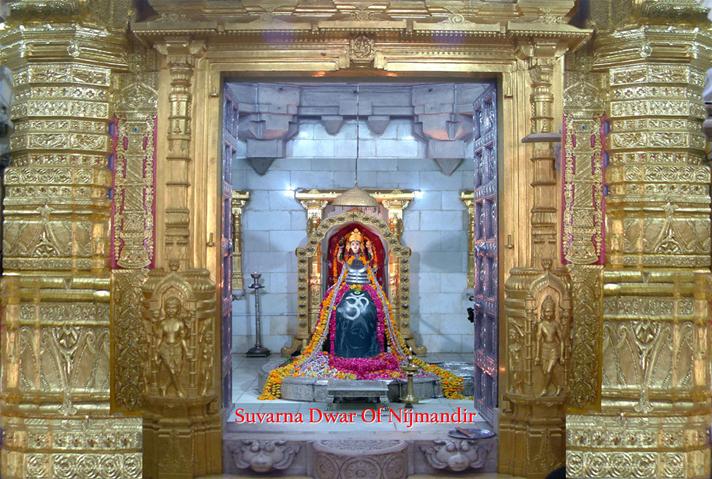
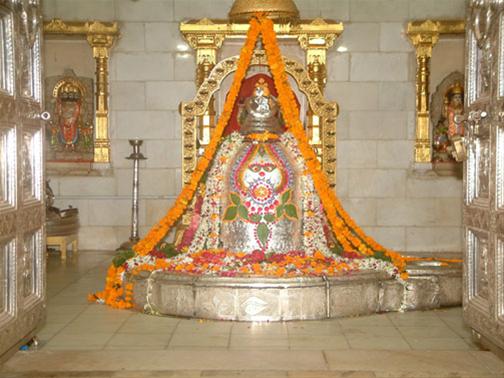
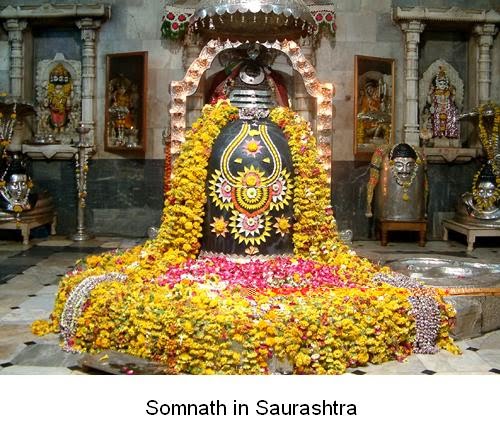
Shree Somnath is first among the twelve Aadi Jyotirlings of India. It is
the holy place of the Aadi Jyotirling Shree Somnath Mahadev and it also
has the sacred soil from where Bhagvan Shri Krishna took his last
journey to his neejdham.
Ancient Indian traditions maintain a close relationship of Somnath with
release of Chandra (Moon God) from the curse of his father-in-law Daksha Prajapati. Moon was married to Twenty-Seven daughters of Daksha. However, he favoured Rohini and neglected other queens. The aggrieved Daksha cursed Moon and the Moon lost power of light. With the advice of Prajapita Brahma, Moon arrived at the Prabhas Teerth and worshipped Bhagvan Shiva. Pleased with the great penance and devotion of Moon, Bhagvan Shiva blessed him and relieved him from the curse of darkness partially, thus causing the periodic waning of moon. . Pauranic traditions maintain that Moon had built a golden temple, followed by a silver temple
by Ravana, Bhagvan Shree Krishna is believed to have built
Somnath temple with Sandalwood. Located as it is, it is widely believed
that if one were to sail from here in a straight line, the end of the journey
would be at the North Pole, without having to travel over land.
The research based on ancient Indian classical texts show that first Somnath Jyotirling Pran-Pratistha was done on the auspicious third day of brighter
half of Shravan month during the tenth Treta yug of Vaivswat Manvantar. Swami Shri Gajananand Saraswatiji, Chairman of Shrimad Aadhya
Jagadguru Shankaracharya Vedic Shodh Sansthan, Varanasi suggested
that the said first temple was built 7,99,25,105 years ago as derived
from the traditions of Prabhas Khand of Skand Puran. Thus, this
temple is a perennial source of inspiration for millions of
Hindus since time immemorial.
The later sources of history account for several desecrations by Muslims invaders during eleventh to eighteen century A.D. The temple was rebuilt
every time with the reconstructive spirit of the people. The modern
temple was reconstructed with the resolve of Sardar Patel who visited
the ruins of Somnath temple on November 13 1947. Then President of India, Dr. Rajendra Prasad, did the Pran-Pratistha at the existing
temple on 11 May 1951.
Somnath temple stands at the shore of the Arabian ocean on the western
corner of Indian subcontinent in Gujarat State. This pilgrimage is one of the oldest and finds its reference in the ancient texts like Skandpuran,
Shreemad Bhagavat, Shivpuran etc. The hymn from Rig-Veda
quoted below mention the Bhagvan Someshwar along with the
great pilgrimage like Gangaji, Yamunaji and Eastward Saraswati.
This signifies the ancient value of this Tirthdham.
Somnath is in Prabhas Patan very near to Veraval.
Somnath means "The Protector of Moon God." The Somnath Temple
is known as 'the Shrine Eternal,' as although the temple has been
destroyed six times it has been rebuilt every single time.
Brahma, one of the trinity, installed the Brahmashila, and paved way for
the construction of the temple. On the request of the Chandrama and other
gods Bhagwan Shankar assumed the name Somchandra (Jyotirlinga) and resided there eternally. He became famous by the name Somnath in
the three worlds. Since, it was the Prabhas Kshetra where Bhagwan Shri Krishna performed all his Lilas. In this temple there is a small cave
in which a lamp burns continuously.
The Skanda Purana describes the Sparsa Linga of Somnath as one bright as the sun, the size of an egg, lodged underground.
The Mahabharata also refers to the Prabhasa Kshetra and
the legend of the moon worshipping Shiva.
Ransacking and Rebuilding of Somnath Jyotirlinga
The present temple is the seventh temple reconstructed on the original site.
The first temple of Somnath is said to have existed before the beginning
of the Christian era. The second temple, built by the Maitraka kings of
Vallabhi in Gujarat, replaced the first one on the same site around 649.
In 725 Junayad, the Arab governor of Sind, sent his armies to destroy
the second temple. The Pratihara king Nagabhata II constructed the
third temple in 815, a large structure of red sandstone.
In 1024, Mahmud Ghazni raided the temple from across the Thar Desert. During his campaign, Mahmud was challenged by Ghogha Rana, who
at the ripe age of 90, sacrificed his own clan fighting against this iconoclast.
The temple and citadel were ransacked, and more than 50,000 defenders
were massacred; Mahmud personally hammered the temple's gilded
lingam to pieces and the stone fragments were carted back to Ghazni,
where they were incorporated into the steps of the
city's new Jamiah Masjid (Friday mosque).
The fourth temple was built by the Paramara King Bhoj of Malwa
and the Solanki king Bhima of Gujarat (Anhilwara) or Patan between
1026 and 1042. The wooden structure was replaced by Kumarpal
who built the temple of stone.The temple was razed in 1297 when
the Sultanate of Delhi conquered Gujarat, and again in 1394.
The Mughal Emperor Aurangzeb destroyed the temple again in 1706.
Sardar Vallabhbhai Patel, then Home Minister & the first Deputy
Prime Minister of India, took a pledge on November 13, 1947
for its reconstruction for the seventh time. A mosque present at that
site was shifted few miles away. It was completed on December 1, 1995
and President of India, Dr. Shankar Dayal Sharma, dedicated it in the
service of the nation. The present temple was built by the
Shree Somnath Trust which looks after the entire complex of
Shree Somnath and its environs.
The following extract is from “Wonders of Things Created, and marvels
of Things Existing” by Asaru-L Bilad, a 13th century Muslim geographer.
It contains the following description of Somnath temple and its destruction:
The following is a long quotation:
“Somnath: celebrated city of India, situated on the shore of the sea, and
washed by its waves. Among the wonders of that place was the temple in
which was placed the idol called Somnath. This idol was in the middle of
the temple without anything to support it from below, or to suspend it from above. It was held in the highest honor among the Hindus, and whoever
beheld it floating in the air was struck with amazement, whether he was a Musulman or an infidel.
The Hindus used to go on pilgrimage to it whenever there was an eclipse
of the moon, and would then assemble there to the number of more than a hundred thousand. They believed that the souls of men used to meet there
after separation from the body, and that the idol used to incorporate them
at its pleasure in other bodies, in accordance with their doctrine of transmigration. “The ebb and flow of the tide was considered to be
the worship paid to the idol by the sea.
Everything of the most precious was brought there as offerings, and
the temple was endowed with more than 10,000 villages. There is a river
(the Ganges) which is held sacred, between which and Somnath, the
distance is 200 parasangs.They used to bring the water of this river to
Somnath every day, and wash the temple with it. A thousand brahmans
were employed in worshipping the idol and attending on the visitors, and
500 damsels sung and danced at the door–all these were maintained
upon the endowments of the temple.
The edifice was built upon fifty-six pillars of teak, covered with lead. The
shrine of the idol was dark, hut was lighted by jeweled chandeliers of great value. Near it was a chain of gold weighing 200 mans. When a portion
(watch) of the night closed, this chain used to be shaken like bells to
rouse a fresh lot of brahmans to perform worship.
“When the Sultan Yamin-ud-Daula Mahmud Bin Subuktigin went to
wage religious war against India, he made great efforts to capture and
destroy Somnath, in the hope that the Hindus would then become Muhammadans. He arrived there in the middle of Zi-l k’ada, 416 A.H. (December, 1025 A.D.). “The king looked upon the idol with wonder,
and gave orders for the seizing of the spoil, and the appropriation of
the treasures. There were many idols of gold and silver and vessels set
with jewels, all of which had been sent there by the greatest personages
in India. The value of the things found in the temples of the idols
exceeded twenty thousand thousand dinars.
 Elliot’s footnote: The enormous treasures found at Somnath have been
 a theme of wonder for all who have written on that conquest.
“When the king asked his companions what they had to say about the
marvel of the idol, and of its staying in the air without prop or support,
several maintained that it was upheld by some hidden support. The king directed a person to go and feel all around and above and below it with a
spear, which he did, but met with no obstacle. One of the attendants then
stated his opinion that the canopy was made of loadstone, and the idol
of iron, and that the ingenious builder had skillfully contrived that the magnet should not exercise a greater force on anyone side-hence the idol was suspended in the middle. Some coincided, others differed. Permission was obtained from the Sultan to remove some stones from the top of the
canopy to settle the point. When two stones were removed from the
summit the idol swerved on one side, when more were taken away
it inclined still further, until at last it rested on the ground.”
May the Jyothirlinga of Shri Somnath temple remove
all the negative energies with in us and inspire us
to be a better human being.
Tomb of Sultan Mahmud of Ghazni, in 1839-40, showing the
replicas of original Sandalwood Doors at Somnath,
which he destroyed in ca 1024
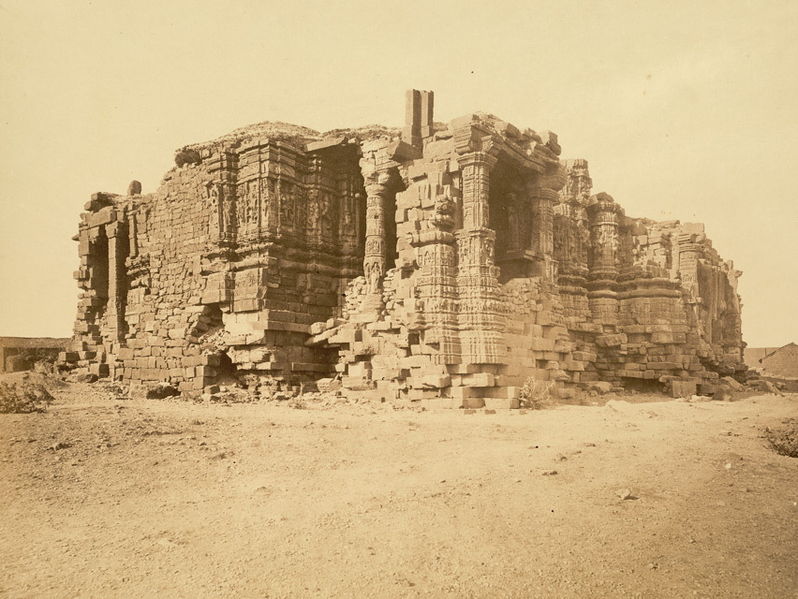
Ruins of somnath temple from 1869
Inside view of Somnath in 1869
Ahilyabais' Somnath Temple or Old Somnath Temple: This temple is adjacent to present temple. As the main Somnath temple witnessed series of attacks and destruction in the medieval period, Maharani Holkar who was a great devotee of Lord Shiva built this
temple in 1783. She felt that the older place was inauspicious as there were series of attacks. She built the temple in basement as a security measure.
Above it on the ground a small temple of Lord Shiva is built. Unlike the
new, there is no restriction on puja by devotee in this temple. So, many
can be seen performing puja here. It is known as old Somnath temple
and it is also managed by Shri Somnath Trust.
Adi Guru Shankaracharya Gufa
Bramkumari temple around Somnath
Gita Mandir
Gita Mandir campus comprises of Gitamandir, Balaramji-ni-gufa,
Laxminarayan Temple, Dehotsarga place, Shri Kashi Vishwanath Temple, Mahaprabhuji Baithak and Bhimnath Mahadev Temple.
Gita temple, also known as Birla temple, is marvelous architectural
beauty in Marbles. The images of Gita Hymns are depicted in the
inscriptions of marble walls. The temple is constructed in such a way that
one can hear the echo of his voice inside the temple, so that the
Krishna bhajans by the devotees can be echoed in the environments
Krishna Mandir
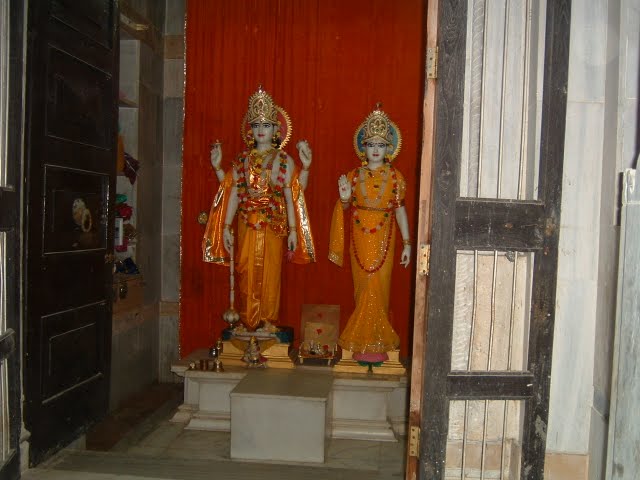
 Laxminarayan Temple
May Shree Laxmi Narayan of Somnath bless our souls...
 Mahaprabhuji Baithak
Balaramji-ni-gufa
Bhimeshwar temple / Panch Pandav ni Gufa / Bhimnath Mahadev Temple:
Panch Pandava Gufa is a temple situated near Lalghati in Somnath. Late Baba Narayandas founded it in the year 1949. This temple is
dedicated to five Pandava brothers. This temple at an elevated place,
offers a beautiful view of surrounding holy city.
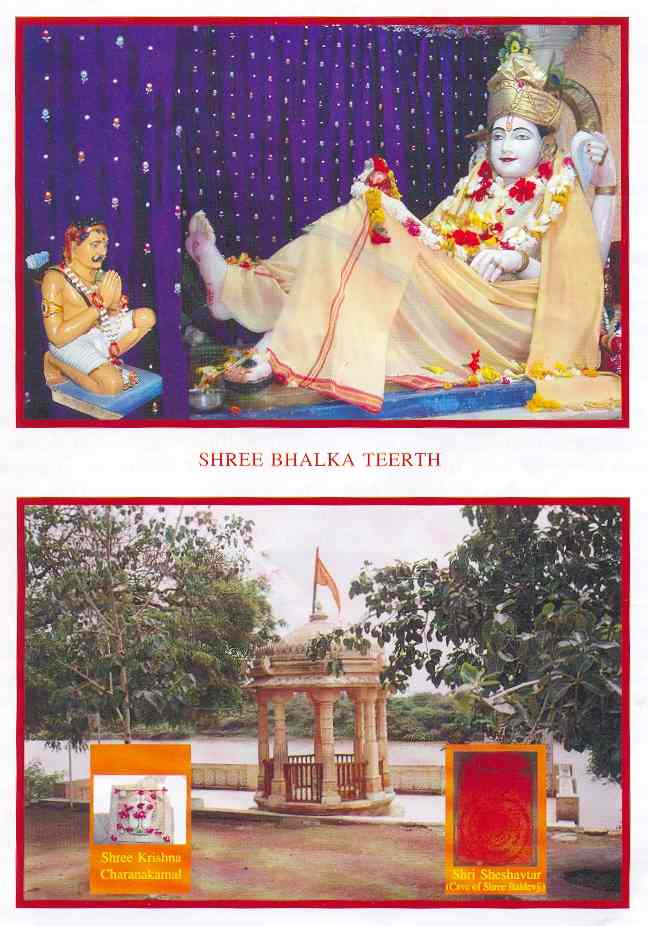
Bhalka Tirtha: There is a beautiful idol of Lord Shri Krishna in meditating form. The peepal tree is also seen outside the main temple. Near the main
temple is Mahadev temple. This is the place where the arrow of Jara
poacher hit Lord Krishna while he was meditating under a peepal tree.
He had taken the shining mark of the foot of Lord Krishna and shot
arrow. Lord Krishna pardoned Jara and walked away to the bank of
Hiren river and left the mundane world. This sacred tirtha is
located 5 km on Prabhaspatan-Veraval road.
Bhalka Teerth, where Lord Krishna was shot on the feet by Jara,
the Bhil hunter
This divined leela of Bhagvan Shree Krishna is immortalised by a
beautiful temple and an ancient peepal tree. Bhagvan Shree Krishna
then walked a small distance and arrived at the holy banks of river
Hiran from where he took his last journey to his Neejdham.
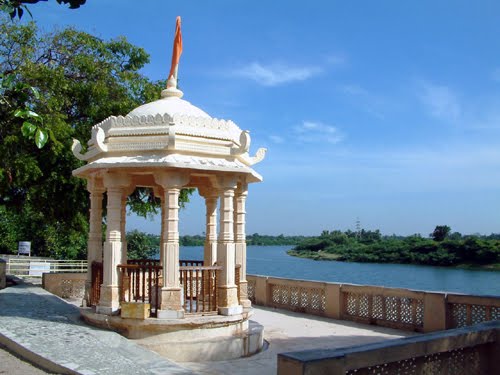
Shree Krishna Neejdham Prasthan Tirth (DEHOTSARG TEERTH)
This Tirtha is located on the banks of Hiran at a distance of 1.5km from Somnath temple. Bhagvan Shree Krishna took his divine journey to
Neejdham from this sacred soil. Rich accounts of the divined Shree
Krishna Neejdham Prasthan Leela are maintained by the authentic
traditions of Mahabhart, Shrimad Bhagwat, and Vishnu Puran etc.
Swami Shri Gajanand Saraswatiji has critically examined the previously mentioned classical Indian traditions and suggested the time of
Neejdham Prasthan. He suggested that Shri Krishna departed on the first
day of bright fortnight of Chaitra month (which corresponds with
18 February of English calendar) in the year 3102 B.C. at 2:27:30 hours
The footprint of Bhagvan Shree Krishna is carved here to mark the divine memory of Shree Krishna Neejdham Prasthan Leela. Baldevji, the elder brother of Shree Krishna also took his last journey from here in
his original serpent form. This is marked by an ancient holy cave
called “Dauji-ni-Gufa”
May Lord Krishna show us all the path that leads to goodness and to the abode of God which is Heaven
Triveni Ghat in Somanth is the confluence of three holy rivers Kapil, Hiran
and a mystical River Saraswaty (also known as Gupt Saraswati). It is
believed that the rivers flow to the ultimate destination of Sea from here.
This symbolises the human birth, life and death. This is a sacred place.
It is believed that the bath in the waters at this Ghat offers relief from
all curses and ills happened. It is an important place to pay homage to ancestors, Pitrutarpan, as it holds high religious importance for tarpan
for the ancestors. In Chaitra and Bhadrapada months of Hindu calendar
huge crowds are seen here. In Hindu religion feeding fish is regarded
as a talisman for getting wealth and prosperity.
People can be seen feeding fish here.
|