
Welcome to Java!

SRK

Duke, the Java mascot
Java is a programming language originally developed by James Gosling at Sun Microsystems (now a subsidiary of Oracle Corporation) and released in 1995 as a core component of Sun Microsystems' Java platform. The language derives much of its syntax from C and C++ but has a simpler object model and fewer low-level facilities. Java applications are typically compiled to bytecode (class file) that can run on any Java Virtual Machine (JVM) regardless of computer architecture. Java is a general-purpose, concurrent, class-based, object-oriented language that is specifically designed to have as few implementation dependencies as possible. It is intended to let application developers "write once, run anywhere." Java is currently one of the most popular programming languages in use, particularly for client-server web applications.
Java History:
James Gosling, Mike Sheridan, and Patrick Naughton initiated the Java language project in June 1991. Java was originally designed for interactive television, but it was too advanced for the digital cable television industry at the time. The language was initially called Oak after an oak tree that stood outside Gosling's office; it went by the name Green later, and was later renamed Java, from Java coffee, said to be consumed in large quantities by the language's creators. Gosling aimed to implement a virtual machine and a language that had a familiar C/C++ style of notation.
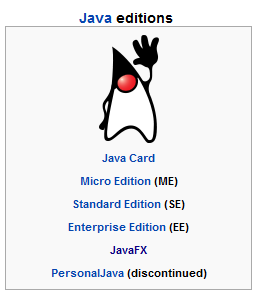
Sun Microsystems released the first public implementation as Java 1.0 in 1995. It promised "Write Once, Run Anywhere" (WORA), providing no-cost run-times on popular platforms. Fairly secure and featuring configurable security, it allowed network- and file-access restrictions. Major web browsers soon incorporated the ability to run Java applets within web pages, and Java quickly became popular. With the advent of Java 2 (released initially as J2SE 1.2 in December 1998–1999), new versions had multiple configurations built for different types of platforms. For example, J2EE targeted enterprise applications and the greatly stripped-down version J2ME for mobile applications (Mobile Java). J2SE designated the Standard Edition. In 2006, for marketing purposes, Sun renamed new J2 versions as Java EE, Java ME, and Java SE, respectively.

- It should be "simple, object-oriented and familiar"
- It should be "robust and secure"
- It should be "architecture-neutral and portable"
- It should execute with "high performance"
- It should be "interpreted, threaded, and dynamic"
- JDK 1.0 (January 23, 1996)
- JDK 1.1 (February 19, 1997)
- J2SE 1.2 (December 8, 1998)
- J2SE 1.3 (May 8, 2000)
- J2SE 1.4 (February 6, 2002)
- J2SE 5.0 (September 30, 2004)
- Java SE 6 (December 11, 2006)
- Java SE 7 (July 28, 2011)

Prateek Srivastava

conhas thakkar
On Nov 9, 10:33 pm, Prateek Srivastava <patt...@gmail.com> wrote:
> interesting...http://youtu.be/b-Cr0EWwaTk