
'The Battle for India' by Dr. B. S. Harishankar

Vijay Kumar


Vijay Kumar
The battle for India by B S Harishankar (New book, an overview)
S. Kalyanaraman
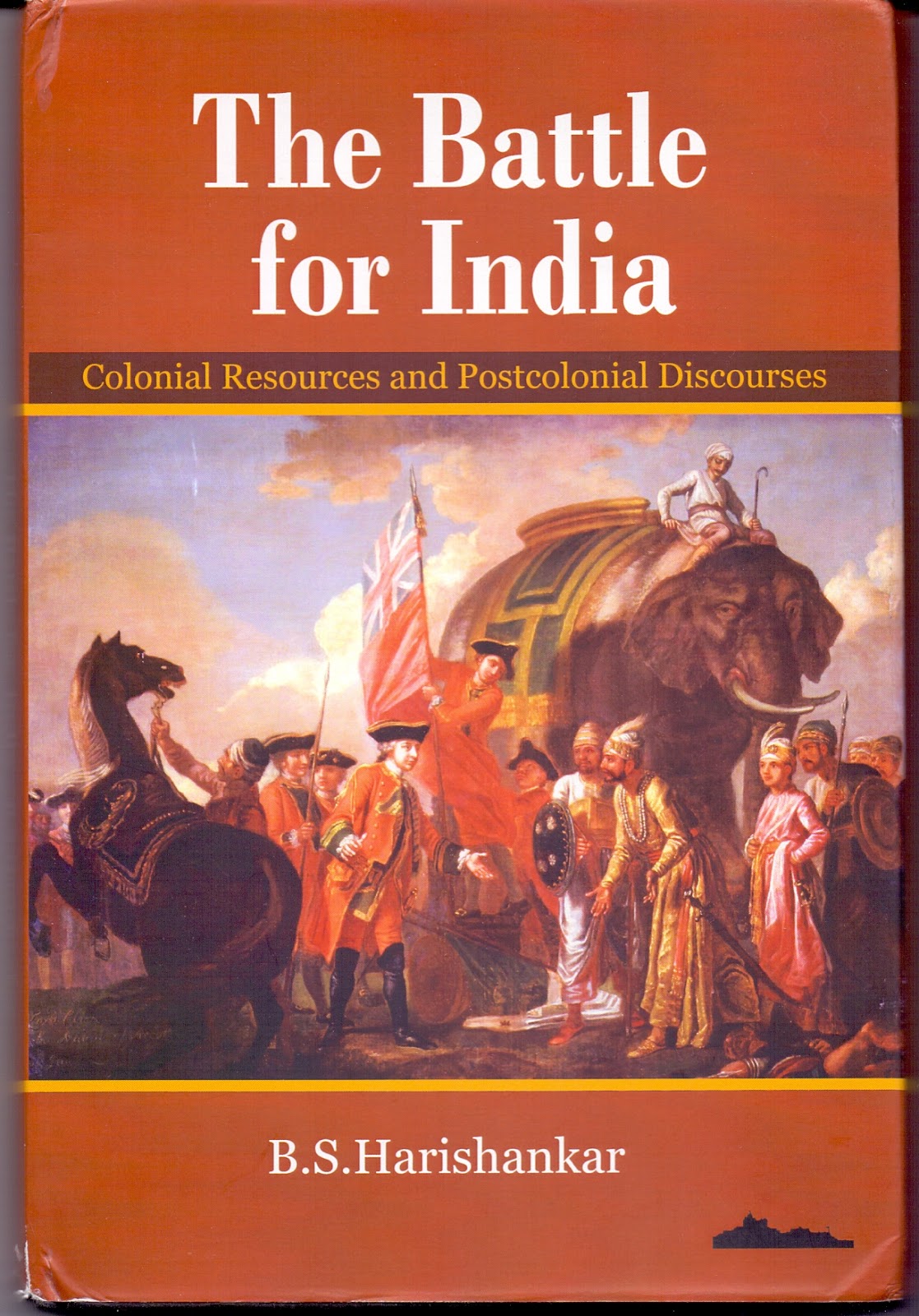
The Battle for India

Vijay Kumar
Behind a controversy

Pattanam
Author- BS Harishankar
Publisher- Bharateeya Vichara Kendram, Rs 250
This book discusses multiple aspects that have repudiated the theory that there existed a port city at Pattanam along the West Coast of Kerala dating back to the 8th century BC, writes KUMAR CHEllAPPAN
An effort by a section of historians in South India to ‘manufacture history’ with the aid of unscientific tools have come crashing down exposing the ulterior motives behind the controversial Pattanam excavation in Kerala.
Pattanam: Constructs, Contexts and Interventions, a new book authored by Dr BS Harishankar, an archaeologist, discusses multiple aspects that have repudiated the theory that there existed a port city at Pattanam along the West Coast of Kerala which the historians of Kerala Council of Historical Research (KCHR) claim as an international trade diaspora dating back to the 8th century BC. The excavators are virtually silent on internal trade with South India.
“The Pattanam port is an edifice on which the left historians want to build up their arguments that there existed a large township and urban realm at Pattanam much before the Christian era. The effort is to impose a belief on us that St Thomas, one of the apostles of Jesus Christ, was the one who led the first settlement in the region,” said R Nagaswamy, former director of Tamil Nadu Archaeology and former vice-chancellor of Kanchipuram University. According to Nagaswamy, the theory that St Thomas had come to India is contested by the church itself with Benedict 16, former Pope, refusing to accept St Thomas as history.
While the KCHR historians collaborated with Universities in Europe and USA in the excavation held at Pattanam, they were careful not to include Archaeological Survey of India, and Indian institutions in the project. They claim that Pattanam is the ancient Muziris. Eminent archaeologists and historians such as DK Chakrabarti, MGS Narayanan, T Sathyamurthy, A Sundara and R Nagaswamy have criticised from the beginning, the process of excavation and hasty conclusions.
But the last nail on the coffin of the Pattanam theory was driven by scientists of the elite Bhabha Atomic Research Centre, Trombay — near Mumbai and the National Institute of Oceanography at Kochi — who have neither collaborated with KCHR nor vindicated their claims of a port city at Pattanam. The Bhabha Atomic Research Centre has already tried to unravel the process of mud banks in Kerala during monsoons which has greatly enhanced maritime trade in the past. “Marine and palaeo-hydrological studies rule out the possibilities of a port city, wharf or township that existed at Pattanam. It is for the ASI and the Institute of Marine Archaeology to conduct dredging at offshores in Kodungalloor to find remains of a port,” writes Harishankar in his book.
The claims by the KCHR historians that there existed a cosmopolitan civilisation at Pattanam much before the first century AD, has upset the Tamil archaeologists and historians who has done yeomen research to reveal the origin of Sangam Era literature including Cilappathikaram. If the claims made by the Church sponsored Pattanam excavations are to be believed, the entire history of South India has to be re-written.
But what stands out in Harishankar’s book are the diverse reasons that there is no basis either scientifically or archaeologically what the KCHR historians have found out. “The area where they excavated does not qualify to be a spot where excavations could be done since stratigraphy has been badly tampered due to monsoons, floods, erosion and construction activities. The ASI is the only body in India which is competent to authorise such excavations,” says Harishankar.
At the same time, author Harishankar also points out the fact that archaeology is a scientific tool with which one cannot infer convenient results. Plant remains from Pattanam have been given to Spices Board under the ministry of commerce and industry and which holds no prior experience in this field. Carbon dating has been done abroad when India has premier institutes. Further, modern historians in KCHR with no former experience in field archaeology cannot excavate a site such as Pattanam using unbridled foreign funds, and a crew of Biblical scholars.
Scientists of the BARC have tracked the course of river Saraswati through Radio Isotope studies in the past. When they tell that there is no sufficient proof on Pattanam, all that the lefts and the Church could do is to dig further to manufacture some history. Both are experts and “leaders” in the segment of manufacturing history to suit their convenience.