
'Chartbook #193 Indian nation-building, Modi and the Adani crisis'

Sukla Sen
The Adani controversy is spectacular. But there is a real danger, if we address it as a question of alleged financial malpractice, that we miss the real issue...>>
The upheaval rocking the Adani business empire is one of the dramatic global developments of the last week. I was delighted that The Wire saw fit to pick up and republish Chartbook #190. I’ve long harbored a secret ambition to join the ranks of the Wire-wallahs. Cam and I also featured the Adani story on the Pod this week.
With continuing losses on the market, the cancelation of the share sale and moves by foreign investors to clarify the extent of their exposure to Adani, it seems clear that the controversy is not going away as quickly as some predicted or hoped. The Adani controversy is spectacular. But there is a real danger, if we address it as a question of alleged financial malpractice, that we miss the real issue. This is well brought out by the op-ed by Mihir Sharma:
You don’t have to agree with Sharma’s critique of “old-fashioned industrial policy”, to see the force of his point. What is really at stake here is not the purity of financial markets, but a model of economic development. Who, if anyone, can get things done? On the massive reach of the “Two As” (The Adani and Ambani conglomerates) and their implications for India’s political economy, Arvind Subramian is, as usual, enlightening). Here a talk with The Wire about India’s growth prospects. 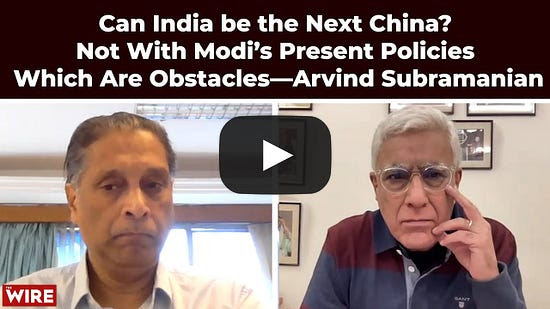 For a useful (and rather downbeat) macro-take on the Indian setting of the Adani crisis, I found this thread very helpful.  Marko Papic @Geo_papic FDI has not contributed to gross capital formation, which speaks to the same issue. 2:39 PM ∙ Jan 31, 2023 44Likes4Retweets For deeper historical perspective on India’s growth outlook, you may wish to pick up Ashoka Mody’s typically fiery interpretation of India’s economic development since independence, which is being released by Stanford University Press this month.
Trigger warning: Mody’s treatment is a no bolds barred attack on “India boosterism”:
It is particularly striking for its moral tone. Mody does not deny the growth, which in recent decades has lifted hundreds of millions out of absolute poverty. But he also highlights mounting inequality, which now places India alongside South Africa and Brazil as one of the most unequal societies on earth;
India’s failure to keep up with its Asian rivals above all in female education;
And the chronic problems of unemployment and underemployment that result from failing to find a suitably-sized niche in the global division of labour.
Compiling a list of critical voices like this, you can easily come across as though you don’t appreciate the dramatic transformation in material circumstances which India and Indians have achieved since the 1980s. In fact, a critical perspective on contemporary India and its politics acquires even more force if you reckon with the reality of spectacular change. Take the remarkable digital infrastructure known as the “India Stack”, starting with the campaign for complete biometric identification set in train in 2009.
For an uninhibited celebration of digital infrastructure as a mechanism for incorporating hundreds of millions of people, both into the governmental machinery of the Indian state and a national market, see Raghavan et al 2019. The graphic below rather nicely illustrates the way in which technology maps onto a caricatured sociology of 21st-century India. A society split three ways between (1) fully empowered smart phone users, (2) families in more traditional clothing accessing services on simpler cell phones and (3) elderly village dwellers whose access is enabled indirectly by way of Aadhar-tied merchant pay terminals in every village across India.
For a more critical take, locating the Aadhaar system in the history of the Indian state, check out this piece by Kavita Dattani also from 2019. The abstract does a good job of explaining what is at stake.
To anyone who has to deal regularly with the antiquated pre-digital processes of governance in either the United States or many parts of Europe, the degree of digitization in India often beggars belief. New Delhi in its role as G20 president is now putting India’s digital stack in the global spotlight. Delhi is selling “India Stack Global” as a model for tech and governance solutions worldwide, but particularly for middle- and low-income countries. Digitization would be completely unthinkable, if it were not for the progress that has been made in the electrification of India.
These data are from the India Residential Energy Survey as analyzed by Shalu Agrawal et al of CEEW. Of course, India’s per capita power consumption is still very low compared to China or advanced economies. Nor does connection to the grid mean 24-hour power supply. Especially in the rural North-East, power supply is intermittent. But, a generation ago, less than half of rural households in India had any connection to the power network at all. Now almost 97 percent do.
Historically, India’s energy system has been heavily dependent on coal. Gautam Adani is a coal baron notorious for his giant Australian development plans. But since PM Modi has committed India to decarbonization by 2070, Adani has also become a champion of India’s energy future as a renewable energy power house with some of the lowest per unit costs of both solar and wind in the world.
Source: Economist Both the Ambani and Adani groups have seized on the new agenda, promising to make India a hydrogen champion and “indigenising the entire supply chain”. No longer will the value of India’s currency fluctuate with the oil price even as it did in the last 12 months. It adds up to an impressive and coherence vision of change. Comprehensive digitization, fed by an encompassing national grid, powered by national renewable energy generation - this is nation-building for real. And it matters all the more in a society in which, as Elizabeth Chatterjee has shown us, electricity has long been seen as an integral part of the national welfare state and the project of nation-building. However ambiguous this progress and however complex are its explanations - it clearly began decades ago - it has foundational significance for contemporary India. You cannot understand the genuine mass appeal of Prime Minister Modi and the BJP unless you recognize the way in which they have managed to associate themselves with a real and very dramatic transformation and at the same time to cast their opponents as those who for so many decades failed to deliver even the most basic services for India’s population. Following the Gujarat model of privatized infrastructure model, corporate interests are not shamefaced but front and center in this vision of nation-building. Nation-building is the key boast of the Adani group. And it is that model that is at stake in this crisis. |


