Critical Power Test?

1,561 views
Skip to first unread message

Martín Jiménez Hernández

unread,
Oct 17, 2017, 2:42:12 PM10/17/17
to golden-cheetah-users
Hi!

I'm totally new to GC and I didn't even knew the existence of the Critical Power concept wich is used in GC. I've reading about it and I think that I already understood the concept correctly and it seems pretty interesting so I'd like to incorporate it in my training because I'm starting a training season after a long season without riding. So I'd love to get some help to do that, specially if someone can shed light on following issues:

1) Last week when I set up the initial data in GC, I used the GC estimator to get my CP and W', given that just a few days before installing GC I did a FTP  test based on Coggan and a CTS field test . The FTP test I think that can be valid as a the "best long effort" requested in the GC estimator. But for the "best short effort" I have no reference, given that the CTS test is for 8 minutes all out and the estimator has no range for that time. So I'd like to know if you have some recomendation about some test in order to get the 3 or 5 minutes effort. By now  I used my best 5 best interval but given it was inside an 8 minutes effor, I guess it's relatively low. In fact, I've read that it's pretty usual that CP > FTP but with the values I entered I got CP < FTP. So, is there any kind of workout you'd recommend to get the 3-5 minutes effort and that can be valid to use for an estimate of the correct CP?

2) Is there any literature you can recommend for design a training plan based on CP?

Thanks in advanced.

Karl-Axel Zander

unread,
Oct 29, 2017, 1:54:41 PM10/29/17
to golden-cheetah-users
When using Critical Power Testing to profile performance, it's key to do the tests preferably in dedicated sessions after a easy week, and naturally in as same conditions as possible. If there is too much variation in the actual true possible max effort against the test duration, not doing the effort even from start to end, and in conditions (like temperature, equipment, inertia etc), the results over time are hard to compare.

The idea behind the "long effort" is to estimate FTP/AT/MLSS or what you want to call "the threshold" - the power at which the lactate production rate equals lactate combustion rate. 20min has (unfortunately) become standard for this test due to athletes find it more manageable, but at least a bit longer towards the hour is better parctice.

For the purpose of calculating "CP" (the point where the fitted CP-curve "flattens" out mathematically determined), just picking a duration for the "short effort" between 3-5 minutes is fine, as a second data point to form the CP-curve. Just make sure it's a real motivated all out effort against the duration. Talking from my own (narrow) experience, CP-tests between like 2-8 minutes I really recommend be in a dedicated session, as the fatigue & discomfort experienced after that feels substained even after a half an hour rest when lactate levels is back to baseline with good marginal

And yes - keeping up a good CP-testing routine is indeed considered a pain in the ass in practice by many athletes, but it's yields information of at least fair value (after some basic metabolic knowledge is applied) and require no additional lab equipment (assuming by now in 2017 that power meters is standard for even recreational athletes).

Sorry, spaced out when attempting consistently answer your first question, but thought you would find this useful

Guido Arrotino

unread,
Oct 30, 2017, 3:54:05 AM10/30/17
to golden-cheetah-users
This is very controversial and could lead to a wrong and much higher CP (a fact that probably makes this kind of CP-test attractive for some athletes): https://www.iat.uni-leipzig.de/datenbanken/iks/bdr/Record/4044986
Message has been deleted

Karl-Axel Zander

unread,
Oct 30, 2017, 8:34:29 AM10/30/17
to golden-cheetah-users
Assuming you're referring to the single-test protocol (3min max) of calculating CP mentioned in the paper - yes that looks like a terrible method of estimating CP (and thus getting the idea of the athlete's FTP/AT/MLSS which correlates high with performance in endurance sports). Test-wise "lazy" athletes that uses that will hopefully quickly notice that CP often get overestimated when looking at the data from following traning & racing.

GC's CP Estimator uses a two-test protocol - would be interesting to see a similar study like in the paper comparing accuracy in 2 vs 3-test protocols

Ale Martinez

unread,
Oct 30, 2017, 10:45:37 AM10/30/17
to golden-cheetah-users
El lunes, 30 de octubre de 2017, 9:34:29 (UTC-3), Karl-Axel Zander escribió:
Assuming you're referring to the single-test protocol (3min max) of calculating CP mentioned in the paper - yes that looks like a terrible method of estimating CP (and thus getting the idea of the athlete's FTP/AT/MLSS which correlates high with performance in endurance sports). Test-wise "lazy" athletes that uses that will hopefully quickly notice that CP often get overestimated when looking at the data from following traning & racing.

GC's CP Estimator uses a two-test protocol - would be interesting to see a similar study like in the paper comparing accuracy in 2 vs 3-test protocols

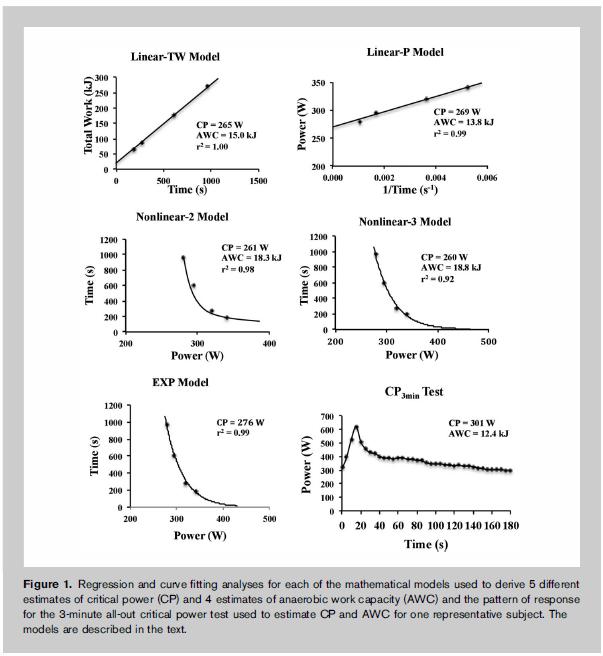
Not exactly that but, here you have a paper comparing several CP models variations using a 4-tests protocol and 3-min all out test:

Differences among estimates of critical power and anaerobic work capacity derived from five mathematical models and the three-minute all-out test.

Abstract

Estimates of critical power (CP) and anaerobic work capacity (AWC) from the power output vs. time relationship have been derived from various mathematical models. The purpose of this study was to examine estimates of CP and AWC from the multiple work bout, 2- and 3-parameter models, and those from the 3-minute all-out CP (CP3min) test. Nine college-aged subjects performed a maximal incremental test to determine the peak oxygen consumption rate and the gas exchange threshold. On separate days, each subject completed 4 randomly ordered constant power output rides to exhaustion to estimate CP and AWC from 5 regression models (2 linear, 2 nonlinear, and 1 exponential). During the final visit, CP and AWC were estimated from the CP3min test. The nonlinear 3-parameter (Nonlinear-3) model produced the lowest estimate of CP. The exponential (EXP) model and the CP3min test were not statistically different and produced the highest estimates of CP. Critical power estimated from the Nonlinear-3 model was 14% less than those from the EXP model and the CP3min test and 4-6% less than those from the linear models. Furthermore, the Nonlinear-3 and nonlinear 2-parameter (Nonlinear-2) models produced significantly greater estimates of AWC than did the linear models and CP3min. The current findings suggested that the Nonlinear-3 model may provide estimates of CP and AWC that more accurately reflect the asymptote of the power output vs. time relationship, the demarcation of the heavy and severe exercise intensity domains, and anaerobic capabilities than will the linear models and CP3min test.
 

Karl-Axel Zander

unread,
Oct 30, 2017, 6:18:10 PM10/30/17
to golden-cheetah-users
Interesting, thanks

Manuel Oberti

unread,
Oct 31, 2017, 7:27:53 AM10/31/17
to golden-cheetah-users
Ale,
is possible to add this 6 charts on GC utilizing R ? HOW ?

thanks

Ale Martinez

unread,
Oct 31, 2017, 9:29:52 AM10/31/17
to golden-cheetah-users
El martes, 31 de octubre de 2017, 8:27:53 (UTC-3), Manuel Oberti escribió:
Ale,
is possible to add this 6 charts on GC utilizing R ?

Yes
 
HOW ?
For how to pull the data from GC there is a document in the wiki: https://github.com/GoldenCheetah/GoldenCheetah/wiki/UG_Special-Topics_Working-with-R

For how to fit and plot a linear model in R there are plenty of tutorials online, for example: http://www.theanalysisfactor.com/linear-models-r-plotting-regression-lines/

Non-linear models are tougher but also there are tutorials s.t. this introduction https://www.r-bloggers.com/first-steps-with-non-linear-regression-in-r/

Manuel Oberti

unread,
Oct 31, 2017, 11:13:42 AM10/31/17
to golden-cheetah-users
THANKS ALE

Mark Liversedge

unread,
Oct 31, 2017, 12:24:58 PM10/31/17
to golden-cheetah-users
There are some example charts of fitting linear and non-linear models in the cloud db, including the CP and eCP model.

Mark 

Martín Jiménez Hernández

unread,
Oct 31, 2017, 12:27:39 PM10/31/17
to golden-cheetah-users
So, would it be ok if I do the next protocol:

a) 15 mins warming up, ramping uo from 50% up to 70% (FTP)
b) 3 × 1 min of fast pedaling (with 1 min of recovery between intervals)
c) 3 mins recovery
d) 5 mins at 100% FTP.
e) 5 mins recovery
f) 3 mins all out (starting on pedals, mantaining cadence between 85-95 rpm)
g) Cooling down.

And then, once I get the CP using GC, can I simply use the CP value instead of FTP for my training plan? Assuming that the workouts may get more difficult??

Nathan Townsend

unread,
Nov 8, 2017, 6:26:28 AM11/8/17
to golden-cheetah-users
There is a recent paper which was published, and I reviewed another paper recently (not yet published but will be soon) and both of these papers conclude the same basic thing...

As long as you can get TWO GOOD quality TTs, then you can model CP + W' using the linear 1/time model and get essentially the same results as doing additional TTs.

Additionally the longest TT really needs to be greater than 10 min. I've done a lot of this testing in a research lab setting and my basic recommendation nowadays for a single day CP test is as follows:


1. Warm up
2. 2 - 3 min TT
3. 60 mins super easy active recovery 
4. 14 - 16 min TT

The TTs should be even paced as best as possible and performed in such a manner that you should continue to be giving a maximum effort yet be experiencing a decreasing power at the end.  Ideally you should continue to give it your maximum effort until the power decreases to around  50-100 W above approx predicted CP.  eg: If I think my CP is around 300, then at least 20-30s to go before end of the effort I should be giving a full on 100% maximal effort.  If I've even paced well already, there will not be a large increase in power, maybe just a marginal increase.  With about 15 s left, the power should be decreasing, but I'm still maxing out.  As long at the power is between 350 - 400W then I could stop. BUT, if I paced too conservatively and my power increased up to 600 w, and it is still 500 w upon reaching the TT duration target, well then, KEEP GOING until it falls below 400 W despite a maximum effort. 

Ron George

unread,
Nov 10, 2017, 4:42:36 AM11/10/17
to golden-cheetah-users
Couple of questions on the Bergstrom paper Ale posted :

1) Is there evidence from running (possibly using critical pace concept) that a 3 parameter model is best to reproduce the asymptote?

2) There models in implemented in GC but how does the user have an idea which "fits" best? There is a parameter called 'RANK' in the model box on the CP chart however almost 95% of the time, it says 'N/A' for my activities.  So this hasn't been useful.  Any way I can correct this?  Also, please define what 'rank' means, as I've been equating it to the quality of fit. For example, for all my runs with power data, the Ward-Smith model yields rank 5, extended CP is rank 3 and multicomponent is rank 4. How do you interpret this scale?  


Ron

Ale Martinez

unread,
Nov 10, 2017, 9:12:46 AM11/10/17
to golden-cheetah-users
El viernes, 10 de noviembre de 2017, 6:42:36 (UTC-3), Ron George escribió:
2) There models in implemented in GC but how does the user have an idea which "fits" best? There is a parameter called 'RANK' in the model box on the CP chart however almost 95% of the time, it says 'N/A' for my activities.  So this hasn't been useful.  Any way I can correct this?  Also, please define what 'rank' means, as I've been equating it to the quality of fit. For example, for all my runs with power data, the Ward-Smith model yields rank 5, extended CP is rank 3 and multicomponent is rank 4. How do you interpret this scale?  
It is intended for cycling ranking and it has no relation to goodness of fit, see https://github.com/GoldenCheetah/GoldenCheetah/blob/28e768a60cbbdec8cebb0fd6b5c53bdaa3a331ff/src/Charts/CPPlot.cpp#L570

Jozef Matejička

unread,
Nov 10, 2017, 12:11:28 PM11/10/17
to golden-cheetah-users
Nathan, so you suggest to try 30 seconds before end to go out and extend until power output stays above 130% of my too conservative pacing?

Now I have recorded it. How can I obtain my CP60 from this?

Thanks,

Jozef

P.S.: Do you also shorten TT? :D
Reply all
Reply to author
Forward
0 new messages