
w', tau, and exhaustion
2,080 views
Skip to first unread message

aaron Levin
Jan 28, 2016, 12:02:07 PM1/28/16
to golden-cheetah-users
I have read through may posts here on w' and found lots of talk about how to troubleshoot when W' goes negative. But how to does one deal with a situation where W' stays high, despite onset of exhaustion? Using the CP and W' modeled by Golden Cheetah, I can repeat 1-3 minute intervals with equal rest intervals until I can't pedal anymore, but W' recovers between each interval. Could my tau setting be too short? Or is W' overestimated? Or can one be unable to do above threshhold VO2 work even in the presence of plenty of W'

Lucas
Feb 1, 2016, 2:22:46 AM2/1/16
to golden-cheetah-users
the same thing is happening here.
and by what I've been reading, it seems that the more data you upload, the more precise is your W'bal estimation.

Mark Liversedge
Feb 1, 2016, 2:32:28 AM2/1/16
to golden-cheetah-users
On Monday, 1 February 2016 07:22:46 UTC, Lucas wrote:
the same thing is happening here.
and by what I've been reading, it seems that the more data you upload, the more precise is your W'bal estimation.
This comes up regularly and is related to how you estimate CP and W'.
I will write up an article for the website since it is so common.
Here is some advice from Nathan Townsend in a similar thread last year.
Mark
"In multiple posts in this thread I'm seeing the same basic mistake.... using some method or another which is a suggested "test" of FTP and using that value as CP in the W'bal model, then tweaking the value of W' to make the W'bal model "fit" properly. This is wrong due to real physiological mechanisms and not because of some mathematical anomaly of the model. In virtually every case where an estimate of FTP is used in place of CP, it looks as though W'bal is being underestimated and thus going negative prior to the point of fatigue. Getting CP set correctly is FAR more important than tweaking W'.
Do not use the 95% fudge factor. Do not do a 40km TT. Do not estimate CP using any method whatsoever which is a recommended "test" of FTP. I know it might be hard for lay people to understand why, but there is simply far too much scientific evidence which invalidates the use of an "FTP like" variable for the purposes of representing a true physiological threshold. Making sure critical power is set correctly underpins the W'bal model.
I do not recommend the 3/20 test to estimate CP + W' because there are not enough points on the curve and so there is a larger risk of error in estimating CP when a linear regression is used in this case. eg: if two cyclists have a 20MMP of 300 but one of them has a 3MMP of 450 and the other is 400W, then the guy with the higher 3MMP will end up with a lower CP by about 10W and it will increase W' by a large amount also. This might be a possible explanation, but exactly the same result could occur by having a higher CP in combination with a marginally higher W'. If you start to add in more points, then each individual data point has less leverage and thus less chance of inducing an error. The recommendation is to conduct 3-5 tests in the range 3-15min and my strongest advice is to stick to these recommendations. You could even fit several models to this data and then take an average CP + W' value. See Bull et al (2000) as an example.
It's not that hard to do people. You can even do three test durations in a single workout with a 30min recovery period in between! As a doublecheck, go and do a 20-30 min TT. If you are relatively out of shape, choose closer to 20min. If you're in good shape then choose closer to 30min. This value should coincide closely with your CP estimate.
Finally, once you've got you CP + W' estimates, then you should lead with tweaking the CP value first in order to derive W'bal = 0 at the point of complete task failure."

tfk
Feb 1, 2016, 12:45:40 PM2/1/16
to golden-cheetah-users
Mark - that write up will be useful. Of particular interest to me would be how W' can be tinkered with after determining a good CP.
Nathan's reposted comments are thought provoking!
aaron Levin
Feb 1, 2016, 1:14:25 PM2/1/16
to golden-cheetah-users
I agree that accuracy in CP and w' calculation are important, but in reviewing most of the posts here, it seems that underestimating CP is probably the most common issue, leading to negative W' balance readings. In my case, I feel that CP and W' are probably pretty close to accurate. In the 3 minute and 2 minute interval workout I did last week, I use up almost all the available W' with each individual effort--and I am pretty close to exhausted at the end of each individual interval.
If my W' was miscalculated or the CP was inaccurate, I would not be able to use up all the w' (cp or w' too high) or would go negative (cp or w' underestimated). The issue I have is that with 2 or 3 minutes of recovery, I apparently regenerate all my W'. By these standards I should be able to keep doing these VO2 intervals all day as far as W' is concerned. But I run out of gas by about the 8th interval. This suggests to me that tau is somehow inaccurate in my case. I changed the preset differential equation to the integral equation at Nathan Townsend's suggestion and did a similar workout yesterday will much more believable results. W' steadily dropped throughout the workout, regenerated approx only about 50% percent with each rest interval, and I "predictably" failed at the 10th interval. BTW, I do love golden cheetah and thanks to all those who make it tick so wonderfully.

Chris Cleeland
Feb 1, 2016, 1:27:54 PM2/1/16
to Mark Liversedge, golden-cheetah-users
On Mon, Feb 1, 2016 at 1:32 AM, Mark Liversedge <liver...@gmail.com> wrote:
Chris Cleeland
The recommendation [to determine CP] is to conduct 3-5 tests in the range 3-15min and my strongest advice is to stick to these recommendations.
Is there a recipe for this protocol? Are these tests performed on different days but at the same duration, or are they performed on the same day at different durations?
I would google, but "critical power" is a pretty overloaded term.
Chris Cleeland
aaron Levin
Feb 1, 2016, 2:58:36 PM2/1/16
to golden-cheetah-users
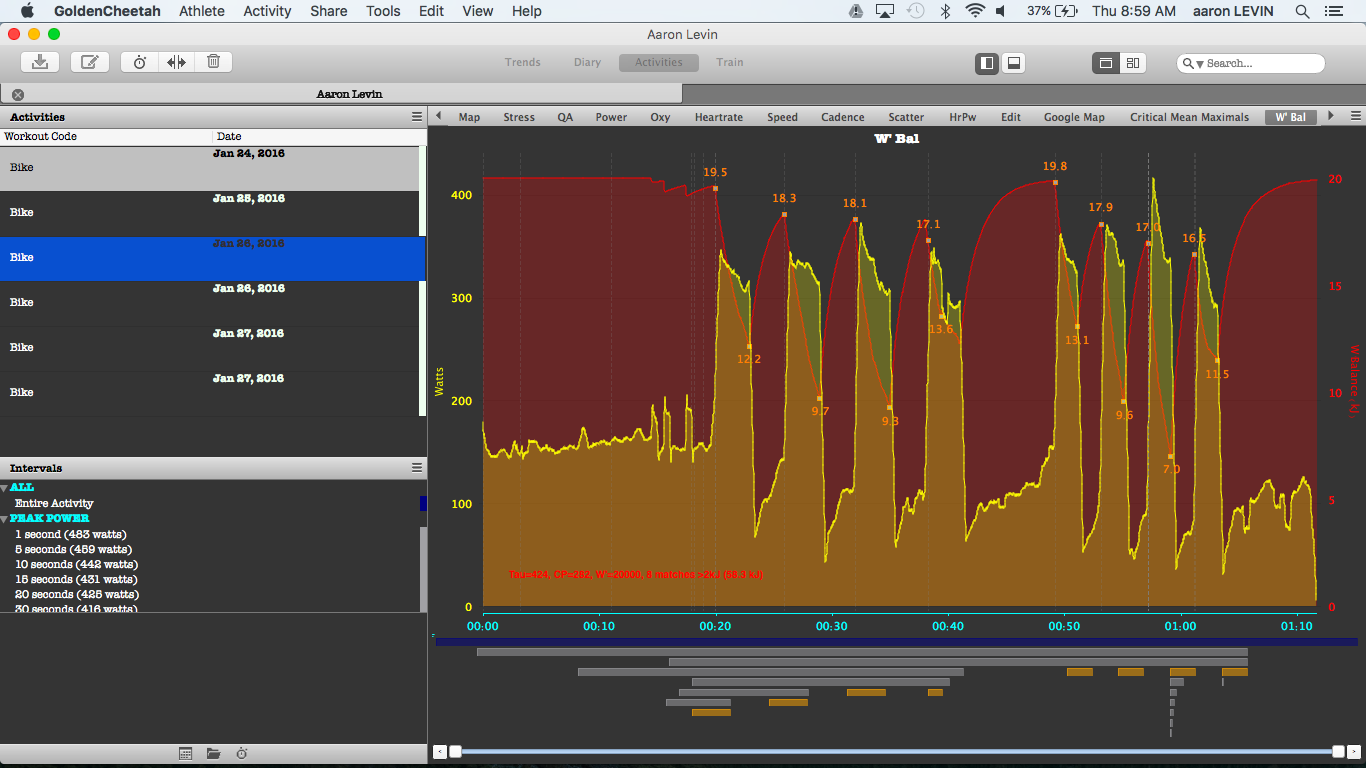
Here is a workout I did yesterday, analysed using the integral form of the equation. This graph seems more realistic than the prior interval workouts using the differential equation, where I couldn't approach zero Wbal after 8 intervals, despite riding mysedf to exhaustion. I'm still puzzled by the physiological explanation for why it seem to become easier to recover W' as a workout progresses--that seems counterintuitive. The more tired one gets the harder it should be to recover if the workload and rest intervals stay constant.
aaron Levin
Feb 1, 2016, 7:45:54 PM2/1/16
to golden-cheetah-users
I just reread my posts, and I probably wasn't clear. I think that my CP is probably close to accurate as calculated by GoldenCheetah, and W' is also probably close to accurate. I attached two similar interval workouts, one calculates W'bal using differential equation method and the other using the integral method. It seems that for these intervals of 1-4 minute duration with equal work to rest ratios, the differential equation overestimates recovery of W', and thus I can find myself exhausted but with still plenty of W' in the tank. The integral method appears to track the way I feel--I can no longer maintain the wattage for a given interval when the W' is exhausted. But I still don't understand why even in the integral method there seems to be an improved recovery of W' as the workout progresses. Mark Liversedge mentioned that this was the case in a separate thread, but I can't understand how that can physiologically be true. My goal in this is to be able to design a workout, and know how many intervals I should be able to maintain at a fixed wattage with a given amount of rest.
Thanks, Hope this makes more sense.
Aaron

Nathan Townsend
Feb 3, 2016, 2:11:50 AM2/3/16
to golden-cheetah-users
On Thursday, 28 January 2016 20:02:07 UTC+3, aaron Levin wrote:
I have read through may posts here on w' and found lots of talk about how to troubleshoot when W' goes negative. But how to does one deal with a situation where W' stays high, despite onset of exhaustion? Using the CP and W' modeled by Golden Cheetah, I can repeat 1-3 minute intervals with equal rest intervals until I can't pedal anymore, but W' recovers between each interval. Could my tau setting be too short? Or is W' overestimated? Or can one be unable to do above threshhold VO2 work even in the presence of plenty of W'
Hi Everyone,
I've been charging through a bunch of data recently on a group of cyclists. We tested for CP + W' at various alttiudes, and they also did an interval workout which contains some max effort 5 sec sprints (see attached). This workout is done at 2250m btw. Anyway, this is the integral model shown, and what we can see is that the sprint efforts make a huge impact on Wbal, such that W'bal goes negative. I didn't find this previously in another study in which we only did 60 s intervals, although in that study we estimated CP using the 3min AOT, which definitely leads to high values for CP.
What I think is going on here has something to do with central regulation of descending motor drive (see study below). The central effect probably recovers much more rapidly than peripheral mechanisms of fatigue. I don't think the integral formula deals with this very effectively because it is monoexponential. Therefore, after very short periods of recovery you are able to produce almost near peak power. If your W'bal was reduced to say 2 or 3 kJ from a previous longer duration interval, then it just doesn't recovery quick enough. So then you do a sprint effort and it can be dropped negative. In Phil Skiba's original article which introduced the W'bal integral formula, he discusses a biexponential approach. So what I think is that a biexponential approach might potentially work better, since the fast tau could represent rapid recovery of muscle activation, whereas the slow tau would represent recovery of peripheral fatigue mechanisms.
Task Failure during Exercise to Exhaustion in Normoxia and Hypoxia Is Due to Reduced Muscle Activation Caused by Central Mechanisms While Muscle Metaboreflex Does Not Limit Performance.
On the flipside (ie: power production as opposed to recovery), it looks as though a similar concept may apply ie: explosive all out sprint activity induces a rapid central mode of 'fatigue' (which is probably better described as regulation) that rapidly reduces muscle activation, hence leading to decreased force output. This central component probably occurs well before there is even enough time for peripheral fatigue to develop.
Central fatigue contributes to the greater reductions in explosive than maximal strength with high-intensity fatigue.
The biggest challenge in understanding W' is that there is no doubt it is a combination of both central and peripheral mechanisms, but knowing the relative contribution of each at any moment in time is highly complex. The way we currently test for CP + W' though dictates that the peripheral mechanisms dominate. Similarly, the current versions of the W'bal formula probably model the peripheral component reasonably well, but if central fatigue rises or falls rapidly, then the model doesn't account for this effectively. I think this is part of the reason why the basic 2p CP model tends to overestimate power at short duration ie: it predicts that you have not generated enough peripheral fatigue to cause "task failure" at a given power since it doesn't account for the effect of central fatigue which is overlayed on top, and contributes an additonal mechanism that reduces the power (or duration) compared to predicted. The 3p model tries but falls short because the parameter of Pmax is not dynamic. The same limitation exists in the WKO4 model btw ie: there is no term which describes the dynamic influence of central regulation of muscle activation. It is becoming very clear (to me at least) that any model of power v duration, which is essentially a model of fatigue versus time, is conceptually incomplete unless a parameter which describes central regulation is included, and we get the behaviour of that parameter right.
Lastly, lets assume you do a work which does not contain sprint efforts.... if you're fatigued from previous training, well then you expect W'bal to stay positive when you have a crack at a max effort. But if you've improved fitness without updating the CP + W' values (which can easily occur), then you'll be able to push it negative.

Will
Feb 3, 2016, 9:03:06 AM2/3/16
to golden-cheetah-users
That is interesting, Nathan, thank you. I recall reading Skiba somewhere saying that microintervals can "break" the CP/W' model (i.e., take it below 0), which fits in with what you're saying. Actually, with your explanation it all makes a lot more sense.
Will



Daniele Marrama Saccente
Feb 4, 2016, 6:11:13 AM2/4/16
to golden-cheetah-users
Congratulations Nathan for clarity and for sharing your experience
Thank you
Daniele
Reply all
Reply to author
Forward
0 new messages