
Happy Gudipadwa- From Ashvin Ghamandi,

Ashvin Ghamandi


Gudhi Padwa is celebrated as Ugadi (or Yugadi) in Karnataka and Andhra Pradesh. The day, begins with ritual showers (oil bath) followed by pooja to god and Panchanga Shravana.Houses are decorated with Mango Leaves and Rangoli and everyone in the family wear new clothes and celebrate the festival by wishing each other New year greetings.
The eating of a specific mixture called Bevu-Bella (Neem and Jaggery) in Kannada, symbolizes the fact that life is a mixture of good and bad, Happiness and Sorrow. Eating Neem and Sweet Jaggery means one need to take both Good and Bad or Happiness and Sorrow should be accepted together and with equanimity through the New Year. The special mixture consists of:
1. Neem Buds/Flowers for its bitterness, signifying Sadness
2. Jaggery which is sweet, signifying Happiness
In Karnataka a special dish called Obbattu or Holige (Puran Poli), is prepared on this occasion. It consists of a filling (gram and jaggery/sugar boiled and made in to a paste) stuffed in a flat roti like bread. It is usually eaten hot/cold with ghee or milk topping or coconut milk at some places of Karnataka.
Science in the worship of the Gudi
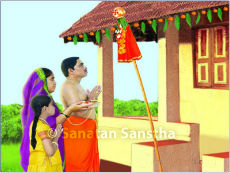 ‘Gudi Padwa’ is the day on which the universe was created. Since on this day Shri Brahma created the universe and the Satyayug began, it marks the commencement of the New Year.
The Divine consciousness emanating during sunrise, absorbed at that time lasts longer. Thus the Gudi should be worshipped within 5-10 minutes after sunrise !
On Gudi Padwa, the waves consisting of the fire principle (Tej tatva) and the creative Prajapati waves are activated on a large scale. The Divine consciousness emanating during sunrise, absorbed at that time lasts longer. This consciousness is stored in the body cells and is used as required. Hence the Gudi should be worshipped within 5-10 minutes after sunrise.
Method of raising the Gudi
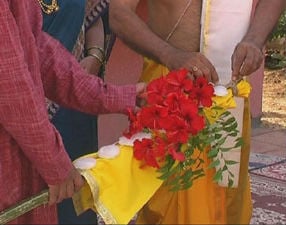 Position of the Gudi: Care should be taken to raise the Gudi next to the main entrance of the house. The spot selected should be on the right side of the entrance(when facing outwards from the entrance of the home). The right side symbolizes the active state of the soul.
1. The area selected for raising the Gudi should be cleaned and then a Swastik rangoli should be drawn on the ground. Turmeric and vermilion (Haldi-kumkum) should be offered at the centre of the Swastik.
2. While raising the Gudi, the ‘Shiva-Shakti’ principle in the Universe should be invoked. This enables all the constituents of the Gudi to accept divine principles.
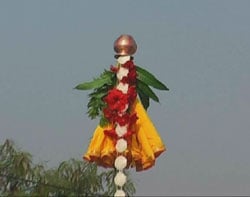
3. The Gudi symbolizes the ‘Sushumna nadi’ of our body. Hence, the Gudi should be raised at the entrance. And it should be kept tilted at an angle. – A Scholar (through the medium of Ms. Anjali Gadgil)
Prayer
‘O Lord Brahma, Lord Vishnu ! Please enable me to absorb the Principle of Creation and the Fire Principle present in the atmosphere. Let the Divine consciousness present in these principles be preserved constantly. Let the energy thus received, be used for my spiritual practice.’
Significance of Gudi Padwa
 There are several ways of commencing a New Year. According to the Christian calendar, 1st January marks the beginning of the year. The financial year begins from 1st April, the Hindu New Year from the first day (Pratipada) of the month of Chaitra from the Hindu lunar calendar, the commercial year from the first day of the Hindu lunar month of ‘Kartik’, the solar (soura) year, the lunar (chandra) year, the luni-solar year and so on. In all these, the year comprises of twelve months. Who first proclaimed that a year should consist of twelve months and how did the world come to accept it ? The foremost exponent of this concept is undoubtedly the Vedas, the most ancient literary texts. The Vedas say, ‘A year consists of twelve months’. It is because they say so that the world has accepted it. Out of all these days of beginning a year the most ideal one is the first day of the month of Chaitra according to the Hindu lunar calendar.
One should note that there is no explanation as to why the 1st of January is the beginning of the New Year. Someone conceived that it should be so and thus it began. Contrary to this, there are natural, historical and spiritual reasons to mark the commencement of the year on the first day of the month of Chaitra.
1. Natural: Towards the first day of the month of Chaitra (Padva), the sun assumes a position above the Vasant intersection (the point of intersection of the equator and the meridians) and the spring season commences. In Shrimadbhagvadgita (10.35), The Lord says, ‘Among the seasons, the exhilarating Vasant season (spring) is my manifestation’. In this season, the weather is pleasant and exhilarating. In the Shishir season (autumn) the trees shed their leaves. Towards Padva, trees bear new foliage and appear fresh.
2. Historical: Rama slayed Vali on this day. The Shakas too defeated the Huns on this day. This day also commemorates the commencement of the Shalivahan calendar after Shalivahan vanquished his enemies.
3. Spiritual
3 A. Creation of the universe: Since on this day Shri Brahma created the universe and the Satyayug began, it marks the commencement of the New Year.
3 B. One among the three and a half auspicious days (‘Muhurts’): Gudhipadva, Akshay trutiya and Dasra (Vijayadashmi) each make up one, and the first day of the Hindu lunar month of Kartik comprises half of the total three and a half auspicious days. The special feature of these three and a half auspicious days is that unlike other days when one has to choose an auspicious moment to perform a ritual, in contrast, on these auspicious days one does not need to, as every moment of these days is auspicious.
3 C. The higher incidence of prajapati sanyukta (conjoint) frequencies on the earth: The tantra text Ganeshyamal states that in all 108 frequencies, one each from the four parts (charans) of the twenty-seven lunar asterisms from the region of lunar asterisms (nakshtralok / karmadevlok) 27×4=108 reach the earth. They disintegrate further into four types of frequencies – yama, surya, prajapati and sanyukta (conjoint).
On this day, the Tej and Prajapati frequencies are effective in large measures. During sunrise on this day, the Chaitanya (Divine Consciousness) emitted from these frequencies can be retained for a longer period. It is accumulated in the cells of the embodied soul and is used by the embodied soul as and when required. Therefore within 5-10 minutes of sunrise one should perform ritualistic worship of the Gudi.

Cell No - 91-094231-73435 | 91-092265-88604
Email- ashving...@gmail.com | rachan...@gmail.com
P Please don't print anything unless you really need to - this will preserve trees on planet earth.
Save Environment. P