SOLAR GEOENGINEERING WEEKLY SUMMARY (09 SEPTEMBER - 15 SEPTEMBER 2024)

32 views
Skip to first unread message

Geoengineering News

unread,
Sep 16, 2024, 4:30:25 PM9/16/24
to geoengineering
SOLAR GEOENGINEERING WEEKLY SUMMARY (09 SEPTEMBER - 15 SEPTEMBER 2024)

Subscribe to our newsletter to receive monthly updates on Solar Geoengineering:


DEADLINES

Call for Abstract—YHYS Colloquium 2024 | Deadline: 16 September 2024
Session: Climate interventions as a phenomenon of the Anthropocene: Environmental social sciences research into the suggested stopgap measures.
Call for Proposals—WCRP Climate Global South Fellowship provides young researchers the opportunity to develop their own research initiatives, including on SRM | Deadline for submitting applications: 30 September 2024
(NEW) Call for Proposals—Exploring Climate Cooling | Deadline to submit concept paper by 07 October 2024 | Full Proposal deadline is 09 December 2024
Funding opportunity: Modelling environmental responses to solar radiation management by Natural Environment Research Council (NERC) | Deadline to apply: 08 October 2024
Call for Submission—Repair Conference 2025 by Centre for Climate Repair | Deadline: 31 October 2024
Applications for presentations and posters are required in the following areas:
-Stratospheric Aerosol Injection
-Marine Cloud Brightening
-Seabed Curtains
-Sea Ice Thickening
-Space Sun Shades
-Other Arctic Repair Topics (e.g. glacier drainage, land surface albedo enhancement, cirrus cloud thinning, ocean foaming etc.)
Submit your recent research on Solar Radiation Management to new ES: Atmospheres collection | Deadline: 31 January 2025

RESEARCH PAPERS

An investigation of the relationship between tropical monsoon precipitation changes and stratospheric sulfate aerosol optical depth

Xavier, A., Bala, G., Roose, S., & Kh, U. (2024). An investigation of the relationship between tropical monsoon precipitation changes and stratospheric sulfate aerosol optical depth. Oxford Open Climate Change, 4(1), kgae016.

Abstract

Stratospheric aerosol geoengineering (SAG) is one of the several solar geoengineering options that have been proposed to counteract climate change. In the case of SAG, reflective aerosols injected into the stratosphere would reflect more sunlight and cool the planet. When assessing the potential efficacy and risks of SAG, the sensitivity of tropical monsoon precipitation changes should be also considered. Using a climate model, we perform several stylized simulations with different meridional distributions and amounts of volcanic sulfate aerosols in the stratosphere. Because tropical monsoon precipitation responds to global mean and interhemispheric difference in radiative forcing or temperature, we quantify the sensitivity of tropical monsoon precipitation to SAG in terms of two parameters: global mean aerosol optical depth (GMAOD) and interhemispheric AOD difference (IHAODD). For instance, we find that the simulated northern hemisphere monsoon precipitation has a sensitivity of −1.33 ± 0.95% per 0.1 increase in GMAOD and −7.62 ± 0.27% per 0.1 increase in IHAODD. Our estimated precipitation changes in terms of the two sensitivity parameters for the global mean precipitation and for the indices of tropical, northern hemisphere, southern hemisphere and Indian summer monsoon precipitation are in good agreement with the model simulated precipitation changes. Similar sensitivity estimates are also made for unit changes in global mean and interhemispheric differences in effective radiative forcing and surface temperature. Our study based on planetary energetics provides a simpler framework for understanding the tropical monsoon precipitation response to external forcing agents.

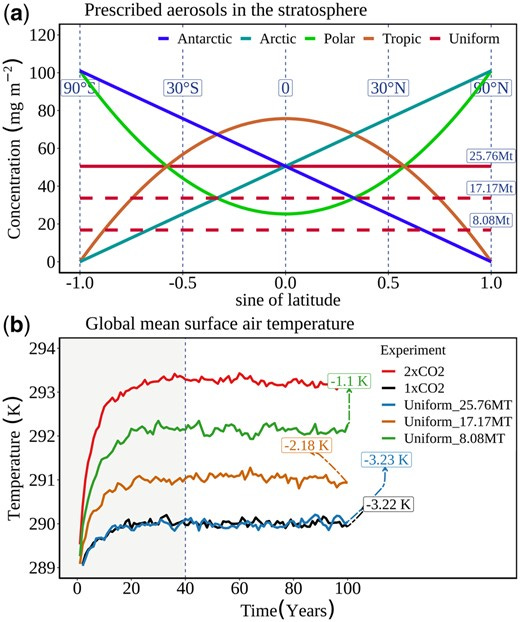
(a) The meridional distribution of zonal mean concentration of volcanic sulfate aerosols prescribed in the stratosphere and (b) the temporal evolution of the global-mean annual surface temperature in the 100-year slab-ocean simulations in the 1 × CO2, 2 × CO2 and the Uniform cases where the total amount of aerosols is 25.76, 17.17 and 8.08 Mt. The numbers in (b) show the global annual mean change in surface temperature in the respective experiment relative to the 2 × CO2 simulation averaged over the last 60 years (non-shaded region).

THESIS

The disappearance of ship tracks – on the impact of sulfur reduction in marine fuel on the climate

Mirčetić, N. (2024). The disappearance of ship tracks–On the impact of sulfur reduction in marine fuel on the climate (Doctoral dissertation, Technische Universität Wien).


REPORT

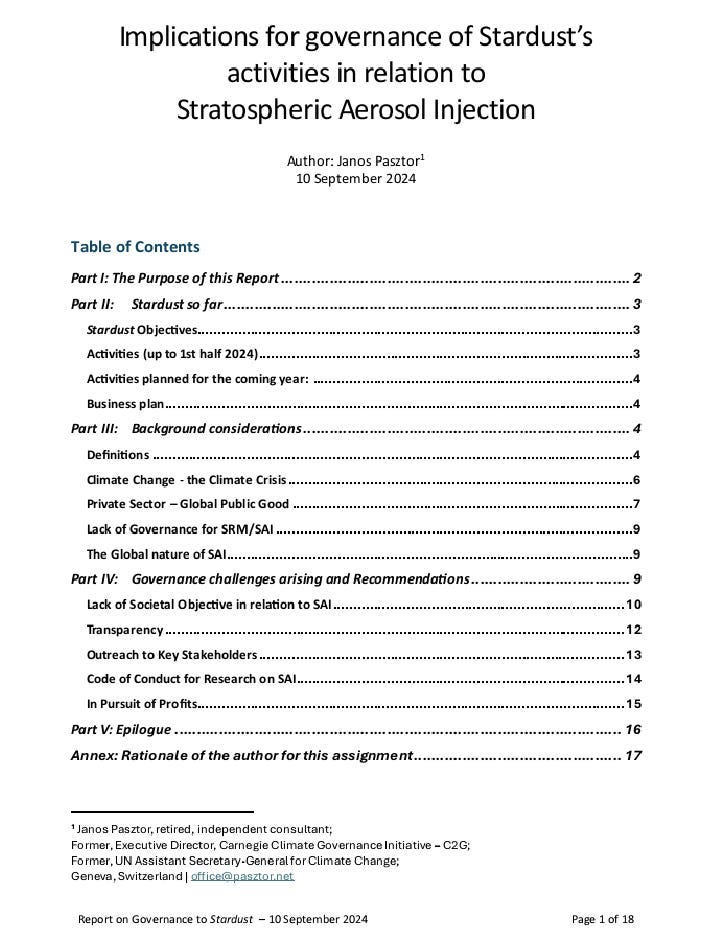
Implications for governance of Stardust’s activities in relation to Stratospheric Aerosol Injection— A report by Janos Pasztor


WEB POSTS

Cloud Brightening Over Oceans May Stave off Climate Change, but With Risk (Good Men Project)
Opportunities and Risks: Solar Geoengineering Scenarios for Climate Change Mitigation by 2050 (Politics_DZ)
U.K. to Fund ‘Small-Scale’ Outdoor Geoengineering Tests (New York Times)
American scientists are trying to deflect sunlight back to space to help cool Earth (Google)
Silicon Valley startup's rogue effort to cool planet met with controversy (CBS News)
Security Implications of Climate Change and Climate Interventions (ICFG) 
Will We Be Ready? Geoengineering Policy Lags Far Behind Pace of Climate Change (Good Men Project)
A Note On Joining The Oversight Committee for ARIA program on Exploring Climate Cooling Options (DSG)
The UK is building an alarm system for climate tipping points (MIT Technology Review)

JOB OPPORTUNITY

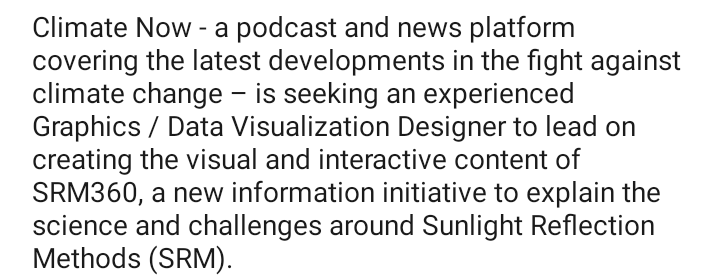
Data Visualization Designer at Climate Now | New York, United States


UPCOMING EVENTS

RFF 2024 SRM Social Science Workshop: Cooperative vs. Non-Cooperative Interventions | 19-20 September 2024 | Washington, DC.
Freetown: Cooling a City at the NYC Climate Film Festival | 22 September 2024 | NYC 
Enlisting Sunlight in the Fight Against Climate Change | 23 September 2024 | New York
Solar Geoengineering: Perspectives on Risks, Governance Implications and Political Challenges at New York Climate Action Week | 23 September 2024 | New York
Climate Intervention Roundtable by SilverLining and ClimateImpact | 24 September 2024 | United States 
(NEW) Solar Geoengineering: What You Need to Know by GBH | 24 September 2024 | Online
Harvard Presents: Time to Think About Solar Geoengineering? at Climate Week New York | 24 September 2024 | New York
The Dangers of Goengineering as a Response to Climate Change at Climate Week NYC | 24 September 2024 | New York
Moving beyond polarization on climate interventions by DSG and ICFG | 25 September 2024 | New York 
Climate Tipping Points and Solar Geoengineering at Harvard Kennedy School | 26 September 2024 | United States 
Exploring the Ethics and Societal Interactions of Climate Intervention by the U.S. National Science Foundation
(Modifying Solar Radiation | 14 October 2024 | Online

Discovery workshop focussing on atmospheric science (SRM) | 18 October 2024 | Online

Integrative synthesis workshop focusing on identifying gaps in current governance & ethics | 18 November 2024 | Online

2025 Solar Radiation Management Annual Meeting by Simons Foundation | 24-25 April 2025 | New York 
The 2025 Degrees Global Forum | 12-16 May 2025 | Cape Town, South Africa
Artic Repair Conference 2025 by University of Cambridge & Center for Climate Repair | 26-28 June 2025 | Cambridge UK

Solar Geoengineering Events Calendar


PODCAST

Near term Arctic SRM - Wake Smith | Reviewer 2 does geoengineering

Near term Arctic SRM - Wake Smith

Reviewer 2 does geoengineering

1:22:21

"What would a mid-century polar geoengineering program look like? What airports and aircraft would be needed - and at what cost? Wake Smith answers all these questions."


YOUTUBE VIDEOS

Oliver Morton at ‪@Cornell‬ : "Carl Sagan, the climate crisis and planetary engineering" | Daniele Visioni

"Live recording of Oliver Morton (The Economist) talk at Cornell University, as part of the 14th GeoMIP workshop. 
Carl Sagan and Jim Pollack wrote together in 1993: "Clearly more work is needed, but comparatively inexpensive and environmentally prudent methods of mitigating greenhouse warming on Earth may be within reach in the next few decades." Sagan always thought 
about planetary climates as things which could be engineered, with papers on terraforming Mars and Venus in the 1960s and 1970s; it is a way of thinking which can be traced back to that of Arrhenius and the other early comparative planetologists of the late 19th/early 20th century. Applying it in a straightforward way to the Earth is problematic in ways Sagan may well not have appreciated. But what he wrote with Pollack thirty years ago was arguably true then and seems true now. What are we to make of the possibility?"

Jeroen Oomen and David Keith debate the Solar Geoengineering Non-use Agreement | UnLivable Cultures Pod

"This episode got a little spicy, and is a must listen for anyone who cares about climate change, geoengineering, or collaboration between natural and social scientists."

Bay Area startup implements controversial plan to combat climate change | KPIX | CBS NEWS BAY AREA

"A strategy to cool the planet using Stratospheric Aerosol Injection (SAI) is being tested in the field in the South Bay. Molly McCrea and Anne Makovec report."


Reply all
Reply to author
Forward
0 new messages