| SOLAR GEOENGINEERING WEEKLY SUMMARY (16 SEPTEMBER - 22 SEPTEMBER 2024) Subscribe to our newsletter to receive monthly updates on Solar Geoengineering:
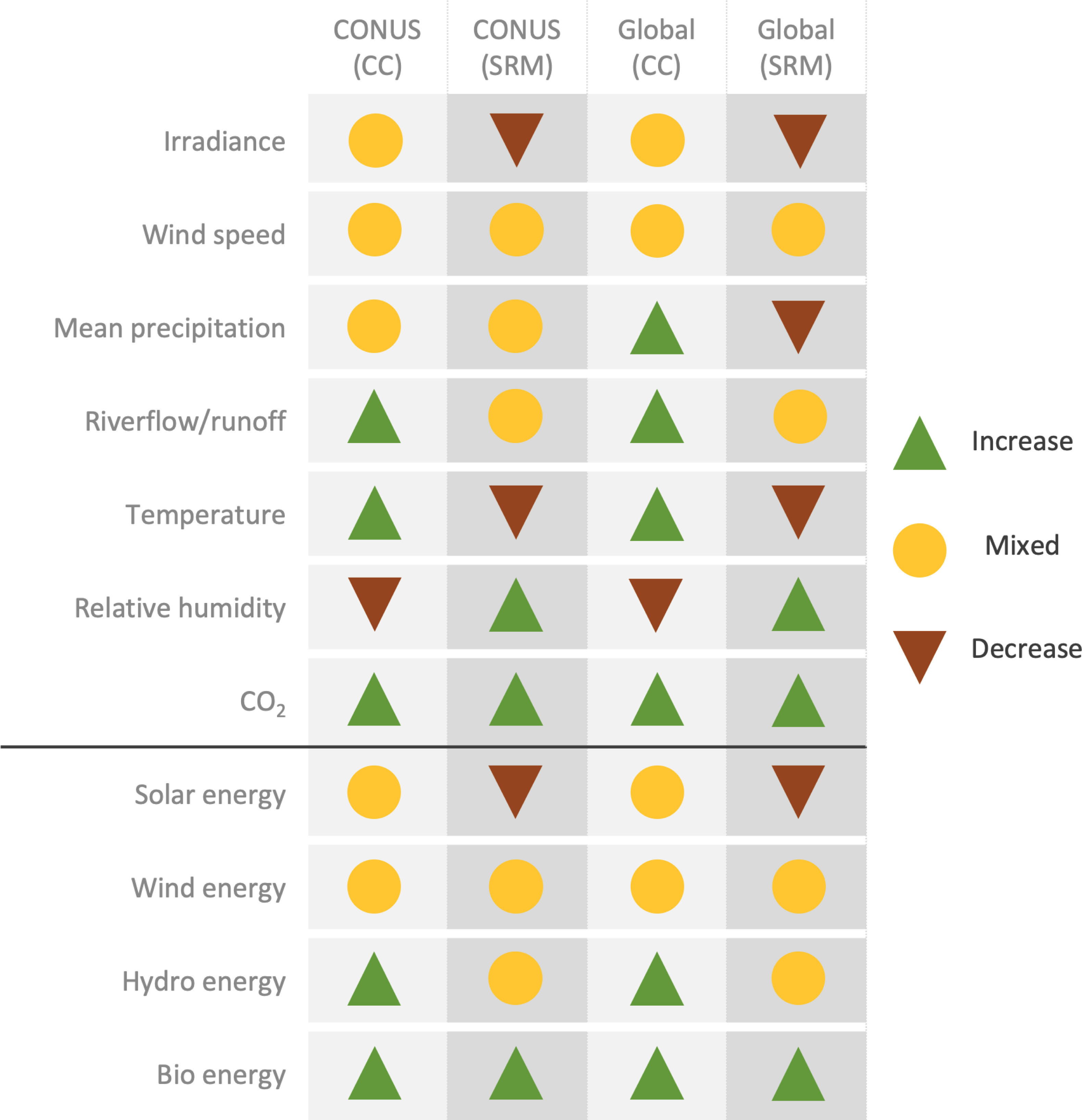
RESEARCH PAPERSKumler, A., Kravitz, B., Draxl, C., Vimmerstedt, L., Benton, B., Lundquist, J. K., ... & Tao, L. (2025). Potential effects of climate change and solar radiation modification on renewable energy resources. Renewable and Sustainable Energy Reviews, 207, 114934. Abstract Solar radiation modification (SRM) is a possible deliberate approach to decrease or reflect incoming solar radiation with the goal of reducing global temperatures, which have increased over the last decades due to high atmospheric greenhouse gas concentrations. Stratospheric aerosol injection, specifically, has shown potential for successfully reducing global temperatures in climate model simulations. Despite the growing literature in the areas of climate change and SRM, their combined effects on renewable energy generation, a climate change mitigation strategy, have not been addressed. In this review paper, we synthesize previous literature on the possible effects of climate change and SRM on renewable energy resources (i.e., wind energy, solar energy, biomass energy, and hydropower), review the status of climate change and SRM research, and explore potential effects of SRM on renewable energy primarily in the Continental United States (CONUS), but with global perspectives as well. We discuss the research challenges and impacts of SRM on renewable energy and conclude by discussing the potential implications of SRM for renewables for SRM governance and policy. This work is not advocating for or against SRM. It is highlighting an important potential impact for future decision makers.
Keys, P. W., & Bell, C. M. (2024). Designing a scenario of unilateral climate intervention. Abstract Climate change is causing increasingly alarming global impacts, such as rising temperatures and more severe storms. Despite this, current multilateral initiatives and agreements to systematically reduce greenhouse gas emissions are completely incommensurate with the scale of the problem. Thus, we explore the potential that some unilateral actor, finding present and near-future climate changes intolerable, may seek to respond to these changes through its own deliberate intervention in the climate. Focusing specifically on stratospheric aerosol injection (SAI), which is the dispersal of reflective particles in the stratosphere to reflect some of the sun’s energy away from Earth, we seek to identify the characteristics of states that might be most likely to modify the climate without broad international consensus. We develop a framework of geopolitically-relevant conditions that progressively reduce the number of candidate states, with the aim of identifying plausible unilateral SAI initiators. These conditions consider the state’s capacity to deploy SAI, variability in states’ motivations to change their local climates, the confidence that a deployment could be sustained and might produce the intended effects, and the state’s insensitivity to global condemnation, should the international community disapprove of this action. We provide a detailed explanation of each of these conditions along with discussion of potential candidate states. Our results highlight a concentration of states meeting all or most of these conditions in the vicinity of the Arabian Sea. Based on this finding, we conclude with a discussion of how this type of geopolitical scenario development can be integrated into social-physical simulations of geopolitically plausible climate intervention scenarios.
Mayer, K. J., Barnes, E. A., & Hurrell, J. W. (2024). Future Seasonal Surface Temperature Predictability with and without ARISE-Stratospheric Aerosol Injection-1.5. Authorea Preprints. Abstract To help reduce anthropogenic climate change impacts, various forms of solar radiation modification have been proposed to reduce the rate of warming. One method to intentionally reflect sunlight into space is through the introduction of reflective particles into the stratosphere, known as stratospheric aerosol injection (SAI). Previous research has shown that SAI implementation could lead to future climate impacts beyond surface temperature, including changes in the distribution of future tropical precipitation. This response has the potential to modulate midlatitude variability and predictability through atmospheric teleconnections. Here, we explore possible differences in seasonal surface temperature predictability under a future with and without SAI implementation, using the ARISE-SAI-1.5 simulations. We find significant future predictability changes in both boreal summer and winter under SSP2-4.5 with and without SAI. However, during boreal winter, some of the increases in future predictability under SS2-4.5 are mitigated by SAI, particularly in regions impacted by ENSO teleconnections.
WEB POSTS
THESIS
UPCOMING EVENTSDiscovery workshop focussing on atmospheric science (SRM) | 18 October 2024 | Online Integrative synthesis workshop focusing on identifying gaps in current governance & ethics | 18 November 2024 | Online
1: On the bright side: new developments in Marine Cloud Brightening technology | 16 October 2024 2: Field trials for a cooler planet: sea, sky and ice | 23 October 2024 3: Ethics and Governance (title TBA) | 06 November 2024 4: Good COP, Bad COP: a post-COP29 assessment | 27 November 2024
Solar Geoengineering Events Calendar
YOUTUBE VIDEOSSolar Geoengineering One Balloon at a Time? with Luke Iseman | Climate Chat “In this Climate Chat episode, we talk with Make Sunsets co-founder Luke Iseman about his approach to "cooling the Earth" by launching balloons into the stratosphere with tiny amounts of sulfur in them. While purposefully putting sulfur into the stratosphere at large scale (called solar geoengineering or solar radiation management (SRM)) is proposed as way to offset global warming, many in the SRM community are opposed to Make Sunsets' "rouge" approach.”
Episode 632 SAI or Why Not | ToSaveTheWorld “Ye Tao is the founder of MEER, an organization that promotes the potential use of mirrors on land to reflect heat back into space. John Nissen and Herb Simmens are both leaders of HPAC, the Healthy Planet Action Coalition, which considers the possible effects of various proposals for cooling the planet -- especially the Arctic.”
Solar Climate Intervention Virtual Symposium 12 (Dr. Ye Tao & Linus Boselius) | Solar Climate Intervention Talks “Solar Climate Intervention Virtual Symposium 12 Dr. Ye Tao (Mirrors for Earth's Energy Rebalancing) : "From Geo-Experiments to Geoengineering—the Journey Ahead for Energy Rebalancing at the Earth's Surface." Linus Boselius (University College London, UK) : "Peak Shaving with Solar Radiation Management Would Shorten Global Temperature Overshoot"
Which aspects of Solar Radiation Modification intrigue or concern young people the most? | SRM Youth Watch “Join SRM Youth Watch as we reflect on last year's journey at New York Climate Week, where we officially launched and connected with brilliant young minds from around the world. This year marks a truly historic moment for future generations with the Summit for the Future taking place from the 20th to the 23rd of September at the 79th United Nations General Assembly. During this time, Heads of State and Government will gather at the United Nations Headquarters to forge a new international consensus on how we can deliver a better present and safeguard the future.”
| |