| Welcome to the Solar Geoengineering Updates Newsletter, a monthly newsletter that updates you on the developments of everything SRM-related.The Solar Geoengineering Updates is a reader-supported publication. To receive new posts and support my work, consider becoming a free or paid subscriber. RESEARCH PAPERSClaudel, C., Lockley, A. J., Hoffmann, F., & Xia, Y. (2023). Marine Cloud Brightening: an airborne concept.
Obahoundje, S., Nguessan-Bi, V. H., Diedhiou, A., Kravitz, B., & Moore, J. C. (2023). Implication of stratospheric aerosol geoengineering on compound precipitation and temperature extremes in Africa. Science of the Total Environment, 863, 160806.
Labe, Z. M., Barnes, E. A., & Hurrell, J. W. (2023). Identifying the regional emergence of climate patterns in the ARISE-SAI-1.5 simulations. Environmental Research Letters, 18(4), 044031.
Gupta, A., Biermann, F., van Driel, E., Bernaz, N., Jayaram, D., Kim, R. E., ... & Wewerinke-Singh, M. (2024). Towards a Non-Use Regime on Solar Geoengineering: Lessons from International Law and Governance. Transnational Environmental Law, 1-32.
Schwarz, J. P., Gao, R. S., Thornberry, T. D., Rollins, A. W., Rosenlof, K. H., Portmann, R. W., ... & Ray, E. A. (2024). Considering intentional stratospheric dehydration for climate benefits. Science Advances, 10(9), eadk0593.
Günther, M., Schmidt, H., Timmreck, C., & Toohey, M. (2024). Why does stratospheric aerosol forcing strongly cool the warm pool?. EGUsphere, 2024, 1-32.
Hueholt, D. M., Barnes, E. A., Hurrell, J. W., Richter, J. H., & Sun, L. (2023). Assessing outcomes in stratospheric aerosol injection scenarios shortly after deployment. Earth's Future, 11(5), e2023EF003488.
Asher, E., Todt, M., Rosenlof, K., Thornberry, T., Gao, R. S., Taha, G., ... & Xiong, K. (2023). Unexpectedly rapid aerosol formation in the Hunga Tonga plume. Proceedings of the National Academy of Sciences, 120(46), e2219547120.
Brody, E., Visioni, D., Bednarz, E. M., Kravitz, B., MacMartin, D. G., Richter, J. H., & Tye, M. R. (2024). Kicking the Can Down the Road: Understanding the Effects of Delaying the Deployment of Stratospheric Aerosol Injection. arXiv preprint arXiv:2402.11992.
Boretti, A. (2024). Reassessing the cooling that followed the 1991 volcanic eruption of Mt. Pinatubo. Journal of Atmospheric and Solar-Terrestrial Physics, 106187.
Liu, Z., Lang, X., & Jiang, D. (2024). Stratospheric aerosol injection geoengineering would mitigate greenhouse gas‐induced drying and affect global drought patterns. Journal of Geophysical Research: Atmospheres, 129(3), e2023JD039988.
Feinberg, A. (2024). Annual Solar Geoengineering: Mitigating Yearly Global Warming Increases. Climate, 12(2), 26.
Jared Farley, Douglas G Macmartin, Daniele Visioni, et al. Emulating Inconsistencies in Stratospheric Aerosol Injection. ESS Open Archive . February 13, 2024.
Daniel Pflüger, Claudia Elisabeth Wieners, Leo van Kampenhout, et al. Flawed Emergency Intervention: Slow Ocean Response to Abrupt Stratospheric Aerosol Injection. ESS Open Archive . February 08, 2024.
Trees, V. J., de Roode, S. R., Wiltink, J. I., Meirink, J. F., Wang, P., Stammes, P., & Siebesma, A. P. (2024). Clouds dissipate quickly during solar eclipses as the land surface cools. Communications Earth & Environment, 5(1), 71.
Ojo, O. S., Emmanuel, I., Ogolo, E., & Adeyemi, B. (2024). Impact of stratospheric aerosol injection on photovoltaic energy potential over Nigeria. Asian Journal of Atmospheric Environment, 18(1), 5.
Morrissey, W. (2024). Avoiding atmospheric anarchy: Geoengineering as a source of interstate tension. Environment and Security, 27538796231221597.
Bodai, T., Lembo, V., Aneesh, S., Lee, S., Ishuzu, M., & Franz, M. O. (2024). The minimal geoengineering problem concerning the Paris 2015 agreement.
Liang, J., & Haywood, J. (2023). Future changes in atmospheric rivers over East Asia under stratospheric aerosol intervention. Atmospheric Chemistry and Physics, 23(2), 1687-1703.
Hendrickson, C., Butcherine, P., Tagliafico, A., Ellis, S. L., Harrison, D. P., & Kelaher, B. P. (2024). Combining shading and lipid-enriched diets as an adaption tool to reduce coral bleaching. Journal of experimental marine biology and ecology, 572, 151988.
Chen, Y., Moore, J. C., & Ji, D. (2024). Simulated responses and feedbacks of permafrost carbon under future emissions pathways and idealized solar geoengineering scenarios. Environmental Research Letters.
Li, H., Grell, G. A., Ahmadov, R., Zhang, L., Sun, S., Schnell, J., & Wang, N. (2024). A simple and realistic aerosol emission approach for use in the Thompson–Eidhammer microphysics scheme in the NOAA UFS Weather Model (version GSL global-24Feb2022). Geoscientific Model Development, 17(2), 607-619.
Arreyndip, N. A., & Joseph, E. (2024). Modeling the contribution of secondary aerosols on aerosol scattering ensemble: a comparative analysis of the scattering abilities of different aerosol species. Optics Express, 32(3), 4614-4626.
Spang, R., Müller, R., & Rap, A. (2024). Radiative effect of thin cirrus clouds in the extratropical lowermost stratosphere and tropopause region. Atmospheric Chemistry and Physics, 24(2), 1213-1230.
Morrissey, W. (2024). Avoiding atmospheric anarchy: Geoengineering as a source of interstate tension. Environment and Security, 0(0).
FUNDING OPPORTUNITYA new £10.5m, five-year research programme will deliver independent risk-risk analyses to inform policymakers in the area of solar radiation management (SRM).
WEB POSTSOPINIONSDISCUSSIONSOPEN LETTER CALLPOLICY BRIEFJOB OPPORTUNITY“We are seeking to appoint a research fellow position in Solar Geoengineering, to be held in the Department of Earth Sciences at UCL. The Horizon Europe-funded project ‘Conditions for Responsible Research of SRM – Analysis, Co-Creation, and Ethos (Co-Create)’ aims to support the development of possible new research governance arrangements for solar geoengineering in the European Union.The post is available for 18 months in the first instance and collaborations will span several UK and European universities and several disciplines.The postdoctoral researcher will play a central role in the scientific and technical evaluation of solar geoengineering and proposed field tests as part of this interdisciplinary project. The postdoctoral researcher will also help organize an international workshop focused on potential field tests of solar geoengineering, bringing together researchers with plans for such field tests.”
Share ANNOUNCEMENTWe have curated a “Solar Geoengineering Events Calendar.” Explore and stay informed about upcoming events, conferences, webinars, funding and job deadlines on Solar Geoengineering technology. Sync specific events / all events to your default calendar to ensure you never miss out on important SRM updates. Solar Geoengineering Events Calendar GUIDELINES:Sync selected events to your default calendar in these simple steps:1) Click on the event you want to sync.2) Tap the menu icon (three vertical lines) at the top left.3) Choose 'Share.'4) Pick your default calendar.5) Save the event.Sync the entire Teamup Calendar to your default calendar with these simple steps:1) Tap the menu icon (three vertical lines) at the top right.2) Choose 'Preferences.'3) Click 'iCalendar Feeds.'4) Copy the URL shown for 'Solar Geoengineering Events / SRM Deadlines.'’5) Paste the URL into your default calendar settings.6) Click 'Subscribe' or 'Add Calendar.'
Solar Geoengineering Events Calendar PODCASTS“This episode’s guest is Janos Pasztor. He has four decades of work experience in the areas of energy, environment, climate change, and sustainable development, including roles as Executive Director of the Carnegie Climate Governance Initiative (C2G) and UN Assistant Secretary-General for Climate Change. In this episode, we explore the political lens of carbon dioxide removal (CDR) and solar radiation management (SRM), discussing the progress of CDR and SRM discourse, as well as its challenges and controversies.”
“Greenland’s Jakobshavn glacier is one of the fastest deteriorating glaciers in the world. But some researchers say they may have figured out a way to save it.”
“Altering the ocean or atmosphere to mitigate the effects of climate change is an approach called geoengineering. For scientists, these techniques were long considered taboo. But now, that’s changing. Researchers and startups are launching three geoengineering field experiments in Israel, Australia and Massachusetts this year. But will they work and could there be unintended consequences? WSJ reporter Eric Niiler tells host Alex Ossola about these projects, and what they could mean for the future of the planet.”
“MEER director Peter Dynes hosts founder and director Dr. Ye Tao discussing climate, geo-engineering, the MEER project and more.”
“1.5C degrees is back in the news again as the recent Copernicus report reported that the world had exceeded this politically agreed temperature limit for the majority of 2023. But what does this mean? Do we abandon this target and set a new one? Is it still useful to use this as our north star in tackling the effects of man-made climate change? Is now the right time to start a serious conversation about geo-engineering? Join Christiana, Tom and Paul as they grapple with these difficult questions and their wider implications. Our guest this week is Dr. Michael E. Mann, Presidential Distinguished Professor of Earth & Environmental Science, and Director of the Penn Center for Science, Sustainability and the Media (PCSSM) at the University of Pennsylvania. He lends us his expertise to discuss the liabilities and implications of breaching the 1.5 degree ceiling, and what his latest legal victory means for the ‘war on science’.”
“Switzerland has submitted a proposal to create a United Nations expert group on solar geoengineering to inform governments and stakeholders. The idea was discussed at the UN Environment Assembly in Nairobi, Kenya, this week. Professor Aarti Gupta shares how, after tense negotiations, the different member states could not agree, and the proposal was withdrawn. Why is solar geoengineering a controversial issue? How would dimming the sun even work? And should we consider it a genuine option in our fight against climate change? Dr Pete Irvine and Professor Joanna Haigh join presenter Marnie Chesterton in the studio to discuss.”
YOUTUBE VIDEOSHow 2023 Broke Our Climate Models with Neil deGrasse Tyson & Gavin Schmidt | StarTalk “Why were climate models so wrong about 2023? Neil deGrasse Tyson learns about why 2023 was hotter than we expected it to be and what effects need to be factored into future climate modeling with climatologist at NASA Goddard Institute, Gavin Schmidt.”
Regional Dialogue 2024 - Day 01- Session II | Institute of Regional Studies “DSG's Hassaan Sipra joined the IRSIslamabad Annual Regional Dialogue 2024 on Crafting Climate Commitments: Next Phase of Regional NDCs, where he provided insights on SG as potential coping strategies and adaptation measures for the South Asia to consider.”
Solar Climate Intervention Virtual Symposium 8 (Dr. Sandro Vattioni & Jessica Wan) | Solar Climate Intervention Talks “Solar Climate Intervention Virtual Symposium 8Dr. Sandro Vattioni (ETH Zurich, Switzerland): "Chemical and climatic impacts of solid particles for stratospheric solar climate intervention."Jessica Wan (Scripps Institution of Oceanography, USA): "Diminished efficacy of regional marine cloud brightening in a warmer world".”
Janos Pasztor on global climate policy and geoengineering | Challenging Climate “This episode’s guest is Janos Pasztor. He has four decades of work experience in the areas of energy, environment, climate change, and sustainable development, including roles as Executive Director of the Carnegie Climate Governance Initiative (C2G) and UN Assistant Secretary-General for Climate Change. In this episode, we explore the political lens of carbon dioxide removal (CDR) and solar radiation management (SRM), discussing the progress of CDR and SRM discourse, as well as its challenges and controversies.”
How Much does Latitude Matter for Stratospheric Aerosol Injection? | Matthew Henry “How Much does Latitude Matter for Stratospheric Aerosol Injection?Co-authors : Jim Haywood and Ewa M Bednarz”
Douglas MacMartin on solar geoengineering (Feb 12, 2024) | Kalamazoo Climate Crisis Coalition “This lecture, presented by Prof. MacMartin from Cornell University, was part of Climate Emergency: Spring into Action 2024 series organized by the WMU Climate Change Working Group.
MEER Update 2023 | Climate Emergency Forum “MEER, which stands for Mirrors for Earth’s Energy Rebalance, aligns with Dr. James Hansen's recent paper on Global Warming in the Pipeline and seeks to provide a way of addressing the problem.Dr. Tao explains his motivation for starting the MEER project, emphasizing the urgency of tackling climate issues. He highlights the potential impact of legacy greenhouse gases and the need for solutions. The discussion touches on the Faustian bargain of aerosols and their role in temperature rise. Dr. Tao shares insights from experiments in Sierra Leone, where rooftop mirrors have demonstrated significant cooling effects on buildings, positively impacting residents' lives.The conversation extends to challenges faced during MEER experiments, such as the need for high-quality data and community engagement. Dr. Tao emphasizes the importance of educating the community, involving children in workshops, and providing them with opportunities to learn about science and technology.Furthermore, Dr. Tao introduces a related project aimed at addressing water safety issues, inspired by the humanitarian crisis in Gaza. He describes a device that utilizes sunlight to heat water, reaching sterilization temperatures and offering a potential solution for regions lacking access to clean drinking water. Dr. Tao concludes by sharing his vision for worker-owned enterprises, incorporating artistic expression, and generating revenue to support basic needs such as clean water, food, and education in vulnerable communities.”
Robert Hunziker and Planetary Restoration Action Group | Robbie Tulip “This is a great discussion! Robert Hunziker is a leading international journalist writing on geoengineering. Last week Counter Punch published his article on the urgent need to refreeze the Arctic, based on discussions with PRAG chair John Nissen. In this video, Robert joins a dozen of us at PRAG to talk about why these issues do not get addressed through our political processes and what we can do to alert people to the problems.”
Amazon re:MARS 2022: Modeling our future: Advancing climate research with AI (MLR218) |SilverLining "Climate researchers have increasingly adopted AI/ML to tackle complex challenges, including prediction, process parameterization, and knowledge discovery. In this session, explore how scientists are using full-scale climate models, explainable AI, and physics-informed AI models to facilitate a deeper understanding of climate processes, climate impacts, and the potential impacts of climate intervention techniques designed to mitigate the worst effects of global warming, such as increasing the reflection of sunlight from particles in the atmosphere. Join Dr. Elizabeth A. Barnes and Kelly Wanser to understand how AWS HPC clusters and training networks on GPU nodes are pushing the frontiers of climate science and climate-risk research."
Growing back Ice, in the Arctic? | Fonger Ypma | TEDxAmsterdam | TEDx Talks "Arctic Sea Ice is rapidly declining, and the Arctic sea is expected to experience ice-free summers as early as the thirties. This will further accelerate the climate crisis and start a series of devastating feedbacks, since the Arctic sea ice functions as the earth’s refrigerator by reflecting the sun’s heat back into space. What if we could preserve the Arctic ice as heat shield by thickening the ice in winter through pumping sea water on top of it in strategically chosen locations across the Arctic Sea? Fonger Ypma is a cleantech entrepreneur, who recently founded Arctic Reflections, with the moonshot mission to restore Arctic Sea Ice to counter global warming. After obtaining a PhD in Mathematical Physics from Oxford University, Fonger worked as a strategy consultant at McKinsey & Company for several years. From there, he moved to Eneco, a Dutch sustainable energy company, to be part of a newly formed unit on Innovation & Corporate Venturing. At Eneco, he led the innovation team, and founded a cross-company programme on data science and AI.As an experienced leader in the energy transition, he co-founded a start-up aimed at datacentre waste heat reuse, and was CEO of a housing market data analytics scale-up. Initially starting his Arctic ice initiative as a side project with the Technical University of Delft, he is now fulltime dedicated to this endeavour. This talk was given at a TEDx event using the TED conference format but independently organized by a local community."
OSM24: Climate interventions and our oceans – ask us anything | AGU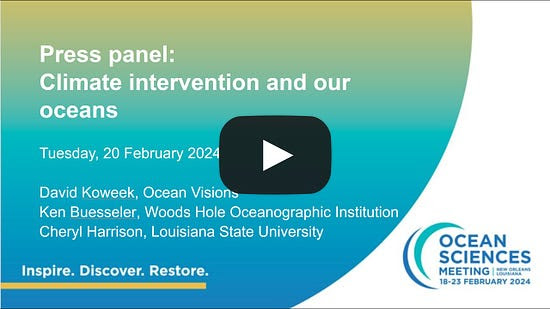 "The oceans are both critical elements regulating Earth's climate and ecosystems vulnerable to the effects of climate change caused by overuse of carbon-based fuels. Climate interventions, including stratospheric aerosol injection, cloud brightening and ocean-based carbon dioxide removal strategies, are gaining attention and investment. What is ocean-based carbon dioxide removal? What are potential benefits, limitations and risks of these approaches? How should applications be regulated? Join our expert panel to discuss these questions and more about future impacts of climate intervention efforts on our oceans."
Share Solar Geoengineering Updates Leave a comment Solar Geoengineering Updates is free today. But if you enjoyed this post, you can tell Solar Geoengineering Updates that their writing is valuable by pledging a future subscription. You won't be charged unless they enable payments. Pledge your support © 2024 Solar Geoengineering Updates
548 Market Street PMB 72296, San Francisco, CA 94104
Unsubscribe  
| |