JUMP TO SECTION
THIS WEEK’S TOP SRM HIGHLIGHTS
Research Paper: Roadmap toward a planetary sunshade for space-based solar geoengineering (ScienceDirect)
Preprint: The Geoengineering Model Intercomparison Project (GeoMIP) contribution to CMIP7 – description of new experimental protocols and preliminary results - Preprint (EGUSphere)
SRM News Brief: Monthly Solar Geoengineering Updates (April’2026) (Solar Geoengineering Updates)
Job Opportunity: Postdoctoral position on Arctic climate dynamics and climate intervention (UCLA)
Upcoming Event: The unknowability of Solar Radiation Management, and why that matters by Center for Climate Repair (University of Cambridge)
YouTube Videos: Playlist - Solar Radiation Management Annual Meeting (2026) (Simons Foundation)
Short Course: Short Course on Carbon Dioxide Removal (CDR) and Solar Radiation Modification (SRM) at UENR, Dormaa Campus (Emerging Climate Frontiers)
Read on to unpack more updates:
RESEARCH PAPERS
Geoengineering and Animal Ethics: The Case of Stratospheric Aerosol Injection
Authors: Leonie N. Bossert & Clare Palmer
Synopsis: This study explores the ethical implications of SRM, particularly Stratospheric Aerosol Injection (SAI), for wild animals. Moving beyond human-centered debates, it examines whether SAI could be ethically unacceptable from animal ethics perspectives and highlights key research gaps related to animal welfare, ecological impacts, and justice considerations involving non-human species under potential SRM deployment scenarios.
Cation Identity, Phase State, and Density as Key Determinants of Radiative Forcing in Atmospheric Sulfate Systems
Authors: Vahid Shahabadi, Yingshi Luo, Aaron M. Palmisano, et al.
Synopsis: This study shows that the optical and physical behavior of sulfate aerosols depends strongly on cation type, phase state, and density, challenging simplified climate model assumptions based on the H₂SO₄–H₂O system. Experiments reveal that multivalent sulfates can form highly viscous, gel-like phases at low humidity, suppressing water transport and altering reactivity. Some sulfates also exhibit higher refractive indices, increasing shortwave radiative forcing efficiency and potentially affecting climate modeling and Solar Radiation Management (SRM) assessments.
Roadmap toward a planetary sunshade for space-based solar geoengineering
Authors: Catello Leonardo Matonti, Marina Coco, Chantal Cappelletti, Bruce Chesley, Christer Fuglesang, Giuseppe Governale
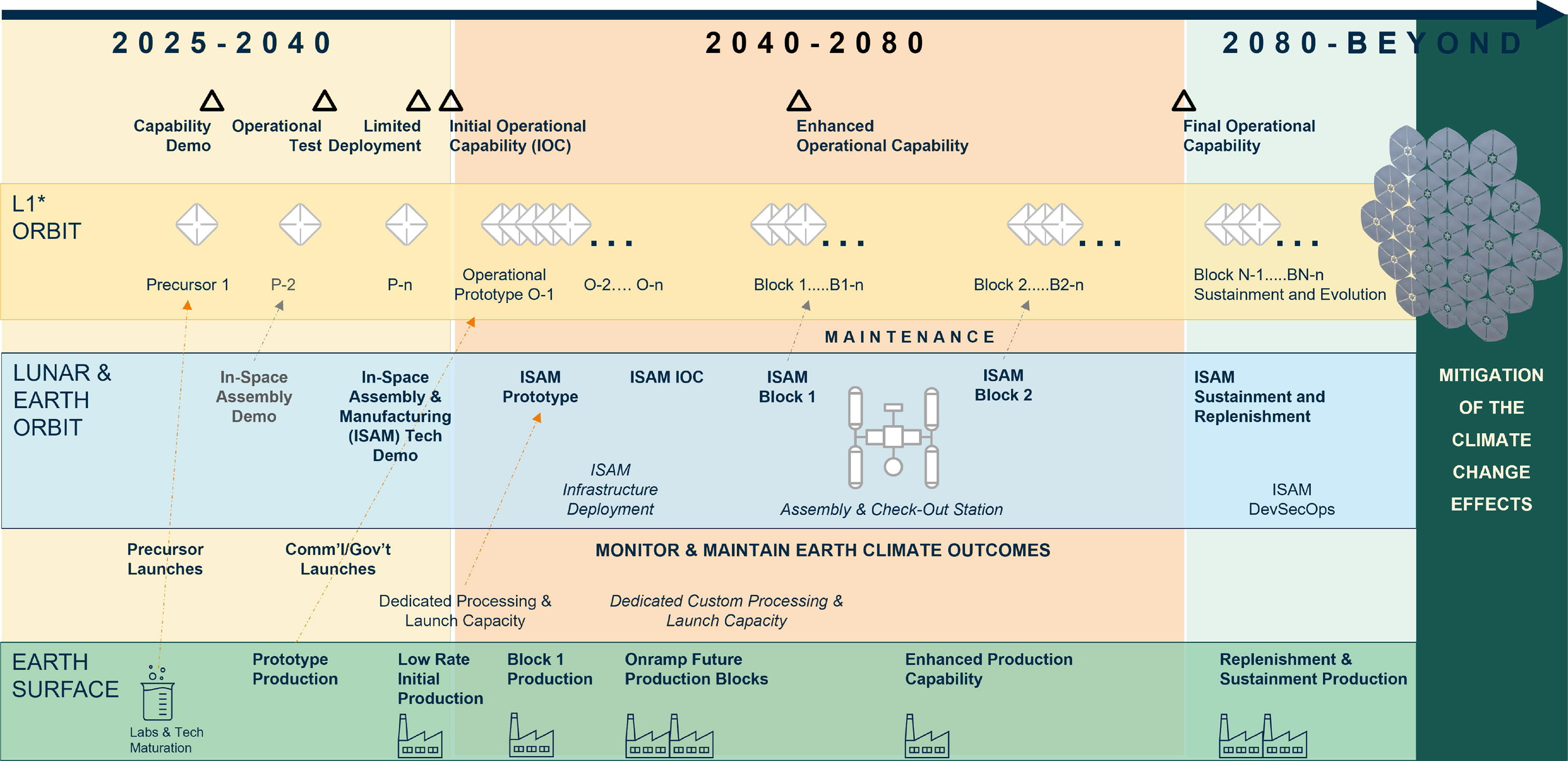
Synopsis: This paper presents a technology roadmap for a Planetary Sunshade System, a space-based SRM concept aimed at reducing incoming solar radiation in a reversible way. The roadmap outlines phased development from early demonstrations to full deployment near the Sun–Earth/Moon photo-gravitational Lagrange point, covering solar sails, in-space assembly, swarm coordination, and launch systems. It proposes initial operations by 2040 and full capability by 2080, while emphasizing feasibility assessment and international collaboration.
Examining Opportunities to Strengthen Climate Governance in Iran for Enhancing International Convergence and Resilience to Climate Change
Author: Sadegh Karimi
Synopsis: This study reviews outcomes from recent UN climate conferences, including COP29 and COP30, and examines their implications for Iran. It highlights growing international focus on climate finance, adaptation, and fossil fuel transition, while assessing Iran’s climate vulnerabilities, including droughts, rising temperatures, and declining rainfall. The paper argues that sanctions and fossil fuel dependence limit Iran’s access to climate finance and calls for stronger, more transparent climate governance integrating global climate strategies, including carbon dioxide removal and SRM.
The Geoengineering Model Intercomparison Project (GeoMIP) contribution to CMIP7 – description of new experimental protocols and preliminary results - Preprint
Authors: Daniele Visioni, Alan Robock, Alistair Duffey, Matthew Henry, Haruki Hirasawa, Walker R. Lee, Cindy Wang, et al.
Synopsis: The Geoengineering Model Intercomparison Project outlines a new framework of SRM climate model experiments for CMIP7, aimed at improving scientific realism, policy relevance, and cross-model comparability. Building on past GeoMIP lessons, the framework introduces Preparatory, Tier 1, and Tier 2 experiments to study SRM impacts, uncertainties, overshoot scenarios, and tipping elements, while enabling flexible, coordinated exploration across global modeling groups.
A preliminary technology roadmap for the Planetary Sunshade programme
(Source)Share
WEB POSTS
Solar Geoengineering Updates - Monthly Solar Geoengineering Updates (April’2026)
LinkedIn - The Way Ahead for Atmospheric Security
Climate Home News - EU warns on solar geoengineering but research debate grinds on
Encompass - From moratorium to mandate: Europe’s next move on geoengineering
Vermont Daily Chronicle - Bean: OGA connects with Secretary Kennedy on Geoengineering
Erik’s Earth - Chasing Sun: A Look Inside Solar Geoengineering
LinkedIn - DSG’s response to the UN Special Rapporteur on Climate Change’s call for input on climate-related technologies and human rights
The Degrees Initiative - Philippines and Ghana teams hold joint workshops on opportunities, risks and governance of SRM
Planetary Sunshade Institute - Planetary Sunshade Irradiance Model
Share Solar Geoengineering Updates
JOB OPPORTUNITIES
Postdoctoral Scholar – Solar Geoengineering Climate Response Evaluation at The University of Chicago
“Dr. Pete Irvine at the University of Chicago is seeking a highly motivated postdoctoral scholar to join an interdisciplinary research team in a position supported by the University of Chicago’s Climate Systems Engineering initiative (CSEi, Director: David Keith). The aim of this position will be to identify and assess potential hotspots of climate risk under scenarios of Stratospheric Aerosol Injection (SAI) deployment and compare those to the risks under global warming.”
Postdoctoral position on Arctic climate dynamics and climate intervention at UCLA | Deadline: 20 May 2026
“The Aerosol–Climate Interactions group at UCLA is seeking a postdoctoral scholar to study the climate response to targeted wintertime polar cooling. The position is part of a Simons Foundation-supported project assessing mixed-phase cloud thinning as a proposed climate-intervention concept. The project does not assume that this approach is feasible, desirable, or deployable; its goal is to determine how the Arctic and global climate system would respond, including effects on sea ice, hydrology, AMOC-relevant ocean stratification, time of emergence, and Arctic-community-relevant climate variables.”
UPCOMING EVENTS
12 May | University of Cambridge - Climate Repair Symposium by Center for Climate Repair
13-15 May | University of Nottingham - IAA Planetary Sunshade Workshop by Planetary Sunshade Foundation
14 May | Online - HPAC Presentation with Associate Professor Daniel Harrison - Marine Cloud Brightening on the Great Barrier Reef (NEW)
14 May | University of Cambridge - The unknowability of Solar Radiation Management, and why that matters by Center for Climate Repair (NEW)
15 May | London, United Kingdom - AI x Weather x Climate Demo Night by Encode: AI for Science Fellowship - Pillar VC x ARIA
18-19 May | University of Chicago - Frontiers in Climate Systems Engineering by CSEi
25 May | Online - Exploring climate interventions and the science-policy interface by WCRP
26 May | Online - How Could the First Decade of Solar Geoengineering Unfold? by SRM360 (NEW)
26-29 May | Tórshavn, Faroe Islands - Healthy Humans and Oceans in the Arctic (NEW)
28 May | Arena 2 Plenum - Building and Sharing Knowledge of Climate Interventions by UArctic Congress
28-29 May | Belgium - International Forum on Solar Radiation Modification Research Governance by Co-Create
01 June | Online - CSAR lecture: Beyond Net Zero: Can We Repair The Climate? by University of Cambridge
02-04 June | Rwanda - The IAF Global Space Conference on Climate Change 2026 - Uniting Space and Earth for Climate Resilience
20-21 June | United States - Bridging the Knowledge Gaps in Climate Engineering with Experiments, Models, and Observations by Gordon Research Seminar
21-26 June 2026 | United States - Gordon Research Conference - Bridging Observations, Models, and Impacts in Solar Radiation Modification Research
10-11 September | Washington, DC. - 2026 RFF and Harvard SRM Social Science Research Workshop
12-15 October | Malaysia - Global Tipping Points 2026 | Abstract Deadline: 15 May
Solar Geoengineering Events Calendar
Add our Solar Geoengineering Events Calendar to your default calendar in 2 ways:
Sync specific event: Click the event → menu (≡) → Share → choose your calendar → Save.
Or sync all events: Menu (≡) → Preferences → iCalendar Feeds → Copy URL → Add to your calendar settings → Subscribe.
YOUTUBE VIDEOS
A polarised debate - is there a middle ground of geoengineering? | Centre for Climate Repair

Ted Parson Insights from the Montreal Protocol for Climate Interventions | Healthy Planet Action Coalition

“Professor Parson is Distinguished Dan and Rae Emmett Professor of Environmental Law and Faculty Director, Emmett Institute on Climate Change and the Environment, University of California Los Angeles. He has written extensively on the Montreal Protocol on Ozone Depleting Substances, and on climate intervention.”
DCA Seminar - Meteorology, April 24, 2026 | Departamento de Ciências Atmosféricas - IAG / USP

“Given the current scenario of global warming, in which the three-year period 2023-2025 recorded, for the first time, average temperatures exceeding 1.5 °C compared to pre-industrial levels, humanity faces the imminent risk of reaching “tipping points”. Although mitigation and adaptation are essential strategies, Climate Intervention, specifically Solar Radiation Modification (SRM), emerges as the only alternative capable of promoting the cooling of the planet in a short period of time. This seminar aims to present the topic, addressing the techniques most discussed in the literature and the results of studies based on numerical modeling. Additionally, questions will be raised regarding the global governance required for such interventions.”
Playlist: Solar Radiation Management Annual Meeting (2026) | Simons Foundation
“The Solar Radiation Management program seeks to communicate the research process, progress and findings of the Simons-funded work on understanding the fundamental processes, uncertainties and potential impacts of strategies for solar radiation management.”
SHORT COURSE
11 - 12 June | UENR, Dormaa Campus - Short Course on Carbon Dioxide Removal (CDR) and Solar Radiation Modification (SRM) by Emerging Climate Frontiers
Follow us on: Twitter | Bluesky | LinkedIn | Google Group | Podcast
Support us here:
While all content on Solar Geoengineering Updates is free for everyone, We urge those who can to become paid subscribers. Your support empowers this important work and helps us spread the message far and wide.