| Links to recent scientific papers, web posts, upcoming events, job opportunities, podcasts, and event recordings, etc. on Solar Radiation Management Technology.Subscribe to Solar Geoengineering Updates Substack here:Thanks for reading Solar Geoengineering Updates! Subscribe for free to receive new posts and support my work. FUNDING REQUEST
RESEARCH PAPERSWang, J., Moore, J. C., & Zhao, L. (2023). Changes in apparent temperature and PM 2.5 around the Beijing–Tianjin megalopolis under greenhouse gas and stratospheric aerosol intervention scenarios. Earth System Dynamics, 14(5), 989-1013.AbstractApparent temperature (AP) and ground-level aerosol pollution (PM2.5) are important factors in human health, particularly in rapidly growing urban centers in the developing world. We quantify how changes in apparent temperature – that is, a combination of 2 m air temperature, relative humidity, surface wind speed, and PM2.5 concentrations – that depend on the same meteorological factors along with future industrial emission policy may impact people in the greater Beijing region. Four Earth system model (ESM) simulations of the modest greenhouse emissions RCP4.5 (Representative Concentration Pathway), the “business-as-usual” RCP8.5, and the stratospheric aerosol intervention G4 geoengineering scenarios are downscaled using both a 10 km resolution dynamic model (Weather Research and Forecasting, WRF) and a statistical approach (Inter-Sectoral Impact Model Intercomparison Project – ISIMIP). We use multiple linear regression models to simulate changes in PM2.5 and the contributions meteorological factors make in controlling seasonal AP and PM2.5. WRF produces warmer winters and cooler summers than ISIMIP both now and in the future. These differences mean that estimates of numbers of days with extreme apparent temperatures vary systematically with downscaling method, as well as between climate models and scenarios. Air temperature changes dominate differences in apparent temperatures between future scenarios even more than they do at present because the reductions in humidity expected under solar geoengineering are overwhelmed by rising vapor pressure due to rising temperatures and the lower wind speeds expected in the region in all future scenarios. Compared with the 2010s, the PM2.5 concentration is projected to decrease by 5.4 µg m−3 in the Beijing–Tianjin province under the G4 scenario during the 2060s from the WRF downscaling but decrease by 7.6 µg m−3 using ISIMIP. The relative risk of five diseases decreases by 1.1 %–6.7 % in G4, RCP4.5, and RCP8.5 using ISIMIP but has a smaller decrease (0.7 %–5.2 %) using WRF. Temperature and humidity differences between scenarios change the relative risk of disease from PM2.5 such that G4 results in 1 %–3 % higher health risks than RCP4.5. Urban centers see larger rises in extreme apparent temperatures than rural surroundings due to differences in land surface type, and since these are also the most densely populated, health impacts will be dominated by the larger rises in apparent temperatures in these urban areas.
Sun, J., Secor, M., Cai, M., & Hu, X. (2024). A Quasi-Linear Relationship between Planetary Outgoing Longwave Radiation and Surface Temperature in a Radiative-Convective-Transportive Climate Model of a Gray Atmosphere. Advances in Atmospheric Sciences, 41(1), 8-18.AbstractIn this study, we put forward a radiative-convective-transportive energy balance model of a gray atmosphere to examine individual roles of the greenhouse effect of water vapor, vertical convection, and atmospheric poleward energy transport as well as their combined effects for a quasi-linear relationship between the outgoing longwave radiation (OLR) and surface temperature (TS). The greenhouse effect of water vapor enhances the meridional gradient of surface temperature, thereby directly contributing to a quasi-linear OLR-TS relationship. The atmospheric poleward energy transport decreases the meridional gradient of surface temperature. As a result of the poleward energy transport, tropical (high-latitude) atmosphere-surface columns emit less (more) OLR than the solar energy input at their respective locations, causing a substantial reduction of the meridional gradient of the OLR. The combined effect of reducing the meridional gradients of both OLR and surface temperature by the poleward energy transport also contributes to the quasi-linear OLR-TS relationship. Vertical convective energy transport reduces the meridional gradient of surface temperature without affecting the meridional gradient of OLR, thereby suppressing part of the reduction to the increasing rate of OLR with surface temperature by the greenhouse effect of water vapor and poleward energy transport. Because of the nature of the energy balance in the climate system, such a quasi-linear relationship is also a good approximation for the relationship between the annual-mean net downward solar energy flux at the top of the atmosphere and surface temperature.
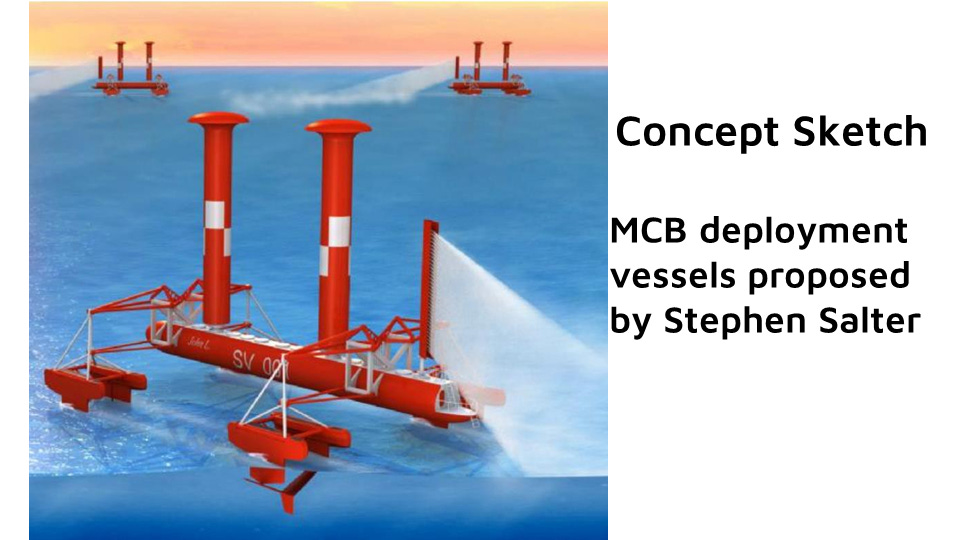
Lightburn, Kenneth D. "Can a Symbolic Mega-Unit of Radiative Forcing (RF) Improve Understanding and Assessment of Global Warming and of Mitigation Methods Using Albedo Enhancement from Algae, Cloud, and Land (AEfACL)?." Climate 11.3 (2023): 62.AbstractBy expressing radiative forcing (RF) in a symbolic mega-unit we better communicate, to governing organizations and the public, the extent of global warming (GW) and the potency of mitigation methods while also ‘translating’ different GW measures to better explain their interrelationship. An easily visualized symbol that has been suggested is the net shading, or mega-unit, of RF of a “standard 1 km2 cumulus cloud over one day of −25 W/m2” (ScCd). As defined, ScCd is equal to 600,000 kWh and equivalent to Temporary heat radiation Equivalent Carbon (ThrEC) of 18,400 tons of carbon heat effect, or 67,300 tons of CO2 and an approximately 0.136 albedo increase, over 1 km2. Shading over the whole earth caused by clouds is estimated by NASA as −13 W/m2. The excess of solar radiation or Earth Energy Imbalance (EEI) striking the earth was + 1.12 W/m2 in mid-2019 and has been continually increasing. Offsetting this requires the creation of additional reflective surfaces equivalent to 22.848 million square kilometers of ScCd. Such an increase could be provided by albedo enhancement from algae on the ocean surface, marine cloud brightening (MCB) or new marine cloud creation, or land area use that rejuvenates salt flats and similar locations (AEfACL). These are potentially politically acceptable and eventually could be achieved at large enough scale to be effective globally.
Shi, X., Liu, Y., & Liu, J. (2023). A Numerical Modeling Study on the Earth’s Surface Brightening Effect of Cirrus Thinning.AbstractCirrus thinning, as one kind of geoengineering approach, not only cools our planet but also enhances the amount of sunlight reaching Earth's surface (brightening effect). This study delves into the brightening effect induced by cirrus thinning with a flexible seeding method. The thinning of only cirrus clouds results in a considerable globally averaged cooling effect (−2.46 W m−2), along with a notable globally averaged brightening effect (2.19 W m−2). Cirrus thinning also results in substantial reductions in the cloud radiative effects of the lower mixed-phase and liquid clouds. While these reductions counteract the cooling effect from cirrus clouds, they enhance the brightening effect from cirrus clouds. Consequently, the brightening effect caused by cirrus seeding (4.69 W m−2) is considerably more potent than its cooling effect (−1.21 W m−2). Furthermore, due to the more pronounced changes from the mixed-phase and liquid clouds at low- and mid-latitudes, the cooling effect is primarily concentrated at high latitudes. In contrast, the brightening effect is significantly stronger over most low- and mid-latitude regions. Overall, cirrus thinning could lead to a notable brightening effect, which can be leveraged to offset the dimming effect (the opposite of brightening effect) of other geoengineering approaches.
McLaren, D. (2023). Governing Emerging Solar Geoengineering: A Role for Risk-Risk Evaluation?. Georgetown Journal of International Affairs, 24(2), 234-243.AbstractIn the face of rapid global heating, ideas of solar geoengineering are receiving increased attention. Yet the governance of such risky emerging technologies is poorly explored. Here I examine how the risks involved in solar geoengineering might be assessed in the context of climate risks in two different models of risk management: the technocratic, and the securitized. I show that neither model alone provides a sufficient foundation for a meaningful ‘risk-risk’ assessment, and suggest a need for better defined, yet broad scope, symmetric assessments using worst-case as well as idealised scenarios, taking into account risks in research and development as well as deployment, and considering the social distribution of risks. I conclude that effective anticipatory and ethical risk assessment may usefully supplement, but cannot replace democratic political judgements on responses to climate change.
Brooks, L., Cannizzaro, S., Bhalla, N., & Richardson, K. (2023, December). Developing Proposals for Ethically Informed Operational Guidelines for Climate Engineering Technologies. In IFIP Joint Working Conference on the Future of Digital Work: The Challenge of Inequality (pp. 28-49). Cham: Springer Nature Switzerland.AbstractIt is generally acknowledged in the 21st century that climate change and hence climate engineering (CE) is one of the biggest issues facing the planet. If we cannot get this under control, in some way, then the future looks very bleak. As Latour says, the issue is both political and ecological, and some people prefer to look away and deny climate change [1]. In this paper, we aim to look at climate engineering technologies from an ethical viewpoint and develop a set of proposals for possible re-engineering of existing guidelines (the Tollgate Principles [2]) in the light of these ethics values and principles.
WEB POSTS
THESES
REPORTS
JOB OPPORTUNITIES“The Degrees Initiative is a UK-based charity that builds the capacity of developing countries to evaluate solar radiation modification (SRM) climate engineering, a controversial proposal for reducing some of the impacts of climate change. The Degrees Initiative is neutral on whether SRM should ever be used, but we believe that developing countries should be empowered to conduct their own research and to play a central role in SRM discussions. The initiative has been registered as a UK charity since 2021, but it has been operating for ten years as the Solar Radiation Management Governance Initiative (SRMGI) and its work has received widespread acclaim.”
“UCL Earth Sciences is engaged in world-class research into the processes at work on and within the Earth and other planets. The department has strong links with resources and hazard risk industries, with most graduates finding employment within academia or geoscience-related industries. Awardees are free to engage in research in any Geoscience-related field from the surface to the core, from Earth to planets. The primary advisor must be an academic staff member of UCL Earth Science. Candidates should contact potential primary advisors to discuss potential projects. The research interests of potential supervisors are listed on the Dept webpages (follow the links to the webpages of academic staff members). Secondary advisors can be outside the Earth Sciences Department, but have to be affiliated UCL with the University of London.Candidates can outline their own projects with the guidance of potential supervisors, and/or focus on a project suggested by them. The details of the project can be further developed after the application deadline; only a very brief outline needs to be included in the application statement. Projects can potentially be changed after the award has been issued, with permission of the Department.”
PODCASTS“The kind of emissions reductions promised in this week’s sweeping COP28 agreement will not suffice to meet the most ambitious climate goals. So other plans to slow the warming are coming to the fore. Solar geoengineering—modifying the amount of Earth’s incoming sunlight—is a once-fringe idea that is at last being taken seriously. It is a strategy with considerable promise, and considerable potential risks.Host: Alok Jha, The Economist’s science and technology editor. Contributors: Rachel Dobbs, The Economist’s climate correspondent; Oliver Morton, a senior editor at The Economist; Douglas MacMartin, a geoengineering researcher at Cornell University; and Shuchi Talati, who leads the Alliance for Just Deliberation on Solar Geoengineering.”
“David Keith is a Professor in the Department of Geophysical Sciences at the University of Chicago and the Founding Faculty Director of the Climate Systems Engineering initiative. Keith previously led the development of Harvard’s Solar Geoengineering Research Program.In this episode, we discuss Keith’s Climate Systems Engineering initiatives, carbon dioxide removal (CDR) and geoengineering techniques. Drawing on David’s decades of expertise, we dive deep into topics such as CDR, solar geoengineering, ice sheet geoengineering.”
Ethics of Volcano Geoengineering - Cassidy | Reviewer 2 does geoengineering | Ethics of Volcano Geoengineering
- Cassidy Reviewer 2 does geoengineering 1:03:54 |
“Should the army be allowed to blow people up with a volcano? If your geothermal power plant triggers an eruption, is that just a risk of doing business? Should we fiddle with volcanoes to make them safer? Is even researching this opening a can of worms? Gideon Futurman interviews Michael Cassidy (giving @geoengineering1 a month long editing nightmare, but with results we hope you'll like).Paper: The Ethics of Volcano Geoengineering, Michael Cassidy, Anders Sandberg, Lara Mani: https://doi.org/10.1029/2023EF003714”
|