| Subscribe to our newsletter to receive monthly updates on Solar Geoengineering: ![]()
RESEARCH PAPERSGünther, M., Schmidt, H., Timmreck, C., & Toohey, M. (2024). Why does stratospheric aerosol forcing strongly cool the warm pool?. EGUsphere, 2024, 1-32. AbstractPrevious research has shown that stratospheric aerosols cause only a small temperature change per unit forcing because they produce stronger cooling in the tropical Indian and Western Pacific Ocean than in the global mean. The enhanced temperature change in this so-called “warm pool” region activates strongly negative local and remote feedbacks, which dampen the global mean temperature response. This paper addresses the question why stratospheric aerosol forcing affects warm pool temperatures more strongly than CO2 forcing, using idealized MPI-ESM simulations. We show that the aerosol’s enhanced effective forcing at the top of the atmosphere (TOA) over the warm pool contributes to the warm pool-intensified temperature change, but is not sufficient to explain the effect. Instead, the pattern of surface effective forcing, which is substantially different from the effective forcing at the TOA, is more closely linked to the temperature pattern. Independent of surface temperature changes, the aerosol heats the tropical stratosphere, which leads to an acceleration of the Brewer-Dobson circulation. The intensified Brewer-Dobson circulation exports additional energy from the tropics to the extratropics, which leads to a particularly strong negative forcing at the tropical surface. These results show how forced circulation changes can affect the climate response by altering the surface forcing pattern. Furthermore, they indicate that the established approach of diagnosing effective forcing at the TOA is useful for global means, but a surface perspective on the forcing must be adopted to understand the evolution of temperature patterns.
Hueholt, D. M., Barnes, E. A., Hurrell, J. W., Richter, J. H., & Sun, L. (2023). Assessing outcomes in stratospheric aerosol injection scenarios shortly after deployment. Earth's Future, 11(5), e2023EF003488. Abstract Stratospheric aerosol injection (SAI) is a proposed form of climate intervention that would release reflective particles into the stratosphere, thereby reducing solar insolation and cooling the planet. The climate response to SAI is not well understood, particularly on short-term time horizons frequently used by decision-makers and planning practitioners to assess climate information. We demonstrate two framings to explore the climate response in the decade after SAI deployment in modeling experiments with parallel SAI and no-SAI simulations. The first framing, which we call a snapshot around deployment, displays change over time within the SAI scenarios and applies to the question “What happens before and after SAI is deployed in the model?” The second framing, the intervention impact, displays the difference between the SAI and no-SAI simulations, corresponding to the question “What is the impact of a given intervention relative to climate change with no intervention?” We apply these framings to annual mean 2 m temperature, precipitation, and a precipitation extreme during the 10 yr after deployment in two large ensembles of Earth system model simulations that comprehensively represent both the SAI injection process and climate response, and connect these results to implications for other climate variables. We show that SAI deployment robustly reduces changes in many high-impact climate variables even on these short timescales where the forced response is relatively small, but that details of the climate response depend on the model version, greenhouse gas emissions scenario, and other aspects of the experimental design.
Asher, E., Todt, M., Rosenlof, K., Thornberry, T., Gao, R. S., Taha, G., ... & Xiong, K. (2023). Unexpectedly rapid aerosol formation in the Hunga Tonga plume. Proceedings of the National Academy of Sciences, 120(46), e2219547120. AbstractThe Hunga Tonga–Hunga Ha’apai (HT-HH) volcanic eruptions on January 13 and 15, 2022, produced a plume with the highest signal in stratospheric aerosol optical depth observed since the eruption of Mt. Pinatubo in 1991. Suites of balloon-borne instruments on a series of launches from Réunion Island intercepted the HT-HH plume between 7 and 10 d of the eruptions, yielding observations of the aerosol number and size distribution and sulfur dioxide (SO2) and water vapor (H2O) concentrations. The measurements reveal an unexpected abundance of large particles in the plume, constrain the total sulfur injected to approximately 0.2 Tg, provide information on the altitude of the injection, and indicate that the formation of sulfuric acid aerosol was complete within 3 wk. Large H2O enhancements contributed as much as ~30% to ambient aerosol surface area and likely accelerated SO2 oxidation and aerosol formation rates in the plume to approximately three times faster than under normal stratospheric conditions.
Brody, E., Visioni, D., Bednarz, E. M., Kravitz, B., MacMartin, D. G., Richter, J. H., & Tye, M. R. (2024). Kicking the Can Down the Road: Understanding the Effects of Delaying the Deployment of Stratospheric Aerosol Injection. arXiv preprint arXiv:2402.11992. Abstract Climate change is a prevalent threat, and it is unlikely that current mitigation efforts will be enough to avoid unwanted impacts. One potential option to reduce climate change impacts is the use of stratospheric aerosol injection (SAI). Even if SAI is ultimately deployed, it might be initiated only after some temperature target is exceeded. The consequences of such a delay are assessed herein. This study compares two cases, with the same target global mean temperature of 1.5C above preindustrial, but start dates of 2035 or a delayed start in 2045. We make use of simulations in the Community Earth System Model version 2 with the Whole Atmosphere Coupled Chemistry Model version 6 (CESM2-WACCM6), using SAI under the SSP2-4.5 emissions pathway. We find that delaying the start of deployment (relative to the target temperature) necessitates lower net radiative forcing (-30%) and thus larger sulfur dioxide injection rates (+20%), even after surface temperatures converge, to compensate for the extra energy absorbed by the Earth system. However, many of the surface climate differences between the 2035 and 2045 start simulations appear to be small during the 10-25 years following the delayed SAI start, although longer simulations would be needed to assess any longer-term impacts in this model. In addition, irreversibilities and tipping points that might be triggered during the period of increased warming may not be adequately represented in the model but could change this conclusion in the real world.
Boretti, A. (2024). Reassessing the cooling that followed the 1991 volcanic eruption of Mt. Pinatubo. Journal of Atmospheric and Solar-Terrestrial Physics, 106187. Abstract A cooling of up to 0.5 °C which lasted 18–36 months is attributed to the 1991 Mt. Pinatubo eruption. A simple mathematical approach is here applied to the 43-year-long satellite global temperature time series. This time series is fitted with a parabolic function representing global warming, multiple sinusoidal functions representing natural variability, and a rectangular function representing the cooling of Mt. Pinatubo. The cooling is estimated at up to 0.28 °C, 0.2 °C on average. Similarly shorter is the duration of the cooling, about 13 months. This result impacts the risk-to-benefit ratio of SAI which may be worse than thought.
WEB POSTS
DISCUSSIONS
UPCOMING EVENTSWe have curated a “Solar Geoengineering Events Calendar.” Explore and stay informed about upcoming events, conferences, and webinars on SRM technology. Sync specific events / all events to your default calendar to ensure you never miss out on important SRM updates. Solar Geoengineering Events Calendar Find sync guidelines in the calendar’s “About” section or you can sync all Solar Geoengineering events to your default calendars by pressing the link below: Sync SG Events to your Default Calendar
PODCASTS“MEER director Peter Dynes hosts founder and director Dr. Ye Tao discussing climate, geo-engineering, the MEER project and more.”
YOUTUBE VIDEOSAmazon re:MARS 2022: Modeling our future: Advancing climate research with AI (MLR218) |SilverLining "Climate researchers have increasingly adopted AI/ML to tackle complex challenges, including prediction, process parameterization, and knowledge discovery. In this session, explore how scientists are using full-scale climate models, explainable AI, and physics-informed AI models to facilitate a deeper understanding of climate processes, climate impacts, and the potential impacts of climate intervention techniques designed to mitigate the worst effects of global warming, such as increasing the reflection of sunlight from particles in the atmosphere. Join Dr. Elizabeth A. Barnes and Kelly Wanser to understand how AWS HPC clusters and training networks on GPU nodes are pushing the frontiers of climate science and climate-risk research."
Growing back Ice, in the Arctic? | Fonger Ypma | TEDxAmsterdam | TEDx Talks "Arctic Sea Ice is rapidly declining, and the Arctic sea is expected to experience ice-free summers as early as the thirties. This will further accelerate the climate crisis and start a series of devastating feedbacks, since the Arctic sea ice functions as the earth’s refrigerator by reflecting the sun’s heat back into space. What if we could preserve the Arctic ice as heat shield by thickening the ice in winter through pumping sea water on top of it in strategically chosen locations across the Arctic Sea? Fonger Ypma is a cleantech entrepreneur, who recently founded Arctic Reflections, with the moonshot mission to restore Arctic Sea Ice to counter global warming. After obtaining a PhD in Mathematical Physics from Oxford University, Fonger worked as a strategy consultant at McKinsey & Company for several years. From there, he moved to Eneco, a Dutch sustainable energy company, to be part of a newly formed unit on Innovation & Corporate Venturing. At Eneco, he led the innovation team, and founded a cross-company programme on data science and AI. As an experienced leader in the energy transition, he co-founded a start-up aimed at datacentre waste heat reuse, and was CEO of a housing market data analytics scale-up. Initially starting his Arctic ice initiative as a side project with the Technical University of Delft, he is now fulltime dedicated to this endeavour. This talk was given at a TEDx event using the TED conference format but independently organized by a local community."
OSM24: Climate interventions and our oceans – ask us anything | AGU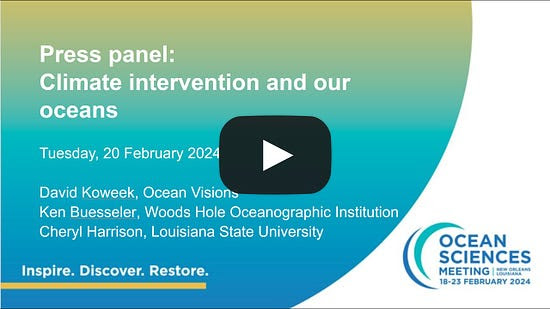 "The oceans are both critical elements regulating Earth's climate and ecosystems vulnerable to the effects of climate change caused by overuse of carbon-based fuels. Climate interventions, including stratospheric aerosol injection, cloud brightening and ocean-based carbon dioxide removal strategies, are gaining attention and investment. What is ocean-based carbon dioxide removal? What are potential benefits, limitations and risks of these approaches? How should applications be regulated? Join our expert panel to discuss these questions and more about future impacts of climate intervention efforts on our oceans."
| |


