| Subscribe to our newsletter to receive monthly updates on Solar Geoengineering:
RESEARCH PAPERSHollowed, J. P., Jablonowski, C., Brown, H. Y., Hillman, B. R., Bull, D. L., & Hart, J. L. (2024). HSW-V v1. 0: localized injections of interactive volcanic aerosols and their climate impacts in a simple general circulation model. Geoscientific Model Development, 17(15), 5913-5938. Abstract A new set of standalone parameterizations is presented for simulating the injection, evolution, and radiative forcing by stratospheric volcanic aerosols against an idealized Held–Suarez–Williamson (HSW) atmospheric background in the Energy Exascale Earth System Model version 2 (E3SMv2). In this model configuration (HSW with enabled volcanism, HSW-V), sulfur dioxide (SO2) and ash are injected into the atmosphere with a specified profile in the vertical, and they proceed to follow a simple exponential decay. The SO2 decay is modeled as a perfect conversion to a long-living sulfate aerosol which persists in the stratosphere. All three species are implemented as tracers in the model framework and are transported by the dynamical core's advection algorithm. The aerosols contribute simultaneously to local heating of the stratosphere and cooling of the surface by a simple plane-parallel Beer–Lambert law applied on two zonally symmetric radiation broadbands in the longwave and shortwave ranges. It is shown that the implementation parameters can be tuned to produce realistic temperature anomaly signatures of large volcanic events. In particular, results are shown for an ensemble of runs that mimic the volcanic eruption of Mt. Pinatubo in 1991. The design requires no coupling to microphysical subgrid-scale parameterizations and thus approaches the computational affordability of prescribed aerosol forcing strategies. The idealized simulations contain a single isolated volcanic event against a statistically uniform climate, where no background aerosols or other sources of externally forced variability are present. HSW-V represents a simpler-to-understand tool for the development of climate source-to-impact attribution methods.
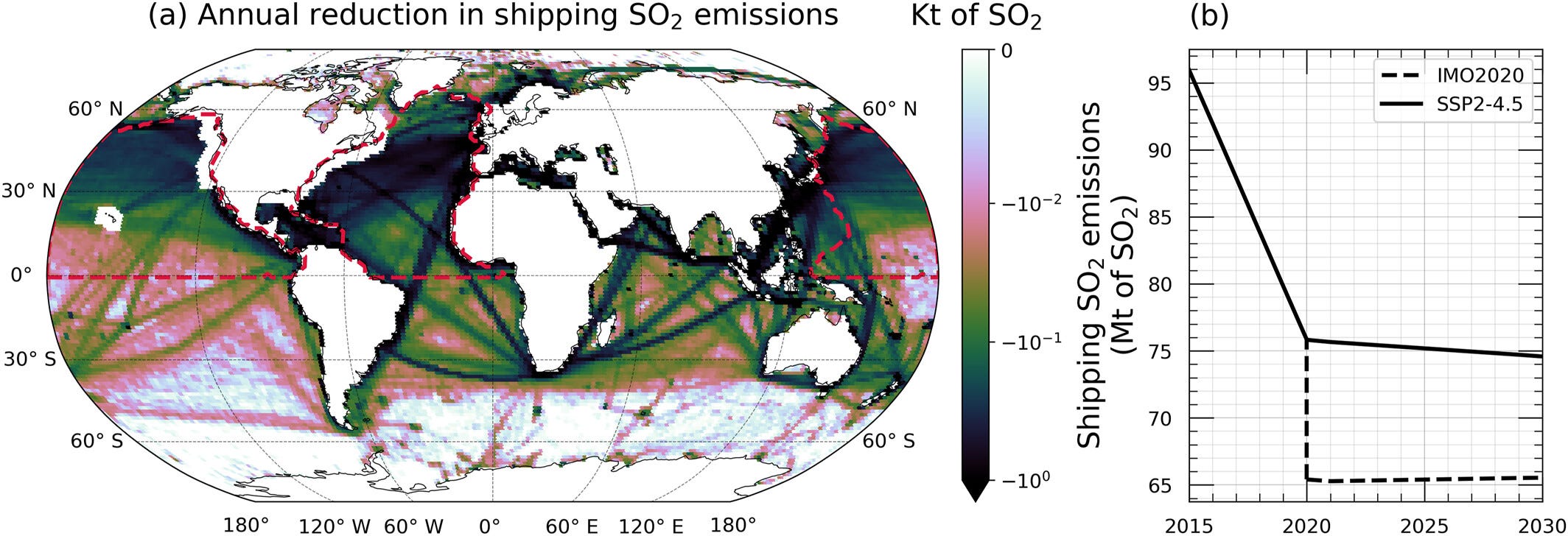
Jordan, G., & Henry, M. (2024). IMO2020 regulations accelerate global warming by up to 3 years in UKESM1. Earth's Future, 12(8), e2024EF005011. Abstract The International Maritime Organization (IMO) introduced new regulations on the sulfur content of shipping emissions in 2020 (IMO2020). Estimates of the climatic impact of this global reduction in anthropogenic sulfate aerosols vary widely. Here, we contribute to narrowing this uncertainty with two sets of climate model simulations using UKESM1. Using fixed sea-surface temperature atmosphere-only simulations, we estimate an IMO2020 global effective radiative forcing of 0.139 ± 0.019 Wm−2 and show that most of this forcing is due to aerosol-induced changes to cloud properties. Using coupled ocean-atmosphere simulations, we note significant changes in cloud top droplet number concentration and size across regions with high shipping traffic density, and—in the North Atlantic and North Pacific—these microphysical changes translate to a decrease in cloud albedo. We show that IMO2020 increases global annual surface temperature on average by 0.046 ± 0.010°C across 2020–2029; approximately 2–3 years of global warming. Furthermore, our model simulations show that IMO2020 helps to explain the exceptional warming in 2023, but other factors are needed to fully account for it. The year 2023 also had an exceptionally large decrease in reflected shortwave radiation at the top-of-atmosphere. Our results show that IMO2020 made that more likely, yet the observations are within the variability of simulations without the reduction in shipping emissions. To better understand the climatic impacts of IMO2020, a model intercomparison project would be valuable whilst the community waits for a more complete observational record.
Smith, W., Bartels, M. F., Boers, J. G., & Rice, C. V. (2024). On thin ice: Solar geoengineering to manage tipping element risks in the cryosphere by 2040. Earth's Future, 12(8), e2024EF004797. Abstract Tipping elements are features of the climate system that can display self-reinforcing and non-linear responses if pushed beyond a certain threshold (the “tipping point”). Models suggest that we may surpass several of these tipping points in the next few decades, irrespective of which emissions pathway humanity follows. Some tipping elements reside in the Arctic and Antarctic and could potentially be avoided or arrested via a stratospheric aerosol injection (SAI) program applied only at the poles. This paper considers the utility of proactively developing the capacity to respond to emergent tipping element threats at the poles as a matter of risk management. It then examines both the air and ground infrastructure that would be required to operationalize such capability by 2040 and finds that this would require a funded launch decision by a financially credible actor by roughly 2030.
THESISAbstract The world continues to boil due to capital’s incapacity to resolve its climatic contradictions. Stratospheric Aerosol Injection (SAI), a technological process theorised to instantly reduce global temperatures, has piqued the interest of a now desperate ruling class. Given its worldwide impacts, enormous risks, and capitalistimperialist reproductive capacities, it is crucial to engage with SAI while it is still in early development. Troublingly, there has thus far been little public consultation. In the UK, an emergent site of SAI development, the climate movement intersects at this critical juncture. The concern is that a historically depoliticised climate movement may uncritically accept SAI as a symptomatic fix to the crisis. Grounded in Marxist theory and departing from the conception of SAI as a spatiotemporal fix, this thesis addresses three primary objectives: assessing current perceptions of SAI among London’s climate movement; evaluating the impact of political education in fostering a critical perspective of the technology, connecting this educational intervention to the Leninist concept of the vanguard layer; and considering how the vanguard layer can assist in counter-hegemonic struggle. The research involved a mixed-method qualitative experiment with members of London’s climate movement. Findings reveal that while there is awareness of SAI’s functionality, participants exhibited technological neutralism and misplaced optimism in liberal governance structures. This underscores the need for more critical education to challenge these perspectives. It likewise highlights the potential benefits of an ecological-Leninist approach to building a counter-hegemonic coalition of forces, capable of addressing the root cause of the ecological crisis.
Abstract This thesis investigates the extent to which cloud seeding laws can be used as a basis for governing regional solar radiation management activities. Solar radiation management (SRM) is being proposed to reflect a portion of sunlight away from Earth, to delay temperature increases while the international community accelerates mitigation actions. It includes planetary-scale interventions, as well as regional-scale activities, such as marine cloud brightening (MCB). Research and deployment of these novel technologies will require the development of governance frameworks to manage associated risks and uncertainties. Whereas attempts to influence the climate system at a global scale will require international governance, domestic arrangements may be more appropriate to govern small-scale field testing and regional SRM applications. Cloud seeding is an established technology, developed after World War II to modify precipitation patterns to enhance rain and snow, or suppress hail. In the context of climate change, cloud seeding continues to be used as a long-term water management strategy to increase freshwater resources in key locations for water, food, and energy security. Governments across the world have long invested in these technologies and developed legal frameworks to govern cloud seeding activities. Cloud seeding and regional SRM bear enough similarities to warrant an in-depth assessment of existing legal and institutional arrangements for cloud seeding, and the extent to which they can inform the governance of SRM technologies, such as MCB. This thesis assesses the relevance of a legal analogy between cloud seeding and regional SRM through the analytical and normative lens of adaptive governance. Using adaptive governance principles, it examines the governance of cloud seeding in two Australian states and two American states. These case studies show that regional SRM regimes require (1) legal arrangements to facilitate greater interactions between institutions across scales of governance, to account both for the scale of deployment and the scale of impacts; (2) broader participation of relevant stakeholders at an early stage of research; (3) flexible legal mechanisms built into the decision-making to foster iterative learning; and (4) mechanisms to prevent and resolve potential conflicts.
WEB POSTS
UPCOMING EVENTSDiscovery workshop focussing on atmospheric science (SRM) | 18 October 2024 | Online Integrative synthesis workshop focusing on identifying gaps in current governance & ethics | 18 November 2024 | Online
Solar Geoengineering Events Calendar
YOUTUBE VIDEOSHarvard Research Fellow & Yale School of Environment Geoengineer Wake Smith | Earth Day Everyday | CirFin "We had the true privilege and honor of having Wake Smith on the podcast! With global temperatures increasing to unprecedented levels, looking at techniques like geoengineering remain more important than ever! While there certainly are ethical considerations for techniques like SAI (Stratospheric Aerosol Injection), we must absolutely consider them as plausible solutions. In 1991, when Mount Pinatubo erupted an immensely large quantity of sulfur dioxide aerosols were injected into the atmosphere. It created a blanket of cloud cover that reflected sunlight, lower temperatures globally by nearly 0.5 a degree celsius!"
Terra Verde – Militarism, Green Capitalism and the Normalization of Solar Geoengineering | KPFA Radio "An interview with Dr Kevin Surprise, an educator, academic and researcher on the political economy of climate change, with a special focus on the rapidly evolving field of solar geoengineering."
The Potential & Pitfalls of Geoengineering | Josh Horton | Collective Responsibility "In this episode of the Sustainable Ambassador Podcast, we speak with Joshua Horton, Senior Program Fellow for Solar Geoengineering at Harvard Kennedy School, about the potential & pitfalls of geoengineering to minimize the impact of climate overshoot. Through our conversation we speak to the roots of this growing interest, introduce several of the "core" technologies, and explore the potential, challenges, and ethical considerations surrounding the use of these technologies."
DEADLINESAbstract Submission Deadline: 01 October 2024Full Manuscript Submission Deadline: 31 December 2024
| |