| SOLAR GEOENGINEERING WEEKLY SUMMARY (11 NOVEMBER - 17 NOVEMBER 2024)Subscribe to our newsletter to receive monthly updates on Solar Geoengineering:
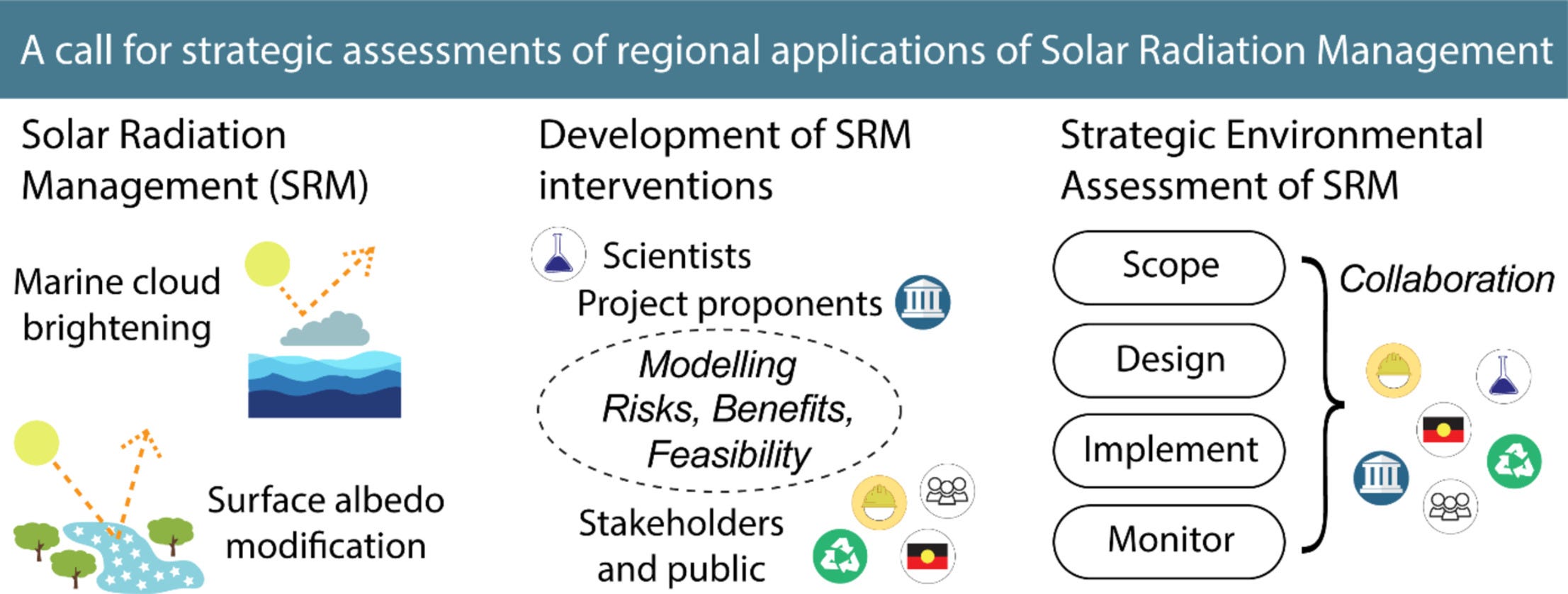
RESEARCH PAPERSBaresi, U., Baum, C. M., Fischer, T. B., Lockie, S., Piggott-McKellar, A., Graham, V., ... & Ristovski, Z. (2025). A call for strategic assessments of regional applications of solar radiation management: Exploring the challenges and opportunities from marine cloud brightening and albedo surface modification. Environmental Impact Assessment Review, 110, 107701. Abstract Technological advancements offer the opportunity for interventions to reduce and potentially even counteract the impacts of climate change. However, advancements that can facilitate the adaptation of human and natural ecosystems to climate change, and possibly lessen the intensity and damaging impacts of extreme weather events, come with social, technical, and environmental challenges. These challenges are triggered by the complexity and uncertainty associated with their deployment in real-world settings. In this paper, we consider Solar Radiation Management interventions aiming to limit the heat absorbed by our planet's surface and trapped in its atmosphere, focusing on Marine Cloud Brightening and Albedo Surface Modification, particularly to protect ice surfaces, as examples of regional-scale interventions. Building on the need for more socially inclusive decision-making around these interventions, as highlighted by the Australian case study of the Great Barrier Reef's Reef Restoration and Adaptation Program, this paper proposes a policy framework with worldwide potential to assist with regional Solar Radiation Management. To this end, we suggest the use of Strategic Environmental Assessment, a United Nations recognised policy framework that is applied internationally to support environmentally sustainable strategic decision-making and planning. We consider Strategic Environmental Assessment's performance criteria in relation to Solar Radiation Management and discuss how these align with much-needed assistance in developing socially inclusive Solar Radiation Management interventions.
Magistro, B., Debnath, R., Wennberg, P. O., & Alvarez, R. M. (2024). Partisanship overcomes framing in shaping solar geoengineering perceptions: Evidence from a conjoint experiment. Abstract The discourse on solar geoengineering (SG) is evolving, yet public perceptions of SG as a climate change solution remain underexplored, especially in the context of today's political polarization in the United States. We examine how different SG narratives—framed as complementary, substitutive, or posing a moral hazard—interact with partisan information sources to shape public attitudes. Using a conjoint experiment with 2,000 American voters, we find that partisan alignment with the information source strongly influences trust in the messenger and support for SG, overshadowing any impact of message framing. When co-partisan sources present information, both Democrats and Republicans are more likely to trust the communicator and support SG. Despite these partisan influences, policy preferences remain consistent with ideological baselines. These findings highlight the importance of political identity in shaping perceptions of emerging climate technologies like SG, even in contexts of low public awareness.
Rasch, P. J., Hirasawa, H., Wu, M., Doherty, S. J., Wood, R., Wang, H., ... & Singh, H. (2024). A protocol for model intercomparison of impacts of Marine Cloud Brightening Climate Intervention. Geoscientific Model Development, 17(21), 7963-7994. Abstract A modeling protocol (defined by a series of climate model simulations with specified model output) is introduced. Studies using these simulations are designed to improve the understanding of climate impacts using a strategy for climate intervention (CI) known as marine cloud brightening (MCB) in specific regions; therefore, the protocol is called MCB-REG (where REG stands for region). The model simulations are not intended to assess consequences of a realistic MCB deployment intended to achieve specific climate targets but instead to expose responses to interventions in six regions with pervasive cloud systems that are often considered candidates for such a deployment. A calibration step involving simulations with fixed sea surface temperatures (SSTs) is first used to identify a common forcing, and then coupled simulations with forcing in individual regions and combinations of regions are used to examine climate impacts. Synthetic estimates constructed by superposing responses from simulations with forcing in individual regions are considered a means of approximating the climate impacts produced when MCB interventions are introduced in multiple regions. A few results comparing simulations from three modern climate models (CESM2, E3SMv2, and UKESM1) are used to illustrate the similarities and differences between model behavior and the utility of estimates of MCB climate responses that were synthesized by summing responses introduced in individual regions. Cloud responses to aerosol injections differ substantially between models (CESM2 clouds appear much more susceptible to aerosol emissions than the other models), but patterns in precipitation and surface temperature responses were similar when forcing is imposed with similar amplitudes in the same regions. A previously identified La Niña-like response to forcing introduced in the Southeast Pacific is evident in this study, but the amplitude of the response was shown to markedly differ across the three models. Other common response patterns were also found and are discussed. Forcing in the Southeast Atlantic consistently (across all three models) produces weaker global cooling than that in other regions, and the Southeast Pacific and South Pacific show the strongest cooling. This indicates that the efficiency of a given intervention depends on not only the susceptibility of the clouds to aerosol perturbations, but also the strength of the underlying radiative feedbacks and ocean responses operating within each region. These responses were generally robust across models, but more studies and an examination of responses with ensembles would be beneficial.
Power, B. L. Disaggregating the Governance Dimensions of Solar Geoengineering. Abstract Recent discussions of the governance of solar geoengineering have emphasized the potential of a polycentric architecture. Specifically, recent contributions have recognized the importance of both international, top-down, structures, and the important role of national and potential sub-national governance entities that reflect diverse, bottom-up perspectives. Viewing solar geoengineering governance through a multi-level lens requires consideration of which governance tasks may be addressed at various levels, and whether formal or informal mechanisms hold utility in addressing these problems. This in turn requires attention be paid to disaggregating governance functions and matching those functions to appropriate governance levels. By disaggregating the key characteristics of governance concern, it may be possible to implement many smaller regulatory mechanisms which can be integrated into a globally effective policy regime, as anticipated under polycentric approaches. This paper is a first step towards mapping key characteristics of concern for the governance of solar geoengineering, and the relevant levels and type of governance institution, thereby developing the first components of a polycentric framework for the governance of solar geoengineering.
Hussain, A., Talati, S., Sipra, H., & Waheed, A. Regionally Cooperative Socio-Political Dimensions of SRM Impacts on Malaria for Health Policy Makers in South Asia via Dashboard Development. Abstract This paper examines the development of an open-source Web-GIS dashboard for the South Asian region integrating three key elements: temperature, precipitation and a malaria variable called Entomological inoculation rate (EIR). The dashboard is sourced from five climate data models used by meteorologists and covers the period from 2021 to 2090 under SSP5-8.5 scenario for climate change (CC) and G6sulfur for climate intervention. The main objective of this study is to provide a comprehensive information interface for temperature, precipitation, and EIR trends over the next seven decades. This Web-GIS dashboard provides a platform for users to visualize projections through graphs, making it easier to understand information regarding climate change and climate intervention and its impact on one aspect of the health sector of South Asia–vector-borne diseases. This tool can support policymakers, scientists, and the public to access accurate data to support climate change scenarios and climate intervention strategies in the region. Additionally, this study involves policy analysis of CC and Health Policies of Pakistan to identifying areas where CC and SRM need to be integrated into health policy, and to pinpoint knowledge gaps providing actionable insights and broader policy implications for health system to address the complex challenges posed by CC and SRM.
WEB POSTSSam's SRM Series Part 1: What Is Solar Radiation Management? (HK81 Climate Blog)  HK81, a climate blog HK81, a climate blogI have to write some preliminary stuff to get to the bigger ideas I actually want to talk about, which will come in followup essays. This essay is a relatively quick primer on solar radiation management, and why it can’t be easily dismissed as a climate solution… 5 days ago · 6 likes · 3 comments · Sam If you don't understand aerosols, you don't understand the missing half of the climate story (One Percent Brighter)  One Percent Brighter One Percent BrighterThe story in the papers about climate change is simple. Too simple. The climate used to be stable, then we added huge volumes of greenhouse gasses to the atmosphere. It started warming. And that made the weather go haywire. Nice, neat, simple, unidirectional change… 4 days ago · 15 likes · 5 comments · Quico Toro
UPCOMING EVENTSGood COP, Bad COP: a post-COP29 assessment | 27 November 2024
Solar Geoengineering Events Calendar
JOB OPPORTUNITIES"The University is building a world-leading Climate Systems Engineering initiative with multiple faculty hires addressing solar geoengineering, open-system carbon removal such as enhanced weathering, and interventions to limit loss of glacial ice. We seek individuals who will lead research programs that will produce significant contributions to their field and to this research initiative."
YOUTUBE VIDEOSAbout the University of Chicago's Climate Systems Engineering initiative | UChiClimate "The University of Chicago is working to better understand the science, technology, and public policy of Climate Systems Engineering and to educate students who will face the challenges of managing industrial civilization on a fragile planet."
How close are we to seeing geoengineering within negotiations? | Centre for Climate Repair "Climate interventions have long been a point for controversy however as global temperatures continue to rise, should they now be formed part of the conversations being had in UNFCCC negotiations? Hear Shaun Fitzgerald's thoughts on this."
DEADLINES  |
| |