
Someone is going to dim the sun, and it will be soon.

Geoengineering News
https://climate.benjames.io/someone-is-going-to-dim-the-sun/
BY BEN JAMES — FEB 12, 2024
I'm going to lay out some fascinating facts, and let you decide whether we are likely to dim the sun within the next 10 years.
Firstly, it’s much easier to artificially dim the sun than most people imagine.
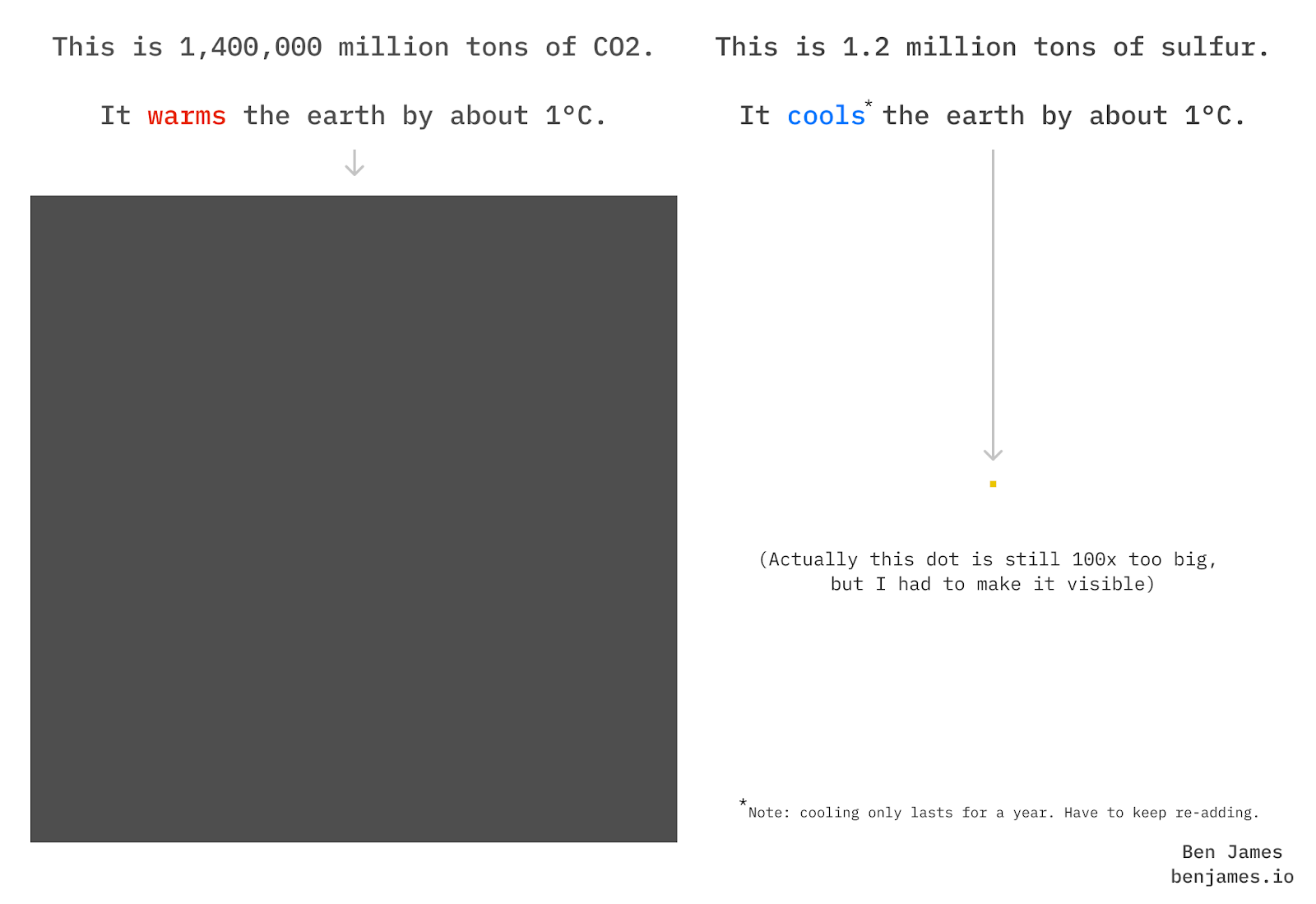
100 planes injecting sulfur particles into the stratosphere would dim the sun by about 1%, and cool the earth by about 1°C.
 Sources
For context, our current sulfur dioxide emissions (from fossil fuels) are >10x bigger than the 1.2m tons shown above. The difference is the height of injection. We’d be putting sulfur into the stratosphere, which is higher up than our normal sulfur emissions in the troposphere.
Spraying a form of sulfur from a plane is incredibly cheap. A full programme would cost less than $20b per year. That’s much cheaper than carbon removal ($600b per year, to remove just 10% of annual emissions @ $100 / tCO2).
Modifying the earth like this is called geoengineering, and blocking out the sun with particles is called Solar Radiation Management (SRM).
SRM awoke in 2023
Interest in SRM spiked in 2023, after years of being too controversial to discuss. Here are a few reasons why.
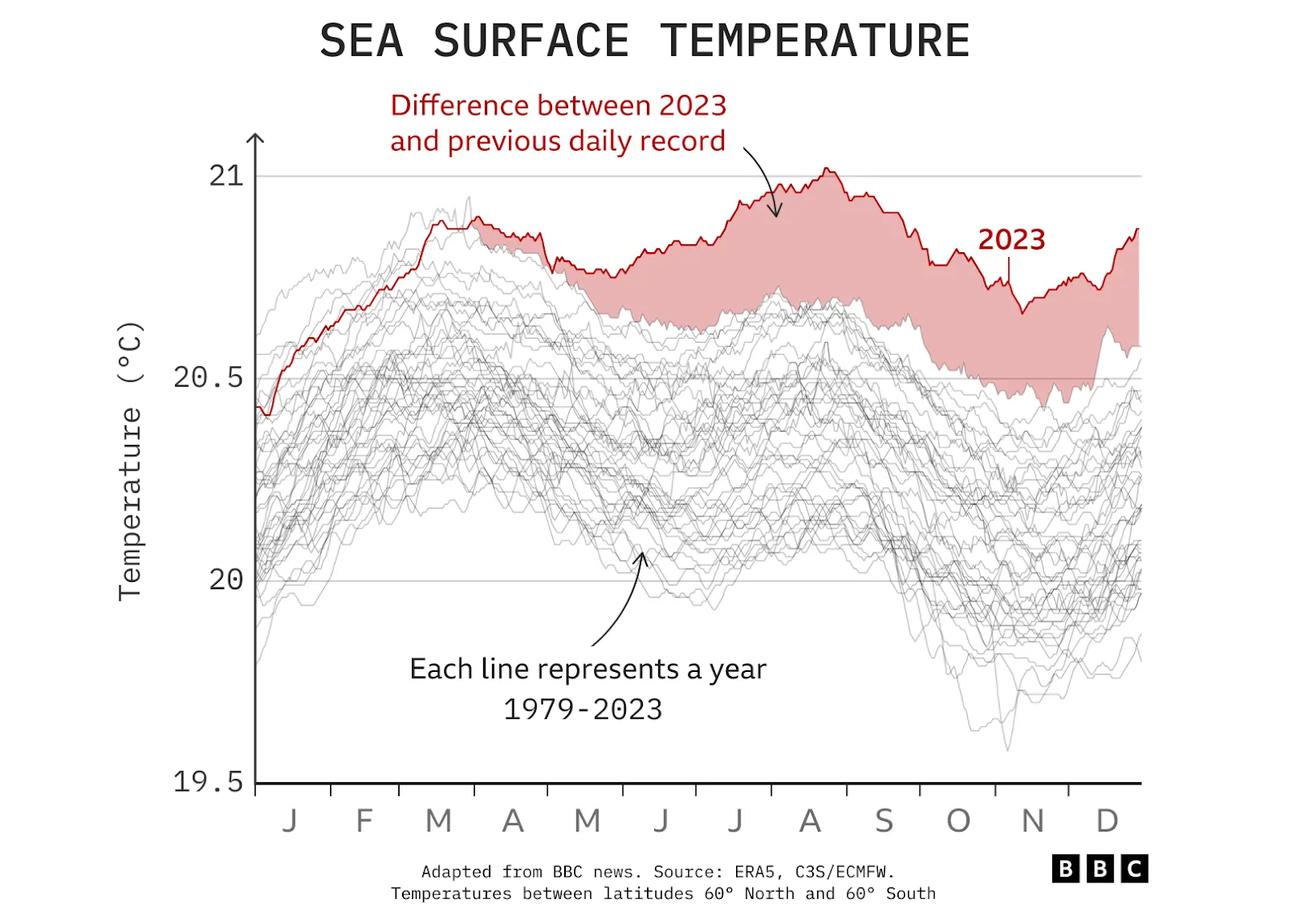
#1 - We don’t know why 2023 was so hot
The climate data from 2023 is scary, because we do not understand why 2023 was so warm. El Niño and low-sulfur fuels had an impact, but their effects were anticipated, and don’t fully explain the temperatures that we saw.
The actual warming in 2023 fell far outside of scientists’ predictions. This is what hitting a climate feedback loop looks like.
#2 - Billionaires are getting interested
It only takes one person rich enough to start a geoengineering programme. In 2023, some powerful and wealthy people started talking publicly about geoengineering.

#3 - Institutions are awakening to geoengineering
- In 2023, both the US and EU commissioned research on solar geoengineering. In the past, state governments have refused to fund anything related.
- Climate scientists are starting to seriously talk about solar geoengineering. Traditionally, they’ve self-censored on this topic, but this is changing. I highly recommend Robinson Meyer’s fascinating account of this.
- The internet noise is rising from a stutter to a low hum. In 2023/24, people are talking about SRM. Casey Handmer, Keep Cool, The Economist, and the BBC, to name just a few. I personally feel that 2023 was the year that SRM broke a critical threshold in the broader climate consciousness.
Ok, let’s rewind for a sec.
You’re telling me that sulfur reflects the sun?
If reflecting the sun with sulfur sounds far fetched - well, we’re already doing it.
The two best examples:
- In 1991, Mount Pinatubo erupted and ejected millions of tons of sulfur dioxide. It cooled the earth by around 0.5°C, and lasted for around two years.
- We already put sulfur into the atmosphere by burning fossil fuels. The sulfur that we’ve emitted so far is already reflecting sunlight, and is currently “masking” about 0.5°C of warming. Without these particles, we’d already be at 1.8°C warming, not 1.3°C.
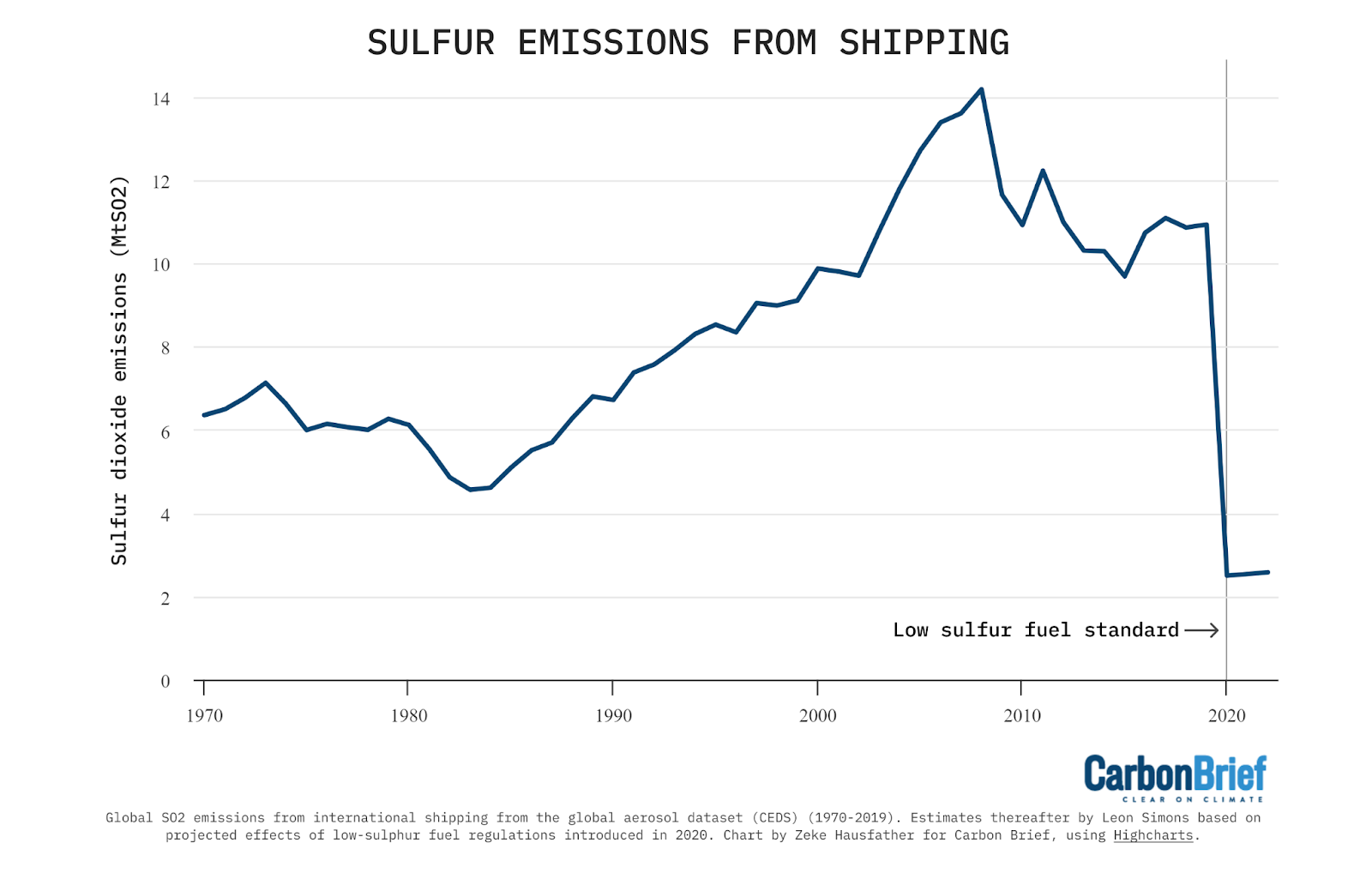
In 2020, the International Maritime Organisation introduced limits on the sulfur content of shipping fuel. It reduced sulfur dioxide emissions by about 8 million tons in its first year - about 10% of the global total.
 Src: CarbonBrief
This reduction in sulfur emissions has “un-masked” warming that was already there. It’s one of the reasons for the jump in warming in 2023 (though it doesn’t fully explain the abnormality).
Instant effect
Because SRM acts almost instantly, we’d need to phase it in gradually. If we began blasting maximum sulfur tomorrow, we’d cause a sharp fall in temperature that would be a nasty shock to the climate.
A better plan is to use sulfur to pause our warming at its current level (about 1.3 °C) whilst we slash emissions. Eventually SRM would become redundant as methane’s warming falls off, and carbon removal takes effect.
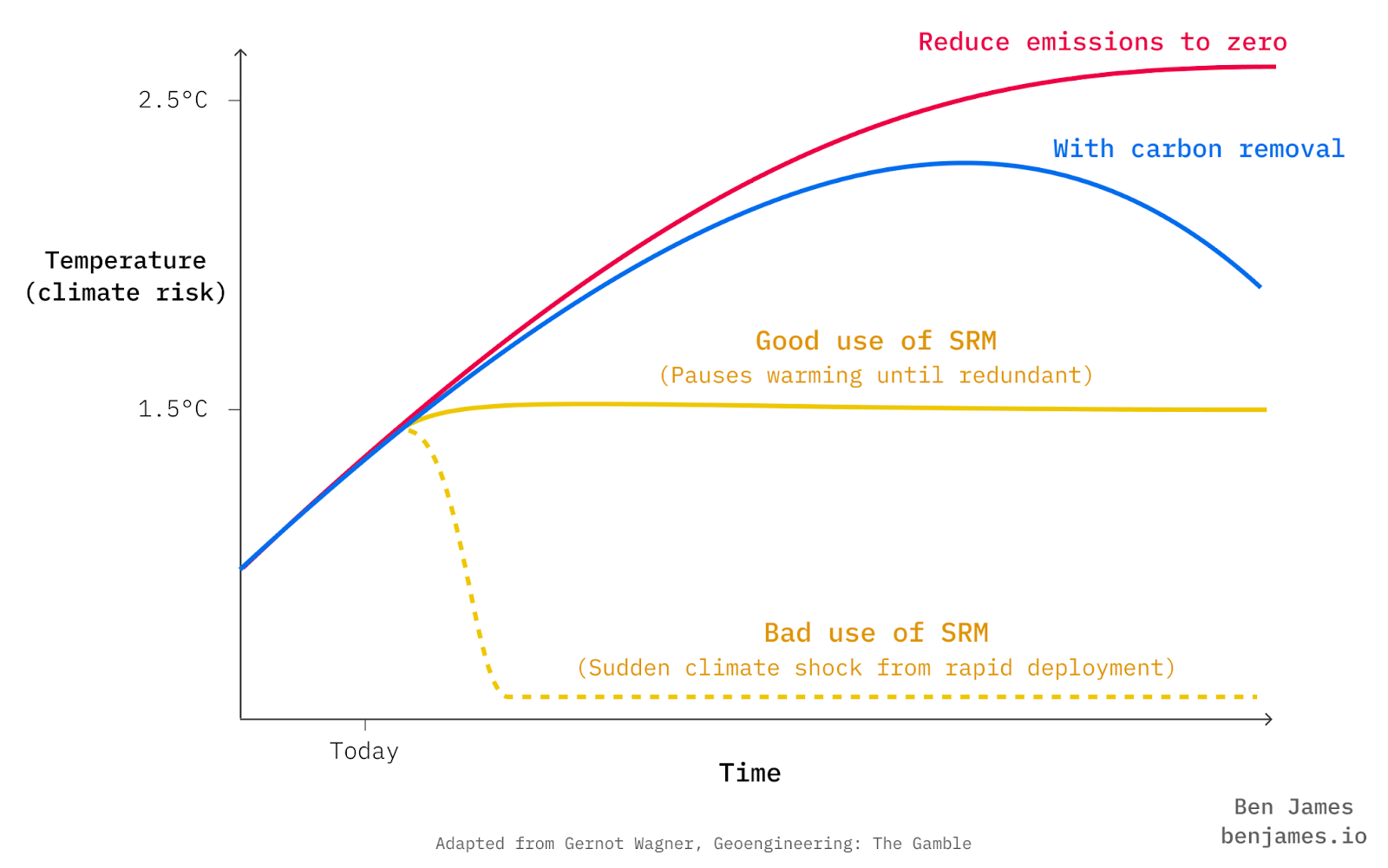
Sulfur disappears from the atmosphere quickly - it rains out after about a year. This means that once we’ve started SRM, it’s dangerous to suddenly stop. We need to keep spraying particles, all the time. If we suddenly stopped, the warming would spring back rapidly, causing a bad temperature shock. The correct way to stop is a gradual phase out.
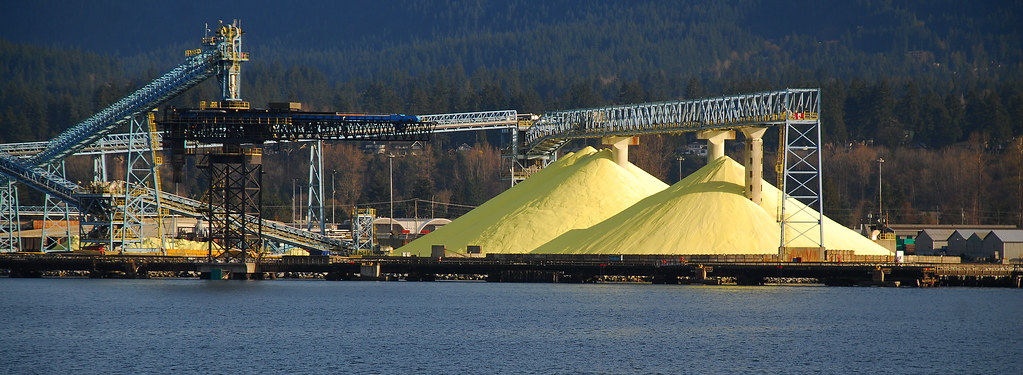 Piles of sulfur in Canada - a by-product of sweetening oil from Alberta. Photo: Gord McKenna.
The rub
Unfortunately, Solar Radiation Management (SRM) has some fairly gigantic problems.
- It doesn’t fix the root cause. Cooling the planet does not remove the CO2 which has accumulated in our atmosphere. It doesn’t stop that CO2 from acidifying the oceans and irreversibly destroying marine biodiversity.
- SRM could make us complacent about dramatically cutting emissions.
- Sulfur increases acid rain (harmful to many life forms) and will likely harm the ozone.
- If SRM is poorly implemented, it could dramatically change weather and rainfall patterns. For example, if sulfur is not injected near the equator, it will not evenly mix into the stratosphere, causing uneven cooling and heating.
Shifted weather and rainfall patterns are one of the scariest possibilities of SRM. Even if deployed “correctly”, it’s unclear how SRM would affect rainfall and monsoons. Our current research suggests that when deployed in the correct locations and volumes, SRM significantly moderates climate hazards everywhere, and significantly exacerbates them nowhere. But we will not know until we try.
Crucially, the biggest problems with SRM are probably not yet known. The side effects of putting sulfur into the stratosphere could be some of the most consequential unknowns in human history. Clearly, that’s a huge reason to do more research. But still - no matter how much research is done, when humanity tries to bend nature to its will, we can be sure that unintended consequences won’t be far behind.
SRM will be deployed without your consent
Geoengineering will not happen by international consensus. I find it impossible to imagine a UN mechanism approving something so universally contentious.
Rather, someone will probably just do it.
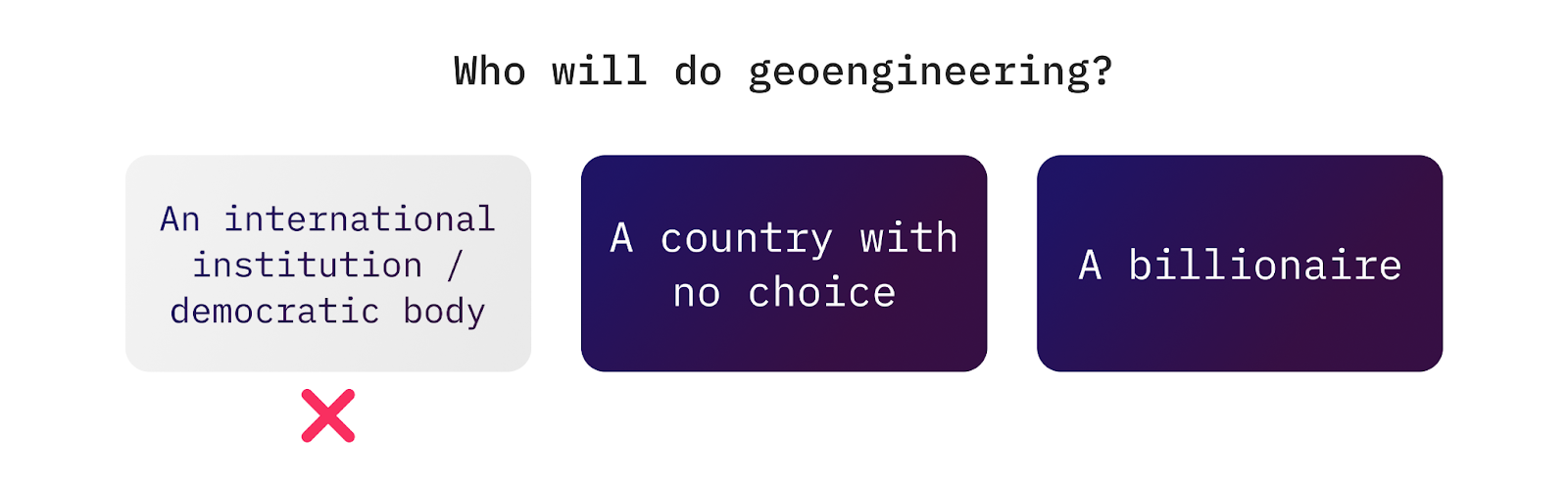
A country with no choice
Some nations will soon have a simple choice: deploy geoengineering or cease to exist.
People underestimate how controversial it can become to not do SRM. Imagine you are the leader of a country close to the equator. Crop failures, extreme heat, and city-destroying cyclones mean that your people are without drinkable water, have nowhere to sleep, and cannot feed their children. Mass social unrest and physical violence become normal for your country. SRM is the only action that you can take to turn off the disasters, and prevent your government being overthrown.
Because SRM is so cheap, it’s completely feasible that one country could do this alone. (The Ministry for the Future and Termination Shock imagine interest from India, Singapore, Venice, Texas and The Netherlands)
Ultimately, the decision to turn on the SRM machines will not be made by climate scientists, or carefully calculated risks. It will be made on the basis of nations rising or falling - by starving populations, revolutionaries, and leaders with their back against a wall.
The conditions only have to align for one country, at one time, to begin geoengineering.
A billionaire
There are three important things to know about billionaires:
- The business interests of many billionaires face total decimation at the hand of climate-induced conflict and destabilisation.
- Many billionaires attribute their success to being hyper-logical, no-BS, getting shit done, and acting upon contrarian beliefs (sometimes this is even correct). The appeal of SRM to this mindset needs no explanation 🤠
- Some billionaires want to use their money for good. The great challenge of the billionaire is how to convert a fortune into a timeless legacy.
It doesn’t matter if 99.9% of billionaires think that geoengineering is a terrible idea. It only takes one person rich enough to implement it.
Every year, SRM inches towards “the logical choice”.
Deploying SRM in 2024 is probably not the logical choice. But it’s not long before that changes.
Taking climate catastrophe off the table
The further that we depart from our current temperature, the more we risk runaway changes that we can't control. We don’t know much about when tipping points will occur - we just know that they are out there.
Why risk the arctic permafrost melting? Why risk losing the Greenland ice sheet? Why risk the tipping points that we don’t even know about?
These risks increase every year that our emissions are above zero - including every year that we are dramatically reducing emissions. SRM gives us the ability to lop off the most catastrophic outcomes from the end of the probability distribution.
Geoengineering is no replacement for getting our shit together. But there would be no honour in allowing the deaths of hundreds of millions of people, simply because they could have theoretically been avoided through more mitigation.
Let’s check in on global emissions
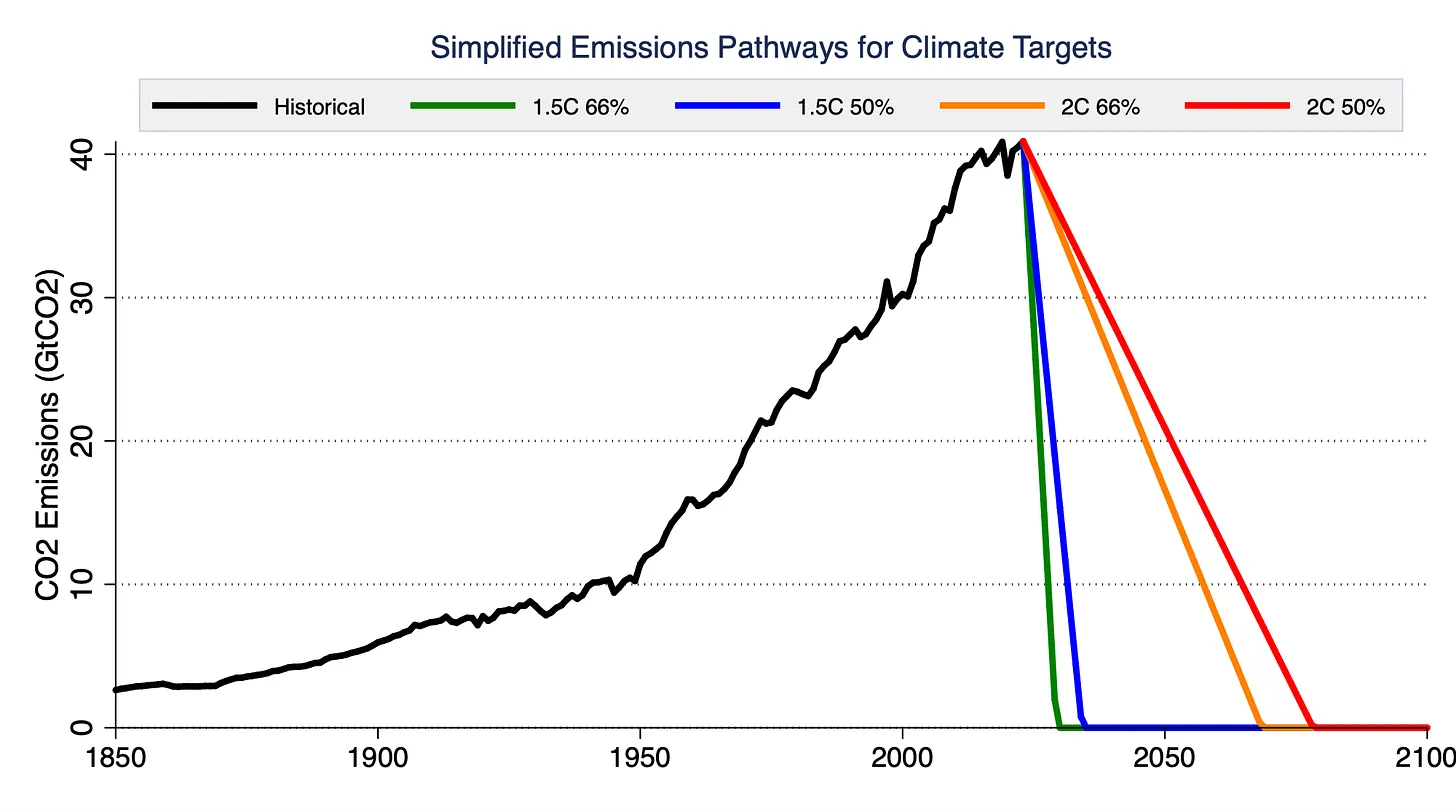 Src: Zeke Hausfather - The Climate Brink
Here’s the actual forecast from the US Energy Information Administration (for energy-related CO2 only).
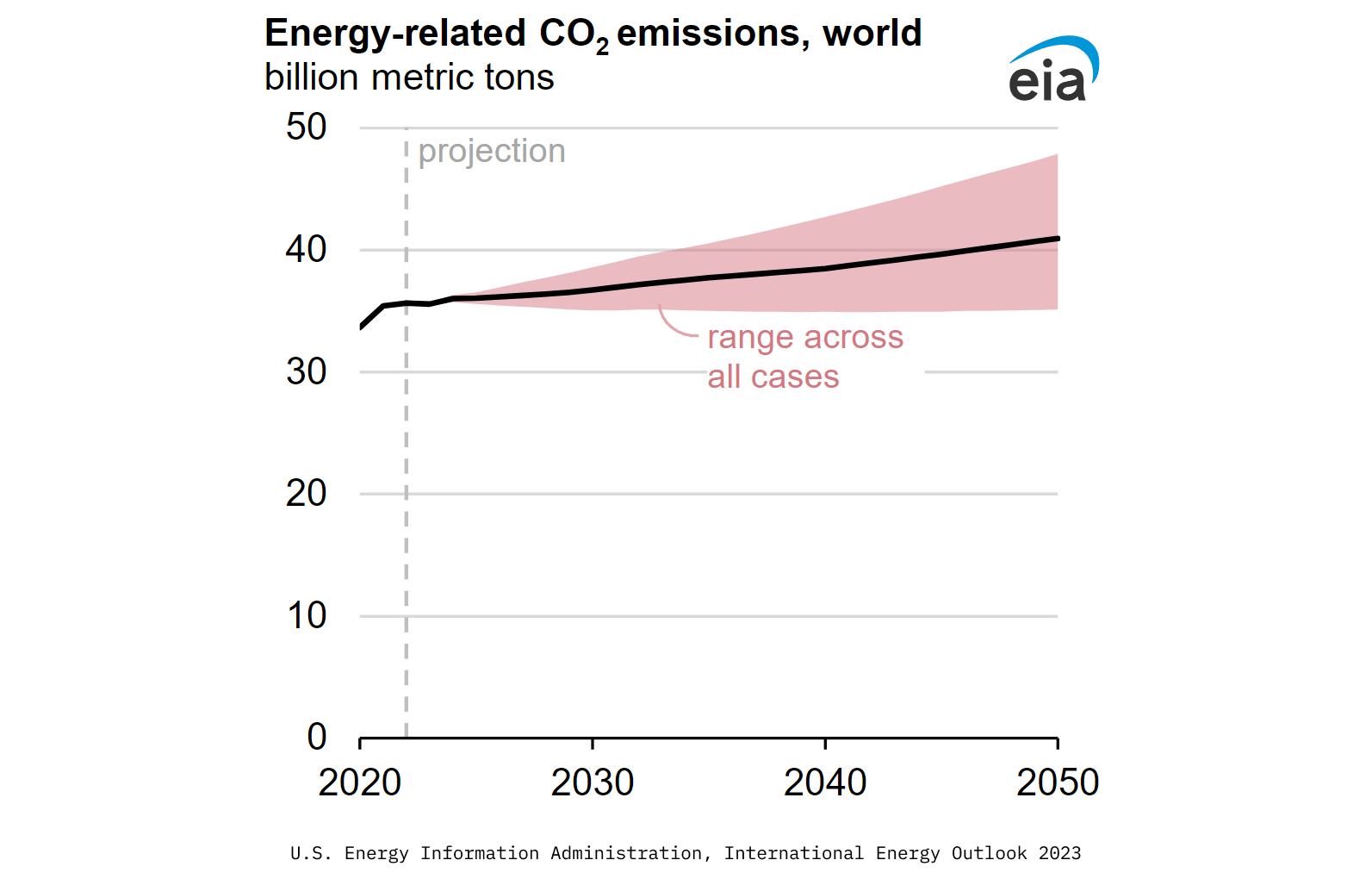
Whilst the EIA is usually wrong, it’s true that things are going to get bad before they get better. The maths no longer checks out to hit 1.5 degrees, and even succeeding in holding 2 degrees would be a disastrous outcome.
I don’t point this out because emissions cuts are hopeless. On the contrary - we will electrify everything, solar & batteries will eat the world, and emissions will plummet. But it still might take a decade or two too long. It would be a shame to die in the meantime.
To be clear: there is no valid argument that SRM should replace deep emissions cuts. But deploying it alongside deep emissions cuts could reduce risk and deaths from climate change.
Climate controversy repeats itself
SRM is the last of the four climate solutions to become widely discussed. It seems to me that their entry into the zeitgeist is ordered like this:

In the 2000s, carbon removal was controversial, because we thought we’d fix everything with mitigation (and a bit of adaptation). This changed in the early 2020s (though CDR is still controversial, and for good reason).
Today, SRM is controversial, because we maintain we’ll fix everything with mitigation, adaptation, and carbon removal. I predict that this will soon change.
Take a look at this flow of climate effects.

The best blend of future solutions to minimise human suffering probably includes some SRM. This is because:
- Mitigation can’t go fast enough to do 100% by 2050.
- Carbon removal is too expensive to do more than a few percent.
- Adaptation doesn’t actually stop temperatures rising.
Final thoughts
So how would we actually put sulfur into the stratosphere?
The most widely discussed method uses customised planes to fly missions into the stratosphere and release sulfur dioxide. People also talk about cannons that launch sulfur rockets, and (more practically) high-altitude balloons filled with sulfur and hydrogen/helium.
It’s easy to imagine a world where amateur enthusiasts launch large sulfur balloons from their backyard, just like hobbyists launch weather balloons today. Scientifically, this would be a terrible idea (remember, we only want to inject sulfur near the equator, in a controlled way). But it’s easy to see the individual appeal of offsetting the warming of hundreds of thousands of people with just a few balloons.
Is it only sulfur that will work?
No. In fact, sulfur is unideal for a lot of reasons (it causes acid rain, could harm the ozone, and in general is not friendly to humans). But it mimics the “natural” effects of volcanoes, and our human sulfur emissions already do a lot of cooling, so we know some things about its effects on the atmosphere.
One promising alternative is calcium carbonate (chalk). Unlike sulfur, it is alkaline, not acidic - which means that it would accelerate the healing of the ozone hole as a co-benefit. Here’s a long blog post on the details of calcite geoengineering.
Harvard has been trying to run a small experiment called SCoPEx to investigate calcium geoengineering. Despite being a fairly basic experiment (injecting less than a kg of calcium into the atmosphere from a balloon), the project has been stuck in approval committees for several years, because of the controversy of researching geoengineering.
Conclusion
SRM might not make sense in your mind (it certainly doesn’t in mine). But do you view the world in the same way as a military dictator, “benevolent” billionaire, or leader of a starving country?
It's 2024, and for better or for worse, people are starting to take geoengineering seriously.
The end
Thanks to Ed Maclean (writes Breakfast of Challengers), Laura Lock, and Art Lapinsch (writes Delphi Zero) for their thoughtful comments on this one. All opinions are mine, not theirs (in fact they all disagree with at least one thing I’ve written above).
Source: Ben James