Subscribe for monthly SRM updates here: 1. This Week’s Top SRM Highlights2. Research Papers3. Web Posts4. Job Opportunity5. Upcoming Events6. Deadlines7. YouTube Videos
Neef, R. (2025). The direct application and potential indirect contribution of space law for solar radiation modification governance. Review of European, Comparative & International Environmental Law.Synopsis: Solar Radiation Modification reflects sunlight to cool Earth but lacks comprehensive international governance. This article reviews space law’s role in SRM governance, arguing it directly applies to space-based SRM (e.g., sunshades) and can indirectly inform broader governance. Given SRM’s global implications, space law offers valuable insights. The study calls for deeper exploration of space law’s relevance to shaping future SRM governance frameworks.
Bandira, P. N. A., Tan, M. L., Samat, N., & Zhang, F. (2025). The Relationship of solar radiation and climate variability in the Northern Region of Peninsular Malaysia. Theoretical and Applied Climatology, 156(4), 1-18.Synopsis: This study examines the link between solar radiation and climate variability in northern Peninsular Malaysia, an important agricultural region. Using the Vector Autoregressive (VAR) model, it finds that solar radiation significantly influences the De Martonne Aridity Index, with dry conditions from December to May and peak rainfall from September to November. The results suggest a long-term warming and humid trend, emphasizing solar radiation’s role in shaping regional climate and its relevance to climate mitigation strategies.
Li, T., Zhu, W., Zhang, Y., Shan, X., Höök, T., Sepúlveda, M., & Kurtz, N. (2025). Wood Ice Seed for Sea Ice Generation.Synopsis: This study introduces Ice-Wood, a bioengineered material designed to promote sea ice formation and mitigate Arctic ice loss. Made from partially lignin-removed, surface-carbonized wood, Ice-Wood enhances ice formation by increasing albedo (0.911) and mid-infrared emittance (0.941), creating a sub-freezing platform. Field tests show it accelerates ice growth and helps drain melt ponds, restoring ice cap reflectivity. This approach offers a scalable solution for ice regeneration in rapidly warming Arctic regions.
Erfani, E., & Mitchell, D. L. (2025). Constraining a Radiative Transfer Model with Satellite Retrievals: Implications for Cirrus Cloud Thinning. EGUsphere, 2025, 1-44.Synopsis: Cirrus cloud formation mechanisms remain challenging to simulate in climate models, leading to uncertainties in their response to aerosols and the effectiveness of cirrus cloud thinning (CCT). Using CALIPSO satellite data, this study finds that homogeneous cirrus clouds have a stronger radiative effect than heterogeneous cirrus, with potential cooling impacts of up to -1.6 W/m² at the TOA. These findings underscore the need for improved modeling to assess CCT's viability in climate intervention strategies.
Nimusiima, A., Ayesiga, G., Odongo, R., Mulinde, C., Ojara, M., Aribo, L., & Ogwang, B. A. (2025). Implications of Solar Radiation Modification on Rainfall and Temperature Patterns over Eastern Africa.Synopsis: This study examines the effects of Solar Radiation Modification on rainfall and temperature in Eastern Africa using GeoMIP models under G6solar and G6sulfur scenarios. Results show that G6solar increases precipitation under SSP245 but reduces it under SSP585, while G6sulfur decreases precipitation in both scenarios. Temperature projections indicate overall cooling under G6solar, whereas G6sulfur yields inconsistent results. These findings highlight SRM’s complex regional climate impacts.
Schoeberl, M. R., Toohey, M., Wang, Y., & Ueyama, R. (2025). Stratospheric Injection Lifetimes.Synopsis: This study examines the stratospheric lifetime of injected material from volcanoes and pyrocumulonimbus clouds, using a tracer simulation to track trajectory parcels over eight years. The Hunga eruption's water vapor plume is estimated to persist for ~3.7 years, aligning with satellite observations. Findings show that altitude, latitude, and removal processes influence lifetimes, with implications for understanding past eruptions and assessing the feasibility of stratospheric aerosol geoengineering.
Pledge Your Support
"The Degrees Initiative is a UK-based NGO that builds the capacity of developing countries to evaluate solar radiation modification, a controversial proposal for reducing some impacts of climate change by reflecting sunlight away from the Earth."
Solar Geoengineering Events Calendar
RFF and the Harvard Solar Geoengineering Research Program invite individuals to present research at the RFF and Harvard SRM Social Science Research Workshop: Governance in a Fractured World, happening September 4–5, 2025 at Washington, DC
The Promises and Pitfalls of Geoengineering | 2025 Isaac Asimov Memorial Debate | American Museum of Natural History "The climate emergency demands bold and unconventional solutions, and geoengineering has emerged as a controversial yet potentially transformative approach.In the 23rd Isaac Asimov Memorial Debate, Neil deGrasse Tyson, Frederick P. Rose Director of the Hayden Planetarium, convenes leading experts to examine the latest advancements in geoengineering. Together, they discuss the scientific, ethical, and policy considerations surrounding relevant technologies and large-scale interventions–and their role in shaping the future of our planet."Asimov Panelists: Holly Jean Buck, Elizabeth Chalecki, Howard Herzog, Dustin Mulvaney, Kevin Surprise, Daniele Visioni
Solar Climate Intervention Virtual Symposium 16 (Alex Luebke & Ansar Lemon) | Solar Climate Intervention talks "Solar Climate Intervention Virtual Symposium 16Alex Luebke (CEO, Ice Preservation) : "Slowing sea level rise through scientifically sound, socially acceptable action".Ansar Lemon (Harvard University) : "Under a not so white sky: visual impacts of stratospheric aerosol injection"."
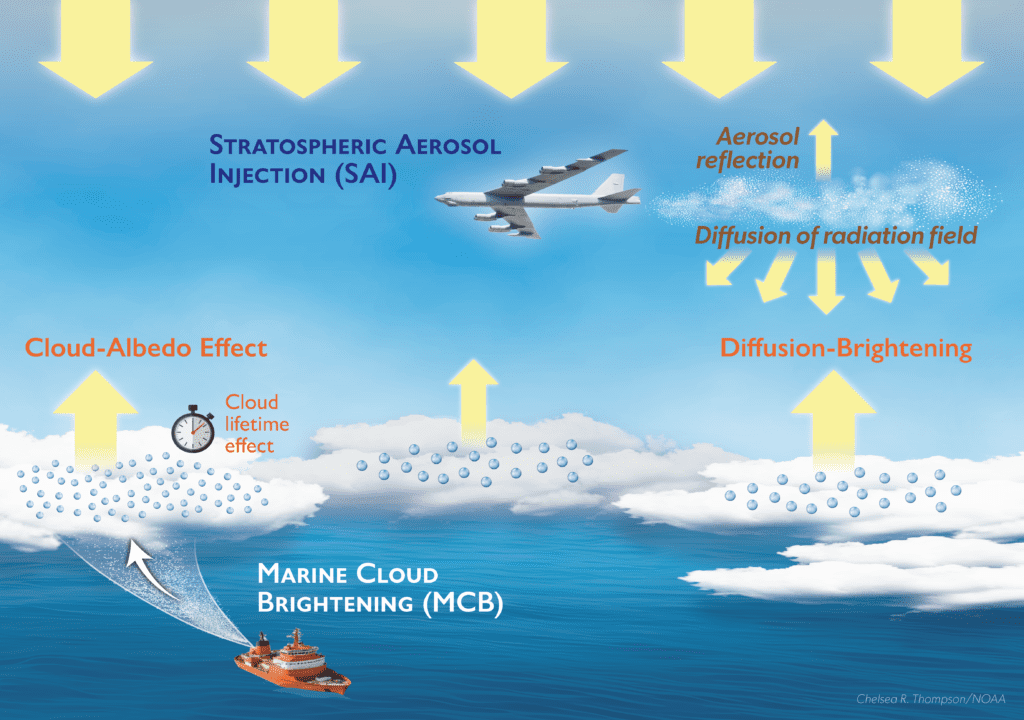
Stratospheric Aerosol Injection Would Change Cloud Brightness | Remove and Reflect Podcast "In this episode, Ms. Sun (AI-generated) and Ms. Remove (AI-generated) discuss a recent research article from Geophysical Research Letters that investigates how stratospheric aerosol injection (SAI), a proposed climate intervention technique, could inadvertently enhance the brightness of clouds. The authors identify a mechanism called "diffusion-brightening," where stratospheric aerosols scatter sunlight, causing it to enter lower clouds at steeper angles, thus increasing their reflectivity. Through idealized simulations, the study estimates that this effect could substantially increase cloud albedo, potentially even exceeding the direct reflective effects of the stratospheric aerosols themselves, with implications for the overall effectiveness and implementation of SAI."
Partisanship overcomes framing in shaping solar geoengineering perceptions | Remove and Reflect Podcast 'In this episode, Mr. Sun (AI-generated) and Ms. Remove (AI-generated) discuss a new research paper that investigates public perception of solar geoengineering (SG) in the United States, focusing on how different framings of SG and the partisan identity of information sources influence attitudes. Through a conjoint experiment with American voters, the study found that partisan alignment of the messenger significantly shapes trust and support for SG, overshadowing the impact of framing the message as complementary, substitutive, or a moral hazard. Both Democrats and Republicans are more receptive to information about SG from sources that share their political affiliation. Despite this strong partisan influence on initial perceptions, underlying ideological beliefs largely determine policy preferences related to climate change. The study highlights the challenge of overcoming political polarization when communicating about emerging climate technologies like SG.'
Global Cooling - Part1 - How to create an Ice Age? | Neofizix "By increasing the albedo (reflectivity) of the Earth we can easily cool it to the desired temperature and even create an Ice Age. Here we discuss very basic calculations with the Zero Dimensional Global Radiation Energy Balance. Of course this is not a substitute for reducing CO2 emissions or for CO2 removal projects. But it is a quick fix solution to manage the temperatures, which is the major reason for the climate change effects like melting of polar ice caps and glaciers."
Climate Interventions: a distraction or a necessity? Seminar by the Centre for Climate Repair | Centre for Climate Repair "A critical discussion in the fight against climate change: the role of climate interventions. As the world grapples with the escalating impacts of climate change, the conversation around interventions—ranging from technological innovations to policy reforms—has become increasingly urgent. Are these strategies essential for meaningful progress, or do they divert our attention from the systemic changes needed for a sustainable future?”
Sea Secrets 2025 with James Hurrell, Ph.D. | MiamiRosenstielSchool "There is growing concern that current international efforts to reduce greenhouse gas emissions, combined with adaptation efforts, are insufficient to avoid intolerable climate change impacts over the coming decades. This has stimulated a rapidly growing interest among researchers, governments, and policy analysts in understanding if the deployment of some form of Solar Climate Intervention (SCI) would help to reduce future risks from adverse climate change impacts, and provide more time for humanity to reduce atmospheric greenhouse gas concentrations. However, proposed SCI strategies involve significant, uncertain risks that must be understood. In this talk, Dr. Hurrell will present a brief overview of SCI and argue for the importance of research on the topic."
Clear Skies, Clear Minds: Harnessing Open Research to Find Climate Solutions | uchicagolibrary "This fireside chat about climate systems engineering features Vice Provost for Research Erin Adams and Professor David Keith, of the Department of Geophysical Sciences, both of the University of Chicago. It was part of the February 13, 2025, symposium Clear Skies, Clear Minds: Harnessing Open Research to Find Climate Solutions, presented by the University of Chicago Library."
Follow us on: Twitter | Bluesky | YouTube | Substack | Google Group | Podcast 1 | Podcast 2
Support us here: | |