| WEEKLY SUMMARY (28 AUGUST - 03 SEPTEMBER 2023)
CONSULTATIONS REQUIRED
RESEARCH PAPERSWrana, F., Niemeier, U., Thomason, L. W., Wallis, S., & von Savigny, C. (2023). Stratospheric aerosol size reduction after volcanic eruptions. EGUsphere, 2023, 1-30.ABSTRACTThe stratospheric aerosol layer plays an important role in the radiative balance of Earth primarily through scattering of solar radiation. The magnitude of this effect depends critically on the size distribution of the aerosol. The aerosol layer is in large part fed by volcanic eruptions strong enough to inject gaseous sulfur species into the stratosphere. The evolution of the stratospheric aerosol size after volcanic eruptions is currently one of the biggest uncertainties in stratospheric aerosol science. We retrieved aerosol particle size information from satellite solar occultation measurements from the Stratospheric Aerosol and Gas Experiment III mounted on the International Space Station (SAGE III/ISS) using a robust spectral method. We show that, surprisingly, some volcanic eruptions can lead to a decrease in average aerosol size, like the 2018 Ambae and the 2021 La Soufrière eruptions. In 2019 an intriguing contrast is observed, where the Raikoke eruption (48∘ N, 153∘ E) in 2019 led to the more expected stratospheric aerosol size increase, while the Ulawun eruptions (5∘ S, 151∘ E), which followed shortly after, again resulted in a reduction in the values of the median radius and absolute distribution width in the lowermost stratosphere. In addition, the Raikoke and Ulawun eruptions were simulated with the aerosol climate model MAECHAM5-HAM. In these model runs, the evolution of the extinction coefficient as well as of the effective radius could be reproduced well for the first 3 months of volcanic activity. However, the long lifetime of the very small aerosol sizes of many months observed in the satellite retrieval data could not be reproduced.
Peng, Y., Yu, P., Portmann, R. W., Rosenlof, K. H., Zhang, J., Liu, C. C., ... & Tian, W. (2023). Perturbation of tropical stratospheric ozone through homogeneous and heterogeneous chemistry due to Pinatubo. Geophysical Research Letters, 50(16), e2023GL103773.ABSTRACTThe Pinatubo eruption in 1991 injected 10–20 Tg SO2 into the stratosphere, which formed sulfate aerosols through oxidation. Our modeling results show that volcanic heating significantly perturbs the heterogeneous and homogeneous chemistry including NOx and HOx catalytic cycles in the tropical stratosphere. The simulated tropical chemical ozone tendency is positive at 20 mb while negative at 10 mb in the tropics. The simulated ozone chemical tendency is of the same magnitude as the dynamical ozone tendency caused by the accelerated tropical upwelling, but with the opposite sign. Our study finds that the tropical ozone chemical tendency due to homogeneous chemistry becomes more important than heterogeneous chemistry 3 months after eruption. Sensitivity simulations further suggest that the tropical ozone tendency through heterogeneous chemistry is saturated when the injected amount exceeds 2 Tg.
Bodai, T., Lembo, V., Aneesh, S., Lee, S. S., Ishuzu, M., & Franz, M. O. (2023). Inverse problems for climate policy mixes including geoengineering [Preprint].ABSTRACTThere is a palpable shift in mainstream attitude towards geoengineering, seen now as a potential part of a climate policy mix. Still, no-one wants to get on a slippery slope, compounding the risks, and, therefore, we should ask ourselves what is the minimal geoengineering that we can get away with. Such questions lead mathematically to inverse problems. Solving them is feasible only with lightweight models of the climate system, various types of which are nowadays often referred to as emulators – some more accurate than others. Here we develop an emulator using nonlinear response theory and apply it to two paradigmatic inverse problems relevant to climate policy. First, we investigate the attainability of the coveted Paris15 temperature targets. Second, through a simple multi-stable model, we determine what it takes to save the Greenland ice sheet (GrIS) as we know it. Our results suggest, first, that as things stand presently, solar radiation management geoengineering will likely have to be part of our climate policy mix. Second, we demonstrate also the importance of precisely knowing not only the stable but also the unstable so-called Melancholia states of climate tipping elements, such as the GrIS, as miscalculations can lead to acting too late.
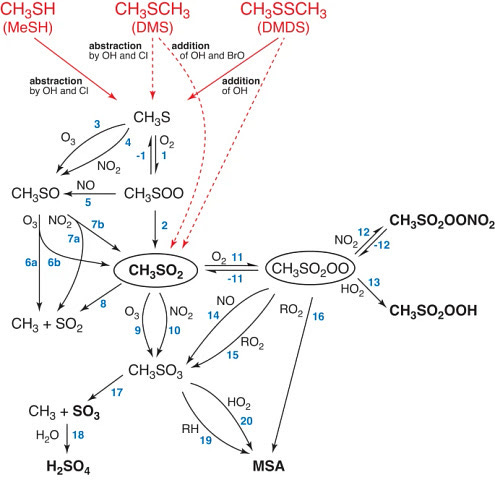
Berndt, T., Hoffmann, E. H., Tilgner, A., Stratmann, F., & Herrmann, H. (2023). Direct sulfuric acid formation from the gas-phase oxidation of reduced-sulfur compounds. Nature Communications, 14(1), 4849.ABSTRACTSulfuric acid represents a fundamental precursor for new nanometre-sized atmospheric aerosol particles. These particles, after subsequent growth, may influence Earth´s radiative forcing directly, or indirectly through affecting the microphysical and radiative properties of clouds. Currently considered formation routes yielding sulfuric acid in the atmosphere are the gas-phase oxidation of SO2 initiated by OH radicals and by Criegee intermediates, the latter being of little relevance. Here we report the observation of immediate sulfuric acid production from the OH reaction of emitted organic reduced-sulfur compounds, which was speculated about in the literature for decades. Key intermediates are the methylsulfonyl radical, CH3SO2, and, even more interestingly, its corresponding peroxy compound, CH3SO2OO. Results of modelling for pristine marine conditions show that oxidation of reduced-sulfur compounds could be responsible for up to ∼50% of formed gas-phase sulfuric acid in these areas. Our findings provide a more complete understanding of the atmospheric reduced-sulfur oxidation.
Li, H., Richter, J. H., Hu, A., Meehl, G. A., & MacMartin, D. (2023). Responses in the subpolar North Atlantic in two climate model sensitivity experiments with increased stratospheric aerosols. Journal of Climate, 1-31.ABSTRACTThe subpolar North Atlantic (SPNA) shows contrasting responses in two sensitivity experiments with increased stratospheric aerosols, offering insight into the physical processes that may impact the Atlantic meridional overturning circulation (AMOC) in a warmer climate. In one, the upper ocean becomes warm and salty, but in the other it becomes cold and fresh. The changes are accompanied by diverging AMOC responses. The first experiment strengthens the AMOC, opposing the weakening trend in the reference simulation. The second experiment shows a much smaller impact. Both simulations use the Community Earth System Model with the Whole Atmosphere Community Climate Model component (CESM-WACCM)) but differ in model versions and stratospheric aerosol specifications. Despite both experiments using similar approaches to increase stratospheric aerosols to counteract the rising global temperature, the contrasting SPNA and AMOC responses indicate a considerable dependency on model physics, climate states, and model responses to forcings. This study focuses on examining the physical processes involved with the impact of stratospheric aerosols on the SPNA salinity changes and their potential connections with the AMOC and the Arctic. We find that in both cases, increased stratospheric aerosols act to enhance the SPNA upper ocean salinity by reducing freshwater export from the Arctic, which is closely tied to the Arctic sea ice changes. The impact on AMOC is primarily through the thermal component of the surface buoyancy fluxes, with negligible contributions from the freshwater component. These experiments shed light on the physical processes that dictate the important connections between the SPNA, the Arctic, the AMOC, and their subsequent feedbacks on the climate system.
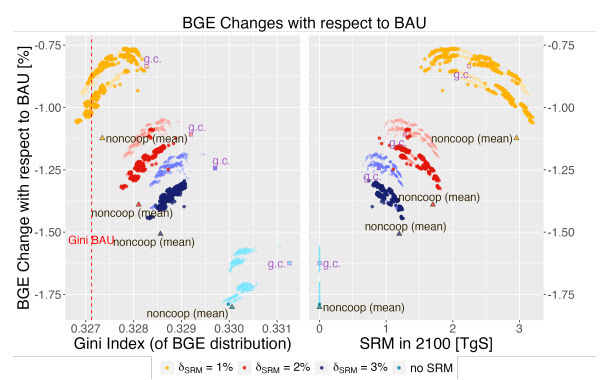
WORKING PAPERSABSTRACTGeoengineering, including solar radiation management (SRM) has received increasing scrutiny due to the rise of climate extremes and slow progress in mitigating global carbon emissions. This climate policy option, even as a possibility, can have consequential implications for international climate governance. Here we study how solar engineering affects the effectiveness and stability of a large set of regional coalitions through numerical simulations. We posit a requirement in terms of global political or economic power and analyze the exclusive membership coalition formation process when coalitions jointly decide on geoengineering and mitigation. We show that geoengineering can provide incentives for cooperation and partially solve the typical trade-off between stability and effectiveness of climate coalitions. However, temperature reduction mostly comes from deploying SRM within the coalition rather than from further emission reductions, thus exposing the world to relatively large-scale deployment of SRM with as of today uncertain potential side effects and risks.
REPORTS
Ph.D. OPPORTUNITY“About the research project:Antarctica is of vital importance for operation of earth's climate system but is also particularly prone to the impacts of human induced climate change. Recent scientific reports have identified ice sheet destabilization, sea-ice retraction, ocean acidification, changed ocean currents and southward range shifting of temperate marine species, as current and/or likely climate change impacts that will in time have a significant impact upon the Antarctic cryosphere and marine environment. The project explores international law and policy implications of proposals for climate intervention through solar radiation management and how such techniques might reduce climate change impacts in Antarctica. The project will examine how legal and institutional interplay between the United Nations Climate Change Negotiations, Antarctic Treaty System, Law of the Sea Convention and other international legal regimes might be developed to govern Solar Radiation Management proposals aimed at protecting the Antarctic cryosphere and marine environment. Governance of similar issues in the Arctic may also be looked at as a comparator. This international legal and policy work is urgently required as states will likely face increasing pressure to take steps beyond global greenhouse gas emissions reductions to protect the Antarctic environment from the impending further effects of climate change."
WEB POSTS
UPCOMING EVENTS
PODCASTS“It is essential for young people in the Global South to become more involved in international climate discussions, including around solar radiation modification, says Ghanaian climate activist Nii Noi Omaboe. His decision to screen a documentary about SRM at Accra sustainability week prompted many questions, both about the risks and insufficient governance, but also about opportunities for research.Omaboe is experienced in youth governance, human rights, and global sustainable development processes. He has organized and worked for nonprofit and international organizations like Amnesty International, Red Cross, and 350 Ghana. In 2019, Omaboe co-founded Sustainability Week Accra, the first local Sustainability Week in Africa, and he currently provides strategic support to Green Africa Youth Organisation’s Ghana team as well as supporting establishment of Youth Climate Councils in the Global South. He is also a program analyst at Impact Hub Accra.”
YOUTUBE VIDEOS“Why is arctic climate change a critical issue both locally and for the global climate system?Can the arctic summer sea ice be preserved and how?How could we assess whether climate interventions would be safer than exceeding 1.5 degrees Celsius?ARCTIC MOMENTUM explores climate interventions in the Arctic and the possibilities for equitable and science-led governance and research. In particular, we will raise awareness of techniques such as stratospheric aerosol injection (SAI) and marine cloud brightening (MCB). We aim to build trust and cooperation between indigenous peoples, the research community and civil society to respond to climate risks.ARCTIC MOMENTUM is organised by the youth climate project Operation Arctic in collaboration with SilverLining and RARE Media. Other partners include The Sami Youth Council, Safer Climate Initiative, Arab Youth Climate Movement Qatar, Green Africa Youth Organization, Sustenta Honduras and Ocean Visions.Operation Arctic is a science outreach project founded by a group of young people. Operaatio Arktis invites diverse sectors of society to discuss climate interventions and the conservation of Arctic sea ice. In 2023, the project is funded by the Maj and Tor Nessling Foundation.”
The Whole Story with Anderson Cooper: How to Unscrew a Planet with CNN's Bill Weir | SilverLining“CNN's new Sunday primetime series, "The Whole Story with Anderson Cooper," celebrated Earth Day with a captivating one-hour adventure led by Bill Weir, CNN's Chief Climate Correspondent. Titled "How to Unscrew a Planet," the episode took viewers on a global journey, introducing them to the most innovative individuals and organizations in carbon removal and solar climate intervention.”
| |