Truncated Icosahedron

William Fisher

Hector Alfredo Hernández Hdez.
Can anyone tell me if the math here is correct. http://lumberjocks.com/rance/blog/26130
--
--
You received this message because you are subscribed to the "Geodesic Help" Google Group
--
To unsubscribe from this group, send email to GeodesicHelp...@googlegroups.com
--
To post to this group, send email to geodes...@googlegroups.com
--
For more options, visit http://groups.google.com/group/geodesichelp?hl=en
---
You received this message because you are subscribed to the Google Groups "Geodesic Help Group" group.
To unsubscribe from this group and stop receiving emails from it, send an email to geodesichelp...@googlegroups.com.
For more options, visit https://groups.google.com/d/optout.

Gerry in Quebec
There's more than one way to skin a cat, carve a pumpkin, or split the dihedral angles of a Buckyball (truncated icosahedron). Here are three scenarios, including the one referenced by Bill Fisher, in which the dihedral angle between a pentagon and a hexagon are split evenly between the two faces. See the attached jpg.
Scenario 1: The dihedral angle between a pentagon face and a hexagon face is split so that all outer-to-inner edges of the panels align with the centre point of the Buckyball. With this arrangement, both the inner and outer faces of the hex panels are the same shape, namely regular hexagons, but the inner faces are smaller than the outer. The same goes for the pentagons. The edges of the pentagons have a bevel angle of 16.5 degrees and the hex edges 20.9 degrees. These are the angles I posted in a series of jpgs a few weeks ago.
Scenario 2: The dihedral angle between a pentagon face and a hexagon face is split evenly, as in the example given by Bill (http://lumberjocks.com/rance/blog/26130). In this case, the inner and outer faces of each pentagon are, as in scenario 1, the same shape. However, the inner and outer faces of the hexagons are NOT the same shape. The inner faces are no longer perfectly regular hexagons. In this instance, the pentagon edges and three of the six hexagon edges have a bevel angle of 18.7 degrees. The remaining 3 edges of the hexagons (where two hexagons meet) have a bevel angle of 20.9 degrees.
Scenario 3: The dihedral angle between a pentagon face and a hexagon face is split unevenly, in such a way that no beveling of the pentagon panel edges is required (bevel angle = 0 degrees). As for the hex panels, the three edges connecting to pentagon panels have a bevel angle of 37.4 degrees, and the other three edges have a bevel angle of 20.9 degrees. As in scenario 2, the inner and outer faces of the hex panels are NOT the same shape.
On Saturday, January 17, 2015 at 10:03:26 PM UTC-5, Hector Alfredo Hernández Hdez. wrote:
William Fisher
How would you bevel flat panels, pease method or the Oregon dome method?

Paul Kranz
Very interesting, never considered how the bevels would change the inside shape.
How would you bevel flat panels, pease method or the Oregon dome method?
--
--
You received this message because you are subscribed to the "Geodesic Help" Google Group
--
To unsubscribe from this group, send email to GeodesicHelp...@googlegroups.com
--
To post to this group, send email to geodes...@googlegroups.com
--
For more options, visit http://groups.google.com/group/geodesichelp?hl=en
---
You received this message because you are subscribed to the Google Groups "Geodesic Help Group" group.
To unsubscribe from this group and stop receiving emails from it, send an email to geodesichelp...@googlegroups.com.
For more options, visit https://groups.google.com/d/optout.
Gerry in Quebec
I have a pile of 2.5" x 2.5" spruce and cedar, about 9' long. The plan is to use this lumber for a prototype dome-like structure composed of 18 triangular panels (T-blocked frames + sheathing), using the Oregon Dome method. To avoid the wood waste Paul Kranz was referring to, I will rip each board on a table saw at the correct bevel angle to make two identical struts. (I believe this is what Paul Robinson does to make his Geodome greenhouses.) The only waste will be the sawdust and the bits at the ends of the boards.
A spreadsheet calculates the amount by which each edge length must be shortened to accommodate butted joints between struts. It also generates an OFF report of the triangular frame (including T-blocking), which can then be displayed in Antiview or another visualization program. The attached jpg is an example -- one of the three types of triangular frame for a 3v Fuller-Kruschke dome.
- Gerry
On Monday, January 19, 2015 at 9:44:57 AM UTC-5, Paul Kranz wrote:
William:For my next dome, I will go with the Pease method. I don't like the idea of loosing all that wood with the Oregon method.Paul sends...
On Mon, Jan 19, 2015 at 9:26 AM, William Fisher <fisher...@gmail.com> wrote:Very interesting, never considered how the bevels would change the inside shape.
How would you bevel flat panels, pease method or the Oregon dome method?
--
Paul Kranz
--
--
You received this message because you are subscribed to the "Geodesic Help" Google Group
--
To unsubscribe from this group, send email to GeodesicHelp...@googlegroups.com
--
To post to this group, send email to geodes...@googlegroups.com
--
For more options, visit http://groups.google.com/group/geodesichelp?hl=en
---
You received this message because you are subscribed to the Google Groups "Geodesic Help Group" group.
To unsubscribe from this group and stop receiving emails from it, send an email to geodesichelp...@googlegroups.com.
For more options, visit https://groups.google.com/d/optout.
Gerry in Quebec
William Fisher
Gerry in Quebec
Paul Kranz
--
--
You received this message because you are subscribed to the "Geodesic Help" Google Group
--
To unsubscribe from this group, send email to GeodesicHelp...@googlegroups.com
--
To post to this group, send email to geodes...@googlegroups.com
--
For more options, visit http://groups.google.com/group/geodesichelp?hl=en
---
You received this message because you are subscribed to the Google Groups "Geodesic Help Group" group.
To unsubscribe from this group and stop receiving emails from it, send an email to geodesichelp...@googlegroups.com.
For more options, visit https://groups.google.com/d/optout.
William Fisher
I have seen plans where the riser/traps are vertical. They are reinforced from the pents and hexes with a framed dormer system. I go back and forth of doing this or traps that are angled like the triangles they are replacing and just make dormers for windows.
I like the 4x4 ripping but wonder if the pease method would be easier. I think the Oregon dome method would make interior framing easier.
Bill
William Fisher
I think you are correct about the 10" blade. Since it is the exact same cut from either side, it would line up perfectly. The cost between 12" tablesaws and 10" is incredible. For making 1 home I can't see spending the money. If I was doing this as a business, I would invest in a heartbeat.
Bill
Gerry in Quebec
A few thoughts on the Pease versus Oregon Dome methods of panel construction...
As I see it, the main disadvantage of the Pease system, at least for low-frequency domes including Buckyballs, is that you have a lot of complex sawing to do. First, you have to cut all the strut ends at various compound angles. Second, if you want the roof sheathing and ceiling panels to sit flush on the triangular frames, you have to bevel-rip both the inner and outer edges of the struts at the right dihedral angle(s). Even the internal bracing of the panels, whether triangles, pentagons or hexagons, requires the cutting of compound angles and ripping down one edge to make the bracing fit snugly within the frame cavity. Cutting a compound angle isn't difficult if you've got the right numbers and a decent compound miter saw. The problem is that it's really easy to make mistakes because you're dealing with both a miter and bevel setting for each cut, left and right, and there are typically many different pairs of such saw settings. So, the Pease method requires a lot of concentration and organization in the shop.
However, for a higher frequency dome, such as a 4v or 5v, you don't have to bevel the narrow edges of your struts if you're using the Pease method. This is because the dihedral angle between triangular panels is so close to being flat (180 degrees). A little bit of construction adhesive on the roof-side strut edges will fill the gap and, combined with nailing, make a strong set of panels. So, it seems to me the Pease method may be practical for higher-frequency domes.
What I like about the Oregon Dome method is that it requires a simple (non-compound) type of cut -- bevel-ripping through the ceiling-to-roof face of a strut -- to get flat panels to approximate a sphere's curvature. Also, the strut-end cuts are all simple bevels, no compound angles. Ditto for the internal bracing. The main disadvantage seems to be the severe limit on the depth of strut you can use to create a good insulation space...unless of course you make a double-frame dome. Another disadvantage is that deep bevel-ripping is probably more dangerous than making the cuts required by the Pease method.
- Gerry in Quebec
On Monday, January 19, 2015 at 9:26:55 AM UTC-5, William Fisher wrote:
William Fisher
Great information. Your argument fits well into what I am seeking to do. Since I will have 4-6 studs inside each panel, simple square cuts make it much easier.
William Fisher
Using the ripped 4x4 method is almost required if not using the pease method. Ripping standard 2x4 for the Oregon Dome method masked for very thin beveled edge boards.
What Paul said about using a standard 10" table saw actually sounds safer. You will be making 2 cuts (on each side of the 4x4) but since the board is being cut directly in half, the table block doesn't need to move, you just flip the board over and cut from the reverse side and the cuts meet in the middle. This allows you to set you blade to cut less each time, you just need to cut a little over half way. Since it is cutting less, the saw isn't working as hard therefore less chance of it kicking back on you. Just need a sharp blade.

norm...@gmail.com
There's another easier way to make panels, used by John Rich from New Zealand I believe. Make the panels with 90 degree sides then make filler strips of the proper V shape to fit and fill the spaces between the panels.Ken,
Gerry in Quebec
norm...@gmail.com
William Fisher
Gerry in Quebec
On Wednesday, February 18, 2015 at 8:20:39 AM UTC-5, William Fisher wrote:
William Fisher
William Fisher
I would like to build these as a 3/8 dome on a 4' riser wall.
Doing multiple 22' domes that will connect to make one building.
I am struggling to find the wall angles from the top of the riser walls.
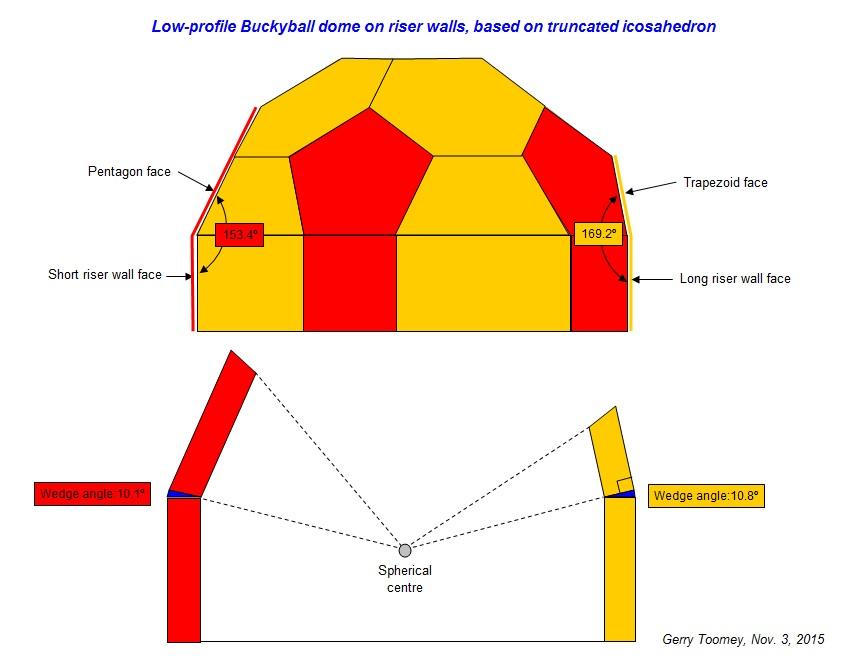
Riser walls would have a short wall with the pent on top and a long wall with a trapezoid on top.
Looking back at other threads, I found Gerry had a few drawings using the 5/8 dome. Considering that the trapezoids will act as half hexes in a 3/8 I know the layout changes.
On the mock up I found a wedge was used under the base trapezoid and hex changing the angle from the standard bevel. This is the part that has me scratching my head.
Thanks
Bill
Gerry in Quebec
The angle between a pentagon panel face and the short riser wall beneath it is 153.4 degrees. Between a trapezoid (half-hex) and the long riser wall the angle is 169.2 degrees. If you're building these Buckyballs as panel domes, the "wedge" angle between the bottom strut of a pent panel and the top strut of its riser wall is 10.1 degrees. Between the trapezoid panel and its riser wall, the wedge angle is 10.8 degrees. The fillet wedge bridges the gap between a panel (based on the Pease method or the Oregon Dome method, for example) and the flat-topped riser wall. Drawing attached.
- Gerry in Québec
William Fisher
Paul Kranz
Expanding on this, I am looking to put a small cupola on top of one of the Domes, doing the "more than one easy to skin a cat" idea, is it possible to get the tyop of the hexes bevelled to accept the cupola walls directly?
--
--
You received this message because you are subscribed to the "Geodesic Help" Google Group
--
To unsubscribe from this group, send email to GeodesicHelp...@googlegroups.com
--
To post to this group, send email to geodes...@googlegroups.com
--
For more options, visit http://groups.google.com/group/geodesichelp?hl=en
---
You received this message because you are subscribed to the Google Groups "Geodesic Help Group" group.
To unsubscribe from this group and stop receiving emails from it, send an email to geodesichelp...@googlegroups.com.
For more options, visit https://groups.google.com/d/optout.
William Fisher
Yes, just for some short windows (2' high by 5' wide). Add light and ventilation into a 29.5' dome.
Plan is 2 29.5' Domes, 1 for 2 bedrooms and ath, the other for living room, kitchen and dining area.
Bill

sergioco...@gmail.com

Ken G. Brown
--
--
You received this message because you are subscribed to the "Geodesic Help" Google Group
--
To unsubscribe from this group, send email to GeodesicHelp...@googlegroups.com
--
To post to this group, send email to geodes...@googlegroups.com
--
For more options, visit http://groups.google.com/group/geodesichelp?hl=en
---
You received this message because you are subscribed to the Google Groups "Geodesic Help Group" group.
To unsubscribe from this group and stop receiving emails from it, send an email to geodesichelp...@googlegroups.com.
For more options, visit https://groups.google.com/d/optout.
<2015-03-27 11.35.33.jpg><2015-03-27 11.35.08.jpg><2015-03-27 09.35.33.jpg>