
How to the Optimize the Strength of a Geodesic Dome?

mru6...@gmail.com
4 frequency dome + 1 1/2 inch EMT conduit + 5 foot strut average (2 per 10ft pole)
or
8 frequency dome + 3/4 inch EMT conduit + 2.5 foot strut average (4 per 10ft pole)
I'm most curious about something like
So a better question might be, what kind of frequency/strut dimensions are really best in terms of strength?
frequency type
strut material
strut wall thickness
strut diameter
strut length
From what I've gathered, it looks as if having the following is ideal when it comes to raising dome strength:
Higher frequency
1/2 sphere via an even frequency dome i.e. 2v, 4v, 6v, 8v (truly flat at the base)
Low strut length variance (the difference between the smallest and the largest strut)
One strut type in the base ring
Contributions appreciated,

Dick Fischbeck

Ashok Mathur
Ashok
--
--
You received this message because you are subscribed to the "Geodesic Help" Google Group
--
To unsubscribe from this group, send email to GeodesicHelp+unsubscribe@googlegroups.com
--
To post to this group, send email to geodes...@googlegroups.com
--
For more options, visit http://groups.google.com/group/geodesichelp?hl=en
---
You received this message because you are subscribed to the Google Groups "Geodesic Help Group" group.
To unsubscribe from this group and stop receiving emails from it, send an email to geodesichelp+unsubscribe@googlegroups.com.
For more options, visit https://groups.google.com/d/optout.

thedomeguy
Have completed a first dome.And am In the beginning stages of designing a second dome (about 30 foot diameter).Now deliberating which ought to be the stronger of the two.
4 frequency dome + 1 1/2 inch EMT conduit + 5 foot strut average (2 per 10ft pole)
or
8 frequency dome + 3/4 inch EMT conduit + 2.5 foot strut average (4 per 10ft pole)
--
You received this message because you are subscribed to the "Geodesic Help" Google Group
--
--
To post to this group, send email to geodes...@googlegroups.com
--
For more options, visit http://groups.google.com/group/geodesichelp?hl=en
---
You received this message because you are subscribed to the Google Groups "Geodesic Help Group" group.

Paul Kranz
--
--
You received this message because you are subscribed to the "Geodesic Help" Google Group
--
To unsubscribe from this group, send email to GeodesicHelp+unsubscribe@googlegroups.com
--
To post to this group, send email to geodes...@googlegroups.com
--
For more options, visit http://groups.google.com/group/geodesichelp?hl=en
---
You received this message because you are subscribed to the Google Groups "Geodesic Help Group" group.
To unsubscribe from this group and stop receiving emails from it, send an email to geodesichelp+unsubscribe@googlegroups.com.
mru6...@gmail.com
On Thursday, December 22, 2016 at 7:03:23 PM UTC-6, Ashok Mathur wrote:
Most FEA analysis has shown that the weak point in a dome is rarely the strut strength.Almost always the weakest link is the hub design and its strength.NB: There are no standard methods of figuring out the strength of a geodesic dome as FEA/FEMA analysis is not rigorous enough to do the job.Domerama has good articles on the subject.Ashok
Regards
Ashok
On Fri, Dec 23, 2016 at 5:40 AM, Dick Fischbeck <dick.fi...@gmail.com> wrote:
Which strut is stronger in compression? I would start there.On Thu, Dec 22, 2016 at 6:46 PM, <mru6...@gmail.com> wrote:Have completed a first dome.And am In the beginning stages of designing a second dome (about 30 foot diameter).Now deliberating which ought to be the stronger of the two.
4 frequency dome + 1 1/2 inch EMT conduit + 5 foot strut average (2 per 10ft pole)
or
8 frequency dome + 3/4 inch EMT conduit + 2.5 foot strut average (4 per 10ft pole)
--
--
You received this message because you are subscribed to the "Geodesic Help" Google Group
--
To unsubscribe from this group, send email to GeodesicHelp...@googlegroups.com
--
To post to this group, send email to geodes...@googlegroups.com
--
For more options, visit http://groups.google.com/group/geodesichelp?hl=en
---
You received this message because you are subscribed to the Google Groups "Geodesic Help Group" group.
To unsubscribe from this group and stop receiving emails from it, send an email to geodesichelp...@googlegroups.com.
mru6...@gmail.com
Ashok Mathur
Let me rephrase your query as a general one as to the best relationship between the the diameter of the cross-section of a strut and its longest recommended length as a strut- i.e. when is a strut any longer than the recommended length not safe to use and therefore one must either (i) change the diameter of cross section or (ii) go for a higher frequency.
There is a fairly simple rule to help you to choose between alternative (i) and (ii) given above.
For both alternatives calculate the total cost of the struts ( Sum lengths of all struts * weight per running measure* dollar cost per running measure). Add to this total cost of hubs. Further add some measure of labor costs to get the shell cost.
Which ever alternative gives a lower shell cost is the way to go.
If you want to see this implemented in an example I can sen you a link.
Now back to the question of the recommended length for a given cross section.
Hugh Kenner attributes this solution to Fuller on page 68 of his book
"In general, in order to minmize component inventory, we use the lowest frequency we can.
How long a component we can tolerate is a function of its slenderness ratio (length divided by its diameter).
Fuller has suggested 24/1 as a slenderness ratio for wood, 30/1 for metal or prestressed concrete."
Regards
Ashok
mru6...@gmail.com


Gerry in Quebec
mru6...@gmail.com
Ashok Mathur
As yet there is no system of measuring the strength of a geodesic dome.
Again FEA has not been modified to show that.
Ashok
--
--
You received this message because you are subscribed to the "Geodesic Help" Google Group
--
To unsubscribe from this group, send email to GeodesicHelp+unsubscribe@googlegroups.com
--
To post to this group, send email to geodes...@googlegroups.com
--
For more options, visit http://groups.google.com/group/geodesichelp?hl=en
---
You received this message because you are subscribed to the Google Groups "Geodesic Help Group" group.
To unsubscribe from this group and stop receiving emails from it, send an email to geodesichelp+unsubscribe@googlegroups.com.

Peter Schwarzel

Blair Wolfram

mru6...@gmail.com
Regards
Ashok
To unsubscribe from this group, send email to GeodesicHelp...@googlegroups.com
--
To post to this group, send email to geodes...@googlegroups.com
--
For more options, visit http://groups.google.com/group/geodesichelp?hl=en
---
You received this message because you are subscribed to the Google Groups "Geodesic Help Group" group.
To unsubscribe from this group and stop receiving emails from it, send an email to geodesichelp...@googlegroups.com.
Ashok Mathur
Dear Gerry,
Sometimes I wonder if I am a person full of hot stuffed air simply incapable of understanding FEA.
I know I am incapable of working out FEA given various parameters.
Peter asserts “ Hi - FEA is definitely up to the task of estimating the strength of a dome. “
Who is right and who is wrong or both are partially wrong in some ways?
Modeling a full dome in FEA and than building that dome in real life and comparing the test results of loading with the theoretical results from FEA is a complex task with the end results not easy to compare for reasons that Peter has hinted upon. Time and Cost of doing so certainly come in the way of resolution.
Anyway, there must be some way to pin prick myself so that hot air is released.
So here is a test that can be implemented in about 2 weekends and under $ 50 to pin prick me.
One of the simpler tensegrity structure
with clear visual compressive and tensional elements is a six equal
struts structure with 24 tensional elements called tensegrity
icosahedra.(Picture enclosed)
All the six struts are of the same length - let us call it unity.
All the 24 tensional elements are of the same length -half of golden ratio or approximately 0.805.
Everything is symmetrical.
The structure is described in full mathematical detail in “ Geodesic Maths and How to Use It.”.
It is described here :
http://tensegritywiki.com/Icosahedron
It is also described here :
http://www.tensegriteit.nl/e-well-known.html
The link to EMT properties that you has recently sent talks about a half inch EMT tube of ten foot length (US Grade ½ or metric 16). With about half an hour of sawing, one such length costing under $10 will provide us 6 one foot long struts to build the tensegrity.
Most hardware stores like Lowe etc will sell a roll of galvanized wire of various grades for about $7 or thereabout. One roll will have about 25 foot of wire – just enough for our purposes. Gauge 16 or thinner Gauge like 18 will do.
There are many FEA tools available in the market and you are free to use any of them to calculate the force that will deform the one foot strut. Mark, an undergrad engineering student, had made a FEA tool that works via an excel sheet. I can send a link for its download.
Let us call the calculated deforming load as D kN.
If the actual model starts to deform near D, then I will accept FEA works for geodesic domes.
I suspect that even 5D KN will not deform the tensegrity, showing that FEA has its limitations.
Regards
Ashok
Ashok
To unsubscribe from this group, send email to GeodesicHelp+unsubscribe@googlegroups.com
--
To post to this group, send email to geodes...@googlegroups.com
--
For more options, visit http://groups.google.com/group/geodesichelp?hl=en
---
You received this message because you are subscribed to the Google Groups "Geodesic Help Group" group.
To unsubscribe from this group and stop receiving emails from it, send an email to geodesichelp+unsubscribe@googlegroups.com.
Peter Schwarzel
mru6...@gmail.com


Peter Schwarzel
--
--
You received this message because you are subscribed to the "Geodesic Help" Google Group
--
To unsubscribe from this group, send email to GeodesicHelp+unsubscribe@googlegroups.com
--
To post to this group, send email to geodes...@googlegroups.com
--
For more options, visit http://groups.google.com/group/geodesichelp?hl=en
---
You received this message because you are subscribed to a topic in the Google Groups "Geodesic Help Group" group.
To unsubscribe from this topic, visit https://groups.google.com/d/topic/geodesichelp/7cHKrCYexgM/unsubscribe.
To unsubscribe from this group and all its topics, send an email to geodesichelp+unsubscribe@googlegroups.com.
Peter Schwarzel
Ashok Mathur
They have properties of a rigid body as well as properties of machines i.e.
the struts are not rigid; they move like parts of a machine even when no force is being externally applied to them.
they rotate when pressed;
the structure does not react only locally but reacts as a whole;
they have varying modulus of elasticity etc.
Ashok
From: Peter Schwarzel <carbonfi...@gmail.com>
Date: Tue, Feb 14, 2017 at 2:33 AM
Subject: Re: How to the Optimize the Strength of a Geodesic Dome?
--
You received this message because you are subscribed to the "Geodesic Help" Google Group
--
To unsubscribe from this group, send email to GeodesicHelp+unsubscribe@googlegroups.com
--
To post to this group, send email to geodes...@googlegroups.com
--
For more options, visit http://groups.google.com/group/geodesichelp?hl=en
---
Ashok Mathur
Ashok
From: Peter Schwarzel <carbonfi...@gmail.com>
Date: Tue, Feb 14, 2017 at 2:33 AM
Subject: Re: How to the Optimize the Strength of a Geodesic Dome?
To: Geodesic Help Group <geodes...@googlegroups.com>
mru6...@gmail.com
Peter Schwarzel
--
--
You received this message because you are subscribed to the "Geodesic Help" Google Group
--
To unsubscribe from this group, send email to GeodesicHelp+unsubscribe@googlegroups.com
--
To post to this group, send email to geodes...@googlegroups.com
--
For more options, visit http://groups.google.com/group/geodesichelp?hl=en
---
You received this message because you are subscribed to a topic in the Google Groups "Geodesic Help Group" group.
To unsubscribe from this topic, visit https://groups.google.com/d/topic/geodesichelp/7cHKrCYexgM/unsubscribe.
To unsubscribe from this group and all its topics, send an email to geodesichelp+unsubscribe@googlegroups.com.
Gerry in Quebec
Peter Schwarzel
--
Ashok Mathur
But I have lived a philosophy that all resources needed to solve a problem are to be found near you if you look sharp enough.
I think near me I can locate a workshop that will build the physical model and an engineering college where FEA analysis will be carried out.
Ashok
You received this message because you are subscribed to the Google Groups "Geodesic Help Group" group.
To unsubscribe from this group and stop receiving emails from it, send an email to geodesichelp+unsubscribe@googlegroups.com.
Peter Schwarzel
Peter Schwarzel
Peter
Ashok Mathur
Ashok
Peter Schwarzel
Ashok Mathur
Cheers to point load or action!
Ashok
Peter Schwarzel
Peter Schwarzel
Ashok Mathur
Ashok
Mr U
Peter Schwarzel
Peter Schwarzel
Gerry in Quebec
To unsubscribe from this group, send email to GeodesicHelp...@googlegroups.com
--
To post to this group, send email to geodes...@googlegroups.com
--
For more options, visit http://groups.google.com/group/geodesichelp?hl=en
---
You received this message because you are subscribed to a topic in the Google Groups "Geodesic Help Group" group.
To unsubscribe from this topic, visit https://groups.google.com/d/topic/geodesichelp/7cHKrCYexgM/unsubscribe.
To unsubscribe from this group and all its topics, send an email to geodesichelp...@googlegroups.com.


Gerry in Quebec
TaffGoch
Since I use a PRO version of the SketchUp program, a DXF export option is already included, in the main menu. (I, therefore, did not need a plugin, such as linked by Ashok.)
Peter Schwarzel
--
TaffGoch
Peter Schwarzel


Bryan L
Hi Peter, because Mr U is the OP of this thread, and he has also provided the data sheets for EMT, that could be a good starting point?
Bryan
On 16 Feb 2017 12:31 pm, "Peter Schwarzel" <carbonfi...@gmail.com> wrote:
>
> Hi - Checked scales etc and its now 40ft in diameter across its base. Do you want Aluminium, steel or titanium struts? I'll optimise the strut size down till we get a collapse or do you want to compare same weight domes for strength? Next step please!! Peter
>
> On Thu, Feb 16, 2017 at 11:18 AM, Peter Schwarzel <carbonfi...@gmail.com> wrote:
>>
>> Hi Taff,
>> Thank you for the dxf. came into rhino and strand perfect. So its a 39 ft dome?. Now need to know the materials tube spec that you want to use. Same in both or do we optimise down until it fails? Peter
>>
>> On Thu, Feb 16, 2017 at 10:58 AM, TaffGoch <taff...@gmail.com> wrote:
>>>
>>> Gerry,
>>>
>>> I'm eager to hear-about/see your results.
>>>
>>> Since I use a PRO version of the SketchUp program, a DXF export option is already included, in the main menu. (I, therefore, did not need a plugin, such as linked by Ashok.)
>>>
>>> -Taff
>>>
>>> --
>>> --
>>> You received this message because you are subscribed to the "Geodesic Help" Google Group
>>> --
>>> To unsubscribe from this group, send email to GeodesicHelp...@googlegroups.com
>>> --
>>> To post to this group, send email to geodes...@googlegroups.com
>>> --
>>> For more options, visit http://groups.google.com/group/geodesichelp?hl=en
>>>
>>> ---
>>> You received this message because you are subscribed to a topic in the Google Groups "Geodesic Help Group" group.
>>> To unsubscribe from this topic, visit https://groups.google.com/d/topic/geodesichelp/7cHKrCYexgM/unsubscribe.
>>> To unsubscribe from this group and all its topics, send an email to geodesichelp...@googlegroups.com.
>>> For more options, visit https://groups.google.com/d/optout.
>>
>>
>
> --
> --
> You received this message because you are subscribed to the "Geodesic Help" Google Group
> --
> To unsubscribe from this group, send email to GeodesicHelp...@googlegroups.com
> --
> To post to this group, send email to geodes...@googlegroups.com
> --
> For more options, visit http://groups.google.com/group/geodesichelp?hl=en
>
> ---
> You received this message because you are subscribed to the Google Groups "Geodesic Help Group" group.
> To unsubscribe from this group and stop receiving emails from it, send an email to geodesichelp...@googlegroups.com.
Peter Schwarzel
Hi Peter, because Mr U is the OP of this thread, and he has also provided the data sheets for EMT, that could be a good starting point?
Bryan
On 16 Feb 2017 12:31 pm, "Peter Schwarzel" <carbonfi...@gmail.com> wrote:
>
> Hi - Checked scales etc and its now 40ft in diameter across its base. Do you want Aluminium, steel or titanium struts? I'll optimise the strut size down till we get a collapse or do you want to compare same weight domes for strength? Next step please!! Peter
>
> On Thu, Feb 16, 2017 at 11:18 AM, Peter Schwarzel <carbonfi...@gmail.com> wrote:
>>
>> Hi Taff,
>> Thank you for the dxf. came into rhino and strand perfect. So its a 39 ft dome?. Now need to know the materials tube spec that you want to use. Same in both or do we optimise down until it fails? Peter
>>
>> On Thu, Feb 16, 2017 at 10:58 AM, TaffGoch <taff...@gmail.com> wrote:
>>>
>>> Gerry,
>>>
>>> I'm eager to hear-about/see your results.
>>>
>>> Since I use a PRO version of the SketchUp program, a DXF export option is already included, in the main menu. (I, therefore, did not need a plugin, such as linked by Ashok.)
>>>
>>> -Taff
>>>
>>> --
>>> --
>>> You received this message because you are subscribed to the "Geodesic Help" Google Group
>>> --
>>> To unsubscribe from this group, send email to GeodesicHelp+unsubscribe@googlegroups.com
>>> --
>>> To post to this group, send email to geodes...@googlegroups.com
>>> --
>>> For more options, visit http://groups.google.com/group/geodesichelp?hl=en
>>>
>>> ---
>>> You received this message because you are subscribed to a topic in the Google Groups "Geodesic Help Group" group.
>>> To unsubscribe from this topic, visit https://groups.google.com/d/topic/geodesichelp/7cHKrCYexgM/unsubscribe.
>>> To unsubscribe from this group and all its topics, send an email to geodesichelp+unsubscribe@googlegroups.com.
>>> For more options, visit https://groups.google.com/d/optout.
>>
>>
>
> --
> --
> You received this message because you are subscribed to the "Geodesic Help" Google Group
> --
> To unsubscribe from this group, send email to GeodesicHelp+unsubscribe@googlegroups.com
> --
> To post to this group, send email to geodes...@googlegroups.com
> --
> For more options, visit http://groups.google.com/group/geodesichelp?hl=en
>
> ---
> You received this message because you are subscribed to the Google Groups "Geodesic Help Group" group.
> To unsubscribe from this group and stop receiving emails from it, send an email to geodesichelp+unsubscribe@googlegroups.com.
> For more options, visit https://groups.google.com/d/optout.
--
--
You received this message because you are subscribed to the "Geodesic Help" Google Group
--
To unsubscribe from this group, send email to GeodesicHelp+unsubscribe@googlegroups.com
--
To post to this group, send email to geodes...@googlegroups.com
--
For more options, visit http://groups.google.com/group/geodesichelp?hl=en
---
You received this message because you are subscribed to a topic in the Google Groups "Geodesic Help Group" group.
To unsubscribe from this topic, visit https://groups.google.com/d/topic/geodesichelp/7cHKrCYexgM/unsubscribe.
To unsubscribe from this group and all its topics, send an email to geodesichelp+unsubscribe@googlegroups.com.
Peter Schwarzel
Peter Schwarzel
Bryan L
EMT is the steel tube used for electrical conduit in the US (I believe). Not so strong but relatively cheap. Mr U posted it's specs earlier in the thread.
Bryan L
Bryan L
The above link was the EMT spacing / buckling data.
Following link is diameter, ID and OD
Peter Schwarzel
mru6...@gmail.com
>>> To unsubscribe from this group, send email to GeodesicHelp...@googlegroups.com
>>> --
>>> To post to this group, send email to geodes...@googlegroups.com
>>> --
>>> For more options, visit http://groups.google.com/group/geodesichelp?hl=en
>>>
>>> ---
>>> You received this message because you are subscribed to a topic in the Google Groups "Geodesic Help Group" group.
>>> To unsubscribe from this topic, visit https://groups.google.com/d/topic/geodesichelp/7cHKrCYexgM/unsubscribe.
>>> To unsubscribe from this group and all its topics, send an email to geodesichelp...@googlegroups.com.
>>> For more options, visit https://groups.google.com/d/optout.
>>
>>
>
> --
> --
> You received this message because you are subscribed to the "Geodesic Help" Google Group
> --
> To unsubscribe from this group, send email to GeodesicHelp...@googlegroups.com
> --
> To post to this group, send email to geodes...@googlegroups.com
> --
> For more options, visit http://groups.google.com/group/geodesichelp?hl=en
>
> ---
> You received this message because you are subscribed to the Google Groups "Geodesic Help Group" group.
> To unsubscribe from this group and stop receiving emails from it, send an email to geodesichelp...@googlegroups.com.
> For more options, visit https://groups.google.com/d/optout.
--
--
You received this message because you are subscribed to the "Geodesic Help" Google Group
--
To unsubscribe from this group, send email to GeodesicHelp...@googlegroups.com
--
To post to this group, send email to geodes...@googlegroups.com
--
For more options, visit http://groups.google.com/group/geodesichelp?hl=en
---
You received this message because you are subscribed to a topic in the Google Groups "Geodesic Help Group" group.
To unsubscribe from this topic, visit https://groups.google.com/d/topic/geodesichelp/7cHKrCYexgM/unsubscribe.
To unsubscribe from this group and all its topics, send an email to geodesichelp...@googlegroups.com.
--
--
You received this message because you are subscribed to the "Geodesic Help" Google Group
--
To unsubscribe from this group, send email to GeodesicHelp...@googlegroups.com
--
To post to this group, send email to geodes...@googlegroups.com
--
For more options, visit http://groups.google.com/group/geodesichelp?hl=en
---
You received this message because you are subscribed to the Google Groups "Geodesic Help Group" group.
To unsubscribe from this group and stop receiving emails from it, send an email to geodesichelp...@googlegroups.com.
For more options, visit https://groups.google.com/d/optout.
--
--
You received this message because you are subscribed to the "Geodesic Help" Google Group
--
To unsubscribe from this group, send email to GeodesicHelp...@googlegroups.com
--
To post to this group, send email to geodes...@googlegroups.com
--
For more options, visit http://groups.google.com/group/geodesichelp?hl=en
---
You received this message because you are subscribed to a topic in the Google Groups "Geodesic Help Group" group.
To unsubscribe from this topic, visit https://groups.google.com/d/topic/geodesichelp/7cHKrCYexgM/unsubscribe.
To unsubscribe from this group and all its topics, send an email to geodesichelp...@googlegroups.com.
Peter Schwarzel
To unsubscribe from this group, send email to GeodesicHelp+unsubscribe@googlegroups.com
--
To post to this group, send email to geodes...@googlegroups.com
--
For more options, visit http://groups.google.com/group/geodesichelp?hl=en
---
You received this message because you are subscribed to a topic in the Google Groups "Geodesic Help Group" group.
To unsubscribe from this topic, visit https://groups.google.com/d/topic/geodesichelp/7cHKrCYexgM/unsubscribe.
To unsubscribe from this group and all its topics, send an email to geodesichelp+unsubscribe@googlegroups.com.
Bryan L
Only empirical, but the last reply to this question on Reddit gives a good insight in what a dome is capable of...
To unsubscribe from this group and stop receiving emails from it, send an email to geodesichelp+unsubscribe@googlegroups.com.
Bryan L
How do you provide a clickable link that shows the content of the web page in the email / forum post?
Bryan L
This what was the reply posted in the Reddit thread I linked to...
" I've done around 40-50 dome builds, all for the purposes of hammocking, and all using EMT. I usually use 3/4" EMT for the 2v 17ft domes like you are building. I've gotten up to 9 hammocks in them before. You can hang up to 2 hammocks from any single joint & things will hold up. Once you get 3 or 4 hammocks on a single joint, you start to have problems. A bar will bend, corner will pop in, and the hammocks connected to that joint will fall a few inches.
I've never did any calculations as far as load goes, but I have plenty of practical experience with how much these things can handle.
now, what /u/spthirtythree said about EMT(and even rigid) conduit not being rated for structural is correct. however, it still works pretty damn well as a cheap solution.
I actually just finished building a 17ft v2 out of 1" EMT today, but haven't gotten to load test it yet. I would imagine it could easily hold 3 hammocks per node. I've used 1" EMT on some of my bigger domes. I have a 21 ft v4 dome that has held up 25 people sitting on top of it and 15 hammocks hanging inside it."
mru6...@gmail.com
Gerry in Quebec

TaffGoch
TaffGoch
Gerry in Quebec
Peter Schwarzel
--
--
You received this message because you are subscribed to the "Geodesic Help" Google Group
--
To unsubscribe from this group, send email to GeodesicHelp+unsubscribe@googlegroups.com
--
To post to this group, send email to geodes...@googlegroups.com
--
For more options, visit http://groups.google.com/group/geodesichelp?hl=en
---
You received this message because you are subscribed to a topic in the Google Groups "Geodesic Help Group" group.
To unsubscribe from this topic, visit https://groups.google.com/d/topic/geodesichelp/7cHKrCYexgM/unsubscribe.
To unsubscribe from this group and all its topics, send an email to geodesichelp+unsubscribe@googlegroups.com.
Gerry in Quebec
On Tuesday, February 14, 2017 at 10:13:22 PM UTC-5, Peter Schwarzel wrote:
Hi Gerry and others,Happy to compare two or three domes with a hung load and dead load plus a snow load pick one to start with. A single loadcase is easier to discuss and compare vs multiple load cases. The limitations are as follows. 1) I need to get a dxf file of the proposed domes to compare plus a description of the tube dimensions and materials used. The length is defined by the dxf file 2) Is the general assumption that the ends of the struts are "pinned" or "fixed". We can run both ways if needed to establish top and bottom boundaries of the design 3) I shall limit the analysis to a beam model which means the struts are analytical beams not actual "plate or solid" geometry, but they will give use the global performance of the dome. Beams will not predict tube crippling but they will predict euler buckling. Strut geometry is usually picked so cripple type buckles are unlikely. ie the tube wall to diameter ratio is over 50 usually. The optimum stut is the lightest that does not euler buckle 4) so get working on a couple of dxfs for some tests 5) this model does not include anything about the hubs, it assumes the struts all connect at the intersection perfectly. 6) the analysis will include linear and non linear effects as much as a beam model can. If there is a dome out there that has been physically tested and someone knows its behavior and limit strengths then it maybe a good one to start with ?? Peter carbon-works.com.au if you want to look at what I doOn Wed, Feb 15, 2017 at 12:27 PM, Gerry in Quebec <toomey...@gmail.com> wrote:Yes, it would be good to clear up the confusion.This discussion group has been heavily focused on geodesic polyhedra/geometry over the years, with relatively little said about the structural integrity of those polyhedra when built as dome shelters. To his credit, Ashok has often pushed us in the direction of finding out more about physical strengths & weaknesses of triangulated domes. I, for one, welcome the chance to get some engineering input/insight from someone like Peter who has actually done many Finite Element Analyses. But, as has become clear, the specific aspects of each dome, including expected loads, need to be nailed down first.Ashok, sorry I didn't respond to your posts, but, coincidentally, I've been busy dealing a series of urgent structural issues of my own -- shoveling snow off the roofs of a few rectilinear buildings. Thankfully, my domes don't require snow removal. Our snow load this winter has been huge, with public warnings to get out that ladder & shovel asap! Well, I more or less finished the rooftop work late this afternoon. It wasn't much fun, but at least I had a wonderful view of the lake and hills.Peter, you asked about getting dxf files. I expect there are a number of people in the group who can provide dome models in that format. I can do so by converting off files (created in Excel) to dxf via MeshLab. But the input file must be triangles only as far as I know.Here in West Québec, Canada, I have a steel-framework dome project (5/9 truncation, 26 ft. spherical diameter) on the back burner. I'd love to know whether it will stand up to the local snow and wind conditions.I really hope this discussion on structural integrity takes off.- Gerry in Québec, with snow above the window sillsOn Tuesday, February 14, 2017 at 2:05:03 PM UTC-5, mru6...@gmail.com wrote:I was hoping there could be some clarification as to who was being referred to; I feel like there has been a misunderstanding.First, there's been two proposals.I recently made one to do an in-depth FEA analysis of two geodesic domes, not long after Peter offered to answer a specific question regarding geodesic structures.Ashok has also made one to construct a small tensegrity structure.From the previous posts, it's my impression that Peter was declining my proposal, seeing that there would be a considerable amount of work and data involved.I do not believe he was brushing your proposal aside, Ashok.Second, when Ashok first proposed his tensegrity structure to be tested, it was in reference to the previous post questioning the pdf of FEA analysis.There were 3 posts in response, none of which were written by Gerry, and I believe you were referring to my response, Ashok.
On Thursday, December 22, 2016 at 3:46:28 PM UTC-8, mru6...@gmail.com wrote:Have completed a first dome.And am In the beginning stages of designing a second dome (about 30 foot diameter).Now deliberating which ought to be the stronger of the two.
4 frequency dome + 1 1/2 inch EMT conduit + 5 foot strut average (2 per 10ft pole)
or
8 frequency dome + 3/4 inch EMT conduit + 2.5 foot strut average (4 per 10ft pole)
I'm most curious about something likewhether or not a 1 foot 1" EMT strut would outperformsomething like a 5 foot 2" EMT strut.
So a better question might be, what kind of frequency/strut dimensions are really best in terms of strength?
frequency type
strut material
strut wall thickness
strut diameter
strut length-
From what I've gathered, it looks as if having the following is ideal when it comes to raising dome strength:
Higher frequency
1/2 sphere via an even frequency dome i.e. 2v, 4v, 6v, 8v (truly flat at the base)
Low strut length variance (the difference between the smallest and the largest strut)
One strut type in the base ring
Contributions appreciated,
--
--
You received this message because you are subscribed to the "Geodesic Help" Google Group
--
To unsubscribe from this group, send email to GeodesicHelp...@googlegroups.com
--
To post to this group, send email to geodes...@googlegroups.com
--
For more options, visit http://groups.google.com/group/geodesichelp?hl=en
---
You received this message because you are subscribed to a topic in the Google Groups "Geodesic Help Group" group.
To unsubscribe from this topic, visit https://groups.google.com/d/topic/geodesichelp/7cHKrCYexgM/unsubscribe.
To unsubscribe from this group and all its topics, send an email to geodesichelp...@googlegroups.com.
mru6...@gmail.com
On Thursday, February 16, 2017 at 4:24:32 PM UTC-8, Peter Schwarzel wrote:
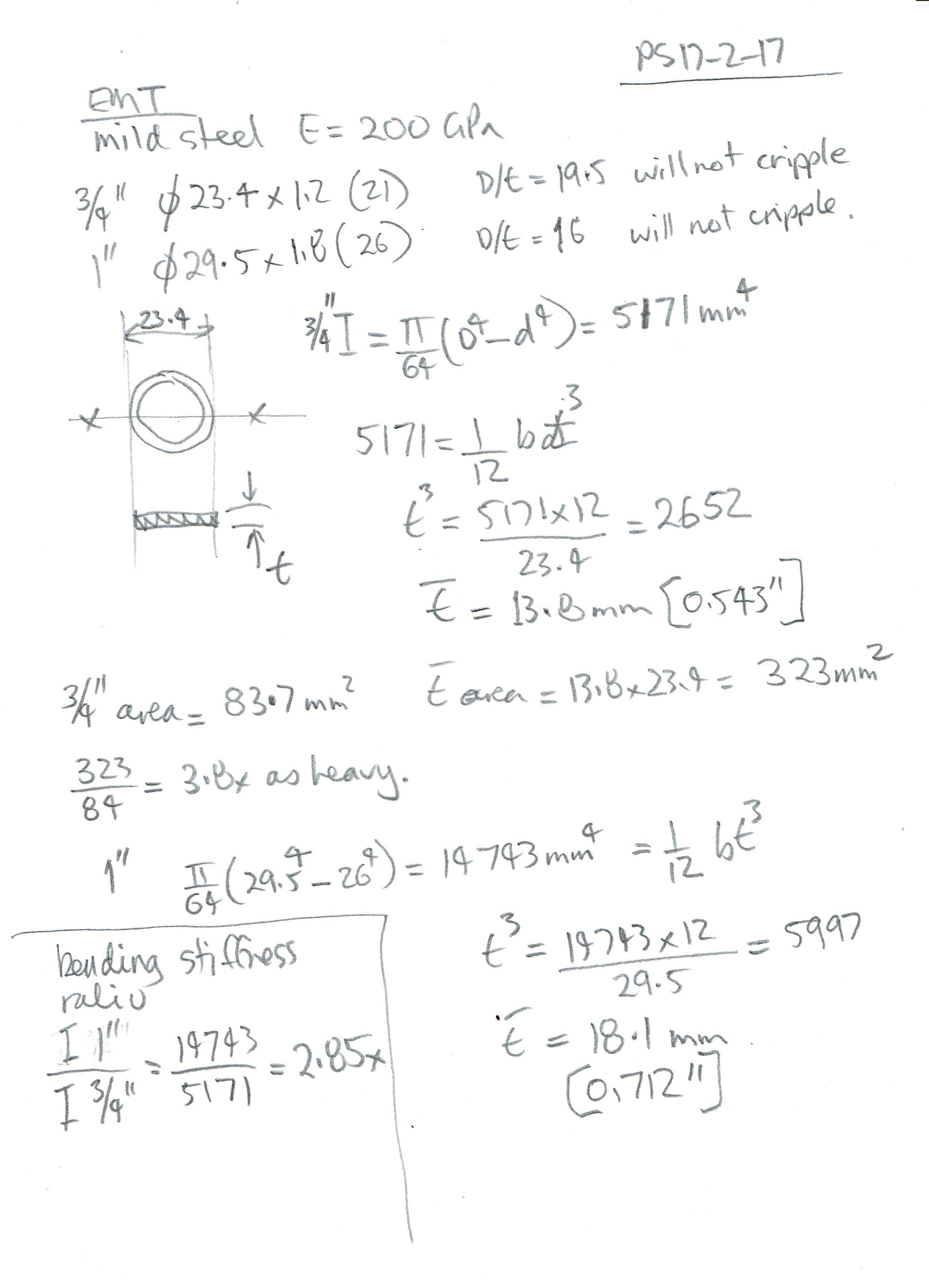
Hi MRU - The Euler load of the strut is not the defining failure mode. The dome "surface" is behaving as a continuum and it moves globally and locally. I will look at the models and try to image the effect. It is acting as a membrane and is just like a single skin balloon (with no internal pressure) So if you had a balloon and pushed your finger into it this is what the domes are doing (nearly). I suggest you download the S7 veiwer and have a look at the models. There's a lot of info in what I have provided before we make new models. I don't think its fair to compare different radii domes. One way to look at it is that if we smear the material into a skin and figure out its equivalent thickness. This gives us the rigidity of the skin. The more rigid the skin at the same areal weight the better the dome will perform. eg like a thin plastic dome vs an aluminium dome. PeterThe more elements you have the "flatter" the local geometry is and the easier it is for the dome to snap through (oil-can then start turning inside out) In the case of a wind load (uplift) the dome is already on the load side so its easy to elongate the dome and the girth becomes unstable. The dome designer tries to add more elements so they can use smaller struts but this reduces the thru thickness stiffness so you end up under designed if you use eulers as the guide. So we need another way to determine the "ideal" skin stiffness to size our optimum dome. Have to think about that one...The 1" tube is 2.85x stiffer in bending then the 3/4" tube (see calcs attached) This is why the 1" does better. If you smear the tube to a single thickness the 1" is 0.712" thick and the 3/4" is 0.54" thick. Round tubes have been used historically because they are easy to get and they are easy to analyse. If I wanted to use rectangles in the FE model I'd have to figure a way to align the axis to the centre of the dome a bit hard with over a 1000 struts... If you really want to optimise you need to think about I beams or rectangular sections that improve the through thickness stiffness but decrease the inplane thickness/stiffness. Because the inplane geometry is very stiff (triangulated) we do not need material in-plane we need it thru thickness. This is sometimes called the short transverse direction. Peter
On Fri, Feb 17, 2017 at 7:40 AM, TaffGoch <taff...@gmail.com> wrote:
GerryGood to hear that the plugin works smoothly. (Actually, knowing the internal structure of a DXF file, I would not expect such a plugin to be too complex or difficult to code.)For SketchUp users, here are a couple of other plugins you might want to try:(I am certain that there are others that can also be found online.)-Taff
--
--
You received this message because you are subscribed to the "Geodesic Help" Google Group
--
To unsubscribe from this group, send email to GeodesicHelp...@googlegroups.com
--
To post to this group, send email to geodes...@googlegroups.com
--
For more options, visit http://groups.google.com/group/geodesichelp?hl=en
---
You received this message because you are subscribed to a topic in the Google Groups "Geodesic Help Group" group.
To unsubscribe from this topic, visit https://groups.google.com/d/topic/geodesichelp/7cHKrCYexgM/unsubscribe.
To unsubscribe from this group and all its topics, send an email to geodesichelp...@googlegroups.com.
Peter Schwarzel
Peter Schwarzel
Peter Schwarzel
mru6...@gmail.com
Peter Schwarzel
--
--
You received this message because you are subscribed to the "Geodesic Help" Google Group
--
To unsubscribe from this group, send email to GeodesicHelp+unsubscribe@googlegroups.com
--
To post to this group, send email to geodes...@googlegroups.com
--
For more options, visit http://groups.google.com/group/geodesichelp?hl=en
---
You received this message because you are subscribed to a topic in the Google Groups "Geodesic Help Group" group.
To unsubscribe from this topic, visit https://groups.google.com/d/topic/geodesichelp/7cHKrCYexgM/unsubscribe.
To unsubscribe from this group and all its topics, send an email to geodesichelp+unsubscribe@googlegroups.com.
Peter Schwarzel
Peter Schwarzel
Bryan L
Hi Peter, thx for all your effort.
I wonder if the pinned analysis is necessary?
Although there is the odd hub / strut design with threaded rod, even they have some sort of lock nut or just wound in tight. So in the main, the struts aren't free to spin.
That's my understanding of the difference between the pinned and fixed analysis. Correct me if I am wrong...
--
--
You received this message because you are subscribed to the "Geodesic Help" Google Group
--
To unsubscribe from this group, send email to GeodesicHelp+unsubscribe@googlegroups.com
--
To post to this group, send email to geodes...@googlegroups.com
--
For more options, visit http://groups.google.com/group/geodesichelp?hl=en
---
You received this message because you are subscribed to the Google Groups "Geodesic Help Group" group.
To unsubscribe from this group and stop receiving emails from it, send an email to geodesichelp+unsubscribe@googlegroups.com.
Peter Schwarzel
You received this message because you are subscribed to a topic in the Google Groups "Geodesic Help Group" group.
To unsubscribe from this topic, visit https://groups.google.com/d/topic/geodesichelp/7cHKrCYexgM/unsubscribe.
To unsubscribe from this group and all its topics, send an email to geodesichelp+unsubscribe@googlegroups.com.
Bryan L
Yep understand. My reading of Euler buckling / critical load (Wikipedia) wrt end fixing didn't include the case of tubes squashed at the ends, drilled for a bolt and bent to the vertex tangent (the simplest form of hub). The strut can't spin on its axis, but can rotate around the bolt. Perhaps a unique case?
Peter Schwarzel
Peter Schwarzel
--
--
You received this message because you are subscribed to the "Geodesic Help" Google Group
--
To unsubscribe from this group, send email to GeodesicHelp+unsubscribe@googlegroups.com
--
To post to this group, send email to geodes...@googlegroups.com
--
For more options, visit http://groups.google.com/group/geodesichelp?hl=en
---
mru6...@gmail.com
My budget is between $1000-$2000 (1304.80 - 2609.60 AU dollars) for the frame. I'm looking to invest in materials and design that will provide the most structurally sound 40 foot (12m) diameter --or possibly less-- dome design for the cost. I've been focusing most of my time into researching in order to fulfill that standard.
My plan after creating the frame is to cover the dome with a fiberglass mesh and then cast a thin concrete shell into this. What I've found so far is to use an acrylic/latex additive and/or fiberglass strands for reinforcement, diminishing any potential failures due to the concrete cracking.
After looking into Robert Clark's idea I'm in agreement with you. This might likely be a better investment and I would seriously consider going this route. But it would also require skills and tools that I don't believe I have access to currently. Though I'm still open to it if it becomes something within my means.
As far as the shape of the strut goes, what design would be recommended. Round vs. square vs. rectangle…
I will most likely be mashing ends and bolting since I have yet to encounter a hub design that's as easy and reliable to fashion.
Aluminum tubing is still a strong option for me at this point. The major disadvantage is that aluminum is chemically reactive. This could be a problem if a thin concrete shell were applied to the dome. Not sure how it will fair with the steel bolts or the high alkalinity of cement. Other than aluminum, I see steel as the only other likely candidate... maybe thin-wall titanium is a possibility even.
Peter Schwarzel
--
mru6...@gmail.com
To unsubscribe from this group, send email to GeodesicHelp...@googlegroups.com
--
To post to this group, send email to geodes...@googlegroups.com
--
For more options, visit http://groups.google.com/group/geodesichelp?hl=en
---
You received this message because you are subscribed to a topic in the Google Groups "Geodesic Help Group" group.
To unsubscribe from this topic, visit https://groups.google.com/d/topic/geodesichelp/7cHKrCYexgM/unsubscribe.
To unsubscribe from this group and all its topics, send an email to geodesichelp...@googlegroups.com.
Peter Schwarzel
To unsubscribe from this group, send email to GeodesicHelp+unsubscribe@googlegroups.com
--
To post to this group, send email to geodes...@googlegroups.com
--
For more options, visit http://groups.google.com/group/geodesichelp?hl=en
---
You received this message because you are subscribed to a topic in the Google Groups "Geodesic Help Group" group.
To unsubscribe from this topic, visit https://groups.google.com/d/topic/geodesichelp/7cHKrCYexgM/unsubscribe.
To unsubscribe from this group and all its topics, send an email to geodesichelp+unsubscribe@googlegroups.com.

Dick Fischbeck
Peter Schwarzel

Ashok Mathur
Ashok
You received this message because you are subscribed to the Google Groups "Geodesic Help Group" group.
To unsubscribe from this group and stop receiving emails from it, send an email to geodesichelp+unsubscribe@googlegroups.com.
Ashok Mathur
I shall soon post a note giving all the details and the arguments in a more cogent way.
Ashok
You received this message because you are subscribed to the Google Groups "Geodesic Help Group" group.
To unsubscribe from this group and stop receiving emails from it, send an email to geodesichelp+unsubscribe@googlegroups.com.
mru6...@gmail.com
Peter Schwarzel
To unsubscribe from this group, send email to GeodesicHelp+unsubscribe@googlegroups.com
--
To post to this group, send email to geodes...@googlegroups.com
--
For more options, visit http://groups.google.com/group/geodesichelp?hl=en
---
You received this message because you are subscribed to a topic in the Google Groups "Geodesic Help Group" group.
To unsubscribe from this topic, visit https://groups.google.com/d/topic/geodesichelp/7cHKrCYexgM/unsubscribe.
To unsubscribe from this group and all its topics, send an email to geodesichelp+unsubscribe@googlegroups.com.
mru6...@gmail.com
Peter Schwarzel
To unsubscribe from this group, send email to GeodesicHelp+unsubscribe@googlegroups.com
--
To post to this group, send email to geodes...@googlegroups.com
--
For more options, visit http://groups.google.com/group/geodesichelp?hl=en
---
You received this message because you are subscribed to a topic in the Google Groups "Geodesic Help Group" group.
To unsubscribe from this topic, visit https://groups.google.com/d/topic/geodesichelp/7cHKrCYexgM/unsubscribe.
To unsubscribe from this group and all its topics, send an email to geodesichelp+unsubscribe@googlegroups.com.
mru6...@gmail.com
Peter Schwarzel
To unsubscribe from this group, send email to GeodesicHelp+unsubscribe@googlegroups.com
--
To post to this group, send email to geodes...@googlegroups.com
--
For more options, visit http://groups.google.com/group/geodesichelp?hl=en
---
You received this message because you are subscribed to a topic in the Google Groups "Geodesic Help Group" group.
To unsubscribe from this topic, visit https://groups.google.com/d/topic/geodesichelp/7cHKrCYexgM/unsubscribe.
To unsubscribe from this group and all its topics, send an email to geodesichelp+unsubscribe@googlegroups.com.
Ashok Mathur
Dear Peter
The case for studying the six strut tensegrity now spans over many pages and with its appendices is over 10 pages in length.
It would be impolite for me to thrust it down the throat of all the readers of this wonderful group.
So it is attached as a text file to this email.
In the note I have written that your results are attached but for this group that already has access to them, I have not attached your results.
I have embedded as an excel sheet the calculation of coordinates of the six strut ends. The calculations are enclosed for a unit length of the strut and 10 unit lengths of the struts.
I have made a drawing in Geo Gebra that is able to export it as eps file and png file.
I can send the eps file if you can convert that into a dxf file. But overall the geometry of the six strut tensegrity s so simple that you will find it much simpler to draw it fresh in a CAD program.
In the note I have not said anything about the material of the six struts and 24 tendons. This is because I want you to be free to use the materials you have at hand to first calculate the strength and then build the six strut tensegrity and then compare the two results.
Any tube of about half inch radius of mild steel will do for struts whose lengths could be 12 inches. The 24 tendons of 0.612 times strut length could be fabricated from either 16 gauge GI wire or the thinner 18 gauge GI wire.
I end with a direct quote from Hugh Kenner that I discovered re-reading him in connection with this debate.
"It follows that calculations pertaining to such a system, taking into account the known characteristics of the materials but presuming the usual methods of assembling them, are certain to be wrong."
Regards
Ashok
Ashok
You received this message because you are subscribed to the Google Groups "Geodesic Help Group" group.
To unsubscribe from this group and stop receiving emails from it, send an email to geodesichelp+unsubscribe@googlegroups.com.