
Bruno Taut's "The Glass Pavilion" 1914

John Hurt


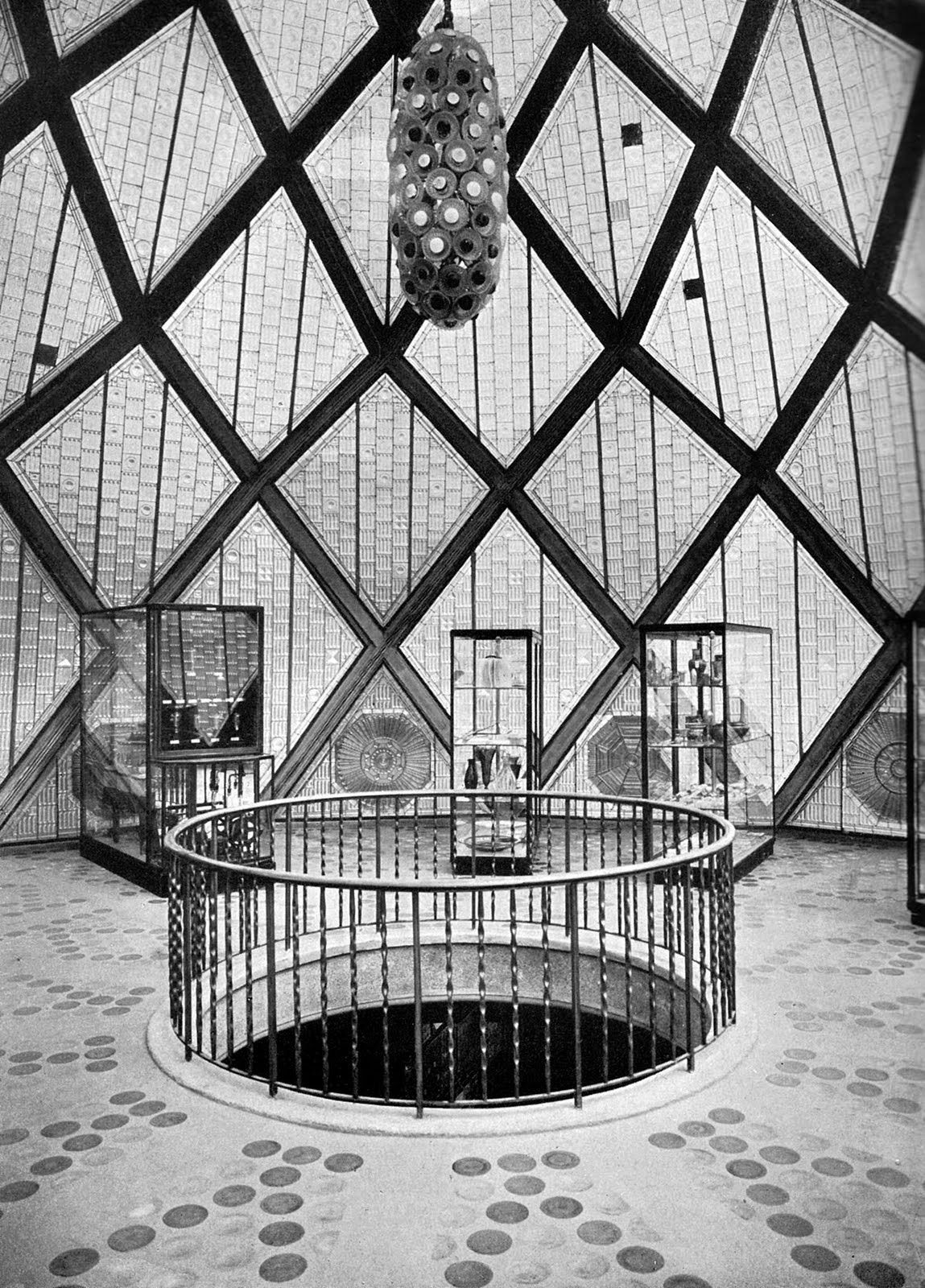

The Glass Pavilion, built in 1914 by Bruno Taut, was a prismatic
glass dome structure at the Cologne Deutscher Werkbund Exhibition.
The structure was a brightly colored landmark at the exhibition, and
was constructed using concrete and glass.The concrete structure had
inlaid colored glass plates on the facade that acted as mirrors.Taut
described his little temple of beauty as "...reflections of
light whose colors began at the base with a dark blue and rose up
through moss green and golden yellow to culminate at the top in a
luminous pale yellow."Taut's Glass Pavilion is his best known
single building achievement. He built it for the association of the
German glass industry specifically for the 1914 exhibition. They
financed the structure that was considered a house of art. The
structure was made at the time when expressionism stood highest in
Germany. There are only black and white photographs known of the
building that were taken in 1914.The building was destroyed soon
after the exhibition since it was an exhibition building only and not
built for practical use. The Glass Pavilion was a pineapple-shaped
multi-faceted polygonal designed rhombic structure. It was a
fourteen-sided base constructed of thick glass bricks used on the
exterior walls devoid of rectangles. Taut's Glass Pavilion was the
first building of glass bricks of importance.
There were
glass-treaded metal staircases inside that led to the upper
projection room that showed a kaleidoscope of colors. Between the
staircases was a seven-tiered cascading waterfall with underwater
lighting. The interior had prisms producing colored rays from the
outside sunlight. The floor-to-ceiling colored glass walls were
mosaic. All this had the effect of a large crystal producing a large
variety of colors. The frieze of the Glass Pavilion was written with
aphoristic poems of glass done by the anarcho-socialist writer Paul
Scheerbart.
Without a glass palace, life is a conviction.
"Paul Scheerbart in 1914 wrote a book called Glasarchitektur
("Architecture in glass") and in turn dedicated it to
Taut.Taut in 1914 founded a magazine called Frühlicht ("Dawn's
Light") for his Expressionist circle of followers. It focused on
the iconography of glass which he drew from which is represented in
his Glass Pavilion. This philosophy can be traced back to accounts of
Solomon's Temple. An early drawing of the Glass Pavilion by Taut says
he made it in the spirit of a Gothic cathedral.
