
Trump tied migrant entries and fentanyl to tariffs. Here are the facts. WAPO

molly...@gmail.com
Neither his claim that border crossings constitute an unchecked “invasion” nor his depiction of drugs pouring across an “open” and unguarded border has any basis in federal data.
Donald Trump’s claim that illegal border crossings are out of control — which was among the reasons he cited for the tariffs he said Monday he plans to enact against Mexico, Canada and China — is contradicted by U.S. Customs and Border Protection data showing lower levels of crossings this fall than during the final months of Trump’s first term.
The president-elect’s Monday-evening announcement tied together two of his top campaign pledges — to slash immigration and impose high tariffs on U.S. trading partners — and he threatened that the tariffs would be lifted only when drugs and immigrants are no longer illegally entering the United States.
Beyond the expected price hikes for American consumers, the tariffs could have massive economic effects on the targeted countries. But whether they apply the type of political pressure on Mexican and Canadian leaders that Trump hopes for — and whether those leaders can “easily solve” the complex problems, as Trump claimed — is far less certain. Neither his claim that border crossings constitute an unchecked “invasion” nor his depiction of drugs pouring across an “open” and unguarded border has any basis in federal data.

Illegal crossings averaged 2 million per year during President Joe Biden’s first three years in office, the highest levels ever recorded. But the Mexican government launched a militarized crackdown this year at the United States’ behest, arresting record numbers of people traveling to the U.S. border. That enforcement blitz and the Biden administration’s new restrictions on migrants’ access to the U.S. asylum system have led crossings to decrease by about 75 percent over the past 10 months, CBP data shows.
U.S. agents tallied 56,530 arrests along the southern border in October, according to the most recent CBP data, compared with 69,032 in October 2020, near the end of Trump’s first term.
The majority of illegal crossings are over the southern border. Some Republicans have raised alarms about illegal crossings from Canada, which rose to 23,721 during the 2024 fiscal year that ended Sept. 30. That is a record number for CBP, but it works out to an average of about 65 per day along the entire 5,525-mile border, the longest international boundary in the world.
However, illegal crossings from Canada have also been declining, and last month U.S. agents made 1,283 arrests along the northern border, or about 41 per day on average.
Trump-Vance transition spokesman Brian Hughes said Americans elected Trump “to seal the border and begin the largest domestic deportation operation in American history on day one.”
Trump’s claim that immigration to the United States is out of control — which he frequently frames in nativist language, inaccurately describing migrants as carrying out an “invasion” of the United States — was central to his presidential campaigns. He has routinely amplified falsehoods about immigrants, drawn on decades-old tropes to vilify them and distorted official federal statistics, successfully making immigration a top issue for many of his voters.
Trump said he plans to detain and deport millions of undocumented immigrants living in the United States and has indicated he could use the U.S. military to do so. Such an effort would probably have seismic consequences on the American economy and on industries including agriculture and construction, as well as on families who could be separated.
On the campaign trail, Trump also promised to slap foreign countries with high tariffs to encourage domestic manufacturing, targeting China in particular. Economists say such action could raise prices for American consumers, cause a global trade war and deal a major blow to European economies.
In his first term, Trump tested the strategy of using trade policy to address a different issue, threatening tariffs in 2019 to pressure the Mexican government to prevent Central American migrants from entering the United States. He never carried out the threat, saying after several days that Mexico had agreed to address the issue.
In a letter to Trump on Tuesday, Mexican President Claudia Sheinbaum warned against connecting immigration and the fentanyl problem to tariffs. She pointed to the Mexican policy that has decreased crossings and said Mexico will respond to tariffs in kind.
“President Trump, migration and drug consumption in the United States cannot be addressed through threats or tariffs. What is needed is cooperation and mutual understanding to tackle these significant challenges,” she wrote.
When it comes to fentanyl, the U.S. government has limited ability to know how much of the drug is coming into the United States from Mexico and Canada, but seizure data indicates that it is being smuggled in through official border crossings, not pouring over an unguarded border carried by people crossing illegally.
About 85 percent of fentanyl seizures occur at official border crossings, where the potent, compact drug is typically smuggled by pedestrian couriers or hidden inside cars and trucks. Most of the rest is confiscated by U.S. agents at Border Patrol highway checkpoints, not in the backpacks of migrants entering the country.
Fentanyl has produced the deadliest drug epidemic in U.S. history, but the latest public health data indicates a drop in fatal overdoses. The U.S. Sentencing Commission found that American citizens accounted for 86 percent of fentanyl trafficking convictions during fiscal 2023.
The Biden administration has invested billions of dollars into sophisticated scanning equipment in recent years, increasing the percentage of vehicles that can be screened for contraband. The amount of fentanyl seized at the U.S. border declined during fiscal 2024 to 21,100 pounds, down from a record 26,700 pounds the previous year. Whether the decline is the result of less-effective enforcement or a decline in smuggling attempts remains a matter of debate among experts.
In Canada, authorities have busted several illegal fentanyl labs in recent years, but so far there is little evidence that traffickers are smuggling the drug across the northern border in significant quantities. During the recently ended fiscal year, CPB confiscated 43 pounds of fentanyl along the northern border, 0.2 percent of the volume seized along the U.S.-Mexico boundary.
David J. Lynch contributed to this report.
Mexican president warns Trump tariffs will kill jobs, hints at retaliation
- Summary
- Companies
- Mexico leader says tariffs put 'our common businesses at risk'
- Trump announced 25% tariffs on goods from Mexico, Canada
- Mexico is the top trade partner of US
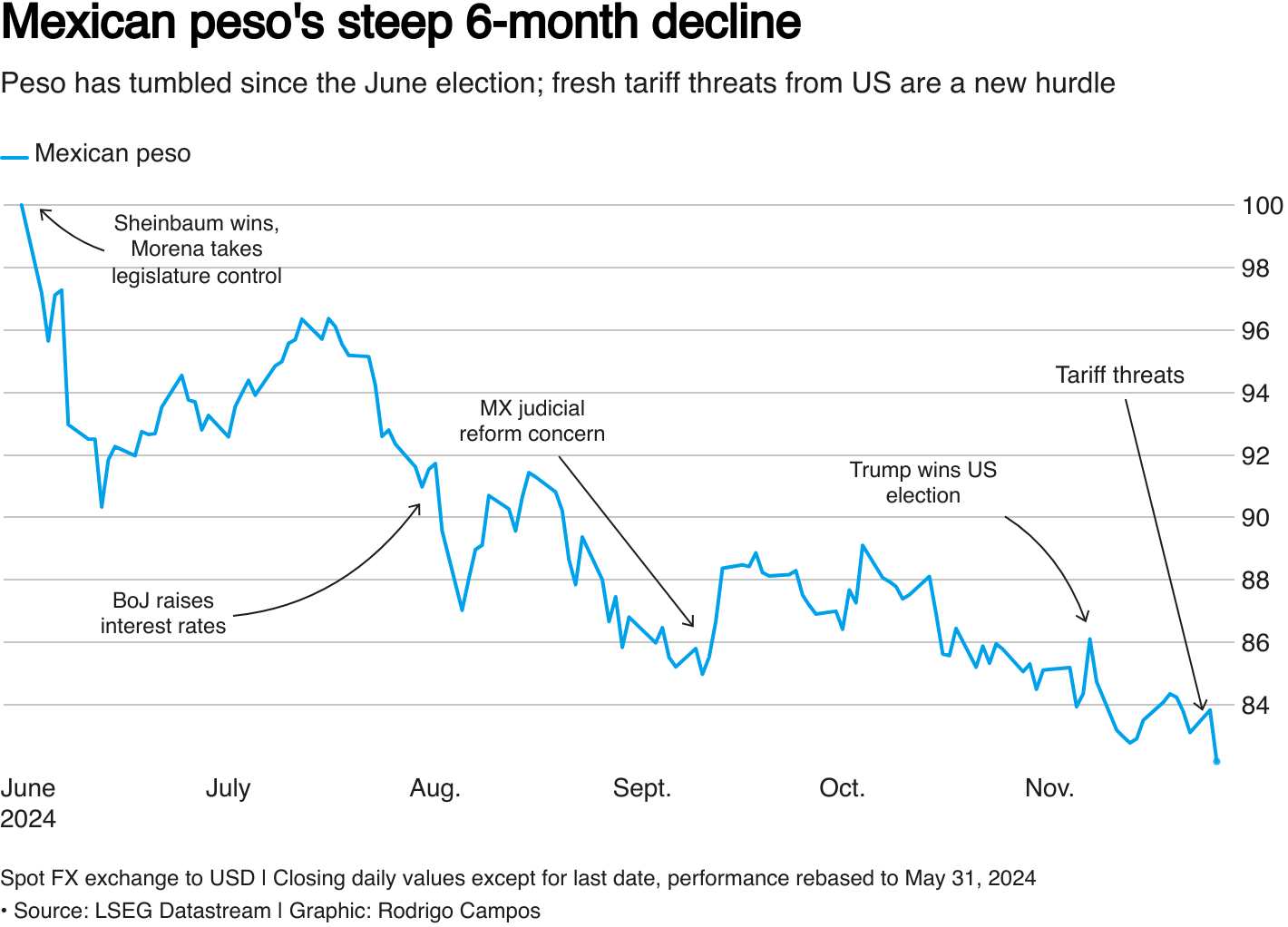
- Peso slides after Trump's threat

The Reuters Daily Briefing newsletter provides all the news you need to start your day. Sign up here.
Reporting by Sarah Morland, Brendan O'Boyle, Raul Cortes, Natalia Siniawski, Rodrigo Campos and Kylie Madry; Editing by Alistair Bell